

Tenochtitlan was the capital of the Aztec Empire. (We call them Aztecs after the legendary land from which they said they had come; they called themselves the Mexica, so as you can see, all of Mexico is named for their empire.)
The city was built out in a shallow, semi-salt and semi-fresh lake, Lake Texcoco. It was reached by large stone causeways which had forts guarding them and had gaps in them where bridges could be lifted to repel invaders. The city itself was honeycombed with canals. It had four residential quarters and a large central plaza where all the main temples were. Buildings tended to have flat roofs.
When I read Cortez and the Aztec Conquest a while back, I found out that, as you might expect, the geography of Tenochtitlan played a huge role in all that went down there. The Spanish were first welcomed (uneasily) into the city. They later got trapped there and had to fight their way out, with catastrophic casualties, when things went wrong. When they returned, fortified with Tlaxcala Indians and additional Spaniards, they spent months building a fleet of boats and then capturing the towns that ringed Lake Texcoco to use as bases. Even then, they had to besiege the city for 50 days. Even then, the construction of the city was so useful for street fighting that the Spaniards and Tlaxcalans eventually had to literally tear down the buildings in order to take the city.
It’s funny how a person’s most eccentric interests sometimes come in useful. This year, I was given the task of teaching the period of about 1400 – 1800 A.D. to young minds. When we came to the part about Cortez, I thought it would be useful to have a model of the city. I thought I could use model-train materials to build it. For sources on how the city layout looked, I drew on Cortez and the Aztec Conquest by Irwin R. Blacker, The Aztecs by Brian M. Fagan, and maps I found on Pinterest. There is not perfect agreement among all sources about the exact location of the different villages and causeways, and there were far more settlements in the hills surrounding the city than I will be able to show. I also had to leave out some causeways for the sake of simplicity.
So, here goes:
I took a wooden display board (actually meant to bear an inspirational slogan) and painted in Lake Texcoco.
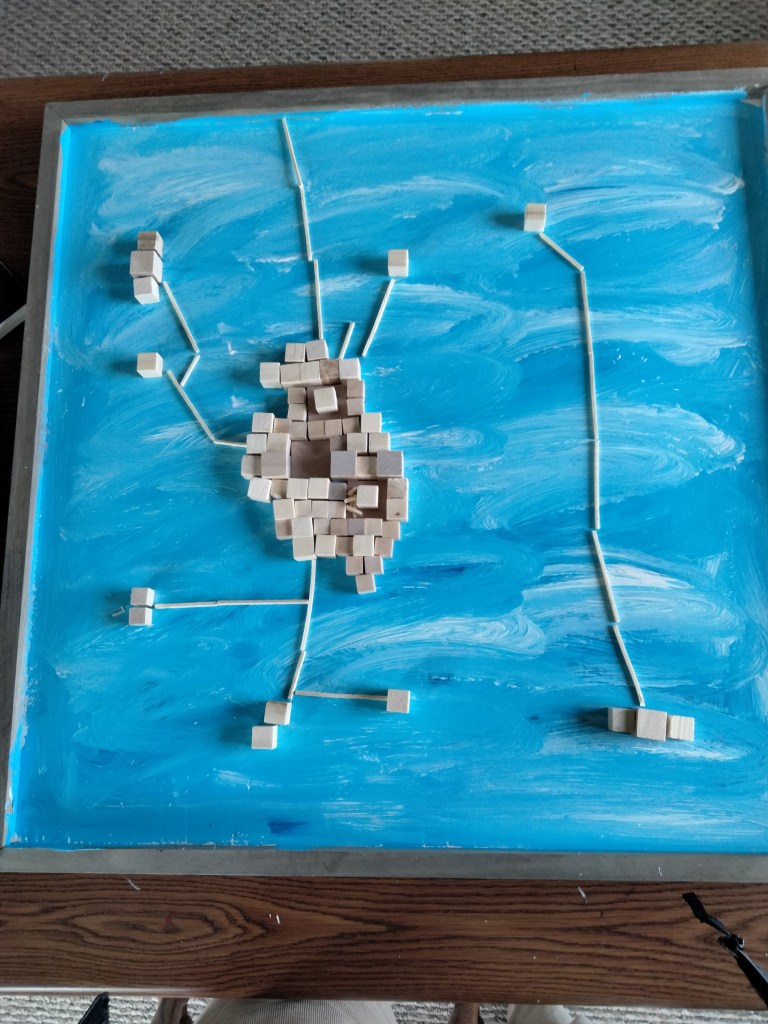
Then I set out the variously-sized wooden blocks, slabs, and matchsticks I had purchased at the hobby store, planning where the city, towns, and causeways would go.

Based on this plan, I was then able to add the “land.” The first step was crumbled packing paper, masking taped down.

Then, paper-mache strips that can be dipped in water and smoothed down to make the hills.
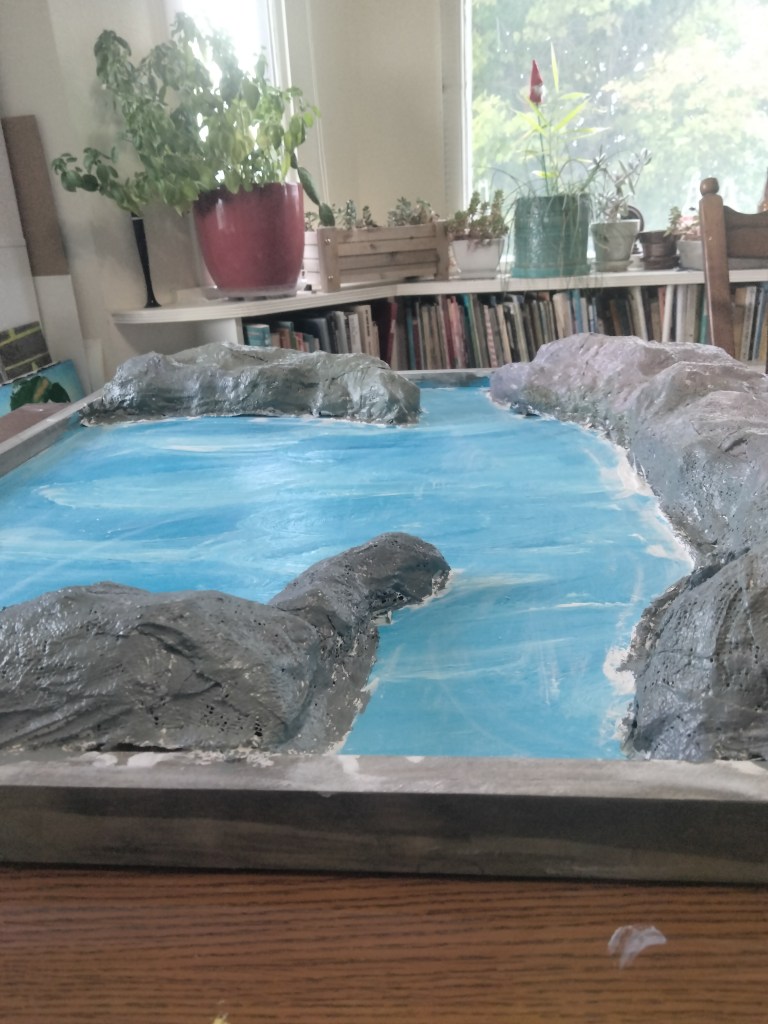
I then painted the hills. I had to mix colors several times, so some of the hills are more greenish and some more greyish. That’s not a huge problem because I have “jungle” greenery to add, and also, the area is somewhat arid.
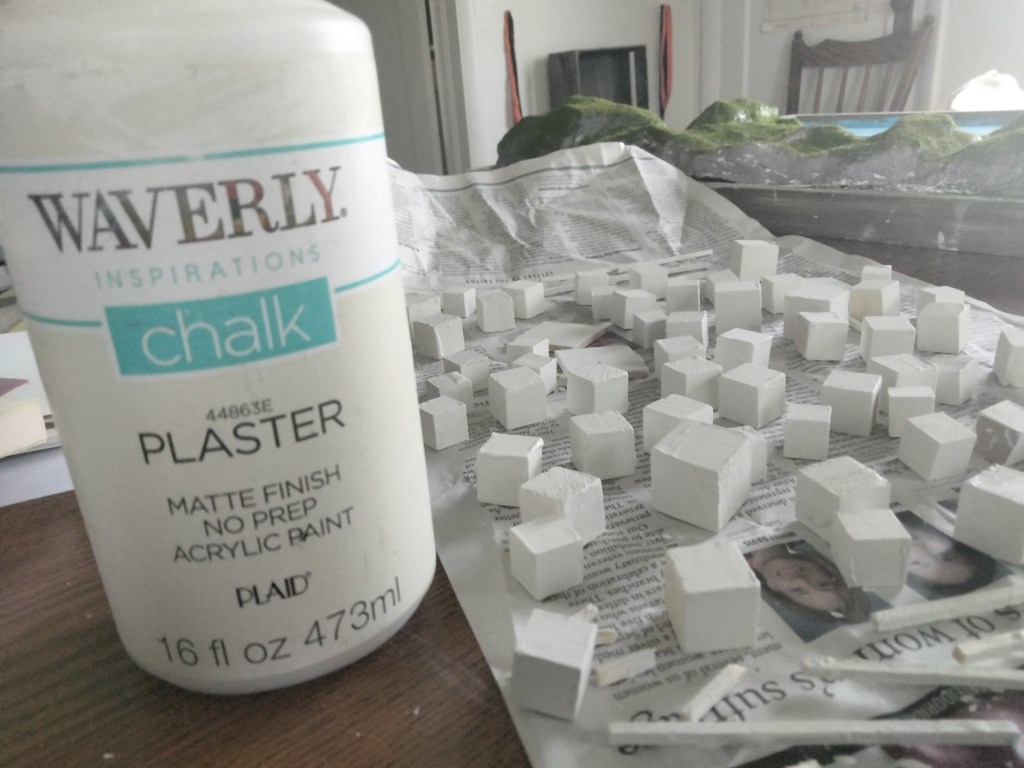
Meanwhile, I painted the blocks white. Actually, the city was probably very colorful, but I am going for a basic look. White represents stone. If desired, I can add color to the temple area over the following years.

Then it was time for the fun part: the hobby store sells “greenery” in a shaker can. I painted glue onto the hills and shook the greenery on. It sticks amazingly well. Let dry, then vacuum up the extra.

Now I placed the city and towns and glued them down, then added additional glue and greenery to make “islands.”
The city is actually two cities: Tenochtitlan, and Tlatelolco slightly to the north and west. I have given each city its own central plaza with a temple in it. The “temples” in my model are actually way too big relative to the size of the city, but this model is not meant to be perfectly to scale.
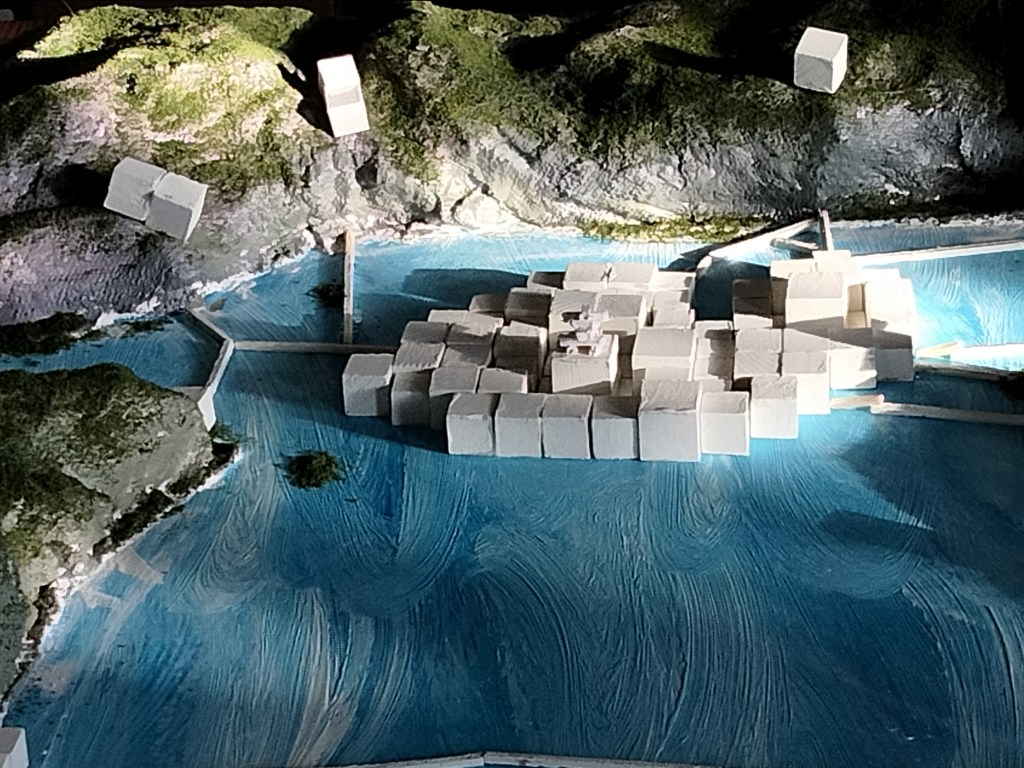
Final step: photograph in slanting sunlight.

Epic!

In days ahead, I plan to add a compass rose out in the lake and fancy title on the side, but for now, this ain’t bad.
 Out of Babel Books
Not bad, as in Amazing!
LikeLiked by 1 person
That’s amazing! And such a fascinating history – I feel like I should dive into that bit of history but I think it would be a long journey
LikeLiked by 1 person
Maybe the opportunity will come up some day. Right now, you are an expert in areas I’ve never dived into.
LikeLiked by 1 person
Pingback: Great Find at my Favorite Store – Out of Babel