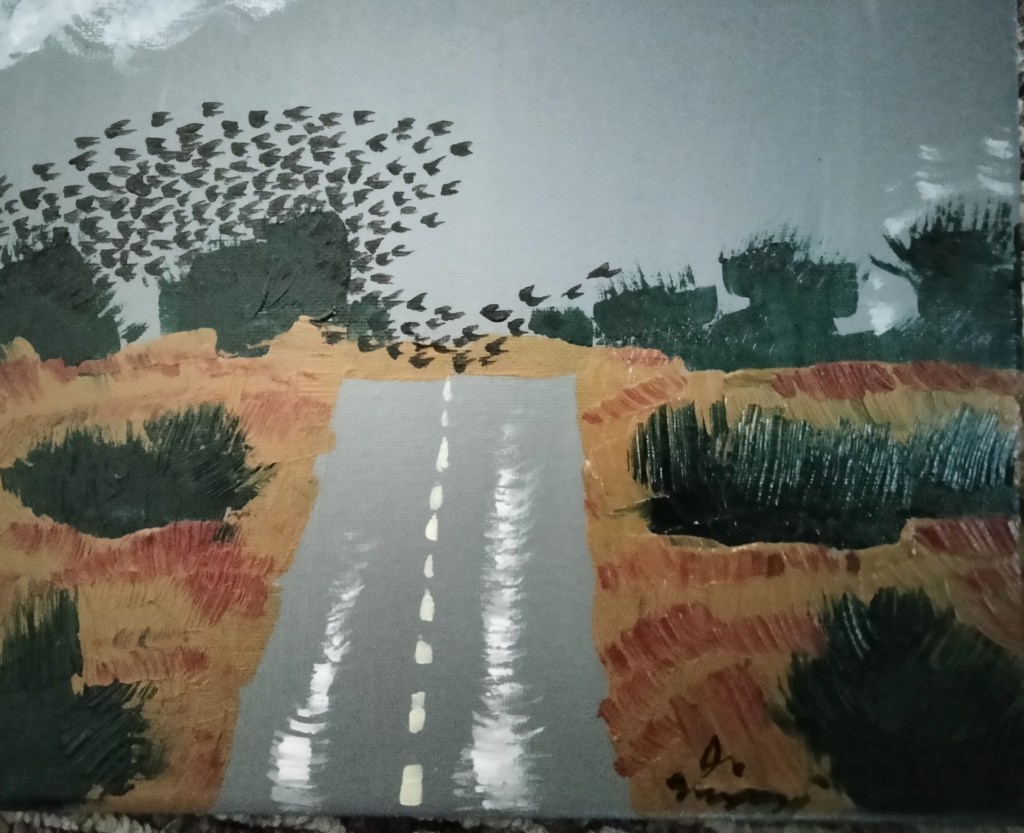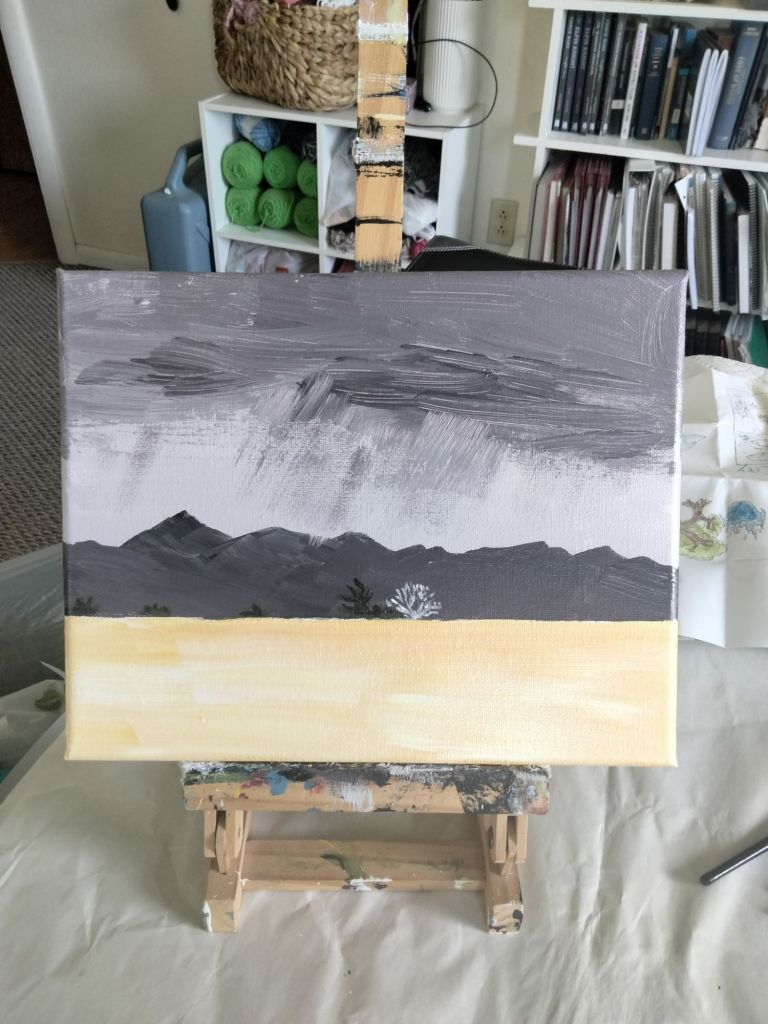
Tag: art
Sunshine Blogger Again
Just as the sun must come up every day, rain or shine, so I am cursed to plod forever through an endless treadmill of answering questions. The questions are ever the same, but on the plus side, my answers keep changing.
I wasn’t exactly “awarded” this tag, but I did see it on the blog of one Bookstooge, who closed his post with “You aren’t hardcore enough!”
I am so hardcore. But, as usual, Bookstooge, thanks for doing everything exactly like Puddleglum. Or Trumpkin.
Here’s the participation rules
- Display the award’s official logo somewhere on your blog
- Thank the person who nominated you
- Provide a link to your nominator’s blog
- Answer your nominator’s questions
- Nominate up to eleven bloggers
- Ask your nominees eleven questions
- Notify your nominees by commenting on their blogs
What’s your favorite book and why?
The Bible, because so many reasons, but among others, it’s got some really wild ancient history that you won’t find anywhere else. At least, you can find stuff elsewhere that’s sort of similar, but you won’t know which parts of it are true.
Can you share some obscure/unusual words you like to use when writing?
I like “interlocutor.” It means whoever the person in focus is speaking to. I also like “salient” and “equivocation.” But obviously, which fancy words are the most salient changes depending on the context of the writing.
When I’m writing narrative, I prefer to describe the action and people’s thoughts as simply as possible and let the actual events deliver the emotional impact.
Do you have pets (if yes, photos!)
Not anymore, sadly. Our last remaining rabbit passed just a few weeks ago. We (my son and I) hope to get another batch of chickens this summer, but standing between us and them is a large run-and-coop building project that, to me at the moment anyway, seems as intimidating as the Tower of Babel.
What brings you joy?
Beauty.
Landscapes, especially if I can paint them; beautiful folk clothing from around the world; beautiful items knitted or crocheted by myself or others; the simple, unforced beauty when your favorite mug is sitting on your favorite coaster and they match. The beauty of a plant: hens & chicks filling a planter, a Boston fern spilling towards the floor. Sunshine on my dining room walls. I love beautiful music, even though I’m not very gifted at it, which is no doubt a trial to the people around me.
I also love things that are beautiful even though they are ugly. “Brutalist” jewelry, that looks weathered, like it came through the apocalypse. Things that are painted, knitted, or sewn in unexpected colors, like browns and greys, or colors that you’d think would clash but then don’t. Stuff that looks worn or pieced together, like an old farm quilt. Well-told tragedies, like the recently reviewed story of Jason and Medea.
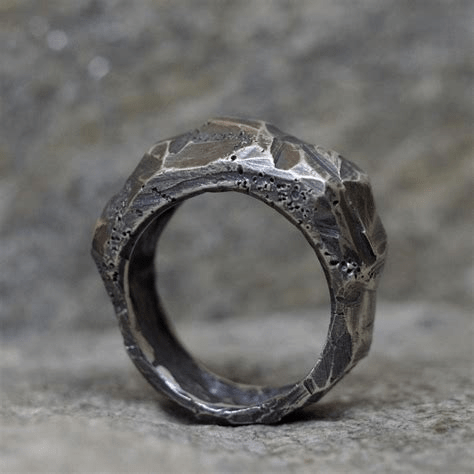
Here’s an example of a “brutalist” ring.
“All things counter, original, spare, strange;/Whatever is fickle, freckled (who knows how?)/With swift, slow; sweet, sour; adazzle, dim;/He fathers-forth whose beauty is past change/Praise Him.”
–Gerard Manley Hopkins
If there’s anything that can make you look forward to tomorrow, what would that be?
My husband and children.
Best vacation destination from your experience?
I have a whole bucket list of ancient sites I want to see, but that’s not what you’re asking about.
I have fond memories of a little cabin hut bungalow on a small island called Gili Air, off the coast of Lombok. Go out and snorkel in the morning, come back in the afternoon and sit on the porch and read. Look across the bay at sunset, and see the mountains of Bali looming out of the sea. Beach is not even my favorite setting, but boy that was one relaxing vacation.
Do you count steps?
What?
Favorite meal?
The last song you listened on repeat?
Hallelujah by Leonard Cohen.
I realize you all have been aware of this song for years, but I just heard it in its entirety a few months ago. Like probably every listener, I found it to be a stunning work of art and also kind of a puzzle, and I listened to it a couple of times in a row for several days until I felt I understood it. I’ll spare you my analysis, as I think volumes have already been written.
How many blogs do you have?
Just this one. I used to have a recipe blog and a book review blog, both on Blogger. I haven’t checked them in years and am not even sure if I could find them anymore.
But don’t forget to buy my books! And for goodness’ sake, please don’t return them. My publisher charges me when you do that. If you buy a hard copy and hate it, just burn it or send it to Goodwill or something.
What’s your favorite quote?
There are so many good ones, I can’t really pick a favorite. It goes in seasons with me. But for today, I’ll leave you with this one:
This is what the LORD says:
"Cursed is the one who trusts in man,/who depends on flesh for his strength/and whose heart turns away from the LORD./He will be like a bush in the wastelands;/he will not see prosperity when it comes./He will dwell in the parched places of the desert,/in a salt land where no one lives.
"But blessed is the man who trusts in the LORD,/whose confidence is in Him./He will be like a tree planted by the water/that sends out its roots by the stream./It does not fear when heat comes;/its leaves are always green./It has no worries in a year of drought/and never fails to bear fruit."
The heart is deceitful above all things/and beyond cure./Who can understand it?
Jeremiah 17:5 - 9
Now, my questions for you, Gentle Reader. These are inspired by our experience in grade school, where you were sure that you had to have a quick, permanent answer about your favorite color, animal, and favorite everything else ready to go. This is important! You never know when you might need to know this stuff! Answer with your first instinct and no cheating!
- What is your favorite brand of tractor?
- What is your favorite kind of cow?
- What is your favorite kind of chicken?
- Country or city?
- Ford or VW?
- Pickup truck or motor scooter?
- Star Wars or Star Trek?
- Beach or mountains?
- Sweet or savory?
- Sci-fi or fantasy?
- Favorite animal, domestic or wild, in your region or any other.
“Lichen” Necklace
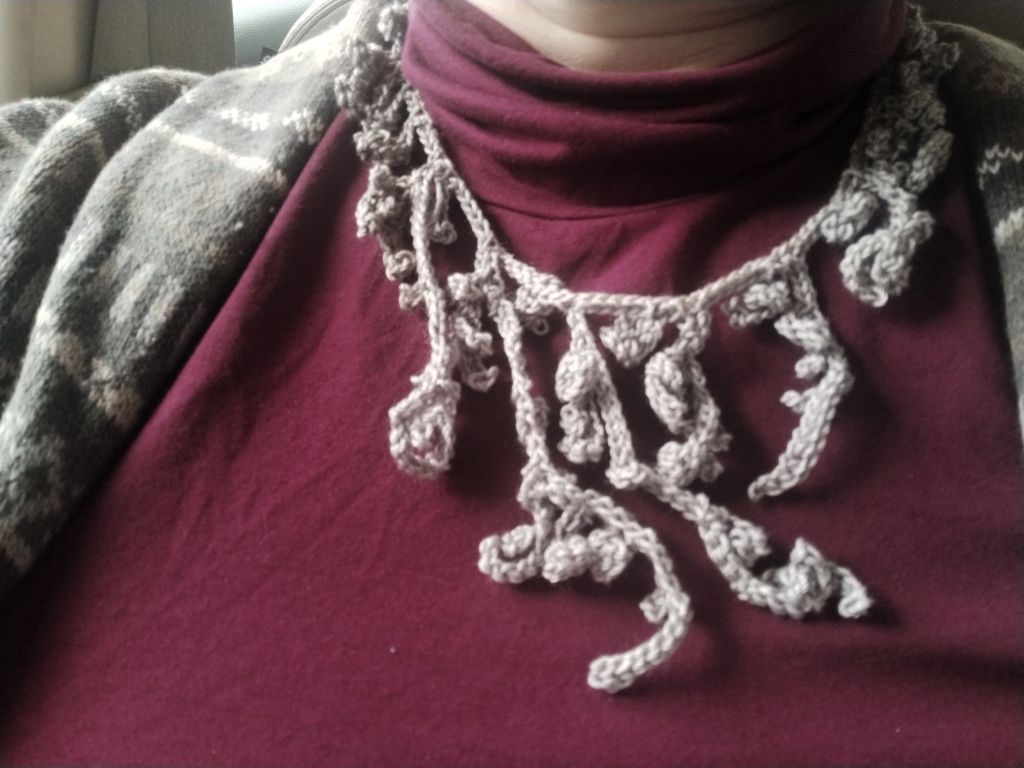
Crochet necklaces are good for the following reasons:
-light
-soft, don’t irritate skin
-less susceptible to damage by any skin ointments you might use
-fasten with a button, hair less likely to get caught than in a chain
-easy to make them look naturalistic
I found the pattern for this necklace in a screenshot on Pinterest. The caption was in Cyrillic, but luckily the few words on the image itself were in English. The photograph showed the necklace done in green with a tiny crochet hook, looking like moss. But I had on hand a merely small hook and some marbeled grey yarn that I thought would look passably like lichen.
I’m pleased with the result. Now that I know the basic principle, I figure I can freestyle this type of necklace on my own.
My crochet skills are still beginner level. I haven’t tried to do anything with flowers, for example. But this necklace just calls for chains, single crochet, and a little patience.
Postscript: Sometimes you make something, not knowing who it is for until it’s finished. I visited a recently bereaved friend after making this necklace. I gave it to her, she put it on, and it looked like it grew there. I guess it was for her all along.
Father Abraham
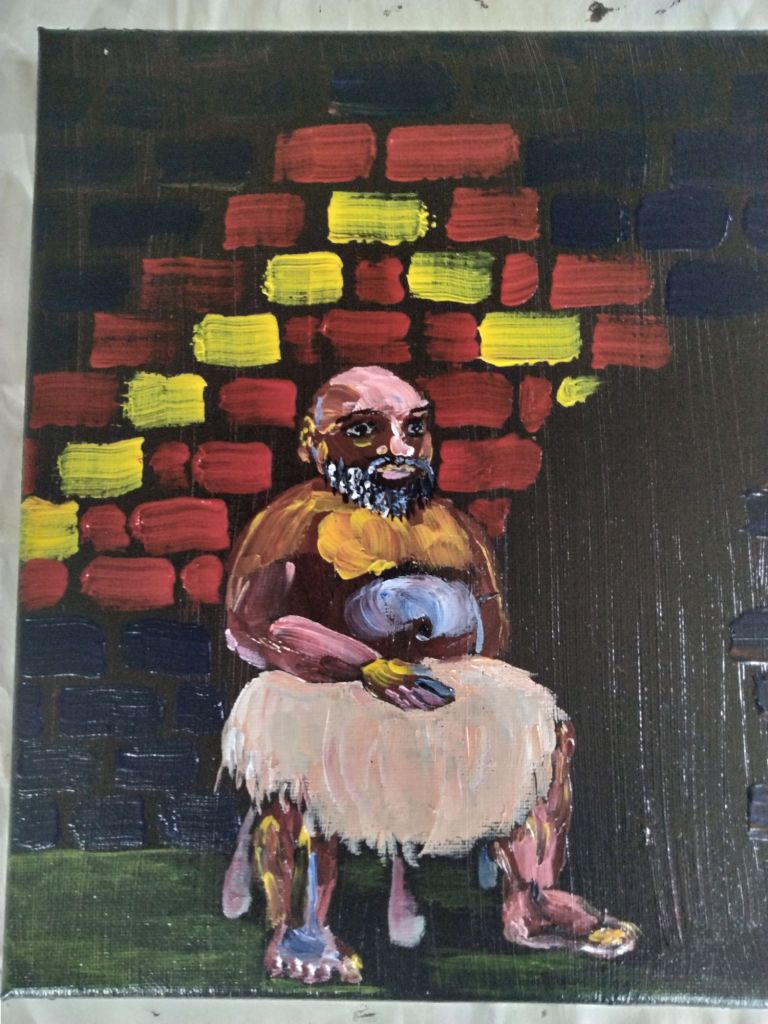
Before his family moved to Haran, Abraham lived in Ur, a Sumerian city. This painting imagines him looking like a member of the culture that he arose from.
Sumerians, the “black-headed ones,” wore skirts of leaves or grasses. After all, their environment was hot and humid, and air flow was important. I am sure that, after he went on the road as a nomadic pastoral warrior-patriarch, Abraham started wearing the woolen robes we are accustomed to seeing. Probably some armor as well, which we are not accustomed to seeing, but it would make a great painting too.
The Sumerians also portrayed themselves as wearing Southeast-Asian-style, cone-shaped hats, but this is a shot of Abraham indoors.
Yearlong Knitting Project
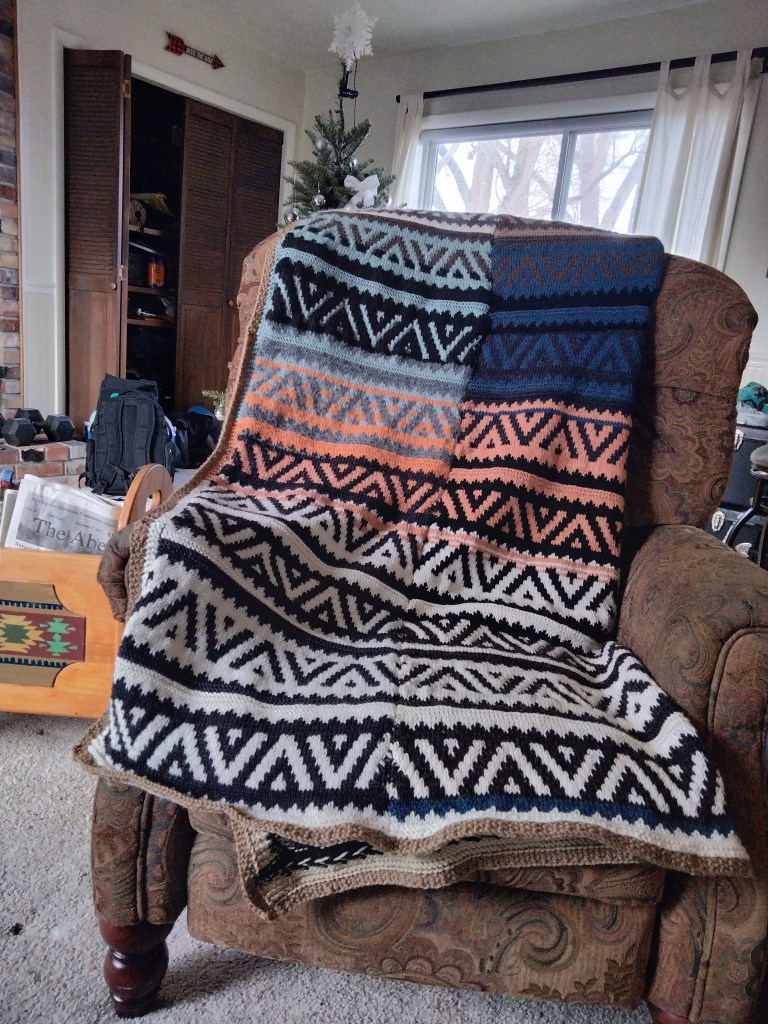
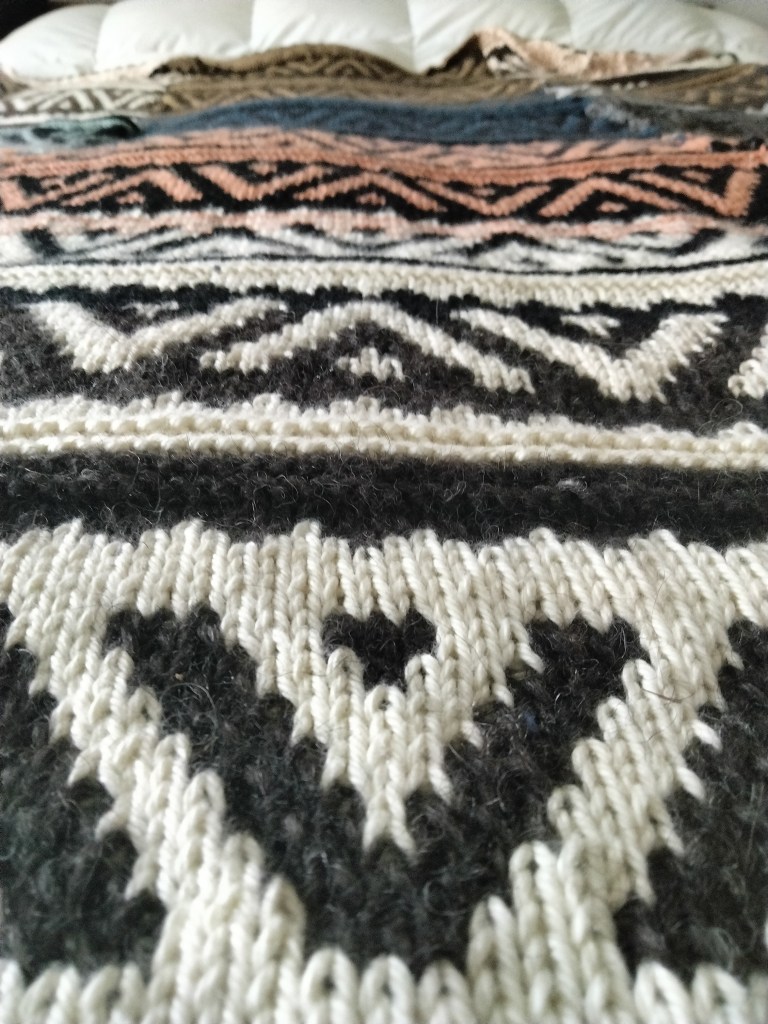
Behold! A so-called “Indian blanket” that it took me about a year to complete.
Real “Indian blankets,” of course, –at least, the Navajo kind– are woven, not knitted. But this type of pattern is very popular in the United States, and has been for more than a century. You find it on clothing, bedspreads, purses … and knitting patterns like this one. You see, when the Europeans conquered the American Indians, all groups immediately started both intermarrying and borrowing each other’s ideas.

As an aside, this type of pattern also sort of resembles some traditional weaving patterns in Indonesia. Because all folk art, when you get right down to it, looks sort of alike. Having been made by humans and that.
So about a year ago, I bought this pattern, called “Mohawk Valley,” from the Vintage Pattern Store on etsy. Then it was time to acquire the yarn. This blanket is a mix of different colors from my stash; high-quality wool and wool-blend yarns bought both online and at a specialty knitting store; and cheap cotton yarns in the appropriate colors, bought wherever I saw them on sale. So the color variations are my own. This pattern would look really good in just two colors. Perhaps, one day, I’ll do one with a bit more color discipline … if I live that long haha!
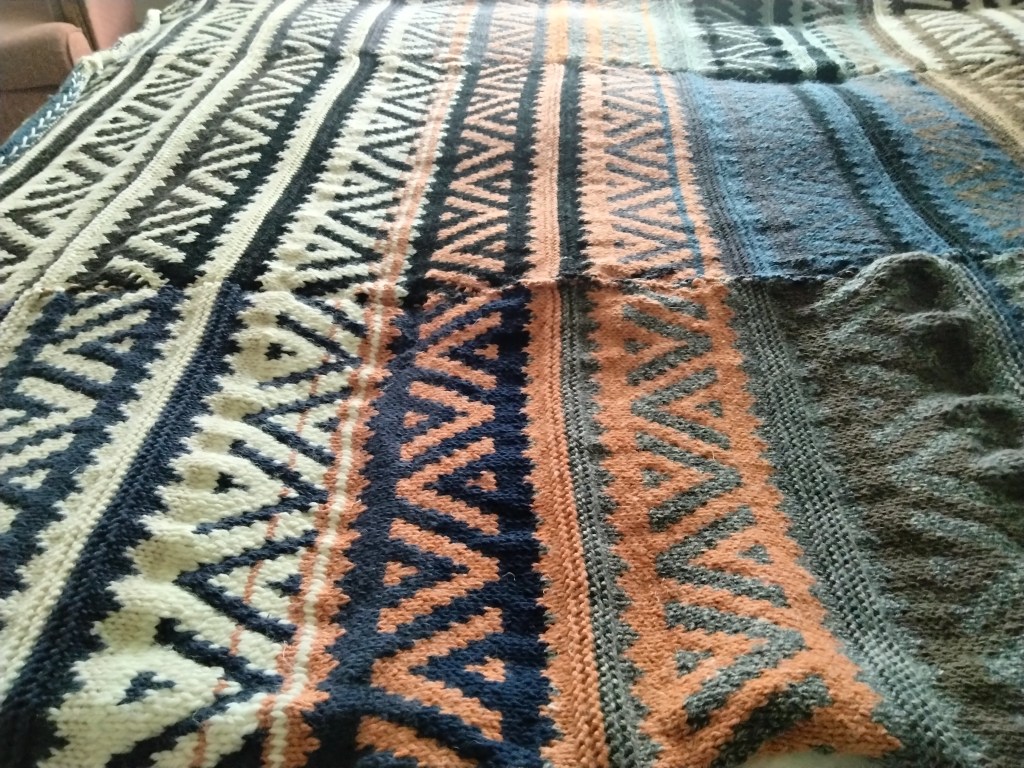
You knit it in three strips, then sew the strips together. I started Strip #1 with scraps, and then I tried to roughly echo the color changes that resulted, in subsequent strips. I even made a mistake on Strip #1, forgetting to add a garter-stitch border between iterations of the pattern, and I faithfully repeated this mistake on the other two strips so that the length would come out the same.
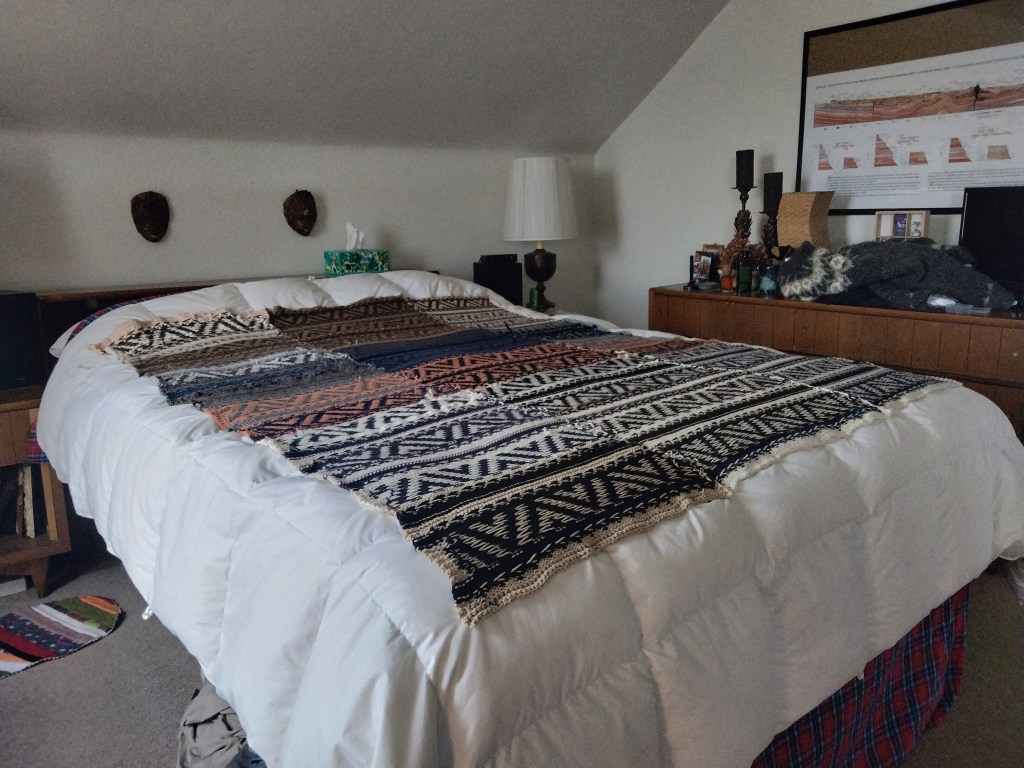
Here is the blanket being “blocked.” I pinned it wrong-side-up on my bedspread, misted it with water, and let it dry. After this, I added a border consisting of five rows of moss stitch, because the edge tended to roll.
Despite its flaws, this blanket is basically priceless. I knew it would take me about a year to complete it in time for the recipient’s birthday, and it did. Here’s another close-up.
The Money Plant
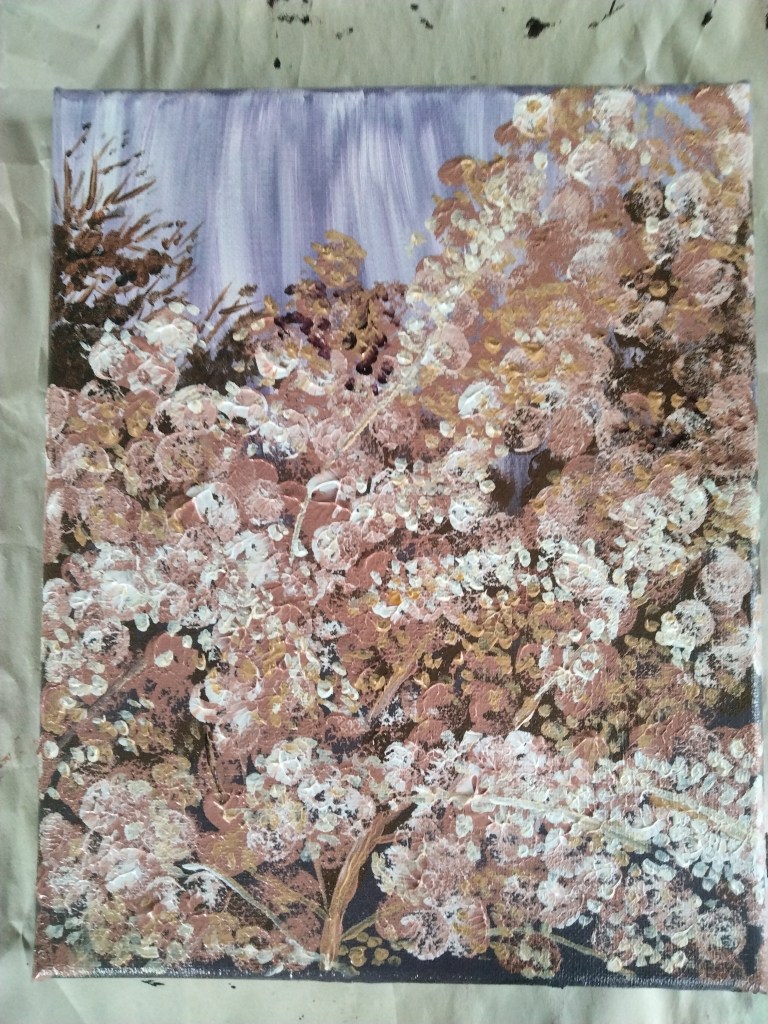
This is an 8×10 painting of a 5-foot weed near my school. It (the painting, not the weed) has already been claimed as a gift by a loved one.

Amusingly Misanthropic Quote on Etruscan Pottery
The most renowned of Etruria’s products is its pottery. Every museum abounds in it, setting the weary navigator of ceramic halls to wonder what unseen perfection exonerates these stores. Etruscan vases, when they are not clearly copies of Greek forms, are mediocre in design, crude in execution, barbarous in ornament. No other art has produced so many distortions of the human frame, so many hideous masks, uncouth animals, monstrous demons, and terrifying gods. … All in all, the robbers were justified who, when they rifled Etruscan tombs, left so much of the pottery.
–Caesar and Christ, by Will Durant, p. 9