
It has been 65 days since our last safety incident.It has been 23 days since our last safety incident.
–the marquee at my husband’s company, which shall remain unnamed
Tag: rants
Egyptian Red Hair

This is my second post about non-stereotypical hair. See my first one here.
If I were to ask you to draw an Ancient Egyptian, you would probably draw someone with gold, reddish, or dark skin, long dark eyes, and black hair. Red hair would probably not appear in your drawing. However, there has been a red-haired strain in Egyptian genetics apparently from time immemorial.
Ramses II, 90 years old when he died, was tall, thin, and by the time of his death he was stooped and had a tooth abscess. He also had red-gold hair. “Specialists who examined the strands under a microscope found that it had been dyed with henna and in all likelihood had been auburn in Ramses’ youth” (Time-Life, p. 153). Tall, thin, red-haired and hook-nosed, Ramses II does not match my mental picture of a typical Egyptian.
But he is not the only one. A number of red-haired Egyptian mummies have been found. Archaeologists used to assume that the hair was once dark and had been bleached out by the embalming process. But a recent study treated hair samples with the natron salts similar to those the Egyptians used, and found that the process did not change the color of the hair. Apparently these were actually redheads.
When I was taught Egyptian mythology in school, I was told that Seth, the villain of the story of Isis and Osiris, was red-haired. He was also Osiris’ brother. I found this intriguing, and it reminded me of the Semitic story of Jacob and Esau, who were twins one of whom was a dark-haired (?), “smooth” man, and one of whom was “hairy” and “red.”
Now I find out that Seth, as his legend later developed, was a trickster god, usually portrayed as a composite of different animals, with red hair or fur. Also, red was a symbolic color that could represent vitality or anger (no surprise there). So it’s possible that Seth was an entirely invented character and that his unusual hair color was picked to match his personality and symbolism. But, since this is an ancient origin myth, I can’t shake the possibility that there once was actually a founding pair of brothers, one of whom was dark-haired and one of whom was red. (Also, shades of the original Thor, a quick-tempered, red-haired, trickster god!)
If Red Hair is Native to Egypt, Does This Mean that Ancient Egyptians were Indo-Europeans?
No.
It just means that, as for most people groups worldwide, their genetics were more complex than the layperson would first imagine.
The ethnicity of the ancient Egyptians has been a hugely contested topic. Their civilization is so intriguing that everyone wants to claim them. Eurocentrists have tried to claim that the Egyptians were actually “Mediterranean” (specifically the Hellenistic, European-style Mediterranean), because this supports their dogma that Europeans have been the only source of civilization and there has never been a high civilization to come out of Africa. Afrocentrists have countered by claiming the ancient Egyptians were not only not white, but were truly black, the ancestors of the modern-day sub-Saharan Africans. The world’s first high civilizations were African, and everyone else has stolen their ideas!
Both groups are wrong about the ethnicity of the ancient Egyptians. Genetic studies of mummies are difficult to do, and this is truer the older the mummies are, but so far, they have concluded that Egyptians have more or less always been … Egyptian. Uniquely themselves, more closely related to the peoples of the Levant than to any others, and genetically, more or less just like the Egyptians of today.
Also, Could We Stop the Tug-of-War?
And may I just add, this is stupid, human race? Could we please (and when I say we, I mean you, human race) stop all this “I started civilization” “No, I did”?
First of all, Egypt was not the world’s first civilization. Contemporary with them, we have the Sumerians, who though they did not live in Africa were probably also black, and the little-known Balkan civilization that gave us the Vinca signs. And there are good indications that many civilizations existed just as advanced as, and prior to, these. See all my posts about The Lost Civilizations of the Stone Age by Richard Rudgley.
The Afrocentrists are closer to being right than the Eurocentrists. Arthur C. Custance makes the case,
One does not think of Africa as particularly inventive. As a matter of fact, however, so many new things came from that great continent during Roman times that they had a proverb, “Ex Africa semper aliquid,” which freely translated means, “There is always something new coming out of Africa.”
It is true to say that whatever inventiveness [Indo-Europeans] have shown in the past three or four centuries has almost always resulted from stimulation from non-Indo-Europeans. Our chief glory has been the ability to improve upon and perfect the inventions of others, often to such an extent that they appear to be original developments … [I]t does not seem proper to call a people “inventive” who once in a while do invent something, but who 99% of the time merely adapt the inventions of others to new ends.
Custance, Noah’s Three Sons, pp. 199, 215
That said, the idea that any one nationality can claim to have founded civilization is … stupid, human race. Human beings are really smart and civilization springs up wherever they go. Lots of people have invented civilization, many times.
(Furthermore, even if your ancestors did build the Parthenon or the Pyramids or Notre Dame, you didn’t build them personally, did you? Do you really want to start taking credit for amazing stuff that people who share your genetics did 3,000 years ago? Are you also going to take credit for all the atrocities they committed? Human race, you are too smart for this stupid idea.)
Egyptian Red Hair Makes an Appearance in The Long Guest
Nimri, the anti-hero of my novel The Long Guest, is a Cushite, who per Genesis is related to “Egypt.” Mid-novel, after being separated from his own people and dragged off on a journey over the Asia steppes, he observes some red-haired Indo-Europeans.
When I first saw that redhaired fellow I was reminded of my relative Mizra. He had red –gold hair and bright burnished skin like my own – only even more ruddy, just a shade darker than his hair. He was tall and thin, with a long thin arrogant face. Between that and his unusual coloring, he was a very striking-looking man. He used to stalk around the architects’ complex like a very god … how we all admired him, and wanted to be like him! But no one could compare to Mizra.
The Long Guest, Chapter 13
The Hebrew word for Egypt is Mizraim, which is actually plural: “Egypts.” Rather than making Nimri’s relative’s name plural, I have simply called him Mizra.
Nimri never manages to tell anyone about Mizra, because he cannot yet communicate at this stage in the story. But I can tell you. In case you didn’t know, I’ll whisper it in your ear: Some Egyptians had red hair.
Sources
“Color (iwen)” Ancient Egypt: the Mythology
Custance, Arthur C. Noah’s Three Sons, The Doorway Papers series vol. 1, Zondervan, 1975. pp. 155 – 216 discuss “The [Technological] Inventiveness of the Hamitic Peoples.” Or you can read the chapter here.
“Isis: Egyptian Goddess,” Britannica.
“New Research Shows that Some Ancient Egyptians were Naturally Fair-Haired,” Ancient Origins, 2 May 2016
Perry, Philip. “Were the ancient Egyptians black or white? Scientists now know,” Big Think, June 11, 2017
Ramses II: Magnificence on the Nile, by the editors of Time-Life books, Time-Life Books, Alexandria, Virginia, 1993. p. 153 shows the red-gold hair on the mummy of Ramses II.
Schuenemann, Verena J., et. al., “Ancient Egyptian mummy genomes suggest an increase of Sub-Saharan African ancestry in post-Roman periods,” Nature.com, 30 May 2017. This is the study that the Big Think article is summarizing.
“Seth: Egyptian God,” Britannica.
Misanthropic Quote: Lawyers
Connor set his notepad down on a sticky spot, noticed it, and then moved it to another sticky spot. None of this dampened his zeal.
The other attorneys looked at him expectantly … And as Connor looked at them, he felt a surge of pride welling up in him. This was a crackerjack team. They knew the law, they knew what justice ought to be, and as each of them had slept with pretty much all the others, they knew one another. They were going to craft the future. With their own hands they would craft it. They would build a tower to the heavens. It would be totally great.
–Ride, Sally, Ride, by Douglas Wilson, p. 34
Ride, Sally, Ride: A Book Review
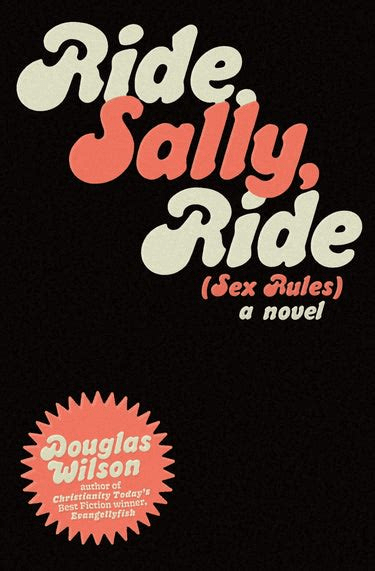
O.K., I’ll just say it. Douglas Wilson is a great theologian/expositional preacher, he seems to be a highly competent counselor, and he is an excellent polemical writer. He is not an excellent novelist.
He is just an okay novelist. I will explain.
Ride, Sally, Ride was published in 2020, which means it was being written in the 20-teens, pre-Covid and pre-George Floyd riots (though not pre-Ferguson and a lot of other riots). It is set in the late 2030s, in a somewhat dystopian setting.
A Little Bit of Orwell
In this setting, the United States is not officially fragmented, but almost. On the Left Coast and the East Coast, you have blue states, which is what we Americans call politically leftist states, with increasingly draconian laws outlawing hate speech and enforcing the rainbow. In the middle of the country, you have red states, which is what we Americans call politically conservative states, also known as “free states.” The free states have been able to survive economically, despite not having access to the East and West Coasts, because they have really developed their natural gas, oil, and grain production, and they still have the Mississippi River. They are able to ship their products down this and out into the Gulf of Mexico (as I still call it). So, in Ride Sally, these United States are not quite separate “states” (read: countries) yet, but they are in the middle of a slo-mo breakup.
Wilson didn’t foresee the Covid debacle, but his characters make frequent references to “the Troubles of 2024,” which seem to have been widespread unrest leading to widespread legal changes.
Most of the action in Ride Sally takes place in Colorado. It (but not Wyoming) is part of the blue, Diversity Gestapo bloc that also includes Washington, Oregon, and California. Americans will recognize this as plausible. Not only have gay marriage, polyamory, and porn been legalized and widely promoted in these states, but so has the sale of “sex bots.” You can order them online for a few thousand dollars, and they can be programmed to say whatever you want.
A Little Bit of Old Testament
Our hero, Ace (short for Asahel) is a twentysomething living with his parents while he attends university. His parents are Christians, but they are sort of cowardly and compromised, as is their church, which is the only reason they have been able to go on living in Colorado. Ace, on the other hand, has been reading Puritan theology (outlawed as hate speech) on the dark web, and has grown into a fine young man. Their last name is Hartwick.
As our story opens, the Hartwicks have a new neighbor. Their new neighbor has a wife, “Sally.” Sally is a sex bot.
The new neighbor introduces Sally as if it were a real person. The Hartwicks are maneuvered into inviting the “couple” over for dinner, at which the neighbor speaks to the bot as if it were a person and eats off its plate to make it appear that Sally has finished her meal. It’s creepy, though it could have been creepier if this were a horror story, which it’s not.
The next day, neighbor asks Ace to go “look in on Sally” while neighbor goes to pick up a package (which turns out to be another bot). He tells Ace this would be “the right thing” to do. Ace, also determined to do the right thing, but in a different way, goes over to the neighbor’s house and sees Sally posed seductively, in an obvious setup. He helpfully puts a t-shirt on the doll, takes it over to the recycling center where he works, and crushes it in the trash compactor. All of this takes place in the first chapter. The rest of the book deals with Ace being put on trial for the “murder” of the neighbor’s “wife.”
And a Little Bit of Wodehouse
The trial unfolds through a series of zany, madcap events. There are slimy lawyers. There are conniving governors. There are riots, conversions, and assassination attempts. There is a refugee from an Amish community. There are crossed wires and mixed signals galore.
Many of the plot points turn on one of the Team Sanity characters causing mayhem at strategic moments. Example: a slimy lawyer is about to hold a press conference where he will trot out a false accusation of rape against Ace from a would-be influencer who knew him slightly in high school. The press conference is totally derailed when another woman, watching in the crowd, yells out, “Then why did you molest me, Dwight?” as soon he says “believe all women.”
In short, this book, besides being a dystopia, also sort of wants to be a P.G. Wodehouse comic adventure.
So, Douglas Wilson, you have tried to combine 1984 with P.G. Wodehouse, with a little bit of Stepping Heavenward. How did it go?
This reader’s verdict is that it was mixed. The absurdity of the Diversity Gestapo laws certainly do lend themselves to Wodehouse-like hijinks on the part of Team Sanity. When the establishment has no category for objective truth, this creates a quite a few loopholes. For example, at one point Ace’s defense attorney makes a motion that the jury have at least three sex bots on it. They cannot be programmed to vote guilty or innocent, of course, as that would constitute jury tampering. This is a stroke of brilliance worthy of Jeeves near the end of one of the Jeeves and Bertie books.
However, one of the things that makes the Jeeves and Bertie books so fun is that the stakes are always so low. Will Bertie’s uncle to get to purchase the coveted antique that he’s had his eye on? Will Anatole, Bertie’s aunt’s temperamental but genius cook, quit, leaving the family without good food to eat? Will Bertie be forced to marry the soppy and naive Madeline Bassett, or will she end up with the man who really loves her, i.e. Augustus Fink-Nottle? Whenever Bertie or one of his friends are in danger of being jailed, it’s not for murder, it’s for something like “stealing a policeman’s helmet.”
The stakes are a lot higher in Ride, Sally, Ride, which makes things a little less funny. Yes, it is possible to write about life-or-death situations in a comedy, but we must not be seriously concerned that disaster will befall the protagonists. Whereas in a dystopia, we should. Furthermore, the stakes in Ride, Sally don’t only involve whether Ace will be unjustly jailed by the state of Colorado. There are quite a number of potentially heartbreaking, messed-up family situations also on the line. These are resolved, in this book, in the same way that interpersonal misunderstandings are resolved in a Bertie and Jeeves novel, which is just frankly weird. It gives the reader the feeling, as Bertie would say, “that you get when you step on the top step and it isn’t there.” If we were reading 1984, we would not expect Wilson and Julia to hash out their mutual betrayal in one heart-to-heart talk.
Douglas Wilson Can’t Write Dialogue
I’m sorry, but he just can’t. His narrative is brilliant. It’s funny, satirical, and extremely quotable. He does sometimes get a little bit lost in the satire at the expense of moving the story, which is not something that usually happens with Wodehouse. He also sometimes neglects to inform the reader, at the beginning of a scene, where this scene is taking place, or what the protagonists look like. For example, we have to wait until the end of the book to find out that the defense lawyer’s wife is a ginger with hazel eyes, tall, and with a full figure. It would have been nice to know that the first time we met her. But this is a flaw for which I have criticized many other authors.
But anyway, back to the dialogue. It stinks. All of the characters talk, to greater or lesser extents, just like the narrative voice. The only exceptions are the woke characters, when they are spouting boilerplate woke stuff. They do that pretty well. And, I’m not saying the dialogue is consistently bad. There are certainly moments when a character says something, and it sounds like a real American person talking. The last line, for example, is great. But for the most part, the characters speak in sentences that are way too complete and way too complex. They sound like they were composed, not blurted. And this is true even in moments of great emotion. When they do get off a funny, half the time it’s British sounding, like the original P.G. Wodehouse.
Look, Bertie is a British character, so he can sound British, even when he is being a dip. But if you want to write an American dip, they should sound like one. Ace’s false accuser is portrayed as being not very bright … but you wouldn’t know it from her speech patterns. Another character, Sarah, left her Amish community just about a month ago, but she says to another woman, “You, my dear, are gorgeous.” Amish people don’t say stuff like that. This is not difficult. I mean, it would not have been difficult to research just a little bit. Go talk to an Amish person, or even just a Mennonite, or even just somebody with German heritage, and take a few notes on their speech patterns.
But that wasn’t Wilson’s priority. He has a lot of irons in the fire, and my impression is that he wasn’t trying to write a book with good dialogue. He wanted to write a rip-roaring satire with a quick-paced plot, and he did. He probably wasn’t going for Great Literature. (And to be fair, P.G. Wodehouse is Great Literature, in his own special way. So maybe it’s not fair to expect Wilson to write fiction as well as Wodehouse.)
Perhaps this inconsistent-dialogue thing would not bother some readers, but in addition to writing fiction, I read a lot of it, and as for this reader, it drove me crazy. I did finish the book, but that problem nearly ruined it for me.
Characters. Should. Talk. Like. Real. People! The end.
The Stepford Wives, and some Spoilers
Brian pointed out in the comments that creepy-sexbot-as-horror-story has been much better done by the original Stepford Wives. He is right. In fact, these two pieces of literature (?) are using the same trope to critique two different things. The Stepford Wives was asserting that having a middle-class, two-parent family living in suburbia is dehumanizing to women, and Ride Sally is asserting the same thing, but about the every-kind-of-sexual-desire-is-sacred value system.
Although Ride Sally is a worse-written book, I think it makes a better case. Here are some spoilers. Near the end of the book, it turns out that Neighbor is a serial sex-bot buyer. Every few months, he finds something that his “wife” has done wrong. He then destroys her and replaces her, because she was a “bad wife.” From this point of view, it becomes clear why Neighbor set up Ace to avail himself of Neighbor’s “wife.” He was also setting up Sally. He had already ordered another “wife,” and his plan was to come home, find Sally “committing adultery,” and get rid of her.
To be honest, I find this portrayal more realistic than in Stepford, where the “wives” live with their husbands for years, just like a regular wife. Men who do not have their impulses directed to something godly, the kind of men who would buy a sexbot, are unlikely to be content with the same Sally year after year. Because what they want is not really a wife.
At one point in Wilson’s novel, a researcher reveals that the sexbot companies keep data about all the units they sell. The average bot has been used a total of only three times. I know this is fiction, but that fictional stat rings depressingly true. Because whatever users are doing with a bot, it cannot be called having sex. That requires two actual people. So users are bound be disappointed.
The psychology is solid. But the development and execution of all these different plotlines is lacking. It’s a shame. It makes me wish that someone else had written this book.
80s Styles Are Back
I have bad news. I do not say this lightly.
I have officially traveled from a Western American state to a Midwestern American state–nay, to Eastern Standard Time–and this involved going through some airports. And here is what I have seen.
Men, wearing short, wavy or curly hairstyles with a small mustache and no beard. I have seen this both in life and on a big, sophisticated advertising billboard, so you know it’s real. It used to be that the young, handsome guy look might include any kind of hair, from bald to Jason Momoa, but one thing you were definitely not going to see was a solo mustache. Now, it’s the reverse.
I’ve seen women wearing cotton dresses with large, colorful, odd-looking, semi-abstract prints on them. Colors that are either primary, or slightly off shades of pastels that I once asked myself why any of us would subject ourselves to them. And the reason was: because they were on sale.
Worst of all, friends, I have seen adults wearing short shorts. Lots of them. Men and women both. Sometimes, these short shorts are worn in conjunction with the aforementioned mustaches.
I really don’t know what to do about this. I’m at a loss. I ask the universe, “Why?”
We can only pray that this phase will pass quickly, and (if fashions are going chronologically), we will soon pass on to the 90s. Everyone will be wearing low-slung, baggy jeans; plaid flannel shirts; and knit caps over choppy hair. They will have smeary makeup and bags under their eyes. They’ll look like they either just rolled out of bed, or are in the midst of surviving a zombie apocalypse.
I’m much more comfortable with that look.
Why We Can’t Just Give Peace a Chance

Storytime.
When I was a kid, I attended a no-nukes protest.
It’s true. My dad was a Protestant pastor, and also sort of hippie about some things. No drug use or sleeping around, but he liked to live “simply” (for example, keeping his old coffee percolator), and around the time I was a baby, he had become a convinced pacifist. That is, he had become convinced based upon the Sermon on the Mount (mostly) that for Christians nowadays, it is never permissible to resist violence with violence. And this went for nations too. For him, principled pacisfism was part of following Jesus.
So here it was, the mid 1980s, late in the Cold War (though we did not know it was late at the time). A no-nukes protest had been planned in a downtown plaza in our large Midwestern city. I believe it was organized by the city’s churches, because among other people, my dad had been asked to sit in a panel onstage.
I was probably 9 or 10 years old. I was excited to go along. It seemed like a good thing. It was pretty clear to me that us, or anybody else, getting killed by nukes was a bad thing, something that we would not want to have happen. I had heard gruesome stories about people’s eyeballs being turned into jelly when the bomb was dropped (by us!) on Hiroshima. This was in a book that we had at home called Peace Be With You.
As the family artist, I made the sign for our protest. I tried to draw the symbol from the cover of Peace Be With You, a dove holding a branch in its beak. I had never drawn a dove before, and I got the beak wrong, so it came out looking more like a parrot.
I don’t remember all the content of the rally, but two things stand out. There was a play about a couple who survive a nuclear holocaust and live in a tent city, only to get radiation sickness. And, I remember the final song.
With the panel of pastors still seated on the stage, a lady came up to give a moving musical number. The first verse was about the Statue of Liberty and how she represents to many people that they have arrived in a place that is free from oppression. The second verse was about the cross of Christ, and how, to the Christian, it means liberty from sin, death, and hell. The refrain was “the Cross is my Statue of Liberty.”
Horribly blasphemous, of course. It was trying to compliment the greater by comparing it to the lesser, which actually reverses the roles of greater and lesser, unintentionally offering a huge insult to Christ.
As soon as he realized where the song was going, my dad abruptly got up from his seat on the stage behind the singer, stalked off the stage in a huff, and marched me and my brother out of there before the rally ended. I’m still proud of him for this. As someone said (I can’t find the reference, but I think it was Spurgeon), “Even a dog barks when its master is attacked.” Referring to himself defending the honor of Christ, however inarticulately.
I think what the organizers were trying to convey with that song was, “We are Christians, and don’t worry, even though we are against nukes we still definitely love our country.” But it was ill chosen.
Although I now think the whole event was incredibly naive, I commend my dad for attending it and for bringing his kids. Kids need to have experiences where they go fight for the right alongside their parents, even if the cause later turns out to have been somewhat misguided. This sends the message, “We have certain values as a family, these are important enough to do something about, my parents are good people” and, above all, “I and my parents are on the same side.” Please, give your kids many experiences like this before they become teenagers!
So, why naive? Well, I can’t blame myself for not noticing this as a kid, but why in the world did we think we were the only people who objected to the idea of a nuclear holocaust? Surely that is something that everyone recognizes is bad? (Except, perhaps, the mullahs, I digress.)
And given that we were not uniquely intelligent or good such that we were the only ones who didn’t like the idea of people being annihilated by a nuclear bomb, it would make sense to connect the next pair of dots (#s 2 and 3) and ask ourselves, since 99% of people don’t like nukes, how is it that they still exist? Could it be that, once you have a nuclear standoff, getting rid of nukes is more complicated than just “getting rid of them”? Perhaps there are people who also don’t want an apocalypse, but whose options are limited?
By the same token, perhaps there are more obstacles standing between humanity and the cessation of wars in general than just a dearth of people saying, “We don’t like war.” After all, most people don’t like wars, including most people who fight them.
But we, the anti-war protestors of the Cold War era, honestly, naively, conceitedly thought we were the only people in our country who saw a moral problem with human suffering. And we thought it would somehow stop if only we were to stand up and heroically say, “We are against this.”
It didn’t work. And not because not enough people were against it. It turns out, just saying that doesn’t do anything.
I’m sure my dad’s generation would say that these antiwar protests were ineffective because “our leaders didn’t listen.” “Listening,” in this context, would mean disarming our nukes and other WMDs, and perhaps completely disbanding our military. After all, if every country did this, peace would flow into the empty space where the weapons used to be. And someone has to go first! So it might as well be us! Someone has to give peace a chance.
This made sense to me at 10, especially when it was coming from respected authority figures. Once we grow up, however, we have a responsibility to ask ourselves what could possibly go wrong with this scenario. And the answer is: a lot. Everything.
War is, unfortunately, the default state of human beings. When we are not at war, it is because a lot of people are working very hard to maintain a precarious balance where things don’t tip into war. Fortunate are we who live in a country or empire large enough, or strong enough, that all that work has paid off and we get to go about our daily lives, assuming that peace is the natural state of things. But it isn’t. It is not the case that wars don’t happen unless some “war monger” goes out and “starts one.” That would be nice, but it’s not what we have here.
There are multiple reasons for this. Until recently, I thought it was sufficiently explained by human beings being sinful, and full of fears, lusts, and cravings. All of that is certainly a huge factor. We usually see wars explained as being caused by “fighting over scarce resources,” but I think that materialistic explanation is far from sufficient. Wars have not become less common as the worldwide standard of living has increased. I have also seen wars attributed to “religion.” There are a number of logical problems with this as well. To test this theory, you’d need a control group of humans who had either no religion, or no war. Since both war and religion are things that humans universally do, such a control group does not exist. To say that because both are universal, means one causes the other, is the post hoc fallacy.
So in general, I think the stubborn persistence of war is adequately explained by the Seven Deadly Sins: Envy, Greed, Lust, Sloth, Gluttony, Anger, and Pride. Especially Pride and Envy.
Say somebody hates you and wants to go to war with you because they are prideful and think their way of life is better, but also, at the same time, they envy some things about, tacitly acknowledging that in those respects, you are better than they are. Is such a person going to put down their weapons because you fold your hands and say, “Look. None of us like war. Let’s all mind our own business and disarm”? No, unfortunately, your enemy may not like war, but they hate you a lot more than they hate war. If they even recognize that you are taking the moral high ground, that is only going to exacerbate the wounded-pride-and-envy problem.
This is why fifty years of “anti-war” protests have done nothing but make the protestors look silly.
But it recently came to my attention that there may be an additional cause besides human sin that keeps stirring up wars in the world.
We need to expand our understanding of spiritual warfare to include the larger social and political structures of our world. Why does war bring ruin to the world? Why do we feel constantly on the verge of a new world war? … Why is peace, specifically the peace the permeates through the spread of the gospel, such a threat to world powers? The answer to these questions falls under the larger context of the unseen battle, a battle that has in mind the final unification of the nations of the world under the banner of Christ.
–Joel Muddamalle, The Unseen Battle, p. 120
Muddamalle is suggesting that the gods of the nations, who would prefer to go on ruling them, feel threatened by the spread of the Gospel and use geopolitical instability as one of their tools to slow this spread. (For more about these entities, see my review of Michael Heiser’s book.)
The idea is that human beings, while plenty fight-y on our own, would sometimes like to rest. But these spiritual entities will not let their people rest. They are hard at work, with demonic delight, stirring up, prolonging, and accelerating generations-long conflicts, to keep the Gospel of Christ out and also perhaps, as a side benefit, because they enjoy human suffering.
This certainly matches the picture of “the gods” that we get in, say, Greek mythology. People are bad enough on their own, but even when you have a majority of people who want to do the right thing, you will see that Fate, or the gods, or whatever, intervene so that exactly the wrong thing happens at exactly the wrong moment. The result: ten years of war.
Peace, it turns out, is not a passive, waterlike thing that flows in wherever a space is opened for it. It has to be established, like a fortress. It is the result of someone coming in, taking names, and routing the false gods. That someone is the Lord Jesus.
No Friend to This House is A Great Title
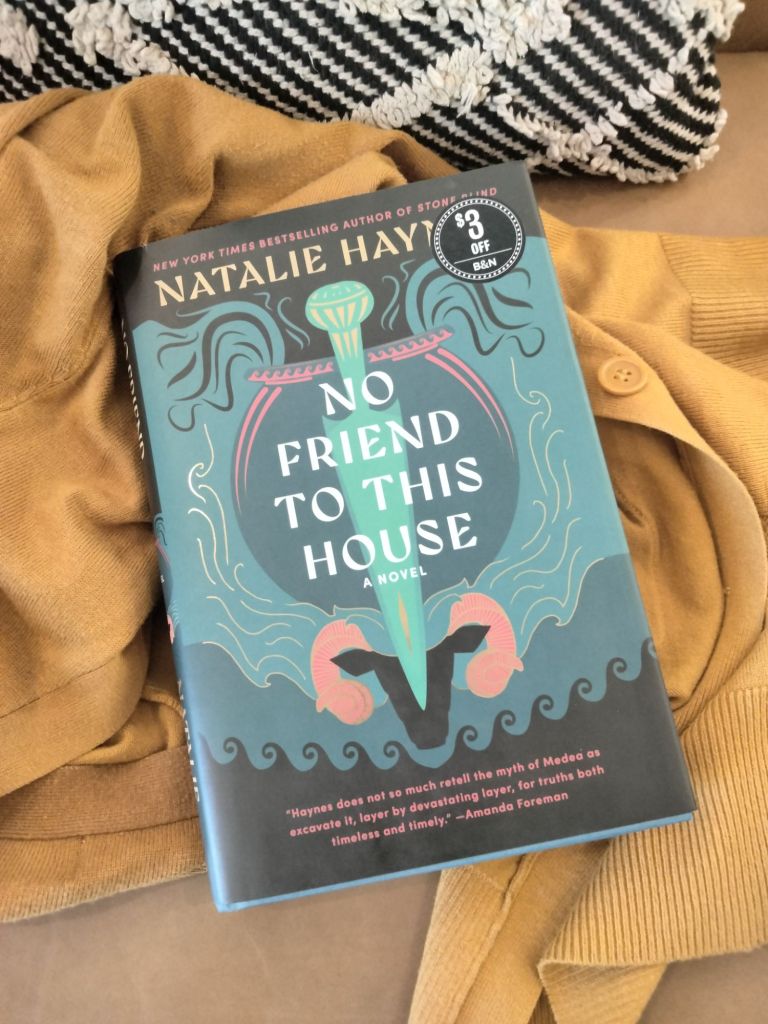
Like anybody who has ever encountered it, I have “issues” with the story of Jason and Medea.
In case you missed it, he sails off on the Argo to get the Golden Fleece. She is a witch, daughter of the king of Colchis, descendent of Helios, the sun god. Struck by Eros with an inordinate crush on Jason, she helps him accomplish all the tasks necessary to get the fleece and escape alive. He takes her with him on the Argo, and they crash around Greece, leaving a trail of bodies in their wake. Eventually, he throws her over for a younger model, a native Greek gal who is daughter of the king of Corinth. Medea takes a bloody and spectacular revenge, which I won’t spoil (look it up).
I first heard all this from my ninth-grade Lit teacher. She presented it in a very feminist way, but to be fair, this particular story sort of begs for that. I remember, in university, arguing rather incoherently with a male classmate about who was the real villain in this story. Later, when I was home schooling and read a simplified version of the legend to my kids, we decided we didn’t like the story, and we didn’t like Jason or Medea either, and they were both horrible people and they deserved each other.
So, hopefully, this book will be the nadir of my year of reading Greco-fiction: facing the story of Jason and Medea square on, by reading an entire novel about them.
The reason I liked the title of this novel is that it sounded like a phrase taken directly from the Greek — and so it was. The author, Natalie Haynes, has really done her homework.
Euripides’ Medea was the first Greek tragedy I saw performed, and it was the first or second play I read in Greek. … I wrote my dissertation on the heroics of infanticide in Euripides (I don’t have children, before you think about composing your sternly worded letter). … I’ve been reading and thinking about this play for the best part of thirty years, and I have probably seen it performed twenty-five times … I decided that the thing I needed to do [before writing the novel] was translate the Euripides, longhand. This is–in case you are wondering–weapons-grade procrastination. It took me a few weeks …
Haynes, in the Afterword, pp. 359 – 360
Haynes’ treatment of this story has been called feminist. And O.K. … sort of? But it’s not “feminist” in the sense of someone who understands the literature poorly who then reacts against the ancient heroic-age value system and sets out to undermine it. It is, rather, the work of someone who has marinated themselves in the ancient heroic-age mileu, which inherently presented a very broken relationship between men and women (especially husbands and wives). This story, and also the story of Agamemnon and Clytemnestra, bring a lot of tension with them and almost demand that you take what might be called a “feminist” perspective, at least in part, unless you want to take a very simplified view of the whole thing and not really analyze it much at all.
It’s not just me saying this. Apparently, everyone has been arguing about Medea for … well, ever since she came to their attention.
Diodorious Siculus says that the reason we have so many contradictory versions of her story is because tragic poets are drawn to talking about marvels. It’s also worth mentioning that any character who prompts different versions of their story is one who was popular in antiquity. If you want to read more about Medea, I spent many happy hours with “Medea,” a collection of essays edited by James J. Clauss …
ibid, pp. 365 – 366
Apparently, my and my children’s feeling that the whole story is regrettable is echoed by the Nurse of Jason and Medea’s two sons. Here is her opening monologue to the play (translated by Haynes):
If only the Argos had sunk to the bottom of the sea rather than winging its way towards the land of Colchis … For then my mistress Medea would not have sailed to the towers of Iolcus, stricken with love for Jason … and she wouldn’t live here, in Corinth, with her husband and children, pleasing the citizens to whose land she came in flight, helping Jason in everything. That is the greatest help: whenever a wife doesn’t disagree with her husband. But now, everything is hostile .. For Jason–betraying his own children and my mistress–is sharing his bed with royalty … Medea is wretched, dishonored like this. She cries out about the oaths he swore to her .. I’m afraid she is planning something. She’s a strange woman. No one starts a fight with her and takes an easy victory.
ibid, pp. 272 – 273
Successive phrases from this speech are used as chapter headings for the first 3/4 of the book.
I give this book 3 out of 4 stars. (Or 4 out of 5, take your pick.) The research, storytelling and psychology are spectacular. It gets tenser and more tragic towards the end. It is, of course, very hard to read, because this is a tragedy. The hardest parts to read, for me, were the parts where the Nurse speaks to the children. Even though it’s set in the ancient world, this is fundamentally a story about a home that gets broken when the children are very small. That’s hard to bear.
The one missing star? I needed more description.
This book consists almost entirely in monologues by the different characters (except for Jason), punctuated occasionally by dialogue. I guess that makes sense for a novel that is a re-telling of a play. But if I’m going to read a book set in the ancient Mediterranean, which includes a tour of the cities of Iolcus, Colchis, Aeaea (Circe’s island), and Corinth, not to mention the Aegean, Adriatic, and Black Seas, I want more than little hints and scraps about what these places look, sound, and smell like. I want to see the terrain, the buildings, and the clothes people wear. Haynes gives us almost none of that. We only get a little bit of description when it is directly relevant to a plot point, like the Symplegades (giant clashing rocks), or the golden dress that Medea gifts to Glauke. This is where Haynes falls short of Renault, who describes buildings, clothing, and artifacts in detail.
Also, there is almost zero description of how the people look. That’s important to me.
As for Jason, we are only told that he is “good-looking” until he meets Medea, when we find out that he has dark, curly hair and golden skin. This means that we have to go through the Argo’s entire outbound journey making up our own mental image of Jason, and then modify it when we find out what is canon in the novel. In the case of Jason, that may be intentional. Part of his characterization is that he is a chameleon, able to be the figure that people want in order to get what he wants; or, as Haynes puts it, “a blank space where a man ought to be.”
But there are plenty of other characters that Haynes could describe when we first meet them, and she doesn’t. What do the Colchians look like? They are “not Greek.” Do they look Asian? Or is Medea made of gold, like the children of Helios in the novel Circe? What do the different Argonauts look like? The Tutor? The Nurse? Haynes does a better job describing the various goddesses, women, nymphs, and the golden ram whose lives are also busted up by this story … but still, I could use more.
Gentle reader, you have survived the harrowing journey of the Argo with me. What horrible ancient Greek story should we read about next?
I’m Finally Going to Run My Mouth About AI
Within the last week, I consumed two thoughtful pieces of commentary about AI, both by thinkers I trust for different reasons.
The recently independent Jeremy Boreing on the topic of AI. Him I trust because of the actual thought process displayed in the video.
https://dougwils.com/books-and-culture/s7-engaging-the-culture/ai-and-the-cream-rising.html
Doug Wilson’s blog post about AI. Wilson I trust because of the volumes of material that he’s written and I’ve read.
I won’t add much to what they have to say. It’s going to be a busy week, for reasons that will be revealed tomorrow. However, I know that most of you won’t listen to the podcast, and only a small number will read the article, so I will summarize the salient parts of each in a sentence or two.
Boreing makes the point that every new technology comes with the fears and negative effects front-loaded, and the benefits arrive in the medium to long term, as we figure out where it fits in human society and how to limit its harms. He further points out that no new technology has ever delivered on any promises made on its behalf to create “less work.” New tech always creates more work: new industries, but also lots of new things that can be done by people who see the potential.
Wilson, too, points out that lazy folks will try to use AI as a way to avoid work, whereas the diligent and the geniuses will see vast new fields of work open up to them. He adds the obvious (but often overlooked) point that a “workless” utopia would actually be a dystopia.
In short, both men sensibly point out that AI is not going to change human nature. Humans do human things no matter how much tech they have. And we were designed to work.
This is, on the whole, a great relief to me. It is good to hear that the scary new thing is not going to change human nature. Granted, human nature isn’t great, but we already knew that, and all attempts to completely remake it always seem to get rid of the only parts worth saving.
Still, I’m not a total AI-o-phile, unlike, say, our friend Ben Shapiro. That’s because I’m a writer and a visual artist. My thinking is still developing on this, but as of spring 2026 here’s where I’m at.
Everyone senses that stories and art (including music) are the sort of things that ought to be made by people and nothing else. Unfortunately, it’s possible that AI will get good enough at “making” these things, that it will be impossible to detect it. You want a gritty, soulful story with human flaws? It will give you a gritty, soulful story with human flaws. It will get rid of the overly vivid colors and unrealistic smoothness in its paintings. It has already produced a country song by a hard-livin’ male voice about overcoming working-class obstacles.
When this happens, it’s like debasing the currency, but with stories and music and art. These things are much more valuable than currency. That’s bad.
From the creators’ side, everyone’s work will become suspect. This is already starting to happen.
From the consumer side, I am possibly even more upset. I DO NOT like it when I look closely at what appears to be a model wearing colorful European folk clothing, and realize that it’s an AI approximation of same. But at least, I can still realize it. I REALLY won’t like it when I have no way of knowing whether the “human” culture I’m imbibing is actually human culture.
That’s all I got today.
Misanthropic Quote about “Creative” Scholarship
But how many serious blunders does a scholar have to make before his reputation is tarnished? If a scientist or even a historian made as many fanciful suggestions in his field that were as devoid of support as some of the theologians we have noticed, or if he begged as many crucial questions, his reputation would surely suffer. But sometimes in theology, it appears, the reverse often holds. I am not sure that this speaks well for theology and biblical studies as intellectual disciplines.
–Ronald H. Nash, Christianity & the Hellenistic World, p. 265
Misanthropic Quote: Most Cliches in One Paragraph
Gardy was essentially convicted the day he was arrested, and his trial is only a formality. The dumb and desperate cops trumped up the charges and fabricated the evidence. The prosecutor knows this but has no spine and is up for reelection next year. The judge is asleep. The jurors are basically nice, simple people, wide-eyed at the process and ever so anxious to believe the lies their proud authorities are producing on the witness stand.
-from Rogue Lawyer, 2016, by a very lazy version of John Grisham
I’m thinking of having a little contest. Who can find a paragraph crammed with the greatest number of offensive, lazy cliches? This is my submission. This is only the second half of the paragraph, but even if I had included the first two sentences, I still think you’d be hard-pressed to find another piece of writing where not a single word is wasted on any original thought.

