Future Events Cast Backward Shadows

Pagan kings looking like Jesus

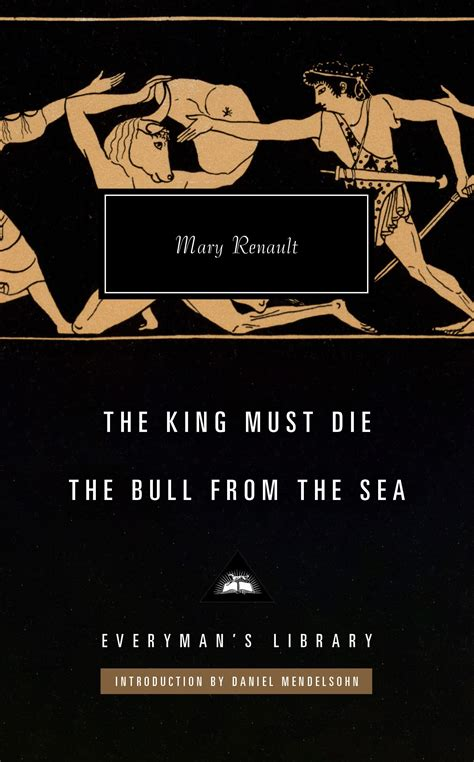
In my recent big post about sacrifice (willing and otherwise), I pointed out some similarities between the different sacrificial deaths in Mary Renault’s The King Must Die, and the death of Christ.

Some of these similarities are deep. Theseus, as future king of Athens, has an honorary title the Shepherd of the People. He is the king’s son, and he feels “the god” (Poseidon) calling him “to the bulls,” that is, to go and be a human sacrifice in Crete. Before he departs, he reassures the parents of the other future bull-dancers, “I will go with your children, and take them into my hand. They shall be my people.”

Two thousand years after Christ, we are so saturated in the power of His story and of the things He said that it is hard to read these ancient customs as anything but Christological types. And, since The King Must Die was published in 1958, it’s pretty clear the author also was aware of Christ and was intentionally pulling phrases from Him. More about that in a moment.

Other similarities are superficial, but nonetheless striking. Near the end of TKMD, a sixteen-year-old “king” who is about to be torn to pieces by wild women in a Dionysian rite, goes to his death riding in a cart, crowned with ivy, brandishing a wine cup and scattering wheat seed on his people. Now, this rite is almost nothing like the death of Christ. It’s pagan. It does not happen on Passover, the date of the annual sacrifice of a lamb, but rather it is part of an annual ritual of human sacrifice mixed with orgy. The “king,” along with everyone else, is reeling drunk. He has just spent a year as the consort of the priestess/queen, and he has no choice in what is about to happen to him. It’s hard to imagine a death more different from Christ’s.

And yet, these very superficial similarities do not strike us as coincidences. Instead, they seem significant. On this side of Christ, we can’t help but notice when a man who is about to go up a hill and die shares out bread and cup to his followers.

This sort of horrifying, yet somehow moving, ritual is not something Renault just made up. It’s well-attested in myths, legends, and histories. In this essay, I will argue that Christ did not share out bread and wine because it had been done before. Rather, the pagan one-year king shared out bread and wine because Christ did so one thousand years later. Future events cast backwards shadows.

What was Renault trying to do?

To be clear, that is my thesis, not Renault’s. She was a lesbian who published a number of contemporary gay romance novels before discovering her personal obsession with ancient Greece. Writing about Socrates and Alexander the Great allowed her to write sympathetic historical novels about gay characters who lived in a context where this sort of behavior was considered completely normal. The King Must Die certainly includes all kinds of sexual activity; for example, in the Bull Court, the female bull-leapers cannot be allowed to get pregnant, so they are sequestered from the boys, and turn to relationships with each other. Many of the male bull-leapers become the paramours of upper-class Cretan men. Theseus himself is straight, but as an ancient prince, let’s just say he’s not exactly chaste. (I may have lucked into picking up Renault’s least gay book about ancient Greece.)

All this to say, I don’t think Renault was trying to say that any ancient customs were foreshadowings of Christ. If she was “trying to say” anything at all about Christ, it’s probably that He’s not so unique, and anybody familiar with ancient Hellenistic ideas would understand that. But her novels (at least TKMD) are not really “message” novels. She immersed herself in that world, wrote characters and customs that grew organically out of it, and this is what came out.

So no, I don’t think Renault is projecting Christ back into the ancient Mediterranean customs intentionally, except in the sense that she would have been familiar with biblical phrases as a woman raised in 1900s England. I think she was primarily writing from her research and imagination.

Is Christianity a ripoff from Greek mystery religions?

Still, when I first read TKMD, the tone was familiar to me and I immediately picked up the implications. Not that many years before reading it, I had been through a year of thorough education in Greek mythology by a high-school teacher who could safely be described as feminist. My best friend at the time was a neo-pagan. Between the two of them, this teacher and friend were quick to point out any parallels between Greek paganism and Christian practice, and to accuse Christians of “stealing” it. Looking back, there was a certain defensiveness there, which I did not realize at the time. But my teacher and friend were only two voices in a large crowd of scholars.

During a period of time running roughly from about 1890 to 1940, scholars often alleged that primitive Christianity had been heavily influenced by Platonism, Stoicism, the pagan mystery religions, or other movements in the Hellenistic world. Largely as a result of a series of scholarly books and articles written in rebuttal … Today, most Bible scholars regard the question as a dead issue. [But] even though specialists in biblical and classical studies know how weak the old case for Christian dependence was, these old arguments continue to circulate in the publications of scholars in such other fields as history and philosophy.

–Christianity and the Hellenistic World (1984), p. 10

As an aside, notice that the peak of this theory were the years during which Mary Renault was growing up and going to school.
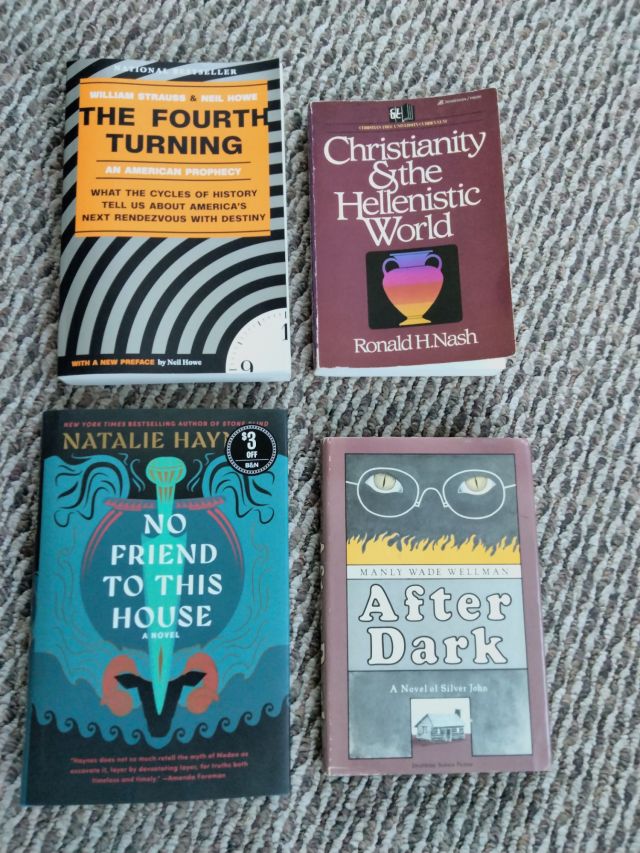
Sometimes books come to you, serendipitously, just when you are ready for them. As I was thinking about this question of the similarities between fictional (but history-based) sacrificial victims in Renault, and my own Dying God, I imagined how I would build a case that He was clearly not copying them. Although He did grow up in a thoroughly Hellenized environment, He was a Jew. He was extremely faithful to the God of Abraham, Isaac, and Jacob, and was so familiar with the Law and the Prophets that He could quote them off the cuff. His veins seemed to flow with the Hebrew Scriptures. In short, He showed no signs of wanting to throw over the religion of His ancestors for that of the Greeks. Furthermore, many of the elements of how His last days went down came about as a result of the particular historical conditions in which He found Himself. He went up the hill to die because Jerusalem is built on a height. He shared out bread and wine because they were having the Passover, and this ceremony had been established 1400 years before in the desert of Sinai, not 1000 years before in the Ionian islands. He called Himself a king because that was what the Jewish Messiah was supposed to be, and He was of the house and lineage of David … not because He had been selected by matriarchal priestess to live as a king for one year and then die. He called Himself the Good Shepherd because of the Israelite pastoral tradition, not because of the Athenian one. The Roman soldiers put a crown of thorns on His head because they were professionals at humiliating and torturing people. It’s hard to imagine how He could have orchestrated all these historical factors intentionally in order to copy a pagan custom that was practiced far away, and centuries before He was born.

I can assert all this stuff, but there is always some scholar out there who could be quoted to argue with me. I needed a book. And the book came to me. As I was turning all these things over in my mind, I had to venture out to a Christian bookstore that was closing. (“Come get your novels,” they said.) Of course, many of their books were on clearance, and there before me was Nash’s Christianity and the Hellenistic World for the low low price of one dollar, its asking price all out of proportion to its value to me at that moment. Nash can prove what I can only assert.

Nash systematically addresses claims that early Christian writers, particularly Paul, got many of their key concepts from Platonism, Stoicism, the mystery religions, and Gnosticism.

Among the many claims published in this century are the following:

  1. Early Christianity was just another Hellenistic mystery religion.
  2. Important Christian beliefs and practices were either borrowed from, or were heavily dependent on, similar beliefs and practices in the mysteries.
  3. Both baptism the Lord’s Supper evidence the influence of similar rituals in the mystery cults.
  4. Among the many Christian beliefs drawn from the mysteries is the Pauline doctrine of salvation, which parallels the essential themes of the mysteries: a savior-god dies violently for those he will eventually deliver, after which the god is restored to life.

A major movement in the development and promotion of such theories was the History of Religions School (Religionsgeschichtliche Schule).

-ibid, pp. 116 – 177

Nash addresses problems with these claims such as the following: in the mysteries, the dying god does not really rise. Osiris lives on in the underworld; the dead god’s body becomes the wheat, etc. As far as we can tell, ritual washings in the mysteries were just purification rituals, and they had to be repeated. They do not seem to have been a one-time entry into a new life like the Christian baptism. For many of these mystery religions, we don’t actually know much about the content of the rituals, because they were intentionally kept secret. For many mystery-religion practices that are well-attested, such as the taurobolium where the initiate stood beneath a grate while a bull was slaughtered, these practices seem to have developed after Christ rose and Paul wrote his letters. In the case of the mystery religions of the first, second, and third centuries, some of them were actually influenced by Christianity, not the other way round.

But I’ll let German scholar Adolf von Harnack, quoted by Nash, have the last word:

We must reject the comparative mythology which finds a causal connection between everything and everything else, which tears down solid barriers, bridges chasms as though it were child’s play, and spins combinations from superficial similarities … By such methods one can turn Christ into a sun god in the twinkling of an eye, or one can bring up legends attending the birth of every conceivable god, or one can catch all sorts of mythological doves to keep company with the baptismal dove; and find any number of celebrated asses to follow the ass on which Jesus rode into Jerusalem; and thus, with the magic wand of “comparative religion,” triumphantly eliminate every spontaneous trait in any religion.

–ibid, pp. 118 – 119

Too many keys to mythology

In short, the problem is not that there are some key symbolic parallels between Christ and ancient pagan symbolism. The problem is that there are too many parallels, or similarities, right down to the animals involved. Part of this is simply the limitations of living in this world. Jesus had to eat something, He had to ride on something, He had to use some kind of words when He spoke, and there were a finite number of foods, mounts, and terms in the ancient world, just as there are everywhere. I have pointed out before, when addressing the problem of whether Christians “stole” pagan practices like hot cross buns and wedding customs, that there are a limited number of ways to do every human activity. If you eat something, wear something, or go through a life passage, and you are a human being, I guarantee that in the past four thousand years there has been someone who did it that way before you. And that someone was probably pagan.

As G.K. Chesterton said about finding mystical and symbolic connections:

The true origin of all the myths has been discovered much too often. There are too many keys to mythology, as there are too many cryptograms in Shakespeare. Everything is phallic; everything is totemistic; everything is seed-time and harvest; everything is ghosts and grave-offerings; everything is the golden bough of sacrifice; everything is the sun and moon; everything is everything.

–The Everlasting Man, p. 103

These are the givens of the universe that all humans encounter; and, unless we are sorely impoverished, we all have some way of dealing with them. But just because they are ubiquitous does not mean they are unimportant. These things are shadows of what was to come. The reality, however, is found in Christ.

Symbolism in Reality

Last point: Jesus was the fulfillment of all these confused hints in every culture. But the vibe of the New Testament historical records is much less gorgeous, mythical, and poetic than the ancient pagan stories. As C.S. Lewis put it:

When I first, after childhood, read the Gospels, I was full of that stuff about the dying God, The Golden Bough, and so on. It was to me then a very poetic, and mysterious, and quickening idea; and when I turned to the Gospels never will I forget my disappointment and repulsion at finding hardly anything about it at all. The metaphor of the seed dropping into the ground in this connexion occurs (I think) twice in the New Testament, and for the rest hardly any notice is taken; it seemed to me extradordinary. You had a dying God, Who is always representative of the corn; you see Him holding the corn, that is, bread, in His hand, and saying, ‘This is My Body,’ and from my point of view, as I then was, He did not seem to realize what He was saying. Surely there, if anywhere, this connexion between the Christian story and the corn must have come out; the whole context is crying out for it. But everything goes on as if the principal actor, and still more, those close to Him, were totally ignorant of what they were doing. It is as if you got very good evidence concerning the sea-serpent, but the men who brought this good evidence seemed never to have heard of sea-serpents. Or to put it another way, why was it that the only case of the ‘dying God’ which might conceivably have been historical occurred among a people (and the only people in the whole Mediterranean world) who had not got any trace of this nature religion, and indeed seemed to know nothing about it?

–C.S. Lewis, “The Grand Miracle,” in God in the Dock, p. 83

Well, when you put it that way, it’s pretty funny, isn’t it? Jesus’s death reads as disappointingly prosaic compared to the myths only because it actually happened. This is very humble of God. He has quite the sense of humor. As John puts it after his account of the Triumphal Entry, “At first His disciples did not understand all this. Only after Jesus was glorified did they realize that these things had been written about Him and that they had done these things to Him.” John 12:16

Sources

Chesteron, G.K. The Everlasting Man. Ignatius Press: 2008, originally published in 1925.

Lewis, C.S., ed. Walter Hooper, God in the Dock: Essays on Theology and Ethics. Eerdmans: 1970, 1978.

Nash, Ronald H. Christianity and the Hellenistic World. Zondervan: 1984.

Renault, Mary. The King Must Die. Alfred A. Knopf, Everyman’s Library edition pub. 2022, originally published by Pantheon Books in 1958.

“Who is Mary Renault?” copyright The Mary Renault Society, 2010 – 2026, Who Is Mary Renault? – The Mary Renault Society, accessed April 17, 2026.


The Unwilling: A Book Review

Mormon vampires. Need I say more?

Actually, that calls for a lot of explanation, doesn’t it?

The Setup

Carl is a faithful Mormon who is grieving his family. His wife, Sharon, and their three small children were killed by a drunk driver who ploughed over them on the sidewalk. But, Carl knows that if he remains faithful, he will be reunited with his family in the Celestial Kingdom. Per the Mormon promises, they’ll be together forever.

Then, Carl’s sister, who has had a troubled history, is killed by a mysterious woman in an alley. Carl becomes obsessed with finding the killer (the police seem to have given up). He tracks her to what appears to be a sex cult with gothic trappings. Thinking he is just going undercover to collect evidence, Carl takes an oath he doesn’t mean and finds himself becoming a vampire.

He doesn’t finish the ceremony, though. As soon as it becomes clear that he is supposed to drink the blood of an innocent girl, Carl instead breaks free and takes her to the nearest hospital. There, he collapses, and is rescued by Moira. Moira is another well-intentioned vampire (a “Penitent”), who works at the hospital so that she can work nights and have access to blood without having to attack people. Moira shows Carl the ways of surviving as a vampire without doing evil. Incredibly, it later turns out that she too is Mormon. She actually became a Mormon after she was already a vampire, thanks to two very persistent missionaries. For about fifty years, one Mormon bishop after another has handed down to his successor a letter explaining Moira’s special “condition.”

Like I said … Mormon vampires.

Pros and Cons, and Why I Was Crying in Public

(P.S. This section turned out kind of long. Sorry about that.)

C. David Belt (shown here with me at the recent Fantasy Faire) is a fantastic horror writer because he pairs the horror writer’s instincts and penchant for research with a uniquely right-side-up view of the world.

Take, for example, his take on vampires. I don’t usually read vampire books because the vampires are usually presented as like mortals, but better: they don’t age, they’re beautiful, they’re sexy. Mortals who don’t want their blood sucked are prudes and bigots and super intolerant. Not so with Belt. In his books, vampires are actually, you know, evil. Vampirism is actually a horror, like it would be if you encountered it in real life. That’s what I mean by a right-side-up view of the world.

Now, this strong sense of the wholesome can shade into a bit of naivete about the human heart. The whole premise of this series is based upon the idea that Carl took the vampire oath and even allowed his own blood to be drunk … “innocently.” Because he “didn’t mean it” and “didn’t think it was real,” he is blameless. He is, in all of history, the only Unwilling vampire.

This raises two questions. Now, perhaps these will be raised by the author himself later in the series, but I’m taking The Unwilling on its own terms. So here we go.

First, is it really possible to take an oath and not be responsible for it because “you don’t mean it”? That would be an extremely convenient thing, if so. Picture this: you are a follower of the One True God. But you live in a pagan environment, and you’re being pressured to take an oath of loyalty to Kukulkan, or Zeus, or the divine Caesar, or Big Brother is requiring you to “just say” there is no God but Big Brother. I think you see where I’m going with this. Now, granted, in The Unwilling Carl was not clinging to secret reservations just to get out of martyrdom when he took the oath to be loyal to Lilith. We know this because he fled the ceremony room, endangering himself, as soon as he realized what he was really being asked to do. So there are degrees of culpability, and of self-awareness. However, the principle that “I didn’t really mean it” or “I thought it was a game” is a dangerous one to introduce. As G.K. Chesterton has pointed out in The Everlasting Man, there is an element of game to much of pagan worship. It’s not always 100% clear how seriously the pagan followers themselves take all their superstitions. However, God still tells Israel in no uncertain terms not to pour out libations to any foreign god or take up their names in oath. So, “it was a game” or “it was maybe partly a game” is not going to cut it.

This leads directly to the second question. How is it possible that, in all of history, Carl is the first person to take the vampire oath without realizing it is real? Wouldn’t we expect that to be true of almost every person that gets inducted into the vampire cult? Or true of at least 50%? In modern times, most people do not really believe that vampires are an actual thing. Surely, the majority of the people that join this “empowering” gothic sex cult think of it as a sort of cosplay.

After all, this is how people join cults: there are concentric circles. There are the hangers-on or wannabes, then the neophytes, then the journeymen, and so on. Typically only the people in the inner circle know what the cult is really about. By the time someone gets that far in, however, they have so much trauma bonding, Stockholm syndrome, sunk cost fallacy, mental confusion and spiritual deception that they tend not to be repelled by even the most bizarre and obviously evil beliefs.

The only way I can square this circle is to figure that, if there were any other Converted who didn’t take the vampire element seriously, then when it came time to commit the ritual murder, unlike Carl they didn’t balk, but rather went ahead. And this because, we can assume, they were not as strong-minded as Carl, or not as pure of heart and motive.

One downside of having a right-side-up view of the world, where you recognize that good and evil actually exist and that people can choose to do good or evil, is that there’s a tendency to think as though the world consists of some good people and some bad ones. Belt falls prey to this, to a certain degree. I don’t want to overstate this flaw, because on the whole he is quite insightful about human psychology, as any good novelist has to be. But here are some examples of what I mean.

Vampires, it appears, can “smell” when a person is truly depraved, truly far gone in their evil. Such a person’s blood “calls” to the vampire, creating an almost irresistible urge to kill. In this book, occasionally Carl will encounter such a person. One is a crooked cop, who is also molesting his stepdaughter. Another is a random mother we encounter at the Mormon church service. The precise nature of her evil is never revealed, but as Carl puts it when he warns the bishop about this woman, “something is very wrong” in that house.

So far so complex, right? I actually love the scene where Carl and Moira have to restrain themselves from attacking this apparently pious Mormon woman. My beef with this phenomenon is that there are far too few of these people who call to Carl with their rotten/sweet-smelling blood.

Technically, on an orthodox Christain view of the world, the taint is in everybody. “There is none righteous, no, not one. All have turned aside; they have together become corrupt.” But let’s grant that this does not mean (as indeed the doctrine of total depravity doesn’t) that everyone is as bad as they could possibly be. Nevertheless, part of a mature Christain world view is realizing more and more uncomforable truths like the following:

  • Given the intervening steps, anyone is capable of anything.
  • I am far weaker and more sinful than I ever realized, but the grace of God is far deeper and stronger than I ever realized.
  • “I know that in myself lives no good thing.”
  • “Cheer up! You are worse than you think.”
  • “Christ Jesus came into this world to save sinners, of whom I am the chief.”

So, to modify our illustration, if The Unwilling had been written by an orthodox Christian, it would show a world where every single person had this taint in their blood, but some of them were in remission. Nevertheless, the proportion of people who had gone far down the road towards “capable of anything” would be quite large – large enough that Carl would be certain to be distracted by their intoxicating scent every time he went out in public.

But Belt is a Mormon, so although his worldview is basically right-side-up, it doesn’t include total depravity. His picture of the world is basically a bunch of lost, but essentially wholesome and well-meaning people, and a few stinkers. Furthermore, in the Mormon cosmology, salvation is not for the stinkers. It is for the well-meaning people who do their best to save themselves and trust God for the rest.

Take this scene, where Carl and Moira are trying to convince a mortal-turned-vampire to repent of his sins. Things start out well enough:

“You’re Catholic, aren’t you?” I ask him.

He laughs bitterly. “Lapsed.”

“Go to your priest,” I say. “Or go to a Mormon bishop. Only God can help you now.”

So far so good. Carl continues,

“Stop killing. Go to your priest or to a Mormon bishop. Pray. Lean on God. I believe you can find your way back. Atone for your sins as best you can. Put your trust in the Savior to take care of the rest. It’s the only way you can ever find redemption.”

And there we have the difference between Mormonism and orthodox Christianity. Ephesians 2:8 – 9 says, “For by grace you are saved, through faith, and this [faith] is not of yourselves, not of works, lest any man should boast.” The Mormons have a similar verse, but it runs like this: “We are saved by grace, through faith, after we have done all we can.” What this misses is that, if we are “doing all we can,” then one of two things is going on. If we are truly repenting and making restitution, then that itself is a gift and is a sign that the Holy Spirit is already revivifying our heart. Which means that He started this good work in us before we were repentant. The other possibility is that we are “doing all we can” in a cynical way, as a work of our own righteousness, so as to put God in a position where He “has to” forgive us. This is a grievous sin against God, probably far worse than the original bad things we did.

To an orthodox Christian, “Atone for your sins as best you can. Put your trust in the Savior to take care of the rest” is a HUGE insult to the Savior. Did He really suffer torture and the wrath of God to take care of our leftovers? Doesn’t it seem that we could have done a little more and spared Him all that? Or, if there was a portion of our sins that called for torture and death on His part, then doesn’t that suggest that the rest of them were equally bad and probably can’t be dealt with by “doing the best we can”?

These are the things that crossed my mind as I read this book. The psychology is good, and somewhat deep, but it’s not the deepest of the deep. That is reserved for writers like Dostoyevsky and St. Paul.

Finally, I won’t give the background of this because you really should read the book, but there was a certain character whose story had me in tears in the doctor’s office. I had brought this book with me to my son’s doctor appointment, to read in the waiting room, as one does. And – well, it was a really hard to put down part, and so it was that the doctor came in to see us just at the moment when my heart got broke. And I had to knuckle a tear away and say, “Sorry, we are fine. This book made me cry.” Good job, Mr. Belt, good job.

Easy There, G.K.C.

It is not demonstrably unchristian to kill the rich as violators of definable justice. It is not demonstrably unchristian to crown the rich as convenient rulers of society. It is not certainly unchristian to rebel against the rich or to submit to the rich. But it is quite certainly unchristian to trust the rich, to regard the rich as more morally safe than the poor.

G.K. Chesterton, Orthodoxy, chapter 7: The Eternal Revolution

Netflix Wants Me to Doubt My Own Mind

So, within about the past month, I’ve watched two different psychological thrillers on Netflix. And they are both the same damn movie. (And I use damn advisedly.) In both, the viewer knows only what the point of view character knows. And he (it’s a he in both movies) is uncovering a conspiracy. Until, at the very end, it turns out that he’s delusional. Many of the major events in the movie, which were shown to the viewer as if in good faith, were actually happening only in his mind. Actual events were quite different. The interpretation he was putting on everything was completely wrong. In one of the movies, the point of view character is brought to realize this, at least briefly. In the other, it is made plain to the viewer only.

I am pretty ticked at both of these movies. Especially at them both being on Netflix at the same time.

On the one hand, they are well-written, well-plotted, well-filmed and well-acted. Tense as heck. They are an immersive experience that helps the viewer understand what it feels like to be delusional. (In both cases, the break with reality was brought on by trauma. In both cases, actually, involving the death of a child.) So, they are very good.

But this strength comes at a pretty steep cost. Namely, they can make you doubt yourself something fierce. I think that the reveal at the end of each movie was that the person was delusional. But who really knows? Maybe I am misinterpreting what the director was trying to say. Maybe I did not even watch the danged movies. Maybe there is no such thing as reality.

This has to be intentional, right? Two movies, running concurrently, aimed at people who like psychological thrillers, both of them trying to tell you that you can’t really know what is real. I mean, God help you if you’ve got dissociative disorder. (And I use God help you advisedly.)

I’m with G.K. Chesterton on this. Or rather, he is there, throwing me a lifeline. GKC believed strongly that we have a moral obligation to believe in reality and to trust our own perceptions of it. I don’t have any of the quotes in front of me, but I do remember that he said something like, “Every day you can hear an educated man utter the heretical statement that he may be wrong.” He also tells a long story, elsewhere, about how he spent an evening at a friend’s house where they had a brisk philosophical debate. GKC was maintaining that reality exists and can be known. His friend was maintaining the opposite. Having vigorously defended reality, GKC got into a taxi and, when he arrived at his destination, had one of those confusing conversations with the cab driver that make you feel as if you’ve fallen through a portal. The cab driver remembered picking up GKC at some other location, and remembered GKC having said something to him that he didn’t say. GKC argued with the man for several minutes, and after just a few minutes was starting to doubt himself and, thus, reality. Then, just when GKC was beginning to waver, the cabman got on his face a look of sudden revelation as he realized that he was remembering a different customer.

You might think that someone like GKC, who believes that “I might be wrong” is a heresy, would be arrogant and impossible to convince of anything. But that’s not necessarily true. If you believe in reality and trust your perceptions of it, then you can be presented with evidence. And if the evidence is good, you can change your mind. If you don’t have the baseline trust in your own mind, then no amount of evidence is going to convince you.

One more, equally sinister, aspect of all this. Traditionally, Hollywood likes to give us messages that we should not trust authority. The cops are on the take. The conspiracy goes all the way to the top. The experts don’t know everything. We are “sleeping with the enemy.” The two movies I watched recently give the opposite message. They play on our expectations that experts and authority figures in movies will turn out to be villains. In both of these particular cases, it is doctors (medical doctors in one; psychologists in another) who appear to be concealing the truth. They appear to want to treat the protagonist like he’s crazy, or else frame him for being crazy. There is bureaucracy and gaslighting and all the stuff we find in dystopias. But in this case, they turn out to be right. What to do you know? He actually is crazy. If only he had listened to them. Lives could have been saved.

I think both of these movies were made before you-know-what, so it’s probably a coincidence. Still, I’m not super comfortable when two pieces of well-done art say to me in stereo, “Trust us. We know what reality is and you don’t. We know best.”

Christmas Tree Rant II

I hope you are not tired of hearing me rant about pagan cultures and why Christians should not think of pagan cultural practices a contaminating substance. This topic may be starting to seem as if it’s relevant only to anthropology geeks like myself, who use their spare time to write anthropology-heavy novels about people who were pagan by default because they lived in a time when there was no other way to be.

But, on the contrary, I think it is very relevant to everyone. There are modern-day tribal people who would like to follow Christ without giving up their entire cultural identity. There are neo-pagans who, living in our technological, post-Christian world, turn to the religions of their ancestors (or a personalized version thereof) because they are looking for something that it appears neither secularism nor the modern evangelical church can offer.

There are Christians who, because of an incomplete understanding of these issues, put stumbling blocks in the path of both the aforesaid groups and in the path of their fellow believers who would like to have a whole, rounded culture. And finally, there are enemies of Christ who would like nothing better than to portray His followers as puritanical, culturally vacuous, colonizing Western imperialists. And who knows, perhaps they actually believe that they are.

All of these people could benefit from a deeper understanding of how formerly pagan practices carry meaning in the modern day. That’s why I have said that, although Christmas trees are not actually pagan, I would still have one if they were. And I will go farther. My kids and I make jack-o-lanterns too. Call, and raise you Hallowe’en. Also, I bake Christmas cookies, hide Easter eggs (!), say “bless you” when someone sneezes, and had bridesmaids at my wedding.

The following is a re-working of a book review I once wrote, which I hope will help to clarify some of the issues. Enjoy! Then go out and kiss under the mistletoe!

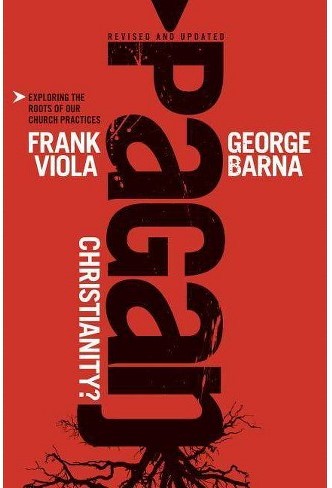
Review of Pagan Christianity? Exploring the Roots of Our Church Practices

by Frank Viola and George Barna, BarnaBooks/Tyndale, 2008

This book examines a variety of common church practices. It really needs to be reviewed chapter by chapter, because some of the chapters raise good questions about complex topics (for example the one about baptism), while others are just laughable (for example the one about why it’s a sin to dress up for church). But lacking the space for such a detailed approach, I would like to focus on a particular assumption that underlies this book and its scare-mongering cover: the idea that anything that started out as a pagan practice is unlawful for Christians. (The key word here is “started out.”)

In the acknowledgements, Frank Viola tells us the origin of this book: “I left the institutional church … I sought to understand how the Christian church ended up in its present state. For years I tried to get my hands on a documented book that traced the origin of every nonbiblical practice we Christians observe every week.” (xiii) Notice, Viola had already decided that institutional Christianity was thoroughly broken. He “knew” that most things most churches were doing, were unbiblical (they may be too, but not in the way Voila thinks). If these practices did not originate in the Bible, they must have come from somewhere else. Since Viola could not find the book he was looking for, he researched and wrote it himself. To his credit, he acknowledges the limits of his research and hopes that true scholars will pick up where he left off.

Viola’s experience is re-created within each chapter. First, we are told that whatever practice the chapter is treating (church buildings, sermons, etc.) is unbiblical. Then, there follows a brief historical survey of how such a practice developed from paganism. Then, we are given the real reasons the authors dislike the practice: arguments that it is undemocratic, unbiblical, or both. These later arguments are real arguments and deserve to be answered. But they are irrelevant to whether a given practice is pagan. If Jesus commands us to do something that the pagans also do (e.g., be shrewd in dealing with people – Luke 16:8 – 9), then that practice is biblical, right? A practice should stand or fall on its own merits, regardless of what it resembles or what it developed from. But in the authors’ minds, if they can show that something developed from a similar thing that was pagan, they have got at least halfway to proving it is unbiblical. And I fear that many American Christians would agree with them.

Interestingly, modern neopagans share this assumption. (You can find their articles on the Internet.) They delight in pointing out the similarities between Christian and pagan practices, and especially the borrowings. They assume that by pointing these out, they have proved that Christianity is not unique.

G.K. Chesterton, in his book The Everlasting Man, has blown this argument apart. He argues that human beings were created by God to do certain things. Human beings, wherever they live and whatever their religion, will do these things. They will have festivals and parties at certain times of the year. They will pray. They will make beautiful clothes and dress up sometimes. When circumstances permit, they will bake cakes. All this is part of the creation order and the cultural mandate, in addition to being lots of fun. The tragedy of pagans, Chesterton continues, is that they do not really have anything or anyone to do these things to or about. They are forever in search of an entity and an event that matches their huge, God-given, distinctively human capacity for celebration and worship. Eventually, it all falls through and degenerates into violence, or superstitious fear, or a sexual free for all.

But God does not command us to stop doing legitimate and lawful things when we leave the pagan gods to worship Christ. He redeems these things! For the first time, we do them for a good reason. So once, we baked hot cross buns unto the Spring Equinox. Now, we bake them unto Christ, and eat with even more joy in our hearts. Once we sang songs and made art unto our pagan gods. Now we sing and make them unto Christ!

Let me hasten to add that of course some pagan practices cannot be carried over into the Christian life. Worshipping other gods is out. So is temple prostitution, consulting the dead, divination, practicing magic, and making images to be worshipped. All of these are explicitly forbidden in the Bible, so we do not need to discuss their origins to see that they are unbiblical. Oh, and don’t let me forget a really big one: sacrificing our children to our gods, whatever those gods might be.

But there are a host of human activities that are not unlawful in themselves, are not condemned in Scripture, yet were certainly done by pagans before they were done by Christians (or even Jews). What I think the authors fail to realize (and what many of us in this modern age fail to realize) is that every human activity, good or bad, was originally done by pagans. Think about the wide range of things this encompasses. It includes cooking, medicine, self-defense, pregnancy and childbirth, coming of age, wedding ceremonies, engineering and construction. It is going to be awfully difficult to find one of these life passages that is not marked by practices that were once pagan.

Pagans are human beings, and they do everything that human beings do. So, art, formal clothing, dancing, and yes, sacred buildings, priests, and sermons are not necessarily forbidden to us just because pagans do them. We will have to find stronger arguments if we want to get rid of these things. What we cannot do is strengthen a weak argument against a practice by tacking the word “pagan” on it. This is dishonest, and frankly it is unfair to pagans. Why blame them for the fact that you don’t like liturgical robes?

Paganism Isn’t All Bad. GKC Says So

[I]n these pagan cults there is every shade of sincerity — and insincerity. In what sense exactly did an Athenian really think he had to sacrifice to Pallas Athene? In what sense did Dr. Johnson really think that he had to touch all the posts in the street or that he had to collect orange-peel? In what sense does a child really think that he ought to step on every alternate paving-stone? … [These things] have the sincerity of art as a symbol that expresses very real spiritualities under the surface of life. But they are only sincere in the same sense as art; not sincere in the same sense as morality. The child does not think it is wrong to step on the paving-stone as he thinks it is wrong to step on the dog’s tail.

These are the myths: and he who has no sympathy with myths has no sympathy with men. But he who has most sympathy with myths will most fully realize that they are not and never were a religion…. They satisfy some of the needs satisfied by religion; and notably the need for doing certain things at certain dates; the need of the twin ideas of festivity and formality. But though they provide a man with a calendar they do not provide him with a creed. A man did not stand up and say ‘I believe in Jupiter and Juno and Neptune,’ etc., as he stands up and says ‘I believe in God the Father Almighty’ and the rest of the Apostles Creed.

The crux and crisis is that man found it natural to worship; even natural to worship unnatural things. The posture of the idol might be stiff and strange; but the gesture of the worshipper was generous and beautiful. He not only felt freer when he bent; he actually felt taller when he bowed. Henceforth anything that took away the gesture of worship would stunt and even maim him forever. If man cannot pray he is gagged; if he cannot kneel he is in irons.

When the man makes the gesture of salutation and sacrifice, when he pours out the libation or lifts up the sword, he knows he is doing a worthy and virile thing. He knows he is doing one of the things for which a man was made. His imaginative experiment is therefore justified. But precisely because it began with imagination, there is to the end something of mockery in it, and especially in the object of it.

G.K. Chesteron, The Everlasting Man, excerpts from the argument that runs pages 107 – 112

GKC Quote on Cave People

To-day all our novels and newspapers will be found swarming with allusions to a popular character called a Cave-Man. So far as I can understand, his chief occupation in life was knocking his wife about …

In fact, people have been interested in everything about the cave-man except what he did in the cave. Now there does happen to be some real evidence of what he did in the cave. What was found in the cave was not the horrible, gory club notched with the number of women it had knocked on the head. [It was] drawings or paintings of animals; and they were drawn or painted not only by a man but by an artist. They showed the experimental and adventurous spirit of the artist, the spirit that does not avoid but attempts difficult things; as where the draughtsman had represented the action of the stag when he swings his head clean round and noses towards his tail. In this and twenty other details it is clear that the artist had watched animals with a certain interest and presumably a certain pleasure. [I]t would seem that he was not only an artist but a naturalist.

When novelists and educationists and psychologists of all sorts talk about the cave-man, they never conceive him in connection with anything that is really in the cave. When the realist of the sex novel writes, ‘Red sparks danced in Dagmar Doubledick’s brain; he felt the spirit of the cave-man rising within him,’ the novelist’s readers would be very much disappointed if Dagmar only went off and drew large pictures of cows on the drawing-room wall.

G.K. Chesterton, The Everlasting Man (orig. ed. published 1925), pp. 27 – 30

The Finally Fall Tag

I thought this image looked sort of autumnal.

Today I will be doing the Finally Fall Book Tag, which I got from Riddhi. A tag is a series of prompts that the blogger responds to, usually by naming one or more books. At the end, we are supposed to “tag” other bloggers, but we all know that I don’t do that because it just gets too complicated, what with not wanting to leave anyone out, not wanting to hand anyone a task they hate, etc., etc. It’s sort of like planning a wedding that way.

In fall, the air is crisp and clear: Name a book with a vivid setting.

The Lord of the Rings.

OK, look, TLOTR could actually be the perfect answer for every one of these prompts, am I right? So I’ll just name it for each of them, and then one other one that is my backup answer.

Beyond Middle Earth, I suggest you check out the setting in Ursula Le Guin’s Hainish cycle. It’s on a planet that, because of its orbit, experiences seasons that last for lengths of time that we on Earth would call years. The people who live there have eyes with no whites to them. After intermarrying with immigrants from Earth, they develop a skin tone that is navy blue in the upper classes and “dusty” blue in the lower classes. It’s fascinating, brutal, and beautifully written.

Nature is beautiful… but also dying: Name a book that is beautifully written, but also deals with a heavy topic like loss or grief.

The Lord of the Rings. They kill off Gandalf.

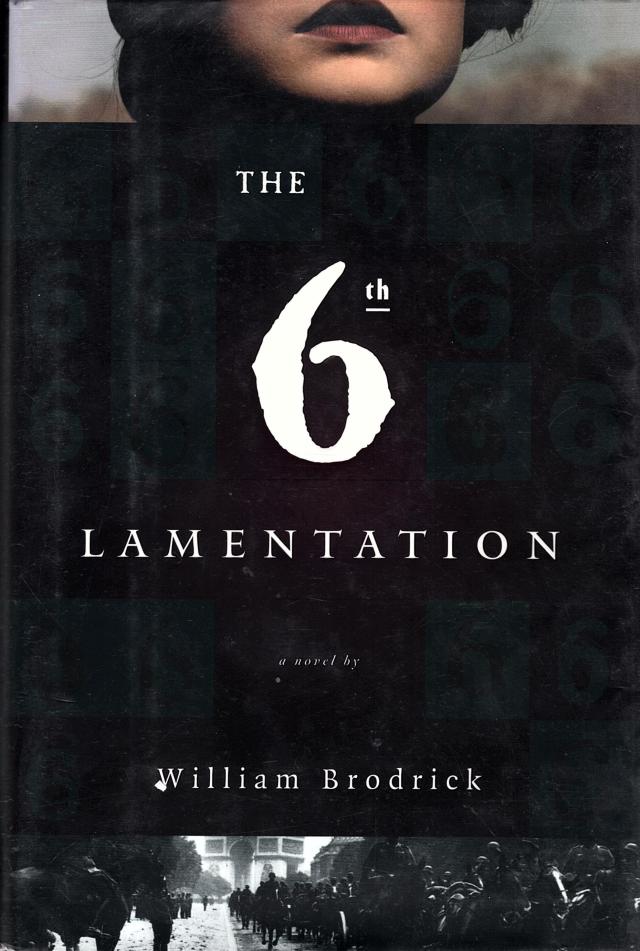
The 6th Lamentation by William Brodrick

Also, this book. The Holocaust, survivor’s guilt, lost children, neurological disease. Are those topics heavy enough? See my full review of it here.

Fall is back to school season: Share a non-fiction book that taught you something new.

The Lord of the Rings will teach you terms like weregild (“person-money” – money paid in compensation for someone’s death).

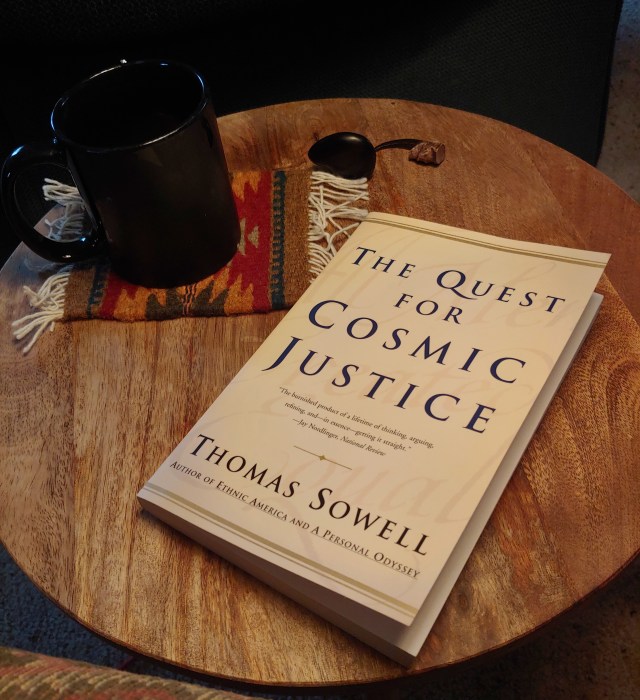
The Quest for Cosmic Justice by Thomas Sowell

Everybody please go read this and as many other Thomas Sowell books as you can get your hands on.

In order to keep warm, it’s good to spend some time with the people we love: Name a fictional family/household/friend-group that you’d like to be part of.

I would like to live with Tom Bombadil and the River Daughter.

Failing that, I would be honored to live and work with Mma Potokwane, the forceful woman who runs the orphanage in The No. 1 Ladies’ Detective Agency series.

The colourful leaves are piling up on the ground: Show us a pile of fall coloured spines!

I didn’t intend it, but every book in this pile except for The Family Mark Twain is indie published.

And Neanderthal Woman is homemade.

Also … the golden-leaved mallorn trees of Lothlorien.

Fall is the perfect time for some storytelling by the fireside: Share a book wherein someone is telling a story.

One of the best things about Lord of the Rings is the way you keep getting hints of yet more ancient places, people, and stories.

And for my backup answer, we have Ursula Le Guin again. In her Earthsea trilogy, there is a very creepy story told about a stone that if you so much as touch it, steals your soul. In her book Left Hand of Darkness, the main story is interspersed with short myths to help us get a feel for the culture of the planet the story is set on, where glaciers cover about half the landmass and people are sexless for most of each month.

The nights are getting darker: Share a dark, creepy read.

The Balrog, and Shelob, and the Ring and the effect it has upon people, are all pretty doggone creepy.

Also, The Dark is Rising and the whole series that follows it deals with pre-Roman paganism still alive in Britain.

The days are getting colder: Name a short, heartwarming read that could warm up somebody’s cold and rainy day.

The Hobbit. Annndddd …

Allie Brosch’s new book Solutions and Other Problems.

It’s not heartwarming in the sense that it presents the universe as a rational or hopeful place, BUT it did make me laugh so hard it brought tears to my eyes. It’s not short in the sense that it’s a big, thick hardcover, BUT that’s only because it is packed with her funny (and actually very artistic) drawings. It’s a fast read.

Fall returns every year: Name an old favourite that you’d like to return to soon.

THE LORD OF THE RINGS.

The Everlasting Man by G.K. Chesterton

Also, this book, The Everlasting Man, by the ebullient GKC. I recently ordered my own copy so that I could mine it for future quotes on the blog, and I quickly discovered that GKC was the original source of all my suspicions about ancient people having been just like us, but smarter.

Fall is the perfect time for cozy reading nights: Share your favourite cozy reading “accessories”!

Bears and coffee.

The Seven Heavenly Virtues Tag

The Orangutan Librarian tagged me for this post that applies the “Seven Heavenly Virtues” to the world of our reading.

By the way. The Seven Deadly Sins are easy to remember, in groups of two, three, and two. There’s The World (Envy, Greed); The Flesh (Lust, Gluttony, Sloth); and The Devil (Anger … and the granddaddy, Pride). The seven virtues are the flip side of these.

Once when I was at university, the theme of our homecoming week was the extremely creative “We’ve Got Pride.” I will always love my fellow English majors who named their contribution to the parade “Beyond pride: the seven deadly sins.” They wanted to show that “[our university] also gots Envy, Greed, Lust, Gluttony, Sloth, and Anger.” And of course it was true.

Onward.

CHASTITY: Which author/book/series you wish you had never read?

Hmm. It’s rare that I go on wishing I had never read a book. Usually if it stuns me with some horror, I hate it at the time, but as my mind assimilates the idea, I’m glad to have encountered it in a book so that I can grapple with that aspect of the world.

A good example is Ken Follett’s Pillars of the Earth. A major part of the plot is a sexual assault. It’s described graphically. The creepy lead-up and the lengthy aftermath include scenes from the point of view of both the victim and rapist. When I read this, it was the first time I’d read a rape described in detail (or, at least, the first time I understood what I was reading). It was very traumatic, and it led to lots of crying and praying for women who were real-life victims. So, as you can see, it bore some good fruit almost immediately.

Later I read another book by Ken Follett in a completely different genre, and it also featured a serial stalker and rapist, with many scenes written from his point of view. At that point I decided that I would not read any more books by Ken Follett, nor would I ever get on an elevator with the man.

TEMPERANCE: Which book/series did you find so good, that you didn’t want to read it all at once, and you read it in doses just to make the pleasure last longer?

I don’t usually show temperance when it comes to serious, emotional reads. … OK, I actually don’t have much temperance at all. I once stayed up all night finishing Mary Doria Russell’s The Sparrow.

However, with comic series, I find that if you binge on them they can become wearing, whereas if you read one every once in a while, they are refreshing. For example, P.G. Wodehouse’e Bertie Wooster books and Janet Evanovich’s Stephanie Plum series.

CHARITY: Which book/series/author do you tirelessly push to others, telling them about it or even giving away spare copies bought for that reason?

Well this question will contain no surprises to anyone who knows me or has followed my blog for any length of time.

The Emberverse series by S.M Stirling: I recommend this often because it encompasses a wide range of interests. The first few books are post-apocalyptic, and then it becomes more of a fantasy series. I’ve recommended it to people because it’s set in the Northwest (Idaho, eastern Washington and Oregon, northern California). Recently I recommended it to someone who is interested in retro martial arts such as sword fighting and archery, because there is a ton of that in these books, including descriptions of how the weapons are made and gripping battle scenes. The research on these books is both wide and deep, from ecology to botany to anthropology to martial arts to Celtic mythology.

Til We Have Faces: A searing, emotional novel about friendship, identity, divided loyalty, and religion. One of C.S. Lewis’s less famous works.

The Everlasting Man (non-fiction): G.K. Chesterton discusses paganism and why it expresses important things about being human … with the cheery paradoxes that only he can bring.

The Divine Conspiracy(non-fiction): With wit and wisdom, Dallas Willard applies the Gospels in a fresh way (which we all need frequently). This is so well-written that it’s a pleasure to read, and you just sail through it even though it’s quite thick.

Now, go forth and read these!

DILIGENCE: Which series/author you follow no matter what happens and how long you have to wait?

Agatha Christie. She has such a large corpus of work that even though I think I’ve read all her novels, I’m never sure.

Also, the Brother Cadfael series by Ellis Peters.

Also anything by Tony Hillerman or Dick Francis.

It looks like formula mysteries are my genre for this.

PATIENCE: Is there an author/book/series you’ve read that improved with time the most, starting out unpromising, but ultimately proving rewarding?

Watership Down. It is gripping from the first, don’t get me wrong, but it is so long. Then when you get to the end, you discover that the author is doing things with it that only a really long book can do.

KINDNESS: Which fictitious character would you consider your role-model in the hassle of everyday life?

Photo by Rene Asmussen on Pexels.com

Any strong, quiet, capable character who consistently takes care of others. Durnik in the Belgariad; Precious Ramotswe in The No. 1 Ladies series; Bardia in ‘Til We Have Faces; Sam Gamgee, Aragorn, Gandalf, Aslan. And, of course, Zillah from my own books.

Unfortunately my gifts and personality are almost opposite from all these characters. But I’ve always wanted to be strong, quiet, calm, and capable.

HUMILITY: Which book/series/author do you find most under-rated?

This is a hard one to answer because I don’t always have a real great idea of what other people are reading. How can I know that the gem I’ve “discovered” hasn’t also been discovered by a bunch of others?

Apparently Thomas Sowell has a bunch of great books about economics and society that have helped the people who’ve read them greatly … but I have not read them, only watched videos of him speaking. There are many such examples.

Now, Discuss

I hesitate to tag people because it seems to freak them out. But if you get inspired by any of the questions in this tag, please answer them either at your own blog or in the comments.