No Friend to This House is A Great Title

Like anybody who has ever encountered it, I have “issues” with the story of Jason and Medea.

In case you missed it, he sails off on the Argo to get the Golden Fleece. She is a witch, daughter of the king of Colchis, descendent of Helios, the sun god. Struck by Eros with an inordinate crush on Jason, she helps him accomplish all the tasks necessary to get the fleece and escape alive. He takes her with him on the Argo, and they crash around Greece, leaving a trail of bodies in their wake. Eventually, he throws her over for a younger model, a native Greek gal who is daughter of the king of Corinth. Medea takes a bloody and spectacular revenge, which I won’t spoil (look it up).

I first heard all this from my ninth-grade Lit teacher. She presented it in a very feminist way, but to be fair, this particular story sort of begs for that. I remember, in university, arguing rather incoherently with a male classmate about who was the real villain in this story. Later, when I was home schooling and read a simplified version of the legend to my kids, we decided we didn’t like the story, and we didn’t like Jason or Medea either, and they were both horrible people and they deserved each other.

So, hopefully, this book will be the nadir of my year of reading Greco-fiction: facing the story of Jason and Medea square on, by reading an entire novel about them.

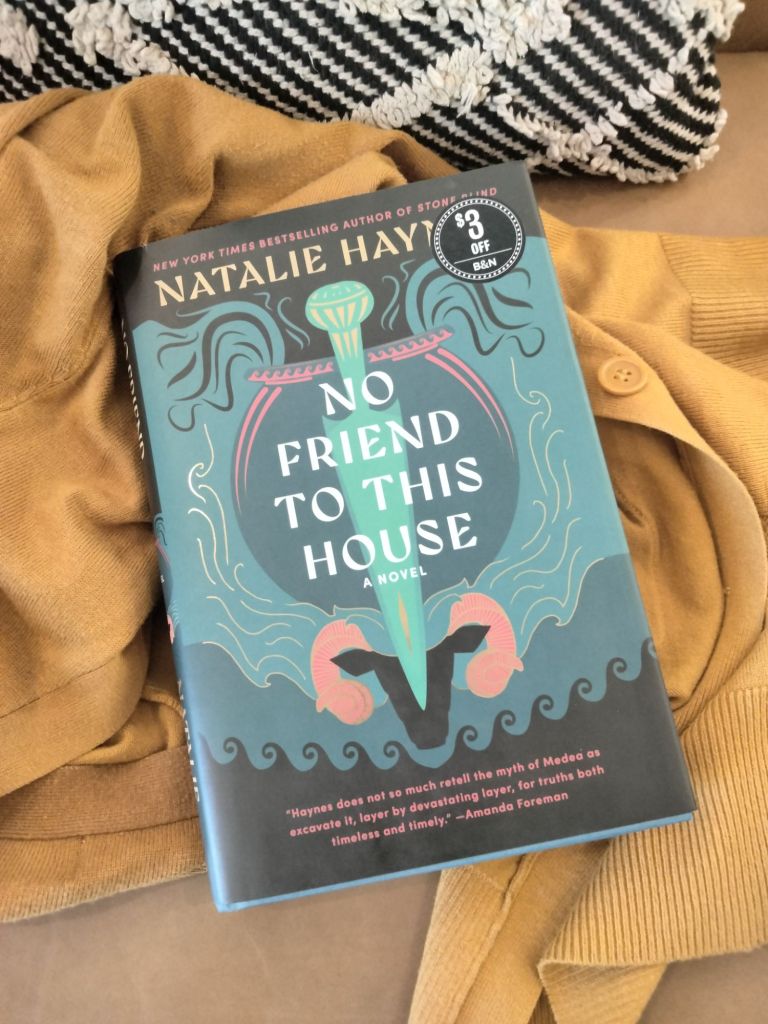
The reason I liked the title of this novel is that it sounded like a phrase taken directly from the Greek — and so it was. The author, Natalie Haynes, has really done her homework.

Euripides’ Medea was the first Greek tragedy I saw performed, and it was the first or second play I read in Greek. … I wrote my dissertation on the heroics of infanticide in Euripides (I don’t have children, before you think about composing your sternly worded letter). … I’ve been reading and thinking about this play for the best part of thirty years, and I have probably seen it performed twenty-five times … I decided that the thing I needed to do [before writing the novel] was translate the Euripides, longhand. This is–in case you are wondering–weapons-grade procrastination. It took me a few weeks …

Haynes, in the Afterword, pp. 359 – 360

Haynes’ treatment of this story has been called feminist. And O.K. … sort of? But it’s not “feminist” in the sense of someone who understands the literature poorly who then reacts against the ancient heroic-age value system and sets out to undermine it. It is, rather, the work of someone who has marinated themselves in the ancient heroic-age mileu, which inherently presented a very broken relationship between men and women (especially husbands and wives). This story, and also the story of Agamemnon and Clytemnestra, bring a lot of tension with them and almost demand that you take what might be called a “feminist” perspective, at least in part, unless you want to take a very simplified view of the whole thing and not really analyze it much at all.

It’s not just me saying this. Apparently, everyone has been arguing about Medea for … well, ever since she came to their attention.

Diodorious Siculus says that the reason we have so many contradictory versions of her story is because tragic poets are drawn to talking about marvels. It’s also worth mentioning that any character who prompts different versions of their story is one who was popular in antiquity. If you want to read more about Medea, I spent many happy hours with “Medea,” a collection of essays edited by James J. Clauss …

ibid, pp. 365 – 366

Apparently, my and my children’s feeling that the whole story is regrettable is echoed by the Nurse of Jason and Medea’s two sons. Here is her opening monologue to the play (translated by Haynes):

If only the Argos had sunk to the bottom of the sea rather than winging its way towards the land of Colchis … For then my mistress Medea would not have sailed to the towers of Iolcus, stricken with love for Jason … and she wouldn’t live here, in Corinth, with her husband and children, pleasing the citizens to whose land she came in flight, helping Jason in everything. That is the greatest help: whenever a wife doesn’t disagree with her husband. But now, everything is hostile .. For Jason–betraying his own children and my mistress–is sharing his bed with royalty … Medea is wretched, dishonored like this. She cries out about the oaths he swore to her .. I’m afraid she is planning something. She’s a strange woman. No one starts a fight with her and takes an easy victory.

ibid, pp. 272 – 273

Successive phrases from this speech are used as chapter headings for the first 3/4 of the book.

I give this book 3 out of 4 stars. (Or 4 out of 5, take your pick.) The research, storytelling and psychology are spectacular. It gets tenser and more tragic towards the end. It is, of course, very hard to read, because this is a tragedy. The hardest parts to read, for me, were the parts where the Nurse speaks to the children. Even though it’s set in the ancient world, this is fundamentally a story about a home that gets broken when the children are very small. That’s hard to bear.

The one missing star? I needed more description.

This book consists almost entirely in monologues by the different characters (except for Jason), punctuated occasionally by dialogue. I guess that makes sense for a novel that is a re-telling of a play. But if I’m going to read a book set in the ancient Mediterranean, which includes a tour of the cities of Iolcus, Colchis, Aeaea (Circe’s island), and Corinth, not to mention the Aegean, Adriatic, and Black Seas, I want more than little hints and scraps about what these places look, sound, and smell like. I want to see the terrain, the buildings, and the clothes people wear. Haynes gives us almost none of that. We only get a little bit of description when it is directly relevant to a plot point, like the Symplegades (giant clashing rocks), or the golden dress that Medea gifts to Glauke. This is where Haynes falls short of Renault, who describes buildings, clothing, and artifacts in detail.

Also, there is almost zero description of how the people look. That’s important to me.

As for Jason, we are only told that he is “good-looking” until he meets Medea, when we find out that he has dark, curly hair and golden skin. This means that we have to go through the Argo’s entire outbound journey making up our own mental image of Jason, and then modify it when we find out what is canon in the novel. In the case of Jason, that may be intentional. Part of his characterization is that he is a chameleon, able to be the figure that people want in order to get what he wants; or, as Haynes puts it, “a blank space where a man ought to be.”

But there are plenty of other characters that Haynes could describe when we first meet them, and she doesn’t. What do the Colchians look like? They are “not Greek.” Do they look Asian? Or is Medea made of gold, like the children of Helios in the novel Circe? What do the different Argonauts look like? The Tutor? The Nurse? Haynes does a better job describing the various goddesses, women, nymphs, and the golden ram whose lives are also busted up by this story … but still, I could use more.

Gentle reader, you have survived the harrowing journey of the Argo with me. What horrible ancient Greek story should we read about next?

I’m Finally Going to Run My Mouth About AI

Within the last week, I consumed two thoughtful pieces of commentary about AI, both by thinkers I trust for different reasons.

The recently independent Jeremy Boreing on the topic of AI. Him I trust because of the actual thought process displayed in the video.

https://dougwils.com/books-and-culture/s7-engaging-the-culture/ai-and-the-cream-rising.html

Doug Wilson’s blog post about AI. Wilson I trust because of the volumes of material that he’s written and I’ve read.

I won’t add much to what they have to say. It’s going to be a busy week, for reasons that will be revealed tomorrow. However, I know that most of you won’t listen to the podcast, and only a small number will read the article, so I will summarize the salient parts of each in a sentence or two.

Boreing makes the point that every new technology comes with the fears and negative effects front-loaded, and the benefits arrive in the medium to long term, as we figure out where it fits in human society and how to limit its harms. He further points out that no new technology has ever delivered on any promises made on its behalf to create “less work.” New tech always creates more work: new industries, but also lots of new things that can be done by people who see the potential.

Wilson, too, points out that lazy folks will try to use AI as a way to avoid work, whereas the diligent and the geniuses will see vast new fields of work open up to them. He adds the obvious (but often overlooked) point that a “workless” utopia would actually be a dystopia.

In short, both men sensibly point out that AI is not going to change human nature. Humans do human things no matter how much tech they have. And we were designed to work.

This is, on the whole, a great relief to me. It is good to hear that the scary new thing is not going to change human nature. Granted, human nature isn’t great, but we already knew that, and all attempts to completely remake it always seem to get rid of the only parts worth saving.

Still, I’m not a total AI-o-phile, unlike, say, our friend Ben Shapiro. That’s because I’m a writer and a visual artist. My thinking is still developing on this, but as of spring 2026 here’s where I’m at.

Everyone senses that stories and art (including music) are the sort of things that ought to be made by people and nothing else. Unfortunately, it’s possible that AI will get good enough at “making” these things, that it will be impossible to detect it. You want a gritty, soulful story with human flaws? It will give you a gritty, soulful story with human flaws. It will get rid of the overly vivid colors and unrealistic smoothness in its paintings. It has already produced a country song by a hard-livin’ male voice about overcoming working-class obstacles.

When this happens, it’s like debasing the currency, but with stories and music and art. These things are much more valuable than currency. That’s bad.

From the creators’ side, everyone’s work will become suspect. This is already starting to happen.

From the consumer side, I am possibly even more upset. I DO NOT like it when I look closely at what appears to be a model wearing colorful European folk clothing, and realize that it’s an AI approximation of same. But at least, I can still realize it. I REALLY won’t like it when I have no way of knowing whether the “human” culture I’m imbibing is actually human culture.

That’s all I got today.

Authorpalooza

About a week ago, I spent the day at a nice, large public library in a nearby city that was holding an event called Authorpalooza.

The hope: library patrons would flock to the event, discover local authors, and buy their books.

The reality: It was mostly authors talking to each other about the writing life, looking at and sometimes buying each other’s books.

Still fun, though.

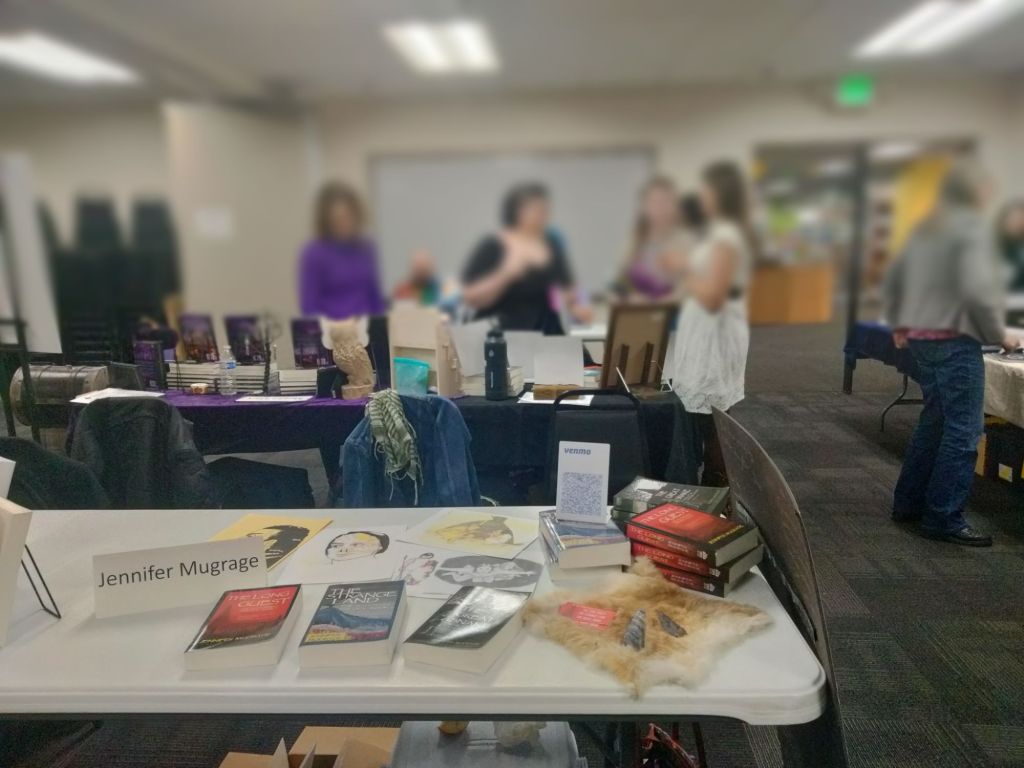
Here’s my book table. I sold exactly one book. In the background, you can see authors talking to each other.

Genres represented included sci-fi, witchy cat books, LDS time-travel historical fiction, Christian YA fantasy, thriller set in a morgue (really!), thrillers set around Indian reservations, practical self-help for authors, and different genres of romance (spicy, comic, cozy, etc.).

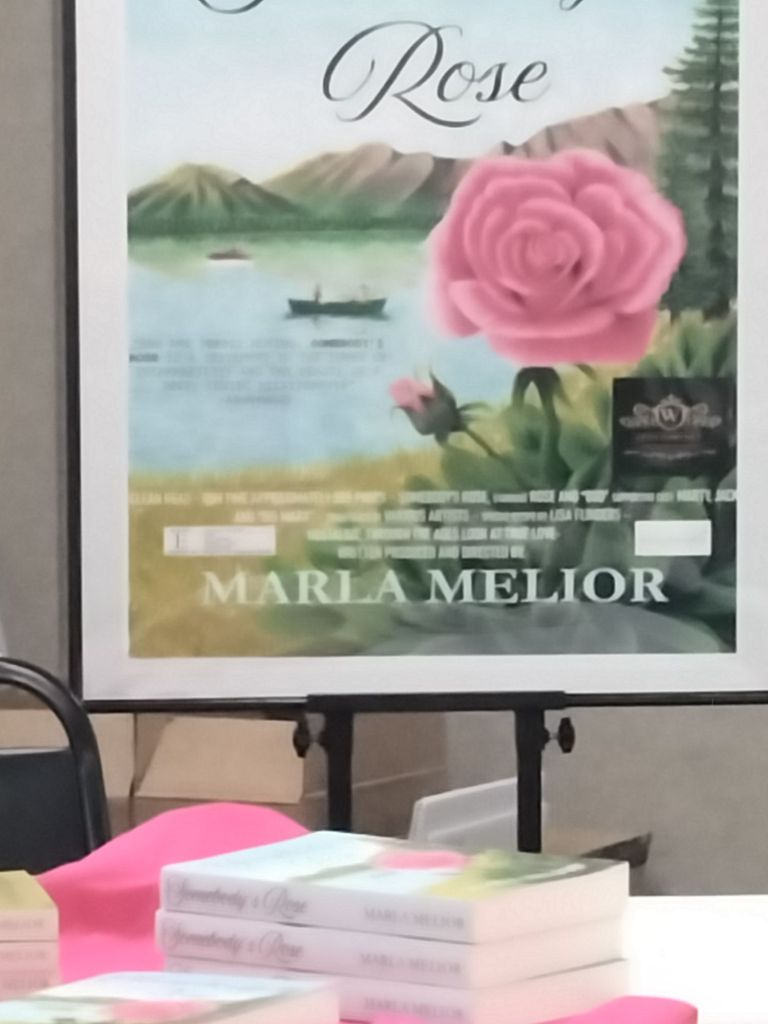
This one author’s name was Marla Melior.

Me (suave as always): Did you know your name means “better” in Latin?

Her: Yes! In fact, I have a podcast called Melior on Mondays.

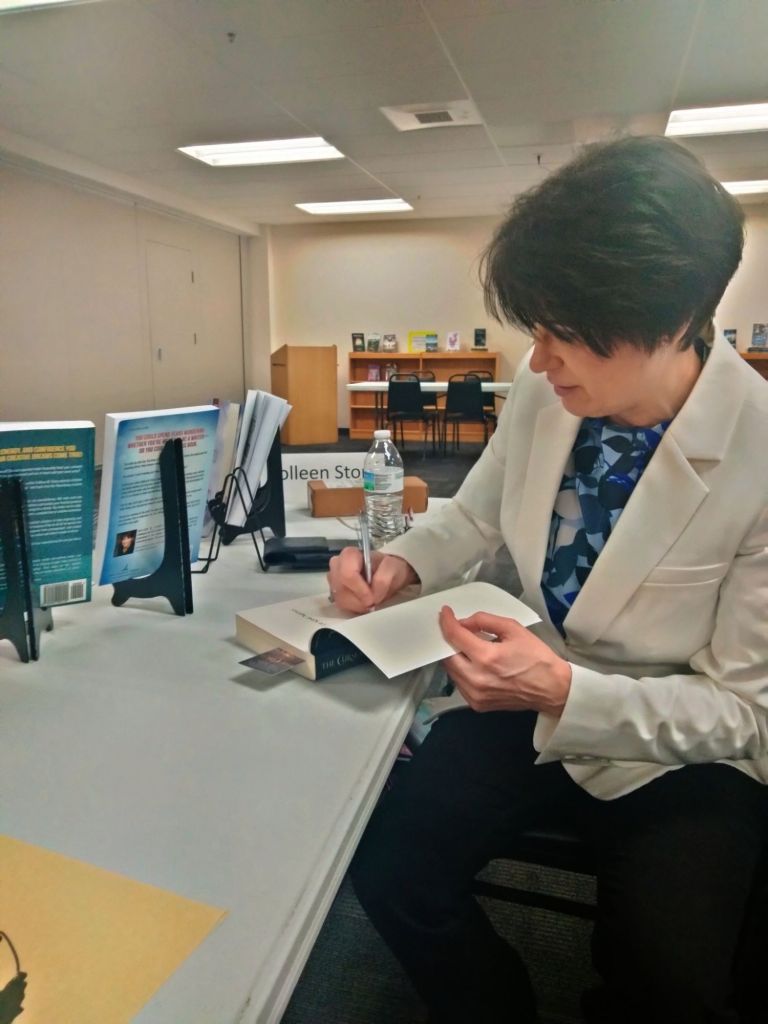
Here is my table neighbor (also happened to be the keynote speaker), signing the only book I bought, which was one of hers.

She has written in a number of genres, including … the genre I am focusing on this year, Greco-fiction! Her book, The Curse of King Midas, blends the historical Midas (a king living in Phrygia in the late 700s BC), with the Midas of legend. I believe there are even gods involved. And there’s a map! No wonder I was undone.

And that’s Catharsis

… in all those parts there is no rite in the year that moves and holds the people like the death of the King. So solemn is the day, he said, that if anyone who watches has grief or fear or trouble of his own, it is all purged out of him by pity and terror; he comes away calmed, and falls into a sleep.

-The King Must Die, p. 67

Misanthropic Quote: Most Cliches in One Paragraph

Gardy was essentially convicted the day he was arrested, and his trial is only a formality. The dumb and desperate cops trumped up the charges and fabricated the evidence. The prosecutor knows this but has no spine and is up for reelection next year. The judge is asleep. The jurors are basically nice, simple people, wide-eyed at the process and ever so anxious to believe the lies their proud authorities are producing on the witness stand.

-from Rogue Lawyer, 2016, by a very lazy version of John Grisham

I’m thinking of having a little contest. Who can find a paragraph crammed with the greatest number of offensive, lazy cliches? This is my submission. This is only the second half of the paragraph, but even if I had included the first two sentences, I still think you’d be hard-pressed to find another piece of writing where not a single word is wasted on any original thought.

Quote: A Typical Roman, for Good or Ill

In summary, the typical educated Roman of this age was orderly, conservative, loyal, sober, reverent, tenacious, severe, practical. He enjoyed discipline, and would have no nonsense about liberty. He distrusted individuality and genius. He had none of the charm, vivacity, and unstable fluency of the Attic Greek. He admired character and will as the Greek admired freedom and intellect; and organization was his forte. He lacked imagination, even to make a mythology of his own. He could with some effort love beauty, but he could seldom create it. He had no use for pure science, and was suspicious of philosophy as a devilish dissolvent of ancient beliefs and ways. He could not, for the life of him, understand Plato, or Archimedes, or Christ. He could only rule the world.

–Caesar and Christ, by Will Durant, pp. 71 – 72

After That, the Dark by Andrew Klavan

Let me fangirl for a minute

I am not a person who eagerly awaits the latest release in a series, and pre-orders books as soon as they become available. Usually, I am the one who discovers the series 20 years after it came out. In fact, this series by Klavan is the only exception I can think of. I pre-ordered After That, and it came, as promised, on Halloween.

Mini reviews of the whole Cameron Winter series

This is the fifth book in the Cameron Winter series. The other books are:

  1. When Christmas Comes (O.K. Sets up Winter’s history, shrink, and issues.)
  2. A Strange Habit of Mind (I like it because my mind is also strange.)
  3. The House of Love and Death (Tragic!)
  4. A Woman Underground (Also tragic, but satisfying. Wraps up Charlotte)

After That, the Dark takes Winter on the next stage of his journey. It’s designed to be readable as a stand-alone, but you will find it more satisfying if you’ve been with him all along.

The Basic Review

Like every Winter book, this one deals with Winter’s psychological journey, and on a parallel track there is an equally devastating crime that he is trying to solve and, inevitably, prevent. Subplots include Winter’s love life and his battles with the leftie professors at the university where he is an English professor.

The title for this book is taken from a poem by English Romantic poet Tennyson:

… Who imagined that his death would be like sailing over the sandbar near the coast and out into the greater ocean.

Twilight and evening bell,

And after that the dark!

And may there be no sadness of farewell,

When I embark;

For tho’ from out our bourne of Time and Place

The flood may bear me far,

I hope to see my Pilot face to face

When I have crost the bar.

ibid, p. 160

Cameron Winter’s academic specialty is English Romantic poetry (about which Klavan recently published a book, himself). Throughout this series, it’s sort of felt as if Klavan wants to have the best of both worlds with his hero. Winter is a former government operative, a dangerous man, and also a soft, spiritual guy who just wants everyone to appreciate poetry. Sort of like a medieval knight. I haven’t felt that this tension was 100% successful in past books, although it does lead to the Superman dynamic where the nerdy guy takes off his glasses and messes up the bad guys good, which is always fun. But in this volume, Winter starts to integrate these two different sides of his personality.

The crimes in this book deal with transhumanism. The victims and potential victims are mothers and babies. One potential victim is an expectant mother who has noticed changes in her husband and can’t articulate them well enough to get anyone to believe her. It’s the kind of thing I wouldn’t have been able to handle a few years ago, when my kids were smaller. I kept reading only because this is Klavan, and I know he doesn’t like stories where women get butchered gratuitously. “Look, when there’s a killer chasing a girl with a knife, I’m on the side of the girl!”

So, if you like poetry, action scenes, demonic possession, or personal growth, you will get all of that here. It’s not exactly like any other action/crime book I’ve read. The hero is usually wrestling with his own demons, but in other books he doesn’t spend so much time talking to his shrink. It’s a bold move on Klavan’s part to allow the hero to actually start beating the personal demons. I don’t know how he’s going to continue a noir-type series once his hero becomes psychologically healthy, but I’m sure he’ll find a way.

As you can see, I’m a little conflicted about Cameron Winter. But I still wholeheartedly give this book five stars, and if you want to find out why, read on for some major spoilers.

Spoilers … and Jesus

I have mentioned before that what I live for in books is when the characters’ concrete experience and myth coalesce, so they are walking the specific path in front of them, but also enacting a mythological scene at the same time. This is a little hard to describe, but you know it when you see it. It’s what makes great art.

This fusion of the everyday and the eternal is most often found in the fantasy or sci-fi genres, because to be honest, it’s easiest to set up there. But to my delight, Klavan has here pulled it off in a modern thriller/true-crime type novel.

Let’s go back to the pregnant woman who starts to suspect her husband. Her name is Tilda, a name probably chosen for how vulnerable it makes her sound. Tilda used to be a “bar girl,” one of the town’s easy marks. Then, her husband Martin picked her up with the line, “Do you have a minute to talk about Jesus Christ?” Tilda thought that was a pretty good joke, but then Martin actually did. He actually did talk to her about Jesus Christ. And he was a perfect gentleman. Tilda married him, and she became a Christian and her life completely changed. But now, the man who led her to this change seems to have become a completely different person and Tilda, understandably, doubts herself. Sometimes, she secretly wonders whether she’s really faking this whole Jesus thing.

Winter, meanwhile, is on the track of a man he knows is out there. He knows this man will have undergone a dramatic personality change recently, and that if not found he will begin to commit gruesome crimes. Winter, though an atheist, is dating a Christian girl and she has given him a cross for his spiritual protection. Winter keeps the cross in the coin pocket of his jeans. When the bad guys, after beating him rather severely, have him handcuffed to a chair, he is able to get the cross out and use it to pick the locks on the cuffs. There follows an action scene wherein Winter, still holding the cross, manages to escape the bad guys and run barefoot into a cornfield. As he runs, a cornstalk punctures his foot. When he finally stops running and wonders why his hand hurts, he looks down and finds that the cross has pierced the inside of his fist. He has to dig it out.

When I read that, I looked up and said to my husband, “The hero just received stigmata.”

But Klavan isn’t done with Winter yet.

Tilda, meanwhile, is tied up in the crawlspace in a house her husband has been working on. She knows her husband is about to come and finish her off. Her mind is a hurricane of incoherent prayers for Jesus to spare her unborn baby.

Then Winter shows up, having already decommissioned the husband outside. Because he has been beaten so badly, his face is a swollen mess, “like a monster.” And the first thing he says to Tilda is exactly what I knew he would say:

“Don’t be afraid.”

This is how Jesus comes to us. “His appearance was so disfigured beyond that of any human being, and his form marred beyond human likeness.” (Isaiah 52:14) He shows up looking like that, and He says to us, “Fear not.”

As Winter strives to calm Tilda down enough to rescue her, he keeps saying the sorts of things that Jesus says:

“Listen to me,” the man said. “I’m going to use a knife. No, no, it’s all right, don’t be afraid. I’m going to use a knife to cut you free. It will look scary, but I will not hurt you. Nothing will hurt you now, but I have to cut you free. Don’t be afraid.”

… The man had climbed out of the space. He was above her again, reaching down for her with both hands.

“[Your husband] is not here. Let me get hold of you. Don’t you hold on to me,” he said. “I’m stronger. Let me hold on to you.”

… Tilda was crying hard now. “I prayed to Jesus and you came,” she explained.

“Oh. Well, good,” said the man. “It’s nice when things happen that way.”

ibid, pp. 305 – 307

That last line, by the way, shows that Klavan is not trying too hard with Winter. Nor is he writing an allegory. This kind of double vision in a book is all the harder to do when you let it grow naturally out of the story and don’t force it. Kudos.

Two October Reads

You Don’t Own Me, by Mary Higgins Clark but actually by Alafair Burke, 2018

I reached for a Mary Higgins Clark because it’s autumn and I wanted me some New York City. I would never want to live there, mind, but a certain version of NYC gives autumn vibes that can’t be beat. I wanted wet leaves, Burberry plaid, private schools, brownstones, Italian restaurants, snobbery, and houses in the Hamptons. (Don’t even know where the Hamptons are, but I know they come with the package.) This book delivered those vibes adequately. It even had me turning to DuckDuckGo to look up some hole-in-the-wall restaurant in the art district that has been a NYC fixture for years apparently. Or I don’t know if New Yorkers would consider it a hole in the wall. The pictures make it look like one, to my West-of-the-Mississippi eyes, where everything is spread out from everything else.

Anyway. This was very New York-y. The protagonist’s dad is a retired NYC cop. There are Italian restaurants. There are nannies. The fiance has a live-in butler. The couple spend most of the book looking for an apartment that has to be in a certain part of the city. In fact, their realtor was so pushy that I started to wonder whether she would turn out to be in on the crime-spiracy. For NYC vibes, it was second only to a Mary Higgins Clark that I read years ago, where the protag’s mother was in the fashion industry and was killed in Central Park by being strangled with a high-fashion scarf.

As with every Mary Higgins Clark, the plotting is very good, very intricate, and the dialogue not so much. Every person who talks is very smooth, articulate, and sounds like a news anchor or else like the narrator. Oh well. I didn’t come here for Chaucer. This book went down easy.

Sweetgirl, by Travis Mulhauser, 2016

This is a Michigan gothic, which is like a Southern gothic, but with blizzards and rude people instead of polite people.

It veers very close to being a horror story, but my overwhelming impression is that of heartbreaking sorrow, but sorrow with a lot of human sweetness in it too.

The very first line sets up the whole plot by outlining the problem and introducing the principle characters in one fell swoop:

Nine days after Mama disappeared I heard she was throwing down with Shelton Potter.

Percy James is a sixteen-year-old girl who is an adult before her time. She has quit school and taken a job so that she can support herself and her druggie mother. Shelton Potter is sort of the opposite: he’s twenty-five, but his mental life is more like that of an immature teen.

The chapters alternate between Percy’s point of view, told in the first person, and Shelton’s, told in limited third. Although Percy goes through a lot of horrible stuff, which I won’t share because of spoilers, the parts that really broke my heart were Shelton’s internal monologue. Although Shelton spends the entire book high–making one horrible decision after another–a danger to himself and others–he still has thoughts and feelings. Quite a lot of feelings, actually. Mulhauser does an amazing job making us follow Shelton’s train of thought, feel his sorrow, and see his naive good intentions. Shelton really does have a good heart. It’s just that he doesn’t have any self-control or common sense. Oh, and he’s high all the time. Many books will give us an antagonist who’s a drug dealer/addict, may be violent and touchy, and may not be too bright, and often at or near the end of the book we get a tiny, poignant glimpse into this person’s sad back story. It’s a rare book that has us in that person’s mind from the very beginning, sympathizing with him to a degree but also hoping something stops him before he does major damage.

One more thing I will say in praise of this book: the prose is top shelf. To take just one example, the last paragraph of the book has Percy going through a variety of complex, poignant emotions. It does not have a single sentence telling us what Percy was thinking or feeling. Instead, every sentence in that paragraph describes something she can hear from where she’s standing. It’s all entirely concrete, and it will rip your heart out. That, my friends, is showing-not-telling. I learn at Travis Mulhauser’s feet.