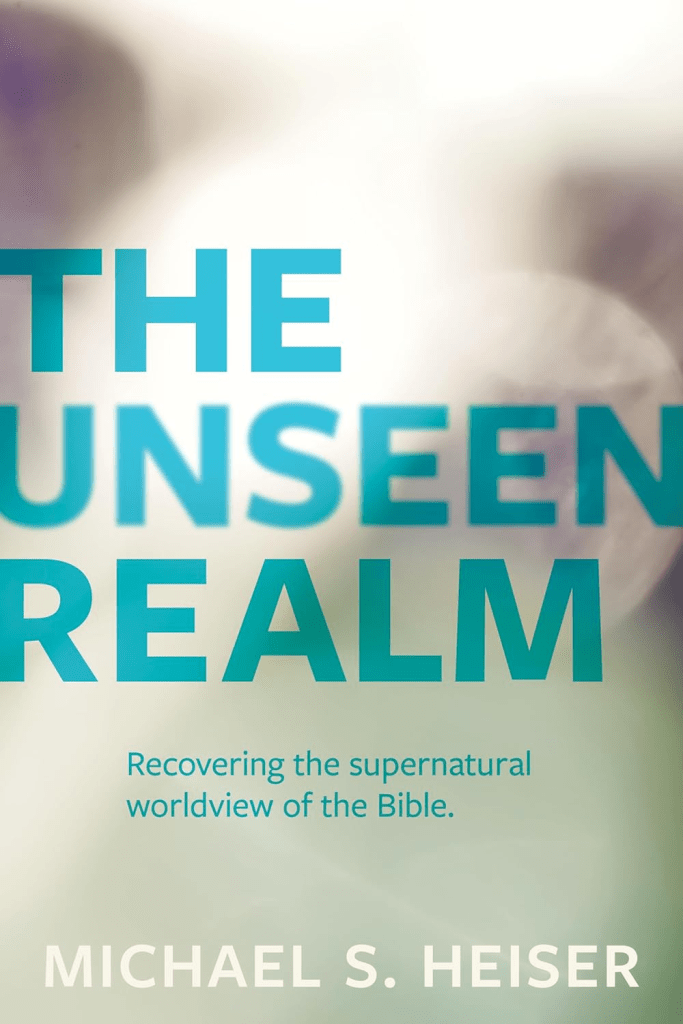
The Unseen Realm is a scholarly book about the concept of the divine council in Ancient Near Eastern cosmology, especially in Ugarit, which was a near neighbor of Israel both geographically, culturally, and linguistically. Heiser finds this concept of the divine council assumed in the Hebrew Scriptures, similar to how the heliocentric model of the solar system is assumed in anything you see written since Copernicus. That is, it’s never stated or described directly, but it is referenced in many stories, phrases, and figures of speech, and is openly the setting for certain passages, such as Psalm 82.
The idea behind “the divine council” is that there is a Most High God (the Creator) who rules the earth with the help of a sort of committee of divine beings (elohim). This committee is traditionally conceived of as meeting on a high mountain, in a garden setting, often a place that is the source of rivers. Or as Ps. 82 calls it, “the great assembly.”
Heiser spends most of his book establishing that this view is present in Scripture.
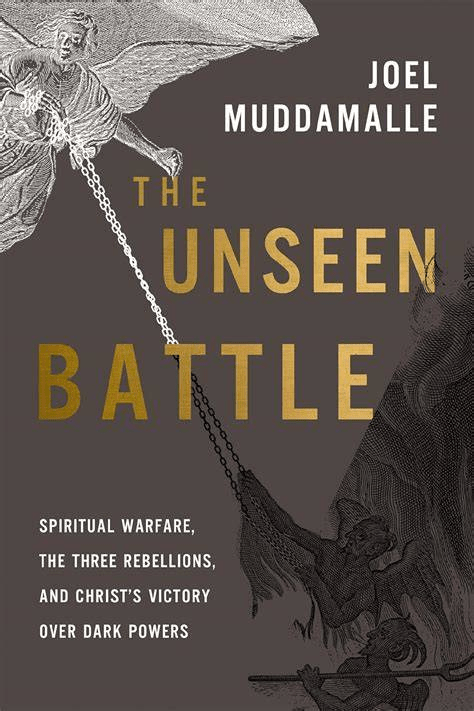
After reading Heiser, I heard a podcast interview with Joel Muddamalle. Muddamalle is the academic protege of Heiser (who has now gone to his reward). He is carrying on with researching this idea of the elohim as an active presence in redemption history, and also with popularizing it in the Christian world. And I heard that he had written a book, The Unseen Battle, which might be viewed as a sequel to Heiser’s book. So naturally, I had to get it.
I expected TUB to be all the same material as TUR, just with Muddamalle’s own personal style. It was not. The first few chapters do recap Heiser’s cosmology, but they don’t spend a lot of time establishing it, as Heiser did. Muddamalle then moves on to the nature of the battle, which Heiser touched on but did not major on.
The nature of the battle is that God wants to get the nations back from the gods.
The way this is done, in the church age, is through evangelism, missions, and building healthy churches and families. In short, obedience. It’s not primarily through a lot of fancy, spooky ghost-hunting or exorcism stuff.
This exegesis, naturally, warmed my little Reformed heart.
Now, it does mean that, if you are attempting to be faithful to your spouse and/or raise your kids; work hard and honestly at a lawful calling; worship the Lord on Sunday and support His people; or do any other forms of healthy, faithful culture-building, you have stepped into the battle. The dethroned powers do not like this sort of behavior. This may, perhaps, explain why just trying to mind your own business and live a quiet, peaceable life can occasion so much resistance: everything from health problems, to Murphy’s Law and attacks of depression and discouragement; to actual hate and legal resistance from human beings who do not like what you are doing. (Per Muddamalle, Scripture makes it clear that the “hosts” on both sides of this battle are mixed, consisting of human beings and of spiritual beings.)
Particularly if you are contributing in any way (including by prayer) to the disciplining of not-yet-Christianized nations, you present a threat to the old gods, who do not want to be cast out as they have been cast out of so many other nations in the last 2000 years. This is why foreign missionaries and native pastors in unreached or partially unreached countries undergo so many hardships: poverty, evil bureaucracy, and all kinds of health and mental problems.
The church itself, existing as an entity comprised of people from many nations, is a rebuke to the powers.
The multiethnic and diverse nature of the family of God, the church, can be seen through Paul’s use of polupoikilos. This term is a combination of two adjectives meaning “much” (polus) and “various kinds, diversified, manifold” (poikilos). The word polupoikilos can also mean “of many colors” or “polychrome.” Classical Greek writers used this word to reference cloth or flowers to convey a sense of intricate beauty. The word poikilos is used in the Septuagint to refer to Joseph’s coat of many colors (Gen. 17:3, 23). As Timothy Gombis observes, “The powers have ordered the present evil age in such a way as to exacerbate the divisions within humanity. God confounds them by creating in Christ one unified, multiracial body consisting of formerly divided groups of people.”
ibid, pp. 169 – 170
How about that. The Rainbow of Diversity, which we have been taught to hate, is actually God’s goal as well. The reason that we have been taught to hate it, is because of the way they have pursued it … trying to force it down by means of human power and moralism, by defining righteous and unrighteous groups and viciously suppressing those deemed to be foes of the rainbow. They have made “inclusion” mean “we exclude you.” This is what happens any time people try to make the world look like the restored heavens and earth, without Christ. They end up bringing about the opposite. True harmony among the ethnic groups is not an easy thing. It can only be obtained by means of the New Birth.
Though this is a scholarly-for-the-layperson work, Muddamalle’s lighter personality shines in it. He has many call-out boxes sprinkled throughout the book, devoting a page or two to questions such as, “Are There Aliens in This World?” and “What About Demonic Exorcisms?”.
That’s it. Just I promised: a short review.
Oh! What are the “three rebellions”?
Adam and Eve’s rebellion at the Tree
The rebellion of the “sons of God,” when they chose to come down and take human wives (Genesis 6)
Humankind’s post-Flood rebellion at Babel (Genesis 11). It was at this point that God divided up humankind among the elohim, giving each people group extant at the time its patron god.
Anyway … back to the battle! God be w ye this weekend!
Alien Intrusion: UFOs and the Evolution Connection by Gary Bates, A Book Review
I’ve found myself recommending this book to multiple people in multiple comments sections in recent days, so perhaps it’s time to re-post a shortened version of my review of it from 2024. This is a great resource if you’re wondering about UFOs and the beings that are presumably inside them.
Alien Intrusion is 400+ pages, with endnotes to each chapter, appendices, and an index, yet it is accessibly written. It is a capable survey of the whole phenomenon, starting with the social history of UFO sightings and how aliens are portrayed in fiction; moving on to the science of whether light-speed travel is really possible (it’s not); whether indications of physical life beyond Earth look promising (they don’t); the theory of Directed Panspermia and how it was supposed to save evolution; sightings of lights in the sky and cover-ups associated with them; conspiracy theorists, true believers, and hucksters who have capitalized on the UFO craze; and finally, testimonies of people who have had abduction experiences.
“Abducted — Close Encounters of the Fourth Kind” is a really interesting chapter. Bates has just spent more than half the book showing that the extraterrestrial hypothesis, at least as it is usually understood, cannot be true for multiple reasons. But now, he turns his attention to the many people who have had alien abduction experiences. And instead of dismissing them as hoaxers (dealt with in the last chapter) or gaslighting them, he believes them. And he has a great deal of compassion for them. This is why I think so highly of Bates.
A “Typical” Alien Abduction Story
According to Bates, drawing on the work of other researchers, here are the elements of “Classic Abduction Syndrome [CAS]”: the abductee is captured, often at night, and often while being seemingly paralyzed. Once on the ship, they are typically undressed and subjected to some kind of invasive and humiliating “medical” examination. Often, this escalates to sexual abuse of various kinds. Then, the aliens “teach” the abductee. This involves being told that they have been chosen for a special mission. Predictions are made about the future of earth or of humanity. The aliens are trying, and they want the abductee’s help, to raise humanity’s consciousness or to save humanity. Often, they say they are engaged in a breeding program, creating human/alien hybrids. Sometimes this is explained as a way for humanity to survive when the earth is destroyed. Abductees may be given a tour of the ship or of other locations, and they may meet a divine being or an entity claiming to be Jesus, the pope (!), or a dead relative. After the abductee is returned to his or her surroundings, they often don’t immediately remember their abduction experience. They may experience “lost time,” and recall the experience only later (sometimes under hypnosis, which raises other issues).
Abductees experience lasting physical and mental aftereffects of their experience, whatever its nature may have been. They have PTSD-like symptoms. They have may bruises, scars, or puncture marks on their body, though these are never of an obvious enough nature to prove their story. They may experience new chronic health problems, commonly with their reproductive system, even including uterine or breast cancer.
On the spiritual side, many abductees come out of the experience with a new openness to the occult and to New Age beliefs. Others, though they initially feel understandable anger and fear towards the aliens, after multiple abductions come to a passive state of appearing to love and be fascinated with their tormentors, almost like Stokholm Syndrome.
Assuming that all these people are not just making up these bizarre and traumatic experiences, it is clear that they have come into contact with entities that do not wish them well.
On their own testimony, the “aliens” can be shown to be unreliable. For example, they tell abductee they are torturing them “for your own good.” They say they are wise and want to help human beings evolve to the next level, yet they subject their human subjects to frightening and degrading sexual practices. Either these beings don’t understand humans very well, or they are traumatizing them on purpose to “break” them.
The aliens also seem eager to explain exactly where they are from. In past decades, they would claim to be from Mars or Venus. Now that we know more about those planets, they tend to name a star or star system that is outside of our galaxy. Aliens tend to appear to humans in whatever form is culturally expected at the time.
Over the decades, we have allegedly been visited by long-haired Space Brothers, stacked Space-Babes, black-eyed and large-headed dwarfs, bipedal reptiles, praying mantis-type creatures, and … well … the list goes on and on. But, they all seem perfectly comfortable with Earth’s gravity, temperature, oxygen levels, etc. Doesn’t that strike you as a bit odd?
Nick Redfern, UFO researcher, quoted in ibid, p. 321
So, we have powerful, apparently deceptive entities, which kidnap and traumatize people, and then unfailingly give them a New Age message to take back to earth, often going out of their way to say that the Bible has “gotten it wrong.”
Furthermore, apart from claiming to be from space, these “alien” abduction experiences have a lot in common with abduction stories from past ages where the perpetrators were fairies, demons, or other paranormal entities. It is starting to look as if we are hearing the same song, but a different verse. And in fact, Bates suggests that these “aliens” are probably demonic, or fallen angelic, entities. They are, in short, the “elohim” described by Heiserand identified as “the gods” by Cahn.
Jesus Really Is the Answer
Two UFO researchers, Joe Jordan and Wes Clark, noticed that out of all the abduction cases they had heard of, very few were Christians. They put out a call for anyone who was a Christian and had an abduction experience to contact them. Confusingly, they were contacted by people who said things like “I’m a Christian and I was abducted and saw Jesus on the spaceship.” With further research, they found that people who identified as Christian but did not “walk the walk,” as the researchers put it, were just as likely to experience abduction and subsequent New Age brainwashing by the “aliens.” However, “walk the walk” Christians had a different experience:
Clark said that many of the respondents claimed to be Christians who told of their own abduction experiences. He felt that they were happy to have someone to talk to; they usually felt uncomfortable talking about their experiences because most UFO investigators had New Age inclinations and ideas that opposed their own beliefs. In addition, the Christian church is not equipped to deal with such reports because the UFO phenomenon has been largely misunderstood and dismissed by organized religions. Clark comments:
“As the number of cases mounted, the data showed that in every instance where the victim knew to invoke the name of Jesus Christ, the event stopped. Period. The evidence was becoming increasingly difficult to ignore.”
ibid, p. 267
So, My Prediction
Therefore, here’s what I expect from the government files about UFOs which are being released a chunk at a time.
These files cover years of reports, so they will comprise a bunch of different types of experiences. “Aliens” seem to adjust their approach based not only on the cultural expectations of the time, but regionally as well, and perhaps tailored to the individual. So this will be a very heterogenous mass of stuff.
Most of it will not be conclusive. There will be grainy videos and plenty of eyewitness testimonies. Some of the testimony is going to come from people considered sane and reliable (like Air Force pilots), but most people simply can’t bring themselves to accept testimony of something they believe is impossible, no matter how upstanding the witness. As we have seen with abduction experiences, “aliens” might leave some kind of physical evidence (small puzzling scars), but they tend not to leave anything conclusive. Observe that they have been dropping strange hints, and lots of them, for more than a century, but they have never made an open appearance that would settle all questions.
If there really are, say, powerful and ethically challenged interdimensional beings who wish to sell humankind a narrative by appearing as aliens, why have they not settled on a unified approach and made a big, dramatic appearance with an internally consistent story to back it up? I can think of three reasons.
The first reason is that they want control of the narrative, which means they only want to present themselves openly to people they can successfully brainwash. Presumably, they can’t give Stockholm Syndrome to 300 million people at the same time, so they save the extreme treatment for individuals. For people they can’t directly access for whatever reason, they give ambiguous physical phenomena, such as lights that move as nothing should be able to.
Second reason: They aren’t unified, and/or they don’t have really great self-control. There is no reason to think that fallen angelic beings would all work together. Perhaps they are all going rogue. Clearly, they can’t resist torturing their victims, even when that would seem to work against their goal of presenting as wise and gaining humankind’s trust.
Third reason: They are limited by a greater power. You cannot come into a strong man’s house and take his possessions unless you can first tie up the strong man. Say you want to manifest yourself as a god or with a big obvious spaceship in a randomly chosen country. If that country was, at one time, loyal to the Creator of the Universe, and large sections of it still are, He quite likely will not put up with this.
So, from these government files I expect a bunch of different stuff, maybe even an alien “corpse,” which will be weird and ambiguous and perhaps look like it was made for a movie (because, in a sense, it was) … but nothing that would be seen as conclusive by a skeptic.
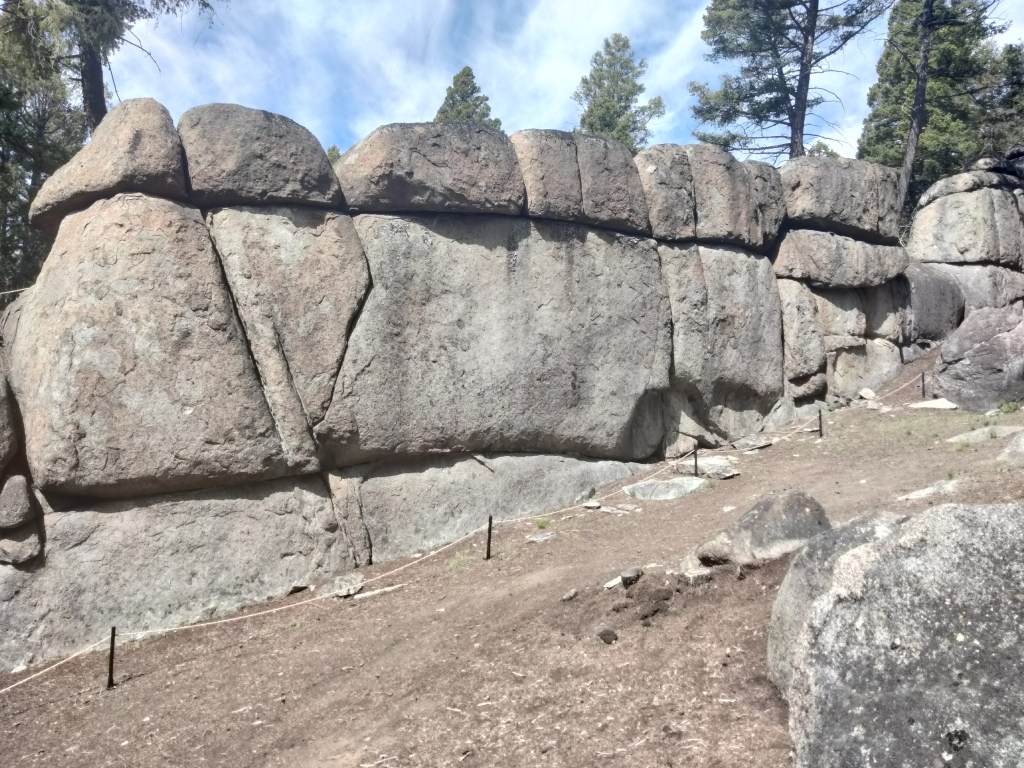
Here I am at Sage Wall, to give you some idea of the scale.
Sage Wall is a possible megalithic site near Butte, Montana. In this post, I am going to thoroughly embarrass my geologist husband by saying that Sage Wall looks manmade to me. But first, how did I come to visit Sage Wall in person?
Getting to Sage Wall
It’s on my bucket list to visit as many archeological sites as a I can, the older the better. Sage Wall was a no-brainer because it’s only a half a day’s drive from my house. It is also a good candidate to visit because looking at photos is kind of ambiguous. To really get a sense of whether it seems manmade or like a natural formation, I felt I had to be there in person.
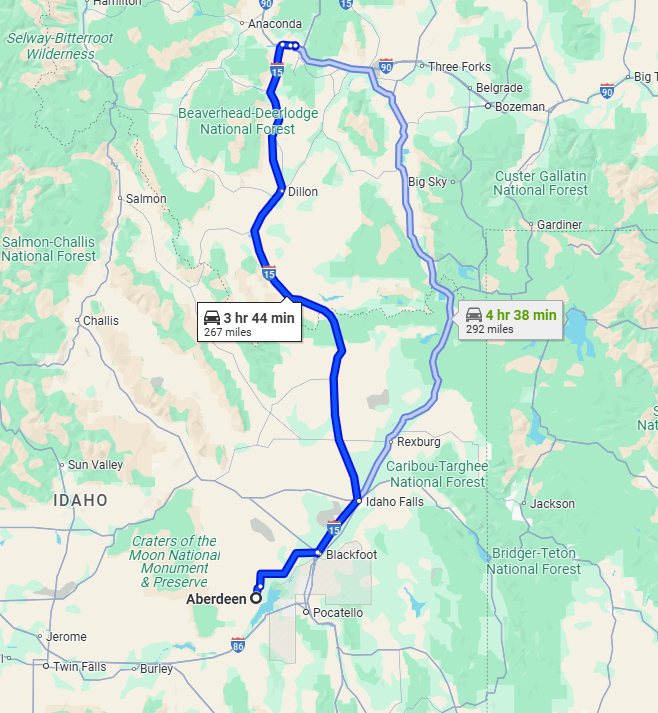
We drove up into the beautiful Montanan Pioneer Mountains (Idaho has some as well), stayed the night in Butte, and the next day, made our way to Sage Mountain Center, where I had a reservation. We could not have asked for a more beautiful day, weather-wise. Early June in the Butte area is still basically Spring.
Chris and Linda are the property owners at Sage Mountain. About three decades ago, they wanted to move out to the middle of nowhere and build a sustainable house and retreat center. They were not looking for megaliths. Linda stumbled upon the wall on a hike one day, and Chris, who has a background in building, looked at it, said, “Yep. That doesn’t look natural. Well, let’s get back to our projects.” It wasn’t until years later, when they had established a sustainability-themed retreat center and had started to create some hiking trails for their guests, that other people started noticing the wall. Chris and Linda cleared the brush around the wall, roped it off, and had it examined by LIDAR and ground-penetrating radar.
Now, many people are coming to see the wall, seemingly to a point where it is almost becoming a problem. Sage Mountain Center is still on a wind-y, washboard-y dirt road, but now many people, seeking to get away from it all, have built new houses and cabins along that same road. Chris asked us, as we drove out, not to “go too fast past our neighbors. We’re trying not to bother them.” I got the impression that his main desire is still to just run a sustainability B&B in peace, but he’s been saddled with this danged wall.
What Would a Skeptic Say?
I want to give the skeptical geologists their due here. I think what they would say is this: “All these people who are saying Sage Wall is amazing megalithic structure are forgetting one thing: It is right in the middle of the Boulder Batholith! There are big granite rocks everywhere!”
source: formontana.net
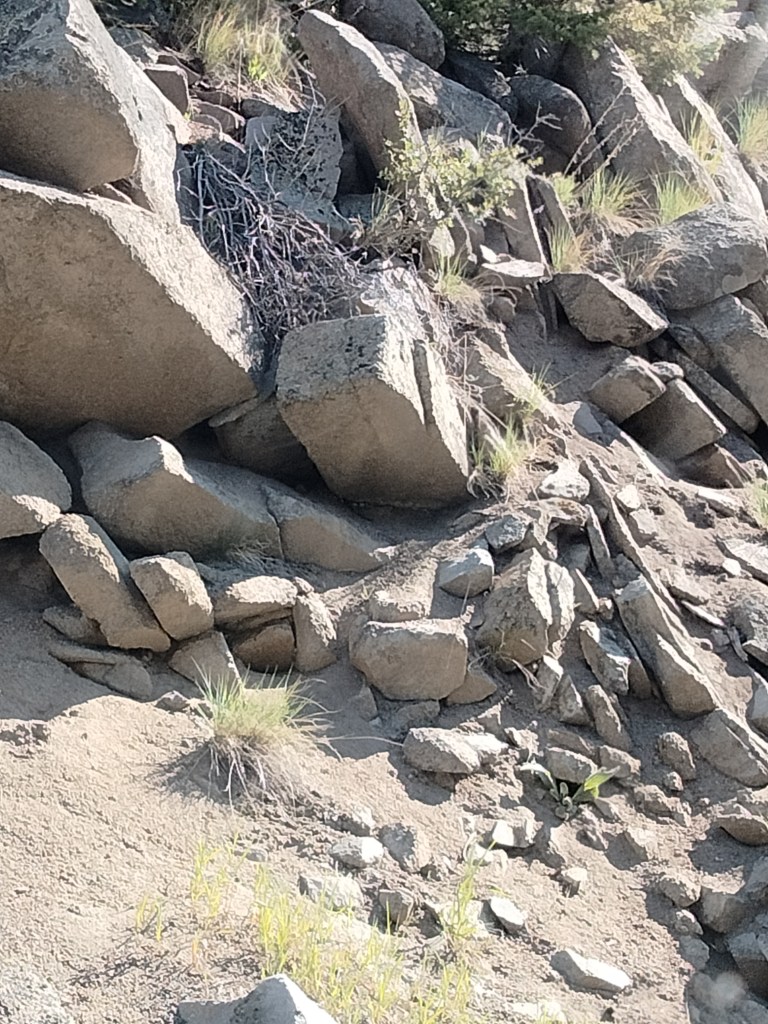
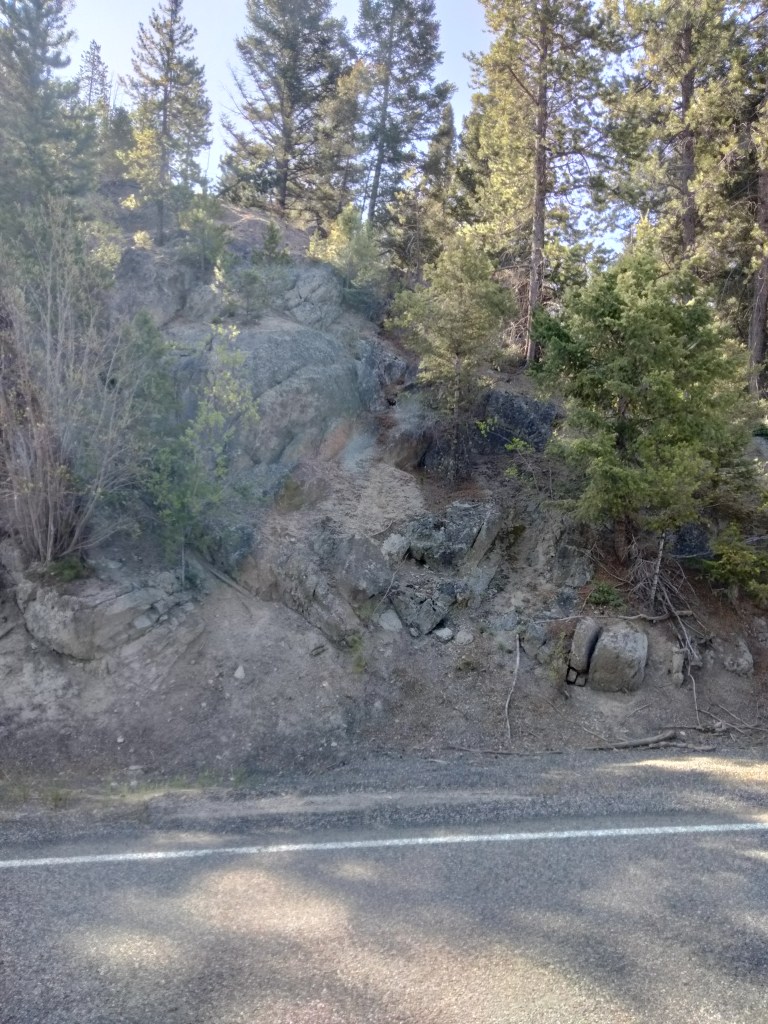
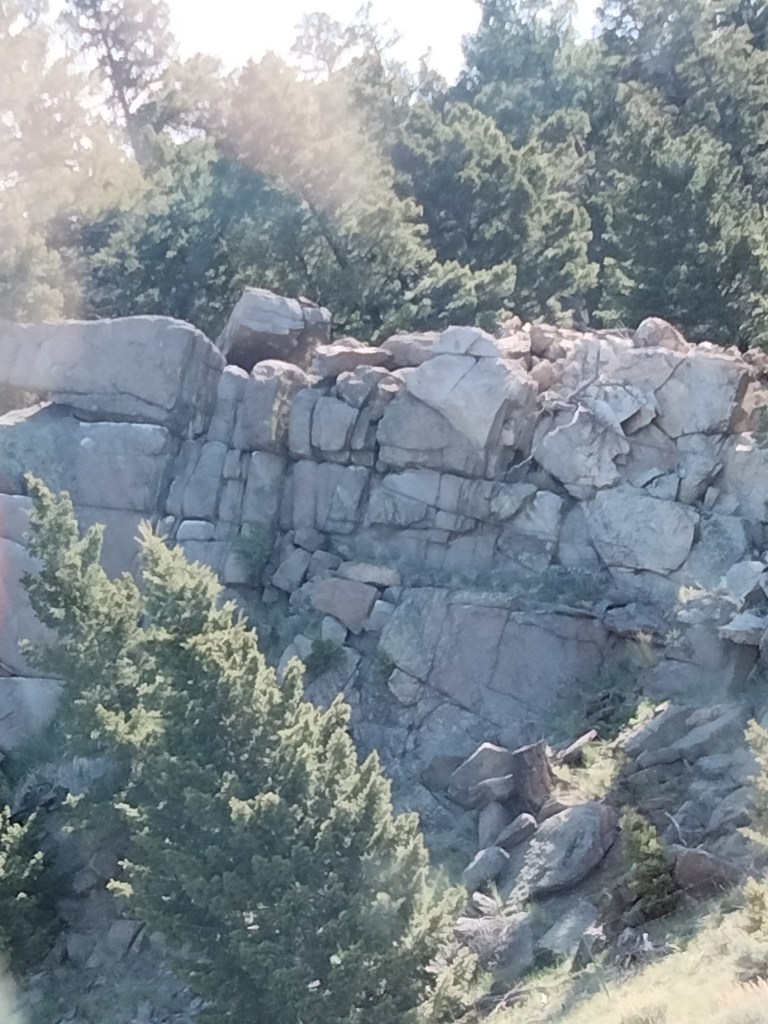
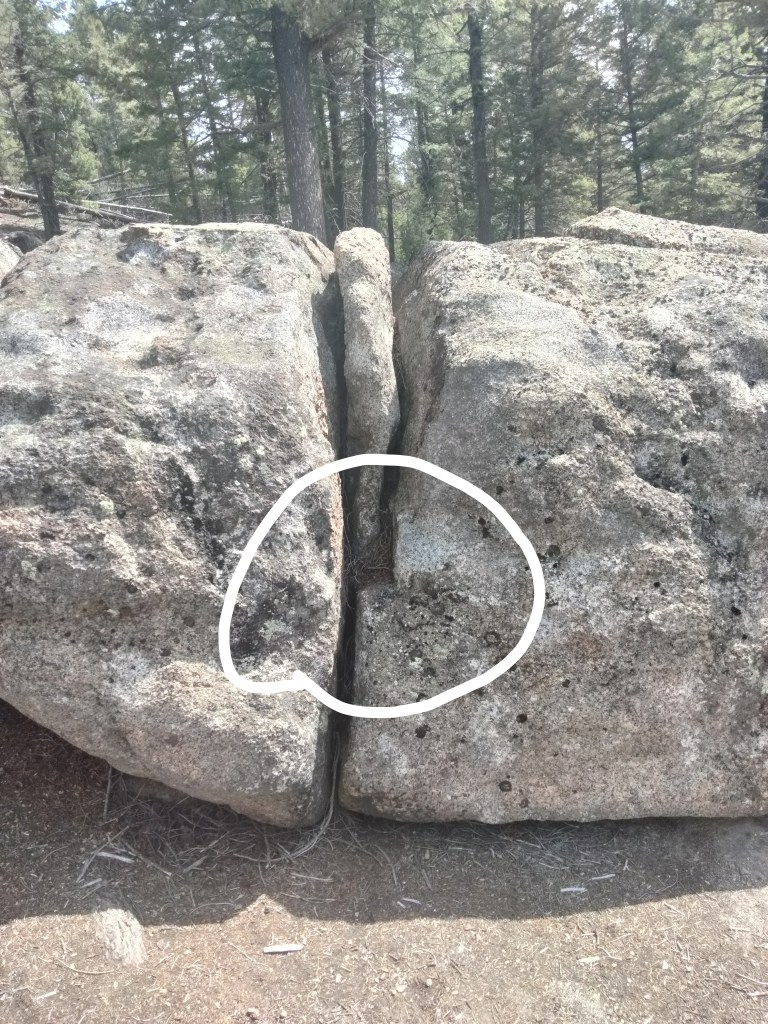
They are not wrong. The mountains to the east of Butte, where Sage Mountain Center is located, are strewn with large granite boulders and outcroppings. These tend to fracture into shapes resembling worked blocks of stone.
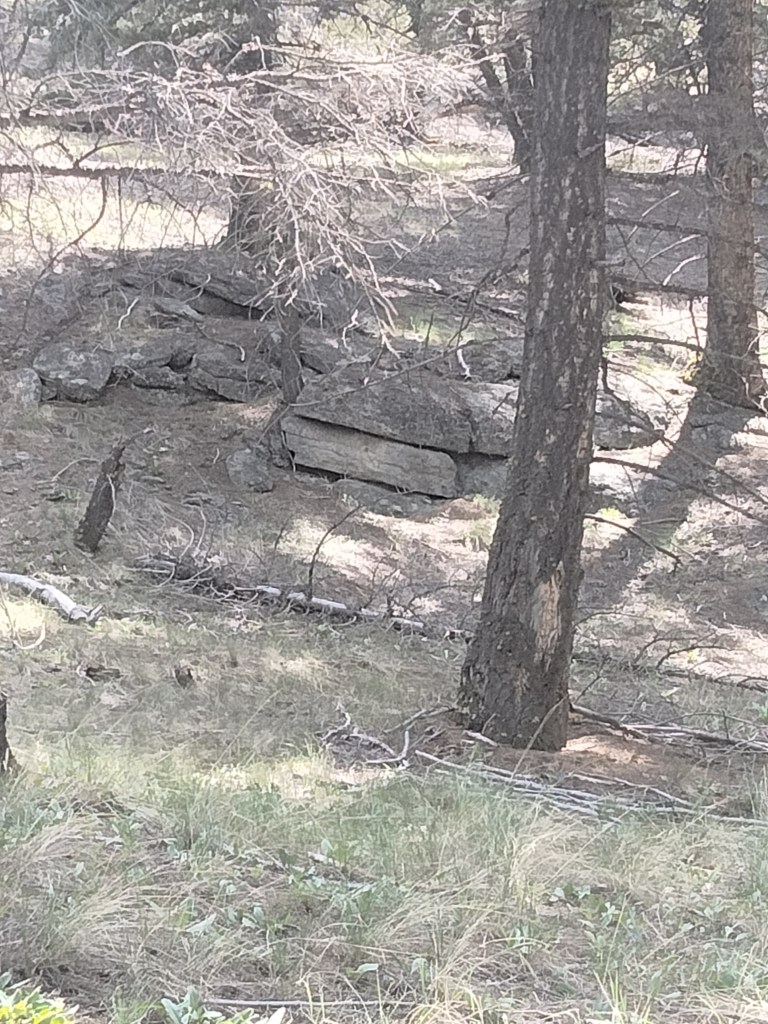
Here are some pictures I took, on the way in, of natural granite outcroppings so you can see how they normally look and how they tend to fracture:
You can see that the fractures are often horizontal and strikingly block-like.
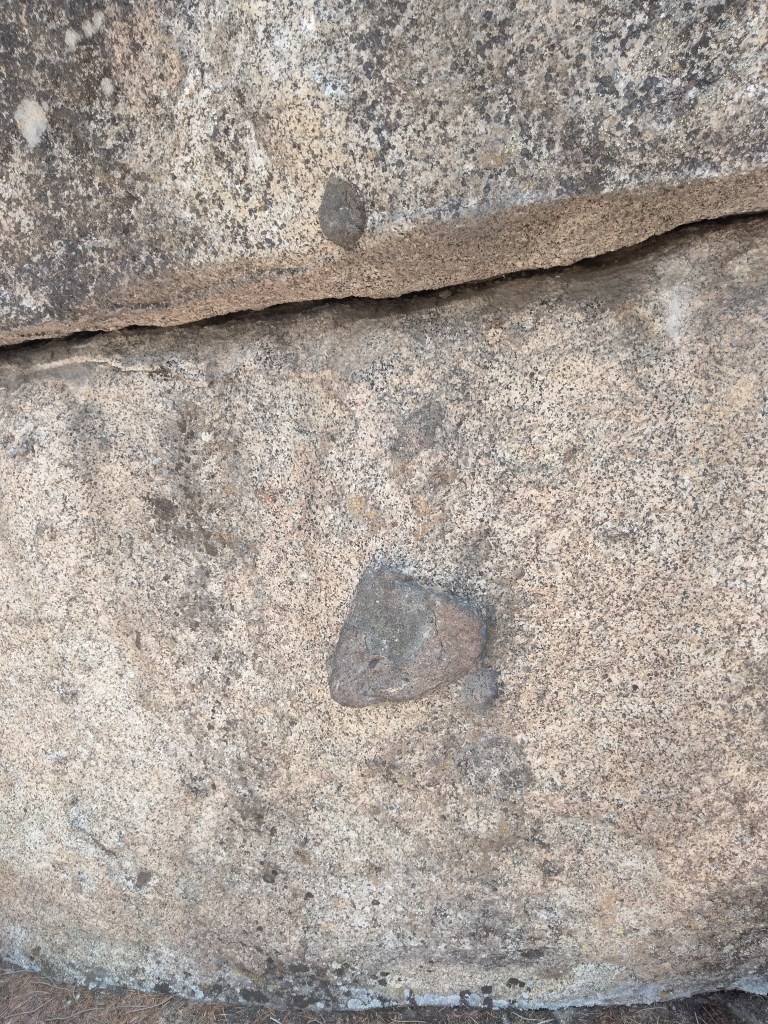
We also saw some pieces of granite that had very large quartz crystals formed in them, which stuck out like chips in a chocolate chip cookie:
And, just for fun, here’s a balanced rock:
I’m not sure whether this balanced rock is natural, but I’m leaning towards no. I’m thinking it was put there to mark the trail.
Anyway, the skeptics are correct that the presence of big, blocky rocks does not an ancient megalithic structure make. This is part of the reason I wanted to see Sage Wall myself. I did not take any videos of it, because I’m not good with video and didn’t have a script ready. But there are now many videos of Sage Wall online, including drone videos. I’ll try to embed some of them at the end of this post.
Why Sage Wall is Likely Man-Made in my Amateur Opinion
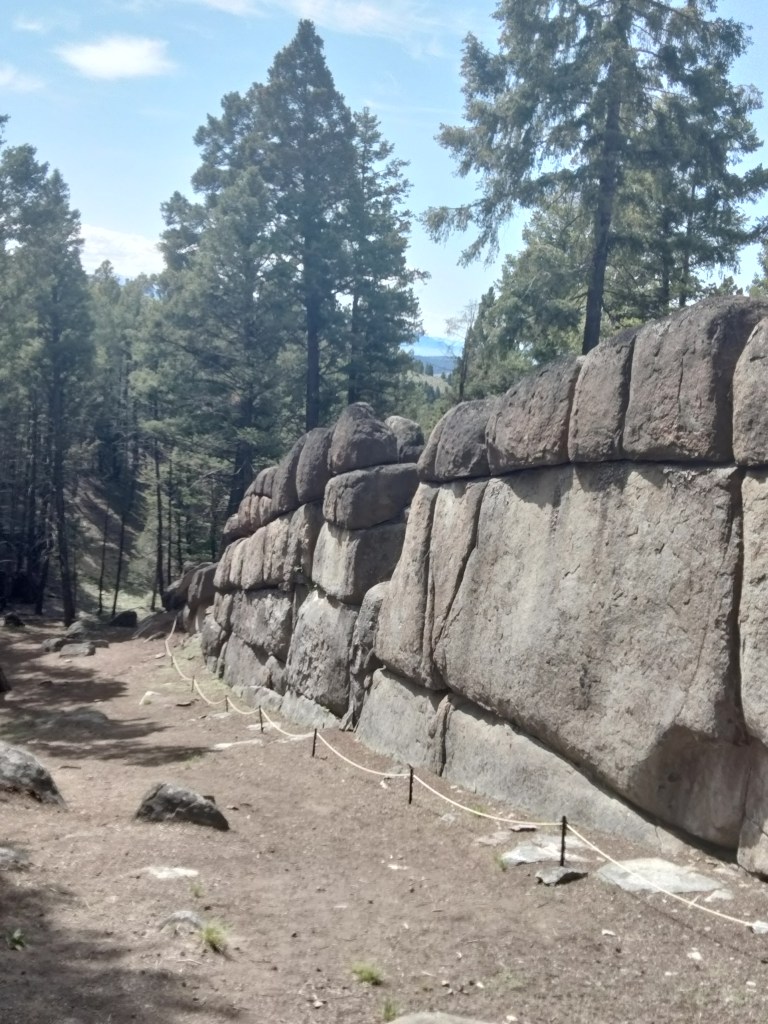
So no, the claim is not that this must be a megalithic structure because it is located somewhere that we would not expect rocks. It is definitely surrounded by rocks. However, it looks distinctly different from the more random rock outcroppings around it.
It is very long, and very straight. (The wall extends past the Sage Mountain Center property, but only their section of it has been cleared.)
Unlike what we see with other fracturing patterns, the wall consist of very big blocks laid out in what appear to be courses. To my (again, amateur) eye, when we see natural fracturing the blocks tend to fracture into smaller pieces where they are exposed.
In the pictures above (and in the one where I’m posing), you can see a hollow lower down in the wall where a block obviously fell out.
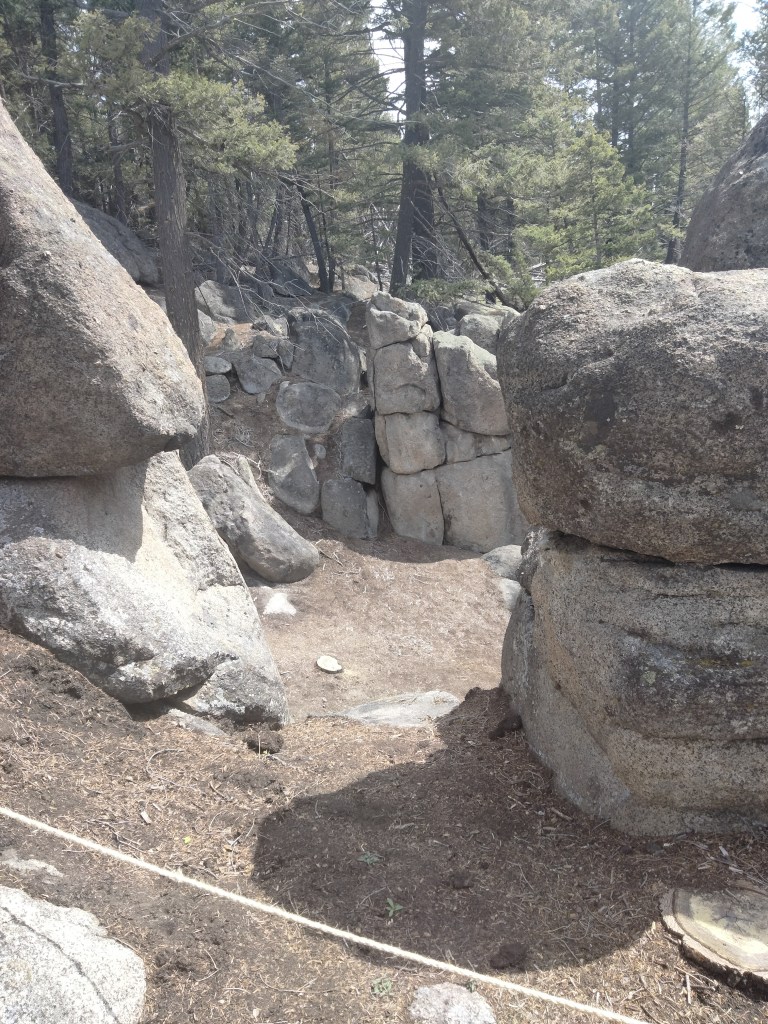
At three different places in the exposed section of the wall, there are gaps in the top similar to doors. Chris told us there had been a lot of speculation about these before researchers realized that they were simply places where boulders had fallen out. In fact, you can see the boulders below them, almost completely buried in dirt and pine duff.
On the picture above, you can also see the remains of a triangular shape. The left side of the triangle is made with shaped blocks, and the right side is incised into the megalith. The triangle happens to frame the gap where a block fell out.
According to Chris, the geophysicist who examined the wall with ground-penetrating radar found that it goes down into the ground about another 20 feet. At the bottom was something that reflected the radar, as it might be a floor or stone foundation.
All of this research is shortly to be posted on the wall’s website, here or possibly here.
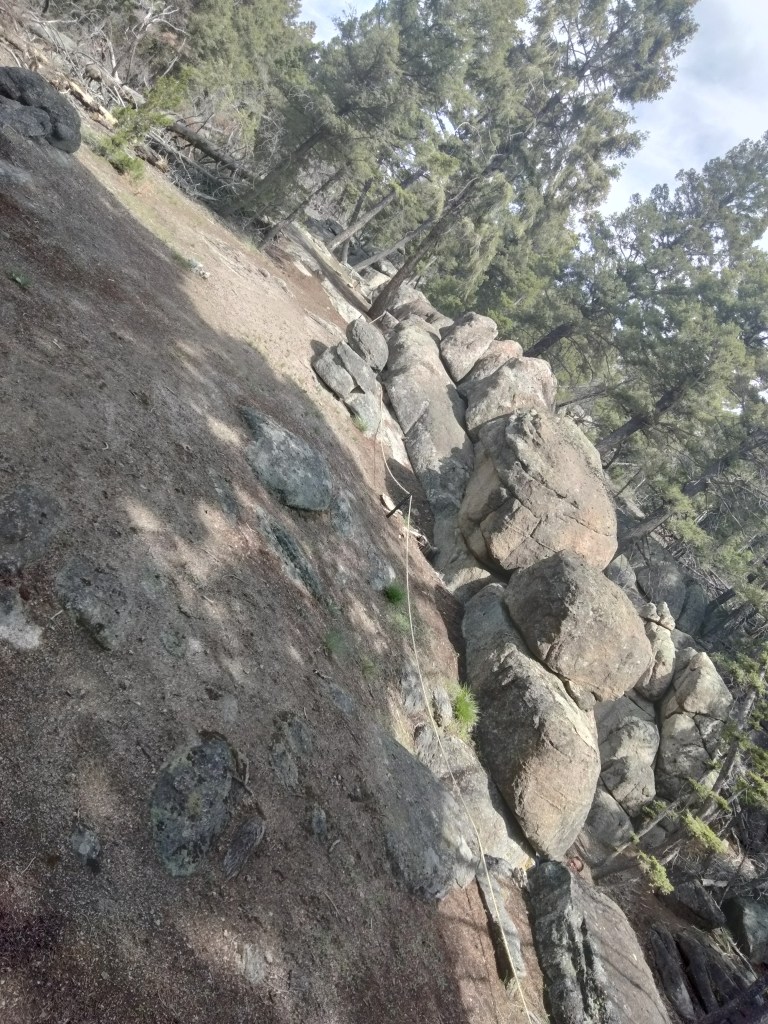
Parallel to the wall are the fallen remains of what appears to be another wall. You can see that it is “fractured” in the same way, and these other blocks also have some of the nub and cup features that we’ll talk about below.
Here’s a bit of the second wall, seen end-on.
Behind the Wall
Here’ a view behind the more intact wall. Chris and Linda have installed a rope that allows visitors to climb up behind the wall. As you can see, the wall is not just part of a cliffside, but it does have earth and rocks filled in behind, either as terraces/a retaining wall, or the ravages of time.
From behind the wall, we look out through a gap left by a fallen stone across the avenue at the remains of the second wall.
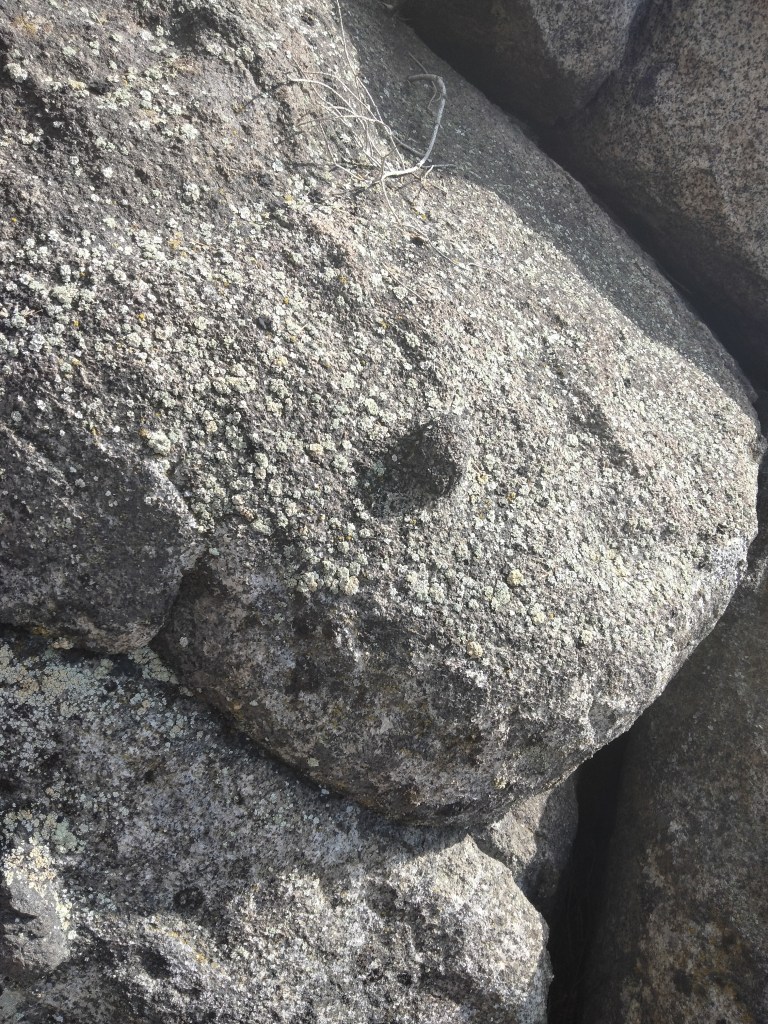
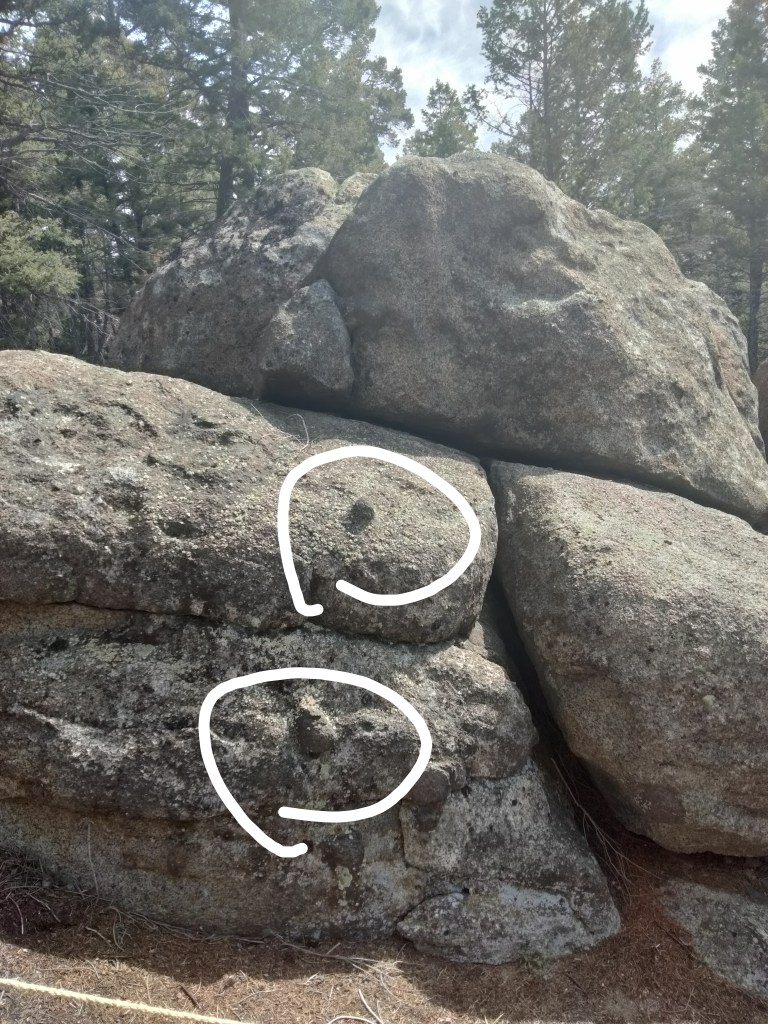
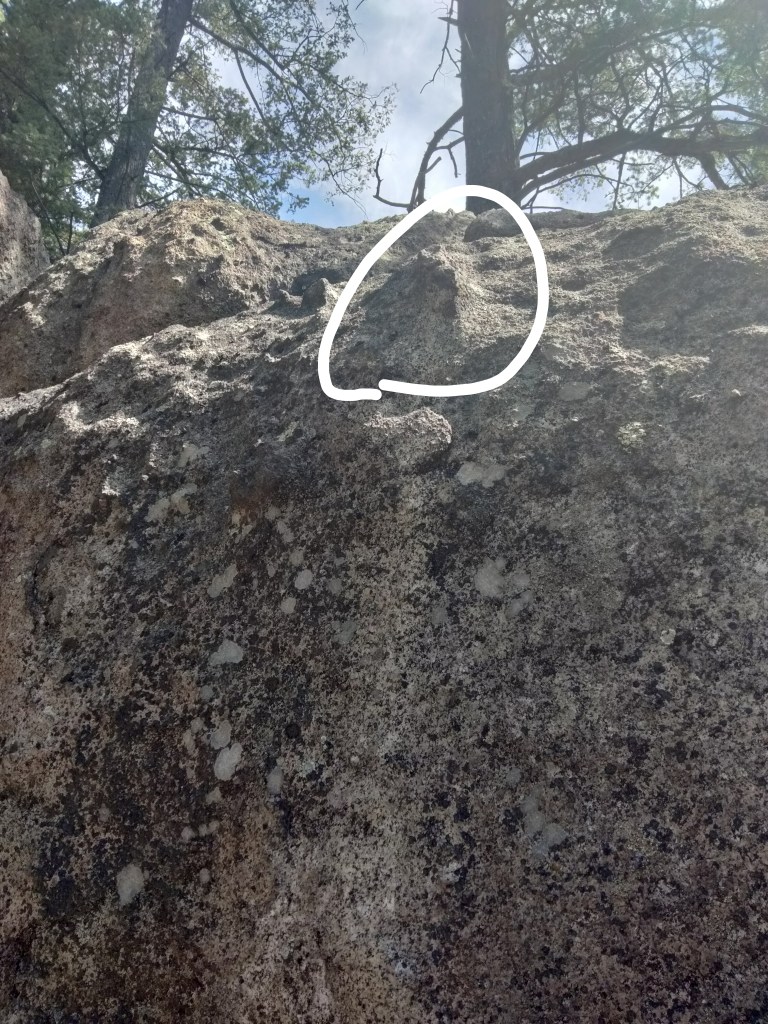
Getting close to the top of the wall allows us to see what might be nubs and cups.
Nubs and Cups
Stone nubs and cups (not necessarily corresponding to each other) are sometimes features of megalithic architecture in other parts of the world.
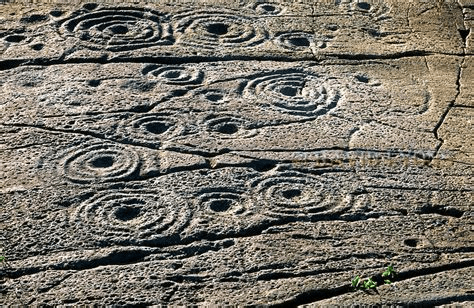
“Cup and ring” markings are apparently found all over the world, but especially in Northern Europe. Here are two articles about them.
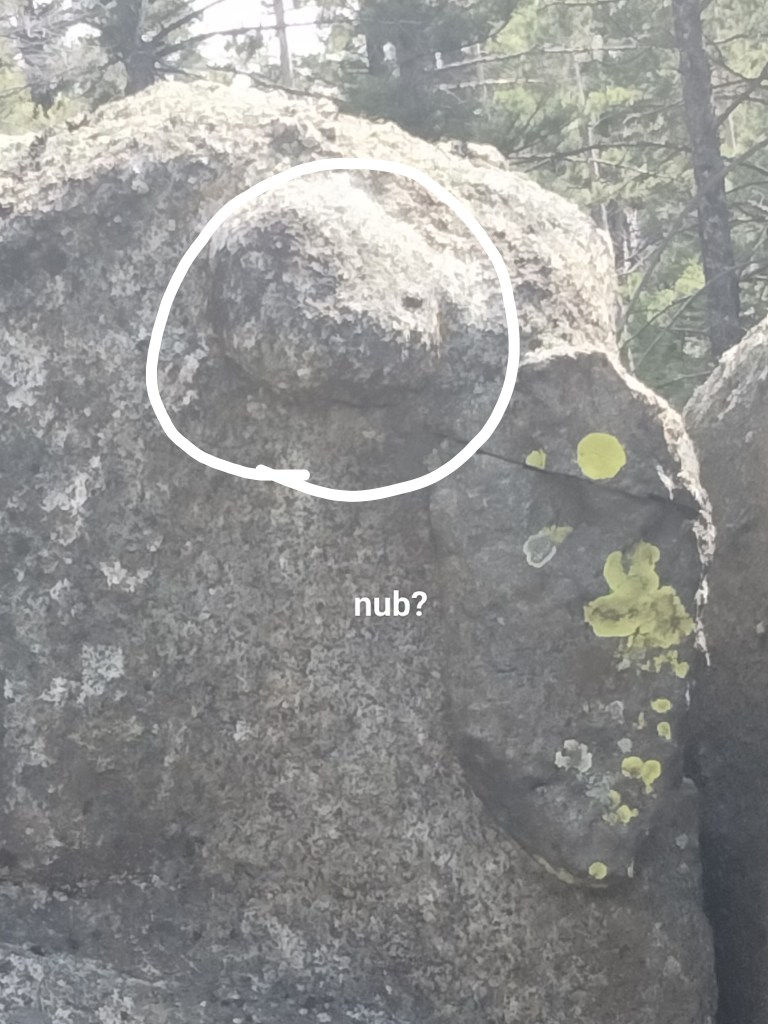
Here are some nubs found on top of the intact wall.
They are not the same as the pieces of quartz sticking out of the natural stone that we photographed earlier.
Because the wall is so weathered, some of them are not certain.
Note the possible incised lines above this last nub.
Here are some other things we saw on the back of the wall:
Incised straight line
Suspiciously square fracture line
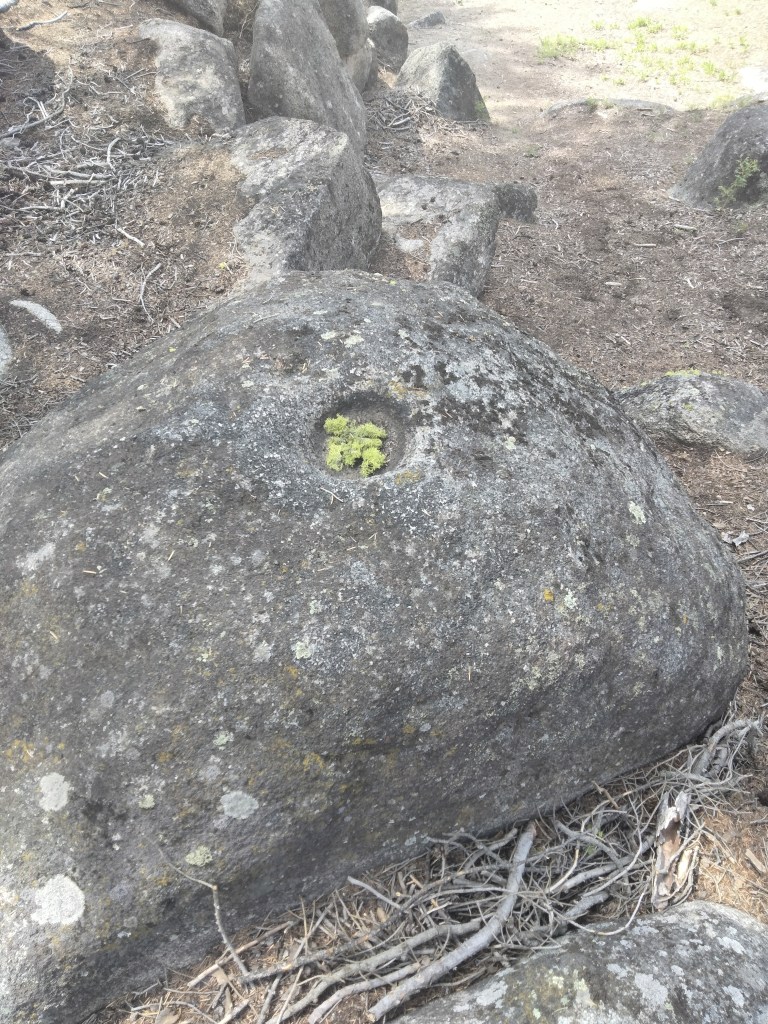
On the fallen wall as well, we found some things that look like nubs, and some possible cups. As a nod to the skeptics, yes, these “cups” do look like they could have been caused by water erosion. This would be especially true if they were found under a waterfall or a persistent drip, which they are not, as far as I can see. Some of them are also suspiciously round.
Very round “cup” in which someone has placed some fresh lichen
Some also have very straight lines incised near them. My son suggested they could be a water feature.
Looks like a cup with a spout
False Nub Alarm? Or Another Part of the Complex?
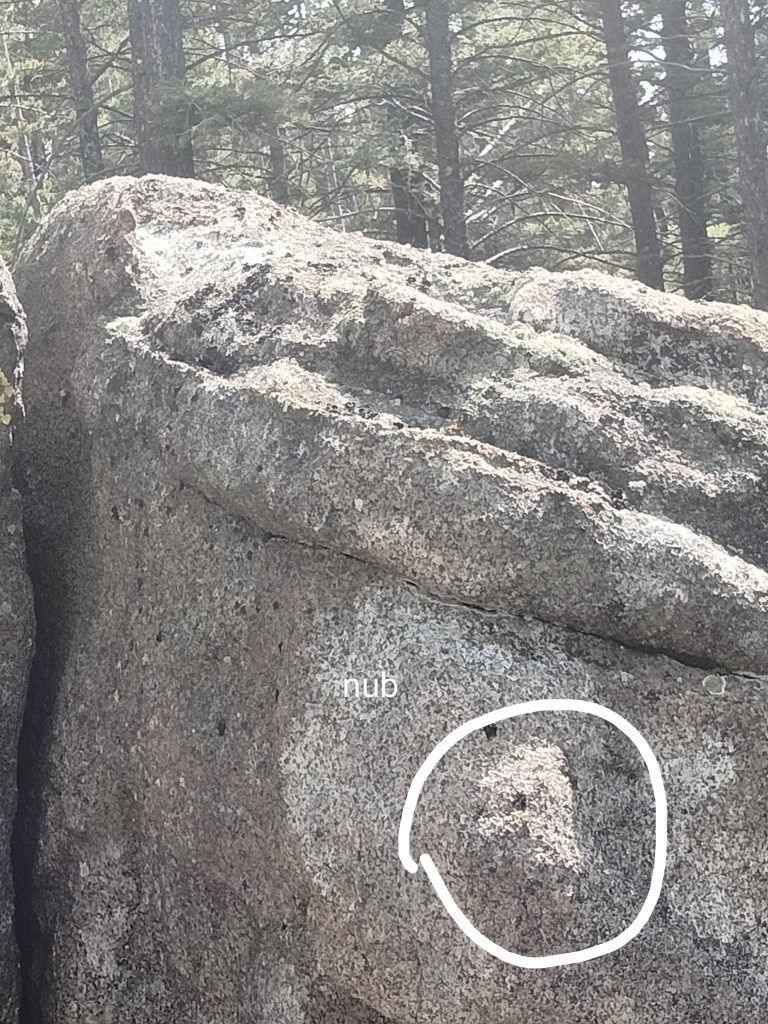
As we hiked away from Sage Wall, I took care to photograph natural rock formations for comparison. Not very far from the walls, I saw something that also looked like nubs.
Did this mean that such nubs are a natural feature of the way granite weathers? Or could this be another part of the same complex as the wall? The formation on which I spotted these nubs certainly looks like the remains of a constructed passage.
A Post-Flood Megalithic Culture
After I left Sage Wall, my husband asked, humoring me, what I thought its purpose had been. My answer is that I have no idea. It is way too old, weathered, and partially buried for me to speculate. (This does not bother Julie Ryder over at Montana Megaliths, so if you want to see some people speculate very confidently, you can visit there.)
What I can say is that, granted this is not a natural formation, it most reminds me of Sacsahuayman and other sites in Peru. You have the same dry stone construction with megalithic blocks that are shaped, but are not in uniform sizes or in a regular pattern. And, of course, you have the nubs. As for scale, it appears that if Sage Wall were excavated down to its foundation, it would be thirty or forty feet high.
Another similarity is that both Sage Wall and the Incan or pre-Incan complexes are built at very high elevations (the Continental Divide runs near Butte).
This suggests to me that they partake of the same culture area.
Sage Wall, of course, has been abandoned much longer than any of the impressive Incan complexes, some of which Europeans got to witness still in use. Consequently, it’s much more weathered, run down, and filled in. But it looks like the same sort of thing.
So, it appears that Sage Wall and any other structures we might find in association with it were built by a group of people who knew how to build with megaliths, and who then had to abandon this site for some reason. It was before recorded history in North America, but that doesn’t mean it was before recorded history was happening elsewhere. Then, they or their descendants or people who partook of the same megalithic culture, moved on towards South America and continued their building there.
I believe there is plenty of evidence–not from Sage Wall, but from other sources–that human dispersion happened very quickly after the Flood, and that when people spread out, they took a megalithic culture with them. Dolmens, pyramids, cities, and inexplicable megaliths have been discovered all over the world. In many cases, as with the Bosnian pyramids, they have been abandoned for so long that they are not immediately recognizable as the work of human hands. You have to know what you are looking at before you can see it. The Bosnian pyramids, first thought to be extremely regular hills, were confirmed as artifacts only when a team dug into them and found tunnels. It looks like something similar happened with Sage Wall.
Immediately after the Flood, the earth would have entered an Ice Age. The climate was in a tailspin: temperatures were low, precipitation at an all-time high. Much of that precipitation quickly got locked up in glaciers. Sea levels fell around the newly configured continents. There were land bridges all over: in Beringia, in Doggerland, in Sundaland. People took advantage of all this newly revealed, very humid land and scattered. But the Ice Age was short, and as glaciers melted, there were sudden catastrophic local floods. People had to abandon their sites. Many of their cities, camps, and settlements are now hidden under water along our coasts. In some cases, such as Gobeklitepe and the Vinca cities, they burned, buried, or otherwise destroyed their sites before moving on. Some of these sites might have been built very quickly and inhabited for only a short time before they were abandoned. Other things being equal, archaeologists tend to overestimate how long it took to build something, and how long ago it appeared. But even very recent sites can be quite mysterious. They have had trouble re-constructing Woodstock, for example.
How Did They Build It?
I don’t know. Obviously they were purty smart. Probably an argument is going to be made that Sage Wall must be a natural formation because “we know” that people in the Stone Age didn’t have the ability to make things like this, despite constant evidence being discovered to the contrary. Or they will argue that “we know” that there were no advanced civilizations in North America, despite Sage Wall itself. Such arguments tend to be self-re-enforcing.
I do know that we do not, currently, have the ability to build with megaliths … at least, not so easily that we consider them our first choice in building material. We might make a monument or a gravestone, but we wouldn’t attempt to build an entire house or city out of megaliths. The effort would just not be worth it. This suggests that the ancients may have had ways that were easier than our current methods.
It is worth noting that there is a well-established oral tradition of giants living in North America. There have also been giant skeletons discovered. In Peru, meanwhile, there is the tradition of the Viracochas, bearded, godlike culture-bringers. No, I’m not suggesting aliens. I do think we should take a closer look at the worldwide oral traditions of apocalypses, floods, gods, and giants, and that we should pay attention to myths that suggest that civilizations were “advanced” right from the beginning. If you want to dig into this more than you already have (and if you are reading this, I assume you already have!), please feel free to look at my page The Research Behind the Books for a suggested reading list.
Disclaimer: None of these pictures are mine. I found them on the Internet. If any of them are yours, and you don’t like them being used in this post, contact me and I’ll be happy to take them down.
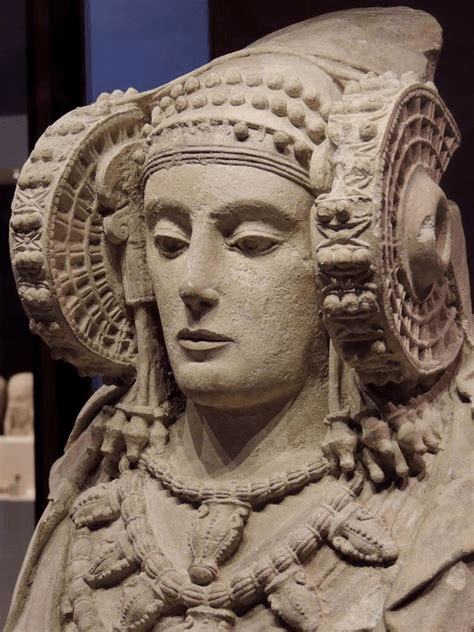
This is the Lady of Elche, Spain.
As you can see, her shoulders are hunched up. Some people describe her as having an “elongated head,” but it could just be the hat. Or it could be a hat meant to imitate elongated heads, as we see in many other cultures, but especially Egypt and MesoAmerica, where there was also head binding.
The following two links are my bibliography. You can follow them to check what I’m about to tell you about the Lady.
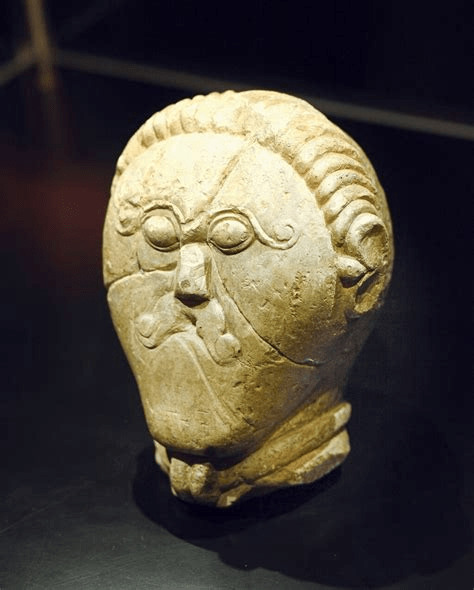
When I first heard that this Lady had been found buried in Iberia, it freaked me out. That’s because my understanding of pre-Roman Iberia was that it was basically Celtic. I was prepared to find Celtic- or Scythian-style artifacts there, such as images of people with narrow chins, large eyes, and moustaches; men with deer antlers; horses, and spirals, perhaps worked in silver, wood, stone, or even gold.
Celtic portrait, with torque necklace
Kurgan stelae in Kyrgyzstan, closer to the probable homeland of the Celts/Indo-Europeans
That’s what I expected to find in Spain. Or maybe something that looked like Etrusacan art, or like statues from the Archaic period of Greece.
I was not prepared for a massive, highly realistic stone statue that looked more classical Greo-Roman in style and featured attire more reminiscent of … I don’t know. Ancient Mesopotamia? Peru? The Lady of Elche freaked me out because it seemed to suggest a whole different style of civilization in Iberia, previously unknown. I was thinking Stone Age or pre-Flood.
Then, I heard that the Lady was believed to be Carthaginian. She instantly became less mysterious, but no less horrifying.
Carthage was a colony of Phoenicians. Phoenicia was an advanced civilization from the Levant. They inhabited the port cities of Tyre and Sidon, near ancient Israel. This explains why the Lady seems to be dressed like someone from the Ancient Near East. The Phoenicians had a shipping empire, so not surprisingly, they started a colony in North Africa. Carthage was here:
As you can see, they are very close to Europe, including territories in Spain. That explains how the Lady of Elche could have Western European facial features and Carthaginian dress.
Like most advanced civilizations of the Ancient Near East, the Phoenicians practiced atrocities in their pagan worship. This was the group that had the god Molech, to whom babies were sacrificed in the fire.
They were dropped down into, or placed in niches in, the red-hot statue. Drums and horns covered the sound of the infants’ screams. Incredibly, Israelites kept taking part in this practice and God had to keep telling them to stop. There was even an Israelite king who “made his son pass through the fire.”
Given that Carthage was part of an advanced, baby-killing empire, the Lady of Elche at once becomes more horrifying. The blank look on the woman’s face becomes more sinister. Is this just a death mask? Or is it because she is cruel? Or mindwiped by all that she had seen and done?
I don’t have any historical reference for this, but an anonymous commenter on the Internet has asserted that the “ear covers” were worn by priests and priestesses to block out the screams of the victims of more gruesome rituals. The bigger the ear muffs, the worse the ritual. I’d like to pooh-pooh that, but it fits with everything else we know about the ancient world. Christ conquering the nations suddenly sounds much less like a step in oppression and more like a relief. If you know more about the earmuff question, I’d love to hear it I wouldn’t exactly love to hear about it, but I’m curious and please send me your information.
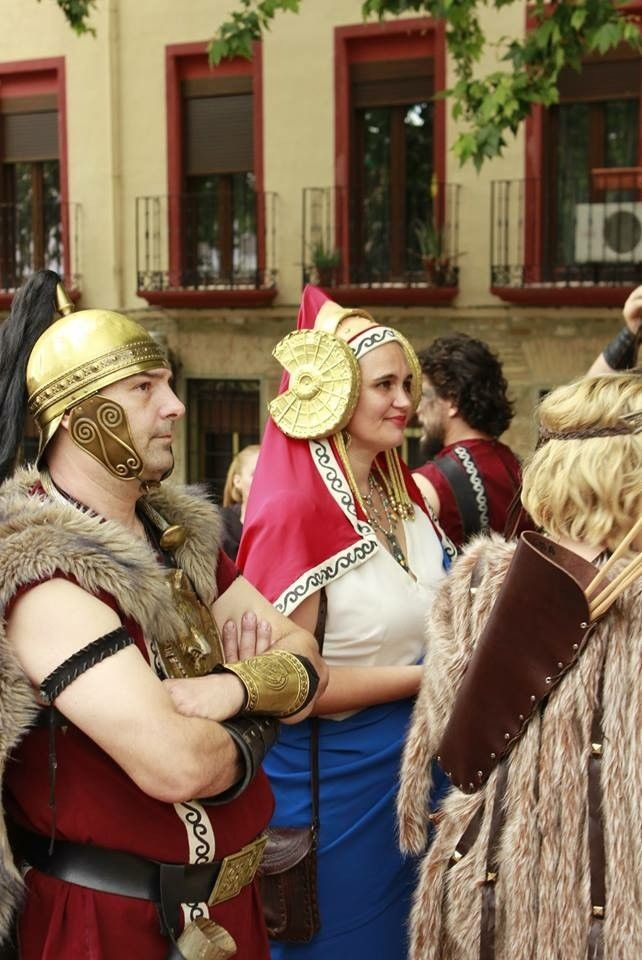
If you know how to indicate your interest in the Lady to the algorithm, you may find people dressed in historical re-constructions of the Lady of Elche’s garb, like these:
These ladies all look significantly happier than the original Lady.
I got this tag from Snapdragon Alcove. I hope it’s OK that I’m posting it after Halloween (life is busy!). Because of the relatively narrow range of my horror consumption, I’m freely mixing movies and books.
Pick your favorite example of a …
Zombie apocalypse
The Book of Eli (a movie)
Not exactly zombies, but as I recall, there is an older couple that seems normal, but then you find out they have some sort of neurological disease from having eaten human flesh to survive. Creepy.
Also, I love the characters Denzel Washington usually plays, and this is no exception. I like my apocalyptic movies to be somewhat uplifting, and this fits the bill.
Vampire
The Unwilling, by C. David Belt (a book). Cheating a little, ‘cause I recently reviewed it here. This one made me cry, because there is a child vampire who wants to be “a real boy.”
Haunted house
I guess I don’t read many haunted house books, because Monster House is the only one I can think of. It is just as sad as ghost stories usually are.
Psychological thriller
Fractured and Shutter Island (both movies). I was very angry with both of these movies, but Fractured probably made me angrier.
Creepy doll
The Collision series, by Rich Colburn. So far, it has only two volumes: The Resolve of Immortal Flesh and The Formulacrum. But The Formulacrum ended on a literal cliffhanger, so that means Colburn owes us another one.
Neither of these books is exclusively about creepy dolls, but one very memorable creepy doll is featured … and that’s just about the only book I have ever read with a creepy doll.
Monster
Beowulf, duh.
And, in case you are not up to speed on this, Grendel is a t-rex. But there are plenty of other monsters in this how-to-defeat-monsters book, including the sea monsters Beowulf encounters while swimming in the North Sea, and Grendel’s mother, who appears to be some sort of octopus.
Comedy-horror
The Tremors franchise. It is the best. Extreme gross-outs, but also extreme humor. Survivalist Ed really steals the show.
Teen Horror
Stranger Things. I will die on this hill.
The series starts out where the kids are about twelve and it more resembles E.T. or The Goonies, but the events cover several years and we see the kids discovering the opposite sex, feeling left out as they grow up at different rates, dealing with problems with their parents and problems involving finding a career and their place in the world. Their lives have all the teen challenges, plus the ghosts and demonic creatures and stuff to deal with. And yes, there are a few make-out scenes that it would be nice if we could skip. I will also say that the series seems to be equally sensitive to the experiences of teen boys and girls.
Some people think the episodes are too long and detailed, but that’s the point. They work in a lot of human drama in addition to the scary stuff, and I am here for it.
Demonic possession
Perelandra and That Hideous Strength by C.S. Lewis both feature possession that gets more terrifying the longer you think about it.
In Perelandra, the possessed man gets to come out and speak instead of the demon once in a while, and this gives a more evocative glimpse into his mind than we might prefer.
In That Hideous Strength, the people that are serving the demons get dehumanized to an even greater extent, and we see the beginning of this dehumanization process happen to one of the main characters. There is also a memorable scene where one of the villains, who up until now has been the most formidable because of his intelligence, wants to put a stop to something, but “he could not think of any words.” This moment of aphasia shows us how close his mind is to total disintegration.
Science fiction
Science fiction reliably pulls towards horror, for obvious reasons. Human nature doesn’t mix well with dimensional portals … or genetic engineering … or time travel.
That second image is from a movie called Paradox. It turns out there are quite a few of those, but this one involves time travel being exploited by a bitter coworker to go postal, and even though the team has an awful lot of information, they can’t figure out what is happening quickly enough.
Alien Intrusion: UFOs and the Evolution Connection by Gary Bates, A Book Review
The next thing [Bill] knew, he was being levitated above his bed. He then had the sensation he was being suspended by what felt like a pole inserted into his rectum. By this time, he was alive with terror, but he couldn’t scream. The following is an excerpt taken directly from the transcript of Mr. D’s interview:
“I thought I was having a satanic experience; that the devil had gotten ahold of me and had shoved a pole up my rectum and was holding me up in the air… . So helpless, I couldn’t do anything. I said, ‘Jesus, Jesus, help me!’ or ‘Jesus, Jesus, Jesus!’ When I did, there was a feeling or sound or something that either my words that I thought or the words that I had tried to say or whatever, had hurt whatever was holding me up in the air on this pole. And I felt like it was withdrawn and I fell. I hit the bed, because it was like I was thrown back in bed. I really can’t tell, but when I did, my wife woke up and asked why I was jumping on the bed.”
ibid, p. 266
A while back, I posted a link to an interview with Gary Bates, in which I called him “a very sane UFOlogist.” This book confirms my initial impression. It’s 400+ pages, with endnotes to each chapter, appendices, and an index, yet it is accessibly written.
Synopsis of the Chapters
The Invasion Gets Underway deals with the social history of the UFO phenomenon, “the ETH,” or “extra-terrestrial hypothesis,” and its reflection of cultural fears and its symbiotic relationship with sci-fi books and movies. (Gates introduced the term ETH because although technically, a UFO just means any explained light in the sky, the term has actually come to mean “spacecraft filled with aliens from other planets.”)
The Science of Fiction addresses major sci-fi writers who have embraced and promoted the ETH. It also addresses the physical impossibility of ultra high-speed or light-speed travel, which is a necessary prerequisite for the ETH to be true. For example, “To propel an object that weighs one pound to 50% of the speed of light would require an energy source equal to the energy of 98 Hiroshima-sized atomic bombs” (69) and “at one-tenth the speed of light, the impact [of hitting a dust particle] would be equivalent to about 10 tons of TNT” (73).
Is There Life on Other Planets? The short answer is, there doesn’t seem to be. Earlier ideas about alien life had them living on other planets in our solar system. As these have been discovered to be unlivable, the aliens have been moved out to distant galaxies, raising the high-speed travel problem from the previous chapter. So far, earth is the only planet we have found that seems to have even the most basic preconditions for life … and it has them all, perfectly. Additionally, based on the red-shift effect, earth appears to be located at the center of the universe. (Everything else appears to be moving away from us.) This would make sense on an intelligent-design hypothesis, where the earth was designed for life including people, but non-ID astronomers find it unacceptable, and a variety of different universe shapes have been proposed to account for the fact that everything seems to be moving away from everything else. This chapter addresses the precommitments behind a belief that the universe came from a “big bang” which then coalesced into stars and planets.
Did Aliens Create Life on Earth? This chapter summarizes the reasons that natural selection cannot have created complex life forms. Natural selection reduces the amount of genetic information, but never increases it. Other than intelligent design, no explanation has ever been proposed for how the complex information got there in the first place. The discussion in this chapter is similar to Philip Johnson’s in his excellent Darwin on Trial, but it is more succinct. Most people who believe in the ETH, believe that since life evolved here on earth, it must have evolved in other star systems too. There is also a theory that aliens brought life to earth. Given that we see complex genetic information appearing on earth seemingly out of nowhere, perhaps it was brought or “seeded” by an intelligent race from the place where it did evolve. This, however, just pushes the problem of how complex information can appear out of nothing farther back in time and off to a distant planet.
Lights in the Sky — Where Are They Coming From? looks at the history of UFO sightings, including mistaken sightings (the majority of cases are Venus, government planes, and the like), hoaxes, and the small residue of sightings that remain truly unexplained. Interestingly, this is a global phenomenon. For example, the 90s saw a rash of well-documented sightings in Mexico, including in Mexico city, sometimes in broad daylight. This chapter also touches on government cover-ups of their research into the UFO phenomenon. This often because the people involved in the sightings were pilots whose activities had to do with national security, but of course the cover-ups give the public the impression that the government knows far more about aliens than they are telling.
Mysteries, Myths, Mayhem, and Money deals mostly with people who tried to capitalize on the UFO craze. Some of these people are true believers, others are hucksters, and many are both. But even the true believers have to use tortured logic in order to put forth their theories. This chapter discusses in detail Roswell, crop circles, and Erich von Daniken (a major proponent of “ancient astronaut theory”), among others. Interestingly, there was also a major UFO craze in the USSR, near weapons testing sites. Not surprisingly for a people who have been lied to about everything else, the Russian true believers are only able to think conspiratorially and impossible to convince otherwise.
Abducted — Close Encounters of the Fourth Kind is a really interesting chapter. Bates has just spent more than half the book showing that the extraterrestrial hypothesis, at least as it is usually understood, cannot be true for multiple reasons. But now, he turns his attention to the many people who have had alien abduction experiences. And instead of dismissing them as hoaxers (dealt with in the last chapter) or gaslighting them, he believes them. And he has a great deal of compassion for them. This is why I think so highly of Bates. This topic deserves more than a bullet point, so now I’m going to stop the synopsis and discuss in a little more depth.
A “Typical” Alien Abduction Story
According to Bates, drawing on the work of other researchers, here are the elements of “Classic Abduction Syndrome [CAS]”: the abductee is captured, often at night, and often while being seemingly paralyzed. Once on the ship, they are typically undressed and subjected to some kind of invasive and humiliating “medical” examination. Often, this escalates to sexual abuse of various kinds. Then, the aliens “teach” the abductee. This involves being told that they have been chosen for a special mission. Predictions are made about the future of earth or of humanity. The aliens are trying, and they want the abductee’s help, to raise humanity’s consciousness or to save humanity. Often, they say they are engaged in a breeding program, creating human/alien hybrids. Sometimes this is explained as a way for humanity to survive when the earth is destroyed. Abductees may be given a tour of the ship or of other locations, and they may meet a divine being or an entity claiming to be Jesus, the pope (!), or a dead relative. After the abductee is returned to his or her surroundings, they often don’t immediately remember their abduction experience. They may experience “lost time,” and recall the experience only later (sometimes under hypnosis, which raises other issues).
Abductees experience lasting physical and mental aftereffects of their experience, whatever its nature may have been. They have PTSD-like symptoms. They have may bruises, scars, or puncture marks on their body, though these are never of an obvious enough nature to prove their story. They may experience new chronic health problems, commonly with their reproductive system, even including uterine or breast cancer.
On the spiritual side, many abductees come out of the experience with a new openness to the occult and to New Age beliefs. Others, though they initially feel understandable anger and fear towards the aliens, after multiple abductions come to a passive state of appearing to love and be fascinated with their tormentors, almost like Stokholm Syndrome.
Assuming that all these people are not just making up these bizarre and traumatic experiences, it is clear that they have come into contact with entities that do not wish them well.
On their own testimony, the “aliens” can be shown to be unreliable. For example, they tell abductee they are torturing them “for your own good.” They say they are wise and want to help human beings evolve to the next level, yet they subject their human subjects to frightening and degrading sexual practices. Either these beings don’t understand humans very well, or they are traumatizing them on purpose to “break” them. The aliens also seem eager to explain exactly where they are from. In past decades, they would claim to be from Mars or Venus. Now that we know more about those planets, they tend to name a star or star system that is outside of our galaxy.
Aliens tend to appear to humans in whatever form is culturally expected at the time.
Over the decades, we have allegedly been visited by long-haired Space Brothers, stacked Space-Babes, black-eyed and large-headed dwarfs, bipedal reptiles, praying mantis-type creatures, and … well … the list goes on and on. But, they all seem perfectly comfortable with Earth’s gravity, temperature, oxygen levels, etc. Doesn’t that strike you as a bit odd?
Nick Redfern, UFO researcher, quoted in ibid, p. 321
So, we have powerful, apparently deceptive entities, which kidnap and traumatize people, and then unfailingly give them a New Age message to take back to earth, often going out of their way to say that the Bible has “gotten it wrong.” Furthermore, apart from claiming to be from space, these “alien” abduction experiences have a lot in common with abduction stories from past ages where the perpetrators were fairies, demons, or other paranormal entities. It is starting to look as if we are hearing the same song, but a different verse. And in fact, Bates suggests that these “aliens” are probably demonic, or fallen angelic, entities. They are, in short, the “elohim” described by Heiserand identified as “the gods” by Cahn.
Jesus Really Is the Answer
Two UFO researchers, Joe Jordan and Wes Clark, noticed that out of all the abduction cases they had heard of, very few were Christians. They put out a call for anyone who was a Christian and had an abduction experience to contact them. Confusingly, they were contacted by people who said things like “I’m a Christian and I was abducted and saw Jesus on the spaceship.” With further research, they found that while people who identified as Christian but did not “walk the walk,” as the researchers put it, were just as likely to experience abduction and subsequent New Age brainwashing by the “aliens.” However, “walk the walk” Christians had a different experience:
Clark said that many of the respondents claimed to be Christians who told of their own abduction experiences. He felt that they were happy to have someone to talk to; they usually felt uncomfortable talking about their experiences because most UFO investigators had New Age inclinations and ideas that opposed their own beliefs. In addition, the Christian church is not equipped to deal with such reports because the UFO phenomenon has been largely misunderstood and dismissed by organized religions. Clark comments:
“As the number of cases mounted, the data showed that in every instance where the victim knew to invoke the name of Jesus Christ, the event stopped. Period. The evidence was becoming increasingly difficult to ignore.”
I just changed my site address in an effort to get this blog to show up in my WordPress followers’ Reader again. If it did show up, please do a me a solid and like this post.
All you need is a “credible” witness who has had an experience, and then you dare someone else — like the government — to “prove it DIDN’T happen.” Unfortunately, this sort of mindset permeates UFOlogy culture, making it very difficult to get a straight story. … It is not any weight of empirical evidence, rather a proliferation of “let me tell you what I saw” experiences. This does not deny that these experiences may have actually occurred, but we’ve all heard fishing stories… Add to this normal human failing a potentially spectacular UFO claim, with eager media and UFOlogists beating down your door, and often the truth is lost along the way — either in the recounting by the witness or the telling of the tale by the media. This gives you some idea of how difficult the process of determining the truth can be. But, nonetheless, we shall try to determine the true nature of the phenomenon.