Future Events Cast Backward Shadows

Pagan kings looking like Jesus

In my recent big post about sacrifice (willing and otherwise), I pointed out some similarities between the different sacrificial deaths in Mary Renault’s The King Must Die, and the death of Christ.

Some of these similarities are deep. Theseus, as future king of Athens, has an honorary title the Shepherd of the People. He is the king’s son, and he feels “the god” (Poseidon) calling him “to the bulls,” that is, to go and be a human sacrifice in Crete. Before he departs, he reassures the parents of the other future bull-dancers, “I will go with your children, and take them into my hand. They shall be my people.”

Two thousand years after Christ, we are so saturated in the power of His story and of the things He said that it is hard to read these ancient customs as anything but Christological types. And, since The King Must Die was published in 1958, it’s pretty clear the author also was aware of Christ and was intentionally pulling phrases from Him. More about that in a moment.

Other similarities are superficial, but nonetheless striking. Near the end of TKMD, a sixteen-year-old “king” who is about to be torn to pieces by wild women in a Dionysian rite, goes to his death riding in a cart, crowned with ivy, brandishing a wine cup and scattering wheat seed on his people. Now, this rite is almost nothing like the death of Christ. It’s pagan. It does not happen on Passover, the date of the annual sacrifice of a lamb, but rather it is part of an annual ritual of human sacrifice mixed with orgy. The “king,” along with everyone else, is reeling drunk. He has just spent a year as the consort of the priestess/queen, and he has no choice in what is about to happen to him. It’s hard to imagine a death more different from Christ’s.

And yet, these very superficial similarities do not strike us as coincidences. Instead, they seem significant. On this side of Christ, we can’t help but notice when a man who is about to go up a hill and die shares out bread and cup to his followers.

This sort of horrifying, yet somehow moving, ritual is not something Renault just made up. It’s well-attested in myths, legends, and histories. In this essay, I will argue that Christ did not share out bread and wine because it had been done before. Rather, the pagan one-year king shared out bread and wine because Christ did so one thousand years later. Future events cast backwards shadows.

What was Renault trying to do?

To be clear, that is my thesis, not Renault’s. She was a lesbian who published a number of contemporary gay romance novels before discovering her personal obsession with ancient Greece. Writing about Socrates and Alexander the Great allowed her to write sympathetic historical novels about gay characters who lived in a context where this sort of behavior was considered completely normal. The King Must Die certainly includes all kinds of sexual activity; for example, in the Bull Court, the female bull-leapers cannot be allowed to get pregnant, so they are sequestered from the boys, and turn to relationships with each other. Many of the male bull-leapers become the paramours of upper-class Cretan men. Theseus himself is straight, but as an ancient prince, let’s just say he’s not exactly chaste. (I may have lucked into picking up Renault’s least gay book about ancient Greece.)

All this to say, I don’t think Renault was trying to say that any ancient customs were foreshadowings of Christ. If she was “trying to say” anything at all about Christ, it’s probably that He’s not so unique, and anybody familiar with ancient Hellenistic ideas would understand that. But her novels (at least TKMD) are not really “message” novels. She immersed herself in that world, wrote characters and customs that grew organically out of it, and this is what came out.

So no, I don’t think Renault is projecting Christ back into the ancient Mediterranean customs intentionally, except in the sense that she would have been familiar with biblical phrases as a woman raised in 1900s England. I think she was primarily writing from her research and imagination.

Is Christianity a ripoff from Greek mystery religions?

Still, when I first read TKMD, the tone was familiar to me and I immediately picked up the implications. Not that many years before reading it, I had been through a year of thorough education in Greek mythology by a high-school teacher who could safely be described as feminist. My best friend at the time was a neo-pagan. Between the two of them, this teacher and friend were quick to point out any parallels between Greek paganism and Christian practice, and to accuse Christians of “stealing” it. Looking back, there was a certain defensiveness there, which I did not realize at the time. But my teacher and friend were only two voices in a large crowd of scholars.

During a period of time running roughly from about 1890 to 1940, scholars often alleged that primitive Christianity had been heavily influenced by Platonism, Stoicism, the pagan mystery religions, or other movements in the Hellenistic world. Largely as a result of a series of scholarly books and articles written in rebuttal … Today, most Bible scholars regard the question as a dead issue. [But] even though specialists in biblical and classical studies know how weak the old case for Christian dependence was, these old arguments continue to circulate in the publications of scholars in such other fields as history and philosophy.

–Christianity and the Hellenistic World (1984), p. 10

As an aside, notice that the peak of this theory were the years during which Mary Renault was growing up and going to school.

Sometimes books come to you, serendipitously, just when you are ready for them. As I was thinking about this question of the similarities between fictional (but history-based) sacrificial victims in Renault, and my own Dying God, I imagined how I would build a case that He was clearly not copying them. Although He did grow up in a thoroughly Hellenized environment, He was a Jew. He was extremely faithful to the God of Abraham, Isaac, and Jacob, and was so familiar with the Law and the Prophets that He could quote them off the cuff. His veins seemed to flow with the Hebrew Scriptures. In short, He showed no signs of wanting to throw over the religion of His ancestors for that of the Greeks. Furthermore, many of the elements of how His last days went down came about as a result of the particular historical conditions in which He found Himself. He went up the hill to die because Jerusalem is built on a height. He shared out bread and wine because they were having the Passover, and this ceremony had been established 1400 years before in the desert of Sinai, not 1000 years before in the Ionian islands. He called Himself a king because that was what the Jewish Messiah was supposed to be, and He was of the house and lineage of David … not because He had been selected by matriarchal priestess to live as a king for one year and then die. He called Himself the Good Shepherd because of the Israelite pastoral tradition, not because of the Athenian one. The Roman soldiers put a crown of thorns on His head because they were professionals at humiliating and torturing people. It’s hard to imagine how He could have orchestrated all these historical factors intentionally in order to copy a pagan custom that was practiced far away, and centuries before He was born.

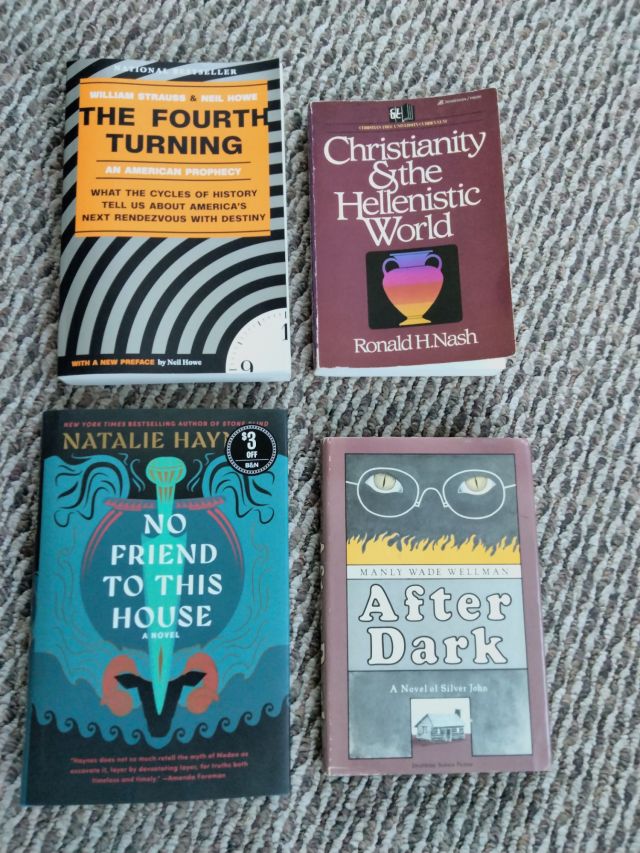
I can assert all this stuff, but there is always some scholar out there who could be quoted to argue with me. I needed a book. And the book came to me. As I was turning all these things over in my mind, I had to venture out to a Christian bookstore that was closing. (“Come get your novels,” they said.) Of course, many of their books were on clearance, and there before me was Nash’s Christianity and the Hellenistic World for the low low price of one dollar, its asking price all out of proportion to its value to me at that moment. Nash can prove what I can only assert.

Nash systematically addresses claims that early Christian writers, particularly Paul, got many of their key concepts from Platonism, Stoicism, the mystery religions, and Gnosticism.

Among the many claims published in this century are the following:

  1. Early Christianity was just another Hellenistic mystery religion.
  2. Important Christian beliefs and practices were either borrowed from, or were heavily dependent on, similar beliefs and practices in the mysteries.
  3. Both baptism the Lord’s Supper evidence the influence of similar rituals in the mystery cults.
  4. Among the many Christian beliefs drawn from the mysteries is the Pauline doctrine of salvation, which parallels the essential themes of the mysteries: a savior-god dies violently for those he will eventually deliver, after which the god is restored to life.

A major movement in the development and promotion of such theories was the History of Religions School (Religionsgeschichtliche Schule).

-ibid, pp. 116 – 177

Nash addresses problems with these claims such as the following: in the mysteries, the dying god does not really rise. Osiris lives on in the underworld; the dead god’s body becomes the wheat, etc. As far as we can tell, ritual washings in the mysteries were just purification rituals, and they had to be repeated. They do not seem to have been a one-time entry into a new life like the Christian baptism. For many of these mystery religions, we don’t actually know much about the content of the rituals, because they were intentionally kept secret. For many mystery-religion practices that are well-attested, such as the taurobolium where the initiate stood beneath a grate while a bull was slaughtered, these practices seem to have developed after Christ rose and Paul wrote his letters. In the case of the mystery religions of the first, second, and third centuries, some of them were actually influenced by Christianity, not the other way round.

But I’ll let German scholar Adolf von Harnack, quoted by Nash, have the last word:

We must reject the comparative mythology which finds a causal connection between everything and everything else, which tears down solid barriers, bridges chasms as though it were child’s play, and spins combinations from superficial similarities … By such methods one can turn Christ into a sun god in the twinkling of an eye, or one can bring up legends attending the birth of every conceivable god, or one can catch all sorts of mythological doves to keep company with the baptismal dove; and find any number of celebrated asses to follow the ass on which Jesus rode into Jerusalem; and thus, with the magic wand of “comparative religion,” triumphantly eliminate every spontaneous trait in any religion.

–ibid, pp. 118 – 119

Too many keys to mythology

In short, the problem is not that there are some key symbolic parallels between Christ and ancient pagan symbolism. The problem is that there are too many parallels, or similarities, right down to the animals involved. Part of this is simply the limitations of living in this world. Jesus had to eat something, He had to ride on something, He had to use some kind of words when He spoke, and there were a finite number of foods, mounts, and terms in the ancient world, just as there are everywhere. I have pointed out before, when addressing the problem of whether Christians “stole” pagan practices like hot cross buns and wedding customs, that there are a limited number of ways to do every human activity. If you eat something, wear something, or go through a life passage, and you are a human being, I guarantee that in the past four thousand years there has been someone who did it that way before you. And that someone was probably pagan.

As G.K. Chesterton said about finding mystical and symbolic connections:

The true origin of all the myths has been discovered much too often. There are too many keys to mythology, as there are too many cryptograms in Shakespeare. Everything is phallic; everything is totemistic; everything is seed-time and harvest; everything is ghosts and grave-offerings; everything is the golden bough of sacrifice; everything is the sun and moon; everything is everything.

–The Everlasting Man, p. 103

These are the givens of the universe that all humans encounter; and, unless we are sorely impoverished, we all have some way of dealing with them. But just because they are ubiquitous does not mean they are unimportant. These things are shadows of what was to come. The reality, however, is found in Christ.

Symbolism in Reality

Last point: Jesus was the fulfillment of all these confused hints in every culture. But the vibe of the New Testament historical records is much less gorgeous, mythical, and poetic than the ancient pagan stories. As C.S. Lewis put it:

When I first, after childhood, read the Gospels, I was full of that stuff about the dying God, The Golden Bough, and so on. It was to me then a very poetic, and mysterious, and quickening idea; and when I turned to the Gospels never will I forget my disappointment and repulsion at finding hardly anything about it at all. The metaphor of the seed dropping into the ground in this connexion occurs (I think) twice in the New Testament, and for the rest hardly any notice is taken; it seemed to me extradordinary. You had a dying God, Who is always representative of the corn; you see Him holding the corn, that is, bread, in His hand, and saying, ‘This is My Body,’ and from my point of view, as I then was, He did not seem to realize what He was saying. Surely there, if anywhere, this connexion between the Christian story and the corn must have come out; the whole context is crying out for it. But everything goes on as if the principal actor, and still more, those close to Him, were totally ignorant of what they were doing. It is as if you got very good evidence concerning the sea-serpent, but the men who brought this good evidence seemed never to have heard of sea-serpents. Or to put it another way, why was it that the only case of the ‘dying God’ which might conceivably have been historical occurred among a people (and the only people in the whole Mediterranean world) who had not got any trace of this nature religion, and indeed seemed to know nothing about it?

–C.S. Lewis, “The Grand Miracle,” in God in the Dock, p. 83

Well, when you put it that way, it’s pretty funny, isn’t it? Jesus’s death reads as disappointingly prosaic compared to the myths only because it actually happened. This is very humble of God. He has quite the sense of humor. As John puts it after his account of the Triumphal Entry, “At first His disciples did not understand all this. Only after Jesus was glorified did they realize that these things had been written about Him and that they had done these things to Him.” John 12:16

Sources

Chesteron, G.K. The Everlasting Man. Ignatius Press: 2008, originally published in 1925.

Lewis, C.S., ed. Walter Hooper, God in the Dock: Essays on Theology and Ethics. Eerdmans: 1970, 1978.

Nash, Ronald H. Christianity and the Hellenistic World. Zondervan: 1984.

Renault, Mary. The King Must Die. Alfred A. Knopf, Everyman’s Library edition pub. 2022, originally published by Pantheon Books in 1958.

“Who is Mary Renault?” copyright The Mary Renault Society, 2010 – 2026, Who Is Mary Renault? – The Mary Renault Society, accessed April 17, 2026.

Quote: “He’s born!”

I had seen often enough before what met us there: the great mob, shouting, “He is born! He is born!” and whirling their rattles, and throwing wheat-seed into the air, all sweaty and struggling and climbing on one another’s backs to get a sight of Arnom and the rest of us. Today it struck me in a new way. It was the joy of the people that amazed me. There they stood where they had waited for hours, so pressed together they could hardly breathe, each doubtless with a dozen cares and sorrows upon him (who has not?), yet every man and woman and the very children looking as if all the world was well because a man dressed up as a bird had walked out of a door after striking a few blows with a wooden sword.

Till We Have Faces, p. 273

Sacrifice in Ancient Greece and Now

This is my final post about The King Must Die. It will have spoilers. They will be the sort of spoilers that make you want to read the book.

Like any good literary book with a strong theme, this one announces the theme in its title. The King Must Die. Why? Why must the king die? The entire story is an effort to provide the answer.

A Rude Awakening: the Death of the King Horse

The first major incident in the book involves the slaughter of a sacred horse. Theseus, who is about seven at the time, loves this horse. It is the “king horse,” the stallion of the sacred herd. Theseus, who has been told that the god Poseidon is his father, thinks of this horse as his literal brother. He is taken to the sacred island to attend a special ceremony. He has no idea that this ceremony is going to culminate in the slaughter of the horse he adores.

It was a good clean killing. I myself, with all Athens watching, am content to do no worse. Yet, even now, I still remember. How he reared up like a tower, feeling his death, dragging the men like children; the scarlet cleft in the white throat, the rank hot smell; the ruin of beauty, the fall of strength, the ebb of valor; and the grief, the burning pity as he sank upon his knees and laid his bright head in the dust. That blood seemed to tear the soul out of my breast, as if my own heart had shed it.

As the newborn babe, who has been rocked day and night in his soft cave knowing no other, is thrust forth where the harsh air pierces him and fierce light stabs his eyes, so it was with me.

p. 13

This is the first king to die in the story. And for Theseus, it is also a kind of death, and a kind of birth. He is the grandson of a king, and this is his birth into the world where the king must die.

Then Theseus is “dedicated.” This involves smearing the horse’s blood on his forehead. But when his older cousin tells him “Come, you must be dedicated,” he thinks that he is about to be sacrificed like the King Horse. So the little boy steps forward in his first act of courage, ready to give his life. And for the first time, he senses the presence of the god Poseidon with him.

Theseus’s grandfather, the king, notices that his grandson is struggling with what just happened. Later, in grandfather’s upper room, the two of them have a talk.

The Lord Poseidon, who rules everything that stretches under the sky, the land and the sea. He told the King Horse, and the King Horse led [our ancestors to new grazing grounds].”

I sat up; this I could understand.

“When they needed new pastures, they let him loose; and he, taking care of his people as the god advised him, would smell the air seeking food and water. Here in Troizen, when he goes out for the god, they guide him round the fields and over the ford. We do that in memory. But in those days he ran free. The barons followed him, to give battle if his passage was disputed; but only the god told him where to go.

And so, before he was loosed, he was always dedicated. The god only inspires his own. Can you understand this, Theseus?

The King Horse showed the way; the barons cleared it; and the King led the people. When the work of the King Horse was done, he was given to the god, as you saw yesterday. And in those days, said my great-grandfather, as with the King Horse, so with the King.”

I looked up in wonder; and yet, not in astonishment. Something within me did not find it strange.

“Horses go blindly to the sacrifice; but the gods give knowledge to men. When the King was dedicated, he knew his moira [=destiny]. In three years, or seven, or nine, or whenever the custom was, his term would end and the god would call him. And he went consenting, or else he was no king, and power would not fall on him to lead the people. And the custom changes, Theseus, but this token never.

“Later the custom altered. Perhaps they had a King they could not spare, when war or plague thinned the Kindred. Or perhaps Apollo showed them a hidden thing. But they ceased to offer the King at a set time. They kept him for the extreme sacrifice, to appease the gods in their greatest angers … And it was no one’s place to say to him, ‘It is time to make the offering.’ He was the nearest to the god, because he consented to his moira; and he himself received the god’s commandment.”

He paused; and I said, “How?”

“In different ways. And so it is still, Theseus. We know our time. Listen, and do not forget, and I will show you a mystery. It is not the sacrifice, whether it comes in youth or age, or the god remits it; it is not the bloodletting that calls down power. It is the consenting, Theseus. The readiness is all. It washes heart and mind from things of no account, and leaves them open to the god. But one washing does not last a lifetime; we must renew it, or the dust returns to cover us.”

pp. 16 – 19

Thus the king of Troizen lays out the entire rationale for Hellene royal sacrifice. Perhaps you have already noticed a few Bible Easter eggs. “Behold, I tell you a mystery” and Jesus saying, “The Father loves me because I lay down my life. No one takes it from me; I lay it down of my own accord. I have authority to lay it down and authority to take it up again. This command I received from my Father.” (John 10:17 – 18) Those few lines map exactly onto what Theseus’s grandfather has just told us, albeit with perfect clarity instead of wrapped in mysterious ancient customs.

Was all this really present in the culture of the ancient Greeks and their Indo-European forebears? Or is Renault reading it back into that culture from the Bible? Or, did Jesus borrow all this from the ancients? I’m looking into it.

You might think that Theseus’s grandfather’s speech is too heavy-handed; showing instead of telling. But Renault knows what she is doing. This is not the whole secret of the book laid bare within the first twenty pages. It is only the beginning. This instruction from his grandfather sets Theseus’s attitude towards the god, himself, and his duty. It will guide how he responds to things throughout the rest of the book.

All the Kings that Die

Spoiler time. Here is a quick list of all the kings whose death Theseus causes or witnesses in this book:

  • Kerkyon, the “king” of Eleusis. This young man is a “solar king,” that is, he lives in a matriarchal society where the king reigns for only one year and then is killed by his successor. Thesus gets chosen as the next solar king and kills Kerkyon in hand to hand combat. Then he becomes the next Kerkyon.
  • Minos. Minos is dying and has no legitimate heir. He eventually becomes aware of Theseus and asks him to kill him using the sacred double-headed axe that has been used by kings in Crete from ancient times.
  • Astarion, the “Minotaur.” In this version of the story, Astarion is Pasiphae’s illegitimate son by an Assyrian bull-dancer. He is angling for the throne of Crete, and after Minos dies he has himself crowned king. A priest anoints him with oil and puts on him the sacred gold bull-mask. Theseus interrupts the ceremony and fights Astarion, who is still wearing the sacred mask. Though he gained the throne by illegitimate means and held it for only a few minutes, technically Astarion is another king whom Theseus kills.
  • The solar king on the island of Dia. Theseus, Ariadne, and the fleeing bull-dancers make a stop on this island on the way home to Athens. It happens to be on the day of the year that the Dionysian rite will take place, where the past year’s king is torn to pieces by the Maenads.
  • Theseus’s father Aigeus. Aigeus kills himself by leaping from the cliff of Athens when he sees that the returning ship is bearing a dark blue Cretan sail instead of a white one. Leaping from the cliff is the traditional way that kings of Athens have been known to “make the sacrifice” when the god calls them.

All of these tragic events might seem like an unrelated potpourri of senseless suffering. But actually, they are all closely bound up with each other, and we can see it if we look at the Hellene, Minyan, and Cretan attitudes towards sacrifice.

Other Sacrifices

Sacrifice is everywhere in this ancient world. Every year, the people of Troizen kill a “scapegoat,” a non-royal person that they have decided is causing their troubles. There are animal sacrifices, there are libations of wine poured out, and so forth. The priestess, when she goes to do divination, offers the “house snake” a dish of milk. In Crete, when a man is going to become king, he throws a ring into the sea to “marry the sea lady.” I want to here mention two notable sacrifices that royal characters make.

Early in the book, we learn that during a time of drought and plague, Theseus’s mother sacrifices her virginity. Typical of ancient pagan thinking, when none of the gods of the Hellenes claimed responsibility for the plague, the king, with increasing desperation, finally figured out that the god who was angry was “the Mother.” He offers a “holocaust” (a burnt offering) of pigs all around the large mossy rock in the Mother’s shrine, but apparently this is not sufficient. The old priestess, who is unattractive and dislikes pretty girls, tells the king that his fifteen-year-old daughter must “hang up her girdle for the Mother.” This means she must go to the “myrtle house” (a shrine on the sacred island) and give herself to the first man who shows up, as an offering to the Mother. Then the drought will stop.

It’s an incredibly poignant scene as the king, now a grandfather, describes to Theseus how he felt he could not get out of this. He goes to his daughter about it, and she says of course she is willing to make this sacrifice to save the life of the people.

As it happens, the king of Athens is visiting Troizen, and he agrees to go and visit the young princess on the island so that at least her experience will be with a man who is kind, and whom she has met before. But the king of Troizen cannot tell his daughter that this is going to happen, because as a member of the royal family, she has to go to the sacrifice consenting. “The readiness is all.” So the king of Athens swims over to the sacred island and becomes Theseus’s father. As he jumps into the water, a thunderstorm is already coming to end the drought.

Later, Theseus sacrifices himself for his people when he volunteers to go to Crete as part of the tribute of seven youths and seven maidens. He feels the god Poseidon calling him to do this, “sending him to the bulls.” (The bull-dance of Crete is actually a sacrificial rite in honor of Poseidon.) At first, Theseus resists. He tries to offer the god his horses instead, but he can feel the presence of the god withdrawing from him in response to this. So, in a moment of anguish, he makes the decision to give up his life in Athens, with his father and eventually the throne. Going to Crete does not mean instant death, though it’s understood that bull-dancers last a maximum of six months in the ring. But it is a death to all of Theseus’s hopes and dreams.

Two Attitudes to Sacrifice

As I’ve hinted in this and in previous posts, the customs of the earth-mother-worshipping Minyans differ quite a bit from those of the sky-god-worshipping Hellenes when it comes to sacrifice. In contrast to the Hellene approach laid out in the first section of this post by Theseus’s grandfather, the Minyan solar “kings” are not really kings at all, but more like sacrificial animals. The “king” serves as the consort of the priestess/queen for one year. During this time, he is pampered in every way, sort of like fattening an animal for slaughter, but he has no real power. The queen, together with the other matriarchs, is one who conducts the business of the land. In Eleusis, the war chief is not the queen’s husband but her brother. In these “earthling” societies, the important thing is not how the king dies but simply that he die.

Just inshore, the road sloped upwards to a flat open place at the foot of a rocky bluff. Stairs led up to the terrace where the Palace stood: red columns with black bases, and yellow walls. The cliff below it was undercut; the hollow looked dark and gloomy, and had a deep cleft in its floor that plunged into the earth. The breeze bore from it a faint stench of rotten flesh.

She pointed to the level place before it, and said, “There is the wrestling ground.”

I looked at the cleft and said, “What happens to the loser?”

She said, “He goes to the Mother. At the autumn sowing his flesh is brought forth and plowed into the fields, and turns to corn.”

ibid, p. 68

It is not the king’s life, his attitude, his self-sacrifice, or his leadership that the goddess-worshippers need, but only his rotting body, his symbolic and literal death.

This system produces a fatalism in Minyan “kings” that is very different from the warrior spirit of the Hellenes.

As we met each other’s eyes, I thought, “He has stood where I stand now, and the man he fought with is bones under the rock.” And then I thought, “He has not consented to his death.”

I drank of the mixed drink, and the priestess gave it to the King. He drank deep. The people gazed at him; but no one cheered. Yet he stripped well, and bore himself bravely; and for a year he had been their king. I remembered what I had heard of the old religion. “They care nothing for him,” I thought, “though he is going to die for them, or so they hope, and put his life into the corn. He is the scapegoat. Looking at him, they see only the year’s troubles, the crop that failed, the barren cows, the sickness. They want to kill their troubles with him, and start again.”

I was angry to see his death not in his own hand … But I saw from his face that none of this came strange to him; he was bitter at it, but did not question it, being Earthling as they were.

“He too,” I thought, “would think me mad if he knew my mind.”

ibid, pp. 69, 71

Theseus encounters this same unbridgeable disconnect again near the end of the book, when on the island of Dia he meets their sixteen-year-old “king.”

There was something about him I could put no name to, a daimon in his eyes; not that they wandered, like men’s eyes whose wits are troubled; rather they were too still. Whatever he fixed his gaze on, it was as if he would drain it dry.

Something oppressed me in his silence, and I said only to break it, “You have a god’s feast here tomorrow.”

“Yes.” That was all; but something woke in my mind, and of a sudden I saw everything. I remembered Pylas saying to me in the mountains above Eleusis, “I know how a man looks who foreknows his end.”

He read it in my face. For a moment our eyes met, seeking to speak together. It was in my mind to say, “Be on my ship before cocklight, and with the dawn we will be away. I too have stood where you stand now; and look, I am free. There is more in a man than the meat and corn and wine that feeds him. How it is called I do not know; but there is some god that knows its name.”

But when I looked into his eyes, there was nothing in them that I could say it to. He was an Earthling, and the ancient snake was dancing already in his soul.

ibid, pp. 319 – 320

The Minyans kill their king, and “do not share the sacrifice, offer nothing of their own.” This attitude is even more pronounced in Crete, as Theseus finds when he goes there.

Theseus takes his call to go “to the bulls” very seriously, as a form of sacrifice. Indeed, the bull-dancing developed from an original simple human sacrifice where a single victim was thrown into a pit to be gored by a bull, representing the god. But in the aeons since then, it has developed into entertainment. Originally, it was the youths of the noble families of Crete who would dance with the bulls until the day they were killed. Even then, they were celebrities. But now, the people of Crete do not enter the bull-ring themselves. Instead, the bull-dancers are slaves taken as tribute, captured, or bought from all corners of the world: not only the Greek islands but Libya, Phoenicia, Assyria, Scythia, even Israel. The Cretan upper classes adore these teenaged bull-dancers. They bet on them, send them gifts, have affairs with them, invite them to parties. They cry over their deaths. But ultimately, what is life and death to the bull-leapers is, to the Cretans, a diversion.

Avoiding the Sacrifice

Theseus does not resent being the one to put his life on the line in the bull-ring, because the sport itself is intoxicating, perfect for a teenaged adrenaline junkie. But he observes more than once, “These people only play at their sacrifices.” For example, the Cretan upper classes have dolls made of themselves which they hang on the trees every year in their place, at the time of year when, in ancient times, a royal person would be sacrificed.

“But that is a …” She checked herself and said, “only a mainland custom. Here in Crete no king has been sacrificed for two hundred years. We hang our dolls on the trees instead, and the Mother has not been angry.”

I made over her the sign against evil.

p. 253

As a result of this unwillingness to do the actual sacrifice, even the family of Minos no longer have the presence of the god. Theseus is appalled when Ariadne tells him how she plans to fake a fit of prophecy in her capacity as priestess. And he is stunned to find that Minos does not hear the voice of the god.

“Come,” he said, “tell me of this. The god spoke to you, you say. You have heard the voice that calls the king. How does it speak? In words? In a sound of music, or the wind? How does it call?”

I stared at him. Amazement rooted my tongue. I thought I must have heard wrong, yet knew not how to ask. We were silent, looking at each other.

He was the first to speak. He leaned his head on his hand, and said in his sad muffled voice, “Boy, how old are you?”

I said, “If I live to spring, my lord, I shall be nineteen.”

“And after dark, when the bats fly over, you hear their cry?”

“Why, yes,” I said. “Often the night is full of it.”

“They cry to the young. And when the old man passes, they are not silent; it is his ear that has hardened. So also with kings’ houses; and it is time then to think of our going. When the god calls you, Theseus, what is in your heart?”

Finding what words I could, I opened my heart in this small closed room to Star-Born Minos, Lord of the Isles.

When I had said my say … he raised his crystal eyes again, and slowly nodded. “So,” he said, “you made the offering. And yet, it is your father who is King.”

His words went sounding through me, deeper even than my grandfather’s long ago; deeper than my own thought could follow. “No matter,” I said. “A good Shepherd will give his life for the sheep.”

pp. 265 – 266

So Minos has lost, but he knows what he has lost. There is an even deeper depth of cynicism displayed in his stepson, Astarion, Pasiphae’s illegitimate child by a bull-leaper. When Theseus finds out that Astarion is planning to become king by a political coup, he can barely comprehend it:

“But,” I said, “then Crete is being ruled by a man who does not belong to any god; who was never dedicated. He has all power; yet he has not consented to make the sacrifice. Has he consented?”

There was a shadow on her cheek, as if she would smile; but her face grew grave, and she shook her head.

“Then,” I said, “the god will never speak to him. How can he lead the people? Who will see their danger coming? What will happen, if the god is angry, and there is no one to offer himself? He takes service, tribute, honor; and he gives nothing! Nothing! He will be death to your people if they let him live.”

p. 256

Theseus understands what many Cretans, and many in our godforsaken time, do not: that being a king is about more than just power.

Eventually, Astarion commits what reads to Theseus as the ultimate sacrilege. Astarion has sponsored Theseus’s team of bull-leapers for almost a year. Hard up for money, and with no access as yet to the royal treasury, Astarion seeks to make some money off his team. He places bets that they will die in the next dance, and then secretly has their bull drugged to madden it. Though Theseus is gored, the team manages to survive for a few minutes, and then the stratagem backfires when the bull dies of the drugs. The team, when they realize what he has done, are furious: “How this man has despised us!”

But Astarion has not only despised his team. He has despised the bull, the ritual, and hence, the god. Within twenty-four hours, Theseus is feeling the warning in his body and spirit that always comes over him right before Poseidon sends an earthquake. But this time, it is stronger than ever before.

The noise tormented me; the warning surged and roared and crashed through my head, or withdrew leaving a dreadful hollow hush filled with the tread of the approaching god. The awe and terror which it is man’s nature to feel before the Immortals goaded and spurred me to fly for my life. And when I held my ground, the madness burned me up, and the warning would not be contained within me. I shook Amyntor off and leaped on the table among broken winecups, and shouted it aloud.

“Poseidon is coming! Poseidon is coming! I Theseus tell you so, I his son. The sacred bull was killed and the Earth Bull has wakened! The House of the Ax will fall! The House will fall!”

p. 294

After the massive earthquake, when Theseus defeats Astarion,

Now I saw his face, grimacing with bared teeth. I stepped up to him, to hear what he would say to me. But he only stared at me as at some shape of chaos, seen in a dream when nothing makes sense. He who had thought to rule without the sacrifice, who had never felt the god’s breath that lifts a man beyond himself, had nothing to take him kinglike to the dark house of Hades.

p. 312

By denying the gods and expecting others to sacrifice for him, Astarion has destroyed his own mind and ushered himself into hell. This is the darkest place. It is darker even than the Minyan solar kings. Though they are about 90% scapegoat and only about 10% king, yet even they, because the Minyans still take their sacrifices seriously, provide some faint foreshadowing of Christ. When the young king of Dia rides off in a cart to go up the mountain and be torn to pieces, he goes crowned with ivy, raising a wine cup in his hand, and scattering wheat (bread) onto his people. Apparently, this is part of the deep structure of a properly done sacrifice: sharing out the bread and the cup before one’s death. Going up the hill. A vegetable crown.

And Today?

What did I mean, “And Now”? I can barely remember why I put that in the title.

Obviously, we no longer live in a world where human sacrifice is necessary to keep ourselves alive. Arguably, it never was, but I think this novel makes a pretty good case that there was something deep going on there. Human sacrifice bad, yes, but we cannot by the same token say paganism worthless, with no glimpses of the truth and with nothing to teach us.

Regarding the question of where these resemblances came from, I do not have time to go into whether Christianity “copied” from ancient Greek mystery religions, was not even aware of them, or was aware of them and did some riffing on them. But in the providence of God, I recently ran across a book that looks into exactly that. I’ll be back when I’ve read it, with a more robust case that these types and shadows found in paganism had their source in God.

The book of Hebrews–and in fact the entire New Testament–makes a strong case that, when our King laid down His life, that was the last, sufficient sacrifice, making it no longer necessary even to sacrifice animals. The only reason Theseus comes out looking so heroic is because of his resemblance to the King of Kings. And a Happy Easter to you. He is risen indeed!

But there is a miniature version of “the king must die” that applies in the daily life of every Christian, indeed of every adult. Being a king is about much more than just power, and this goes for every kind of leader. In order to be a good parent, you should be sacrificing yourself for your children much more often than you expect them to sacrifice for you, although of course this doesn’t mean that you let them be in charge. Most of a parent’s sacrifice is invisible to the children. And in fact, the one who sacrifices the most is the one who has the most authority. Otherwise, how will the unction of the god fall upon you to lead your people? Who will see danger coming?

Similarly, a good boss or manager works harder than any of his employees. A major principle of leadership and love is “my life for yours.” As Jesus said, “Whoever wants to come after me must deny themselves, pick up their cross, and follow me.” “Pick up their cross” corresponds to getting in the cart, the one that takes you up the hill. So, you, know, in a small way, we should all strive to be Theseus and not Astarion.

Let’s Talk About the Sun

1 The heavens declare the glory of God;

the skies proclaim the work of His hands.

2 Day after day they pour forth speech;

night after night they display knowledge.

3 There is no speech or language where their voice is not heard.

4 Their voice goes out into all the earth, their words to the ends of the world.

In the heavens He has pitched a tent for the sun,

5 which is like a bridegroom coming forth from his pavilion,

like a champion rejoicing to run his course.

6 It rises at one end of the heavens and makes its circuit to the other;

nothing is hidden from its heat.

7 The law of the LORD is perfect, reviving the soul.

The statutes of the LORD are trustworthy, making wise the simple.

8 The precepts of the LORD are right, giving joy to the heart.

The commands of the LORD are radiant, giving light to the eyes.

9 The fear of the LORD is pure, enduring forever.

The ordinances of the LORD are sure and altogether righteous.

10 They are more precious than gold, than much pure gold;

they are sweeter than honey, than honey from the comb.

11 By them is your servant warned; in keeping them is great reward.

12 Who can discern his errors? Forgive my hidden faults.

13 Keep your servant also from willful sins;

may they not rule over me.

Then will I be blameless, innocent of great transgression.

14 May the words of my mouth and the meditation of my heart

be pleasing in your sight,

O LORD, my Rock and my Redeemer.

–Psalm 19, of David

The following is a reader-response literary analysis of Psalm 19.

This is an extremely famous psalm. If you have been around Bible circles for any length of time, you probably have heard it quoted. I was no different, but for some reason, it took me 40 years to really understand why the elements of this psalm are here and how they all work together. So perhaps you can find some benefit from following my plodding steps.

The first four verses of Psalm 19 are often quoted. They describe how the skies and space themselves testify to all humankind that there is a God and that He is glorious. Paul alludes to this in Romans 1, where he says, “since the creation of the world God’s invisible qualities–His eternal power and divine nature–have been clearly seen, being understood from what has been made, so that men are without excuse.” Of course, God makes it abundantly clear to the Israelites that the sun, moon, and stars are in fact creatures and that He is not pleased when people worship them … which raises the question of sun-worship … which we will get to momentarily.

Similarly, the last three verses of the psalm–the prayer for personal cleansing from sin–are also often quoted. These are very accessible. You could pick them up and pray them, with no obstacles to understanding, if you became a Christian just yesterday. On a slightly deeper level, I have heard these verses taught as a very savvy description of the progressive nature of sin. It starts out as “hidden faults,” then if unrepented becomes “willful,” which leads to sin ruling over a person, and this state of being ruled by sin eventually leads to some egregious “great transgression.”

And this is really a psalm that is best understood back to front. If the last three verses are the most easily accessible, verses 7 – 11, about the law of God, are a close second. True to Hebrew poetry, David uses a bunch of different synonyms: law, statutes, precepts, commands, ordinances, and, interestingly, fear. Obviously these are English translations of Hebrew words for God’s law, of which the language had quite a number.

To David, he wasn’t just referring to the Ten Commandments or to the book of Leviticus. By all these synonyms he meant the whole “law of God,” that is all the revealed word of God that they had at the time. And by his inclusion of fear, it’s also clear that he meant the revelation of God’s nature, His presence with His people, and the holy awe that they were supposed to have in response.

However, I don’t want to unsay what the psalm says. The emphasis in these verses is clearly on the moral, right-and-wrong aspect of God’s word. God has given us a law. But rather than just being an obscure collection of ancient rules, this is a law that somehow revives the human soul, makes the simple wise, gives joy to the heart, light to the eyes, endures forever, warns, and is sweeter than honey.

It was for this passage that I returned to Psalm 19 recently. I had noticed after forgetting for a while–again–as one does–that without some kind of moral standard coming from outside ourselves, human beings are really and truly sunk. If there is no objective right and wrong, then might makes right and all truth claims are actually just attempts to grab power. (Thank you, Derrida!) The last couple of hundred years have been a big social experiment demonstrating this. Again.

So, my original reason for pulling out Psalm 19 was so I could pray verses 7 – 11 and thank God for His Word. Of course, as a Christian, I had an even more in-depth appreciation for the treasure that Bible truly is. It doesn’t just give us the only extra-human set of truth claims upon which a civilization can be built. It’s also, by far, our most comprehensive and reliable source text on ancient history. As if that weren’t enough, it’s not written in dry legalese or as lists of facts, but in the form of stirring stories, terrifying mythological scenes, and challenging and moving poetry. Books, and libraries, are already a treasure, but this particular library of books is truly “more precious than gold, than much pure gold.”

So I really just wanted to quote that back to God. But it’s a short psalm, and the confession verses at the end are sooo good, so of course I ended up reading the whole thing out loud whenever I went to use it.

The only sour note in this symphony of devotion were the verses about the sun. They seemed overdone. I get that we are talking about the skies and things in the skies, but why devote three whole verses just to poetically describing the sun? Rabbit trail much, David?

Then, after I don’t know how many iterations, it dawned (even) upon me that there might, possibly, be a few similarities between the sun and the law of God as described in the verses that follow it. Let’s see: nothing is hidden from its heat. It covers the whole earth and all people. It’s inescapable. It gives light to the eyes, and it revives the soul (think about the effect of sunlight after a long night!). It gives hope. But it can also be kind of oppressive. It “warns.” It also disinfects things that are exposed to it. Hiding from the sun is not usually a good sign. It can be a metaphor for hiding wrongdoing. However, we do still need shelter from the sun, because it’s pretty intense. Almost as if it were a small picture of the One Who is too holy to look upon.

Haha! I get it now!

There was just one remaining fly in the ointment. I really didn’t see why it was necessary for David to compare the sun to “a bridegroom coming forth from his pavilion” … that is, to a young man who has just had sex with his wife for the first time. Yeah, I suppose that does give a guy a certain glow. Yeah, Hebrew poetry is earthy. I get it. But … why? Is this just there to make modern readers squirm?

In the providence of God, I happened to be reading Till We Have Faces. In this book, the narrator (Orual) has a little sister (Psyche) who marries a god. This is literal, not figurative. It is a retelling of the Cupid and Psyche myth.

Orual meets her divine brother-in-law twice. The first time, it is in terrible judgment:

There came as it were a lightning that endured. That is, the look of it was the look of lightning, pale, dazzling, without warmth or comfort, showing each smallest thing with fierce distinctiveness, but it did not go away. This great light stood over me as still as a candle burning in a curtained and shuttered room. In the center of the light was something like a man. It is strange that I cannot tell you its size. Its face was far above me, yet memory does not show the shape as a giant’s. And I do not know whether it stood, or seemed to stand, on the far side of the water or on the water itself.

Though this light stood motionless, my glimpse of the face was as swift as a true flash of lightning. I could not bear it for longer. Not my eyes only, but my heart and blood and very brain were too weak for that. A monster would have subdued me less than the beauty this face wore. And I think anger (what men call anger) would have been more supportable than the passionless and measureless rejection with which it looked upon me.

-Till We Have Faces, pp. 172 – 173

The second time, Orual’s literal and metaphorical ugliness has been cleansed, and the god coming to judge her is going to see only beauty:

“Did I not tell you, Maia,” she said, “that a day was coming when you and I would meet in my house and no cloud between us?”

Joy silenced me. But now, what was this? You have seen torches grow pale when men open the shutters and broad summer morning shines in on the feasting hall? So now. Suddenly, from a strange look on Psyche’s face, or from a glorious and awful deepening of the blue sky above us, or from a deep breath like a sigh uttered all round us by invisible lips, or from a deep, doubtful, quaking and surmise in my own heart, I knew that all this had been only a preparation. Some far greater matter was upon us. The voices spoke again; but not loud this time. They were awed and trembled. “He is coming,” they said. “The god is coming into his house. The god comes to judge Orual.”

The air was growing brighter and brighter about us; as if something had set it on fire. Each breath I drew let into me new terror, joy, overpowering sweetness. I was pierced through and through with the arrows of it. I was being unmade. And he was coming. The most dreadful, the most beautiful, the only dread and beauty there is, was coming. The pillars on the far side of the pool flushed at his approach. I cast down my eyes.

“You also are Psyche,” came a great voice.

–ibid, pp. 306 – 308

The bridegroom is actually the one Who links everything together in this poem. C.S. Lewis had to hit me over the head with an extremely long, vivid description before I could see it, but I see it now. The god–Christ–is the bridegroom and He’s also the sun. He comes in horrible, revealing judgment, he comes in shining beauty, He overwhelms the senses. He convicts and purifies and beautifies the people that His light touches. And, of course, He is also the Word. And Word also does all these things.

Amen. Come, Lord Jesus.

This is Taking a Toll.

Hello, fellow readers. I just don’t know.

This is an unplanned post. But, after all, a blog is a “web-log,” no? As in, a record of how we are doing day to day. And book blogs are records of how our reading affects us.

And whoof. Reading Greco-fiction is proving costlier than I anticipated.

First, there was Circe, with its depressing picture of Odysseus slipping into OCD paranoia after his return to Ithaca.

Then, I read Till We Have Faces, which is sort of like having the Holy Spirit do open heart surgery on you, if you really pore over it.

Now, I’m sitting here trying to work, but I’m having to take a break because reading The King Must Die has made my stomach hurt. That is not an exaggeration; I am experiencing psychologically caused stomach pain from reading this book.

I had some time to myself this morning, before leaving for the office. I thought I’d just get caught up on my reading of The King Must Die. Plus, it is hard to put down. I enjoyed reading about the earthquake that brought down the palace of Knossos. I relished when the Greek ship passed the island of Kalliste, the source of the earthquake, and the watery crater where the island used to lie. (This is the eruption of Thera, a well-documented event that took place about 1500 B.C.) Theseus is bringing with him Princess Ariadne of Crete. He is in love with her, and he has promised her father Minos that he will marry her and protect her.

The party lands on the Isle of Dia. I knew what was coming, but I kept reading. I remember this from university.

The people on the Isle of Dia are about to have a festival to Dionysius. Terrible things happen at such times, but everyone is in an altered state. A sacrificial man is torn apart by the wild women, the Maenads. I mean with their bare hands, teeth, etc.

Ariadne participates in this ceremony. When Theseus finds her, sleeping the wine off peacefully, all covered in someone else’s blood and still holding a body part, he vomits. He knew the king must die, but he didn’t anticipate exactly how it would happen. And he’s only eighteen years old.

I knew what would happen, but for some reason, it affected me worse this time. Perhaps because this time, I have children the ages of Theseus, Ariadne (16), and the “King” (also 16) whom she murdered.

At the same time, I can’t just dismiss it as follows: “Well, of course. It’s paganism. It’s all horrible and worthless, not worth caring about these people, not worth my time.” The reason these stories still intrigue us is because there is some very deep stuff going on there. And The King Must Die is filled, almost on every page, with Biblical easter eggs, both as direct quotes and as symbolic allusions. Even the Dionysian ceremony has them. Though I don’t doubt those wild women would indeed have to be possessed, and not in a good way, to do what they did.

Anyway, I’ll get to how I found Christ in The King Must Die in a later post, when I have gathered myself. I just wanted to report that it sort of ruined my day.

Have you ever had a physical reaction to a book? And did you still like the book after?

Themes in The King Must Die: Hellenes vs. ‘Shore People’

source: https://external-content.duckduckgo.com/iu/?u=http%3A%2F%2Farthistoryresources.net%2Fgreek-art-archaeology-2016%2Fgreek-art-archaeology-images%2Fmycenaefemalehead.jpg&f=1&nofb=1&ipt=7f3ec109d2b5fa5fc8a646dec84f0413e7fff54487f710be3ff027785a877590

As part of my ongoing, yearlong foray into fiction set in the ancient Mediterranean, I am now re-reading Mary Renault’s The King Must Die. There is so much history and speculation packed into this book, that I make free to do a series of posts on different topics from it, en route to the final book review. So, buckle up! I hope you like ancient historical fiction! (And, since you are visiting Out of Babel Books, I assume you at least don’t hate it!) Today’s topic is Renault’s theme of the two conflicting cultures of Hellenes vs. what they call the “Shore People.”

On the timing of the Theseus story

I have always had the impression that the story of Theseus was one of the older historical myths. It happens when Knossos, on Crete, is still a thriving city. So, in my mind, I put it a few generations before the Iliad. Madeline Miller, author of Circe, seems to agree. In her book, Circe hears of Theseus having killed the Minotaur well before Odysseus comes to land on her island.

If you do the math, Theseus living before the Odyssey would also put him living before Agamemnon returns from the war at Troy and is slaughtered in his bath by his wife, Clytemnestra. In the play Agamemnon (written, of course, much later), Clytemnestra kills her husband in revenge for his having sacrificed their thirteen-year-old daughter before he sailed for Troy, in addition to a couple of other grudges. Like most women, I find it hard not to think Clytemnestra has a case.

Renault, however, takes a different tack. She has a teenaged Theseus hear the following story from a bard:

The song he gave us was the Lay of Mycenae: how Agamemnon the first High King took the land from the Shore Folk, and married their Queen. But while he was at war she brought back the old religion, and chose another king; and when her lord came home she sacrificed him, though he had not consented. Their son, who had been hidden by the Hellenes, came back when he was a man, to restore the Sky Gods’ worship and avenge the dead. But in his blood was the old religion, to which nothing is holier than a mother. So, when he had done justice, horror sent him mad, and the Night’s Daughters chased him half over the world.

ibid, p. 40 in my copy

So here we have Agamemnon, Clytemnestra, their son Orestes, and the Furies. At the same time, this passage raises some questions.

The Shore People and Their Appearance

The Shore People make their appearance on the very first page of The King Must Die.

Our house is Hellene, sprung from the seed of Ever-Living Zeus. We worship the Sky Gods before Mother Dia and the gods of the earth. And we have never mixed our blood with the blood of the Shore People, who had the land before us.

-ibid, p. 1

As the story progresses, it rapidly becomes obvious that the Hellenes have, in fact, mixed their blood with the blood of the Shore People. There is the story of Agamemnon, above; Theseus is said to be “blonde and blue-eyed like the Hellenes, but small and wiry like the Shore People,” and Theseus, who is very promiscuous, even has a child who “came out small and dark, but so was [his mother’s] brother.”

So we have two populations, one that is native to the Greek coastlands (or at least has been there a long time), and one that came there from the steppes. Theseus’s grandfather explains to him their ethnic history, which he got from his own grandfather:

“Long ago, he said, our people lived in the northland, beyond Olympos. He said, and he was angry when I doubted it, that they never saw the sea. Instead of water they had a sea of grass, which stretched as far as the swallow flies, from the rising to the setting sun. They lived by the increase of their herds, and built no cities; when the grass was eaten, they moved where there was more. … When they journeyed, the barons in their chariots rode round about, guarding the flocks and the women … [Lord Poseidon] told the King Horse, and the King Horse led them. When they needed new pastures, they let him loose; and he, taking care of the people as the god advised him, would smell the air seeking food and water. The barons followed him, to give battle if his passage was disputed; but only the god told him where to go.”

ibid, pp. 16 – 17

This is a description of the Indo-European lifestyle and homeland. The Indo-Europeans took their reverence for the horse, and their wheeled carts and chariots, with them wherever they went, including to Scandinavia. So the Hellenes are Indo-European, and the Shore People, presumably, Hamitic or Semitic.

The mask at the top of this post is Mycenaean. Mycenae is located in the Peloponnesian Peninsula, which is also the location of Troizen, Theseus’s home. The ancient Mycenaean culture, older than classical Greece, took its cues from the Cretan urban culture of the time. In later Greece, you get men wearing himations and women wearing finely woven chitons. This is usually how Helen of Troy, for example, is illustrated. However, she probably looked more like the Mycenaean and Cretan women. Here is someone’s attempt to reconstruct the probable hairstyle and costume of the most beautiful woman in the world:

source: https://external-content.duckduckgo.com/iu/?u=https%3A%2F%2Fi.pinimg.com%2Foriginals%2F7d%2F29%2F38%2F7d293880174568ffd506b49b1f90aefd.jpg&f=1&nofb=1&ipt=500d8b11965e5cbdcd1de9286836a9a6b69ab9fcdb46f8991655a2c6648b4ab5

Notice the Egyptian-style, kohl-lined eyes, and the red suns for makeup. Helen might have been blonde, being a Hellene, but her clothing was perhaps more like this.

Here is someone else, reconstructing a traditional Mycenean costume and pose:

source: https://external-content.duckduckgo.com/iu/?u=https%3A%2F%2Fi.pinimg.com%2F474x%2Fcf%2F30%2Fde%2Fcf30de47e8298251f9d3ecc2976996ec.jpg&f=1&nofb=1&ipt=64a6c835ea102cac25d991e173ec53081fe8af0a6bd70db48b6d80c562988c33

I’m guessing these fashion choices came from the Shore People.

Theseus’s mother is described as wearing this ancient Mycenaean style. She wears a tiered, flounced skirt hung with charms, exposed breasts (what was going on, Crete and Mycenae?) and hair that is curled by the use of “crimping braids” (probably to attain a very curly look for those who do not, like the Shore People, have it naturally). Though a blonde Hellene, she is a priestess of the mother goddess, and so she takes some of her cues from the Shore People, and here is where we find the tension.

The Shore People and Their Religion

Both the Hellenes and the Shore People practice the sacrifice of their kings. However, there is a difference. For the Hellenes, it does not come on a regular schedule. Theseus’s grandfather explains:

“When the work of the King Horse was done, he was given to the god … And in those days, said my great-grandfather, as with the King Horse, so with the King. When the king was dedicated, he knew his moira [i.e. doom]. In three years, or seven, or nine, or whenever the custom was, his term would end and the god would call him. And he went consenting, or else he was no king, and no power would fall on him to lead the people. And the custom changes, Theseus, but the token never. … Later the custom altered. They ceased to offer the King at a set time. They kept him for the extreme sacrifice … And it was no one’s place to say to him, ‘It is time to make the offering.’ He was the nearest to the god, because he had consented to his moira; and he himself received the god’s commandment. And so it is still, Theseus. We know our time. … It is not the sacrifice … it is not the bloodletting that calls down power. It is the consenting, Theseus. The readiness is all.”

ibid. pp. 18 – 19

This might explain why so many kurgan burials are of high-born individuals who seem not to have died of old age.

It also, of course, explains the title of the book.

Meanwhile, it has been established that the Shore People do things a different way: “old laments have come down from the Shore People, of young heroes who love a goddess for a year, and foreknow their deaths” (p. 37). In other words, the Shore People treat their king primarily as the goddess or priestess’s consort, and kill him after just a year.

Marija Gimbutas has tried to make the case that the Shore People practiced a gentle, feminine, goddess-worshipping religion, and that they were cruelly exterminated by the warlike, sky-god worshipping evil Indo-Europeans. Renault is not going to paint with such a broad brush. Realistically, she shows both groups living next to one another and influencing each other. Also, throughout the course of the story, she is going to show by increasingly vivid illustrations that these two cultural systems are absolutely incompatible with each other. And that the mother-worship, in the end, is at least as bloody as the worship of Zeus.

Renault’s take on the story of Agamemnon is a great illustration of this. She interprets the story as a conflict between Clytemnestra’s mother-goddess culture and Agamemnon’s sky-father culture. When Clytemnestra brings back the “old religion,” it means that Agamemnon must die–not in battle, not some day, but now, and actually, yesterday. It means that Orestes is doubly cursed. He has loyalty to both religions, with their incompatible demands, and he is put at the mercy of the furies, the representatives of the goddess-religion. They chase him because he killed his mother, but if we string out the implications, even if he had not, they would probably be chasing him anyway. After all, he is a male heir to the throne, so his days are definitely numbered. Behold, the kindness of the religion of the goddess.

Obviously, there are some universal truths and some redemptive metaphors here, hidden under a thick layer of occultism, war between the sexes, and general pain and suffering for everyone. It is going to take a much greater King than Theseus to cut this difficult knot.

Seasonal Postscript

Oh, and Happy Valentine’s Day to everyone! Such a romantic post, I realize.

It’s Time Again for my Favorite Latin Christmas Carol

Adeste fideles, laeti triumphantes

“O come, all ye faithful, joyful and triumphant”

Venite, venite in Bethlehem

“Come, come into Bethlehem”

Natum videte, regem angelorum

“Born see, the king of angels”

Venite adoremus [3x]

“O come, let us adore him” [3x]

Dominum

“The Lord”

Deum de Deo, lumen de lumine

“God from God, light from light” *(these are direct objects, so the subject and verb are coming up)

Gestant puellae viscera

“A girls’ innards carry” (the subject and verb, and by far my favorite line)

Deum verum

“True God” (and still the direct object)

genitum non factum

“Begotten, not made”

Refrain: Venite adoremus, Dominum “O come, let us adore/The Lord”

Cantet nunc io, chorus angelorum

“Now sings it, the chorus of angels”

Cantet nunc aula caelestium

“Now the heavenly court sings”

Gloria, gloria in excelsis Deo

“Glory, glory to God in the highest”

Refrain: “O come, let us adore/The Lord”

Ergo qui natus die hodierna

“Therefore, who is born on the day of today”

Jesu, tibi sit gloria

“Jesus, to you be glory”

Patris aeterni Verbum caro factum

“Word of the eternal Father made flesh”

Refrain

See how the Latin is actually more direct/efficient than the English? Kind of shockingly so?

I think because the original Latin version had so many syllables, to translate the lines into English, additional words had to be added, and sometimes even new ideas such as “Yea, Lord, we greet thee,” which is how the fourth verse begins in English and is one of my favorite lines in that version.

And there was also a daughter

And there was also a daughter.

She drops out of the story very early, sacrificed

for good winds on the way to Troy.

But her mother’s revenge has made history.

And there was also a daughter

cursed to foresee the destruction of the city,

as daughters often do,

and no one believed her.

And there was also a daughter,

kidnapped (seduced?) by Shechem,

avenged (destroyed?) by her brothers,

a single chapter in Genesis.

And there was also a prophet,

a man too young to know what women suffer–

yet He did, somehow.

Daughter, your faith has healed you. Go in peace.