A Review, A Reaction, & A Chuckle over The Fourth Turning

The Big Idea

The gist of this book is that history moves in seasonal cycles. The authors spend a lot of time talking about how expecting seasonal cycles in history is the wisdom of the ancients, and that this has been lost to a linear conception of time that came from Christianity and got even more exaggerated during the Enlightenment. Linear time leads people to expect that things will just keep getting “more so;” that the future will look like an extrapolation of the recent past. As a result, people never expect a turn of history coming, and are always gobsmacked when it arrives.

As they urge readers to accept a cyclical view of history, the authors go slightly overboard and make it sound as if we should worship the circle. They point out circular symbolism in various myths. They say that a cycle is associated with the number four and feminine energy, whereas a line, or triangle, is associated with the number three and masculine energy. While this is not wrong, they then make it sound as if the idea of history as a line, moving in a particular direction, should be rejected and has nothing to offer us.

It’s not a big part of the book, but it is foundational and I found myself trying to integrate their view before I moved forward.

Should We Worship the Circle?

I believe that much of the symbolism they describe is correct. (Not all of it is, since the authors tend to cast a really wide net throughout history and literature, and then throw into the book anything they drag in that looks superficially similar to their thesis. But much of it is.) Seeing history as inescapably circular is an ancient, pagan way to view the world. And it does reflect something about the nature of humans and of creation. However, uncorrected, it tends to leave people fatalistic and trapped in the cycle. Exhibit A would be Hinduism. Christianity did indeed break people out of this endless treadmill by presenting a picture of history where the end is not like the beginning, where history moves in a definite arc or story from creation to fall to redemption to glorification. Of the many things that Christ did on the Cross, He broke us out of the endless cycle. That is why history fundamentally changed after His death and resurrection. You get different types of people, who think in different types of ways, and you get cultures that are Christianized developing in very different ways than any culture before them. Of course, one downstream effect of all this was that it made possible the Enlightenment, materialism, and what C.S. Lewis calls “the fatal serialism of the modern imagination.” These things aren’t good, but to put this in perspective, blaming them on Christianity is sort of like blaming your parents because you scraped your knee while you were on a trip that they took you on to Disneyworld.

Here’s how G.K. Chesterton put it:

As we have taken the circle as the symbol of reason and madness, we may very well take the cross as the symbol at once of mystery and of health. Buddhism is centripetal, but Christianity is centrifugal: it breaks out. For the circle is perfect and infinite in its nature; but is fixed forever in size; it can never be larger or smaller. But the cross, though it has at its heart a collision and a contradiction, can extend its four arms forever without altering its shape. Because it has a paradox at its centre it can grow without changing. The circle returns upon itself and is bound. The cross opens its arms to the four winds; it is a signpost for free travelers.

–Orthodoxy, p. 32

So, yeah. Although in the big picture, history is linear, cycles of development do still exist, both in human lives and in human societies, and we would do well to remember that and work within our nature.

The Seasons of a Saeculum

Briefly, they assert that history moves in cycles of just over or just under 100 years. These, they call a saeculum, following the Roman word for it. The seasons are:

  • Spring / A High: A time of building, strong families, and strong social cohesion
  • Summer / An Awakening: A time of spiritual revolution led by idealistic young people
  • Autumn / An Unraveling: A time when the values of the Awakening are applied to changing society, and things start to fragment
  • Winter / A Crisis: A time when the society is threatened by a series of shocks that often include war

(Fun fact, if you are into personality typologies, you can also make these seasons match the Four Humors: Sanguine, Choleric, Phlegmatic, Melancholic.)

Each season takes roughly 20 to 25 years. Each one causes the next.

The authors also identify four generational “personalities.” The personality of each generation is determined based upon their experiences in childhood and young adulthood. In what conditions did they grow up, and when did they come of age?

  • If you came of age during a Crisis, your generation is the Hero type: the can-do ones, prone to hubris.
  • If you came of age during a High, your generation is the Artist type: passive and conformist.
  • If you came of age during an Awakening, your generation is the Prophet type: fiery and moralistic.
  • If you came of age during an Unraveling, your generation is the Nomad type: neglected and cynical survivors.

Armed with these thought tools, you can now make applications.

The Applications

I appreciate the authors for not claiming too much for their rubric. First of all, they point out that these cycles are not precise in the time they arrive. This is an organic cycle, like the seasons. Some years, you might have a cool summer or a mild winter. Sometimes, seasons are delayed beyond what is usual. For example, the authors have a series of detailed charts in which they apply this rubric to American history. They say that during the Civil War, the Crisis came fast and didn’t last the usual 20 years. As a result, the cycle was shorter. That saeculum skipped the Hero generation. It went straight to the Artist generation of traumatized conformists.

Another helpful thing they say is that this year-like cycle in human history does not cause random events. There is still such a thing as chance, and as human will. However, a society’s reaction to events is heavily influenced by what season they are in. The United States did not immediately enter WWI after the sinking of the Lusitania, because we were in an Unraveling period. But we did immediately mobilize for war after the attack on Pearl Harbor, because we were now in a Crisis.

Finally, this cycle of history is not equally prominent in all societies. Because it has to do with changes in public attitudes, fashions, values, and child-rearing practices, in very traditional societies the cycle is muted. One generation is much like the last. When a society throws off tradition and allows its citizens a lot of social mobility and freedom to make their own choices, ironically that is when the cycle becomes a large factor in that nation’s history. It is for this reason, say the authors, that these seasons are particularly easy to spot in the United States.

It can be difficult to spot seasons of history in past societies (beyond speculation) when we know relatively little about them. Sometimes it’s pretty clear, as when we look at the cycle of idolatry-oppression by enemies-repentance-deliverance found in the book of Judges. We can also find many historic diatribes (probably written during an Unraveling) lamenting the loss of civic virtues.

O.K., so, with those caveats, if you are an American, you have probably been applying this rubric to the last hundred years in our country, which is super easy to do. Here we go:

  • Crisis: Wall Street Crash of Oct. 1929 through the end of WWII. Coming of age: the Great Generation, or what the authors call the G.I. Generation.
  • High: Late 1940s to early 1960s. Coming of age: the Silent generation. Beatniks.
  • Awakening: the “Consciousness Revolution,” late 1960s to early 1980s. Coming of age: the now-much-maligned Boomers. Hippies.
  • Unraveling: late 1980s to early 2000s. Coming of age: Generation X, or what the authors calls 13ers. Slackers.

The Great Generation are Heroes, the Silent are Artists, the Boomers are Prophets, and the Xers are Nomads. Tag yourself. I’m an Xer.

When It Doesn’t Fit Exactly

Now, how do we define a “generation”? It usually works out that once every 20 to 25 years, there is an identifiable new crop of young people. Hero and Prophet generations tend to be bigger, because of what’s going on around the time they are born. Hence, the Baby Boomers are Prophets. Artist and Nomad generations tend to be smaller, because they were born during a time when adults had other things on their minds (the Crisis or the Awakening).

Also, of course, the generations in a nation don’t necessarily fit with the generations in a given family. The authors point out that, often, it takes one big generation more than 20 to 25 years to reproduce, so that, for example, the children of Heroes are Prophets. The Prophets react against what their parents’ generation valued, but they get along better with their grandparents (also Prophets).

Here’s another example. My parents are Boomers. Now, the Boomer culture was rather anti-baby, anti-family, anti-settling down. However, my folks were not typical Boomers. They swam against the tide. They had six children, and my mom stayed home with us when we were small. They tried to raise us in a very pro-family way. So I was shielded from many of the things that my fellow Gen Xers had to deal with, growing up in an environment where kids were considered to “trap” their mothers, or with parents who divorced or went off to “find themselves.” However, I did pick up on the Gen Xer vibe of living in an unravelling society, being blamed for everything from racism to pollution to the hole in the ozone layer. When I read this line,

[O]ne student mockingly tells his friends in River’s Edge: “You young people are a disgrace to all living things, to plants even. You shouldn’t even be seen in the same room as a cactus.”

-p. 195

… I laughed. The fact that I found this funny, tells me that I am a true Gen Xer.

So anyway, I am a younger Xer. But because my parents had a large family, I have younger siblings who are Millennials (supposed to be the Hero generation; more on this later). Meanwhile, my husband’s parents are Silent generation (Artists). My husband has older siblings who are Boomers, and he is an older Xer. And because we waited a while to have children, our own children are … I guess … Zoomers? Who are supposed to be Artists? Or maybe Alphas? Who … I’m not sure what they should be, because this Crisis seems to be extending. Again, more on this later.

The Predictions, Accurate and Otherwise

The Fourth Turning, published in 1997, predicted that beginning around or shortly before 2005, America would enter a Crisis. There were a variety of things they thought could happen:

  • States secede or try to secede over federal taxes, causing a Constitutional crisis
  • “A global terrorist group blows up an aircraft and announces it possesses portable nuclear weapons.”
  • A government budget crisis leads to a government shutdown and a Wall Street crash.
  • A “new communicable virus” leads to quarantine, which local areas resist, leading to martial law.
  • War with Russia and Iran.

All these are taken from pages 272 – 273 of the book.

So where are we at now? Something that takes 25 years of your life might be too big to see, but I suggest the following. America’s Crisis era started on Sept. 11, 2001, with an unprecedented kind of terrorist attack, which led to big curtailments of freedom like the Patriot Act and the creation of the TSA, and to a number of wars. Then we had a housing market crash and financial crisis in 2008. Meanwhile, there were a series of incidents that, helped by agitators, caused riots in our cities. Police departments responded by being less active, and crime soared. People started to get freaked out, which led to the election of 2016 (nations tend to turn to a “strongman” in a crisis), which caused more people to freak out. The Crisis reached its climax in 2020 – 2022, with you-know-what.

So counting from Sept. 11, 2001, we are almost exactly 25 years into this Crisis era. According to the authors’ rubric of how these seasons usually go, we should be coming out of our Crisis soon, into either a new High with regenerated values, prosperity, and social order, or else into the total destruction of our society.

Which one do you think is happening? For me, I’m not sure. I see elements of people building new values and communities, but I don’t see any national consensus on these things. Nor do I particularly see signs of the Crisis ending.

To prepare for the Fourth Turning, the authors in 1997 recommended that individuals and families do the following:

  • “Return to the classic virtues.”
  • “Do not isolate yourself from community affairs.”
  • “Build personal relationships of all kinds. Face-to-face contacts … will become newly important.”
  • “Prepare yourself and your children for teamwork.”
  • “Maintain relationships of trust with your extended family … your household will function best if it is multigenerational.”
  • “Gird for the weakening collapse of public support mechanisms.”
  • “Generalists with survival know-how will have the edge over specialists who skills are useful only in an undamaged environment.”

These are all taken from pp. 318 – 321 of The Fourth Turning.

These are steps that are being, and have been, taken by many who think of themselves as preppers. and by people who are working and hoping for a cultural renaissance. I’m most familiar with those who are doing this within Christian circles.

The only blind spot that the authors seem to have is that they incurably think of the “teamwork” and “coming together” that must take place during a Crisis, as a national affair. They say “we” while thinking primarily of the national government. In the section on “preparing your children for teamwork,” they suggest not pulling your children out of government schools “if the schools are working.” While I have seen many people doing community building throughout this crisis, one thing I have not seen is a newfound trust in, or willingness to comply with, the federal or even in most cases the local governments. People have been coming together in “teams” to found and maintain private schools and other things like that, but not to join federal programs.

O.K., now for the predictions that didn’t prove to be so prescient.

Any book that makes this many predictions (even in general terms) is going to result in some howlers. For example, here’s the authors’ prediction about how the Silent generation would handle Social Security entitlements:

… America’s rising familiarity with the Silent elder persona will erode today’s support for across-the-board senior benefits. Unlike G.I.s, the Silent will not feel entitled. Their prior public deeds will not inspire them (or others) to lobby for a vast elder reward. … [The Silent’s] sense of guilt and instinct for compromise will compel them to give in some, relax their claims on young workers, and drain the electricity out of the third rail of Social Security politics.

— ibid, pp. 220 – 221

This — how to put it?– emphatically did not happen. I have heard with my own ears Silent generation members say, “We paid into the system for a lot of years. Now we need to get out of it.” When you set up a Ponzi scheme, no one wants to be left holding even a little bit of the bag.

They make a similar prediction about Boomers:

When the market hits bottom, millions of Boomers … will immediately have to make do with steeply diminished material consumption. Many will have no choice but to live communally or with their adult children… public spending on elder benefits will necessarily decline. … Congresses will debate massive cuts. To maintain G.I.-style elder dependence on the young, Boomers would have to wage political war on their coming-of-age Millennial children. It is a war they will not wage–and would not win if they did.

ibid, p. 284

Now, the retirement age has been raised, but other than that, I have not noticed any “massive cuts.” And from my observation, Boomers as a group have been perfectly happy to wage political war on Millennials. And they have won it, by convincing Millennials that the solution to their financial woes is more taxes and entitlements, not just for older people but for everyone.

I have not noticed a trend of Boomers moving in with their adult children, either. In the first place, they, not their children, are usually the ones who own homes, a situation brought about by entitlement policy applied to housing. In the second place, their children are often alienated Xers, and relationship isn’t the greatest (present company excepted). Finally, some Boomers I know are effectively the caregivers for their grandchildren.

In short, the collapse of the Social Security/Medicare system has come about more slowly than Strauss & Howe (or, frankly, I) expected. As an Xer, I did not expect to be able to retire, and maybe I still won’t, but my husband is approaching the age when he can start withdrawals to give us some breathing room, and there has not yet been a nationwide apocalypse. Color me surprised.

One more howler:

As they break into their twenties, Millennials will already be accustomed to meeting and beating adult expectations. Basking in praise… they will seek out [their elders’] advice … Every youth domain will become more mannerly, civic-spirited, and emotionally placid. In college, Millennials will lead a renaissance in student decorum and appearance, making profanity as out of date as the backward cap. … On the job, Millennials will be seekers of order and harmony. They will delight employers with their skills, work habits, and institutional loyalties. … Millennials will respond [to economic hard times] with a cheerful patience reminiscent of Depression-era G.I.s.

ibid, pp. 293 – 294

Look, I’m not here to slam on Millennials. I actually have a lot of sympathy for your generation. But there is no way this general picture describes the way things have gone with the Millennial generation.

Strauss & Howe are predicting that the Millennials will emerge as a Hero generation, because that’s what his historical scheme calls for. But this requires a lot more strength and resilience than Millennials, as a group, entered young adulthood possessing.

The authors did not foresee that Millennials would have been intentionally weakened by a number of cultural trends which were pushed on them by earlier generations. These include behavioral meds, and overpraising/participation trophy culture combined with identity politics culture, which gave complimentary messages that, on the one hand, you are so amazing and talented and don’t need to work to improve yourself, and on the other hand, you are a victim of history and society. Each of these messages is weakening; in combination, they are devastating. There is also the horrible sexual confusion that has been foisted upon the Millennial and Zoomer generations. This draws on the power of identity politics (being a sexual minority is an easy way to obtain an oppressed identity), and on the behavioral meds culture (giving powerful new medications in response to emotional distress).

What generation could emerge from such a gauntlet unscathed? It is no exaggeration to compare all these horrors to WWI, which wiped out a generation of young people and traumatized the survivors. These are not conditions that cause young people to “meet and beat adult expectations” in the positive sense, nor to “delight their employers.”

Perhaps Millennials are a Hero Generation in a new sense. If they are functional at all, it’s because they have won through an intense spiritual war. Perhaps we should think of them as veterans. Like veterans, they certainly bear mental and physical scars. But instead of coming back from a physical war and plugging into an existing social structure, they are having to re-invent the wheel in all the most basic domains of life: schedules, self-care, family.

And quite a few Millennials are a “Hero Generation,” itching for action, in the sense that they are committed Marxists who want to see the violent overthrow of society.

Others, like my younger siblings, are more like the G.I. generation after WWII, eager to get married, raise children, contribute to their communities, and build a wholesome cultural high.

The fact that we have Millennials going in these two very different directions makes me rather uncertain about how this Crisis is going to go.

I wonder whether what we have seen is what the author predicted on page 302:

If [the Crisis] ends badly, Millennials would bear the full burden of its consequence throughout their adult lives. If they come of age traumatized, like the Progressive youths of the Civil War, Millennials will thereafter attend to the details of suffering and healing as heirs to the Artist archetype.

It seems to me that our Millennials are behaving more like a “sensitive Artist” generation than like a “hubristic Hero” generation. This would mean that, as with the Civil War, America had once again skipped the Hero generation and gone straight to Artist.

The Prophet, born in the High, seeks vision; the Nomad, born in the Awakening, seeks realism; the Hero, born in the Unraveling, seeks power; and the Artist, born in the (prior or current) Crisis, seeks empathy.

p. 322

Reader, I Read-ed It

So, that’s the outlines of the book plus a few of my thoughts on it. Obviously, there is a lot more material in there. Some of it is really interesting (the parts that apply the seasonal rubric to the past). Other parts feel dated (ironically, the parts written in the future tense). Read it if you’re curious and want to know more. Meanwhile, what do you think? What generation are you? What do you want to do in the coming High?

Fool of a Took! The ESFP

Photo by karol miranda on Pexels.com

It’s been a while since I highlighted one of the sixteen MBTI types.

The ESFP came to my attention recently as I decided, this summer, to read through The Lord of the Rings with my youngest. And as soon as you start LOTR you run up against an obvious ESFP: Pippin.

ESFP (Extraverted, Sensing/Concrete, Feeling/Social, Perceiving/Responsive) is among the friendliest and most fun of the types. They are not quite the force for chaos that you find in the ESTP, since their Feeling preference means they care a lot about the effects of their actions upon others. But they are chatty, impulsive, and distractible, and may need to be “managed.”

Here are a few of the ESFP things that Pippin does in the course of the trilogy: He tells the story of Bilbo’s disappearance in the Inn at Bree, almost exposing the secret of the Ring. He drops a stone into the well in Moria, probably waking the Balrog. He looks into the Palantir. He impulsively pledges his loyalty to Denethor as a gesture of thanks for Boromir giving his life to protect him.

Pippin is a young ESFP. I have known a few older ESFPs. One was a boss, one a parent in law. Older ESFPs may get stressed out if they have to be the ones organizing everything, but give them a structure to work within, and they are wonderful. They create a sense of fun and closeness in their family or team. They keep alive family stories and in-jokes. They remember names and anniversaries. My ESFP boss (at a farm-type job) frequently said, “Make it easy on yourself.” He created such a relaxed atmosphere on our crew that rumors flew we took naps in our break room (we didn’t).

Pippin may seem a bit flaky, but his cheerfulness is actually very sturdy, even, some might say, invincible.  He remains social, optimistic and good-natured even when captured by orcs. Lost in Fangorn Forest, and with every reason to be frozen with trauma, he and Merry go on chatting lightly in their, what Treebeard calls, “nice little voices.” At Isengard, they manage to find food and tobacco (ESFPs can always be counted on to find food), and endure the teasing of Gimli, who cannot believe he found them “smoking. Smoking!

And crucially, Pippin remains sane even when surrounded by people who are losing hope. He responds to the crisis when Denethor tries to burn himself and Faramir alive. He stays at the side of Merry, who is stabbed with a Morgul-knife and is halfway in the world of the dead (a parallel state to depression). Eventually, he and Merry ride back into the Shire singing.

Now, about my own novels. I have one, possibly two, possibly three, ESFPs among my characters. Hyuna, daughter of Hur, is lively, chattery, and “always laughing.” She makes the perfect foil for the quiet, intense, and burdened INFP Ikash. Sha, Ikash’s kid brother, might also be an ESFP, but as an artist (he does wood carvings), Sha is probably closer to an ISFP. Finally, Hyuna’s mother, Ninna, might be an ESFP or perhaps an ESFJ.

ESFPs bring the fun. See if you can get an ESFP in your life.

Behold, an Introvert and Extravert at Breakfast

“Do you think we shall see anything of those Riders?” asked Pippin cheerfully.

“Yes, probably,” said Frodo, not liking the reminder. “But I hope to get across the River without their seeing us.”

“Did you find out anything about them from Gildor?”

“Not much–only hints and riddles,” said Frodo evasively.

“Did you ask about the sniffing?”

“We didn’t discuss it,” said Frodo with his mouth full.

“You should have. I am sure it is very important.”

“In that case I am sure Gildor would have refused to explain it,” said Frodo sharply. “And now leave me in peace for a bit! I don’t want to answer a string of questions while I am eating. I want to think!”

“Good heavens!” said Pippin. “At breakfast?”

–The Fellowship of the Ring, p. 95

This passage gets funnier every time I read it. This is an exact picture of me (Frodo) and my husband (Pippin) in the morning.

Quote: Indirect Communication III

Everyone here [in the pub] has stuff to tell him and ask him, and stuff they want to tell each other about him. Not a one of these things will be said in so many words; lack of clarity is this place’s go-to, a kind of all-purpose multi-tool comprising both offensive and defensive weapons as well as broad-spectrum precautionary measures.

Tana French, The Hunter, p. 350

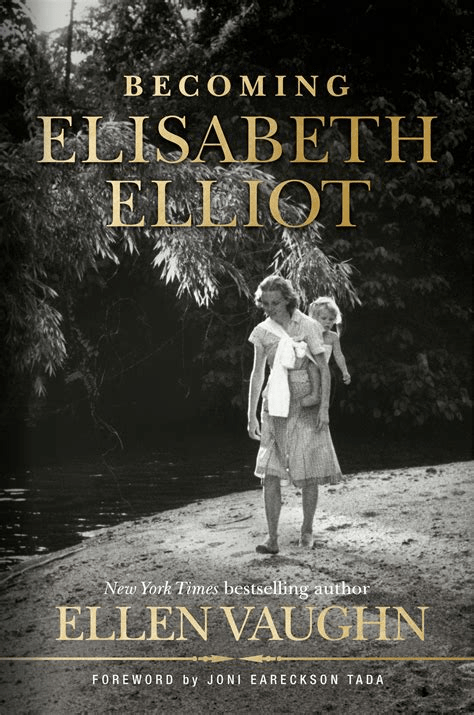
Becoming, and then Being, Elisabeth Elliot: a review

Quick! Who do we know who’s a linguist, a former missionary, a gifted writer, and wants to capture in novel form the human condition and God’s grace to us in it?

Who is awkward, reserved, and can come off as rude and abrupt, but actually has passionate emotions, a deep love for others, and a rich inner life?

Who loves nature? Crosses cultures happily, but doesn’t fit in so well in the American evangelical context? Who has a secret desire to be admired, but also suffers from poor judgement about the opposite sex?

Why, Elisabeth Elliot, of course!

Me and Elisabeth Elliot

When I was college and just discovering the things I ranted about last Friday, like the fact that we as a culture could use some guidelines about the how the sexes ought to relate to each other, I came across Elisabeth Elliot’s book Passion and Purity. I devoured it.

This book was exactly suited for me at the time. I was just starting to grow in Christ. I really wanted to do God’s will. I also, unbeknownst to me, had a lot in the common with the author of Passion and Purity: socially awkward, ascetic tendencies, perfectionistic, a longing for old-fashioned values. This book is basically about the lessons Betty, as she was called at that time, learned during her five years (!) of waiting for Jim Elliot to make up his mind that God had given him the go-ahead to marry her. Their courtship story strikes many Christian young people as really spiritual upon first hearing, and then on a second look, it starts to look as if he didn’t treat her very well possibly. But I bought into it fully.

Anyway. Full of missionary zeal to win other young people over to the idea of an extremely awkward, chaste, long courtship, I gave this book to a friend. She read it, and her reaction was, “There are the Elisabeth Elliots of this world, but I am not one of them.”

That annoyed me at the time (someone had rejected my idealistic ideal!), but from my perspective now, that friend of mine didn’t know how right she was. In fact, not even Elisabeth Elliot herself was one of the Elisabeth Elliots of the world, at least not in the sense of having perfect wisdom and self-control. At the time she was writing this (early 1980s), Elisabeth was enduring an extremely controlling marriage with a man she married because she didn’t want to be lonely. She stayed with him for the rest of her life, despite an intervention by her family. It’s chilling to realize that the woman who wrote Passion and Purity could make such a foolish decision.

Before Passion and Purity, I remember as kid seeing black-and-white photos of Elisabeth toting her small daughter Valerie into the jungle to serve the Waorani people (then called the Auca), a few years after her husband Jim was killed by them. These were the photos taken by Hungarian photographer Cornell Capa. They, and the books Elisabeth wrote about the Waorani, had made her and her martyred husband Jim famous throughout the evangelical world.

Both greater and lesser than I thought

When you think you know a story, you expect it to be boring. I put off for some time reading this duology by Ellen Vaughn, until it finally floated to the top of my reading list. Once I opened the books, I found that I couldn’t put them down. Vaughn is an excellent researcher and a vivid and sympathetic writer, and though I had read a number of books by and about the Elliots, I certainly didn’t know as much of their story as I thought.

Vaughn, aware that she is telling a story the outlines of which are familiar to readers, moves skillfully back and forth through time, as in a novel (though in rough outline, the first book deals with Betty’s early life and the second book with her post-Ecuador years). Vaughn doesn’t try to tell every story–there are too many, many of which have been told elsewhere, and others of which are apparently too private and will stay hidden forever in Elisabeth’s prolific journals. In fact, as I read these books, I felt I was getting to know two fellow woman writers: Elliot and Vaughn.

When you are a former missionary, it’s difficult to read other missionaries’ stories without comparing them to your own. Usually, this means you are reading about people who were far ahead of you in dedication, selflessness, toughness, and in what they suffered. This is certainly true of the Elliots. At the same time, so much of their personalities and stories seemed shockingly familiar. For example, young Jim Elliot was, besides being a great guy, an insufferable holier-than-thou know-it-all, of the “I’m going to go read my Bible” type. Betty, as Elisabeth was then called, was quiet and reserved and often didn’t realize that she was coming off as standoffish. Jim’s family verbally eviscerated her after her first visit to their home in Portland, and foolish young Jim passed all these criticisms on to Betty in a letter. She was devasted, but thought and prayed over the things they had said, and then concluded that none of them were things she could actually change. Later, Jim couldn’t believe he had shared his family’s words with Betty. As Bugs Bunny would say, “What a maroon. What an imBAYsill.”

They were just people, you see. Not angels. Which means that “just people” can always serve God.

Jim Elliot, you beautiful dunce.

The things they suffered also rang poignantly familiar. They suffered setbacks that lost them a year of their work–for her, language work; for him, building a mission station. Neat and tidy Elisabeth at some points had to live in squalor, and felt guilty for the fact that it bothered her. Fellow missionaries (not all) and Waorani Christians alike (not all) proved manipulative and controlling. In fact, it was relationship difficulties that caused Elisabeth eventually to leave the Waorani, after spending only a few years with them. This was not Elisbeth’s fault: person after person found it impossible to work with Rachel Saint, her fellow translator. But she took on as much of the responsibility for it as she possibly could, agonizing before God in her journals, because that was the kind of person she was.

Elisabeth the Novelist

Now we are getting into events of the second book, Being Elisabeth Elliot. Elisabeth knew that she had a gift of writing. She had made so much money from her books Through Gates of Splendor and The Shadow of the Almighty that she was able to build a house for herself and her daughter near the White Mountains of New Hampshire (talk about living the dream!) and settled down to become a writer. She really wanted to write great literature, the kind that would elevate people’s hearts and give them fresh eyes to see the great work of God all around them in the world.

If I were writing a novel about Elisabeth Elliot, I would end it there, and let her have a period of rest, in the beautiful mountains, with her daughter, writing her books, for the rest of her days. I wish that was how it had gone. I kept hoping, as I read this duology, for there to come a point when Vaughn could write, “And then, she rested.” Alas, that moment never came.

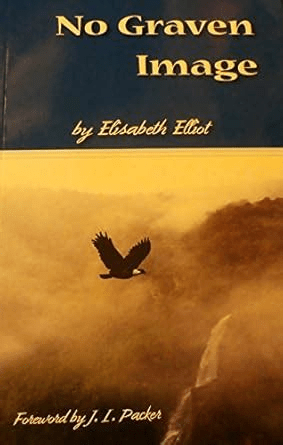
Elliot was indeed a really good writer. Sometime in the twenty-teens, when I was a young mom who had come back from the mission field hanging my head over my many failures, and had unpacked my books and settled into a rented house to minister to my small children, I found on an upstairs shelf a slim volume that looked as if it had been published in the 1960s or 70s, called No Graven Image. This was the novel that Elliot wrote when she first settled down in New Hampshire. She wished, through fiction, to give her readers a more powerful, truer picture of missionary life than her biographies had done.

This is not the cover my copy of the book had, though it also had an image of a condor.

No Graven Image was not well received when it came out. It was the old problem of marketing. To what audience do you market a genre-bending book? The people who liked to read tragic, worldly novels were not interested in a so-called “novel” about a young missionary woman, probably expecting that it would be preachy. The Christians who liked to read missionary stories were shocked and dismayed by a novel in which the protagonist flounders around, makes mistakes, and ultimately, accidently kills her language informant when he has a bad reaction to a shot of penicillin. And then decides that her desire to have a successful language project had been a form of idolatry.

Some readers appreciated the novel (particularly overseas missionaries), but most found it shocking, even blasphemous. They wanted a triumphant novel, not the story of Job. They wondered whether Elisabeth had lost her faith.

When I picked it up, in the twenty-teens, it made me feel extremely understood.

One thing that killed me as I read of Elisabeth’s later years is that this was the only novel she wrote. She very much wanted to write others, and she got as far as making notes for another novel. But life (read: men) intervened, and she was in demand for speaking and for writing nonfiction books such as Passion and Purity. She wasn’t able ever again to get the extended periods of time to concentrate that it would have taken to gestate a novel. She convinced herself that she just didn’t have what it took to write actual good fiction (and perhaps, that it was selfish to try). I am so sad to watch this dream die. I believe that she would have been a good novelist. I don’t know whether her publisher would have kept publishing her books if she had turned to fiction, or whether she would have had trouble finding another publisher. Spiritual non-fiction was what she had already become known for. She probably would have made less money, perhaps found it difficult to support herself. But still … you know … it’s hard to watch. So many things about the second volume of her biography are hard to watch. At the same time, because of Vaugh’s amazing research and writing, it’s hard not to sit back and just stare at this major accomplishment.

PUNS! Brought to you by the ENFP

Time for another Meyers-Briggs profile.

The ENFP

This abbreviation stands for Extraverted, INtuitive (grasping things with a quick impression instead of looking at every detail), Feeling, and Perceiving (going with the flow instead of planning a lot).

According to the website 16personalities.com:

When something sparks their imagination, ENFPs show an enthusiasm that is nothing short of infectious. These personalities can’t help but to radiate a positive energy that draws other people in. Consequently, they might find themselves being held up by their peers as a leader or guru. However, once their initial bloom of inspiration wears off, ENFPs can struggle with self-discipline and consistency, losing steam on projects that once meant so much to them.

Even in moments of fun, ENFPs want to connect emotionally with others. Few things matter more to these personalities than having genuine, heartfelt conversations with the people they cherish. …

ENFPs need to be careful, however. Their intuition may lead them to read far too much into other people’s actions and behaviors. Instead of simply asking for an explanation, they may end up puzzling over someone else’s desires or intentions.

My Particular ENFP

As it happens, I am married to an ENFP, so I can tell you all about them. I can say with confidence that anything done by my ENFP is, reliably, done by every other ENFP out there. You can rely on me for guidance to this type.

And what I can tell you is that ENFPs make puns.

Puns are my ENFP’s daily bread. When he gets on a roll, he makes them a-grain and a-grain. They are a lot butter than these ones I am making, dough.

Few things are a bigger treat than to have a front-row seat when an ENFP and another type that likes to pun get into a pun volley. I have been witness to a few of these, where they not only stayed on the facial topic, but also kept the puns within the same theme. This kind of art is so ephemeral, I have forgotten all the puns they made.

ENFPs are funny with language. They might have favorite big words:

  • Chick flicks are films that are lugubrious. I don’t like getting all lugubrious.

They tend to give things funny names. See if you recognize these restaurants:

  • Burger Death
  • Dead Lobster
  • Taco Gehenna
  • Taco Jaundice
  • Unterweg
  • Little Squeezer’s
  • Dead Robin

Other nicknames are not suitable for a public blog.

Speaking of which, ENFPs (again, this is based on my extensive expertise) are so into building good relationships that will use mock attacks to do so. For example, my ENFP has occasionally been known to cry out, “Lies!” while a friend is speaking. He once asked me whether I thought he ought to sucker-punch another guy in the lobby at church, because they were friends. (He ended up faking a punch.) Often, these play fights become in-jokes, another category of relationship/humor that the ENFP loves. Once something has a silly nickname, or someone has been accused of something ridiculous, it stays that way forever, or at least until a better in-joke comes up.

My ENFP loves insults that sound unanswerable, for example:

  • If we aren’t supposed to eat animals, how come they are made of meat?
  • If you have a little more time, I have a few more pearls to cast.

Neither of these is original to him, but he uses them frequently.

But as a counterpoint to all the linguistic virtuosity, you get utterances like this:

  • Did you load the one thing? (the dishwasher)
  • Have you seen that one kid? (that’s your son, sir)
  • We need to get the thingy. (You got me on this one. The taxes? The lotto ticket? Another chicken coop? I don’t know, but it’s urgent.)

ENFPs are the type most likely to use words like whatsit, thingamagig, dealybob, and doohickey. They are very smart, but they can’t always slow down to locate the precise term. In Southeast Asia, we learned the term ano, which can literally replace any part of speech. My ENFP still uses it occasionally.

ENFP’s gifts make him the perfect trip planner. He is great at throwing together a spontaneous weekend jaunt to go on a hike or see a local (or not-so-local) site … and get eight people to join him. And he will be punning all the way.

Keepin’ Everyone in Line: the ESTJ

Photo by cottonbro studio on Pexels.com

Here it is: my next post about one of the sixteen MBTI types! I’ve already profiled ESTP and INFP, from my unique, rather personal perspective. (INFP is me — and Frodo –, and ESTP is the antihero of my first novel, so he has a special place in my heart, even though he would drive me CRAZY in real life.)

If you don’t like the MBTI, please skip this post. I’ve already shared my caveats about it, and noted that the same territory is covered, just as effectively and probably more data-based, by The Big Five. However, I still enjoy the MBTI, and if the Lord wills, I will eventually make a post about every one of the sixteen types. I just don’t think it should be woodenly applied. It’s descriptive, not prescriptive.

The ESTJ

ESTJs are people who are Extraverted and prefer Sensing (they build up from sense data rather than getting an intuitive big picture in one fell swoop), Thinking (they aren’t overly concerned with their own or others’ feelings when making decisions), and Judging (they like to organize their time and environment rather than going with the flow).

According to the website sixteen personalities,

ESTJs are classic images of the model citizen: they help their neighbors, uphold the law, and try to make sure that everyone participates in the communities and organizations that they hold so dear.

Strong believers in the rule of law and authority that must be earned, ESTJ personalities lead by example, demonstrating dedication and purposeful honesty and an utter rejection of laziness and cheating. If anyone declares hard, manual work to be an excellent way to build character, it’s ESTJs.

https://www.16personalities.com/estj-personality

This is the type that loves to play games (Monopoly, Uno) because they can remind everyone of the rules … and maybe even make up some rules, too!

I have an ESTJ

Being as it is the opposite of my personality type, perhaps God knew that I would not learn to love ESTJs unless I gave birth to one.

It started from the womb. My ESTJ baby wasn’t comin’ out until he was good and ready. We went to the hospital three times with false alarms, which left us embarrassed and worried about the cost. Finally, when I did really go into labor, we stalled out and got sent home again. But finally, some time the next day, we had our precious little ESTJ. (Also, by the way, I had a very quick labor with my first, but a more normal length of labor with my ESTJ. Remember, they like to do things in the way that is socially acceptable.)

It’s hard to be an ESTJ when you are little and don’t have anyone to direct or keep in line yet. This is the kid that you are always having to remind, “You are not the parent.”

However, when they get older, the ESTJ’s unique gifts start to shine. My son’s coaches love him, because he follows instructions and always practices and plays with all his heart. (Remember, ESTJs are model citizens.) As a Judging type, he is super organized and always lets me know about upcoming events, fees and assignments due, and so forth. On the whole, this is a lovely type and society needs a lot of them. They are almost 9% of the population according to estimates, but since this is a type that is likely to be involved in social institutions (and getting others involved), they may be setting expectations out of proportion to their number. They may be unpleasantly surprised when weirdo types like myself can’t just easily get with the program.

Things my ESTJ has said

  • “Do it!” (He used to say this a lot at the age of about two. It is quintessential ESTJ.)
  • “C’mon, Spidey, let’s go up to the Celestial City.” (This is one of my favorite quotes from him.)
  • “[The guy opposite me in the football game] got mad ’cause I was doing my job.”
  • “Why are you such a libertarian? What’s a libertarian?” (He’ll often accuse me of being a new word in order to find out what it means.)
  • “I don’t have a personality. I just do what makes sense.”

The House of Love and Death: A Book Review

I ordered this and it arrived a long time ago, but I just now got to it. (Look at me! I am powering through my TBR like a good girl!) Once I opened it, I finished in just a few days because it’s that good.

This is the third book in the Cameron Winter series. Winter is a character created by Andrew Klavan, reportedly the first character Klavan has created that he’s felt could sustain a whole series. Winter is a former spy who is now a professor of Romantic English Literature at an unnamed university in an unnamed Great Lake state (but pretty obviously Madison, Wisconsin). So he fits into that beloved mystery trope, a character who looks unprepossessing (in this case, because he’s a slight, blond, pretty-boy academic) and whom people consequently underestimate, unaware of his hand-to-hand combat skills.

It was fortuitous that I read House not too long after reading The Bourne Treachery, which is also a spy story featuring a longstanding character. Winter even has, in this book, some experiences similar to those Bourne has in Treachery. However, the two books couldn’t be more different.

Winter does check many of the same boxes as Bourne, and House checks many of the same action-novel boxes as Treachery. It moves a little slower and is a little less intricate, but not much. But it is way more emotional. This is one of those mysteries where, after you find out whodunit, you have to set the book down and (if you are a soft touch) cry for a while as you contemplate just how tragic the whole thing was. And like any good tragedy, it has the simultaneous feel of “This was so preventable! This should have been easily preventable!” and of inescapability.

Winter has a “strange habit of mind” (also the title of the first book in the series), where sometimes he will go into a “fugue state” and zone out for several minutes while his subconscious, essentially, becomes his conscious and works on a puzzle he is contemplating. As a writer and artist, I recognize this habit of mind and actually don’t find it that strange (although it doesn’t help me solve mysteries, more’s the pity). I assume that Klavan has given Winter this “strange habit” because, as an artist and writer, he also has some version of this habit. Certain kinds of mind tend to do this. Call it what you want – hyperfocus, being “in the zone.” Being an introvert. Not everyone is “on” (in the sense of externally focused) all the time.

It does make a person wonder whether this tendency, which is similar to narcolepsy, disadvantaged Winter as a spy. In fact, it makes one wonder how he ever managed to survive his espionage years. If Jason Bourne were to zone out like that even for a minute, he’d be dead. Once in House, Winter is driving somewhere and keeping an eye out for a tail. He briefly enters the fugue state, and when he comes out of it, sure enough, he is now being followed.

Yet somehow, those of us with the strange habit of mind do manage to survive. Some of us even manage to raise children. I dunno.

Anyway (shakes shoulders) aaahh, good book. Recommend. Very very sad though.