The Septuagint translation of Isaiah 11:10 references the root of Jesse, the one who “rises up to rule the nations; nations will put their hope in him, and his repose will be honor.” The Septuagint has anistamenos for “rise,” and this is reflected in Romans 15:8 – 12 where Paul quotes Isaiah and refers to the Messiah who “arises” (anistamenos) and is both the ruler and the hope of the gentiles. This same concept is also present in Psalm 82:8, where Yahweh “rises” (anasta in the Septuagint) to judge the earth and inherit the nations. As we will see below, this language closely resembles the ascension language of Paul in Ephesians.
Joel Muddamalle, The Unseen Battle, p. 113
So, in this context, the word “rise” or “rise up” implies a warrior/king rousing himself to battle and conquering (in this case, conquering the gods of the nations). Like the word “inheritance,” it’s a clue that the Scripture is talking about which god has legal rights to a geographical area or a group of people: the unseen battle.
I believe it is also linked to the name Anastasia, which means resurrection.
Not sure why, but it feels very appropriate to me that the word for resurrection should have four or five syllables.
demə- … “to force,” especially in the sense of “to tame horses.”
Derivatives: daunt, indomitable, tame
kwel– … “to revolve, move around; herd stock.”
Derivatives: Latin colere, to till, cultivate, inhabit; colonus, farmer. Hence, cult, cultivate, culture, colony, colonize.
Greek telos (from the suffixed form kwel–es), completion of a cycle, consummation, end result. Hence, talisman, teleology, leutospore.
kw(e)-kwl-o (suffixed reduplicated form of kwel) … “wheel, circle.”
Derivatives: Old English hwēol, hweogol. Hence, wheel.
Greek kuklos “wheel” and Latin circulus, “circle.” Hence, circle, cycle, cyclone, etc.
Sanskrit chakram, “circle or wheel.” Hence, chakra.
wegh- … “to go or transport in a vehicle” Derivative: wagon
“Chariot racing for sport and ritual purposes was prominent in the culture of many early Indo-European peoples, such as the Indo-Iranians, Greeks, and Irish.”
source: The American Heritage Dictionary of Indo-European Roots, rev. & ed. by Calvert Watkins, pp. xxviii – xxix and 46
Yes indeed, the Indo-Europeans loved their horses.
But they are not the only ones.
The Mongolians love their horses too. And let’s not forget the American Plains Indians. As soon as horses became available to them, some of them (notably the Lakota) re-structured their entire society around them, and began doing amazing things that the Europeans had never dreamt of (at least, not for many generations), such as hanging by their legs off the side of the horse to shoot a moving target with a bow.
Basically, horses are cool and beautiful, and also extremely demanding and high-maintenance. People tend to like them, but bear in mind that you do have to make them the focus of your entire life if you are going to do anything at all with them.
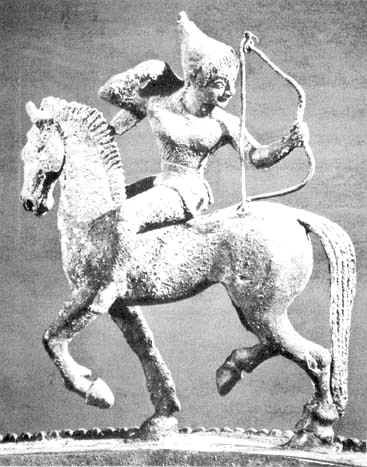
The “Parthian shot.” The Parthians were a people related to the Scythians and other horse-riding groups of Central Asia. That conical hat, too, is found among the Scythians, a people who live in what is presumed to be the Indo-European homeland.
Among these original national gods Jupiter or Jove was the favorite … In the early centuries of Rome he was still a half-impersonal force–the bright expanse of the sky, the light of the sun and moon, a bolt of thunder, or (as Jupiter Pluvius) a shower of fertilizing rain; even Virgil and Horace occasionally use “Jove” as a synonym for rain or sky. In time of drought the richest ladies of Rome walked in barefoot procession up the Capitoline hill to the Temple of Jupiter Tonans–Jove the Thunderer–to pray for rain. Probably his name was a corruption of Diuspater, or Diespiter, Father of the Sky.
–Caesar and Christ, by Will Durant, p. 61
… and when the Romans encountered Zeus, they said, “Hmm, seems to be Jupiter.”
“God from God, light from light” *(these are direct objects, so the subject and verb are coming up)
Gestant puellae viscera
“A girls’ innards carry” (the subject and verb, and by far my favorite line)
Deum verum
“True God” (and still the direct object)
genitum non factum
“Begotten, not made”
Refrain: Venite adoremus, Dominum “O come, let us adore/The Lord”
Cantet nunc io, chorus angelorum
“Now sings it, the chorus of angels”
Cantet nunc aula caelestium
“Now the heavenly court sings”
Gloria, gloria in excelsis Deo
“Glory, glory to God in the highest”
Refrain: “O come, let us adore/The Lord”
Ergo qui natus die hodierna
“Therefore, who is born on the day of today”
Jesu, tibi sit gloria
“Jesus, to you be glory”
Patris aeterni Verbum caro factum
“Word of the eternal Father made flesh”
Refrain
See how the Latin is actually more direct/efficient than the English? Kind of shockingly so?
I think because the original Latin version had so many syllables, to translate the lines into English, additional words had to be added, and sometimes even new ideas such as “Yea, Lord, we greet thee,” which is how the fourth verse begins in English and is one of my favorite lines in that version.
“No name. I refuse. You should too. … So long as you answer to a name people can make you do things. You write your name down on a piece of paper and suddenly you have obligations. They say Prism go here, Prism go there, and you have to, because you answer to your name.”
Besides growing up around farms and reading a lot of literature set there, I’ve always kind of craved traditions, folk costumes, and folk practices. It’s not because I like being circumscribed in everything I do–I’m kind of a free spirit actually–but because I sensed these traditions and customs and bits of folk wisdom represented a thick culture, rooted in the distant past, that I as an American lacked. Traditional ways, whatever they were and wherever I read about them, seemed at the same time intriguingly exotic, and almost familiar.
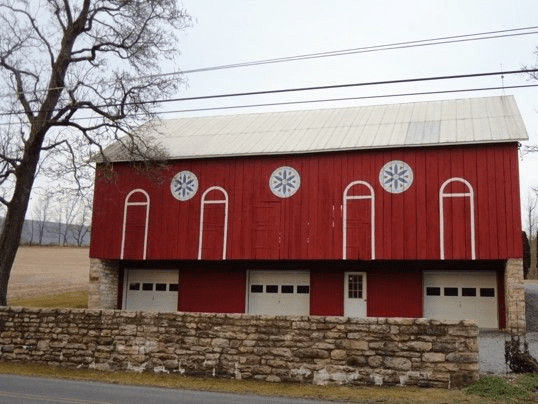
In eastern Pennsylvania, where I spent my earliest years, many of the farmers were Pennsylvania Dutch–i.e., German immigrants. They had their own language, a dialect of German that my dad was able to pick up due to having majored in German. They had their own foods, like shoefly pie and scrapple. And they had a little, tiny bit of superstition: hex signs painted on barns. As a kid, I knew that these pretty little designs were called hex signs, but I had no idea of the connection between the word hex and spells or witches.
The Pennsylvania Dutch were nominally Christian, though I understand from my dad that they, like the Amish, often had a shallow and moralistic understanding of the Bible, and in fact sometimes didn’t have a Bible in a language they could read.
Despite their attractions, the Germans were to me among the least interesting of pagan farmers. I was more interested in British, Scots, and Irish folklore. It seemed warmer and more colorful somehow, and we had plenty of that around too, being in the Appalachians. It was also readily available in literature.
The connections between farming, weather-watching, astronomy, and European pagan religion are ancient and obvious. Here is Will Durant on Roman practices:
When [the Roman peasant] left the house he found himself again and everywhere in the presence of the gods. The earth itself was a deity: sometimes Tellus, or Terra Mater–Mother Earth; sometimes Mars as the very soil he trod, and its divine fertility; sometimes Bona Dea, the Good Goddess who gave rich wombs to women and fields. On the farm there was a helping god for every task or spot: Pomona for orchards, Faunus for cattle, Pales for pasturage, Sterculus for manure heaps, Saturn for sowing, Ceres for crops, Fornax for baking corn in the oven, Vulcan for making fire. Over the boundaries presided the great god Terminus, imaged and worshiped in the stones or trees that marked the limits of the farm. … Every December the Lares of the soil were worshiped in the joyful Feast of the Crossroads, or Compitalia; every January rich gifts sought the favor of Tellus for all planted things; every May the priests of the Arval (or Plowing) Brotherhood led a chanting procession along the boundaries of adjoining farms, garlanded the stones with flowers, sprinkled them with the blood of sacrificial victims, and prayed to Mars (the earth) to bear generous fruit.
Caesar and Christ, p. 59
Farming is so labor-intensive, so high-stakes, so heartbreaking, so subject to factors beyond human control, that it tends to produce nervous and conservative people. It would be impossible to engage in it for generations without coming to a profound humility before whatever entity you have been led to believe determines whether your whole year of work will be wiped out within a few days. For Christian farmers, that entity is the One who owns the cattle on a thousand hills. For post-Christian farmers, such as Wendell Berry, it’s the earth itself, I suppose, the environment. For pagans, it’s not hard to understand why they might be reluctant to let go of all the little rituals that stand between them and disaster.
Thus, paganism hangs on longer among country folk than in the city. If you want your eyeballs to be assaulted with an astonishing variety of pagan superstitions still proudly held by modern Americans, go get yourself a Farmer’s Almanac and look in the classifieds section.
“But modern Americans are returning to paganism!” you say. “It’s part of the New Age. It’s trendy, not traditional.”
Don’t I know it. I have met a few neopagans in my day. The one I knew best, was raised in a nominally Roman Catholic home. She was innovating with her paganism, part of the modern self-worshipping, I’ll-make-it-up-as-I-go ethos. The neopagans in the back pages of The Farmer’s Almanac don’t give me that vibe. I could be wrong, but it seems like they never left.
Where is the line between weather-watching, paying attention to the phases of the moon when you plant, following the zodiac along with the yearly calendar, hiring a water-witch, hanging a horseshoe over your door to protect your entryway with iron, and full-on pagan worship? How much of it is science, and how much is just doing things the way your mother did them? And how many “mindlessly followed” folk traditions turn out to have a sound scientific basis?
I’m guessing that Christian farmers in the modern age may have given up some valuable folk knowledge in an effort to avoid idolatry. Idolatry is a deadly poison, though, so no doubt, the sacrifice is worth it. If your eye cause you to sin, pluck it out. I hope that, as the generations roll by, we can build a culture that’s even richer than the pagan one we left behind.