Why We Can’t Just Give Peace a Chance

Storytime.

When I was a kid, I attended a no-nukes protest.

It’s true. My dad was a Protestant pastor, and also sort of hippie about some things. No drug use or sleeping around, but he liked to live “simply” (for example, keeping his old coffee percolator), and around the time I was a baby, he had become a convinced pacifist. That is, he had become convinced based upon the Sermon on the Mount (mostly) that for Christians nowadays, it is never permissible to resist violence with violence. And this went for nations too. For him, principled pacisfism was part of following Jesus.

So here it was, the mid 1980s, late in the Cold War (though we did not know it was late at the time). A no-nukes protest had been planned in a downtown plaza in our large Midwestern city. I believe it was organized by the city’s churches, because among other people, my dad had been asked to sit in a panel onstage.

I was probably 9 or 10 years old. I was excited to go along. It seemed like a good thing. It was pretty clear to me that us, or anybody else, getting killed by nukes was a bad thing, something that we would not want to have happen. I had heard gruesome stories about people’s eyeballs being turned into jelly when the bomb was dropped (by us!) on Hiroshima. This was in a book that we had at home called Peace Be With You.

As the family artist, I made the sign for our protest. I tried to draw the symbol from the cover of Peace Be With You, a dove holding a branch in its beak. I had never drawn a dove before, and I got the beak wrong, so it came out looking more like a parrot.

I don’t remember all the content of the rally, but two things stand out. There was a play about a couple who survive a nuclear holocaust and live in a tent city, only to get radiation sickness. And, I remember the final song.

With the panel of pastors still seated on the stage, a lady came up to give a moving musical number. The first verse was about the Statue of Liberty and how she represents to many people that they have arrived in a place that is free from oppression. The second verse was about the cross of Christ, and how, to the Christian, it means liberty from sin, death, and hell. The refrain was “the Cross is my Statue of Liberty.”

Horribly blasphemous, of course. It was trying to compliment the greater by comparing it to the lesser, which actually reverses the roles of greater and lesser, unintentionally offering a huge insult to Christ.

As soon as he realized where the song was going, my dad abruptly got up from his seat on the stage behind the singer, stalked off the stage in a huff, and marched me and my brother out of there before the rally ended. I’m still proud of him for this. As someone said (I can’t find the reference, but I think it was Spurgeon), “Even a dog barks when its master is attacked.” Referring to himself defending the honor of Christ, however inarticulately.

I think what the organizers were trying to convey with that song was, “We are Christians, and don’t worry, even though we are against nukes we still definitely love our country.” But it was ill chosen.

Although I now think the whole event was incredibly naive, I commend my dad for attending it and for bringing his kids. Kids need to have experiences where they go fight for the right alongside their parents, even if the cause later turns out to have been somewhat misguided. This sends the message, “We have certain values as a family, these are important enough to do something about, my parents are good people” and, above all, “I and my parents are on the same side.” Please, give your kids many experiences like this before they become teenagers!

So, why naive? Well, I can’t blame myself for not noticing this as a kid, but why in the world did we think we were the only people who objected to the idea of a nuclear holocaust? Surely that is something that everyone recognizes is bad? (Except, perhaps, the mullahs, I digress.)

And given that we were not uniquely intelligent or good such that we were the only ones who didn’t like the idea of people being annihilated by a nuclear bomb, it would make sense to connect the next pair of dots (#s 2 and 3) and ask ourselves, since 99% of people don’t like nukes, how is it that they still exist? Could it be that, once you have a nuclear standoff, getting rid of nukes is more complicated than just “getting rid of them”? Perhaps there are people who also don’t want an apocalypse, but whose options are limited?

By the same token, perhaps there are more obstacles standing between humanity and the cessation of wars in general than just a dearth of people saying, “We don’t like war.” After all, most people don’t like wars, including most people who fight them.

But we, the anti-war protestors of the Cold War era, honestly, naively, conceitedly thought we were the only people in our country who saw a moral problem with human suffering. And we thought it would somehow stop if only we were to stand up and heroically say, “We are against this.”

It didn’t work. And not because not enough people were against it. It turns out, just saying that doesn’t do anything.

I’m sure my dad’s generation would say that these antiwar protests were ineffective because “our leaders didn’t listen.” “Listening,” in this context, would mean disarming our nukes and other WMDs, and perhaps completely disbanding our military. After all, if every country did this, peace would flow into the empty space where the weapons used to be. And someone has to go first! So it might as well be us! Someone has to give peace a chance.

This made sense to me at 10, especially when it was coming from respected authority figures. Once we grow up, however, we have a responsibility to ask ourselves what could possibly go wrong with this scenario. And the answer is: a lot. Everything.

War is, unfortunately, the default state of human beings. When we are not at war, it is because a lot of people are working very hard to maintain a precarious balance where things don’t tip into war. Fortunate are we who live in a country or empire large enough, or strong enough, that all that work has paid off and we get to go about our daily lives, assuming that peace is the natural state of things. But it isn’t. It is not the case that wars don’t happen unless some “war monger” goes out and “starts one.” That would be nice, but it’s not what we have here.

There are multiple reasons for this. Until recently, I thought it was sufficiently explained by human beings being sinful, and full of fears, lusts, and cravings. All of that is certainly a huge factor. We usually see wars explained as being caused by “fighting over scarce resources,” but I think that materialistic explanation is far from sufficient. Wars have not become less common as the worldwide standard of living has increased. I have also seen wars attributed to “religion.” There are a number of logical problems with this as well. To test this theory, you’d need a control group of humans who had either no religion, or no war. Since both war and religion are things that humans universally do, such a control group does not exist. To say that because both are universal, means one causes the other, is the post hoc fallacy.

So in general, I think the stubborn persistence of war is adequately explained by the Seven Deadly Sins: Envy, Greed, Lust, Sloth, Gluttony, Anger, and Pride. Especially Pride and Envy.

Say somebody hates you and wants to go to war with you because they are prideful and think their way of life is better, but also, at the same time, they envy some things about, tacitly acknowledging that in those respects, you are better than they are. Is such a person going to put down their weapons because you fold your hands and say, “Look. None of us like war. Let’s all mind our own business and disarm”? No, unfortunately, your enemy may not like war, but they hate you a lot more than they hate war. If they even recognize that you are taking the moral high ground, that is only going to exacerbate the wounded-pride-and-envy problem.

This is why fifty years of “anti-war” protests have done nothing but make the protestors look silly.

But it recently came to my attention that there may be an additional cause besides human sin that keeps stirring up wars in the world.

We need to expand our understanding of spiritual warfare to include the larger social and political structures of our world. Why does war bring ruin to the world? Why do we feel constantly on the verge of a new world war? … Why is peace, specifically the peace the permeates through the spread of the gospel, such a threat to world powers? The answer to these questions falls under the larger context of the unseen battle, a battle that has in mind the final unification of the nations of the world under the banner of Christ.

–Joel Muddamalle, The Unseen Battle, p. 120

Muddamalle is suggesting that the gods of the nations, who would prefer to go on ruling them, feel threatened by the spread of the Gospel and use geopolitical instability as one of their tools to slow this spread. (For more about these entities, see my review of Michael Heiser’s book.)

The idea is that human beings, while plenty fight-y on our own, would sometimes like to rest. But these spiritual entities will not let their people rest. They are hard at work, with demonic delight, stirring up, prolonging, and accelerating generations-long conflicts, to keep the Gospel of Christ out and also perhaps, as a side benefit, because they enjoy human suffering.

This certainly matches the picture of “the gods” that we get in, say, Greek mythology. People are bad enough on their own, but even when you have a majority of people who want to do the right thing, you will see that Fate, or the gods, or whatever, intervene so that exactly the wrong thing happens at exactly the wrong moment. The result: ten years of war.

Peace, it turns out, is not a passive, waterlike thing that flows in wherever a space is opened for it. It has to be established, like a fortress. It is the result of someone coming in, taking names, and routing the false gods. That someone is the Lord Jesus.

Behold, an Introvert and Extravert at Breakfast

“Do you think we shall see anything of those Riders?” asked Pippin cheerfully.

“Yes, probably,” said Frodo, not liking the reminder. “But I hope to get across the River without their seeing us.”

“Did you find out anything about them from Gildor?”

“Not much–only hints and riddles,” said Frodo evasively.

“Did you ask about the sniffing?”

“We didn’t discuss it,” said Frodo with his mouth full.

“You should have. I am sure it is very important.”

“In that case I am sure Gildor would have refused to explain it,” said Frodo sharply. “And now leave me in peace for a bit! I don’t want to answer a string of questions while I am eating. I want to think!”

“Good heavens!” said Pippin. “At breakfast?”

–The Fellowship of the Ring, p. 95

This passage gets funnier every time I read it. This is an exact picture of me (Frodo) and my husband (Pippin) in the morning.

The Unseen Battle — Are You In?

This review will be short and not very comprehensive. Why don’t I have time for a longer review? Because I’m in a fierce battle. Heh.

A few years ago, I reviewed Michael Heiser’s book The Unseen Realm.

The Unseen Realm is a scholarly book about the concept of the divine council in Ancient Near Eastern cosmology, especially in Ugarit, which was a near neighbor of Israel both geographically, culturally, and linguistically. Heiser finds this concept of the divine council assumed in the Hebrew Scriptures, similar to how the heliocentric model of the solar system is assumed in anything you see written since Copernicus. That is, it’s never stated or described directly, but it is referenced in many stories, phrases, and figures of speech, and is openly the setting for certain passages, such as Psalm 82.

The idea behind “the divine council” is that there is a Most High God (the Creator) who rules the earth with the help of a sort of committee of divine beings (elohim). This committee is traditionally conceived of as meeting on a high mountain, in a garden setting, often a place that is the source of rivers. Or as Ps. 82 calls it, “the great assembly.”

Heiser spends most of his book establishing that this view is present in Scripture.

After reading Heiser, I heard a podcast interview with Joel Muddamalle. Muddamalle is the academic protege of Heiser (who has now gone to his reward). He is carrying on with researching this idea of the elohim as an active presence in redemption history, and also with popularizing it in the Christian world. And I heard that he had written a book, The Unseen Battle, which might be viewed as a sequel to Heiser’s book. So naturally, I had to get it.

I expected TUB to be all the same material as TUR, just with Muddamalle’s own personal style. It was not. The first few chapters do recap Heiser’s cosmology, but they don’t spend a lot of time establishing it, as Heiser did. Muddamalle then moves on to the nature of the battle, which Heiser touched on but did not major on.

The nature of the battle is that God wants to get the nations back from the gods.

The way this is done, in the church age, is through evangelism, missions, and building healthy churches and families. In short, obedience. It’s not primarily through a lot of fancy, spooky ghost-hunting or exorcism stuff.

This exegesis, naturally, warmed my little Reformed heart.

Now, it does mean that, if you are attempting to be faithful to your spouse and/or raise your kids; work hard and honestly at a lawful calling; worship the Lord on Sunday and support His people; or do any other forms of healthy, faithful culture-building, you have stepped into the battle. The dethroned powers do not like this sort of behavior. This may, perhaps, explain why just trying to mind your own business and live a quiet, peaceable life can occasion so much resistance: everything from health problems, to Murphy’s Law and attacks of depression and discouragement; to actual hate and legal resistance from human beings who do not like what you are doing. (Per Muddamalle, Scripture makes it clear that the “hosts” on both sides of this battle are mixed, consisting of human beings and of spiritual beings.)

Particularly if you are contributing in any way (including by prayer) to the disciplining of not-yet-Christianized nations, you present a threat to the old gods, who do not want to be cast out as they have been cast out of so many other nations in the last 2000 years. This is why foreign missionaries and native pastors in unreached or partially unreached countries undergo so many hardships: poverty, evil bureaucracy, and all kinds of health and mental problems.

The church itself, existing as an entity comprised of people from many nations, is a rebuke to the powers.

The multiethnic and diverse nature of the family of God, the church, can be seen through Paul’s use of polupoikilos. This term is a combination of two adjectives meaning “much” (polus) and “various kinds, diversified, manifold” (poikilos). The word polupoikilos can also mean “of many colors” or “polychrome.” Classical Greek writers used this word to reference cloth or flowers to convey a sense of intricate beauty. The word poikilos is used in the Septuagint to refer to Joseph’s coat of many colors (Gen. 17:3, 23). As Timothy Gombis observes, “The powers have ordered the present evil age in such a way as to exacerbate the divisions within humanity. God confounds them by creating in Christ one unified, multiracial body consisting of formerly divided groups of people.”

ibid, pp. 169 – 170

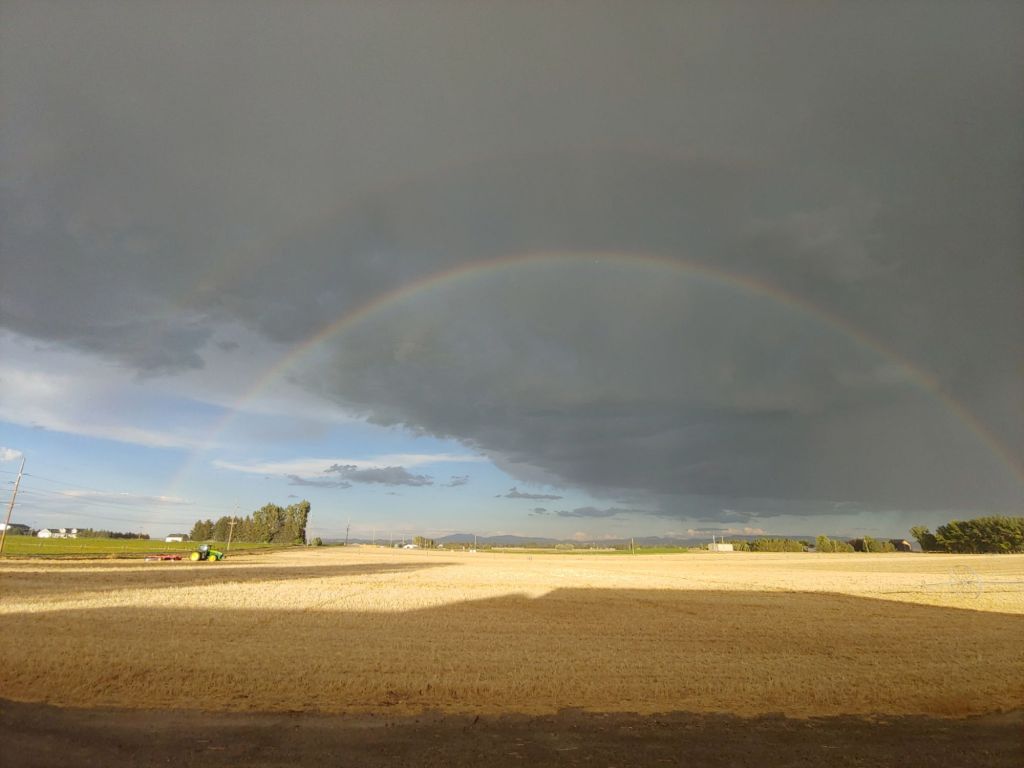
How about that. The Rainbow of Diversity, which we have been taught to hate, is actually God’s goal as well. The reason that we have been taught to hate it, is because of the way they have pursued it … trying to force it down by means of human power and moralism, by defining righteous and unrighteous groups and viciously suppressing those deemed to be foes of the rainbow. They have made “inclusion” mean “we exclude you.” This is what happens any time people try to make the world look like the restored heavens and earth, without Christ. They end up bringing about the opposite. True harmony among the ethnic groups is not an easy thing. It can only be obtained by means of the New Birth.

Though this is a scholarly-for-the-layperson work, Muddamalle’s lighter personality shines in it. He has many call-out boxes sprinkled throughout the book, devoting a page or two to questions such as, “Are There Aliens in This World?” and “What About Demonic Exorcisms?”.

That’s it. Just I promised: a short review.

Oh! What are the “three rebellions”?

  1. Adam and Eve’s rebellion at the Tree
  2. The rebellion of the “sons of God,” when they chose to come down and take human wives (Genesis 6)
  3. Humankind’s post-Flood rebellion at Babel (Genesis 11). It was at this point that God divided up humankind among the elohim, giving each people group extant at the time its patron god.

Anyway … back to the battle! God be w ye this weekend!

Sunshine Blogger Again

Just as the sun must come up every day, rain or shine, so I am cursed to plod forever through an endless treadmill of answering questions. The questions are ever the same, but on the plus side, my answers keep changing.

I wasn’t exactly “awarded” this tag, but I did see it on the blog of one Bookstooge, who closed his post with “You aren’t hardcore enough!”

I am so hardcore. But, as usual, Bookstooge, thanks for doing everything exactly like Puddleglum. Or Trumpkin.

Here’s the participation rules

  1. Display the award’s official logo somewhere on your blog
  2. Thank the person who nominated you
  3. Provide a link to your nominator’s blog
  4. Answer your nominator’s questions
  5. Nominate up to eleven bloggers
  6. Ask your nominees eleven questions
  7. Notify your nominees by commenting on their blogs

What’s your favorite book and why?

The Bible, because so many reasons, but among others, it’s got some really wild ancient history that you won’t find anywhere else. At least, you can find stuff elsewhere that’s sort of similar, but you won’t know which parts of it are true.

Can you share some obscure/unusual words you like to use when writing?

I like “interlocutor.” It means whoever the person in focus is speaking to. I also like “salient” and “equivocation.” But obviously, which fancy words are the most salient changes depending on the context of the writing.

When I’m writing narrative, I prefer to describe the action and people’s thoughts as simply as possible and let the actual events deliver the emotional impact.

Do you have pets (if yes, photos!)

Not anymore, sadly. Our last remaining rabbit passed just a few weeks ago. We (my son and I) hope to get another batch of chickens this summer, but standing between us and them is a large run-and-coop building project that, to me at the moment anyway, seems as intimidating as the Tower of Babel.

What brings you joy?

Beauty.

Landscapes, especially if I can paint them; beautiful folk clothing from around the world; beautiful items knitted or crocheted by myself or others; the simple, unforced beauty when your favorite mug is sitting on your favorite coaster and they match. The beauty of a plant: hens & chicks filling a planter, a Boston fern spilling towards the floor. Sunshine on my dining room walls. I love beautiful music, even though I’m not very gifted at it, which is no doubt a trial to the people around me.

I also love things that are beautiful even though they are ugly. “Brutalist” jewelry, that looks weathered, like it came through the apocalypse. Things that are painted, knitted, or sewn in unexpected colors, like browns and greys, or colors that you’d think would clash but then don’t. Stuff that looks worn or pieced together, like an old farm quilt. Well-told tragedies, like the recently reviewed story of Jason and Medea.

Here’s an example of a “brutalist” ring.

“All things counter, original, spare, strange;/Whatever is fickle, freckled (who knows how?)/With swift, slow; sweet, sour; adazzle, dim;/He fathers-forth whose beauty is past change/Praise Him.”

–Gerard Manley Hopkins

If there’s anything that can make you look forward to tomorrow, what would that be?

My husband and children.

Best vacation destination from your experience?

I have a whole bucket list of ancient sites I want to see, but that’s not what you’re asking about.

I have fond memories of a little cabin hut bungalow on a small island called Gili Air, off the coast of Lombok. Go out and snorkel in the morning, come back in the afternoon and sit on the porch and read. Look across the bay at sunset, and see the mountains of Bali looming out of the sea. Beach is not even my favorite setting, but boy that was one relaxing vacation.

Do you count steps?

What?

Favorite meal?

Fish and chips and coleslaw.

The last song you listened on repeat?

Hallelujah by Leonard Cohen.

I realize you all have been aware of this song for years, but I just heard it in its entirety a few months ago. Like probably every listener, I found it to be a stunning work of art and also kind of a puzzle, and I listened to it a couple of times in a row for several days until I felt I understood it. I’ll spare you my analysis, as I think volumes have already been written.

How many blogs do you have?

Just this one. I used to have a recipe blog and a book review blog, both on Blogger. I haven’t checked them in years and am not even sure if I could find them anymore.

But don’t forget to buy my books! And for goodness’ sake, please don’t return them. My publisher charges me when you do that. If you buy a hard copy and hate it, just burn it or send it to Goodwill or something.

What’s your favorite quote?

There are so many good ones, I can’t really pick a favorite. It goes in seasons with me. But for today, I’ll leave you with this one:

This is what the LORD says:
"Cursed is the one who trusts in man,/who depends on flesh for his strength/and whose heart turns away from the LORD./He will be like a bush in the wastelands;/he will not see prosperity when it comes./He will dwell in the parched places of the desert,/in a salt land where no one lives.
"But blessed is the man who trusts in the LORD,/whose confidence is in Him./He will be like a tree planted by the water/that sends out its roots by the stream./It does not fear when heat comes;/its leaves are always green./It has no worries in a year of drought/and never fails to bear fruit."
The heart is deceitful above all things/and beyond cure./Who can understand it?
Jeremiah 17:5 - 9

Now, my questions for you, Gentle Reader. These are inspired by our experience in grade school, where you were sure that you had to have a quick, permanent answer about your favorite color, animal, and favorite everything else ready to go. This is important! You never know when you might need to know this stuff! Answer with your first instinct and no cheating!

  1. What is your favorite brand of tractor?
  2. What is your favorite kind of cow?
  3. What is your favorite kind of chicken?
  4. Country or city?
  5. Ford or VW?
  6. Pickup truck or motor scooter?
  7. Star Wars or Star Trek?
  8. Beach or mountains?
  9. Sweet or savory?
  10. Sci-fi or fantasy?
  11. Favorite animal, domestic or wild, in your region or any other.

Misanthropic Quote: History Research Basics

Manson suggests we do two things: first, assume that whatever else may be the case, the New Testament at the very least gives us evidence about what the early church believed and did; second, read the New Testament “with ordinary common sense” and not through the spectacles of naturalistic unbelief or fanciful speculation.

–Ronald H. Nash, Christianity & the Hellenistic World, p. 269

Of course, there are many people whose definition of common sense includes a strict naturalism, or rather anti-supernaturalism. However, Nash and Manson are both talking to Bible scholars, who we would not expect to hold this view.

No Friend to This House is A Great Title

Like anybody who has ever encountered it, I have “issues” with the story of Jason and Medea.

In case you missed it, he sails off on the Argo to get the Golden Fleece. She is a witch, daughter of the king of Colchis, descendent of Helios, the sun god. Struck by Eros with an inordinate crush on Jason, she helps him accomplish all the tasks necessary to get the fleece and escape alive. He takes her with him on the Argo, and they crash around Greece, leaving a trail of bodies in their wake. Eventually, he throws her over for a younger model, a native Greek gal who is daughter of the king of Corinth. Medea takes a bloody and spectacular revenge, which I won’t spoil (look it up).

I first heard all this from my ninth-grade Lit teacher. She presented it in a very feminist way, but to be fair, this particular story sort of begs for that. I remember, in university, arguing rather incoherently with a male classmate about who was the real villain in this story. Later, when I was home schooling and read a simplified version of the legend to my kids, we decided we didn’t like the story, and we didn’t like Jason or Medea either, and they were both horrible people and they deserved each other.

So, hopefully, this book will be the nadir of my year of reading Greco-fiction: facing the story of Jason and Medea square on, by reading an entire novel about them.

The reason I liked the title of this novel is that it sounded like a phrase taken directly from the Greek — and so it was. The author, Natalie Haynes, has really done her homework.

Euripides’ Medea was the first Greek tragedy I saw performed, and it was the first or second play I read in Greek. … I wrote my dissertation on the heroics of infanticide in Euripides (I don’t have children, before you think about composing your sternly worded letter). … I’ve been reading and thinking about this play for the best part of thirty years, and I have probably seen it performed twenty-five times … I decided that the thing I needed to do [before writing the novel] was translate the Euripides, longhand. This is–in case you are wondering–weapons-grade procrastination. It took me a few weeks …

Haynes, in the Afterword, pp. 359 – 360

Haynes’ treatment of this story has been called feminist. And O.K. … sort of? But it’s not “feminist” in the sense of someone who understands the literature poorly who then reacts against the ancient heroic-age value system and sets out to undermine it. It is, rather, the work of someone who has marinated themselves in the ancient heroic-age mileu, which inherently presented a very broken relationship between men and women (especially husbands and wives). This story, and also the story of Agamemnon and Clytemnestra, bring a lot of tension with them and almost demand that you take what might be called a “feminist” perspective, at least in part, unless you want to take a very simplified view of the whole thing and not really analyze it much at all.

It’s not just me saying this. Apparently, everyone has been arguing about Medea for … well, ever since she came to their attention.

Diodorious Siculus says that the reason we have so many contradictory versions of her story is because tragic poets are drawn to talking about marvels. It’s also worth mentioning that any character who prompts different versions of their story is one who was popular in antiquity. If you want to read more about Medea, I spent many happy hours with “Medea,” a collection of essays edited by James J. Clauss …

ibid, pp. 365 – 366

Apparently, my and my children’s feeling that the whole story is regrettable is echoed by the Nurse of Jason and Medea’s two sons. Here is her opening monologue to the play (translated by Haynes):

If only the Argos had sunk to the bottom of the sea rather than winging its way towards the land of Colchis … For then my mistress Medea would not have sailed to the towers of Iolcus, stricken with love for Jason … and she wouldn’t live here, in Corinth, with her husband and children, pleasing the citizens to whose land she came in flight, helping Jason in everything. That is the greatest help: whenever a wife doesn’t disagree with her husband. But now, everything is hostile .. For Jason–betraying his own children and my mistress–is sharing his bed with royalty … Medea is wretched, dishonored like this. She cries out about the oaths he swore to her .. I’m afraid she is planning something. She’s a strange woman. No one starts a fight with her and takes an easy victory.

ibid, pp. 272 – 273

Successive phrases from this speech are used as chapter headings for the first 3/4 of the book.

I give this book 3 out of 4 stars. (Or 4 out of 5, take your pick.) The research, storytelling and psychology are spectacular. It gets tenser and more tragic towards the end. It is, of course, very hard to read, because this is a tragedy. The hardest parts to read, for me, were the parts where the Nurse speaks to the children. Even though it’s set in the ancient world, this is fundamentally a story about a home that gets broken when the children are very small. That’s hard to bear.

The one missing star? I needed more description.

This book consists almost entirely in monologues by the different characters (except for Jason), punctuated occasionally by dialogue. I guess that makes sense for a novel that is a re-telling of a play. But if I’m going to read a book set in the ancient Mediterranean, which includes a tour of the cities of Iolcus, Colchis, Aeaea (Circe’s island), and Corinth, not to mention the Aegean, Adriatic, and Black Seas, I want more than little hints and scraps about what these places look, sound, and smell like. I want to see the terrain, the buildings, and the clothes people wear. Haynes gives us almost none of that. We only get a little bit of description when it is directly relevant to a plot point, like the Symplegades (giant clashing rocks), or the golden dress that Medea gifts to Glauke. This is where Haynes falls short of Renault, who describes buildings, clothing, and artifacts in detail.

Also, there is almost zero description of how the people look. That’s important to me.

As for Jason, we are only told that he is “good-looking” until he meets Medea, when we find out that he has dark, curly hair and golden skin. This means that we have to go through the Argo’s entire outbound journey making up our own mental image of Jason, and then modify it when we find out what is canon in the novel. In the case of Jason, that may be intentional. Part of his characterization is that he is a chameleon, able to be the figure that people want in order to get what he wants; or, as Haynes puts it, “a blank space where a man ought to be.”

But there are plenty of other characters that Haynes could describe when we first meet them, and she doesn’t. What do the Colchians look like? They are “not Greek.” Do they look Asian? Or is Medea made of gold, like the children of Helios in the novel Circe? What do the different Argonauts look like? The Tutor? The Nurse? Haynes does a better job describing the various goddesses, women, nymphs, and the golden ram whose lives are also busted up by this story … but still, I could use more.

Gentle reader, you have survived the harrowing journey of the Argo with me. What horrible ancient Greek story should we read about next?