Future Events Cast Backward Shadows

Pagan kings looking like Jesus

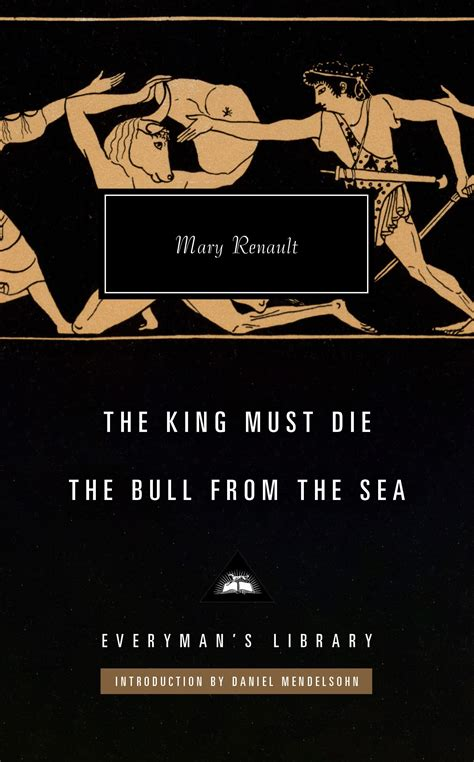
In my recent big post about sacrifice (willing and otherwise), I pointed out some similarities between the different sacrificial deaths in Mary Renault’s The King Must Die, and the death of Christ.

Some of these similarities are deep. Theseus, as future king of Athens, has an honorary title the Shepherd of the People. He is the king’s son, and he feels “the god” (Poseidon) calling him “to the bulls,” that is, to go and be a human sacrifice in Crete. Before he departs, he reassures the parents of the other future bull-dancers, “I will go with your children, and take them into my hand. They shall be my people.”

Two thousand years after Christ, we are so saturated in the power of His story and of the things He said that it is hard to read these ancient customs as anything but Christological types. And, since The King Must Die was published in 1958, it’s pretty clear the author also was aware of Christ and was intentionally pulling phrases from Him. More about that in a moment.

Other similarities are superficial, but nonetheless striking. Near the end of TKMD, a sixteen-year-old “king” who is about to be torn to pieces by wild women in a Dionysian rite, goes to his death riding in a cart, crowned with ivy, brandishing a wine cup and scattering wheat seed on his people. Now, this rite is almost nothing like the death of Christ. It’s pagan. It does not happen on Passover, the date of the annual sacrifice of a lamb, but rather it is part of an annual ritual of human sacrifice mixed with orgy. The “king,” along with everyone else, is reeling drunk. He has just spent a year as the consort of the priestess/queen, and he has no choice in what is about to happen to him. It’s hard to imagine a death more different from Christ’s.

And yet, these very superficial similarities do not strike us as coincidences. Instead, they seem significant. On this side of Christ, we can’t help but notice when a man who is about to go up a hill and die shares out bread and cup to his followers.

This sort of horrifying, yet somehow moving, ritual is not something Renault just made up. It’s well-attested in myths, legends, and histories. In this essay, I will argue that Christ did not share out bread and wine because it had been done before. Rather, the pagan one-year king shared out bread and wine because Christ did so one thousand years later. Future events cast backwards shadows.

What was Renault trying to do?

To be clear, that is my thesis, not Renault’s. She was a lesbian who published a number of contemporary gay romance novels before discovering her personal obsession with ancient Greece. Writing about Socrates and Alexander the Great allowed her to write sympathetic historical novels about gay characters who lived in a context where this sort of behavior was considered completely normal. The King Must Die certainly includes all kinds of sexual activity; for example, in the Bull Court, the female bull-leapers cannot be allowed to get pregnant, so they are sequestered from the boys, and turn to relationships with each other. Many of the male bull-leapers become the paramours of upper-class Cretan men. Theseus himself is straight, but as an ancient prince, let’s just say he’s not exactly chaste. (I may have lucked into picking up Renault’s least gay book about ancient Greece.)

All this to say, I don’t think Renault was trying to say that any ancient customs were foreshadowings of Christ. If she was “trying to say” anything at all about Christ, it’s probably that He’s not so unique, and anybody familiar with ancient Hellenistic ideas would understand that. But her novels (at least TKMD) are not really “message” novels. She immersed herself in that world, wrote characters and customs that grew organically out of it, and this is what came out.

So no, I don’t think Renault is projecting Christ back into the ancient Mediterranean customs intentionally, except in the sense that she would have been familiar with biblical phrases as a woman raised in 1900s England. I think she was primarily writing from her research and imagination.

Is Christianity a ripoff from Greek mystery religions?

Still, when I first read TKMD, the tone was familiar to me and I immediately picked up the implications. Not that many years before reading it, I had been through a year of thorough education in Greek mythology by a high-school teacher who could safely be described as feminist. My best friend at the time was a neo-pagan. Between the two of them, this teacher and friend were quick to point out any parallels between Greek paganism and Christian practice, and to accuse Christians of “stealing” it. Looking back, there was a certain defensiveness there, which I did not realize at the time. But my teacher and friend were only two voices in a large crowd of scholars.

During a period of time running roughly from about 1890 to 1940, scholars often alleged that primitive Christianity had been heavily influenced by Platonism, Stoicism, the pagan mystery religions, or other movements in the Hellenistic world. Largely as a result of a series of scholarly books and articles written in rebuttal … Today, most Bible scholars regard the question as a dead issue. [But] even though specialists in biblical and classical studies know how weak the old case for Christian dependence was, these old arguments continue to circulate in the publications of scholars in such other fields as history and philosophy.

–Christianity and the Hellenistic World (1984), p. 10

As an aside, notice that the peak of this theory were the years during which Mary Renault was growing up and going to school.
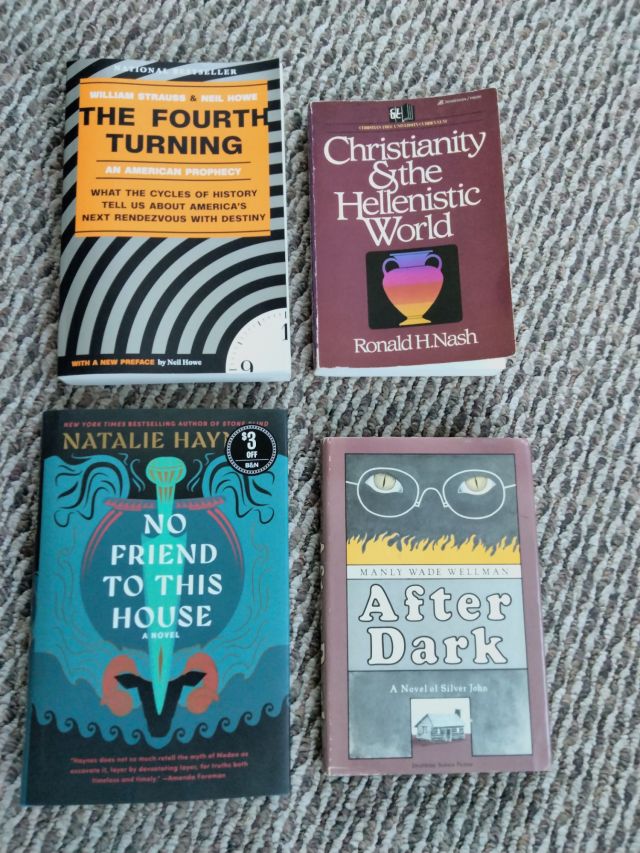
Sometimes books come to you, serendipitously, just when you are ready for them. As I was thinking about this question of the similarities between fictional (but history-based) sacrificial victims in Renault, and my own Dying God, I imagined how I would build a case that He was clearly not copying them. Although He did grow up in a thoroughly Hellenized environment, He was a Jew. He was extremely faithful to the God of Abraham, Isaac, and Jacob, and was so familiar with the Law and the Prophets that He could quote them off the cuff. His veins seemed to flow with the Hebrew Scriptures. In short, He showed no signs of wanting to throw over the religion of His ancestors for that of the Greeks. Furthermore, many of the elements of how His last days went down came about as a result of the particular historical conditions in which He found Himself. He went up the hill to die because Jerusalem is built on a height. He shared out bread and wine because they were having the Passover, and this ceremony had been established 1400 years before in the desert of Sinai, not 1000 years before in the Ionian islands. He called Himself a king because that was what the Jewish Messiah was supposed to be, and He was of the house and lineage of David … not because He had been selected by matriarchal priestess to live as a king for one year and then die. He called Himself the Good Shepherd because of the Israelite pastoral tradition, not because of the Athenian one. The Roman soldiers put a crown of thorns on His head because they were professionals at humiliating and torturing people. It’s hard to imagine how He could have orchestrated all these historical factors intentionally in order to copy a pagan custom that was practiced far away, and centuries before He was born.

I can assert all this stuff, but there is always some scholar out there who could be quoted to argue with me. I needed a book. And the book came to me. As I was turning all these things over in my mind, I had to venture out to a Christian bookstore that was closing. (“Come get your novels,” they said.) Of course, many of their books were on clearance, and there before me was Nash’s Christianity and the Hellenistic World for the low low price of one dollar, its asking price all out of proportion to its value to me at that moment. Nash can prove what I can only assert.

Nash systematically addresses claims that early Christian writers, particularly Paul, got many of their key concepts from Platonism, Stoicism, the mystery religions, and Gnosticism.

Among the many claims published in this century are the following:

  1. Early Christianity was just another Hellenistic mystery religion.
  2. Important Christian beliefs and practices were either borrowed from, or were heavily dependent on, similar beliefs and practices in the mysteries.
  3. Both baptism the Lord’s Supper evidence the influence of similar rituals in the mystery cults.
  4. Among the many Christian beliefs drawn from the mysteries is the Pauline doctrine of salvation, which parallels the essential themes of the mysteries: a savior-god dies violently for those he will eventually deliver, after which the god is restored to life.

A major movement in the development and promotion of such theories was the History of Religions School (Religionsgeschichtliche Schule).

-ibid, pp. 116 – 177

Nash addresses problems with these claims such as the following: in the mysteries, the dying god does not really rise. Osiris lives on in the underworld; the dead god’s body becomes the wheat, etc. As far as we can tell, ritual washings in the mysteries were just purification rituals, and they had to be repeated. They do not seem to have been a one-time entry into a new life like the Christian baptism. For many of these mystery religions, we don’t actually know much about the content of the rituals, because they were intentionally kept secret. For many mystery-religion practices that are well-attested, such as the taurobolium where the initiate stood beneath a grate while a bull was slaughtered, these practices seem to have developed after Christ rose and Paul wrote his letters. In the case of the mystery religions of the first, second, and third centuries, some of them were actually influenced by Christianity, not the other way round.

But I’ll let German scholar Adolf von Harnack, quoted by Nash, have the last word:

We must reject the comparative mythology which finds a causal connection between everything and everything else, which tears down solid barriers, bridges chasms as though it were child’s play, and spins combinations from superficial similarities … By such methods one can turn Christ into a sun god in the twinkling of an eye, or one can bring up legends attending the birth of every conceivable god, or one can catch all sorts of mythological doves to keep company with the baptismal dove; and find any number of celebrated asses to follow the ass on which Jesus rode into Jerusalem; and thus, with the magic wand of “comparative religion,” triumphantly eliminate every spontaneous trait in any religion.

–ibid, pp. 118 – 119

Too many keys to mythology

In short, the problem is not that there are some key symbolic parallels between Christ and ancient pagan symbolism. The problem is that there are too many parallels, or similarities, right down to the animals involved. Part of this is simply the limitations of living in this world. Jesus had to eat something, He had to ride on something, He had to use some kind of words when He spoke, and there were a finite number of foods, mounts, and terms in the ancient world, just as there are everywhere. I have pointed out before, when addressing the problem of whether Christians “stole” pagan practices like hot cross buns and wedding customs, that there are a limited number of ways to do every human activity. If you eat something, wear something, or go through a life passage, and you are a human being, I guarantee that in the past four thousand years there has been someone who did it that way before you. And that someone was probably pagan.

As G.K. Chesterton said about finding mystical and symbolic connections:

The true origin of all the myths has been discovered much too often. There are too many keys to mythology, as there are too many cryptograms in Shakespeare. Everything is phallic; everything is totemistic; everything is seed-time and harvest; everything is ghosts and grave-offerings; everything is the golden bough of sacrifice; everything is the sun and moon; everything is everything.

–The Everlasting Man, p. 103

These are the givens of the universe that all humans encounter; and, unless we are sorely impoverished, we all have some way of dealing with them. But just because they are ubiquitous does not mean they are unimportant. These things are shadows of what was to come. The reality, however, is found in Christ.

Symbolism in Reality

Last point: Jesus was the fulfillment of all these confused hints in every culture. But the vibe of the New Testament historical records is much less gorgeous, mythical, and poetic than the ancient pagan stories. As C.S. Lewis put it:

When I first, after childhood, read the Gospels, I was full of that stuff about the dying God, The Golden Bough, and so on. It was to me then a very poetic, and mysterious, and quickening idea; and when I turned to the Gospels never will I forget my disappointment and repulsion at finding hardly anything about it at all. The metaphor of the seed dropping into the ground in this connexion occurs (I think) twice in the New Testament, and for the rest hardly any notice is taken; it seemed to me extradordinary. You had a dying God, Who is always representative of the corn; you see Him holding the corn, that is, bread, in His hand, and saying, ‘This is My Body,’ and from my point of view, as I then was, He did not seem to realize what He was saying. Surely there, if anywhere, this connexion between the Christian story and the corn must have come out; the whole context is crying out for it. But everything goes on as if the principal actor, and still more, those close to Him, were totally ignorant of what they were doing. It is as if you got very good evidence concerning the sea-serpent, but the men who brought this good evidence seemed never to have heard of sea-serpents. Or to put it another way, why was it that the only case of the ‘dying God’ which might conceivably have been historical occurred among a people (and the only people in the whole Mediterranean world) who had not got any trace of this nature religion, and indeed seemed to know nothing about it?

–C.S. Lewis, “The Grand Miracle,” in God in the Dock, p. 83

Well, when you put it that way, it’s pretty funny, isn’t it? Jesus’s death reads as disappointingly prosaic compared to the myths only because it actually happened. This is very humble of God. He has quite the sense of humor. As John puts it after his account of the Triumphal Entry, “At first His disciples did not understand all this. Only after Jesus was glorified did they realize that these things had been written about Him and that they had done these things to Him.” John 12:16

Sources

Chesteron, G.K. The Everlasting Man. Ignatius Press: 2008, originally published in 1925.

Lewis, C.S., ed. Walter Hooper, God in the Dock: Essays on Theology and Ethics. Eerdmans: 1970, 1978.

Nash, Ronald H. Christianity and the Hellenistic World. Zondervan: 1984.

Renault, Mary. The King Must Die. Alfred A. Knopf, Everyman’s Library edition pub. 2022, originally published by Pantheon Books in 1958.

“Who is Mary Renault?” copyright The Mary Renault Society, 2010 – 2026, Who Is Mary Renault? – The Mary Renault Society, accessed April 17, 2026.
Sacrifice in Ancient Greece and Now

This is my final post about The King Must Die. It will have spoilers. They will be the sort of spoilers that make you want to read the book.

Like any good literary book with a strong theme, this one announces the theme in its title. The King Must Die. Why? Why must the king die? The entire story is an effort to provide the answer.

A Rude Awakening: the Death of the King Horse

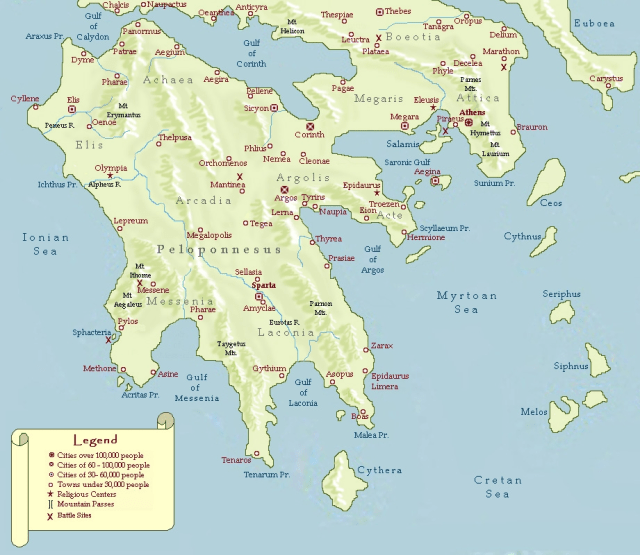
The first major incident in the book involves the slaughter of a sacred horse. Theseus, who is about seven at the time, loves this horse. It is the “king horse,” the stallion of the sacred herd. Theseus, who has been told that the god Poseidon is his father, thinks of this horse as his literal brother. He is taken to the sacred island to attend a special ceremony. He has no idea that this ceremony is going to culminate in the slaughter of the horse he adores.

It was a good clean killing. I myself, with all Athens watching, am content to do no worse. Yet, even now, I still remember. How he reared up like a tower, feeling his death, dragging the men like children; the scarlet cleft in the white throat, the rank hot smell; the ruin of beauty, the fall of strength, the ebb of valor; and the grief, the burning pity as he sank upon his knees and laid his bright head in the dust. That blood seemed to tear the soul out of my breast, as if my own heart had shed it.

As the newborn babe, who has been rocked day and night in his soft cave knowing no other, is thrust forth where the harsh air pierces him and fierce light stabs his eyes, so it was with me.

p. 13

This is the first king to die in the story. And for Theseus, it is also a kind of death, and a kind of birth. He is the grandson of a king, and this is his birth into the world where the king must die.

Then Theseus is “dedicated.” This involves smearing the horse’s blood on his forehead. But when his older cousin tells him “Come, you must be dedicated,” he thinks that he is about to be sacrificed like the King Horse. So the little boy steps forward in his first act of courage, ready to give his life. And for the first time, he senses the presence of the god Poseidon with him.

Theseus’s grandfather, the king, notices that his grandson is struggling with what just happened. Later, in grandfather’s upper room, the two of them have a talk.

The Lord Poseidon, who rules everything that stretches under the sky, the land and the sea. He told the King Horse, and the King Horse led [our ancestors to new grazing grounds].”

I sat up; this I could understand.

“When they needed new pastures, they let him loose; and he, taking care of his people as the god advised him, would smell the air seeking food and water. Here in Troizen, when he goes out for the god, they guide him round the fields and over the ford. We do that in memory. But in those days he ran free. The barons followed him, to give battle if his passage was disputed; but only the god told him where to go.

And so, before he was loosed, he was always dedicated. The god only inspires his own. Can you understand this, Theseus?

The King Horse showed the way; the barons cleared it; and the King led the people. When the work of the King Horse was done, he was given to the god, as you saw yesterday. And in those days, said my great-grandfather, as with the King Horse, so with the King.”

I looked up in wonder; and yet, not in astonishment. Something within me did not find it strange.

“Horses go blindly to the sacrifice; but the gods give knowledge to men. When the King was dedicated, he knew his moira [=destiny]. In three years, or seven, or nine, or whenever the custom was, his term would end and the god would call him. And he went consenting, or else he was no king, and power would not fall on him to lead the people. And the custom changes, Theseus, but this token never.

“Later the custom altered. Perhaps they had a King they could not spare, when war or plague thinned the Kindred. Or perhaps Apollo showed them a hidden thing. But they ceased to offer the King at a set time. They kept him for the extreme sacrifice, to appease the gods in their greatest angers … And it was no one’s place to say to him, ‘It is time to make the offering.’ He was the nearest to the god, because he consented to his moira; and he himself received the god’s commandment.”

He paused; and I said, “How?”

“In different ways. And so it is still, Theseus. We know our time. Listen, and do not forget, and I will show you a mystery. It is not the sacrifice, whether it comes in youth or age, or the god remits it; it is not the bloodletting that calls down power. It is the consenting, Theseus. The readiness is all. It washes heart and mind from things of no account, and leaves them open to the god. But one washing does not last a lifetime; we must renew it, or the dust returns to cover us.”

pp. 16 – 19

Thus the king of Troizen lays out the entire rationale for Hellene royal sacrifice. Perhaps you have already noticed a few Bible Easter eggs. “Behold, I tell you a mystery” and Jesus saying, “The Father loves me because I lay down my life. No one takes it from me; I lay it down of my own accord. I have authority to lay it down and authority to take it up again. This command I received from my Father.” (John 10:17 – 18) Those few lines map exactly onto what Theseus’s grandfather has just told us, albeit with perfect clarity instead of wrapped in mysterious ancient customs.

Was all this really present in the culture of the ancient Greeks and their Indo-European forebears? Or is Renault reading it back into that culture from the Bible? Or, did Jesus borrow all this from the ancients? I’m looking into it.

You might think that Theseus’s grandfather’s speech is too heavy-handed; showing instead of telling. But Renault knows what she is doing. This is not the whole secret of the book laid bare within the first twenty pages. It is only the beginning. This instruction from his grandfather sets Theseus’s attitude towards the god, himself, and his duty. It will guide how he responds to things throughout the rest of the book.

All the Kings that Die

Spoiler time. Here is a quick list of all the kings whose death Theseus causes or witnesses in this book:

  • Kerkyon, the “king” of Eleusis. This young man is a “solar king,” that is, he lives in a matriarchal society where the king reigns for only one year and then is killed by his successor. Thesus gets chosen as the next solar king and kills Kerkyon in hand to hand combat. Then he becomes the next Kerkyon.
  • Minos. Minos is dying and has no legitimate heir. He eventually becomes aware of Theseus and asks him to kill him using the sacred double-headed axe that has been used by kings in Crete from ancient times.
  • Astarion, the “Minotaur.” In this version of the story, Astarion is Pasiphae’s illegitimate son by an Assyrian bull-dancer. He is angling for the throne of Crete, and after Minos dies he has himself crowned king. A priest anoints him with oil and puts on him the sacred gold bull-mask. Theseus interrupts the ceremony and fights Astarion, who is still wearing the sacred mask. Though he gained the throne by illegitimate means and held it for only a few minutes, technically Astarion is another king whom Theseus kills.
  • The solar king on the island of Dia. Theseus, Ariadne, and the fleeing bull-dancers make a stop on this island on the way home to Athens. It happens to be on the day of the year that the Dionysian rite will take place, where the past year’s king is torn to pieces by the Maenads.
  • Theseus’s father Aigeus. Aigeus kills himself by leaping from the cliff of Athens when he sees that the returning ship is bearing a dark blue Cretan sail instead of a white one. Leaping from the cliff is the traditional way that kings of Athens have been known to “make the sacrifice” when the god calls them.

All of these tragic events might seem like an unrelated potpourri of senseless suffering. But actually, they are all closely bound up with each other, and we can see it if we look at the Hellene, Minyan, and Cretan attitudes towards sacrifice.

Other Sacrifices

Sacrifice is everywhere in this ancient world. Every year, the people of Troizen kill a “scapegoat,” a non-royal person that they have decided is causing their troubles. There are animal sacrifices, there are libations of wine poured out, and so forth. The priestess, when she goes to do divination, offers the “house snake” a dish of milk. In Crete, when a man is going to become king, he throws a ring into the sea to “marry the sea lady.” I want to here mention two notable sacrifices that royal characters make.

Early in the book, we learn that during a time of drought and plague, Theseus’s mother sacrifices her virginity. Typical of ancient pagan thinking, when none of the gods of the Hellenes claimed responsibility for the plague, the king, with increasing desperation, finally figured out that the god who was angry was “the Mother.” He offers a “holocaust” (a burnt offering) of pigs all around the large mossy rock in the Mother’s shrine, but apparently this is not sufficient. The old priestess, who is unattractive and dislikes pretty girls, tells the king that his fifteen-year-old daughter must “hang up her girdle for the Mother.” This means she must go to the “myrtle house” (a shrine on the sacred island) and give herself to the first man who shows up, as an offering to the Mother. Then the drought will stop.

It’s an incredibly poignant scene as the king, now a grandfather, describes to Theseus how he felt he could not get out of this. He goes to his daughter about it, and she says of course she is willing to make this sacrifice to save the life of the people.

As it happens, the king of Athens is visiting Troizen, and he agrees to go and visit the young princess on the island so that at least her experience will be with a man who is kind, and whom she has met before. But the king of Troizen cannot tell his daughter that this is going to happen, because as a member of the royal family, she has to go to the sacrifice consenting. “The readiness is all.” So the king of Athens swims over to the sacred island and becomes Theseus’s father. As he jumps into the water, a thunderstorm is already coming to end the drought.

Later, Theseus sacrifices himself for his people when he volunteers to go to Crete as part of the tribute of seven youths and seven maidens. He feels the god Poseidon calling him to do this, “sending him to the bulls.” (The bull-dance of Crete is actually a sacrificial rite in honor of Poseidon.) At first, Theseus resists. He tries to offer the god his horses instead, but he can feel the presence of the god withdrawing from him in response to this. So, in a moment of anguish, he makes the decision to give up his life in Athens, with his father and eventually the throne. Going to Crete does not mean instant death, though it’s understood that bull-dancers last a maximum of six months in the ring. But it is a death to all of Theseus’s hopes and dreams.

Two Attitudes to Sacrifice

As I’ve hinted in this and in previous posts, the customs of the earth-mother-worshipping Minyans differ quite a bit from those of the sky-god-worshipping Hellenes when it comes to sacrifice. In contrast to the Hellene approach laid out in the first section of this post by Theseus’s grandfather, the Minyan solar “kings” are not really kings at all, but more like sacrificial animals. The “king” serves as the consort of the priestess/queen for one year. During this time, he is pampered in every way, sort of like fattening an animal for slaughter, but he has no real power. The queen, together with the other matriarchs, is one who conducts the business of the land. In Eleusis, the war chief is not the queen’s husband but her brother. In these “earthling” societies, the important thing is not how the king dies but simply that he die.

Just inshore, the road sloped upwards to a flat open place at the foot of a rocky bluff. Stairs led up to the terrace where the Palace stood: red columns with black bases, and yellow walls. The cliff below it was undercut; the hollow looked dark and gloomy, and had a deep cleft in its floor that plunged into the earth. The breeze bore from it a faint stench of rotten flesh.

She pointed to the level place before it, and said, “There is the wrestling ground.”

I looked at the cleft and said, “What happens to the loser?”

She said, “He goes to the Mother. At the autumn sowing his flesh is brought forth and plowed into the fields, and turns to corn.”

ibid, p. 68

It is not the king’s life, his attitude, his self-sacrifice, or his leadership that the goddess-worshippers need, but only his rotting body, his symbolic and literal death.

This system produces a fatalism in Minyan “kings” that is very different from the warrior spirit of the Hellenes.

As we met each other’s eyes, I thought, “He has stood where I stand now, and the man he fought with is bones under the rock.” And then I thought, “He has not consented to his death.”

I drank of the mixed drink, and the priestess gave it to the King. He drank deep. The people gazed at him; but no one cheered. Yet he stripped well, and bore himself bravely; and for a year he had been their king. I remembered what I had heard of the old religion. “They care nothing for him,” I thought, “though he is going to die for them, or so they hope, and put his life into the corn. He is the scapegoat. Looking at him, they see only the year’s troubles, the crop that failed, the barren cows, the sickness. They want to kill their troubles with him, and start again.”

I was angry to see his death not in his own hand … But I saw from his face that none of this came strange to him; he was bitter at it, but did not question it, being Earthling as they were.

“He too,” I thought, “would think me mad if he knew my mind.”

ibid, pp. 69, 71

Theseus encounters this same unbridgeable disconnect again near the end of the book, when on the island of Dia he meets their sixteen-year-old “king.”

There was something about him I could put no name to, a daimon in his eyes; not that they wandered, like men’s eyes whose wits are troubled; rather they were too still. Whatever he fixed his gaze on, it was as if he would drain it dry.

Something oppressed me in his silence, and I said only to break it, “You have a god’s feast here tomorrow.”

“Yes.” That was all; but something woke in my mind, and of a sudden I saw everything. I remembered Pylas saying to me in the mountains above Eleusis, “I know how a man looks who foreknows his end.”

He read it in my face. For a moment our eyes met, seeking to speak together. It was in my mind to say, “Be on my ship before cocklight, and with the dawn we will be away. I too have stood where you stand now; and look, I am free. There is more in a man than the meat and corn and wine that feeds him. How it is called I do not know; but there is some god that knows its name.”

But when I looked into his eyes, there was nothing in them that I could say it to. He was an Earthling, and the ancient snake was dancing already in his soul.

ibid, pp. 319 – 320

The Minyans kill their king, and “do not share the sacrifice, offer nothing of their own.” This attitude is even more pronounced in Crete, as Theseus finds when he goes there.

Theseus takes his call to go “to the bulls” very seriously, as a form of sacrifice. Indeed, the bull-dancing developed from an original simple human sacrifice where a single victim was thrown into a pit to be gored by a bull, representing the god. But in the aeons since then, it has developed into entertainment. Originally, it was the youths of the noble families of Crete who would dance with the bulls until the day they were killed. Even then, they were celebrities. But now, the people of Crete do not enter the bull-ring themselves. Instead, the bull-dancers are slaves taken as tribute, captured, or bought from all corners of the world: not only the Greek islands but Libya, Phoenicia, Assyria, Scythia, even Israel. The Cretan upper classes adore these teenaged bull-dancers. They bet on them, send them gifts, have affairs with them, invite them to parties. They cry over their deaths. But ultimately, what is life and death to the bull-leapers is, to the Cretans, a diversion.

Avoiding the Sacrifice

Theseus does not resent being the one to put his life on the line in the bull-ring, because the sport itself is intoxicating, perfect for a teenaged adrenaline junkie. But he observes more than once, “These people only play at their sacrifices.” For example, the Cretan upper classes have dolls made of themselves which they hang on the trees every year in their place, at the time of year when, in ancient times, a royal person would be sacrificed.

“But that is a …” She checked herself and said, “only a mainland custom. Here in Crete no king has been sacrificed for two hundred years. We hang our dolls on the trees instead, and the Mother has not been angry.”

I made over her the sign against evil.

p. 253

As a result of this unwillingness to do the actual sacrifice, even the family of Minos no longer have the presence of the god. Theseus is appalled when Ariadne tells him how she plans to fake a fit of prophecy in her capacity as priestess. And he is stunned to find that Minos does not hear the voice of the god.

“Come,” he said, “tell me of this. The god spoke to you, you say. You have heard the voice that calls the king. How does it speak? In words? In a sound of music, or the wind? How does it call?”

I stared at him. Amazement rooted my tongue. I thought I must have heard wrong, yet knew not how to ask. We were silent, looking at each other.

He was the first to speak. He leaned his head on his hand, and said in his sad muffled voice, “Boy, how old are you?”

I said, “If I live to spring, my lord, I shall be nineteen.”

“And after dark, when the bats fly over, you hear their cry?”

“Why, yes,” I said. “Often the night is full of it.”

“They cry to the young. And when the old man passes, they are not silent; it is his ear that has hardened. So also with kings’ houses; and it is time then to think of our going. When the god calls you, Theseus, what is in your heart?”

Finding what words I could, I opened my heart in this small closed room to Star-Born Minos, Lord of the Isles.

When I had said my say … he raised his crystal eyes again, and slowly nodded. “So,” he said, “you made the offering. And yet, it is your father who is King.”

His words went sounding through me, deeper even than my grandfather’s long ago; deeper than my own thought could follow. “No matter,” I said. “A good Shepherd will give his life for the sheep.”

pp. 265 – 266

So Minos has lost, but he knows what he has lost. There is an even deeper depth of cynicism displayed in his stepson, Astarion, Pasiphae’s illegitimate child by a bull-leaper. When Theseus finds out that Astarion is planning to become king by a political coup, he can barely comprehend it:

“But,” I said, “then Crete is being ruled by a man who does not belong to any god; who was never dedicated. He has all power; yet he has not consented to make the sacrifice. Has he consented?”

There was a shadow on her cheek, as if she would smile; but her face grew grave, and she shook her head.

“Then,” I said, “the god will never speak to him. How can he lead the people? Who will see their danger coming? What will happen, if the god is angry, and there is no one to offer himself? He takes service, tribute, honor; and he gives nothing! Nothing! He will be death to your people if they let him live.”

p. 256

Theseus understands what many Cretans, and many in our godforsaken time, do not: that being a king is about more than just power.

Eventually, Astarion commits what reads to Theseus as the ultimate sacrilege. Astarion has sponsored Theseus’s team of bull-leapers for almost a year. Hard up for money, and with no access as yet to the royal treasury, Astarion seeks to make some money off his team. He places bets that they will die in the next dance, and then secretly has their bull drugged to madden it. Though Theseus is gored, the team manages to survive for a few minutes, and then the stratagem backfires when the bull dies of the drugs. The team, when they realize what he has done, are furious: “How this man has despised us!”

But Astarion has not only despised his team. He has despised the bull, the ritual, and hence, the god. Within twenty-four hours, Theseus is feeling the warning in his body and spirit that always comes over him right before Poseidon sends an earthquake. But this time, it is stronger than ever before.

The noise tormented me; the warning surged and roared and crashed through my head, or withdrew leaving a dreadful hollow hush filled with the tread of the approaching god. The awe and terror which it is man’s nature to feel before the Immortals goaded and spurred me to fly for my life. And when I held my ground, the madness burned me up, and the warning would not be contained within me. I shook Amyntor off and leaped on the table among broken winecups, and shouted it aloud.

“Poseidon is coming! Poseidon is coming! I Theseus tell you so, I his son. The sacred bull was killed and the Earth Bull has wakened! The House of the Ax will fall! The House will fall!”

p. 294

After the massive earthquake, when Theseus defeats Astarion,

Now I saw his face, grimacing with bared teeth. I stepped up to him, to hear what he would say to me. But he only stared at me as at some shape of chaos, seen in a dream when nothing makes sense. He who had thought to rule without the sacrifice, who had never felt the god’s breath that lifts a man beyond himself, had nothing to take him kinglike to the dark house of Hades.

p. 312

By denying the gods and expecting others to sacrifice for him, Astarion has destroyed his own mind and ushered himself into hell. This is the darkest place. It is darker even than the Minyan solar kings. Though they are about 90% scapegoat and only about 10% king, yet even they, because the Minyans still take their sacrifices seriously, provide some faint foreshadowing of Christ. When the young king of Dia rides off in a cart to go up the mountain and be torn to pieces, he goes crowned with ivy, raising a wine cup in his hand, and scattering wheat (bread) onto his people. Apparently, this is part of the deep structure of a properly done sacrifice: sharing out the bread and the cup before one’s death. Going up the hill. A vegetable crown.

And Today?

What did I mean, “And Now”? I can barely remember why I put that in the title.

Obviously, we no longer live in a world where human sacrifice is necessary to keep ourselves alive. Arguably, it never was, but I think this novel makes a pretty good case that there was something deep going on there. Human sacrifice bad, yes, but we cannot by the same token say paganism worthless, with no glimpses of the truth and with nothing to teach us.

Regarding the question of where these resemblances came from, I do not have time to go into whether Christianity “copied” from ancient Greek mystery religions, was not even aware of them, or was aware of them and did some riffing on them. But in the providence of God, I recently ran across a book that looks into exactly that. I’ll be back when I’ve read it, with a more robust case that these types and shadows found in paganism had their source in God.

The book of Hebrews–and in fact the entire New Testament–makes a strong case that, when our King laid down His life, that was the last, sufficient sacrifice, making it no longer necessary even to sacrifice animals. The only reason Theseus comes out looking so heroic is because of his resemblance to the King of Kings. And a Happy Easter to you. He is risen indeed!

But there is a miniature version of “the king must die” that applies in the daily life of every Christian, indeed of every adult. Being a king is about much more than just power, and this goes for every kind of leader. In order to be a good parent, you should be sacrificing yourself for your children much more often than you expect them to sacrifice for you, although of course this doesn’t mean that you let them be in charge. Most of a parent’s sacrifice is invisible to the children. And in fact, the one who sacrifices the most is the one who has the most authority. Otherwise, how will the unction of the god fall upon you to lead your people? Who will see danger coming?

Similarly, a good boss or manager works harder than any of his employees. A major principle of leadership and love is “my life for yours.” As Jesus said, “Whoever wants to come after me must deny themselves, pick up their cross, and follow me.” “Pick up their cross” corresponds to getting in the cart, the one that takes you up the hill. So, you, know, in a small way, we should all strive to be Theseus and not Astarion.

This is Taking a Toll.

Hello, fellow readers. I just don’t know.

This is an unplanned post. But, after all, a blog is a “web-log,” no? As in, a record of how we are doing day to day. And book blogs are records of how our reading affects us.

And whoof. Reading Greco-fiction is proving costlier than I anticipated.

First, there was Circe, with its depressing picture of Odysseus slipping into OCD paranoia after his return to Ithaca.

Then, I read Till We Have Faces, which is sort of like having the Holy Spirit do open heart surgery on you, if you really pore over it.

Now, I’m sitting here trying to work, but I’m having to take a break because reading The King Must Die has made my stomach hurt. That is not an exaggeration; I am experiencing psychologically caused stomach pain from reading this book.

I had some time to myself this morning, before leaving for the office. I thought I’d just get caught up on my reading of The King Must Die. Plus, it is hard to put down. I enjoyed reading about the earthquake that brought down the palace of Knossos. I relished when the Greek ship passed the island of Kalliste, the source of the earthquake, and the watery crater where the island used to lie. (This is the eruption of Thera, a well-documented event that took place about 1500 B.C.) Theseus is bringing with him Princess Ariadne of Crete. He is in love with her, and he has promised her father Minos that he will marry her and protect her.

The party lands on the Isle of Dia. I knew what was coming, but I kept reading. I remember this from university.

The people on the Isle of Dia are about to have a festival to Dionysius. Terrible things happen at such times, but everyone is in an altered state. A sacrificial man is torn apart by the wild women, the Maenads. I mean with their bare hands, teeth, etc.

Ariadne participates in this ceremony. When Theseus finds her, sleeping the wine off peacefully, all covered in someone else’s blood and still holding a body part, he vomits. He knew the king must die, but he didn’t anticipate exactly how it would happen. And he’s only eighteen years old.

I knew what would happen, but for some reason, it affected me worse this time. Perhaps because this time, I have children the ages of Theseus, Ariadne (16), and the “King” (also 16) whom she murdered.

At the same time, I can’t just dismiss it as follows: “Well, of course. It’s paganism. It’s all horrible and worthless, not worth caring about these people, not worth my time.” The reason these stories still intrigue us is because there is some very deep stuff going on there. And The King Must Die is filled, almost on every page, with Biblical easter eggs, both as direct quotes and as symbolic allusions. Even the Dionysian ceremony has them. Though I don’t doubt those wild women would indeed have to be possessed, and not in a good way, to do what they did.

Anyway, I’ll get to how I found Christ in The King Must Die in a later post, when I have gathered myself. I just wanted to report that it sort of ruined my day.

Have you ever had a physical reaction to a book? And did you still like the book after?

Christmas Trees are Christian, but still Very Ancient

This post is about how we got our Christmas trees. For the record, I would probably still have a Christmas tree in the house even if it they were pagan in origin. (I’ll explain why in a different post, drawing on G.K. Chesterton.) But Christmas trees aren’t pagan. At least, not entirely.

My Barbarian Ancestors

Yes, I had barbarian ancestors, in Ireland, England, Friesland, and probably among the other Germanic tribes as well. Some of them were headhunters, if you go back far enough. (For example, pre-Roman Celts were.) All of us had barbarian ancestors, right? And we love them.

St. Boniface was a missionary during the 700s to pagan Germanic tribes such as the Hessians. At that time, oak trees were an important part of pagan worship all across Europe. You can trace this among the Greeks, for example, and, on the other side of the continent, among the Druids. These trees were felt to be mystical, were sacred to the more important local gods, whichever those were, and were the site of animal and in some cases human sacrifice.

God versus the false gods

St. Boniface famously cut down a huge oak tree on Mt. Gudenberg, which the Hessians held as sacred to Thor.

Now, I would like to note that marching in and destroying a culture’s most sacred symbol is not commonly accepted as good missionary practice. It is not generally the way to win hearts and minds, you might say.

The more preferred method is the one Paul took in the Areopagus, where he noticed that the Athenians had an altar “to an unknown god,” and began to talk to them about this unknown god as someone he could make known, even quoting their own poets to them (Acts 17:16 – 34). In other words, he understood the culture, knew how to speak to people in their own terms, and in these terms was able to explain the Gospel. In fact, a city clerk was able to testify, “These men have neither robbed temples nor blasphemed our goddess” (Acts 19:37). Later (for example, in Ephesus) we see pagan Greeks voluntarily burning their own spellbooks and magic charms when they convert to Christ (Acts 19:17 – 20). This is, in general, a much better way. (Although note that later in the chapter, it causes pushback from those who were losing money in the charm-and-idol trade.)

However, occasionally it is appropriate for a representative of the living God to challenge a local god directly. This is called a power encounter. Elijah, a prophet of ancient Israel, staged a power encounter when he challenged 450 priests of the pagan god Baal to get Baal to bring down fire on an animal sacrifice that had been prepared for him. When no fire came after they had chanted, prayed, and cut themselves all day, Elijah prayed to the God of Israel, who immediately sent fire that burned up not only the sacrifice that had been prepared for Him, but also the stones of the altar (I Kings chapter 18). So, there are times when a power encounter is called for.

A wise missionary who had traveled and talked to Christians all over the world once told me, during a class on the subject, that power encounters tend to be successful in the sense of winning people’s hearts only when they arise naturally. If an outsider comes in and tries to force a power encounter, “It usually just damages relationships.” But people are ready when, say, there had been disagreement in the village or nation about which god to follow, and someone in authority says, “O.K. We are going to settle this once and for all.”

That appears to be the kind of power encounter that Elijah had. Israel was ostensibly supposed to be serving their God, but the king, Ahab, had married a pagan princess and was serving her gods as well. In fact, Ahab had been waffling for years. There had been a drought (which Ahab knew that Elijah — read God — was causing). Everyone was sick of the starvation and the uncertainty. Before calling down the fire, Elijah prays, “Answer me, O LORD, answer me, so these people will know that you, O LORD, are God, and that you are turning their hearts back again.” (I Kings 18:37)

Similar circumstances appear to have been behind Boniface’s decision to cut down the great oak tree. In one of the sources I cite below, Boniface is surrounded by a crowd of bearded, long-haired Hessian chiefs and warriors, who are watching him cut down the oak and waiting for Thor to strike him down. When he is able successfully to cut down the oak, they are shaken. “If our gods are powerless to protect their own holy places, then they are nothing” (Hannula p. 62). Clearly, Boniface had been among them for some time, and the Hessians were already beginning to have doubts and questions, before the oak was felled.

Also note that, just as with Elijah, Boniface was not a colonizer coming in with superior technological power to bulldoze the Hessians’ culture. They could have killed him, just as Ahab could have had Elijah killed. A colonizer coming in with gunboats to destroy a sacred site is not a good look, and it’s not really a power encounter either, because what is being brought to bear in such a case is man’s power and not God’s.

And, Voila! a Christmas Tree

In some versions of this story, Boniface “gives” the Hessians a fir tree to replace the oak he cut down. (In some versions, it miraculously sprouts from the spot.) Instead of celebrating Winter Solstice at the oak tree, they would now celebrate Christ-mass (during Winter Solstice, because everyone needs a holiday around that time) at the fir tree. So, yes, it’s a Christian symbol.

Now, every holiday tradition, laden with symbols and accretions, draws from all kinds of streams. So let me hasten to say that St. Boniface was not the only contributor to the Christmas tree. People have been using trees as objects of decoration, celebration, and well-placed or mis-placed worship, all through history. Some of our Christmas traditions, such as decorating our houses with evergreen and holly boughs, giving gifts, and even pointed red caps, come from the Roman festival of Saturnalia. This is what holidays are like. This is what symbols are like. This is what it is like to be human.

Still, I’d like to say thanks to St. Boniface for getting some of my ancestors started on the tradition of the Christmas tree.

Bonus rant, adapted from a discussion I had …

... in a YouTube comments section with a Hebraic-roots Christian who was insisting that Christmas is a “pagan” holiday:

So, as we can see, the evergreen tree is a Christian symbol, not a pagan one, and has been from the very beginning of its usage. St. Boniface cut down the tree that was sacred to Thor, and that was an oak tree, not a Christmas tree. Sacred oaks are pagan. Christmas trees, which incidentally are not actually considered sacred, are Christian.

Yes, I am aware, as are most Christians, that Jesus was probably not actually born on Dec. 25th. Yes, I am aware that Yule was originally a pagan feast time.

But let’s look at the symbolism, shall we?

For those of us who live in northern climes, and especially before the industrial revolution, the winter solstice is the scariest time of the year. The light is getting less and less, and the weather is getting worse and worse, and all in all, this is the time of year when winter officially declares war on humanity. Winter comes around every year. It kills the sick and weak. It makes important activities like travel and agriculture impossible. It makes even basic activities, like getting water, washing things, bathing, and going to the bathroom anywhere from inconvenient to actually dangerous to do without freezing to death. If winter never went away, then we would all surely die. That is a grim but undeniable fact. Read To Build A Fire by Jack London, and tremble.

Thus, people’s vulnerability before winter is both an instance and a symbol of our vulnerable position before all the hardships and dangers in this fallen world, including the biggie, death. And including, because of death, grief and sorrow.

Yule is a time of dealing with these realities and of waiting for them to back off for another year. After the solstice, the days slowly start getting longer again. The light is coming back. Eventually, it will bring warmth with it. Eventually, life.

Thus, it is entirely appropriate that when the Germanic tribes became Christians, they picked the winter solstice as the time to celebrate Jesus’ birth. He is, after all, the light of the world. A little, tiny light – a small beginning – had come into the bitter winter of the sad, dark world, and it was the promise of life to come. The light shines in the darkness, and the darkness has not overcome it. All this biblical, very Hebrew symbolism answers beautifully the question raised by the European pagans’ concern with the sun coming back.

Our ancestors were not “worshipping pagan gods” at Christmas. They were welcoming Christ (who is the God of Abraham, Isaac, and Jacob) into the heart of their culture. They were recognizing that He was the light, using terms they knew, which were Germanic terms, and this is not surprising because they were Germans.

So, if you want to make the case that no holidays are lawful for Christians except those prescribed in the Old Testament for Israel, be my guest. Try to find some Scriptures to back that up. And maybe you can. But you cannot make that case by accusing people who put up a Christmas tree of worshipping pagan gods. All you’ll do then is reveal yourself to be historically ignorant.

Sources

BBC, “Devon Myths and Legends,” http://www.bbc.co.uk/devon/content/articles/2005/12/05/st_boniface_christmas_tree_feature

Foster, Genevieve, Augustus Caesar’s World: 44 BC to AD 14, Beautiful Feet Books, 1947, 1975, Saturnalia on p. 56 ff.

Hannula, Richard, Trial and Triumph: Stories from church history, Canon Press, 1999. Boniface in chapter 9, pp. 61 – 64.

Puiu, Tibi, “The origin and history of the Christmas tree: from paganism to modern ubiquity,” ZME Science, https://www.zmescience.com/science/history-science/origin-christmas-tree-pagan/

Thank You, St. Boniface: A Repost About Christmas

This post is about how we got our Christmas trees. For the record, I would probably still have a Christmas tree in the house even if it they were pagan in origin. (I’ll explain why in a different post, drawing on G.K. Chesterton.) But Christmas trees aren’t pagan. At least, not entirely.

My Barbarian Ancestors

Yes, I had barbarian ancestors, in Ireland, England, Friesland, and probably among the other Germanic tribes as well. Some of them were headhunters, if you go back far enough. (For example, pre-Roman Celts were.) All of us had barbarian ancestors, right? And we love them.

St. Boniface was a missionary during the 700s to pagan Germanic tribes such as the Hessians. At that time, oak trees were an important part of pagan worship all across Europe. You can trace this among the Greeks, for example, and, on the other side of the continent, among the Druids. These trees were felt to be mystical, were sacred to the more important local gods, whichever those were, and were the site of animal and in some cases human sacrifice.

God versus the false gods

St. Boniface famously cut down a huge oak tree on Mt. Gudenberg, which the Hessians held as sacred to Thor.

Now, I would like to note that marching in and destroying a culture’s most sacred symbol is not commonly accepted as good missionary practice. It is not generally the way to win hearts and minds, you might say.

The more preferred method is the one Paul took in the Areopagus, where he noticed that the Athenians had an altar “to an unknown god,” and began to talk to them about this unknown god as someone he could make known, even quoting their own poets to them (Acts 17:16 – 34). In other words, he understood the culture, knew how to speak to people in their own terms, and in these terms was able to explain the Gospel. In fact, a city clerk was able to testify, “These men have neither robbed temples nor blasphemed our goddess” (Acts 19:37). Later (for example, in Ephesus) we see pagan Greeks voluntarily burning their own spellbooks and magic charms when they convert to Christ (Acts 19:17 – 20). This is, in general, a much better way. (Although note that later in the chapter, it causes pushback from those who were losing money in the charm-and-idol trade.)

However, occasionally it is appropriate for a representative of the living God to challenge a local god directly. This is called a power encounter. Elijah, a prophet of ancient Israel, staged a power encounter when he challenged 450 priests of the pagan god Baal to get Baal to bring down fire on an animal sacrifice that had been prepared for him. When no fire came after they had chanted, prayed, and cut themselves all day, Elijah prayed to the God of Israel, who immediately sent fire that burned up not only the sacrifice that had been prepared for Him, but also the stones of the altar (I Kings chapter 18). So, there are times when a power encounter is called for.

A wise missionary who had traveled and talked to Christians all over the world once told me, during a class on the subject, that power encounters tend to be successful in the sense of winning people’s hearts only when they arise naturally. If an outsider comes in and tries to force a power encounter, “It usually just damages relationships.” But people are ready when, say, there had been disagreement in the village or nation about which god to follow, and someone in authority says, “O.K. We are going to settle this once and for all.”

That appears to be the kind of power encounter that Elijah had. Israel was ostensibly supposed to be serving their God, but the king, Ahab, had married a pagan princess and was serving her gods as well. In fact, Ahab had been waffling for years. There had been a drought (which Ahab knew that Elijah — read God — was causing). Everyone was sick of the starvation and the uncertainty. Before calling down the fire, Elijah prays, “Answer me, O LORD, answer me, so these people will know that you, O LORD, are God, and that you are turning their hearts back again.” (I Kings 18:37)

Similar circumstances appear to have been behind Boniface’s decision to cut down the great oak tree. In one of the sources I cite below, Boniface is surrounded by a crowd of bearded, long-haired Hessian chiefs and warriors, who are watching him cut down the oak and waiting for Thor to strike him down. When he is able successfully to cut down the oak, they are shaken. “If our gods are powerless to protect their own holy places, then they are nothing” (Hannula p. 62). Clearly, Boniface had been among them for some time, and the Hessians were already beginning to have doubts and questions, before the oak was felled.

Also note that, just as with Elijah, Boniface was not a colonizer coming in with superior technological power to bulldoze the Hessians’ culture. They could have killed him, just as Ahab could have had Elijah killed. A colonizer coming in with gunboats to destroy a sacred site is not a good look, and it’s not really a power encounter either, because what is being brought to bear in such a case is man’s power and not God’s.

And, Voila! a Christmas Tree

In some versions of this story, Boniface “gives” the Hessians a fir tree to replace the oak he cut down. (In some versions, it miraculously sprouts from the spot.) Instead of celebrating Winter Solstice at the oak tree, they would now celebrate Christ-mass (during Winter Solstice, because everyone needs a holiday around that time) at the fir tree. So, yes, it’s a Christian symbol.

Now, every holiday tradition, laden with symbols and accretions, draws from all kinds of streams. So let me hasten to say that St. Boniface was not the only contributor to the Christmas tree. People have been using trees as objects of decoration, celebration, and well-placed or mis-placed worship, all through history. Some of our Christmas traditions, such as decorating our houses with evergreen and holly boughs, giving gifts, and even pointed red caps, come from the Roman festival of Saturnalia. This is what holidays are like. This is what symbols are like. This is what it is like to be human.

Still, I’d like to say thanks to St. Boniface for getting some of my ancestors started on the tradition of the Christmas tree.

Bonus rant, adapted from a discussion I had …

... in a YouTube comments section with a Hebraic-roots Christian who was insisting that Christmas is a “pagan” holiday:

So, as we can see, the evergreen tree is a Christian symbol, not a pagan one, and has been from the very beginning of its usage. St. Boniface cut down the tree that was sacred to Thor, and that was an oak tree, not a Christmas tree. Sacred oaks are pagan. Christmas trees, which incidentally are not actually considered sacred, are Christian.

Yes, I am aware, as are most Christians, that Jesus was probably not actually born on Dec. 25th. Yes, I am aware that Yule was originally a pagan feast time.

But let’s look at the symbolism, shall we?

For those of us who live in northern climes, and especially before the industrial revolution, the winter solstice is the scariest time of the year. The light is getting less and less, and the weather is getting worse and worse, and all in all, this is the time of year when winter officially declares war on humanity. Winter comes around every year. It kills the sick and weak. It makes important activities like travel and agriculture impossible. It makes even basic activities, like getting water, washing things, bathing, and going to the bathroom anywhere from inconvenient to actually dangerous to do without freezing to death. If winter never went away, then we would all surely die. That is a grim but undeniable fact. Read To Build A Fire by Jack London, and tremble.

Thus, people’s vulnerability before winter is both an instance and a symbol of our vulnerable position before all the hardships and dangers in this fallen world, including the biggie, death. And including, because of death, grief and sorrow.

Yule is a time of dealing with these realities and of waiting for them to back off for another year. After the solstice, the days slowly start getting longer again. The light is coming back. Eventually, it will bring warmth with it. Eventually, life.

Thus, it is entirely appropriate that when the Germanic tribes became Christians, they picked the winter solstice as the time to celebrate Jesus’ birth. He is, after all, the light of the world. A little, tiny light – a small beginning – had come into the bitter winter of the sad, dark world, and it was the promise of life to come. The light shines in the darkness, and the darkness has not overcome it. All this biblical, very Hebrew symbolism answers beautifully the question raised by the European pagans’ concern with the sun coming back.

Our ancestors were not “worshipping pagan gods” at Christmas. They were welcoming Christ (who is the God of Abraham, Isaac, and Jacob) into the heart of their culture. They were recognizing that He was the light, using terms they knew, which were Germanic terms, and this is not surprising because they were Germans.

So, if you want to make the case that no holidays are lawful for Christians except those prescribed in the Old Testament for Israel, be my guest. Try to find some Scriptures to back that up. And maybe you can. But you cannot make that case by accusing people who put up a Christmas tree of worshipping pagan gods. All you’ll do then is reveal yourself to be historically ignorant.

Sources

BBC, “Devon Myths and Legends,” http://www.bbc.co.uk/devon/content/articles/2005/12/05/st_boniface_christmas_tree_feature

Foster, Genevieve, Augustus Caesar’s World: 44 BC to AD 14, Beautiful Feet Books, 1947, 1975, Saturnalia on p. 56 ff.

Hannula, Richard, Trial and Triumph: Stories from church history, Canon Press, 1999. Boniface in chapter 9, pp. 61 – 64.

Puiu, Tibi, “The origin and history of the Christmas tree: from paganism to modern ubiquity,” ZME Science, https://www.zmescience.com/science/history-science/origin-christmas-tree-pagan/

R.I.P., Huitzilopochtli

The name Huitzilopochtli means “hummingbird of the left [hand]” or “hummingbird of the South.” Now, if we were to play a word-association game and I said “hummingbird,” I doubt that the first thing out of your mouth would be “human sacrifice.” This was not true of the tribe of the Mexica, however.

The hummingbird was closely linked both with human sacrifice and with rain, since it appears in the rainy season, so the bird was associated with the form of death believed to feed the sun and with fertility as well. Huitzilopochtli [after, in the myth, killing his sister and routing his brothers] was no longer just an obscure earth deity, he was now the Lord of the Daylight Sky, the Rising Sun, and his symbol, the hummingbird, also came to represent the fallen warriors who accompanied the sun on his daily journey. Among his other attributes, the Mexica came to believe in Huitzilopochtli as the God of War … who incited his chosen people to greatness … by the force of their own hearts and their arms which would “lift the Mexican nation to the clouds.” These same hearts and arms were also to provide the vital, nourishing blood that sustained the god and the Aztec world.

The Aztecs, by Brian M. Fagan, pp. 55 – 56

Got that? Hummingbird >>> rainy season >>> fertility >>> human sacrifice >>> war.

The Mexica were sacrificing to Huitzilopochtli as they wandered around central Mexico, fighting one people after another, before they ever founded their great capital city of Tenochtitlan. (We are still not clear on the location of their original homeland.) However, if we count from the founding of Tenochtitlan in the year Two House (probably about A.D. 1325), when the Mexica built a reed temple to the hummingbird god on the small island where they had seen an eagle perched on a prickly pear, then Huitzilopochtli reigned in central Mexico just under 200 years. Cortez arrived in 1519, and by 1522, Tenochtitlan was destroyed.

According to the ancient world view that dates back to Genesis, the One God temporarily gave the lesser gods control over various nations. At Babel, when He scatters the peoples, there are 70 groups, corresponding to the 70 gods that traditionally composed God’s council in Ugaritic and Hebrew mythology. But the gods do a rotten job of leading their people. They tend to behave tyrannically, as do the human rulers who both serve and imitate them. Hints begin very early that one day, the gods’ time will be up. The One God will take back direct rule, not just of the Hebrews, but of all nations of the earth. Then all the nations will once again be His portion, His inheritance.

In the meantime, He lets them run, and things get very bad. When things get too bad in a nation, the One God often judges them. He brings that civilization to an end, usually by using another nation (equally wicked but not yet ready for their own judgement). Defeat in war was well known in the ancient world as a sign that our god had either abandoned us or been defeated by a foreign god. It was well known to the Hebrews as a sign that the One God had had enough of the way this lesser god, and these human kings, were running this nation.

Some nations got to go a very long time. Before the Israelites went into slavery in Egypt, the One God predicted that He would bring them to the land of Canaan four hundred years later — but not yet, “for the sin of the Amorites has not yet reached its full measure.” The Phoenicians, who would burn live babies to appease their god Moloch, got to go on with their wicked ways until Rome destroyed Carthage in 146 B.C. … a very long run indeed. Rome would have her turn many centuries later.

Using this scale, the reign of Huitzilopochtli was shockingly short. Less than two centuries … but what centuries they were! By the time judgement arrived in the person of Cortez, the Mexica were carrying out raids and wars farther and farther afield (almost to Guatemala) to feed the demand for prisoners whose hearts were ripped out of them and offered to Huitzilopochtli, now almost daily. The bodies were kicked down the steps of the temple. Depending upon the type of sacrifice, the arms and legs might later be eaten with some prickly pear on the side. The skulls were stored on massive skull racks. Aztec warriors moved up the ranks based upon how many prisoners they had captured for sacrifice. After a certain number, they were allowed to wear a mohawk. More captures, and they earned a cotton cloak, a necklace, a feathered headdress.

When Cortez and his men were fighting their way out of the city for the first time, astoundingly they managed to capture the temple, though it was covered in hundreds of very tough Aztec warriors. They then took the statue of Huitzilopochtli and hurled it down the temple steps … the very steps down which so many human bodies had been flung. Then, with heavy casualties, a few of them managed to escape the city. On the way back to their base among the Tlaxcalans, they fought battle after battle in which they were massively outnumbered. They should have perished dozens of times, but they didn’t. About a year later, Tenochtitlan was under siege and the Mexica, unable to keep up with death rate, began throwing the bodies of their fallen loved ones into the canals of the city. Hardened Spanish warriors couldn’t handle the smell when they entered the city. Nor could they stop their Tlaxcalan allies from slaughtering the Aztec civilians. God’s judgement on a 200-year orgy of bloodshed was a terrible thing to behold.

Today, Huitzilopochtli is an obscure name. Many people have heard of the Aztecs, and even of Quetzalcoatl, but the hummingbird of the south is not a name on everyone’s lips. He who once filled millions of people with terror has passed into obscurity. Now he’s a bit of trivia, a name known to experts on Mesoamerican history and archaeology only. Nor is Huitzilopochtli alone in this. He has joined the ranks of many gods, such as Moloch, Ishtar, Vesta, Cernunnos, and Tanit, who were once mighty in their lands and now are known only by people with a special interest in a particular corner of history. There are other gods, of course, whose names we do not know. We find a strangely shaped cultic object and we can only speculate. All of these lesser gods have become part of history. But everyone knows the name of Christ, the one Who sets the prisoners free. If someone wants to break into a strong man’s house and take his precious possessions, his people, one must first tie up the strong man.

R.I.P., Huitzilopochtli. You had a good run — 200 years — but beating hearts will be cut out and offered to you no more.

Why Everyone Should Be Educated about the Ancient Near East: A Repost

Here is a representative New Atheist argument from Richard Dawkins:

“The God of the Old Testament is arguably the most unpleasant character in all fiction: jealous and proud of it; a petty, unjust, unforgiving control-freak; a vindictive, bloodthirsty ethnic cleanser; a misogynistic, homophobic, racist, infanticidal, genocidal, filicidal, pestilential, megalomaniacal, sadomasochistic, capriciously malevolent bully.”

Richard Dawkins, The God Delusion, page 31

Of course, each of these epithets could be backed up with an example from Scripture in which God calls Himself ‘jealous’ (not bothering to investigate what was meant by this), or appears to condone – or at least appears in the vicinity of – one of the crimes mentioned.

On its surface, this argument sounds really convincing and even damning … as long as you know nothing about the Ancient Near East.   It basically blames God for all the pre-existing features of the cultures into which He was speaking.

Description Is Not Prescription

First off, let’s dispense with a very basic misunderstanding that nevertheless seems to be widespread.

Just because an incident is recorded in the Bible does not mean that the Old Testament God endorses, let alone prescribes it. Much of the Bible is not prescriptive but is straightforward history.  The Ancient Near East was a horrible place, and any history set there will contain horrors.  In Genesis 19 there is an attempted homosexual gang rape.  In Judges 19 there is a horrific, fatal gang rape, followed by a bloody clan war, followed by a mass kidnapping. In 2 Kings 6 there is cannibalism.  And so on.  It makes no more sense to blame God for these events than it does to blame a historian for the atrocities he documents.

God Commanded Animal Sacrifice, Holy War, Theocracy

But, let’s move on to the more difficult stuff.  It is true that in the Old Testament, God commands His people to establish a theocracy by force.  Furthermore, His worship involves animal sacrifice (which seems mild by comparison, but some people have a problem with this too). To modern eyes, all of this is very very bad.  If God were really good, He would never have set up a theocracy.

I would like to ask the Richard Dawkinses of the world: What kind of society, exactly, do you think the ancient Israelites found themselves in at the time that God gave them all these laws?

Apparently, before the mean ol’ God of Israel came stomping through the Ancient Near East, all the other peoples there were living in a state of secular, egalitarian innocence.  Everything found in the Old Testament was completely new to them.  They had no gods, no priest-kings, no temples in their city-states. They did not offer animal or human sacrifices.  They had no war, no rape, no slavery.  They did not even eat meat.  They were all vegans and went around with Coexist bumper stickers on their camels.

No, no, no.  Come on.  That picture is the exact opposite of the truth.  There was no such thing as an egalitarian, secular society back then, and would not be for millennia.

The Actual Conditions in the Ancient Near East

Public Domain. Maarten van Heemskerck’s interpretation of the Hanging Gardens of Babylon. In the background, the ziggurat (temple) towers over the city.

When God began speaking to the Israelites, here are the historical and cultural conditions that He had to work with:

In the Ancient Near East, literally every kingdom was a theocracy.  If you wanted to live in civilization, that meant that you lived in, or were a farmer attached to, a city-state.  At the center of your city would be the temple of that city’s god.  Typically the king was also the high priest of said god and was considered his or her representative on earth.  So, the god was ruling you through the king.  Every citizen of the city-state owed the king absolute obedience and the god service and sacrifice.  And how was that religion practiced? Typically with animal sacrifice. This is pretty normal for cultures in which livestock represent wealth.  But actually, animal sacrifice was the least of it.  Temple prostitution (which could include ritual rape) was a frequent feature of fertility cults. Human sacrifice, even child sacrifice, was also not unheard-of and in some places it was common. 

Public Domain image of Moloch, the Phonecian god. Children were sacrificed by being placed inside the fiery metal statue. In some versions, the statue is shown with arms stretched out in front of it, into which the baby is placed. This god was popular in Canaan at the time of the Israelite conquest.

In other words, every single person in the ancient world lived in, not to mince words, a brutal theocracy.  All of these kingdoms were far more authoritarian than the system set up by God for the Israelites.  The power of the ruling class was considered absolute.  Being enslaved was routine: because of your own debts, or your parents’, or because your city had been conquered, or because someone fancied you or because you had somehow annoyed the king.   There was no concept of the lower classes having natural rights; and, in many cases, no sense of the rule of law.  Nobody can be a snob or tyrant like an Ancient Near Eastern god-king.

For most people in the Ancient Near East, life was a horror show.

It Wasn’t the Bible World, It Was the Whole World

Public Domain. The temple of Jupiter towers over Rome during the days of the Republic.

Actually, this highly centralized kind of politico-religious system was not confined to the Ancient Near East.  The early civilizations of the Indus Valley had a very similar system to that of ancient Sumer, even down to the temples and city layouts looking almost identical.  The Indian style of centralized religious system can be spotted in Cambodia and Indonesia.  Meanwhile, back in the Ancient Near East, this kind of system persisted, in the centuries following the giving of the Old Testament law, in the civilizations of Crete, Greece, the Hittites, Babylon, Assyria, and Persia.  Thousands of years later, we see similar arrangements in Mayan, Aztec, and Incan culture.  In fact, it is not too big of a stretch to say that until very recent times, a centralized, stratified, bureaucratic theocracy has been the norm, at least among major civilizations, throughout human history.

Public Domain. Pre-Aztec pyramid/temple complex at Teotihuacan.

But that kind of world is strange to us now. We are accustomed to a very different kind of society: relatively open, free, and secular, with lots of social mobility (and no animal sacrifices whatsoever).  For many people, their first encounter with this once-familiar style of centralized theocracy comes when they open the Bible.  They then attribute all this stuff to the God of Israel, as if He had commanded all of this.  But no, He was not instituting theocracy, animal sacrifice, arranged marriage, slavery, or any of the rest of it.  Those things were already universal.  He was, instead, speaking in to cultures for which these things were already the norm.  He spoke to them in their terms, but at the same time transformed the terms to be more in line with His character.

Well, Why Didn’t God Just Fix It?

You might say, “Well, then, why didn’t He tell them to stop having theocracies, sacrifice, and slavery, and to become a modern secular state?”   This would, of course, have made no sense to them.  They would have been completely unable to understand the message.  If they had nevertheless tried to implement it, it would have led to a French Revolution-style Terror and a complete breakdown of their societies.  You cannot completely and instantly transform a society without breaking it.  But He did begin to transform those Ancient Near Eastern cultures by giving them a model of a good theocracy.

Suddenly, people had available to them the option to live in a land where the local god was not represented by a statue (this was unbelievably counterintuitive) and where instead of being arbitrary, He was “righteous” … where His worship did not allow human sacrifice or temple prostitution, but only carefully regulated animal sacrifice … where the behavior of priests was regulated and limited by the law … where institutions like slavery and arranged marriage were, again, limited by relatively humane laws … where each family was supposed to own their own land … where, for many years, there was no king.

If you wanted to set up a sane society in the midst of the Ancient Near East, I don’t know how else you would possibly go about it.

Sources

Richard Dawkins, The God Delusion (Boston: Houghton Mifflin, 2006)

Public domain images in this post come from the pages of Streams of Civilization, Vol. 1, 3rd ed., edited by Albert Hyma and Mary Stanton. (Christian Liberty Press, Arlington Heights, Illinois, 2016)

Information about life in the Ancient Near East, Cambodia, Indonesia, and the American civilizations comes from Streams of Civilization and from many, many other sources.

Thank You, St. Boniface

This post is about how we got our Christmas trees. For the record, I would probably still have a Christmas tree in the house even if it they were pagan in origin. (I’ll explain why in a different post, drawing on G.K. Chesterton.) But Christmas trees aren’t pagan. At least, not entirely.

My Barbarian Ancestors

Yes, I had barbarian ancestors, in Ireland, England, Friesland, and probably among the other Germanic tribes as well. Some of them were headhunters, if you go back far enough. (For example, pre-Roman Celts were.) All of us had barbarian ancestors, right? And we love them.

St. Boniface was a missionary during the 700s to pagan Germanic tribes such as the Hessians. At that time, oak trees were an important part of pagan worship all across Europe. You can trace this among the Greeks, for example, and, on the other side of the continent, among the Druids. These trees were felt to be mystical, were sacred to the more important local gods, whichever those were, and were the site of animal and in some cases human sacrifice.

God versus the false gods

St. Boniface famously cut down a huge oak tree on Mt. Gudenberg, which the Hessians held as sacred to Thor.

Now, I would like to note that marching in and destroying a culture’s most sacred symbol is not commonly accepted as good missionary practice. It is not generally the way to win hearts and minds, you might say.

The more preferred method is the one Paul took in the Areopagus, where he noticed that the Athenians had an altar “to an unknown god,” and began to talk to them about this unknown god as someone he could make known, even quoting their own poets to them (Acts 17:16 – 34). In other words, he understood the culture, knew how to speak to people in their own terms, and in these terms was able to explain the Gospel. In fact, a city clerk was able to testify, “These men have neither robbed temples nor blasphemed our goddess” (Acts 19:37). Later (for example, in Ephesus) we see pagan Greeks voluntarily burning their own spellbooks and magic charms when they convert to Christ (Acts 19:17 – 20). This is, in general, a much better way. (Although note that later in the chapter, it causes pushback from those who were losing money in the charm-and-idol trade.)

However, occasionally it is appropriate for a representative of the living God to challenge a local god directly. This is called a power encounter. Elijah, a prophet of ancient Israel, staged a power encounter when he challenged 450 priests of the pagan god Baal to get Baal to bring down fire on an animal sacrifice that had been prepared for him. When no fire came after they had chanted, prayed, and cut themselves all day, Elijah prayed to the God of Israel, who immediately sent fire that burned up not only the sacrifice that had been prepared for Him, but also the stones of the altar (I Kings chapter 18). So, there are times when a power encounter is called for.

A wise missionary who had traveled and talked to Christians all over the world once told me, during a class on the subject, that power encounters tend to be successful in the sense of winning people’s hearts only when they arise naturally. If an outsider comes in and tries to force a power encounter, “It usually just damages relationships.” But people are ready when, say, there had been disagreement in the village or nation about which god to follow, and someone in authority says, “O.K. We are going to settle this once and for all.”

That appears to be the kind of power encounter that Elijah had. Israel was ostensibly supposed to be serving their God, but the king, Ahab, had married a pagan princess and was serving her gods as well. In fact, Ahab had been waffling for years. There had been a drought (which Ahab knew that Elijah — read God — was causing). Everyone was sick of the starvation and the uncertainty. Before calling down the fire, Elijah prays, “Answer me, O LORD, answer me, so these people will know that you, O LORD, are God, and that you are turning their hearts back again.” (I Kings 18:37)

Similar circumstances appear to have been behind Boniface’s decision to cut down the great oak tree. In one of the sources I cite below, Boniface is surrounded by a crowd of bearded, long-haired Hessian chiefs and warriors, who are watching him cut down the oak and waiting for Thor to strike him down. When he is able successfully to cut down the oak, they are shaken. “If our gods are powerless to protect their own holy places, then they are nothing” (Hannula p. 62). Clearly, Boniface had been among them for some time, and the Hessians were already beginning to have doubts and questions, before the oak was felled.

Also note that, just as with Elijah, Boniface was not a colonizer coming in with superior technological power to bulldoze the Hessians’ culture. They could have killed him, just as Ahab could have had Elijah killed. A colonizer coming in with gunboats to destroy a sacred site is not a good look, and it’s not really a power encounter either, because what is being brought to bear in such a case is man’s power and not God’s.

And, Voila! a Christmas Tree

In some versions of this story, Boniface “gives” the Hessians a fir tree to replace the oak he cut down. (In some versions, it miraculously sprouts from the spot.) Instead of celebrating Winter Solstice at the oak tree, they would now celebrate Christ-mass (during Winter Solstice, because everyone needs a holiday around that time) at the fir tree. So, yes, it’s a Christian symbol.

Now, every holiday tradition, laden with symbols and accretions, draws from all kinds of streams. So let me hasten to say that St. Boniface was not the only contributor to the Christmas tree. People have been using trees as objects of decoration, celebration, and well-placed or mis-placed worship, all through history. Some of our Christmas traditions, such as decorating our houses with evergreen and holly boughs, giving gifts, and even pointed red caps, come from the Roman festival of Saturnalia. This is what holidays are like. This is what symbols are like. This is what it is like to be human.

Still, I’d like to say thanks to St. Boniface for getting some of my ancestors started on the tradition of the Christmas tree.

Sources

BBC, “Devon Myths and Legends,” http://www.bbc.co.uk/devon/content/articles/2005/12/05/st_boniface_christmas_tree_feature

Foster, Genevieve, Augustus Caesar’s World: 44 BC to AD 14, Beautiful Feet Books, 1947, 1975, Saturnalia on p. 56 ff.

Hannula, Richard, Trial and Triumph: Stories from church history, Canon Press, 1999. Boniface in chapter 9, pp. 61 – 64.

Puiu, Tibi, “The origin and history of the Christmas tree: from paganism to modern ubiquity,” ZME Science, https://www.zmescience.com/science/history-science/origin-christmas-tree-pagan/

Why Everyone Should Be Educated about the Ancient Near East

Here is a representative New Atheist argument from Richard Dawkins:

“The God of the Old Testament is arguably the most unpleasant character in all fiction: jealous and proud of it; a petty, unjust, unforgiving control-freak; a vindictive, bloodthirsty ethnic cleanser; a misogynistic, homophobic, racist, infanticidal, genocidal, filicidal, pestilential, megalomaniacal, sadomasochistic, capriciously malevolent bully.”

Richard Dawkins, The God Delusion, page 31

Of course, each of these epithets could be backed up with an example from Scripture in which God calls Himself ‘jealous’ (not bothering to investigate what was meant by this), or appears to condone – or at least appears in the vicinity of – one of the crimes mentioned.

On its surface, this argument sounds really convincing and even damning … as long as you know nothing about the Ancient Near East.   It basically blames God for all the pre-existing features of the cultures into which He was speaking.

Description Is Not Prescription

First off, let’s dispense with a very basic misunderstanding that nevertheless seems to be widespread.

Just because an incident is recorded in the Bible does not mean that the Old Testament God endorses, let alone prescribes it. Much of the Bible is not prescriptive but is straightforward history.  The Ancient Near East was a horrible place, and any history set there will contain horrors.  In Genesis 19 there is an attempted homosexual gang rape.  In Judges 19 there is a horrific, fatal gang rape, followed by a bloody clan war, followed by a mass kidnapping. In 2 Kings 6 there is cannibalism.  And so on.  It makes no more sense to blame God for these events than it does to blame a historian for the atrocities he documents.

God Commanded Animal Sacrifice, Holy War, Theocracy

But, let’s move on to the more difficult stuff.  It is true that in the Old Testament, God commands His people to establish a theocracy by force.  Furthermore, His worship involves animal sacrifice (which seems mild by comparison, but some people have a problem with this too). To modern eyes, all of this is very very bad.  If God were really good, He would never have set up a theocracy.

I would like to ask the Richard Dawkinses of the world: What kind of society, exactly, do you think the ancient Israelites found themselves in at the time that God gave them all these laws?

Apparently, before the mean ol’ God of Israel came stomping through the Ancient Near East, all the other peoples there were living in a state of secular, egalitarian innocence.  Everything found in the Old Testament was completely new to them.  They had no gods, no priest-kings, no temples in their city-states. They did not offer animal or human sacrifices.  They had no war, no rape, no slavery.  They did not even eat meat.  They were all vegans and went around with Coexist bumper stickers on their camels.

No, no, no.  Come on.  That picture is the exact opposite of the truth.  There was no such thing as an egalitarian, secular society back then, and would not be for millennia.

The Actual Conditions in the Ancient Near East

Public Domain. Maarten van Heemskerck’s interpretation of the Hanging Gardens of Babylon. In the background, the ziggurat (temple) towers over the city.

When God began speaking to the Israelites, here are the historical and cultural conditions that He had to work with:

In the Ancient Near East, literally every kingdom was a theocracy.  If you wanted to live in civilization, that meant that you lived in, or were a farmer attached to, a city-state.  At the center of your city would be the temple of that city’s god.  Typically the king was also the high priest of said god and was considered his or her representative on earth.  So, the god was ruling you through the king.  Every citizen of the city-state owed the king absolute obedience and the god service and sacrifice.  And how was that religion practiced? Typically with animal sacrifice. This is pretty normal for cultures in which livestock represent wealth.  But actually, animal sacrifice was the least of it.  Temple prostitution (which could include ritual rape) was a frequent feature of fertility cults. Human sacrifice, even child sacrifice, was also not unheard-of and in some places it was common. 

Public Domain image of Moloch, the Phonecian god. Children were sacrificed by being placed inside the fiery metal statue. In some versions, the statue is shown with arms stretched out in front of it, into which the baby is placed. This god was popular in Canaan at the time of the Israelite conquest.

In other words, every single person in the ancient world lived in, not to mince words, a brutal theocracy.  All of these kingdoms were far more authoritarian than the system set up by God for the Israelites.  The power of the ruling class was considered absolute.  Being enslaved was routine: because of your own debts, or your parents’, or because your city had been conquered, or because someone fancied you or because you had somehow annoyed the king.   There was no concept of the lower classes having natural rights; and, in many cases, no sense of the rule of law.  Nobody can be a snob or tyrant like an Ancient Near Eastern god-king.

For most people in the Ancient Near East, life was a horror show.

It Wasn’t the Bible World, It Was the Whole World

Public Domain. The temple of Jupiter towers over Rome during the days of the Republic.

Actually, this highly centralized kind of politico-religious system was not confined to the Ancient Near East.  The early civilizations of the Indus Valley had a very similar system to that of ancient Sumer, even down to the temples and city layouts looking almost identical.  The Indian style of centralized religious system can be spotted in Cambodia and Indonesia.  Meanwhile, back in the Ancient Near East, this kind of system persisted, in the centuries following the giving of the Old Testament law, in the civilizations of Crete, Greece, the Hittites, Babylon, Assyria, and Persia.  Thousands of years later, we see similar arrangements in Mayan, Aztec, and Incan culture.  In fact, it is not too big of a stretch to say that until very recent times, a centralized, stratified, bureaucratic theocracy has been the norm, at least among major civilizations, throughout human history.

Public Domain. Pre-Aztec pyramid/temple complex at Teotihuacan.

But that kind of world is strange to us now. We are accustomed to a very different kind of society: relatively open, free, and secular, with lots of social mobility (and no animal sacrifices whatsoever).  For many people, their first encounter with this once-familiar style of centralized theocracy comes when they open the Bible.  They then attribute all this stuff to the God of Israel, as if He had commanded all of this.  But no, He was not instituting theocracy, animal sacrifice, arranged marriage, slavery, or any of the rest of it.  Those things were already universal.  He was, instead, speaking in to cultures for which these things were already the norm.  He spoke to them in their terms, but at the same time transformed the terms to be more in line with His character.

Well, Why Didn’t God Just Fix It?

You might say, “Well, then, why didn’t He tell them to stop having theocracies, sacrifice, and slavery, and to become a modern secular state?”   This would, of course, have made no sense to them.  They would have been completely unable to understand the message.  If they had nevertheless tried to implement it, it would have led to a French Revolution-style Terror and a complete breakdown of their societies.  You cannot completely and instantly transform a society without breaking it.  But He did begin to transform those Ancient Near Eastern cultures by giving them a model of a good theocracy.

Suddenly, people had available to them the option to live in a land where the local god was not represented by a statue (this was unbelievably counterintuitive) and where instead of being arbitrary, He was “righteous” … where His worship did not allow human sacrifice or temple prostitution, but only carefully regulated animal sacrifice … where the behavior of priests was regulated and limited by the law … where institutions like slavery and arranged marriage were, again, limited by relatively humane laws … where each family was supposed to own their own land … where, for many years, there was no king.

If you wanted to set up a sane society in the midst of the Ancient Near East, I don’t know how else you would possibly go about it.

Sources

Richard Dawkins, The God Delusion (Boston: Houghton Mifflin, 2006)

Public domain images in this post come from the pages of Streams of Civilization, Vol. 1, 3rd ed., edited by Albert Hyma and Mary Stanton. (Christian Liberty Press, Arlington Heights, Illinois, 2016)

Information about life in the Ancient Near East, Cambodia, Indonesia, and the American civilizations comes from Streams of Civilization and from many, many other sources.

This Is Why Your Favorite Character Had to Die

No, authors don’t kill off your favorite character just for kicks. It’s usually because the story demands it. But why? Why should any story demand such a thing? Unfortunately, it has to do with the spiritual structure of reality.

Jessica McAdams explains why in this recent article at Tor.com. “The defining feature of fantasy is the reality of the supernatural within the narrative …” If, like me, you think that’s a super compelling first line, then follow the link and read the rest.