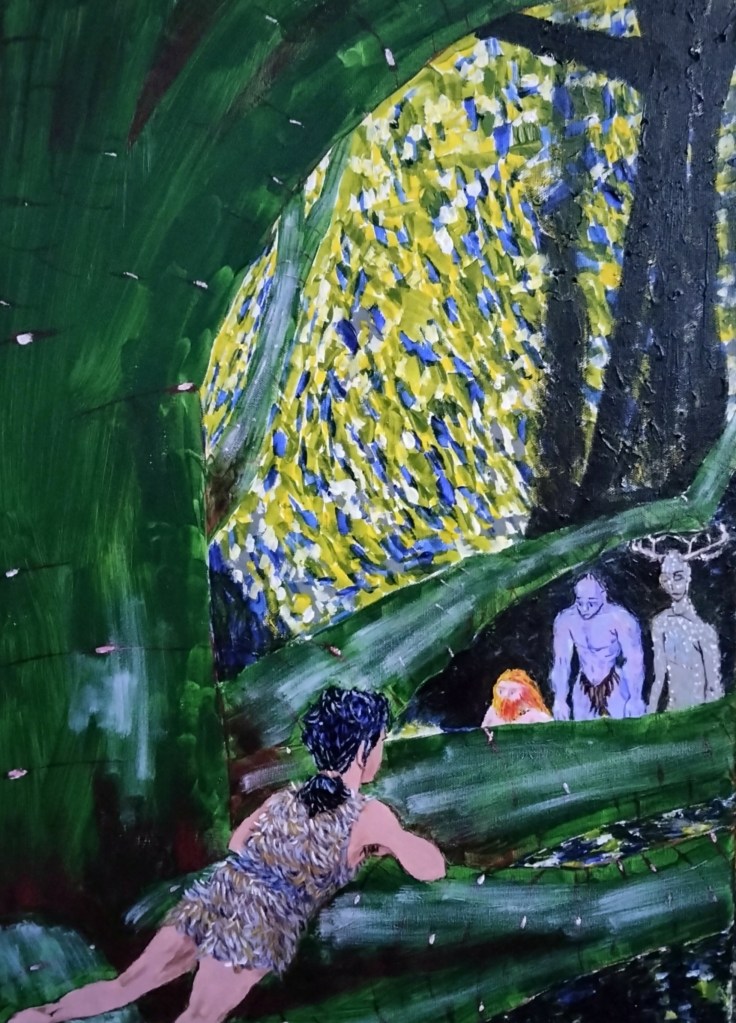
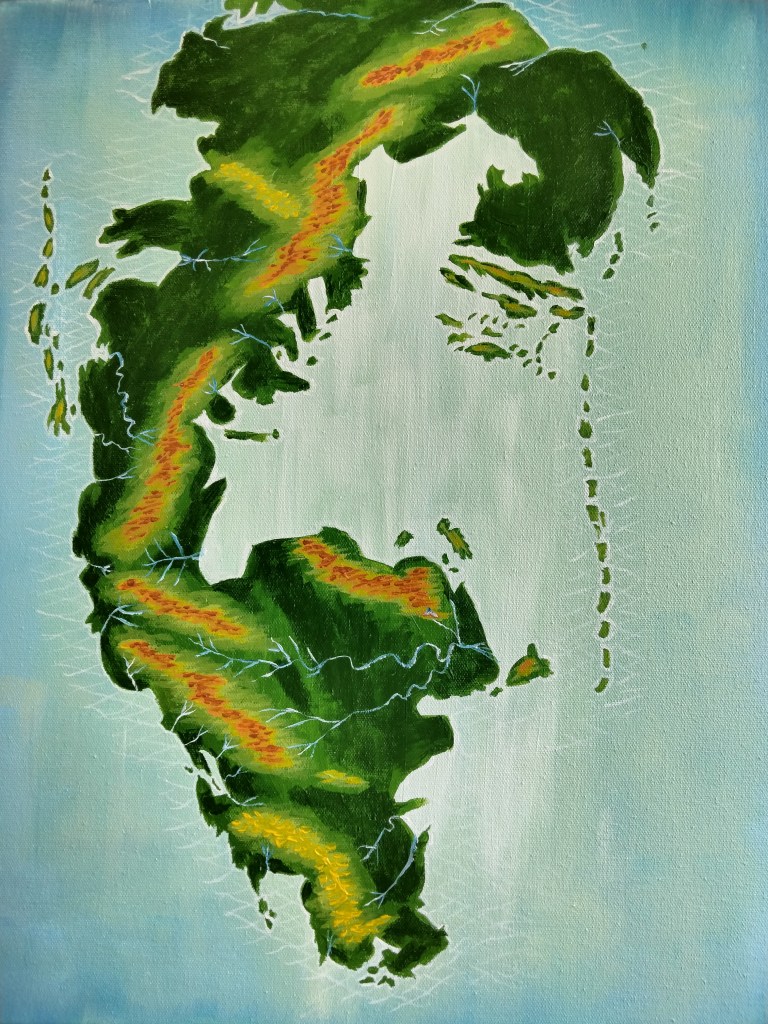
I’m looking for beta readers for the draft of my latest novel, The Bright World. If you’re interested, let me know through the Contact page, and I’ll e-mail you a copy of the draft. I’m looking for what is confusing, unsatisfying, or what you would like to see developed more.
Here it is, advertising my book The Great Snake. Out of all my books, TGS is probably the best beach read, because it’s the shortest and takes place mostly in a subtropical setting. There might still be time for you to read it before the end of summer! Just saying!
Doug Wilson’s blog post about AI. Wilson I trust because of the volumes of material that he’s written and I’ve read.
I won’t add much to what they have to say. It’s going to be a busy week, for reasons that will be revealed tomorrow. However, I know that most of you won’t listen to the podcast, and only a small number will read the article, so I will summarize the salient parts of each in a sentence or two.
Boreing makes the point that every new technology comes with the fears and negative effects front-loaded, and the benefits arrive in the medium to long term, as we figure out where it fits in human society and how to limit its harms. He further points out that no new technology has ever delivered on any promises made on its behalf to create “less work.” New tech always creates more work: new industries, but also lots of new things that can be done by people who see the potential.
Wilson, too, points out that lazy folks will try to use AI as a way to avoid work, whereas the diligent and the geniuses will see vast new fields of work open up to them. He adds the obvious (but often overlooked) point that a “workless” utopia would actually be a dystopia.
In short, both men sensibly point out that AI is not going to change human nature. Humans do human things no matter how much tech they have. And we were designed to work.
This is, on the whole, a great relief to me. It is good to hear that the scary new thing is not going to change human nature. Granted, human nature isn’t great, but we already knew that, and all attempts to completely remake it always seem to get rid of the only parts worth saving.
Still, I’m not a total AI-o-phile, unlike, say, our friend Ben Shapiro. That’s because I’m a writer and a visual artist. My thinking is still developing on this, but as of spring 2026 here’s where I’m at.
Everyone senses that stories and art (including music) are the sort of things that ought to be made by people and nothing else. Unfortunately, it’s possible that AI will get good enough at “making” these things, that it will be impossible to detect it. You want a gritty, soulful story with human flaws? It will give you a gritty, soulful story with human flaws. It will get rid of the overly vivid colors and unrealistic smoothness in its paintings. It has already produced a country song by a hard-livin’ male voice about overcoming working-class obstacles.
When this happens, it’s like debasing the currency, but with stories and music and art. These things are much more valuable than currency. That’s bad.
From the creators’ side, everyone’s work will become suspect. This is already starting to happen.
From the consumer side, I am possibly even more upset. I DO NOT like it when I look closely at what appears to be a model wearing colorful European folk clothing, and realize that it’s an AI approximation of same. But at least, I can still realize it. I REALLY won’t like it when I have no way of knowing whether the “human” culture I’m imbibing is actually human culture.
About a week ago, I spent the day at a nice, large public library in a nearby city that was holding an event called Authorpalooza.
The hope: library patrons would flock to the event, discover local authors, and buy their books.
The reality: It was mostly authors talking to each other about the writing life, looking at and sometimes buying each other’s books.
Still fun, though.
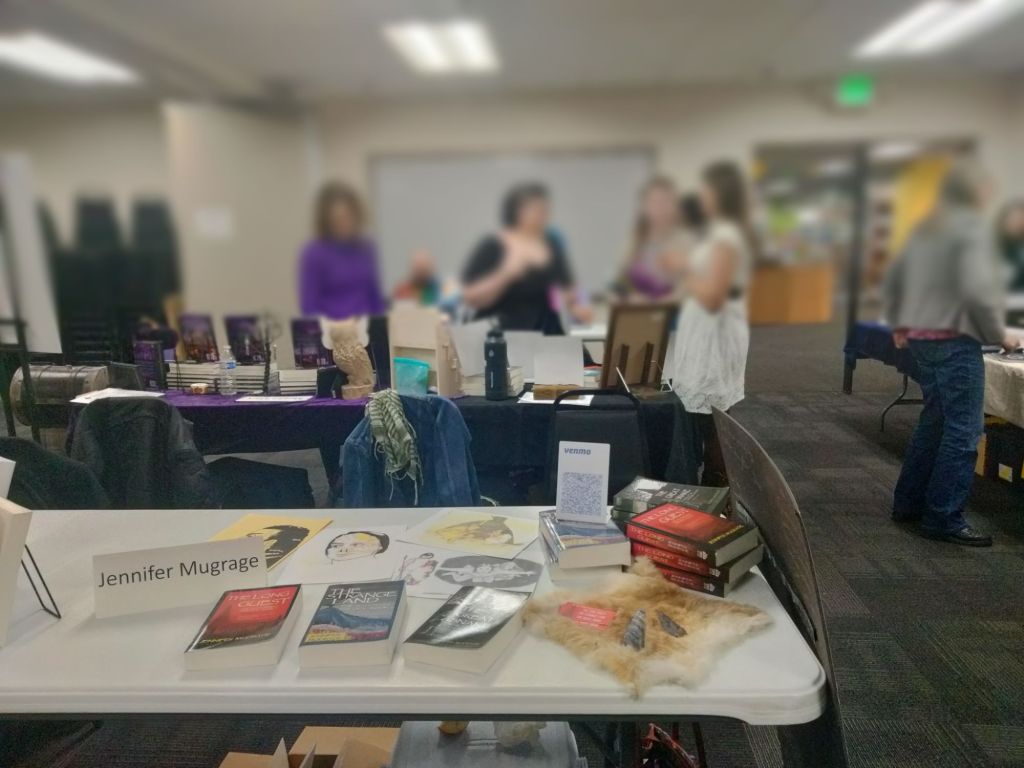
Here’s my book table. I sold exactly one book. In the background, you can see authors talking to each other.
Genres represented included sci-fi, witchy cat books, LDS time-travel historical fiction, Christian YA fantasy, thriller set in a morgue (really!), thrillers set around Indian reservations, practical self-help for authors, and different genres of romance (spicy, comic, cozy, etc.).
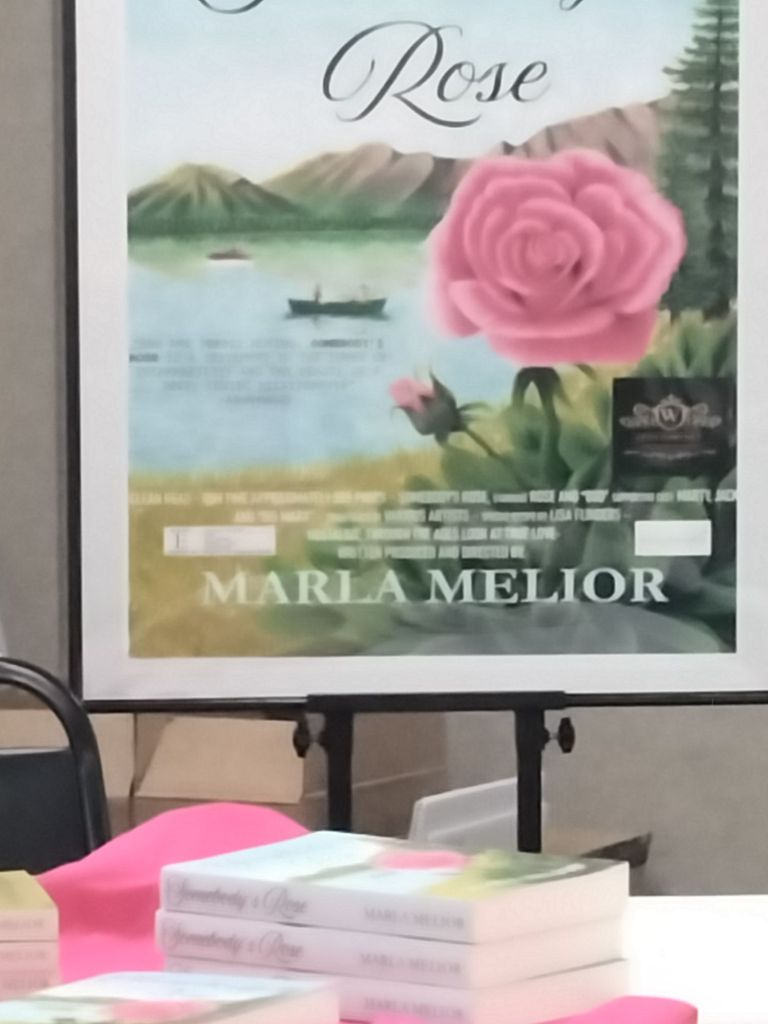
This one author’s name was Marla Melior.
Me (suave as always): Did you know your name means “better” in Latin?
Her: Yes! In fact, I have a podcast called Melior on Mondays.
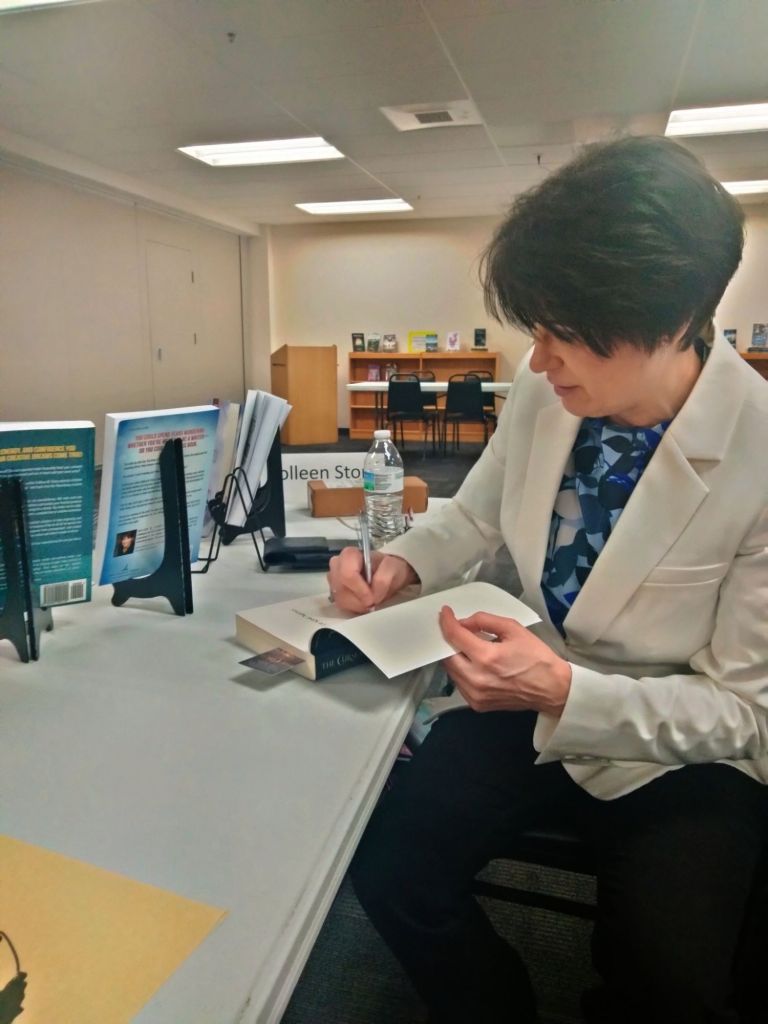
Here is my table neighbor (also happened to be the keynote speaker), signing the only book I bought, which was one of hers.
She has written in a number of genres, including … the genre I am focusing on this year, Greco-fiction! Her book, The Curse of King Midas, blends the historical Midas (a king living in Phrygia in the late 700s BC), with the Midas of legend. I believe there are even gods involved. And there’s a map! No wonder I was undone.
I’m not sure what happened, but for some reason, on Tuesday this week Out of Babel Books got more than 400 views. That is about 3000% more than my usual 14. Most of these views were from the United States.
I don’t know whether to thank you all for visiting, or grumble that you’re going to wreck my stats. (No matter how good of a day I have after this, it will look like views are down dramatically.)
I think I’ll go with Thank You. I am so glad you visited Out of Babel. I hope you found what you were looking for. I hope you were all peoples and not botses. I hope you will all buy my books and leave breathless reviews… (O.K., no need to get greedy …)
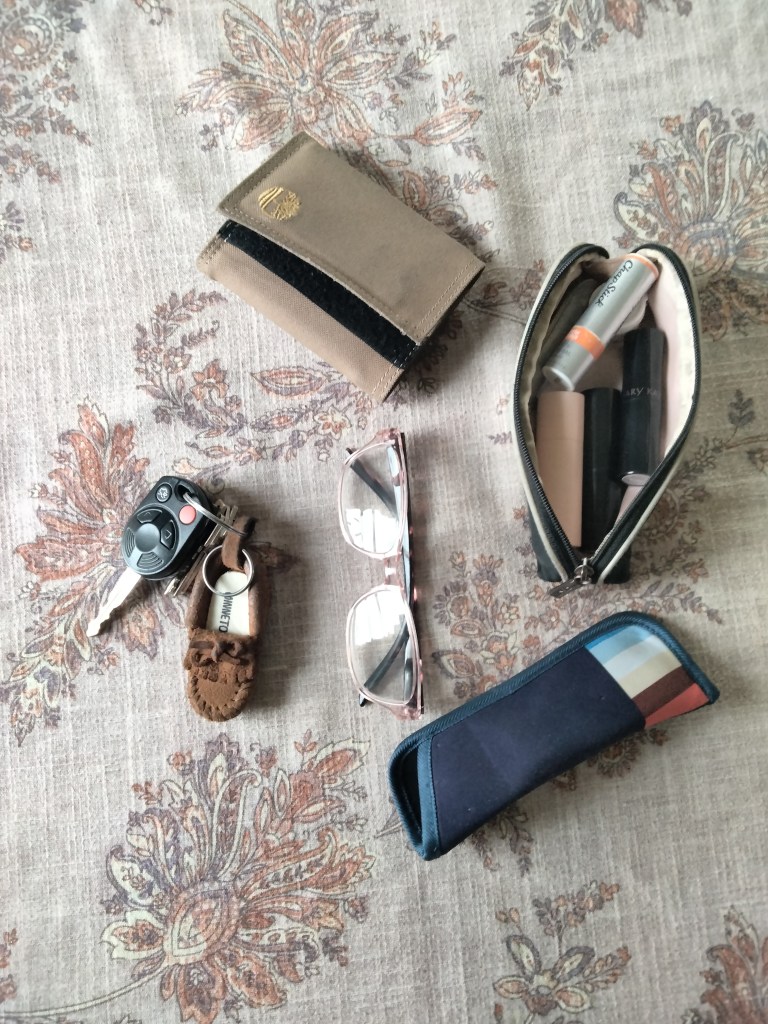
First, the basics: wallet, lip gloss and lipstick, reading glasses, key fob with a little Minnetonka moccasin.
Now, the walking pharmacy: Two kinds of Aleve, two kinds of Claritin, Tums I forgot I had, Kleenex, dental floss picks, hand lotion, and a loose lipstick that is probably twenty years old, but I can’t bring myself to throw away. The Claritin is generally for my kids, not me.
Finally … air fresheners from the oil change place, Band-Aids and antibiotic ointment, tabs for when I simply must flag a passage in a book, business cards in case I need to give one out, and, oh, look! A pair of earrings that needs to go back to my jewelry box.
No, I don’t carry a brush. I have curly hair. One does not brush curly hair; the results are unfortunate.
I occasionally carry a comb in case one of my sons needs it, but they are getting older and starting to comb their own hair before they leave the house.
Other things that might, from time to time, get thrown on top of these: a hand-knitted hat or bonnet, a hair band, clip, or pin that I have taken off, a book that I want to have with me. And of course, the phone.
American Falls, Idaho, is the ultimate American Small Town.
What do I mean by Small Town?: a brief parenthesis
For those who are not American–by which I mean the United States–“small town” doesn’t have quite the same connotations as “village.” A “village” sounds older, like it might have been there for a thousand years, whereas a small town, because it’s in America, is no more than 300 and often only 100 years old. “Village” also sounds more homogenous (is everyone related?), and more rural. A village might have feuds and unspoken rules in it that go back a millennium. A small town, while it is getting a start on these things, is basically a recent, frontier development. Though there are founding families, there’s also a lot more movement. City folk come in, start businesses, or get jobs as teachers. Newcomers arrive from other small towns. Children grow up and leave. Americans are very mobile, and the composition and atmosphere of a small town reflects that. There isn’t as rigid a class system as in most other places. And, though American Falls, for example, is the county seat, there’s also a lot less bureaucracy and fewer government jobs than in a town of comparable size in Asia.
On the other hand, a “small town” is definitely not the same as “hood” (short for neighborhood), which is a village-like section of a large city. Small towns are typically located in farmland.
Anyway. American Falls has the following: a river. A hydroelectric dam. A railroad to take farm produce away to be sold. A lot with silos, trucks, and piles of produce near where this railroad passes through town. Lots of churches. Post office, barber shop, mom & pop shops on Main Street (tree-lined), one of which is of course a bar. A hometown football team. Gracious parks, a golf course, and a nearby cattle lot that you can smell most days. Pizza, Chinese, and Mexican restaurants, because this is America after all. It also has a small hospital, though like most people I prefer to take emergencies to the city hospital 25 minutes down the road. Oh, and a community theater!
You can walk around American Falls during the day without fear. Law and order is maintained. The town is hilly enough that, on these walks, you can catch glimpses of all these small-town features and feel as if you just stepped into a slightly more modern, drastically less New England Norman Rockwell painting. Rising above the town, on the southwest side, is the Big State Highway, and, beyond that, the rolling foothills.
I felt I had to burst into this paean to American Falls in order to set the scene for the main point of this post, which is that a delightfully hippie shop has come to our small town.
An Art Shop comes to our Small Town
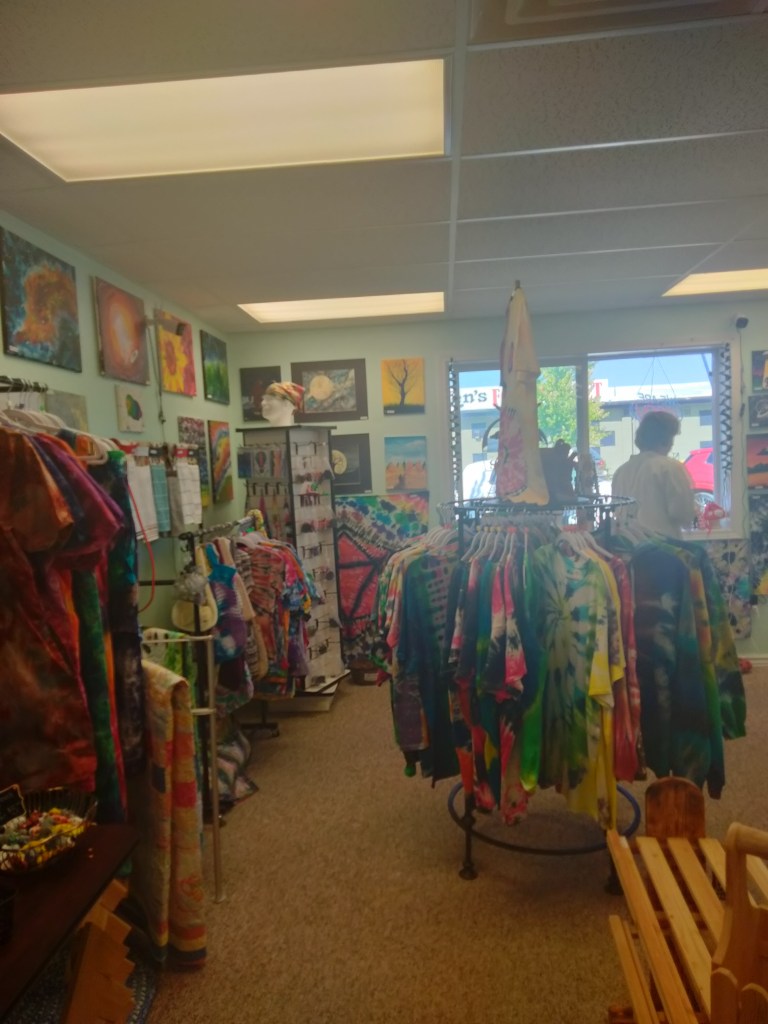
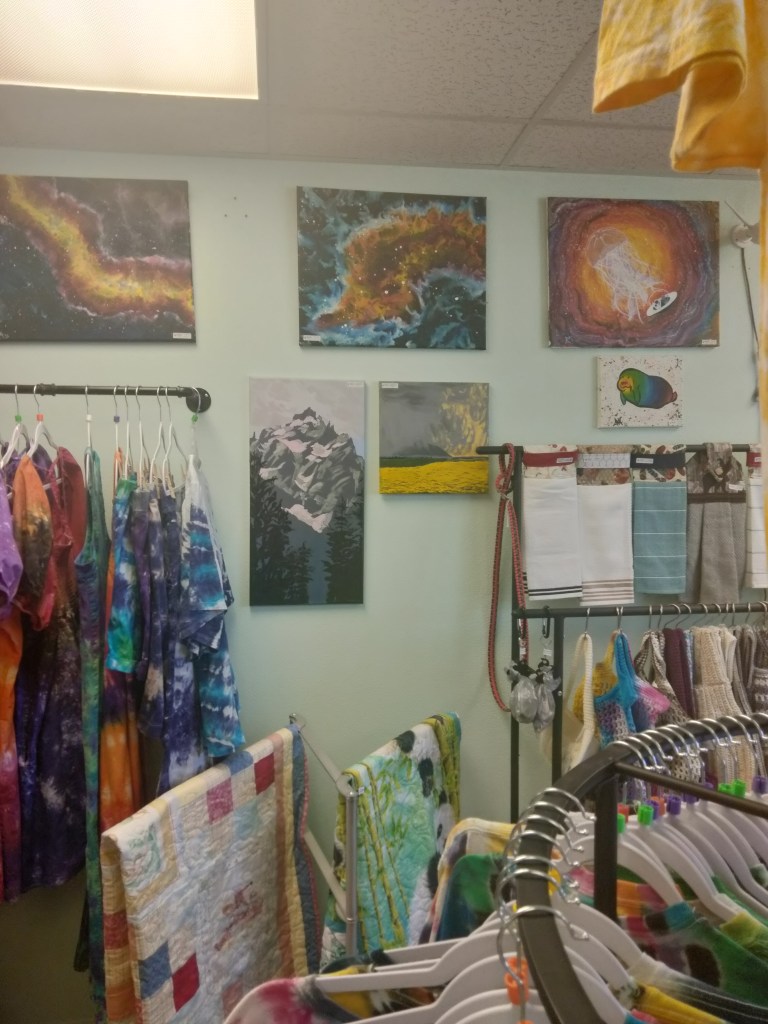
This is the interior of The Trove, which opened in American Falls in May.
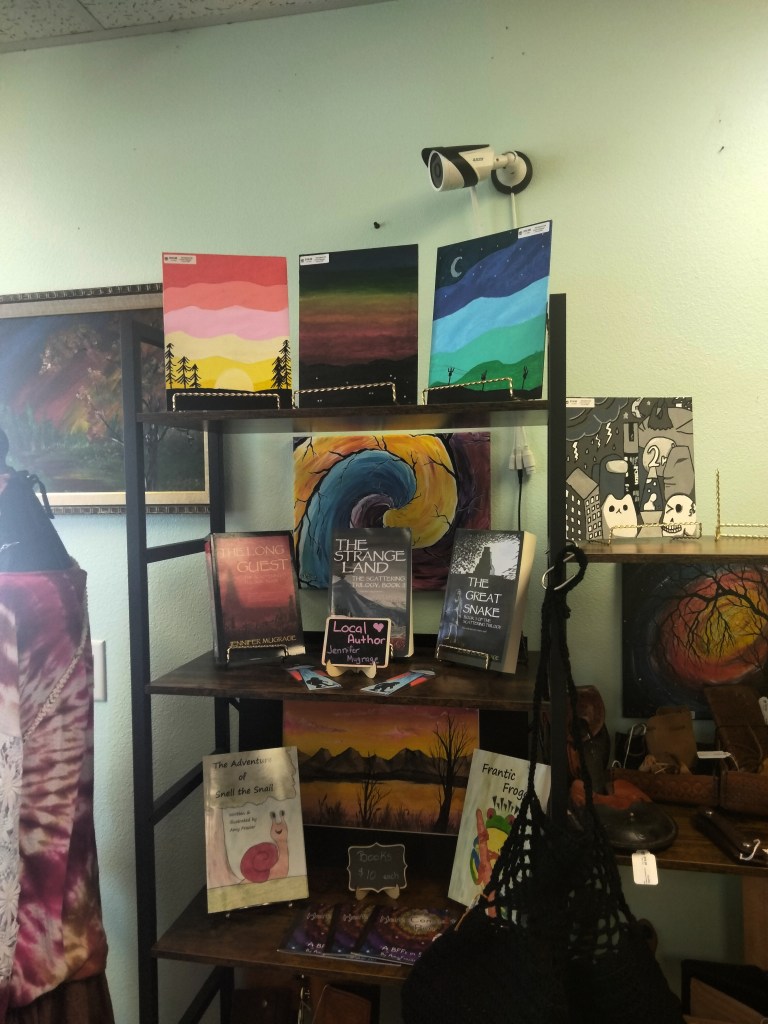
Here we are looking towards the back of the shop. Notice that it features jewelry, leather goods, and paintings involving UFOs. And that the owners are fond of 78 records.
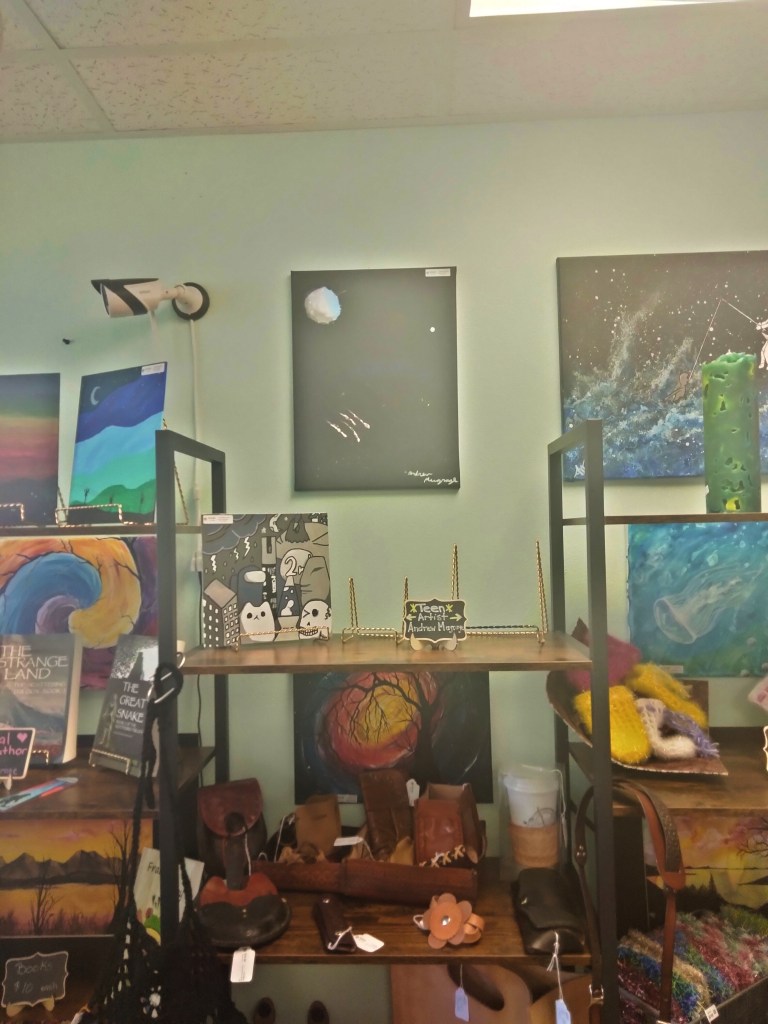
I first heard about The Trove from a person I met at the town festival this summer. This person, who was buying one of my son’s paintings, suggested that The Trove might be happy to carry our work, since its stated mission is to showcase local artists. Although we don’t live actually in American Falls, we figured we might be local enough to count. We headed straight from the town festival to The Trove, with the trunk of our car still full of paintings. Long story short, the owners of The Trove were amenable to this idea, and that’s why some of the paintings pictured above are by my son Andrew.
The mountain and the storm are my paintings, hung under the owner’s paintings of space and a (manatee?), over some quilts, and beside dish towels.
The Trove was even happy to carry a copy of my trilogy! So, if you ever find yourself in southeast Idaho, and want a touristy, artsy shop with lots of cool stuff, know that American Falls has one.
Click through to the Amazon review for the traffic, or enjoy this excerpt:
Many potentially interesting things are going on in this story, but it is unclear who or what it is about. Endu has the most significant character flaw to overcome, but even he does not create the thin red line necessary to create a cohesive plot line, nor does he have a character arc. None of the characters do. Instead, it’s a series of events tend to ramble too much about mundane things. … Luckily, as the story progresses, it becomes very visual. However, it still lacks the emotional connection needed to captivate the reader’s mind because the author tells us some of the dramatic beats, which lessen the impact. The author is on the cusp of developing a writer’s voice. I found some treasures that express that voice: “Wildflowers rose up like an army.” “Knowing the hidden rocks in the sea.” They are not only vivid, they express the theme and help set up the events.
I’m kind of tickled with this 3-star review. I’m also impressed, because it appears the person read the book over the weekend and then wrote this review to post on Monday.
Next to come to mind was my original literary agent delivering her verdict on my first novel. Don’t want to show it to anyone, she said. Why not? It’s a bad book. Have to think of your reputation as well as mine. Why bad? It falls between the stools, halfway betwixt mainstream and mystery. No way to promote it. And where does the bookseller shelve it? Stick to nonfiction, said my agent. I can sell that for you. How about me rewriting it? Well, if you do, get rid of the Indian stuff.
Tony Hillerman, acclaimed author of the Navajo mysteries, in his memoir, p. 5