
Benson was not an unintelligent man, but he was a simple man. [His son] Ace was much quicker, and more widely read, and Benson had been aware of that gap for about five years now. Whenever he began his cautions against intellectualism, he knew how lame it sounded. He didn’t like it, but didn’t know what else to do, or say.
After their conversations, Ace would be unsettled too, but for different reasons. He would work through the arguments again in his mind, and could not see any alternatives to the way he had gone. And he was constantly mystified by the things his father would say and then go and do. The arguments were watertight, and his father’s thinking was not watertight.
And yet, now … an irrational desire to be irrational went over his head like a wave. He knew he had no moves. If he just surrendered, all would be well. If he continued to struggle, there would be nothing but … well, nothing but struggle. Struggle in every direction. A world of struggle.
–Ride, Sally, Ride, by Douglas Wilson, pp. 85 – 86
Tag: parenting
A Review, A Reaction, & A Chuckle over The Fourth Turning

The Big Idea
The gist of this book is that history moves in seasonal cycles. The authors spend a lot of time talking about how expecting seasonal cycles in history is the wisdom of the ancients, and that this has been lost to a linear conception of time that came from Christianity and got even more exaggerated during the Enlightenment. Linear time leads people to expect that things will just keep getting “more so;” that the future will look like an extrapolation of the recent past. As a result, people never expect a turn of history coming, and are always gobsmacked when it arrives.
As they urge readers to accept a cyclical view of history, the authors go slightly overboard and make it sound as if we should worship the circle. They point out circular symbolism in various myths. They say that a cycle is associated with the number four and feminine energy, whereas a line, or triangle, is associated with the number three and masculine energy. While this is not wrong, they then make it sound as if the idea of history as a line, moving in a particular direction, should be rejected and has nothing to offer us.
It’s not a big part of the book, but it is foundational and I found myself trying to integrate their view before I moved forward.
Should We Worship the Circle?
I believe that much of the symbolism they describe is correct. (Not all of it is, since the authors tend to cast a really wide net throughout history and literature, and then throw into the book anything they drag in that looks superficially similar to their thesis. But much of it is.) Seeing history as inescapably circular is an ancient, pagan way to view the world. And it does reflect something about the nature of humans and of creation. However, uncorrected, it tends to leave people fatalistic and trapped in the cycle. Exhibit A would be Hinduism. Christianity did indeed break people out of this endless treadmill by presenting a picture of history where the end is not like the beginning, where history moves in a definite arc or story from creation to fall to redemption to glorification. Of the many things that Christ did on the Cross, He broke us out of the endless cycle. That is why history fundamentally changed after His death and resurrection. You get different types of people, who think in different types of ways, and you get cultures that are Christianized developing in very different ways than any culture before them. Of course, one downstream effect of all this was that it made possible the Enlightenment, materialism, and what C.S. Lewis calls “the fatal serialism of the modern imagination.” These things aren’t good, but to put this in perspective, blaming them on Christianity is sort of like blaming your parents because you scraped your knee while you were on a trip that they took you on to Disneyworld.
Here’s how G.K. Chesterton put it:
As we have taken the circle as the symbol of reason and madness, we may very well take the cross as the symbol at once of mystery and of health. Buddhism is centripetal, but Christianity is centrifugal: it breaks out. For the circle is perfect and infinite in its nature; but is fixed forever in size; it can never be larger or smaller. But the cross, though it has at its heart a collision and a contradiction, can extend its four arms forever without altering its shape. Because it has a paradox at its centre it can grow without changing. The circle returns upon itself and is bound. The cross opens its arms to the four winds; it is a signpost for free travelers.
–Orthodoxy, p. 32
So, yeah. Although in the big picture, history is linear, cycles of development do still exist, both in human lives and in human societies, and we would do well to remember that and work within our nature.
The Seasons of a Saeculum

Briefly, they assert that history moves in cycles of just over or just under 100 years. These, they call a saeculum, following the Roman word for it. The seasons are:
- Spring / A High: A time of building, strong families, and strong social cohesion
- Summer / An Awakening: A time of spiritual revolution led by idealistic young people
- Autumn / An Unraveling: A time when the values of the Awakening are applied to changing society, and things start to fragment
- Winter / A Crisis: A time when the society is threatened by a series of shocks that often include war
(Fun fact, if you are into personality typologies, you can also make these seasons match the Four Humors: Sanguine, Choleric, Phlegmatic, Melancholic.)
Each season takes roughly 20 to 25 years. Each one causes the next.
The authors also identify four generational “personalities.” The personality of each generation is determined based upon their experiences in childhood and young adulthood. In what conditions did they grow up, and when did they come of age?
- If you came of age during a Crisis, your generation is the Hero type: the can-do ones, prone to hubris.
- If you came of age during a High, your generation is the Artist type: passive and conformist.
- If you came of age during an Awakening, your generation is the Prophet type: fiery and moralistic.
- If you came of age during an Unraveling, your generation is the Nomad type: neglected and cynical survivors.
Armed with these thought tools, you can now make applications.
The Applications
I appreciate the authors for not claiming too much for their rubric. First of all, they point out that these cycles are not precise in the time they arrive. This is an organic cycle, like the seasons. Some years, you might have a cool summer or a mild winter. Sometimes, seasons are delayed beyond what is usual. For example, the authors have a series of detailed charts in which they apply this rubric to American history. They say that during the Civil War, the Crisis came fast and didn’t last the usual 20 years. As a result, the cycle was shorter. That saeculum skipped the Hero generation. It went straight to the Artist generation of traumatized conformists.
Another helpful thing they say is that this year-like cycle in human history does not cause random events. There is still such a thing as chance, and as human will. However, a society’s reaction to events is heavily influenced by what season they are in. The United States did not immediately enter WWI after the sinking of the Lusitania, because we were in an Unraveling period. But we did immediately mobilize for war after the attack on Pearl Harbor, because we were now in a Crisis.
Finally, this cycle of history is not equally prominent in all societies. Because it has to do with changes in public attitudes, fashions, values, and child-rearing practices, in very traditional societies the cycle is muted. One generation is much like the last. When a society throws off tradition and allows its citizens a lot of social mobility and freedom to make their own choices, ironically that is when the cycle becomes a large factor in that nation’s history. It is for this reason, say the authors, that these seasons are particularly easy to spot in the United States.
It can be difficult to spot seasons of history in past societies (beyond speculation) when we know relatively little about them. Sometimes it’s pretty clear, as when we look at the cycle of idolatry-oppression by enemies-repentance-deliverance found in the book of Judges. We can also find many historic diatribes (probably written during an Unraveling) lamenting the loss of civic virtues.
O.K., so, with those caveats, if you are an American, you have probably been applying this rubric to the last hundred years in our country, which is super easy to do. Here we go:
- Crisis: Wall Street Crash of Oct. 1929 through the end of WWII. Coming of age: the Great Generation, or what the authors call the G.I. Generation.
- High: Late 1940s to early 1960s. Coming of age: the Silent generation. Beatniks.
- Awakening: the “Consciousness Revolution,” late 1960s to early 1980s. Coming of age: the now-much-maligned Boomers. Hippies.
- Unraveling: late 1980s to early 2000s. Coming of age: Generation X, or what the authors calls 13ers. Slackers.
The Great Generation are Heroes, the Silent are Artists, the Boomers are Prophets, and the Xers are Nomads. Tag yourself. I’m an Xer.
When It Doesn’t Fit Exactly
Now, how do we define a “generation”? It usually works out that once every 20 to 25 years, there is an identifiable new crop of young people. Hero and Prophet generations tend to be bigger, because of what’s going on around the time they are born. Hence, the Baby Boomers are Prophets. Artist and Nomad generations tend to be smaller, because they were born during a time when adults had other things on their minds (the Crisis or the Awakening).
Also, of course, the generations in a nation don’t necessarily fit with the generations in a given family. The authors point out that, often, it takes one big generation more than 20 to 25 years to reproduce, so that, for example, the children of Heroes are Prophets. The Prophets react against what their parents’ generation valued, but they get along better with their grandparents (also Prophets).
Here’s another example. My parents are Boomers. Now, the Boomer culture was rather anti-baby, anti-family, anti-settling down. However, my folks were not typical Boomers. They swam against the tide. They had six children, and my mom stayed home with us when we were small. They tried to raise us in a very pro-family way. So I was shielded from many of the things that my fellow Gen Xers had to deal with, growing up in an environment where kids were considered to “trap” their mothers, or with parents who divorced or went off to “find themselves.” However, I did pick up on the Gen Xer vibe of living in an unravelling society, being blamed for everything from racism to pollution to the hole in the ozone layer. When I read this line,
[O]ne student mockingly tells his friends in River’s Edge: “You young people are a disgrace to all living things, to plants even. You shouldn’t even be seen in the same room as a cactus.”
-p. 195
… I laughed. The fact that I found this funny, tells me that I am a true Gen Xer.
So anyway, I am a younger Xer. But because my parents had a large family, I have younger siblings who are Millennials (supposed to be the Hero generation; more on this later). Meanwhile, my husband’s parents are Silent generation (Artists). My husband has older siblings who are Boomers, and he is an older Xer. And because we waited a while to have children, our own children are … I guess … Zoomers? Who are supposed to be Artists? Or maybe Alphas? Who … I’m not sure what they should be, because this Crisis seems to be extending. Again, more on this later.
The Predictions, Accurate and Otherwise
The Fourth Turning, published in 1997, predicted that beginning around or shortly before 2005, America would enter a Crisis. There were a variety of things they thought could happen:
- States secede or try to secede over federal taxes, causing a Constitutional crisis
- “A global terrorist group blows up an aircraft and announces it possesses portable nuclear weapons.”
- A government budget crisis leads to a government shutdown and a Wall Street crash.
- A “new communicable virus” leads to quarantine, which local areas resist, leading to martial law.
- War with Russia and Iran.
All these are taken from pages 272 – 273 of the book.
So where are we at now? Something that takes 25 years of your life might be too big to see, but I suggest the following. America’s Crisis era started on Sept. 11, 2001, with an unprecedented kind of terrorist attack, which led to big curtailments of freedom like the Patriot Act and the creation of the TSA, and to a number of wars. Then we had a housing market crash and financial crisis in 2008. Meanwhile, there were a series of incidents that, helped by agitators, caused riots in our cities. Police departments responded by being less active, and crime soared. People started to get freaked out, which led to the election of 2016 (nations tend to turn to a “strongman” in a crisis), which caused more people to freak out. The Crisis reached its climax in 2020 – 2022, with you-know-what.
So counting from Sept. 11, 2001, we are almost exactly 25 years into this Crisis era. According to the authors’ rubric of how these seasons usually go, we should be coming out of our Crisis soon, into either a new High with regenerated values, prosperity, and social order, or else into the total destruction of our society.
Which one do you think is happening? For me, I’m not sure. I see elements of people building new values and communities, but I don’t see any national consensus on these things. Nor do I particularly see signs of the Crisis ending.
To prepare for the Fourth Turning, the authors in 1997 recommended that individuals and families do the following:
- “Return to the classic virtues.”
- “Do not isolate yourself from community affairs.”
- “Build personal relationships of all kinds. Face-to-face contacts … will become newly important.”
- “Prepare yourself and your children for teamwork.”
- “Maintain relationships of trust with your extended family … your household will function best if it is multigenerational.”
- “Gird for the weakening collapse of public support mechanisms.”
- “Generalists with survival know-how will have the edge over specialists who skills are useful only in an undamaged environment.”
These are all taken from pp. 318 – 321 of The Fourth Turning.
These are steps that are being, and have been, taken by many who think of themselves as preppers. and by people who are working and hoping for a cultural renaissance. I’m most familiar with those who are doing this within Christian circles.
The only blind spot that the authors seem to have is that they incurably think of the “teamwork” and “coming together” that must take place during a Crisis, as a national affair. They say “we” while thinking primarily of the national government. In the section on “preparing your children for teamwork,” they suggest not pulling your children out of government schools “if the schools are working.” While I have seen many people doing community building throughout this crisis, one thing I have not seen is a newfound trust in, or willingness to comply with, the federal or even in most cases the local governments. People have been coming together in “teams” to found and maintain private schools and other things like that, but not to join federal programs.
O.K., now for the predictions that didn’t prove to be so prescient.
Any book that makes this many predictions (even in general terms) is going to result in some howlers. For example, here’s the authors’ prediction about how the Silent generation would handle Social Security entitlements:
… America’s rising familiarity with the Silent elder persona will erode today’s support for across-the-board senior benefits. Unlike G.I.s, the Silent will not feel entitled. Their prior public deeds will not inspire them (or others) to lobby for a vast elder reward. … [The Silent’s] sense of guilt and instinct for compromise will compel them to give in some, relax their claims on young workers, and drain the electricity out of the third rail of Social Security politics.
— ibid, pp. 220 – 221
This — how to put it?– emphatically did not happen. I have heard with my own ears Silent generation members say, “We paid into the system for a lot of years. Now we need to get out of it.” When you set up a Ponzi scheme, no one wants to be left holding even a little bit of the bag.
They make a similar prediction about Boomers:
When the market hits bottom, millions of Boomers … will immediately have to make do with steeply diminished material consumption. Many will have no choice but to live communally or with their adult children… public spending on elder benefits will necessarily decline. … Congresses will debate massive cuts. To maintain G.I.-style elder dependence on the young, Boomers would have to wage political war on their coming-of-age Millennial children. It is a war they will not wage–and would not win if they did.
ibid, p. 284
Now, the retirement age has been raised, but other than that, I have not noticed any “massive cuts.” And from my observation, Boomers as a group have been perfectly happy to wage political war on Millennials. And they have won it, by convincing Millennials that the solution to their financial woes is more taxes and entitlements, not just for older people but for everyone.
I have not noticed a trend of Boomers moving in with their adult children, either. In the first place, they, not their children, are usually the ones who own homes, a situation brought about by entitlement policy applied to housing. In the second place, their children are often alienated Xers, and relationship isn’t the greatest (present company excepted). Finally, some Boomers I know are effectively the caregivers for their grandchildren.
In short, the collapse of the Social Security/Medicare system has come about more slowly than Strauss & Howe (or, frankly, I) expected. As an Xer, I did not expect to be able to retire, and maybe I still won’t, but my husband is approaching the age when he can start withdrawals to give us some breathing room, and there has not yet been a nationwide apocalypse. Color me surprised.
One more howler:
As they break into their twenties, Millennials will already be accustomed to meeting and beating adult expectations. Basking in praise… they will seek out [their elders’] advice … Every youth domain will become more mannerly, civic-spirited, and emotionally placid. In college, Millennials will lead a renaissance in student decorum and appearance, making profanity as out of date as the backward cap. … On the job, Millennials will be seekers of order and harmony. They will delight employers with their skills, work habits, and institutional loyalties. … Millennials will respond [to economic hard times] with a cheerful patience reminiscent of Depression-era G.I.s.
ibid, pp. 293 – 294
Look, I’m not here to slam on Millennials. I actually have a lot of sympathy for your generation. But there is no way this general picture describes the way things have gone with the Millennial generation.
Strauss & Howe are predicting that the Millennials will emerge as a Hero generation, because that’s what his historical scheme calls for. But this requires a lot more strength and resilience than Millennials, as a group, entered young adulthood possessing.
The authors did not foresee that Millennials would have been intentionally weakened by a number of cultural trends which were pushed on them by earlier generations. These include behavioral meds, and overpraising/participation trophy culture combined with identity politics culture, which gave complimentary messages that, on the one hand, you are so amazing and talented and don’t need to work to improve yourself, and on the other hand, you are a victim of history and society. Each of these messages is weakening; in combination, they are devastating. There is also the horrible sexual confusion that has been foisted upon the Millennial and Zoomer generations. This draws on the power of identity politics (being a sexual minority is an easy way to obtain an oppressed identity), and on the behavioral meds culture (giving powerful new medications in response to emotional distress).
What generation could emerge from such a gauntlet unscathed? It is no exaggeration to compare all these horrors to WWI, which wiped out a generation of young people and traumatized the survivors. These are not conditions that cause young people to “meet and beat adult expectations” in the positive sense, nor to “delight their employers.”
Perhaps Millennials are a Hero Generation in a new sense. If they are functional at all, it’s because they have won through an intense spiritual war. Perhaps we should think of them as veterans. Like veterans, they certainly bear mental and physical scars. But instead of coming back from a physical war and plugging into an existing social structure, they are having to re-invent the wheel in all the most basic domains of life: schedules, self-care, family.
And quite a few Millennials are a “Hero Generation,” itching for action, in the sense that they are committed Marxists who want to see the violent overthrow of society.
Others, like my younger siblings, are more like the G.I. generation after WWII, eager to get married, raise children, contribute to their communities, and build a wholesome cultural high.
The fact that we have Millennials going in these two very different directions makes me rather uncertain about how this Crisis is going to go.
I wonder whether what we have seen is what the author predicted on page 302:
If [the Crisis] ends badly, Millennials would bear the full burden of its consequence throughout their adult lives. If they come of age traumatized, like the Progressive youths of the Civil War, Millennials will thereafter attend to the details of suffering and healing as heirs to the Artist archetype.
It seems to me that our Millennials are behaving more like a “sensitive Artist” generation than like a “hubristic Hero” generation. This would mean that, as with the Civil War, America had once again skipped the Hero generation and gone straight to Artist.
The Prophet, born in the High, seeks vision; the Nomad, born in the Awakening, seeks realism; the Hero, born in the Unraveling, seeks power; and the Artist, born in the (prior or current) Crisis, seeks empathy.
p. 322
Reader, I Read-ed It
So, that’s the outlines of the book plus a few of my thoughts on it. Obviously, there is a lot more material in there. Some of it is really interesting (the parts that apply the seasonal rubric to the past). Other parts feel dated (ironically, the parts written in the future tense). Read it if you’re curious and want to know more. Meanwhile, what do you think? What generation are you? What do you want to do in the coming High?
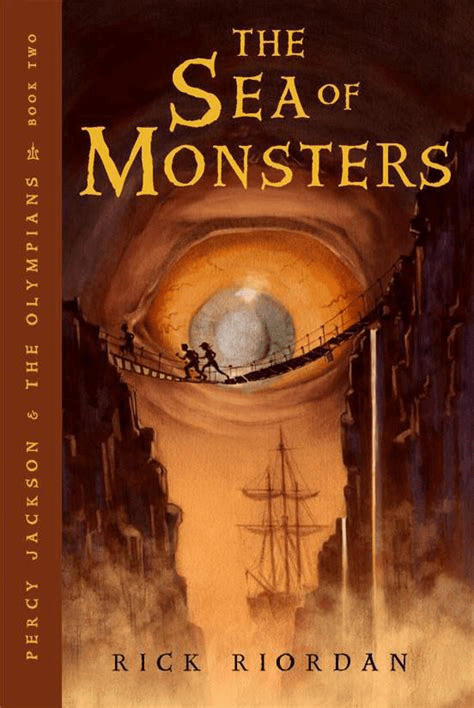
Review: Sea of Monsters
Storytime.
Last year, I taught Ancient History to a group of third, fourth, and fifth graders.
One pair of brothers in my class were very knowledgeable, and very enthusiastic, about the Greek monsters, myths, and pantheon. This was great. Some of their “knowledge” was a little overly specific, however. They gave me to understand that they had learned all this from reading the Percy Jackson books, which were so good and I really ought to read them.
So, when I decided to spend a year reading Greek-mythology-inspired fiction, I added “at least one Percy Jackson book” to my reading list.
The library had a bunch of the Percy Jackson series, but curiously, not the first one. So I checked out books #2 and #3. Sea of Monsters is #2 in the series.
Having read it, I get the idea. It was enjoyable enough, but I don’t feel the need to read any more of them.
Riordan has done some nice, internally consistent worldbuilding where the ancient Greek gods, monsters, and even locations, move around the world depending upon where the center of Western Civilization is at the time. So, in the Bronze Age, they were based in the Mediterranean. Now, in modern times, they are based in and around New York City (with the ocean conveniently nearby). The titular Sea of Monsters, which used to be the entire Mediterranean, is now (spoilers) the Bermuda Triangle.
Percy (short for Perseus) Jackson is a son of Poseidon, who lives with his mother in New York City. During the summers, he attends Camp Half-Blood, a training camp for children of the gods. It is staffed by the centaur Chiron (who, in the original myths, trained Achilles — very appropriate). In this book, Chiron has been fired, and one of the camp directors is Tantalus. Tantalus spends the entire book chasing pieces of food (donuts, burgers, etc.), which flee from him so that he never gets to take a bite.
We also meet Hermes, a fit, middle-aged man in a jogging suit, whose caduceus has been transformed into a cell phone around whose antenna twine two small green snakes by the names of George and Martha.
You get the idea. The book is a lighthearted blend of ancient Greek characters with modern technology, slang, and what is supposed to be teen culture.
Like many books that are supposed to be relatable for tweens, it’s told in the first person. There is some generic slang (“Dude!” etc.), and many of the adult authority figures are clueless and/or careless about the teens’ well-being. These are the pitfalls of such books. The use of technology and slang runs the risk that the books will not age well. The portrayal of the adults, while it might facilitate the requisite adventure, does not encourage respect. Surely, there could be ways for the author to show teachers that actually care about their students, and still get Percy away from the camp and off on his own.
As a teacher, I’m also concerned about the portrayal of bullies in Percy’s private school in New York City. The idea that there is a vicious hierarchy in middle- and high- school is definitely a Hollywood trope. I’m sure this is true in some places, but in the schools I’ve been in (both as a student and teacher), the successful, “popular” kids were mostly very kind. Kids who are less socially adept (like I was) tend to be fearful and envious, and project their feelings of inferiority onto the “popular” kids. Stories like this are not helping them gain social confidence or believe the best about others’ intentions, as we are told to do in I Corinthians 13.
This book had some poignant moments, especially near the end, but the author kept it mostly lighthearted. The series is clearly building towards some big showdown, having to do with a plot by Kronos. If I didn’t have such a long reading list, I might finish it.
Knitting Project Finished: Black Otter Rex
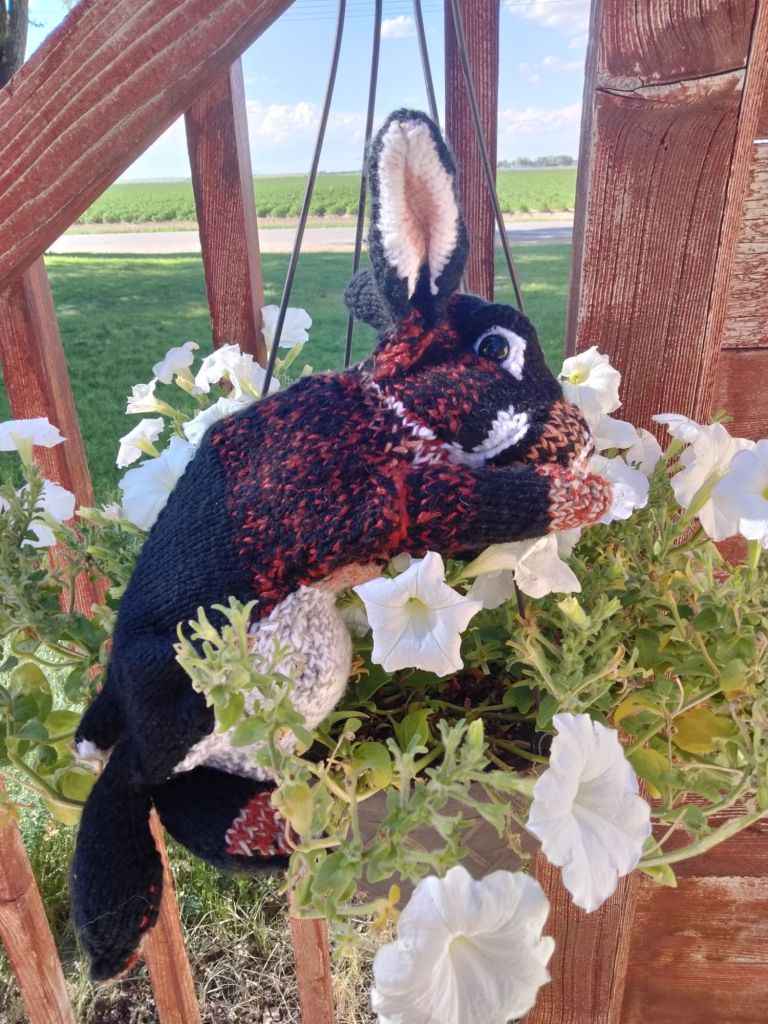
They say, “If someone knits you something, they like you. If it’s made of black yarn, they love you.”
I love my teenaged son. He’s been asking me to make this knitted Black Otter Rex rabbit for years, ever since he was a rabbit-crazy little boy.

By the way, Black Otter Rex rabbits are almost unbelievably sharp-looking. Here’s what they look like in real life.
My son owned a black (not Black Otter) rex rabbit.
To make this rabbit, I used a pattern purchased from Claire Garland on Etsy. For the most part, it’s a really great knitting pattern. It starts at the rabbit’s nose and works back over its head, adding the ears as you go. Then, we do the black portions of the rabbit … down the back (with forearms attached but not stuffed yet), tail (stuffed and sewn on the spot). Then, we change colors and work back up the belly, to the neck and chin. Only the hind feet are knitted separately and then sewn on. Pretty ingenious! The pattern instructs you how to do so-called “short rows” for shaping in the face, upper hind legs, and belly. Then, you essentially just attach the front to the back, and stuff. The pattern includes plenty of pictures of the developing rabbit, with instructional dotted lines and so forth, so you can visualize what you’re doing. It also has multiple pictures of the finished rabbit, so you know what you are aiming for.
Now, about the few hiccups I had.
To get that beautiful color gradient, nearly all the pattern calls for you to hold up to four different colors of yarn together while knitting (for example, black, black mohair, petrol, and copper). These yarns that you are meant to be using are generally very fine (4-ply or mohair). Since I was working from my stash, I adapted this aspect of the pattern. I didn’t have “petrol,” but I assumed it was pretty close to black, so I just used my thicker black yarn on the sections that call for “black, petrol, and black mohair.” I did have white, grey, copper, ochre, and black, mostly in worsted or sport weight, though my black yarn was chunky. So, my end result was a little stiffer and a little less fuzzy probably than the original. Sometimes, having multiple yarns on the needles became a challenge when, for example, I was occasionally told to “knit three together.”
Making up, the part where you sew the contoured belly onto the contoured back & legs, presented a few confusing moments. I don’t know whether I mistakenly skipped or added rows in various parts of the pattern (it’s’ quite possible), but I seemed to have a lot more material on the back/hind legs than on the corresponding belly part, and I had to do some finessing to make it work. If I make this pattern again, I’ll pay special attention when I am knitting those parts.
Still, I’m pleased with the result, and so is my son. This rabbit has been at his side since yesterday, when I completed it.
Why We Can’t Just Give Peace a Chance
Storytime.
When I was a kid, I attended a no-nukes protest.
It’s true. My dad was a Protestant pastor, and also sort of hippie about some things. No drug use or sleeping around, but he liked to live “simply” (for example, keeping his old coffee percolator), and around the time I was a baby, he had become a convinced pacifist. That is, he had become convinced based upon the Sermon on the Mount (mostly) that for Christians nowadays, it is never permissible to resist violence with violence. And this went for nations too. For him, principled pacisfism was part of following Jesus.
So here it was, the mid 1980s, late in the Cold War (though we did not know it was late at the time). A no-nukes protest had been planned in a downtown plaza in our large Midwestern city. I believe it was organized by the city’s churches, because among other people, my dad had been asked to sit in a panel onstage.
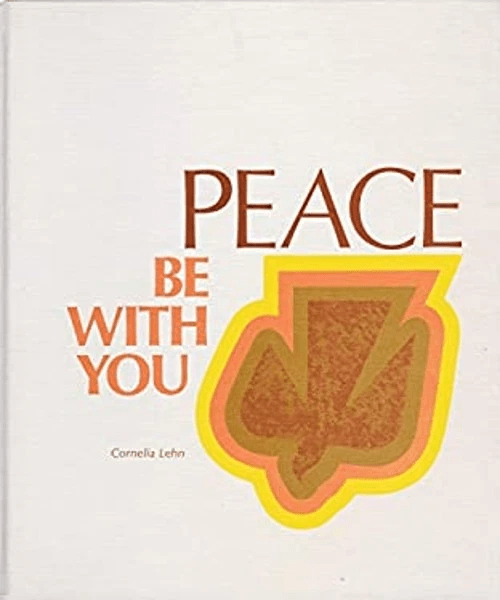
I was probably 9 or 10 years old. I was excited to go along. It seemed like a good thing. It was pretty clear to me that us, or anybody else, getting killed by nukes was a bad thing, something that we would not want to have happen. I had heard gruesome stories about people’s eyeballs being turned into jelly when the bomb was dropped (by us!) on Hiroshima. This was in a book that we had at home called Peace Be With You.
As the family artist, I made the sign for our protest. I tried to draw the symbol from the cover of Peace Be With You, a dove holding a branch in its beak. I had never drawn a dove before, and I got the beak wrong, so it came out looking more like a parrot.
I don’t remember all the content of the rally, but two things stand out. There was a play about a couple who survive a nuclear holocaust and live in a tent city, only to get radiation sickness. And, I remember the final song.
With the panel of pastors still seated on the stage, a lady came up to give a moving musical number. The first verse was about the Statue of Liberty and how she represents to many people that they have arrived in a place that is free from oppression. The second verse was about the cross of Christ, and how, to the Christian, it means liberty from sin, death, and hell. The refrain was “the Cross is my Statue of Liberty.”
Horribly blasphemous, of course. It was trying to compliment the greater by comparing it to the lesser, which actually reverses the roles of greater and lesser, unintentionally offering a huge insult to Christ.
As soon as he realized where the song was going, my dad abruptly got up from his seat on the stage behind the singer, stalked off the stage in a huff, and marched me and my brother out of there before the rally ended. I’m still proud of him for this. As someone said (I can’t find the reference, but I think it was Spurgeon), “Even a dog barks when its master is attacked.” Referring to himself defending the honor of Christ, however inarticulately.
I think what the organizers were trying to convey with that song was, “We are Christians, and don’t worry, even though we are against nukes we still definitely love our country.” But it was ill chosen.
Although I now think the whole event was incredibly naive, I commend my dad for attending it and for bringing his kids. Kids need to have experiences where they go fight for the right alongside their parents, even if the cause later turns out to have been somewhat misguided. This sends the message, “We have certain values as a family, these are important enough to do something about, my parents are good people” and, above all, “I and my parents are on the same side.” Please, give your kids many experiences like this before they become teenagers!
So, why naive? Well, I can’t blame myself for not noticing this as a kid, but why in the world did we think we were the only people who objected to the idea of a nuclear holocaust? Surely that is something that everyone recognizes is bad? (Except, perhaps, the mullahs, I digress.)
And given that we were not uniquely intelligent or good such that we were the only ones who didn’t like the idea of people being annihilated by a nuclear bomb, it would make sense to connect the next pair of dots (#s 2 and 3) and ask ourselves, since 99% of people don’t like nukes, how is it that they still exist? Could it be that, once you have a nuclear standoff, getting rid of nukes is more complicated than just “getting rid of them”? Perhaps there are people who also don’t want an apocalypse, but whose options are limited?
By the same token, perhaps there are more obstacles standing between humanity and the cessation of wars in general than just a dearth of people saying, “We don’t like war.” After all, most people don’t like wars, including most people who fight them.
But we, the anti-war protestors of the Cold War era, honestly, naively, conceitedly thought we were the only people in our country who saw a moral problem with human suffering. And we thought it would somehow stop if only we were to stand up and heroically say, “We are against this.”
It didn’t work. And not because not enough people were against it. It turns out, just saying that doesn’t do anything.
I’m sure my dad’s generation would say that these antiwar protests were ineffective because “our leaders didn’t listen.” “Listening,” in this context, would mean disarming our nukes and other WMDs, and perhaps completely disbanding our military. After all, if every country did this, peace would flow into the empty space where the weapons used to be. And someone has to go first! So it might as well be us! Someone has to give peace a chance.
This made sense to me at 10, especially when it was coming from respected authority figures. Once we grow up, however, we have a responsibility to ask ourselves what could possibly go wrong with this scenario. And the answer is: a lot. Everything.
War is, unfortunately, the default state of human beings. When we are not at war, it is because a lot of people are working very hard to maintain a precarious balance where things don’t tip into war. Fortunate are we who live in a country or empire large enough, or strong enough, that all that work has paid off and we get to go about our daily lives, assuming that peace is the natural state of things. But it isn’t. It is not the case that wars don’t happen unless some “war monger” goes out and “starts one.” That would be nice, but it’s not what we have here.
There are multiple reasons for this. Until recently, I thought it was sufficiently explained by human beings being sinful, and full of fears, lusts, and cravings. All of that is certainly a huge factor. We usually see wars explained as being caused by “fighting over scarce resources,” but I think that materialistic explanation is far from sufficient. Wars have not become less common as the worldwide standard of living has increased. I have also seen wars attributed to “religion.” There are a number of logical problems with this as well. To test this theory, you’d need a control group of humans who had either no religion, or no war. Since both war and religion are things that humans universally do, such a control group does not exist. To say that because both are universal, means one causes the other, is the post hoc fallacy.
So in general, I think the stubborn persistence of war is adequately explained by the Seven Deadly Sins: Envy, Greed, Lust, Sloth, Gluttony, Anger, and Pride. Especially Pride and Envy.
Say somebody hates you and wants to go to war with you because they are prideful and think their way of life is better, but also, at the same time, they envy some things about, tacitly acknowledging that in those respects, you are better than they are. Is such a person going to put down their weapons because you fold your hands and say, “Look. None of us like war. Let’s all mind our own business and disarm”? No, unfortunately, your enemy may not like war, but they hate you a lot more than they hate war. If they even recognize that you are taking the moral high ground, that is only going to exacerbate the wounded-pride-and-envy problem.
This is why fifty years of “anti-war” protests have done nothing but make the protestors look silly.
But it recently came to my attention that there may be an additional cause besides human sin that keeps stirring up wars in the world.
We need to expand our understanding of spiritual warfare to include the larger social and political structures of our world. Why does war bring ruin to the world? Why do we feel constantly on the verge of a new world war? … Why is peace, specifically the peace the permeates through the spread of the gospel, such a threat to world powers? The answer to these questions falls under the larger context of the unseen battle, a battle that has in mind the final unification of the nations of the world under the banner of Christ.
–Joel Muddamalle, The Unseen Battle, p. 120
Muddamalle is suggesting that the gods of the nations, who would prefer to go on ruling them, feel threatened by the spread of the Gospel and use geopolitical instability as one of their tools to slow this spread. (For more about these entities, see my review of Michael Heiser’s book.)
The idea is that human beings, while plenty fight-y on our own, would sometimes like to rest. But these spiritual entities will not let their people rest. They are hard at work, with demonic delight, stirring up, prolonging, and accelerating generations-long conflicts, to keep the Gospel of Christ out and also perhaps, as a side benefit, because they enjoy human suffering.
This certainly matches the picture of “the gods” that we get in, say, Greek mythology. People are bad enough on their own, but even when you have a majority of people who want to do the right thing, you will see that Fate, or the gods, or whatever, intervene so that exactly the wrong thing happens at exactly the wrong moment. The result: ten years of war.
Peace, it turns out, is not a passive, waterlike thing that flows in wherever a space is opened for it. It has to be established, like a fortress. It is the result of someone coming in, taking names, and routing the false gods. That someone is the Lord Jesus.
Sunshine Blogger Again
Just as the sun must come up every day, rain or shine, so I am cursed to plod forever through an endless treadmill of answering questions. The questions are ever the same, but on the plus side, my answers keep changing.

I wasn’t exactly “awarded” this tag, but I did see it on the blog of one Bookstooge, who closed his post with “You aren’t hardcore enough!”
I am so hardcore. But, as usual, Bookstooge, thanks for doing everything exactly like Puddleglum. Or Trumpkin.
Here’s the participation rules
- Display the award’s official logo somewhere on your blog
- Thank the person who nominated you
- Provide a link to your nominator’s blog
- Answer your nominator’s questions
- Nominate up to eleven bloggers
- Ask your nominees eleven questions
- Notify your nominees by commenting on their blogs
What’s your favorite book and why?
The Bible, because so many reasons, but among others, it’s got some really wild ancient history that you won’t find anywhere else. At least, you can find stuff elsewhere that’s sort of similar, but you won’t know which parts of it are true.
Can you share some obscure/unusual words you like to use when writing?
I like “interlocutor.” It means whoever the person in focus is speaking to. I also like “salient” and “equivocation.” But obviously, which fancy words are the most salient changes depending on the context of the writing.
When I’m writing narrative, I prefer to describe the action and people’s thoughts as simply as possible and let the actual events deliver the emotional impact.
Do you have pets (if yes, photos!)
Not anymore, sadly. Our last remaining rabbit passed just a few weeks ago. We (my son and I) hope to get another batch of chickens this summer, but standing between us and them is a large run-and-coop building project that, to me at the moment anyway, seems as intimidating as the Tower of Babel.
What brings you joy?
Beauty.
Landscapes, especially if I can paint them; beautiful folk clothing from around the world; beautiful items knitted or crocheted by myself or others; the simple, unforced beauty when your favorite mug is sitting on your favorite coaster and they match. The beauty of a plant: hens & chicks filling a planter, a Boston fern spilling towards the floor. Sunshine on my dining room walls. I love beautiful music, even though I’m not very gifted at it, which is no doubt a trial to the people around me.
I also love things that are beautiful even though they are ugly. “Brutalist” jewelry, that looks weathered, like it came through the apocalypse. Things that are painted, knitted, or sewn in unexpected colors, like browns and greys, or colors that you’d think would clash but then don’t. Stuff that looks worn or pieced together, like an old farm quilt. Well-told tragedies, like the recently reviewed story of Jason and Medea.
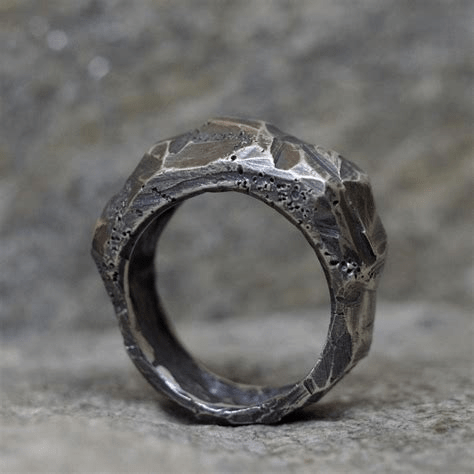
Here’s an example of a “brutalist” ring.
“All things counter, original, spare, strange;/Whatever is fickle, freckled (who knows how?)/With swift, slow; sweet, sour; adazzle, dim;/He fathers-forth whose beauty is past change/Praise Him.”
–Gerard Manley Hopkins
If there’s anything that can make you look forward to tomorrow, what would that be?
My husband and children.
Best vacation destination from your experience?
I have a whole bucket list of ancient sites I want to see, but that’s not what you’re asking about.
I have fond memories of a little cabin hut bungalow on a small island called Gili Air, off the coast of Lombok. Go out and snorkel in the morning, come back in the afternoon and sit on the porch and read. Look across the bay at sunset, and see the mountains of Bali looming out of the sea. Beach is not even my favorite setting, but boy that was one relaxing vacation.
Do you count steps?
What?
Favorite meal?
The last song you listened on repeat?
Hallelujah by Leonard Cohen.
I realize you all have been aware of this song for years, but I just heard it in its entirety a few months ago. Like probably every listener, I found it to be a stunning work of art and also kind of a puzzle, and I listened to it a couple of times in a row for several days until I felt I understood it. I’ll spare you my analysis, as I think volumes have already been written.
How many blogs do you have?
Just this one. I used to have a recipe blog and a book review blog, both on Blogger. I haven’t checked them in years and am not even sure if I could find them anymore.
But don’t forget to buy my books! And for goodness’ sake, please don’t return them. My publisher charges me when you do that. If you buy a hard copy and hate it, just burn it or send it to Goodwill or something.
What’s your favorite quote?
There are so many good ones, I can’t really pick a favorite. It goes in seasons with me. But for today, I’ll leave you with this one:
This is what the LORD says:
"Cursed is the one who trusts in man,/who depends on flesh for his strength/and whose heart turns away from the LORD./He will be like a bush in the wastelands;/he will not see prosperity when it comes./He will dwell in the parched places of the desert,/in a salt land where no one lives.
"But blessed is the man who trusts in the LORD,/whose confidence is in Him./He will be like a tree planted by the water/that sends out its roots by the stream./It does not fear when heat comes;/its leaves are always green./It has no worries in a year of drought/and never fails to bear fruit."
The heart is deceitful above all things/and beyond cure./Who can understand it?
Jeremiah 17:5 - 9
Now, my questions for you, Gentle Reader. These are inspired by our experience in grade school, where you were sure that you had to have a quick, permanent answer about your favorite color, animal, and favorite everything else ready to go. This is important! You never know when you might need to know this stuff! Answer with your first instinct and no cheating!
- What is your favorite brand of tractor?
- What is your favorite kind of cow?
- What is your favorite kind of chicken?
- Country or city?
- Ford or VW?
- Pickup truck or motor scooter?
- Star Wars or Star Trek?
- Beach or mountains?
- Sweet or savory?
- Sci-fi or fantasy?
- Favorite animal, domestic or wild, in your region or any other.
I Made a Real Good Thing

Here it is.
Sacrifice in Ancient Greece and Now
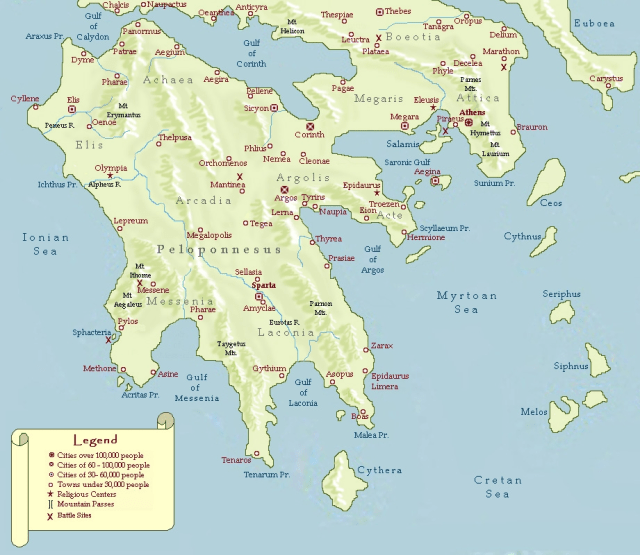
This is my final post about The King Must Die. It will have spoilers. They will be the sort of spoilers that make you want to read the book.
Like any good literary book with a strong theme, this one announces the theme in its title. The King Must Die. Why? Why must the king die? The entire story is an effort to provide the answer.
A Rude Awakening: the Death of the King Horse
The first major incident in the book involves the slaughter of a sacred horse. Theseus, who is about seven at the time, loves this horse. It is the “king horse,” the stallion of the sacred herd. Theseus, who has been told that the god Poseidon is his father, thinks of this horse as his literal brother. He is taken to the sacred island to attend a special ceremony. He has no idea that this ceremony is going to culminate in the slaughter of the horse he adores.
It was a good clean killing. I myself, with all Athens watching, am content to do no worse. Yet, even now, I still remember. How he reared up like a tower, feeling his death, dragging the men like children; the scarlet cleft in the white throat, the rank hot smell; the ruin of beauty, the fall of strength, the ebb of valor; and the grief, the burning pity as he sank upon his knees and laid his bright head in the dust. That blood seemed to tear the soul out of my breast, as if my own heart had shed it.
As the newborn babe, who has been rocked day and night in his soft cave knowing no other, is thrust forth where the harsh air pierces him and fierce light stabs his eyes, so it was with me.
p. 13
This is the first king to die in the story. And for Theseus, it is also a kind of death, and a kind of birth. He is the grandson of a king, and this is his birth into the world where the king must die.
Then Theseus is “dedicated.” This involves smearing the horse’s blood on his forehead. But when his older cousin tells him “Come, you must be dedicated,” he thinks that he is about to be sacrificed like the King Horse. So the little boy steps forward in his first act of courage, ready to give his life. And for the first time, he senses the presence of the god Poseidon with him.
Theseus’s grandfather, the king, notices that his grandson is struggling with what just happened. Later, in grandfather’s upper room, the two of them have a talk.
The Lord Poseidon, who rules everything that stretches under the sky, the land and the sea. He told the King Horse, and the King Horse led [our ancestors to new grazing grounds].”
I sat up; this I could understand.
“When they needed new pastures, they let him loose; and he, taking care of his people as the god advised him, would smell the air seeking food and water. Here in Troizen, when he goes out for the god, they guide him round the fields and over the ford. We do that in memory. But in those days he ran free. The barons followed him, to give battle if his passage was disputed; but only the god told him where to go.
And so, before he was loosed, he was always dedicated. The god only inspires his own. Can you understand this, Theseus?
The King Horse showed the way; the barons cleared it; and the King led the people. When the work of the King Horse was done, he was given to the god, as you saw yesterday. And in those days, said my great-grandfather, as with the King Horse, so with the King.”
I looked up in wonder; and yet, not in astonishment. Something within me did not find it strange.
“Horses go blindly to the sacrifice; but the gods give knowledge to men. When the King was dedicated, he knew his moira [=destiny]. In three years, or seven, or nine, or whenever the custom was, his term would end and the god would call him. And he went consenting, or else he was no king, and power would not fall on him to lead the people. And the custom changes, Theseus, but this token never.
“Later the custom altered. Perhaps they had a King they could not spare, when war or plague thinned the Kindred. Or perhaps Apollo showed them a hidden thing. But they ceased to offer the King at a set time. They kept him for the extreme sacrifice, to appease the gods in their greatest angers … And it was no one’s place to say to him, ‘It is time to make the offering.’ He was the nearest to the god, because he consented to his moira; and he himself received the god’s commandment.”
He paused; and I said, “How?”
“In different ways. And so it is still, Theseus. We know our time. Listen, and do not forget, and I will show you a mystery. It is not the sacrifice, whether it comes in youth or age, or the god remits it; it is not the bloodletting that calls down power. It is the consenting, Theseus. The readiness is all. It washes heart and mind from things of no account, and leaves them open to the god. But one washing does not last a lifetime; we must renew it, or the dust returns to cover us.”
pp. 16 – 19
Thus the king of Troizen lays out the entire rationale for Hellene royal sacrifice. Perhaps you have already noticed a few Bible Easter eggs. “Behold, I tell you a mystery” and Jesus saying, “The Father loves me because I lay down my life. No one takes it from me; I lay it down of my own accord. I have authority to lay it down and authority to take it up again. This command I received from my Father.” (John 10:17 – 18) Those few lines map exactly onto what Theseus’s grandfather has just told us, albeit with perfect clarity instead of wrapped in mysterious ancient customs.
Was all this really present in the culture of the ancient Greeks and their Indo-European forebears? Or is Renault reading it back into that culture from the Bible? Or, did Jesus borrow all this from the ancients? I’m looking into it.
You might think that Theseus’s grandfather’s speech is too heavy-handed; showing instead of telling. But Renault knows what she is doing. This is not the whole secret of the book laid bare within the first twenty pages. It is only the beginning. This instruction from his grandfather sets Theseus’s attitude towards the god, himself, and his duty. It will guide how he responds to things throughout the rest of the book.
All the Kings that Die
Spoiler time. Here is a quick list of all the kings whose death Theseus causes or witnesses in this book:
- Kerkyon, the “king” of Eleusis. This young man is a “solar king,” that is, he lives in a matriarchal society where the king reigns for only one year and then is killed by his successor. Thesus gets chosen as the next solar king and kills Kerkyon in hand to hand combat. Then he becomes the next Kerkyon.
- Minos. Minos is dying and has no legitimate heir. He eventually becomes aware of Theseus and asks him to kill him using the sacred double-headed axe that has been used by kings in Crete from ancient times.
- Astarion, the “Minotaur.” In this version of the story, Astarion is Pasiphae’s illegitimate son by an Assyrian bull-dancer. He is angling for the throne of Crete, and after Minos dies he has himself crowned king. A priest anoints him with oil and puts on him the sacred gold bull-mask. Theseus interrupts the ceremony and fights Astarion, who is still wearing the sacred mask. Though he gained the throne by illegitimate means and held it for only a few minutes, technically Astarion is another king whom Theseus kills.
- The solar king on the island of Dia. Theseus, Ariadne, and the fleeing bull-dancers make a stop on this island on the way home to Athens. It happens to be on the day of the year that the Dionysian rite will take place, where the past year’s king is torn to pieces by the Maenads.
- Theseus’s father Aigeus. Aigeus kills himself by leaping from the cliff of Athens when he sees that the returning ship is bearing a dark blue Cretan sail instead of a white one. Leaping from the cliff is the traditional way that kings of Athens have been known to “make the sacrifice” when the god calls them.
All of these tragic events might seem like an unrelated potpourri of senseless suffering. But actually, they are all closely bound up with each other, and we can see it if we look at the Hellene, Minyan, and Cretan attitudes towards sacrifice.
Other Sacrifices
Sacrifice is everywhere in this ancient world. Every year, the people of Troizen kill a “scapegoat,” a non-royal person that they have decided is causing their troubles. There are animal sacrifices, there are libations of wine poured out, and so forth. The priestess, when she goes to do divination, offers the “house snake” a dish of milk. In Crete, when a man is going to become king, he throws a ring into the sea to “marry the sea lady.” I want to here mention two notable sacrifices that royal characters make.
Early in the book, we learn that during a time of drought and plague, Theseus’s mother sacrifices her virginity. Typical of ancient pagan thinking, when none of the gods of the Hellenes claimed responsibility for the plague, the king, with increasing desperation, finally figured out that the god who was angry was “the Mother.” He offers a “holocaust” (a burnt offering) of pigs all around the large mossy rock in the Mother’s shrine, but apparently this is not sufficient. The old priestess, who is unattractive and dislikes pretty girls, tells the king that his fifteen-year-old daughter must “hang up her girdle for the Mother.” This means she must go to the “myrtle house” (a shrine on the sacred island) and give herself to the first man who shows up, as an offering to the Mother. Then the drought will stop.
It’s an incredibly poignant scene as the king, now a grandfather, describes to Theseus how he felt he could not get out of this. He goes to his daughter about it, and she says of course she is willing to make this sacrifice to save the life of the people.
As it happens, the king of Athens is visiting Troizen, and he agrees to go and visit the young princess on the island so that at least her experience will be with a man who is kind, and whom she has met before. But the king of Troizen cannot tell his daughter that this is going to happen, because as a member of the royal family, she has to go to the sacrifice consenting. “The readiness is all.” So the king of Athens swims over to the sacred island and becomes Theseus’s father. As he jumps into the water, a thunderstorm is already coming to end the drought.
Later, Theseus sacrifices himself for his people when he volunteers to go to Crete as part of the tribute of seven youths and seven maidens. He feels the god Poseidon calling him to do this, “sending him to the bulls.” (The bull-dance of Crete is actually a sacrificial rite in honor of Poseidon.) At first, Theseus resists. He tries to offer the god his horses instead, but he can feel the presence of the god withdrawing from him in response to this. So, in a moment of anguish, he makes the decision to give up his life in Athens, with his father and eventually the throne. Going to Crete does not mean instant death, though it’s understood that bull-dancers last a maximum of six months in the ring. But it is a death to all of Theseus’s hopes and dreams.
Two Attitudes to Sacrifice
As I’ve hinted in this and in previous posts, the customs of the earth-mother-worshipping Minyans differ quite a bit from those of the sky-god-worshipping Hellenes when it comes to sacrifice. In contrast to the Hellene approach laid out in the first section of this post by Theseus’s grandfather, the Minyan solar “kings” are not really kings at all, but more like sacrificial animals. The “king” serves as the consort of the priestess/queen for one year. During this time, he is pampered in every way, sort of like fattening an animal for slaughter, but he has no real power. The queen, together with the other matriarchs, is one who conducts the business of the land. In Eleusis, the war chief is not the queen’s husband but her brother. In these “earthling” societies, the important thing is not how the king dies but simply that he die.
Just inshore, the road sloped upwards to a flat open place at the foot of a rocky bluff. Stairs led up to the terrace where the Palace stood: red columns with black bases, and yellow walls. The cliff below it was undercut; the hollow looked dark and gloomy, and had a deep cleft in its floor that plunged into the earth. The breeze bore from it a faint stench of rotten flesh.
She pointed to the level place before it, and said, “There is the wrestling ground.”
I looked at the cleft and said, “What happens to the loser?”
She said, “He goes to the Mother. At the autumn sowing his flesh is brought forth and plowed into the fields, and turns to corn.”
ibid, p. 68
It is not the king’s life, his attitude, his self-sacrifice, or his leadership that the goddess-worshippers need, but only his rotting body, his symbolic and literal death.
This system produces a fatalism in Minyan “kings” that is very different from the warrior spirit of the Hellenes.
As we met each other’s eyes, I thought, “He has stood where I stand now, and the man he fought with is bones under the rock.” And then I thought, “He has not consented to his death.”
I drank of the mixed drink, and the priestess gave it to the King. He drank deep. The people gazed at him; but no one cheered. Yet he stripped well, and bore himself bravely; and for a year he had been their king. I remembered what I had heard of the old religion. “They care nothing for him,” I thought, “though he is going to die for them, or so they hope, and put his life into the corn. He is the scapegoat. Looking at him, they see only the year’s troubles, the crop that failed, the barren cows, the sickness. They want to kill their troubles with him, and start again.”
I was angry to see his death not in his own hand … But I saw from his face that none of this came strange to him; he was bitter at it, but did not question it, being Earthling as they were.
“He too,” I thought, “would think me mad if he knew my mind.”
ibid, pp. 69, 71
Theseus encounters this same unbridgeable disconnect again near the end of the book, when on the island of Dia he meets their sixteen-year-old “king.”
There was something about him I could put no name to, a daimon in his eyes; not that they wandered, like men’s eyes whose wits are troubled; rather they were too still. Whatever he fixed his gaze on, it was as if he would drain it dry.
Something oppressed me in his silence, and I said only to break it, “You have a god’s feast here tomorrow.”
“Yes.” That was all; but something woke in my mind, and of a sudden I saw everything. I remembered Pylas saying to me in the mountains above Eleusis, “I know how a man looks who foreknows his end.”
He read it in my face. For a moment our eyes met, seeking to speak together. It was in my mind to say, “Be on my ship before cocklight, and with the dawn we will be away. I too have stood where you stand now; and look, I am free. There is more in a man than the meat and corn and wine that feeds him. How it is called I do not know; but there is some god that knows its name.”
But when I looked into his eyes, there was nothing in them that I could say it to. He was an Earthling, and the ancient snake was dancing already in his soul.
ibid, pp. 319 – 320
The Minyans kill their king, and “do not share the sacrifice, offer nothing of their own.” This attitude is even more pronounced in Crete, as Theseus finds when he goes there.
Theseus takes his call to go “to the bulls” very seriously, as a form of sacrifice. Indeed, the bull-dancing developed from an original simple human sacrifice where a single victim was thrown into a pit to be gored by a bull, representing the god. But in the aeons since then, it has developed into entertainment. Originally, it was the youths of the noble families of Crete who would dance with the bulls until the day they were killed. Even then, they were celebrities. But now, the people of Crete do not enter the bull-ring themselves. Instead, the bull-dancers are slaves taken as tribute, captured, or bought from all corners of the world: not only the Greek islands but Libya, Phoenicia, Assyria, Scythia, even Israel. The Cretan upper classes adore these teenaged bull-dancers. They bet on them, send them gifts, have affairs with them, invite them to parties. They cry over their deaths. But ultimately, what is life and death to the bull-leapers is, to the Cretans, a diversion.
Avoiding the Sacrifice
Theseus does not resent being the one to put his life on the line in the bull-ring, because the sport itself is intoxicating, perfect for a teenaged adrenaline junkie. But he observes more than once, “These people only play at their sacrifices.” For example, the Cretan upper classes have dolls made of themselves which they hang on the trees every year in their place, at the time of year when, in ancient times, a royal person would be sacrificed.
“But that is a …” She checked herself and said, “only a mainland custom. Here in Crete no king has been sacrificed for two hundred years. We hang our dolls on the trees instead, and the Mother has not been angry.”
I made over her the sign against evil.
p. 253
As a result of this unwillingness to do the actual sacrifice, even the family of Minos no longer have the presence of the god. Theseus is appalled when Ariadne tells him how she plans to fake a fit of prophecy in her capacity as priestess. And he is stunned to find that Minos does not hear the voice of the god.
“Come,” he said, “tell me of this. The god spoke to you, you say. You have heard the voice that calls the king. How does it speak? In words? In a sound of music, or the wind? How does it call?”
I stared at him. Amazement rooted my tongue. I thought I must have heard wrong, yet knew not how to ask. We were silent, looking at each other.
He was the first to speak. He leaned his head on his hand, and said in his sad muffled voice, “Boy, how old are you?”
I said, “If I live to spring, my lord, I shall be nineteen.”
“And after dark, when the bats fly over, you hear their cry?”
“Why, yes,” I said. “Often the night is full of it.”
“They cry to the young. And when the old man passes, they are not silent; it is his ear that has hardened. So also with kings’ houses; and it is time then to think of our going. When the god calls you, Theseus, what is in your heart?”
Finding what words I could, I opened my heart in this small closed room to Star-Born Minos, Lord of the Isles.
When I had said my say … he raised his crystal eyes again, and slowly nodded. “So,” he said, “you made the offering. And yet, it is your father who is King.”
His words went sounding through me, deeper even than my grandfather’s long ago; deeper than my own thought could follow. “No matter,” I said. “A good Shepherd will give his life for the sheep.”
pp. 265 – 266
So Minos has lost, but he knows what he has lost. There is an even deeper depth of cynicism displayed in his stepson, Astarion, Pasiphae’s illegitimate child by a bull-leaper. When Theseus finds out that Astarion is planning to become king by a political coup, he can barely comprehend it:
“But,” I said, “then Crete is being ruled by a man who does not belong to any god; who was never dedicated. He has all power; yet he has not consented to make the sacrifice. Has he consented?”
There was a shadow on her cheek, as if she would smile; but her face grew grave, and she shook her head.
“Then,” I said, “the god will never speak to him. How can he lead the people? Who will see their danger coming? What will happen, if the god is angry, and there is no one to offer himself? He takes service, tribute, honor; and he gives nothing! Nothing! He will be death to your people if they let him live.”
p. 256
Theseus understands what many Cretans, and many in our godforsaken time, do not: that being a king is about more than just power.
Eventually, Astarion commits what reads to Theseus as the ultimate sacrilege. Astarion has sponsored Theseus’s team of bull-leapers for almost a year. Hard up for money, and with no access as yet to the royal treasury, Astarion seeks to make some money off his team. He places bets that they will die in the next dance, and then secretly has their bull drugged to madden it. Though Theseus is gored, the team manages to survive for a few minutes, and then the stratagem backfires when the bull dies of the drugs. The team, when they realize what he has done, are furious: “How this man has despised us!”
But Astarion has not only despised his team. He has despised the bull, the ritual, and hence, the god. Within twenty-four hours, Theseus is feeling the warning in his body and spirit that always comes over him right before Poseidon sends an earthquake. But this time, it is stronger than ever before.
The noise tormented me; the warning surged and roared and crashed through my head, or withdrew leaving a dreadful hollow hush filled with the tread of the approaching god. The awe and terror which it is man’s nature to feel before the Immortals goaded and spurred me to fly for my life. And when I held my ground, the madness burned me up, and the warning would not be contained within me. I shook Amyntor off and leaped on the table among broken winecups, and shouted it aloud.
“Poseidon is coming! Poseidon is coming! I Theseus tell you so, I his son. The sacred bull was killed and the Earth Bull has wakened! The House of the Ax will fall! The House will fall!”
p. 294
After the massive earthquake, when Theseus defeats Astarion,
Now I saw his face, grimacing with bared teeth. I stepped up to him, to hear what he would say to me. But he only stared at me as at some shape of chaos, seen in a dream when nothing makes sense. He who had thought to rule without the sacrifice, who had never felt the god’s breath that lifts a man beyond himself, had nothing to take him kinglike to the dark house of Hades.
p. 312
By denying the gods and expecting others to sacrifice for him, Astarion has destroyed his own mind and ushered himself into hell. This is the darkest place. It is darker even than the Minyan solar kings. Though they are about 90% scapegoat and only about 10% king, yet even they, because the Minyans still take their sacrifices seriously, provide some faint foreshadowing of Christ. When the young king of Dia rides off in a cart to go up the mountain and be torn to pieces, he goes crowned with ivy, raising a wine cup in his hand, and scattering wheat (bread) onto his people. Apparently, this is part of the deep structure of a properly done sacrifice: sharing out the bread and the cup before one’s death. Going up the hill. A vegetable crown.
And Today?
What did I mean, “And Now”? I can barely remember why I put that in the title.
Obviously, we no longer live in a world where human sacrifice is necessary to keep ourselves alive. Arguably, it never was, but I think this novel makes a pretty good case that there was something deep going on there. Human sacrifice bad, yes, but we cannot by the same token say paganism worthless, with no glimpses of the truth and with nothing to teach us.
Regarding the question of where these resemblances came from, I do not have time to go into whether Christianity “copied” from ancient Greek mystery religions, was not even aware of them, or was aware of them and did some riffing on them. But in the providence of God, I recently ran across a book that looks into exactly that. I’ll be back when I’ve read it, with a more robust case that these types and shadows found in paganism had their source in God.
The book of Hebrews–and in fact the entire New Testament–makes a strong case that, when our King laid down His life, that was the last, sufficient sacrifice, making it no longer necessary even to sacrifice animals. The only reason Theseus comes out looking so heroic is because of his resemblance to the King of Kings. And a Happy Easter to you. He is risen indeed!
But there is a miniature version of “the king must die” that applies in the daily life of every Christian, indeed of every adult. Being a king is about much more than just power, and this goes for every kind of leader. In order to be a good parent, you should be sacrificing yourself for your children much more often than you expect them to sacrifice for you, although of course this doesn’t mean that you let them be in charge. Most of a parent’s sacrifice is invisible to the children. And in fact, the one who sacrifices the most is the one who has the most authority. Otherwise, how will the unction of the god fall upon you to lead your people? Who will see danger coming?
Similarly, a good boss or manager works harder than any of his employees. A major principle of leadership and love is “my life for yours.” As Jesus said, “Whoever wants to come after me must deny themselves, pick up their cross, and follow me.” “Pick up their cross” corresponds to getting in the cart, the one that takes you up the hill. So, you, know, in a small way, we should all strive to be Theseus and not Astarion.
You Guys, Theseus’s Father-Hunger is Breaking My Heart
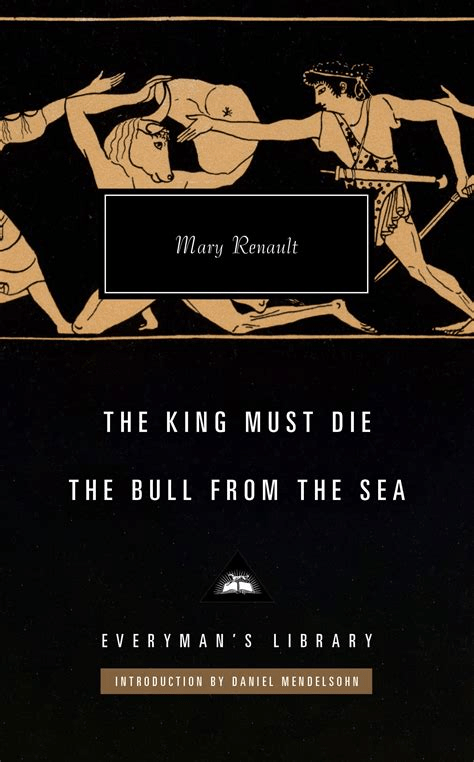
I read The King Must Die back in university. My education up to that point had some gaping holes, but I had been privileged to attend a school one time where they spent an entire year getting us thoroughly familiar with Greek myths and history. My point is, I knew the story of Theseus. I knew the labyrinth and the Minotaur were the main event. And I was eager to get to them. So I moved through the first part of the book at a pretty good clip, the part that tells of Theseus’ childhood in Troizen, his coming of age, and his journey across the Peloponnesian Peninsula to find his father, the king of Athens.
I thought then, and still think now, that Theseus is not an especially likeable character to modern eyes. He’s a prince of Heroic Age Greek culture, and he is, as they say, a product of his time. He is proud, ambitious, pious towards the gods, stoic, brave, and clever (those are his virtues), and also snobby, entitled, callous, cruel, sexist, and promiscuous. He has all the virtues of ancient paganism, but none of the virtues a Christian man. You can’t endorse all his actions or even his value system. (By the way, that is exactly what makes this such a fantastic historical novel.) But despite all this, there are moments in his story that ring incredibly poignant. And these are moments that I either forgot since my first reading, or missed entirely.
You want to hear about the Minotaur? Let me tell you about a son and his father.
Theseus’s grandfather is king in Troizen, a small Greek kingdom on the east coast of the Peloponnesian Peninsula (or what they call the Isle of Pelops). His mother, a princess, had him when she was a teenager. She lives, still unmarried, in the palace, and serves as a priestess of the Mother, who is goddess left over from before the Greeks arrived, whom they feel they must give her due.
Theseus’s mother has always told him that he is the son of Poseidon. Theseus takes this seriously as a little child. He views the sacred horse, also called a son of Poseidon, as his brother. He whispers “Are you there, Father?” into the sacred well that sometimes grumbles when Poseidon is stirred up. But as he gets a little older, he sees that other people doubt he has a divine father. He becomes defensive.
Truly “god-got” children are known to be really tall, and Theseus has always been small for his age. He waits and waits to grow (he hopes to be six or seven feet tall). He develops “short man syndrome,” taking daring risks in order to prove himself in front of the other boys. He is the best at every sport except for Hellene-style wrestling, because that requires mass and weight.
Once, he even swims way out into the ocean, figuring either Poseidon will prove he is his father, or Theseus will welcome a death by drowning. The current sweeps him back to the island, and he figures he has his answer.
Then Theseus turns seventeen, and his mother shows him the rock that his father said he should try to raise in order to prove whose son he is. So, it wasn’t Poseidon after all.
Theseus tries and can’t raise it by brute strength. He is broken, furious with his mother who won’t tell him anything.
But eventually, he realizes that he can raise it with a lever. That’s when he finds the sword.
His grandfather tells him the story, which is full of the tragedy, ugliness and beauty of ancient paganism is and basically a mini novel within this novel. There was a plague, a drought. Apollo claimed not to be responsible. Poseidon wasn’t answering. Finally, the priestess said it was the Mother. “A virgin must go and wait in the myrtle-house and give herself to the first man who comes along.” The priestess disliked Theseus’s mother, because she was an attractive young girl. His grandfather couldn’t see a way to get her out of this.
But it happened that Aigeus, the thirtysomething king of Athens, was visiting Troizen. He agreed with Theseus’s grandfather that he would be the man. At least the princess would lose her virginity to someone she had met before, and he would be kind and gentle with her. They could not tell her about this arrangement beforehand, because when a member of the royal family is in some way sacrificing themselves for the people, their willingness to make the sacrifice is a critical element. Only then will the god bless it.
The thunderstorm was already arriving. Aigeus stripped and swam across the channel to the sacred island where the Myrtle House was. A flash of lightning revealed to the princess a dark-haired man rising up out of the water, with a ribbon of seaweed on his shoulder. She thought he was Poseidon. She knelt, and crossed her arms over her chest, as one would do for a god.
Why didn’t he wait for the boat? Why did he jump into unknown waters, in a rainstorm, and swim across? Was Poseidon indeed possessing him? say these pagans. Who knows?
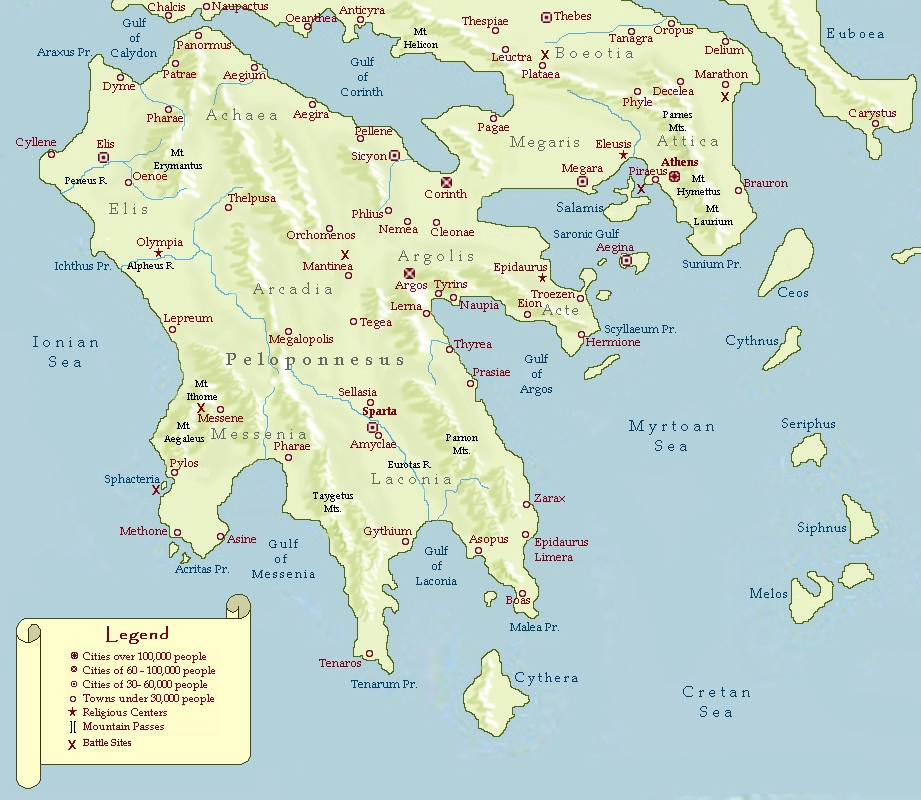
Theseus is disappointed, but intrigued, to find out that he has a human father. He travels over the Isthmus (a dangerous and lawless place), gets entangled with the earth-mother-worshipping people of Eleusis, which is very creepy, and eventually makes it to Athens and reveals himself to his father, narrowly escaping being assassinated first.
On the map above, if you look around the Saronic Gulf, you can see Troezen on the south side, Athens on the north side, and Eleusis just a bit west of Athens. I wish I’d had this map 25 years ago, when I first read the book.
Aigeus has no other sons. He is thunderstruck and delighted to see Theseus.
There’s not exactly hugging and crying, because both of them are proud, aristocratic, cautious men. On the whole, Aigeus probably wears his feelings closer to the surface than Theseus does. Still, they start getting to know each other.
Theseus’s birthday is approaching. Aigeus wants to have a feast for him. Theseus suggests sending to Troizen to bring his mother for the feast, but Aigeus dismisses this plan. If they wait, the time will get too close to “the tribute” (the sending of young men and women to Crete), and he doesn’t want to be celebrating his long-lost son when some of his subjects have just had to give up theirs.
It’s at this point that the reader who knows the outline of the story realizes that Theseus and his father are not going to have much more time together.
The day of the feast comes. Aigeus gifts Theseus a chariot, “of dark polished cypress-wood, with ivory inlays and silver-bound wheels, a craftsman’s masterpiece.”
It was a gift beyond my dearest wish. I thank him on one knee, putting his hand to my brow; but he said, “Why this haste, before you have seen the horses?”
They were matched blacks, with white-blazed foreheads; strong and glossy, sons of the north wind. My father said, “Aha, we slipped them up here, as neat as Hermes the Trickster lifting Apollo’s steers. The chariot while you were in Eleusis; and the horses this very morning, while you still slept.”
He rubbed his hands together. I was touched at his taking all this care to surprise me, as if I had been a child. “We must take them out,” I said. “Father, finish your business early, and I will be your charioteer.” We agreed that after the rites, we would drive to Paionia below Hymettos.
pp. 154 – 155
In case you missed it, Aigeus just gave his son a sports car.
After the rites, Theseus goes to the stables and waits and waits for his father. When the king does show up, he seems to have forgotten their plan to take a ride. He is stressed out by something. He urges Theseus to ride by himself, but to leave by the back gate.
The reader realizes, with a sinking feeling, that the representatives from Crete have come early to collect the youths and maidens for the tribute.
Aigeus, almost in tears, is trying to get Theseus away from there. But Theseus, too sharp not to realize something is wrong and too proud to be hustled out the back, quickly finds out what is happening and insists on entering the deadly lottery.
And now, the reader realizes that they are never, ever going to take that chariot ride.
The youths and maidens of Athens are chosen by putting their names on scraps of pottery, which are then drawn at random out of a bowl. Aigeus puts in a lot for his son, on which he has surreptitiously written some other youth’s name. But Theseus, standing among the crowd, realizes what has happened when he sees that his father is not worried. What should he do? Should he let the deception stand? Or should he stride forward and insist on being among those who are sacrificed?
I thought, “What was it? What has my father done? What every father would do if he could. And he is King. He has to think for the kingdom. It is true enough that I am needed here. I ought not to think like a warrior only. Has someone else gone to Crete for me? I have led such lads to war, and never thought I wronged them, though some were sure to die. Why then do I hate my father, and myself still more, and feel I cannot bear my life?”
I looked at my father, and remembered how he had invoked Poseidon, praying him to choose the victims. And I thought, “Yes! That is it! He has mocked the god, the guardian of the house, who brought him to beget me. Well may I be angry! This man has mocked my father.”
p. 163
Theseus begins praying his heart to Poseidon. He senses that the god wants him to go to Crete. It is time to make the sacrifice.
Sorrow fell black upon my eyes and the sun grew cold. I thought of what I had planned to do in Athens: small things I had to hoped to force my father’s hand to, great ones when my own time came. I knelt where I was, with my hair hiding my face, and thought of my life; of hunting with the Guard, of feasts and dances, of my room with the lion walls; of a woman I wanted, and had meant to speak to at the festival; of my beautiful horses, who had scarcely felt my hand; of the war paean, the bright rage of battle, and the triumph song. And I thought, “The god cannot mean it. He sent me here to be king.”
“Father Poseidon,” I whispered, “take something else from me. I will not ask to live long, if I can make a name and be remembered in Athens. Now it will be as if I had never been born.” I heard the name called of some Athenian. It was the last of the seven. “Lord Poseidon, I will give you my horses, the best I ever had. Take anything but this.”
The sea-sound grew fainter in my ears. And I thought, “The god is leaving me.”
p. 164
So off he goes. Rather than lose the unction of the god to rule, Theseus insists on going to Crete, where, he has been told, bull-dancers last six months at the most.
“Don’t grieve, Athenians. The god is sending me. He has called me to the bulls, and I must obey his sign. But don’t weep for me, I will come again.” I did not know these words till I had spoken them; they came to me from the god. “I will go with your children, and take them into my hand. They shall be my people.”
They had left off weeping, and their voices sank to a hush. I turned, and faced my father.
I saw the face of a man who has got his death-wound.
p. 165
I mean!
Misanthropic Quote: Touching Simplicity
Student: Is there anyone in this world who has never sinned?
Me: Jesus.
Student: Anyone alive today?
Me: Nope. We are all really sinful. People will let you down, it’s very sad.
Student: When I grow up, I’m gonna try to never sin.
Me: Well, of course we should try not to–
Student: When I grow up, I’m gonna never sin by yelling a lot.

