Alert readers may notice that in my second novel, The Strange Land, my main character’s love interest is also his cousin.
Ewww.
In my defense, I painted myself
into a corner by writing about a small group of people who flee from a disaster
in ancient history. They are
founders. Some of them are going to have
to marry their cousins. By hypothesis,
their genetic code is richer and less deteriorated than is ours today. So cousin marriage is not going to have the
same bad effects that we see today from years of inbreeding.
Nowadays we have gotten rid of
almost all of our sexual taboos. But one
we have kept is: don’t marry your cousin!
In the group I am writing about, it is almost the opposite. They have a lot of common-sense taboos, but
cousin-marriage is not one of them.
But wait.
Even they can’t marry just any cousin.
Let’s do some anthropology.
One thing anthropologists do when they are studying a culture is make a kinship chart. This is like a family tree with, by convention, triangles representing males and circles representing females. We make this kinship chart, we identify the Ego (the person whose relatives we are naming), and then we can discover and fill in words for all these relationships. When I did this in Borneo, I discovered that the language I was studying had, for example, a unique word for the woman who is married to my husband’s brother. (Duoi.) Fun stuff.
As you might expect, different cultures have different ways to slice up the kinship universe and these ways tend to cluster with other cultural traits. The chart I am about to show you is called the Iroquois kinship system, but it is also found in many other cultures around the world. It tends to be found in cultures that have a patrilineal inheritance system. My source for this is found here. (I also found the chart there, but I re-copied it by hand to simplify it a bit and to avoid image copyright issues. If my handwriting makes your eyes bleed, I encourage you to follow the link and take a look at the original chart.)
As you can see, “Uncle” or “Aunt” means someone who is married to a relative of your parents’ generation, such as the man married to your mother’s sister. There are unique words for “Father’s Sister” and “Mother’s Brother.” And – this is key – a parent’s sibling of the same sex is also considered your parent.
So, in the Iroquois kinship system you would call your mother’s sister “Mother.” Her kids would be considered your brothers and sisters. They are parallel cousins. You do not get to marry them. (You see, we still have marriage taboos, just not the same ones!)
On the other hand, the children of your mother’s brother are not called brothers and sisters. They are called cousins. They are your cross cousins. You are encouraged to marry them. The same is true for the children of your father’s sister.
This may seem strange to us, whose extended families are small and who have a wide world of non-relatives from which to select a spouse. But you can see that it would become important to anyone living in a small, isolated community.
Luckily for my character Ikash, the cousin on whom he gets a crush is the daughter of his father’s … sister. She is not just his cousin, she is his cross cousin. She is fair game, at least as far as the kinship system is concerned. Of course, he still has to overcome her father’s grave doubts about him, but that’s another story …
In this post I attempt to summarize Graham Hancock’s book Fingerprints of the Gods: The Evidence of Earth’s Lost Civilization (1995). This book influenced the background for my novels. It also, in my mind, dovetails with Douglas Van Dorn’s biblical/archaeological research on giants in ways that I am sure Hancock never intended or imagined.
This post is only a summary. It will naturally be much less convincing than the book itself. My copy of Fingerprints runs 578 pages counting the bibliography and index. Hancock builds up to his thesis slowly, presenting many different lines of evidence and dropping mysterious hints to keep the reader intrigued. He also has to get into some fairly technical topics, particularly when talking about astronomy. I can’t do any of that in a 1,000-word post. So, like a bucket of cold water in the face, you will be treated to Hancock’s thesis in all its bizarre and fascinating glory.
Incredibly Sophisticated, Incredibly Ancient Maps
Hancock’s first two chapters are dedicated to the details of a number of old maps drawn up during the 1500s which show parts of South America that were undiscovered by Europeans at that time. More intriguingly, they show the coast of Antarctica as it appears under the ice. (This was before modern man’s discovery of Antarctica, and before seismic surveys revealed what lay beneath the ice.) The best-known of these is the Piri Reis map (drawn up in A.D. 1513), but there are others, such as the Orontes Finaeus map, the Mercator map, and the Buache map. All these mapmakers drew on older maps, which they compiled. Piri Reis, for example, had access to the Imperial Library at Constantinople, which is probably where he got the sources for his map.
The other amazing thing about these old maps is they often show locations in South America, for example, at accurate longitude and latitude.
The lesson that Hancock draws from these maps is this. Whatever source maps Piri Reis and others used, must themselves have been drawn up by an advanced seafaring civilization that had explored the world and knew how to project longitude and latitude. Amazingly, these seafarer/mathematicians apparently charted Antarctica at a time when it was not yet completely covered in ice. That makes their civilization, how do you say? Very, very old.
Ancient Astronomer/Engineers Again
Hancock then turns to the sophisticated ancient buildings that have baffled us in previous posts. He dedicates ten chapters to the Incan and pre-Incan civilization: the Nazca Lines, the amazing complex at Lake Titicaca, and the tradition that connects these to a bearded culture-bringer (the Viracocha), who came from over the sea.
Eleven more chapters describe the Central American cultures: their obsession with numbers, with calculating exact dates in the distant past and future, with forestalling the apocalypse (including by human sacrifice). They were also sophisticated astronomers. The pyramid complex at Teotihuacan, for example, appears to have been laid out as a scale model of the solar system.
And then there is ancient Egypt. Seventeen chapters are dedicated to it. There are many things to notice. Here are just a few: ancient Egyptian civilization seems to have appeared suddenly as a high civilization, complete with myths, history, engineering, and an obsession with boats. Overall, its history is one of slow decline and loss of knowledge, rather than slow buildup. (Interestingly, the same point has been made about ancient Sumer.)
The pyramids at Giza do not match the pyramids that are supposed to have been built immediately before and immediately after them. They are far more durable and sophisticated than these others. If we accept the received chronology, the Egyptians built some relatively crummy pyramids, then a few generations later built some amazingly good ones, then turned around and went back to building relatively low-quality pyramids again. Hancock suggests that instead, the Giza pyramids are much older than commonly thought. They were built with knowledge or technology that was subsequently lost. The comparatively crummy pyramids are attempts to copy the ones at Giza.
Hancock writes, “Robert Bauval’s evidence showed that the three pyramids [at Giza] were an unbelievably precise terrestrial map of the three stars of Orion’s belt, accurately reflecting the angles between each of them and even (by their respective sizes) providing some indication of their individual magnitudes. Moreover, this map extended outwards to the north and south to encompass several other structures on the Giza plateau … the Giza monuments were so arranged as to provide a picture of the skies … as they had looked – and only as they had looked – around the year 10,450 BC.” (page 356)
The Great Pyramid at Giza has a ratio of 2pi between its original height and the circumference of its base. This strengthens the argument that it was meant to represent a star (a circle). The Pyramid of the Sun at Teotihuacan has a ratio of 4pi between height and base circumference. Both of these pyramids had to have an odd angle of slope to accomplish this (52 degrees for Giza; 43.5 degrees for Teotihuacan), so it seems to have been intentional. Pi was supposedly not calculated correctly until it was done by Archimedes in the third century BC, but apparently the ancient Egyptians and the ancient Mexicans were familiar with it.
Where Hancock is going with all this is that people on both sides of the Atlantic got their amazing engineering, mathematical, and astronomical knowledge from an older “source” civilization. He thinks it was the same seafaring civilization that apparently charted Antarctica. This impression is strengthened by the Egyptian obsession with boats and by the Incan legends that say all this knowledge came from over the sea.
Is Hancock Arguing for Aliens?
Not in this book.
He has written several books about ancient mysteries. I have not read them all. He has now started writing fiction, and in the one novel of his that I have read, it becomes apparent that his interest in all this is decidedly New Age in character. The novel features an angelic/earth mother spirit guide, telepathic Neanderthals, the whole nine yards. So, I can’t swear that aliens won’t show up at some point. But that is not the thesis of Fingerprints. Hancock is arguing that there was a very advanced civilization of people well before 10,000 BC. Whether these people were taught by aliens, spirits, or some other stuff like that, he does not say, thankfully. Because, luckily, this book relies heavily on evidence.
So the ancient cartographers were not aliens, not even according to Hancock. But still we have a problem: Where was this civilization located? You don’t normally get an advanced civilization until you have a critical mass of arable land. In short, a continent. Hancock believes he has solved this problem. He believes there was such a mass of land, but that it has since undergone a cataclysm. And now we come to the really wild part of his thesis.
It’s the End of the World As They Knew It
Mythology about a period of cataclysms in ancient times is universal. Hancock dedicates four chapters to this alone. Flood myths, for example, are very common. But most cultures also record things like earthquakes, fire falling from the sky, the sun not rising for some long period of time, or an endless winter. Hancock discusses myths like this in some detail from the following cultures: Aztec, Sumerian, Greek, Inuit, Chinese, Southeast Asian, Pacific, Indian, Egyptian, Mayan, and Norse. It should not be hard for the reader to track down these myths. Some cultures (the Aztecs and the Hopi, for example) believe that disasters come at regular intervals and that each one ushers in a new age of the world.
Hancock believes that these myths are actually historical records (with all the usual caveats about them becoming garbled, etc.) of a period of geologic upheaval that happened within human history. I’ll put it in his own words:
“This geological theory was formulated by Professor Charles Hapgood and supported by Albert Einstein. What it suggests is a complete slippage of our planet’s thirty-mile-thick lithosphere over its nearly 8000-mile-thick central core, forcing large parts of the western hemisphere southward towards the equator and thence to the Antarctic Circle. This movement is not seen as taking place along a due north-south meridian but on a swivelling course – pivoting, as it were, around the central plains of what is now the United States. The result is that the north-eastern segment of North America (in which the North Pole was formerly located in Hudson’s Bay) was dragged southwards out of the Arctic Circle along with large parts of Siberia [which were dragged into the Arctic Circle].
“In the southern hemisphere, Hapgood’s model shows the landmass that we now call Antarctica, much of which was previously at temperate or even warm latitudes, being shifted in its entirety inside the Antarctic Circle. The overall movement is seen as having been in the region of 30 degrees (approximately 2000 miles) and as having been concentrated, in the main, between the years 14,500 BC and 12,500 BC – but with massive aftershocks on a planetary scale continuing at widely-separated intervals down to about 9500 BC.” (page 471)
So that’s the thesis. Here are the things it explains:
Why North America was once covered with glaciers, centered around Hudson Bay, and why they suddenly started melting.
Why, during the same period of time, Siberia was apparently not covered in glaciers
Why there is evidence that the climate was once much warmer in parts of Siberia. We find flash-frozen mammoths with temperate or even tropical plants still in their mouths and stomachs. (Actually, I still don’t understand how mammoths could be flash-frozen even with Hancock’s thesis. But at least it offers some explanation.)
Why there is evidence that the climate was once much warmer in Antarctica as well.
Furthermore:
According to Hancock’s theory, the survivors of this advanced civilization that previously existed on what is now Antarctica fled their homeland, taking their science with them.
They settled in other parts of the world and tried to rebuild.
Hancock also thinks that they deliberately seeded myths and cults to preserve knowledge and to draw people’s attention to the processional cycle of the constellations because they wanted to warn them. They believed that geological disasters like this occurred cyclically in concert with celestial events. He believes this is why the pyramids were built, for example. A good chunk of his book is about this, but I don’t have time to relate it here.
What’s a Christian Writer to Do With All This?
First of all, it is not possible to integrate everything. It just isn’t.
To take just one example from above, if the earth’s crust took 2,000 years to slip, how did mammoths come to be flash frozen? I have no idea. I don’t think anybody does, whatever their theory.
To take another example, Hancock’s thesis requires that after the age of cataclysms, there were human survivors in scattered parts of the world. These were then visited by refugees from the mother civilization, who taught them things, and they remember these culture-bringers in their mythology. You cannot make this work perfectly with the idea that at one point there was a universal flood that wiped out all humankind except four couples, and that the flood myths are memories of that.
Every culture has stories of culture-bringers (human or divine) who taught them to do things that are basic to that culture. Most cultures with a flood myth have the survivors of the flood landing right in that culture’s homeland and becoming the direct ancestors of that culture. Most of them don’t have a section in there where the survivors land somewhere very far away, and then their descendants travel a really long way to get to the current homeland. Most peoples believe that they live at the mythic center of the world. So you have to take these things into account. Every origin myth cannot be true in all its details.
That said, here is what I, as a Christian, have attempted to do with Hancock’s thesis and more importantly with the evidence that inspired it.
What I appreciate about Hancock is his attempt to take seriously the many lines of evidence that human beings were familiar with advanced mathematics, engineering, and astronomy long ages before we are told that human civilization started. This fits in, far better than the received “cave man” picture, with the ancient world as it is hinted at in the early chapters of Genesis. There we see civilization taking off like rocket, apparently with writing and record-keeping, and flourishing until it is destroyed by the flood.
Hancock’s theory of earth crust slippage does not contradict the Genesis account either. It is not hard to imagine an age of cataclysms leading up to the great flood. We are not told that this happened, but then Genesis, with its laser focus on redemptive history, does not tell us a great many of the things we would like to know. If we imagine earth crust slippage culminating in a worldwide flood, we end up with almost the same picture as that painted in Fingerprints. The only difference is that the amazing monuments at Giza and other places could not have been built by refugees from a mother civilization. They would have to have been built by Noah’s descendants trying to recover lost knowledge … or by the almost-unknown-to-us civilizations before the flood.
Genesis: Even More Daring than Hancock
Genesis does not give us a complete picture of the antediluvian world. It tells us only a few major names and events with very little explanation or context. We are not told how long the antediluvian period lasted; what the world population was before the flood; what the people or animals looked like or their relative sizes; what kind of technology existed; whether there were cities. As a result, we tend to picture Noah and his family, almost all alone, out in the middle of a desert (inspired by the way the Middle East appears today), with a bunch of modern-day animals. But we aren’t told that’s how it was. We aren’t told much at all. In fact, we don’t have – anywhere – any reliable sources that can tell us much about the very ancient world.
Genesis does, however, tell us one very weird thing which fits in well with worldwide myths but which Hancock’s thesis basically ignores.
Interesting as I find Fingerprints of the Gods, it is of course not perfect. Among other problems, it fails to take seriously the universal testimony of human culture that there used to be “gods.” Hancock falls prey (at least in this book) to the materialist notion that anything attributed to gods must be explainable by smarter people with higher technology. Of course, this smuggles in the idea that most ancient humans were stupid and gullible and would apply the “gods” label to anything they didn’t understand. This kind of snobbery dogs Hancock. For example, he quotes with approval a source that wonders how the Mayans could have had such advanced calendars when they hadn’t even invented the wheel.
Genesis, on the other hand, does not patronize ancient humans. Shockingly, it vindicates their myths. It is recorded in Genesis chapter 6 that the “sons of God” (some kind of heavenly beings, members of the divine council) came down to earth and intermarried with human women, and that their offspring were giants.
Obviously, that is a stunning claim. I can’t blame you if you’re not convinced of it on first hearing. Some day I will deal with it in more detail in another post (one that summarizes Douglas Van Dorn’s book). For now, I just want to say a few things about this idea as it relates to Hancock’s thesis.
Every culture, worldwide, has myths about gods and giants. There is a huge body of mythology about this stuff, and it usually shows up in the form of origin stories and tales that purport to be about historical rulers. No doubt the ideas of gods and giants, and many other themes from mythology, are a deep part of the human mental furniture. But this does not necessarily mean they are not also memories of historical events. How and why did this particular furniture get in our particular living room? Perhaps people did not get these ideas just from plumbing the depths of the human psyche. We might want to take these stories seriously as memories of historical events, since we are taking seriously the stories of floods and cataclysms that show up in the same cultures, and often in the very same narratives.
And, if you are still with me, taking seriously the idea of gods and giants might also give us our answer as to how people managed to build incredibly sophisticated monuments out of megaliths. Imagine a world in which people typically live almost a thousand years (per the ages given in Genesis) … in which ten or twelve generations can be alive at the same time, so knowledge is not lost … in which people are smarter and healthier than we are now, since there has been less genetic decay … and in which some of these people are actual giants. All of a sudden it starts to sound … maybe … almost possible. Maybe you and I could build the Giza pyramids too, if we had a thousand years to do it in and if we had intelligent giants helping (even directing?) us.
Now it’s your turn. I am posting this 24 hours late (I usually post on Friday, not Saturday), and even with the extra time, I realize this post is loosely written. This is such a big topic, worthy of an essay weeks or months in the making … not to say years. I did not spend years, months or even weeks on this post (although I have spent a few years thinking about all this stuff). My goal is not to make a watertight argument, just to sketch out some intriguing possibilities. Still, if you find problems with the post, point them out in the comments section (alongside your laudatory comments, of course) and I’ll do my best to tighten and polish it.
This is my second post about non-stereotypical hair. See my first one here.
If I were to ask you to draw an Ancient Egyptian, you would probably draw someone with gold, reddish, or dark skin, long dark eyes, and black hair. Red hair would probably not appear in your drawing. However, there has been a red-haired strain in Egyptian genetics apparently from time immemorial.
Ramses II, 90 years old when he died, was tall, thin, and by the time of his death he was stooped and had a tooth abscess. He also had red-gold hair. “Specialists who examined the strands under a microscope found that it had been dyed with henna and in all likelihood had been auburn in Ramses’ youth” (Time-Life, p. 153). Tall, thin, red-haired and hook-nosed, Ramses II does not match my mental picture of a typical Egyptian.
But he is not the only one. A number of red-haired Egyptian mummies have been found. Archaeologists used to assume that the hair was once dark and had been bleached out by the embalming process. But a recent study treated hair samples with the natron salts similar to those the Egyptians used, and found that the process did not change the color of the hair. Apparently these were actually redheads.
When I was taught Egyptian mythology in school, I was told that Seth, the villain of the story of Isis and Osiris, was red-haired. He was also Osiris’ brother. I found this intriguing, and it reminded me of the Semitic story of Jacob and Esau, who were twins one of whom was a dark-haired (?), “smooth” man, and one of whom was “hairy” and “red.”
Now I find out that Seth, as his legend later developed, was a trickster god, usually portrayed as a composite of different animals, with red hair or fur. Also, red was a symbolic color that could represent vitality or anger (no surprise there). So it’s possible that Seth was an entirely invented character and that his unusual hair color was picked to match his personality and symbolism. But, since this is an ancient origin myth, I can’t shake the possibility that there once was actually a founding pair of brothers, one of whom was dark-haired and one of whom was red. (Also, shades of the original Thor, a quick-tempered, red-haired, trickster god!)
If Red Hair is Native to Egypt, Does This Mean that Ancient Egyptians were Indo-Europeans?
No.
It just means that, as for most people groups worldwide, their genetics were more complex than the layperson would first imagine.
The ethnicity of the ancient Egyptians has been a hugely contested topic. Their civilization is so intriguing that everyone wants to claim them. Eurocentrists have tried to claim that the Egyptians were actually “Mediterranean” (specifically the Hellenistic, European-style Mediterranean), because this supports their dogma that Europeans have been the only source of civilization and there has never been a high civilization to come out of Africa. Afrocentrists have countered by claiming the ancient Egyptians were not only not white, but were truly black, the ancestors of the modern-day sub-Saharan Africans. The world’s first high civilizations were African, and everyone else has stolen their ideas!
Both groups are wrong about the ethnicity of the ancient Egyptians. Genetic studies of mummies are difficult to do, and this is truer the older the mummies are, but so far, they have concluded that Egyptians have more or less always been … Egyptian. Uniquely themselves, more closely related to the peoples of the Levant than to any others, and genetically, more or less just like the Egyptians of today.
Also, Could We Stop the Tug-of-War?
And may I just add, this is stupid, human race? Could we please (and when I say we, I mean you, human race) stop all this “I started civilization” “No, I did”?
First of all, Egypt was not the world’s first civilization. Contemporary with them, we have the Sumerians, who though they did not live in Africa were probably also black, and the little-known Balkan civilization that gave us the Vinca signs. And there are good indications that many civilizations existed just as advanced as, and prior to, these. See all my posts about The Lost Civilizations of the Stone Age by Richard Rudgley.
The Afrocentrists are closer to being right than the Eurocentrists. Arthur C. Custance makes the case,
One does not think of Africa as particularly inventive. As a matter of fact, however, so many new things came from that great continent during Roman times that they had a proverb, “Ex Africa semper aliquid,” which freely translated means, “There is always something new coming out of Africa.”
It is true to say that whatever inventiveness [Indo-Europeans] have shown in the past three or four centuries has almost always resulted from stimulation from non-Indo-Europeans. Our chief glory has been the ability to improve upon and perfect the inventions of others, often to such an extent that they appear to be original developments … [I]t does not seem proper to call a people “inventive” who once in a while do invent something, but who 99% of the time merely adapt the inventions of others to new ends.
Custance, Noah’s Three Sons, pp. 199, 215
That said, the idea that any one nationality can claim to have founded civilization is … stupid, human race. Human beings are really smart and civilization springs up wherever they go. Lots of people have invented civilization, many times.
(Furthermore, even if your ancestors did build the Parthenon or the Pyramids or Notre Dame, you didn’t build them personally, did you? Do you really want to start taking credit for amazing stuff that people who share your genetics did 3,000 years ago? Are you also going to take credit for all the atrocities they committed? Human race, you are too smart for this stupid idea.)
Egyptian Red Hair Makes an Appearance in The Long Guest
Nimri, the anti-hero of my novel The Long Guest, is a Cushite, who per Genesis is related to “Egypt.” Mid-novel, after being separated from his own people and dragged off on a journey over the Asia steppes, he observes some red-haired Indo-Europeans.
When I first saw that redhaired fellow I was reminded of my relative Mizra. He had red –gold hair and bright burnished skin like my own – only even more ruddy, just a shade darker than his hair. He was tall and thin, with a long thin arrogant face. Between that and his unusual coloring, he was a very striking-looking man. He used to stalk around the architects’ complex like a very god … how we all admired him, and wanted to be like him! But no one could compare to Mizra.
The Long Guest, Chapter 13
The Hebrew word for Egypt is Mizraim, which is actually plural: “Egypts.” Rather than making Nimri’s relative’s name plural, I have simply called him Mizra.
Nimri never manages to tell anyone about Mizra, because he cannot yet communicate at this stage in the story. But I can tell you. In case you didn’t know, I’ll whisper it in your ear: Some Egyptians had red hair.
Custance, Arthur C. Noah’s Three Sons, The Doorway Papers series vol. 1, Zondervan, 1975. pp. 155 – 216 discuss “The [Technological] Inventiveness of the Hamitic Peoples.” Or you can read the chapter here.
Ramses II: Magnificence on the Nile, by the editors of Time-Life books, Time-Life Books, Alexandria, Virginia, 1993. p. 153 shows the red-gold hair on the mummy of Ramses II.
Doug Wilson’s blog post about AI. Wilson I trust because of the volumes of material that he’s written and I’ve read.
I won’t add much to what they have to say. It’s going to be a busy week, for reasons that will be revealed tomorrow. However, I know that most of you won’t listen to the podcast, and only a small number will read the article, so I will summarize the salient parts of each in a sentence or two.
Boreing makes the point that every new technology comes with the fears and negative effects front-loaded, and the benefits arrive in the medium to long term, as we figure out where it fits in human society and how to limit its harms. He further points out that no new technology has ever delivered on any promises made on its behalf to create “less work.” New tech always creates more work: new industries, but also lots of new things that can be done by people who see the potential.
Wilson, too, points out that lazy folks will try to use AI as a way to avoid work, whereas the diligent and the geniuses will see vast new fields of work open up to them. He adds the obvious (but often overlooked) point that a “workless” utopia would actually be a dystopia.
In short, both men sensibly point out that AI is not going to change human nature. Humans do human things no matter how much tech they have. And we were designed to work.
This is, on the whole, a great relief to me. It is good to hear that the scary new thing is not going to change human nature. Granted, human nature isn’t great, but we already knew that, and all attempts to completely remake it always seem to get rid of the only parts worth saving.
Still, I’m not a total AI-o-phile, unlike, say, our friend Ben Shapiro. That’s because I’m a writer and a visual artist. My thinking is still developing on this, but as of spring 2026 here’s where I’m at.
Everyone senses that stories and art (including music) are the sort of things that ought to be made by people and nothing else. Unfortunately, it’s possible that AI will get good enough at “making” these things, that it will be impossible to detect it. You want a gritty, soulful story with human flaws? It will give you a gritty, soulful story with human flaws. It will get rid of the overly vivid colors and unrealistic smoothness in its paintings. It has already produced a country song by a hard-livin’ male voice about overcoming working-class obstacles.
When this happens, it’s like debasing the currency, but with stories and music and art. These things are much more valuable than currency. That’s bad.
From the creators’ side, everyone’s work will become suspect. This is already starting to happen.
From the consumer side, I am possibly even more upset. I DO NOT like it when I look closely at what appears to be a model wearing colorful European folk clothing, and realize that it’s an AI approximation of same. But at least, I can still realize it. I REALLY won’t like it when I have no way of knowing whether the “human” culture I’m imbibing is actually human culture.
I say, “O.K., we’re going to put in a load of laundry, then we’re going to water the garden, write blog post, start supper.” The purpose of this should be obvious. It helps me organize the twenty things I want to do, triage them, and make the winners my official Next Activity. This is hard to do without saying stuff out loud (at least, for me). My thoughts don’t do well when they are left inside my head unsupervised.
Notice that I call myself “we” for purposes of decision making. This may be a side effect of having raised three children.
But I also talk to other entities that are not visible to the naked eye. I talk to God, of course. “I’m sorry, Lord, I was trying to promote myself just now instead of Your glory.” “I’m scared, God.” “Help!” I talk to people I haven’t seen in years, apologizing out loud for that one thing I did back in university. I tell my potted plants, “You guys sit tight there. I’ll be right back.” I’ll never forget the first time I accidentally said “I love you” to the chickens.
I won’t put down what I say to web sites that make it difficult to do things.
I know it’s not just me. You are busted, Reader! I’ll bet you, too, talk to … I don’t know, spoons. Trees. Whatever. It turns out, people need something to talk to. Evidence:
“Elves always wanted to talk to things,” says Treebeard, when speaking of the Elves first “waking up the trees.”
The Tom Hanks character, in Castaway, famously saves his sanity by talking constantly to a volleyball named “Wilson.” When Wilson is washed away, near the end of the movie, he really grieves him. And it turns out that, by getting into daily “conflicts” with the volleyball, he has become better at relating to actual people when he is near them again. This points up how humans are able to anthropomorphize anything. Robots, for example, or rocks.
I have not done this myself, but I’ve heard that many people talk to their dead loved ones… either at their grave, or just throughout the day.
In C.S. Lewis’s novel Perelandra, philologist Ransom finds himself alone on Mars after he had been kidnapped by fellow academics. (In the story, Mars has air and water that are consumable by humans.) Ransom is very alone, very scared, in a very strange situation. As he wanders through the Martian forests, he begins to talk to himself. Not just in the sense of speaking out loud. He actually feels as though “Ransom” is a second person beside him, whom he must comfort, reassure, and consult with. “Don’t worry, Ransom,” he says. “We’ll make it.” It’s actually a creepy scene as we realize how on the edge he is, and even feel our stability slipping with his.
This might be Lewis’s interpretation of the intriguing and spooky Third Man Phenomenon. This is an experience that some people have in survival situations, such as mountain climbing, where they sense another person with them in the situation. It can happen to people who are alone in the wilderness, or in a group. This sense of another person with them is persistent, and so vivid that they may hear a voice. Psychologists, of course, tend to explain this as a hallucination brought on by things like sleep and oxygen deprivation, and/or a coping mechanism comparable to Stockholm Syndrome. (The sleep deprivation theory does raise the question, Why doesn’t this happen to new mothers? At least, not that I know of.) I don’t know what to make of the Third Man, but I will say that he does make me think of the fourth man in the furnace with Shadrach, Meshach, and Abednego.
Lewis has another instance of the Third Man phenomenon in his book Pilgrim’s Regress. The narrator, who has been traveling all over the world to find the place he considers paradise, ends up on a perilous cliff, at night, and debates going back to the last house he stopped at, which is definitely not the place he has spent his whole life looking for, but at least it’s safe. At this point a mysterious man appears, prevents him from going back the way he came, and forces him to go on until he is “cliffed out,” at which point the stranger leads him over the perilous part.
“Men go crazy in congregations, but they only come back one by one,” sings Sting. While I like Sting, and while I recognize that cults do exist, as a generalization this line from his song is the inverse of the truth. People really, really need something or someone to talk to. We always want to talk to things.
So, if you’re comfortable sharing, what do you talk to?
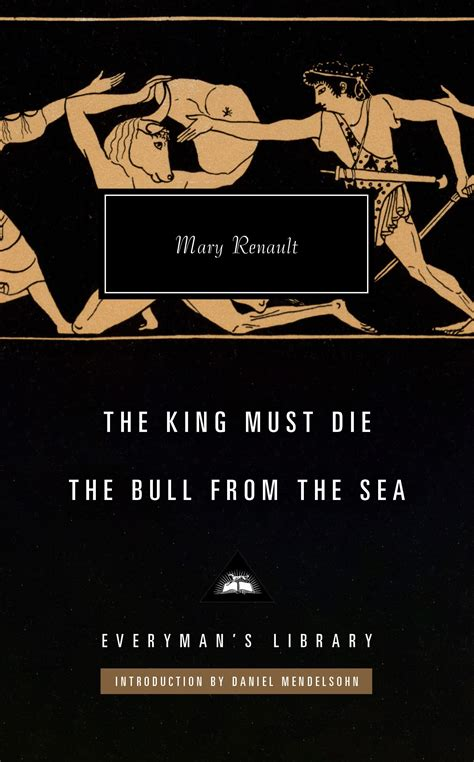
In my recent big post about sacrifice (willing and otherwise), I pointed out some similarities between the different sacrificial deaths in Mary Renault’s The King Must Die, and the death of Christ.
Some of these similarities are deep. Theseus, as future king of Athens, has an honorary title the Shepherd of the People. He is the king’s son, and he feels “the god” (Poseidon) calling him “to the bulls,” that is, to go and be a human sacrifice in Crete. Before he departs, he reassures the parents of the other future bull-dancers, “I will go with your children, and take them into my hand. They shall be my people.”
Two thousand years after Christ, we are so saturated in the power of His story and of the things He said that it is hard to read these ancient customs as anything but Christological types. And, since The King Must Die was published in 1958, it’s pretty clear the author also was aware of Christ and was intentionally pulling phrases from Him. More about that in a moment.
Other similarities are superficial, but nonetheless striking. Near the end of TKMD, a sixteen-year-old “king” who is about to be torn to pieces by wild women in a Dionysian rite, goes to his death riding in a cart, crowned with ivy, brandishing a wine cup and scattering wheat seed on his people. Now, this rite is almost nothing like the death of Christ. It’s pagan. It does not happen on Passover, the date of the annual sacrifice of a lamb, but rather it is part of an annual ritual of human sacrifice mixed with orgy. The “king,” along with everyone else, is reeling drunk. He has just spent a year as the consort of the priestess/queen, and he has no choice in what is about to happen to him. It’s hard to imagine a death more different from Christ’s.
And yet, these very superficial similarities do not strike us as coincidences. Instead, they seem significant. On this side of Christ, we can’t help but notice when a man who is about to go up a hill and die shares out bread and cup to his followers.
This sort of horrifying, yet somehow moving, ritual is not something Renault just made up. It’s well-attested in myths, legends, and histories. In this essay, I will argue that Christ did not share out bread and wine because it had been done before. Rather, the pagan one-year king shared out bread and wine because Christ did so one thousand years later. Future events cast backwards shadows.
What was Renault trying to do?
To be clear, that is my thesis, not Renault’s. She was a lesbian who published a number of contemporary gay romance novels before discovering her personal obsession with ancient Greece. Writing about Socrates and Alexander the Great allowed her to write sympathetic historical novels about gay characters who lived in a context where this sort of behavior was considered completely normal. The King Must Die certainly includes all kinds of sexual activity; for example, in the Bull Court, the female bull-leapers cannot be allowed to get pregnant, so they are sequestered from the boys, and turn to relationships with each other. Many of the male bull-leapers become the paramours of upper-class Cretan men. Theseus himself is straight, but as an ancient prince, let’s just say he’s not exactly chaste. (I may have lucked into picking up Renault’s least gay book about ancient Greece.)
All this to say, I don’t think Renault was trying to say that any ancient customs were foreshadowings of Christ. If she was “trying to say” anything at all about Christ, it’s probably that He’s not so unique, and anybody familiar with ancient Hellenistic ideas would understand that. But her novels (at least TKMD) are not really “message” novels. She immersed herself in that world, wrote characters and customs that grew organically out of it, and this is what came out.
So no, I don’t think Renault is projecting Christ back into the ancient Mediterranean customs intentionally, except in the sense that she would have been familiar with biblical phrases as a woman raised in 1900s England. I think she was primarily writing from her research and imagination.
Is Christianity a ripoff from Greek mystery religions?
Still, when I first read TKMD, the tone was familiar to me and I immediately picked up the implications. Not that many years before reading it, I had been through a year of thorough education in Greek mythology by a high-school teacher who could safely be described as feminist. My best friend at the time was a neo-pagan. Between the two of them, this teacher and friend were quick to point out any parallels between Greek paganism and Christian practice, and to accuse Christians of “stealing” it. Looking back, there was a certain defensiveness there, which I did not realize at the time. But my teacher and friend were only two voices in a large crowd of scholars.
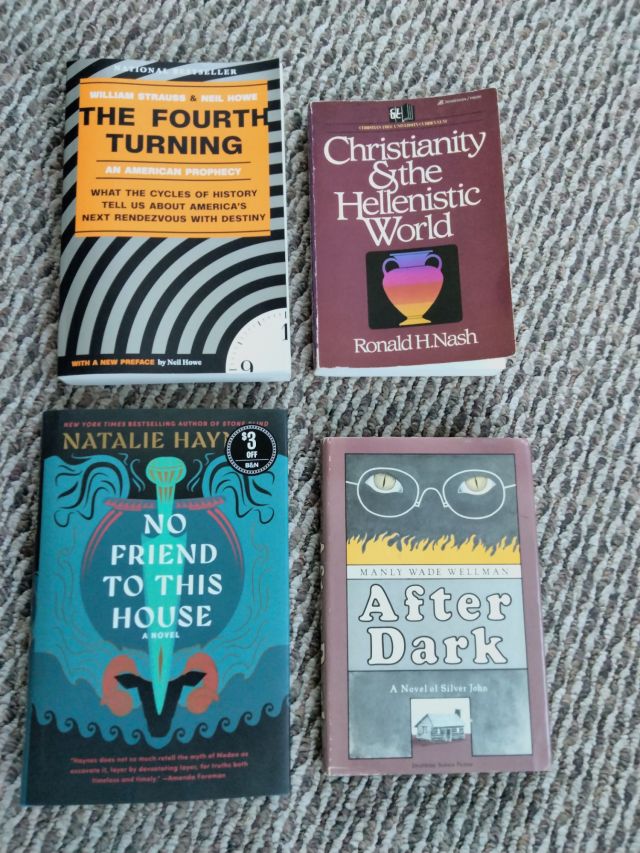
During a period of time running roughly from about 1890 to 1940, scholars often alleged that primitive Christianity had been heavily influenced by Platonism, Stoicism, the pagan mystery religions, or other movements in the Hellenistic world. Largely as a result of a series of scholarly books and articles written in rebuttal … Today, most Bible scholars regard the question as a dead issue. [But] even though specialists in biblical and classical studies know how weak the old case for Christian dependence was, these old arguments continue to circulate in the publications of scholars in such other fields as history and philosophy.
–Christianity and the Hellenistic World (1984), p. 10
As an aside, notice that the peak of this theory were the years during which Mary Renault was growing up and going to school.
Sometimes books come to you, serendipitously, just when you are ready for them. As I was thinking about this question of the similarities between fictional (but history-based) sacrificial victims in Renault, and my own Dying God, I imagined how I would build a case that He was clearly not copying them. Although He did grow up in a thoroughly Hellenized environment, He was a Jew. He was extremely faithful to the God of Abraham, Isaac, and Jacob, and was so familiar with the Law and the Prophets that He could quote them off the cuff. His veins seemed to flow with the Hebrew Scriptures. In short, He showed no signs of wanting to throw over the religion of His ancestors for that of the Greeks. Furthermore, many of the elements of how His last days went down came about as a result of the particular historical conditions in which He found Himself. He went up the hill to die because Jerusalem is built on a height. He shared out bread and wine because they were having the Passover, and this ceremony had been established 1400 years before in the desert of Sinai, not 1000 years before in the Ionian islands. He called Himself a king because that was what the Jewish Messiah was supposed to be, and He was of the house and lineage of David … not because He had been selected by matriarchal priestess to live as a king for one year and then die. He called Himself the Good Shepherd because of the Israelite pastoral tradition, not because of the Athenian one. The Roman soldiers put a crown of thorns on His head because they were professionals at humiliating and torturing people. It’s hard to imagine how He could have orchestrated all these historical factors intentionally in order to copy a pagan custom that was practiced far away, and centuries before He was born.
I can assert all this stuff, but there is always some scholar out there who could be quoted to argue with me. I needed a book. And the book came to me. As I was turning all these things over in my mind, I had to venture out to a Christian bookstore that was closing. (“Come get your novels,” they said.) Of course, many of their books were on clearance, and there before me was Nash’s Christianity and the Hellenistic World for the low low price of one dollar, its asking price all out of proportion to its value to me at that moment. Nash can prove what I can only assert.
Nash systematically addresses claims that early Christian writers, particularly Paul, got many of their key concepts from Platonism, Stoicism, the mystery religions, and Gnosticism.
Among the many claims published in this century are the following:
Early Christianity was just another Hellenistic mystery religion.
Important Christian beliefs and practices were either borrowed from, or were heavily dependent on, similar beliefs and practices in the mysteries.
Both baptism the Lord’s Supper evidence the influence of similar rituals in the mystery cults.
Among the many Christian beliefs drawn from the mysteries is the Pauline doctrine of salvation, which parallels the essential themes of the mysteries: a savior-god dies violently for those he will eventually deliver, after which the god is restored to life.
A major movement in the development and promotion of such theories was the History of Religions School (Religionsgeschichtliche Schule).
-ibid, pp. 116 – 177
Nash addresses problems with these claims such as the following: in the mysteries, the dying god does not really rise. Osiris lives on in the underworld; the dead god’s body becomes the wheat, etc. As far as we can tell, ritual washings in the mysteries were just purification rituals, and they had to be repeated. They do not seem to have been a one-time entry into a new life like the Christian baptism. For many of these mystery religions, we don’t actually know much about the content of the rituals, because they were intentionally kept secret. For many mystery-religion practices that are well-attested, such as the taurobolium where the initiate stood beneath a grate while a bull was slaughtered, these practices seem to have developed after Christ rose and Paul wrote his letters. In the case of the mystery religions of the first, second, and third centuries, some of them were actually influenced by Christianity, not the other way round.
But I’ll let German scholar Adolf von Harnack, quoted by Nash, have the last word:
We must reject the comparative mythology which finds a causal connection between everything and everything else, which tears down solid barriers, bridges chasms as though it were child’s play, and spins combinations from superficial similarities … By such methods one can turn Christ into a sun god in the twinkling of an eye, or one can bring up legends attending the birth of every conceivable god, or one can catch all sorts of mythological doves to keep company with the baptismal dove; and find any number of celebrated asses to follow the ass on which Jesus rode into Jerusalem; and thus, with the magic wand of “comparative religion,” triumphantly eliminate every spontaneous trait in any religion.
–ibid, pp. 118 – 119
Too many keys to mythology
In short, the problem is not that there are some key symbolic parallels between Christ and ancient pagan symbolism. The problem is that there are too many parallels, or similarities, right down to the animals involved. Part of this is simply the limitations of living in this world. Jesus had to eat something, He had to ride on something, He had to use some kind of words when He spoke, and there were a finite number of foods, mounts, and terms in the ancient world, just as there are everywhere. I have pointed out before, when addressing the problem of whether Christians “stole” pagan practices like hot cross buns and wedding customs, that there are a limited number of ways to do every human activity. If you eat something, wear something, or go through a life passage, and you are a human being, I guarantee that in the past four thousand years there has been someone who did it that way before you. And that someone was probably pagan.
As G.K. Chesterton said about finding mystical and symbolic connections:
The true origin of all the myths has been discovered much too often. There are too many keys to mythology, as there are too many cryptograms in Shakespeare. Everything is phallic; everything is totemistic; everything is seed-time and harvest; everything is ghosts and grave-offerings; everything is the golden bough of sacrifice; everything is the sun and moon; everything is everything.
–The Everlasting Man, p. 103
These are the givens of the universe that all humans encounter; and, unless we are sorely impoverished, we all have some way of dealing with them. But just because they are ubiquitous does not mean they are unimportant. These things are shadows of what was to come. The reality, however, is found in Christ.
Symbolism in Reality
Last point: Jesus was the fulfillment of all these confused hints in every culture. But the vibe of the New Testament historical records is much less gorgeous, mythical, and poetic than the ancient pagan stories. As C.S. Lewis put it:
When I first, after childhood, read the Gospels, I was full of that stuff about the dying God, The Golden Bough, and so on. It was to me then a very poetic, and mysterious, and quickening idea; and when I turned to the Gospels never will I forget my disappointment and repulsion at finding hardly anything about it at all. The metaphor of the seed dropping into the ground in this connexion occurs (I think) twice in the New Testament, and for the rest hardly any notice is taken; it seemed to me extradordinary. You had a dying God, Who is always representative of the corn; you see Him holding the corn, that is, bread, in His hand, and saying, ‘This is My Body,’ and from my point of view, as I then was, He did not seem to realize what He was saying. Surely there, if anywhere, this connexion between the Christian story and the corn must have come out; the whole context is crying out for it. But everything goes on as if the principal actor, and still more, those close to Him, were totally ignorant of what they were doing. It is as if you got very good evidence concerning the sea-serpent, but the men who brought this good evidence seemed never to have heard of sea-serpents. Or to put it another way, why was it that the only case of the ‘dying God’ which might conceivably have been historical occurred among a people (and the only people in the whole Mediterranean world) who had not got any trace of this nature religion, and indeed seemed to know nothing about it?
–C.S. Lewis, “The Grand Miracle,” in God in the Dock, p. 83
Well, when you put it that way, it’s pretty funny, isn’t it? Jesus’s death reads as disappointingly prosaic compared to the myths only because it actually happened. This is very humble of God. He has quite the sense of humor. As John puts it after his account of the Triumphal Entry, “At first His disciples did not understand all this. Only after Jesus was glorified did they realize that these things had been written about Him and that they had done these things to Him.” John 12:16
Sources
Chesteron, G.K. The Everlasting Man. Ignatius Press: 2008, originally published in 1925.
Lewis, C.S., ed. Walter Hooper, God in the Dock: Essays on Theology and Ethics. Eerdmans: 1970, 1978.
Nash, Ronald H. Christianity and the Hellenistic World. Zondervan: 1984.
Renault, Mary. The King Must Die. Alfred A. Knopf, Everyman’s Library edition pub. 2022, originally published by Pantheon Books in 1958.
This is my final post about The King Must Die. It will have spoilers. They will be the sort of spoilers that make you want to read the book.
Like any good literary book with a strong theme, this one announces the theme in its title. The King Must Die. Why? Why must the king die? The entire story is an effort to provide the answer.
A Rude Awakening: the Death of the King Horse
The first major incident in the book involves the slaughter of a sacred horse. Theseus, who is about seven at the time, loves this horse. It is the “king horse,” the stallion of the sacred herd. Theseus, who has been told that the god Poseidon is his father, thinks of this horse as his literal brother. He is taken to the sacred island to attend a special ceremony. He has no idea that this ceremony is going to culminate in the slaughter of the horse he adores.
It was a good clean killing. I myself, with all Athens watching, am content to do no worse. Yet, even now, I still remember. How he reared up like a tower, feeling his death, dragging the men like children; the scarlet cleft in the white throat, the rank hot smell; the ruin of beauty, the fall of strength, the ebb of valor; and the grief, the burning pity as he sank upon his knees and laid his bright head in the dust. That blood seemed to tear the soul out of my breast, as if my own heart had shed it.
As the newborn babe, who has been rocked day and night in his soft cave knowing no other, is thrust forth where the harsh air pierces him and fierce light stabs his eyes, so it was with me.
p. 13
This is the first king to die in the story. And for Theseus, it is also a kind of death, and a kind of birth. He is the grandson of a king, and this is his birth into the world where the king must die.
Then Theseus is “dedicated.” This involves smearing the horse’s blood on his forehead. But when his older cousin tells him “Come, you must be dedicated,” he thinks that he is about to be sacrificed like the King Horse. So the little boy steps forward in his first act of courage, ready to give his life. And for the first time, he senses the presence of the god Poseidon with him.
Theseus’s grandfather, the king, notices that his grandson is struggling with what just happened. Later, in grandfather’s upper room, the two of them have a talk.
The Lord Poseidon, who rules everything that stretches under the sky, the land and the sea. He told the King Horse, and the King Horse led [our ancestors to new grazing grounds].”
I sat up; this I could understand.
“When they needed new pastures, they let him loose; and he, taking care of his people as the god advised him, would smell the air seeking food and water. Here in Troizen, when he goes out for the god, they guide him round the fields and over the ford. We do that in memory. But in those days he ran free. The barons followed him, to give battle if his passage was disputed; but only the god told him where to go.
And so, before he was loosed, he was always dedicated. The god only inspires his own. Can you understand this, Theseus?
The King Horse showed the way; the barons cleared it; and the King led the people. When the work of the King Horse was done, he was given to the god, as you saw yesterday. And in those days, said my great-grandfather, as with the King Horse, so with the King.”
I looked up in wonder; and yet, not in astonishment. Something within me did not find it strange.
“Horses go blindly to the sacrifice; but the gods give knowledge to men. When the King was dedicated, he knew his moira [=destiny]. In three years, or seven, or nine, or whenever the custom was, his term would end and the god would call him. And he went consenting, or else he was no king, and power would not fall on him to lead the people. And the custom changes, Theseus, but this token never.
“Later the custom altered. Perhaps they had a King they could not spare, when war or plague thinned the Kindred. Or perhaps Apollo showed them a hidden thing. But they ceased to offer the King at a set time. They kept him for the extreme sacrifice, to appease the gods in their greatest angers … And it was no one’s place to say to him, ‘It is time to make the offering.’ He was the nearest to the god, because he consented to his moira; and he himself received the god’s commandment.”
He paused; and I said, “How?”
“In different ways. And so it is still, Theseus. We know our time. Listen, and do not forget, and I will show you a mystery. It is not the sacrifice, whether it comes in youth or age, or the god remits it; it is not the bloodletting that calls down power. It is the consenting, Theseus. The readiness is all. It washes heart and mind from things of no account, and leaves them open to the god. But one washing does not last a lifetime; we must renew it, or the dust returns to cover us.”
pp. 16 – 19
Thus the king of Troizen lays out the entire rationale for Hellene royal sacrifice. Perhaps you have already noticed a few Bible Easter eggs. “Behold, I tell you a mystery” and Jesus saying, “The Father loves me because I lay down my life. No one takes it from me; I lay it down of my own accord. I have authority to lay it down and authority to take it up again. This command I received from my Father.” (John 10:17 – 18) Those few lines map exactly onto what Theseus’s grandfather has just told us, albeit with perfect clarity instead of wrapped in mysterious ancient customs.
Was all this really present in the culture of the ancient Greeks and their Indo-European forebears? Or is Renault reading it back into that culture from the Bible? Or, did Jesus borrow all this from the ancients? I’m looking into it.
You might think that Theseus’s grandfather’s speech is too heavy-handed; showing instead of telling. But Renault knows what she is doing. This is not the whole secret of the book laid bare within the first twenty pages. It is only the beginning. This instruction from his grandfather sets Theseus’s attitude towards the god, himself, and his duty. It will guide how he responds to things throughout the rest of the book.
All the Kings that Die
Spoiler time. Here is a quick list of all the kings whose death Theseus causes or witnesses in this book:
Kerkyon, the “king” of Eleusis. This young man is a “solar king,” that is, he lives in a matriarchal society where the king reigns for only one year and then is killed by his successor. Thesus gets chosen as the next solar king and kills Kerkyon in hand to hand combat. Then he becomes the next Kerkyon.
Minos. Minos is dying and has no legitimate heir. He eventually becomes aware of Theseus and asks him to kill him using the sacred double-headed axe that has been used by kings in Crete from ancient times.
Astarion, the “Minotaur.” In this version of the story, Astarion is Pasiphae’s illegitimate son by an Assyrian bull-dancer. He is angling for the throne of Crete, and after Minos dies he has himself crowned king. A priest anoints him with oil and puts on him the sacred gold bull-mask. Theseus interrupts the ceremony and fights Astarion, who is still wearing the sacred mask. Though he gained the throne by illegitimate means and held it for only a few minutes, technically Astarion is another king whom Theseus kills.
The solar king on the island of Dia. Theseus, Ariadne, and the fleeing bull-dancers make a stop on this island on the way home to Athens. It happens to be on the day of the year that the Dionysian rite will take place, where the past year’s king is torn to pieces by the Maenads.
Theseus’s father Aigeus. Aigeus kills himself by leaping from the cliff of Athens when he sees that the returning ship is bearing a dark blue Cretan sail instead of a white one. Leaping from the cliff is the traditional way that kings of Athens have been known to “make the sacrifice” when the god calls them.
All of these tragic events might seem like an unrelated potpourri of senseless suffering. But actually, they are all closely bound up with each other, and we can see it if we look at the Hellene, Minyan, and Cretan attitudes towards sacrifice.
Other Sacrifices
Sacrifice is everywhere in this ancient world. Every year, the people of Troizen kill a “scapegoat,” a non-royal person that they have decided is causing their troubles. There are animal sacrifices, there are libations of wine poured out, and so forth. The priestess, when she goes to do divination, offers the “house snake” a dish of milk. In Crete, when a man is going to become king, he throws a ring into the sea to “marry the sea lady.” I want to here mention two notable sacrifices that royal characters make.
Early in the book, we learn that during a time of drought and plague, Theseus’s mother sacrifices her virginity. Typical of ancient pagan thinking, when none of the gods of the Hellenes claimed responsibility for the plague, the king, with increasing desperation, finally figured out that the god who was angry was “the Mother.” He offers a “holocaust” (a burnt offering) of pigs all around the large mossy rock in the Mother’s shrine, but apparently this is not sufficient. The old priestess, who is unattractive and dislikes pretty girls, tells the king that his fifteen-year-old daughter must “hang up her girdle for the Mother.” This means she must go to the “myrtle house” (a shrine on the sacred island) and give herself to the first man who shows up, as an offering to the Mother. Then the drought will stop.
It’s an incredibly poignant scene as the king, now a grandfather, describes to Theseus how he felt he could not get out of this. He goes to his daughter about it, and she says of course she is willing to make this sacrifice to save the life of the people.
As it happens, the king of Athens is visiting Troizen, and he agrees to go and visit the young princess on the island so that at least her experience will be with a man who is kind, and whom she has met before. But the king of Troizen cannot tell his daughter that this is going to happen, because as a member of the royal family, she has to go to the sacrifice consenting. “The readiness is all.” So the king of Athens swims over to the sacred island and becomes Theseus’s father. As he jumps into the water, a thunderstorm is already coming to end the drought.
Later, Theseus sacrifices himself for his people when he volunteers to go to Crete as part of the tribute of seven youths and seven maidens. He feels the god Poseidon calling him to do this, “sending him to the bulls.” (The bull-dance of Crete is actually a sacrificial rite in honor of Poseidon.) At first, Theseus resists. He tries to offer the god his horses instead, but he can feel the presence of the god withdrawing from him in response to this. So, in a moment of anguish, he makes the decision to give up his life in Athens, with his father and eventually the throne. Going to Crete does not mean instant death, though it’s understood that bull-dancers last a maximum of six months in the ring. But it is a death to all of Theseus’s hopes and dreams.
Two Attitudes to Sacrifice
As I’ve hinted in this and in previous posts, the customs of the earth-mother-worshipping Minyans differ quite a bit from those of the sky-god-worshipping Hellenes when it comes to sacrifice. In contrast to the Hellene approach laid out in the first section of this post by Theseus’s grandfather, the Minyan solar “kings” are not really kings at all, but more like sacrificial animals. The “king” serves as the consort of the priestess/queen for one year. During this time, he is pampered in every way, sort of like fattening an animal for slaughter, but he has no real power. The queen, together with the other matriarchs, is one who conducts the business of the land. In Eleusis, the war chief is not the queen’s husband but her brother. In these “earthling” societies, the important thing is not how the king dies but simply that he die.
Just inshore, the road sloped upwards to a flat open place at the foot of a rocky bluff. Stairs led up to the terrace where the Palace stood: red columns with black bases, and yellow walls. The cliff below it was undercut; the hollow looked dark and gloomy, and had a deep cleft in its floor that plunged into the earth. The breeze bore from it a faint stench of rotten flesh.
She pointed to the level place before it, and said, “There is the wrestling ground.”
I looked at the cleft and said, “What happens to the loser?”
She said, “He goes to the Mother. At the autumn sowing his flesh is brought forth and plowed into the fields, and turns to corn.”
ibid, p. 68
It is not the king’s life, his attitude, his self-sacrifice, or his leadership that the goddess-worshippers need, but only his rotting body, his symbolic and literal death.
This system produces a fatalism in Minyan “kings” that is very different from the warrior spirit of the Hellenes.
As we met each other’s eyes, I thought, “He has stood where I stand now, and the man he fought with is bones under the rock.” And then I thought, “He has not consented to his death.”
I drank of the mixed drink, and the priestess gave it to the King. He drank deep. The people gazed at him; but no one cheered. Yet he stripped well, and bore himself bravely; and for a year he had been their king. I remembered what I had heard of the old religion. “They care nothing for him,” I thought, “though he is going to die for them, or so they hope, and put his life into the corn. He is the scapegoat. Looking at him, they see only the year’s troubles, the crop that failed, the barren cows, the sickness. They want to kill their troubles with him, and start again.”
I was angry to see his death not in his own hand … But I saw from his face that none of this came strange to him; he was bitter at it, but did not question it, being Earthling as they were.
“He too,” I thought, “would think me mad if he knew my mind.”
ibid, pp. 69, 71
Theseus encounters this same unbridgeable disconnect again near the end of the book, when on the island of Dia he meets their sixteen-year-old “king.”
There was something about him I could put no name to, a daimon in his eyes; not that they wandered, like men’s eyes whose wits are troubled; rather they were too still. Whatever he fixed his gaze on, it was as if he would drain it dry.
Something oppressed me in his silence, and I said only to break it, “You have a god’s feast here tomorrow.”
“Yes.” That was all; but something woke in my mind, and of a sudden I saw everything. I remembered Pylas saying to me in the mountains above Eleusis, “I know how a man looks who foreknows his end.”
He read it in my face. For a moment our eyes met, seeking to speak together. It was in my mind to say, “Be on my ship before cocklight, and with the dawn we will be away. I too have stood where you stand now; and look, I am free. There is more in a man than the meat and corn and wine that feeds him. How it is called I do not know; but there is some god that knows its name.”
But when I looked into his eyes, there was nothing in them that I could say it to. He was an Earthling, and the ancient snake was dancing already in his soul.
ibid, pp. 319 – 320
The Minyans kill their king, and “do not share the sacrifice, offer nothing of their own.” This attitude is even more pronounced in Crete, as Theseus finds when he goes there.
Theseus takes his call to go “to the bulls” very seriously, as a form of sacrifice. Indeed, the bull-dancing developed from an original simple human sacrifice where a single victim was thrown into a pit to be gored by a bull, representing the god. But in the aeons since then, it has developed into entertainment. Originally, it was the youths of the noble families of Crete who would dance with the bulls until the day they were killed. Even then, they were celebrities. But now, the people of Crete do not enter the bull-ring themselves. Instead, the bull-dancers are slaves taken as tribute, captured, or bought from all corners of the world: not only the Greek islands but Libya, Phoenicia, Assyria, Scythia, even Israel. The Cretan upper classes adore these teenaged bull-dancers. They bet on them, send them gifts, have affairs with them, invite them to parties. They cry over their deaths. But ultimately, what is life and death to the bull-leapers is, to the Cretans, a diversion.
Avoiding the Sacrifice
Theseus does not resent being the one to put his life on the line in the bull-ring, because the sport itself is intoxicating, perfect for a teenaged adrenaline junkie. But he observes more than once, “These people only play at their sacrifices.” For example, the Cretan upper classes have dolls made of themselves which they hang on the trees every year in their place, at the time of year when, in ancient times, a royal person would be sacrificed.
“But that is a …” She checked herself and said, “only a mainland custom. Here in Crete no king has been sacrificed for two hundred years. We hang our dolls on the trees instead, and the Mother has not been angry.”
I made over her the sign against evil.
p. 253
As a result of this unwillingness to do the actual sacrifice, even the family of Minos no longer have the presence of the god. Theseus is appalled when Ariadne tells him how she plans to fake a fit of prophecy in her capacity as priestess. And he is stunned to find that Minos does not hear the voice of the god.
“Come,” he said, “tell me of this. The god spoke to you, you say. You have heard the voice that calls the king. How does it speak? In words? In a sound of music, or the wind? How does it call?”
I stared at him. Amazement rooted my tongue. I thought I must have heard wrong, yet knew not how to ask. We were silent, looking at each other.
He was the first to speak. He leaned his head on his hand, and said in his sad muffled voice, “Boy, how old are you?”
I said, “If I live to spring, my lord, I shall be nineteen.”
“And after dark, when the bats fly over, you hear their cry?”
“Why, yes,” I said. “Often the night is full of it.”
“They cry to the young. And when the old man passes, they are not silent; it is his ear that has hardened. So also with kings’ houses; and it is time then to think of our going. When the god calls you, Theseus, what is in your heart?”
Finding what words I could, I opened my heart in this small closed room to Star-Born Minos, Lord of the Isles.
When I had said my say … he raised his crystal eyes again, and slowly nodded. “So,” he said, “you made the offering. And yet, it is your father who is King.”
His words went sounding through me, deeper even than my grandfather’s long ago; deeper than my own thought could follow. “No matter,” I said. “A good Shepherd will give his life for the sheep.”
pp. 265 – 266
So Minos has lost, but he knows what he has lost. There is an even deeper depth of cynicism displayed in his stepson, Astarion, Pasiphae’s illegitimate child by a bull-leaper. When Theseus finds out that Astarion is planning to become king by a political coup, he can barely comprehend it:
“But,” I said, “then Crete is being ruled by a man who does not belong to any god; who was never dedicated. He has all power; yet he has not consented to make the sacrifice. Has he consented?”
There was a shadow on her cheek, as if she would smile; but her face grew grave, and she shook her head.
“Then,” I said, “the god will never speak to him. How can he lead the people? Who will see their danger coming? What will happen, if the god is angry, and there is no one to offer himself? He takes service, tribute, honor; and he gives nothing! Nothing! He will be death to your people if they let him live.”
p. 256
Theseus understands what many Cretans, and many in our godforsaken time, do not: that being a king is about more than just power.
Eventually, Astarion commits what reads to Theseus as the ultimate sacrilege. Astarion has sponsored Theseus’s team of bull-leapers for almost a year. Hard up for money, and with no access as yet to the royal treasury, Astarion seeks to make some money off his team. He places bets that they will die in the next dance, and then secretly has their bull drugged to madden it. Though Theseus is gored, the team manages to survive for a few minutes, and then the stratagem backfires when the bull dies of the drugs. The team, when they realize what he has done, are furious: “How this man has despised us!”
But Astarion has not only despised his team. He has despised the bull, the ritual, and hence, the god. Within twenty-four hours, Theseus is feeling the warning in his body and spirit that always comes over him right before Poseidon sends an earthquake. But this time, it is stronger than ever before.
The noise tormented me; the warning surged and roared and crashed through my head, or withdrew leaving a dreadful hollow hush filled with the tread of the approaching god. The awe and terror which it is man’s nature to feel before the Immortals goaded and spurred me to fly for my life. And when I held my ground, the madness burned me up, and the warning would not be contained within me. I shook Amyntor off and leaped on the table among broken winecups, and shouted it aloud.
“Poseidon is coming! Poseidon is coming! I Theseus tell you so, I his son. The sacred bull was killed and the Earth Bull has wakened! The House of the Ax will fall! The House will fall!”
p. 294
After the massive earthquake, when Theseus defeats Astarion,
Now I saw his face, grimacing with bared teeth. I stepped up to him, to hear what he would say to me. But he only stared at me as at some shape of chaos, seen in a dream when nothing makes sense. He who had thought to rule without the sacrifice, who had never felt the god’s breath that lifts a man beyond himself, had nothing to take him kinglike to the dark house of Hades.
p. 312
By denying the gods and expecting others to sacrifice for him, Astarion has destroyed his own mind and ushered himself into hell. This is the darkest place. It is darker even than the Minyan solar kings. Though they are about 90% scapegoat and only about 10% king, yet even they, because the Minyans still take their sacrifices seriously, provide some faint foreshadowing of Christ. When the young king of Dia rides off in a cart to go up the mountain and be torn to pieces, he goes crowned with ivy, raising a wine cup in his hand, and scattering wheat (bread) onto his people. Apparently, this is part of the deep structure of a properly done sacrifice: sharing out the bread and the cup before one’s death. Going up the hill. A vegetable crown.
And Today?
What did I mean, “And Now”? I can barely remember why I put that in the title.
Obviously, we no longer live in a world where human sacrifice is necessary to keep ourselves alive. Arguably, it never was, but I think this novel makes a pretty good case that there was something deep going on there. Human sacrifice bad, yes, but we cannot by the same token say paganism worthless, with no glimpses of the truth and with nothing to teach us.
Regarding the question of where these resemblances came from, I do not have time to go into whether Christianity “copied” from ancient Greek mystery religions, was not even aware of them, or was aware of them and did some riffing on them. But in the providence of God, I recently ran across a book that looks into exactly that. I’ll be back when I’ve read it, with a more robust case that these types and shadows found in paganism had their source in God.
The book of Hebrews–and in fact the entire New Testament–makes a strong case that, when our King laid down His life, that was the last, sufficient sacrifice, making it no longer necessary even to sacrifice animals. The only reason Theseus comes out looking so heroic is because of his resemblance to the King of Kings. And a Happy Easter to you. He is risen indeed!
But there is a miniature version of “the king must die” that applies in the daily life of every Christian, indeed of every adult. Being a king is about much more than just power, and this goes for every kind of leader. In order to be a good parent, you should be sacrificing yourself for your children much more often than you expect them to sacrifice for you, although of course this doesn’t mean that you let them be in charge. Most of a parent’s sacrifice is invisible to the children. And in fact, the one who sacrifices the most is the one who has the most authority. Otherwise, how will the unction of the god fall upon you to lead your people? Who will see danger coming?
Similarly, a good boss or manager works harder than any of his employees. A major principle of leadership and love is “my life for yours.” As Jesus said, “Whoever wants to come after me must deny themselves, pick up their cross, and follow me.” “Pick up their cross” corresponds to getting in the cart, the one that takes you up the hill. So, you, know, in a small way, we should all strive to be Theseus and not Astarion.
demə- … “to force,” especially in the sense of “to tame horses.”
Derivatives: daunt, indomitable, tame
kwel– … “to revolve, move around; herd stock.”
Derivatives: Latin colere, to till, cultivate, inhabit; colonus, farmer. Hence, cult, cultivate, culture, colony, colonize.
Greek telos (from the suffixed form kwel–es), completion of a cycle, consummation, end result. Hence, talisman, teleology, leutospore.
kw(e)-kwl-o (suffixed reduplicated form of kwel) … “wheel, circle.”
Derivatives: Old English hwēol, hweogol. Hence, wheel.
Greek kuklos “wheel” and Latin circulus, “circle.” Hence, circle, cycle, cyclone, etc.
Sanskrit chakram, “circle or wheel.” Hence, chakra.
wegh- … “to go or transport in a vehicle” Derivative: wagon
“Chariot racing for sport and ritual purposes was prominent in the culture of many early Indo-European peoples, such as the Indo-Iranians, Greeks, and Irish.”
source: The American Heritage Dictionary of Indo-European Roots, rev. & ed. by Calvert Watkins, pp. xxviii – xxix and 46
Yes indeed, the Indo-Europeans loved their horses.
But they are not the only ones.
The Mongolians love their horses too. And let’s not forget the American Plains Indians. As soon as horses became available to them, some of them (notably the Lakota) re-structured their entire society around them, and began doing amazing things that the Europeans had never dreamt of (at least, not for many generations), such as hanging by their legs off the side of the horse to shoot a moving target with a bow.
Basically, horses are cool and beautiful, and also extremely demanding and high-maintenance. People tend to like them, but bear in mind that you do have to make them the focus of your entire life if you are going to do anything at all with them.
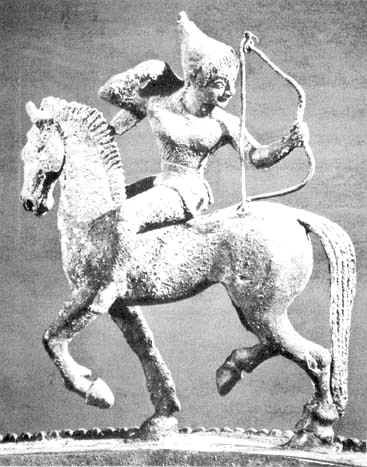
The “Parthian shot.” The Parthians were a people related to the Scythians and other horse-riding groups of Central Asia. That conical hat, too, is found among the Scythians, a people who live in what is presumed to be the Indo-European homeland.