
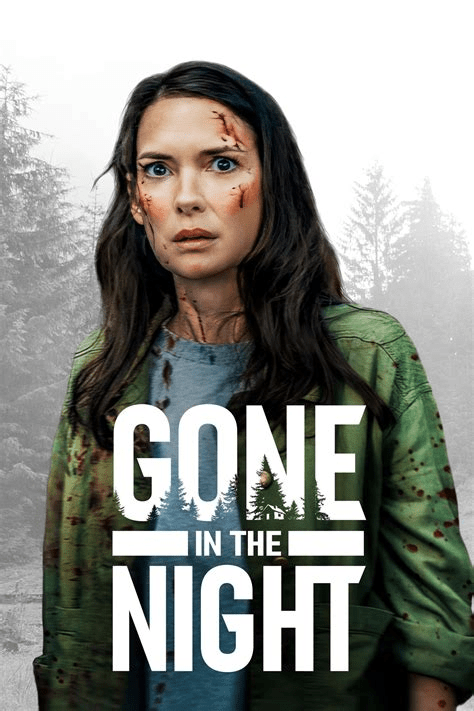
“When Kath and her boyfriend arrive at a remote cabin, they find a mysterious young couple already there. But when her boyfriend disappears with the young woman, Kath becomes obsessed with finding an explanation with the help of an unlikely supporter.”
I checked this 2022 film out of the library so I’d have something to watch while knitting in the evening. I like Winona Ryder, although her character in this film is very different from the beloved Joyce of Stranger Things. As you can see from this cover, she doesn’t look at all like the same person.
This is a mystery/thriller. I won’t give away the plot, except to say that it is disturbing. Instead, I want to talk about the movie’s theme: aging and the way our culture fears it.
Gone does a fabulous job of working the theme into almost every scene. (And, now that I think about it, it’s even arguably present in the title … you wake up and your youth has “gone in the night.”) Some things are very subtle: for example, when the boyfriend (I think his name is Max) gets out of the car to retrieve his hat, the camera lingers on Kath, sitting in the driver’s seat. She opens the mirror on the sun visor and looks at her reflection, then wrinkles her forehead and touches the lines there.
Max is having a beer with a young couple. The woman is flirting with him. She asks how old he is, and he jokingly replies, “Fifty.”
“Fifty? You look good for fifty,” she responds. “You look like you work out.”
“Oh, God, no, I was kidding! I’m not fifty!”
In fact, Kath and Max are both probably closing on 40, or perhaps in their early 40s. They don’t have grey hair or use a walker. They are not old enough to be grandparents. They are middle-aged. Kath seems OK with this. She would be happy to live with “my books, my plants, and have it quiet … forever.” Max, on the other hand, seems to be trying to cling to lost youth. He wants to go to raves and concerts, hike up mountains, and do all the things done by adrenaline junkies in their 20s. He and Kath, since they are not married and don’t have children, are still sort of trying to live in youth culture, but they keep getting messages that they don’t belong.
“How long have you been married?” the twenty-something woman asks Kath.
“What makes you think Max and I are married?”
“Oh! It’s just that people like you are usually either married or alone.”
“What do you mean, ‘people like me’?”
Awkward silence.
In another scene, Kath is following someone. The person leads her to what appears to be a rave happening in an old warehouse. Kath says to bouncer, “I need to get in for a minute. I can pay whatever.”
The bouncer, who is eating a snack, eyes her up and down and then says through a mouthful of food, “Dyahavakidinere or somethin’?”
“What?”
With an eye roll, he clears his mouth, and then articulates very clearly, “Do – you – have – a – kid – in – there?”
Fear of aging – and ultimately, of death – ends up being highly relevant to the plot of Gone. And, really, unless you happen to be a Christian with the certain hope of the resurrection of the body and the life everlasting, how could you not fear it? As Kath says, in a memorable line, “We are all scared.”
 Out of Babel Books