
Behold, the following reconstructed Proto-Indo-European words:
- ekwo- … “horse” equus (Latin), equestrian (English) Perhaps from Proto-Indo-European ōku-, “swift.”
- demə- … “to force,” especially in the sense of “to tame horses.”
- Derivatives: daunt, indomitable, tame
- kwel– … “to revolve, move around; herd stock.”
- Derivatives: Latin colere, to till, cultivate, inhabit; colonus, farmer. Hence, cult, cultivate, culture, colony, colonize.
- Greek telos (from the suffixed form kwel–es), completion of a cycle, consummation, end result. Hence, talisman, teleology, leutospore.
- kw(e)-kwl-o (suffixed reduplicated form of kwel) … “wheel, circle.”
- Derivatives: Old English hwēol, hweogol. Hence, wheel.
- Greek kuklos “wheel” and Latin circulus, “circle.” Hence, circle, cycle, cyclone, etc.
- Sanskrit chakram, “circle or wheel.” Hence, chakra.
- wegh- … “to go or transport in a vehicle” Derivative: wagon
“Chariot racing for sport and ritual purposes was prominent in the culture of many early Indo-European peoples, such as the Indo-Iranians, Greeks, and Irish.”
source: The American Heritage Dictionary of Indo-European Roots, rev. & ed. by Calvert Watkins, pp. xxviii – xxix and 46
Yes indeed, the Indo-Europeans loved their horses.
But they are not the only ones.
The Mongolians love their horses too. And let’s not forget the American Plains Indians. As soon as horses became available to them, some of them (notably the Lakota) re-structured their entire society around them, and began doing amazing things that the Europeans had never dreamt of (at least, not for many generations), such as hanging by their legs off the side of the horse to shoot a moving target with a bow.
Basically, horses are cool and beautiful, and also extremely demanding and high-maintenance. People tend to like them, but bear in mind that you do have to make them the focus of your entire life if you are going to do anything at all with them.
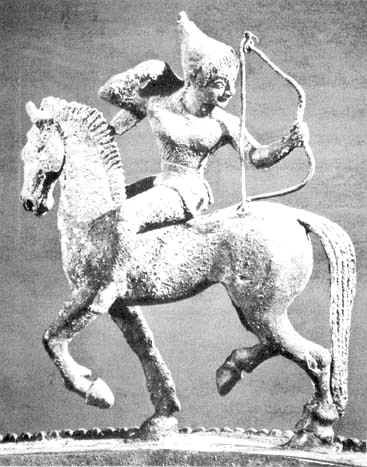
The “Parthian shot.” The Parthians were a people related to the Scythians and other horse-riding groups of Central Asia. That conical hat, too, is found among the Scythians, a people who live in what is presumed to be the Indo-European homeland.
 Out of Babel Books

I had a book on horses when I was a kid. And because of that book I’ve carried “Eohippus” around with me ever since.
LikeLiked by 1 person
itty bitty horse
LikeLike
I love horses. I used to work at a horse theory stable and a lot of the horses and ponies there belong to people who lend them to the stable.
LikeLiked by 1 person
Lucky you!
LikeLike