In my Greco-Fiction project, I have briefly set aside The King Must Die in order to re-read Till We Have Faces. I have to read TWHF for a book club, but I can’t complain, really, because I was one who convinced the book club to read it for our February discussion.
If you have never heard of it, Till We Have Faces is one of C.S. Lewis’s lesser-known novels. The point of view character is a young woman, a princess in the ancient, fictional kingdom of Glome, who is cursed with an ugly face, an abusive father, and a horrible fertility goddess for a religion. Her name is Orual. The first bright spot in Orual’s life is a Greek slave her father captured in war, who becomes her tutor. The second, and much brighter, spot is her younger half-sister Psyche.
The back of the book describes it as a “timeless tale of two princesses–one beautiful and one unattractive.” Naturally, when I first picked it up, then in my late teens, I thought, “Well, I know which one of these I will identify with!” Like probably every young woman, I expected to have a grand time wallowing in self-pity on behalf of the ugly princess. However, this is not that kind of story. Orual is not envious of Psyche’s beauty. The jealousy she feels is of a very different kind.
I don’t want to give away the events of the story, because you should definitely read it. However, I do want to post a long passage from the book. This passage is very important thematically, and in terms of Orual’s character development, even though it is not an action scene.
When we topped [the ridge], and stood for a while to let the horse breathe, everything was changed. And my struggle began.
We had come into the sunlight now, too bright to look into, and warm (I threw back my cloak). Heavy dew made the grass jewel-bright. The Mountain, far greater yet also far further off than I expected, seen with the sun hanging a hand-breadth above its topmost crags, did not look like a solid thing. Between us and it was a vast tumble of valley and hill, woods and cliffs, and more little lakes than I could count. To the left and right, and behind us, the whole coloured world with all its hills was heaped up and up to the sky, with, far away, a gleam of what we call the sea. There was a lark singing; but for that, huge and ancient stillness.
And my struggle was this. You may well believe that I had set out sad enough; I came on a sad errand. Now, flung at me like frolic or insolence, there came as if it were a voice–no words–but if you made it into words it would be, “Why should your heart not dance?” It’s the measure of my folly that my heart almost answered, “Why not?” I had to tell myself over and over like a lesson the infinite reasons it had not to dance. My heart to dance? Mine whose love was taken from me, I, the ugly princess who must never look for other love, the drudge of the King, perhaps to be murdered or turned out as a beggar when my father died? And yet, it was a lesson I could hardly keep in my mind. The sight of the huge world put mad ideas into me, as if I could wander away, wander forever, see strange and beautiful things, one after the other to the world’s end. The freshness and wetness all about me made me feel that I had misjudged the world; it seemed kind, and laughing, as if its heart also danced. Even my ugliness I could not quite believe in. Who can feel ugly when the heart meets delight? It is as if, somewhere inside, within the hideous face and bony limbs, one is soft, fresh, lissom and desirable.
Was I not right to struggle against this fool-happy mood? What woman can have patience with the man who can be yet again deceived by his doxy’s fawning after he has thrice proved her false? I should be just like such a man if a mere burst of fair weather, and fresh grass after a long drought, and health after sickness, could make me friends again with this god-haunted, plague-breeding, decaying, tyrannous world.
Spain, rewon from Carthage, had to be kept under control lest Carthage should win it again; besides, it was rich in iron, silver and gold. The Senate exacted from it a heavy annual tribute, and the Romans governors reimbursed themselves liberally for spending a year away from home … Tiberius Sempronius Gracchus (179) adjusted his rule sympathetically to the character and civilization of the native population, made friends of the tribal chieftains, and distributed land among the poor. But one of his successors, Lucius Lucullus (150) lured 7000 natives to his camp by a treaty promising them land; when they arrived he had them surrounded and enslaved or massacred. … The rebellious Celtiberians of central Spain bore a siege of fifteen months in Numantia, living on their dead; at last (133) Scipio Aemilianus starved them into surrender. In general the policy of the Roman Republic in Spain was so brutal and dishonest that it cost more than it paid. “Never,” said Mommsen, “had war been waged with so much perfidgy, cruelty, and avarice.”
Gardy was essentially convicted the day he was arrested, and his trial is only a formality. The dumb and desperate cops trumped up the charges and fabricated the evidence. The prosecutor knows this but has no spine and is up for reelection next year. The judge is asleep. The jurors are basically nice, simple people, wide-eyed at the process and ever so anxious to believe the lies their proud authorities are producing on the witness stand.
-from Rogue Lawyer, 2016, by a very lazy version of John Grisham
I’m thinking of having a little contest. Who can find a paragraph crammed with the greatest number of offensive, lazy cliches? This is my submission. This is only the second half of the paragraph, but even if I had included the first two sentences, I still think you’d be hard-pressed to find another piece of writing where not a single word is wasted on any original thought.
demə- … “to force,” especially in the sense of “to tame horses.”
Derivatives: daunt, indomitable, tame
kwel– … “to revolve, move around; herd stock.”
Derivatives: Latin colere, to till, cultivate, inhabit; colonus, farmer. Hence, cult, cultivate, culture, colony, colonize.
Greek telos (from the suffixed form kwel–es), completion of a cycle, consummation, end result. Hence, talisman, teleology, leutospore.
kw(e)-kwl-o (suffixed reduplicated form of kwel) … “wheel, circle.”
Derivatives: Old English hwēol, hweogol. Hence, wheel.
Greek kuklos “wheel” and Latin circulus, “circle.” Hence, circle, cycle, cyclone, etc.
Sanskrit chakram, “circle or wheel.” Hence, chakra.
wegh- … “to go or transport in a vehicle” Derivative: wagon
“Chariot racing for sport and ritual purposes was prominent in the culture of many early Indo-European peoples, such as the Indo-Iranians, Greeks, and Irish.”
source: The American Heritage Dictionary of Indo-European Roots, rev. & ed. by Calvert Watkins, pp. xxviii – xxix and 46
Yes indeed, the Indo-Europeans loved their horses.
But they are not the only ones.
The Mongolians love their horses too. And let’s not forget the American Plains Indians. As soon as horses became available to them, some of them (notably the Lakota) re-structured their entire society around them, and began doing amazing things that the Europeans had never dreamt of (at least, not for many generations), such as hanging by their legs off the side of the horse to shoot a moving target with a bow.
Basically, horses are cool and beautiful, and also extremely demanding and high-maintenance. People tend to like them, but bear in mind that you do have to make them the focus of your entire life if you are going to do anything at all with them.
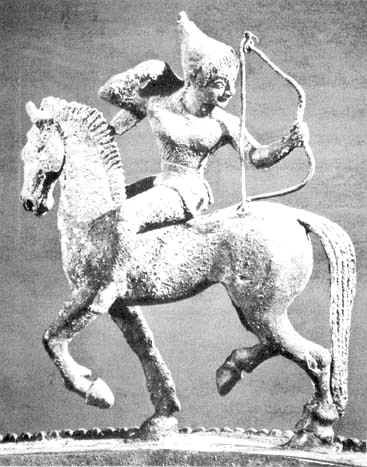
The “Parthian shot.” The Parthians were a people related to the Scythians and other horse-riding groups of Central Asia. That conical hat, too, is found among the Scythians, a people who live in what is presumed to be the Indo-European homeland.
In 146 the cities of the Achaean League [in Greece] announced a war of liberation [from Rome]. Leaders of the poor seized control of the movement, freed and armed the slaves, declared a moratorium on debts, promised a redistribution of land, and added revolution to war. When the Romans under Mummius entered Greece they found a divided people and easily overcame the undisciplined Greek troops. Mummius burned Corinth, slew its males, sold its women and children into bondage, and carried nearly all its movable wealth and art to Rome. Greece and Macedon were made into a Roman province under a Roman governor; only Athens and Sparta were allowed to remain under their own laws. Greece disappeared from political history for two thousand years.
As part of my ongoing, yearlong foray into fiction set in the ancient Mediterranean, I am now re-reading Mary Renault’s The King Must Die. There is so much history and speculation packed into this book, that I make free to do a series of posts on different topics from it, en route to the final book review. So, buckle up! I hope you like ancient historical fiction! (And, since you are visiting Out of Babel Books, I assume you at least don’t hate it!) Today’s topic is Renault’s theme of the two conflicting cultures of Hellenes vs. what they call the “Shore People.”
On the timing of the Theseus story
I have always had the impression that the story of Theseus was one of the older historical myths. It happens when Knossos, on Crete, is still a thriving city. So, in my mind, I put it a few generations before the Iliad. Madeline Miller, author of Circe, seems to agree. In her book, Circe hears of Theseus having killed the Minotaur well before Odysseus comes to land on her island.
If you do the math, Theseus living before the Odyssey would also put him living before Agamemnon returns from the war at Troy and is slaughtered in his bath by his wife, Clytemnestra. In the play Agamemnon (written, of course, much later), Clytemnestra kills her husband in revenge for his having sacrificed their thirteen-year-old daughter before he sailed for Troy, in addition to a couple of other grudges. Like most women, I find it hard not to think Clytemnestra has a case.
Renault, however, takes a different tack. She has a teenaged Theseus hear the following story from a bard:
The song he gave us was the Lay of Mycenae: how Agamemnon the first High King took the land from the Shore Folk, and married their Queen. But while he was at war she brought back the old religion, and chose another king; and when her lord came home she sacrificed him, though he had not consented. Their son, who had been hidden by the Hellenes, came back when he was a man, to restore the Sky Gods’ worship and avenge the dead. But in his blood was the old religion, to which nothing is holier than a mother. So, when he had done justice, horror sent him mad, and the Night’s Daughters chased him half over the world.
ibid, p. 40 in my copy
So here we have Agamemnon, Clytemnestra, their son Orestes, and the Furies. At the same time, this passage raises some questions.
The Shore People and Their Appearance
The Shore People make their appearance on the very first page of The King Must Die.
Our house is Hellene, sprung from the seed of Ever-Living Zeus. We worship the Sky Gods before Mother Dia and the gods of the earth. And we have never mixed our blood with the blood of the Shore People, who had the land before us.
-ibid, p. 1
As the story progresses, it rapidly becomes obvious that the Hellenes have, in fact, mixed their blood with the blood of the Shore People. There is the story of Agamemnon, above; Theseus is said to be “blonde and blue-eyed like the Hellenes, but small and wiry like the Shore People,” and Theseus, who is very promiscuous, even has a child who “came out small and dark, but so was [his mother’s] brother.”
So we have two populations, one that is native to the Greek coastlands (or at least has been there a long time), and one that came there from the steppes. Theseus’s grandfather explains to him their ethnic history, which he got from his own grandfather:
“Long ago, he said, our people lived in the northland, beyond Olympos. He said, and he was angry when I doubted it, that they never saw the sea. Instead of water they had a sea of grass, which stretched as far as the swallow flies, from the rising to the setting sun. They lived by the increase of their herds, and built no cities; when the grass was eaten, they moved where there was more. … When they journeyed, the barons in their chariots rode round about, guarding the flocks and the women … [Lord Poseidon] told the King Horse, and the King Horse led them. When they needed new pastures, they let him loose; and he, taking care of the people as the god advised him, would smell the air seeking food and water. The barons followed him, to give battle if his passage was disputed; but only the god told him where to go.”
ibid, pp. 16 – 17
This is a description of the Indo-European lifestyle and homeland. The Indo-Europeans took their reverence for the horse, and their wheeled carts and chariots, with them wherever they went, including to Scandinavia. So the Hellenes are Indo-European, and the Shore People, presumably, Hamitic or Semitic.
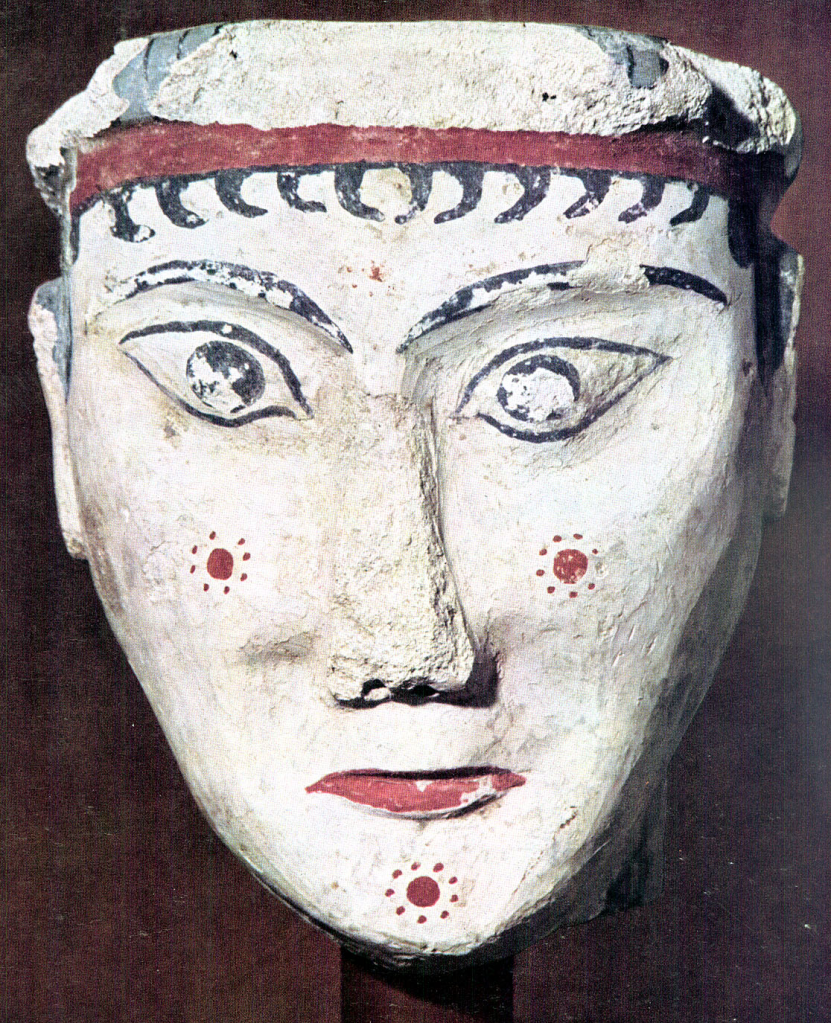
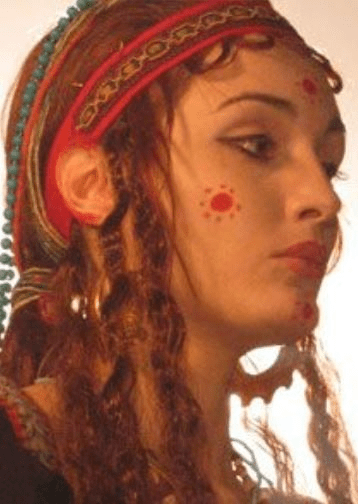
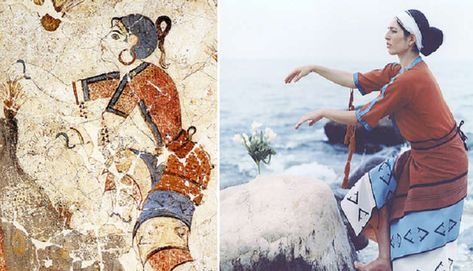
The mask at the top of this post is Mycenaean. Mycenae is located in the Peloponnesian Peninsula, which is also the location of Troizen, Theseus’s home. The ancient Mycenaean culture, older than classical Greece, took its cues from the Cretan urban culture of the time. In later Greece, you get men wearing himations and women wearing finely woven chitons. This is usually how Helen of Troy, for example, is illustrated. However, she probably looked more like the Mycenaean and Cretan women. Here is someone’s attempt to reconstruct the probable hairstyle and costume of the most beautiful woman in the world:
Notice the Egyptian-style, kohl-lined eyes, and the red suns for makeup. Helen might have been blonde, being a Hellene, but her clothing was perhaps more like this.
Here is someone else, reconstructing a traditional Mycenean costume and pose:
I’m guessing these fashion choices came from the Shore People.
Theseus’s mother is described as wearing this ancient Mycenaean style. She wears a tiered, flounced skirt hung with charms, exposed breasts (what was going on, Crete and Mycenae?) and hair that is curled by the use of “crimping braids” (probably to attain a very curly look for those who do not, like the Shore People, have it naturally). Though a blonde Hellene, she is a priestess of the mother goddess, and so she takes some of her cues from the Shore People, and here is where we find the tension.
The Shore People and Their Religion
Both the Hellenes and the Shore People practice the sacrifice of their kings. However, there is a difference. For the Hellenes, it does not come on a regular schedule. Theseus’s grandfather explains:
“When the work of the King Horse was done, he was given to the god … And in those days, said my great-grandfather, as with the King Horse, so with the King. When the king was dedicated, he knew his moira [i.e. doom]. In three years, or seven, or nine, or whenever the custom was, his term would end and the god would call him. And he went consenting, or else he was no king, and no power would fall on him to lead the people. And the custom changes, Theseus, but the token never. … Later the custom altered. They ceased to offer the King at a set time. They kept him for the extreme sacrifice … And it was no one’s place to say to him, ‘It is time to make the offering.’ He was the nearest to the god, because he had consented to his moira; and he himself received the god’s commandment. And so it is still, Theseus. We know our time. … It is not the sacrifice … it is not the bloodletting that calls down power. It is the consenting, Theseus. The readiness is all.”
ibid. pp. 18 – 19
This might explain why so many kurgan burials are of high-born individuals who seem not to have died of old age.
It also, of course, explains the title of the book.
Meanwhile, it has been established that the Shore People do things a different way: “old laments have come down from the Shore People, of young heroes who love a goddess for a year, and foreknow their deaths” (p. 37). In other words, the Shore People treat their king primarily as the goddess or priestess’s consort, and kill him after just a year.
Marija Gimbutas has tried to make the case that the Shore People practiced a gentle, feminine, goddess-worshipping religion, and that they were cruelly exterminated by the warlike, sky-god worshipping evil Indo-Europeans. Renault is not going to paint with such a broad brush. Realistically, she shows both groups living next to one another and influencing each other. Also, throughout the course of the story, she is going to show by increasingly vivid illustrations that these two cultural systems are absolutely incompatible with each other. And that the mother-worship, in the end, is at least as bloody as the worship of Zeus.
Renault’s take on the story of Agamemnon is a great illustration of this. She interprets the story as a conflict between Clytemnestra’s mother-goddess culture and Agamemnon’s sky-father culture. When Clytemnestra brings back the “old religion,” it means that Agamemnon must die–not in battle, not some day, but now, and actually, yesterday. It means that Orestes is doubly cursed. He has loyalty to both religions, with their incompatible demands, and he is put at the mercy of the furies, the representatives of the goddess-religion. They chase him because he killed his mother, but if we string out the implications, even if he had not, they would probably be chasing him anyway. After all, he is a male heir to the throne, so his days are definitely numbered. Behold, the kindness of the religion of the goddess.
Obviously, there are some universal truths and some redemptive metaphors here, hidden under a thick layer of occultism, war between the sexes, and general pain and suffering for everyone. It is going to take a much greater King than Theseus to cut this difficult knot.
Seasonal Postscript
Oh, and Happy Valentine’s Day to everyone! Such a romantic post, I realize.
In summary, the typical educated Roman of this age was orderly, conservative, loyal, sober, reverent, tenacious, severe, practical. He enjoyed discipline, and would have no nonsense about liberty. He distrusted individuality and genius. He had none of the charm, vivacity, and unstable fluency of the Attic Greek. He admired character and will as the Greek admired freedom and intellect; and organization was his forte. He lacked imagination, even to make a mythology of his own. He could with some effort love beauty, but he could seldom create it. He had no use for pure science, and was suspicious of philosophy as a devilish dissolvent of ancient beliefs and ways. He could not, for the life of him, understand Plato, or Archimedes, or Christ. He could only rule the world.

 Out of Babel Books


