
First, it puts out a really tall “chick.”

Let’s zoom in on the top of that rosette.
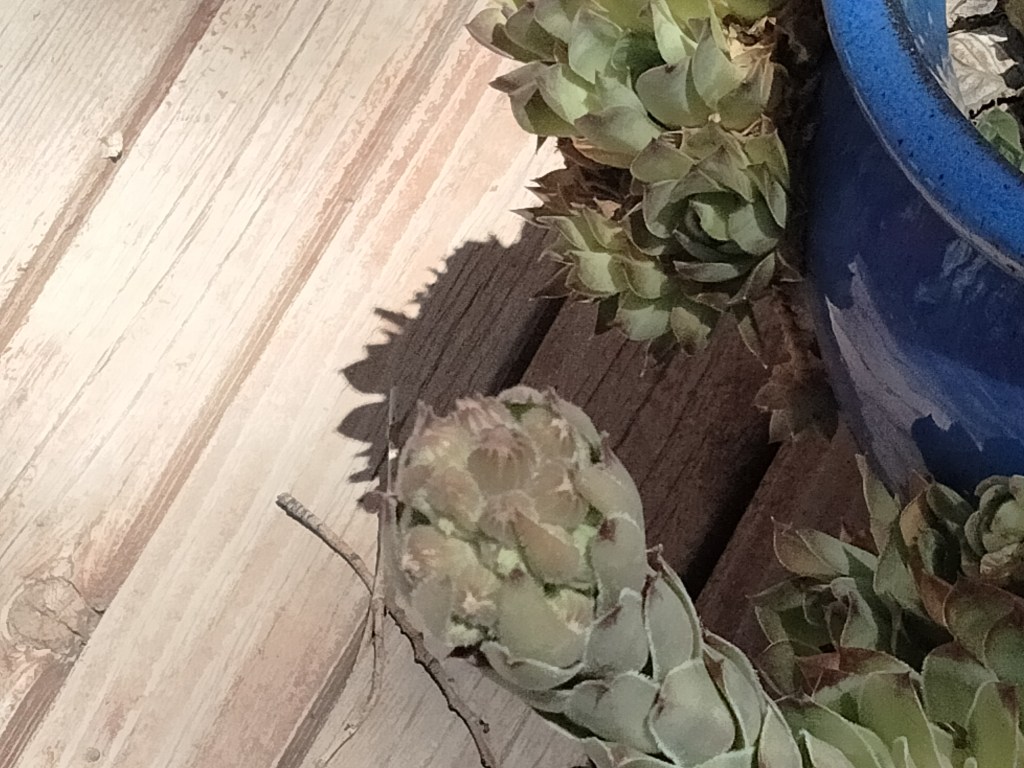
It seems to be packed with waiting flowers.

Update: it now looks like this. Terrifying. Maybe Sigourney Weaver could help me with this.

First, it puts out a really tall “chick.”
Let’s zoom in on the top of that rosette.
It seems to be packed with waiting flowers.
Update: it now looks like this. Terrifying. Maybe Sigourney Weaver could help me with this.

Here I am at Sage Wall, to give you some idea of the scale.
Sage Wall is a possible megalithic site near Butte, Montana. In this post, I am going to thoroughly embarrass my geologist husband by saying that Sage Wall looks manmade to me. But first, how did I come to visit Sage Wall in person?
It’s on my bucket list to visit as many archeological sites as a I can, the older the better. Sage Wall was a no-brainer because it’s only a half a day’s drive from my house. It is also a good candidate to visit because looking at photos is kind of ambiguous. To really get a sense of whether it seems manmade or like a natural formation, I felt I had to be there in person.
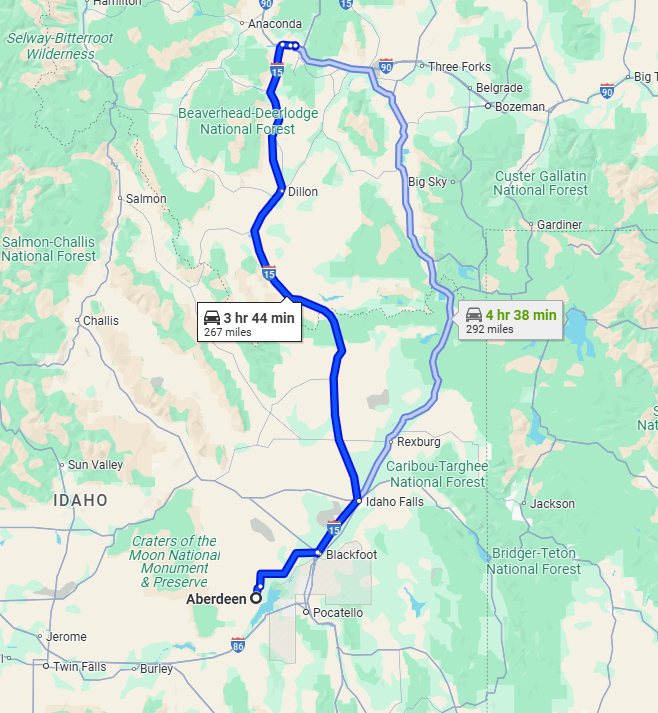
We drove up into the beautiful Montanan Pioneer Mountains (Idaho has some as well), stayed the night in Butte, and the next day, made our way to Sage Mountain Center, where I had a reservation. We could not have asked for a more beautiful day, weather-wise. Early June in the Butte area is still basically Spring.
Chris and Linda are the property owners at Sage Mountain. About three decades ago, they wanted to move out to the middle of nowhere and build a sustainable house and retreat center. They were not looking for megaliths. Linda stumbled upon the wall on a hike one day, and Chris, who has a background in building, looked at it, said, “Yep. That doesn’t look natural. Well, let’s get back to our projects.” It wasn’t until years later, when they had established a sustainability-themed retreat center and had started to create some hiking trails for their guests, that other people started noticing the wall. Chris and Linda cleared the brush around the wall, roped it off, and had it examined by LIDAR and ground-penetrating radar.
Now, many people are coming to see the wall, seemingly to a point where it is almost becoming a problem. Sage Mountain Center is still on a wind-y, washboard-y dirt road, but now many people, seeking to get away from it all, have built new houses and cabins along that same road. Chris asked us, as we drove out, not to “go too fast past our neighbors. We’re trying not to bother them.” I got the impression that his main desire is still to just run a sustainability B&B in peace, but he’s been saddled with this danged wall.
I want to give the skeptical geologists their due here. I think what they would say is this: “All these people who are saying Sage Wall is amazing megalithic structure are forgetting one thing: It is right in the middle of the Boulder Batholith! There are big granite rocks everywhere!”

source: formontana.net
They are not wrong. The mountains to the east of Butte, where Sage Mountain Center is located, are strewn with large granite boulders and outcroppings. These tend to fracture into shapes resembling worked blocks of stone.
Here are some pictures I took, on the way in, of natural granite outcroppings so you can see how they normally look and how they tend to fracture:
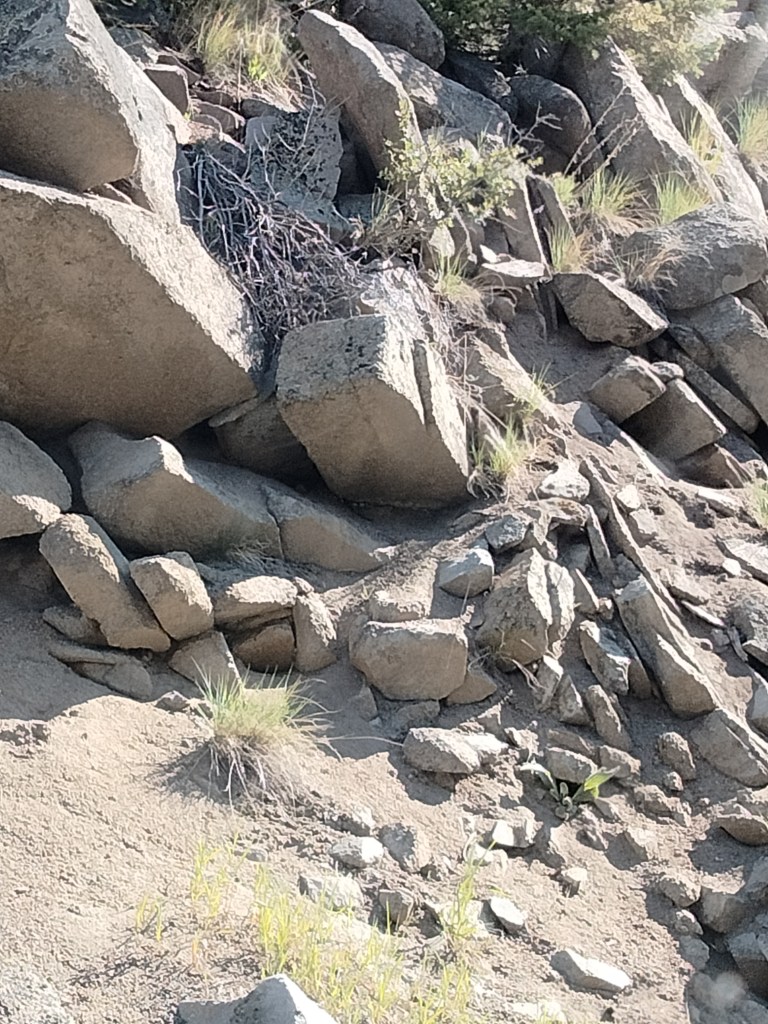

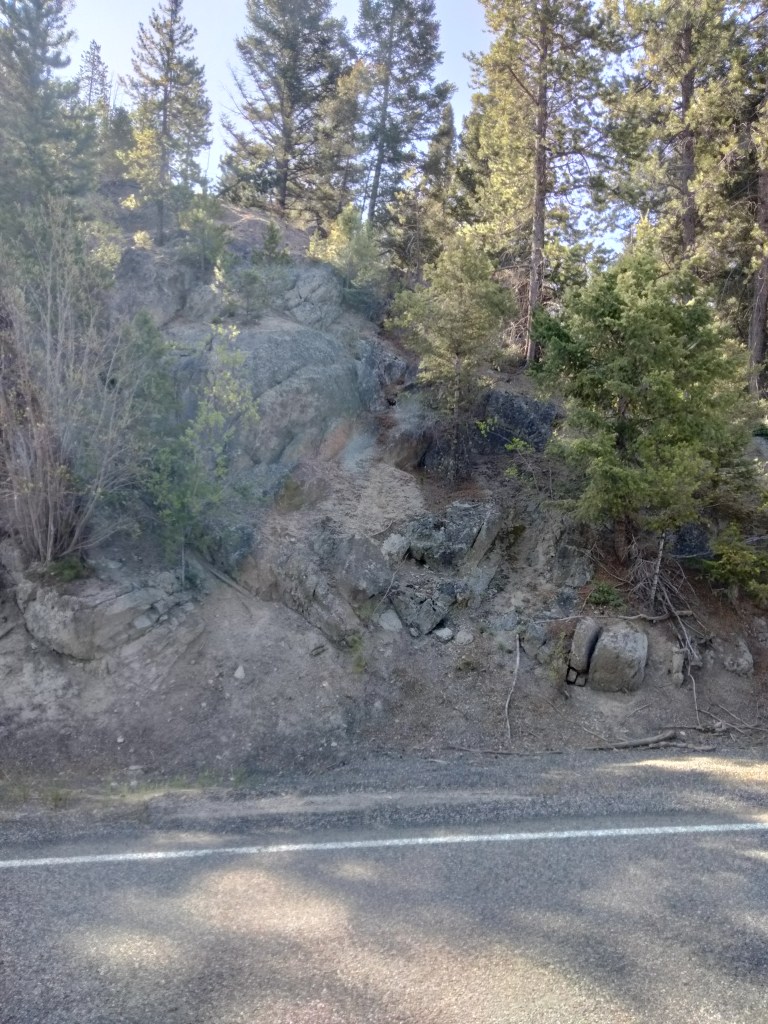
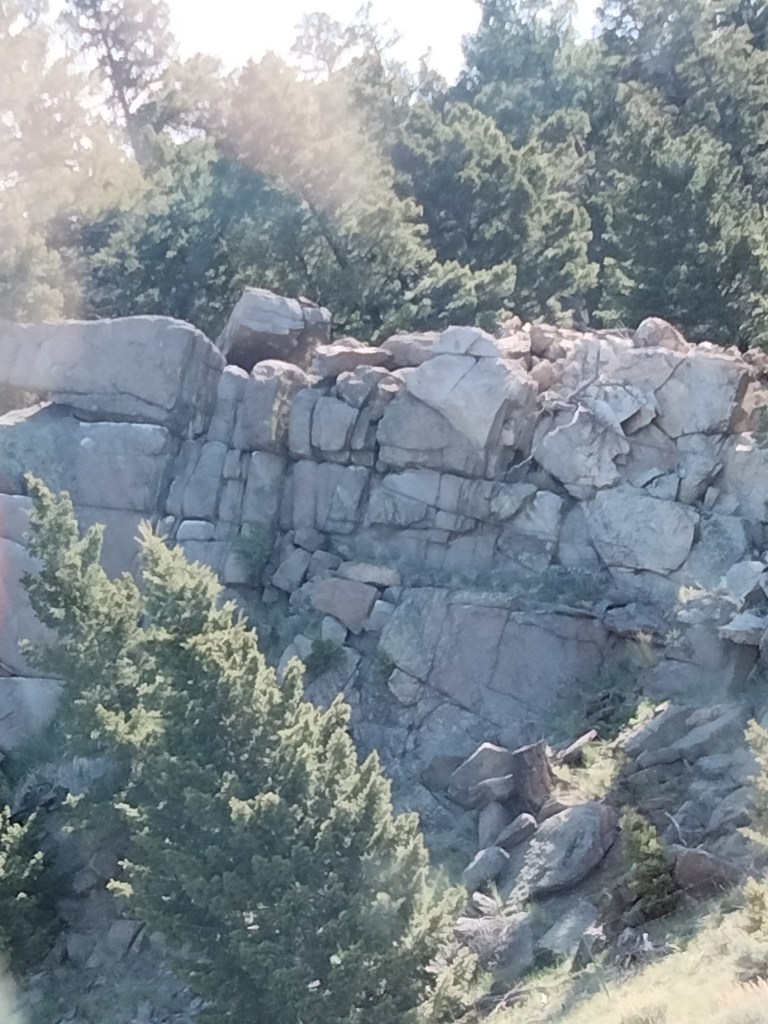
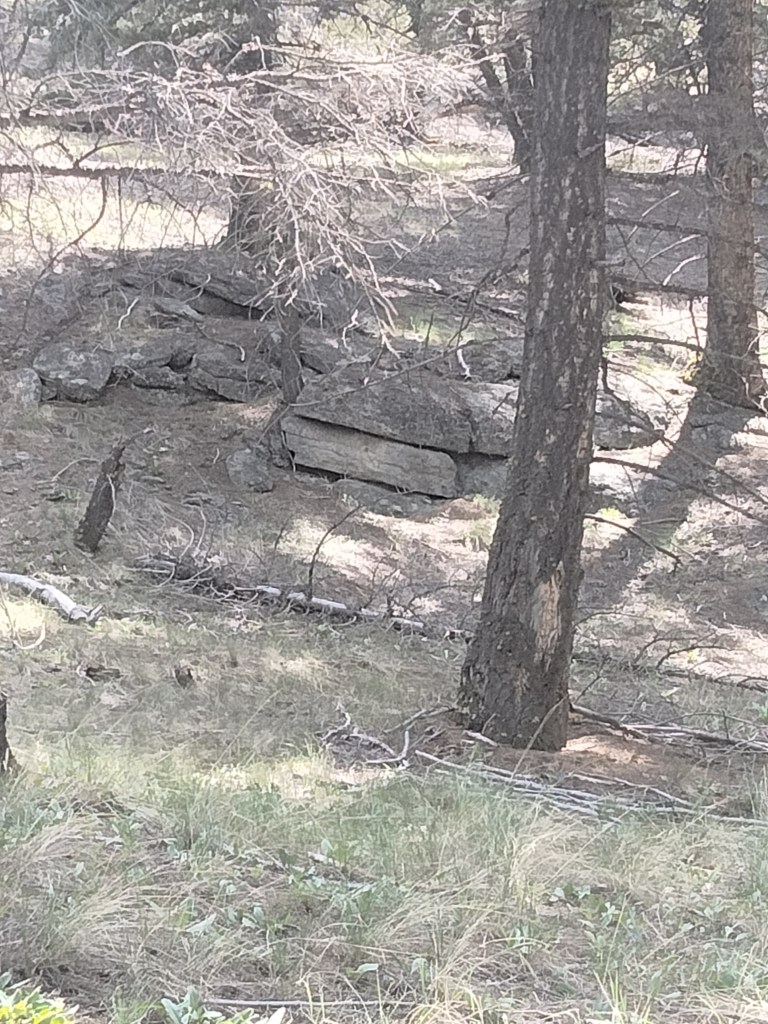
You can see that the fractures are often horizontal and strikingly block-like.
We also saw some pieces of granite that had very large quartz crystals formed in them, which stuck out like chips in a chocolate chip cookie:

And, just for fun, here’s a balanced rock:
I’m not sure whether this balanced rock is natural, but I’m leaning towards no. I’m thinking it was put there to mark the trail.
Anyway, the skeptics are correct that the presence of big, blocky rocks does not an ancient megalithic structure make. This is part of the reason I wanted to see Sage Wall myself. I did not take any videos of it, because I’m not good with video and didn’t have a script ready. But there are now many videos of Sage Wall online, including drone videos. I’ll try to embed some of them at the end of this post.
So no, the claim is not that this must be a megalithic structure because it is located somewhere that we would not expect rocks. It is definitely surrounded by rocks. However, it looks distinctly different from the more random rock outcroppings around it.
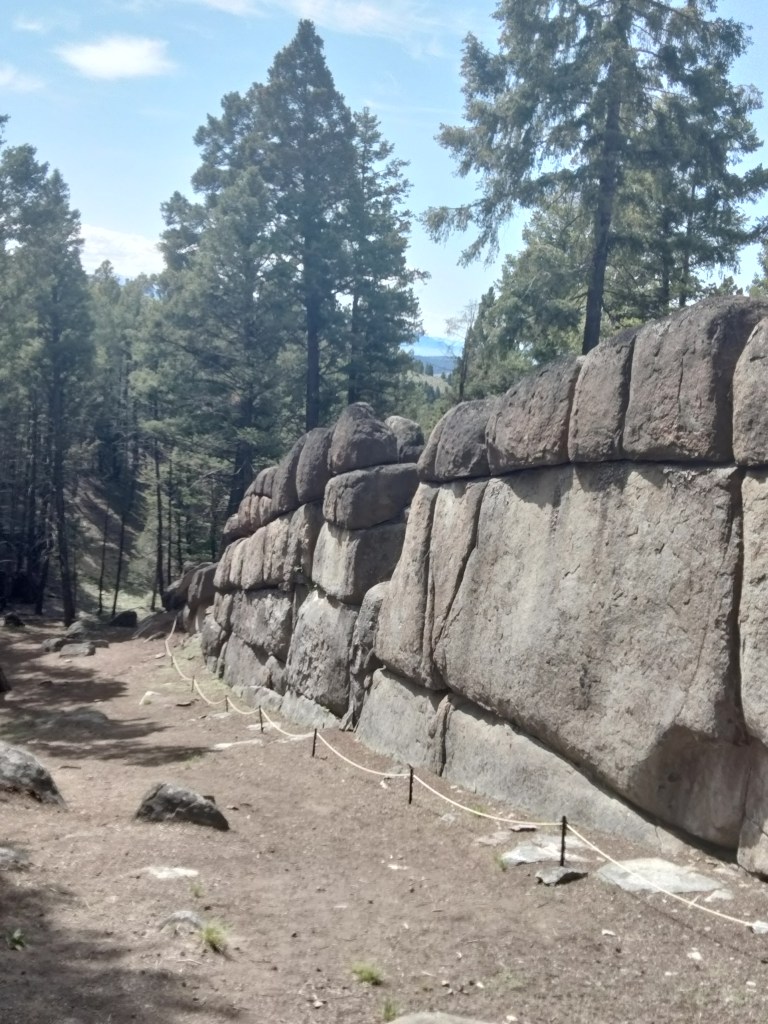
It is very long, and very straight. (The wall extends past the Sage Mountain Center property, but only their section of it has been cleared.)
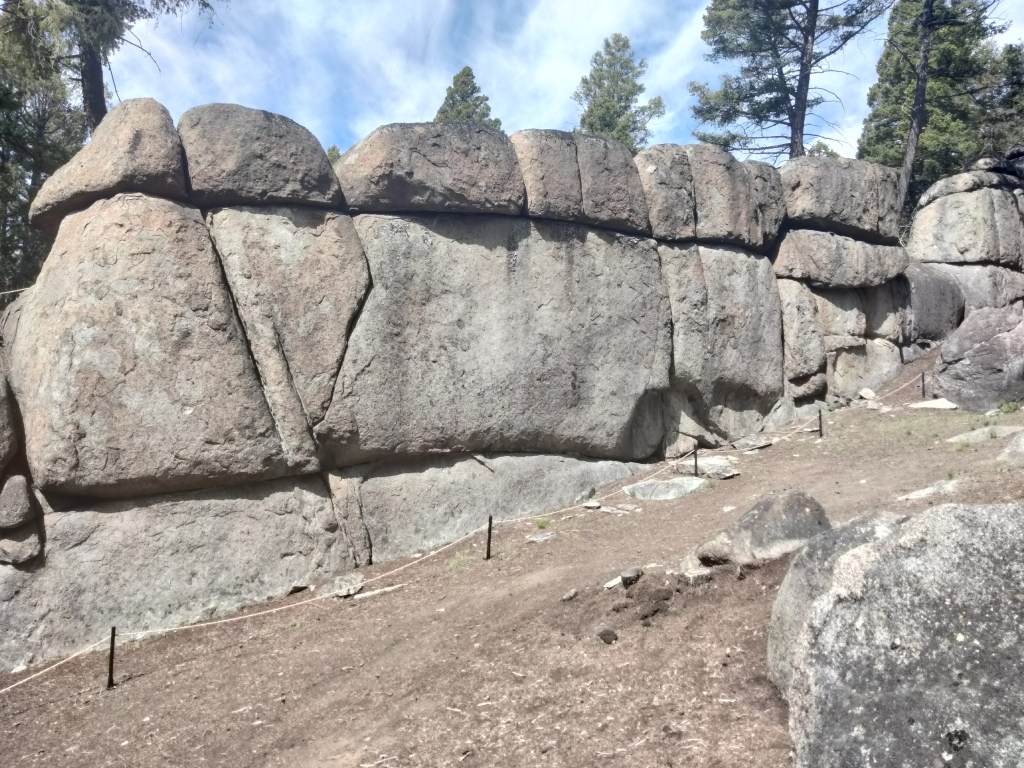
Unlike what we see with other fracturing patterns, the wall consist of very big blocks laid out in what appear to be courses. To my (again, amateur) eye, when we see natural fracturing the blocks tend to fracture into smaller pieces where they are exposed.
In the pictures above (and in the one where I’m posing), you can see a hollow lower down in the wall where a block obviously fell out.

At three different places in the exposed section of the wall, there are gaps in the top similar to doors. Chris told us there had been a lot of speculation about these before researchers realized that they were simply places where boulders had fallen out. In fact, you can see the boulders below them, almost completely buried in dirt and pine duff.
On the picture above, you can also see the remains of a triangular shape. The left side of the triangle is made with shaped blocks, and the right side is incised into the megalith. The triangle happens to frame the gap where a block fell out.
According to Chris, the geophysicist who examined the wall with ground-penetrating radar found that it goes down into the ground about another 20 feet. At the bottom was something that reflected the radar, as it might be a floor or stone foundation.
All of this research is shortly to be posted on the wall’s website, here or possibly here.

Parallel to the wall are the fallen remains of what appears to be another wall. You can see that it is “fractured” in the same way, and these other blocks also have some of the nub and cup features that we’ll talk about below.

Here’s a bit of the second wall, seen end-on.
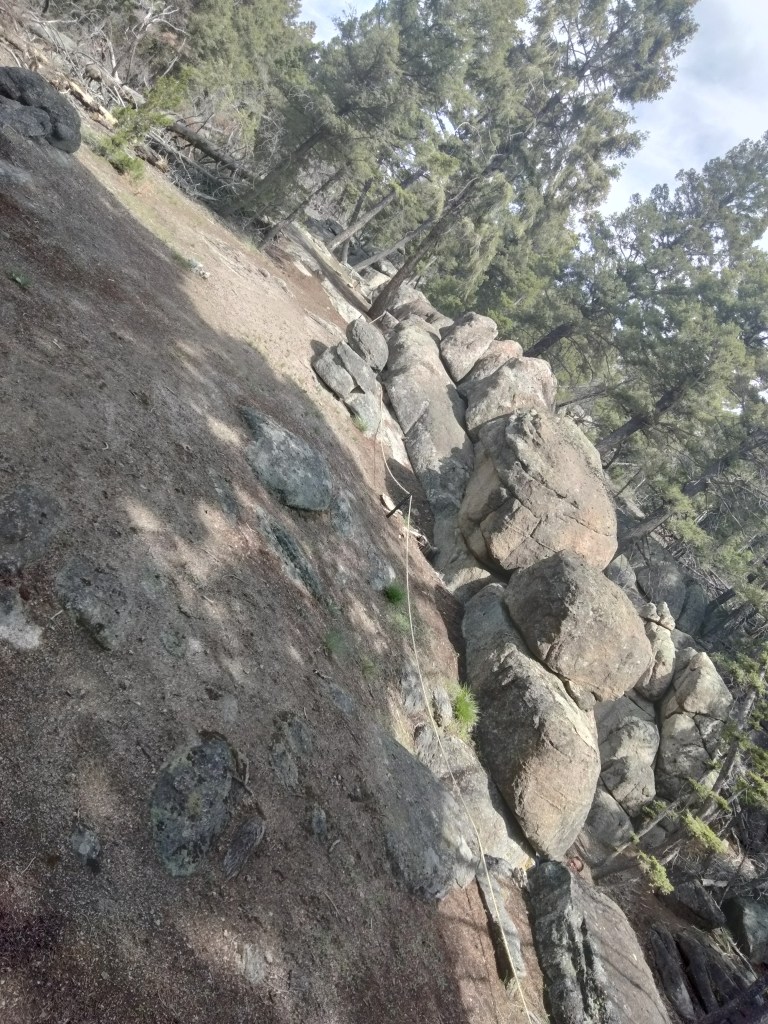
Here’ a view behind the more intact wall. Chris and Linda have installed a rope that allows visitors to climb up behind the wall. As you can see, the wall is not just part of a cliffside, but it does have earth and rocks filled in behind, either as terraces/a retaining wall, or the ravages of time.
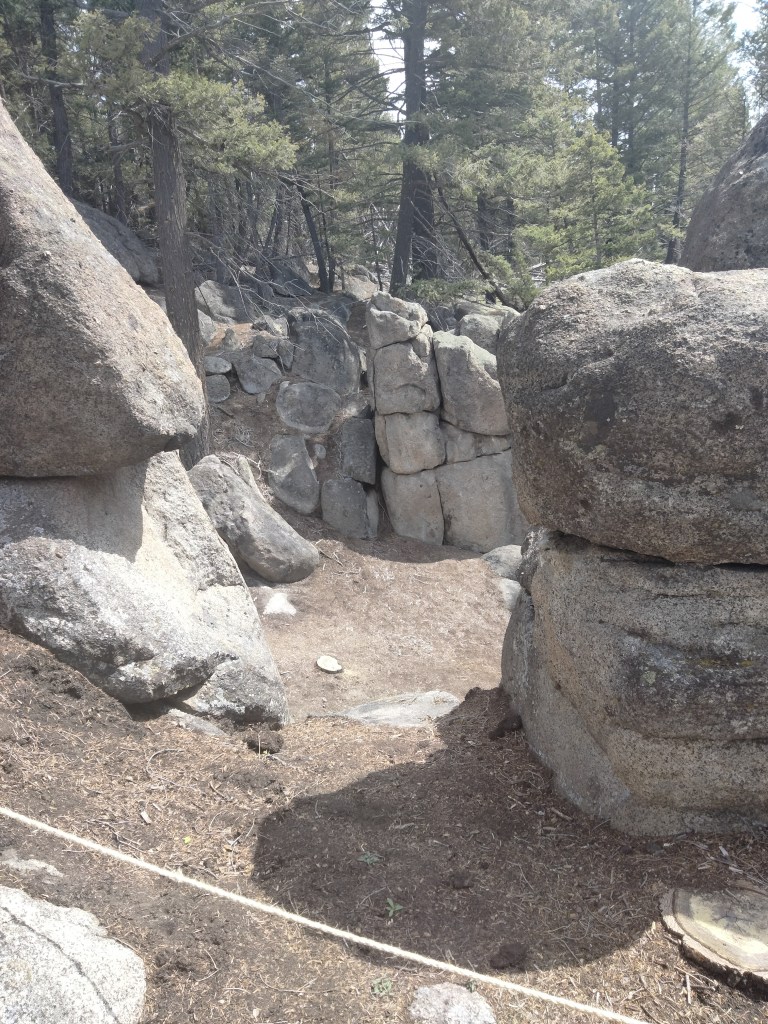
From behind the wall, we look out through a gap left by a fallen stone across the avenue at the remains of the second wall.
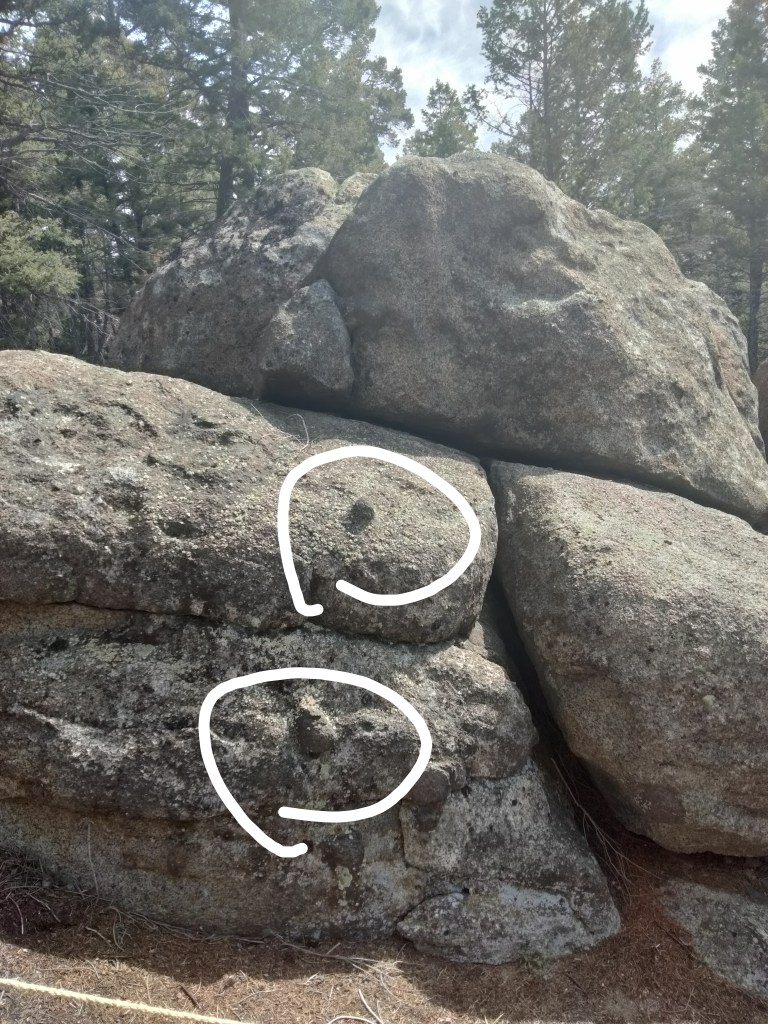
Getting close to the top of the wall allows us to see what might be nubs and cups.
Stone nubs and cups (not necessarily corresponding to each other) are sometimes features of megalithic architecture in other parts of the world.
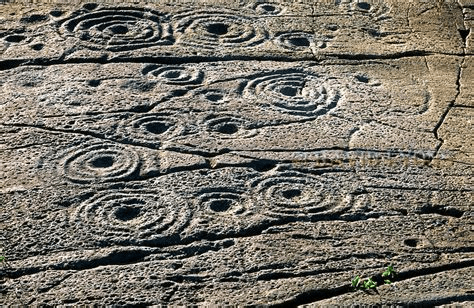
“Cup and ring” markings are apparently found all over the world, but especially in Northern Europe. Here are two articles about them.
Stone nubs or knobs are also found, especially in Incan or pre-Incan megalithic architecture.
Here are some nubs found on top of the intact wall.
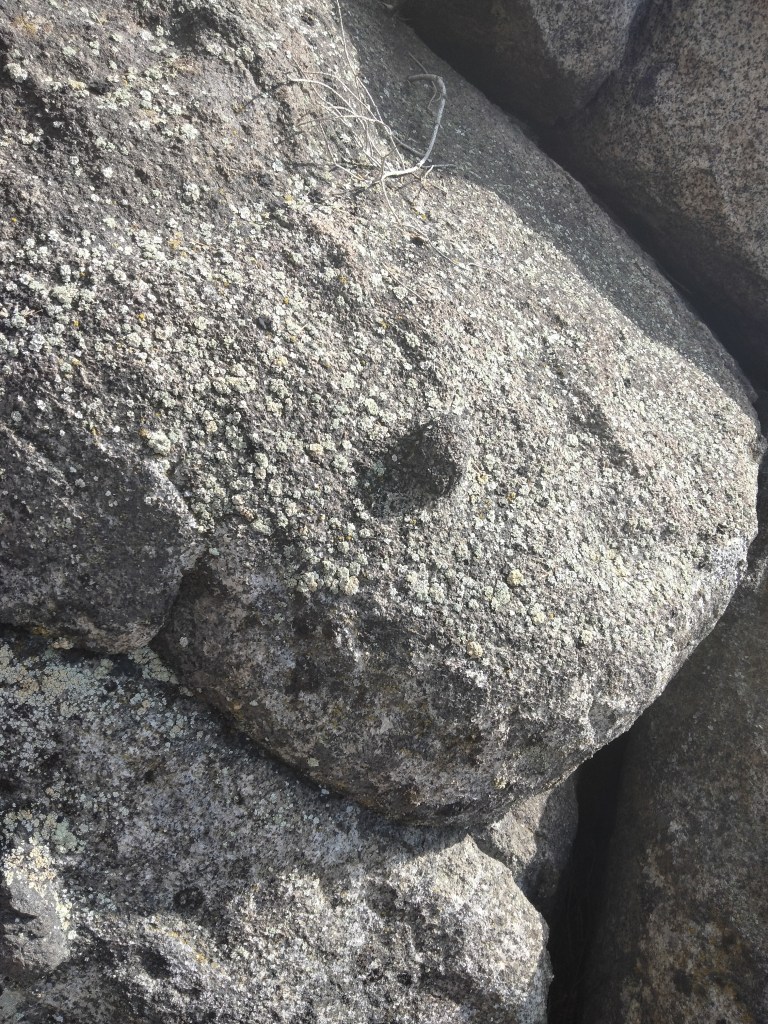

They are not the same as the pieces of quartz sticking out of the natural stone that we photographed earlier.
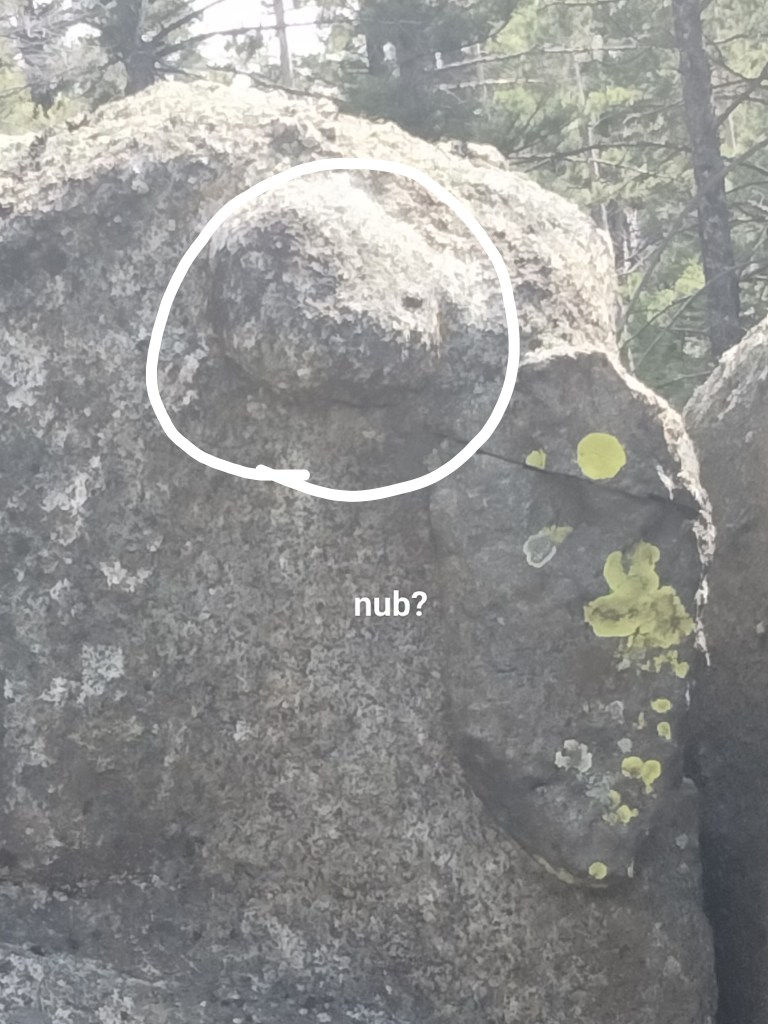
Because the wall is so weathered, some of them are not certain.
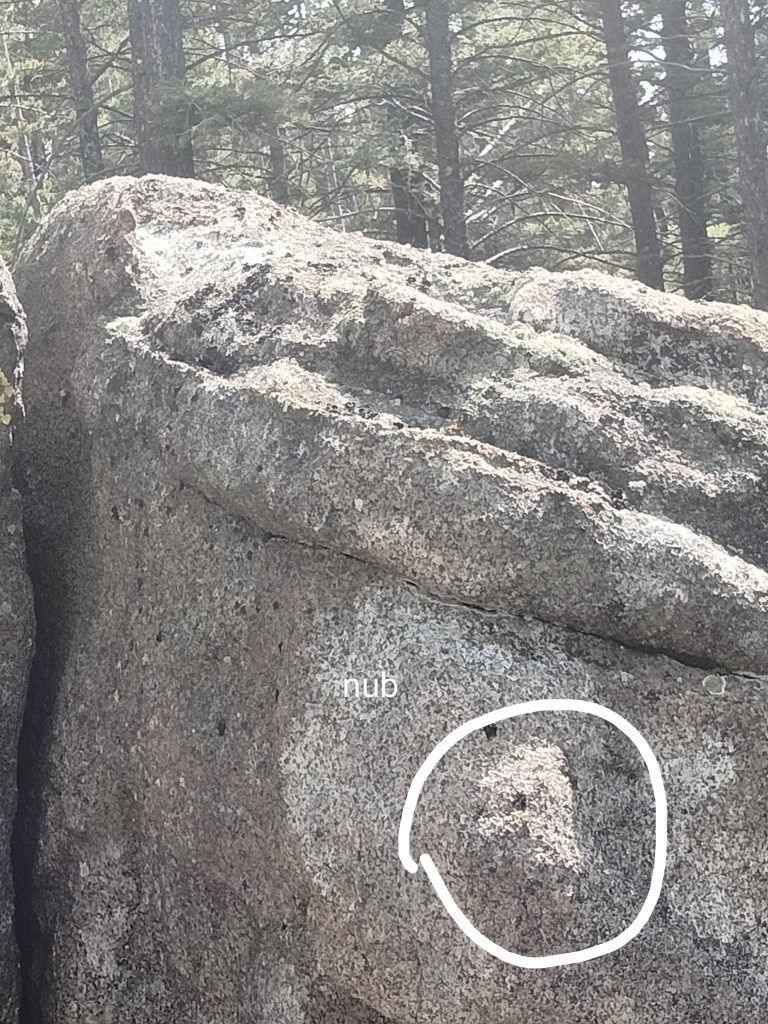
Note the possible incised lines above this last nub.
Here are some other things we saw on the back of the wall:


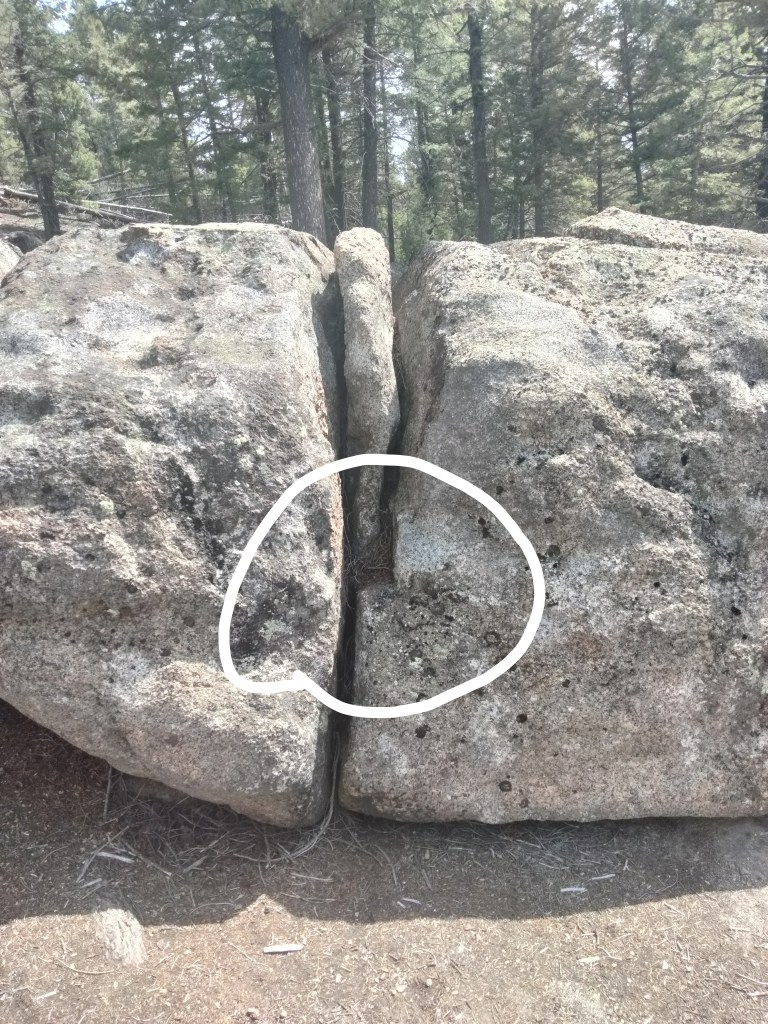
Suspiciously square fracture line
On the fallen wall as well, we found some things that look like nubs, and some possible cups. As a nod to the skeptics, yes, these “cups” do look like they could have been caused by water erosion. This would be especially true if they were found under a waterfall or a persistent drip, which they are not, as far as I can see. Some of them are also suspiciously round.

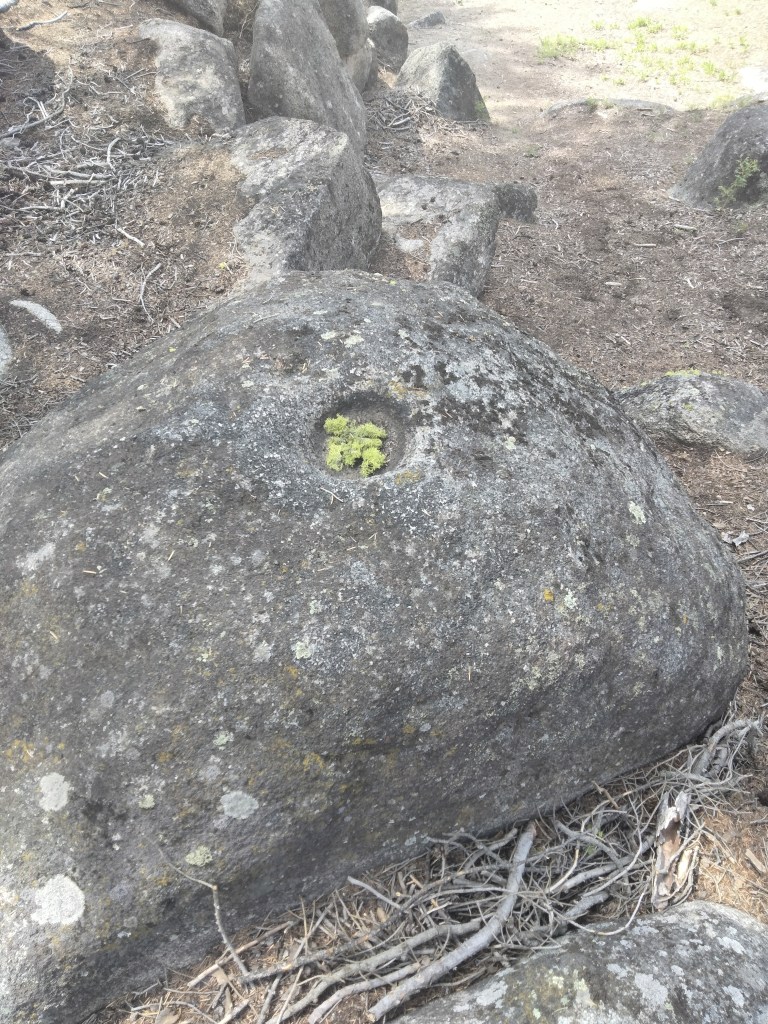
Some also have very straight lines incised near them. My son suggested they could be a water feature.

Looks like a cup with a spout
As we hiked away from Sage Wall, I took care to photograph natural rock formations for comparison. Not very far from the walls, I saw something that also looked like nubs.
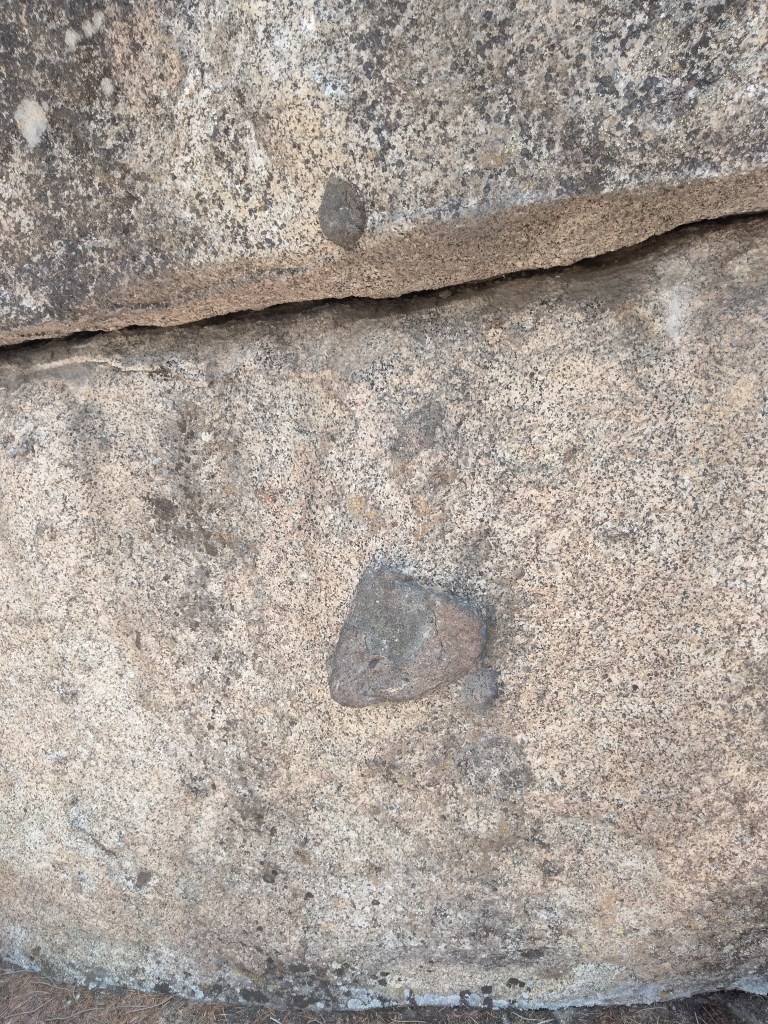
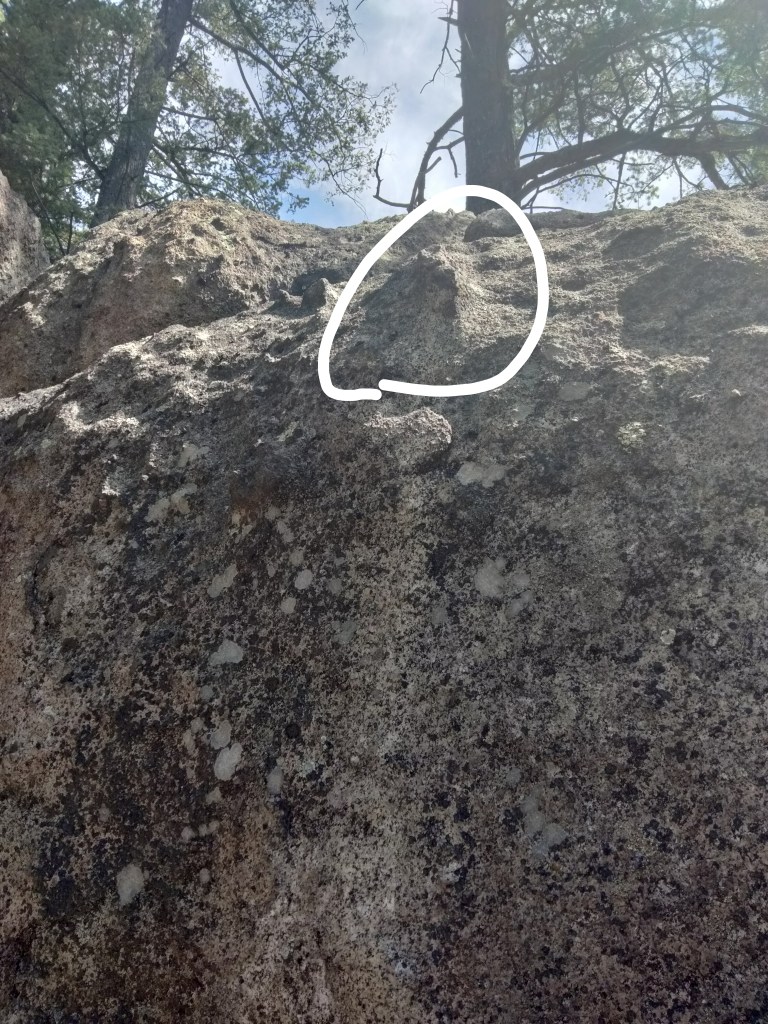
Did this mean that such nubs are a natural feature of the way granite weathers? Or could this be another part of the same complex as the wall? The formation on which I spotted these nubs certainly looks like the remains of a constructed passage.

After I left Sage Wall, my husband asked, humoring me, what I thought its purpose had been. My answer is that I have no idea. It is way too old, weathered, and partially buried for me to speculate. (This does not bother Julie Ryder over at Montana Megaliths, so if you want to see some people speculate very confidently, you can visit there.)
What I can say is that, granted this is not a natural formation, it most reminds me of Sacsahuayman and other sites in Peru. You have the same dry stone construction with megalithic blocks that are shaped, but are not in uniform sizes or in a regular pattern. And, of course, you have the nubs. As for scale, it appears that if Sage Wall were excavated down to its foundation, it would be thirty or forty feet high.
Another similarity is that both Sage Wall and the Incan or pre-Incan complexes are built at very high elevations (the Continental Divide runs near Butte).
This suggests to me that they partake of the same culture area.
Sage Wall, of course, has been abandoned much longer than any of the impressive Incan complexes, some of which Europeans got to witness still in use. Consequently, it’s much more weathered, run down, and filled in. But it looks like the same sort of thing.
So, it appears that Sage Wall and any other structures we might find in association with it were built by a group of people who knew how to build with megaliths, and who then had to abandon this site for some reason. It was before recorded history in North America, but that doesn’t mean it was before recorded history was happening elsewhere. Then, they or their descendants or people who partook of the same megalithic culture, moved on towards South America and continued their building there.
I believe there is plenty of evidence–not from Sage Wall, but from other sources–that human dispersion happened very quickly after the Flood, and that when people spread out, they took a megalithic culture with them. Dolmens, pyramids, cities, and inexplicable megaliths have been discovered all over the world. In many cases, as with the Bosnian pyramids, they have been abandoned for so long that they are not immediately recognizable as the work of human hands. You have to know what you are looking at before you can see it. The Bosnian pyramids, first thought to be extremely regular hills, were confirmed as artifacts only when a team dug into them and found tunnels. It looks like something similar happened with Sage Wall.
Immediately after the Flood, the earth would have entered an Ice Age. The climate was in a tailspin: temperatures were low, precipitation at an all-time high. Much of that precipitation quickly got locked up in glaciers. Sea levels fell around the newly configured continents. There were land bridges all over: in Beringia, in Doggerland, in Sundaland. People took advantage of all this newly revealed, very humid land and scattered. But the Ice Age was short, and as glaciers melted, there were sudden catastrophic local floods. People had to abandon their sites. Many of their cities, camps, and settlements are now hidden under water along our coasts. In some cases, such as Gobeklitepe and the Vinca cities, they burned, buried, or otherwise destroyed their sites before moving on. Some of these sites might have been built very quickly and inhabited for only a short time before they were abandoned. Other things being equal, archaeologists tend to overestimate how long it took to build something, and how long ago it appeared. But even very recent sites can be quite mysterious. They have had trouble re-constructing Woodstock, for example.
I don’t know. Obviously they were purty smart. Probably an argument is going to be made that Sage Wall must be a natural formation because “we know” that people in the Stone Age didn’t have the ability to make things like this, despite constant evidence being discovered to the contrary. Or they will argue that “we know” that there were no advanced civilizations in North America, despite Sage Wall itself. Such arguments tend to be self-re-enforcing.
I do know that we do not, currently, have the ability to build with megaliths … at least, not so easily that we consider them our first choice in building material. We might make a monument or a gravestone, but we wouldn’t attempt to build an entire house or city out of megaliths. The effort would just not be worth it. This suggests that the ancients may have had ways that were easier than our current methods.
It is worth noting that there is a well-established oral tradition of giants living in North America. There have also been giant skeletons discovered. In Peru, meanwhile, there is the tradition of the Viracochas, bearded, godlike culture-bringers. No, I’m not suggesting aliens. I do think we should take a closer look at the worldwide oral traditions of apocalypses, floods, gods, and giants, and that we should pay attention to myths that suggest that civilizations were “advanced” right from the beginning. If you want to dig into this more than you already have (and if you are reading this, I assume you already have!), please feel free to look at my page The Research Behind the Books for a suggested reading list.
Disclaimer: None of these pictures are mine. I found them on the Internet. If any of them are yours, and you don’t like them being used in this post, contact me and I’ll be happy to take them down.
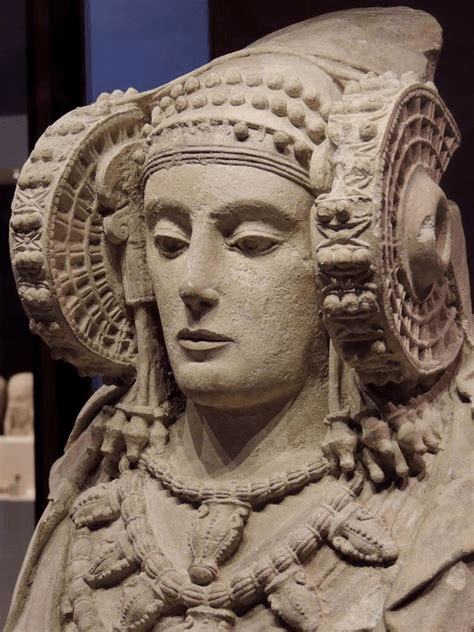
This is the Lady of Elche, Spain.

As you can see, her shoulders are hunched up. Some people describe her as having an “elongated head,” but it could just be the hat. Or it could be a hat meant to imitate elongated heads, as we see in many other cultures, but especially Egypt and MesoAmerica, where there was also head binding.
The following two links are my bibliography. You can follow them to check what I’m about to tell you about the Lady.
https://www.ancient-origins.net/news-history-archaeology/lady-of-elche-002305
https://www.atlasobscura.com/places/the-lady-of-elche
When I first heard that this Lady had been found buried in Iberia, it freaked me out. That’s because my understanding of pre-Roman Iberia was that it was basically Celtic. I was prepared to find Celtic- or Scythian-style artifacts there, such as images of people with narrow chins, large eyes, and moustaches; men with deer antlers; horses, and spirals, perhaps worked in silver, wood, stone, or even gold.
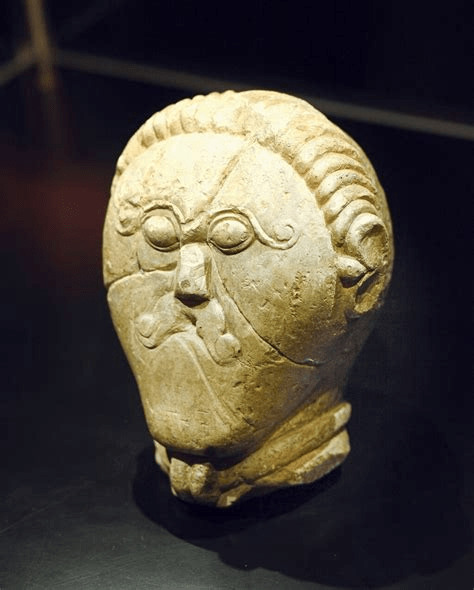
Celtic portrait, with torque necklace

Kurgan stelae in Kyrgyzstan, closer to the probable homeland of the Celts/Indo-Europeans
That’s what I expected to find in Spain. Or maybe something that looked like Etrusacan art, or like statues from the Archaic period of Greece.
I was not prepared for a massive, highly realistic stone statue that looked more classical Greo-Roman in style and featured attire more reminiscent of … I don’t know. Ancient Mesopotamia? Peru? The Lady of Elche freaked me out because it seemed to suggest a whole different style of civilization in Iberia, previously unknown. I was thinking Stone Age or pre-Flood.
Then, I heard that the Lady was believed to be Carthaginian. She instantly became less mysterious, but no less horrifying.
Carthage was a colony of Phoenicians. Phoenicia was an advanced civilization from the Levant. They inhabited the port cities of Tyre and Sidon, near ancient Israel. This explains why the Lady seems to be dressed like someone from the Ancient Near East. The Phoenicians had a shipping empire, so not surprisingly, they started a colony in North Africa. Carthage was here:

As you can see, they are very close to Europe, including territories in Spain. That explains how the Lady of Elche could have Western European facial features and Carthaginian dress.
Like most advanced civilizations of the Ancient Near East, the Phoenicians practiced atrocities in their pagan worship. This was the group that had the god Molech, to whom babies were sacrificed in the fire.

They were dropped down into, or placed in niches in, the red-hot statue. Drums and horns covered the sound of the infants’ screams. Incredibly, Israelites kept taking part in this practice and God had to keep telling them to stop. There was even an Israelite king who “made his son pass through the fire.”
Given that Carthage was part of an advanced, baby-killing empire, the Lady of Elche at once becomes more horrifying. The blank look on the woman’s face becomes more sinister. Is this just a death mask? Or is it because she is cruel? Or mindwiped by all that she had seen and done?
I don’t have any historical reference for this, but an anonymous commenter on the Internet has asserted that the “ear covers” were worn by priests and priestesses to block out the screams of the victims of more gruesome rituals. The bigger the ear muffs, the worse the ritual. I’d like to pooh-pooh that, but it fits with everything else we know about the ancient world. Christ conquering the nations suddenly sounds much less like a step in oppression and more like a relief. If you know more about the earmuff question, I’d love to hear it I wouldn’t exactly love to hear about it, but I’m curious and please send me your information.
If you know how to indicate your interest in the Lady to the algorithm, you may find people dressed in historical re-constructions of the Lady of Elche’s garb, like these:
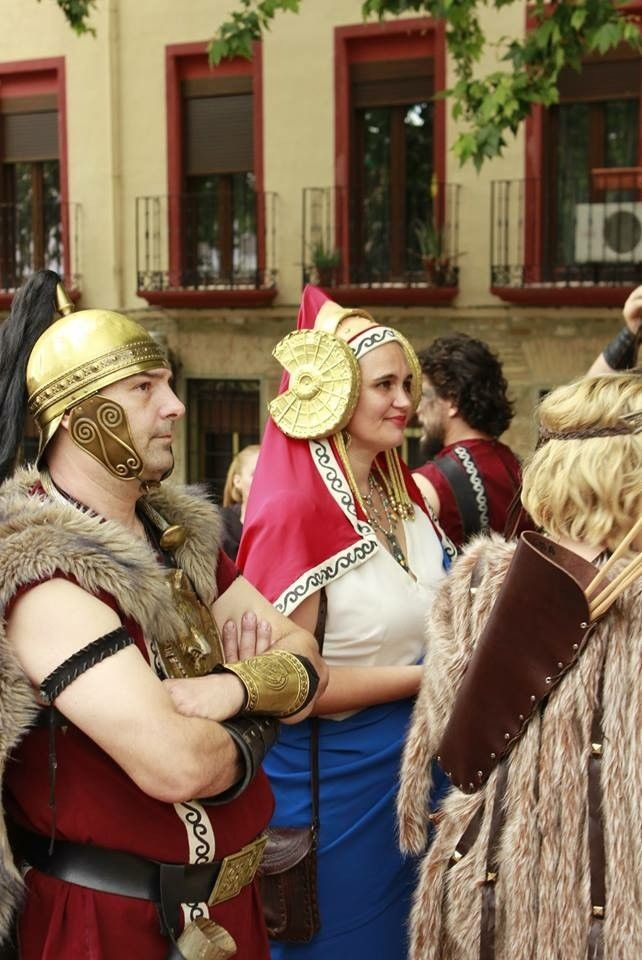


These ladies all look significantly happier than the original Lady.
to include sources about Pangea and aliens.
P.S. And my FAQs.
I got this tag from Snapdragon Alcove. I hope it’s OK that I’m posting it after Halloween (life is busy!). Because of the relatively narrow range of my horror consumption, I’m freely mixing movies and books.
Pick your favorite example of a …

The Book of Eli (a movie)
Not exactly zombies, but as I recall, there is an older couple that seems normal, but then you find out they have some sort of neurological disease from having eaten human flesh to survive. Creepy.
Also, I love the characters Denzel Washington usually plays, and this is no exception. I like my apocalyptic movies to be somewhat uplifting, and this fits the bill.

The Unwilling, by C. David Belt (a book). Cheating a little, ‘cause I recently reviewed it here. This one made me cry, because there is a child vampire who wants to be “a real boy.”

I guess I don’t read many haunted house books, because Monster House is the only one I can think of. It is just as sad as ghost stories usually are.


Fractured and Shutter Island (both movies). I was very angry with both of these movies, but Fractured probably made me angrier.

The Collision series, by Rich Colburn. So far, it has only two volumes: The Resolve of Immortal Flesh and The Formulacrum. But The Formulacrum ended on a literal cliffhanger, so that means Colburn owes us another one.
Neither of these books is exclusively about creepy dolls, but one very memorable creepy doll is featured … and that’s just about the only book I have ever read with a creepy doll.
Beowulf, duh.
And, in case you are not up to speed on this, Grendel is a t-rex. But there are plenty of other monsters in this how-to-defeat-monsters book, including the sea monsters Beowulf encounters while swimming in the North Sea, and Grendel’s mother, who appears to be some sort of octopus.

The Tremors franchise. It is the best. Extreme gross-outs, but also extreme humor. Survivalist Ed really steals the show.

Stranger Things. I will die on this hill.
The series starts out where the kids are about twelve and it more resembles E.T. or The Goonies, but the events cover several years and we see the kids discovering the opposite sex, feeling left out as they grow up at different rates, dealing with problems with their parents and problems involving finding a career and their place in the world. Their lives have all the teen challenges, plus the ghosts and demonic creatures and stuff to deal with. And yes, there are a few make-out scenes that it would be nice if we could skip. I will also say that the series seems to be equally sensitive to the experiences of teen boys and girls.
Some people think the episodes are too long and detailed, but that’s the point. They work in a lot of human drama in addition to the scary stuff, and I am here for it.

Perelandra and That Hideous Strength by C.S. Lewis both feature possession that gets more terrifying the longer you think about it.
In Perelandra, the possessed man gets to come out and speak instead of the demon once in a while, and this gives a more evocative glimpse into his mind than we might prefer.
In That Hideous Strength, the people that are serving the demons get dehumanized to an even greater extent, and we see the beginning of this dehumanization process happen to one of the main characters. There is also a memorable scene where one of the villains, who up until now has been the most formidable because of his intelligence, wants to put a stop to something, but “he could not think of any words.” This moment of aphasia shows us how close his mind is to total disintegration.



Science fiction reliably pulls towards horror, for obvious reasons. Human nature doesn’t mix well with dimensional portals … or genetic engineering … or time travel.
That second image is from a movie called Paradox. It turns out there are quite a few of those, but this one involves time travel being exploited by a bitter coworker to go postal, and even though the team has an awful lot of information, they can’t figure out what is happening quickly enough.

The next thing [Bill] knew, he was being levitated above his bed. He then had the sensation he was being suspended by what felt like a pole inserted into his rectum. By this time, he was alive with terror, but he couldn’t scream. The following is an excerpt taken directly from the transcript of Mr. D’s interview:
“I thought I was having a satanic experience; that the devil had gotten ahold of me and had shoved a pole up my rectum and was holding me up in the air… . So helpless, I couldn’t do anything. I said, ‘Jesus, Jesus, help me!’ or ‘Jesus, Jesus, Jesus!’ When I did, there was a feeling or sound or something that either my words that I thought or the words that I had tried to say or whatever, had hurt whatever was holding me up in the air on this pole. And I felt like it was withdrawn and I fell. I hit the bed, because it was like I was thrown back in bed. I really can’t tell, but when I did, my wife woke up and asked why I was jumping on the bed.”
ibid, p. 266
A while back, I posted a link to an interview with Gary Bates, in which I called him “a very sane UFOlogist.” This book confirms my initial impression. It’s 400+ pages, with endnotes to each chapter, appendices, and an index, yet it is accessibly written.
According to Bates, drawing on the work of other researchers, here are the elements of “Classic Abduction Syndrome [CAS]”: the abductee is captured, often at night, and often while being seemingly paralyzed. Once on the ship, they are typically undressed and subjected to some kind of invasive and humiliating “medical” examination. Often, this escalates to sexual abuse of various kinds. Then, the aliens “teach” the abductee. This involves being told that they have been chosen for a special mission. Predictions are made about the future of earth or of humanity. The aliens are trying, and they want the abductee’s help, to raise humanity’s consciousness or to save humanity. Often, they say they are engaged in a breeding program, creating human/alien hybrids. Sometimes this is explained as a way for humanity to survive when the earth is destroyed. Abductees may be given a tour of the ship or of other locations, and they may meet a divine being or an entity claiming to be Jesus, the pope (!), or a dead relative. After the abductee is returned to his or her surroundings, they often don’t immediately remember their abduction experience. They may experience “lost time,” and recall the experience only later (sometimes under hypnosis, which raises other issues).
Abductees experience lasting physical and mental aftereffects of their experience, whatever its nature may have been. They have PTSD-like symptoms. They have may bruises, scars, or puncture marks on their body, though these are never of an obvious enough nature to prove their story. They may experience new chronic health problems, commonly with their reproductive system, even including uterine or breast cancer.
On the spiritual side, many abductees come out of the experience with a new openness to the occult and to New Age beliefs. Others, though they initially feel understandable anger and fear towards the aliens, after multiple abductions come to a passive state of appearing to love and be fascinated with their tormentors, almost like Stokholm Syndrome.
Assuming that all these people are not just making up these bizarre and traumatic experiences, it is clear that they have come into contact with entities that do not wish them well.
On their own testimony, the “aliens” can be shown to be unreliable. For example, they tell abductee they are torturing them “for your own good.” They say they are wise and want to help human beings evolve to the next level, yet they subject their human subjects to frightening and degrading sexual practices. Either these beings don’t understand humans very well, or they are traumatizing them on purpose to “break” them. The aliens also seem eager to explain exactly where they are from. In past decades, they would claim to be from Mars or Venus. Now that we know more about those planets, they tend to name a star or star system that is outside of our galaxy.
Aliens tend to appear to humans in whatever form is culturally expected at the time.
Over the decades, we have allegedly been visited by long-haired Space Brothers, stacked Space-Babes, black-eyed and large-headed dwarfs, bipedal reptiles, praying mantis-type creatures, and … well … the list goes on and on. But, they all seem perfectly comfortable with Earth’s gravity, temperature, oxygen levels, etc. Doesn’t that strike you as a bit odd?
Nick Redfern, UFO researcher, quoted in ibid, p. 321
So, we have powerful, apparently deceptive entities, which kidnap and traumatize people, and then unfailingly give them a New Age message to take back to earth, often going out of their way to say that the Bible has “gotten it wrong.” Furthermore, apart from claiming to be from space, these “alien” abduction experiences have a lot in common with abduction stories from past ages where the perpetrators were fairies, demons, or other paranormal entities. It is starting to look as if we are hearing the same song, but a different verse. And in fact, Bates suggests that these “aliens” are probably demonic, or fallen angelic, entities. They are, in short, the “elohim” described by Heiser and identified as “the gods” by Cahn.
Two UFO researchers, Joe Jordan and Wes Clark, noticed that out of all the abduction cases they had heard of, very few were Christians. They put out a call for anyone who was a Christian and had an abduction experience to contact them. Confusingly, they were contacted by people who said things like “I’m a Christian and I was abducted and saw Jesus on the spaceship.” With further research, they found that while people who identified as Christian but did not “walk the walk,” as the researchers put it, were just as likely to experience abduction and subsequent New Age brainwashing by the “aliens.” However, “walk the walk” Christians had a different experience:
Clark said that many of the respondents claimed to be Christians who told of their own abduction experiences. He felt that they were happy to have someone to talk to; they usually felt uncomfortable talking about their experiences because most UFO investigators had New Age inclinations and ideas that opposed their own beliefs. In addition, the Christian church is not equipped to deal with such reports because the UFO phenomenon has been largely misunderstood and dismissed by organized religions. Clark comments:
“As the number of cases mounted, the data showed that in every instance where the victim knew to invoke the name of Jesus Christ, the event stopped. Period. The evidence was becoming increasingly difficult to ignore.”
ibid, p. 267
I just changed my site address in an effort to get this blog to show up in my WordPress followers’ Reader again. If it did show up, please do a me a solid and like this post.
All you need is a “credible” witness who has had an experience, and then you dare someone else — like the government — to “prove it DIDN’T happen.” Unfortunately, this sort of mindset permeates UFOlogy culture, making it very difficult to get a straight story. … It is not any weight of empirical evidence, rather a proliferation of “let me tell you what I saw” experiences. This does not deny that these experiences may have actually occurred, but we’ve all heard fishing stories… Add to this normal human failing a potentially spectacular UFO claim, with eager media and UFOlogists beating down your door, and often the truth is lost along the way — either in the recounting by the witness or the telling of the tale by the media. This gives you some idea of how difficult the process of determining the truth can be. But, nonetheless, we shall try to determine the true nature of the phenomenon.
Alien Intrusion, by Gary Bates, p. 28

Too many Atlantises. An embarrassment of Atlantises. One Atlantis, two Atlantis, red Atlantis, blue Atlantis …
This article describes an intact granite city, with pyramids, discovered off the West coast of Cuba, about 2,000 feet down, in December of 2001. As our old friend KFM, of Bad Archaeology, points out, the city would be unlikely to survive intact like this if it actually dropped dramatically from what is now sea level, as Plato seems to describe. The article points out that there is another city, the Yonaguni Monument, off the coast of Japan, and Graham Hancock in his book, Underworld, points out that there are submerged megalithic cities in many places around the world, including off the coast of India. (Hancock has cycled through seriously advancing a number of different Atlantis theories, so he will be sort of the workhorse of this post.)
It seems to me that the city off the coast of Cuba is part of a worldwide phenomenon where sea levels were once much lower. We can include in this phenomenon Doggerland (which will make another appearance later in this post), and the land bridges known to have once connected Asia to the Americas and the Indonesian islands to the mainland.
If you are an old-earth believer and have to juggle millions of years, multiple cooling and warming periods, slow but somehow effective continental drift, and some confusing archeological indications that humans were perhaps around well before they should have been … good luck. As someone who believes that the history of the earth is measured in thousands or tens of thousands, but not millions or billions of years, my guess is that this period of low sea levels plus advanced civilization came right after the Great Flood.
You would have a much colder, rainier climate as the earth adjusted to the recent cataclysm (about this more in a minute). You would have had frequent snow and rain storms, with all this precipitation getting frozen in the rapidly forming ice sheets, causing Earth’s water supply to be greatly reduced. Meanwhile, you would have Noah’s children and grandchildren branching out as quickly as possible, building megalithic cities wherever they went, still remembering the techniques and technology (and possibly still assisted by the giants and gods) that they had seen pre-Flood. This period of low sea levels would have had to last long enough for people to disperse and to build, but it need not have been very long. It could have a been a matter of a few hundred to a thousand years. As the climate stabilized, you would have had floods covering settlements and civilizations in different parts of the world. This, I believe, is the reason we have an embarrassment of Atlantises.
There have also been assertions that the reason for the Bermuda Triangle phenomenon is that Atlantis lies underneath it. (Note that the west coast of Cuba is outside of the Bermuda Triangle.) This theory certainly appeals to those who are interested in the potential paranormal effects of the lost city, but I do not know of any actual submerged city found in the Bermuda Triangle area. (If you do, please enlighten me in the comments. I’m always looking for another Atlantis to add to my collection.) This article discusses how ocean-floor mapping technology can create lines that look like city streets.
Graham Hancock makes the case for this in his book Fingerprints of the Gods. He posits that the evidence points to an ancient, advanced civilization which was destroyed by a cataclysm, and asserts that the refugees from it seeded their scientific knowledge, in code form, by creating new religious cults all around the world that featured certain sacred numbers.
If you’ve been reading Out of Babel for a while, you know my assessment of all of this is that it’s right, but not in the way that Hancock thinks it is. Among other things, his scientific materialism and evolutionary beliefs make it impossible for him to imagine that people groups like the Maya, for example, would have come up with advanced mathematics on their own, so he needs to posit a more “advanced” civilization bringing these things from without.
Anyway. For his advanced ancient civilization, Hancock realizes he needs a continent-sized homeland (because, again, his evolutionary beliefs about man require that such a civilization develop gradually, over millennia, from hunter-gatherers to farmers and so on). Antarctica is a good candidate because it’s an entire continent; there is some evidence that it was mapped before it was quite so covered in ice; its general pre-ice outline corresponds roughly to Plato’s description of Atlantis; and there is a theory available for how it could have gone from being in a temperate part of the Atlantic, to being at the South Pole, in a relatively short amount of time. Hancock calls this “earth crust slippage” and posits that it happened about 20,000 B.C.
Now for the version I find more plausible: Creation scientist Dr. Kurt Wise presents his team’s model for “continental sprint” in this video. I find Dr. Wise’s model persuasive as a model of the Great Flood, and as we will discuss, it could explain the Atlantis legend wherever in the world Atlantis proves to have been. However, even if you buy into “continental sprint,” it does not follow that Plato was describing Antarctica when he wrote about Atlantis. If all the land on the earth were breaking up, the ultimate fate of that portion that later became Antarctica would seem like a minor detail.
This one was put forward by Graham Hancock, after he abandoned his Antarctica theory, in his book America Before, a review of which I react to here. Although weak, the theory relies on the fact that there are large structures, either megalithic or earthworks, which align to different astronomical features and/or function as observatories, all around the world, including in North America. For example, the pyramid complex at Teotihuacan appears to be a model of the solar system; the Giza Plateau appears to be a model of Orion, and Serpent Mound in Ohio, which sites towards the sunrise at solstices, may be according to Hancock a model of the constellation Draco.
All that to say, anywhere you can find a large astronomical structure, you can make a case for Atlantis, and Hancock has made that case for North America.
This article, which I posted last summer, asserts that Plato’s descriptions of Atlantis are admirably matched by the Cyclades Plateau (now the Cyclades islands), which would have existed when sea levels were 400 feet lower than they are now. The Cyclades Plateau is a rather large formation right in the middle of the Aegean. (If we consider that lower sea levels would have also expanded the coastlines of the rest of Greece, then it would have been even closer to the mainland.) This is an attractive theory in terms of its being what Plato was actually talking about (since he makes Atlantis contemporary with Athens), but it does depend upon this:
Recently, a four year study that included a thorough analysis of Plato’s work established that serious errors by early translators allowed for the mixed messages in the translated document.
Yet another underwater location that used to be inhabited when sea levels were lower, Doggerland was a vast region that stretched between England, France, Holland, and Scandanavia, and is now the relatively shallow southern part of the North Sea. Archaeological discoveries have handily established that this area was once inhabited, here and here among others. As with other now-submerged human habitations, the reader’s preconceptions will determine how long ago you believe it was inhabited, and for how long.
This article describes an entire book which puts forth a detailed theory Plato was describing Doggerland. Apparently, Atlantis had a large, roughly rectangular plain surrounded by “ditches,” which the author thinks could also be translated “dikes.” He imagines the inhabitants of AtlantiDoggerland using these dikes to keep the sea back from a certain region of Doggerland for a period of time. Without some very expensive underwater archeological expeditions (in a notoriously dangerous sea), there is no way to confirm whether the ruins of a large city lie where this theory would predict. The maps are well worth looking at.

The Richat Structure, of the “Eye of the Sahara,” is a large (c. 40 km) formation of concentric rings of stone located in present-day Mauritania. Because of its size and remote location, it is hard to spot except from orbit.
Depending upon how you calculate, the structure matches the recorded dimensions of Atlantis quite well. There are also, of course, explanations about how this structure could have formed geologically. I’m not enough of an expert to assess these, but I am more skeptical of geological explanations than I used to be, now that I’ve seen “mountains” that turned out to be pyramids with insides, and geologists’ attempts to explain how a single fossilized tree could cross-cut millions of years’ worth of sedimentary rock layers. In other words, could go either way.
For the Richat structure to be Atlantis, we have to imagine that it was once nearer to coast and was inundated by a tsunami or something of that nature. This theory actually works fairly well with the geological model that Dr. Kurt Wise presents above. “Continental sprint” would have included many earthquakes and resultant tsunamis. Africa, in the model, does not move as much as the other pieces of Pangea, but it would still have undergone earthquakes and, possibly, some uplift.
On this theory, with his tale of Atlantis Plato somehow retained a memory of a pre-Flood incident (and read Athens back into it?). Below is a video of Pastor Joel Webbon discussing the theory with Brian Suave and Ben Garrett of Haunted Cosmos. They get into local lore around the Richat structure, how this dovetails with Greek legends about Atlantis, and how this all could have been plausible in a pre-Flood world haunted by gods and nephilim.
When I first started composing this post, I thought I was going to come out in support of the Richat Structure. Now, I just don’t know. The Haunted Cosmos guys make it sound very plausible, but a few of the other candidates are also plausible (some less so). There does not seem to be any way to “find” Atlantis without sacrificing at least some of what Plato has to say about it. (For example, Athens existed before the Flood? Before there was a Europe?) This makes it really difficult to favor any one theory (although we can probably discard others). What is clear, is that the prehistoric world had many sophisticated cities, lots of things built with megaliths, pyramids on almost every continent, and that there was a period when many human settlements were submerged as sea levels rose. The details are a matter of speculation, of the kind suitable for someone writing a novel.
Gary Bates, interviewed by Jon Harris on Conversations That Matter, is the most sane and humane UFOlogist you could hope to meet.
 Out of Babel Books