The following review was posted on GoodReads on June 27.
I love Tony Hillerman’s Navajo police procedurals. A few years ago, I got to travel through Navajo country (Dinetah), which was amazing because for fans of Hillerman it’s like getting to visit Middle Earth. At the Navajo Cultural Center gift shop, they displayed many of Hillerman’s books, and this memoir. I picked it up, but it took me several years to get around to reading it.
Once I did, it went fast because this is a page-turner. Hillerman’s writing is understated and vivid (he started his writing career as a journalist).
It turns out that Hillerman is closer to the age of my grandparents. He grew up in the Dust Bowl during the Depression, fought in the Battle of the Bulge. Quite a lot of the book is devoted to his memories of France during WWII. He was then injured (legs, and eyes), spent some time in the hospital, and was sent home with crutches and an eye patch. He discovered that “Military Intelligence is usually neither.” He doesn’t dwell on it, but he had PTSD before that was a word. Nightmares, unable to keep his breakfast down. He recounts, in the 1950s, seeing a grisly car accident that made the police officer on the scene vomit, but Hillerman stood there unaffected.
Hillerman and his wife also adopted a number of children, and raised a big, happy family.
All of this is related with almost no self-pity, and it’s often very funny.
This book contained less about the Navajo than I expected. I guess Hillerman has poured his learning about them into his novels rather than into his memoir. But by the time the book reached his later years, when the Navajo became a big theme, I was not disappointed about this because the book itself had already been such an entertaining ride.
There is an appendix which lists a number of Hillerman’s books and sketches out the process that led to each one. They presented different kinds of problems that will be reassuringly familiar to other authors.
All in all, Tony Hillerman is a total mensch, a good egg, and it’s been an honor to get to know him.
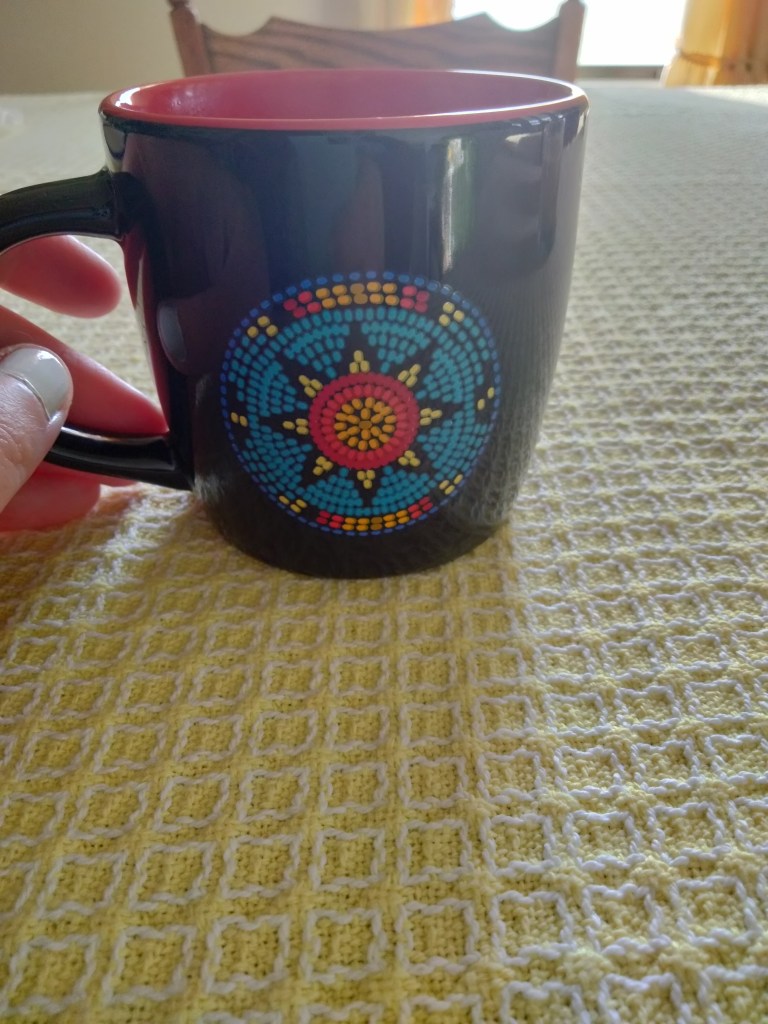
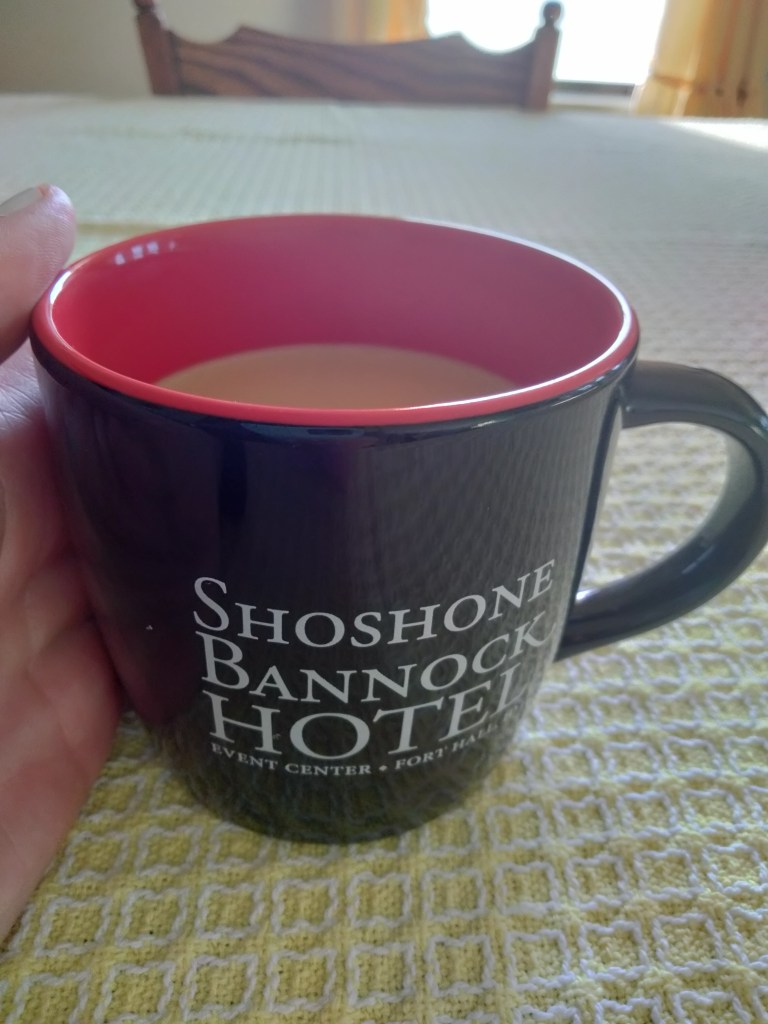
Continuing with the “nails and mugs” series, just for fun. It’s these tiny luxuries that make life pleasant.
I got this mug at a local thrift store. I have never gambled at our local casino, but here is its web site.
The Sho-Ban tribal lands are less than an hour’s drive from my house. The Shoshone and Bannock tribes used to have a range that extended farther north, into central Idaho and Montana, as you can verify if you read the book Naya Nuki. They were moved to a smaller place, as has happened to so many tribes. Read this book for a strong argument that American Indians should be treated just like regular American citizens, not as collectivist wards of the state.
Anyway. Although I do not go to the Sho-Ban casino/hotel/event center to gamble, I have been there a number of times. Its banquet halls have hosted our local pro-life banquet for the last several years. Plus, I like to go and eat at their resto (fry bread! bison burgers!) and go to their gift shop. For my last two birthdays, I’ve asked my husband to get me a hand-beaded Sho-Ban item from the gift shop there. These things are not cheap, but boy oh boy, I love them so much. They also smell like woodsmoke when you first buy them.
Here’s a leather barrette beaded in classic Sho-Ban colors.
Apparently, people will come from out of state to play at the Sho-Ban casino. I’ve seen billboards advertising it in Utah, for example. And when my husband and I go and eat at the resto there, the servers assume we are staying at the hotel. I guess we are getting old enough to look the part.
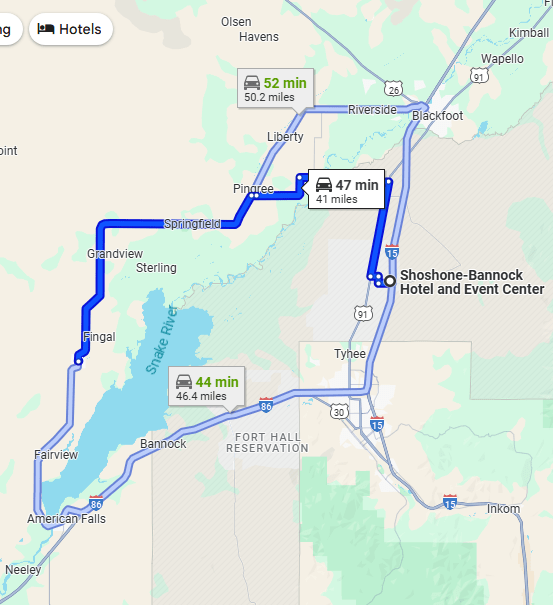
To get from the Sho-Ban event center to our house, you can take the back roads. You can drive through the reservation, over Sage Hill, cross the Snake River, and come out on Highway 39.
It’s a little longer, but it’s prettier and gives a fresh perspective.
Rodeos also take place on the Fort Hall Reservation. I aim to attend one some day. We moved here in 2019, and by the time I realized I ought to attend a rodeo on the rez, they had been cancelled indefinitely because of you-know-what. But I think they are having them again now.
Here I am at Sage Wall, to give you some idea of the scale.
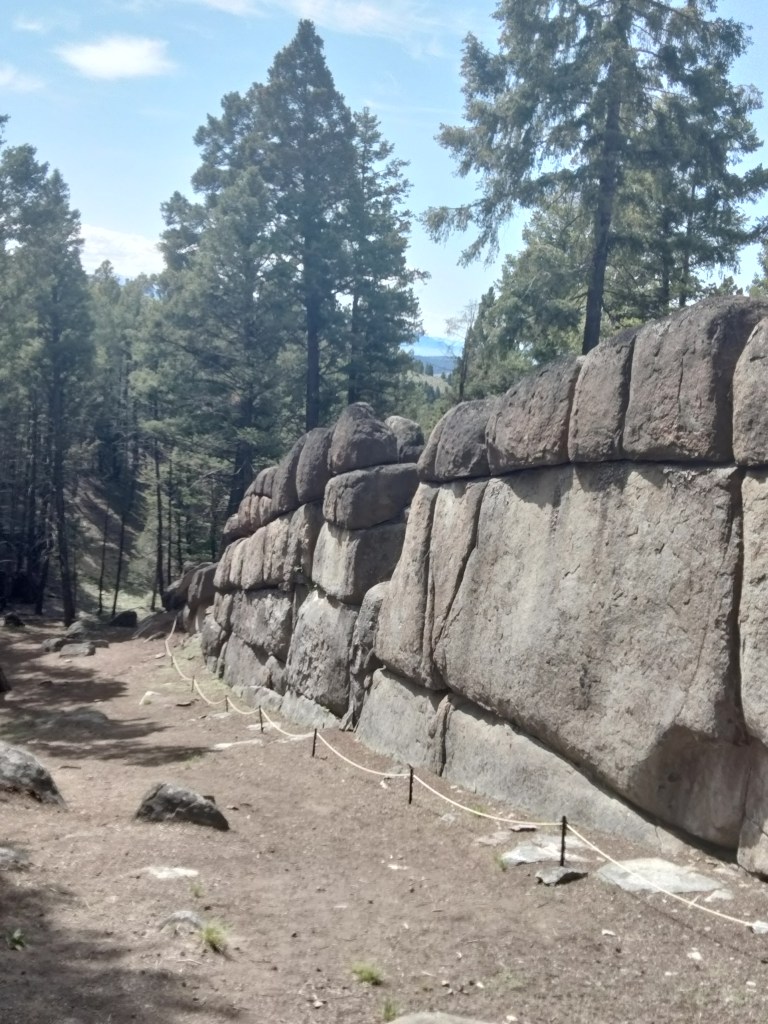
Sage Wall is a possible megalithic site near Butte, Montana. In this post, I am going to thoroughly embarrass my geologist husband by saying that Sage Wall looks manmade to me. But first, how did I come to visit Sage Wall in person?
Getting to Sage Wall
It’s on my bucket list to visit as many archeological sites as a I can, the older the better. Sage Wall was a no-brainer because it’s only a half a day’s drive from my house. It is also a good candidate to visit because looking at photos is kind of ambiguous. To really get a sense of whether it seems manmade or like a natural formation, I felt I had to be there in person.
We drove up into the beautiful Montanan Pioneer Mountains (Idaho has some as well), stayed the night in Butte, and the next day, made our way to Sage Mountain Center, where I had a reservation. We could not have asked for a more beautiful day, weather-wise. Early June in the Butte area is still basically Spring.
Chris and Linda are the property owners at Sage Mountain. About three decades ago, they wanted to move out to the middle of nowhere and build a sustainable house and retreat center. They were not looking for megaliths. Linda stumbled upon the wall on a hike one day, and Chris, who has a background in building, looked at it, said, “Yep. That doesn’t look natural. Well, let’s get back to our projects.” It wasn’t until years later, when they had established a sustainability-themed retreat center and had started to create some hiking trails for their guests, that other people started noticing the wall. Chris and Linda cleared the brush around the wall, roped it off, and had it examined by LIDAR and ground-penetrating radar.
Now, many people are coming to see the wall, seemingly to a point where it is almost becoming a problem. Sage Mountain Center is still on a wind-y, washboard-y dirt road, but now many people, seeking to get away from it all, have built new houses and cabins along that same road. Chris asked us, as we drove out, not to “go too fast past our neighbors. We’re trying not to bother them.” I got the impression that his main desire is still to just run a sustainability B&B in peace, but he’s been saddled with this danged wall.
What Would a Skeptic Say?
I want to give the skeptical geologists their due here. I think what they would say is this: “All these people who are saying Sage Wall is amazing megalithic structure are forgetting one thing: It is right in the middle of the Boulder Batholith! There are big granite rocks everywhere!”
source: formontana.net
They are not wrong. The mountains to the east of Butte, where Sage Mountain Center is located, are strewn with large granite boulders and outcroppings. These tend to fracture into shapes resembling worked blocks of stone.
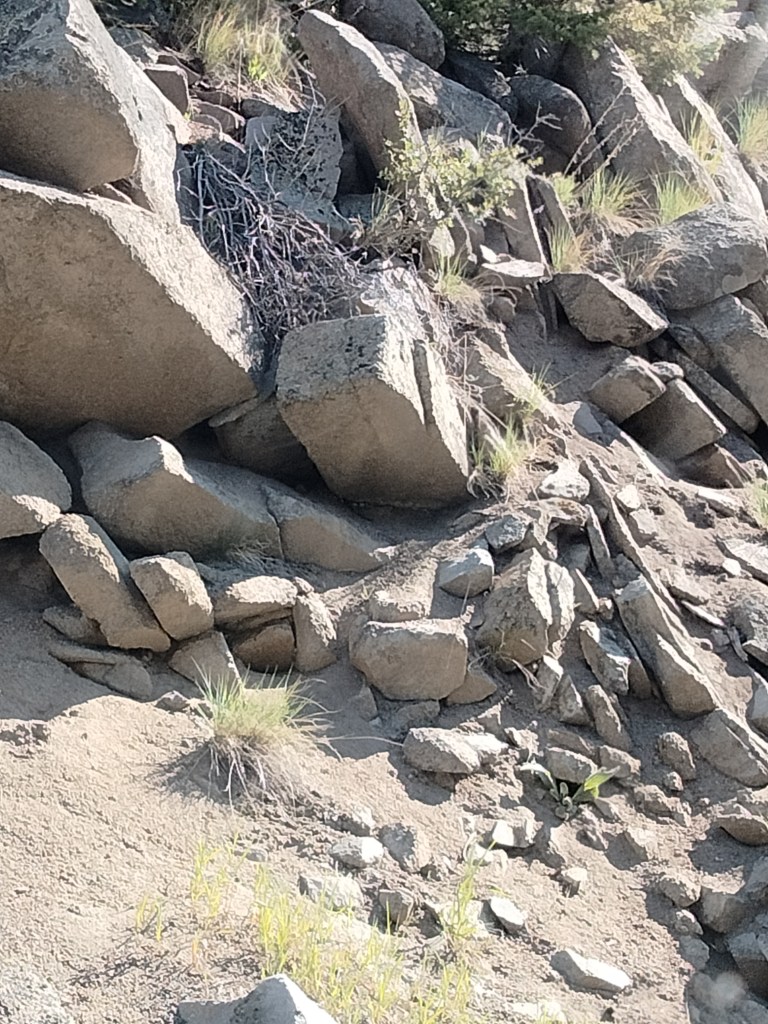
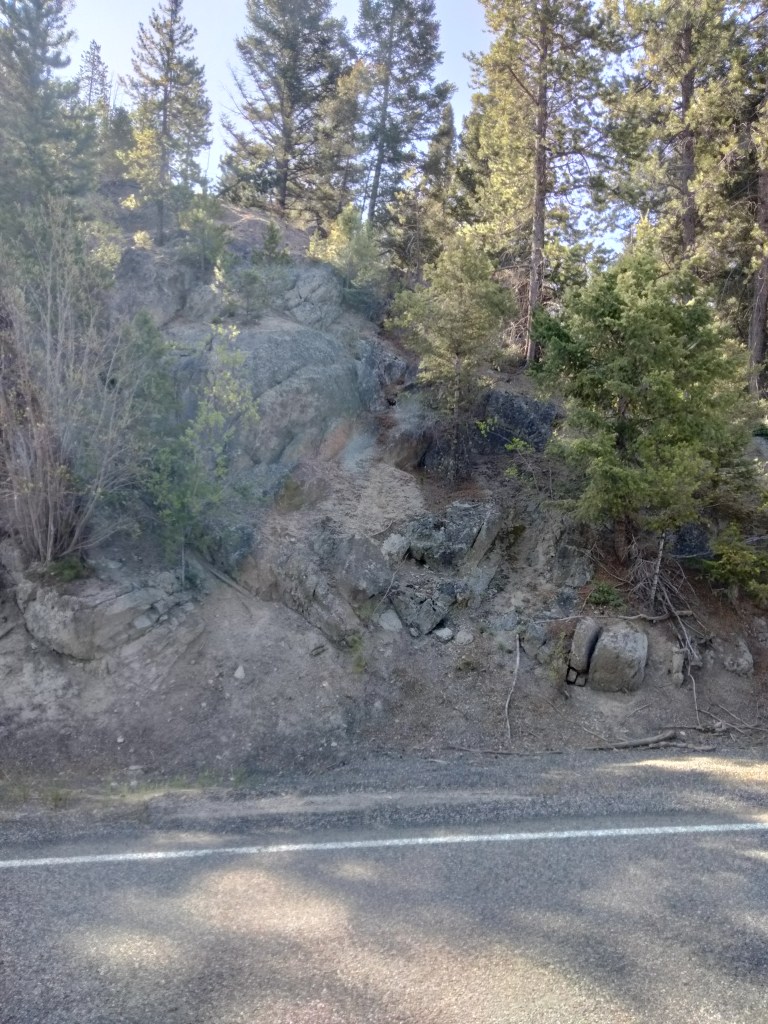
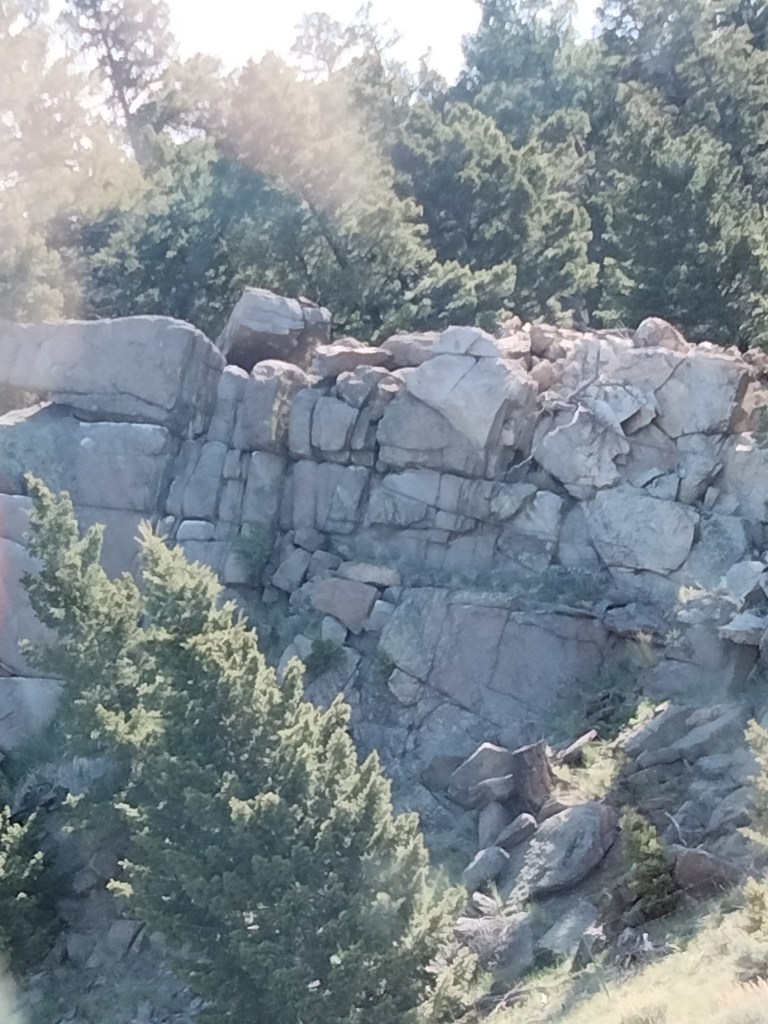
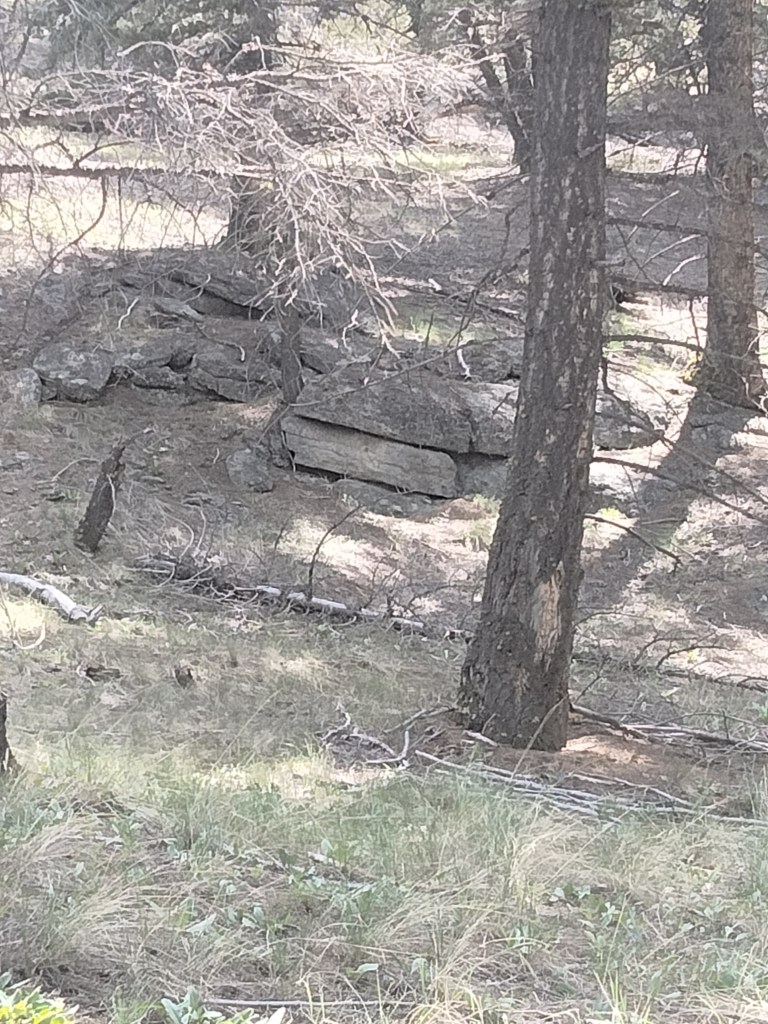
Here are some pictures I took, on the way in, of natural granite outcroppings so you can see how they normally look and how they tend to fracture:
You can see that the fractures are often horizontal and strikingly block-like.
We also saw some pieces of granite that had very large quartz crystals formed in them, which stuck out like chips in a chocolate chip cookie:
And, just for fun, here’s a balanced rock:
I’m not sure whether this balanced rock is natural, but I’m leaning towards no. I’m thinking it was put there to mark the trail.
Anyway, the skeptics are correct that the presence of big, blocky rocks does not an ancient megalithic structure make. This is part of the reason I wanted to see Sage Wall myself. I did not take any videos of it, because I’m not good with video and didn’t have a script ready. But there are now many videos of Sage Wall online, including drone videos. I’ll try to embed some of them at the end of this post.
Why Sage Wall is Likely Man-Made in my Amateur Opinion
So no, the claim is not that this must be a megalithic structure because it is located somewhere that we would not expect rocks. It is definitely surrounded by rocks. However, it looks distinctly different from the more random rock outcroppings around it.
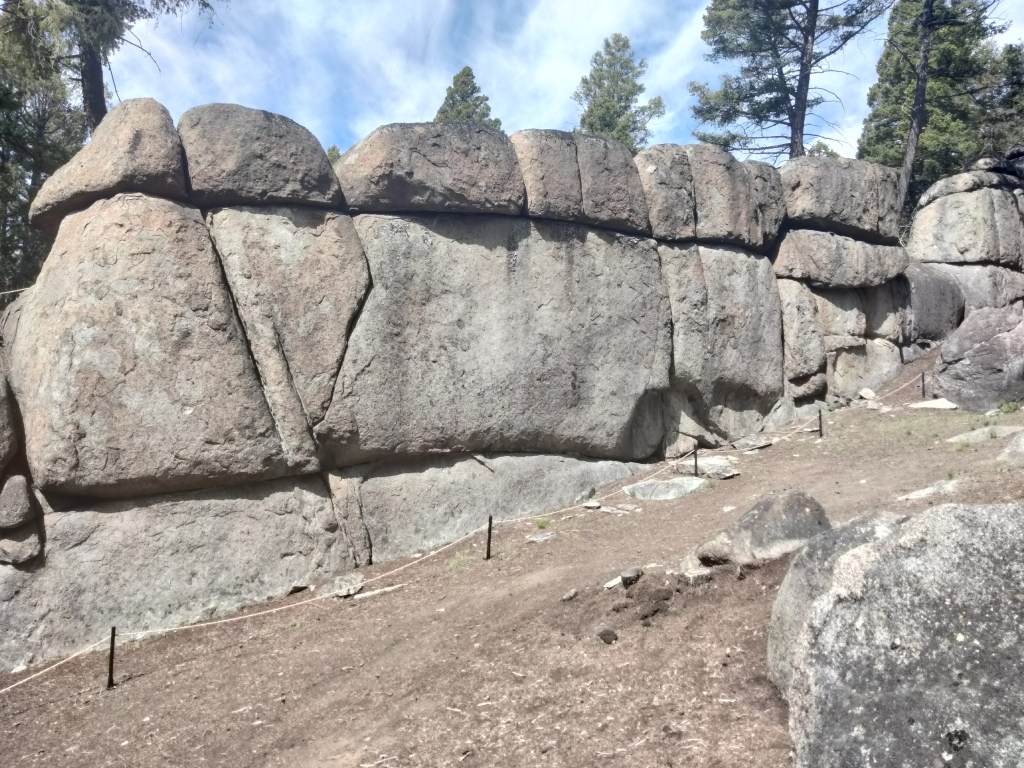
It is very long, and very straight. (The wall extends past the Sage Mountain Center property, but only their section of it has been cleared.)
Unlike what we see with other fracturing patterns, the wall consist of very big blocks laid out in what appear to be courses. To my (again, amateur) eye, when we see natural fracturing the blocks tend to fracture into smaller pieces where they are exposed.
In the pictures above (and in the one where I’m posing), you can see a hollow lower down in the wall where a block obviously fell out.
At three different places in the exposed section of the wall, there are gaps in the top similar to doors. Chris told us there had been a lot of speculation about these before researchers realized that they were simply places where boulders had fallen out. In fact, you can see the boulders below them, almost completely buried in dirt and pine duff.
On the picture above, you can also see the remains of a triangular shape. The left side of the triangle is made with shaped blocks, and the right side is incised into the megalith. The triangle happens to frame the gap where a block fell out.
According to Chris, the geophysicist who examined the wall with ground-penetrating radar found that it goes down into the ground about another 20 feet. At the bottom was something that reflected the radar, as it might be a floor or stone foundation.
All of this research is shortly to be posted on the wall’s website, here or possibly here.
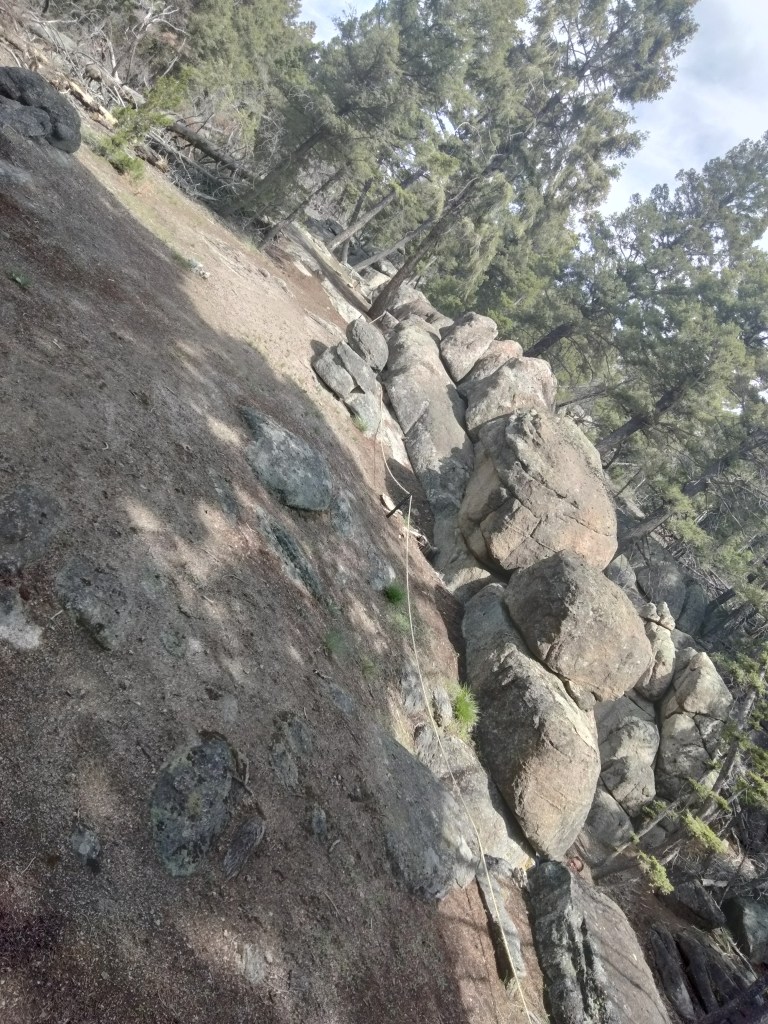
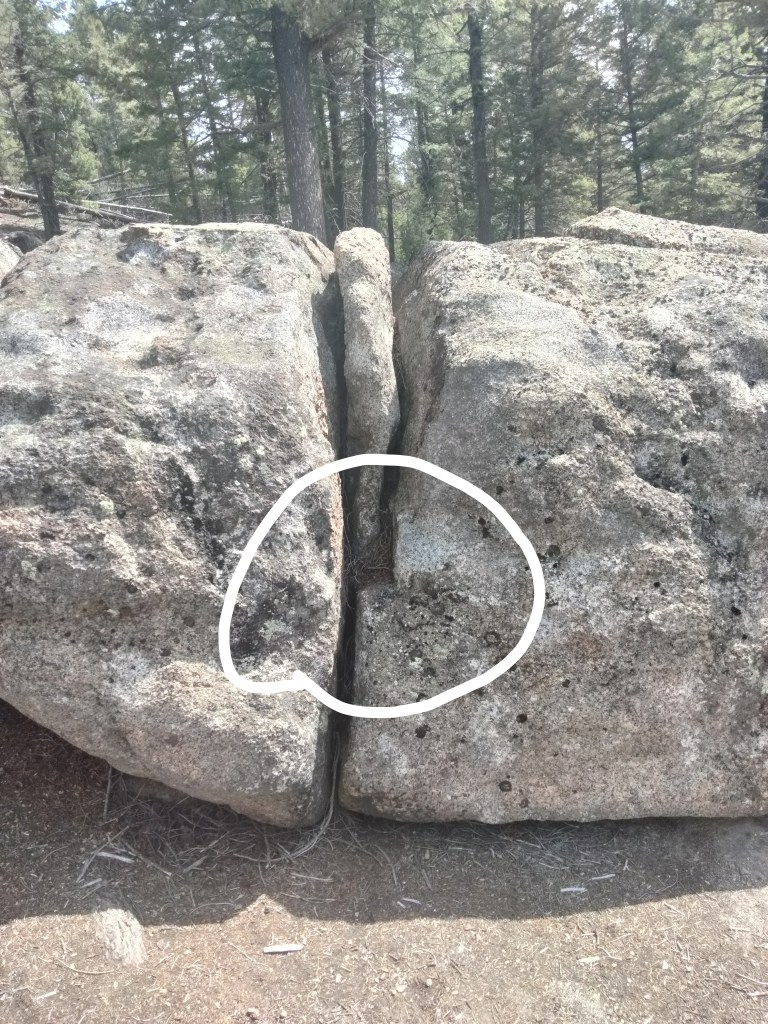
Parallel to the wall are the fallen remains of what appears to be another wall. You can see that it is “fractured” in the same way, and these other blocks also have some of the nub and cup features that we’ll talk about below.
Here’s a bit of the second wall, seen end-on.
Behind the Wall
Here’ a view behind the more intact wall. Chris and Linda have installed a rope that allows visitors to climb up behind the wall. As you can see, the wall is not just part of a cliffside, but it does have earth and rocks filled in behind, either as terraces/a retaining wall, or the ravages of time.
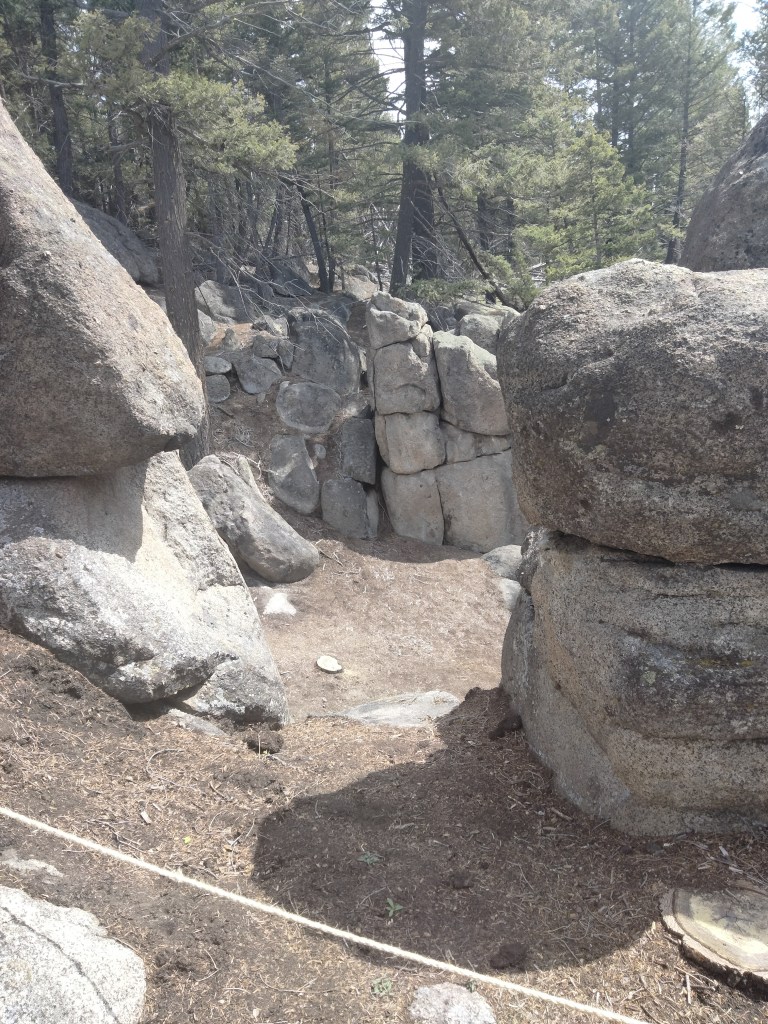
From behind the wall, we look out through a gap left by a fallen stone across the avenue at the remains of the second wall.
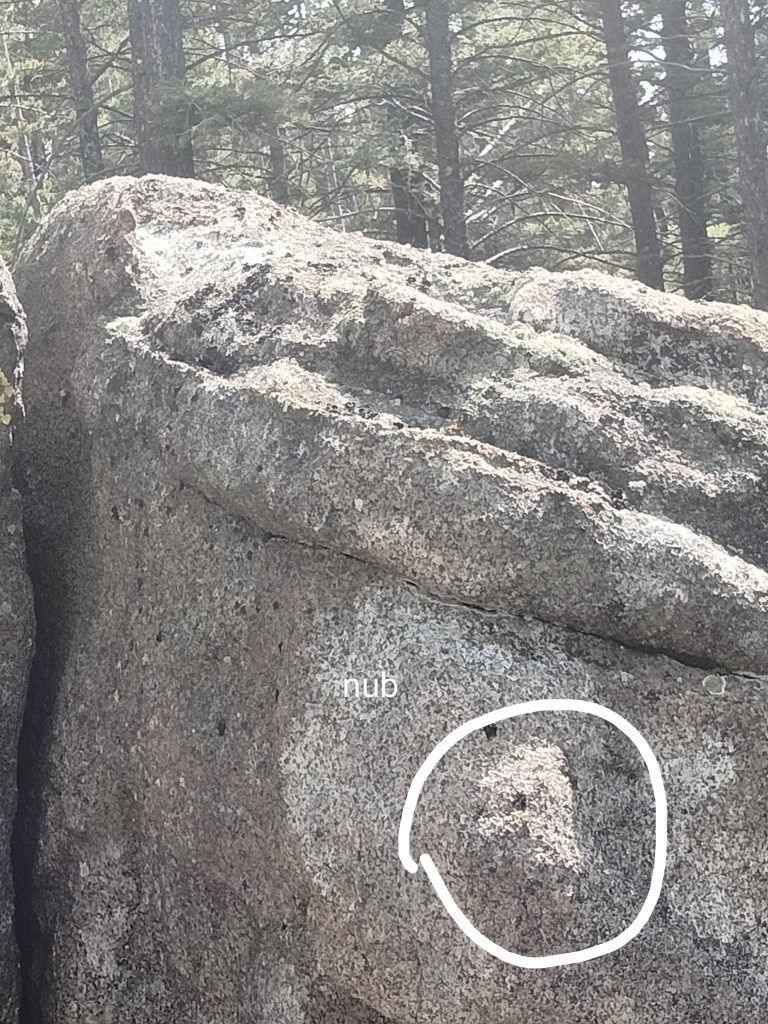
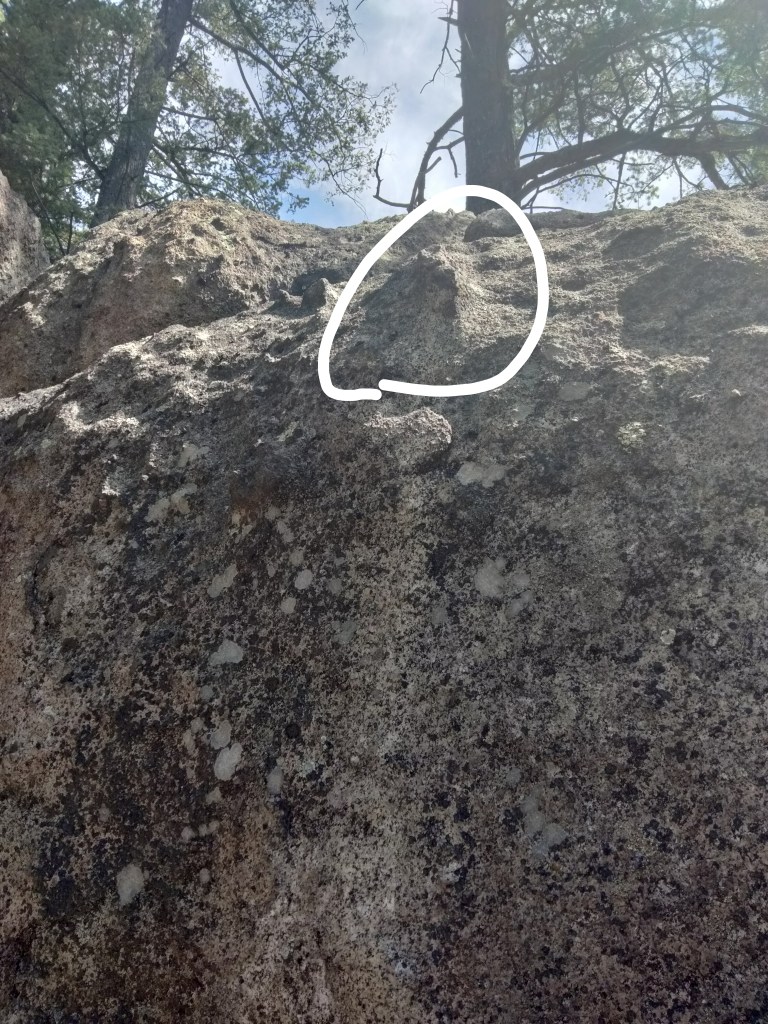
Getting close to the top of the wall allows us to see what might be nubs and cups.
Nubs and Cups
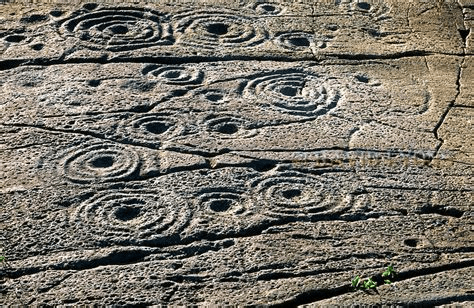
Stone nubs and cups (not necessarily corresponding to each other) are sometimes features of megalithic architecture in other parts of the world.
“Cup and ring” markings are apparently found all over the world, but especially in Northern Europe. Here are two articles about them.
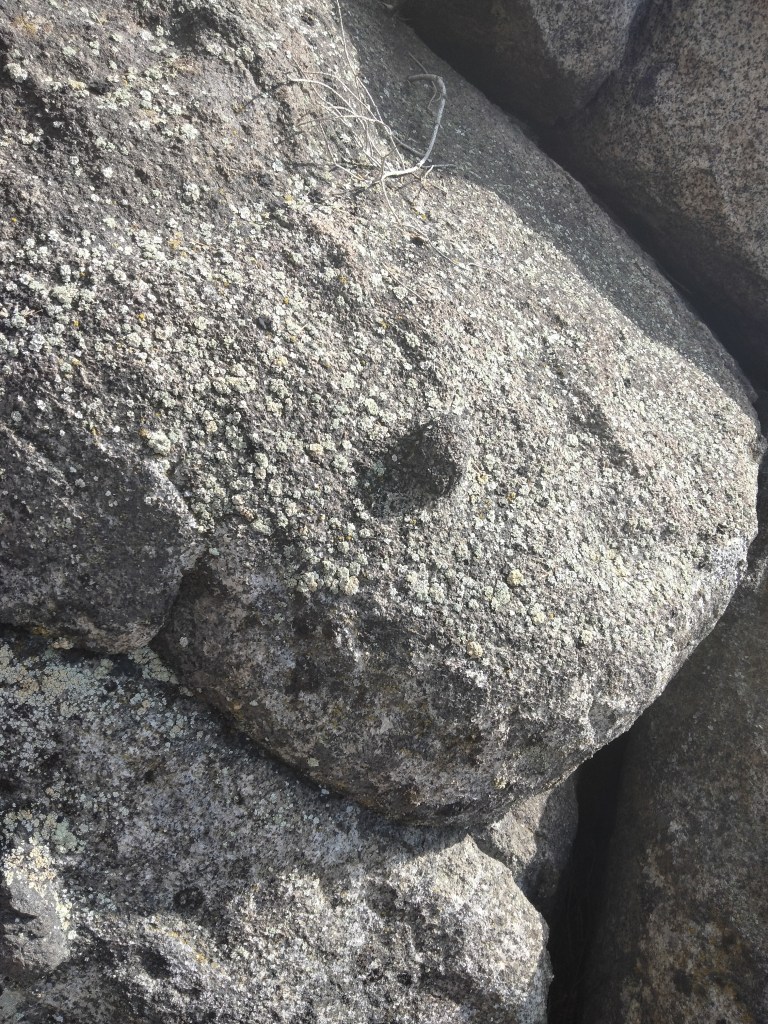
Here are some nubs found on top of the intact wall.
They are not the same as the pieces of quartz sticking out of the natural stone that we photographed earlier.
Because the wall is so weathered, some of them are not certain.
Note the possible incised lines above this last nub.
Here are some other things we saw on the back of the wall:
Incised straight line
Suspiciously square fracture line
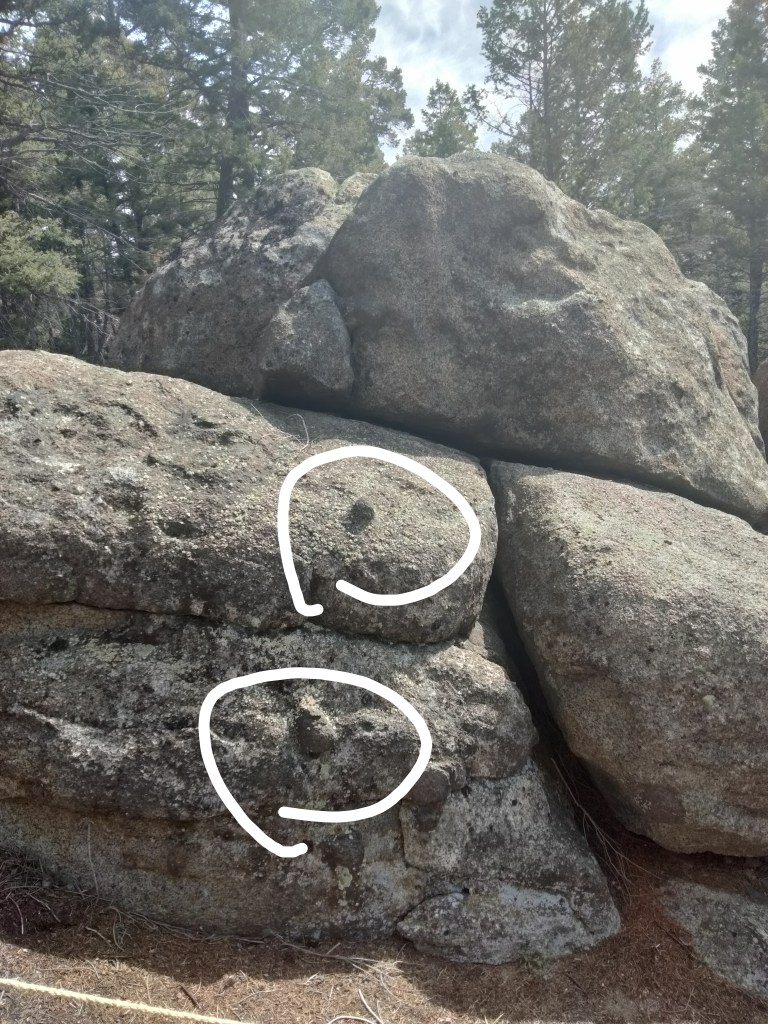
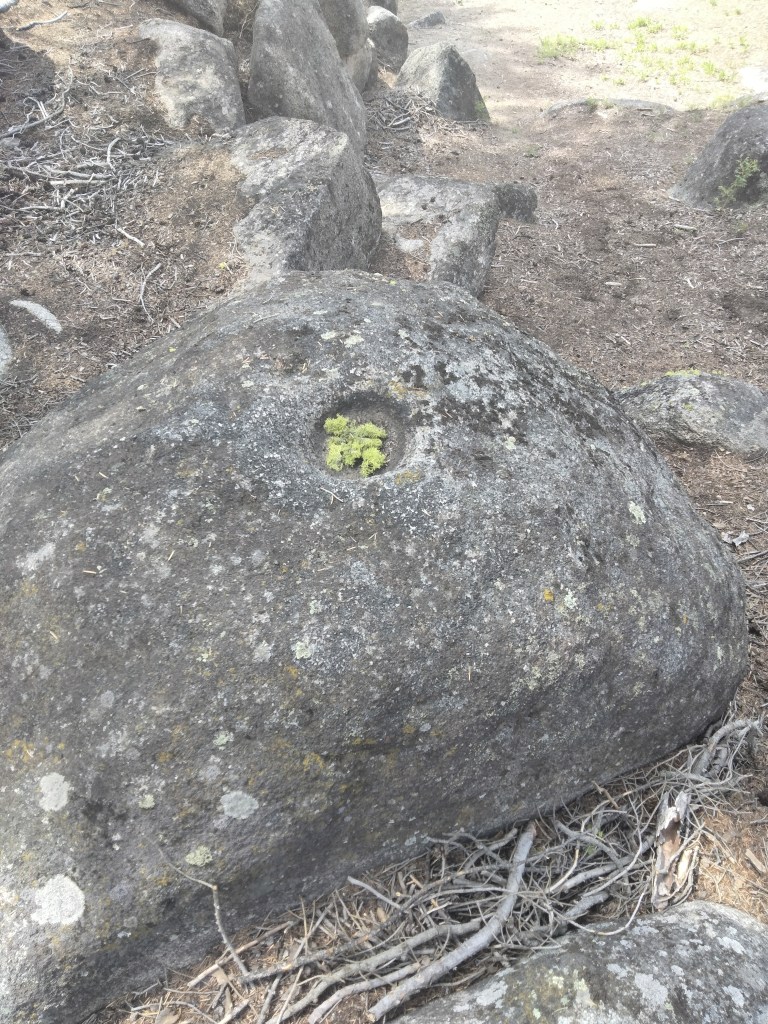
On the fallen wall as well, we found some things that look like nubs, and some possible cups. As a nod to the skeptics, yes, these “cups” do look like they could have been caused by water erosion. This would be especially true if they were found under a waterfall or a persistent drip, which they are not, as far as I can see. Some of them are also suspiciously round.
Very round “cup” in which someone has placed some fresh lichen
Some also have very straight lines incised near them. My son suggested they could be a water feature.
Looks like a cup with a spout
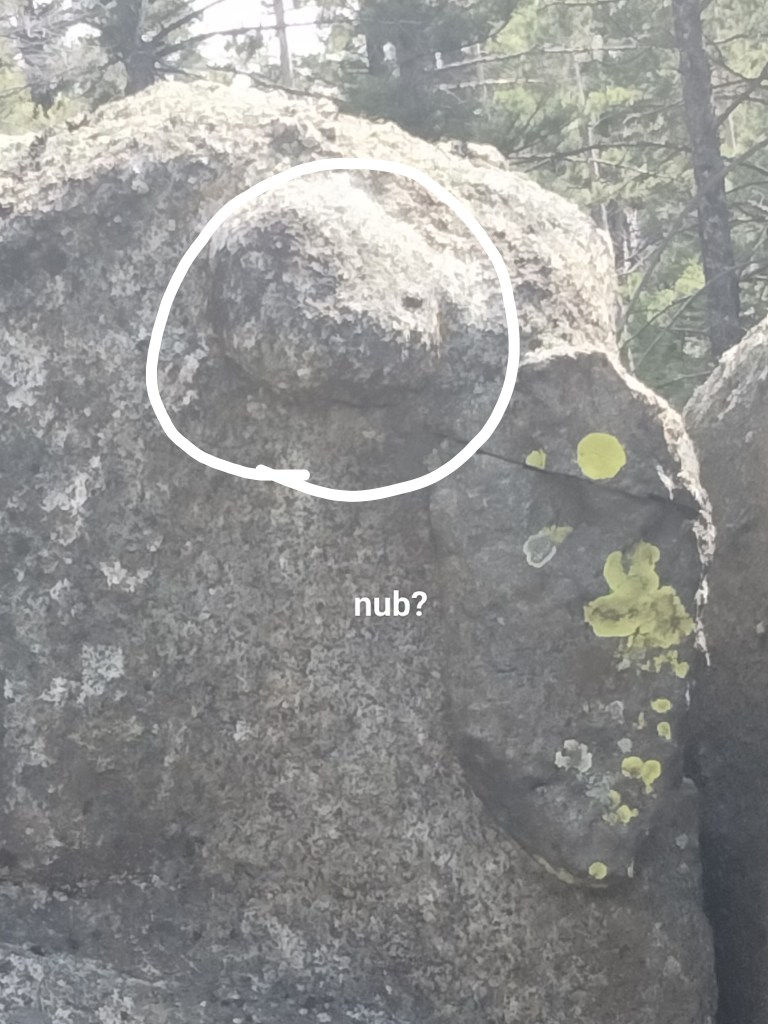
False Nub Alarm? Or Another Part of the Complex?
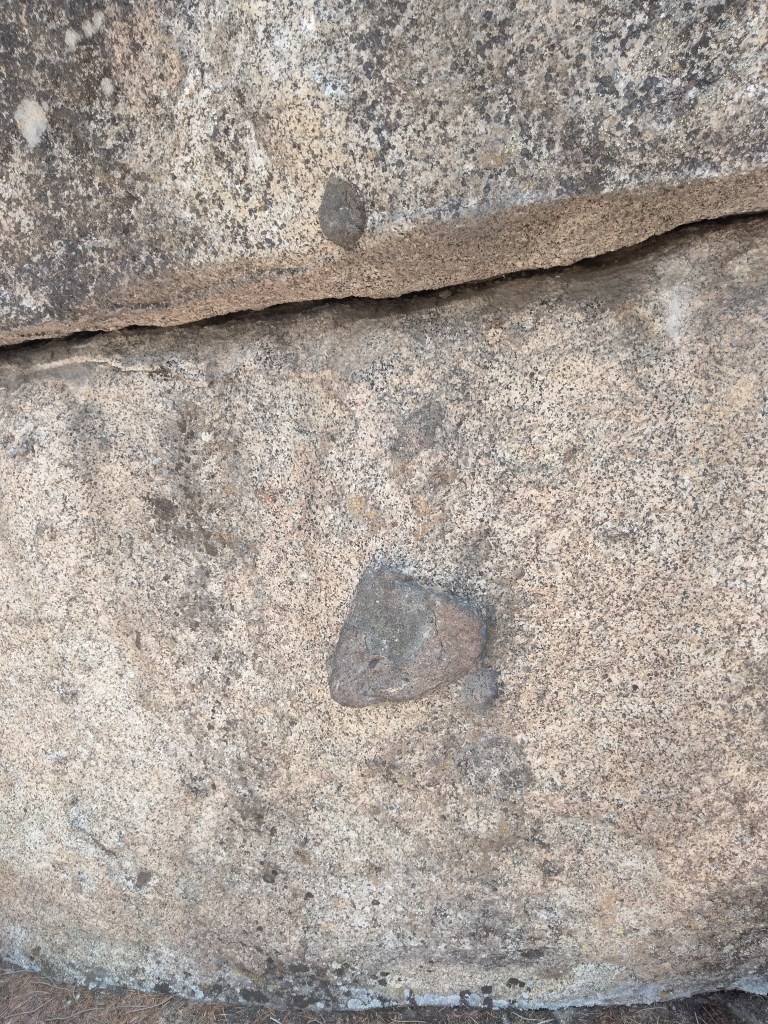
As we hiked away from Sage Wall, I took care to photograph natural rock formations for comparison. Not very far from the walls, I saw something that also looked like nubs.
Did this mean that such nubs are a natural feature of the way granite weathers? Or could this be another part of the same complex as the wall? The formation on which I spotted these nubs certainly looks like the remains of a constructed passage.
A Post-Flood Megalithic Culture
After I left Sage Wall, my husband asked, humoring me, what I thought its purpose had been. My answer is that I have no idea. It is way too old, weathered, and partially buried for me to speculate. (This does not bother Julie Ryder over at Montana Megaliths, so if you want to see some people speculate very confidently, you can visit there.)
What I can say is that, granted this is not a natural formation, it most reminds me of Sacsahuayman and other sites in Peru. You have the same dry stone construction with megalithic blocks that are shaped, but are not in uniform sizes or in a regular pattern. And, of course, you have the nubs. As for scale, it appears that if Sage Wall were excavated down to its foundation, it would be thirty or forty feet high.
Another similarity is that both Sage Wall and the Incan or pre-Incan complexes are built at very high elevations (the Continental Divide runs near Butte).
This suggests to me that they partake of the same culture area.
Sage Wall, of course, has been abandoned much longer than any of the impressive Incan complexes, some of which Europeans got to witness still in use. Consequently, it’s much more weathered, run down, and filled in. But it looks like the same sort of thing.
So, it appears that Sage Wall and any other structures we might find in association with it were built by a group of people who knew how to build with megaliths, and who then had to abandon this site for some reason. It was before recorded history in North America, but that doesn’t mean it was before recorded history was happening elsewhere. Then, they or their descendants or people who partook of the same megalithic culture, moved on towards South America and continued their building there.
I believe there is plenty of evidence–not from Sage Wall, but from other sources–that human dispersion happened very quickly after the Flood, and that when people spread out, they took a megalithic culture with them. Dolmens, pyramids, cities, and inexplicable megaliths have been discovered all over the world. In many cases, as with the Bosnian pyramids, they have been abandoned for so long that they are not immediately recognizable as the work of human hands. You have to know what you are looking at before you can see it. The Bosnian pyramids, first thought to be extremely regular hills, were confirmed as artifacts only when a team dug into them and found tunnels. It looks like something similar happened with Sage Wall.
Immediately after the Flood, the earth would have entered an Ice Age. The climate was in a tailspin: temperatures were low, precipitation at an all-time high. Much of that precipitation quickly got locked up in glaciers. Sea levels fell around the newly configured continents. There were land bridges all over: in Beringia, in Doggerland, in Sundaland. People took advantage of all this newly revealed, very humid land and scattered. But the Ice Age was short, and as glaciers melted, there were sudden catastrophic local floods. People had to abandon their sites. Many of their cities, camps, and settlements are now hidden under water along our coasts. In some cases, such as Gobeklitepe and the Vinca cities, they burned, buried, or otherwise destroyed their sites before moving on. Some of these sites might have been built very quickly and inhabited for only a short time before they were abandoned. Other things being equal, archaeologists tend to overestimate how long it took to build something, and how long ago it appeared. But even very recent sites can be quite mysterious. They have had trouble re-constructing Woodstock, for example.
How Did They Build It?
I don’t know. Obviously they were purty smart. Probably an argument is going to be made that Sage Wall must be a natural formation because “we know” that people in the Stone Age didn’t have the ability to make things like this, despite constant evidence being discovered to the contrary. Or they will argue that “we know” that there were no advanced civilizations in North America, despite Sage Wall itself. Such arguments tend to be self-re-enforcing.
I do know that we do not, currently, have the ability to build with megaliths … at least, not so easily that we consider them our first choice in building material. We might make a monument or a gravestone, but we wouldn’t attempt to build an entire house or city out of megaliths. The effort would just not be worth it. This suggests that the ancients may have had ways that were easier than our current methods.
It is worth noting that there is a well-established oral tradition of giants living in North America. There have also been giant skeletons discovered. In Peru, meanwhile, there is the tradition of the Viracochas, bearded, godlike culture-bringers. No, I’m not suggesting aliens. I do think we should take a closer look at the worldwide oral traditions of apocalypses, floods, gods, and giants, and that we should pay attention to myths that suggest that civilizations were “advanced” right from the beginning. If you want to dig into this more than you already have (and if you are reading this, I assume you already have!), please feel free to look at my page The Research Behind the Books for a suggested reading list.
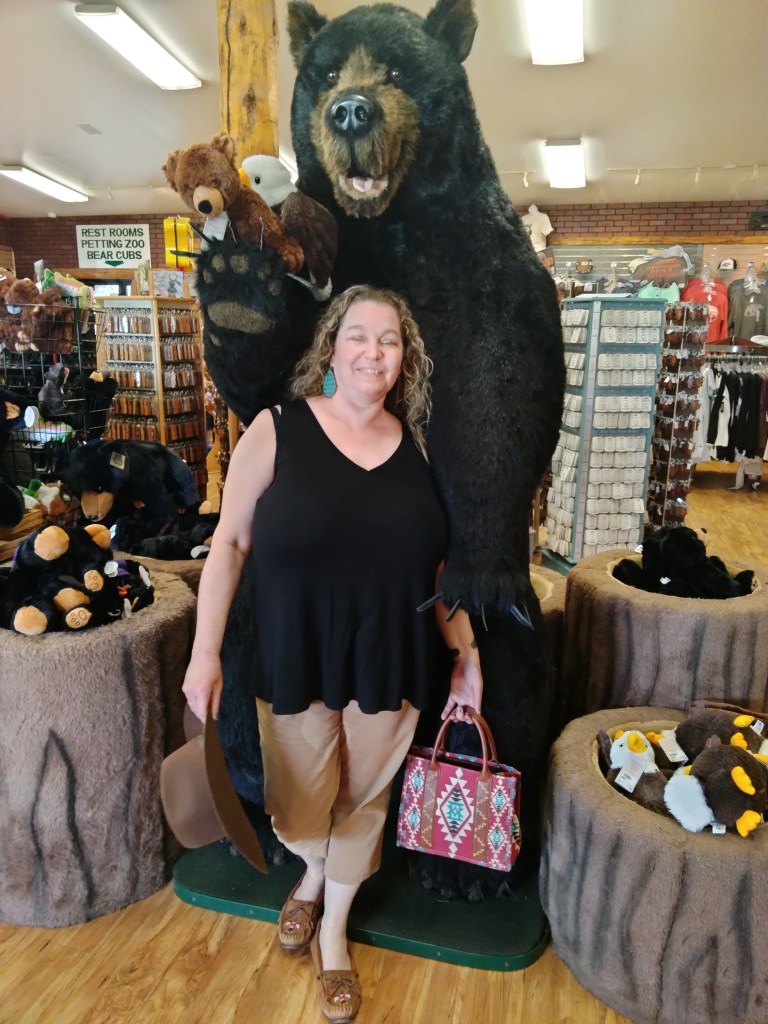
I am so excited to be standing in front of this bear that my eyes are closing!
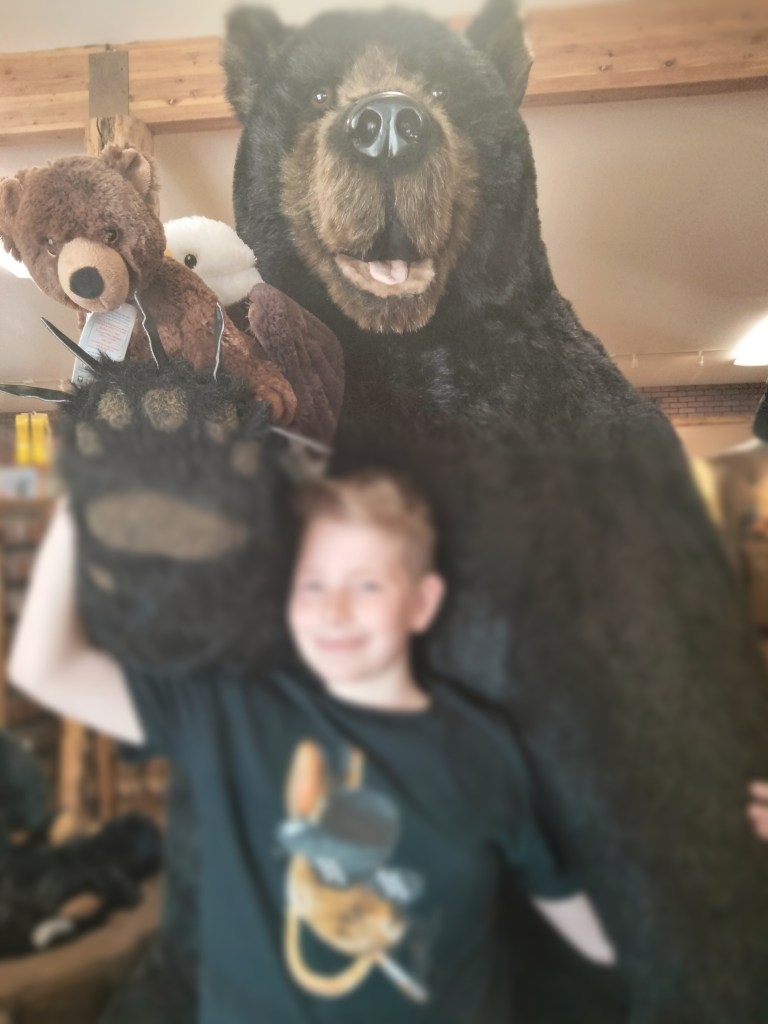
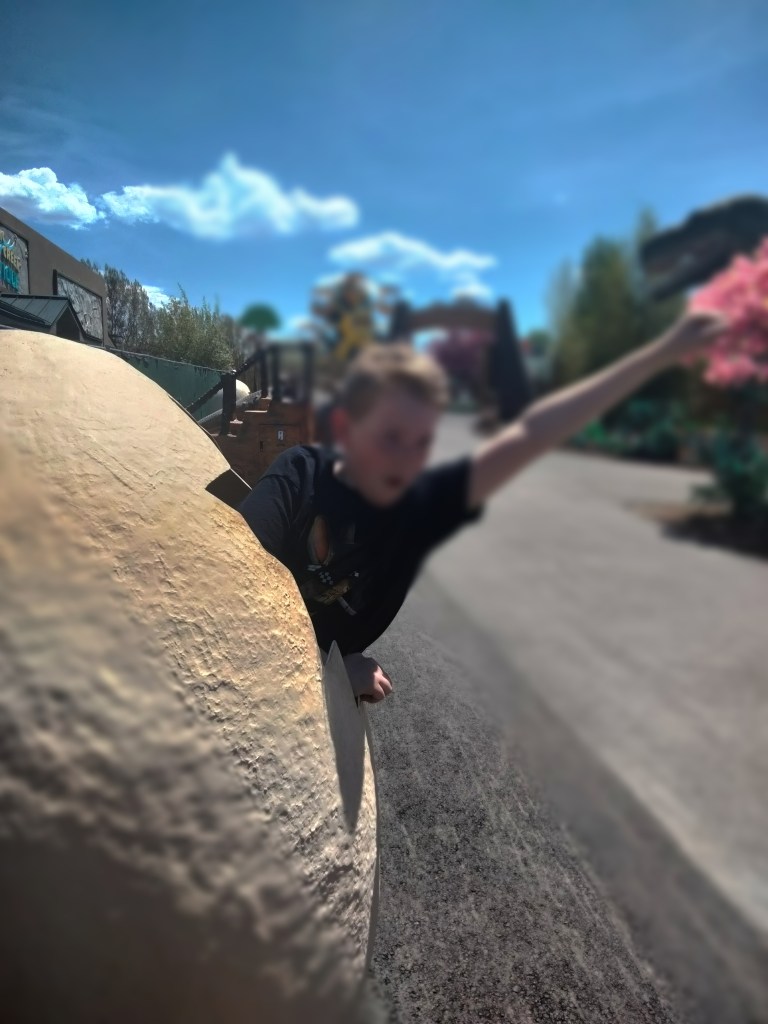
Recently, we had Mother’s Day here in America. My beloved children are now getting big enough that they can take the initiative to do things for me. Thirteen heard on the radio that Bear World was letting moms in free, so he decided we should go. Here he is with the bear, face blurred for privacy. My son is the blonde one and the bear is the dark-haired one.
“Yellowstone” Bear World, despite its name, is not at or in Yellowstone Park but actually closer to Rexburg, Idaho, where you can see the foothills of the Grand Tetons but not the Tetons themselves. The day we went was beautiful and sunny:
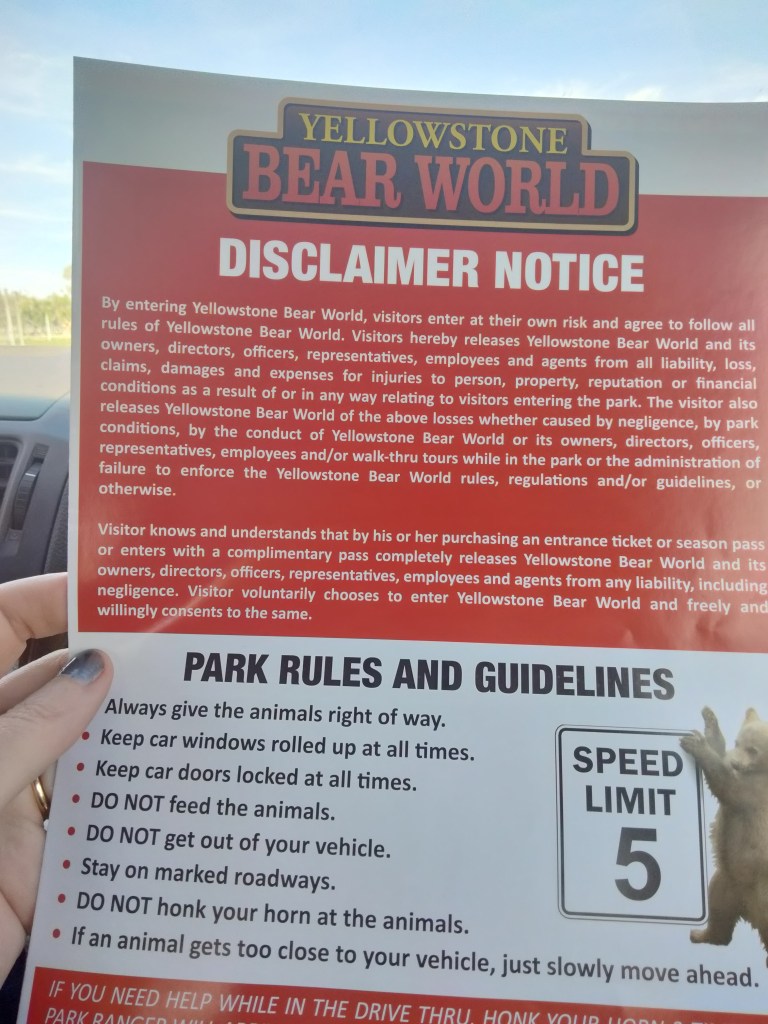
The way it works is that you first drive through an animal park, and then you access the parking lot and other attractions. You can drive back through the animal park as many times as you like on one ticket. But there is a very stern warning:
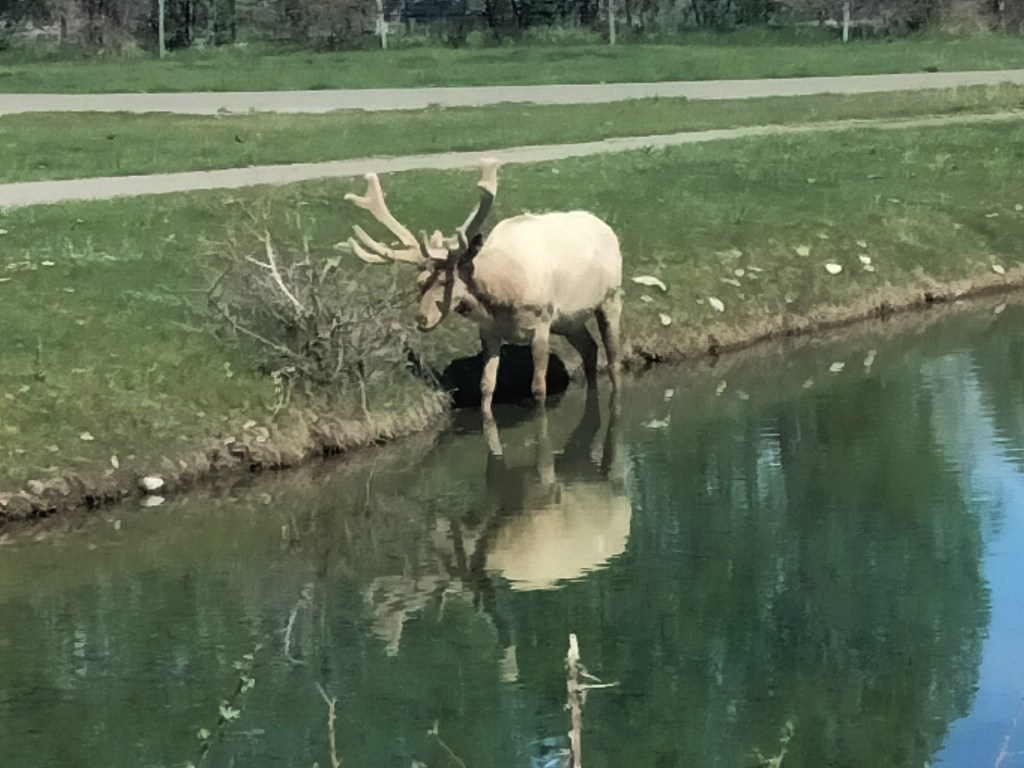
The first part of the park has various ungulates like this rare albino elk:
and this regular elk:
… and also bison.
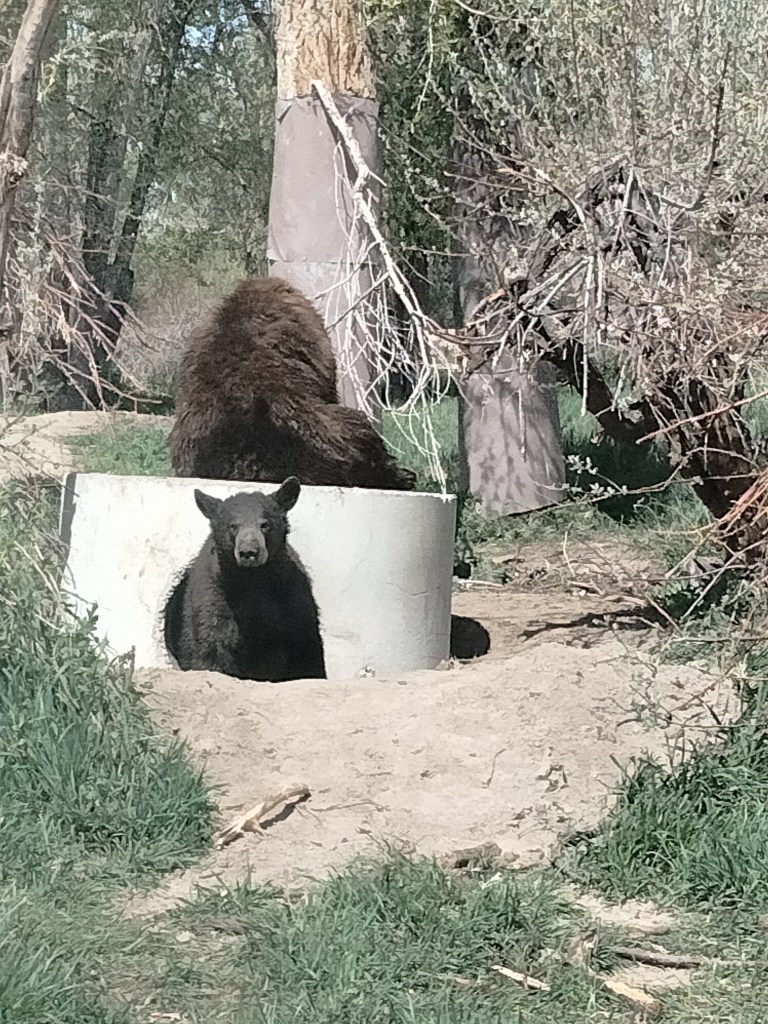
Then you go through a gate where an employee checks your receipt and reiterates the instructions. Beyond the gate, you are in the bear part of bear world, where you can see multiple bears just hanging out. There are, at least in the black bear area, far more bears than you would normally see all in one place. The trees all have metal cuffs on them, I guess to prevent them from being destroyed by all those bears.
There are feeding troughs for the bears,
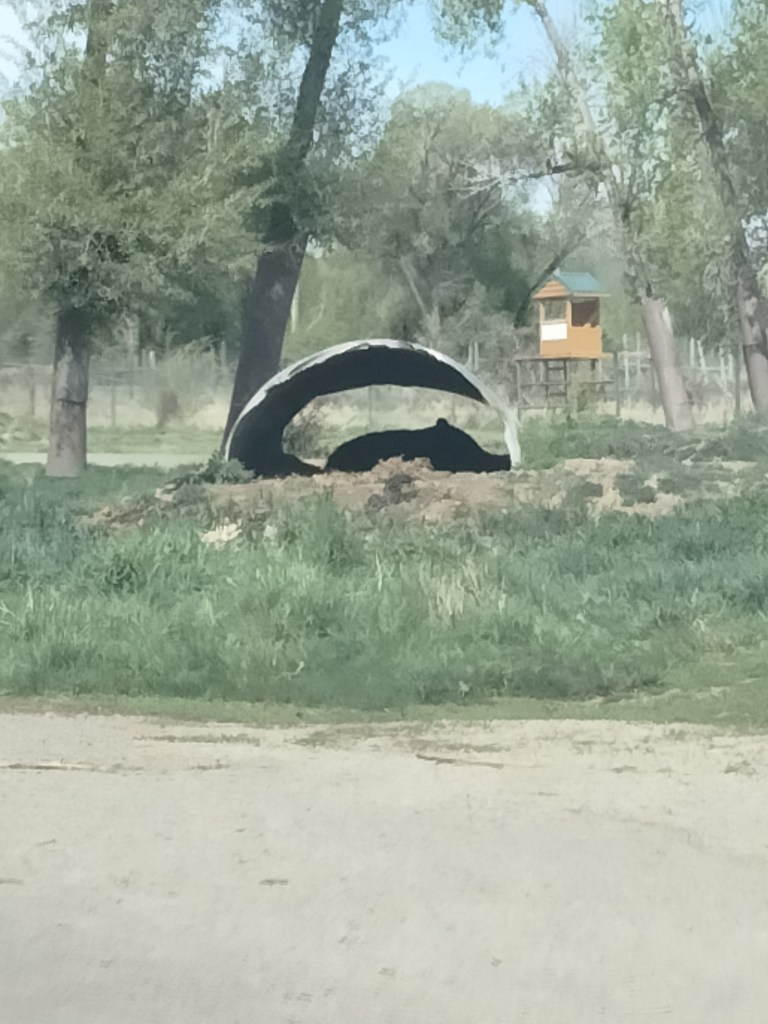
and shady places for them to sleep. Many of them were doing just that.
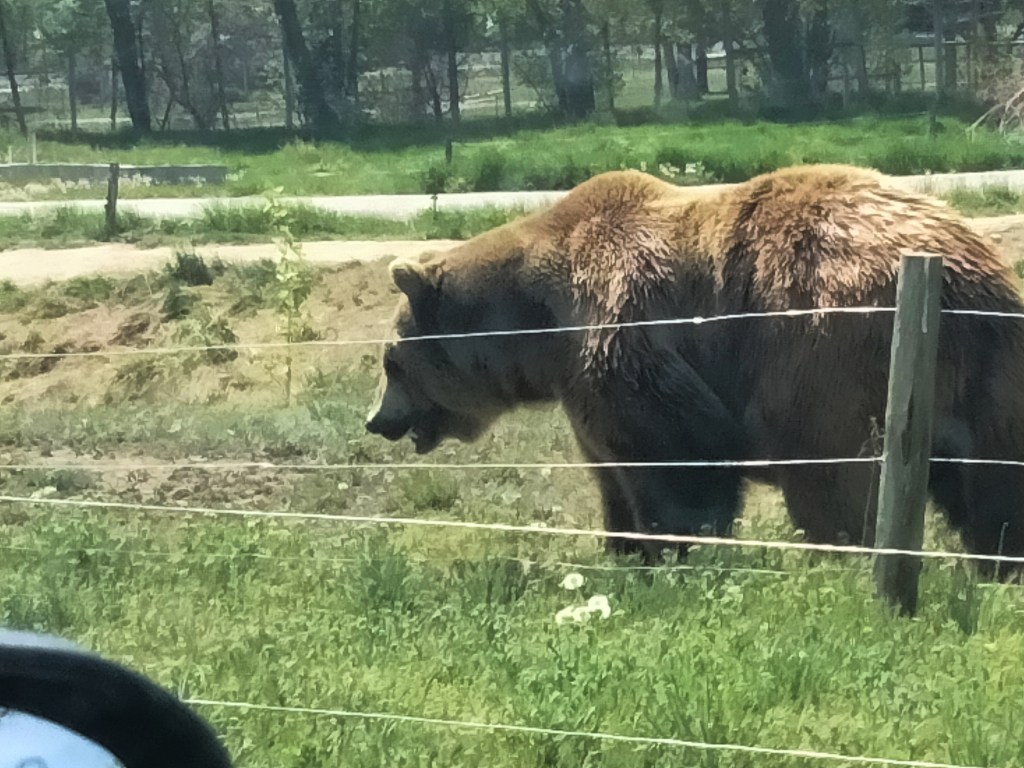
But before you get to where the black bears are, you pass an enclosure with a few grizzly bears. The grizzlies are behind an electric fence.
This is gal is pacing the perimeter.
Notice that she has the distinctive grizzly look: the concave or “dished” face, and the grizzly shoulder hump. They are also a lot larger than black bears.
I say “she.” We assumed all the bears in the park were females, because it’s hard to imagine you could keep one or more males in these conditions without them fighting each other.
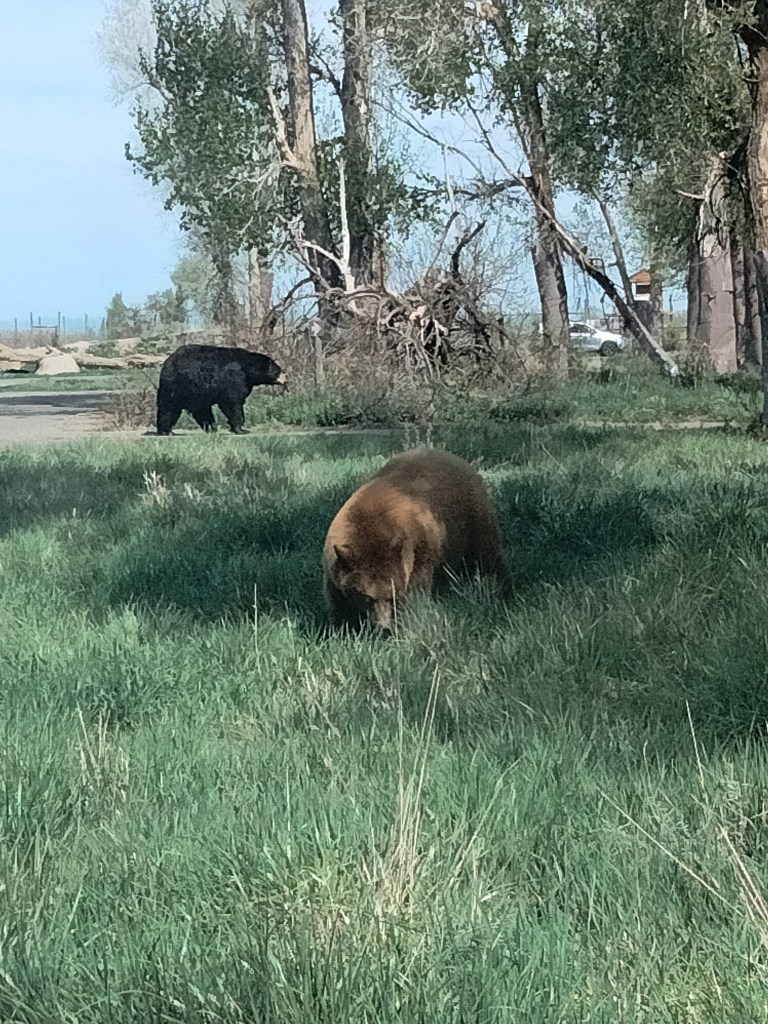
Back to the black bear area. The black bears were free to roam across the road if they liked, even right in front of your car. Notice the black bear silhouette: straight muzzle, no hump, smaller. I love the curving feet!
At one point, we even saw some employees standing among the black bears! They were photographing a large tree whose trunk had been torn up. The bears seemed unconcerned.
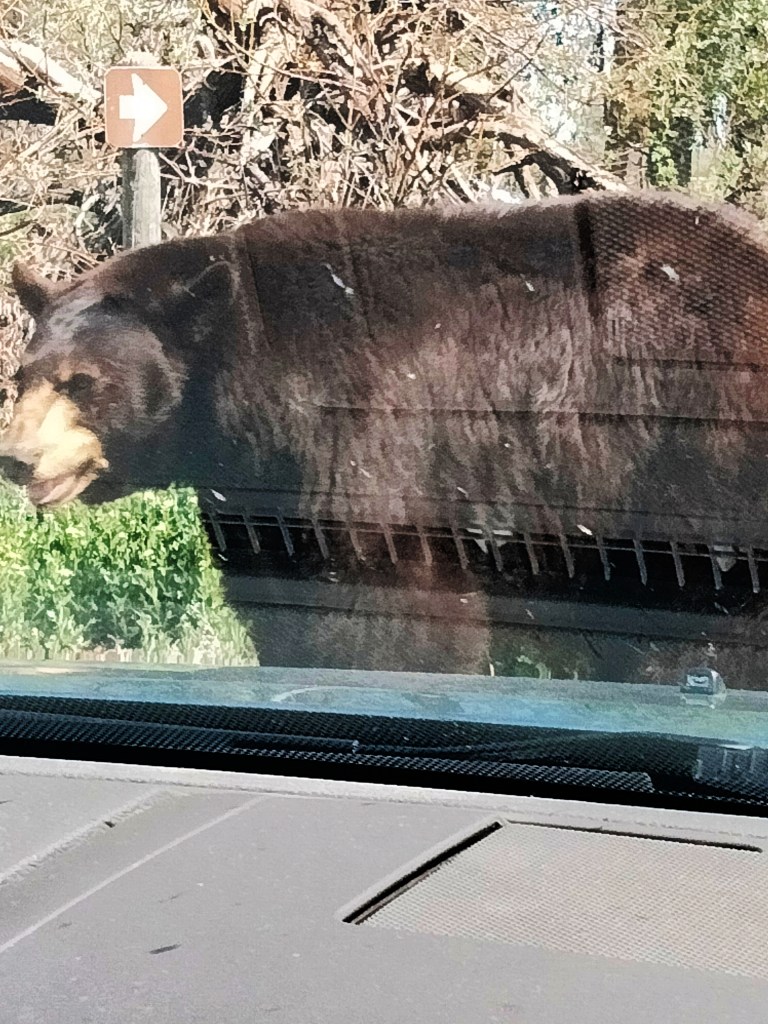
And now we get to my favorite thing! You see, “black” bears (and actually grizzlies as well!) can be any color. (I am learning so much from Bear World!) They can be blond, for example. We did see one that was black-and-blond patches. But this here … is a cinnamon bear! It’s hard to tell from the picture, but its brown coat was almost ginger. The hair also looked thicker and more luscious than on some of the other bears, almost as if it had been groomed.
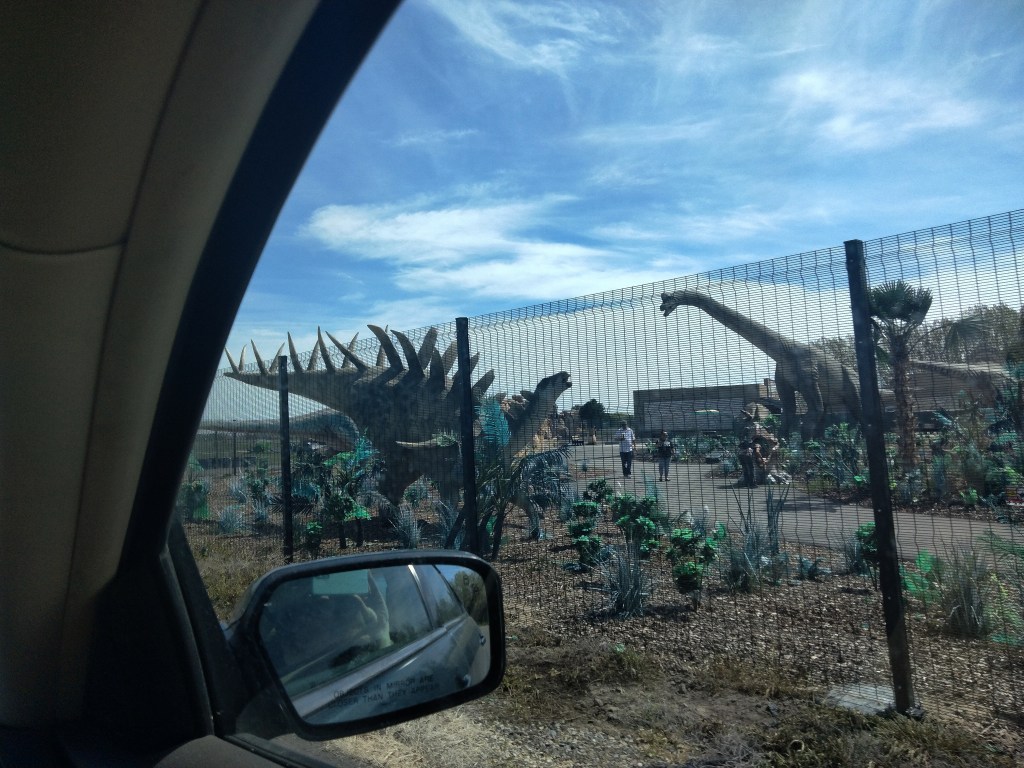
Also … and I bet you didn’t see this coming … Bear World also has DINOSAURS!
One of them went so far as to eat Mr. Mugrage.
Thirteen, meanwhile, snuck into a dino’s nest and hatched out of its egg:
I have seen better dinosaur parks, but I have never seen more bears.
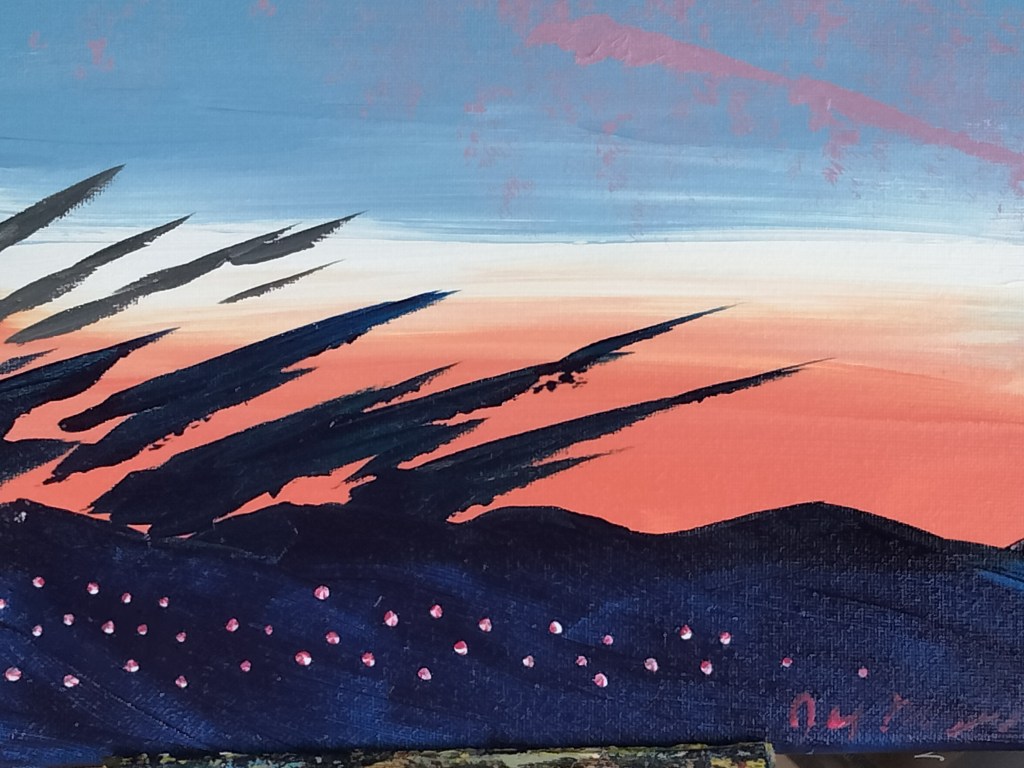
This is it. This is finally the texture-y, right in between Impressionistic and realistic look that I’ve been going for.
I also like the colors in this. Not too sweet, but not too monochromatic either.
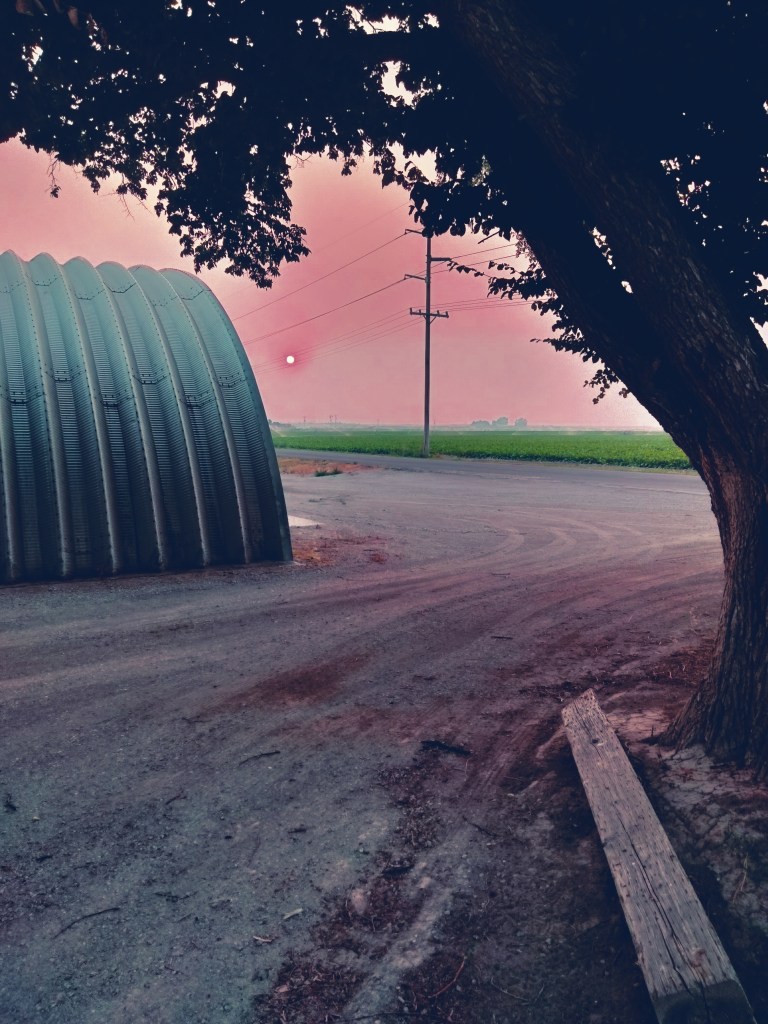
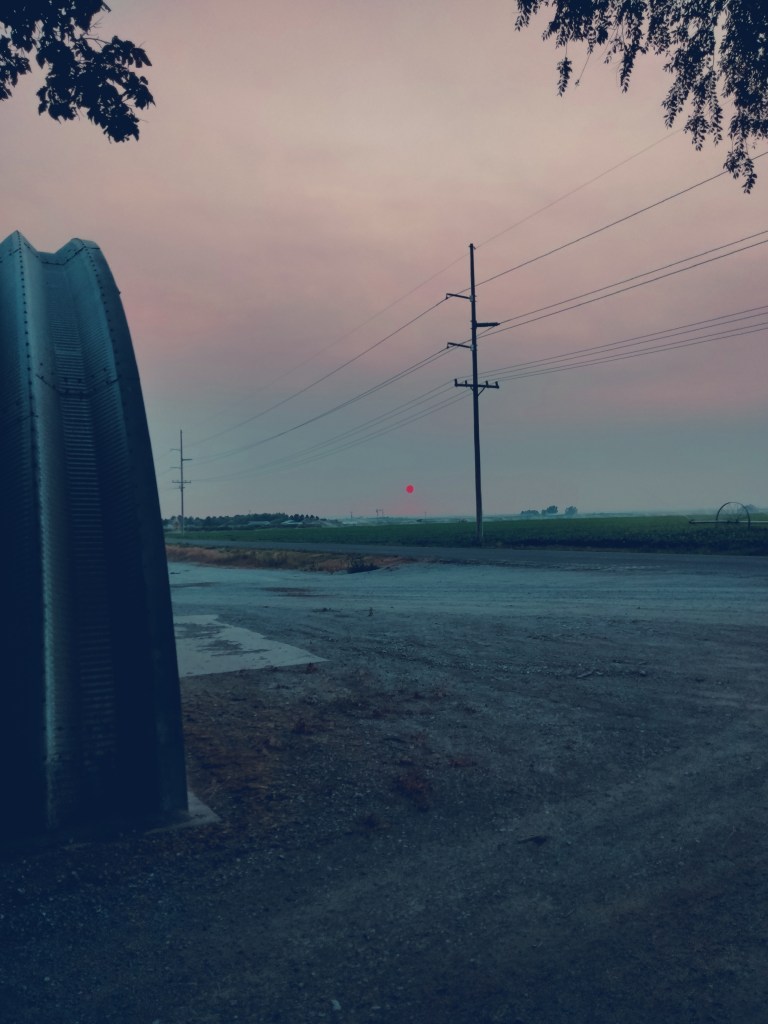
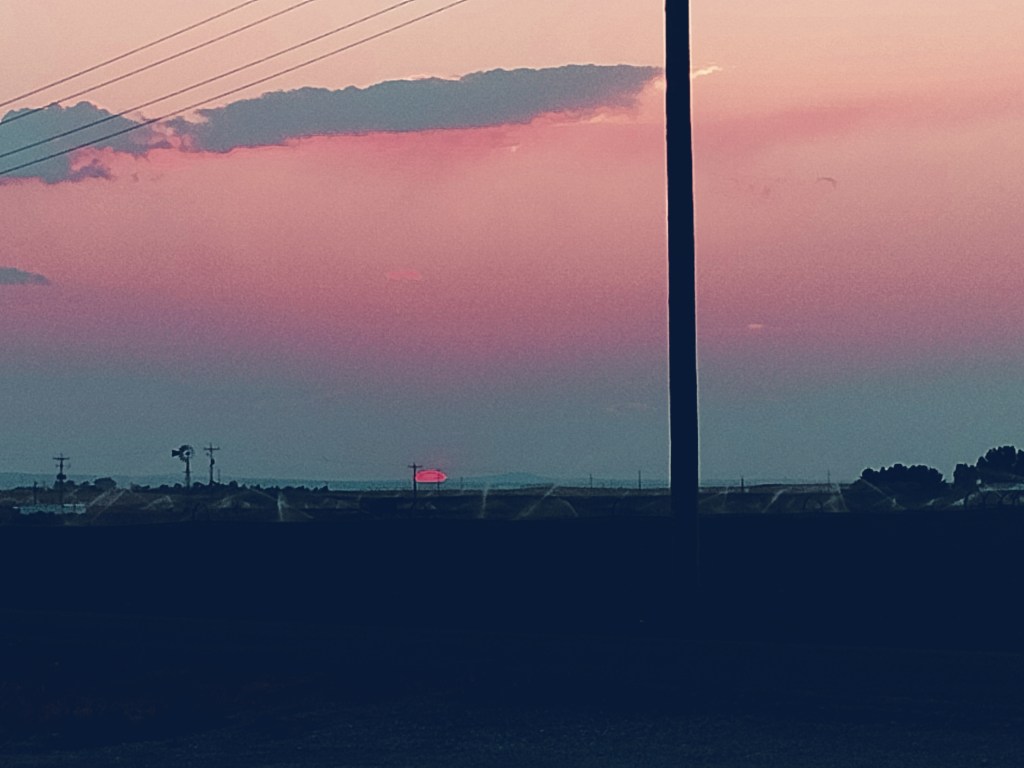
This painting is an attempt to capture the eerie afternoons that happened last summer, when we had our usual season of wildfire smoke blowing in from Oregon. Not only can you smell the smoke, but it can actually dim the sunlight enough to lower the temperature.
During one of these afternoons last year, I went out and tried to photograph the odd effect the smoke was having on the appearance of the sun.
My initial photos looked like this:
While accurate, these did not perfectly capture the vibe I was getting, so I tried taking some of the same scene with a variety of filters.
The filters do a better job capturing how red the sun looked to the naked eye.
I then did a painting using one of the filtered photos as a reference.
Obviously, there is room for many more paintings here, if I choose to pursue it.
I hope you enjoy being shown the reference photos beside the picture. I know some people like that. I recently learned the term “process journal” from a novel, which I thought was really cool. Apparently this is something that all art majors know about.
If you don’t like hearing about the process, just enjoy the painting and figure that you’ve somehow stumbled onto the cover of a Stephen King farm book.
This little (8×6) landscape acrylic painting is one of my favorites that I’ve done recently.
The water portrayed is actually a stream leading to the Snake River Reservoir, because the canals are not running at this time of year. However, I thought I’d give you some history about our local irrigation canals, because they are really remarkable.
The scheme diverts water from the [Snake] river about ten miles above Blackfoot. The main canal was planned to be 60-85 feet wide, carrying a depth of six feet of water about sixty miles, with many more miles of laterals and smaller ditches. … The canal is 60 feet wide and 8 feet deep, beginning near Firth and ending near the Lamb Weston Potato Plant at American Falls where a small amount of water then empties into the Snake.
Aberdeen, Idaho: Our Small Town Story, by Celia Klassen, p. 14
The canal system was constructed, essentially by hand, using horses, scrapers, and large baskets, and dynamite for rocky areas, between 1894 and approximately 1910. There were a series of investors, some working groups that fell apart, and two different canal companies that were formed to head up the project. The system includes many “fills” … areas where the canal was built up above the surrounding land, as to pass through a low spot.
During the construction, “Tent camps … were set up at various points, and everything the laborers needed had to be brought through the sagebrush by wagon … Families of canal workers lived along the canal while it was being built in what were called ‘ditch camps’.” (ibid, p. 15)
The canal system allows us to farm the Idaho soil, which is volcanic and very fertile, but doesn’t get enough rain for dryland farming. The Aberdeen-Springfield canal company still maintains the 190 miles of main and lateral canals, with sluice gates and the like. A canal runs right past my backyard, built up above the surrounding fields. The canals are drained in the winter months, and last year, an excavator worked its way slowly by our property, deepening the canal and creating large piles of soil on its banks. In the summer, “canal riders” patrol the system, checking for leaks. This is a wonderful system, and it takes a lot of effort to keep it working properly.
Despite being man-made, the canals also beautify the countryside. The presence of water attracts Russian olive trees, cattails, showy milkweed, and birds. Many farm kids grew up inner-tubing in the canals in the summertime, and their raised banks make a natural hiking route for people who want to walk in nature.
The source for this post was the book Aberdeen, Idaho: Our small town story, published by Celia Klassen in 2019. Celia did not grow up in Aberdeen, but married in. As so often happens, it took someone from the outside to appreciate that our local history was worth researching and recording.
[T]he newcomer to Garden City, once he has adjusted to the nightly after-eight silence of Main Street, discovers much to support the defensive boastings of the citizenry: a well-run public library, a competent daily newspaper, green-lawned and shady squares here and there, placid residential streets where animals and children are safe to run free, a big, rambling park complete with a small menagerie (“See the Polar Bears!” “See Penny the Elephant!”), and a swimming pool that consumes several acres (“World’s Largest FREE Swim-pool!”). Such accessories, and the dust and the winds and the ever-calling train whistles, add up to a “home town” that is probably remembered with nostalgia by those who have left it, and that, for those who have remained, provides a sense of roots and contentment.
I live in the West, where you can see long distances. About twenty-five miles south of our house is wind farm perched on the foothills. At night, you can clearly see the windmills’ lights twinkling. This painting portrays a more close-up view, glimpsed as I started the drive home on a winter evening.
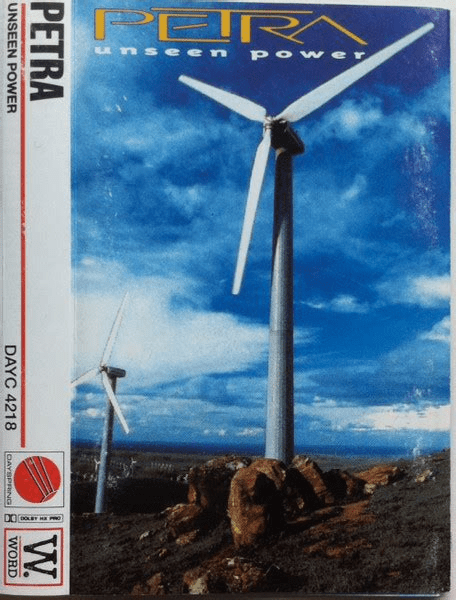
I never minded seeing wind farms, even in the daytime. I had a positive association with them, almost entirely because of the cover of a Petra album I had as a teenager:
I also believed what I was told, that these windmills would provide cleaner power than oil, coal, and natural gas.
Then, I started hearing about the downsides of wind farms. I heard that people who live near them develop health problems. I heard that, shockingly, it is not unusual for birds to get chopped up by them. The windmills have to be built in naturally windy areas, which are also migration routes for birds, which are apparently hard-wired in to the birds and can’t be changed.
Then, I found out that these turbines are expensive to build, last only about twenty years, and are difficult to dispose of:
Unfortunately, my aesthetic response to these windmills has already been locked in by Petra. I don’t think it’s going to change. Now, though, I no longer think of them as a good thing, a step in the right direction. I think of them as evidence that we are living in a sci-fi dystopia. Maybe some day, the wind farm in my part of the state will come down. But this little painting will remain as evidence that I lived in the Age of Man when we feared the imminent end of the world and thought we could forestall it by building these things.
It was ideal apple-eating weather; the whitest sunlight descended from the purest sky, and an easterly wind rustled, without ripping loose, the last of the leaves on the Chinese elms. Autumns reward western Kansas for the evils that the remaining seasons impose: winter’s rough Colorado winds and hip-high, sheep-slaughtering snows; the slushes and the strange land fogs of spring; and summer, when even crows seek the puny shade, and the tawny infinitude of wheatstalks bristle, blaze.

























 Out of Babel Books