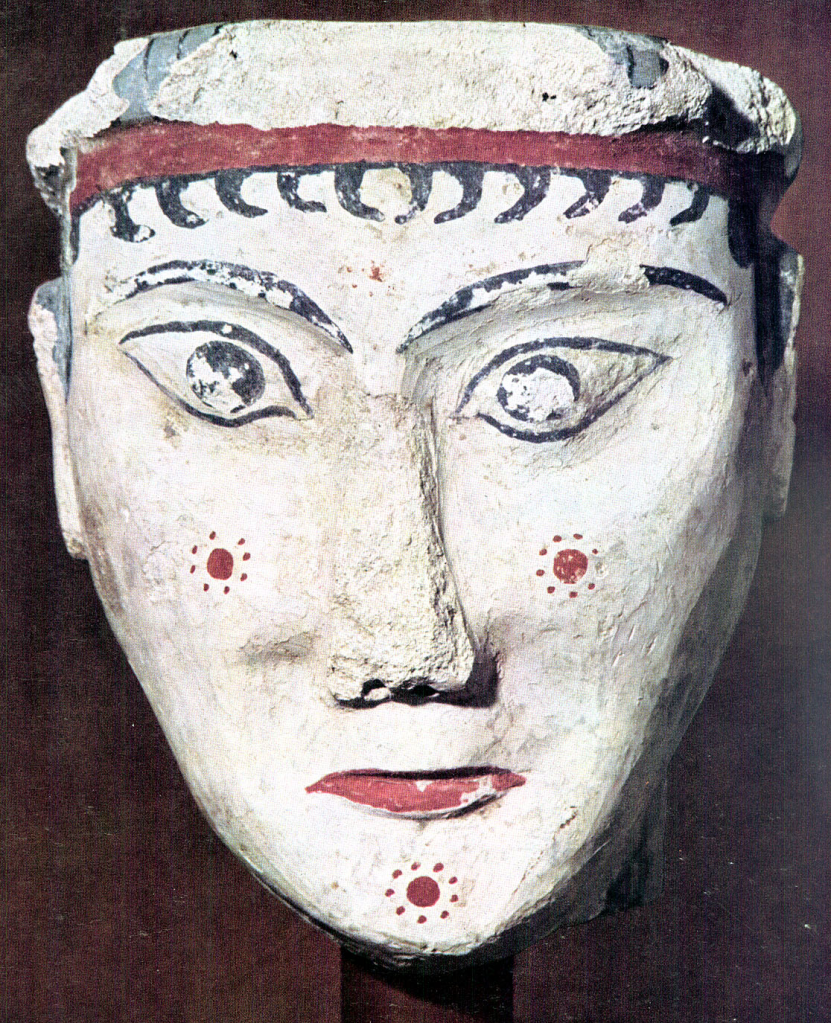
Why Jupiter is not just another name for Zeus

Among these original national gods Jupiter or Jove was the favorite … In the early centuries of Rome he was still a half-impersonal force–the bright expanse of the sky, the light of the sun and moon, a bolt of thunder, or (as Jupiter Pluvius) a shower of fertilizing rain; even Virgil and Horace occasionally use “Jove” as a synonym for rain or sky. In time of drought the richest ladies of Rome walked in barefoot procession up the Capitoline hill to the Temple of Jupiter Tonans–Jove the Thunderer–to pray for rain. Probably his name was a corruption of Diuspater, or Diespiter, Father of the Sky.

–Caesar and Christ, by Will Durant, p. 61

… and when the Romans encountered Zeus, they said, “Hmm, seems to be Jupiter.”

Oh, Rats!

You can read the incident that this is a reference to, in I Samuel chapters 4 – 6.

The Philistines were a culturally Aegean/Mycenaean people who had settled along the coast of Canaan. Though culturally Greek, they spoke a Semitic language. Their god, Dagon, was a man/fish god who had antecedents going all the way back to Sumeria.

The genre of these particular chapters of Scripture might be described as dark comedy. It’s a unique story, because it presents the reaction of an Aegean people when confronted with the God of Israel. The story is told in a Hebrew historical record, but the amount of detail means that the Hebrew chronicler must have had spies or eyewitness accounts.

The Philistines, though, or perhaps because, they are pagans, are pretty canny. They start out thinking they have won a victory over the Israelites by capturing their god, but it doesn’t take them too long to figure out that this God is trouble, and to ascertain, by process of elimination, what He wants.

Or you could say that God is very adept at communicating with the Philistines.

Roman Priests: the Original Lawyers

Before [the Twelve Tables of the Decemvirs], Roman law had been a mixture of tribal customs, royal edicts, and priestly commands. “Mos maiorum“–the way of the ancients–remained the exemplar of morals and a source of law … early Roman law was a priestly rule, a branch of religion, surrounded with sacred sanctions and solemn rites. The priests declared what was right and wrong (“fas et nefas“), on what days the courts might open and assemblies meet. All questions regarding marriage or divorce, celibacy or incest, wills or transfers, or the rights of children, required the priest as now so many of them require the lawyer. Only the priests knew the formulas without which hardly anything could be legally done. The laws were recorded in their books, and these volumes were so securely guarded from the plebs that suspicion charged the priests with altering the texts, on occasion, to suit ecclesiastical or aristocratic ends.

The Twelve Tables effected a double juristic revolution: the publication and secularization of Roman law.

–Caesar and Christ, by Will Durant, p. 31

Theological Question: Did Paganism do Romans Any Good?

Did this religion help Roman morals? In some ways it was immoral; its stress on ritual suggested that the gods rewarded not goodness but gifts and formulas; and its prayers were nearly always for material goods or martial victory. The gods were, with some exceptions, awesome spirits without moral aspect or nobility.

Nevertheless, the old religion made for morality, for order and strength in the individual, the family, and the state. Before the child could learn to doubt, faith molded its character into discipline, duty and decency. Religion gave divine sanctions and support to the family; it instilled in parents and children a mutual respect and piety never surpassed, it gave sacramental significance and dignity to birth and death, encouraged fidelity to the marriage vow, and promoted fertility by making parentage indispensable to the peace of the dead soul. By ceremonies sedulously performed before each campaign and battle it raised the soldier’s morale, and led him to believe that supernatural powers were fighting on his side. It invested every phase of public life with religious solemnity, prefaced every act of government with ritual and prayer, and fused the state into such intimate union with the gods that piety and patriotism became one, and love of country rose to a passion stronger than in any other society known to history. Religion shared with the family the honor and responsibility of forming that iron character which was the secret of Rome’s mastery of the world.

–Caesar and Christ, by Will Durant, p. 67

… In other words, it wasn’t enough to hold back the tide of human wickedness, but it was a good preparation for the Gospel.

Quote: What Was so Great about the Roman Senate?

The Senate of the Republic [508 – 49 B.C.] often abused its authority, defended corrupt officials, waged war ruthlessly, exploited conquered provinces greedily, and suppressed the aspirations of the people for a larger share in the prosperity of Rome. But never elsewhere … have so much energy, wisdom, and skill been applied to statesmanship; and never elsewhere has the idea of service to the state so dominated a government or a people. These senators were not supermen; they made serious mistakes … But most of them had been magistrates, administrators, and commanders; some of them, as proconsuls, had ruled provinces as large as kingdoms … it was impossible that a body made up of such men should escape some measure of excellence. The Senate was at its worst in victory, at its best in defeat. It could carry forward policies that spanned generations and centuries; it could begin a war in 264 and end it in 146 B.C.

–Caesar and Christ, by Will Durant, p. 28

Amusingly Misanthropic Quote on Etruscan Pottery

The most renowned of Etruria’s products is its pottery. Every museum abounds in it, setting the weary navigator of ceramic halls to wonder what unseen perfection exonerates these stores. Etruscan vases, when they are not clearly copies of Greek forms, are mediocre in design, crude in execution, barbarous in ornament. No other art has produced so many distortions of the human frame, so many hideous masks, uncouth animals, monstrous demons, and terrifying gods. … All in all, the robbers were justified who, when they rifled Etruscan tombs, left so much of the pottery.

–Caesar and Christ, by Will Durant, p. 9

A Monster Theology Post about the Three Types of Old Testament Law, because it is Theology November

A writing prompt from the Internet

Sometimes, you get into a discussion in a comments section that clearly is beyond the scope of the comments section, both because a) it requires really long comments, b) with footnotes, and c) your interlocutor is not actually going to be convinced. In other words, this discussion ought to be a persuasive essay instead.

When you have a theology blog, this is nothing but good news.

I recently got into such a discussion.

The context: Doug Wilson’s interview with Ross Douthat. Douthat asks Wilson whether, in his ideal Christian Republic 500 years from now, every sin would be against the law. Wilson makes the helpful distinction between sins and crimes. Not every sin should be against the law, he says. Failure to understand this concept got the Puritans into trouble, but we have learned a lot since then. Wilson then goes on to mention the well-known classification of “three types of law” found in the Old Testament: the moral law (universal, binding on all individuals before God), the civil law (what was legal and illegal in the kingdom of Israel, and with what civil penalties), and the ceremonial law (regulations having to do with the Temple, the sacrificial system, and various purity laws such as food laws). If you have been around Christian circles, particularly Reformed circles, you will have heard this distinction. (Edit: I’m now not sure whether Wilson brought up the three categories of law in the video, or whether it came up in the comments as we discussed the distinction he was making between sin and crime.)

Now we come to the commenter who kindly gave me a prompt for this essay. I don’t even know whether this person is man or a woman, but I’m going to call him Rufus.

Rufus says,

The problem is that the distinction [between sin and crime] is always arbitrary, and tends to align with the cultural norms of a particular period of time (e.g. USA in the 1950s).

The inconvenient fact is that moral/civil/ceremonial law distinctions are not in the text, either explicitly or implicitly based on the arrangement (e.g. if you read straight through Leviticus and Deuteronomy, you will find yourself constantly flipping between categories, sometimes verse to verse, without any indication you should be doing so.)

What you are doing is looking at the text vs. normative Christian practice and trying to figure out a system that explains why we follow some of the commandments and not others. Then once you have devised the system, you apply it to the text and say that’s why we follow these and not those. This is a circular argument. The fact you can’t explain satisfactorily how Matthew 5:18 – 20 fits with normative Christian practice is why the Hebrew Roots movement exists. Their position is wrong, but it’s totally reasonable given the premises they’re starting with.

Thanks for the prompt, Rufus. This will give us a lot to chew on.

The trickiness of not knowing who you’re talking to

First, let me clear up just a few simple misunderstandings that Rufus can hardly be blamed for.

Rufus mentions, or implies, that Wilson is just taking a sentimental look back at 1950s America and assuming that, if he can get his Christian republic to look like that, he will have applied the law of God in a culturally appropriate way. Now, it happens that Wilson, in this interview and elsewhere, does mention 50s & 60s America as a place he remembers fondly. He usually brings it up in order to make the point that sodomy was banned back then, and yet America did not resemble the Handmaid’s Tale, which must mean laws against sodomy don’t necessarily produce that kind of society.

However, if Rufus knew Wilson a little better, he would know that Wilson does not look back at the 1950s with a sentimental and uncritical eye. In fact, Wilson has compared the position of the U.S. in the 1950s to that of someone who has just fallen out of an airplane, but is still only a yard below it. Now, we are approaching the ground, but going back to one yard below the plane, if we could do such a thing, would not help in the long run.

If Rufus knew the neoReformed world from within Wilson is writing even better, he would know that, when we do romanticize historical eras, it ain’t the 1950s we usually choose. It’s more likely to be Jane Austen’s England, or Knox’s Scotland, or Jonathan Edwards’s Puritan New England. This shows that Rufus does not really know who he is talking to. He can hardly be blamed for this, on the Internet, but if he wants to attain a “touche” moment, he needs to find out the actual position of his interlocutor, not talk to somebody he has in his mind (maybe a Southern Baptist?).

Then Rufus says to me (or perhaps it’s a general “you”), “What you are doing is looking at the text vs. normative Christian practice and trying to figure out a system that explains why we follow some of the commandments and not others. Then once you have devised the system, you apply it to the text and say that’s why we follow these and not those. This is a circular argument.”

Why yes, it would be a circular argument, if that were something I was doing. And perhaps there are some people who do that, and these are the people Rufus had in mind as the intended audience for his comment. However, I am not those people. I am a person who lived overseas, trying to get a Bible translation movement started in jungle area that boasted a lot of paganism still, a strong Muslim presence as well, and heavy influence from Christian norms that were not American Christian norms. Both before and after living there, I took anthropology and missiology classes where almost all we did was discuss how the Bible can and should be applied in different cultural contexts. I’ve prayed with native people who use their language’s name for the Creator (Mohotara), and it was glorious. I’ve attended a traditional dance ceremony that had been adapted for Christian purposes to give thanks for something. I’ve listened to people discuss whether Christians can keep in their homes heirlooms that were once used for pagan purposes, and what happens when a Muslim man with multiple wives converts to Christianity.

So no, Rufus, if I was the intended audience for your comment, you have me wrong. I was not just taking a received American Christian practice and backfilling it to make it look biblical. But there is no way you could be expected to know this. After all, I don’t even know whether you are a man or a woman.

O.K., so my claim is that people who talk about the three categories of the Law are not just arguing in a circle, or justifying sentimentality or lazy thinking. What is our biblical argument, then? Let’s address Rufus’s exegetical objections.

Rufus is right … sort of

First, let me say that Rufus is technically right in his comments about Leviticus and Deuteronomy:

The inconvenient fact is that moral/civil/ceremonial law distinctions are not in the text, either explicitly or implicitly based on the arrangement (e.g. if you read straight through Leviticus and Deuteronomy, you will find yourself constantly flipping between categories, sometimes verse to verse, without any indication you should be doing so.)

Rufus 100% is correct that nowhere in the Law are there headings that say “Moral Law,” “Civil Law,” or “Ceremonial Law.” He is also correct that all these three types of commands tend to be mixed together, and sometimes it’s hard to tell which one a given commandment is. In this essay, I will argue that his correctness about the distinctions being “not in the text” only holds if you confine yourself to the texts of the actual commands, ignore the narrative parts, ignore the New Testament, and play dumb.

Mysterious Accounts and Emerging Distinctions

First, let’s acknowledge that the Books of the Law (Exodus, Leviticus, Numbers, and Deuteronomy) strike the modern person as disorganized. These books toggle back and forth between law and narrative. They give the Ten Commandments, and then a bunch of differing elaborations on them in different places, organized in different ways depending upon the book, the passage, and what is foregrounded after the narrative that just took place. Sometimes, Israel acts up, God says He’s going to reject them, Moses talks Him around, and then all the commands are repeated as they are reiterated. In Numbers, new applications and case law are given as new situations arise (for example, how inheritance should work if a man has only daughters). Some of the annual ceremonies (not to mention the daily ceremonies) work differently when the people of Israel were dwelling in tents with the Tabernacle right there, versus when they were living on their homesteads throughout the land, days, or weeks’ journey from the Tabernacle and later the Temple. So, no, the laws are not organized and laid out conveniently, the way modern people would like a code of laws to be. In some ways, they are more like a tribal history, which is how laws often worked back then.

In fact, I’ll do you one better. The narrative accounts from the times of the patriarchs and Exodus are also mysterious and confusing. All this was so long ago, and so little is known about the context, that it can be difficult to re-construct, for example, Israel’s exact route out of Egypt, despite the many, now obsolete, place-names given. So yes, this is an ancient, ancient document, not a simple user’s manual.

But the distinction between ceremonial, civil, and moral law is far from the only distinction that was not present in the ancient mind, and emerged over time with progressive revelation. Another great example of this would be the doctrine of the Trinity. In the Old Testament, we often see the LORD appearing as a man. Sometimes “the Angel of the LORD” does the same thing, and very occasionally, such as in Genesis 18, we see them together. (See Michael Heiser and his discussion of “two powers in heaven” in his book The Unseen Realm.) We also see “the spirit of the LORD” coming upon people in the Old Testament. The result was usually that they prophesied, or had a kind of battle madness come upon them. Thousands of years later, in the New Testament, we see Jesus say that He is God’s Son, and that “I and the Father are one.” We see the Spirit come down upon Jesus in the form of a dove. In John 15 and 16, Jesus talks openly about both the Father and the Spirit. Finally, in Matthew 28, we get “Baptize them in the name of the Father and of the Son and of the Holy Spirit.” You could not get trinitarian doctrine out of just Leviticus and Deuteronomy, but if you take the whole Bible as inspired, you can’t avoid it.

C.S. Lewis has said somewhere, I think in The Abolition of Man, that the ancient mind did not make a distinction between spiritual and physical. When ancient people saw a king’s throne, for example, they reacted to it as a totality. The physical throne and the concept of majesty and authority were one thing. As time has gone by, and humanity has made a sharper and sharper distinction between physical and spiritual, we can readily infer when the ancients were talking about one, the other, or both.

In the same way, once we have been given the “three categories of law” as a tool to help us in reading Leviticus, it’s usually pretty easy to tell which kind we are looking at. Civil laws usually come with some kind of civil penalty, anything from remuneration to death. Moral laws are usually just commands: “If you see the donkey of one who hates you falling down under its load, do not leave it there; be sure to help him with it.” (Ex. 23:5) Ceremonial laws are often prescriptions of how to handle ceremonial objects and what sacrifices to offer; the subclass of ceremonial laws called purity laws usually come with some kind of purification ritual if someone becomes “unclean.” All this may not be explicit, but neither is it arbitrary.

Now, we acknowledge that these categories are not completely watertight in the context of ancient Israel. Some offenses are both civil and ceremonial, and these often call for death. Examples would be a wide range of sexual offenses that not only wrong the victim, but also defile the nation and dishonor God. Some offenses are just ceremonial but not civil or moral: touching a dead body. Some are both moral and civil (false testimony in court), where others are just moral (envy, gossip). Having said all this, you can usually tell the category(-ies) of the offense by using common sense.

Also – ahem – the New Testament

Finally, I’d like to call Rufus’s attention to the fact that the New Testament exists. The question of the difference between a sin and a crime, and of what parts of the Old Testament Law were binding on non-Jewish believers, occupies large swathes of the New Testament. I mean large swathes. This is discussed at length.

The entire book of Hebrews establishes that the ceremonial law was a preparation for Christ, was fulfilled by Christ, and now is no longer necessary. Hebrews was written not too long before the destruction of the Temple in 70 A.D. It warns repeatedly that the whole sacrificial system is “passing away.” Galatians discusses at length whether circumcision, a purity ordinance designed to differentiate Israel from other peoples, is necessary for a Christian to practice (answer: No). Large chunks of Acts are devoted to early believers trying to figure out which parts of the Law are binding on Gentile converts to Christianity. God Himself reveals to Peter that the food laws no longer apply. This gives us a pretty good case that the ceremonial laws associated with temple system, and the purity laws associated with separateness, are their own category.

But there were some prohibitions that were moral, civil, and ceremonial offenses in old Israel, which now are just moral offenses. Fornication, adultery, and sex with temple prostitutes are prime examples. These things were legal in the Roman empire. They are not ceremonial offenses for Gentiles who are no longer under the ceremonial law. But Paul is at some pains to point out in his letters that they are still moral offenses against God. (“Then they should not be illegal in a Christian republic!” Whether they should be civil offenses, they were not in the Roman empire. This shows there is a distinction between moral law and a civil law.)

There is also a fair amount of discussion in the New Testament as to what should be the Christian’s relationship to the civil magistrate — the legal system of the country they live in. In Luke 3:14, when Roman soldiers ask John what they should do to demonstrate repentance, he doesn’t tell them to quit working for Empire, but he tells them not to be corrupt and oppressive. Paul says that Christians should be known as law-abiding (Romans 13:4). He seems to feel that the civil magistrate has actual real authority to enforce civil laws, but that he should not get involved in disputes within the church (I Cor. 6). Similarly, Jesus tells us that paying taxes to pay for law enforcement and national defense should not burden our conscience (Matthew 22:15ff). If someone who has legal authority over others becomes a Christian, Paul (Philemon 1 – 25) and Jesus (Matt. 24:48) say that they should use their authority to do good. Jesus also says that we should use our wealth to do good (Luke 16:9). The general picture is of two different spheres of authority, which overlap in commonsense ways. A Christian may have to engage in civil disobedience if ordered to bow down to the golden statue, but he is not culpable merely by virtue of participating in the system in which he finds himself, and should be law-abiding except in extraordinary circumstances. A Christian who finds himself with some civil power should use that power like a Christian: don’t be corrupt (the prohibition on taking bribes goes all the way back to Exodus), and try to use your influence to do as much good as possible. Long-term, this was going to lead to things like the abolition of sex slavery, then polygamy and wife-beating, and then slavery in general. But the early church could not dream of such influence.

In sum, the New Testament has a lot to tell us about ceremonial, moral, and civil law, but it is not neatly organized. It is in the form of letters and narrative history.

Looking Matthew 5:17 – 22 in the face

So now we can address Rufus’s claim that “you can’t explain satisfactorily how Matthew 5:18 – 20 fits with normative Christian practice.”

I tell you the truth, until heaven and earth disappear, not the smallest letter, not the least stroke of a pen, will by any means disappear from the Law until everything is accomplished. Anyone who breaks one of these commandments and teaches others to do the same will be called least in the kingdom of heaven, but whoever practices and teaches these commands will be called great in the kingdom of heaven.

You are right, Rufus, but again, you are only right if we squint and play dumb. I can certainly explain it if you back up and include Matthew 5:17:

Do not think that I have come to abolish the Law or the Prophets; I have not come to abolish them but to fulfill them.

Jesus fulfills the Law and the Prophets. How does He do it? By being the last High Priest we’ll ever need (Hebrews 7), the last sacrificial lamb we’ll ever need (John 1:29), the true temple (John 2:19 – 22), the true Ark (I Peter 3:20 – 21), the one for whom the prophets searched intently (I Peter 1:10 – 12), the second Adam (Romans 5:12 – 21), and so on. When His ongoing work is done, then “everything will be accomplished.” At the moment, He has accomplished a lot of it, including making the ceremonial law obsolete. At the time He was speaking in Matthew 5, He had not yet accomplished a lot of this, so the ceremonial Law was still in full force. For a little while.

Jesus did take major issue with how the Law was being applied (all out of emphasis, and contrary to its own spirit). He had been so outspoken about this that some people got the impression He was throwing out the whole thing, and they didn’t know whether to be excited or terrified. In Matthew 5:17 – 22, Jesus hastens to clarify that He is still on the side of the Lawgiver. He wanted us to know that, although large parts of the Law were shortly going to be “accomplished,” they were never going to become wrong. That book is closed, you might say, but it is not burned. It will never be the case that God was wrong to give the Law He gave to the ancient Israelites. It will never be the case that that Law was not good. We cannot accuse God of giving an imperfect Law, which I think is the main point of this passage.

O.K., that’s it. Rufus, if you’re out there, you say that you have looked into these issues deeply, “for decades.” I don’t know what your experience has been. Clearly, it has differed from mine. I hope we can stop talking past each other.

Quote: All Is Vanity

His slaves carried his litter behind him, acting as a bodyguard, but he was not afraid of Pompeii after dark. He knew every stone of the town, every hump and hollow in the road, every storefront, every drain. The vast full moon and the occasional streetlight–another of his innovations–showed him the way home clearly enough. But it was not just Pompeii’s buildings he knew. It was its people, and the mysterious workings of its soul, especially at elections…

Pompeii, p. 207

Farmlands and Paganism

Besides growing up around farms and reading a lot of literature set there, I’ve always kind of craved traditions, folk costumes, and folk practices. It’s not because I like being circumscribed in everything I do–I’m kind of a free spirit actually–but because I sensed these traditions and customs and bits of folk wisdom represented a thick culture, rooted in the distant past, that I as an American lacked. Traditional ways, whatever they were and wherever I read about them, seemed at the same time intriguingly exotic, and almost familiar.

In eastern Pennsylvania, where I spent my earliest years, many of the farmers were Pennsylvania Dutch–i.e., German immigrants. They had their own language, a dialect of German that my dad was able to pick up due to having majored in German. They had their own foods, like shoefly pie and scrapple. And they had a little, tiny bit of superstition: hex signs painted on barns. As a kid, I knew that these pretty little designs were called hex signs, but I had no idea of the connection between the word hex and spells or witches.

The Pennsylvania Dutch were nominally Christian, though I understand from my dad that they, like the Amish, often had a shallow and moralistic understanding of the Bible, and in fact sometimes didn’t have a Bible in a language they could read.

Despite their attractions, the Germans were to me among the least interesting of pagan farmers. I was more interested in British, Scots, and Irish folklore. It seemed warmer and more colorful somehow, and we had plenty of that around too, being in the Appalachians. It was also readily available in literature.

The connections between farming, weather-watching, astronomy, and European pagan religion are ancient and obvious. Here is Will Durant on Roman practices:

When [the Roman peasant] left the house he found himself again and everywhere in the presence of the gods. The earth itself was a deity: sometimes Tellus, or Terra Mater–Mother Earth; sometimes Mars as the very soil he trod, and its divine fertility; sometimes Bona Dea, the Good Goddess who gave rich wombs to women and fields. On the farm there was a helping god for every task or spot: Pomona for orchards, Faunus for cattle, Pales for pasturage, Sterculus for manure heaps, Saturn for sowing, Ceres for crops, Fornax for baking corn in the oven, Vulcan for making fire. Over the boundaries presided the great god Terminus, imaged and worshiped in the stones or trees that marked the limits of the farm. … Every December the Lares of the soil were worshiped in the joyful Feast of the Crossroads, or Compitalia; every January rich gifts sought the favor of Tellus for all planted things; every May the priests of the Arval (or Plowing) Brotherhood led a chanting procession along the boundaries of adjoining farms, garlanded the stones with flowers, sprinkled them with the blood of sacrificial victims, and prayed to Mars (the earth) to bear generous fruit.

Caesar and Christ, p. 59

Farming is so labor-intensive, so high-stakes, so heartbreaking, so subject to factors beyond human control, that it tends to produce nervous and conservative people. It would be impossible to engage in it for generations without coming to a profound humility before whatever entity you have been led to believe determines whether your whole year of work will be wiped out within a few days. For Christian farmers, that entity is the One who owns the cattle on a thousand hills. For post-Christian farmers, such as Wendell Berry, it’s the earth itself, I suppose, the environment. For pagans, it’s not hard to understand why they might be reluctant to let go of all the little rituals that stand between them and disaster.

Thus, paganism hangs on longer among country folk than in the city. If you want your eyeballs to be assaulted with an astonishing variety of pagan superstitions still proudly held by modern Americans, go get yourself a Farmer’s Almanac and look in the classifieds section.

“But modern Americans are returning to paganism!” you say. “It’s part of the New Age. It’s trendy, not traditional.”

Don’t I know it. I have met a few neopagans in my day. The one I knew best, was raised in a nominally Roman Catholic home. She was innovating with her paganism, part of the modern self-worshipping, I’ll-make-it-up-as-I-go ethos. The neopagans in the back pages of The Farmer’s Almanac don’t give me that vibe. I could be wrong, but it seems like they never left.

Where is the line between weather-watching, paying attention to the phases of the moon when you plant, following the zodiac along with the yearly calendar, hiring a water-witch, hanging a horseshoe over your door to protect your entryway with iron, and full-on pagan worship? How much of it is science, and how much is just doing things the way your mother did them? And how many “mindlessly followed” folk traditions turn out to have a sound scientific basis?

I’m guessing that Christian farmers in the modern age may have given up some valuable folk knowledge in an effort to avoid idolatry. Idolatry is a deadly poison, though, so no doubt, the sacrifice is worth it. If your eye cause you to sin, pluck it out. I hope that, as the generations roll by, we can build a culture that’s even richer than the pagan one we left behind.

3D Map of the Mediterranean

Get a white signboard from Hobby Lobby.

Freehand the coastlines in pencil while looking at a map for reference. Paint the seas, using Duckduckgo to find out relative depths. Start adding topography using plaster-of-Paris coated gauze strips.

Continue adding topography.

Some of these mountainous areas threatened to come loose after they dried. I simply applied some Elmer’s glue under them.

Paint as desired. I protected some of the smaller bodies of water by squeezing a thick layer of Elmer’s on top of them.

When dry, paint grassy areas with craft glue and sprinkle on “grass” that you can get in the model railroads aisle. Let dry, then vacuum up loose “grass.”

Show to 3rd, 4th, and 5th graders.