
Winter got this reaction a lot when he killed people. He was a well-spoken man, a man of taste and culture, a gentle man in many ways and given to fine feelings. Cold-blooded killing was not the sort of thing people expected from him. Unless they were very insightful, they did not understand the complete absence of sentimentality in his makeup. He knew there were some men so low that only death could improve their personalities. He did not hesitate to improve them when the need arose.
–After That, the Dark, by Andrew Klavan, p. 298
Tag: Andrew Klavan
After That, the Dark by Andrew Klavan

Let me fangirl for a minute
I am not a person who eagerly awaits the latest release in a series, and pre-orders books as soon as they become available. Usually, I am the one who discovers the series 20 years after it came out. In fact, this series by Klavan is the only exception I can think of. I pre-ordered After That, and it came, as promised, on Halloween.
Mini reviews of the whole Cameron Winter series
This is the fifth book in the Cameron Winter series. The other books are:
- When Christmas Comes (O.K. Sets up Winter’s history, shrink, and issues.)
- A Strange Habit of Mind (I like it because my mind is also strange.)
- The House of Love and Death (Tragic!)
- A Woman Underground (Also tragic, but satisfying. Wraps up Charlotte)
After That, the Dark takes Winter on the next stage of his journey. It’s designed to be readable as a stand-alone, but you will find it more satisfying if you’ve been with him all along.
The Basic Review
Like every Winter book, this one deals with Winter’s psychological journey, and on a parallel track there is an equally devastating crime that he is trying to solve and, inevitably, prevent. Subplots include Winter’s love life and his battles with the leftie professors at the university where he is an English professor.
The title for this book is taken from a poem by English Romantic poet Tennyson:
… Who imagined that his death would be like sailing over the sandbar near the coast and out into the greater ocean.
Twilight and evening bell,
And after that the dark!
And may there be no sadness of farewell,
When I embark;
For tho’ from out our bourne of Time and Place
The flood may bear me far,
I hope to see my Pilot face to face
When I have crost the bar.
ibid, p. 160
Cameron Winter’s academic specialty is English Romantic poetry (about which Klavan recently published a book, himself). Throughout this series, it’s sort of felt as if Klavan wants to have the best of both worlds with his hero. Winter is a former government operative, a dangerous man, and also a soft, spiritual guy who just wants everyone to appreciate poetry. Sort of like a medieval knight. I haven’t felt that this tension was 100% successful in past books, although it does lead to the Superman dynamic where the nerdy guy takes off his glasses and messes up the bad guys good, which is always fun. But in this volume, Winter starts to integrate these two different sides of his personality.
The crimes in this book deal with transhumanism. The victims and potential victims are mothers and babies. One potential victim is an expectant mother who has noticed changes in her husband and can’t articulate them well enough to get anyone to believe her. It’s the kind of thing I wouldn’t have been able to handle a few years ago, when my kids were smaller. I kept reading only because this is Klavan, and I know he doesn’t like stories where women get butchered gratuitously. “Look, when there’s a killer chasing a girl with a knife, I’m on the side of the girl!”
So, if you like poetry, action scenes, demonic possession, or personal growth, you will get all of that here. It’s not exactly like any other action/crime book I’ve read. The hero is usually wrestling with his own demons, but in other books he doesn’t spend so much time talking to his shrink. It’s a bold move on Klavan’s part to allow the hero to actually start beating the personal demons. I don’t know how he’s going to continue a noir-type series once his hero becomes psychologically healthy, but I’m sure he’ll find a way.
As you can see, I’m a little conflicted about Cameron Winter. But I still wholeheartedly give this book five stars, and if you want to find out why, read on for some major spoilers.
Spoilers … and Jesus
I have mentioned before that what I live for in books is when the characters’ concrete experience and myth coalesce, so they are walking the specific path in front of them, but also enacting a mythological scene at the same time. This is a little hard to describe, but you know it when you see it. It’s what makes great art.
This fusion of the everyday and the eternal is most often found in the fantasy or sci-fi genres, because to be honest, it’s easiest to set up there. But to my delight, Klavan has here pulled it off in a modern thriller/true-crime type novel.
Let’s go back to the pregnant woman who starts to suspect her husband. Her name is Tilda, a name probably chosen for how vulnerable it makes her sound. Tilda used to be a “bar girl,” one of the town’s easy marks. Then, her husband Martin picked her up with the line, “Do you have a minute to talk about Jesus Christ?” Tilda thought that was a pretty good joke, but then Martin actually did. He actually did talk to her about Jesus Christ. And he was a perfect gentleman. Tilda married him, and she became a Christian and her life completely changed. But now, the man who led her to this change seems to have become a completely different person and Tilda, understandably, doubts herself. Sometimes, she secretly wonders whether she’s really faking this whole Jesus thing.
Winter, meanwhile, is on the track of a man he knows is out there. He knows this man will have undergone a dramatic personality change recently, and that if not found he will begin to commit gruesome crimes. Winter, though an atheist, is dating a Christian girl and she has given him a cross for his spiritual protection. Winter keeps the cross in the coin pocket of his jeans. When the bad guys, after beating him rather severely, have him handcuffed to a chair, he is able to get the cross out and use it to pick the locks on the cuffs. There follows an action scene wherein Winter, still holding the cross, manages to escape the bad guys and run barefoot into a cornfield. As he runs, a cornstalk punctures his foot. When he finally stops running and wonders why his hand hurts, he looks down and finds that the cross has pierced the inside of his fist. He has to dig it out.
When I read that, I looked up and said to my husband, “The hero just received stigmata.”
But Klavan isn’t done with Winter yet.
Tilda, meanwhile, is tied up in the crawlspace in a house her husband has been working on. She knows her husband is about to come and finish her off. Her mind is a hurricane of incoherent prayers for Jesus to spare her unborn baby.
Then Winter shows up, having already decommissioned the husband outside. Because he has been beaten so badly, his face is a swollen mess, “like a monster.” And the first thing he says to Tilda is exactly what I knew he would say:
“Don’t be afraid.”
This is how Jesus comes to us. “His appearance was so disfigured beyond that of any human being, and his form marred beyond human likeness.” (Isaiah 52:14) He shows up looking like that, and He says to us, “Fear not.”
As Winter strives to calm Tilda down enough to rescue her, he keeps saying the sorts of things that Jesus says:
“Listen to me,” the man said. “I’m going to use a knife. No, no, it’s all right, don’t be afraid. I’m going to use a knife to cut you free. It will look scary, but I will not hurt you. Nothing will hurt you now, but I have to cut you free. Don’t be afraid.”
… The man had climbed out of the space. He was above her again, reaching down for her with both hands.
“[Your husband] is not here. Let me get hold of you. Don’t you hold on to me,” he said. “I’m stronger. Let me hold on to you.”
… Tilda was crying hard now. “I prayed to Jesus and you came,” she explained.
“Oh. Well, good,” said the man. “It’s nice when things happen that way.”
ibid, pp. 305 – 307
That last line, by the way, shows that Klavan is not trying too hard with Winter. Nor is he writing an allegory. This kind of double vision in a book is all the harder to do when you let it grow naturally out of the story and don’t force it. Kudos.
Quote: A Surprising Turn of Events
Judging by the expression on Tat Man’s face, he was startled to find himself dead. His body stiffened and jerked back … He was staring and his mouth was agape as if he could not get over his surprise.
Winter got this reaction a lot when he killed people.
–After That, the Dark, by Andrew Klavan, pp. 297 – 298
Finding God in the Literature of Darkness
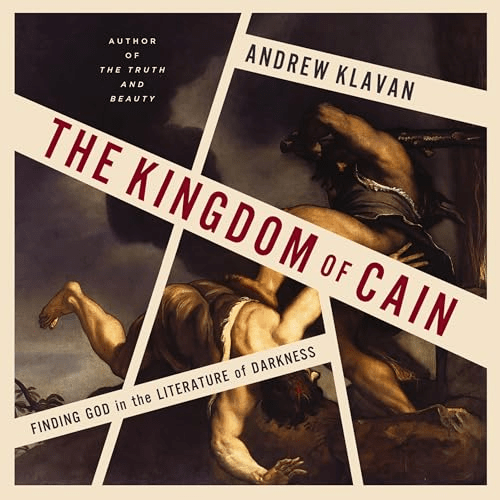
A review of noir writer Andrew Klavan’s The Kingdom of Cain: Finding God in the Literature of Darkness. I have already posted this review on Amazon and Goodreads.
This is a very readable book that fleshes out Andrew Klavan’s thesis:
The opposite of murder is creation–creation, which is the telos of love. And because art, true art, is an act of creation, it always transforms its subject into itself, even if the subject is murder. An act of darkness is not the same thing as a work of art about an act of darkness. The murders in Shakespeare’s Macbeth are horrific, but they are part of a beautiful play.
page 17
In other words, Klavan is wrestling with the problem of evil. Based on his decades of thinking about this, he has concluded that in this life, there is no theological answer that can redeem evil for those who have suffered it. Theological answers there may be, but those are not what redeem it for us. The only answer to suffering is not an answer, exactly; it is beauty. The example he frequently re-visits is the Pieta, “the most beautiful statue in the world,” a statue of Mary cradling her maimed and innocent, dead son.
I think Klavan’s thesis is a very strong one. I think of the book of Job. Job suffers horribly, and apparently undeservedly, and to add to his suffering, he is told that it must be his fault. He asks God why. Now, as it happens, there is an explanation for everything that is happening to Job. But God doesn’t give it. He just starts talking to Job about the wild animals and their habits. This is beauty, it is wonder, and it is far beyond Job’s experience. But ultimately, God answers Job with Himself, with His presence. He answers Job out of the whirlwind. He mentions just a few of His mighty, mysterious works in creation. And this is a good answer. It is enough. It is a much better answer than if God had said, “Well, it all started when I got into this argument with Satan …”
Kingdom of Cain is a hard book to read because of the real-life crimes described in it. Klavan tries not to get too graphic unless he has to, but this is a book about murders after all, including copycat murders. The blurb says it examines the impact of three murders on our culture, but there are a lot more than that, both fictional and–this is the hard to read part–real. The hardest one for me was the kidnap, rape, and murder of a 14-year-old boy by a pair of older teenagers who were later lionized in fiction.
This book is very insightful. Perhaps if I had never heard Klavan make these points before, I’d have given it five stars. But I have been following him for years, and he has been working on this concept for years, so the idea was not new to me. Especially in the later chapters, it felt a little belaboring. Hence, four stars.
A Woman Underground by Andrew Klavan

February, month of Posts of Stuff I Love, continues with the category “novels by Andrew Klavan” for 500. What I didn’t anticipate was the way that putting title and author together would make the author sound a bit like a serial killer. Anyway … onward!

Here is Andrew Klavan, known by some as “hot Gandalf.” (No, I’m not kidding.) Ironically, given that he is a fiction writer, my first discovery of Andrew Klavan came through his autobiography, The Great Good Thing, where he chronicled his journey from tough, noir-loving Jewish kid from Long Island to tough, Jesus-loving Jewish geezer from California. Klavan always loved the old-school tough-guy private-eye stories and aspired to write more of them. He got really good at tension, pacing, and action scenes. He’s also good at psychology, and particularly loves stories where the character isn’t sure he can trust his own mind.
Now, in his golden years and arguably at the peak of his art, Klavan is finally writing a mystery series. (His other novels have been stand-alones, plus movie scripts and a fantasy trilogy.)
The hero of this series is Cameron Winter, a former poor little rich boy and former spook whose Apollonian good looks and tweedy job as an English professor do a poor job of hiding the fact that he is still a dangerous man. Because this is by Klavan, about 30% of each novel is spent in Winter’s shrink’s office, where we find out through a series of sessions about different aspects of Winter’s tragic past. In the very first book, we heard that Winter’s childhood crush was Charlotte Schaefer, the daughter of his German-immigrant nanny. Winter has been looking back on Young Charlotte as his feminine ideal, and kind of not really growing up partly as a consequence of the Ghost of Charlotte. In this book, Winter finally has to deal with that. He has to go to the aid of the real Charlotte. But time has been flowing for her, too, of course, and Real Charlotte has her own ghosts.
(By the way, A Woman Underground is book 4 in the series, but I had to go crawling on my hands and knees to Amazon to find this out. Please, Mysterious Press, put the book numbers in a prominent place both on the spine and on the title page!)
I won’t give anything further away, but like all Klavans, the book weaves through time, giving us satisfying action in several different forms: international spy games, local mystery that is really none of Winter’s business, sentimental looks at the way things used to be … or did they? Plus a psychologically satisfying twist at the end.
You may wonder, since this is a series, do you have to read the earlier books first? No, you don’t, because Klavan does a fine job making each book work on its own. However, just in case you want to, here they are:
- #1 When Christmas Comes
- #2 A Strange Habit of Mind
- #3 The House of Love and Death
So, what do you think? Do these sound like something you would like? Are you also in favor of book numbers being put on spines? Let me know in the comments!
Another jaded quote about the government
“Well, yeah, but I work for the good guys. Don’t I?”
“Who can say? Not you, certainly. In your lunatic dream of a godless universe, good and evil can only be determined by the opinions of your fellow madmen, and morality is just a matter of democracy in the asylum. Mind you, I can work with that. The government can always find a use for lunatics as long as they’re homicidal. Speaking of which, I have another assignment for you.”
The House of Love and Death, by Andrew Klavan, p. 79
Quote: When your government handler gots religion
The second I sat down across from him, he said, “So, Poetry Boy, here you are. And you’ll be awestruck to learn that with a single glance through the glassy surface of your idiot gaze, I can see straight into the black heart of nothingness that is your godless and therefore soulless experience of this our only mortal life. And on that evidence of my own senses, I feel safe in saying you have now become morally dead in the service of your country and are therefore ready for your next government assignment.”
“Uh .. thank you?” I asked.
The House of Love and Death, by Andrew Klavan, pp. 4 -5
The House of Love and Death: A Book Review

I ordered this and it arrived a long time ago, but I just now got to it. (Look at me! I am powering through my TBR like a good girl!) Once I opened it, I finished in just a few days because it’s that good.
This is the third book in the Cameron Winter series. Winter is a character created by Andrew Klavan, reportedly the first character Klavan has created that he’s felt could sustain a whole series. Winter is a former spy who is now a professor of Romantic English Literature at an unnamed university in an unnamed Great Lake state (but pretty obviously Madison, Wisconsin). So he fits into that beloved mystery trope, a character who looks unprepossessing (in this case, because he’s a slight, blond, pretty-boy academic) and whom people consequently underestimate, unaware of his hand-to-hand combat skills.
It was fortuitous that I read House not too long after reading The Bourne Treachery, which is also a spy story featuring a longstanding character. Winter even has, in this book, some experiences similar to those Bourne has in Treachery. However, the two books couldn’t be more different.
Winter does check many of the same boxes as Bourne, and House checks many of the same action-novel boxes as Treachery. It moves a little slower and is a little less intricate, but not much. But it is way more emotional. This is one of those mysteries where, after you find out whodunit, you have to set the book down and (if you are a soft touch) cry for a while as you contemplate just how tragic the whole thing was. And like any good tragedy, it has the simultaneous feel of “This was so preventable! This should have been easily preventable!” and of inescapability.
Winter has a “strange habit of mind” (also the title of the first book in the series), where sometimes he will go into a “fugue state” and zone out for several minutes while his subconscious, essentially, becomes his conscious and works on a puzzle he is contemplating. As a writer and artist, I recognize this habit of mind and actually don’t find it that strange (although it doesn’t help me solve mysteries, more’s the pity). I assume that Klavan has given Winter this “strange habit” because, as an artist and writer, he also has some version of this habit. Certain kinds of mind tend to do this. Call it what you want – hyperfocus, being “in the zone.” Being an introvert. Not everyone is “on” (in the sense of externally focused) all the time.
It does make a person wonder whether this tendency, which is similar to narcolepsy, disadvantaged Winter as a spy. In fact, it makes one wonder how he ever managed to survive his espionage years. If Jason Bourne were to zone out like that even for a minute, he’d be dead. Once in House, Winter is driving somewhere and keeping an eye out for a tail. He briefly enters the fugue state, and when he comes out of it, sure enough, he is now being followed.
Yet somehow, those of us with the strange habit of mind do manage to survive. Some of us even manage to raise children. I dunno.
Anyway (shakes shoulders) aaahh, good book. Recommend. Very very sad though.
Quote: Sangfroid
“Why do you torment me?” Stan-Stan growled. Then he shouted, “I can’t get your voice out of my head! What do you want from me? I have nothing to do with you! Leave me alone!”
Since this was something a schizophrenic might say to his demons and also something Stan-Stan said to Winter [his contact] almost every time they met, Winter had to admire the subtlety of it.
“I need a favor, Stan-Stan,” Winter said.
The reeking mass of rags and sores leapt at him, jamming his unrecognizable features to within an inch of Winter’s tortured nose.
“Arrrgh-gnarr-ach,” Stan-Stan remarked.
“Be that as it may,” said Winter, struggling not to gag on the stench of him, “It concerns a town called Maidenvale.”
The House of Love and Death, by Andrew Klavan, p. 135
A quote that demonstrates that action can be well written
Lenny Guerrero was Search and Rescue, Truck 48, the first truck. A broad, strong, boyishly handsome man in his mid-thirties, he was at the truck’s side near the curb, near the lawn. The light arrays from the truck and the nearby engine, Engine 39, flashed scarlet and shadow over him as he worked to get himself game ready. Strapping his air pack on, his mask on, his hood on, his helmet.
The House of Love and Death, by Andrew Klavan, p. ix
Look at the poetic use of repetition that doesn’t seem strained.
 Out of Babel Books