
A man must be far gone in Utopian speculations who can seriously doubt that, if these States should either be wholly disunited, or only united in partial confederacies, the subdivisions into which they might be thrown would have frequent and violent contests with each other. To presume a want of motives for such contests as an argument against their existence, would be to forget that men are ambitious, vindictive, and rapacious. To look for a continuation of harmony between a number of independent, unconnected sovereignties in the same neighborhood, would be to disregard the uniform course of human events, and to set at defiance the accumulated experience of ages.
Federalist No. 6
Tag: anthropology
Misanthropic Quote of the Week from John Jay
But the safety of the people of America against dangers from foreign force depends not only on their forebearing to give just causes of war to other nations, but on their placing and continuing themselves in such a situation as not to invite hostility or insult; for it need not be observed that there are pretended as well as just causes of war.
It is too true, however disgraceful it may be to human nature, that nations in general will make war whenever they have a prospect of getting any thing by it; nay, absolute monarchs will often make war when their nations are to get nothing by it, but for purposes and objects merely personal, such as a thirst for military glory, revenge for personal affronts, ambition, or private compacts to aggrandize and support their particular families or partisans.
Federalist No. 4
Video: What Did Ham Do Wrong and Why? What’s So Terrible About Women’s Hair? Will We Ever Stop Talking about the Nephilim?
Turns out, “uncovering your father’s nakedness” isn’t quite as bad you suspected … but it’s still pretty bad.
Also, lots of interesting stuff about other aspects of worldview in the ancient world, including that hair was seen as a genital structure by first-century Greek scientists, which is probably the explanation for why women were supposed to cover their hair in public (particularly in church) and men to wear theirs short.
Also, if memory does not fail me, Nephilim!
Scary stuff! Welcome to Halloween!
Another Candidate for Atlantis

There have been a number of proposed sites for Atlantis. Graham Hancock has proposed Antarctica, North America, and probably some other places that I don’t know about. I’ve also heard rumors that the sunken continent could be in the Bahamas area and could explain the Bermuda Triangle phenomenon. The Disney movie Atlantis locates it off the coast of Iceland, and I have also heard people advocate the Eye of the Sahara in Mauritania. (The idea being that, before continental uplift, this site was closer to the coast, and it could have been inundated by a tsunami or something like that.) Well, the article above makes what strikes me as the most likely proposal yet.
The super-island of the Cyclades Plateau (Plato’s Atlantis) was drowned by the sea at around 8000 BC, during the rapid rise of the Mediterranean and just prior to the flooding of the Black Sea (see UNESCO study, 2009.) Incidentally, around this time, Lake Agassiz, a gigantic glacial lake in North America, also burst open and began to drain into the Atlantic. It is worth noting that Lake Agassiz covered an area larger than all the Great Lakes combined (440,000 Km 2) and at times, it contained more fresh water than all the lakes in the world today. The total fresh water outflow from this lake alone was so immense, scientists believe it raised the oceans worldwide by as much as nine feet and further produced the 8.2 kilo-year event that followed, a mini ice age that lasted 400 years! This global cataclysm at the end of the last Ice Age, which ultimately raised sea levels by 400 feet, not only erased our early history, but this could also be the event we all inadvertently refer to as the “Great Flood.”
ibid
Proposing the Cyclades Plateau as the site of Atlantis ties its inundation to a known rise in sea levels that happened right around the date that Plato says Atlantis was submerged. The article shows maps of what the plateau would have looked like and how it roughly matches Plato’s description of Atlantis (though the scale is slightly off). Of course, in my integrated version of ancient history, it went like this:
- Pangea
- Continental Sprint, involving cataclysmic earthquakes and also tsunamis. This is the Great Flood
- A cold, rainy period after the Flood, leading to the Ice Age, which meant lower sea levels, coinciding with human dispersion across the newly shaped continents
- As the Ice Age ended, we get sea levels rising and large but not worldwide local floods like those described above.
The article also suggests that this civilization was part of a larger pan-Mediterranean civilization:
Finally, a 10,000 year old Mediterranean civilization, may help explain more archaeological oddities in this region. Recent erosion and seismic tests at the Giza Plateau, indicated that the Great Sphinx may be much older structure than previously thought, and along with the site of Gobekli Tepe in Turkey, both seem to coincide with Plato’s story of Atlantis. Is it possible that Gobekli Tepe and the monument of The Great Sphinx could be remnants of the same advanced civilization Plato referenced in his story, one that was aggressively advancing against its neighbors in Africa and the Middle East, or do those belong to another culture? And what about the advanced proto-Euphratean people who descended upon the Mesopotamia around 7000 BC, from a region “unknown.” Could these enigmatic people be the refugees of the same culture who fled the Mediterranean basin and moved eastwards to escape the inundation? Undoubtedly, they could have brought with them the story of the great flood as well as the skills and technology to incite yet another great civilization, like that of ancient Sumer (just as the survivors around the Cyclades and neighboring islands may have ultimately contributed to the rise of the Minoans).
ibid
This sort of thing is catnip to me.
Finally, for the reconstructive genetics nerds among us (raises hand), the article offers bonus evidence that the residents of this Aegean Atlantis may have island-hopped their way to North America, which would explain why Haplogroup X is concentrated most heavily in the eastern Mediterranean and around the Great Lakes. (Bonus: the Great Lakes area was also the source of a particular type of copper that was used in the Mediterranean during the Bronze Age.)
Misanthropic Quote from The Federalist Papers
Experience on a former occasion teaches us not to be too sanguine in such hopes.
John Jay, Federalist #2
Review of Breath

Five stars. Would keep breathing.
Just kidding.
My sister gave me this book. I don’t know how she knew it, but I’m a horrible mouth-breather. I also have a habit of holding my breath when: in pain, concentrating, doing a delicate task, listening to someone talk. (I exhale when they finish the sentence. So don’t pause.) Turns out, breath-holding throughout the day might be causing a lot of people chronic anxiety and also causing them to “overbreathe.” Since reading, I’ve been at work to change my ways.
It’s rather shocking to realize the extent to which breathing through the nose affects nearly all other aspects of our health, even aspects that you wouldn’t expect, such as biochemistry and bone structure. But on reflection, it makes sense. We were designed to nose breathe; there is a reason for the way the air is routed through our sinuses; there is even a reason we have two nostrils. (Did you know that air taken in through the right nostril has a different effect than the left … and that your nostrils naturally tag-team throughout the day? Wild!) It makes sense that the more restricted supply of air coming in through our nose compared to our mouth is not only adequate but optimal, even though it doesn’t feel that way for recovering mouth-breathers.
It also makes sense that we were designed spend many hours a day chewing on tough foods (fruit, nuts, wild game), and that this regular daily workout of our jaw muscles would result in wider facial bones, flatter palates, and wider nose-breathing passages. It also explains why so many people in the modern age have crooked teeth: it’s not bad genetic design, it’s that we aren’t chewing enough and our face bones are literally atrophying, making our mouths too narrow. So those cave people who didn’t have orthodontists, also didn’t need them. (Shoutout to my characters! Keep eating game, guys!)
Ahem. Back to the book …
You have to watch out for the usual non sequiters that we have come to expect from Darwinian materialists. Almost any place that Nestor writes, “We evolved to …”, you can safely substitute, “We were designed to …” and come up with the same conclusion. There are a few long paragraphs about how “early life” was anaerobic and how “we” started using oxygen in “our” metabolizing. I skipped those; you can read them if you want to find out how bacteria do things differently from human beings.
Then there is the section on prayer, which finds that the repetitive prayers from all around the world get their practitioners breathing at the ideal rate for humans, which to Nestor’s mind can account for all the health, mind clarity, and relaxation benefits of prayer. (I have long been aware that my breathing changes when I pray – even silently – but this is not to say that there is nothing else going on during prayer or meditation, or that it matters not to whom or to what you pray.)
As someone who doesn’t believe that the spiritual world is a thing, Nestor is free to try – and qualifiedly endorse – all the yoga practices that, he says, are merely applied medical knowledge about breathing and posture. They certainly include some of that, but yoga is also a serious attempt to commune with spiritual entities, and we ignore that at our peril.
There is a helpful appendix that catalogs all the breathing techniques Nestor encountered on his ten-year journey. My big takeaway: breathe through your nose. Tape your mouth shut at night if you have to. Breathe a little slower … you won’t choke. Exhale completely before inhaling. See how many health and emotional problems that clears up for you. I’ll check back in and let you guys know whether I lost any weight.
Misanthropic Quote of the Week from P.D. James
He knew even better than she did that you could never predict, any more than you could completely understand, what human beings were capable of. Before an overwhelming temptation everything went down, all the moral and legal sanctions, the privileged education, even religious belief. The act of murder could surprise even the murderer. She had seen, in the faces of men and women, astonishment at what they had done.
The Murder Room, by P.D. James, p. 219
Misanthropic Quote of the Week from Garrison Keillor
In the Sanctified Brethren church, a tiny fundamentalist bunch who we were in, there was a spirit of self-righteous pissery and B.S.ification among certain elders that defied peacemaking. They were given to disputing small points of doctrine that to them seemed the very fulcrum of the faith. We were cursed with a surplus of scholars and a deficit of peacemakers, and so we tended to be divisive and split into factions. One dispute when I was a boy had to do with the question of hospitality towards those in error, whether kindness shown to one who holds false doctrine implicates you in his wrongdoing.
Uncle Al had family and friends on both sides of the so-called Cup of Cold Water debate, and it broke his heart.
Leaving Home, Garrison Keillor, p. 155
Good thing this never happens outside of tiny fundamentalist Christian churches.
What Is A Tell?
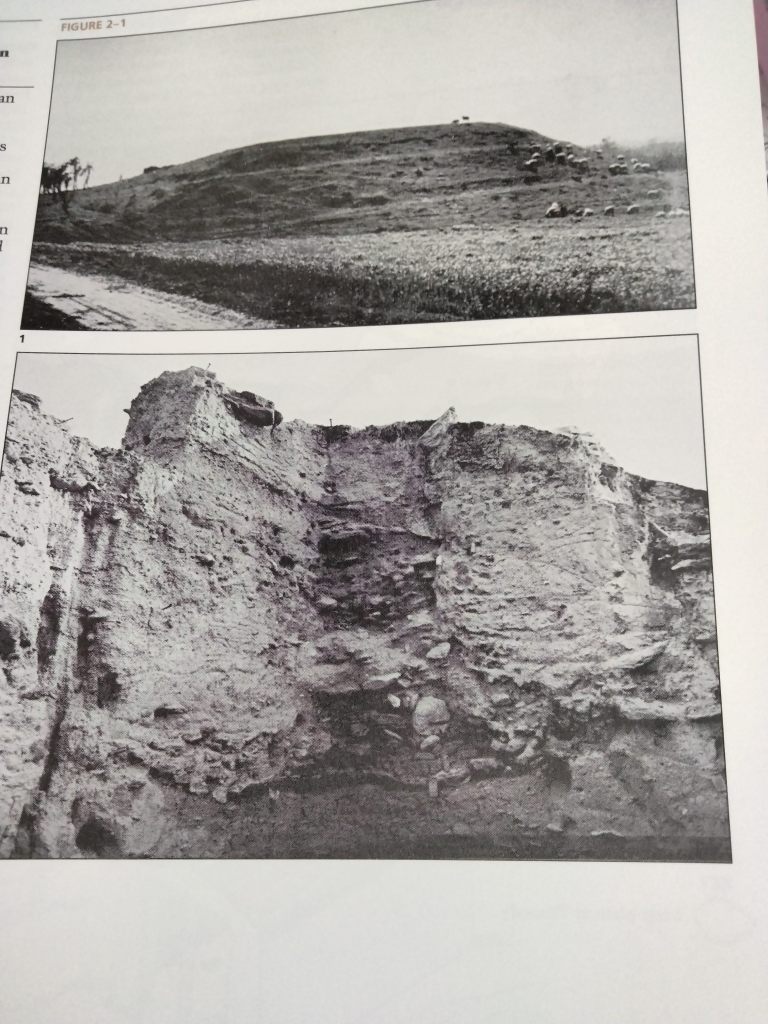
A tell is, essentially, a man-made hill that consists of layers upon layers of ancient ruins.
I first heard about tells in a Biblical Archaeology context. The Levant is filled with tells. Often, the original city was built on a high spot to begin with. Then, as successive generations of the city were destroyed and rebuilt, the tell got higher and higher. In the Levant, you often find a current city still thriving on top of the tell. So there is a modern city on top of a medieval city on top of a Greco-Roman city top of an Israelite city on top of a Canaanite city on top of a city from the time of Sumer. If you dig down carefully through these tells, you will find mosaics, pots, coins, garbage, all kinds of good stuff. Tells are different from grave mounds because they don’t usually contain grave goods carefully selected, but rather the debris of everyday life, and often the ash layers of past battles.
Well, it turns out, the Levant ain’t the only place that gots tells! I am currently reading The Civilization of the Goddess: The World of Old Europe, by Marija Gimbutas, published in 1991. As you can tell (haha!) from the title, Gimbutas has her own spin on the history of Old Europe, about which I will no doubt post later. But today, I am just here to talk about tells. There are many tells in Thessaly, Macedonia, Bulgaria, Yugoslavia, Romania, western Ukraine and southern Hungary (as we call them today) which show that in the 6,000 to 4,000s B.C., the Balkans were a happenin’ place. They revealed tidy planned cities, sometimes of a few thousand people, with hearths, idols, loom weights, and “exquisite” pots. (I love it when archeologists call something like a pot “exquisite.” It means they are really excited about it.)
I have previously posted about the Vinca Signs, which came from this culture area and may have been an alphabet, though Gimbutas looks like she’s gearing up to treat them as primarily religious symbols. The settlements in this area are all fairly uniform, especially in their earlier stages, which says to me that people spread out quickly, probably from the Levant via Turkey and Macedonia. The climate at the time was rainier than now, which made farming easier. The sea levels were probably also lower, which might have facilitated travel.
Take a look at the photo at the top of this post. It comes from page 13 of Gimbutas’ book. The upper image is labeled “Argisa tell, west of Larisa, Thessaly.” The lower one: “Profile of Sesklo tell, c. 12 m of cultural deposits, with Early Neolithic (Early Ceramic) at the base and classical Sesklo on the top, c. 65th – 57th cents. B.C.”
Twelve meters of cultural deposits! Imagine the riches.
At the time this book was published, a few tells in the Balkan area had been excavated (Sesklo by Gimbutas herself), but most had not. I expect that is still true today. There have been some “hills” in Bosnia that turned out to be pyramids and to have tunnels inside, but really, even archeologists like Gimbutas who realize that Old Europe was much more advanced than previously thought are just getting started. I doubt that everything will be excavated, or the ancient story fully told, in this life. But if you have any interest in such things at all, it’s amazing to think of all the wealth of all those tells sitting there with their meters and meters of secrets.
Exquisite.
Article by a Smart Person
Sorry about my radio silence, friends. It’s been a busy week.
Please enjoy this article by a friend of mine about songwriting as a liminal process.
 Out of Babel Books