Pompeii: A Masterclass in How to Write Historical Fiction

Pompeii by Robert Harris, pub. 2003

Dear Robert Harris,

I am sorry. I am sorry that I left your book, Pompeii, moldering on my bedside bookshelf for … I don’t know … several years after I got it … I don’t know … from my husband’s trucker friend, from the library sale shelf, somewhere like that. I should have picked it up and read it immediately. I thought it was going to be demanding and … you know … educational. I didn’t know it was going to be educational. Or gripping. Or The Perfect Historical Novel.

Spoiler: Vesuvius Blows

I don’t know, reader, whether you would pick up a novel about Pompeii. Perhaps you would worry that the tension would be somewhat lacking, given how everyone knows that the mountain explodes and buries the town. It would be, you might think, sort of like reading a novel called John Dies at the End.

Harris, of course, uses the volcanic eruption’s very fame to his advantage. The people in Pompeii, and Herculaneum, and in the other towns around the bay of Neapolis, don’t know what is about to happen to them. This gives the opportunity for an infinite number of ironic quotes and thematic moments, such as the line, “I ought to die and come back to life more often,” when a narrow escape from death causes a character to be met with newfound respect. You spend much of the book wondering which, if any, of these people are going to survive.

The Historical Background

No, I am not going to sketch all the historical background here. I’ll just tell you that an awful lot is known about Roman society of this period, both general things about the culture, diet, and technology, and specific things about individuals like Pliny the Elder. (And Nero. Nero had a favorite moray eel, did you know that?) Harris makes excellent use of all this research to build a story that grows organically out of the who the characters are and what they value.

At the beginning of the book is a nice clear map of the Bay of Neapolis and surrounding regions, which is critical to visualizing the action of the book. Special attention is given to the Aqua Agusta, an aqueduct which runs from the Apenine Mountains, past all the towns in the region, with spurs providing water to Pompeii, Herculaneum, and so on, until it terminates at the naval base of Misenum, in a reservoir called the Piscina Mirabilis, “Miracle Pool.” When you see how close the Aqua Agusta runs to Vesuvius, you can see that an imminent eruption might well cause problems for the region’s water system.

The Hero

Marcus Attilius, the “aquarius,” comes from a family of men who build and maintain the empire’s aqueducts (which, by the way, like the Aqua Agusta, are often not elevated but rather are underground pipes). He was sent from Rome to Misenum two weeks ago after his predecessor, Exomnius, mysteriously disappeared. When the water running into Misenum first turns sulfurous and then starts to lose pressure, everyone is ready to blame Attilius for not having foreseen or prevented this.

Attilius, realizing the gravity of the situation, orders the city’s water supply to be shut off. There is enough in the Piscina Mirabilis to last Misenum two days with rationing. Attilius, based on which towns have lost water and which haven’t, thinks he knows approximately where the break in the aqueduct is. By pressing very hard, he hopes in two days to sail to Pompeii, send a team inland to find the exact source of the leak, send another team to re-direct the water farther upstream, buy supplies, and work through the night with a team of slaves to fix the blockage. In this way, he hopes to prevent riots and death in the towns without water. The reader knows that Attilius is also racing against time to find the reason the aqueduct broke.

We learn a lot about the Romans’ amazing aqueduct system. All the cities had, essentially, free water as a gift from the Empire. The underground pipe was six feet in diameter, with a three-foot thickness on either side made of the famous Roman cement, made with seawater, which could dry underwater and which got harder with time. There are maintenance manholes at regular intervals, and water sinks along the route which allow the water to drop rocks and silt it’s been carrying. These are then used for gravel.

The great Roman roads went crashing through nature in a straight line, brooking no opposition. But the aqueducts, which had to drop the width of a finger every hundred yards–any more and the flow would rupture the walls; any less and the water would lie stagnant–they were obliged to follow the contours of the ground. Their greatest glories, such as the triple-tiered bridge in southern Gaul, the highest in the world, that carried the aqueduct of Nemausus, were frequently far from human view.

page 181

The Villain

Ampliatus is a former slave. His master, who used him as a toy (yes, the Romans were horrible people), set him free in his will at the age of twenty. Ampliatus, by this time a ruthless social climber, began to amass wealth by buying real estate around Pompeii. Several years before the book opens, the city suffered an earthquake. Most of the aristocrats fled, but Ampliatus is unendingly proud of himself because he stayed, bought up a bunch of buildings on the cheap, fixed them up, and became the nouveau riche. By the time the book opens, he has bought his former master’s estate. His bedroom is the one where he used to be molested. He has gotten his former master’s son in debt to him, and is persuading him to marry Ampliatus’s daughter. He is building an ambitious bathhouse in the middle of the city. As Ampliatus says to the aquarius when he’s trying to corrupt him, water is key to civilization.

As a former slave, Ampliatus outdoes the aristocrats he imitates in both cruelty and ostentatiousness. There is a memorable scene of a feast Ampliatus gives, of the kind that historians would probably call sumptuous. It’s held in Ampliatus’ triclinium (dining room) on a swelteringly hot August night, and no one but Ampliatus wants to be there.

And the food! Did Ampliatus not understand that hot weather called for simple, cold dishes … then had come lobster, sea urchins, and, finally, mice rolled in honey and poppy seeds. … Sow’s udder stuffed with kidneys, with the sow’s vulva served as a side dish … Roast wild boar filled with live thrushes that flapped helplessly across the table as the belly was carved open … Then the delicacies: the tongues of storks and flamingoes (not too bad), but the tongue of a talking parrot had always looked to Popidius like nothing so much as a maggot. Then a stew of nightingales’ livers …

pp. 146 – 147

Reader, I have spared you the most disgusting parts of this dinner.

Ampliatus has commissioned a positive prophecy about the city of Pompeii from a sybil–an older female seer–and is keeping it in readiness for the next time he needs to get the people all excited … probably in order to ensure the election to public office of an aristocrat he has in his pocket. And here is what the sybil has said: Pompeii is going to be famous all over the world. Long after the Caesars’ power has faded, people from all over the world will walk Pompeii’s streets and marvel at its buildings. Ampliatus takes this as a very good sign.

The Scholar

Pliny the Elder, an actual historical person, makes an appearance as a prominent side character. Pliny was stationed as a peacetime admiral at Misenum. When Vesuvius started erupting, it was clearly visible across the bay. Pliny, who had written a whole encyclopedia about the natural world, received a message from an older female aristocrat in Herculaneum, begging him to come and save her library. (In Pompeii, this message is delivered by Attilius.) Pliny launched the navy without imperial permission, intending to save the library and also evacuate the towns near the eruption. But pumice falling from the sky, floating on the water, and clogging the bay prevented the ships from approaching the coast. Pliny and his crew were forced to take refuge belowdecks, and their ship was driven across the bay to Stabiae, where they took refuge overnight. Eventually, they had to evacuate on foot, but Pliny, who was fat and was perhaps suffering from congestive heart failure, chose to stay, and ended up dying in the gaseous cloud that swept along the coast.

The remarkable thing is that during this entire time, Pliny had his scribe with him, and he was dictating his observations about the “manifestation.” His notes were saved. It occurs to me that the stereotype of the British absentminded professor who is never rattled by anything, and always keeps his cool and approaches everything with perfect manners and scientific curiosity (and is an incurable snob), may have roots deeper than England itself.

Go read this book right now!

Despite the large amount of detail in this review, I assure you that I have merely scratched the surface and that this review contains very few spoilers for the novel. I really can’t say anything better about it than that it is, in my estimation, the perfect historical novel. Please go read it if you have any interest at all in the genre.

Megalithic Ruins in Montana II: Sage Wall, near Butte

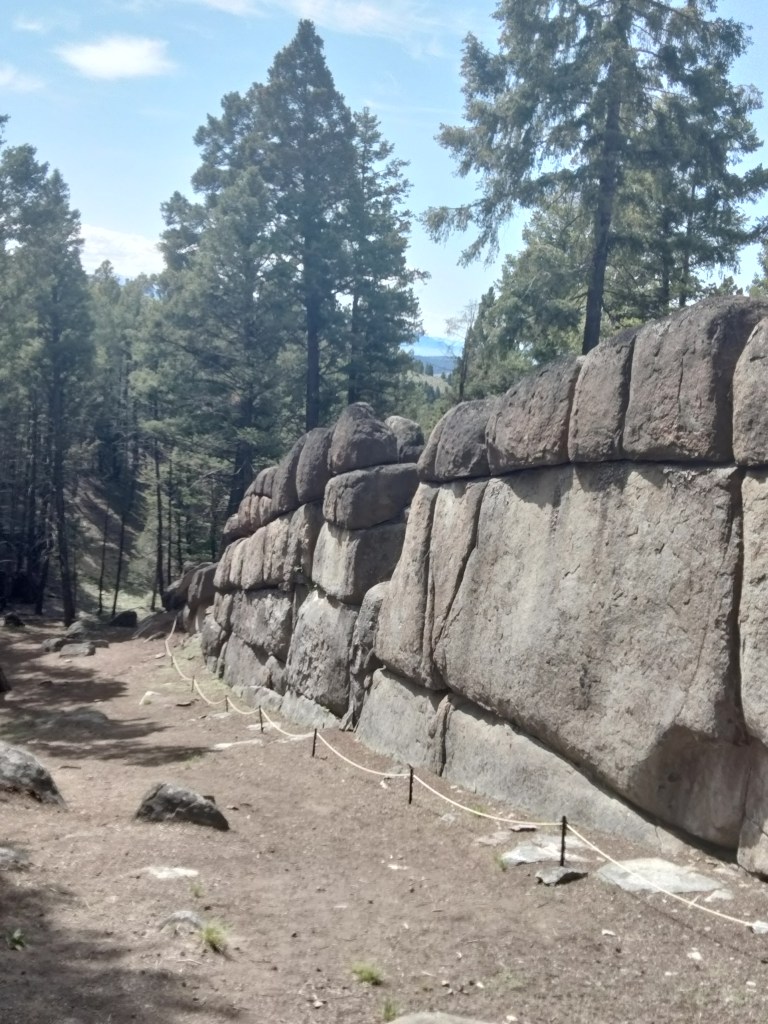
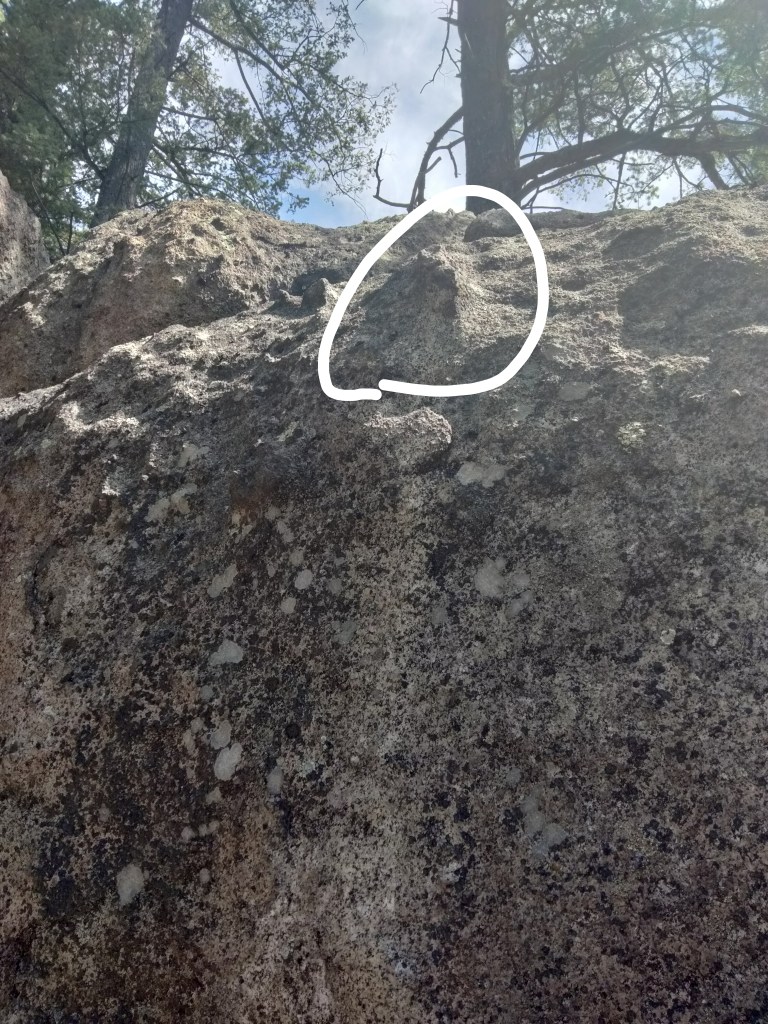
Here I am at Sage Wall, to give you some idea of the scale.

Sage Wall is a possible megalithic site near Butte, Montana. In this post, I am going to thoroughly embarrass my geologist husband by saying that Sage Wall looks manmade to me. But first, how did I come to visit Sage Wall in person?

Getting to Sage Wall

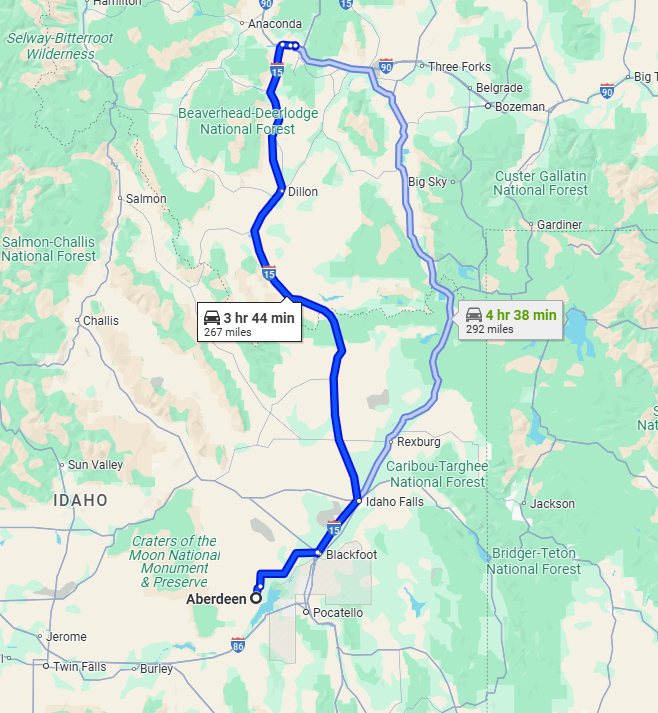
It’s on my bucket list to visit as many archeological sites as a I can, the older the better. Sage Wall was a no-brainer because it’s only a half a day’s drive from my house. It is also a good candidate to visit because looking at photos is kind of ambiguous. To really get a sense of whether it seems manmade or like a natural formation, I felt I had to be there in person.

We drove up into the beautiful Montanan Pioneer Mountains (Idaho has some as well), stayed the night in Butte, and the next day, made our way to Sage Mountain Center, where I had a reservation. We could not have asked for a more beautiful day, weather-wise. Early June in the Butte area is still basically Spring.

Chris and Linda are the property owners at Sage Mountain. About three decades ago, they wanted to move out to the middle of nowhere and build a sustainable house and retreat center. They were not looking for megaliths. Linda stumbled upon the wall on a hike one day, and Chris, who has a background in building, looked at it, said, “Yep. That doesn’t look natural. Well, let’s get back to our projects.” It wasn’t until years later, when they had established a sustainability-themed retreat center and had started to create some hiking trails for their guests, that other people started noticing the wall. Chris and Linda cleared the brush around the wall, roped it off, and had it examined by LIDAR and ground-penetrating radar.

Now, many people are coming to see the wall, seemingly to a point where it is almost becoming a problem. Sage Mountain Center is still on a wind-y, washboard-y dirt road, but now many people, seeking to get away from it all, have built new houses and cabins along that same road. Chris asked us, as we drove out, not to “go too fast past our neighbors. We’re trying not to bother them.” I got the impression that his main desire is still to just run a sustainability B&B in peace, but he’s been saddled with this danged wall.

What Would a Skeptic Say?

I want to give the skeptical geologists their due here. I think what they would say is this: “All these people who are saying Sage Wall is amazing megalithic structure are forgetting one thing: It is right in the middle of the Boulder Batholith! There are big granite rocks everywhere!”

source: formontana.net

They are not wrong. The mountains to the east of Butte, where Sage Mountain Center is located, are strewn with large granite boulders and outcroppings. These tend to fracture into shapes resembling worked blocks of stone.

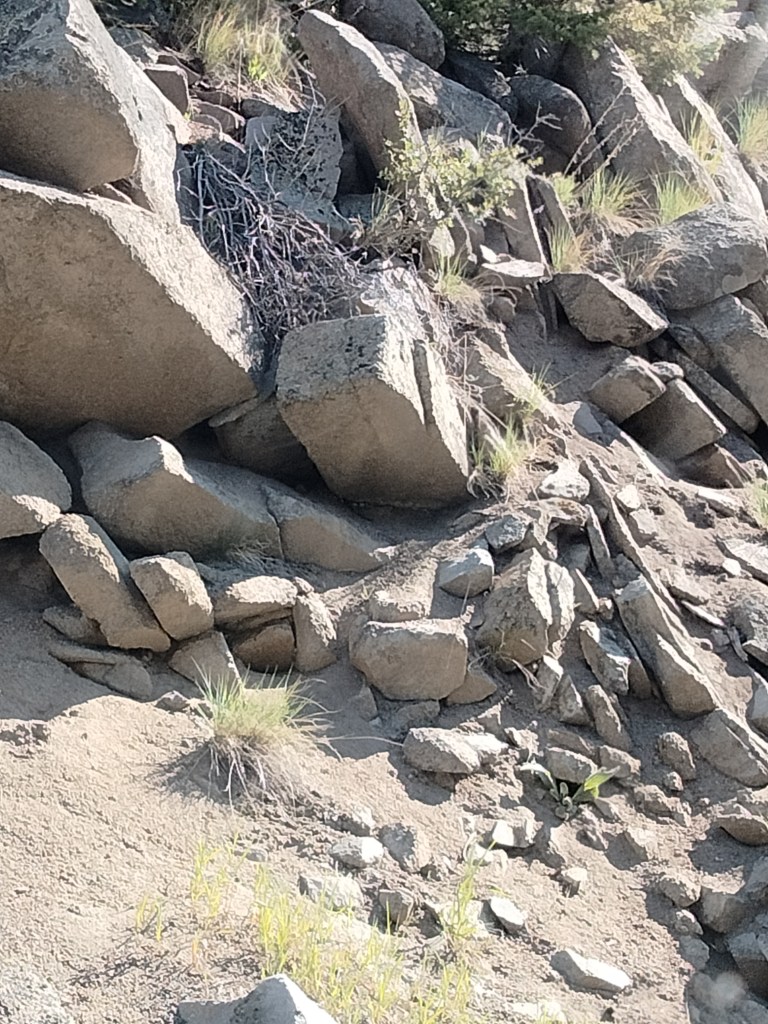
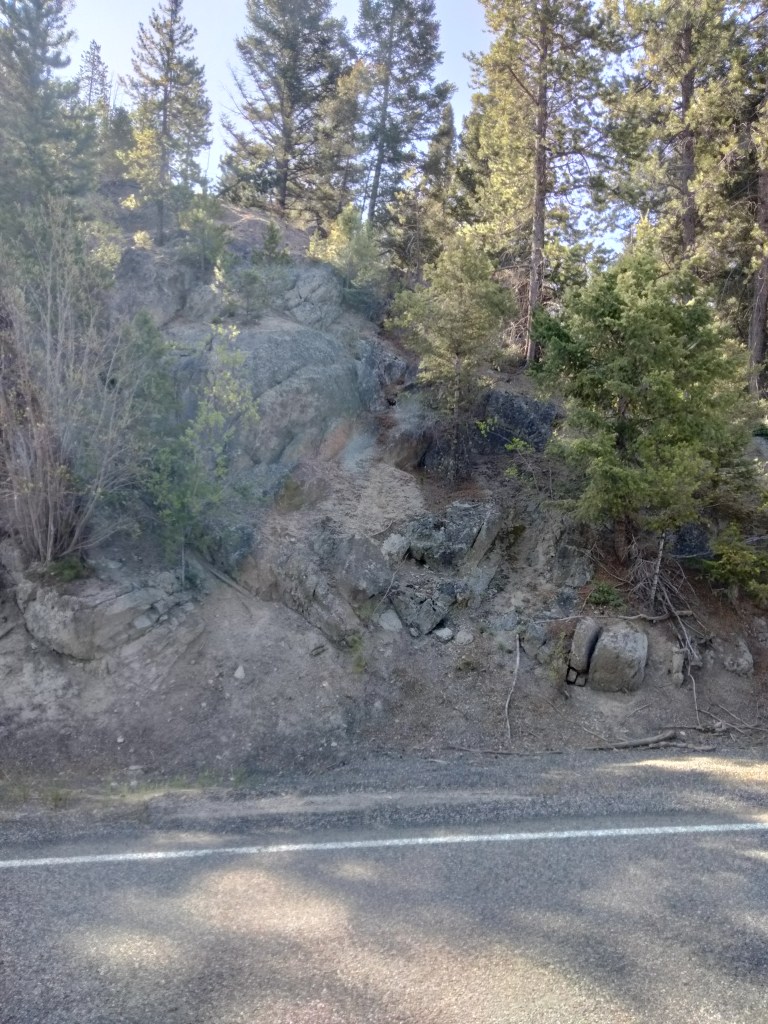
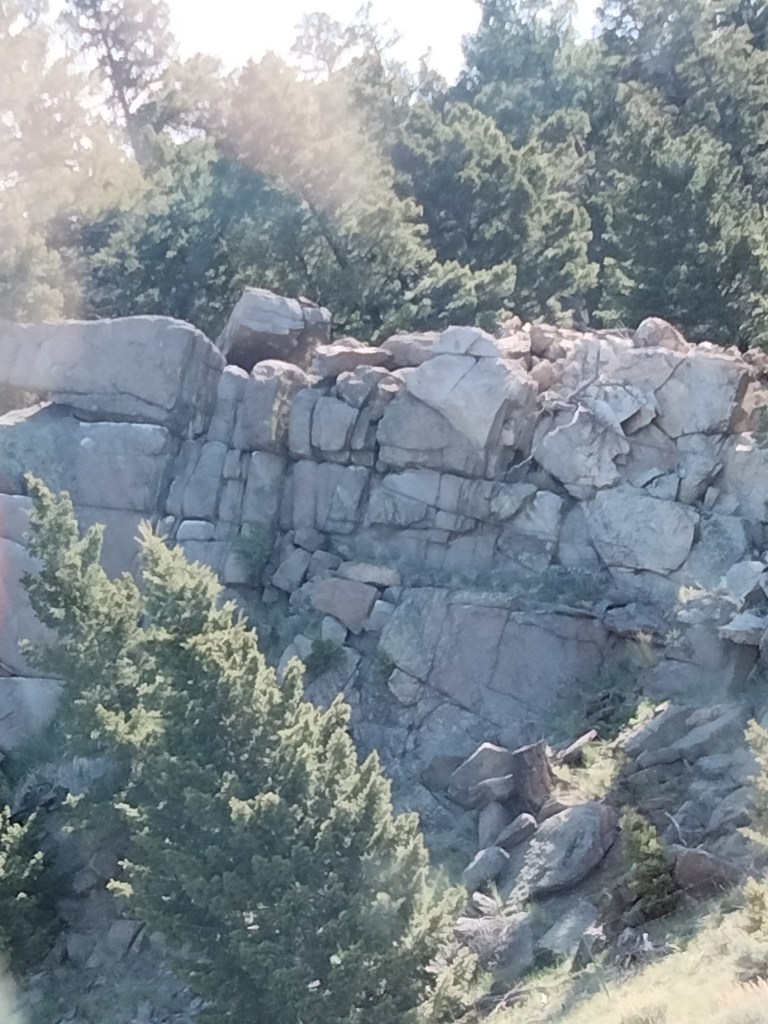
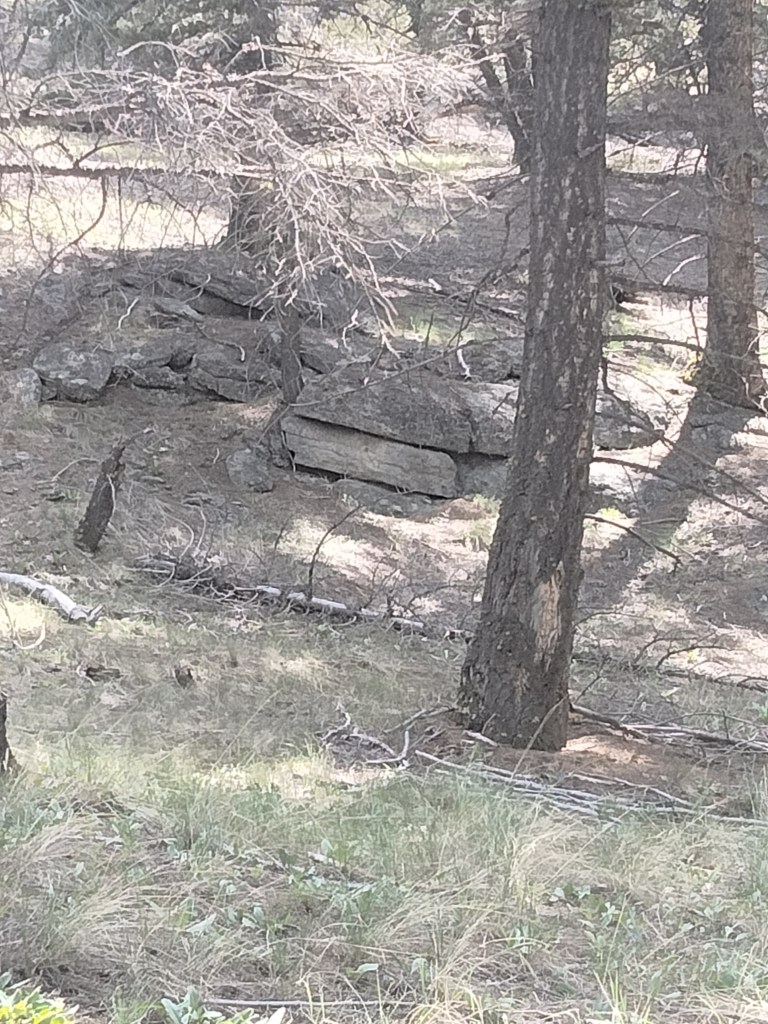
Here are some pictures I took, on the way in, of natural granite outcroppings so you can see how they normally look and how they tend to fracture:

You can see that the fractures are often horizontal and strikingly block-like.

We also saw some pieces of granite that had very large quartz crystals formed in them, which stuck out like chips in a chocolate chip cookie:

And, just for fun, here’s a balanced rock:

I’m not sure whether this balanced rock is natural, but I’m leaning towards no. I’m thinking it was put there to mark the trail.

Anyway, the skeptics are correct that the presence of big, blocky rocks does not an ancient megalithic structure make. This is part of the reason I wanted to see Sage Wall myself. I did not take any videos of it, because I’m not good with video and didn’t have a script ready. But there are now many videos of Sage Wall online, including drone videos. I’ll try to embed some of them at the end of this post.

Why Sage Wall is Likely Man-Made in my Amateur Opinion

So no, the claim is not that this must be a megalithic structure because it is located somewhere that we would not expect rocks. It is definitely surrounded by rocks. However, it looks distinctly different from the more random rock outcroppings around it.

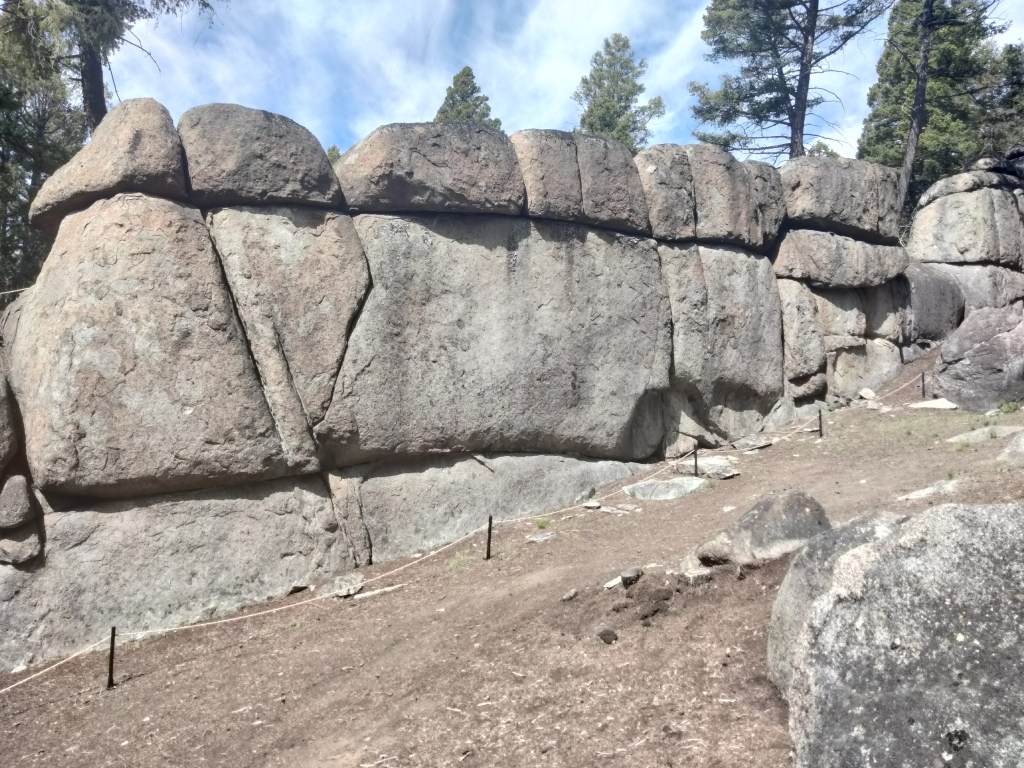
It is very long, and very straight. (The wall extends past the Sage Mountain Center property, but only their section of it has been cleared.)

Unlike what we see with other fracturing patterns, the wall consist of very big blocks laid out in what appear to be courses. To my (again, amateur) eye, when we see natural fracturing the blocks tend to fracture into smaller pieces where they are exposed.

In the pictures above (and in the one where I’m posing), you can see a hollow lower down in the wall where a block obviously fell out.

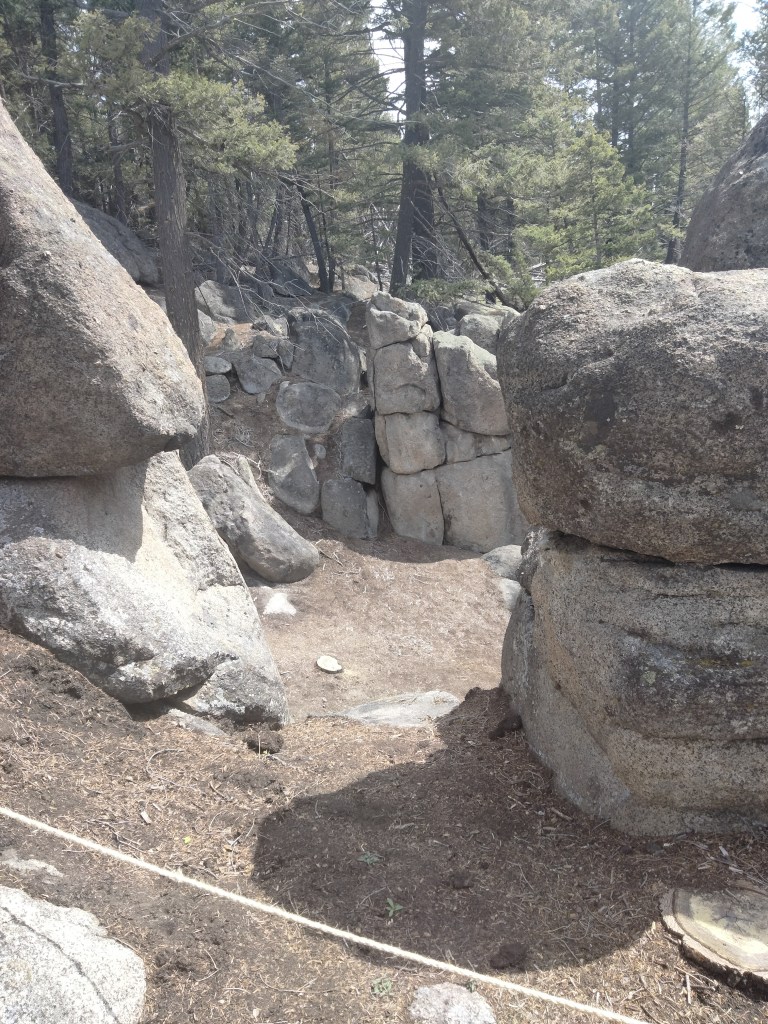
At three different places in the exposed section of the wall, there are gaps in the top similar to doors. Chris told us there had been a lot of speculation about these before researchers realized that they were simply places where boulders had fallen out. In fact, you can see the boulders below them, almost completely buried in dirt and pine duff.

On the picture above, you can also see the remains of a triangular shape. The left side of the triangle is made with shaped blocks, and the right side is incised into the megalith. The triangle happens to frame the gap where a block fell out.

According to Chris, the geophysicist who examined the wall with ground-penetrating radar found that it goes down into the ground about another 20 feet. At the bottom was something that reflected the radar, as it might be a floor or stone foundation.

All of this research is shortly to be posted on the wall’s website, here or possibly here.

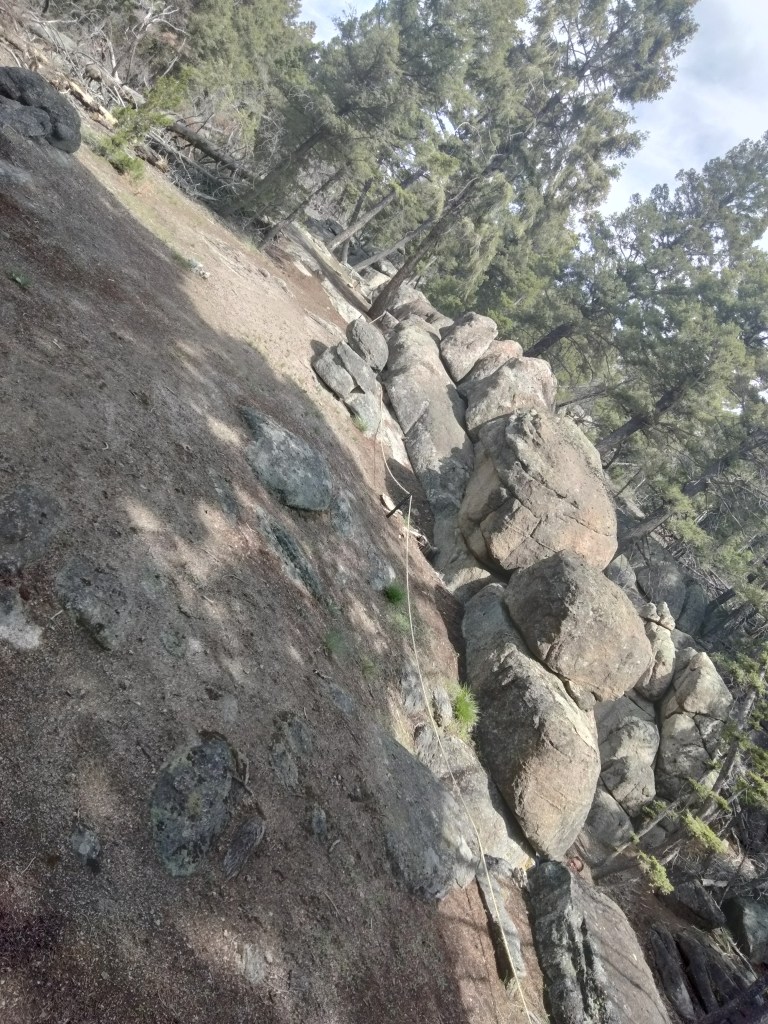
Parallel to the wall are the fallen remains of what appears to be another wall. You can see that it is “fractured” in the same way, and these other blocks also have some of the nub and cup features that we’ll talk about below.

Here’s a bit of the second wall, seen end-on.

Behind the Wall

Here’ a view behind the more intact wall. Chris and Linda have installed a rope that allows visitors to climb up behind the wall. As you can see, the wall is not just part of a cliffside, but it does have earth and rocks filled in behind, either as terraces/a retaining wall, or the ravages of time.

From behind the wall, we look out through a gap left by a fallen stone across the avenue at the remains of the second wall.

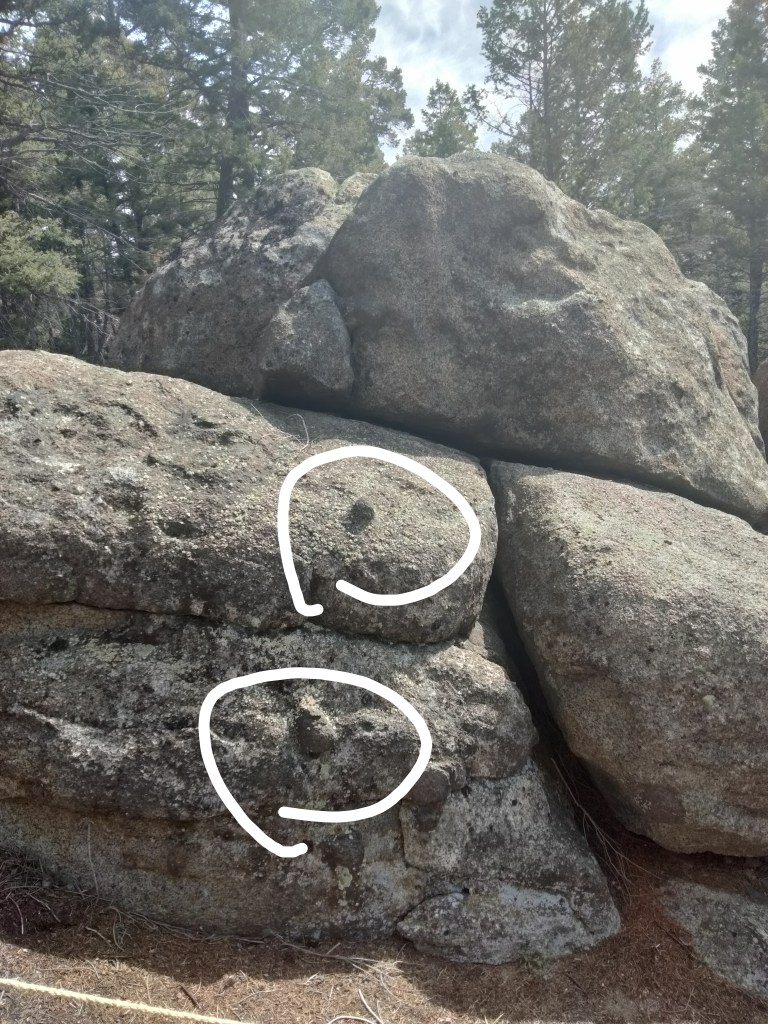
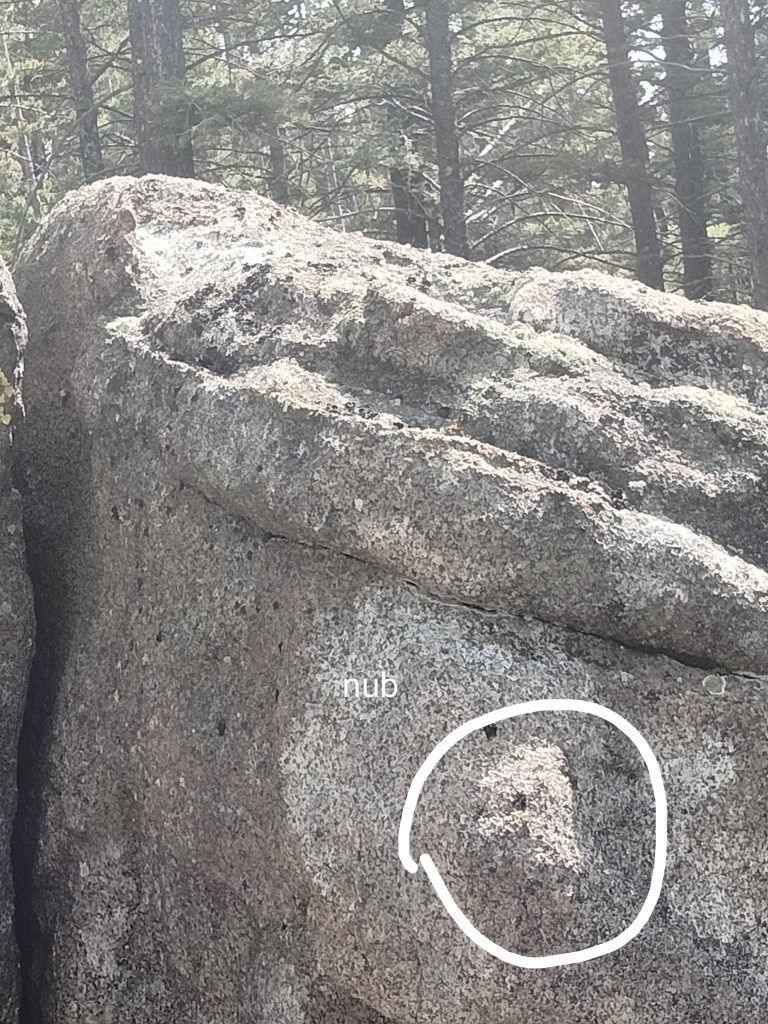
Getting close to the top of the wall allows us to see what might be nubs and cups.

Nubs and Cups

Stone nubs and cups (not necessarily corresponding to each other) are sometimes features of megalithic architecture in other parts of the world.

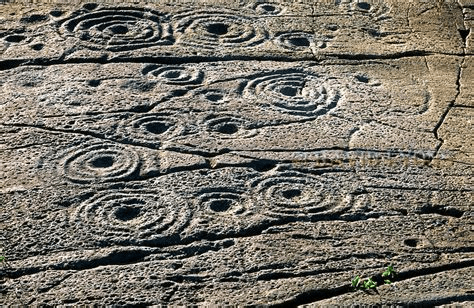
“Cup and ring” markings are apparently found all over the world, but especially in Northern Europe. Here are two articles about them.

Stone nubs or knobs are also found, especially in Incan or pre-Incan megalithic architecture.

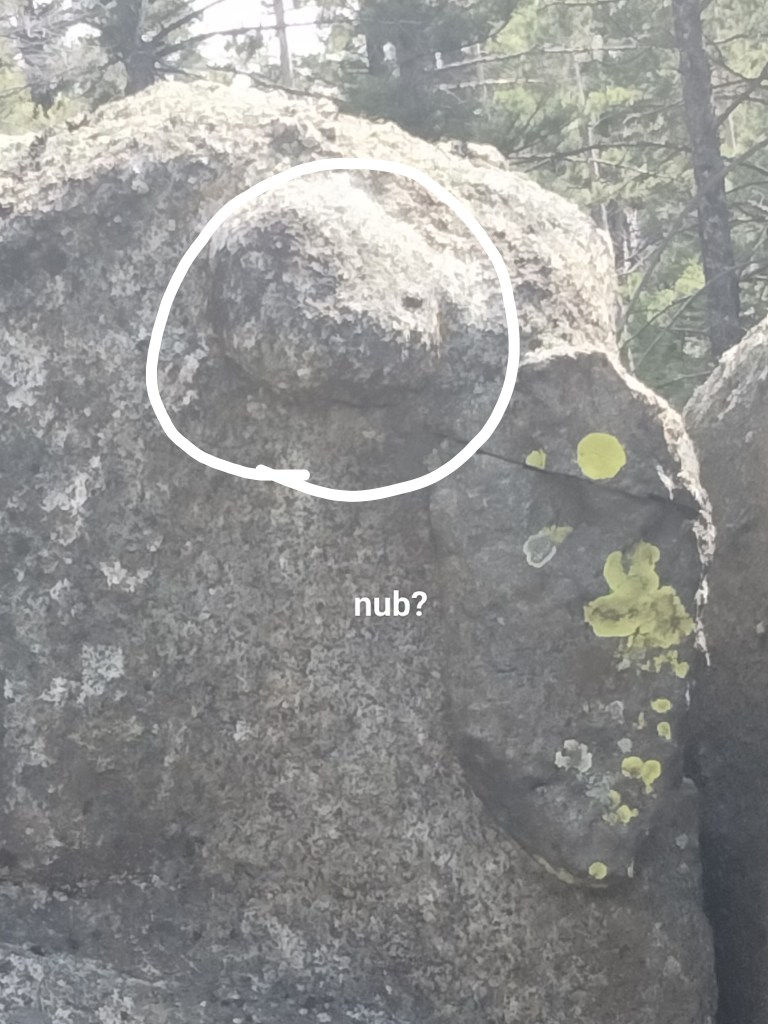
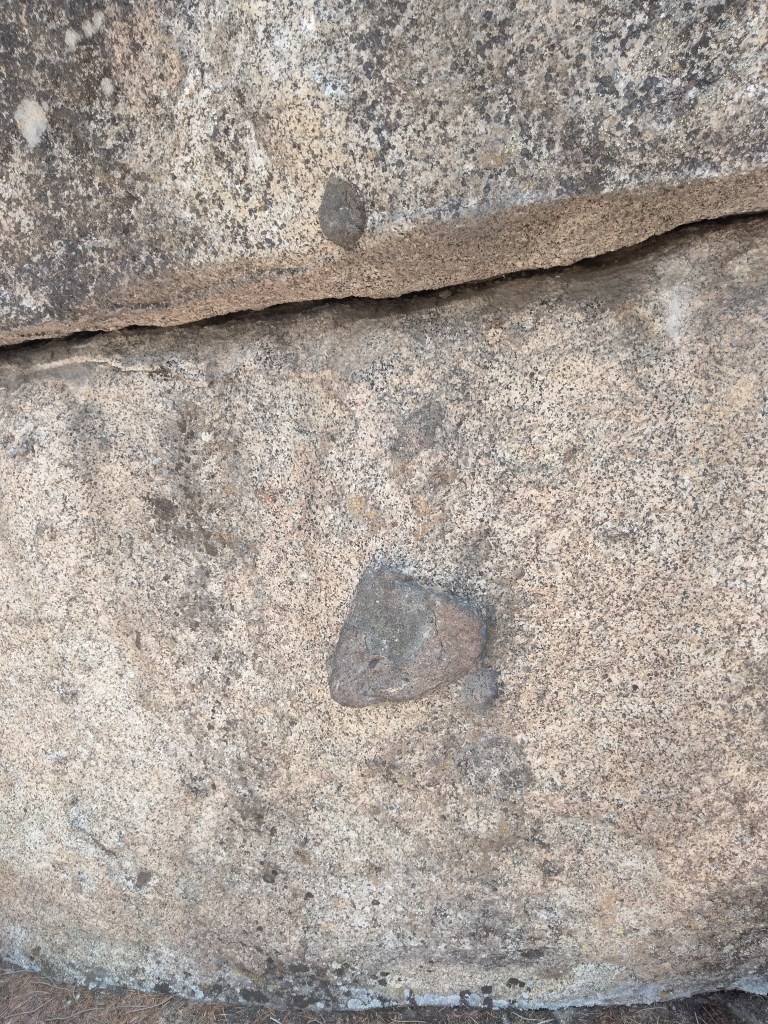
Here are some nubs found on top of the intact wall.

They are not the same as the pieces of quartz sticking out of the natural stone that we photographed earlier.

Because the wall is so weathered, some of them are not certain.

Note the possible incised lines above this last nub.

Here are some other things we saw on the back of the wall:

Incised straight line

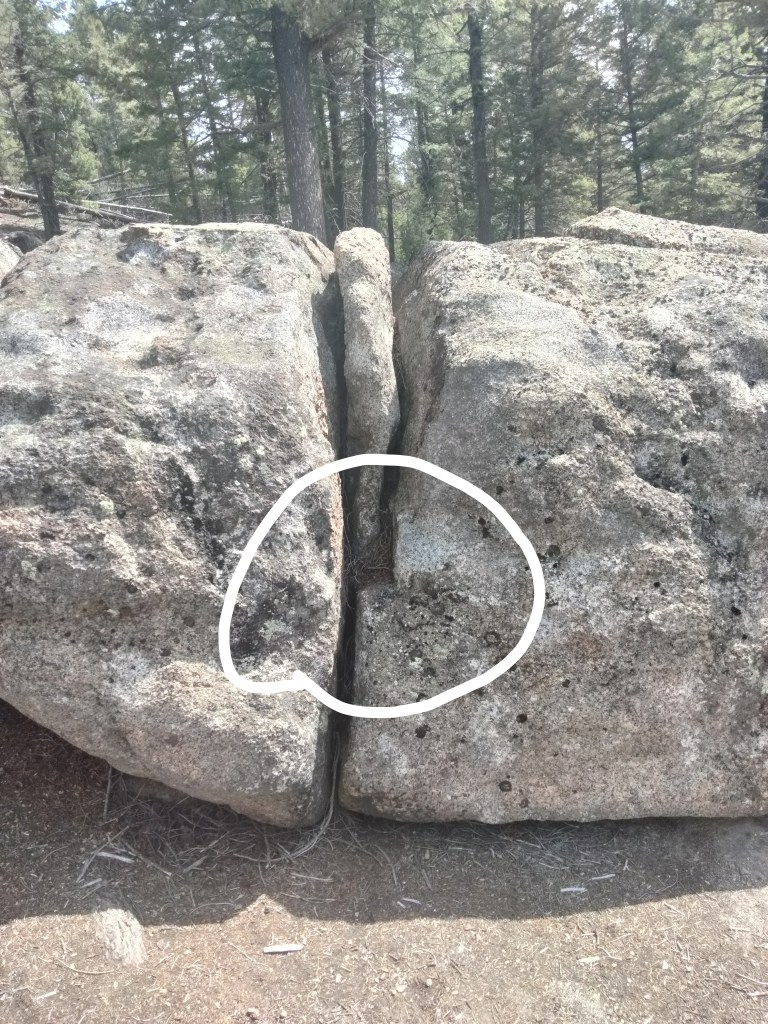
Suspiciously square fracture line

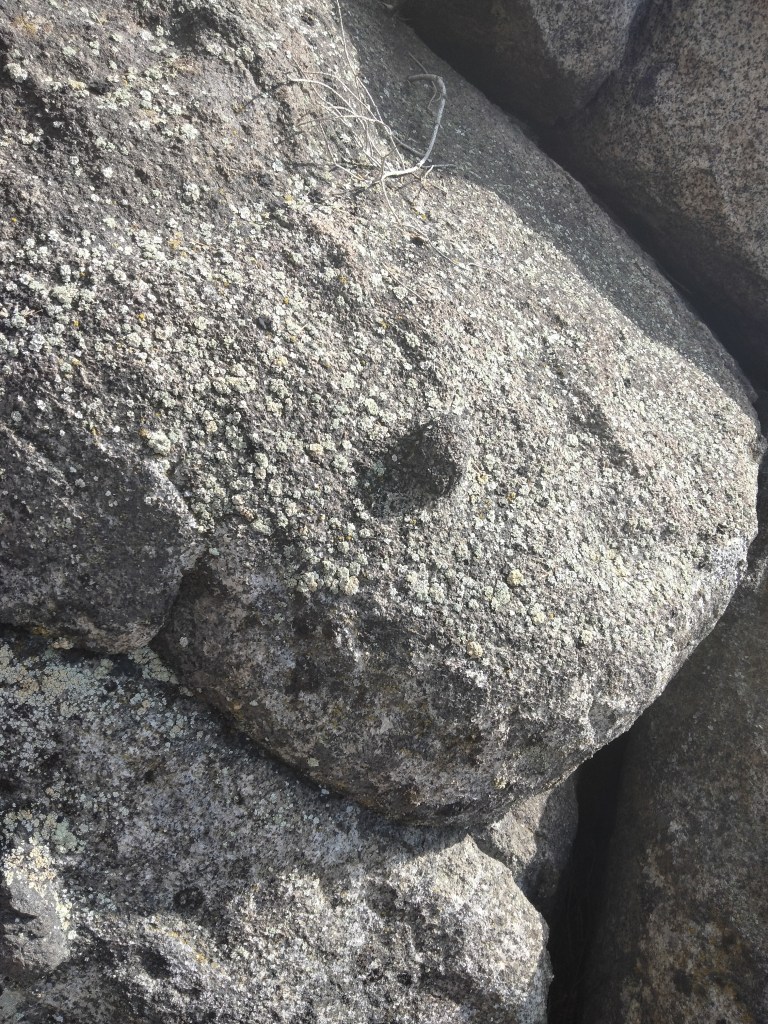
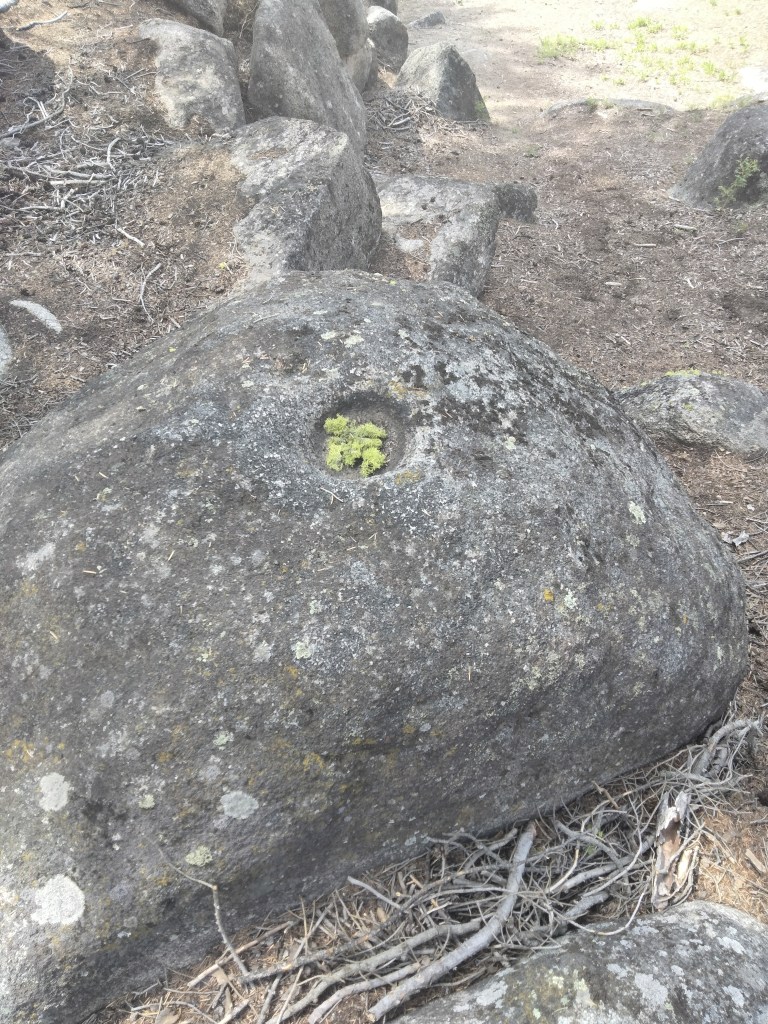
On the fallen wall as well, we found some things that look like nubs, and some possible cups. As a nod to the skeptics, yes, these “cups” do look like they could have been caused by water erosion. This would be especially true if they were found under a waterfall or a persistent drip, which they are not, as far as I can see. Some of them are also suspiciously round.

Very round “cup” in which someone has placed some fresh lichen

Some also have very straight lines incised near them. My son suggested they could be a water feature.

Looks like a cup with a spout

False Nub Alarm? Or Another Part of the Complex?

As we hiked away from Sage Wall, I took care to photograph natural rock formations for comparison. Not very far from the walls, I saw something that also looked like nubs.

Did this mean that such nubs are a natural feature of the way granite weathers? Or could this be another part of the same complex as the wall? The formation on which I spotted these nubs certainly looks like the remains of a constructed passage.

A Post-Flood Megalithic Culture

After I left Sage Wall, my husband asked, humoring me, what I thought its purpose had been. My answer is that I have no idea. It is way too old, weathered, and partially buried for me to speculate. (This does not bother Julie Ryder over at Montana Megaliths, so if you want to see some people speculate very confidently, you can visit there.)

What I can say is that, granted this is not a natural formation, it most reminds me of Sacsahuayman and other sites in Peru. You have the same dry stone construction with megalithic blocks that are shaped, but are not in uniform sizes or in a regular pattern. And, of course, you have the nubs. As for scale, it appears that if Sage Wall were excavated down to its foundation, it would be thirty or forty feet high.

Another similarity is that both Sage Wall and the Incan or pre-Incan complexes are built at very high elevations (the Continental Divide runs near Butte).

This suggests to me that they partake of the same culture area.

Sage Wall, of course, has been abandoned much longer than any of the impressive Incan complexes, some of which Europeans got to witness still in use. Consequently, it’s much more weathered, run down, and filled in. But it looks like the same sort of thing.

So, it appears that Sage Wall and any other structures we might find in association with it were built by a group of people who knew how to build with megaliths, and who then had to abandon this site for some reason. It was before recorded history in North America, but that doesn’t mean it was before recorded history was happening elsewhere. Then, they or their descendants or people who partook of the same megalithic culture, moved on towards South America and continued their building there.

I believe there is plenty of evidence–not from Sage Wall, but from other sources–that human dispersion happened very quickly after the Flood, and that when people spread out, they took a megalithic culture with them. Dolmens, pyramids, cities, and inexplicable megaliths have been discovered all over the world. In many cases, as with the Bosnian pyramids, they have been abandoned for so long that they are not immediately recognizable as the work of human hands. You have to know what you are looking at before you can see it. The Bosnian pyramids, first thought to be extremely regular hills, were confirmed as artifacts only when a team dug into them and found tunnels. It looks like something similar happened with Sage Wall.

Immediately after the Flood, the earth would have entered an Ice Age. The climate was in a tailspin: temperatures were low, precipitation at an all-time high. Much of that precipitation quickly got locked up in glaciers. Sea levels fell around the newly configured continents. There were land bridges all over: in Beringia, in Doggerland, in Sundaland. People took advantage of all this newly revealed, very humid land and scattered. But the Ice Age was short, and as glaciers melted, there were sudden catastrophic local floods. People had to abandon their sites. Many of their cities, camps, and settlements are now hidden under water along our coasts. In some cases, such as Gobeklitepe and the Vinca cities, they burned, buried, or otherwise destroyed their sites before moving on. Some of these sites might have been built very quickly and inhabited for only a short time before they were abandoned. Other things being equal, archaeologists tend to overestimate how long it took to build something, and how long ago it appeared. But even very recent sites can be quite mysterious. They have had trouble re-constructing Woodstock, for example.

How Did They Build It?

I don’t know. Obviously they were purty smart. Probably an argument is going to be made that Sage Wall must be a natural formation because “we know” that people in the Stone Age didn’t have the ability to make things like this, despite constant evidence being discovered to the contrary. Or they will argue that “we know” that there were no advanced civilizations in North America, despite Sage Wall itself. Such arguments tend to be self-re-enforcing.

I do know that we do not, currently, have the ability to build with megaliths … at least, not so easily that we consider them our first choice in building material. We might make a monument or a gravestone, but we wouldn’t attempt to build an entire house or city out of megaliths. The effort would just not be worth it. This suggests that the ancients may have had ways that were easier than our current methods.

It is worth noting that there is a well-established oral tradition of giants living in North America. There have also been giant skeletons discovered. In Peru, meanwhile, there is the tradition of the Viracochas, bearded, godlike culture-bringers. No, I’m not suggesting aliens. I do think we should take a closer look at the worldwide oral traditions of apocalypses, floods, gods, and giants, and that we should pay attention to myths that suggest that civilizations were “advanced” right from the beginning. If you want to dig into this more than you already have (and if you are reading this, I assume you already have!), please feel free to look at my page The Research Behind the Books for a suggested reading list.

Embedded YouTube Video about Sage Wall

Ancient Maps of Antarctica Debunked. Maybe. Also, We Are All Idiots

Playin’ the Hits

This is a repost. These past weeks have been busy, what with wrapping up the school year, many family events, and illness. (I have a fever right now, and it’s making my online comments amazing.) So I give you this, one of my most-often-viewed posts of all time.

Disclaimer

Like most sane people, I hate Internet debates. Love/hate, that is.  Even in real life, I’ve always found it hard to let a debate go. I’ve sometimes stubbornly backed positions that later turned out to be false, and on the other end of the spectrum I’ve gotten scared by ad hominems and conceded stuff I didn’t need to concede.   Almost no matter how the debate goes, I end up feeling like an idiot.

I don’t want this site to become a debating site. But a few weeks ago, I posted a wild historical theory and invited you guys to critique it.  Benjamin did, in the comments, here.  So, for the integrity of this site, I’ve got to respond to the critique found in the link.  If you don’t like Internet debates, please please skip this post.

The link that Benjamin posted to is to a site called Bad Archaeology.  The site has two guys’ names on it, but at appears to be mostly written by one guy. (At least, he is the one who responds to comments.)  Let’s call him KFM.  I am not posting his full name here nor am I linking to his web site, because I don’t want to attract his attention because I hate Internet debates!  However, you can easily find his site by Googling it.

The site exists to debunk “Bad Archaeology” (caps in the original), which mostly means various wild theories like the ones we’ve been discussing about lost civilizations, aliens, etc.  It calls proponents of these theories Bad Archaeologists and it fights them with facts, with mischaracterization of their positions, and sometimes with mockery. And by capitalizing its references to them. Always fun.

Summary of the Refutation

KFM’s main arguments against Hancock’s idea that the Piri Reis, Orontius Finaeus, and Buache maps come from an older source are as follows:

-Piri Reis SAID he got his data for the New World part of his map from Columbus.  This is confirmed because he faithfully reproduces some of Columbus’s errors, such as showing Cuba as part of the mainland.

-Most Bad Archaeologists consistently spell Orontius Finaeus’s name wrong.  (Oronteus.)  This shows they don’t know what they’re talking about. 

-There are major errors in Reis’s and Finaeus’s depictions of Antarctica.  So we cannot claim that a supposed older source map was accurate.  (More on this in a second.)

-Only one version of Buache’s famous map exists that shows Antarctica.  It is in the Library of Congress.  Other versions of the same map just show a big blank space there.

-Buache was an accomplished geographer who had a theory that there must be a landmass at the bottom of the world.  He also theorized that within it, there must be a large inland sea that was the source of icebergs.  So, if the map he supposedly drew is not a hoax and was in fact drawn by him, then he just made it up out of pure speculation.  In fact, he wrote “supposed” and “conjectured” all over it.

-He also shows ice and icebergs all over it.  This renders ridiculous the idea that it is a map of Antarctica before the continent was covered in ice. 

-Buache’s and Finaeus’s maps don’t match Reis’s or each other, so clearly they cannot have come from a single source map, let alone an accurate one.

The Strong

KFM’s arguments look, at first glance, super convincing. Some of them are dead on.

The strongest part of KFM’s argument is this:

“[Charles] Hapgood, [Hancock’s source for this theory], assumed that the original source maps, which he believed derived from an ancient survey of Antarctica at a time when it was free from ice, were extremely accurate. Because of this, he also assumed that any difference between the Piri Re‘is map and modern maps were the result of copying errors made by Piri. Starting from this position, it mattered little to Hapgood if he adjusted the scales between stretches of coastline, redrew ‘missing’ sections of coastline and altered the orientation of landmasses to ‘correct errors’ on Piri’s map to match the hypothesised source maps …. Hapgood found it necessary to redraw the map using four separate grids, two of which are parallel, but offset by a few degrees and drawn on different scales; a third has to be turned clockwise nearly 79 degrees from these two, while the fourth is turned counterclockwise almost 40 degrees and drawn on about half the scale of the main grid. Using this method, Hapgood identified five separate equators.”

This is pretty damning to the theory.  It’s not necessarily fatal to the idea that Reis used an obscure ancient source among the 20 that went into his map.  After all, copying errors do happen, especially when we are trying to compile a bunch of maps from different eras of places we have never surveyed ourselves.  But that’s an unfalsifiable claim, so let’s leave it.  Regardless, Hapgood’s shenanigans certainly are fatal to the idea that this ancient map, if it existed, was astonishingly accurate in latitude and longitude.

The Not So Strong

But alongside this excellent argument, KFM also includes a bunch of inconsistent ones:

“All in all, the Piri Re‘is map of 1513 is easily explained. It shows no unknown lands, least of all Antarctica, and contained errors (such as Columbus’s belief that Cuba was an Asian peninsula) that ought not to have been present if it derived from extremely accurate ancient originals. It also conforms to the prevalent geographical theories of the early sixteenth century, including ideas about the necessity of balancing landmasses in the north with others in the south to prevent the earth from tipping over.”

So, the map does not show Antarctica, but one sentence later it does show Antarctica, but Antarctica was only put there because contemporary geographical theory demanded it.  Also, note the assumption that the ‘extremely accurate originals’ are supposed to have included all of the Americas as well as Antarctica.  That’s not my understanding of Hancock’s claim.

It’s also not clear whether KFM is claiming that all the data for Reis’s map came from Columbus.  If he is, this inconsistent with both Hancock’s claim (and KFM’s own showing) that Reis said the map was compiled from 20 others, including among them a map whose source was Columbus. 

Similarly, KFM shows errors on Orontius Finaeus’s map, although he admits that “There are fairly obvious similarities between the general depiction of the southern continent by Orontius Finaeus and modern maps of Antarctica.” 

The Buache Map Shows an Archipelago

For the Buache map, KFM contends that Buache essentially made up the entire map to satisfy a geographical theory he had, namely that there must be a land mass at the bottom of the world to balance the land at the top (this was a popular theory at the time), and that it probably had a large inland lake in it with two major outlets leading to the sea (this was Buache’s own brilliant guess, and he thought this lake must be the source of the icebergs that navigators encountered in the southern sea). 

I take KFM’s word that Buache had this theory, and that his map shows ice and icebergs on Antarctica, which KFM says “makes the claims that Buache’s map shows an ice-free Antarctica all the more bizarre.”

Well, sort of.  But actually, Hancock’s claim is that the source map Buache used shows Antarctica early in the process of icing over.  Also, given Buache’s theory, it would not be surprising if he had added ice and icebergs to any other data that he may have had. 

“Over several parts of the southern continent, Buache writes conjecturée (conjectured) and soupçonnée (suspected).”   KFM thinks this is conclusive proof that Buache basically invented the interior of Antarctica on his map, based purely on his own theory.  That could be.  But I have to say, if it is, he did a great job!  He does not just draw a round mass, attach the few islands and promontories that he knows about (New Zealand, which he took for a peninsula, and the Cape of the Circumcision), and then draw a lake in the middle.  Instead, he has a waterway offset between two unequal land masses.  It corresponds surprisingly well to the shapes of the ranges of mountains and low areas that we now know Antarctica has.

The “Well, I’ll Bet You Didn’t Know About … This!” Argument

Besides these arguments, KFM includes a lot of interesting history about the biographies of these cartographers.  Almost half his page about Finaeus is taken up with the cartographer’s biography, even though it has little to do with claims about his map (beyond boosting his credentials, which I would think Hancock would also want to do).  Similarly, with Buache we are given: “The claims of Bad Archaeologists about Buache’s map ignore a crucial fact: he was the foremost theoretical geographer of his generation, whose published works include hypotheses about the Antarctic continent.”  I’m not sure why Buache’s eminence is supposed to be a devastating blow to any claims about his map, but again we are treated to a long and interesting biography before KFM finally gets to Buache’s theories about a southern continent. 

This style of argument reminds me of people who think they have shown the Bible is not divinely inspired merely because they can show that it happened in a particular historical context and is expressed in a particular historical idiom.  They will trot out some tidbit of historical context that they assume is complete news to some Bible scholar who has been studying ANE history his whole life.  Their line of argument is based on a misunderstanding of what divine inspiration is claimed to be.  They assume that if something is claimed to be the Word of God, it must have come to humanity in an abstract, context-free, propositional and not literary or historical form.  (They also assume that it must cover all knowledge in the world, e.g. so that the discovery of North America was supposed to somehow shake our faith in the Bible.)

KFM’s argument about these maps is exactly the same kind of argument.  He gives a bunch of historical context about these cartographers and thinks that refutes Hancock’s claims.  It’s as if Hancock had been arguing that Piri Reis, Finaeus, and Buache were born of virgins, went through life without interacting with anyone, and then one day, without any context whatsoever, this complete, easy-to-interpret map from an ancient civilization dropped out of the sky into their hands.  Well, that certainly isn’t the argument that Hancock makes in his book. His argument is (or was; he has apparently retracted it) that there were several source maps, made over centuries or millienia, which traced the progressive growth of the Antarctic ice cap.  He does not claim that these were complete, accurate world maps or even that they showed the Americas.  “Someone who knew what they were doing once mapped Antarctica.”  That’s the basic claim.

When We Think We Don’t Have Preconceptions

It turns out that there is a more than coincidental similarity between the way KFM caricatures Hancock’s claims and the way that some people caricature claims about the Bible.  KFM, in fact, classes Biblical Archaeology as a subset of Bad Archaeology.  The following quotes should give you a sense of his general attitude:

“Some Bad Archaeology is just so outrageously Bad that it can only be examined charitably by assuming that its proponents are slightly confused. How else can you explain the complete lack of critical judgment, the belief in ancient fairy stories, the utter absence of logical thought they display? Either that, or they have a particular agenda, usually driven by a religious viewpoint.

 Biblical Archaeology, which has been described as excavation with a trowel in one hand and a Bible in the other, is a specialised branch of archaeology that often seems to ignore the rules and standards required of real archaeology. Conducted for the most part, by people with an explicitly religious agenda (usually Christian or Jewish), it is a battleground between fundamentalist zeal and evidence-based scholarship …  If we can’t find evidence for Solomon’s glorious empire, it must be that we’re not interpreting the archaeological data correctly and that a big discovery is just around the corner (the ‘Jehoash inscription’ leaps to mind in this context). If contemporary Roman documents don’t mention Jesus of Nazareth, why here’s an ossuary that belongs to James, his brother… It’s all very much centred around contentious objects, poorly-dated sites and great interpretative leaps that the non-religious may find astounding.”

Got that?  If you believe in a historical Solomon or even a historical Jesus, you’ve just been dubbed a Bad Archaeologist.  Welcome to the club, friends.

I mention this attitude not because it’s off-putting, but because it tells us something about KFM’s mindset and about what it would take to convince him that something is “good” archaeology.  I’m guessing that any evidence of advanced civilizations older than about 4,000 BC is going to be dismissed out of hand.  As will any evidence showing that humanity might have declined, rather than slowly progressed, over our history.

Conclusion: Inconclusive

Going back to the maps, what has been shown here?  I would say it’s inconclusive.  The maps are less accurate than Hancock claims and far less accurate than I made them sound in my original post, because I was going over Hancock’s theory at treetop level and didn’t bother to get off into the weeds when he discusses the details of the maps.  (As I still haven’t done in this post. I would like to, but my time is limited.)

On the other hand, I think the Finaeus and Buache maps especially are more accurate than we would expect of maps that had been drawn out of pure conjecture, without any source at all.  It looks like more was known about Antarctica in the 16th century than we previously assumed, whatever the source of that knowledge.

So it’s not a case of “Lost civilization proven!” but neither is it “Nothing to see here.”  The most we can say is that something strange is going on, but we don’t know what.  To paraphrase Andrew Klavan, KFM isn’t wrong to think Hancock and Hapgood are wrong; but he is wrong to think that he himself is right.

About the theory of earth crust slippage, I feel the same way.  On the one hand, it’s a pretty hard theory to swallow on geological grounds.  (For example: if a big section of the earth’s crust pivoted around the North American plains – even granted that this could happen – shouldn’t there be some kind of seam where the edge was?)  On the other hand, clearly something weird happened, or we wouldn’t have Siberia being ice-free when Canada was ice-covered.  Nor would we have flash-frozen tropical plants and baby mammoths.  

So, in conclusion, nobody knows anything, boys and girls.  Let us eat, drink and be merry.

Hundreds of Thousands of Ancient Stone Structures in Saudi Arabia

On Oct. 17, Live Science published an article describing a highly unusual type of site – called gates in the Harret Khaybar area, that my colleagues and I had systematically catalogued and mapped and were to publish in the scientific literature in November. That sparked immediate and extensive international media coverage, including features in The New York Times, Newsweek and the National Geographic Education Blog. Four days after the article was published on Live Science, I got an invitation from publication from the Royal Commission for Al-Ula, in northwest Saudi Arabia, to visit that town. The Al-Ula oasis is famous for hosting the remains of a succession of early cultures and more recent civilizations, all strewn thickly among its 2 million-plus date palms. As a Roman archaeologist, I had known this oasis for over 40 years as the location of Madain Salih, Al-Hijr — ancient Hegra, a world-class Nabataean site adopted by UNESCO.

Four days after the invitation from the Royal Commission, my colleague Don Boyer, a geologist who now works in archaeology, and I were on our way to Riyadh. Almost immediately, on Oct. 27 to Oct. 29, we began three days of flying in the helicopter of the Royal Commission. In total, we flew for 15 hours and took almost 6,000 photographs of about 200 sites of all kinds — but mainly the stone structures in the two harrat.

Though we didn’t have much notice, Boyer and I spent three days before our visit looking over the sites we had “pinned” and catalogued using Google Earth over several years. We then, relatively easily, planned where we wanted to fly in order to capture several thousand structures in these two lava fields. Our helicopter survey was probably the first systematic aerial reconnaissance for archaeology ever carried out in Saudi Arabia. It was possible only because of the publication of the Live Science feature article describing my research on the gate structures, and the resulting international media coverage, which caught the attention of the Royal Commission.

-Prof. David Kennedy, in this LiveScience article, November 2017

I am just so excited about this, people. Just so excited.

I had heard that there were large stone structures, called “gates,” in Saudi Arabia. I’d even blogged about it before. But I had no idea that there were hundreds of thousands. Hundreds of thousands. Saudi Arabia must be simply covered in these things.

It gets better. Guesses are that they date back 7,000 years (pre-Flood? Immediately post-Flood?). We know because many of them have been covered by lava flows in the interim. The Bedouins say they are “the works of the old men.”

It gets better. Why was the extent of these structures previously unknown? Must be racism, right? Evil European archaeologists didn’t expect the ancient inhabitants of Saudi Arabia to have built stuff like this?

Why, no. These structures are waaay out in the desert, known only to the locals. Almost impossible to find on foot. They are best surveyed from the air. Well, shortly after the last two World Wars (when small planes first came into general use), the Arab states started to achieve their independence from Britain and France. And they became closed states. They didn’t want anybody flying over their land. So, these amazing structures have been unknown and underappreciated, because those archaeologists who were interested, weren’t allowed to observe them.

So, let’s review. This story simply has everything guaranteed to make Out of Babel squirm with joy. Old, mysterious structures, really old, pre-dating even the amazing Nabatean civilization (the folks who built Petra), HUNDREDS OF THOUSANDS of them, purpose unknown, not generally known to exist because of remote location and closed country. Not only would this make a great movie, but it is the kind of thing that is continually popping up all over the world. Apparently, there is literally tons of evidence of smart humans building advanced civilizations, in just about every country on earth, yet we moderns have been unaware of this for a variety of reasons. Some of these reasons weren’t our fault (how were we supposed to know?), some were (we were blinded by the evolutionary narrative that says prehistoric people weren’t “advanced”).

When I say “advanced civilizations,” I mean a variety of different things by that. I mean cities with sophisticated water systems like Teohihuacan, observatory/computers like Stonehenge, observatory/cities like Poverty Point, temples using advanced geometry like Gobekli Tepe, pyramids like the ones in Bosnia, giant geoglyphs like the Nazca Lines and Serpent Mound and, apparently, these Saudi Arabian gate things. I also mean stones that appear to have been drilled, or precisely molded like the ones at Puma Punku.

If you have time, please follow the link and look up the LiveScience article. It’s worth reading the whole thing, and includes a video with views of the structures from an airplane.

Stone Age Surgery

Photo by Renato Danyi on Pexels.com

Trigger warning: Stone Age surgery!

This post is the first in a series I have planned about prehistory. Each post will draw on one or more chapters from the book The Lost Civilizations of the Stone Age, by Richard Rudgley, Touchstone, 2000. From the front flap:

Our long-held myths are exploding. Recent discoveries of astonishing accomplishments from the Neolithic Age – in art, technology, writing, math, science, religion, and medicine, and exploration – demand a fundamental rethinking of human history before the dawn of civilization.

Lost Civilizations, inside flap

So, Rudgley’s thesis is basically that there was, in fact, civilization long before there was civilization. That is, of course, also a theme of this blog. “Ancient people were smarter than we think,” or that art, literature, science and civilization are the natural state of human beings and have been present (ebbing and flowing of course) as long as there has been humanity.

A near-universal theme in the mythologies of the world is that the present state of the world, and more specifically the social world, is in decline — a fall from the Garden of Eden or from a Golden Age. Modern civilization has turned these traditional mythological assumptions on their head and written a new script, one based on the idea of social progress and evolution. In this new mythology the notion of civilization (as it is generally understood) replaces Eden and this novel paradise exists not at the beginning of time but, if not right now, then just around the corner. Civilization is … presented as the final flowering of human achievement born out of a long and interminable struggle against the powers of darkness and ignorance that are represented by the Stone Age.

Lost Civilizations, Introduction, page 1

I have come to believe in the ancientness of civilization because I take ancient documents seriously as historical records: Genesis, primarily, but also the other legends and myths from around the world which Rudgley mentions in his intro. This suspicion that ancient people were much smarter than we give them credit for was further strengthened as I learned about some of their building projects. Now Rudgley is presenting archaeological evidence that they knew far more than we suspect about art, mathematics, the natural sciences, and medicine.

Disclaimer about Dates

By the way, I don’t have a coherent way to sort out which archaeological dates to accept and which ones to doubt. As far as I can tell from my reading, all methods of dating archaeological sites are based on some form of dead reckoning.

Carbon dating depends on certain assumptions about rates of molecular decay, which can’t be proven in the first place and can also be thrown off universally or locally by events such as a comet strike. Carbon dating also seems to be less reliable the farther we go back in time.

Dating by archaeological layers also depends on assumptions about different historical periods and what might be diagnostic of each, except in cases where a site can be reliably linked to a known historical event (which is obviously only the case for relatively recent sites). Other than that, it’s all dead reckoning.

Dating events in human history by the use of genetics depends upon assuming that all genetic differences evolved and assuming certain rates of change. Historical linguistics has the same problem.

Finally, historical records such as the genealogies found in Genesis and in the oral traditions of other peoples worldwide hit only the highlights of a family line and don’t give us any idea how many generations were skipped.

Each of these methods can be pretty convincing in specific cases. It is even more convincing when one or more methods converge, yielding the same date range. But even when that happens, it’s still just one method of dead reckoning appearing to validate another. And most often, different dating methods contradict each other. If a plurality of them converged on one timeline for human history, maybe we could accept that. But they don’t. It’s complete chaos.

I would love to present a clever, coherent, data-grounded rubric for sorting all this stuff out. But I’m not a professional in any of these fields. Even if I were, the pros don’t all agree with one another. It’s starting to look like, in order to have a sorting method that makes sense, I would have to do full-time research for several years. Maybe for a lifetime. So I got nothin’.

My working theory is that humanity, and hence human civilization, is tens of thousands but not hundreds of thousands and certainly not millions of years old. I can’t prove this. No one can.

So, in these posts about Rudgley’s book, I’ll just present the dates as he gives them. I won’t try to integrate them with the picture of ancient human history that I have been piecing together in my books and in other posts on this site, all of which could be invalidated at any time by a new historical or archaeological discovery. Sometimes Rudgley gives dates that are hundreds of thousands or even millions of years old (though not in this chapter). I might be skeptical that they are really that old, but can still accept that these people were living long before mainstream archaeology tells us that there was “civilization.”

On to the Icky Stuff!

So. Stone Age Surgery.

Undoubtedly the widest-known major surgical operation in tribal cultures is trepanation … which, as will become clear, was also known in the Stone Age. This operation involves the removing of one or more parts of the skull without damaging the blood vessels, the three membranes that envelop the brain … or the actual brain.

Lost Civilizations, p 126

That’s right, removing parts of the skull. There are three methods by which this can be done: scraping, “a mixture of boring and sawing,” and “the push-plough method,” which involves creating an oval groove in the skull (basically another method of scraping).

Thomas Wilson Parry, MD (1866 – 1945), became fascinated by trepanation and practiced various methods of it on human skulls (not on live patients), “using implements made of obsidian, flint, slate, glass, shell and shark teeth.” “Parry records that the average time it took him to perform a trepanation by the scraping method on a fresh adult skull was half an hour. He found both flint and obsidian excellent materials to work with surgically, and also expressed the opinion that shells — which were used in Oceania to perform such operations — were highly effective too.” (page 128)

Trepanation appears to be less painful than it sounds. It has been used at various times and places to treat epilepsy, mental illness, head injuries, severe headaches, vertigo and deafness (129). It is “still regularly practised among the Gusii of Kenya, a Bantu people with a population of about one million, and theirs is perhaps the last surviving traditional practice of its kind.” (130) Trepanation was also practiced by the Incas and the pre-Inca peoples; in Neolithic Europe; in 6th-century BC Palestine; and now, trepanned skulls a few thousand years old have also been found in Australia.

Rudgley points out that “as it is usually only the bones of Stone Age people that survive to be discovered … any operation that was performed on the soft parts of the body cannot be detected.” (136) If Neolithic people were willing and able occasionally to practice trepanation, it seems likely that they were able to perform less risky kinds of surgery too. There is some evidence from Neolithic Europe of various kinds of dentistry, including toothpick grooves, birch bark chewing gum, and even a skull with a tooth that has been drilled. (136)

Rudgley’s chapter on trepanation (“Stone Age Surgery”) comes after a chapter called “Under the Knife” (pp 116 – 125), which discusses medical procedures in “tribal” cultures that are known from history and ethnography. This includes everything from circumcision in the Ancient Near East, to amputation among the Australian aborigines, to very detailed anatomical knowledge among the Aleutian islanders. The chapter concludes with two horrifying yet impressive accounts of successful surgeries in a tribal context. There is a c-section performed in Uganda in 1879, and various tumor removals performed in the Ellice [sic] Islands in the 1920s. The message is clear: modern, “civilized” people don’t have a corner on medical knowledge.

Antiseptics and Painkillers

We don’t know whether Stone Age people had germ theory. Nor, if they had it, do we know how they referred to germs. In one of Ursula le Guin’s novels, a wound getting infected is called “the evil of the blade.” That’s hardly less scientific than calling it an “infection,” as long as you know how to prevent or treat it.

Studies of both the trepanned skulls of the Incas and some of those found in Neolithic Europe indicate that healing seems to have been the norm in both cases. It is hard to explain the Stone Age success rate without concluding that some kind of effective antiseptic agent must have been used. Furthermore, the surgeons of the time must have understood the need for it.

Lost Civilizations, p 131

If germ theory was ever explicitly known, it was obviously forgotten at some point in human history, only to be re-discovered much later. But even if people were operating on a different theory, it would be possible for them to know the importance of cleanliness and to know how to treat a patient using any of a large number of natural substances that have antiseptic properties. The words “Stone Age” naturally evoke the image of a cave man, and the idea of a cave man naturally includes an individual who never takes a bath. But it ain’t necessarily so.

It is also possible that people’s immune systems were much stronger many years ago, if we are willing to entertain the idea that the human race has declined over time rather than evolving upwards.

Now, I am sure you want to know about painkillers. Here, gleaned from Rudgley’s Stone Age Surgery chapter, is a short list of substances that have been used as painkillers at different times and places:

  • cocaine (in coca leaves — South America)
  • wine mixed with extract of mandrake (first-century Greece)
  • mandrake beer (ancient Egypt)
  • possibly just beer
  • the opium poppy (starting in the Mediterranean around 6000 BC and spreading west from there)
  • cannabis (native to Central Asia, but quickly spread to Old Europe and China)
  • betel nut (Southeast Asia)
  • tobacco (in the Americas)
  • pituri (a nicotine-bearing plant used by the Australian Aborigines)

Clearly, although we might prefer modern anesthesia, ancient peoples were not completely without recourse when it came to pain. Most of the substances on this list are attested not only in history but also in ancient burials.

This has been a repost from January 2020, which by now is … ancient history.

A Roundup of Atlantis Theories

Photo by Pixabay on Pexels.com

Too many Atlantises. An embarrassment of Atlantises. One Atlantis, two Atlantis, red Atlantis, blue Atlantis …

Atlantis is Now Off the Coast of Cuba

This article describes an intact granite city, with pyramids, discovered off the West coast of Cuba, about 2,000 feet down, in December of 2001. As our old friend KFM, of Bad Archaeology, points out, the city would be unlikely to survive intact like this if it actually dropped dramatically from what is now sea level, as Plato seems to describe. The article points out that there is another city, the Yonaguni Monument, off the coast of Japan, and Graham Hancock in his book, Underworld, points out that there are submerged megalithic cities in many places around the world, including off the coast of India. (Hancock has cycled through seriously advancing a number of different Atlantis theories, so he will be sort of the workhorse of this post.)

It seems to me that the city off the coast of Cuba is part of a worldwide phenomenon where sea levels were once much lower. We can include in this phenomenon Doggerland (which will make another appearance later in this post), and the land bridges known to have once connected Asia to the Americas and the Indonesian islands to the mainland.

If you are an old-earth believer and have to juggle millions of years, multiple cooling and warming periods, slow but somehow effective continental drift, and some confusing archeological indications that humans were perhaps around well before they should have been … good luck. As someone who believes that the history of the earth is measured in thousands or tens of thousands, but not millions or billions of years, my guess is that this period of low sea levels plus advanced civilization came right after the Great Flood.

You would have a much colder, rainier climate as the earth adjusted to the recent cataclysm (about this more in a minute). You would have had frequent snow and rain storms, with all this precipitation getting frozen in the rapidly forming ice sheets, causing Earth’s water supply to be greatly reduced. Meanwhile, you would have Noah’s children and grandchildren branching out as quickly as possible, building megalithic cities wherever they went, still remembering the techniques and technology (and possibly still assisted by the giants and gods) that they had seen pre-Flood. This period of low sea levels would have had to last long enough for people to disperse and to build, but it need not have been very long. It could have a been a matter of a few hundred to a thousand years. As the climate stabilized, you would have had floods covering settlements and civilizations in different parts of the world. This, I believe, is the reason we have an embarrassment of Atlantises.

There have also been assertions that the reason for the Bermuda Triangle phenomenon is that Atlantis lies underneath it. (Note that the west coast of Cuba is outside of the Bermuda Triangle.) This theory certainly appeals to those who are interested in the potential paranormal effects of the lost city, but I do not know of any actual submerged city found in the Bermuda Triangle area. (If you do, please enlighten me in the comments. I’m always looking for another Atlantis to add to my collection.) This article discusses how ocean-floor mapping technology can create lines that look like city streets.

Atlantis as Antarctica

Graham Hancock makes the case for this in his book Fingerprints of the Gods. He posits that the evidence points to an ancient, advanced civilization which was destroyed by a cataclysm, and asserts that the refugees from it seeded their scientific knowledge, in code form, by creating new religious cults all around the world that featured certain sacred numbers.

If you’ve been reading Out of Babel for a while, you know my assessment of all of this is that it’s right, but not in the way that Hancock thinks it is. Among other things, his scientific materialism and evolutionary beliefs make it impossible for him to imagine that people groups like the Maya, for example, would have come up with advanced mathematics on their own, so he needs to posit a more “advanced” civilization bringing these things from without.

Anyway. For his advanced ancient civilization, Hancock realizes he needs a continent-sized homeland (because, again, his evolutionary beliefs about man require that such a civilization develop gradually, over millennia, from hunter-gatherers to farmers and so on). Antarctica is a good candidate because it’s an entire continent; there is some evidence that it was mapped before it was quite so covered in ice; its general pre-ice outline corresponds roughly to Plato’s description of Atlantis; and there is a theory available for how it could have gone from being in a temperate part of the Atlantic, to being at the South Pole, in a relatively short amount of time. Hancock calls this “earth crust slippage” and posits that it happened about 20,000 B.C.

Now for the version I find more plausible: Creation scientist Dr. Kurt Wise presents his team’s model for “continental sprint” in this video. I find Dr. Wise’s model persuasive as a model of the Great Flood, and as we will discuss, it could explain the Atlantis legend wherever in the world Atlantis proves to have been. However, even if you buy into “continental sprint,” it does not follow that Plato was describing Antarctica when he wrote about Atlantis. If all the land on the earth were breaking up, the ultimate fate of that portion that later became Antarctica would seem like a minor detail.

Atlantis as North America

This one was put forward by Graham Hancock, after he abandoned his Antarctica theory, in his book America Before, a review of which I react to here. Although weak, the theory relies on the fact that there are large structures, either megalithic or earthworks, which align to different astronomical features and/or function as observatories, all around the world, including in North America. For example, the pyramid complex at Teotihuacan appears to be a model of the solar system; the Giza Plateau appears to be a model of Orion, and Serpent Mound in Ohio, which sites towards the sunrise at solstices, may be according to Hancock a model of the constellation Draco.

All that to say, anywhere you can find a large astronomical structure, you can make a case for Atlantis, and Hancock has made that case for North America.

Atlantis as the Cyclades Plateau in the Aegean

This article, which I posted last summer, asserts that Plato’s descriptions of Atlantis are admirably matched by the Cyclades Plateau (now the Cyclades islands), which would have existed when sea levels were 400 feet lower than they are now. The Cyclades Plateau is a rather large formation right in the middle of the Aegean. (If we consider that lower sea levels would have also expanded the coastlines of the rest of Greece, then it would have been even closer to the mainland.) This is an attractive theory in terms of its being what Plato was actually talking about (since he makes Atlantis contemporary with Athens), but it does depend upon this:

Recently, a four year study that included a thorough analysis of Plato’s work established that serious errors by early translators allowed for the mixed messages in the translated document.

Atlantis as Part of Doggerland

Yet another underwater location that used to be inhabited when sea levels were lower, Doggerland was a vast region that stretched between England, France, Holland, and Scandanavia, and is now the relatively shallow southern part of the North Sea. Archaeological discoveries have handily established that this area was once inhabited, here and here among others. As with other now-submerged human habitations, the reader’s preconceptions will determine how long ago you believe it was inhabited, and for how long.

This article describes an entire book which puts forth a detailed theory Plato was describing Doggerland. Apparently, Atlantis had a large, roughly rectangular plain surrounded by “ditches,” which the author thinks could also be translated “dikes.” He imagines the inhabitants of AtlantiDoggerland using these dikes to keep the sea back from a certain region of Doggerland for a period of time. Without some very expensive underwater archeological expeditions (in a notoriously dangerous sea), there is no way to confirm whether the ruins of a large city lie where this theory would predict. The maps are well worth looking at.

Atlantis as the Richat Structure

The Richat Structure, of the “Eye of the Sahara,” is a large (c. 40 km) formation of concentric rings of stone located in present-day Mauritania. Because of its size and remote location, it is hard to spot except from orbit.

Depending upon how you calculate, the structure matches the recorded dimensions of Atlantis quite well. There are also, of course, explanations about how this structure could have formed geologically. I’m not enough of an expert to assess these, but I am more skeptical of geological explanations than I used to be, now that I’ve seen “mountains” that turned out to be pyramids with insides, and geologists’ attempts to explain how a single fossilized tree could cross-cut millions of years’ worth of sedimentary rock layers. In other words, could go either way.

For the Richat structure to be Atlantis, we have to imagine that it was once nearer to coast and was inundated by a tsunami or something of that nature. This theory actually works fairly well with the geological model that Dr. Kurt Wise presents above. “Continental sprint” would have included many earthquakes and resultant tsunamis. Africa, in the model, does not move as much as the other pieces of Pangea, but it would still have undergone earthquakes and, possibly, some uplift.

On this theory, with his tale of Atlantis Plato somehow retained a memory of a pre-Flood incident (and read Athens back into it?). Below is a video of Pastor Joel Webbon discussing the theory with Brian Suave and Ben Garrett of Haunted Cosmos. They get into local lore around the Richat structure, how this dovetails with Greek legends about Atlantis, and how this all could have been plausible in a pre-Flood world haunted by gods and nephilim.

Conclusion

When I first started composing this post, I thought I was going to come out in support of the Richat Structure. Now, I just don’t know. The Haunted Cosmos guys make it sound very plausible, but a few of the other candidates are also plausible (some less so). There does not seem to be any way to “find” Atlantis without sacrificing at least some of what Plato has to say about it. (For example, Athens existed before the Flood? Before there was a Europe?) This makes it really difficult to favor any one theory (although we can probably discard others). What is clear, is that the prehistoric world had many sophisticated cities, lots of things built with megaliths, pyramids on almost every continent, and that there was a period when many human settlements were submerged as sea levels rose. The details are a matter of speculation, of the kind suitable for someone writing a novel.