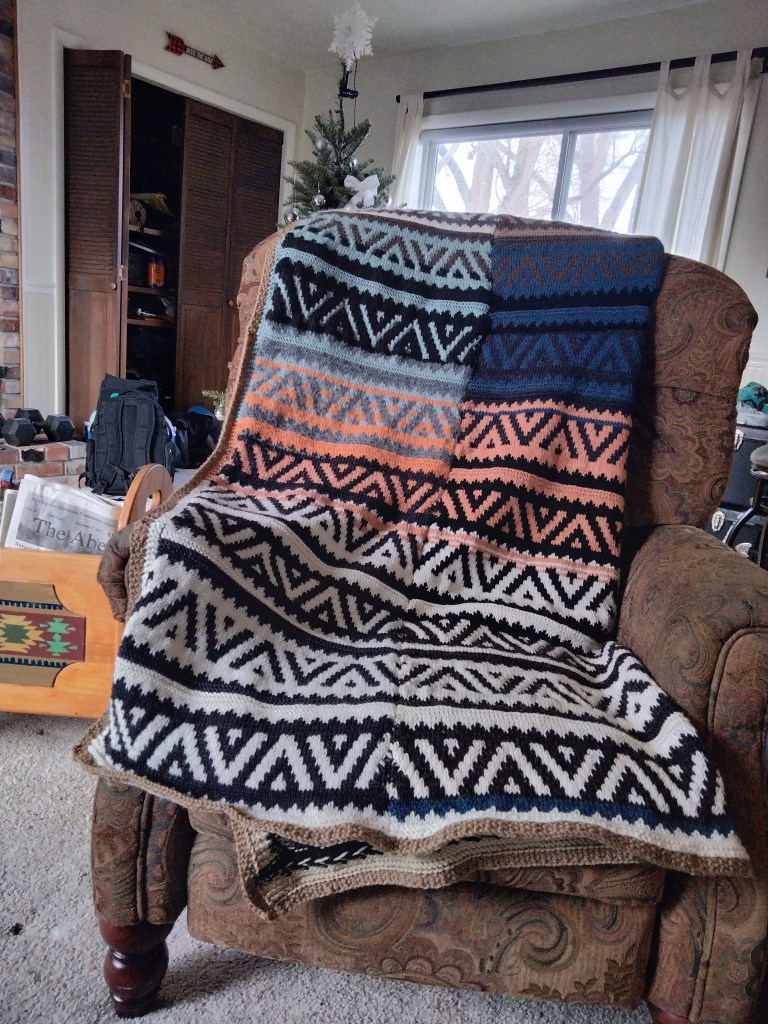
Behold! A so-called “Indian blanket” that it took me about a year to complete.
Real “Indian blankets,” of course, –at least, the Navajo kind– are woven, not knitted. But this type of pattern is very popular in the United States, and has been for more than a century. You find it on clothing, bedspreads, purses … and knitting patterns like this one. You see, when the Europeans conquered the American Indians, all groups immediately started both intermarrying and borrowing each other’s ideas.
As an aside, this type of pattern also sort of resembles some traditional weaving patterns in Indonesia. Because all folk art, when you get right down to it, looks sort of alike. Having been made by humans and that.
So about a year ago, I bought this pattern, called “Mohawk Valley,” from the Vintage Pattern Store on etsy. Then it was time to acquire the yarn. This blanket is a mix of different colors from my stash; high-quality wool and wool-blend yarns bought both online and at a specialty knitting store; and cheap cotton yarns in the appropriate colors, bought wherever I saw them on sale. So the color variations are my own. This pattern would look really good in just two colors. Perhaps, one day, I’ll do one with a bit more color discipline … if I live that long haha!
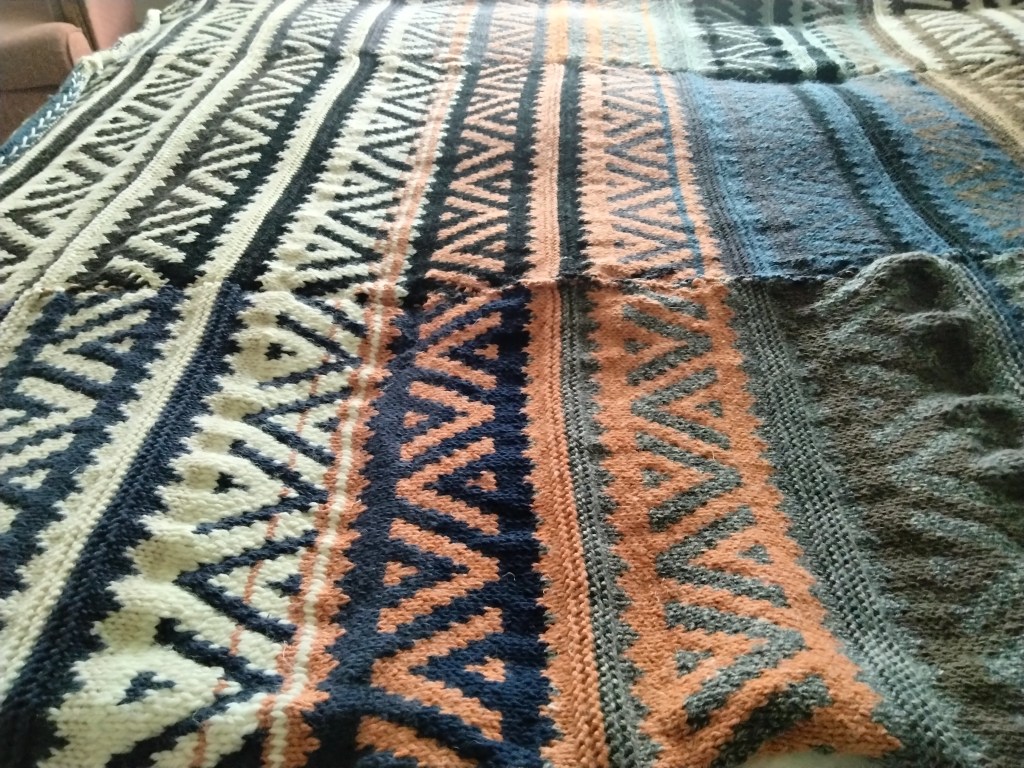
You knit it in three strips, then sew the strips together. I started Strip #1 with scraps, and then I tried to roughly echo the color changes that resulted, in subsequent strips. I even made a mistake on Strip #1, forgetting to add a garter-stitch border between iterations of the pattern, and I faithfully repeated this mistake on the other two strips so that the length would come out the same.
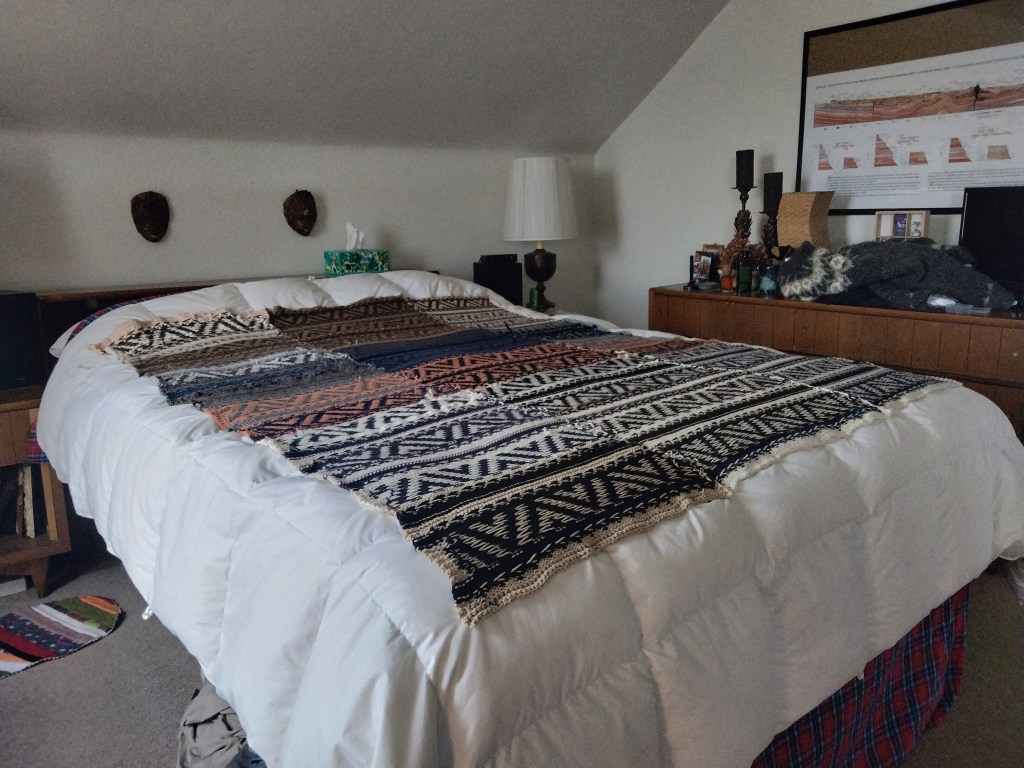
Here is the blanket being “blocked.” I pinned it wrong-side-up on my bedspread, misted it with water, and let it dry. After this, I added a border consisting of five rows of moss stitch, because the edge tended to roll.
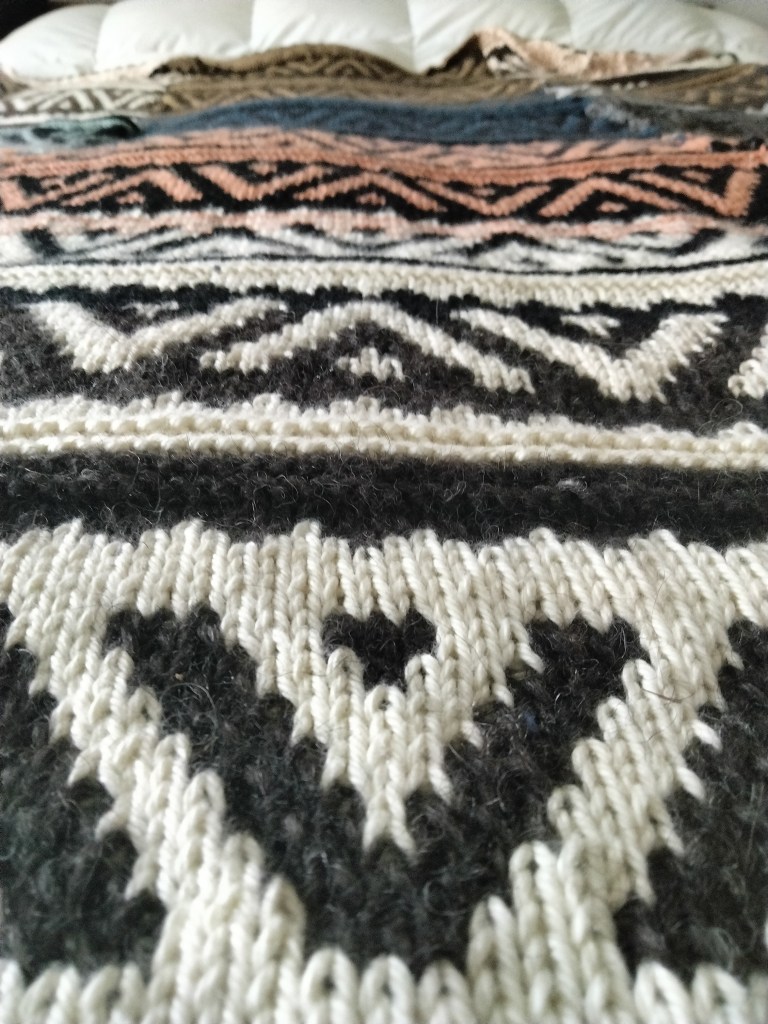
Despite its flaws, this blanket is basically priceless. I knew it would take me about a year to complete it in time for the recipient’s birthday, and it did. Here’s another close-up.
The most renowned of Etruria’s products is its pottery. Every museum abounds in it, setting the weary navigator of ceramic halls to wonder what unseen perfection exonerates these stores. Etruscan vases, when they are not clearly copies of Greek forms, are mediocre in design, crude in execution, barbarous in ornament. No other art has produced so many distortions of the human frame, so many hideous masks, uncouth animals, monstrous demons, and terrifying gods. … All in all, the robbers were justified who, when they rifled Etruscan tombs, left so much of the pottery.
Besides growing up around farms and reading a lot of literature set there, I’ve always kind of craved traditions, folk costumes, and folk practices. It’s not because I like being circumscribed in everything I do–I’m kind of a free spirit actually–but because I sensed these traditions and customs and bits of folk wisdom represented a thick culture, rooted in the distant past, that I as an American lacked. Traditional ways, whatever they were and wherever I read about them, seemed at the same time intriguingly exotic, and almost familiar.
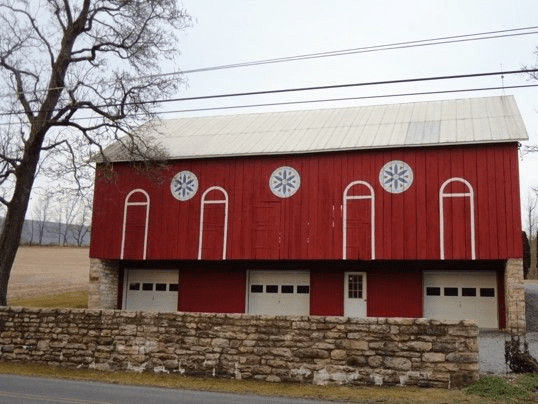
In eastern Pennsylvania, where I spent my earliest years, many of the farmers were Pennsylvania Dutch–i.e., German immigrants. They had their own language, a dialect of German that my dad was able to pick up due to having majored in German. They had their own foods, like shoefly pie and scrapple. And they had a little, tiny bit of superstition: hex signs painted on barns. As a kid, I knew that these pretty little designs were called hex signs, but I had no idea of the connection between the word hex and spells or witches.
The Pennsylvania Dutch were nominally Christian, though I understand from my dad that they, like the Amish, often had a shallow and moralistic understanding of the Bible, and in fact sometimes didn’t have a Bible in a language they could read.
Despite their attractions, the Germans were to me among the least interesting of pagan farmers. I was more interested in British, Scots, and Irish folklore. It seemed warmer and more colorful somehow, and we had plenty of that around too, being in the Appalachians. It was also readily available in literature.
The connections between farming, weather-watching, astronomy, and European pagan religion are ancient and obvious. Here is Will Durant on Roman practices:
When [the Roman peasant] left the house he found himself again and everywhere in the presence of the gods. The earth itself was a deity: sometimes Tellus, or Terra Mater–Mother Earth; sometimes Mars as the very soil he trod, and its divine fertility; sometimes Bona Dea, the Good Goddess who gave rich wombs to women and fields. On the farm there was a helping god for every task or spot: Pomona for orchards, Faunus for cattle, Pales for pasturage, Sterculus for manure heaps, Saturn for sowing, Ceres for crops, Fornax for baking corn in the oven, Vulcan for making fire. Over the boundaries presided the great god Terminus, imaged and worshiped in the stones or trees that marked the limits of the farm. … Every December the Lares of the soil were worshiped in the joyful Feast of the Crossroads, or Compitalia; every January rich gifts sought the favor of Tellus for all planted things; every May the priests of the Arval (or Plowing) Brotherhood led a chanting procession along the boundaries of adjoining farms, garlanded the stones with flowers, sprinkled them with the blood of sacrificial victims, and prayed to Mars (the earth) to bear generous fruit.
Caesar and Christ, p. 59
Farming is so labor-intensive, so high-stakes, so heartbreaking, so subject to factors beyond human control, that it tends to produce nervous and conservative people. It would be impossible to engage in it for generations without coming to a profound humility before whatever entity you have been led to believe determines whether your whole year of work will be wiped out within a few days. For Christian farmers, that entity is the One who owns the cattle on a thousand hills. For post-Christian farmers, such as Wendell Berry, it’s the earth itself, I suppose, the environment. For pagans, it’s not hard to understand why they might be reluctant to let go of all the little rituals that stand between them and disaster.
Thus, paganism hangs on longer among country folk than in the city. If you want your eyeballs to be assaulted with an astonishing variety of pagan superstitions still proudly held by modern Americans, go get yourself a Farmer’s Almanac and look in the classifieds section.
“But modern Americans are returning to paganism!” you say. “It’s part of the New Age. It’s trendy, not traditional.”
Don’t I know it. I have met a few neopagans in my day. The one I knew best, was raised in a nominally Roman Catholic home. She was innovating with her paganism, part of the modern self-worshipping, I’ll-make-it-up-as-I-go ethos. The neopagans in the back pages of The Farmer’s Almanac don’t give me that vibe. I could be wrong, but it seems like they never left.
Where is the line between weather-watching, paying attention to the phases of the moon when you plant, following the zodiac along with the yearly calendar, hiring a water-witch, hanging a horseshoe over your door to protect your entryway with iron, and full-on pagan worship? How much of it is science, and how much is just doing things the way your mother did them? And how many “mindlessly followed” folk traditions turn out to have a sound scientific basis?
I’m guessing that Christian farmers in the modern age may have given up some valuable folk knowledge in an effort to avoid idolatry. Idolatry is a deadly poison, though, so no doubt, the sacrifice is worth it. If your eye cause you to sin, pluck it out. I hope that, as the generations roll by, we can build a culture that’s even richer than the pagan one we left behind.
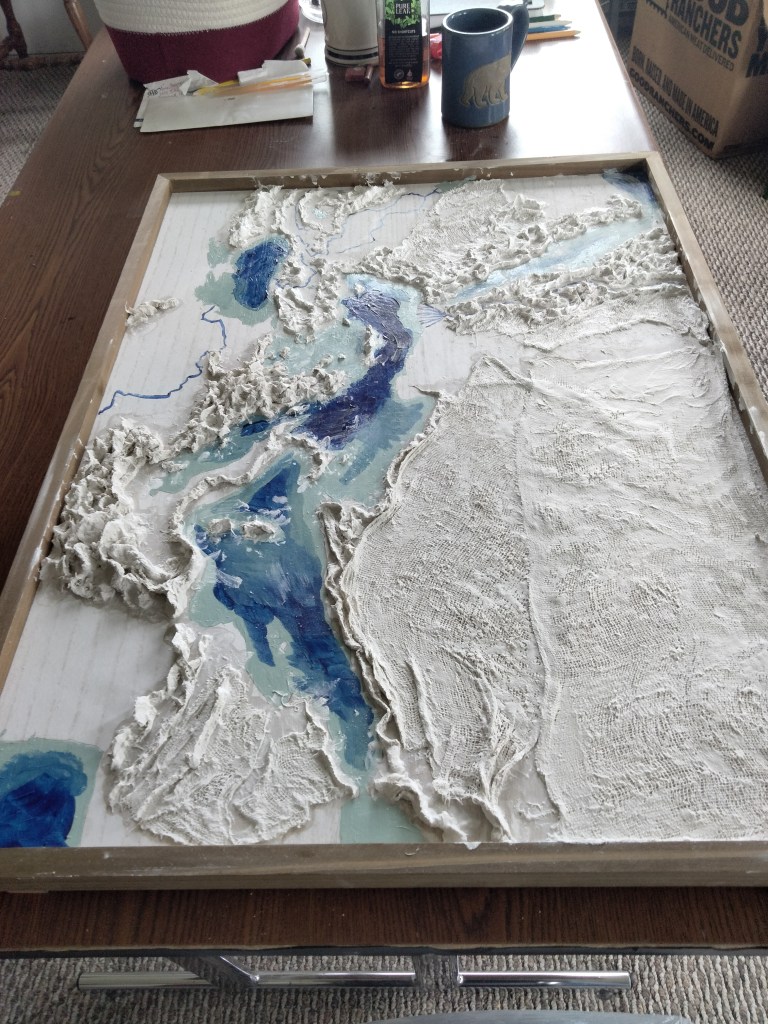
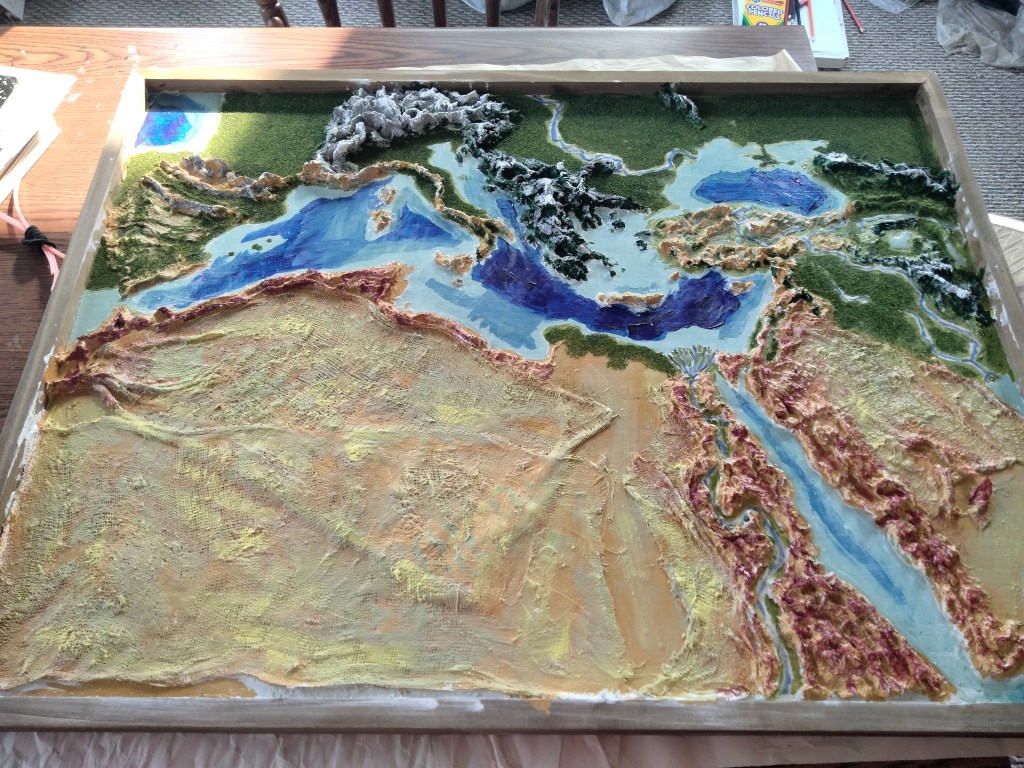
Freehand the coastlines in pencil while looking at a map for reference. Paint the seas, using Duckduckgo to find out relative depths. Start adding topography using plaster-of-Paris coated gauze strips.
Continue adding topography.
Some of these mountainous areas threatened to come loose after they dried. I simply applied some Elmer’s glue under them.
Paint as desired. I protected some of the smaller bodies of water by squeezing a thick layer of Elmer’s on top of them.
When dry, paint grassy areas with craft glue and sprinkle on “grass” that you can get in the model railroads aisle. Let dry, then vacuum up loose “grass.”
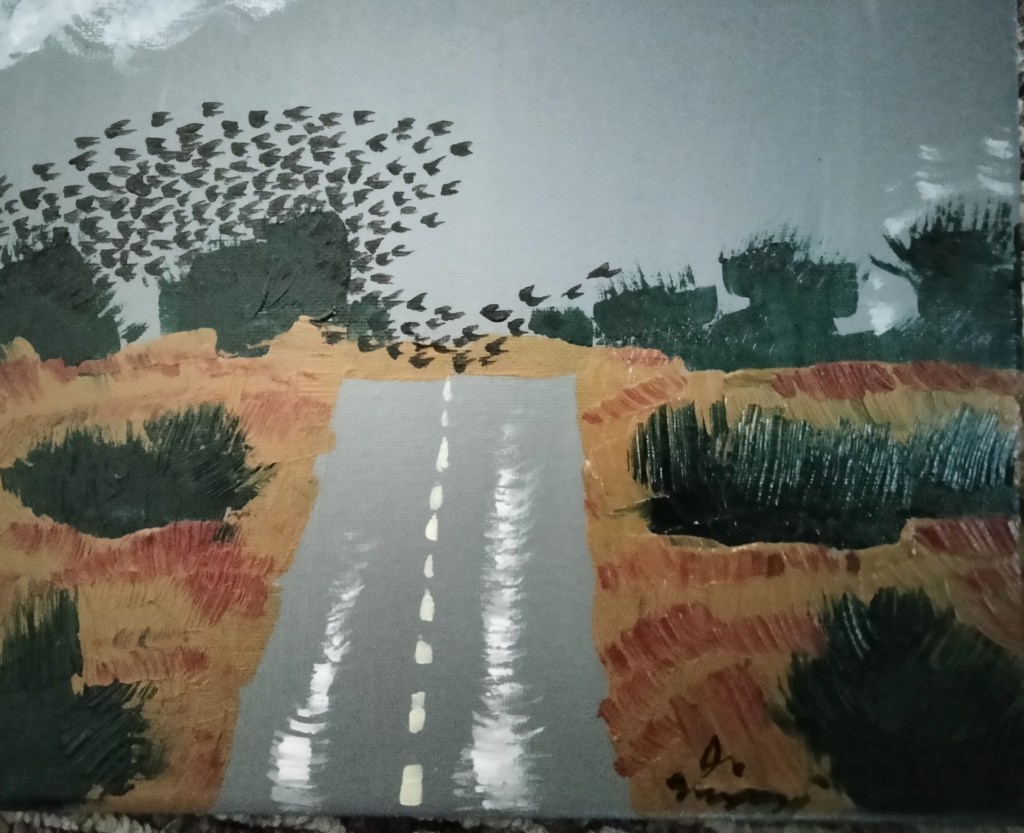
This is a view of my neighbor’s house on a smokey afternoon late last summer. It’s also part of the internal landscape of my mind.
Farmlands are one of my favorite biomes. (Yes, they are a biome. I will die on this hill. They are a part of Naure. They are what nature looks like when people live in it.)
Farms and I go way back. I didn’t grow up on one, but I grew up around farms and farmers.
My early years were spent in eastern Pennsylvania, which is a country of rolling green hills and low mountains. My dad was the pastor of a small country church, and most of its members were dairy farmers. Whenever we visited anybody, which was often, we would first be taken into the cow barn. These were black-and-white milk cows. As soon as you stepped into the barn, your senses would be filled with cow sensations: the chorus of moos, the smell. To this day, when I smell a cattle lot, it doesn’t smell bad to me, just like a clean farm smell.
And even cleaner farm smell was the “milk room,” a little brick building with a large stainless-steel tank of milk in the center, and a drain in the middle of the wet floor. It smelled like coolness, milk, and water.
These are memories from when I was very small. That same family that I have in mind, although they had indoor plumbing, also still had a working outhouse in their back yard. There were bees, and the smell wasn’t so nice, but it was raised up on several steps, not just thrown together but definitely constructed. My brother and I would torment this family’s chickens by pulling backwards on their tails so that they flapped. (Not recommended.) We would sit in corrugated buckets filled with water to cool down in the summer, and drink from the garden hose. This family had Dobermans, and I can remember a black bear hanging up in their barn after the father shot it while hunting. Later, it was stuffed in a scary pose and placed in their study.
The dairy farmers in our church also had fields of crops. Our own house had a yard of about an acre and a half. At the back of this yard was a line of poplar trees, and right beyond them, fields rolling away towards the creek. Beyond that, you could see a mountain. They must have rotated the crops in these fields, but I know that at least one year, they were soybeans. We were allowed to pick the pods, open them, and eat the tiny, hard beans out from inside. There was a lot of milkweed, which was fun to pull open and let the tufty parachutes out when it was ripe. There was a lot of ragweed, which my brother turned out to be allergic to, and one year a plague of tent caterpillars turned the mountainside brown.
My dad had a somewhat free schedule, and he would take my brother and me (and later, our sister) on walks in the countryside. These were probably short walks, given that we were little kids, but I remember them lasting hours. We could walk along the borders of the fields and find new fields, or the creek. This habit set “walking between farm fields” permanently in my mind as a normal thing to do. If it was nighttime during this walk, my dad would sing “Walking at Night,” which, in retrospect, is probably a German hiking song.
When I was eight, we moved to western Michigan. Worse, we moved to a city. I complained hard about this. It was the first remotely tragic thing that had ever happened to me, and I was determined to milk it. By this time, my crush on American Indians was well-developed, and I was keenly aware that it was tragic to be driven off your land.
However, despite that we technically lived in a city, our tiny church there was still about half farmers. There were still many opportunities, on prayer meeting and picnic and potluck nights, to run on vast grassy lawns while the adults sat and talked, to climb trees, walk between fields, and hide in the hay lofts and corn cribs.
The countryside in Michigan was flatter and dryer than it had been in Pennsylvania. Furthermore, my small denomination (the “Michiana Mennonites”) straddled the border between Michigan and its neighbor to the south, Indiana, which is really flat. The summer camp we went to served kids from both states, and we often found ourselves crossing the border for pulpit exchanges and things like that. I have attended church in what was literally a tiny, plain white chapel perched at the edge of a sea of fields with no other building nearby. I have tramped over Indiana farms, again with my brother and usually another farm boy, while the adults sat in the house and talked. And these Indiana farms are truly the farmland biome, because there is nothing there but farms, not even a hill to break up the monotony.
The farmland biome combines the best features of wilderness and human habitation. You can walk for as long as you like in solitude. There is wind, there is the changing sky, there are wildflowers, and flora and fauna on the windrows. You can get lost if you want, and if it’s winter, you can get cold and miserable too. But as the sun goes down, you can see in the distance the lights of houses. Coming back from the walk to the warmly glowing farmhouse provides all the romance that a kid with a big imagination and a copy of The Lord of the Rings could desire.
Farms have always been with us, and, though technology has changed somewhat, the logistics of having fields surrounding clusters of buildings mean that farmlands in every place and time look essentially the same. You have the wide horizon, the walls, canals or windrows carving the space up and giving some sense of distance, and the lights low to the ground. Perhaps one reason I like fantasy, as a genre, is that it naturally includes farms surrounding the town and castle.
Some of my favorite fantasy series start with, and often return to, the humble but honest farming community. O.K., actually I can only think of two, but they are good ones. The Belgariad starts off with Garion growing up on Faldor’s farm in Sendaria. Actually, it starts in one of my favorite parts of the farm, the kitchen. And, of course, The Lord of the Rings. Bilbo is not really a farmer, he’s more of a country squire, but the Shire is definitely a farming countryside. The four hobbits’ journey starts out hiking through the fields, as every journey should. Their first encounter with one of the Nine takes place on an otherwise ordinary country road. Farmer Maggot, a wholesome character, takes the four friends in, feeds them, and gets them safely to the river crossing in his wagon. And, when the journey is over, the four hobbits must come back and rescue from collectivization the ordinary, boring farms that they sacrificed to save. What would we do without ordinary, boring farms, after all? We’d starve, that’s what. And we would go insane, because the farming life, though hard, represents a very basic pattern for the way people were designed to live.







 Out of Babel Books