“Jo Marshall, Dashiell Hammett’s only surviving daughter, in 2006 said ‘Yes!’ to a prequel to the The Maltese Falcon. Jo gave me not only her blessings and inspiration but also the idea (and the research) for much of part III of the novel. Vince Emory let me write the introduction to Hammett’s Lost Stories, then shared his vast knowledge of San Francisco and Hammett with me. A history of the coroner’s office from 1850 to 1960 gave me the idea for part II.”
Ten stars. Ten.
This is so well researched and written, so atmospheric. Naturally worked into the story, we find a wealth of details about San Fran in the 20s: how people dressed (including disguises), what they ate, and how much it cost. (They ate well, and for cheap!) There are ferryboats and fishing boats, there are foghorns, there is lots and lots of fog. There are immigrant communities: Greek, “Portugee,” Chinese, and German. Stuff happens that will rip your heart out, and Spade reacts to it in his characteristic hard-boiled way. Twists are many, revenge is sweet. This book covers the years 1921 to 1928.
Ray Kentzler turned to look at Spade. He had a square Germanic head and a pleasant broad-mouthed face with pale, smart, watchful eyes under blond brows.
Spade & Archer: The Prequel to Dashiell Hammett’s The Maltese Falcon, by Joe Gores, p. 112
In her silence, Winter’s eye flicked to the gold cross gleaming on her blouse. He began to compose a speech in his head. In the speech, he told Molly Byrne that her husband had had a vision, a drugged vision in the jungles of Brazil. He had seen a god who was both the mind of the universe and somehow his own mind at the same time. In his speech, Winter confessed to her that he did not know anything about God. He did not even know whether or not God existed. But he knew this: if God did exist, He might be many things, but He was not Gerald Byrne. And Gerald Byrne was not God.
He did not make the speech out loud. He didn’t have the nerve.
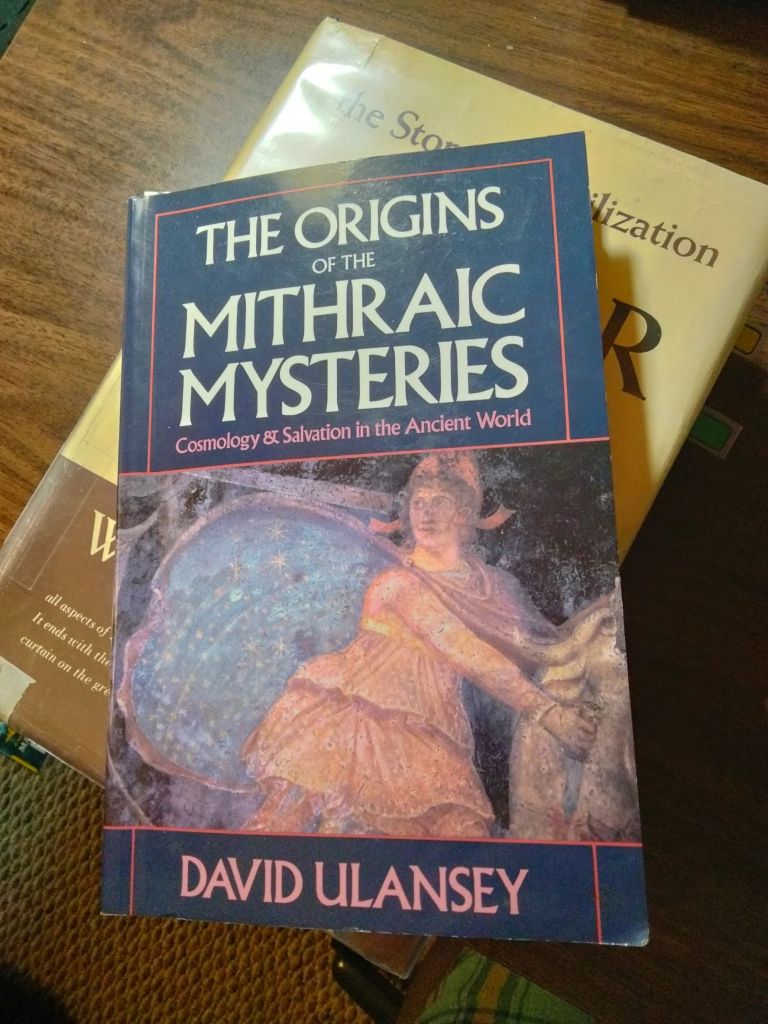
I don’t even remember where I got it. I have a feeling I got it at a used book store or a library sale, or maybe I stole it from my dad’s library. I know it’s been sitting around my study for a few years, waiting for me to get to it. It was published in 1989.
This is a good, accessible piece of scholarly work that first explains what the cult of Mithros was, then traces the history of scholarly thinking about it, and then advances Ulansey’s theory about what was really behind the cult.
What Is Mithraism
Mithraism began to spread throughout the Roman Empire in the first century C.E., reached its peak in the third century, and finally succumbed to Christianity at the end of the fourth century. At the cult’s height mithraea could be found from one end of the empire to the other, “from the banks of the Black Sea to the mountains of Scotland and to the borders of the great Sahara Desert,” as one authority puts it.
ibid, p. 4
As a result, many of the underground Mithraic temples whose iconography Ulansey shows pictures of are found in Germany or in Italy, although this is a cult that had its origins in Tarsus, in southern Turkey.
For a long time, the accepted theory among scholars was that the god Mithras got his start as the Iranian god Mithra, because they happen to share a name. However, the attributes of Mithras don’t line up very well with those of Mithra, which leaves the door open to other explanations.
The cult was apparently based on a story where Mithras slaughters a bull, and from the bull’s body sprang all the plants that man finds useful, such as wheat, grapes, etc. Because it was a mystery cult, nothing was ever written down about the secret meaning of this story, nor of the levels through which the neophyte progresses as he is initiated deeper and deeper into the mysteries. But in all Mithraic temples, there is consistent iconography. This includes a picture of Mithras slaying the bull, with wheat coming out of the wound. Mithras is typically looking away from the bull (though this is “corrected” in some reconstructions), wearing a distinctive hat which was associated with Persia and with Perseus in the ancient world. Around him are placed other figures which will prove to have significance in unravelling the meaning of the cult. Sometimes, the whole scene is placed under an arch or inside a circle that shows the zodiac. Sometimes, Mithras is also portrayed as standing inside a circle or hoop lined with star symbols.
A Brief Tour of the Ancient Mediterranean, Near East, and Europe
In unfolding his theory, Ulansey takes us on a fascinating tour of the ancient world. For example, he spends a lot of time establishing how and why Mithras came to be associated with (based on?) Perseus, who was the founder and hero of the city of Tarsus and, in fact, the local god of that whole region. (Mithras’ hat — a “Phrygian cap” — was originally worn by Perseus, and Ulansey contends that he looks away from the bull as he slaughters it because Perseus looked away from Medusa as he slaughtered her.) He gets into the fact that the cult may have originated with pirates of Cicilia, which lies just off the coast from Tarsus:
[T]he Cicilian pirates were far more than a mere band of thieves. Rather, the pirates, who numbered at least twenty thousand, formed what amounted to a small nation which at its height controlled the entire Mediterranean Sea.
ibid, p. 88
Ulansey then quotes Plutarch from Life of Pompey:
“The power of the pirates had its seat in Cicilia at first … then, while the Romans were embroiled in civil wars, the sea was left unguarded … until they no longer attacked navigators only, but also laid waste islands and maritime cities … There were also fortified roadsteads and signal-stations for piratical craft in many places … more annoying than the fear [the pirate fleets] inspired was the odious extravagance of their equipment, with their gilded sails, and purple awnings, and silvered oars … For you see, the ships of the pirates numbered more than a thousand, and the cities captured by them four hundred … Presently men whose wealth gave them power, and those whose lineage was illustrious, and those who laid claim to superior intelligence, began to embark on piratical craft and share their enterprises.”
ibid, p. 88
There are plenty of other fascinating historical nooks in this edifice, such as the figure of a lion-headed man, entwined by a snake, standing on a sphere; the idea of Mithras being born out of the rock; the exact nature of the Gorgon, and many, many others. Every single one makes sense when it comes up in context. That said, there were certainly some bizarre ideas floating around in the ancient world.
The Zodiac
So, to get right down to it, Ulansey’s case is that the Mithraic mysteries were a way of encoding astronomical knowledge. Because this is the ancient world we are talking about, this knowledge could equally be considered scientific, cosmological, and religious, as will become clear shortly.
Lately, I’ve been studying the zodiac in a desultory fashion. Don’t worry, I am not planning to take up astrology. Astrology is specifically forbidden to faithful Jews, and to children-of-Abraham-by-faith like myself. But it is of interest to me, because it was so important to the people of the ancient world. They worked it into their monuments and their mythology. The signs of the zodiac, and other constellations, were associated with the gods, and a good case could be made that this association started in pre-Flood days.
The other thing that fascinates me about the zodiac is that it’s so hard to observe. Now that I keep chickens and also work outside the home, I’ve been obliged to get up before dawn to let the chickens out. I live in a rural area with relatively dry weather, so you’d think it would be easy for me to take a quick glance at the horizon while I’m out there, and be able to tell which constellation is in the east, right where the sun is going to rise in an hour or two. As it turns out, it’s not so easy as all that. You not only have to know which direction is due east, you also have to have something that helps you sight where the sun is going to rise … and it moves. Then you have to be able to recognize the constellations. To really figure out the whole zodiac, you’d have to be making these observations daily, throughout all the seasons of the year, until you noticed that the constellations of the zodiac make a notional belt around the earth, and that at different times of year, they take turns “housing” the sunrise. This is already difficult enough that you’d have to have a pretty strong motivation to pursue it. (Stronger than mine is right now.) Ancient people thought this was so worthwhile that they managed to master the very difficult science of astronomy. Many ancient monuments, in fact, were built as observatories, from Stonehenge to many structures in the Americas.
Why were they so motivated to study the stars? That’s a discussion for another time.
According to Ulansey, the Mithraic iconography (and probably the whole cult) was designed to encode the secret of Equinoctal Precession. This is a really complicated phenomenon, so if you don’t know what it is, I’ll let you look it up. Basically, because of an irregularity in the earth’s rotation, the zodiac sign that “houses” the sunrise on the equinox will stay the same for 2,160 years, by which time the sunrise has migrated back to the previous zodiacal sign (hence, precession). (Also, incidentally, Polaris has not always been the the pole star.) Precession has been discovered at different times in the past by different civilizations. Graham Hancock makes a pretty good case that it was known by somebody, before conventional history began. But due to the difficulty of observing it, it has not been known at all times by all peoples. Around the time that the cult of Mithras apparently started, it had recently been discovered, and begun to be talked about, in the vicinity of Tarsus, in the same intellectual circles that were also providing aristocratic pirates.
Breaking Hoops and Wheels and Mills
Now, to you and me, equinoctal precession might fall into the category of “Oh, that’s interesting.” Not so for the ancients. For one thing, this cult probably started among pirates, who use the stars to navigate. The idea that the stars were once different and are not the same all the time would be earth-shattering to them. But this news gets even more ominous when we understand ancient cosmology.
(And when I say “ancient” here, I am talking about the cultures of the Mediterranean, Ancient Near East, and parts of Europe. Though, not to keep mentioning Graham Hancock, but in his book Fingerprints of the Gods he finds similar cosmology in ancient India, Central America, and Scandanavia. So a case could be made that this cosmology was once worldwide.)
This ancient cosmology, then, conceived of the heavens as a huge machine, constructed of two or more intersecting hoops (the zodiac, the celestial equator, and, essentially, the prime meridian/international date line projected into the sky). Sometimes the heavenly machinery is portrayed more as a big edifice with four pillars supporting it. Sometimes it’s a “mill” that turns. Probably some ancient people took this more literally than others; some understood it was notional, but represented something real.
Now, imagine that you think of the universe as a big, finely tuned machine, where the constellations always end up in the place they are supposed to be. If the whole hoop has moved out of its place, this could be conceived of as “breaking” the machine. This is why cycles of a certain number of years (not everyone got the precessional intervals right) were thought to bring cataclysms upon the world. So, we get myths worldwide about a mill being broken, and this causing the stars to fall from their places, the sky to become dark, fire and floods to sweep over the earth, etc. Again, read Hancock to find out more about this than you ever wanted to know.
But the point is, whether the Cicilian pirates thought that precession caused a cataclysm, or whether it just meant the universe was less stable than they had imagined, this would have been a revolution in their scientific, cosmological, and religious thought. (Religious because, in ancient times, science and cosmology and religion were really all a part of one system, especially when you consider that the stars and other heavenly bodies were thought to metaphysically influence events on earth.) So, whether you count it as belonging to three, two, or just one unified field of knowledge, this was a big enough discovery to be kept secret (a “mystery”) and passed on to initiates in a whole new cult religion.
This two-volume book, The Devil’s Redemption by Michael J. McClymond, is just too good of a resource to fuel only one blog post.
Last week, it was McClymond who helped me sort through the (intentionally?) confusing tangle of different claims about what Hermeticism actually is. We scratched the surface of Hermetic/Esoteric/Gnostic/Platonic/New Age thought enough to recognize that we have all encountered it before, and that it has had a pervasive influence on our culture in all sorts of ways. This week, I’m just going to list a number of characteristic doctrines of Hermetic/Esoteric thought.
Each of these bullet points (or cluster of them) could have a volume written about it (and probably has). I could write a 1,000-word blog post about each one: My personal history with it, the damage it does to people, why it seems to make sense, how it differs from biblical teaching. But today, I’m not going to do that. I just want you to be able to recognize these doctrines when you hear them, so you know that they are neither just common sense, nor orthodox Christian teaching, nor are they a profound new insight that was just had on the spot by whoever is asserting them to you. They are characteristic doctrines coming from an ancient, broad and deep, but erroneous, stream of human thought. All of these bullet points are paraphrased from the section “Common Esoteric Teachings” in McClymond’s Appendix A: Gnosis and Western Esotericism: Definitions and Lineages, pp. 1069 – 1070.
The godhead has within it some or all of these things: inherent crisis, inherent evil, inherent or intrinsic suffering, temporality or process arising from inherent imperfection.
Apophatic theology: God does not know himself, because “the infinite or unbounded cannot in principle be known” (p. 382).
A divine feminine principle (sometimes called Sophia) exists in the godhead.
Coincidence of opposites
God did not create from nothing, and/or nothing is not really nothing; instead, nothingness or chaos is a “constitutive principle.”
Spiritual things are somehow material, and material things are somehow spiritual. (“Spirit stuff”)
All things are alive.
“The material universe [is] ontologically inferior.”
“The material universe [is] generated by human desire and imagination.”
God/heaven/etc. was originally somehow human, or defined in human terms.
And was also an androgyne (male and female at the same time).
Christ: only seemed to have a material body (docetism); was an example or teacher rather than a savior; and did not atone for human sins.
Humans have divine or godlike powers; human imagination has the power to create material reality; therefore magic, divination; and astrology are OK.
Souls are reincarnated or transmigrated; this life (and sometimes, processes in the life beyond) acts as a purging fire to get rid of the soul’s imperfections.
Following from all this, salvation is understood as “self-knowledge, self-realization, or self-integration” (p. 1070). Therefore, “love, not law.” Strict justice is understood as mean and unenlightened.
Spiritual elitism: the good people are not those who have repented of their sins and placed their faith in God, but those who have secret knowledge. Hence, we do a lot of allegorical and other nonliteral readings of the Bible, and we make authoritative religious claims based not on the text but on “visions, dreams, or supernatural encounters” (p. 1070). (What could go wrong?)
I hope I don’t need to point this out, but … none of these doctrines are remotely Judeo-Christian. They cannot be reconciled with the picture of reality that is painted, both explicitly and implicitly, in the Old and New Testaments, unless we are willing to do violence to the text by reading it in an arcane, “symbolic” way which allows us to import our own esoteric doctrines. Esotericists, of course, are completely willing to do this, because they don’t like doctrines or definitions anyway.
Making things even more confusing, many of these ideas are alluded to by the New Testament writers, because they were “talking to” the estoeric philisophies that were already popular in their day. For example, John begins his gospel with “In the beginning was the Word [ho Logos], and the Word was with God, and the Word was God.” In first-century Gnostic and Platonic thought, the Logos was a character which was sort of embodiment of the organizing principles of the universe. John is saying, by implication, that these thinkers were close, but not quite right in their cosmology. The Logos, for John, is an actual person, namely Jesus, who is also actually a member of the godhead as God was understood by the ancient Israelites. He is not immanent nor present in everyone, and rather than there being inherent conflict within the godhead, He and the Father are one. John does all of this in just a few phrases. But if we bring esoteric assumptions to the gospel of John, it will be easy for us to “prove,” from this and other lines lifted from this gospel, that John supports our Hermetic or Mormon or New Age theology.
Next week, we will see how the apostle Paul upbraids esotericism directly in just one short, beautiful paragraph.
… I was going to put, “… I’ve been waiting for all my life,” but it hasn’t been quite that long.
[T]he scientific community selected father-son pairs (or other male relatives of known genealogy) and sequenced their Y chromosome DNA. Then they counted the number of differences between the relatives. The number of Y chromosome DNA differences between them revealed how many copying errors occurred each generation. These differences told them how fast the Y chromosome clock ticked.
One of the first studies to measure the error rate was published in 2009. Two Chinese men of a known genealogical relationship going back to the 1800s had their Y chromosome DNA sequences determined. The resultant rate of copying errors was slow. It fit the existence of a “Y chromosome Adam” (the ancestor of all living men) about 200,000 years ago. In 2015, a study of hundreds of Icelandic men produced the same result.
So far, these results would leave the mainstream time scale as is.
However, due to financial and time constraints, these earlier studies were based on low quality DNA sequence. Then, in 2015, another research group compared father and son Y chromosome DNA sequences. This time, they used high quality methods. The result was a copying error rate that was much faster than the previous, lower quality studies: “The number of [father-son Y chromosome] differences was approximately 10-fold higher than the expected number … considering the range of published [Y chromosome copying mistake] rates.”
In fact, the data from this study implied that “Y chromosome Adam” lived just a few thousand years ago.
What was the mainstream scientific community to do? Oddly, they filtered their results, removing data that contradicted the 200,000-year timescale. They did so until the Y chromosome copying error rate matched their expectations.
In 2017, researchers compared the DNA sequences between 50 parent-offspring trios — i.e., they obtained DNA from father, mother, and child. Again, they did so by using high quality DNA sequencing methods. The researchers published detailed analyses of the copying error rate in these people. But conspicuously absent from their published results was a statement on the father-son Y chromosome copying error rate. Why? From the raw data that did make it into their published study, a potential answer emerged. From this raw data, the father-son Y chromosome DNA copying error rate could be extracted. The results were consistent with the 2015 high-quality study. The 2017 Y chromosome copying error rate again implied that “Y chromosome Adam” existed about 4,500 years ago.
Traced, pp. 67 – 68
Jeanson, the author of this book, is a geneticist who works for Answers in Genesis. In this book, written for the lay person, he explains the study of genetics and its often counter-intuitive results. For example, early in the book he covers how, if all of your ancestors were unrelated to each other, by the time you go back about a thousand years you have to have had more great-grandparents than the population of the world at the time. Obviously that can’t be right, so in the deeps of the past, you must have had cousins or second cousins marrying each other. Also early in the book, he walks us through a simple thought/mathematics experiment to show how a minority population moving into a new area could make their genes the majority in that area after several generations by dint of simply having a few more children per family than the native population. This has actually happened in Europe with a Central Asian population that apparently came to Western Europe fleeing the Mongols.
Having oriented us and laid some foundational principles, Jeanson moves on to looking at specific branches of the human family tree as it has been reconstructed through geneticists looking at Y chromosome data. Using this data, we can “see” historical events like the population collapse that happened in the Americas in the few centuries after the arrival of Columbus; the massive people movements out of Central Asia in response to the Mongols; and the dispersion of certain haplogroups from East Africa into the rest of Africa in response to the Muslim expansion. Going deeper in the family tree, we can reconstruct the movement of certain haplogroups: for example, one group that started in Central Asia, split, and moved into India and into Europe, without meeting up again. Jeanson has a method, which he explains, to convert conventional dating for these events to his young-earth dates. In some cases, historical records like the ones mentioned above corroborate his method. If you look at the pages of his book end-on, the middle third of them are thick, high-quality, glossy paper. These are the diagrams, illustrations, and numerous maps to which Jeanson is constantly referring his reader. It really is important to be able to reference these in order to follow his arguments, so that you can visualize geographic dispersion and understand the different branches on the human family tree. (Being named by scientists, the branches have names like R1a and R1b, so it is really helpful to have a visual, where they are distinguished by different colors, to help you keep them all straight.)
Everyone likes to imaginatively trace the footsteps of their ancestors, but this book is a special treat for me. I am the kind of person who can get story ideas just from staring hard at a map. Give me a multigenerational migration story to go with it, and I’m in my element. This gets even more so when you start trying to use it to peer into the deep past. Bearing in mind that the world population was much smaller in past ages than it is now, when we look at these branches of haplogroups we are, in most cases, not seeing entire nations as we would now conceive of them. We are “seeing” clans, maybe in some cases individual families.
Traced is a real gift to people like me who want to write novels about early human dispersion. Of course, Jeanson is a good enough scientist to tell us that it is not the final word. Some haplogroups have been identified, but the sample size has been small. There are probably more out there, waiting to find their places on the big family tree. There are probably also haplogroups that have been completely wiped out, that will never be found no matter how many currently living men we sample.
In the West today, we are living under decadent, pre-totalitarian conditions. Social atomization, widespread loneliness, the rise of ideology, widespread loss of faith in institutions, and other factors leave society vulnerable to the totalitarian temptation to which both Russia and Germany succumbed in the previous century.
Furthermore, intellectual, cultural, academic, and corporate elites are under the sway of a left-wing political cult built around social justice. It is a militantly illiberal ideology that shares alarming commonalities with Bolshevism, including dividing humanity between the Good and the Evil. This pseudoreligion appears to meet a need for meaning and moral purpose in a post-Christian society and seeks to build a just society by demonizing, excluding, and even persecuting all who resist its harsh dogmas.
Finally, Big Business’s embrace and promotion of progressive social values and the emergence of “surveillance capitalism” — the sales-directed mining of individual data gathered by electronic devices — is preparing the West to accept a version of China’s social credit system. We are being conditioned to surrender privacy and liberties for the sake of comfort, convenience, and an artificially imposed social harmony.
This is the brave new world of the twenty-first century. It is coming, and it is coming fast. How should we resist it?
Live Not by Lies, by Rod Dreher (2020), pp. 93 – 94
A Scary Book for October
I saved this book review for October, because over here at Out of Babel we have a tradition of talking about scary things all month. Of course, this isn’t the spooky sort of scary that you might expect around Halloween. (We will get to that later, and plenty of it.) This is more realistic-scary.
Soft Totalitarianism
The main thing that scared me was the first part of Dreher’s book, titled “Soft Totalitarianism.” Dreher explains that the impetus for the book was his interviews of older folks, now living in America, who survived the Communist states in Eastern Europe. They are very concerned about the social trends they see in America, because things look familiar. They are also, of course, madly frustrated with Americans for not wanting to listen to their warnings. Nobody likes to be Cassandra. Dreher wrote the book because he thinks there is a lot we can learn from them, and from others who engaged in resistance in these countries (Dreher also traveled to Hungary, Russia, and some other former Soviet republics while doing research for this book). There are valuable lessons these folks have learned, but the learning curve is steep, and we have a limited amount of time to start putting their advice into practice.
In Chapter Two, “Our Pre-Totalitarian Culture,” Dreher gives a brief history of social conditions in Russia right before the Revolution. This includes not just former peasants who had come to the cities and were now isolated from their churches and communities, but also the idealistic, utopian thinking that was popular among intellectuals. “It was only toward the middle of the twentieth century that the inhabitants of many European countries came, in general unpleasantly, to the realization that their fate could be influenced directly by intricate and abstruse books of philosophy” (pp. 41 – 42).
Chapter 3 is called “Progressivism as Religion” and Chapter 4 is about the surveillance state.
I didn’t find all this scary because it was a new thought. I have read quite a bit of socialist, utopian, and progressive literature (it’s hard to avoid), either directly myself or indirectly by hearing such people as James Lindsay read it out loud and analyze it in podcasts. And I’ve read Animal Farm and The Gulag Archipelago (abridged), and Brave New World and The Giver and The Hiding Place. I know that attempts at utopia never go well, because they run contrary to human nature. This is not my first rodeo.
Except that, in a way, it is, because I’ve never actually had to live under totalitarianism, whether the hard kind or the soft kind, until quite recently. My country is sliding rapidly into soft totalitarianism, and knowing all the things I boasted of knowing in the previous paragraph is not helping one little bit to stop it. That is what is depressing (or scary, if you like), and that is what the first part of Dreher’s book forces you to look at in some detail.
It is even scarier if you have read, say in The Gulag Archipelago, about some of the extremely creative tortures that the Soviets would subject prisoners to in order to break their minds. That’s why Part 2 of Dreher’s book, “How to Live in the Truth,” ends with Chapter 10, “The Gift of Suffering.”
I Do Have One Critique
This critique should not be understood to detract from the value of Dreher’s book. I mean, five stars, absolutely. But I think it is important enough to mention because Dreher seems to confuse the meaning of a key word, which is not a good mistake to make when you are fighting propagandists.
Tamas Salyi, the Budapest teacher, says that Hungarians survived German occupation and a Soviet puppet regime, but thirty years of freedom has destroyed more cultural memory than the previous eras. “What neither Nazism or Communism could do, victorious liberal capitalism has done,” he muses.
The idea that the past and its traditions, including religion, is an intolerable burden on individual liberty has been poison for Hungarians, he believes. About progressives today, Salyi says, “I think they really believe that if they erase all memory of the past … they can write whatever they want on the blank slate. It’s not so easy to manipulate people who know who they are, rooted in tradition.”
pp. 116 – 177
See what Dreher did there? “Capitalism” is identified as “the idea that the past and its traditions, including religion, is an intolerable burden on individual liberty.”
That is not what capitalism is. Capitalism is the idea that every person ought to be able to own private property, charge for their own products or labor, and buy and sell freely. How do I know this? Because according to Marx, “Communism can be summed up in one sentence: the abolition of private property.”
I have written beforeabout how belief in private property and free markets does not imply belief in a vast, radically individualistic, consumerist culture. In fact, if you want to have a humble, grounded life, one that remembers the past, honors traditions, works the land, etc., then private property is absolutely essential.
Of course, we live in a fallen world, so no matter what legal and economic system is in place, there will arise corruption and abuses within it. That does not (necessarily) mean that it is an evil totalitarian system, nor that its laws are inherently unjust. However, what I’ve noticed is that when the average person, speaking or writing casually, says “capitalism,” it usually carries negative connotations, meaning either:
corruption
consumerism
unjust practices
… or, in this case, radical individualism
In fact, “capitalism” is used in exactly this equivocal way by people who want to abolish private property. They use it to imply that all the human ills don’t just occur in a system with private property, but are actually the result of it, and that getting rid of private property would also get rid of corruption, consumerism, etc.
When you conflate capitalism with something else, like radical individualism, it leads to sloppy thinking, as in Dreher’s paragraph above, where one second, he is blaming capitalism for causing Hungarians to forget their traditions, and a few sentences later it’s “progressives today,” who are in fact all the sworn enemies of capitalism.
This is too important a word to give up, and I’m disappointed that Dreher hasn’t taken the time to define his terms more carefully. However, despite that minor-yet-important complaint, this is a helpful book. Researching it cannot have been enjoyable, and it contains vital information about what previous generations have learned from living under totalitarian regimes … information that it might be just as well to have a hard copy of, so that it doesn’t go down the memory hole.
“If your self is the problem, how can your self also be the solution?”
Allie Beth Stuckey is a podcaster who speaks mostly to Millennial and Gen-Z aged women from a reformed Baptist perspective. She wrote this book to counteract the essentially Gnostic messages that are constantly being sent from all quarters to this demographic.
When Allie became a mom, it became obvious to her that young moms struggle with feeling inadequate as mothers and as people. There are a lot of reasons for this. One is that in our culture, motherhood is denigrated as a calling. Simply being a mother is not considered enough to make you an interesting, capable, intelligent person. Mothers are criticized no matter what they do. Another reason is that they are, in fact, inadequate. No one is really adequate to care for small children well while also maintaining a good relationship with a husband, and this problem is made worse by the fact that young women rarely receive any training in the domestic arts. Finally, we tend to feel overwhelmed when we are hormonal and sleep-deprived.
In response to this, a cottage industry has arisen that exists to affirm moms as follows: You are already doing great! This message comes from both secular and Christian sources. (Nominally Christian, though of course their theology leaves something to be desired.) Obviously, it’s a good business model to tell people they are already doing great. People like to hear that, and when the dopamine hit from the message inevitably wears off in the face of reality, they will come back for more, sometimes several times a day.
Allie uses her own experiences (being a mom, before that struggling with bulemia, and talking with hundreds of women) to apply some good Reformed theology to the following five myths. (She calls them myths, which is sort of polite. I would call them lies.)
“You Are Enough”
“You Determine Your Truth”
“You’re Pefect the Way You Are”
“You’re Entitled to Your Dreams”
“You Can’t Love Others Until You Love Yourself”
Obviously, these lies are not directed only at young women in our culture, and it’s not only young women that they are damaging.
Allie systematically shows how each of these creedal statements promises comfort and power, but ultimately, if we buy into it and try to implement it, delivers despair. She does so in her signature kind, personable way that is perfectly suited to her target audience. She quotes pertinent passages of Scripture (of which there are many) and shows us how the belief that we are enough in ourselves will trap us in an endless cycle of self-improvement and prevent us from turning to the one who is enough and who has the power to save and transform us, namely Christ.







 Out of Babel Books