my review of The Penitent by C. David Belt, posted on GoodReads on July 31
I’ve been enjoying these Mormon vampire stories by C. David Belt. This one is the second in the trilogy. In the first book, The Unwilling, a Mormon man named Carl accidentally became a vampire while investigating what he believed was a cult that had seduced his sister. He took the vows you need to take to become a vampire, but didn’t mean them or think they were real. Hence, he is the first “unwilling” vampire in history. Whether or not you think that taking vows while holding mental reservations about them actually lets a person off the hook, for the purposes of this series, it does. The first book is written in the first person, present tense, from Carl’s point of view.
This second book is written in the first person, present tense, from the point of view of Carl’s vampire wife, Moira. (How that came about is a long story, told in the first book.) Moira is a Scottish lass who, more than two hundred years ago, became a vampire intentionally in order to get revenge on the British. But she has since repented and has managed to spend her life without killing any mortals. Hence, she is “The Penitent.” Through a long and convoluted chain of events, Carl and Moira are both somehow vampires and also faithful Mormons who were married in the Temple in Salt Lake City, and who call people to repent and turn to Christ whenever they get a chance.
The worldbuilding in these books is detailed and consistent, in terms of scientific explanations for why vampires are freakishly strong, why they can fly, what can and cannot kill them, and so forth. Oh, and how they can be Christians. The main antagonist is Lilith, “Mother of Night.” The lore around Lilith seems to be a little different in the Mormon world than elsewhere. I had heard that the legend was that Lilith was Adam’s first wife, created before Eve, but in one passage, the characters in this book refer to her as being “three generations down from Adam.”
The theology behind this book is Mormon, which is to say it sounds about 90% Christian, but isn’t quite there. For example, in one scene, Moira is telling a wretched, extremely bitter woman that instead of self-terminating, she should repent and turn to Christ. So far so good. But then Moira tells her that she can be saved if she “turns to Christ and lives a righteous life.” Meanwhile, this poor woman is obviously totally unable to live a righteous life. That’s her whole problem. Mormon theology doesn’t have a really deep grasp of sin nature. I really like the author of this series, C. David Belt, and I sincerely hope that he soon comes to grips with this problem and realizes that people are truly helpless sinners who need something more than what moralism can offer.
The language in this book is pretty good. I don’t personally prefer books written in the present tense, but Belt’s books include a lot of action and also vision/dream sequences that lend themselves to the present tense. Moira tells her story in a slightly Scottish dialect (for example, she consistently uses “nae” instead of “not”), and it’s fun to hear Carl, a former fighter pilot, revert to “pilot speak” when the vampires are flying on a military-like mission.
Based on the plot, worldbuilding, and language, I give this book 5 out of 5 stars for the genre, and in fact it may be the only series of its kind in this genre.
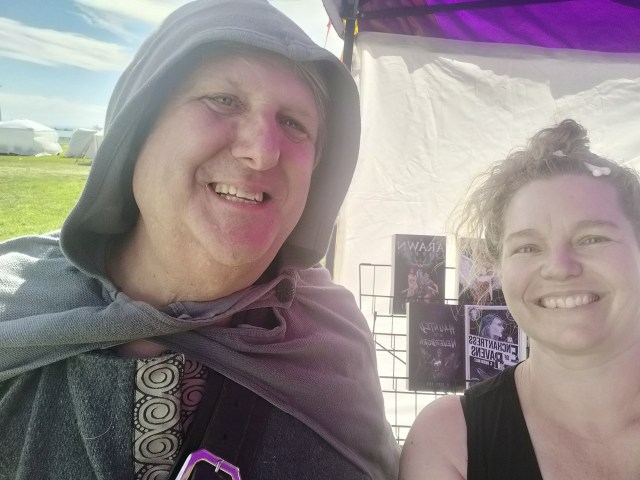
me and C. David Belt at a RenFaire a few years ago. I was dressed as a cartoon cave woman, and he was dressed as a medieval Scot.
I got this tag from Snapdragon Alcove. I hope it’s OK that I’m posting it after Halloween (life is busy!). Because of the relatively narrow range of my horror consumption, I’m freely mixing movies and books.
Pick your favorite example of a …
Zombie apocalypse
The Book of Eli (a movie)
Not exactly zombies, but as I recall, there is an older couple that seems normal, but then you find out they have some sort of neurological disease from having eaten human flesh to survive. Creepy.
Also, I love the characters Denzel Washington usually plays, and this is no exception. I like my apocalyptic movies to be somewhat uplifting, and this fits the bill.
Vampire
The Unwilling, by C. David Belt (a book). Cheating a little, ‘cause I recently reviewed it here. This one made me cry, because there is a child vampire who wants to be “a real boy.”
Haunted house
I guess I don’t read many haunted house books, because Monster House is the only one I can think of. It is just as sad as ghost stories usually are.
Psychological thriller
Fractured and Shutter Island (both movies). I was very angry with both of these movies, but Fractured probably made me angrier.
Creepy doll
The Collision series, by Rich Colburn. So far, it has only two volumes: The Resolve of Immortal Flesh and The Formulacrum. But The Formulacrum ended on a literal cliffhanger, so that means Colburn owes us another one.
Neither of these books is exclusively about creepy dolls, but one very memorable creepy doll is featured … and that’s just about the only book I have ever read with a creepy doll.
Monster
Beowulf, duh.
And, in case you are not up to speed on this, Grendel is a t-rex. But there are plenty of other monsters in this how-to-defeat-monsters book, including the sea monsters Beowulf encounters while swimming in the North Sea, and Grendel’s mother, who appears to be some sort of octopus.
Comedy-horror
The Tremors franchise. It is the best. Extreme gross-outs, but also extreme humor. Survivalist Ed really steals the show.
Teen Horror
Stranger Things. I will die on this hill.
The series starts out where the kids are about twelve and it more resembles E.T. or The Goonies, but the events cover several years and we see the kids discovering the opposite sex, feeling left out as they grow up at different rates, dealing with problems with their parents and problems involving finding a career and their place in the world. Their lives have all the teen challenges, plus the ghosts and demonic creatures and stuff to deal with. And yes, there are a few make-out scenes that it would be nice if we could skip. I will also say that the series seems to be equally sensitive to the experiences of teen boys and girls.
Some people think the episodes are too long and detailed, but that’s the point. They work in a lot of human drama in addition to the scary stuff, and I am here for it.
Demonic possession
Perelandra and That Hideous Strength by C.S. Lewis both feature possession that gets more terrifying the longer you think about it.
In Perelandra, the possessed man gets to come out and speak instead of the demon once in a while, and this gives a more evocative glimpse into his mind than we might prefer.
In That Hideous Strength, the people that are serving the demons get dehumanized to an even greater extent, and we see the beginning of this dehumanization process happen to one of the main characters. There is also a memorable scene where one of the villains, who up until now has been the most formidable because of his intelligence, wants to put a stop to something, but “he could not think of any words.” This moment of aphasia shows us how close his mind is to total disintegration.
Science fiction
Science fiction reliably pulls towards horror, for obvious reasons. Human nature doesn’t mix well with dimensional portals … or genetic engineering … or time travel.
That second image is from a movie called Paradox. It turns out there are quite a few of those, but this one involves time travel being exploited by a bitter coworker to go postal, and even though the team has an awful lot of information, they can’t figure out what is happening quickly enough.
Actually, that calls for a lot of explanation, doesn’t it?
The Setup
Carl is a faithful Mormon who is grieving his family. His wife, Sharon, and their three small children were killed by a drunk driver who ploughed over them on the sidewalk. But, Carl knows that if he remains faithful, he will be reunited with his family in the Celestial Kingdom. Per the Mormon promises, they’ll be together forever.
Then, Carl’s sister, who has had a troubled history, is killed by a mysterious woman in an alley. Carl becomes obsessed with finding the killer (the police seem to have given up). He tracks her to what appears to be a sex cult with gothic trappings. Thinking he is just going undercover to collect evidence, Carl takes an oath he doesn’t mean and finds himself becoming a vampire.
He doesn’t finish the ceremony, though. As soon as it becomes clear that he is supposed to drink the blood of an innocent girl, Carl instead breaks free and takes her to the nearest hospital. There, he collapses, and is rescued by Moira. Moira is another well-intentioned vampire (a “Penitent”), who works at the hospital so that she can work nights and have access to blood without having to attack people. Moira shows Carl the ways of surviving as a vampire without doing evil. Incredibly, it later turns out that she too is Mormon. She actually became a Mormon after she was already a vampire, thanks to two very persistent missionaries. For about fifty years, one Mormon bishop after another has handed down to his successor a letter explaining Moira’s special “condition.”
Like I said … Mormon vampires.
Pros and Cons, and Why I Was Crying in Public
(P.S. This section turned out kind of long. Sorry about that.)
C. David Belt (shown here with me at the recent Fantasy Faire) is a fantastic horror writer because he pairs the horror writer’s instincts and penchant for research with a uniquely right-side-up view of the world.
Take, for example, his take on vampires. I don’t usually read vampire books because the vampires are usually presented as like mortals, but better: they don’t age, they’re beautiful, they’re sexy. Mortals who don’t want their blood sucked are prudes and bigots and super intolerant. Not so with Belt. In his books, vampires are actually, you know, evil. Vampirism is actually a horror, like it would be if you encountered it in real life. That’s what I mean by a right-side-up view of the world.
Now, this strong sense of the wholesome can shade into a bit of naivete about the human heart. The whole premise of this series is based upon the idea that Carl took the vampire oath and even allowed his own blood to be drunk … “innocently.” Because he “didn’t mean it” and “didn’t think it was real,” he is blameless. He is, in all of history, the only Unwilling vampire.
This raises two questions. Now, perhaps these will be raised by the author himself later in the series, but I’m taking The Unwilling on its own terms. So here we go.
First, is it really possible to take an oath and not be responsible for it because “you don’t mean it”? That would be an extremely convenient thing, if so. Picture this: you are a follower of the One True God. But you live in a pagan environment, and you’re being pressured to take an oath of loyalty to Kukulkan, or Zeus, or the divine Caesar, or Big Brother is requiring you to “just say” there is no God but Big Brother. I think you see where I’m going with this. Now, granted, in The Unwilling Carl was not clinging to secret reservations just to get out of martyrdom when he took the oath to be loyal to Lilith. We know this because he fled the ceremony room, endangering himself, as soon as he realized what he was really being asked to do. So there are degrees of culpability, and of self-awareness. However, the principle that “I didn’t really mean it” or “I thought it was a game” is a dangerous one to introduce. As G.K. Chesterton has pointed out in The Everlasting Man, there is an element of game to much of pagan worship. It’s not always 100% clear how seriously the pagan followers themselves take all their superstitions. However, God still tells Israel in no uncertain terms not to pour out libations to any foreign god or take up their names in oath. So, “it was a game” or “it was maybe partly a game” is not going to cut it.
This leads directly to the second question. How is it possible that, in all of history, Carl is the first person to take the vampire oath without realizing it is real? Wouldn’t we expect that to be true of almost every person that gets inducted into the vampire cult? Or true of at least 50%? In modern times, most people do not really believe that vampires are an actual thing. Surely, the majority of the people that join this “empowering” gothic sex cult think of it as a sort of cosplay.
After all, this is how people join cults: there are concentric circles. There are the hangers-on or wannabes, then the neophytes, then the journeymen, and so on. Typically only the people in the inner circle know what the cult is really about. By the time someone gets that far in, however, they have so much trauma bonding, Stockholm syndrome, sunk cost fallacy, mental confusion and spiritual deception that they tend not to be repelled by even the most bizarre and obviously evil beliefs.
The only way I can square this circle is to figure that, if there were any other Converted who didn’t take the vampire element seriously, then when it came time to commit the ritual murder, unlike Carl they didn’t balk, but rather went ahead. And this because, we can assume, they were not as strong-minded as Carl, or not as pure of heart and motive.
One downside of having a right-side-up view of the world, where you recognize that good and evil actually exist and that people can choose to do good or evil, is that there’s a tendency to think as though the world consists of some good people and some bad ones. Belt falls prey to this, to a certain degree. I don’t want to overstate this flaw, because on the whole he is quite insightful about human psychology, as any good novelist has to be. But here are some examples of what I mean.
Vampires, it appears, can “smell” when a person is truly depraved, truly far gone in their evil. Such a person’s blood “calls” to the vampire, creating an almost irresistible urge to kill. In this book, occasionally Carl will encounter such a person. One is a crooked cop, who is also molesting his stepdaughter. Another is a random mother we encounter at the Mormon church service. The precise nature of her evil is never revealed, but as Carl puts it when he warns the bishop about this woman, “something is very wrong” in that house.
So far so complex, right? I actually love the scene where Carl and Moira have to restrain themselves from attacking this apparently pious Mormon woman. My beef with this phenomenon is that there are far too few of these people who call to Carl with their rotten/sweet-smelling blood.
Technically, on an orthodox Christain view of the world, the taint is in everybody. “There is none righteous, no, not one. All have turned aside; they have together become corrupt.” But let’s grant that this does not mean (as indeed the doctrine of total depravity doesn’t) that everyone is as bad as they could possibly be. Nevertheless, part of a mature Christain world view is realizing more and more uncomforable truths like the following:
Given the intervening steps, anyone is capable of anything.
I am far weaker and more sinful than I ever realized, but the grace of God is far deeper and stronger than I ever realized.
“I know that in myself lives no good thing.”
“Cheer up! You are worse than you think.”
“Christ Jesus came into this world to save sinners, of whom I am the chief.”
So, to modify our illustration, if The Unwilling had been written by an orthodox Christian, it would show a world where every single person had this taint in their blood, but some of them were in remission. Nevertheless, the proportion of people who had gone far down the road towards “capable of anything” would be quite large – large enough that Carl would be certain to be distracted by their intoxicating scent every time he went out in public.
But Belt is a Mormon, so although his worldview is basically right-side-up, it doesn’t include total depravity. His picture of the world is basically a bunch of lost, but essentially wholesome and well-meaning people, and a few stinkers. Furthermore, in the Mormon cosmology, salvation is not for the stinkers. It is for the well-meaning people who do their best to save themselves and trust God for the rest.
Take this scene, where Carl and Moira are trying to convince a mortal-turned-vampire to repent of his sins. Things start out well enough:
“You’re Catholic, aren’t you?” I ask him.
He laughs bitterly. “Lapsed.”
“Go to your priest,” I say. “Or go to a Mormon bishop. Only God can help you now.”
So far so good. Carl continues,
“Stop killing. Go to your priest or to a Mormon bishop. Pray. Lean on God. I believe you can find your way back. Atone for your sins as best you can. Put your trust in the Savior to take care of the rest. It’s the only way you can ever find redemption.”
And there we have the difference between Mormonism and orthodox Christianity. Ephesians 2:8 – 9 says, “For by grace you are saved, through faith, and this [faith] is not of yourselves, not of works, lest any man should boast.” The Mormons have a similar verse, but it runs like this: “We are saved by grace, through faith, after we have done all we can.” What this misses is that, if we are “doing all we can,” then one of two things is going on. If we are truly repenting and making restitution, then that itself is a gift and is a sign that the Holy Spirit is already revivifying our heart. Which means that He started this good work in us before we were repentant. The other possibility is that we are “doing all we can” in a cynical way, as a work of our own righteousness, so as to put God in a position where He “has to” forgive us. This is a grievous sin against God, probably far worse than the original bad things we did.
To an orthodox Christian, “Atone for your sins as best you can. Put your trust in the Savior to take care of the rest” is a HUGE insult to the Savior. Did He really suffer torture and the wrath of God to take care of our leftovers? Doesn’t it seem that we could have done a little more and spared Him all that? Or, if there was a portion of our sins that called for torture and death on His part, then doesn’t that suggest that the rest of them were equally bad and probably can’t be dealt with by “doing the best we can”?
These are the things that crossed my mind as I read this book. The psychology is good, and somewhat deep, but it’s not the deepest of the deep. That is reserved for writers like Dostoyevsky and St. Paul.
Finally, I won’t give the background of this because you really should read the book, but there was a certain character whose story had me in tears in the doctor’s office. I had brought this book with me to my son’s doctor appointment, to read in the waiting room, as one does. And – well, it was a really hard to put down part, and so it was that the doctor came in to see us just at the moment when my heart got broke. And I had to knuckle a tear away and say, “Sorry, we are fine. This book made me cry.” Good job, Mr. Belt, good job.
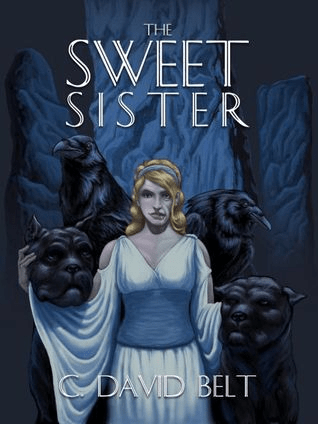
Fun story about how I discovered this book: I was at a Fantasy Faire as a vendor. A fantasy faire is sort of a like a RenFaire, but calling it “fantasy” opens it up to more time periods and more imaginative costumes. This Faire took place in southeast Idaho, so quite a few of the booths were from Utah. As I wandered the booths on the first morning, a banner on one of them caught my eye: “Strangely uplifting LDS horror.” In case you don’t know, LDS stands for Latter-Day Saints, which is the more respectful term for Mormon and what the Mormons usually call themselves. I am not Mormon, but I could not help but be intrigued by this advertising phrase. Horror, written by someone from a community that is mostly known for wanting to keep everything in life PG if not G? That’s going to be some interesting horror. Also, I do like my horror uplifting.
So, long story short, I missed meeting the author, but I bought the book. He has a lot of others, but I went for this one because it was a stand-alone.
The LDS horror did not disappoint. The opening scene takes place at fantasy convention, very similar to the event I was at when I started reading. (Nice.) The main character is LDS, and she is a tall, big-boned, plain-faced 30-year-old woman who has a secret crush on her handsome, also LDS, coworker. In short, a very relatable female lead. Being a lonely, not conventionally attractive 30-year-old woman is tough for everyone, but it’s even worse in the LDS community where there is so much emphasis on marriage.
So, the contemporary main characters are Peggy, whom you met above, and Derek, her crush, who is happy to go to conventions and watch fantasy and sci-fi movies with Peggy, but doesn’t like her “that way” and does not see her worth.
But very soon, we get into the spooky stuff. This is not exactly a time-traveling book, but it has characters who move through time by spending decades in a state of suspended animation brought about by eating an apple-like fruit from a magical tree. So, the mysterious, princess-like young woman on whom Derek gets a hopeless crush really is a woman from millennia ago who doesn’t quite know how to function in the modern world because she has been skipping through time.
I don’t want to give more spoilers than that, but let me just say that the research on this book impressed the heck out of me. The author has taken a deep dive into Celtic mythology, Arthurian legends, British/Roman history, and fairy tales, and he ties it all together. Although the main characters do not travel back in time, the story takes jaunts into the past to reveal to us the sleeping princess’s back story. We see how she gave rise to the “sleeping maiden” fairy tales like Sleeping Beauty and Snow White, but what actually happened was … much creepier. These reveals are tantalizingly done. They are not info dumps, and the whole story is not revealed until the very end.
This author takes a unique approach to paganism, one that I really appreciate. As a Mormon (which he understands to be a version of Christianity), Belt does not endorse the ancient Celtic religion and he doesn’t whitewash it either. He is perfectly willing to portray the darkness and terror and human sacrifice that come with Cernunnos and Morrigan. This is very different from most modern fictional treatments of Celtic paganism, which tend to portray the pagans as harmless, live-and-let-live, nature-loving types whose religion has no down side. However, although Belt mines paganism for horror, he passes the “love test” (the author must love the culture he’s writing about). He writes about the ancient pagans with sympathy and seems to understand their point of view. They are real human beings to him, and their gods are real entities.
And that’s why this horror is “strangely uplifting.” Unlike some horror writers I could name (ahem Stephen King), there are actually good, admirable characters in this book alongside the horror.
If you like fairy tale re-tellings, Arthurian legends, Celtic paganism, or modern-day horror, you might like this book. If you like all four, this book is definitely for you!







 Out of Babel Books