Here’s the setting for my second book: Beringia circa 10,000 BC.
As you can see, at this time the sea levels were lower (coastlines are a guess). Volcanoes were active in what is now the Kamchatka Peninsula.
The area that is now the Bering Strait is believed to have been a vast plain that somehow, despite being so far North, supported a great variety of game, including different varieties of mammoth.
Meanwhile, weirdly, North America was still covered in ice sheets. No one knows why this should be, but here is a guess. Anyway, the ice sheets were beginning to melt, creating an ice-free corridor down into the Americas. When exactly this corridor became passable is up for debate. There may also have been a coastal way to access North America (not shown on this map). Meanwhile, there could also have been people migrating to America from Africa via the Atlantic, and from Asia via Polynesia.
The corridor could also have been the route that Gigantopithecus took to get to America.
Late in the book, my characters discover mountains of ice. The ice is south of them and lies between them and the sea. They are just as confused by this as you are.
Bigfoot is a cryptid, which means “hidden animal,” i.e. an animal whose existence has not been proved. Cryptid is a big category. Some cryptids, when researched, turn out not to exist (for example the Loch Ness Monster, as far as we can tell). Others eventually get moved from the category of cryptid to that of actual animal. (Europeans did not believe in the existence of gorillas until the corpse of one was brought to Europe.) Other cryptids are 100% hoax (the Fiji mermaid, constructed by sewing a preserved monkey torso onto the preserved tail of a large fish). This post will argue that Bigfoot is in the gorilla category. In fact, he is almost exactly like a gorilla: a large, elusive primate native to the deep forests of North America.
My Sources
Obviously I did not research all
this stuff myself. My source is the research done by Jeff Meldrum, Ph.D.,
associate professor of anatomy and anthropology at Idaho State
University. He has
written a lot of stuff, but the source I am using is his book Sasquatch: Legend Meets Science (Tom
Doherty Associates, 2006).
By the way, I had already read the
book, but last month I got to attend a Bigfoot conference in Pocatello
(home of Idaho State University)
and hear Meldrum give a talk. Turns out he’s a very nice guy, with none of that
defensiveness that we might expect from a cryptid researcher. The pictures in
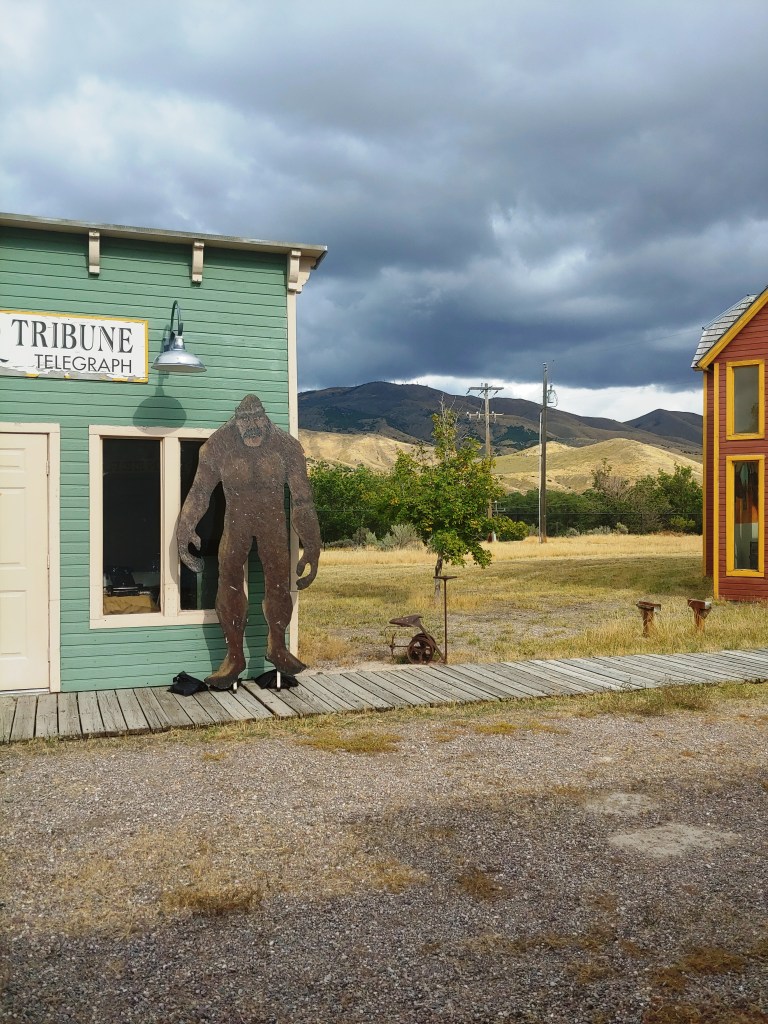
this post are from that event.
It’s hard for a blog post adequately to cover a scientific topic like this one. (And yes it is scientific: detailed analysis of footprint casts, human and primate gaits, fossils, local legends, and more.) I’ll just try to summarize some of Meldrum’s main arguments, but obviously, if you want to delve deeper, you can buy the book yourself.
Many Casts of Prints
Bigfoot is often reported in places
that are conducive to taking casts of footprints, such as a muddy forest floor
at a logging site. Many casts have been taken of footprints in such places.
Some are up to 17 inches long. None of
them match the stiff, narrow, 15-inch wooden fake feet supposedly used by Ray
Wallace and his family to fake all(!) of the Bigfoot tracks in the Northwest.
Some have a step length of 50 – 60 inches and a depth that indicates whatever
made them weighed more than 800 pounds (Sasquatch
chapter 2). There is even an instance of
a very large club foot (page 238), a few knuckle and hand prints (105 – 111),
and a hilarious butt print where the sasquatach apparently sat in the mud, then
leaned on its left forearm to reach for a fruit (111 – 115).
Large, deep tracks with a 65 – 70 inch stride have also been photographed in the sand on the Oregon coast, after a sighting the previous evening (190).
“Patty,” the Lady Bigfoot
The famous October 1967 Patterson
film “was shot during the day, in full sunlight, out in the open on 16mm
film. Independent researchers examined
the location immediately after the encounter, and footprint casts and countless
measurements and photos were taken … and yet this film remains controversial,
written off as an obvious hoax by
many” (134 – 135).
Not surprisingly, the star of the
video, dubbed “Patty,” has had everything about her analyzed, from her gait, to
her saggital crest, to the speed of the film, to the color of the soles of her
feet. The book covers this in more detail over several chapters. The upshot is that experts, when asked to
view the Patterson film, tend to be very impressed at first, then panic, back
off, and start thinking the film is a fake is because if it isn’t, they would
have to “believe” in Bigfoot. One typical protest is that this film is suspect
because it was shot by someone who was specifically looking for evidence of
Bigfoot. It’s hard to imagine, though,
how we could get such a film from anyone else.
It’s also hard to imagine how the
creature on the film could have been faked. Consider:
The Bigfoot in the Patterson film appears to have breasts, and as it walks, you can see its muscles moving underneath the hair. An experienced Hollywood costume designer who has designed many ape costumes opined that it does not look like a man in a suit. He felt that instead of a suit it would have to have been a minimum ten-hour makeup job in which the hair was glued directly to the actor’s skin (158). (The actor would then have to have been delivered to the film site and just as quickly spirited away, without leaving any vehicle tracks.) A computer graphics animator adds that “the boundaries of the human form do not even fit within the form of the creature” (176). Six-foot men have tried to re-create “Patty’s” walk in the same spot, and have found it difficult to match her stride and impossible to make footprints as deep as the ones she made.
Native American Knowledge of Bigfoot
Many Native American tribes, all
over the continent, have Bigfoot legends. This is particularly true in the
Northwest, where you can see stylized carved stone heads, masks, and statues of
the buk’wus (a Kwakiutl word), or his
female counterpart, the dsonoqua.
Their faces look ape-like and distinct from similar carvings of bears. (In
the picture below, some of the souvenirs are adapted versions of this native
art.) The Northwestern tribes seem to have more zoological detail in their
legends about Bigfoot and have testimonies of sightings right down to the
present day. They also, of course, ascribe spiritual qualities to the creature,
as they do to other animals.
The earrings, which do not look like Native art, are based on “Patty” from the Patterson film.
As we move farther East, Bigfoot
becomes a more purely spirit-like figure.
This may imply that the creatures died in out first in the eastern part
of the continent, where they are remembered only as a myth.
On Painted Rock, in central California, there is a
large (2.6 meter high) pictograph of Hairy Man with tears streaming from his
eyes. According to the local creation story, Hairy Man is crying because people
are afraid and run away from him.
At any rate, these legends definitely pre-date Ray Wallace, who supposedly “created” Bigfoot all by himself. The descriptions of Bigfoot’s behavior in the Northwestern native traditional knowledge match well with what has been reported in sightings and surmised from the behavior of other great apes.
Great Ape Behavior
Much of the Bigfoot behavior that is sometimes reported in sightings has parallels in the intimidation behavior of other primates. This includes grimacing, throwing things, banging wood on trees, pushing snags of dead branches at an intruder, hair bristling, emitting a pungent stink when agitated (male mountain gorillas do this), and vocalizing (chapters 9 and 10). There are also behaviors that resemble that of other primates but are not intimidation behaviors, such as making sleeping nests from branches. Of known primates, the one that Bigfoot most seems to resemble is Gigantopithecus (89 ff).
But Isn’t It Really Just a Bear?
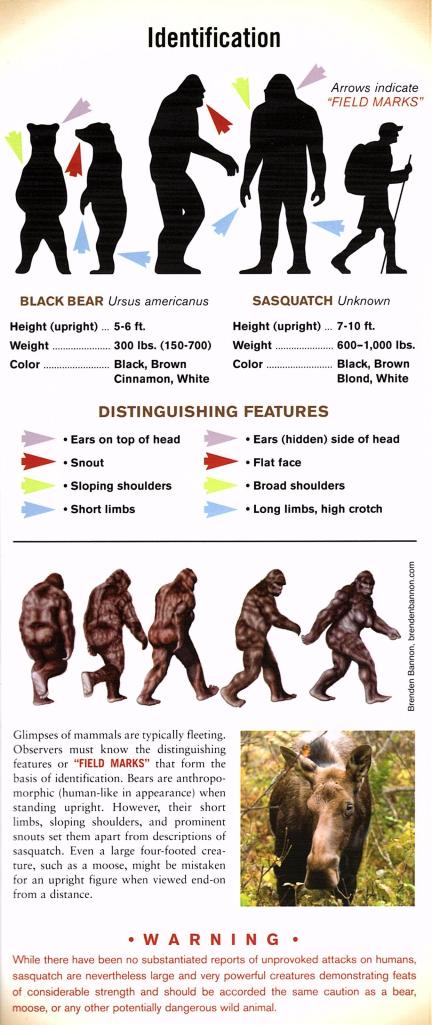
A page from Meldrum’s “Sasquatch field guide,” showing differences between Bigfoot and bears
Bigfoot’s range, as determined by footprints
and reported sightings, overlaps almost perfectly with the range of the
bear. To a believer, this means the two
animals share a similar habitat: temperate forests and rainforests. To a
skeptic, this means that all “Bigfoot” sightings are actually bears.
This was the subject of the lecture
by Jeff Meldrum that I attended. It is
certainly true that photographs of black bears have been put forward as
photographs of Bigfoot, only to be exposed later. Meldrum showed a series of
bear photos which, at first glance, can look surprisingly humanoid, especially
if the animal is skinny and is standing on its hind legs. However, he went on to point out, telling the
difference between a bear and a huge, bipedal ape “isn’t rocket science.” Bears do not have a clavicle, so when
standing, they don’t have protruding shoulders. Their legs are much shorter in
proportion to their body. And, of course, there are the prominent round ears.
Bear tracks don’t resemble Bigfoot
tracks at all, except in cases of multiple, overlapping, unclear bear tracks. A bear’s inside toe is its shortest, their
feet are shorter and very narrow at the back, and they leave claw marks. Their stride is, of course, very different,
although when a bear is walking quickly its footprints can overlap, “giving an
impression of elongated footprints spaced in a two-footed pattern.”
Skeptics have also raised the
question of whether two large animals can fill the same niche. Bigfoot, if it
exists, is probably a fructivore like the other large primates and like Gigantopithecus,
whose jaw and teeth are designed for grinding, not for predation. Bears, while
also ominivores, have a very different shaped set of chompers. So even if the
two animals share a range, they would not be occupying exactly the same
ecological niche.
(Fun near-fact: based on his estimate of how many Sasquatch compared to bears a given region of wilderness can support, Meldrum estimates there could be as many as 175 individual Bigfoot in the state of Idaho.)
Bigfoot Outside the Great Northwest
It turns out that, despite usually having much less wilderness than the Great Northwest, nearly every state in the Union has its own version of the Bigfoot legend. I’ll let you make up your mind about these on a case-by-case basis. In Ohio, until recently my home state, we have “the Grassman.” Here is a Hubpages article about him. If you follow the link and read the comments, you will no doubt see many personal testimonies about Grassman sightings.
Update: another WordPress blogger, The Traveling Maiden, had an experience while camping in the Great Northwest that may have been Bigfoot. Read about it here.
Based on the success of the Leviathan post, I conclude that you guys like creature pictures. And I have another one in my archives.
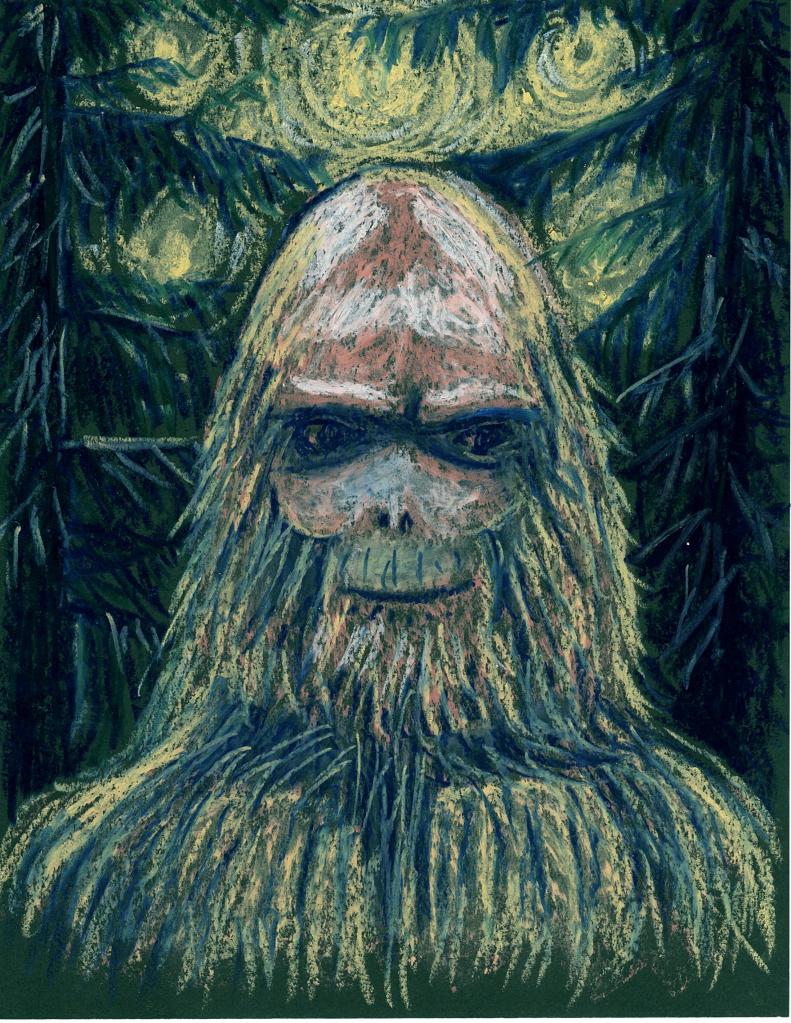
A few years ago, I was assistant teaching in an art class. At one point, the teacher had the students use pastels on black paper to re-create Starry Night. It was beautiful. I got inspired, so naturally I did what one does when one gets inspired. I went home and drew Sasquatch.



 Out of Babel Books