They are making a really cool movie that is due to come in out 2026.
No, it’s not based on my books in any way, but it has all the themes of my series, turned up to 11. I mean to say, if you click on the link above, you will see that their web site features American Indians fighting a dinosaur. Things do not get cooler than that, and as it turns out, they also do not get better historically supported.
Here is a quote from their FAQs section:
The Walam Olum or “Red Record,” which is central to our movie, is very much not alone from multiple Native American historical narratives that provide a clear and consistent telling of giants—especially giants associated with the mound builders and earth works, of which there are tens of thousands in America. The Lenni Lenape’s account of the Nephilim is central to their history (see the “snake people” and the makowini, translated “big men” that existed before and after their Flood account, were part of the reason for the Flood, matching our Bible history). See the Glyphs in Book 2 and Glyphs 1-2 in Book 3. Several other historical documents also mention giants affiliated with tribes around the Lenni-Lenape people.
In other words, these people are kindred spirits, which is why they wanted to buy my url in the first place.
My little url is all grown up, and I couldn’t be prouder.
Still buy my books, I mean. They have their own peculiar charm. But by all means, go and see this movie too.
What are these extra fishbone looking thingies on the side of the t-rex’s neck?
Look, this little guy has them too.
And so does this sauropod.
Are we sure we have these attached at the correct angle? Is it possible the dinosaurs could swell out their neck like a grouse or something? Should we be reconstructing them more like birds, with thicker, sleeker appearances?
Speaking of which… that’s basically a chicken foot, right?
Also … I’m not an expert, but I am weirded out by how big of a shoulder blade t-rex seems to need for his tiny hands. Were there possibly wings attached to these?
Basically chickens, amirite?
The chicken status of dinosaurs has been confirmed. They ate gastroliths, which are stones that help an animal digest, just as hens do.
Basically a moose .
A huge, terrifying moose.
I’m sure he looked better with skin on.
Speaking of what we call things, how are we supposed to keep up with prehistoric animals if they keep changing their names in this manner?
Now let’s look at some really cool petrified “wood.” Some of the specimens actually look like modern hardwood grain, but this one looks as if, when alive, it had the texture of a giant celery.
This one had some really disturbing strawlike structures inside that are creeping me out. Cork perhaps?
This one has the ghost of the tree trapped inside, going “Heeeelp meee!”
And these last two…. what the heck? I’m guessing the first one is a giant lichen and the second one is petrified slime mold or something like that.
What parts of this dinosaur are not made up? The ones in red.
Ah, my old friend, the iguanodon! I remember you from the dinosaur book I loved when I was a kid, published in the 1970s. My iguanodon back then looked like the guy on the far left. In case you can’t read the sign, it says, “These are all models of the same dinosaur.”
Next question : Triceratops. I always took its appearance for granted, ever since that same beloved dinosaur book, but now I am asking myself, What in the world did it need that huge expanse of bone for? Wasn’t it heavy? Are we sure it was all made of bone? Or was it cartilage or something lighter? Was anything attached to it … like even more expansive flaps of skin, or feathers?
This is the “death pose.” Here are some more:
Per this sign, evolutionists’ best guess about the death pose is that it’s caused by ligaments constricting as the animal begins to decay. Of course, animals that get a chance to decay don’t generally become fossils. You have a much better chance of becoming a fossil if you are suddenly buried in an anaerobic environment, such as under a giant tsunami of mud during, say, a cataclysmic worldwide flood. Which might also smash you in this position.
These different-sized femurs belong to a large herd of allosauruses (allosauri?) who were apparently all buried together.
This is pretty cool: There’s such a thing as a “brain cast” when a dinosaur’s brain gets “pickled” in peat.
Finally: Trilobites. I knew this guys existed, but I was thinking of them as basically glorified pillbugs.
I had no idea their spines were so … um … 3-D.
Will I ever be comfortable knowing these guys existed? No. No, I will not.
Thanks to the George C. Eccles Dinosaur Park in Ogden for an enjoyable afternoon feeling dwarfed by chickens and other horrors, in their pleasant air-conditioned museum!
Tom, you won’t be able to see this, because it’s a gif and you can never view those. It’s a short video of a man holding at bay three velociraptors … which is exactly what it now looks like when I feed my chickens.
I now wonder whether a chicken owner was behind the animatronic dinos in the Jurassic Park franchise.
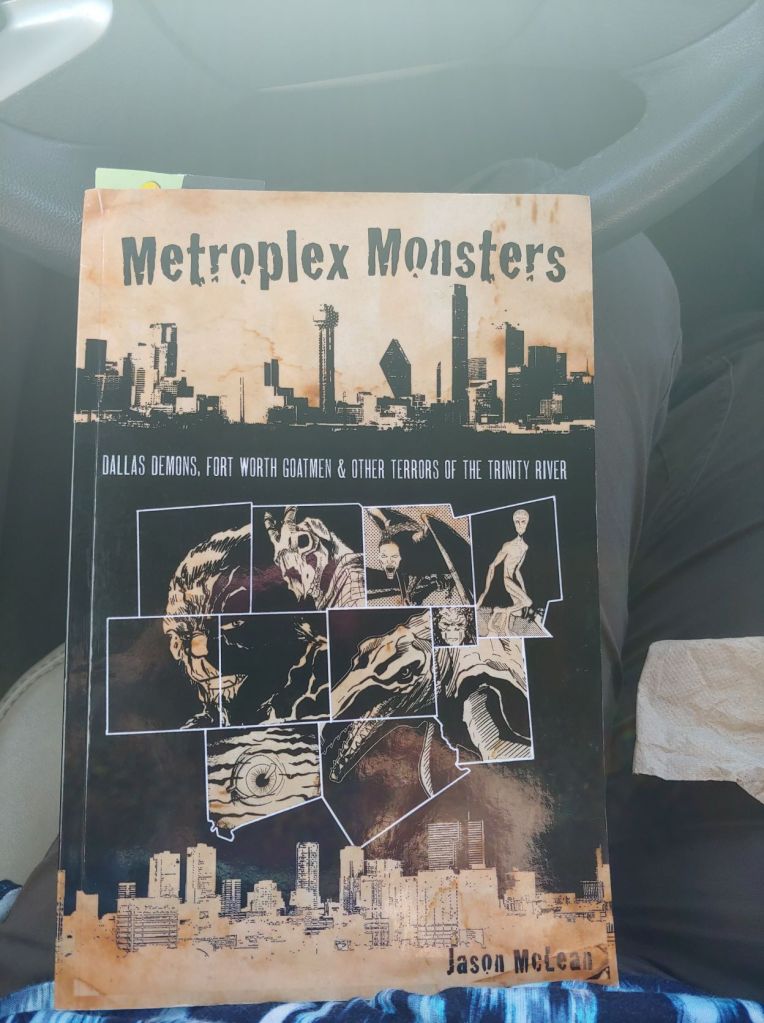
What, I ask you, could be more of a romp than a book about cryptids, urban legends and paranormal experiences, set in a metro area in which you once lived and even taking place in parks you have walked in?
Almost nothing, expect maybe gifting same on Father’s Day to your husband, who lived in said metro area longer than you did and who knows it even better.
Or, enjoying the fact that the book is illustrated in a retro, pulp-fiction style by the author, who is also a graphic artist.
All of these minor delights are now mine.
The D/FW metro area is not the first place one would think of when hearing the word “Bigfoot,” or the word “spooky.” Even as a city, it is not very attractive. The area is sprawling, and tends to be unwalkable, with wide streets, vast parking lots, hot temperatures, and glaring daylight. It gets lot of Wild West points for its cowtown/railroad/cotton growing local history (all documented in the book), but it gets almost no gothic points.
However, despite being a vast metro area, D/FW is seamed through with green spaces around the Trinity River and its tributaries. As the book points out, the brushy edge of this greenspace is so dense that it could really be called a “green wall.” As is alleged to have happened, surprisingly recently, you could drive by this “green wall” and be unaware that Bigfoot was quietly standing 40 feet from the highway.
The area also has a quite a few large lakes, such as Joe Pool Lake (I’ve been there!) and White Rock Lake (I’ve been there too!). These are man-made, created by damming various tributaries of the Trinity River. They are popular recreational areas, but also big enough and old enough to have spooky urban legends associated with them and to allow people to have hard-to-believe encounters.
Finally, because of the river system and the associated lakes, the D/FW area has a lot of large birds, such as egrets and blue herons. I can confirm that it is very common to see these feathered creatures while simply driving from place to place in the metro area. One really fascinating contention in this book is that some of these “herons” are actually, on a closer look, featherless and are in fact a kind of small pterosaur. A few people have gotten a good enough look to realize that the “heron” looked more like a lizard, but they have understandably kept quiet.
About the Author
Jason McLean, the author of Metroplex Monsters, is the founder of the SIRU papers podcast on YouTube. I found out about him, and his book, when the two of us were on yet another podcast discussing the weirder elements of the Old Testament. So, this book, while I have described it as a romp, is actually in deadly earnest. McLean traces the origins of various Dallas urban legends somewhat in the style of Snopes, though more along the lines of let’s-find-out-the-actual-history rather than whatever-it-is-we-will-debunk-it. Though you can’t tell from Metroplex Monsters alone, he has a worldview that allows for quite a few paranormal phenomena to make sense within a biblical, and entirely rational, framework. If you are interested in that sort of thing, I encourage you to check out SIRU papers (and of course, The Unseen Realm by Michael Heiser, Giants: Sons of the gods by Douglas Van Dorn, and The Scattering Trilogy by a distinguished novelist. But SIRU papers is even more hair-raising). If you are not interested in how a Christian could possibly countenance the paranormal, but just want to laugh and shake your head over how even a seemingly banal metro area like D/FW can have cryptids, feel free to read, and enjoy, Metroplex Monsters at face value.
Teal Veyre is really interesting thinker whose blog I’ve been following for a few years now. (She’s the angry bespectacled cartoon gal on the left.) In this episode of her Viridescent Storms book podcast, she and I talk about dinosaurs, giants, utilitarianism, worldbuilding, and of course, The Lord of the Rings. Many of the topics are ones that faithful Out of Babel-ites will recognize, but with Teal’s unique perspective, it’s all fresh! Plus, you get to hear our voices. The interview with me takes up about the first 30 minutes, and then the Storms offer a tutorial on a program called Notion and how it can be used by indie authors.
I notice that so far, the video has only one like, which is of course disgraceful. Get over there and like it and club some sense into those YouTube algorithms!
Find out this and more in this article, which seems to indicate that the dinosaur-killing asteroid impact (or, if you prefer, the “continental sprint“ associated with the Flood) happened as the Northern Hemisphere was entering spring. There’s something poetic about that.
As I heard a podcaster say, “The plural of anecdote is data.”
Wait. Are We Even Sure It Was Worldwide?
You can make a case that the account in Genesis 7 – 8 is not necessarily describing a global flood. This is because the same Hebrew word can be translated “world,” “earth,” or “land.” How we interpret it depends upon context. There is a case to be made, for example, that the whole book of Revelation is describing the devastation of the land of Israel during the destruction of Jerusalem in 70 A.D. (hence the frequent warnings that it is going to happen “soon”), and that lines like “one third of the people on the earth died” are better translated as “one third of the people in the land died.”
I have even seen people try to interpret the poetic descriptions of creation in Genesis 1 and 2 as happening from the perspective of a person standing on the surface of the earth, in the land of Israel.
However, getting back to the flood narrative, there are good reasons to think that the text is in fact describing a global flood. This passage is set in very ancient times, before the nation of Israel existed. It’s before Abram was called by God out of Ur. Before Abram was even born. Before the Table of Nations (Genesis 10). So, not only was there no nation of Israel at the time of flood narrative, but we can’t even be sure there was a land of Israel, given the dramatic damage that the flood did to the earth’s geography. (And by the way, yes, I have just revealed that I think the flood narrative was not composed by Moses — even under the inspiration of God — but was passed down to Moses from a much older source.)
Finally, it’s hard to imagine how a local flood could “cover the mountains to a depth of more than fifteen cubits” (Genesis 7:20) … especially for enough of a length of time for Noah and his sons to take soundings so as to estimate this depth.
So, given all this, I don’t think it’s straining the text to say that the flood account in Genesis is meant to be describing a global event.
Like so many sensational things in the Bible, the flood account sounds hard to believe, but the longer we look at it, the better it matches with the world we live in. Here are some features of the world we live, which are features we would expect if the dark millennia of our past concealed a worldwide flood.
Oral Flood Histories from Around the World
I have written before about Graham Hancock. I really enjoyed his book Fingerprints of the Gods, which posits an ancient period of cataclysms that included “earth crust slippage,” a geological upheaval so dramatic that it would have caused catastrophic floods among many other disasters. Hancock keeps changing his theories, and he has his own reasons for collecting the historical data that he does. However, here is some of the data that he conveniently collected about flood legends worldwide:
More than 500 deluge legends are known around the world and, in a survey of 86 of these (50 Asiatic, 3 European, 7 African, 46 American and 10 from Australia and the Pacific), the specialist researcher Dr. Richard Andree concluded that 62 were entirely independent of the Mesopotamian and Hebrew accounts.
Hancock, Fingerprints, p. 193
People Group
page in Fingerprints
summary
Aztec
98
“First Sun, Matlactli Atl: duration 4008 years. In this age lived the giants … The First Sun was destroyed by water in the sign Matlactli Atl (Ten Water). It was called Apachiohualiztli (flood, deluge), the art of sorcery of the permanent rain. Men were turned into fish. Some say that only one couple escaped, protected by an old tree living near the water. Others say there were seven couples who hid in a cave until the flood was over and the waters had gone down. They repopulated the earth and were worshipped as gods in their nations …”
Sumerian
188 – 189
The Noah figure is called Utnapishtim. He later tells his story to Gilgamesh. It almost exactly parallels the Genesis 7 account.
South American tribes
191 – 192
Hancock mentions flood accounts coming from the following tribes: Chibcas (Colombia); Canarians (Ecuador); Tupinamba (Brazil); Araucnaian (Chile); Yamana (Tierra del Fuego); Pehuenche (Tierra del Fuego); and numerous groups in Peru.
Inuit
192 – 193
“a terrible flood, accompanied by an earthquake, which swept so rapidly over the face of the earth that only a few people managed to escape in their canoes or take refuge on the tops of the highest mountains.”
“The planets altered their courses. The sky sank lower towards the north. The sun, moon, and stars changed their motions. The earth fell to pieces and the waters in its bosom rushed upwards with violence and overflowed the earth.”
Southeast Asia
194
Flood accounts in: Chewong (Malaysia); Laos and northern Thailand; Karen (Burma); Vietnam; tribes along the northern coast of Australia
Hawai’i
194
“The world was destroyed by a flood and later recreated by a god named Tangaloa.”
Samoa
194
The flood is survived by “two human beings who put to sea in a boat which eventually came to rest in the Samoan archipelago.”
Japan
194
The Pacific islands were formed after the deluge receded.
Greek (Hesiod)
195 – 196
After a series of races of gold and silver, there is a “bronze race” who “have the strength of giants, and mighty hands on their mighty limbs.” After Prometheus gets them into trouble, Zeus wipes out the bronze race with a flood. Deucalion and Pyrrha float over the sea in a box for nine days and finally land on Mt. Parnassus.
“Vedic India”
196 – 197
The Noah figure is named Manu. He rescues a fish, which in return warns him of a coming flood. Manu loads a ship with two of every living species and seeds of every plant. The fish turns out to be Vishnu, who pulls Manu’s ship through the flood.
Egypt (Book of the Dead)
197
Thoth says, “They have fought fights, they have upheld strifes, they have done evil, they have created hostilities, they have made slaughter, they have caused trouble and oppression … I am going to blot out everything which I have made. This earth shall enter into the watery abyss by means of a raging flood, and will become even as it was in primeval time.”
Mayan (Popol Vuh)
203
“It was cloudy and twilight all over the world … the faces of the sun and moon were covered … Sunlight did not return till the twenty-sixth year after the flood.”
Norse
204 – 205
An awful lot happens in this apocalyptic tale. First a “hideous winter,” then worldwide war, then Yggdrasil (the earth tree) is shaken, causing the earth to literally fall apart. Then, worldwide fire. And finally, a flood. “The earth sank beneath the sea … Yet not all men perished in the great catastrophe. Enclosed in the wood itself of the ash tree Yggdrasil — which the devouring flames of the universal conflagration had been unable to consume — the ancestors of the future race of men had escaped death. In this asylum they had found that their only nourishment had been the morning dew. Slowly the earth emerged from the waves. Mountains rose again …”
The charming thing about these origin tales is that couple who survive the flood usually end up landing on the local mountain, founding the nation that is currently telling the story, and not moving from that spot ever since. This is similar to how nearly every people group has a local landmark (usually a mountain, terrain permitting) that is believed to be the home of the gods or “the center of the world.”
This is what origin stories are supposed to do. They ground the local community in the great ancient story of the world, and they also give the ancient stories credibility by grounding them in local features “still seen to this day.” This is not to say, however, that origin stories are simply made up out of whole cloth. They are handed down the generations, and though they might get tailored to make human beings look better, and have bits of other interesting stories added to them, they ultimately have some kind of origin in actual events. (Especially since they often come with genealogies that are also handed down.) I can’t imagine the coincidence that would be required for hundreds of peoples all around the world to make up a traditional flood story.
Yes, But It Could Still Have Been Local, If …
… if all of these widely scattered people groups were descended from a small number of couples who were once all in one place and who experienced a catastrophic local flood together.
That is true. Could still be true. And, in fact, even if the entire world were experiencing earthquakes, uplifts and sinkings, tsunamis, etc., all at once, there wouldn’t necessarily have been a moment when water was covering all the land on earth all at the same time. On the other hand, there wouldn’t have to be, for events to satisfy the description given in these flood accounts, including the Genesis one. After all, the perspective from which these stories are told, is that of human beings experiencing the flood and associated disasters, not the perspective of an observer looking at the globe from outer space. The mental picture of the whole world sitting under a flat layer of water, while not impossible, is more of a Sunday School stylization of the account, than the actual claim being made.
Buried Beneath a Wave of Mud
In all of these accounts, the flood is sudden, dramatic, and overwhelming, whether or not it is accompanied by other disasters such as earthquake or fire. Even the Genesis account (often simplified to sound like just rain) says “on that day all the springs of the great deep burst forth, and the floodgates of the heavens were opened” (Genesis 7:11, NIV).
In a world in which this had happened, we should expect to find the remains of plants and animals that had been instantly buried under huge waves of mud and essentially frozen in time. And that is exactly what we do find. Here is the latest example, which was called to my attention by Google within the last month:
This poor dino mom, if she had been given any warning that she was about to be buried in an oxygen-free environment that would later prove convenient to future paleontologists, would probably have fled or tried to move her eggs to safety. OK, maybe she would have stayed to protect them. But we also find fossil dinos caught in the act of, say, eating prey. We find mammoths apparently flash-frozen with summer plants still in their mouths and/or stomachs. I can’t imagine how that could have come about, but it can’t have been gradual. (Although here are some fish who appear to be frozen in a wave, but the process was a quite different.)



 Out of Babel Books