Mind: Blown Book of the Year

Who are the gods?

Over the past several years, my research and reading has led me more and more to the conviction that the entities that people often call the old gods were not “mere mythology.” They were and are real.

Several threads of my thinking have re-enforced each other in coming to this conclusion.

First of all, as a Christian, I reject the Enlightenment-era, materialist notion that there is no spiritual world, that matter is all that really exists. I reject both the strong version of this, in which not even the human mind is real, and the weak version of it, in which we accept that human beings exist as minds, but we try envision as them as “arising” out of matter, and we disbelieve in any other spiritual beings, whether spirits, angels, demons, ghosts, or the one true God. This view, the one I reject, has held sway for most of our lifetimes. Even people such as myself who would not call themselves materialists will lapse into this sort of thinking by default, looking for a physical or mechanical process to explain what is “really” going on behind any claimed spiritual phenomenon.

Another thread in the tapestry has been my interest in the ancient world. Anyone with a passing familiarity with archaeology quickly comes to realize that ancient people were much smarter than they have gotten credit for, at least during the Golden Age of Scientific Triumphalism, the late 1800s and early 1900s. All the good, old-fashioned scientific materialists from this era took it as an axiom that human beings started out as apelike hunter-gatherers, and slowly “ascended,” developing shelter and clothing, “discovering” fire, slowly and painfully inventing various “primitive” tools, and then finally moving on to farming, language, and religion. By hypothesis, ancient people were stupid compared to us now.  

Genesis, my favorite history book, tells a very different story. It shows people being fully human from the get-go, immediately launching into writing, herding, weaving, art, music, and founding cities. And in fact, archaeology confirms this. Every year, we discover a more ancient civilization than the evolutionists told us existed. Some recent examples: the Antikythera mechanism is an ancient computer. The Vinca signs are an alphabet that pre-dates Sumeria. Gobekli Tepe is a temple complex that uses equilateral triangles and pi, and dates to “before agriculture was invented” (as is still being claimed). The Amazon basin turns out to have been once covered in cities.

Evolutionists’ dogmatism about early man being stupid has allowed them to ignore all the data that ancient history presents us about the existence of a spirit world. Why should we believe claims (universally attested) about heavenly beings that come to earth to visit, rule over, and even mate with humans? These are primitive people’s attempts to explain purely scientific phenomena that they didn’t understand. But if, as a Christian, I choose to respect ancient people and take seriously their intelligence, then I also have to grapple with their historical and cosmological claims.

Moving on to the third thread. The Bible itself confirms that there were entities called gods (“elohim”), some of whom, at one point in very ancient times, actually came to earth and reproduced with human women, creating a race of preternatural giants, “the heroes of old, men of renown” (Gen. 6:4).  The story is told in Genesis ch. 6, but it is assumed and referenced throughout the rest of the Bible and in Hebrew cosmology. This idea is also attested in oral and written traditions worldwide, which universally have gods and giants.  A Bible-believing Christian can take seriously the bulk of pagan history, cosmology and myth, whereas a strict materialist evolutionist has to reject it all as primitive superstition.

Two books that have helped me understand Genesis 6 and how it fits into Ancient Near Eastern cosmology were The Unseen Realm by Michael Heiser and Giants: Sons of the Gods by Douglas Van Dorn. I’ve also had conversations with Jason McLean and enjoyed listening to The Haunted Cosmos podcast. The historical record about gods and giants, once forgotten by mainstream Christians in America, is again becoming a topic of interest in the evangelical world.

Part of the Biblical understanding of the gods is that they are created entities who were supposed to help the one true God rule the cosmos. In the course of redemption history, the fallen gods were first banished from appearing physically on earth (in the Flood). At Babel, the gods were each given a nation of men as their “portion” to rule over (Deut. 32:7 – 8), which they did a pretty poor job (Psalm 82). Then God called Abram to make a people for Himself, with the ultimate goal of making all the nations His portion (Ps. 82:8, Ps. 2, Matt. 4:8 – 9). When Christ came, He began to drive the gods out of their long-held territories (Mat. 12:28 – 29). Whenever a region was Christianized, the old gods would first fight back, then become less powerful, and eventually go away altogether. Sometimes, their very names were forgotten. This disappearance of lesser spiritual entities from more and more corners of the earth is the only reason any person could ever seriously have asserted that there is no spirit world.

As a Christian, I am immensely grateful to have grown up in a civilization from which the old gods had been driven. It has been a mostly sane civilization, in which everyday life is not characterized by spooks, curses, possession, temple prostitution or human sacrifice.

This, then, is the background that I brought to Cahn’s book. This mental background helped me to accept many of his premises immediately. If you do not have this background – if you are, for example, a modern evangelical Christian but still a functional materialist – Cahn’s book might be a bit challenging. He dives into the deep end right away. He moves fast and covers a lot of material.

Who is Jonathan Cahn?

In his own words,

Jonathan Cahn caused a worldwide stir with the release of the New York Times best seller The Harbinger and his subsequent New York Times best sellers.

n.b.: I had seen The Harbinger on sale, but I assumed it was fiction in the style of the Left Behind series and avoided it.

He is known as a prophetic voice to our times and for the opening up of the deep mysteries of God. Jonathan leads Hope of the World … and Beth Israel/the Jerusalem Center, his ministry base and worship center in Wayne, New Jersey, just outside New York City.

To get in touch, to receive prophetic updates, to receive free gifts from his ministry (special messages and much more), to find out about his over two thousand messages and mysteries … use the following contacts …

From page 239 of this book

In other words, Jonathan Cahn swims in the dispensational or charismatic stream of Christianity. He calls himself a prophet. That’s a red flag to me, as a Reformed Christian. I believe that the prophetic age ended with John the Baptist (Matt. 11:11 -14). The prophets and apostles were the foundation of the church, and they died out with the first generation of Christians (Eph. 2:19 – 22). This exegesis of Scripture finds confirmation in daily life. I have met Christians who sensed God speaking to them (and have experienced it myself), but I have never met anyone who claimed to be a modern-day prophet, receiving authoritative words from God, who wasn’t a charlatan.

To make matters worse, Cahn asserts that he can “open up the deep mysteries of God” and that we can “find out about his over two thousand messages and mysteries.” This is a direct claim to have exclusive spiritual knowledge that is not available to all in the already-revealed Word of God. If he were just talking about knowledge already found in the Bible, he would call it “exegesis” or “Bible teaching,” not “messages and mysteries.” This claim reveals him to be part of the Gnostic or Hermetic stream of Christianity. Yes, I am using the words “Gnostic” and “Hermetic” loosely. They are big terms with somewhat flexible definitions. However, both are characterized by an emphasis on secret or esoteric knowledge which can only be accessed through a teacher (or, in this case, a prophet) who has been enlightened somehow. To see my posts about Hermeticism and why it is it antithetical to orthodox Christianity, click here, here, here, and here.

What was my approach to this book?

I knew when I picked up this book that Cahn was dispensational, a “prophet,” and therefore fundamentally a false teacher. So, I approached the book not as I would an exegesis by a trusted or mostly trusted, orthodox teacher or scholar like Michael Heiser or Douglas Van Dorn, but rather with curiosity. My interest in the topic of the old gods is such that I can’t ignore what anyone claiming the name of Christ had to say about it. I already knew there was a resurgence of interest in this topic in the Reformed world, and now I wanted to see what the Dispensationalists were saying. I picked it up prepared for anything up to and including rank heresy, but as it turned out, the most heretical thing in the book was the “About Jonathan Cahn” section that I just showed you. The rest was, for someone with my cosmology, mostly pretty hard to disagree with.

The Parable of the Empty House

Cahn spends four very short chapters (Chapters 2 – 5; pages 5 – 22) establishing the ideas I attempted to establish above: that the gods of the ancient world were real spiritual entities who ruled over nations and received their worship. He demonstrates briefly that this was assumed in the Bible and in Hebrew cosmology. He uses the word shedim, a Hebrew word for demon or unclean spirit, which is sometimes used in the Old Testament to describe the gods. He doesn’t get into the idea of elohim, Watchers, or other different names for spiritual entities, or many details of how they fell. Entire books can be (and have been) written about this (see Michael Heiser). However, Cahn wants to move on and see what is going on with these entities in the modern day.  

Moving at treetop level, he reviews how the coming of Christ progressively drove the gods out of more and more regions of the earth, in a process that took centuries. He describes civilizations as being “possessed” by the gods they serve. I don’t think he means that every person in a pagan civilization is demon possessed, but as a group, their thinking and behavior is shaped and to some extent controlled by whatever god they serve. As someone who has studied the Aztecs, I can’t disagree. Cahn also points out that it was common, indeed routine, for priests, priestesses, and prophets of the pagan gods to experience actual possession, such as the Oracle of Delphi, the girl with the “python spirit” in Acts 16, or worshippers going into a “divine frenzy.”

Having introduced the concept of possession, Cahn moves on to a parable Jesus told about the dynamics of possession in an individual.

When an evil spirit comes out of a man, it goes through arid places seeking rest and does not find it. Then it says, “I will return to the house I left.” When it arrives, it finds the house unoccupied, swept clean and put in order. Then it goes and takes with it seven other spirits more wicked than itself, and they go in and live there. And the final condition of that man is worse than the first. That is how it will be with this wicked generation. Matt. 12:43 – 45, NIV

Typically of Jesus, this parable works on three levels. The house which is cleansed, left empty, and then re-occupied stands for a person who has been demon-possessed, has been delivered, and then ends up in a worse state than before. And the person, Jesus says, can stand for “this wicked generation.”

Cahn takes this parable and applies it to entire civilizations. He has already established that pagan civilizations were possessed, sometimes literally, by a variety of old gods, to their sorrow. When the Gospel came to them, Christ showed up in person, delivered and cleansed them, and lived in their house. Now, says Cahn, what might happen if a civilization rejects Christ, drives Him out? The house (the post-Christian civilization) has been “swept clean and put in order” by its centuries of Christianity, but it is now “empty,” having driven out Christ. It is now a very attractive vessel for “seven other spirits more wicked than the last.”

I honestly don’t think this is an abuse of Scripture. Cahn seems to be applying the parable in one of the senses in which Jesus meant it. Furthermore, he is not the first to point out that the many wonderful benefits of modern Western civilization are an aftereffect of about 1500 years of Christianity. Some commentators have said that “we are living off interest.” Others have compared us, as a society, to someone sawing off the branch he is sitting on. Doug Wilson has mourned that “we like apple pie, but we want to get rid of all the apple orchards.”

A post-Christian society, say Cahn and many others, for various reasons is vulnerable to much greater evils than a pre-Christian one. In the rest of the book, Cahn will show how the old gods have indeed come back. His focus is on the United States, because he’s an American, but also because the United States has a been a major exporter of culture to the world, and in recent years that culture has been of the demonic variety. Cahn’s book is so persuasive because he is not, as “prophets” often do, sketching a near-future scenario and trying to convince us of it. Instead, he is describing what has already happened.

Which gods, though?

When Cahn first started talking about “the gods” coming back, it occurred to me to wonder, “Which gods?” When Americans or Europeans become openly neo-pagan, I’ve noticed they often go for the gods their ancestors worshipped. So, many people research the Norse gods and cosplay as Vikings … except it’s not just cosplay. Other people are more attracted to the Celtic pantheon. These are the Wiccans. Interestingly, in S.M. Stirling’s Emberverse series, we have a very literal return of the gods when technology vanishes from modern society.  Creative anachronists suddenly find that their skills are useful.  A Wiccan busker becomes the leader of her own little witch community. Other people get into reviving the Norse religion. It’s a neopagan’s fantasy.

But there are a couple of problems with this. For one thing, neopagans’ version of the ancient religion often looks very different from the actual beliefs of the ancient pagans (many of which have been lost to history). Also, modern neopagans are happy to mix elements of different traditions from opposite sides of the globe: wicca, Tibetan Buddhism, or their kooky version of American Indian religions (probably also not very authentic). I once commented to a neopagan friend of mine (back when we were still friends) that her religion resembled a “personal scrapbook”. And she happily acknowledged this as one of its good points. A DIY paganism, popular with modern individualists, is not the sort of the thing that can become the state religion of a whole society. Finally, actual, hardcore neopagans are not small in number, but they are nowhere near the majority in the United States. Neopaganism does not appear, at this moment, to be the manner in which an entire postChristian society comes under the control of the old gods. And, in fact, that’s not exactly what Cahn has in mind.

America is not made up of any one ethnicity or people group but many, almost all. In many ways America is a composite and summation of Western civilization. So then what gods could relate not to one nation or ethnicity within Western civilization but to all of them or to Western civilization as whole? … The faith of Western civilization come from ancient Israel. The Bible consists of the writings of Israel, the psalms of Israel, the chronicles and histories of Israel, the prophecies of Israel, and the gospel of Israel. The spiritual DNA of Western civilization comes from and, in many ways, is the spiritual DNA of ancient Israel. … The gods, or spirits, that have returned to America and Western civilization are the same gods and spirits that seduced ancient Israel in the days of its apostacy. … If a civilization indwelled by Israel’s faith and word should apostacize from that faith, it would become subject to the same gods and spirits of Israel’s apostacy.

ibid, pp. 34 – 35

The dark trinity

I have a feeling that Cahn, coming from the worldview he does, is setting up this principle as a hard-and-fast rule, and I don’t feel he has really established it as such from Scripture. However, I’m open to it as speculation.  Though it’s not, in my opinion, closely argued, his line of reasoning becomes more convincing when we see the gods that he identifies as having returned to America.

He calls them the “dark trinity”:

  • Baal (“the lord”): the god of rain in the Ancient Near East, he was often portrayed as riding on a bull and brandishing a thunderbolt. Controlling the rain meant that Baal controlled crops, and hence fertility, wealth, and prosperity. Thus, he was the god of power and wealth, and was a ruler.
  • Ishtar/Ashera (Sumerian Inanna): goddess of sex, alehouses, and the occult. Among the Canaanites, Ashera was considered the consort of Baal and “Ashera poles” were the site of orgies.
  • Moloch/Molech: The dark god of human sacrifice, particularly child sacrifice. His name means “king.”

Once these gods are identified, we can see that it does not seem so arbitrary that they should be the ones to return. For one thing, they and the God of the Israelites were personal enemies, as it were, battling for control of the same territory, for many centuries. But secondly, these pagan gods come close to being universal.

Baal is your basic male sky god. His name means “lord,” and his essence is basically that of taking power for oneself, rebelling against the Creator. Once we look at him this way, we can see that every pantheon has a Baal. In Ugarit, an ancient Semitic civilization, Baal was understood to be the Creator’s chief administrator over the earth, head of the divine council (credit: Michael Heiser). Baal was actually translated as Zeus in Greek and Jupiter in Rome.

Ishtar, a dangerous female sex goddess, shows up as Inanna in Sumer, one of the most ancient civilizations whose records we can actually read. Cahn spends much of the book delving into Inanna’s characteristics and history, for reasons that will become clear. But, through a process of cultural exchange, she showed up as Ishtar in ancient Babylon (leading to the words Ostara and Easter), Ashera among the Phoenicians (a.k.a. Canaanites), and Aphrodite among the Greeks (Venus among the Romans).

Molech was called Chemosh in Moab. Greek historian Diodorus Siculus translates his name as Kronos (Saturn), the god who devoured his own children. Many many cultures throughout the world have practiced infant sacrifice.

These three gods, then, not only show up by different names in nearly all the cultures of the Ancient Near East right down to Christian times; they not only are the types of entities that show up in nearly every pantheon worldwide, even in the Americas; they also appear to date back to ancient Sumer, which is still a source that is sought by modern neopagans and Hermetic believers. They are not, unfortunately, out of date or obscure. Suddenly, it no longer seems as if they are irrelevant to modern America.

How it went down

Briefly, Cahn argues that cultures (not just America) first let in Baal, who ushers in Ishtar, who ushers in Molech. And he argues that in our culture, this has already happened.

Baal represents the motivation for rebelling against the one true God that seems reasonable. Human beings want prosperity, they want security, they want to do their own thing. They want a god who can reliably make the rain come, the crops grow, the city flourish. They want to have independent, personal power, and not have to humble themselves before or depend upon the Creator. Baal is the god of prosperity, money, and success. Cahn says that America first welcomed Baal. He points to the actual bronze statue of a bull at Wall Street as a literal, though unintentional, idol to Baal, right in the financial center of arguably the most powerful and influential city in our nation.

Once you have Baal, he ushers in his consort, Ishtar. Ishtar is a much more unstable character. As the prostitute goddess, she likes people to engage in sexual chaos. In her instantiation as Inanna, she is emotionally unstable and vengeful, notorious for taking lovers and then killing them (which is why Gilgamesh tried to turn her down). As the patron of the alehouse, she is also the goddess of beer. And she presides over the occult, and with it, drugs. So, Ishtar’s influence began to surge in the 1960s, with sex, drugs, and rock ‘n’ roll, accompanied by a rising interest in the occult and a rising sense of rage.  Cahn will have more to say about Ishtar.

Finally, Ishtar ushers in Molech. In the early 70s, after the worship of money and immediately after the Sexual Revolution, American’s highest court legalized the killing of infants. This practice has been defended with religious fervor by its followers ever since. Just as with the Phoenician worshippers of Molech, killing babies has been called not just a necessary evil but a moral good, and opposing this killing has been called a moral evil. Just as when Molech reigned in the Ancient Near East, babies have been killed in their thousands and then in their millions.

We started out just wanting to get ahead, and now here we are, in the darkest place imaginable. But unfortunately, with the gods things can always get worse.

Now, here is where it gets weird

So far, Cahn’s claims have presented themselves to me as insightful, not completely new. Adjusting for his dispensational worldview, what he says makes good sense to anyone who has a passing familiarity with the Old Testament and modern American history. To someone who has had a special interest in the ancient world, they make even more sense. Everything that he has said so far has been hard to argue with, though of course it is still a terrible sight.

Now, however, we are moving into the part of the book that caused me to put Mind: Blown in the title of this post. Cahn spends a good half of the book (pages 115 – 207, out of 240 total) delving into Inanna/Ishtar, and how precisely her characteristics map onto the social changes that have recently been taking place in the United States.

I can’t go into detail about this, but quickly, here are some characteristics of the Sumerian goddess Inanna and her cult. I’ll let you make the applications yourself:

  • Inanna had the power to metamorphose and transform: people into animals, men into women and vice versa. (She was obviously not the only old god with this ability.) She liked to blur the boundaries between kinds.
  • As a female goddess, she behaved like a fierce male warrior and could also manifest as a young man. Her female followers carried swords. She was known for being bloodthirsty rather than nurturing.
  • She could curse human beings by making their men behave like women and their women behave like men.
  • But this was sometimes considered a good thing. She had several different kinds of cross-dressing priests, who would curl their hair, tie it up in colorful cloths, dance, and sing in the female dialect.
  • In some places, such as in her cult in Turkey, male worshippers would work themselves up into a frenzy and the castrate themselves in her honor. (My note: this may be what the Apostle Paul, who grew up in Tarsus in modern-day Turkey, had in view when he said he wished the Circumcision fanatics would “go the whole way” [Gal. 5:12].)
  • Inanna was associated with the rainbow, “stretching herself like a rainbow across the sky.”
  • She wanted absolute submission. When spurned or disrespected in any way, she would fly into a rage and seek to destroy the one who had not submitted to her.
  • In the ancient world, it was common for gods to be honored with annual festivals. Inanna’s took place in the month of Tammuz, which roughly corresponds to June. It consisted of a large parade, starting at the gate of the city and proceeding to her temple. These parades would feature music, dancing, multicolored cloths and of course her cross-dressing priests and priestesses.

Mind even blown-er

Cahn spends nine chapters (pp. 143 – 172) arguing that the infamous Stonewall riot was, in many ways, the exact night that Ishtar battered down the gates of America. In June 1969 a crowd outside Stonewall, a gay bar in New York City, turned on the police who had raided the place. The police eventually withdrew into the bar, and the crowd, ironically, was now trying to get inside, battering at the doors and even trying to set it on fire. Symbolically, they were trying to get in, just as Inanna famously insisted on being let in to the gates of the underworld. They threw bricks, just as she stood on the brick wall of the city of Uruk to unleash her fury on the whole city because of Gilgamesh.

Cahn argues that New York City is symbolically the gateway of America. As the gay crowd battered at the door of the Stonewall bar, Inanna was simultaneously battering to be let in. As they felt enraged at not being considered mainstream, Inanna too was enraged at, for many centuries, having been driven out.

“If you do not open the gate for me to come in, I shall smash the door and shatter the bolt, I shall smash the doorpost and overturn the doors.”

Myths from Mesopotamia, quoted in ibid, p. 166

Cahn is trying to cover a lot of ground, so he goes over all this at treetop level. I particularly would like to have heard more about the details of the Sumerian sacred calendar, how it relates to the month of Tammuz celebrated by the Israelites, and how its dates in relation to the modern calendar are calculated. Cahn finds significance, for example, in the date June 26, which was the date of the Supreme Court decisions Lawrence vs. Texas (2003), which legalized homosexual behavior; United States vs. Windsor (2013), which overturned the Defense of Marriage Act, and Obergefell vs. Hodges (2015), when the rainbow was projected onto the Empire State Building, Niagara Falls, the castle at Disney World, and the White House, in a clear statement that our nation had declared it allegiance to Inanna. Cahn asserts that June 26 has significance in the commemoration of Inanna’s lover Tammuz, who was ritually mourned every year.

In 1969 the month of Tammuz, the month of Ishtar’s passion, came to its full moon on the weekend that began on June 27 and ended on June 29. It was the weekend of Stonewall. The riots began just before the full moon and continued just after it. The Stonewall riots centered on the full moon and center point of Tammuz.

ibid., p. 170

The day that sealed Stonewall and all that would come from it was June 26, 1969. It was then that deputy police inspector Seymour Pine obtained search warrant number 578. … On the ancient Mesopotamian and biblical calendar, [the warrant] took place on the tenth day of the month of Tammuz. Is there any significance to that day? There is. An ancient Babylonian text reveals it. The tenth of Tammuz is the day given to perform the spell to cause “a man to love a man.”

ibid, p. 171

This does seem really striking at first blush. Note, though, that in the typical manner of esoteric gurus, if the date June 26 doesn’t fall on exactly the beginning of the Stonewall riots, Cahn takes something significant – or that he asserts is significant – that happened on a date near by the riots, and points to that. Why are we considering the obtaining of the warrant to be the event that “sealed” the riots? Because otherwise, the dates don’t work out quite right.

The timing of the Supreme Court decision had nothing to do with the timing of Stonewall … it was determined by the schedule and functioning of the Supreme Court. And yet every event would converge within days of the others and all at the same time of year ordained for such things in the ancient calendar… So the ruling that legalized homosexuality across the nation happened to fall on the anniversary of the day Stonewall was sealed. The mystery had ordained it.

ibid., p. 203

I must say, if Graham Hancock were covering this subject, he would devote several lengthy chapters to the calendar aspect of it. Whole books have probably been written about this. It did make me want to study in more depth ancient Sumeria, with the same terrible fascination with which I have scratched the surface of studying the Aztecs and the Mayas. I’m not super good at the mathematical thinking required to correlate calendars or unpack ancient astronomy, though I do enjoy reading other people’s work.

Not being a dispensationalist, I am less concerned with exact numbers and dates being the fulfillment of very precise prophecies, and more concerned with the general, overall picture of nations turning toward or away from God. I don’t think we need the repeated date of June 26 to match up with the Sumerian calendar perfectly in order to see that America has rejected heterosexuality, and indeed the whole concept of the normal, in a fit of murderous rebellion against the Creator, and that this is entirely consistent with the spirit of this particular goddess.

Nevertheless, I have only named a few striking parallels between the Stonewall riots and the myths and cult of Inanna. Cahn weaves it into a compelling story, and hence the title of this blog post.

Now, about times and seasons I do not need to write you

I’m also a little concerned with the amount of power that Cahn seems to be granting here to Inanna, and to the whole Sumerian/Babylonian sacred calendar. I have no doubt that this ancient entity would prefer to bring back her worship in the month it used to be conducted, around the summer solstice every year. I realize that every day in the Babylonian calendar was considered auspicious or inauspicious for different activities, due to the labyrinthine astrological bureaucracy that the gods had set up. No doubt, the gods would prefer to bring back as much of that headache-inducing system as possible. However, this does not mean that they are always going to get their way. It is not “ordained” in the same sense that the One God ordains things by His decretive will. He is in charge of days, times, and seasons, and of stars and solstices. He is the one who made these beings, before they went so drastically wrong.

Then Daniel praised the God of heaven and said,

“Praise be to the name of God for ever and ever; wisdom and power are His.

He changes times and seasons; he sets up kings and deposes them.

He gives wisdom to the wise and knowledge to the discerning.

He reveals deep and hidden things; He knows what lies in darkness, and light dwells with Him.”

Daniel 2:19 – 22

To his credit, Cahn, after scaring the pants off anyone who is not on board with bringing back full-on Sumerian paganism, gives a nice, clear Gospel presentation at the end of his book. His last chapter, The Other God, points his readers to Yeshua:

Even two thousand years after His coming, even in the modern world, there was still none like Him among the gods. There was none so feared and hated by them. … He was, in the modern world, as much as He had been in the ancient, the only antidote to the gods — the only answer. As it was in the ancient world, so too in the modern — in Him alone was the power to break their chains, pull down their strongholds, nullify their spells and curses, set their captives free.

ibid, p. 232

I Love It When them Aliens Be Comin’ Around

I posted the following several years ago in response to some information being released from Navy pilots about UFOs. Making the necessary adjustments, most of what I say below is still relevant to the more recent sensational revelations about aliens, which are getting ignored by everyone except Matt Walsh.

If you want more interesting theories about all this, see also the interviews I’ve done with Jason McLean. I am watching his YouTube channel, SIRU papers, for his reaction to these latest news stories.

So, now for the repost …

Finally Facing the News

You guys may have noticed, there has been a spate of news articles and videos about U.S. Navy pilots sighting what appear to be UFOs.

U.S. Navy videos declassified last year

60 Minutes interview with Navy pilots

Former head of the Pentagon’s UFO program says they have “exotic material” … what???

I’ve ignored these news items for a long time, mostly because I didn’t know what to do with them. Now I’m ready to give my analysis. It will be just as expert as anyone else’s, and no more expert than any comments you may leave.

Problems with all the Possible Theories

  1. This is all just a big hoax by our government, to distract us from the attempted power grab by [fill in your favorite villains]. The problems: First of all, it’s not working if that was indeed the plan. The media have not camped on this nearly as hard as on some other, less sensational things, and even when they have run stories, the public (including me, I might add) seem much more interested in their own problems. The government and media are not using these reports to whip up fear or preparations for an intergalactic war, nor are they trying to turn this into a scandal about past administrations’ lack of preparedness on the space alien issue. They have just kind of thrown out all this newly declassified information with a clunk, a shrug, and a big trombone slide. Secondly, the pilots who were interviewed seemed like sane, professional people. They did not seem like people who “want to believe” in space aliens. Thirdly, some of these reports and videos go back for decades.
  2. These aircraft belong to another world power, such as China, which has developed technology far more advanced than we suspected. Possible but implausible, because again, these sightings go back for decades. It’s hard to imagine a geopolitical rival having advanced millennia beyond us in terms of their technology, and not having already used it to conquer us. Regular earth people don’t have that kind of self-control.
  3. The aircraft belong to a private, independently wealthy genius, like Elon Musk, who does not want to take over the world but just zips over the Pacific Ocean as a hobby. Possible. Very possible. Although again, it would take phenomenal humility and self-control for a private organization to have these capabilities and not try to leverage them for whatever their own pet project is: fame, space travel, stopping perceived climate change, etc.
  4. The aircraft belong to an advanced civilization of space aliens. The first problem with this is that, if this is an invading force, they are taking their time. At the risk of repeating myself: these sightings go back decades. So if these are space aliens, they frankly don’t seem super interested in us. Perhaps they are just here as tourists. The Pacific Ocean would certainly be a worthy destination for tourism, and perhaps it is more interesting to them than humans. But there is another huge problem with the space alien theory; that is, if we are imagining these space aliens as they are usually conceived of: physical beings, designed to live in three dimensions, like us, physically inhabiting a very different ecosystem on a distant planet or planets in a distant solar system. The problem is this: any possible life-supporting planets in our universe are prohibitively distant for vehicles traveling at normal speeds. The time (and, if I may say so, the risks) involved are not at all practical for tourism or warfare, or even for beings not designed for space to survive the journey probably. Of course, there is a that hoary sci-fi trope of hyperspace (going faster than the speed of light). But everything I’ve ever heard about this indicates it’s either not possible, or would almost certainly destroy any object that accelerated to that speed, and would certainly kill any physical being, designed to live in three dimensions, that tried it. All of this makes it impossible for me to swallow a Star Wars or Avatar-like scenario where there are physical aliens living galaxies away, who have traveled through hyperspace to get to Earth. But there is another possibility.

Interdimensional Beings

In the short satirical novel Flatland, the protagonist is a square who lives in a two-dimensional world of geometric beings. These two-dimensional beings are visited by a sphere. The sphere shows himself to them by intersecting his body with the plane of their universe. The way this looks to the two-dimensional beings is that a point appears out of nowhere, then becomes a rapidly growing circle as the sphere inserts more of his diameter into their plane of existence. When he wishes to, the sphere can move out the other side. This looks to the two-dimensional shapes as if the circle shrinks and then vanishes. The sphere can then move to somewhere else on the two-dimensional plane and appear there, again giving the impression that he has appeared out of nowhere. Later, the sphere takes the square on a mystical journey to observe lower dimensions, so as to give him an idea of how higher dimensions might exist. There is a one-dimensional world (a line) where the inhabitants are all line segments. Each can only see the end of his neighbor (he or she looks like a point), but they can hear one another and communicate by harmonizing. The square is also shown a universe that consists of a single point. This point is the only being in its universe and thinks it is God. It is impossible to communicate with this point. If it hears a voice not coming from within its own universe, it imagines that it must be having auditory hallucinations.

Returning to the vehicles in the section above, I’m sure you can see where I’m going with this. If these mysterious vehicles turn out to be piloted by nonhuman beings, it seems most probable to me that they would be creatures designed to live in more dimensions than we do. Creatures in a higher dimension can do things that appear miraculous in lower dimensions, such vanishing abruptly or appearing to defy the laws of physics. Though wild, the “higher-dimensional beings” theory seems to me more plausible than the idea of three-dimensional beings who are subject to the same laws of physics that we are, yet somehow have managed to pull off intergalactic travel and vanishing through “technology.”

And, by the way, notice your own reaction to this. Did you breathe a sigh of relief? Does the phrase “interdimensional beings” sound way more intelligent than “space aliens” or “angels”? I confess it rolls off my tongue much more smoothly. (More syllables = better?) Some people might say that interdimensional beings was what they meant all along by “aliens,” and moving through multiple higher dimensions was what they meant by “technology.” O.K., that’s fair. Such beings would certainly be alien to us. Still, I think it’s a helpful distinction to make, because I don’t think “creatures designed to live in a higher dimension” is the first thing that comes to most people’s minds when they hear “aliens,” or especially “space aliens.” We might think of aliens as having the ability to mess with higher dimensions than we can, but I think most people think of that as a sort of extra, while conceiving of the aliens as primarily creatures like us (perhaps smarter and uglier), who make their primary home on a physical planet and are anchored in the three dimensions (four if you count time).

The Third Circle of Weird

Ready to get even stranger with me? Let’s go.

On this blog, I have in the past reviewed the excellent, very odd, very mind-blowing Collision Series, which consists of the books The Resolve of Immortal Flesh and The Formulacrum. That series is a lot of things, including a hilarious, Hitchhiker’s Guide-style romp … but more than anything it’s an extended exploration of this idea of interdimensional beings. Human characters in the series get ahold of a vehicle that can travel in higher dimensions. They exploit their access to higher dimensions to move through walls, travel the depths of the sea, and vanish when there’s trouble, and they do it a lot. Of course, the convenience of this is limited by the fact that throughout the books, the human protagonists are at different times being hunted by beings who also have access to these higher dimensions.

A major thesis of these books is that the beings we are used to referring to as angels and demons are actually interdimensional beings whose goals intersect with human life in complex ways. One interesting thing that comes up is that humans do in fact move through some of these higher dimensions, but we do so without knowing it. We experience our interdimensional blunders as intuitions, insights, creepy feelings, etc. This makes sense. After all, in theory there’s nothing to stop a two-dimensional creature from blundering through the body of a three-dimensional creature, right? Anyway, that’s an interesting detail but I’m getting off track here.

Helped by Rich Colburn, the author of The Formulacrum, I am now ready to cap off the weirdness by integrating this interdimensional beings idea into the world view of my own book series.

The Long Guest and The Strange Land both proceed on the premise, taken from Genesis 6, that in ancient times “the sons of God” (interdimensional beings?) walked the earth in some kind of physical form that allowed them somehow to reproduce with human women, thus producing a race of monsters. The resulting chaos was in fact the main reason for the Flood: God was doing triage to save the human race as originally created. This horrifying period in history was also the source of the all the legends and origin stories about gods, giants, and monsters that we find in cultures worldwide. For more on this theory, see my post, here, or the book Giants: sons of the gods by Douglas Van Dorn.

So, yes, strange as it sounds, I am speculating that your “aliens” might be what the ancient world called “gods” … but only if we specify that they were not regular “space aliens” but interdimensional beings who could probably appear as people or animals or whatever they wanted to look like (hat tip to the Greek myths).

So, Why Am I Not Terrified?

I’m not terrified because the gods ain’t what they used to be.

I see the “gods” as having less influence on human life now than ever before. I basically see three phases of this. In the first phase, they were actually here, manifesting physically, demanding worship in person. God put a stop to that with the Flood.

After the Flood, people still remembered the gods, and they seem to have continued to be pretty active on earth, but unable to manifest physically. So, each nation had a god that was responsible for it (or that it was responsible to). They built altars to these gods, identified them with different stars and constellations, and kept trying to get in touch with them physically even though that door had now been closed. “In the past,” Paul says, “God let all nations go their own way.” He picked one people and told them not to worship false gods (gods which were not the Creator and which, in many cases, didn’t even try to hide the fact that they were evil). If we look at legends and even recorded history, it seems to me that often these gods were actual spiritual presences who, though they could no longer manifest physically, could have quite an influence on human life through things like visions, possessions, illnesses, and disasters. For example, in Palestine in Jesus’ day we see many cases, unironically reported, of people being possessed by “unclean spirits.” This is in a region that had been heavily Hellenized, and where people were definitely still worshipping the Roman gods, the Greek gods, and the pre-Hellenistic local deities such as Artemis of the Ephesians. In this second phase, it was truly a dangerous thing to turn from your local deity to worship “the living God,” the God of Israel. Local deities perhaps could actually harm people they took a hate-on to. God spends a lot of time in the Old Testament reassuring the people that if they forsake the fertility and rain gods, and worship Him, He will bless their households and crops and will take care of them.

So, in phase two, God has set some limits on the interdimensional beings but there are still lots of manifestations from other dimensions and lots of communication (or attempts at such) between them and humans.

In phase three, we get Jesus. He opens the way for all human beings to relate directly to the living God. When people turn to Him, they turn away from the worship of the lesser gods. And when people do this in large numbers, a funny thing happens. Paganism no longer works any more. It’s as if the lesser gods have been banished — not partially, but completely now — from their traditional territories. In the Christian era, as worship of the true God spreads slowly but surely throughout the world like leaven, the world becomes less and less spooky. Now, 2000 years later, in many parts of the world, interdimensional/spooky/spiritual manifestations are so rare that we do not have to worry about them and many people don’t even believe that they exist or ever did. If we see a weird thing, we have to find some kind of physical explanation for it, whether it’s a hallucination caused by chemicals in our brain or physical, three-dimensional beings from somewhere else in our physical galaxy.

I’m OK with this change, frankly. It might make the world a little more boring … but, my gosh, it makes it so much less scary! It even means that, if these tic-tac-shaped spacecraft are being driven by interdimensional beings, we probably don’t have to worry. Probably the reason they have not used their capabilities to enslave us is that they aren’t allowed to interact with us in any significant way. Zip around a little, make us scratch our heads, yes. Manifest, show their power, attack us, no. Those days are gone. Christ is the victor. We can all breathe a sigh of relief.

A Weird Post (Because Aliens)

You’ve been warned, friends. If you don’t want to read a post about possible space aliens, you are welcome to leave the room with no hard feelings. Goodbye, and I’ll see you back here next week!

Finally Facing the News

You guys may have noticed, there has been a spate of news articles and videos about U.S. Navy pilots sighting what appear to be UFOs.

U.S. Navy videos declassified last year

60 Minutes interview with Navy pilots

Former head of the Pentagon’s UFO program says they have “exotic material” … what???

I’ve ignored these news items for a long time, mostly because I didn’t know what to do with them. Now I’m ready to give my analysis. It will be just as expert as anyone else’s, and no more expert than any comments you may leave.

Problems with all the Possible Theories

  1. This is all just a big hoax by our government, to distract us from the attempted power grab by [fill in your favorite villains]. The problems: First of all, it’s not working if that was indeed the plan. The media have not camped on this nearly as hard as on some other, less sensational things, and even when they have run stories, the public (including me, I might add) seem much more interested in their own problems. The government and media are not using these reports to whip up fear or preparations for an intergalactic war, nor are they trying to turn this into a scandal about past administrations’ lack of preparedness on the space alien issue. They have just kind of thrown out all this newly declassified information with a clunk, a shrug, and a big trombone slide. Secondly, the pilots who were interviewed seemed like sane, professional people. They did not seem like people who “want to believe” in space aliens. Thirdly, some of these reports and videos go back for decades.
  2. These aircraft belong to another world power, such as China, which has developed technology far more advanced than we suspected. Possible but implausible, because again, these sightings go back for decades. It’s hard to imagine a geopolitical rival having advanced millennia beyond us in terms of their technology, and not having already used it to conquer us. Regular earth people don’t have that kind of self-control.
  3. The aircraft belong to a private, independently wealthy genius, like Elon Musk, who does not want to take over the world but just zips over the Pacific Ocean as a hobby. Possible. Very possible. Although again, it would take phenomenal humility and self-control for a private organization to have these capabilities and not try to leverage them for whatever their own pet project is: fame, space travel, stopping perceived climate change, etc.
  4. The aircraft belong to an advanced civilization of space aliens. The first problem with this is that, if this is an invading force, they are taking their time. At the risk of repeating myself: these sightings go back decades. So if these are space aliens, they frankly don’t seem super interested in us. Perhaps they are just here as tourists. The Pacific Ocean would certainly be a worthy destination for tourism, and perhaps it is more interesting to them than humans. But there is another huge problem with the space alien theory; that is, if we are imagining these space aliens as they are usually conceived of: physical beings, designed to live in three dimensions, like us, physically inhabiting a very different ecosystem on a distant planet or planets in a distant solar system. The problem is this: any possible life-supporting planets in our universe are prohibitively distant for vehicles traveling at normal speeds. The time (and, if I may say so, the risks) involved are not at all practical for tourism or warfare, or even for beings not designed for space to survive the journey probably. Of course, there is a that hoary sci-fi trope of hyperspace (going faster than the speed of light). But everything I’ve ever heard about this indicates it’s either not possible, or would almost certainly destroy any object that accelerated to that speed, and would certainly kill any physical being, designed to live in three dimensions, that tried it. All of this makes it impossible for me to swallow a Star Wars or Avatar-like scenario where there are physical aliens living galaxies away, who have traveled through hyperspace to get to Earth. But there is another possibility.

Interdimensional Beings

In the short satirical novel Flatland, the protagonist is a square who lives in a two-dimensional world of geometric beings. These two-dimensional beings are visited by a sphere. The sphere shows himself to them by intersecting his body with the plane of their universe. The way this looks to the two-dimensional beings is that a point appears out of nowhere, then becomes a rapidly growing circle as the sphere inserts more of his diameter into their plane of existence. When he wishes to, the sphere can move out the other side. This looks to the two-dimensional shapes as if the circle shrinks and then vanishes. The sphere can then move to somewhere else on the two-dimensional plane and appear there, again giving the impression that he has appeared out of nowhere. Later, the sphere takes the square on a mystical journey to observe lower dimensions, so as to give him an idea of how higher dimensions might exist. There is a one-dimensional world (a line) where the inhabitants are all line segments. Each can only see the end of his neighbor (he or she looks like a point), but they can hear one another and communicate by harmonizing. The square is also shown a universe that consists of a single point. This point is the only being in its universe and thinks it is God. It is impossible to communicate with this point. If it hears a voice not coming from within its own universe, it imagines that it must be having auditory hallucinations.

Returning to the vehicles in the section above, I’m sure you can see where I’m going with this. If these mysterious vehicles turn out to be piloted by nonhuman beings, it seems most probable to me that they would be creatures designed to live in more dimensions than we do. Creatures in a higher dimension can do things that appear miraculous in lower dimensions, such vanishing abruptly or appearing to defy the laws of physics. Though wild, the “higher-dimensional beings” theory seems to me more plausible than the idea of three-dimensional beings who are subject to the same laws of physics that we are, yet somehow have managed to pull off intergalactic travel and vanishing through “technology.”

And, by the way, notice your own reaction to this. Did you breathe a sigh of relief? Does the phrase “interdimensional beings” sound way more intelligent than “space aliens” or “angels”? I confess it rolls off my tongue much more smoothly. (More syllables = better?) Some people might say that interdimensional beings was what they meant all along by “aliens,” and moving through multiple higher dimensions was what they meant by “technology.” O.K., that’s fair. Such beings would certainly be alien to us. Still, I think it’s a helpful distinction to make, because I don’t think “creatures designed to live in a higher dimension” is the first thing that comes to most people’s minds when they hear “aliens,” or especially “space aliens.” We might think of aliens as having the ability to mess with higher dimensions than we can, but I think most people think of that as a sort of extra, while conceiving of the aliens as primarily creatures like us (perhaps smarter and uglier), who make their primary home on a physical planet and are anchored in the three dimensions (four if you count time).

The Third Circle of Weird

Ready to get even stranger with me? Let’s go.

On this blog, I have in the past reviewed the excellent, very odd, very mind-blowing Collision Series, which consists of the books The Resolve of Immortal Flesh and The Formulacrum. That series is a lot of things, including a hilarious, Hitchhiker’s Guide-style romp … but more than anything it’s an extended exploration of this idea of interdimensional beings. Human characters in the series get ahold of a vehicle that can travel in higher dimensions. They exploit their access to higher dimensions to move through walls, travel the depths of the sea, and vanish when there’s trouble, and they do it a lot. Of course, the convenience of this is limited by the fact that throughout the books, the human protagonists are at different times being hunted by beings who also have access to these higher dimensions.

A major thesis of these books is that the beings we are used to referring to as angels and demons are actually interdimensional beings whose goals intersect with human life in complex ways. One interesting thing that comes up is that humans do in fact move through some of these higher dimensions, but we do so without knowing it. We experience our interdimensional blunders as intuitions, insights, creepy feelings, etc. This makes sense. After all, in theory there’s nothing to stop a two-dimensional creature from blundering through the body of a three-dimensional creature, right? Anyway, that’s an interesting detail but I’m getting off track here.

Helped by Rich Colburn, the author of The Formulacrum, I am now ready to cap off the weirdness by integrating this interdimensional beings idea into the world view of my own book series.

The Long Guest and The Strange Land both proceed on the premise, taken from Genesis 6, that in ancient times “the sons of God” (interdimensional beings?) walked the earth in some kind of physical form that allowed them somehow to reproduce with human women, thus producing a race of monsters. The resulting chaos was in fact the main reason for the Flood: God was doing triage to save the human race as originally created. This horrifying period in history was also the source of the all the legends and origin stories about gods, giants, and monsters that we find in cultures worldwide. For more on this theory, see my post, here, or the book Giants: sons of the gods by Douglas Van Dorn.

So, yes, strange as it sounds, I am speculating that your “aliens” might be what the ancient world called “gods” … but only if we specify that they were not regular “space aliens” but interdimensional beings who could probably appear as people or animals or whatever they wanted to look like (hat tip to the Greek myths).

So, Why Am I Not Terrified?

I’m not terrified because the gods ain’t what they used to be.

I see the “gods” as having less influence on human life now than ever before. I basically see three phases of this. In the first phase, they were actually here, manifesting physically, demanding worship in person. God put a stop to that with the Flood.

After the Flood, people still remembered the gods, and they seem to have continued to be pretty active on earth, but unable to manifest physically. So, each nation had a god that was responsible for it (or that it was responsible to). They built altars to these gods, identified them with different stars and constellations, and kept trying to get in touch with them physically even though that door had now been closed. “In the past,” Paul says, “God let all nations go their own way.” He picked one people and told them not to worship false gods (gods which were not the Creator and which, in many cases, didn’t even try to hide the fact that they were evil). If we look at legends and even recorded history, it seems to me that often these gods were actual spiritual presences who, though they could no longer manifest physically, could have quite an influence on human life through things like visions, possessions, illnesses, and disasters. For example, in Palestine in Jesus’ day we see many cases, unironically reported, of people being possessed by “unclean spirits.” This is in a region that had been heavily Hellenized, and where people were definitely still worshipping the Roman gods, the Greek gods, and the pre-Hellenistic local deities such as Artemis of the Ephesians. In this second phase, it was truly a dangerous thing to turn from your local deity to worship “the living God,” the God of Israel. Local deities perhaps could actually harm people they took a hate-on to. God spends a lot of time in the Old Testament reassuring the people that if they forsake the fertility and rain gods, and worship Him, He will bless their households and crops and will take care of them.

So, in phase two, God has set some limits on the interdimensional beings but there are still lots of manifestations from other dimensions and lots of communication (or attempts at such) between them and humans.

In phase three, we get Jesus. He opens the way for all human beings to relate directly to the living God. When people turn to Him, they turn away from the worship of the lesser gods. And when people do this in large numbers, a funny thing happens. Paganism no longer works any more. It’s as if the lesser gods have been banished — not partially, but completely now — from their traditional territories. In the Christian era, as worship of the true God spreads slowly but surely throughout the world like leaven, the world becomes less and less spooky. Now, 2000 years later, in many parts of the world, interdimensional/spooky/spiritual manifestations are so rare that we do not have to worry about them and many people don’t even believe that they exist or ever did. If we see a weird thing, we have to find some kind of physical explanation for it, whether it’s a hallucination caused by chemicals in our brain or physical, three-dimensional beings from somewhere else in our physical galaxy.

I’m OK with this change, frankly. It might make the world a little more boring … but, my gosh, it makes it so much less scary! It even means that, if these tic-tac-shaped spacecraft are being driven by interdimensional beings, we probably don’t have to worry. Probably the reason they have not used their capabilities to enslave us is that they aren’t allowed to interact with us in any significant way. Zip around a little, make us scratch our heads, yes. Manifest, show their power, attack us, no. Those days are gone. Christ is the victor. We can all breathe a sigh of relief.

Serpent Mound, Ohio

Body of the serpent seen from the viewing tower, looking North

This post originally appeared on this site on July 19, 2019.

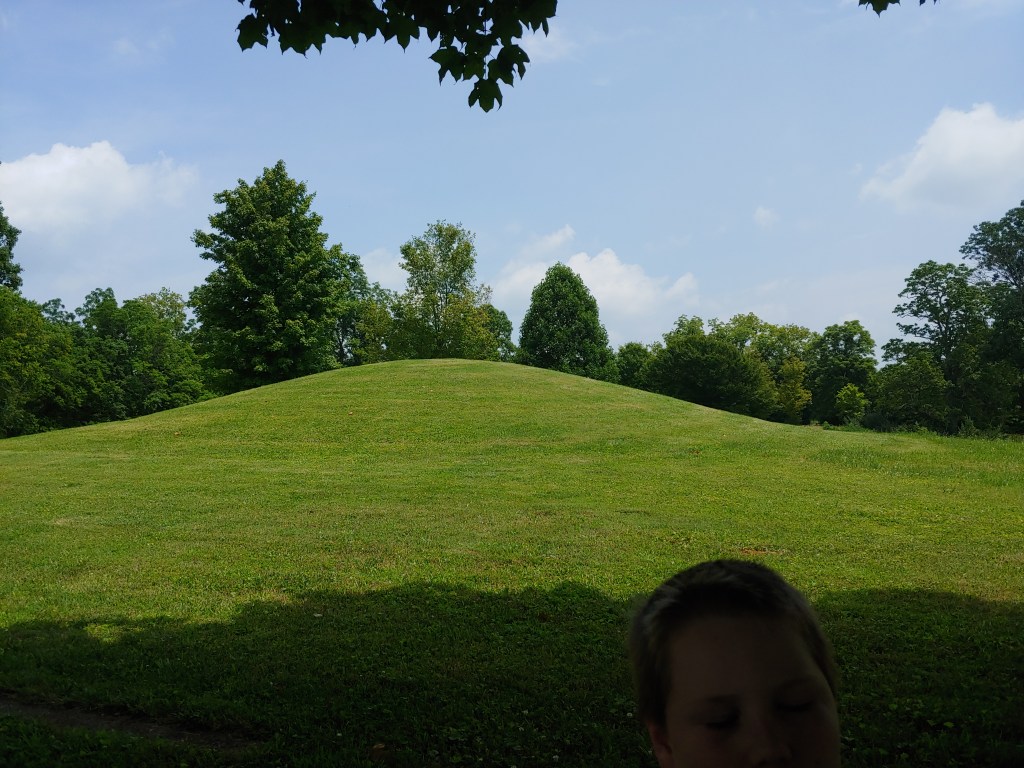
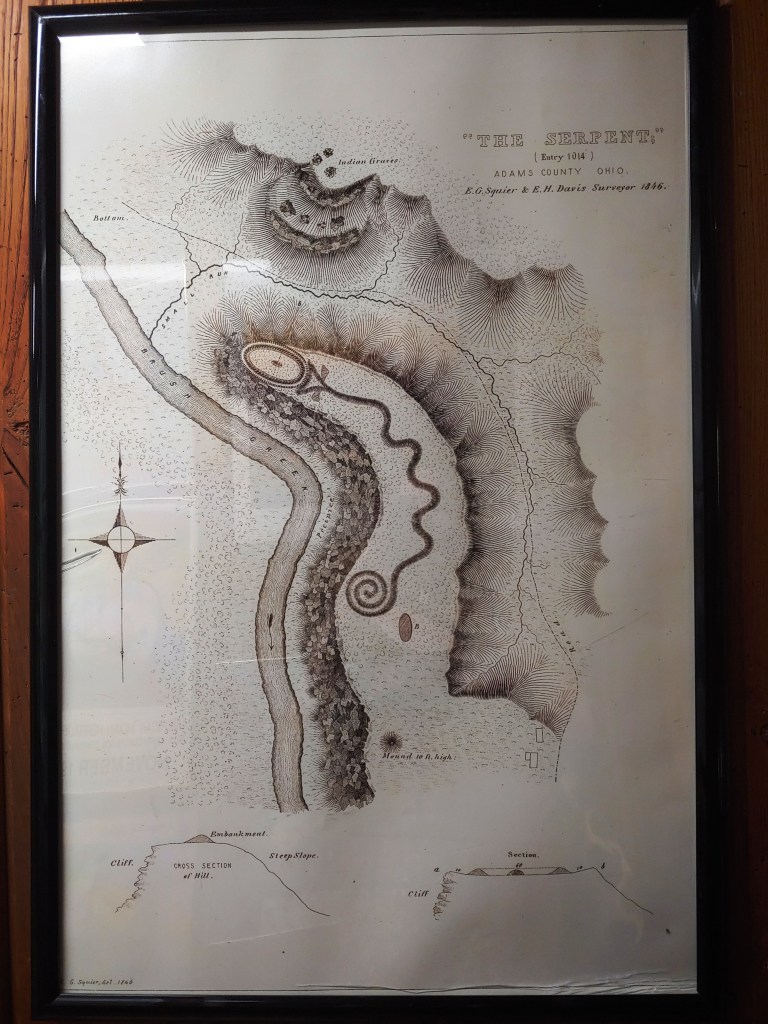
Ohio’s serpent mound was first discovered by white people in about 1846.  It was difficult to survey or even to find due to being covered in trees and brush.  When the brush was partly cleared, it became obvious that the mound, perched on a cliff at the confluence of a creek (which cliff itself resembles the head of a serpent), was a really remarkable earthwork and was designed to be visible from the nearby valley.

The following article will draw on the book The Serpent Mound by E.O. Randall, published in 1905, which is a compilation of maps, surveys, and speculation about the mound by archaeologists of the time; and on my own visit to the mound. One advantage in using these older sources is that we get a variety of voices, we can learn what the Mound looked like when it was first (re)-discovered, and we get an archaeological perspective that is different from the modern one.  For example, one source in Randall’s book says the mound appears to be “not more than 1,000 years old, nor less than 350 years” (p.50).  This is not very precise, but I actually prefer it to a super-confident proclamation about the mound’s age based on dating methods and assumptions that might be suspect.  In fact, the uncertainty of this early source is echoed by the informational video in the mound’s museum.  It features an archaeologist saying that we could get “a million different carbon dates” from the mound because the earth was that used to build it was already old and had been through multiple forest fires, etc.  He adds that it’s basically impossible to carbon-date earthworks.

On the Road to Serpent Mound

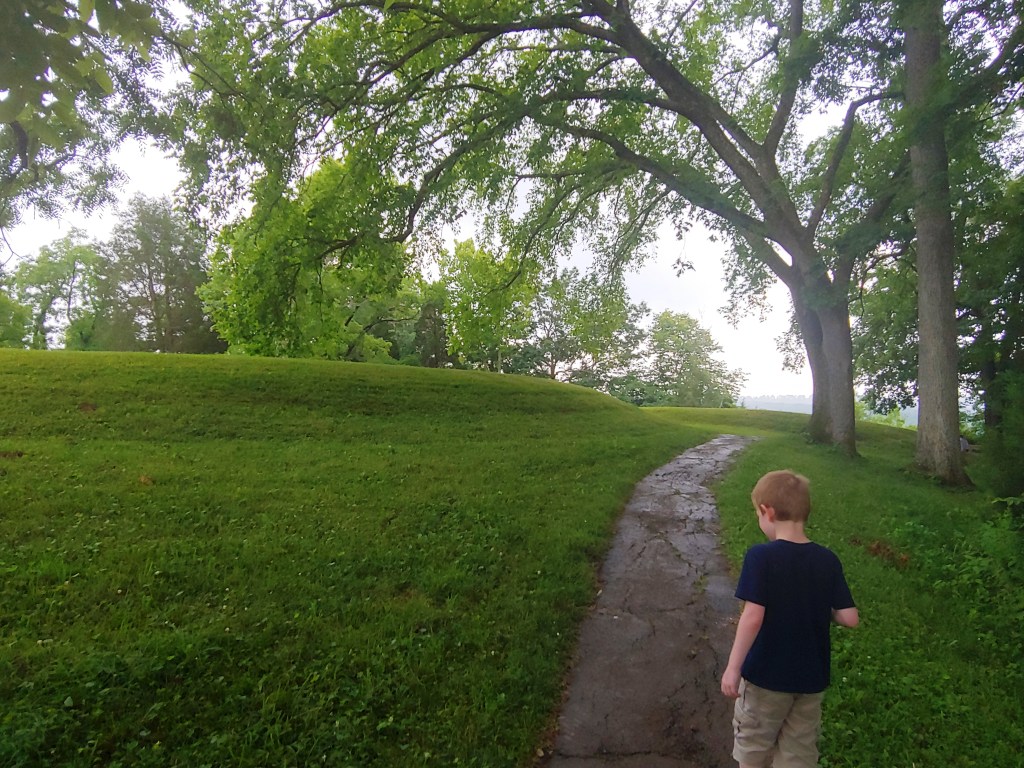
Walking south along the serpent (viewing tower in background)

To get to Serpent Mound (at least from where we are), you get in your car and head south over the Ohio highways.  You leave behind the urban build-up and progress into farm country.  Eventually, the landscape becomes less Midwestern and more Appalachian. Hills and hollers take the place of open farmland.  Finally, after hopping from one rural route to another, you find yourself winding through thickly wooded hills in southern Ohio.  You approach the Mound from the South.  Though it stands on a bluff overlooking Brush Creek, the area is so heavily wooded that you can’t catch a glimpse of the Mound on your way in.

Large burial mound some ways south of the serpent

This land was purchased in 1885.  At that time, the land was owned by a farmer and the Mound was “in a very neglected and deplorable condition” (Randall 106).  To save the Mound from “inevitable destruction,” a Prof. F.W. Putnam arranged to have it bought by the Trustees of the Peabody Museum, Cambridge, where he was Chief of the Ethnological and Archaeological Department.  Putnam later worked to have a law protecting it passed in Ohio, the first law of its kind in the United States (Randall 108).  Today the Mound is a National Historical Landmark.  Besides the Serpent itself, the area includes some additional burial mounds, a picnic shelter, and a tiny, log-cabin-style museum.

You disembark in the parking lot.  The heat, the humidity, the strong sweetish green smells, and the variety of insect life remind you of your Appalachian childhood.  They also remind you why you are planning to move out West.

The Serpent Mound Itself

An old drawing of the serpent as it would look if there were no trees around it (Randall p. 8)

Serpent Mound is difficult to describe in words, so please see the associated maps and photographs.  It is 1335 feet long (winding over an area of about 500 feet), varies from three to six feet high, and slopes downward from the spiral tail to the jaws and egg which stand on the tip of the overlook.  The head faces West towards the sunset at Summer Solstice.   The body includes three bends which may sight towards the sunrises at Summer Solstice, Equinox, and Winter Solstice (short lines of sight and the gentle curves of the Serpent make it difficult to tell whether these alignments were intended for astronomical viewing).

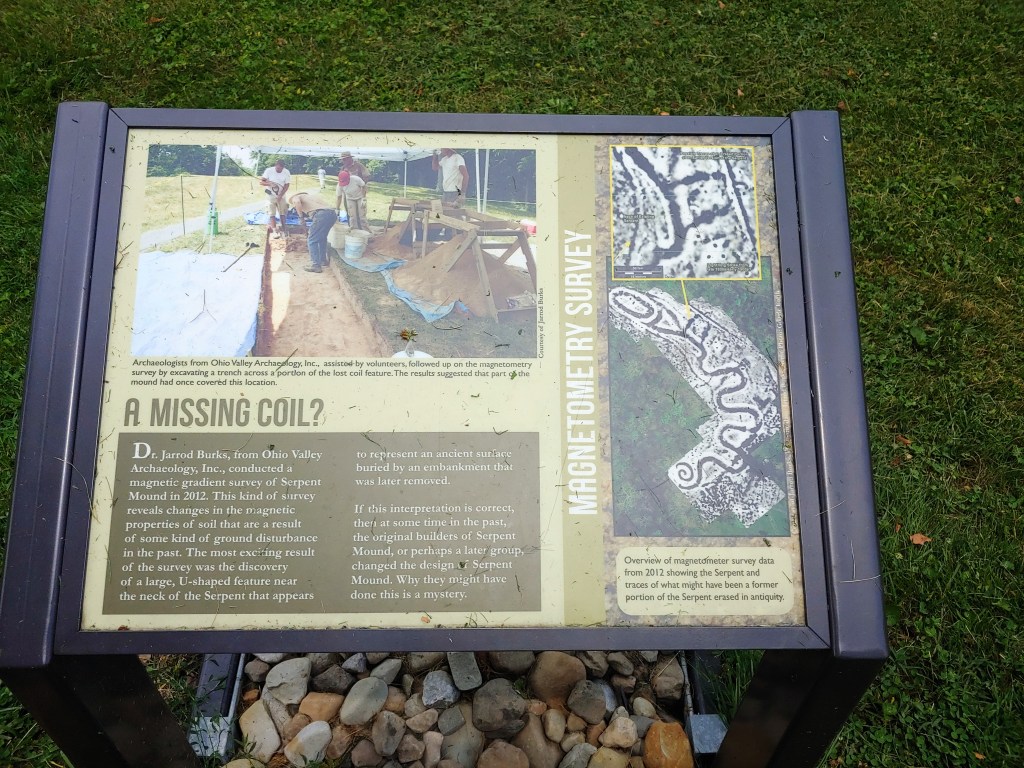
Archaeologists have discovered the serpent once had a fourth coil near the head, which was deliberately dismantled.

It was made apparently by hand on a base of clay, followed by rocks, more clay, dirt, and then sod.  Though it cannot be carbon-dated, there is evidence that it is not as ancient as some megaliths elsewhere in the world.  The bluff it sits on and the creeks that surround it cannot be older than the retreat of the glaciers.   The burials near it date to the Adena period, which runs 600 B.C. to 100 A.D., though there is no way to tell if the burials are contemporaneous with the Serpent or were added later.  There has even been speculation that the Mound could have been built by the Fort Ancient culture, which flourished around 1000 A.D.

The “egg” which the Serpent contains in its jaws (or, the Serpent’s eye) used to have in its center a stone altar which bore traces of fire.  (In the largest burial, too, the corpse was placed on a bed of hot coals and then covered with clay while the coals were still smoldering.)   We assume, then, that the Serpent was the site of ceremonies, but we have no way of knowing anything about their nature.

A close up view of the oval “egg.” It once contained an altar.

The Serpent, despite its name, does not give a spooky or “wrong” feeling.  The scale of it is very human and does not overwhelm.  The shapes and proportions of the curves are pleasing and give a sense of calm and beauty.  The Serpent is, in fact, inviting to walk on.  One is tempted to walk along the curves, climb down into the oval of the egg, step into the middle of the spiral tail.  One cannot do this, of course, as it is strictly forbidden.

The only problem with Serpent aesthetically (if this is a problem) is that it’s impossible to view it all at once.  This is mostly because of the bend in the tail.  In modern times an understated observation tower has been placed next to the Serpent, right near the tailmost curve.  But even from the top of this tower it is impossible to take in the entire Serpent with either eye or cellphone camera.  Looking to the left, we get a view of the spiral tail.  Looking to the right, we see the undulations stretching off into the distance and falling away with the slope of the hill, but even then we cannot see the entire head because it takes its own slight curve and is blocked by trees. 

Approaching the tail spiral. In the background, the cliff drops away into a wooded vista.

I can’t help but think this effect is intentional.  This monument is not designed to be taken in all at once, looking along a line of sight, and to overwhelm the viewer.  Instead, it’s apparently designed to draw us on, tantalizingly offering small charming vista after small charming vista.  There is no one best place to view it.  Perhaps the architects among us can explain what this says about the minds and intentions of the people who designed it.

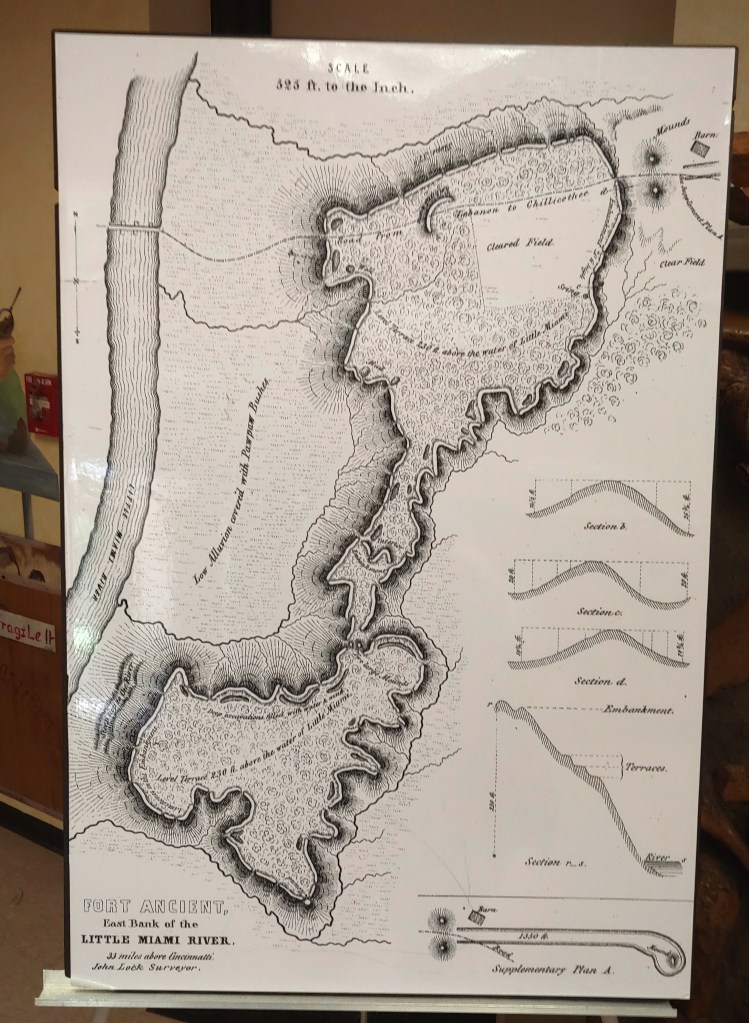
Fort Ancient, another hill-and-plateau complex in southern Ohio, is also sprawling, hard to view, and offers the same “please explore me” effect.

Fort Ancient is a plateau surrounded by man-made hills with gaps in them, overlooking the Little Miami River, Ohio. It has man-made mounds on it as well.

“Effigy Mounds” in North America

The Serpent is definitely not the only large animal-shaped mound in North America.  There are many of them, called by archaeologists “effigy mounds” (not the usual meaning of the term effigy). 

“The effigy mounds appear … in various parts of … the Mississippi Valley.  They are found in many of the southern states; many appear in Illinois, but Wisconsin seems to have been their peculiar field.  Hundreds of them were discovered in that state … In Wisconsin they represent innumerable animal forms: the moose, buffalo, bear, fox, deer, frog, eagle, hawk, panther, elephant, and various fishes, birds and even men and women.  In a few instances, a snake.  In Wisconsin the effigies were usually situated on high ridges along the rivers or on the elevated shores of the lake.  Very few effigy mounds have been found in Ohio – though it is by far the richest field in other forms of mounds.” (Randall 31) 

There are, of course, large animal-shaped terraforms in other parts of the world, such as the Uffington and Westbury White Horses in Britain and the Nazca Lines in Peru.

So Ohio’s serpent mound is not unique.  It is, however, impressive and well-done, and tends to strike people as mysterious and significant.

The Serpent Mound is a Giant Rorschach Blot

Map of the serpent found in the museum

Whatever else it might be, the Serpent Mound reliably functions as a giant Rorschach blot.  It appears significant but ambiguous.  Everyone who is not content to admit that we don’t know its purpose tends to bring their own interpretation.

Here are four examples.

One example, roundly mocked in Randall’s book, is the “amusing and ridiculous” “Garden of Eden fancy” (p. 93).  This theory, put forward by a Baptist minister of the day, is that the Mound was built by God Himself to commemorate the eating of the forbidden fruit and to warn mankind against the Serpent.  The oval object, which many people take to be an egg, is on this view the forbidden fruit itself, which the Serpent is taking in its jaws as if to eat or offer.  Furthermore, the three streams that come together nearby represent the Father, the Son, and the Holy Spirit.  “Pain and death are shown by the convolutions of the serpent, just as a living animal would portray pain and death’s agony … America is, in fact, the land in which Eden was located” (pp 99, 101). 

Now, here’s another interpretation, based on the accepted anthropology of the day: “Students of anthropology, ethnology and archaeology seem to agree that among the earliest of religious beliefs is that of animism or nature worship.  Next to this in the rising scale is animal worship and following it is sun worship.  Animism is the religion of the savage and wilder races, who are generally wanderers.  Animal worship is more peculiarly the religion of the sedentary tribes … Sun worship is the religion of the village tribes and is peculiar to the stage which borders upon the civilized.  ‘Now judging from the circumstances and signs,’ says Dr. Peet, ‘we should say that the emblematic mound builders were in a transition state between the conditions of savagery and barbarism and that they had reached the point where animal worship is very prevalent’” (pp. 37 – 38).

This theory of the slow development of man’s religion as they rise out of “savagery” into “barbarism” and finally into “civilization” is reported with much more respect than the Baptist pastor’s theory, but it is in fact just as fanciful.  It is based on an overly neat-and-tidy and, frankly, snobby view of the history of religion that was popular for many years but that actual history does not support.  But, again, Rorschach blot.

Many other observors have linked the Mound with its oval to the “egg and serpent” origin mythology that crops up in many places in the world, including Greece and India. This theory receives many pages in Randall’s book.

We got rained on while at Serpent Mound. Coincidence? I think not!

To take just one more out of many other examples, on this very blog we learned from a book review that Graham Hancock’s latest book prominently features the Serpent Mound as part of his latest theory that North America is, in fact, the source of the Atlantis legends.  He believes that the Mound is meant to represent the constellation Draco and was built during an era when Draco was ascendant.  Or something like that.

I, too, have taken the Serpent Mound Rorschach test and here is what I see.  I see more evidence that serpent mythology (with or without eggs) and the strong motivation to build large, long-lasting religious monuments are both universal in human culture.  I personally think that these things didn’t arise independently in every corner of the world but were carried distributively and that they represent distant memories of certain events in human history, which are hinted at but not fleshed out in the early chapters of Genesis. However, I am not fool enough to think that the existence of Serpent Mound “proves” any of this.  It is, as I said, a Rorschach blot.

Other Serpent Mounds Around the World

Otonabee Serpent Mound sits on the north shore of Rice Lake, not far from the city of Toronto, Ontario (Randall 114). It is 189 feet long. The head faces “a few degrees north of east,” with an oval burial mound in front of the head which could represent an egg (115). 

In Scotland, there is the stone serpent of Loch Nell:

“The mound is situated on a grassy plain.  The tail of the serpent rests near the shore of Loch Nell, and the mound gradually rises seventeen to twenty feet in height and is continued for 300 feet, ‘forming a double curve like the letter S’ … the head lies at the western end [and] forms a circular cairn, on which [in 1871] there still remained some trace of an altar, which has since wholly disappeared, thanks to the cattle and herd boys.  … The mound has been formed in such a position that worshippers, standing at the altar, would naturally look eastward, directly along the whole length of the great reptile, and across the dark lake to the triple peaks of Ben Chruachan. This position must have been carefully selected, as from no other point are the three peaks visible.  General Forlong … says, ‘Here we have an earth-formed snake, emerging in the usual manner from dark water, at the base, as it were, of a triple cone – Scotland’s Mount Hermon, – just as we so frequently meet snakes and their shrines in the East.’” (Randall pp. 121 – 122)

Speaking of Mount Hermon.  This large, lone mountain sits at the northern end of the Golan Heights in Israel.  It is so high that it is home to a winter ski resort.  In ancient times, this region was called Bashan.  It was known for its large and vigorous animals (the “bulls of Bashan”), and for its humanoid giants.  Down to Hellenistic times, Bashan was a center for pagan worship (the Greek god Pan had a sacred site there).  And guess what else it has?  A serpent mound.

“The serpent mound of Bashan has ruins on its head and tail.  The ruins are square (altars?) on top of small circular mounds” (Van Dorn 144).  

The Ohio serpent’s spiral tail, which evokes a stone circle. Viewing tower in the background.

This serpent mound is less than mile from a stone circle called Gilgal Rephaim (“Wheel of the Giants”).  (Stone circles, as sacred sites, are also found throughout the world.)  “The Wheel contains some 42,000 tons of partly worked stone, built into a circle 156 meters in diameter and 8 feet high on the outer wall.  It is aligned to the summer solstice.  The area is littered with burial chambers … If you go due North of the Wheel, [sighting] through the serpentine mound [and proceed] for 28 miles, you will run straight into the summit of Mt. Hermon” (Van Dorn 145).

Serpent, altar, circle, and sacred mountain.  I don’t know about you, but the site in Golan sounds a lot scarier to me than Ohio’s Serpent Mound. However, it also makes me wonder whether people in Ohio – and Scotland – were trying to re-create this arrangement.

Sources

Giants: Sons of the gods by Douglas Van Dorn, Waters of Creation Publishing, Erie, Colorado, 2013.

The Serpent Mound: Adams County, Ohio: Mystery of the Mound and History of the Serpent: Various Theories of the Effigy Mounds and the Mound Builders, by E.O. Randall (L.L., M., Secretary Ohio State Archeological and Historical Society; Reporter Ohio Supreme Court), Coachwhip Publications, Greenville Ohio, 2013.  First published 1905.  This book is a compilation: “The effort has been made not merely to give a description, indeed several descriptions, of Serpent Mound, but also to set forth a summary of the literature concerning the worship of the serpent. … It is hoped that this volume, while it may not solve the problem of the origin and purpose of the Serpent Mound, will at least add to its interest and give the reader such information as it is possible to obtain.” (page 5)

Giants II

Photo by NEOSiAM 2020 on Pexels.com

Welcome to October, month of Halloween! Every Friday, we will discuss scary things. This week’s scary thing is giants, and specifically the proper use of the word cannibalism.

A few weeks ago, I wrote a post arguing that in both ancient history and folklore, giants are more horror creature than fantasy creature. Part of the reason for this is that they eat people. My question for you is, Can we properly call them cannibals?

But first, a detour about eating blood

In my second book, The Strange Land, the people group whose adventures I am following (I think of them as “my” people) tell stories of giants who eat people and animals indiscriminately. Their euphemism for them is “blood eaters.”

Some religions have a taboo on “eating meat with the blood still in it.” In Indonesia, there is a special word for such meat. If you want to eat, say, a chicken, the word for the animal and the meat is ayam. But that’s only if the bird has been killed properly and bled out. If these rules have not been followed, it is ayam bangkai, which translates as “chicken carrion” or “corpse chicken.” If you are a devout Muslim, you would not eat meat without knowing that it has been butchered in the proper manner. Otherwise, you could accidentally defile yourself by eating ayam bangkai or some other kind of bangkai.

Obviously, this rule goes way back, at least to Leviticus:

“Any Israelite or any alien living among them who eats any blood — I will set my face against that person who eats blood and will cut him off from his people. For the life of a creature is in the blood, and I have given it to you to make atonement for yourselves on the altar; it is the blood that makes atonement for one’s life. Therefore I say to the Israelites, ‘None among you may eat blood, nor may an alien living among you eat blood.’

“Any Israelite or any alien living among you who hunts any animal or bird that may be eaten must drain out the blood and cover it with earth, because the life of every creature is its blood.”

Leviticus 17:10 – 14

There is a similar passage in Deuteronomy 12:23.

Here in Leviticus, God gives two reasons for the taboo on blood-eating. First of all, the blood is important to the sacrificial system that He had set up for the Israelites. “I have given it to you to make atonement for yourselves on the altar.” This blood was a key part of God’s solution for dealing with the people’s sins. Obviously, to eat such a thing for mere physical nourishment would be to take lightly the evil in one’s own people, family, and heart, and to disrespect the sacrificial system and, by extension, the One who set it up. Note that God does not expect the other nations, to whom He has not yet given this sacrificial system, to abstain from blood, unless an individual foreigner happens to be living among the Israelites, and therefore presumably learning about and also benefiting from that system.

The other reason, which seems to be implied here, is that eating or drinking an animal’s blood shows disrespect for the creature itself. “The life of every creature is its blood.” Even when out hunting, and not bringing an animal for sacrifice, He tells them to bleed out the body and to cover the blood with earth, as if to symbolically give the animal a proper burial before we take it home and eat it.

Apparently, avoiding eating an animal’s blood is the respectful, civilized, human thing to do. This is very different from the usual picture we are given of ancient people, where they club something in the field and then tear right into it with their teeth.

I have described elsewhere how Genesis 6:1 – 4 tells of spiritual beings interbreeding with human women, producing a race of giants who terrorized the earth. This would have been before the Flood (and was probably a major reason for the Flood), which makes the time frame very ancient indeed. The extrabiblical book of 1 Enoch tells us,

“and when the people were not able to sustain them [with agriculture], the giants dared (to attack) them, and they devoured the people. And they began to sin with birds and wild animals and reptiles and fish, and to devour one another’s (!) flesh, and drink blood.” (I Enoch 7:2 – 6, quoted in Giants by Doug Van Dorn, p. 60)

This horrifying practice was apparently common knowledge even as “recently” as the time of the Exodus, which is still ancient history but is now within the realm of recorded history, not just dim memories. When the Israelites arrived on the border of the land of Canaan, having escaped from Egypt, Joshua sent twelve men to spy out the land. They came back and reported “it is a land that devours its inhabitants” (Numbers 13:32 -33). That’s why they were so scared. Even after having seen God’s ability to deliver them from the merely human inhabitants of Egypt, they recommended not entering the promised land for their own safety.

I am not arguing that the Biblical taboo on eating blood was given because the giants ate blood. I see it in reverse: eating blood — like eating people, like bestiality — was just one of many obvious and intuitive taboos in ordinary human morality which the giants either were unable to perceive or perversely sought to break.

This picture of giants as somehow paranormal and as eating humans and/or drinking their blood is well attested in world folklore. Polyphemus, the cyclops who captures Odysseus and his men in the Odyssey, will literally pick up a human and eat him alive. And he’s not hunting them like animals. He is fully aware that the sailors he has captured are persons and can talk, and he doesn’t care. He likes Odysseus, and so promises to eat him last.

Beyond Polyphemus, Van Dorn points out in his book that cultures all around the world have stories about paranormal creatures that seek to drink human blood, though they are not always portrayed as giants.

About the word “cannibal”

Surely, cannibalism has to be one of the last taboos. Even if you have been exposed to the concept before, it never seems to lose its shock value. (“Soylent Green is people!!!“)

On the other hand, the idea of a giant eating people, I believe has lost its shock value, though maybe it shouldn’t have. We associate it with fairy tales. After all, how scary can a character be if he lives in the clouds and goes around saying Fe, Fi, Fo, Fum?

To recover the shock value, I propose using the term “cannibal giants.” But there’s a problem. Technically, cannibalism means eating your own kind. Technically, these giants aren’t human. So, is this hyperbole only slightly less serious than that committed by every earnest 13-year-old vegetarian who calls her parents “cannibals” for eating something was that once sentient?

I argue no, for two reasons. For one thing, giants are clearly humanoid. They look like people (more or less). In Genesis, they have human mothers. Critically, like Polyphemus, they can talk. If they were less human-y, it wouldn’t make sense to call them cannibal. We would call them man-eating, like a man-eating tiger, which would still be scary, but not as much so, because it would be done more innocently somehow.

Secondly, the word cannibal actually has two subtly distinct senses. One, indeed, is the idea of eating one’s own kind. So we can say chickens or spiders are cannibals, or we can talk about someone cannibalizing their own ideas. But the other meaning is just eating people, who are a thing which should not be eaten, and I think this its primary meaning. Once that line has been crossed, humanity itself is now somehow defiled. We have been shown that it’s possible to think of people not as sacred bearers of the image of God, irreplaceable individuals, eternal embodied souls … but as a substance. A food source. We are being invited to change the way we view ourselves and our fellow humans, and this is true whether that ancient taboo is being broken by actual humans, or just by creatures that look sort of human and can talk and, frankly, ought to know better.

Neither one is great.

So I am going to go ahead and call these giants cannibals.

Giants

This is actually just a person in a tunnel, but imagine that it’s Polyphemus, blocking your way out of his cave.

How creepy, on a scale of 1 to 10, do you find the idea of giants?

I must confess, I was never particularly bothered by them. They have never struck me as uncanny. Just extra-large people, right? This might be partly because of portrayals like Disney’s, where the giants(s) are not too malevolent and certainly not too bright.

And the Iron Giant, and Gulliver when he was in Lilliput. In all of these cases, the fact of a person being huge creates some interesting logistical problems, but it certainly isn’t horror in the same category as anything unnatural, undead, or even as really depraved human evil.

All that to say, if I had set about, unguided, to pick a force of evil for my story, giants would not be the first place I would have gone.

Nevertheless, giants ended up in my first novel because they are featured in Genesis.

[The] story is told succinctly in Genesis 6:1 – 4, one of the most enigmatic and misinterpreted passages in the Bible. Here is how it reads in the oldest surviving copy … the Greek Septuagint:

“And it came to pass when men began to be numerous upon the earth, and daughters were born to them, that the sons of God having seen the daughters of men that they were beautiful, took to themselves wives of all whom they chose. … Now the giants were upon the earth in those days; and after that when the sons of God were wont to go in to the daughters of men, they bore children to them, those were the giants of old, men of renown.”

[In this book], we will proceed upon the premise that this passage tells of a time in the remote past when heavenly beings entered the abode of humans, and through our women were able to spawn a race of half-breed children, giants that all cultures throughout the world remember as powerful and often wicked, ruthless demigods.

Douglas Van Dorn, Giants: sons of the gods, pp. 2 – 3, emphasis in the original

In other words, that there were once, in actual history, giants that were half human, and that could in some sense be called demigods.

In the rest of the book, Van Dorn looks in detail at this passage and others, and answers arguments about whether this passage, and other passages that seem to assume the same background, should be interpreted to be talking about literal giants or about the people of God versus humans who had rejected God. He also delves into Hebrew terms for other demonic and paranormal creatures, terms that often get rendered as various animals in modern translations.

I am not going to get into the exegetical discussion in this post. But I am going to touch on how Van Dorn’s thesis – that this stuff actually happened, way back in the mists of human history – is backed up by what is usually called mythology.

It is a really strange fact that every culture has stories about giants, gods, and various other supernatural creatures (including chimeras, but that’s another topic). This fact does not strike us as strange – at least, it didn’t me – precisely because these stories are so old and so universal. We just accept it as a given that human “legends” and “myths” deal with threatening creatures that we do not see today. We don’t look for an explanation of why this should be. I am sure that Jung could give you a psychological explanation for the universality of giant stories. Jordan Peterson could give you a Jungian, evolutionary explanation.

And certainly, the idea of a giant as a large and threatening presence is deeply embedded in the human mind. But why? How did this idea get there? Why aren’t our symbols of evil just bears and saber-toothed tigers, if those were the only threats our ancestors were dealing with?

If you go to Bali, you can see sculptures of an ugly, bearded giant being attacked by an eagle as he attempts to carry off a beautiful girl with an elaborate crown and hair that falls to her ankles. This is an illustration of a scene from the Ramayana, an ancient Indian epic that, in the millennia since it entered Indonesia, has there acquired its own flavor. In the Indonesian version, the beautiful girl is Sinta, bride of the prince Rama. The giant (raksasa) captures her through deception, carries her off, and is able to fly to get her back to his castle. The heroic eagle (garuda) attacks him in the air. This is a favorite scene for sculptors and illustrators, who still exist in great numbers in Bali and are insanely talented. The story is also told in shadow-puppet plays and operas.

In Borneo, where I had the privilege to live for a few years, they have their own local legends. One common theme in these is that you should not marry outside your clan, because if you marry a girl from an unknown people, she might turn out not to be human. In one story, a young man marries a foreign girl. When she goes down to the river to bathe, he goes to spy on her and is shocked to see her take off her head.

One area, where we lived for about a year, had a large local mountain with a distinctive jagged top. As the story went, this mountain once reached the clouds. A giant used to climb down it in order to eat the people down below. Then a female hero used a machete to hack off the top of the mountain. The giant, now trapped in the clouds, looks down upon the people but cannot eat them anymore. It drools, and the drops of drool become the bloodsucking leeches that live in the jungle on the slopes of the mountain. Still trying to eat the people, you see.

These few stories from island southeast Asia illustrate features that show up associated with giants again and again: kidnapping/rape, and eating people. (I mean, that is virtually all the giants and demigods do in the Greek myths, for example.) I mention these stories from Bali and Borneo to show just what a wide geographical area the human consensus on giant behavior seems to cover.

Given all this, giants are starting to look more like what we in our house would call a “horror creature.” To review: based on Genesis and numerous myths worldwide, the giants:

  • are not fully human, but are some sort of human/supernatural hybrid
  • are nevertheless fully physical and present in actual history
  • seem to like kidnapping human women
  • seem to like eating people
  • are smart enough to practice deception

Ok, now this is starting to get scary. If we accept that these myths are historical memories, then all of a sudden, hearing giant stories is sort of like hearing about atrocities committed by people during the Holocaust, or the Communist takeover of Cambodia, or any other of humanity’s many periods of pure, unrestrained, depraved evil. But it’s scary in another way too. Given the purported origin of these giants, it’s like hearing about a successful genetic experiment, or like finding out that demon possession is real.

I’ve always kind of longed to live in the really ancient ages of the world. But, the more I learn, the more relieved I am to be living in modern times. We slam the door to the giants shut behind us, and lean against it, panting.

The “Never Have I Ever” Tag for Writers

How appropriate that just as I am starting to do a bunch of posts about publishing, the orangutan librarian should tag me with this bunch of questions about the writing process! The original idea was created by the Long Voyage- so definitely check out the original here!

This tag asks writers about whether they have ever engaged in a number of (mostly disreputable) behaviors. The headings will say the behavior, and then I’ll comment about whether it applies to me.

Never Have I Ever …

. . . started a novel that I did not finish.

I have started, and not finished, a number of novels. You know that whole idea that an artist can create a complete work in his or her head and then it’s irrelevant whether they ever put it on paper or canvas or whatever? That’s baloney. The actual process of enfleshing the work forces you to include so much more detail than you do in your head when you see the end from the beginning.

. . . written a story completely by hand.

(gets dreamy look)

As teenagers, my BFF and I used to write stories together. We would pass a notebook back and forth. Each of us controlled certain characters. We would write notes to each other and argue with each other in the margins.

My parts of those particular stories were the worst tripe ever written. We all have to write our awful tripe on the way to becoming writers.

. . . changed tenses midway through a story.

What?

. . . not researched anything before starting a story.

It’s never possible to do enough research.

But the experts don’t agree.

Also, if you research too long, you can end up talking yourself out of the premise for your story, at which point you’ve ripped out its heart.

So far, my stories have been inspired by cool theories (“research”) about the ancient world. So, I take the premise from the research. (See the ‘ancient world’ tag on my blog for all the stuff that interests me.) I have, so far, avoided setting my stories in really well-documented periods of ancient history (such as Rome) because of the sheer amount of research that would be required so as not to make glaring errors about the details of daily life.

Anyway, see the Bibliography page of this blog for a constantly slightly outdated, constantly growing tally of my sources.

. . . changed my protagonist’s name halfway through a draft.

I like stories that feature someone assimilating to a foreign culture. A total or partial name change is often part of this. So my protagonist Nimri starts out being called Nimri, which is basically Sumerian, but as they get to know him, the people around him eventually start calling him Nirri and that’s how he finishes the story. This is kind of an inconvenient feature, actually, because it makes it difficult to refer to him in summaries.

As for changing a name completely, just for the heck of it, I haven’t done so yet. But Find & Replace will make it easy to do if someone ever comes to me and says, “This name means [dirty word] in [major world language].”

. . . written a story in a month or less.

Short stories, yes.

. . . fallen asleep while writing.

What?

. . . corrected someone’s grammar irl / online.

Scene: Husband and I have been married less than a year, visiting a friend of his.

Friend: I need to go get some groceries. [Names several cleaning supplies, none of which are edible]

Me: Those things are not normally included in the core definition of ‘groceries.’

Friend: Well, excuuuuse me!

Me: (laughing) You are talking to a linguist.

Friend: That’s not the word that I thought of.

. . . yelled in all caps at myself in the middle of a novel.

No.

. . . used “I’m writing” as an excuse.

More like finding other tasks as an excuse not to write.

. . . killed a character who was based on someone I know in real life.

Mmm sooo …. I used to create characters based on my crushes and then kill them off. Yes, I was a sick puppy. Putting the best possible construction on it, I had figured out that killing off a character was the most poignant thing you can do in a story and I was overusing that tool sort of like a kid constantly dropping a new vocabulary word.

. . . used pop culture references in a story.

I avoid these because I am certain to use them clumsily, plus they will soon become dated. It’s part of the reason that my novels are set in the distant past, and that I may never try a “contemporary” novel.

. . . written between the hours of 1am and 6am.

Only at university, when finishing a paper due the next day. (Fun fact: if I stay up all night, I throw up!)

. . . drank an entire pot of coffee while writing.

While writing papers in college, yes, remembering that my “pot” only made two or three cups at a time. Also, vending machine brownies. Good times!

. . . written down dreams to use in potential novels.

Only once, age eleven.

. . . published an unedited story on the internet / Wattpad / blog.

No, but I have turned in a crummy first draft of a devotional essay to a church magazine. I believe the editor used his discretion and didn’t run it.

. . . procrastinated homework because I wanted to write.

Well, this gets into the whole topic of my work habits, which I’d rather not discuss …

. . . typed so long that my wrists hurt.

Not that I recall. I tend to take pauses for thinking.

. . . spilled a drink on my laptop while writing.

No, but that’s probably just dumb luck. I don’t take care of my equipment nearly as well as I should.

. . . forgotten to save my work / draft.

No, and I have even been known to send copies of Word documents to relatives so that copies exist out there in case my house burns down.

. . . finished a novel.

Two and counting.

. . . laughed like an evil villain while writing a scene.

… Um … I don’t think so? Not aware of the sounds I make while writing. Possibly grunts.

. . . cried while writing a scene.

Even in real life I am more likely to cry when angry, frustrated, or humiliated, rather than when sad. I’m not sure what that says about me. Nothing good, probably.

But I have certainly given myself the sads with my writing.

. . . created maps of my fictional worlds.

. . . researched something shady for a novel.

Giants and chimeras in history

horrible pagan practices of the ancient world

abusive husbands

what happens when a person falls into a super-hot sulpherous pool, as at Yellowstone National Park

All equally terrifying.

Now, Your Turn

In the comments section, tell me all your writerly habits! Or, judge mine!

Serpent Mound, Ohio

Body of the serpent seen from the viewing tower, looking North

Ohio’s serpent mound was first discovered by white people in about 1846.  It was difficult to survey or even to find due to being covered in trees and brush.  When the brush was partly cleared, it became obvious that the mound, perched on a cliff at the confluence of a creek (which cliff itself resembles the head of a serpent), was a really remarkable earthwork and was designed to be visible from the nearby valley.

The following article will draw on the book The Serpent Mound by E.O. Randall, published in 1905, which is a compilation of maps, surveys, and speculation about the mound by archaeologists of the time; and on my own visit to the mound. One advantage in using these older sources is that we get a variety of voices, we can learn what the Mound looked like when it was first (re)-discovered, and we get an archaeological perspective that is different from the modern one.  For example, one source in Randall’s book says the mound appears to be “not more than 1,000 years old, nor less than 350 years” (p.50).  This is not very precise, but I actually prefer it to a super-confident proclamation about the mound’s age based on dating methods and assumptions that might be suspect.  In fact, the uncertainty of this early source is echoed by the informational video in the mound’s museum.  It features an archaeologist saying that we could get “a million different carbon dates” from the mound because the earth was that used to build it was already old and had been through multiple forest fires, etc.  He adds that it’s basically impossible to carbon-date earthworks.

On the Road to Serpent Mound

Walking south along the serpent (viewing tower in background)

To get to Serpent Mound (at least from where we are), you get in your car and head south over the Ohio highways.  You leave behind the urban build-up and progress into farm country.  Eventually, the landscape becomes less Midwestern and more Appalachian. Hills and hollers take the place of open farmland.  Finally, after hopping from one rural route to another, you find yourself winding through thickly wooded hills in southern Ohio.  You approach the Mound from the South.  Though it stands on a bluff overlooking Brush Creek, the area is so heavily wooded that you can’t catch a glimpse of the Mound on your way in.

Large burial mound some ways south of the serpent

This land was purchased in 1885.  At that time, the land was owned by a farmer and the Mound was “in a very neglected and deplorable condition” (Randall 106).  To save the Mound from “inevitable destruction,” a Prof. F.W. Putnam arranged to have it bought by the Trustees of the Peabody Museum, Cambridge, where he was Chief of the Ethnological and Archaeological Department.  Putnam later worked to have a law protecting it passed in Ohio, the first law of its kind in the United States (Randall 108).  Today the Mound is a National Historical Landmark.  Besides the Serpent itself, the area includes some additional burial mounds, a picnic shelter, and a tiny, log-cabin-style museum.

You disembark in the parking lot.  The heat, the humidity, the strong sweetish green smells, and the variety of insect life remind you of your Appalachian childhood.  They also remind you why you are planning to move out West.

The Serpent Mound Itself

An old drawing of the serpent as it would look if there were no trees around it (Randall p. 8)

Serpent Mound is difficult to describe in words, so please see the associated maps and photographs.  It is 1335 feet long (winding over an area of about 500 feet), varies from three to six feet high, and slopes downward from the spiral tail to the jaws and egg which stand on the tip of the overlook.  The head faces West towards the sunset at Summer Solstice.   The body includes three bends which may sight towards the sunrises at Summer Solstice, Equinox, and Winter Solstice (short lines of sight and the gentle curves of the Serpent make it difficult to tell whether these alignments were intended for astronomical viewing).

Archaeologists have discovered the serpent once had a fourth coil near the head, which was deliberately dismantled.

It was made apparently by hand on a base of clay, followed by rocks, more clay, dirt, and then sod.  Though it cannot be carbon-dated, there is evidence that it is not as ancient as some megaliths elsewhere in the world.  The bluff it sits on and the creeks that surround it cannot be older than the retreat of the glaciers.   The burials near it date to the Adena period, which runs 600 B.C. to 100 A.D., though there is no way to tell if the burials are contemporaneous with the Serpent or were added later.  There has even been speculation that the Mound could have been built by the Fort Ancient culture, which flourished around 1000 A.D.

The “egg” which the Serpent contains in its jaws (or, the Serpent’s eye) used to have in its center a stone altar which bore traces of fire.  (In the largest burial, too, the corpse was placed on a bed of hot coals and then covered with clay while the coals were still smoldering.)   We assume, then, that the Serpent was the site of ceremonies, but we have no way of knowing anything about their nature.

A close up view of the oval “egg.” It once contained an altar.

The Serpent, despite its name, does not give a spooky or “wrong” feeling.  The scale of it is very human and does not overwhelm.  The shapes and proportions of the curves are pleasing and give a sense of calm and beauty.  The Serpent is, in fact, inviting to walk on.  One is tempted to walk along the curves, climb down into the oval of the egg, step into the middle of the spiral tail.  One cannot do this, of course, as it is strictly forbidden.

The only problem with Serpent aesthetically (if this is a problem) is that it’s impossible to view it all at once.  This is mostly because of the bend in the tail.  In modern times an understated observation tower has been placed next to the Serpent, right near the tailmost curve.  But even from the top of this tower it is impossible to take in the entire Serpent with either eye or cellphone camera.  Looking to the left, we get a view of the spiral tail.  Looking to the right, we see the undulations stretching off into the distance and falling away with the slope of the hill, but even then we cannot see the entire head because it takes its own slight curve and is blocked by trees. 

Approaching the tail spiral. In the background, the cliff drops away into a wooded vista.

I can’t help but think this effect is intentional.  This monument is not designed to be taken in all at once, looking along a line of sight, and to overwhelm the viewer.  Instead, it’s apparently designed to draw us on, tantalizingly offering small charming vista after small charming vista.  There is no one best place to view it.  Perhaps the architects among us can explain what this says about the minds and intentions of the people who designed it.

Fort Ancient, another hill-and-plateau complex in southern Ohio, is also sprawling, hard to view, and offers the same “please explore me” effect.

Fort Ancient is a plateau surrounded by man-made hills with gaps in them, overlooking the Little Miami River, Ohio. It has man-made mounds on it as well.

“Effigy Mounds” in North America

The Serpent is definitely not the only large animal-shaped mound in North America.  There are many of them, called by archaeologists “effigy mounds” (not the usual meaning of the term effigy). 

“The effigy mounds appear … in various parts of … the Mississippi Valley.  They are found in many of the southern states; many appear in Illinois, but Wisconsin seems to have been their peculiar field.  Hundreds of them were discovered in that state … In Wisconsin they represent innumerable animal forms: the moose, buffalo, bear, fox, deer, frog, eagle, hawk, panther, elephant, and various fishes, birds and even men and women.  In a few instances, a snake.  In Wisconsin the effigies were usually situated on high ridges along the rivers or on the elevated shores of the lake.  Very few effigy mounds have been found in Ohio – though it is by far the richest field in other forms of mounds.” (Randall 31) 

There are, of course, large animal-shaped terraforms in other parts of the world, such as the Uffington and Westbury White Horses in Britain and the Nazca Lines in Peru.

So Ohio’s serpent mound is not unique.  It is, however, impressive and well-done, and tends to strike people as mysterious and significant.

The Serpent Mound is a Giant Rorschach Blot

Map of the serpent found in the museum

Whatever else it might be, the Serpent Mound reliably functions as a giant Rorschach blot.  It appears significant but ambiguous.  Everyone who is not content to admit that we don’t know its purpose tends to bring their own interpretation.

Here are four examples.

One example, roundly mocked in Randall’s book, is the “amusing and ridiculous” “Garden of Eden fancy” (p. 93).  This theory, put forward by a Baptist minister of the day, is that the Mound was built by God Himself to commemorate the eating of the forbidden fruit and to warn mankind against the Serpent.  The oval object, which many people take to be an egg, is on this view the forbidden fruit itself, which the Serpent is taking in its jaws as if to eat or offer.  Furthermore, the three streams that come together nearby represent the Father, the Son, and the Holy Spirit.  “Pain and death are shown by the convolutions of the serpent, just as a living animal would portray pain and death’s agony … America is, in fact, the land in which Eden was located” (pp 99, 101). 

Now, here’s another interpretation, based on the accepted anthropology of the day: “Students of anthropology, ethnology and archaeology seem to agree that among the earliest of religious beliefs is that of animism or nature worship.  Next to this in the rising scale is animal worship and following it is sun worship.  Animism is the religion of the savage and wilder races, who are generally wanderers.  Animal worship is more peculiarly the religion of the sedentary tribes … Sun worship is the religion of the village tribes and is peculiar to the stage which borders upon the civilized.  ‘Now judging from the circumstances and signs,’ says Dr. Peet, ‘we should say that the emblematic mound builders were in a transition state between the conditions of savagery and barbarism and that they had reached the point where animal worship is very prevalent’” (pp. 37 – 38).

This theory of the slow development of man’s religion as they rise out of “savagery” into “barbarism” and finally into “civilization” is reported with much more respect than the Baptist pastor’s theory, but it is in fact just as fanciful.  It is based on an overly neat-and-tidy and, frankly, snobby view of the history of religion that was popular for many years but that actual history does not support.  But, again, Rorschach blot.

Many other observors have linked the Mound with its oval to the “egg and serpent” origin mythology that crops up in many places in the world, including Greece and India. This theory receives many pages in Randall’s book.

We got rained on while at Serpent Mound. Coincidence? I think not!

To take just one more out of many other examples, on this very blog we learned from a book review that Graham Hancock’s latest book prominently features the Serpent Mound as part of his latest theory that North America is, in fact, the source of the Atlantis legends.  He believes that the Mound is meant to represent the constellation Draco and was built during an era when Draco was ascendant.  Or something like that.

I, too, have taken the Serpent Mound Rorschach test and here is what I see.  I see more evidence that serpent mythology (with or without eggs) and the strong motivation to build large, long-lasting religious monuments are both universal in human culture.  I personally think that these things didn’t arise independently in every corner of the world but were carried distributively and that they represent distant memories of certain events in human history, which are hinted at but not fleshed out in the early chapters of Genesis. However, I am not fool enough to think that the existence of Serpent Mound “proves” any of this.  It is, as I said, a Rorschach blot.

Other Serpent Mounds Around the World

Otonabee Serpent Mound sits on the north shore of Rice Lake, not far from the city of Toronto, Ontario (Randall 114). It is 189 feet long. The head faces “a few degrees north of east,” with an oval burial mound in front of the head which could represent an egg (115). 

In Scotland, there is the stone serpent of Loch Nell:

“The mound is situated on a grassy plain.  The tail of the serpent rests near the shore of Loch Nell, and the mound gradually rises seventeen to twenty feet in height and is continued for 300 feet, ‘forming a double curve like the letter S’ … the head lies at the western end [and] forms a circular cairn, on which [in 1871] there still remained some trace of an altar, which has since wholly disappeared, thanks to the cattle and herd boys.  … The mound has been formed in such a position that worshippers, standing at the altar, would naturally look eastward, directly along the whole length of the great reptile, and across the dark lake to the triple peaks of Ben Chruachan. This position must have been carefully selected, as from no other point are the three peaks visible.  General Forlong … says, ‘Here we have an earth-formed snake, emerging in the usual manner from dark water, at the base, as it were, of a triple cone – Scotland’s Mount Hermon, – just as we so frequently meet snakes and their shrines in the East.’” (Randall pp. 121 – 122)

Speaking of Mount Hermon.  This large, lone mountain sits at the northern end of the Golan Heights in Israel.  It is so high that it is home to a winter ski resort.  In ancient times, this region was called Bashan.  It was known for its large and vigorous animals (the “bulls of Bashan”), and for its humanoid giants.  Down to Hellenistic times, Bashan was a center for pagan worship (the Greek god Pan had a sacred site there).  And guess what else it has?  A serpent mound.

“The serpent mound of Bashan has ruins on its head and tail.  The ruins are square (altars?) on top of small circular mounds” (Van Dorn 144).  

The Ohio serpent’s spiral tail, which evokes a stone circle. Viewing tower in the background.

This serpent mound is less than mile from a stone circle called Gilgal Rephaim (“Wheel of the Giants”).  (Stone circles, as sacred sites, are also found throughout the world.)  “The Wheel contains some 42,000 tons of partly worked stone, built into a circle 156 meters in diameter and 8 feet high on the outer wall.  It is aligned to the summer solstice.  The area is littered with burial chambers … If you go due North of the Wheel, [sighting] through the serpentine mound [and proceed] for 28 miles, you will run straight into the summit of Mt. Hermon” (Van Dorn 145).

Serpent, altar, circle, and sacred mountain.  I don’t know about you, but the site in Golan sounds a lot scarier to me than Ohio’s Serpent Mound. However, it also makes me wonder whether people in Ohio – and Scotland – were trying to re-create this arrangement.

Sources

Giants: Sons of the gods by Douglas Van Dorn, Waters of Creation Publishing, Erie, Colorado, 2013.

The Serpent Mound: Adams County, Ohio: Mystery of the Mound and History of the Serpent: Various Theories of the Effigy Mounds and the Mound Builders, by E.O. Randall (L.L., M., Secretary Ohio State Archeological and Historical Society; Reporter Ohio Supreme Court), Coachwhip Publications, Greenville Ohio, 2013.  First published 1905.  This book is a compilation: “The effort has been made not merely to give a description, indeed several descriptions, of Serpent Mound, but also to set forth a summary of the literature concerning the worship of the serpent. … It is hoped that this volume, while it may not solve the problem of the origin and purpose of the Serpent Mound, will at least add to its interest and give the reader such information as it is possible to obtain.” (page 5)