How to Date Like a Normal Person

How the train wreck first happened

Once upon a time, in the 1950s, dating just meant “going on a date.” It was a very short-term commitment, lasting only a few hours. You went out for ice cream or whatever, and then you went home. If you couldn’t stand the person, there was a natural limit to how long to you had to spend with them (the length of the date). If you liked each other, you might go on another date some time. But you were not bound to go on date after date with the same person. The idea was to go out with a variety of people, to get a sense of what sort of person might be for you. Eventually, you might “go steady” with a person you really liked, and maybe eventually get married.

But then … the Sexual Revolution happened. The expectation that a date might mean actually having sex was introduced. Suddenly, dating a variety of people made less sense. It clashed with the old-fashioned sexual mores (and with common sense) that said it wasn’t good to sleep around. Now, “going steady” with one person became the norm, and people who dated around were seen in a negative light. After all, if you were going to be sexually involved with somebody, it had better be with just one person at a time.

Futhermore, because this was a big societal shift, now nobody knew what the rules were. On the part of some of the drivers of the sexual revolution, this was intentional. They thought that society, rules, and norms as such were inherently oppressive, and that getting rid of all these things would usher in a hippie, free-love paradise. What it actually ushered in was total confusion. And while total confusion might work to the advantage of a few libertines who want to live completely unrestricted, it stresses out regular people (especially young people) who just want to know what they are supposed to do.

This confusion has persisted from my generation (X) down to the present day. It creates endless amounts of frustration, misunderstanding, and wheel-spinning as generation after generation struggles to re-invent the wheel. It also creates lots of tension and hostility between the sexes, because as it turns out, the way men naturally approach things and the way women do, do not mesh terribly well when completely unguided by any kind of norm.

The secondary car crash, caused by the train wreck

Christians, naturally, had their own reactions to all of this. We looked at modern dating, which could mean getting very sexually involved as a teen, cohabiting as a young adult, and so on, clapped our palms to our cheeks, and went “AAAAAG! This is not right!” Nor were we wrong. When I was growing up, in the 90s, the choice seemed to be between trying to do the highly risky methods of modern dating – but hopefully in such a way that you didn’t have sex before marriage, although that was kind of a crapshoot to be honest – or taking the sensible course and not dating at all. I, and many other Christians, went for the latter, but this left us without any path to get to know the opposite sex or find a suitable spouse.

Some Christian communities decided that the solution to all this confusion was “courtship” — or, as some called it, “biblical courtship.” One of the early advocates of this system was Douglas Wilson, a pastor and writer for whom I still have great deal of respect. Courtship seemed to a lot of people, myself included, like a godly alternative to the train wreck we were witnessing. Unfortunately, in an effort to avoid the train, the courtship car drove directly into the other ditch, into a wreck that was equally fiery. That’s what Thomas Umstattd Jr.’s book is about.

Components of Courtship

As older Gen Xers, my now-husband and I dodged a bullet on this one. We had both read some Douglas Wilson and we both saw the problems with modern dating since the 60s, and so when we met and realized we kinda liked each other, we wanted to do some kind of courtship. However, both of us were adults, out of the house, and living hundreds of miles away from our parents. I had gone to university, then lived with my parents again for a year while working so I could go to missions school. My husband, almost a decade older, had been to university, grad school, and had lived in various countries overseas. So, we were fully launched. Still, we tried to “court.” My husband e-mailed my dad (yes, e-mailed) and asked for permission to date me. I called my dad and said, “Aren’t you going to ask me what I think?” and he said, “Well, I assume you like him?”

In our case, “courtship” ended up meaning little more than meeting each other’s parents, getting to know them, and showing them honor as we prepared for marriage. And that’s certainly not a bad thing. But it’s very different from how it was implemented in some Christian communities, where the parents were hard-core.

When I write about courtship online, defining courtship often becomes the most controversial point in the comments. I believe that the lack of clear definition may be contributing to the crisis.

Each community feels that its form of courtship is superior to the others. Many feel that any problem pointed out in Modern Courtship as a whole doesn’t apply to them.

Umstattd, p. 53

As such, Umstattd describes courtship with a list of common characteristics:

  • Modern Courtship is exclusive (only court one person at a time – not like 1950s dating)
  • Courtship is explicitly “for the purpose of marriage.” “This kind of thinking leads to unintended consequences. Offering to take a girl out for ice cream is tantamount to asking for her hand in marriage. Awkward!” (p. 54)
  • Courtship requires parental approval. “Modern Courtship gives parents the right to veto any relationship. In essence, they have only a very definitive no vote. The more people in the relationship with a no button in front of them, the higher the likelihood that one of them will press it. The result is that fewer people get married.” (p. 56 – 57)
  • Courtship requires high accountability. “The courtship trend of high accountability at the beginning of the relationship and lower accountability as the couple moves towards marriage is exactly backward. First dates are awkward enough without a third wheel sitting there not talking — or worse, not shutting up.” (p. 58)
  • Courtship comes packed with purity rules. “‘The problem,’ [one man] said, ‘was that we were so accountable, we never had a moment to get to know each other. Sure, we didn’t have physical temptation, but we also didn’t have quality social interaction. After we got married, I felt like I’d married a stranger.'” (p. 59)
  • Courtship is intentional and intense. “Greater intensity leads to greater awkwardness. There is a lot to be said for slowing down and reducing the intensity.” (p. 62)
  • Courtship requires marital readiness. Most people do not feel ready to get married when they are young. They worry about finances, or about finding or being the perfect person. But a good model is to get married young. Most people will never feel ready.

These bullet points are taken from pages 53 to 64 of the book.

Uh oh, we turned the dial the wrong way!

Getting too serious too soon is a problem that Modern Dating and Modern Courtship share. Both of these systems result in singles going through one committed, heartbreaking relationship after another. They differ only in frequency and style of intensity. Modern Dating is more physically intense, while Modern Courtship of often more emotionally intense. Going steady too soon is one of the leading causes of unnecessary heartbreak for young people.

ibid, p. 88

In other words, the courtship crowd, in an effort to fix the inappropriate sexual involvement of modern dating, turned the dial in exactly the wrong direction: in the direction of more intensity, not less! This leads to more heartbreak, not less. That, if I had to sum it up, is the thesis of this book. 

Umstattd goes into some detail about additional problems, one of which is the enormous amount of leverage that the courtship system gives to overprotective dads. The result is young men who are never allowed even to take a young woman out for coffee, and consequently feel like failures, and young women who feel unattractive, unaware that there are many young men who would like to date her, but her dad has been screening them out without even telling her.

How to date like a normal person

The [Christian] Baby Boomers created the rules of courtship out of fear. They wanted to protect their children from the mistakes they made during the Sexual Revolution and its aftermath. The rules came from good intentions.

During the 1990s and early 2000s, millions of young people embraced the tenets of courtship in part or in whole. And it’s no wonder why — in a culture where we demonized dating, and divorce ran rampant, Modern Courtship seemed like the only alternative.

Many of those young people are still single today, but they don’t have to be.

If you’re one of the millions of frustrated singles, there’s hope for you: there’s an easier path to marriage that’s more fun and still honors God.

If we want to get back to the marriage rates of our grandparents, we need to learn from them and adopt their approach. It’s my hope that the Traditional Dating practiced by our grandparents will be part of the solution to resolving the Courtship Crisis.

Umstattd, p. 68

In other words, according to Umstattd, the way to date like a normal person is to date the way your grandmother (or maybe now, great-grandmother) would have: don’t go out with the same fellow twice, and be home by ten.

I really wish this had been the system when I was growing up. Courtship wasn’t really a thing in my circles, so we were left, as I said, with Sexual Revolution or Nothing. Or Make It Up As You Go. Consequently, although not scarred by purity culture or courtship, I was one of those women who felt unwanted and never got asked out … and was afraid to say yes on the rare occasions when I was.

I would like my kids to be able to enjoy the practice of Traditional Dating. However, there’s a problem. Traditional Dating, like any society- or community-wide custom, depends upon everybody knowing the rules. Everybody does not know the rules. In my observation, most Zoomers still have the expectation that once a boy and girl go out or hang out once, they are “a couple” until further notice (whether that means they are sexually involved or not), and would have to “break up” if they wanted to go out with someone else. I’d like to take this pressure off our kids. But, as with so many cultural rebuilding tasks, it looks as if we are going to have to do this the hard way. Which means doing it on a case-by-case basis, with parents of Christian young people talking to one another about norms and expectations.

I would really love it if the parents of all the young women my sons know would read this book.

One Last Disclaimer

A major goal of the courtship trend, as well as purity culture (“guard your heart!”) was to avoid heartbreak. And yes, there is a large amount of totally unnecessary heartbreak that the sexual revolution had brought to those who faithfully practices its tenets. (Idols always devour their worshippers.) I absolutely agree that it ought to be possible to live in this world without throwing your heart and body out into the arena, going out and collecting heartbreak after heartbreak, trauma after frustrating and degrading trauma.

However, that doesn’t mean that it’s possible to go from being a kid to being a married adult without ever getting your heart broke.

Being a teenager is rough in every society. You feel things more intensely. Finding a wife or husband is a challenge in every society. Most people are going to have some near misses.

In other words, no system, certainly not courtship but also not Traditional Dating, guarantees protection from living in a fallen world. And no system, however wise, guarantees every person a smooth, easy path to marriage.

When applying Scripture, particularly the Old Testament, we have to differentiate between biblical practice, principle, and command. Just because Jacob had two wives and a seven-year engagement doesn’t mean that God wants all men to have two wives and seven-year engagements.

What we have in the Old Testament are a lot of stories: each one different from the others.

Sometimes a woman is the protagonist in a romance (such as Ruth with Boaz) and at other times the man takes the lead (like Jacob with Rachel). There are arranged marriages (Isaac and Rebekah) and women who entered marriage through a harem (David and Abigail, Michal, and Bathsheba). Some women even chose their own husbands (Zelophehad’s daughters).

The Bible is surprisingly quiet when it comes to laying out a system of courtship. In fact, Jesus even qualified the Old Testament marriage laws when He said the divorce code was written because of the hardness of Israel’s hearts (Matt. 19:8).

The Apostle Paul, who is usually very direct, speaks with all kinds of qualifiers when talking about romantic relationships. He makes a special point to say that not all of his instructions are from the Lord in I Corinthians 7:25 – 28. I can’t think of another topic where Paul is this cautious with his words.

Could it be that God expects courtship systems to reflect the culture of the folks getting married?

What we need is a system to help young people make good decisions.

Umstattd, pp. 65 – 67
Enjoy the Stuff: New Year’s Advice from Doug Wilson

“And Jesus answered and said, ‘Verily, I say unto you, There is no man that hath left house, or brethren, or sisters, or father, or mother, or wife, or children, or lands, for my sake, and the gospel’s, but he shall receive an hundredfold now in this time, houses, and brethren, and sisters, and mothers, and children, and lands, with persecutions; and in the world to come eternal life” (Mark 10:29 – 30)

Now there is a certain kind of compromised Christian for whom the first part of this passage (v. 29) is the “hard saying.” The cares of this world do choke out spiritual interest. But there is another kind of Christian, the pious, otherworldly kind, for whom the hard saying is actually found in v. 30. It is as hard to give house and lands to some Christians as it is to take them away from others.

Imagine a glorious mansion on one hundred acres on a scenic stretch of the Oregon coast, and then imagine yourself having been assigned the task of giving it to an otherworldly prayer warrior. The Lord wanted him to be in a position to paint some glorious water colors, but only after conducting his prayer walks on the beach. He nevertheless was struggling with the whole concept because the guilt made it difficult to hold the brush.

The challenge is this: how can we hold things in the palm of our hand without those things themselves growing hands that can hold us in a death grip? The Lord promised that we could handle serpents and not be bitten (Mark 16:18), and mammon is certainly one of those serpents.

American Milk and Honey, pp. 151 – 153

Jean Cauvin

How I fell down the Calvinist rabbit hole: a 25-year saga

Do you want to know how I fell down the Calvinist rabbit hole? Of course you do.

I was raised in your basic free-will-Baptist, Arminian environment. I discovered Calvinism in college, but I didn’t know right away that it was called Calvinism. I just knew I was encountering deeper Bible teaching than I had seen before, teaching that seemed to be based on good exegesis, to contain a great deal of psychological insight, and to fit with my own experiences of belief, spiritual growth, and successful and unsuccessful evangelism. Above all, this teaching had the effect of exalting Christ and making the great kindness and mercy of God shine all the more bright. In other words, Gospel teaching.

Not long after, I found out that one of its most copious articulators had been Calvin.

That was OK with me. Anybody who does a great job expounding the grace of God abounding to the chief of sinnners is someone I call friend. If they wrote volumes about it and were insightful and articulate, so much the better. I think this teaching is Biblical; that’s why I’m a Calvinist. But I’m not personally loyal to Calvin or to the idea of Calvin. (“I am of Apollos; I am of Paul.”) I wasn’t growing in the grace and knowledge of Calvin, but of Christ.

Anyway, the upshot was that I started attending Presbyterian churches whenever I was able to find one. That seemed to be where the good stuff was. Oh, and then I married a guy who was also a convert to what we call Reformed Theology or covenant theology. So, you know. I was in pretty deep by this time. All this went down about twenty-five years ago.

Over the years, I’ve interacted with quite a few Christians who are hostile to the name Calvin. These interactions have, in general, served to strengthen my conviction that the doctrine is true. That is because anti-Calvinist arguments, instead of presenting troubling “oh, I never thought of that!” Bible passages that make me call covenant theology into question, usually just seem to be reacting to a straw man of Calvinism, often a really egregious straw man. Here are a few.

No Free Will

The straw man of Calvinism that I most commonly hear presented is as follows: Calvinism is a completely deterministic system in which God controls all people, angels, and demons like He’s Jim Henson and they are the Muppets. It looks like you are making decisions, but it’s actually God steering you with His hand inside your little felt head. You have no free will.

Usually, this straw man came about in one of two ways. First of all, the person has not actually read much (or any?) Calvinist literature but has just heard the doctrine of predestination summarized, often in a hostile way, by someone else. And/or, the person has taken the doctrine of predestination and/or irresistible grace and has tried to work out all its implications in a completely logical system of thought such as we might find in the hard sciences, ignoring human psychology, other Bible passages, and even other Calvinist doctrines.

At its very base, this caricature is based on a naive misunderstanding of the nature of human will.

You see, my friends, our wills are not actually free when we are bound in sin. Sin is like addiction, and we all know that the addict is not free. He is not free to do anything but indulge over and over again in the the thing that has mastered him. Believe me, the working of the Holy Spirit of God on your heart is not nearly so damaging to your free will as is sin. That’s why the Bible says that whoever sins is a slave to sin.

This is basic human psychology, and most people understand it when they are not contemplating Calvinism. None of our decisions are ever completely “free” in the sense of not being influenced by anything at all. That doesn’t make them not decisions. Yes, you did decide to follow Jesus … it’s just that first, He had to set your heart free to do so.

But wait, isn’t the doctrine that God decided back in eternity past who would be saved and who would be damned? How, Madame Calvinist, you ask, can you call that free will? Hmmm?

Well, true. But keep in mind that this doctrine does not only apply to salvation. The sovereignty of God over all things in the universe is a doctrine that is found throughout the Bible. Who of you by worrying can add one hour to his life? God knows about every sparrow that falls, and don’t worry, you are worth at least several sparrows. And even the very hairs of your head are all numbered. He sends rain on the just and on the unjust. He changes times and seasons; he sets up kings and deposes them. The heart of the king is like a watercourse, and the Lord turns it wherever he pleases. The Lord opens and closes the womb. He gives and takes away. Blessed be the name of the Lord.

The sovereignty of God, as I say, is an extremely basic doctrine, and even Christians who hate the name of Calvin will affirm it in a general way when it is presented like this. To try to deny it would land us in much deeper difficulties. (Cue Darwinistic determinism.)

So, God is sovereign over every molecule and every sentient being in the universe (a basic doctrine), AND this universe includes beings other than God (animals; demons; you and me) who make actual decisions with actual consequences. That is another doctrine that is not only blindingly obvious from our experience, but is affirmed, directly and indirectly, in numerous places in Scripture.

Is this a paradox? You bet. Not everything in Scripture is a paradox, but this one is. Not everything in our universe is a paradox, but this one definitely is. Don’t ask me to explain how it works. I’m not God. But to be fair, I should not have to be able to explain how it works in order to assert that God is sovereign over all of creation including the human heart, AND that humans make decisions. Remember, no one else has been able to come up with a philosophical system that accounts for human nature without landing us in determinism, either. This is a paradox that all of us, Calvinist and non-Calvinist, have to live with. If you follow Darwin or Marx instead of Calvin, you will get to determinism a lot faster, and you will like it even less when you get there.

So, this thing about “Calvinisim means we have no free will” is the result of an attempt to woodenly apply human, binary logic to a doctrine about the sovereignty of God, and to draw the conclusions that we think must follow from it (even though they don’t actually follow from it in Calvinist teaching or in Scripture).

So, there’s no point in doing anything, is there?

Another objection I often hear (which is actually a corollary of the first misunderstanding): “If, as Calvin says, God ultimately determines who will be saved and who will be lost, why then there is no point in preaching the Gospel, calling people to repentance, teaching our children about Christ, or combating false teaching. After all, it’s all decided already.”

Again, this is a mischaracterization of actual Calvinist teaching. It’s what people think follows from what they think Calvinism is. But if you crack open any Reformed piece of writing (say, the Canons of Dort), you will very quickly encounter the doctrine that God uses means to accomplish His purposes. Prayer, preaching and the Lord’s Supper are called “the ordinary means of grace.” In other words, sometimes God can use extraordinary means, as He did with Saul on the road to Damascus, in order to call someone to Himself. But ordinarily, the means He uses are someone gave you some good Bible teaching, and so you heard the Gospel. God is sovereign, AND, due to the way He has designed the world, false teaching can do real harm and Gospel teaching can do real good.

Furthermore, God typically (not exclusively, but typically) works in families. So, if you were born into a Christian family, were loved and were taught God’s Word, these were the means He used to bring about your salvation (which He had determined from all eternity past, but that part might not be super relevant to your experience right at first). In my experience, parents in Reformed churches are more serious about giving their children good Gospel teaching than those in other Protestant traditions. So, you may think that Calvinism implies there is no need to teach our children the Gospel, but in actual fact that is not how Calvinists behave, nor is it what they teach.

From childhood, I have sat under both Arminian and Calvinist types of teaching. (Arminian would be the typical Baptist “altar call.”) From personal experience, I can say that certain types of Arminian teaching, especially the kind you get around the campfire in youth group, put a lot of pressure on the individual. “Deciding to follow Jesus” becomes a work that you do, whereby you whip yourself up into an emotional fervor to manufacture a spiritual experience. “Turn over every area of your life to Christ.” That’s right, don’t just repent of the sins you know about and that the Holy Spirit is bringing to mind right now, and then trust Him to reveal more of your sin later. That would be too easy. Instead, you need to do a thorough self-examination and personally peer into and clean out every dark corner of your heart, right now, tonight. After all, it’s your choice. You save yourself, Christ does not save you.

Another bad effect of this shallow understanding of choice, will, and grace is that it tends to keep us trapped in spiritual immaturity. Since people choose God instead of God choosing people, when a child or a teen who has believed on Christ shows that they are still immature, or falls back into sin (which we all do), the tendency of an Arminian is to take this as a sign that the person did not “really” decide to follow Jesus. So instead of being given rebuke, teaching, encouragement, and exhortation, they are terrified with the prospect that they’re not really saved, and invited to manufacture a second (or a fifth or a twentieth) conversion experience. It would be much more helpful to these young people to treat them as Christians who are immature and sinful. This would allow them to grow in spiritual maturity as they gain practice in battling against sin. Such an approach (Calvinist, by the way) is also less insulting to Christ. Christ can save teens and children. He does not just save the good ones. His power is not so frail as to be foiled by the fact that we are lazy, stupid, proud, a bully, or have fallen into sexual sin.

Farther down the rabbit hole

So, over the past 25 years of delightedly growing in grace, I have read a number of books by Calvinist authors. These include books and essays by Martin Luther, R.C. Sproul, John Piper, Ted Tripp, Ed Welch, Matt Whitling, Douglas Jones, and Douglas Wilson. I’ve read a few of the older confessions and creeds, such as the Westminster Confession and the Canons of Dort. I’ve sat under some fantastic Reformed teaching. But one thing I had never done was read a history of Calvin’s life, conversion, and time in Geneva.

That changed this fall, when I was obliged to read up on Calvin (and on his magnum opus, Institutes of the Christian Religion), in order to teach a unit on him. Reading, in fact, is what I am supposed to be doing instead of writing this excellent blog post.

Anyway, what I have found out so far is that his original name was Jean Cauvin. It got Latinized to Calvinus when he entered school, and then later the -us was dropped. He grew up in northeastern France, in and around the stunning cathedral of Noyon, as a Roman Catholic. His dad actually worked as a secretary to the bishop of Noyon, and Calvin was educated with the bishop’s children. Later, Calvin boarded for a while with a godly old man who was a Waldensian (French Protestant). At this same time, the Waldensians who had settled in the Piedmont in Italy were being gruesomely butchered for refusing to convert to Roman Catholicism (read Foxe’s Book of Martyrs, and tremble). The Inquisition was still going on.

Now I have to get back to reading the Institutes and stuff like that. I haven’t come to the bottom of the rabbit hole yet. Have a great weekend, and if you feel a tug, read the Scriptures! It’s probably God calling you, as He determined to do out of His sheer kindness to you from all eternity past!

Reactionary Feminists, Meet Your New Heroine

This is Mary Harrington. She has written a book, and here it is:

Mary is an academic. She describes herself as someone who has “liberalled as hard as it is possible to liberal.” She believed all the lies that were told her by the sexual revolution, and though she has no desire to share the details, says her experience of it was comparable to that of Bridget Phetasy, with her famously heartbreaking article, “I Regret Being A Slut.”

Progressivism is no longer in the interests of women

As you can see from the phrase that makes “liberal” into a verb, Mary has quite the way with words. The basic thesis of her book is that the progressive religion, by making personal autonomy the only definition of the good to which everything else must be sacrificed, has gone way past the point of diminishing returns and is now actually harming women rather than helping them. But since Mary is so articulate and fiery, she can put it far better than I can:

We’re increasingly uncertain about what it means to be [sexually] dimorphic. But when we socialise in disembodied ways online, even as biotech promises total mastery of the bodies we’re trying to leave behind, these efforts to abolish sex dimorphism in the name of ‘human’ will end up abolishing what makes us human men and women, leaving something profoundly post-human in its place. In this vision, our bodies cease to be interdependent, sexed and sentient, and are instead re-imagined as a kind of Meat Lego, built of parts that can be reassembled at will. And this vision in turn legitimises a view of men and women alike as raw resource for commodification, by a market that wears women’s political interests as a skin suit but is ever more inimical to those interests in practice.

What we call ‘feminism’ today … should more accurately be called ‘bio-libertarianism,’ [and it is] taking on increasingly pseudo-religious overtones. This doctrine focuses on extending individual freedom as far as possible, into the realm of the body, stripped alike of physical, cultural or reproductive dimorphism in favour of a self-created ‘human’ autonomy. This protean condition is ostensibly in the name of progress. But its realisation is radically at odds with the political interests of all but the wealthiest women — and especially those women who are mothers.

… nothwithstanding the hopes of ‘radical’ progressives and cyborg feminism, a howlingly dystopian scenario can’t in fact be transformed into a dream future just by looking at it differently.

ibid, p. 17, 18, 19

I mean, I couldn’t agree more. The most obvious people to suffer from the real-life application of what Mary elsewhere calls “Meat-Lego Gnosticism,” are children. Babies and children need their moms. In fact, Mary’s thinking began to really change on this topic of progress when she had a child of her own and was shocked by the instant bond.

But even a little bit of thought shows that women are also suffering, because most women, like Mary, actually want to bear and raise their own children, preferably in a household with the child’s father. And, in fact, men are suffering too, not only because half of those motherless children grow up to be men, but because it turns out that humans were made to be embodied, and so living a disembodied life, alienated from our physicality and from human relationships, makes all humans miserable.

Mary calls herself a “reactionary feminist” because she is reacting against “progress” in favor of the interests of women.

Down with Big Romance

Often, when people reject progressive feminism, the only alternative that they hear presented is “traditional marriage,” by which they mean the 1950s sitcom model. But that model is actually not traditional marriage so much as postindustrial marriage.

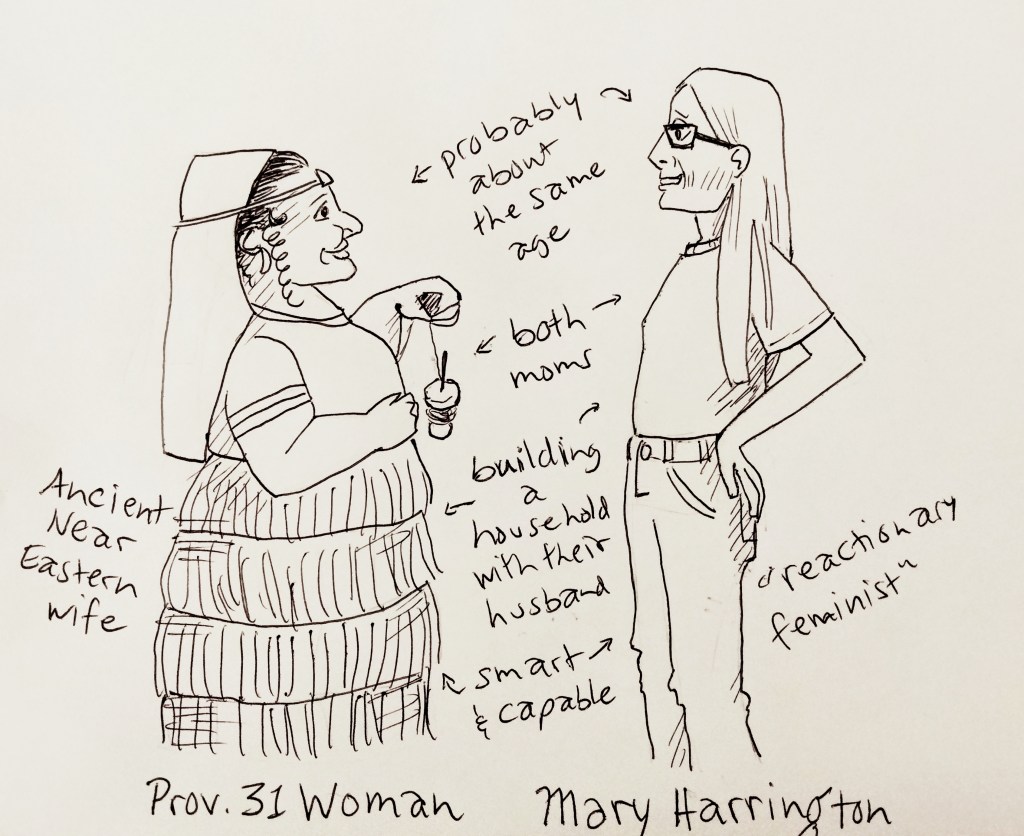
Harrington spends a lot of space in the book pointing out how, with industrialization, many of the homesteading tasks that were once the responsibility of the housewife got outsourced to the market. She draws on Dorothy Sayers for this, who pointed it out a long time ago in her essay “Are Women Human?” I wanted to quote Sayers directly, but don’t have a copy of the essay on hand. Essentially, she says that before the industrial revolution, women got to do milking, cheesemaking, beer brewing, baking, spinning, weaving, sewing, mending, and a number of other arts and crafts that took quite a lot of skill and are also fun. Sayers’ main point is that, in the wake of all these trades being moved out of the household, it is no wonder that middle- and upper-class women are bored and would like to do something other than sit around the house. Harrington’s application of this point is a little different. She points out that in economic terms, before industrialization a wife contributed really essential labor to the household. A husband could not get along economically without her. Because both spouses were committed to keeping the same ship afloat, the man was less likely to abandon the woman.

Post- Industrial Revolution, the woman (particularly in upper and middle classes) now contributed much less to the household economically. The man was the sole wage earner, which gave him a lot of economic power. He could treat his wife badly, and she’d have no recourse. It is to this shifting dynamic that Harrington attributes the rise of Big Romance. A husband and wife must like each other, must be madly in love, and then he will treat her kindly despite the imbalance of economic power.

I think Harrington’s analysis has merit, though it doesn’t tell the whole story. For example, I would argue that relations between men and women first got badly messed up at the Fall. Wife abuse was certainly possible before the Industrial Revolution. Also, I would argue that Big Romance owes something to the concept of Courtly Love in the Middle Ages, which in turn owes something to Paul’s exhortation to newly Christianized former pagans: “Husbands, love your wives as Christ loved the church and gave Himself up for her.” But all that said, I do think Harrington is on to something here. Obviously, when we are talking in broad strokes about the relationships between men in general and women in general, over centuries or millennia, there are going to be a ton of cultural and historical and literary and religious and yes, economic factors that go into it, even if we confine our survey to just the West.

Mixed-Economy Households

So, if we don’t like Meat-Lego “feminism” and we don’t like 1950s Big Romance, what’s left? At this point, Mary’s book begins to have the feel of re-inventing the wheel. Metaphors abound that compare modern men and women’s situation to rebuilding, using broken tools, in a postapocalyptic wasteland. Mary doesn’t know a lot about what a life that is good for women, children, and men should look like, but she is pretty sure that for the majority of people, it’s going to be in families built on heterosexual marriage. And she’s aware that, to find a good model, we’ll have to go back before the Industrial Revolution.

Here’s what she comes up with.

The weakness of [proposals to go back to 1950s style marriage] isn’t that they’re unworkable, or even that they’re ‘traditional,’ but that they’re not traditional enough. For most of history, men and women worked together, in a productive household, and this is the model reactionary feminism should aim to retrieve.

Remote work, e-commerce and the ‘portfolio career’ are not without risks … But cyborg developments also offer scope for families to carve out lives where both partners blend family obligations, public-facing economic activity and rewarding local community activities in productive mixed-economy households, where both partners are partly or wholly home-based and work collaboratively on the common tasks of the household, whether money-earning, food production, childcare or housekeeping.

ibid, p. 179, 180

She then profiles two young women who are doing just that. Willow, in Canada, is a writer and mom to a small baby who, when childcare allows, also works with her husband on the family woodworking business. (He does the building, she does the finishing, basically.) Ashley and her husband, in Uruguay, have three children and do a mix of homesteading and language teaching.

In [Ashley’s] view, the romance comes not through the ego-fulfillment of a perfectly congenial partner, but working with someone to build something that will outlast them: ‘It’s much more romantic in the end when you realise this home, this life, these children, if they’re thriving it’s a result of our shared ability to create something greater together through our interdependence and cooperation … We’re working towards something bigger than ourselves. We’re building a legacy.’

Isn’t this a rather bleak and utilitarian view of a long-term relationship, though? To this I can only say that in my own experience, in practice the Big Romance focus on maximum emotional intensity and minimum commitment is bleaker. … A commons is, by definition, not available for consumption by anyone with the freedom to contract, or the money to buy, but only to those who share and sustain it.

ibid, pp. 183 – 184

What’s interesting about this vision of the household is that it has been described, not by “conservatives,” but by Reformed Christians, frequently, even within the past few years. Douglas Wilson, whom Mary Harrington has perhaps never heard of, has by now written a small library’s worth of volumes on this very topic. His daughter, Rebekah Merkle, has a book and a documentary about it, both called Eve in Exile.

And here, in his video Theology of the Household, Alistair Roberts lays out a view that is strikingly similar to the one in Harrington’s book:

Not surprisingly, these Christian thinkers are getting their picture of a household that is good for both men and women from … the Bible. And now I’d like you to meet Reactionary Feminism’s poster girl, and surprise! it’s not Mary Harrington.

The Proverbs 31 Woman

A wife of noble character who can find? She is worth far more than rubies. Her husband has full confidence in her and lacks nothing of value. She brings him good, not harm, all the days of her life. She selects wool and flax and works with eager hands. She is like the merchant ships, bringing her food from afar. She gets up while it is still dark; she provides food for her family and portions for her servant girls. She considers a field and buys it; out of her earnings she plants a vineyard. She sets about her work vigorously; her arms are strong for her tasks. She sees that her trading is profitable, and her lamp does not go out at night. In her hand she holds the distaff and grasps the spindle with her fingers. She opens her arms to the poor and extends her hands to the needy. When it snows, she has no fear for her household, for all of them are clothed in scarlet. She makes coverings for her bed; she is clothed in fine linen and purple. Her husband is respected at the city gate, where he takes his seat among the elders of the land. She makes linen garments and sells them, and supplies the merchants with sashes. She is clothed with strength and dignity; she can laugh at the days to come. She speaks with wisdom, and faithful instruction is on her tongue. She watches over the affairs of her household and does not eat the bread of idleness. Her children arise and call her blessed; her husband also, and he praises her: ‘Many women do noble things, but you surpass them all.’ Charm is deceptive, and beauty is fleeting, but a woman who fears the Lord is to be praised. Give her the reward she has earned, and let her works bring her praise at the city gate.

Proverbs 31:10 – 31, NIV

Wow!

So, this is an older lady, a matriarch. She has children, and she is honored both by her husband, her children, and the public for her role as a matriarch. (Contrast this with Meat Lego feminism, where being a mom means you are dumb and irrelevant.) Perhaps this lady is beautiful, but we are not told that. In any case, she is an older woman, and “beauty is fleeting.” Her beauty has faded. But she has style (clothed in linen, purple, and scarlet). There is a lot of emphasis on her strength and capability. She engages in cottage industry, she has employees (servant girls), and she handles money and gets into real estate. She speaks with wisdom and faithful instruction, which probably primarily is directed at her children, but this could include her mentoring younger women and nowadays it could include being a writer like Willow. Her husband is a pillar of the community, and this is not to the exclusion of his excellent wife, but because of her and because of the kind of household they have built together. She, too, is known in the community and opens her hands to the poor. They are the people you go to if you need advice or help.

And, finally, this lady is not meant to be an outlier. “Many women do noble things, but you surpass them all.” The idea is that there are a lot of amazing women out there, but every husband should feel this way about his wife, that she is the best. The Prov. 31 woman is an older matriarch, so she has had time to build up an impressive portfolio of skills and accomplishments that for many young moms is years away. But this is where they can end up, if they are given support and honor in their role as moms and are shown what is possible.

In other words – I wouldn’t make this a headline without context as it would be misunderstood, but — the Prov. 31 Woman is the original Girl Boss.

And I love those guys

… the man who serves his God with his whole heart is apt to forget his surroundings, and to fling himself so completely into his work that the whole of his nature comes into action, and even his humor, if he be possessed of that faculty, rushes into the battle.

Spurgeon, from Eccentric Preachers, quoted by Douglas Wilson in A Serrated Edge

I was just reading … a scary book

No, no. I was just reading a, uh... a scary book.

(In case you are not familiar, Shrek was just caught reading the old childhood diary of his now-wife, Fiona. This clip should help you imagine the title of this blog post being delivered in a Scottish accent.)

But, here is the actual book that skeered everybody real bad:

BEHOLD!

And … behold! I have posed it with my scary black nail polish.

In my experience so far, the people who are most alarmed by this book are just reacting to the title. And it is a scary title, because Wolfe is trying to do something that many people try to do, which is take a derogatory term and own it, while of course redefining it somewhat or at least clarifying the definition. In fact, this book is nothing more nor less than one big, extended definition/explanation of what Wolfe means by the term, and what he thinks Christians should mean by it.

Most of the people who reacted to the publication of this book as if their hair were on fire, apparently did not read it, because their definitions of Christian Nationalism are very different and, in many cases, the opposite of the extended definition found in this book. I will demonstrate this with quotations from the book, below.

(To be fair: the other possible problem is that they did try to read it, or else they listened to an interview with Wolfe trying to explain it. I have heard a few such interviews, and I cannot say that Wolfe is the clearest at expressing himself in person. The book, too, is … dry. It sounds like it was written by a lawyer, or a more-than-usually-dry theologian. Combine this with the fact that many of the concepts in this book are entirely foreign to modern Americans, especially those who have not been raised Presbyterian, and I can easily imagine that someone could dip in, get dizzy, and quickly flee … or else fix on a phrase or two and completely misconstrue them. If you want to hear Wolfe’s ideas expressed in a vivid, accessible, and much clearer way, seek out the blog posts of Douglas Wilson.)

But anyway, here are a few of the assumptions people often make when they hear the phrase Christian nationalism, and quotes from the book that show Wolfe’s actual take on the topic:

Here’s what the scared people are saying:

Nationalism means imperialism or jingoism

Several ethnicities can share the same language, of course. But since language is a particular and is necessary for civil fellowship, it follows that at least some particularity is a prerequisite for civil fellowship. Hence, sharing only what is universal — viz., common humanity — is wholly inadequate for a complete social bond. And even a cursory reflection on one’s daily habits and everyday life reveals that more extensive unity in particulars is necessary for living well. We do not, and indeed cannot, live (let alone live well) according to universal rules. Nor can we live well among contrary particulars; there must be a normal to which all conform or assimilate, at least in order for people to live well together. Thus, an instinct for a suitable normal is a good instinct; so too is the moral expectation that people conform to that normal or else face some degree of social separation.

Exclusion [of out-group members] follows not necessarily from maliciousness or from the absence universal benevolence, but from a natural principle of difference that recognizes for oneself and for others the goods provided by similarity and solidarity in that similarity. To exclude an out-group is to recognize a universal good for man — a good made possible only by respecting and conserving difference. Since it is a universal good, you and your people are entitled by nature to a right of difference. This is a natural right, because particularity is necessary to live well according to the nature of man.

pp. 144 – 145

The principle of exclusion does not preclude the reception of foreigners absolutely. Nations ought to be hospitable. At the individual and family levels, hospitality demands generosity to strangers, especially to those in need. A nation, as a sort of corporate person, can and ought to be hospitable as well. But hospitality is subordinate to higher duties: no individual, family, or nation is duty-bound to welcome strangers to the detriment of the good of those most near and bound to it. Furthermore, guests have duties toward their hosts.

p. 167

Christian nationalism is a code phrase for wanting an all-white America (a.k.a. White Supreme Pizza)

Nations express Christianity like they express gender through dress — a universal is expressed in a particular way. Christianity perfects the whole not by eliminating earthly particularity, just as any man who comes to Christ does not lose his personality and other unique characteristics. The Christian nation is still a nation as described in the previous chapter, having intergenerational memory and love, degrees and types of loves, and a delight in people and place. Grace sanctifies sinners, but it does homogenize personality; likewise, Christ sanctifies nations but does not eliminate national distinctness.

p. 175

“Christians should not have any loyalty to any particular country or family, because ‘all are one in Christ.'”

Man’s limitedness is expressed in the natural need for a sort of directed gregariousness. That is, he is close at heart with a particular, bounded people, who ground and confirm his way of life in the world and who provide for him his most cherished goods. [Even] Unfallen man is benevolent to all but can only be beneficent (i.e., act for the good of) to some, and this limitation is based not merely in geographic closeness but in shared understanding, expectations, and culture.

Cultural diversity is, therefore, a necessary consequence of human nature, and so it is good for us. It is good that particular practices are made habitual by localized socialization and are “owned” in a sense by a particular place and people. It is good that the particularity of each community distinguishes it from the others. Man’s limitedness was not a divine mistake; neither is cultural diversity, separated geographically, an error. It was God’s design for man and thus a necessary feature of his good.

p. 65

“Christian nationalism” mean getting rid of the First Amendment, and establishing a national church to which every citizen is required to belong.

Althuis states, “Franz Burckhard therefore errs, and the Jesuits with him, who think that the magistrate is not able to tolerate diverse religions.” Burckhard, a Roman Catholic professor at Ingolstadt, is reported to have said, “What more just than to cut off the heads of all these villains of Lutherans!” Burckhard … called for Roman Catholics to rescind the Peace of Passau (1552), which granted religious freedom to Lutherans within the Holy Roman Empire.

This rigid position is natural enough for Roman Catholic theology, which asserted that it is the one true visible church … But in Protestantism the church is essentially invisible and composed of the elect by faith, and belonging to that church is not conditioned on or grounded in one’s outward belonging to a visible, centralized communion. Thus, Protestants of different doctrinal persuasions can mutually recognize their shared faith. This is the basis for principled toleration and religious liberty in Protestant commonwealths. Indeed, the unfolding of Protestant principles — not Enlightenment or Roman Catholic “doctrinal development” — is what led Americans to affirm religious liberty in the 18th century, which I demonstrate in the next chapter. The point here is that a Protestant people have principled flexibility when faced with religious diversity. How a Christian magistrate navigates this complexity requires wisdom, prudence, and resolve.

p.375

The political status of non-Christians in a Christian commonwealth is a matter of prudence. Since civil society is a human institution, it must guarantee equal protection and due process with regard to human things for all people. That is, it must guarantee justice and secure natural rights. But this does not entail equal participation, status, and standing in political, social, and cultural institutions. Thus, they are guaranteed a basic right to life and and property (the absence of which would harm the common good), but they may be denied by law to conduct certain activities that could exploit or harm Christians or the Christian religion.

This position, though fairly standard in the Christian tradition until recently, will be received with controversy today, and few would stomach any legal discrimination on the basis of religion. But even in the absence of legal distinctions, the cultural norms of a Christian nation will require non-Christians to be the exception to the norm.

pp. 392 – 393

“It means that the same person is the leader both of the church and of the country in a civil sense.”

I think that a strictly indirect role for civil leaders in intra-ecclesial affairs is both preferable and most consistent with Protestant principles. There is, I admit, a natural fittingness to Christian nationalism and the [civil leader] as the “head of the Church.” But granting the leader this title would be, in my view, an abuse of power and constitute the usurpation of Christ’s kingship over the church. I offer my reasoning below.

p. 300

It means giving church leaders political power.

God does not (ordinarily) declare by special revelation that this or that person has civil power. Rather, it is “a characteristic property resulting from nature,” writes Suarez. He continues:

‘This [civil power] does not emerge in human nature until men gather in one perfect community and unite politically … Once constituted, this body is at once, and by force of natural reason, the site of this [civil] power.’

The people possess civil power as a necessary and natural consequence of their combination.

One important corollary is that recognizing the true God (or Christ) is unnecessary to possess this power, for having this power is simply a natural consequence of the people’s combination into human society. And they can likewise devolve this power upon those who do not recognize the true God. Hence, true civil authority does not depend on true religion, though certainly in failing to acknowledge the divine source of civil authority, the people and civil ruler are in a perilous situation. It doesn’t bode well for them, but being godless or idolatrous does not itself preclude true political order. Hence, Peter instructs his recipients to “honor the [Roman] emperor.”

pp. 283 – 284

Though we can in principle disobey unjust laws, we should recognize the difficulty in determining whether a law is unjust. It one thing for a law to be unjust and another for you to know that it is unjust. Civil magistrates are necessary, as I’ve said, because of natural epistemic limitations in individuals to determine expedient actions for the common good. … [M]any or perhaps most laws evade a simple evaluation, mainly because civil authorities are typically in a better position than private persons to make judgments about what serves the common good.

Pastors can admonish erring magistrates to correct injustice in the law, but pastors must not mistake their theological training or scriptural knowledge for expertise in jurisprudence. Pastors as pastors are no more competent to analyze or make civil law than any other private person.

p. 274, 275

“People who advocate Christian nationalism think that they can use outer means, such as laws, to compel people to believe.”

Civil power cannot legislate or coerce people into belief; it can only command outward things — to outwardly do this or not do that. No classical Protestant has ever claimed that civil action can itself bring about assent to, let alone true faith in, the Gospel. Though the ultimate purpose of civil action can be the spiritual good of the people, the direct object cannot be the conscience. Spiritual good is a matter of the heart before God in Christ. Thus, civil action for the advancement of the Gospel only indirectly operates to that end.

p.182

As for power over conscience, implicit power can influence beliefs, such as assent to Christian truth, but civil law cannot command belief. It can only direct bodies. It orders outward action. Civil power cannot touch the conscience. Why? Because the conscience is a forum of persuasion and civil power is the power of command. The civil command “believe in Christ” violates a necessary condition of belief, namely, that belief is a matter of persuasion.

p. 253

It means that the entire Mosaic law, including the ceremonial laws, would become the legal code of the land.

[W]hether any civil law is good depends on the circumstances, which requires the discernment of a prudent man. Calvin writes, “[E]ach nation has been left at liberty to enact the laws which it judges as beneficial.” Nothing about this disparages the Mosaic law — a law of God. It is a perfect example of law. But it is not a universal body of law.

Some civil laws in the Mosaic law are universal in a way. But they are universal because they are necessary for any just and commodious human society.

Though not universally suitable, the civil laws of Scripture provide certainty as to their inherent righteousness. They are, therefore, morally permissible in civil law, and the closeness of the circumstances aid in determining whether any of them is suitable.

pp. 267 – 268

We can just have a neutral, secular nation, with no national religion at all.

This “neutral” or “common” space lasted only about twenty years, which shouldn’t surprise us: the most common human arrangements in history for public space are decidedly not neutral. It is a shame that we treated this neutral world as normal and universal.

Experience over the last decades has made evident that there are two options: Christian nationalism or pagan nationalism. The totality of national action will be either Christian, and thus ordered to the complete good, or pagan — ordered to the celebration of degeneracy, child sacrifice (e.g., abortion), mental illness, and idolatry. Neutrality, even if it was real for a time, will never hold, because man by his nature infuses his transcendent concerns into his way of life and into the place of that life. The pagan nationalist rejection of neutrality is correct in principle

p. 381

For decades, theologians have developed theologies that exclude Christianity from public institutions but require Christians to affirm the language of universal dignity, tolerance, human rights, anti-nationalism, anti-nativism, multiculturalism, social justice, and equality, and they ostracize from their own ranks any Christian who deviates from these social dogmas. They’ve effectively Christianized the modern West’s social creed. The Christian leaders most immersed in the modern West’s [actual] civil religion are those who loudly denounce the “civil religion” of “Christian nationalism.”

p. 5

How to Get Dressed

For the ladies

This article is a letter to my self of 25 years ago, with the hope that it might also prove helpful to my little sisters in Christ who might be struggling with some of the same issues that I was then. It’s for young Christian women who want to dress modestly, but know that being told “dress modestly” gives you close to zero guidance as to how to proceed. It builds on this article by venerable pastor and father Douglas Wilson, which gives a man’s perspective. His article lays out some excellent general principles, but I felt there was quite a bit more to be said.

So, guys, you can probably stop reading now. Read on if you wish to find out all the sartorial complexity that women have to deal with. But be warned: the passage below contains the word “bra.”

I will now address my fellow ladies directly.

Ahem

Surprise! You’re a woman. You have a brand-new, woman’s body. If you are in your late teens or early twenties, the body you have now is not the same as the one you had just a few years ago. It comes with new aches and pains. It moves differently. It attracts more attention. It’s harder to dress.

Unfortunately, there is no Standard Modest Outfit out there that all women can just pluck off the rack and don. Some societies in the past have had “traditional garb” or even actual laws about what people of different social classes could wear. Modern America is the opposite. Clothing, especially for women, is viewed as a matter of personal expression. On the plus side, this means we have almost infinite choices. On the down side, this means we have almost infinite choices. So, like it or not, if we want to wear anything at all, we have just been thrown into the wild and crazy world of women’s fashion.

But first, mindset.

You Are Probably Beautiful

You may feel unattractive in your new body. You may even feel grotesque. You may, then, be tempted to reason that it doesn’t matter whether you dress modestly or put any thought into your ensemble. No one is looking; or you can’t “get away with” a classy look; or no matter what you wear, the effect will still be one of the orcs from Lord of the Rings, but with lipstick.

This is probably not true.

The odds are overwhelming, if you are a young woman, that men find you attractive. Even if not every man does, there are probably many, many out there who do, on a daily basis.

It’s not good to motivate yourself to modesty with shame over some aspect (or all aspects) of your appearance. This can backfire in so many ways. So, regardless of how you may feel about yourself, for the purposes of getting dressed, think of yourself as a beautiful woman who wants to be modest and dignified and classy, and who can get away with any look she desires to attempt, no matter how formal, rather than as an ugly woman who has to use her clothing to either conceal or compensate for her ugliness.

You Are Going to Have to Spend Some Money

You may also be hampered in your quest to dress classy by a reluctance to spend more than $20 on any one item at any one time.

The eleventh commandment in some Christian families is, “Thou shalt be frugal.” Perhaps you were raised wearing hand-me-downs, and that worked fine when you were a kid, but now you have this new body that you have to clothe.

You may also have received the impression that spending – not just money, but time, effort, and worry – on your appearance is vain and shallow. You don’t want to be a Barbie doll. You don’t want to be “high maintenance.”

Let me tell you, putting together a modest, classy wardrobe is worth the effort. I’m not saying you have to be dressed like an executive every day and apply makeup with a trowel. Depending upon your current calling in life, your wardrobe might be different. But whatever job or role you are dressing for, you’re allowed to put some thought into it. Lumberjacks are allowed to buy steel-toed boots and suspenders and hard hats or whatever it is that lumberjacks wear, and grown women are allowed to invest in some good bras, slacks, dresses, dress boots. You are going to be donning some kind of clothes every day. They might as well be nice-looking clothes that fit you right now, not stuff left over from your middle school days, or stuff you bought on clearance but it didn’t fit but you continue to wear it because you don’t want to throw it away.

In short, by spending some time, effort, and money on this, you are not being wasteful or shallow or vain. You are being responsible.

Building up a good wardrobe might cost more or less depending upon how difficult it is to shop for your particular build.

Special Problems

If you happen to be very curvy, it’s worth pointing out that this is a special problem. When it comes to getting dressed, being very curvy is a handicap. As you have probably already noticed, most clothes are not designed for you. It’s going to be harder to find clothes that fit, and of those that do fit, clothes that look modest when they go on. You may need to go through a grieving process until you can accept that this is what you look like now, and proceed with the interesting challenge of dressing the body that has been given to you.

Get yourself fitted for a bra. It’s possible that you have been wearing ones that don’t really fit, just because that’s all that was available in stores. Because of your special problem, you are going to have to spend more money and effort than most women, but luckily, there are companies out there that specialize in making bras and clothes for the very curvy woman.

When possible, use dressing rooms. I hate dressing rooms as much as the next gal: they are gross, the lighting is always ugly, and just being in there drains the energy out of you. But it is better to spend a few minutes crying with frustration in the dressing room, than to buy a top that almost fits.

Don’t worry about sizes. Sizes are not consistent from one clothing brand to another. Many many women wear XL or XXL and do not appear fat. Buy whatever fits you.

Ponchos are your friend.

Get Your Colors Done

You could find the perfect garment, one that is modest but attractive, fits you perfectly, etc., and drop a lot of money on it … but if you hate it, you just won’t wear it.

A big part of whether you hate the garment, and whether it actually looks good on you, is color. No matter what your favorite color is, there is probably a version of it that flatters you and a version that doesn’t. Getting your colors done is a cheat code to help you find the shades that will look best on you.

The basic idea behind getting your colors done is that someone helps you determine whether you are a “Spring, Summer, Fall, or Winter” based upon your natural coloring. These aren’t personality types or anything like that … they purely describe different types of skin tone, and to a lesser degree eye and hair color. There are also YouTube videos that can help walk you through this process at home.

On the related issue of figuring out what looks good on you, I recommend finding an older fashion book from the library (not a magazine, which will just try to sell you the latest looks). I stumbled upon one in the local library which had a bunch of ordinary-looking women for models, with pictures, and it was incredibly helpful. It was a revelation, for instance, to discover that if you have a lot of color contrast between your skin and hair, you will look good in patterns with a lot of contrast such as black and white, whereas if you don’t have a lot of contrast, you will look good in softer tones. Seeing this illustrated with a variety of models was invaluable.

Pick A Few Looks You Like

Why “pick a few looks”? Why not just individual pieces? Having a look in mind will help you determine what pieces you need, how they best go together, and which ones you can and can’t combine when you get dressed in the morning. (Also, of course, every look comes with its attendant hairstyles, makeup, and accessories, but that is beyond the scope of this post.)

Why looks “you like”? Do this mean that it is all down to individual taste, and you are a modern liberated woman who can wear whatever you want? No, I am not saying that. Coming from a Christian world view, we know that no one can do whatever they want, with no limits, in any area. You have to consider modesty, being appropriate to the occasion, and what kind of image you are projecting when you go outside.

But this does not mean that individual taste is entirely irrelevant. As discussed, we live in a society where clothing is not prescribed. There are a great variety of ways to get dressed, and the choices among these are thrown back onto the individual. This is especially true for women, for whom in most situations there is no “neutral” outfit. (I owe this point to Deborah Tannen.) In this kind of social environment, you have no choice but to make choices. And that means that one factor you need to consider – you must consider – is your own taste. If you like the look you have put together, you will wear it. If you don’t, you will just keep reaching for the old t-shirt you loved when you were 15.

What look(s) you select will depend upon what region of the country you live in; whether you live urban or rural; and what kinds of social circles you move in. Perhaps you live in a city environment where you have to dress rather formally just to be taken seriously. Perhaps you are in a Christian community where the consensus is that women should always wear skirts and dresses. Perhaps you’re a farm girl who looks perfectly fine in jeans, flannel or fleece tops, work boots, and a baseball cap or maybe even a cowboy hat.

You also have to consider whether your typical day involves frequently climbing in and out of a vehicle, and if so, what vehicle. I love skirts and dresses, but if I am going to be running errands, I opt for pants instead because they are more convenient and modest when getting in and out of my car. Also, pockets.

Now we are getting into opinion territory. I’ll give you my opinions about some looks and whether they can be adapted by a Christian woman to look dignified and wholesome. This will not be comprehensive. New looks, and new variations on old looks, keep popping up all the time. I am not an expert, and have made my share of sartorial mistakes. (Oh, so many mistakes!) I am an artistic person who always secretly kind of wants to wear a costume. So take this for what it’s worth.

Some looks, in my opinion, cannot be adapted by a Christian woman because it’s integral to the look to appear very sexy, very edgy or very rebellious. Here are a few:

  • 80s rocker
  • 70s dance party
  • Punk
  • Goth/Vampire
  • Steampunk
  • Rockabilly (but see 50s housewife below)
  • Lady rapper
  • Anything pirate (Sorry, fellow costume afficionados!)
  • Motorcycle gang
  • Viking-inspired

Other looks can be made modest, classy, or at least sweet without doing violence to the look. Here are a few:

  • Hippie (there are variations on this – beachy hippie, hippie chic)
  • Preppy (also formal preppie/Audrey Hepburn/Jackie O)
  • Academic (corduroy, sweaters, blazers, sensible shoes, neutral tones)
  • Sporty
  • 90s Grunge (baggy jeans, flannel shirts, beanies)
  • 50s housewife, like Lucille Ball. Believe it or not, this is a look that is coming back. The thing that distinguishes it from Rockabilly is that the Rockabilly look combines 1950s clothes and hairstyles with an intentionally rebellious attitude, shows more skin, and features lots of tattoos.

All of these looks also have immodest versions featuring very short skirts, crop tops, and the like. They also have rebellious versions. For example, the hippie look can go in the direction of a ton of beads, peace signs, and not taking a shower. But it doesn’t need to. For preppy, you could wear a tennis skirt. For 90s grunge, some people would do their makeup to make themselves look like a heroin addict. But none of these things are integral to the look and you don’t need them. You can get the look by picking its distinctive fabrics, patterns, and colors.

Of course, you can also, if you so desire, go in the direction of Amish/Little House on the Prairie/Anne of Green Gables/Cottagecore. I love that look on other people, but it makes me look like a grandmother and I’m not ready for that yet. Also, though modest, this look is actually more conspicuous in the modern world than the looks listed above.

Good Luck, Sisters

Finally, realize that you are not locked in. You won’t be buying new clothes as often as when you were a growing child, but you will switch out your wardrobe every few years as your stage of life changes and as you get older and (probably) gain some weight. The good news is that clothing marketed to older women tends to be more modest and dignified than clothing marketed to younger women. Also, you will know yourself better when you are older, and will probably have a husband whose tastes have influenced your own, and probably more income to spend on clothes. So, feel free to take the time and money required to look classy in a way that fits your body and personality right now, realizing that this will probably change and that’s fine.

And when you have done all this, you will be a dazzling Proverbs 31 woman, “Clothed with strength and dignity.”

Terrifying Quote of the Week

[The megachurch’s] ads extolling the virtues of flexibility in changing times, adaptability in the face of difficulties, and going-with-the-flowness in the event that your church was ever caught in a flash flood of scandal, were ads that were hip, ironic, self-effacing, detached, and exuded a coolness unto death.

Evangellyfish, by Douglas Wilson, p. 202

Quote: Don’t Worry, This is Totally Natural

“Childbirth is natural, and not an event that has to be conducted in a hospital. I am here to help women understand how natural this is. But I will have to go in just a moment. How may I help you?”

Rourke had delivered at least three babies in the back seats of cars and taxi cabs, and thought he was qualified to assert that there was nothing whatever that was natural about it. It was the craziest thing in the world. Women were the kind of people that people came out of, for crying out loud, and he thought it was the kind of thing best monitored by world-class doctors and sophisticated electronic gear, maintained closely by teams of nurses with graduate degrees in astrophysics. But that was just his opinion.

Evengellyfish, by Douglas Wilson, pp. 86 – 87