to include sources about Pangea and aliens.
P.S. And my FAQs.

to include sources about Pangea and aliens.
P.S. And my FAQs.
I have edited the question about the age of the earth extensively to reflect changes in my thinking.
I have also added some information about my next book.
Also, you will see some more breathless quotes added to my home page (outofbabelbooks.com) from volunteer reviewers who gave The Strange Land and The Great Snake three or four or five stars.
This is a repost. These past weeks have been busy, what with wrapping up the school year, many family events, and illness. (I have a fever right now, and it’s making my online comments amazing.) So I give you this, one of my most-often-viewed posts of all time.
Like most sane people, I hate Internet debates. Love/hate, that is. Even in real life, I’ve always found it hard to let a debate go. I’ve sometimes stubbornly backed positions that later turned out to be false, and on the other end of the spectrum I’ve gotten scared by ad hominems and conceded stuff I didn’t need to concede. Almost no matter how the debate goes, I end up feeling like an idiot.
I don’t want this site to become a debating site. But a few weeks ago, I posted a wild historical theory and invited you guys to critique it. Benjamin did, in the comments, here. So, for the integrity of this site, I’ve got to respond to the critique found in the link. If you don’t like Internet debates, please please skip this post.
The link that Benjamin posted to is to a site called Bad Archaeology. The site has two guys’ names on it, but at appears to be mostly written by one guy. (At least, he is the one who responds to comments.) Let’s call him KFM. I am not posting his full name here nor am I linking to his web site, because I don’t want to attract his attention because I hate Internet debates! However, you can easily find his site by Googling it.
The site exists to debunk “Bad Archaeology” (caps in the original), which mostly means various wild theories like the ones we’ve been discussing about lost civilizations, aliens, etc. It calls proponents of these theories Bad Archaeologists and it fights them with facts, with mischaracterization of their positions, and sometimes with mockery. And by capitalizing its references to them. Always fun.
KFM’s main arguments against Hancock’s idea that the Piri Reis, Orontius Finaeus, and Buache maps come from an older source are as follows:
-Piri Reis SAID he got his data for the New World part of his map from Columbus. This is confirmed because he faithfully reproduces some of Columbus’s errors, such as showing Cuba as part of the mainland.
-Most Bad Archaeologists consistently spell Orontius Finaeus’s name wrong. (Oronteus.) This shows they don’t know what they’re talking about.
-There are major errors in Reis’s and Finaeus’s depictions of Antarctica. So we cannot claim that a supposed older source map was accurate. (More on this in a second.)
-Only one version of Buache’s famous map exists that shows Antarctica. It is in the Library of Congress. Other versions of the same map just show a big blank space there.
-Buache was an accomplished geographer who had a theory that there must be a landmass at the bottom of the world. He also theorized that within it, there must be a large inland sea that was the source of icebergs. So, if the map he supposedly drew is not a hoax and was in fact drawn by him, then he just made it up out of pure speculation. In fact, he wrote “supposed” and “conjectured” all over it.
-He also shows ice and icebergs all over it. This renders ridiculous the idea that it is a map of Antarctica before the continent was covered in ice.
-Buache’s and Finaeus’s maps don’t match Reis’s or each other, so clearly they cannot have come from a single source map, let alone an accurate one.
KFM’s arguments look, at first glance, super convincing. Some of them are dead on.
The strongest part of KFM’s argument is this:
“[Charles] Hapgood, [Hancock’s source for this theory], assumed that the original source maps, which he believed derived from an ancient survey of Antarctica at a time when it was free from ice, were extremely accurate. Because of this, he also assumed that any difference between the Piri Re‘is map and modern maps were the result of copying errors made by Piri. Starting from this position, it mattered little to Hapgood if he adjusted the scales between stretches of coastline, redrew ‘missing’ sections of coastline and altered the orientation of landmasses to ‘correct errors’ on Piri’s map to match the hypothesised source maps …. Hapgood found it necessary to redraw the map using four separate grids, two of which are parallel, but offset by a few degrees and drawn on different scales; a third has to be turned clockwise nearly 79 degrees from these two, while the fourth is turned counterclockwise almost 40 degrees and drawn on about half the scale of the main grid. Using this method, Hapgood identified five separate equators.”
This is pretty damning to the theory. It’s not necessarily fatal to the idea that Reis used an obscure ancient source among the 20 that went into his map. After all, copying errors do happen, especially when we are trying to compile a bunch of maps from different eras of places we have never surveyed ourselves. But that’s an unfalsifiable claim, so let’s leave it. Regardless, Hapgood’s shenanigans certainly are fatal to the idea that this ancient map, if it existed, was astonishingly accurate in latitude and longitude.
But alongside this excellent argument, KFM also includes a bunch of inconsistent ones:
“All in all, the Piri Re‘is map of 1513 is easily explained. It shows no unknown lands, least of all Antarctica, and contained errors (such as Columbus’s belief that Cuba was an Asian peninsula) that ought not to have been present if it derived from extremely accurate ancient originals. It also conforms to the prevalent geographical theories of the early sixteenth century, including ideas about the necessity of balancing landmasses in the north with others in the south to prevent the earth from tipping over.”
So, the map does not show Antarctica, but one sentence later it does show Antarctica, but Antarctica was only put there because contemporary geographical theory demanded it. Also, note the assumption that the ‘extremely accurate originals’ are supposed to have included all of the Americas as well as Antarctica. That’s not my understanding of Hancock’s claim.
It’s also not clear whether KFM is claiming that all the data for Reis’s map came from Columbus. If he is, this inconsistent with both Hancock’s claim (and KFM’s own showing) that Reis said the map was compiled from 20 others, including among them a map whose source was Columbus.
Similarly, KFM shows errors on Orontius Finaeus’s map, although he admits that “There are fairly obvious similarities between the general depiction of the southern continent by Orontius Finaeus and modern maps of Antarctica.”

For the Buache map, KFM contends that Buache essentially made up the entire map to satisfy a geographical theory he had, namely that there must be a land mass at the bottom of the world to balance the land at the top (this was a popular theory at the time), and that it probably had a large inland lake in it with two major outlets leading to the sea (this was Buache’s own brilliant guess, and he thought this lake must be the source of the icebergs that navigators encountered in the southern sea).
I take KFM’s word that Buache had this theory, and that his map shows ice and icebergs on Antarctica, which KFM says “makes the claims that Buache’s map shows an ice-free Antarctica all the more bizarre.”
Well, sort of. But actually, Hancock’s claim is that the source map Buache used shows Antarctica early in the process of icing over. Also, given Buache’s theory, it would not be surprising if he had added ice and icebergs to any other data that he may have had.
“Over several parts of the southern continent, Buache writes conjecturée (conjectured) and soupçonnée (suspected).” KFM thinks this is conclusive proof that Buache basically invented the interior of Antarctica on his map, based purely on his own theory. That could be. But I have to say, if it is, he did a great job! He does not just draw a round mass, attach the few islands and promontories that he knows about (New Zealand, which he took for a peninsula, and the Cape of the Circumcision), and then draw a lake in the middle. Instead, he has a waterway offset between two unequal land masses. It corresponds surprisingly well to the shapes of the ranges of mountains and low areas that we now know Antarctica has.
Besides these arguments, KFM includes a lot of interesting history about the biographies of these cartographers. Almost half his page about Finaeus is taken up with the cartographer’s biography, even though it has little to do with claims about his map (beyond boosting his credentials, which I would think Hancock would also want to do). Similarly, with Buache we are given: “The claims of Bad Archaeologists about Buache’s map ignore a crucial fact: he was the foremost theoretical geographer of his generation, whose published works include hypotheses about the Antarctic continent.” I’m not sure why Buache’s eminence is supposed to be a devastating blow to any claims about his map, but again we are treated to a long and interesting biography before KFM finally gets to Buache’s theories about a southern continent.
This style of argument reminds me of people who think they have shown the Bible is not divinely inspired merely because they can show that it happened in a particular historical context and is expressed in a particular historical idiom. They will trot out some tidbit of historical context that they assume is complete news to some Bible scholar who has been studying ANE history his whole life. Their line of argument is based on a misunderstanding of what divine inspiration is claimed to be. They assume that if something is claimed to be the Word of God, it must have come to humanity in an abstract, context-free, propositional and not literary or historical form. (They also assume that it must cover all knowledge in the world, e.g. so that the discovery of North America was supposed to somehow shake our faith in the Bible.)
KFM’s argument about these maps is exactly the same kind of argument. He gives a bunch of historical context about these cartographers and thinks that refutes Hancock’s claims. It’s as if Hancock had been arguing that Piri Reis, Finaeus, and Buache were born of virgins, went through life without interacting with anyone, and then one day, without any context whatsoever, this complete, easy-to-interpret map from an ancient civilization dropped out of the sky into their hands. Well, that certainly isn’t the argument that Hancock makes in his book. His argument is (or was; he has apparently retracted it) that there were several source maps, made over centuries or millienia, which traced the progressive growth of the Antarctic ice cap. He does not claim that these were complete, accurate world maps or even that they showed the Americas. “Someone who knew what they were doing once mapped Antarctica.” That’s the basic claim.
It turns out that there is a more than coincidental similarity between the way KFM caricatures Hancock’s claims and the way that some people caricature claims about the Bible. KFM, in fact, classes Biblical Archaeology as a subset of Bad Archaeology. The following quotes should give you a sense of his general attitude:
“Some Bad Archaeology is just so outrageously Bad that it can only be examined charitably by assuming that its proponents are slightly confused. How else can you explain the complete lack of critical judgment, the belief in ancient fairy stories, the utter absence of logical thought they display? Either that, or they have a particular agenda, usually driven by a religious viewpoint.
Biblical Archaeology, which has been described as excavation with a trowel in one hand and a Bible in the other, is a specialised branch of archaeology that often seems to ignore the rules and standards required of real archaeology. Conducted for the most part, by people with an explicitly religious agenda (usually Christian or Jewish), it is a battleground between fundamentalist zeal and evidence-based scholarship … If we can’t find evidence for Solomon’s glorious empire, it must be that we’re not interpreting the archaeological data correctly and that a big discovery is just around the corner (the ‘Jehoash inscription’ leaps to mind in this context). If contemporary Roman documents don’t mention Jesus of Nazareth, why here’s an ossuary that belongs to James, his brother… It’s all very much centred around contentious objects, poorly-dated sites and great interpretative leaps that the non-religious may find astounding.”
Got that? If you believe in a historical Solomon or even a historical Jesus, you’ve just been dubbed a Bad Archaeologist. Welcome to the club, friends.
I mention this attitude not because it’s off-putting, but because it tells us something about KFM’s mindset and about what it would take to convince him that something is “good” archaeology. I’m guessing that any evidence of advanced civilizations older than about 4,000 BC is going to be dismissed out of hand. As will any evidence showing that humanity might have declined, rather than slowly progressed, over our history.
Going back to the maps, what has been shown here? I would say it’s inconclusive. The maps are less accurate than Hancock claims and far less accurate than I made them sound in my original post, because I was going over Hancock’s theory at treetop level and didn’t bother to get off into the weeds when he discusses the details of the maps. (As I still haven’t done in this post. I would like to, but my time is limited.)
On the other hand, I think the Finaeus and Buache maps especially are more accurate than we would expect of maps that had been drawn out of pure conjecture, without any source at all. It looks like more was known about Antarctica in the 16th century than we previously assumed, whatever the source of that knowledge.
So it’s not a case of “Lost civilization proven!” but neither is it “Nothing to see here.” The most we can say is that something strange is going on, but we don’t know what. To paraphrase Andrew Klavan, KFM isn’t wrong to think Hancock and Hapgood are wrong; but he is wrong to think that he himself is right.
About the theory of earth crust slippage, I feel the same way. On the one hand, it’s a pretty hard theory to swallow on geological grounds. (For example: if a big section of the earth’s crust pivoted around the North American plains – even granted that this could happen – shouldn’t there be some kind of seam where the edge was?) On the other hand, clearly something weird happened, or we wouldn’t have Siberia being ice-free when Canada was ice-covered. Nor would we have flash-frozen tropical plants and baby mammoths.
So, in conclusion, nobody knows anything, boys and girls. Let us eat, drink and be merry.

Too many Atlantises. An embarrassment of Atlantises. One Atlantis, two Atlantis, red Atlantis, blue Atlantis …
This article describes an intact granite city, with pyramids, discovered off the West coast of Cuba, about 2,000 feet down, in December of 2001. As our old friend KFM, of Bad Archaeology, points out, the city would be unlikely to survive intact like this if it actually dropped dramatically from what is now sea level, as Plato seems to describe. The article points out that there is another city, the Yonaguni Monument, off the coast of Japan, and Graham Hancock in his book, Underworld, points out that there are submerged megalithic cities in many places around the world, including off the coast of India. (Hancock has cycled through seriously advancing a number of different Atlantis theories, so he will be sort of the workhorse of this post.)
It seems to me that the city off the coast of Cuba is part of a worldwide phenomenon where sea levels were once much lower. We can include in this phenomenon Doggerland (which will make another appearance later in this post), and the land bridges known to have once connected Asia to the Americas and the Indonesian islands to the mainland.
If you are an old-earth believer and have to juggle millions of years, multiple cooling and warming periods, slow but somehow effective continental drift, and some confusing archeological indications that humans were perhaps around well before they should have been … good luck. As someone who believes that the history of the earth is measured in thousands or tens of thousands, but not millions or billions of years, my guess is that this period of low sea levels plus advanced civilization came right after the Great Flood.
You would have a much colder, rainier climate as the earth adjusted to the recent cataclysm (about this more in a minute). You would have had frequent snow and rain storms, with all this precipitation getting frozen in the rapidly forming ice sheets, causing Earth’s water supply to be greatly reduced. Meanwhile, you would have Noah’s children and grandchildren branching out as quickly as possible, building megalithic cities wherever they went, still remembering the techniques and technology (and possibly still assisted by the giants and gods) that they had seen pre-Flood. This period of low sea levels would have had to last long enough for people to disperse and to build, but it need not have been very long. It could have a been a matter of a few hundred to a thousand years. As the climate stabilized, you would have had floods covering settlements and civilizations in different parts of the world. This, I believe, is the reason we have an embarrassment of Atlantises.
There have also been assertions that the reason for the Bermuda Triangle phenomenon is that Atlantis lies underneath it. (Note that the west coast of Cuba is outside of the Bermuda Triangle.) This theory certainly appeals to those who are interested in the potential paranormal effects of the lost city, but I do not know of any actual submerged city found in the Bermuda Triangle area. (If you do, please enlighten me in the comments. I’m always looking for another Atlantis to add to my collection.) This article discusses how ocean-floor mapping technology can create lines that look like city streets.
Graham Hancock makes the case for this in his book Fingerprints of the Gods. He posits that the evidence points to an ancient, advanced civilization which was destroyed by a cataclysm, and asserts that the refugees from it seeded their scientific knowledge, in code form, by creating new religious cults all around the world that featured certain sacred numbers.
If you’ve been reading Out of Babel for a while, you know my assessment of all of this is that it’s right, but not in the way that Hancock thinks it is. Among other things, his scientific materialism and evolutionary beliefs make it impossible for him to imagine that people groups like the Maya, for example, would have come up with advanced mathematics on their own, so he needs to posit a more “advanced” civilization bringing these things from without.
Anyway. For his advanced ancient civilization, Hancock realizes he needs a continent-sized homeland (because, again, his evolutionary beliefs about man require that such a civilization develop gradually, over millennia, from hunter-gatherers to farmers and so on). Antarctica is a good candidate because it’s an entire continent; there is some evidence that it was mapped before it was quite so covered in ice; its general pre-ice outline corresponds roughly to Plato’s description of Atlantis; and there is a theory available for how it could have gone from being in a temperate part of the Atlantic, to being at the South Pole, in a relatively short amount of time. Hancock calls this “earth crust slippage” and posits that it happened about 20,000 B.C.
Now for the version I find more plausible: Creation scientist Dr. Kurt Wise presents his team’s model for “continental sprint” in this video. I find Dr. Wise’s model persuasive as a model of the Great Flood, and as we will discuss, it could explain the Atlantis legend wherever in the world Atlantis proves to have been. However, even if you buy into “continental sprint,” it does not follow that Plato was describing Antarctica when he wrote about Atlantis. If all the land on the earth were breaking up, the ultimate fate of that portion that later became Antarctica would seem like a minor detail.
This one was put forward by Graham Hancock, after he abandoned his Antarctica theory, in his book America Before, a review of which I react to here. Although weak, the theory relies on the fact that there are large structures, either megalithic or earthworks, which align to different astronomical features and/or function as observatories, all around the world, including in North America. For example, the pyramid complex at Teotihuacan appears to be a model of the solar system; the Giza Plateau appears to be a model of Orion, and Serpent Mound in Ohio, which sites towards the sunrise at solstices, may be according to Hancock a model of the constellation Draco.
All that to say, anywhere you can find a large astronomical structure, you can make a case for Atlantis, and Hancock has made that case for North America.
This article, which I posted last summer, asserts that Plato’s descriptions of Atlantis are admirably matched by the Cyclades Plateau (now the Cyclades islands), which would have existed when sea levels were 400 feet lower than they are now. The Cyclades Plateau is a rather large formation right in the middle of the Aegean. (If we consider that lower sea levels would have also expanded the coastlines of the rest of Greece, then it would have been even closer to the mainland.) This is an attractive theory in terms of its being what Plato was actually talking about (since he makes Atlantis contemporary with Athens), but it does depend upon this:
Recently, a four year study that included a thorough analysis of Plato’s work established that serious errors by early translators allowed for the mixed messages in the translated document.
Yet another underwater location that used to be inhabited when sea levels were lower, Doggerland was a vast region that stretched between England, France, Holland, and Scandanavia, and is now the relatively shallow southern part of the North Sea. Archaeological discoveries have handily established that this area was once inhabited, here and here among others. As with other now-submerged human habitations, the reader’s preconceptions will determine how long ago you believe it was inhabited, and for how long.
This article describes an entire book which puts forth a detailed theory Plato was describing Doggerland. Apparently, Atlantis had a large, roughly rectangular plain surrounded by “ditches,” which the author thinks could also be translated “dikes.” He imagines the inhabitants of AtlantiDoggerland using these dikes to keep the sea back from a certain region of Doggerland for a period of time. Without some very expensive underwater archeological expeditions (in a notoriously dangerous sea), there is no way to confirm whether the ruins of a large city lie where this theory would predict. The maps are well worth looking at.

The Richat Structure, of the “Eye of the Sahara,” is a large (c. 40 km) formation of concentric rings of stone located in present-day Mauritania. Because of its size and remote location, it is hard to spot except from orbit.
Depending upon how you calculate, the structure matches the recorded dimensions of Atlantis quite well. There are also, of course, explanations about how this structure could have formed geologically. I’m not enough of an expert to assess these, but I am more skeptical of geological explanations than I used to be, now that I’ve seen “mountains” that turned out to be pyramids with insides, and geologists’ attempts to explain how a single fossilized tree could cross-cut millions of years’ worth of sedimentary rock layers. In other words, could go either way.
For the Richat structure to be Atlantis, we have to imagine that it was once nearer to coast and was inundated by a tsunami or something of that nature. This theory actually works fairly well with the geological model that Dr. Kurt Wise presents above. “Continental sprint” would have included many earthquakes and resultant tsunamis. Africa, in the model, does not move as much as the other pieces of Pangea, but it would still have undergone earthquakes and, possibly, some uplift.
On this theory, with his tale of Atlantis Plato somehow retained a memory of a pre-Flood incident (and read Athens back into it?). Below is a video of Pastor Joel Webbon discussing the theory with Brian Suave and Ben Garrett of Haunted Cosmos. They get into local lore around the Richat structure, how this dovetails with Greek legends about Atlantis, and how this all could have been plausible in a pre-Flood world haunted by gods and nephilim.
When I first started composing this post, I thought I was going to come out in support of the Richat Structure. Now, I just don’t know. The Haunted Cosmos guys make it sound very plausible, but a few of the other candidates are also plausible (some less so). There does not seem to be any way to “find” Atlantis without sacrificing at least some of what Plato has to say about it. (For example, Athens existed before the Flood? Before there was a Europe?) This makes it really difficult to favor any one theory (although we can probably discard others). What is clear, is that the prehistoric world had many sophisticated cities, lots of things built with megaliths, pyramids on almost every continent, and that there was a period when many human settlements were submerged as sea levels rose. The details are a matter of speculation, of the kind suitable for someone writing a novel.
Some day, we are going to have to do a long post about Doggerland. Right now is a busy time of year, so I don’t have the time for that at the moment, but long story short, Doggerland has everything.
Doggerland was an area that you probably know as “the bottom of the North Sea.” Apparently, there is a shallow area there, with evidence that when sea levels were lower, it was once not only exposed but inhabited. This vast area of land would have joined England and Ireland to what is now Holland and Denmark. The proximity to Holland, plus the theory that Doggerland is the setting for The Lord of the Rings, are what I mean when I say this place has everything.
For now, let’s put a pin in this article. Jean Deruelle, the French guy with the theory, has detailed ideas about exactly what the inhabitants of Doggerland got up to. He assumes (reasonably, I think) that they were part of the Old European megalithic culture. The article also includes lots of cool speculative maps of Doggerland in various stages of submersion by the sea. We can argue about the exact timing of it all, later.
… is zigzags carved onto a possibly 13,500-year-old bison bone retrieved from Doggerland.
Retrieved by Dutch fishermen.
“The oldest Dutch art,” haha, get it?
Doggerland was a fertile area inhabited by people when sea levels were much lower. It lay under what is now the North Sea. Unlike the map in the linked article, some maps show it being a vast lowland area essentially joining England with what is today Scandanavia. These maps also often show England joined to France and Ireland. Europe’s current rivers are just the headwaters of a larger river system. Of course, no one knows exactly what it would have looked like, but it’s fun to speculate.
On an evolutionary timescale, Doggerland was inhabited over millennia, millennia ago. On a young earth/catastrophic flood timescale, it could have been settled over decades or centuries by people dispersing after the flood, when the climate was cool and rainy, large glaciers formed rapidly, and sea levels were consequently much lower, exposing land bridges all over the world that facilitated humanity’s dispersion. There could have been a relatively short period of time (a few centuries?) before the climate stabilized, the glaciers melted, and sea levels rose, marooning people wherever they had ended up.
As a Dutch person myself, I think it’s incredibly clever that they call this the “oldest Dutch work of art.” I mean, given that the Dutch have reclaimed a good part of their country from the sea, why don’t we just go ahead and let them have as much of Doggerland as they can manage?
However, I disagree with some of the experts in the article that the only possible use we can imagine for zigzags is artistic or “ritual.” Following Richard M. Rudgley, other possible are uses are a calendar, music, or some other kind of scientific notation.
The Altai mountains are in central Asia, north of the Himalayas, around the area where countries such as China, Mongolia, Russia, and Kazakstan meet. They are not too far from the stompin’ grounds of the horse-riding Central Asian tribes such as the Scythians and Parthians, part of the same culture area that gave rise to the early Indo-Europeans with their kurgans, before they moved west into Europe proper. That’s why these guys look sort of European and sort of Asian. People who live here have looked like this for thousands of years.
The Altai mountains are an old range of mountains (left over from Pangea?), not created by whatever event caused the Himalayas. Hence, they are low and rolling. I had to (lightly) research this part of the world when I went to write The Long Guest. My characters called them the Gentle Mountains. They had a lodge there for some years before moving on to the Gobi desert (which possibly didn’t actually exist in the immediate post-flood years in which my story is set, but we will ignore that. Onward!)
I thought this was a perfect video to share on a winter’s day. Are these people cool or what? I love how he warms up for throat singing by making horse noises.
As with many cultures, my imagination is very attracted to their way of life, but I would probably hate it if I had to actually live that way, not being tough enough.
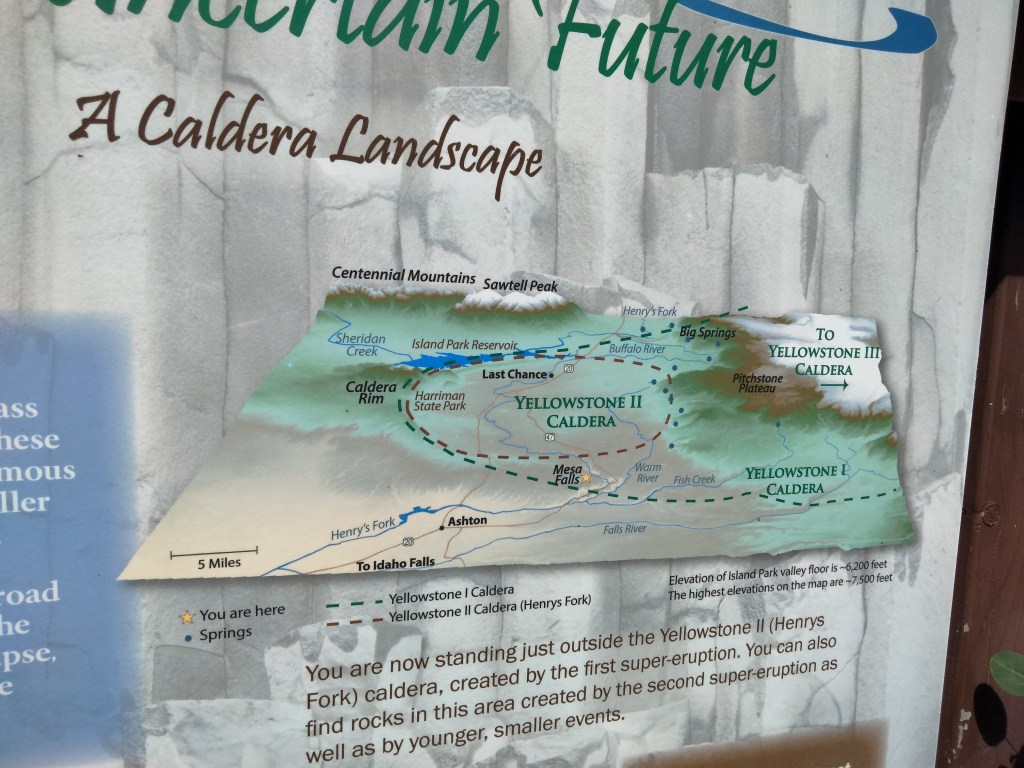
Mesa Falls is located up in the northeastern area of Idaho. If you head due east from there, you’ll find yourself crossing the border into Wyoming and into Yellowstone National Park. It’s also near popular campsite Island Park, as well as near lots of hunting and fly fishing, well-positioned to attract people who are enjoying all the beauties of the region.
As you can see from the map above, Mesa Falls lies in part of an old caldera. The earth’s crust has moved, putting the fresh caldera under Yellowstone National Park. Hence the geysers that can be found in Yellowstone, and the eerie, sulfur-scented, brightly colored, deadly hot springs (which incidentally play a cameo role in my book The Strange Land).
This summer, I went up to Ashton, Idaho for a writing retreat. (What was I writing? That is for me to know and for you to find out!) Ashton is a relatively small, relatively remote town, but it’s touristy because of its proximity to hunting, fishing, and the Yellowstone area. I stayed in a mom ‘n’ pop motel consisting of camping cabins that have been there for ages.
On the way back from Ashton to my home stompin’ grounds, it would have made sense for me just to get on the highway and go south. But my husband has hike radar, which lets him know whenever he is within twelve hours’ drive of a good hike. This radar also works remotely, when someone he knows is in range of a good hike. So he let me know that I should go north instead, view Mesa Falls, and then head back. As it was a Sunday afternoon, I did so.
Mesa Falls is on a forest service road or something like that, so my paper map actually showed the road ending well before I got there. Thankfully, in real life it continued.

Here is proof I was there.
The hike was not at all demanding. There’s a capacious parking lot ($5 entry, envelope system), and then a series of well-maintained steps and boardwalks that bring you down to the very top of the falls, with many specially designed niches for selfies.
I did not bother to photograph the other falls-goers, but place was packed.
Now I’ll post some short videos I took of the falls.
The cliff opposite the falls was lush and green due to the permanent plume of mist that hits it.

There have been a number of proposed sites for Atlantis. Graham Hancock has proposed Antarctica, North America, and probably some other places that I don’t know about. I’ve also heard rumors that the sunken continent could be in the Bahamas area and could explain the Bermuda Triangle phenomenon. The Disney movie Atlantis locates it off the coast of Iceland, and I have also heard people advocate the Eye of the Sahara in Mauritania. (The idea being that, before continental uplift, this site was closer to the coast, and it could have been inundated by a tsunami or something like that.) Well, the article above makes what strikes me as the most likely proposal yet.
The super-island of the Cyclades Plateau (Plato’s Atlantis) was drowned by the sea at around 8000 BC, during the rapid rise of the Mediterranean and just prior to the flooding of the Black Sea (see UNESCO study, 2009.) Incidentally, around this time, Lake Agassiz, a gigantic glacial lake in North America, also burst open and began to drain into the Atlantic. It is worth noting that Lake Agassiz covered an area larger than all the Great Lakes combined (440,000 Km 2) and at times, it contained more fresh water than all the lakes in the world today. The total fresh water outflow from this lake alone was so immense, scientists believe it raised the oceans worldwide by as much as nine feet and further produced the 8.2 kilo-year event that followed, a mini ice age that lasted 400 years! This global cataclysm at the end of the last Ice Age, which ultimately raised sea levels by 400 feet, not only erased our early history, but this could also be the event we all inadvertently refer to as the “Great Flood.”
ibid
Proposing the Cyclades Plateau as the site of Atlantis ties its inundation to a known rise in sea levels that happened right around the date that Plato says Atlantis was submerged. The article shows maps of what the plateau would have looked like and how it roughly matches Plato’s description of Atlantis (though the scale is slightly off). Of course, in my integrated version of ancient history, it went like this:
The article also suggests that this civilization was part of a larger pan-Mediterranean civilization:
Finally, a 10,000 year old Mediterranean civilization, may help explain more archaeological oddities in this region. Recent erosion and seismic tests at the Giza Plateau, indicated that the Great Sphinx may be much older structure than previously thought, and along with the site of Gobekli Tepe in Turkey, both seem to coincide with Plato’s story of Atlantis. Is it possible that Gobekli Tepe and the monument of The Great Sphinx could be remnants of the same advanced civilization Plato referenced in his story, one that was aggressively advancing against its neighbors in Africa and the Middle East, or do those belong to another culture? And what about the advanced proto-Euphratean people who descended upon the Mesopotamia around 7000 BC, from a region “unknown.” Could these enigmatic people be the refugees of the same culture who fled the Mediterranean basin and moved eastwards to escape the inundation? Undoubtedly, they could have brought with them the story of the great flood as well as the skills and technology to incite yet another great civilization, like that of ancient Sumer (just as the survivors around the Cyclades and neighboring islands may have ultimately contributed to the rise of the Minoans).
ibid
This sort of thing is catnip to me.
Finally, for the reconstructive genetics nerds among us (raises hand), the article offers bonus evidence that the residents of this Aegean Atlantis may have island-hopped their way to North America, which would explain why Haplogroup X is concentrated most heavily in the eastern Mediterranean and around the Great Lakes. (Bonus: the Great Lakes area was also the source of a particular type of copper that was used in the Mediterranean during the Bronze Age.)
I shamelessly stole this tag from Bookstooge and The Orangutan Librarian … oh wait, it looks like TOL actually did tag me. Technically. Thanks to Sheri Dye for creating this fab tag!
Here they come:

Andrew Klavan. He writes older female characters pretty well, plus he totally adores women, so he will make me seem like a much better person than I actually am finally give me the credit I’m due!
On the down side, his stories tend to be rather dark and violent, so buckle up.

It’s a paranormal portal fantasy where I go to an archaeological site to research a book, unwisely step along a ley line, and end up in Atlantis.

Mixed with a Miss Marple mystery.

I’m a married woman, and besides I’m too old for romance. The romances will take place among secondary characters, the way they always do in Brother Cadfael mysteries. My grown sons will each get married in the course of the book, plus there will be at least one secondary romance in Atlantis, but it will end tragically.

Myself, but about 20 years older. I’ll be a spry little old lady with wild, flyaway hair. Sort of a Good Witch look. Also, my nose will be bigger than current.

My niece, a very cool person who just happened to meet up with me at Newgrange because she was on a study program in England.
I have a lot of nieces. I won’t say which one I have in mind, but she knows who she is.

Twenty years from now, I will be so sanctified and refined by the sufferings of life that I am the goodest of the good, hidden underneath a thick layer of Old Lady bitterness and cynicism.
Wait a minute … we have options other than human? Why wasn’t this mentioned earlier???


Since this is an Andrew Klavan novel, there will be two nemesises (nemesi?). In this world, it will be Klaus Schwab. In Atlantis, it will be a being of light that is going to help bring humanity to a higher plane. Later, it turns out that Schwab is working for the being of light.

Like they all end: I die.
But not before I make it back to the 21st century in time to help expose Klaus Schwab (working together with my niece and an unlikely band of misfits that includes James Lindsey, Andrew Klavan, and my pastor. Klavan will be about 100 years old at this point, unless he has also engaged in time travel).

And, we all know what happens to Atlantis.
(What’s that you say?
Plotholes, schmotholes!)
 Out of Babel Books

