Blackpilled by Bitten

I have a friend who, shortly after he was married, came down with a mysterious illness. It was causing fatigue, pain, digestive problems, and a bunch of other debilitating symptoms. This guy is young (or was when he first became sick), handsome, and looks fit. He is not in a demographic that you would expect to have trouble being believed, but he had trouble. He’s been accused of faking. He’s been yelled at by a doctor. He and his wife used up all their money, and the illness made it difficult for him to work his job as a builder. Finally, after years of seeking solutions on their own, outside the traditional medical establishment, my friend found a doctor who was willing to look at his blood under a microscope.

Turns out, he has Lyme disease.

It took him fifteen years to get this diagnosis.

As I found out when I read this book, this sort of experience is not unusual for a Lyme patient.

Let’s start with another Lyme testimony

The author, Kris Newby, and her husband were both bitten by Lyme-bearing ticks while on vacation in Martha’s Vineyard in 2002. It didn’t take them 15 years to get a diagnosis … but the disease did ruin their professional lives, use up all their money, and cause them to search through more than ten doctors.

We had brain fog: we couldn’t think, multitask, or remember simple things. The crushing fatigue continued. Our necks felt like they were locked in a vice-grip. Paul’s symptoms were more muscle and joint related. He didn’t have the strength to lift his leg over a bike or press the trigger of a portable drill. Mine were more neurological. I was no longer capable of reading books aloud to my sons before bedtime … I’d run into the side of doorways and had trouble recalling the current month and year. … One day I found myself at a stoplight unable to remember what the red, yellow, and green lights meant.

Rather than admit defeat, Dr. B decided that I was an attention-seeking, hysterical female whose husband was suffering from sympathy pains. He diagnosed us with a “psychosomatic couples thing.”

I spent weeks pulling strings to get an appointment with another infectious disease specialist, this one at Stanford University School of Medicine. Our first few appointments were with a young physician/fellow whom I’ll call Dr. C. …During my final appointment, Dr. C told me, “You’d have more chance of winning the lottery than both of you getting Lyme disease.” Then he strongly recommended that we both seek psychological counseling for the depression we were experiencing.

Dr. D came in at the end of the appointment, handed me a box of tissues, and said, “Sorry, we don’t have the tools to fix what is wrong with you.” Then he dismissed us as patients.

ibid, pp. 85 – 88

As it turned out, most Lyme ticks are also infected with rickettsia, another tick-borne illness that is even harder to detect than Lyme in a blood test: “If you’re not looking for it, you won’t see it.” (231) More in a moment about the reasons for this double infection.

Years later, when Newby had been researching Lyme and rickettsia, she found herself again sitting in front of Dr. D., this time as a journalist rather than a patient.

As I sat in his office, I wondered if he remembered me, but I didn’t mention our previous meeting.

At the end of the meeting, I took a chance and asked him, “Are you screening for any rickettsias?”

He said he didn’t know. The genetic sequencing was being done at Columbia University … Dr. D. opened the study protocol on his laptop and realized there were no rickettsias on the screening list. He said he’d see if rickettsias could be added to the search.

As I got up to leave, he added, “When you came by my clinic before, we weren’t allowed to treat chronic Lyme disease. It was department policy. I’m sorry.”

ibid, pp. 236 – 237

The diagnostic standards: made-up

He was not wrong. The diagnostic standards for Lyme specifically deny that chronic Lyme exists.

In the Infectious Disease Society of America guidelines, chronic Lyme isn’t classified as an ongoing, persistent infection; it’s considered either an autoimmune syndrome or a psychological condition caused by “the aches and pains of living” or “prior traumatic psychological events.” These guidelines were often used by medical insurers to deny treatment, and many of its authors are paid consulting fees to testify as expert witnesses in these insurance cases. In some states, the guideline recommendations take on the force of law, so that Lyme physicians who practice outside them are at risk of losing their medical licenses.

ibid, p. 121

It gets worse. In preparation for her documentary Under Our Skin, the author put in a FOIA request to obtain emails between CDC employees and IDSA guidelines authors. She got the runaround for five years, so they completed the documentary without it. Eventually, she received 3,000 pages of emails which revealed that “a majority of the authors of the 2006 IDSA Lyme diagnosis and treatment guidelines held direct or indirect commercial interests related to Lyme disease … tests or vaccines for which they were patent holders. ” (124) Furthermore, “part of the group’s stated mission … was to run a covert ‘disinformation war ‘ to discredit Lyme patients, physicians, and journalists … ‘loonies’ and ‘quacks.'” (123)

This pill is not just red, it’s black

The Jen of ten years ago would have been very skeptical of this kind of expose. It would have struck me as too similar to Marxist conspiracy theories where all the bad stuff in the world is caused by “capitalists,” which means primarily “big corporations,” but then is applied to anybody who doesn’t want socialism. Journalists, and Hollywood movie directors, love their government/big business conspiracies. It’s one of the very few kinds of story that get them going. Ordinarily, when I am presented with a “corrupt capitalists” narrative, I sympathize with the supposed villains of the piece because I know that the authors of the piece, if they knew my views, would probably villainize me just as readily.

However, when it comes to health, the Jen of ten years ago has seen some stuff since that time. I’ve met people with Lyme (my friend above is the most poignant example, but there have been others). I’ve met people, particularly women, who have had an extraordinarily hard time getting autoimmune type physical complaints taken seriously. I’ve even had that happen, on a small scale, to myself.

Then there have been the scandals. The ADD drugs scandal, the depression drugs scandal, the cross-sex hormones scandal, and the one we don’t talk about, which involved financial incentives for drug companies to discredit victims of their product and doctors who tried alternative treatments almost exactly like the incentives in relation to Lyme described in this book.

So yeah, I’m not that Jen anymore. I do think Newby is a little leftie (maybe a lot leftie), but that’s not why she wrote this book. She wrote it because she got Lyme disease and a series of doctors called her crazy.

My friend with Lyme also has a lot of food allergies and substance sensitivities. During You-Know-What, when one of his kids broke an arm, he was worried about bringing her to the hospital, because they might force You-Know-What on her as a condition of treatment. They got the arm treated without a jab; happy ending. But we live in a relatively red state. This is a horrible position to be in: where you’ve basically lost all trust in the people you need for critical care.

And that’s not even the bad part.

The Bad Part

Most of Bitten is neither about IDSA scandal nor about the author’s personal experience with Lyme. Instead, it follows the life of Willy Burgdorfer, a Swiss-American scientist. Chapter 2 opens with Willy’s triumph when, in 1981, he discovered spirochetes, similar to those that cause African relapsing fever, inside the midgut of a blacklegged deer tick. Burgdorfer became a hero in the medical and scientific communities after he and his team proved that these tick-borne spirochetes were what was causing the mysterious Lyme disease. He received awards and honorary degrees. (13 – 15)

Willy called his discovery “serendipity,” a happy accident.

Shortly before his death, Willy was videotaped saying that he believed that the outbreak of tick-borne diseases that started around Lyme, Connecticut, had been caused by a bioweapons release. [This] could explain why the condition we call Lyme disease is so hard to diagnose and treat–and why the epidemic is spreading so far and so fast, [but] Willy’s confession was vague and fragmented because he was suffering from advanced Parkinson’s disease.

ibid, pp. 15 – 17

The book then backs up and starts with Willy’s childhood in Switzerland and his Ph.D. work there on ticks mailed from East Africa which caused relapsing fever and African swine fever. He does a postdoctoral program at the University of Basel (25), then accepts a research position at the Rocky Mountain Laboratory in Hamilton, Montana, studying Rocky Mountain spotted fever. More ticks! In fact, the biggest tick collection in North America. “The U.S. Public Health Service, which would later be renamed the National Institutes of Health, paid for the lab by developing, manufacturing, and distributing vaccines for … diseases transmitted from animal or arthropod vectors to man.” (35) As the chapters roll by, we follow Willy as he falls in love with and marries a fellow scientist who is a U.S. citizen. Already working for the U.S. government during the Cold War, he soon found himself involved in programs testing nerve gasses and biological weapons.

America’s first deployable incapacitating biological weapon was an aerosolized mix of a toxin, a virus, and a bacterium, designed to create a prolonged period of incapacitation across a population. The first component … SEB, was a toxic waste product of the bacterium that causes food poisoning. In three to twelve hours, [victims] would come down with chills, headache, muscle pain, coughing, and a fever as high as 106 F. The second component, Venezuelan equine encephalitis virus, would, in one to five days, cause a high fever and weakness and fatigue lasting for weeks. The third component, Q fever, would cause debilitating flulike symptoms for weeks to months … Q fever could be chronic and sometimes even fatal.

When exposed to this mass-produced germ cocktail, theoretically, few people would die, but it could put a significant percentage of a population out of commission, making an invasion easier. And no city infrastructure would be harmed. Later, Henry Kissinger questioned how nonlethal these weapons could be and wryly noted that they would be nonlethal only for someone with two nurses.

ibid, p. 145

In other words, this was a way to bomb civilians without bombing civilians.

In other words, weapons developers were mixing different germs and toxins deliberately and putting them into a form that could be easily spread.

Meanwhile, Willy was force-feeding pathogens to thousands of ticks.

Near the end of his life, Willy was interviewed on video by Tim Grey, an indie filmmaker, who later shared the tape with Newby.

“If there’s an emergence of a brand-new epidemic that has the tenets of all those things that you put together, do you feel responsible for that?”

“Yeah. It sounds like, throughout the thirty-eight years, I may have …”

Finally, after three hours and fourteen minutes, Grey asked him the one question, the only question, he really cared about: “Was the pathogen that you found in the tick that Allen Steere [the Lyme outbreak investigator] gave you the same pathogen or similar, or a generational mutation, of the one you published in the paper … the paper from 1952?”

In response, Willy crossed his arms defensively, took a deep breath, and stared into the camera for forty-three seconds–an eternity. Then he looked away, down and to the right; he appeared to be working through an internal debate. The left side of his mouth briefly curled up, as if he is thinking, “Oh, well.” Then anger flashes across his face. “Yah,” he said, more in German than English.

ibid, pp. 100 – 101

So now you know why I’m blackpilled when it comes to “science” and “medicine” and the NIH. This is why Lyme is going around ruining people’s lives. Because it was designed to.

Black-pilled, but still not a hippie

The book closes, as all hippie books must, with the obligatory chapter blaming Western colonialism.

Big Hole [Montana] was the site of one of the bloodiest conflicts between the U.S. government and the Nez Perce. … U.S. soldiers ambushed them while they were sleeping. The Nez Perce lost eight-nine people, mostly women and children, and the U.S. soldiers lost twenty-nine, with an additional forty injured.

Two months later, Chief Joseph surrendered.

The Native Americans who used to live here understood that they were part of nature, not the overlords of all living things.

When the white settlers arrived in the Bitterroot Valley, they clear-cut the trees around Hamilton for their houses, railroad ties, and mine shafts. This fostered the overgrowth of brush, which led to a proliferation of small mammals, the blood meal hosts for the wood ticks that carry Rickettsia rickettsi. The spotted fever epidemic at the turn of the last century was fueled by this disruption of a previously balanced ecosystem.

ibid, pp. 245 – 247

Now, you know that I have a special interest in American Indians, and feel as much sympathy for them as anybody. And just for the record, I am against the massacre of civilians. That said, it is ridiculous to imply that the settling of North America by Europeans is responsible for the existence of the Lyme epidemic, or of disease in general.

It is a fact of history that people groups move, expand, colonize, and kill each other. And as a result of these people movements, ecology changes, and new diseases spread or become prominent. All this is true. It does not follow that, before any given people movement, the ecosystem was perfectly “balanced,” or that there was no disease and no death. There would have been different causes of death, different diseases, and different wars. The Anasazi, for example, were severely malnourished. The Aztecs were systematically wiping out all the other peoples in central Mexico. Montana was not Eden. It’s a fallen world.

Rather than blaming the U.S. soldiers who killed the Nez Perce for the Lyme epidemic, let’s blame them for what they actually did; namely, killing the Nez Perce. And call me an old stick-in-the-mud, but I feel that the blame for the Lyme epidemic should fall on the Cold War era government bioweapons bureaucrats and scientists who actually infected ticks with Lyme and rickettsia, and apparently allowed them to escape somewhere on Long Island. I feel that Occam’s Razor would lead us to point towards them as the culprits, rather than to something big and vague like colonialism. Just a thought.

And I do blame them. Despite my semi-defense of colonialism as the way of the world, no, I do not think it’s a good idea to create a cocktail of infectious agents that result in chronic, debilitating, hard-to-diagnose disease, and then to put this into a form that is easy to disseminate. You don’t have to be a naive, anti-war hippie to realize that this is a terrible idea that is sure to bring Murphy’s Law crashing down upon your head. In the same way, I am just a humble non-scientist but I don’t think it’s a good idea to create a genetic “vaccine” packaged in a lipid particle that instructs the body to make a disease, for which you cannot control the dosage or where it goes in the human body. And I’m not sure it’s such a good idea to stop testing this concoction halfway through, turn up your nose at long-term testing, bill it to the public as safe and effective, ignore contrary data, suppress alternative treatment methods, and then demonize and gaslight people who report injuries. It just seems that there are a few things that might could go wrong there. Just a thought.
When Did We Stop Marrying Our Siblings?

… and why do I care?

I might be in the process of drafting a book that takes place before the Flood. So that is forcing me to tackle this issue. Besides needing to get it settled in my own mind, this post is meant to test the waters and see how you, my readers, react to this concept. If I even bring it up, will I be kicked out of polite society?

So, this post is a historical survey of sister-marrying. And it starts in Egypt.

Royals did it

Marrying one’s sister, or half-sister, was not unheard of in the royal families of Ancient Near Eastern cultures. See the following two links for some hair-raising proof that it happened in ancient Egypt:

https://www.historyskills.com/classroom/ancient-history/egypt-brother-sister-marriage/

The practice of royal inbreeding continued so long in Egypt that, by the time we get to Tut-ankh-amen, he has a myriad of health problems and is rather strange-looking.

This was such an established part of married love, at least among royals, in the Ancient Near East that calling someone “my sister” became a conventional endearment. Here, for example, is Solomon:

You have stolen my heart, my sister, my bride,

you have stolen my heart with one glance of your eyes,

with one jewel of your necklace.

Song of Solomon 4:9

And why did they do it? The obvious answer is to keep the royal bloodline pure. Most ANE cultures tended to believe that their royal family was descended from the gods (see my post Genetic Engineering in the Ancient World), and to add another layer to this, their myths about the gods also often featured sibling-marriage. Typically, you’d have gods and goddesses all being descended from the same being (Father Sky and Mother Earth, say), and then reproducing with each other to produce all the typically observed features of the cosmos. (Please, for the love of God, take my word for this and don’t read the Sumerian creation myths. I’m begging you–don’t!)

Speaking of Sumerians, here is an article that argues that Abram married his half-sister Sarai (whose name means princess) for the same reason: because their family was some kind of royalty in Mesopotamia before he left on his journey.

https://biblicalanthropology.blogspot.com/2011/03/sister-wives-and-cousin-wives.html

My question, however, is this. Did this practice of royals marrying their sisters represent breaking an established taboo for a “good” reason, or was it a case of carrying on a common practice a little longer than most people? My contention is that it’s the latter.

Let’s Go to Genesis

Genesis is, as I have often said, my favorite ancient history book. The more I study all of this, the more I realize that it is by far the most accurate written record we have of really ancient history, and of course it’s the only written record we have for some events that are, nevertheless, corroborated indirectly by archaeology, genetics, and historical traditions from around the world.

So, in Genesis, we have humanity starting out with one single couple. If we take this seriously, we have to conclude that the first generation would have had to marry their brothers and sisters, because there was nobody else around.

Nowadays, this would be an impossible genetic problem, besides being taboo. However, clearly it wasn’t taboo at the time. By producing families, people were obeying God’s command to “be fruitful and multiply, fill the earth, and subdue it.” (Gen. 1:28) Based on the extremely long lifespans recorded in Genesis, we can infer that the newly created people were much healthier than we are, with a much more varied and robust genetic code. They would have had few diseases as yet, and almost no harmful mutations to inherit. Adam and Eve, who didn’t die until they were into their 900s, could have had literally a hundred or more children in that first generation. Furthermore, these children need not all have looked alike, except in the sense of being human. We have to remember that Adam and Eve had within them the potential to produce every genetic variation we see today (and actually more, since most of the variety was lost during the Flood).

By the time Cain kills Abel, there are enough people in the earth that Cain can complain, “I will be a restless wanderer on the earth, and whoever finds me will kill me.” These other people that he is worried about would have been his siblings, nephews and nieces, grandnephews and -nieces, and so forth. If we figure that Seth was born not long after the murder of Abel, then the murder of Abel took place just under 130 years after the Fall. (Genesis 4:25 – 5:3) Apparently, that was enough time for the world to be populated.

In this video, starting at about 20:00, geneticist Nathaniel T. Jeansen discusses how our ancestors had to have been more closely related “than we are usually comfortable with.”

A Detour into Evolutionary Theory

“But wait!” you may say. “All this is nonsense. People didn’t all come from one founding couple, we evolved from several different but related species of hominids.”

Actually, if you think that way, you probably stopped reading this article before you got to this section. But let’s dip a toe into natural selection, just in case there is anyone hate-reading or any readers who are intrigued by what I’m saying about history, but are bothered by the science side of things.

Natural selection, in order to work as a mechanism, has to have a population of creatures already in place, with some genetic variation already in their genome. And–this is critical–they have to be already reproducing. That way, natural selection can operate on the subsequent generations of the population, encouraging variety here, stamping it out there, etc.

This creates a big problem if you want to argue that people evolved from (ultimately) one-celled animals. Now, how one-celled animals reproduce is itself a beautiful, complex mystery, but it’s basically by subdividing, producing clones of themselves. In other words, it’s not sexual reproduction.

How did sexual reproduction come about through natural selection? It would call for a wildly improbable series of (already vanishingly rare) beneficial mutations to the genetic code of two different creatures of the same species, such that one ended up male and one ended up female, with their systems perfectly corresponding to each other for reproduction. And it would have to work perfectly the first time.

If you want several different populations of human species, then you need this miracle to happen not once but several times, in different places. If it only happens once, then you’re back to what Genesis describes, which is just one founding couple.

What I’m saying is that introducing evolutionary theory doesn’t make the believability problem smaller, it makes it bigger.

Stephen Meyer explains why beneficial mutations are mathematically impossible.

Back to Genesis Again

We’ve established that in the pre-Flood world, there was no taboo on marrying one’s sibling (or probably, cousin or niece either), and also no health cost to doing so. Also (probably) it would not necessarily mean marrying someone you had grown up in close proximity with, given the size of the families we are talking about.

Then we get the Flood, in Genesis 6 – 9 and also attested in numerous local histories worldwide. At the Flood, the human population of the earth, previously vast in genetic diversity, gets culled down to just four couples, and the men of these couples are all related to each other. It’s from these four couples (perhaps just three of them?) that all of us today are descended. (We are literally just one big family!)

Think about the implications of this. The most distant relationship that any of Noah’s grandchildren would have had to each other would have been cousin during that first generation. Perhaps they married their cousins, and then their second cousins and so forth, but there is nothing to indicate that the possibility of marrying siblings had been closed to them. In Gen. 9:1 -17, God makes a new covenant with Noah and his sons. He reiterates the command to increase in number and fill the earth. He gives them the animals to eat, institutes the death penalty for murder of humans, and promises never to send another worldwide flood. He does not mention any new rules about not marrying your sister.

Next, in Genesis 11 and 10 respectively, we get the Tower of Babel and the Table of Nations. Though the Table of Nations comes before the account of Babel, the fact that we are told which geographical areas these nations settled in hints that the Table of Nations is at least a partial elaboration of where people went when “the LORD scattered them over the face of the earth.”

In the Table of Nations, the peoples are sorted by father. We see the descendants of Shem, Ham, and Japeth listed by a paternal line, and we see them scattering to found cities, kingdoms, and peoples. This implies, though it does not directly say, that they were having a lot of children per family, and that they were practicing in-group marriage.

Now we get to Abram, who was a Sumerian basically, or was living in that region of the world and in that culture area. As has been covered, he married his half-sister Sarai, whether because theirs was an aristocratic family or because it was still common practice in Mesopotamia at the time. Later, on two separate occasions (Gen. 12:10 – 20 and 20:1 – 18), he “lies” by telling a local ruler that Sarai is his sister. On both occasions, the local king understands this to mean that Sarai is not Abram’s wife and is fair game for his harem. This shows that, probably, most wives were not sisters at the time, at least in Egypt (Gen. 12) and southern Palestine (Gen. 20).

This would be about 2,000 B.C.

In Genesis 24, Abraham asks his servant to get a wife for Isaac from among “my own relatives.” The servant, guided by the LORD (!), finds Rebekah, the daughter of Abraham’s niece (Gen. 24:15). One generation later, Rebekah herself encourages Jacob to marry one of his cousins, daughters of her brother Laban. So by this time, we are practicing in-group marriage, but with cousins, not siblings.

Some groups still do this. See my post on The Iroquois Kinship System.

Finally, A Taboo in Leviticus 18!

Finally, in Leviticus 18, we get an explicit prohibition on marrying your sister.

Leviticus comprises the details of the giving of the Law, right after the exodus from Egypt, so about 1400 B.C. If you plop your finger onto Leviticus, it looks really early in the Bible. However, it’s 600 years after Abraham and a couple of thousand years after the Flood, so it is coming rather late from this blog’s perspective on ancient history.

The intended recipients of Leviticus are a large population of tribes who have just spent 400 years becoming culturally Egyptian. Since Moses’ parents were both from the tribe of Levi (Exodus 2:1), we can infer that they are still practicing in-group marriage.

Leviticus chapter 18 begins this way:

The LORD said to Moses: “Speak to the Israelites and say to them: ‘I am the LORD your God. You must not do as they do in Egypt, where you used to live, and you must not do as they do in the land of Canaan, where I am bringing you. Do not follow their practices. You must obey my laws and be careful to follow my decrees. I am the LORD your God. Keep my decrees and laws, for the man who obeys them will live [i.e. find life] by them. I am the LORD.

“No one is to approach any close relative to have sexual relations. I am the LORD.”

Lev. 18:1 – 6

There follows a very comprehensive list of close relatives who are off-limits. This list includes everything you can think of, and some things that you perhaps haven’t. It ranges from very sick perversions, to this:

“‘Do not have sexual relations with your sister, either your father’s daughter or your mother’s daughter, whether she was born in the same home or elsewhere. (v. 9)

“‘Do not take your wife’s sister as a rival wife and have sexual relations with her while your wife is living.'” (v. 17)

Verse 9 gives us a clue of what types of family arrangements were possible among the Israelites of 1400 B.C. You might have a half-sister who was raised in a separate household. Verse 17 describes a behavior that Jacob famously engaged in with Rachael and Leah (additionally, both women were his cousins). In fact, the two women’s rivalry was how we got the twelve tribes of Israel. Marrying two sisters at the same time (not to mention their respective maidservants) was apparently something that was normal in the age of the patriarchs, but now, giving the Law 600 years later, God forbids it.

Leviticus 18:24 – 29 makes it clear that “all these things were done by the people who lived in the land before you,” but God considers them to be things that defile a land. I gather that this means the wide variety of disordered sexual relationships described in Leviticus 18 were not unheard-of, probably not just among the Egyptians and Canaanites, but among many or all of the many tribes in the surrounding areas.

We have God to thank for this taboo

So, now we know approximately when marrying your sister became taboo. 1400 B.C. And people didn’t come up with this on their own; God had to enforce it.

The overall picture is one where we start off with is marriages taking place among close family, in sort of a wholesome way, before and immediately after the Flood. Then, instead of branching out and marrying more and more distantly related people as the earth’s population increases, we see cultures in the Ancient Near East curving back in on themselves and coming up with more and more perverse ways to approach this. I gather from Lev. 18 that, once an ANE man had bagged a wife, he seemed to feel entitled, or at least have an eye out for the opportunity, for sexual rights to everyone related to her.

The time of the Israelite patriarchs, enslavement in Egypt, and Exodus also overlaps with the Minoan civilization on Crete, which gave us the legend (?) of the Minotaur, the offspring (allegedly) of Queen Pasiphae and a white bull. That gives us a clue that such horrifying practices were not confined to the Levant. “Do not defile yourselves in any of these ways, because this is how that nations that I am going to drive out before you became defiled.”

Words That Mean Things, Part I

  • kill — This means to cause to die.
  • murder — Murder has to have the following components: direct killing, of a human being, intentional, and unlawful. Therefore, the following things are not murder: Executing someone who has committed a capital crime (lawful). Killing an enemy soldier in war (lawful). Accidentally killing civilians in war (unintentional). Shooting in self-defense (unintentional, and in the case of a firefight, indirect). Killing an animal, even a highly sentient animal (not human). Being unable to provide prompt medical care for someone who is OD’ing while in your custody (not direct or intentional, and also not actually killing).
  • genocide — direct, intentional, systematic killing of an entire ethnic group, with the express purpose of wiping them out. Not genocide: a war that has a devastating impact upon a particular ethnic group, unless all the abovementioned components of genocide are present. Invasion and conquest. Intermarriage. Taking captives. Poverty. Death of a culture because of any of these causes or because of urbanization. All of these are tragic things that have happened to many, many ethnic groups throughout history, but they are not genocide. Definitely not genocide: natural cultural change that happens because of the spread of an innovation like the written word, or a new religion.

La Dama de Elche / The Lady of Elche

Disclaimer: None of these pictures are mine. I found them on the Internet. If any of them are yours, and you don’t like them being used in this post, contact me and I’ll be happy to take them down.

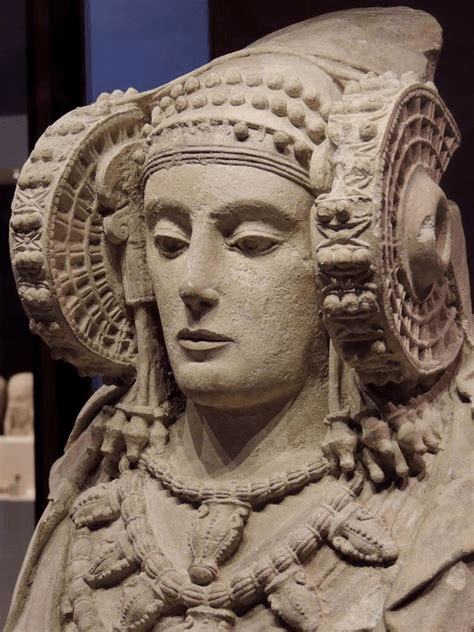
This is the Lady of Elche, Spain.

As you can see, her shoulders are hunched up. Some people describe her as having an “elongated head,” but it could just be the hat. Or it could be a hat meant to imitate elongated heads, as we see in many other cultures, but especially Egypt and MesoAmerica, where there was also head binding.

The following two links are my bibliography. You can follow them to check what I’m about to tell you about the Lady.

https://www.ancient-origins.net/news-history-archaeology/lady-of-elche-002305

https://www.atlasobscura.com/places/the-lady-of-elche

When I first heard that this Lady had been found buried in Iberia, it freaked me out. That’s because my understanding of pre-Roman Iberia was that it was basically Celtic. I was prepared to find Celtic- or Scythian-style artifacts there, such as images of people with narrow chins, large eyes, and moustaches; men with deer antlers; horses, and spirals, perhaps worked in silver, wood, stone, or even gold.

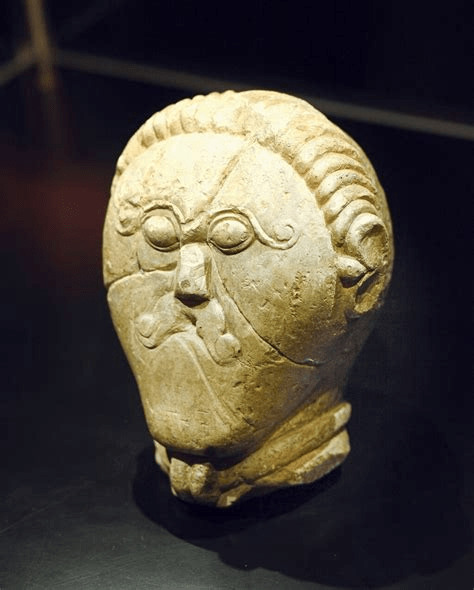
Celtic portrait, with torque necklace

Kurgan stelae in Kyrgyzstan, closer to the probable homeland of the Celts/Indo-Europeans

That’s what I expected to find in Spain. Or maybe something that looked like Etrusacan art, or like statues from the Archaic period of Greece.

I was not prepared for a massive, highly realistic stone statue that looked more classical Greo-Roman in style and featured attire more reminiscent of … I don’t know. Ancient Mesopotamia? Peru? The Lady of Elche freaked me out because it seemed to suggest a whole different style of civilization in Iberia, previously unknown. I was thinking Stone Age or pre-Flood.

Then, I heard that the Lady was believed to be Carthaginian. She instantly became less mysterious, but no less horrifying.

Carthage was a colony of Phoenicians. Phoenicia was an advanced civilization from the Levant. They inhabited the port cities of Tyre and Sidon, near ancient Israel. This explains why the Lady seems to be dressed like someone from the Ancient Near East. The Phoenicians had a shipping empire, so not surprisingly, they started a colony in North Africa. Carthage was here:

As you can see, they are very close to Europe, including territories in Spain. That explains how the Lady of Elche could have Western European facial features and Carthaginian dress.

Like most advanced civilizations of the Ancient Near East, the Phoenicians practiced atrocities in their pagan worship. This was the group that had the god Molech, to whom babies were sacrificed in the fire.

They were dropped down into, or placed in niches in, the red-hot statue. Drums and horns covered the sound of the infants’ screams. Incredibly, Israelites kept taking part in this practice and God had to keep telling them to stop. There was even an Israelite king who “made his son pass through the fire.”

Given that Carthage was part of an advanced, baby-killing empire, the Lady of Elche at once becomes more horrifying. The blank look on the woman’s face becomes more sinister. Is this just a death mask? Or is it because she is cruel? Or mindwiped by all that she had seen and done?

I don’t have any historical reference for this, but an anonymous commenter on the Internet has asserted that the “ear covers” were worn by priests and priestesses to block out the screams of the victims of more gruesome rituals. The bigger the ear muffs, the worse the ritual. I’d like to pooh-pooh that, but it fits with everything else we know about the ancient world. Christ conquering the nations suddenly sounds much less like a step in oppression and more like a relief. If you know more about the earmuff question, I’d love to hear it I wouldn’t exactly love to hear about it, but I’m curious and please send me your information.

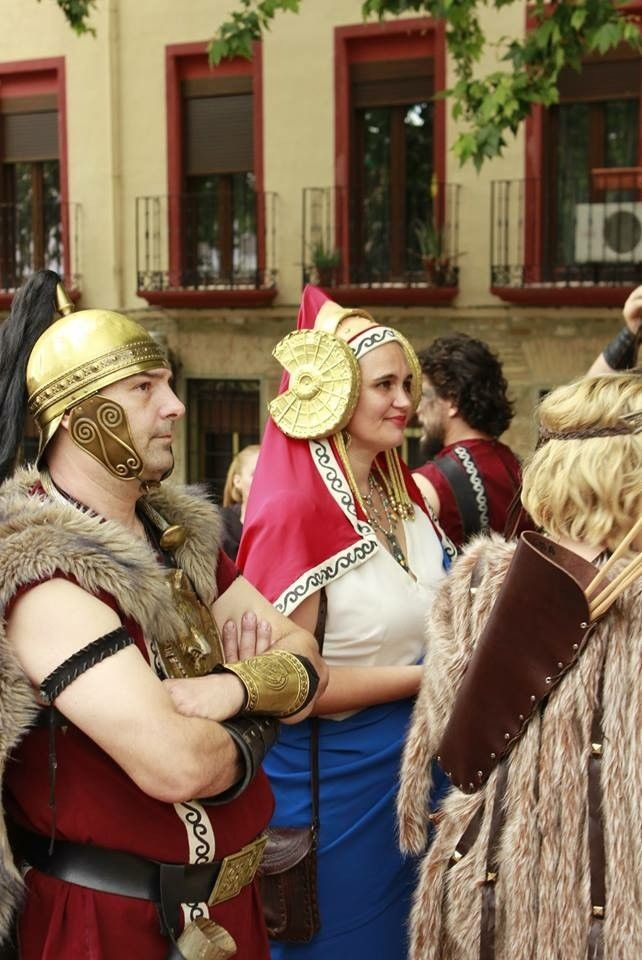
If you know how to indicate your interest in the Lady to the algorithm, you may find people dressed in historical re-constructions of the Lady of Elche’s garb, like these:

These ladies all look significantly happier than the original Lady.

The Belated Hallowe’en / Horror Tropes Tag

I got this tag from Snapdragon Alcove. I hope it’s OK that I’m posting it after Halloween (life is busy!). Because of the relatively narrow range of my horror consumption, I’m freely mixing movies and books.

Pick your favorite example of a …

Zombie apocalypse

The Book of Eli (a movie)

Not exactly zombies, but as I recall, there is an older couple that seems normal, but then you find out they have some sort of neurological disease from having eaten human flesh to survive. Creepy.

Also, I love the characters Denzel Washington usually plays, and this is no exception. I like my apocalyptic movies to be somewhat uplifting, and this fits the bill.

Vampire

The Unwilling, by C. David Belt (a book). Cheating a little, ‘cause I recently reviewed it here. This one made me cry, because there is a child vampire who wants to be “a real boy.”

Haunted house

I guess I don’t read many haunted house books, because Monster House is the only one I can think of. It is just as sad as ghost stories usually are.

Psychological thriller

Fractured and Shutter Island (both movies). I was very angry with both of these movies, but Fractured probably made me angrier.

Creepy doll

The Collision series, by Rich Colburn. So far, it has only two volumes: The Resolve of Immortal Flesh and The Formulacrum. But The Formulacrum ended on a literal cliffhanger, so that means Colburn owes us another one.

Neither of these books is exclusively about creepy dolls, but one very memorable creepy doll is featured … and that’s just about the only book I have ever read with a creepy doll.

Monster

Beowulf, duh.

And, in case you are not up to speed on this, Grendel is a t-rex. But there are plenty of other monsters in this how-to-defeat-monsters book, including the sea monsters Beowulf encounters while swimming in the North Sea, and Grendel’s mother, who appears to be some sort of octopus.

Comedy-horror

The Tremors franchise. It is the best. Extreme gross-outs, but also extreme humor. Survivalist Ed really steals the show.

Teen Horror

Stranger Things.  I will die on this hill.

The series starts out where the kids are about twelve and it more resembles E.T. or The Goonies, but the events cover several years and we see the kids discovering the opposite sex, feeling left out as they grow up at different rates, dealing with problems with their parents and problems involving finding a career and their place in the world. Their lives have all the teen challenges, plus the ghosts and demonic creatures and stuff to deal with. And yes, there are a few make-out scenes that it would be nice if we could skip. I will also say that the series seems to be equally sensitive to the experiences of teen boys and girls.

Some people think the episodes are too long and detailed, but that’s the point. They work in a lot of human drama in addition to the scary stuff, and I am here for it.

Demonic possession

Perelandra and That Hideous Strength by C.S. Lewis both feature possession that gets more terrifying the longer you think about it.

In Perelandra, the possessed man gets to come out and speak instead of the demon once in a while, and this gives a more evocative glimpse into his mind than we might prefer.

In That Hideous Strength, the people that are serving the demons get dehumanized to an even greater extent, and we see the beginning of this dehumanization process happen to one of the main characters. There is also a memorable scene where one of the villains, who up until now has been the most formidable because of his intelligence, wants to put a stop to something, but “he could not think of any words.” This moment of aphasia shows us how close his mind is to total disintegration.

Science fiction

Science fiction reliably pulls towards horror, for obvious reasons. Human nature doesn’t mix well with dimensional portals … or genetic engineering … or time travel.

That second image is from a movie called Paradox. It turns out there are quite a few of those, but this one involves time travel being exploited by a bitter coworker to go postal, and even though the team has an awful lot of information, they can’t figure out what is happening quickly enough.

A True Horror Story from the Bible

The following account has been brought to my attention three times in the last forty-eight hours, so I guess I’d better pay attention.

The Gadarene region was Greek, not Jewish, in culture. There were a lot of pigs. There was a lot of paganism. People understood power. They knew there were things out there beyond their control or ken.

Jesus and his disciples landed on these shores in their fishing boat. I am not sure why they made this decision. It’s possible that they were blown there by the recent storm and needed to touch land and regroup.

Almost as soon as they disembarked (“immediately,” Peter says, telling the tale to John Mark), they encounter the scariest sight any of them have ever seen: the town demoniac.

Peter gives us some background, which apparently was well-known to the people in area. This man “had an unclean spirit.” The local people had tried to “tame him,” but they couldn’t do it. With paranormal strength, he would break through any chains put on him. (Demons are quite reckless with the bodies of their human hosts.) He had it so bad that he couldn’t live around people. But he didn’t go far. Night and day, they could hear him screaming in the hills that surrounded the town and in the graveyard, his home base. He was apparently naked (because later, he is “clothed”), and he would cut himself with stones.

It breaks the imagination, what this man must have suffered.

The demons for some reason were attracted to the sight of Jesus stepping on their shores. The man runs up to Jesus, falls on his knees, and screams, “Why can’t you leave me alone, son of the most high God? Swear to God that you won’t torture me!”

Jesus, the only sane person in this story, asks a simple, human question. “What’s your name?”

He was asking the man, but the demons answer: “Legion, for we are many.” (This would later prove to be really really true.)

Jesus, unfazed, tells the demons to come out of the man. And they begin to bargain. I’m not sure why they thought this was possible. Was it because they were gods in their own country? Was it because there were so many of them? At any rate, rather than be banished from that region, the demons get Jesus to agree that they can go into a nearby herd of two thousand pigs.

There were enough of them to possess the entire herd.

The pigs, unable to handle what this poor man had been going through, panicked and “ran violently down a steep place into the sea” and drowned.

The swineherds, understandably horrified, went for help. By the time the people of the region had been summoned from their homes and fields and made their way to the beach, the formerly demon-possessed man was “sitting, and clothed, and in his right mind.” Jesus, still bringing the sanity and relief, had apparently rustled up clothing for him from somewhere. (One of His or His disciplines’ spare cloaks, perhaps, from the boat?) This man’s body no doubt still bore the scars of the harrowing life he had been leading. He was probably still fragile. Did he even remember the months or years he had lost to demon possession? We don’t know. But he was near Jesus.

The Gadarene people were freaked out. There were a bunch of dead pigs washing up on the beach. They were confronted with the disorienting sight of the madman’s face now looking sane. And, though they might not have known exactly what Jesus was, He clearly represented a dangerous power. They pleaded with Him to leave their region.

The delivered man, for obvious reasons, wanted to go with Jesus. But Jesus told him to go back and “tell your friends the great things the Lord has done for you.” Perhaps, during the time it took the swineherds to bring the townspeople, Jesus had been interviewing the man, finding out about relationships he had before disaster befell him fully. And this man was not a Jew, and would find it difficult to live on the west side of the sea. Going back to his old life might be hard, but going anywhere else would be a lot harder. He followed Jesus’ instructions.

This story would have been a very different horror story had Jesus not been present.

This story was re-told from Mark chapter 5.

The Bourne Treachery: A Book Review

by Robert Ludlum, but actually by Brian Freeman

As you might expect from a Ludlum novel written by somebody else, this book has the feel of something made on an assembly line. It has all the parts and doodads that you expect from the genre, and it does what you want it to do (in this case, be thriller), but it has no particular artistry or character. To be fair, this also means it’s lacking some of the flaws that might show up in quirkier, more idiosyncratic books.

Pacing and Action: A+

This is, I gather, the outstanding characteristic of Bourne books. The action is almost constant. Nevertheless, the author does a good job of introducing characters and explaining the setup and the stakes, so that we don’t get the phenomenon of action that we don’t know the significance of. I will say that to a certain degree, tension is inflationary, so the shock and horror isn’t quite as shocking and horrible as it would be with a slower buildup.

Tours of Foreign Cities: A

Traveling the world is one of the things we expect from the Bourne novels. Freeman does a good job of making us feel as if we are familiar with the cities where the action takes place by mentioning particular roads, parks, markets, and squares. He also does a decent job with the weather and atmospherics.

Russians Betraying Each Other: A

Also other spies betraying Bourne, and Bourne possibly betraying other people (who knows, since he lost his memory). The hypocrisy of people in espionage, as well as the messed-up kind of person that years in espionage makes you, is a major theme of this book. Speaking of which:

Character Development: B-

The book tries to do some character development with Bourne discovering his past, wishing he could get out of the espionage game, and realizing that he has been made into the kind of person who probably isn’t capable of anything else. There’s a fair amount of character development given that this is a thriller. But, the thriller distinctives limit the emotional impact of all this, at least for me. The pace is too fast and the writing too matter-of-fact for character development to get really emotional. Speaking of which:

Relationships between Men and Women: C-

Okay, so there is a lot of sex. Including one scene that lasts several pages. But it’s written the way a man would write it, which is to say, the emotional element is minimal. Speaking of which:

Portrayal of Women: D

Hmm, where to start?

Obviously, we are talking about spy women, so that skews the sampling. But these ladies are ruthless killers. They are also … how to put it …? Not overly concerned with monogamy. They can go from killing to kissing, or worse, in no time flat. They don’t seem to get emotionally attached as a result of sexual involvement, the way a normal woman would. They aren’t adversely affected by all the gruesome things they have to do, even as much as Bourne is.

There are two women who don’t appear to be nymphos, but they are both cool as cucumbers. One only cares about science, one about spycraft. You know, like most women you meet.

Also, spy goddess is petite and very athletic, but also has “deep curves.” I dunno. Deep curves (such as wide hips) affect the way a person runs, tumbles, throws, etc. I went through most of the book picturing her as wiry and boyish, and then all of a sudden the author threw these curves at me. Also, their hair is always loose. Not very practical, ladies.

I’m not even trying to be feminist here. I just find these women hella unrealistic and unrelatable, which in turn makes the “romance” (such as it is) tepid.

Russians Talking: F-

This was the thing that annoyed me the most, because it messed with the verisimilitude even more than the Bond-style spy women. Many of the characters in this book are expatriate Russians. Many of them need to monologue to explain their positions. All of them talk exactly like an American explaining something in a business seminar. Listen, Russian sentence structure, word choice, and so on, is very distinctive, even when they are speaking English. It should not have been hard to watch a few movies where this was well done, and then imitate it in this book. If you are going to research foreign cities and bring them to life, why not make the dialogue believable too? I think I would have enjoyed this book a lot more if the Russians had sounded like Russians. And it would have supported the theme. Make them sound like Russians!

More about the Plymouth Colony

Trigger warning: graphic description of smallpox

This spring also [1634], those Indians that lived about their [the Plymouth settlement’s] trading house there, fell sick of the small pox and died most miserably; for a sorer disease cannot befall them, they fear it more than the plague. For usually they that have this disease have them in abundance, and for want of bedding and linen and other helps they fall into a lamentable condition as they lie on their hard mats, and pox breaking and mattering and running one into another, their skin cleaving by reason thereof to the mats they lie on. When they turn them, a whole side will flay off at once as it were, and they will be all of a gore blood, most fearful to behold. And then being very sore, what with cold and other distempers, they die like rotten sheep. The condition of this people was so lamentable and they fell down so generally of this disease as they were in the end not able to help one another, no not to make a fire nor to fetch a little water to drink, nor any to bury the dead. But would strive as long as they could, and when they could procure no other means to make a fire, they could burn the wooden trays and dishes they ate their meat in, and their very bows and arrows. And some would crawl on all fours to get a little water, and sometimes die by the way and not be able to get in again. But of those of the English house, though at first they were afraid of the infection, yet seeing their woeful and sad condition and hearing their pitiful cries and lamentations, they had compassion of them, and daily fetched them wood and water and made them fires, got them victuals whilst they lived; and buried them when they died. For very few of them escaped, notwithstanding they did what they could for them to hazard of themselves. The chief sachem himself now died and almost all his friends and kindred. But by the marvelous goodness and providence of God, not one of the English was so much as sick or in the least measure tainted with this disease, though they daily did these offices for them for many weeks together. And this mercy which they showed them was kindly taken and thankfully acknowledged of all the Indians that knew or heard of the same.

William Bradford, Of Plymouth Plantation, pp. 302 – 303

Stone Age Surgery

Photo by Renato Danyi on Pexels.com

Trigger warning: Stone Age surgery!

This post is the first in a series I have planned about prehistory. Each post will draw on one or more chapters from the book The Lost Civilizations of the Stone Age, by Richard Rudgley, Touchstone, 2000. From the front flap:

Our long-held myths are exploding. Recent discoveries of astonishing accomplishments from the Neolithic Age – in art, technology, writing, math, science, religion, and medicine, and exploration – demand a fundamental rethinking of human history before the dawn of civilization.

Lost Civilizations, inside flap

So, Rudgley’s thesis is basically that there was, in fact, civilization long before there was civilization. That is, of course, also a theme of this blog. “Ancient people were smarter than we think,” or that art, literature, science and civilization are the natural state of human beings and have been present (ebbing and flowing of course) as long as there has been humanity.

A near-universal theme in the mythologies of the world is that the present state of the world, and more specifically the social world, is in decline — a fall from the Garden of Eden or from a Golden Age. Modern civilization has turned these traditional mythological assumptions on their head and written a new script, one based on the idea of social progress and evolution. In this new mythology the notion of civilization (as it is generally understood) replaces Eden and this novel paradise exists not at the beginning of time but, if not right now, then just around the corner. Civilization is … presented as the final flowering of human achievement born out of a long and interminable struggle against the powers of darkness and ignorance that are represented by the Stone Age.

Lost Civilizations, Introduction, page 1

I have come to believe in the ancientness of civilization because I take ancient documents seriously as historical records: Genesis, primarily, but also the other legends and myths from around the world which Rudgley mentions in his intro. This suspicion that ancient people were much smarter than we give them credit for was further strengthened as I learned about some of their building projects. Now Rudgley is presenting archaeological evidence that they knew far more than we suspect about art, mathematics, the natural sciences, and medicine.

Disclaimer about Dates

By the way, I don’t have a coherent way to sort out which archaeological dates to accept and which ones to doubt. As far as I can tell from my reading, all methods of dating archaeological sites are based on some form of dead reckoning.

Carbon dating depends on certain assumptions about rates of molecular decay, which can’t be proven in the first place and can also be thrown off universally or locally by events such as a comet strike. Carbon dating also seems to be less reliable the farther we go back in time.

Dating by archaeological layers also depends on assumptions about different historical periods and what might be diagnostic of each, except in cases where a site can be reliably linked to a known historical event (which is obviously only the case for relatively recent sites). Other than that, it’s all dead reckoning.

Dating events in human history by the use of genetics depends upon assuming that all genetic differences evolved and assuming certain rates of change. Historical linguistics has the same problem.

Finally, historical records such as the genealogies found in Genesis and in the oral traditions of other peoples worldwide hit only the highlights of a family line and don’t give us any idea how many generations were skipped.

Each of these methods can be pretty convincing in specific cases. It is even more convincing when one or more methods converge, yielding the same date range. But even when that happens, it’s still just one method of dead reckoning appearing to validate another. And most often, different dating methods contradict each other. If a plurality of them converged on one timeline for human history, maybe we could accept that. But they don’t. It’s complete chaos.

I would love to present a clever, coherent, data-grounded rubric for sorting all this stuff out. But I’m not a professional in any of these fields. Even if I were, the pros don’t all agree with one another. It’s starting to look like, in order to have a sorting method that makes sense, I would have to do full-time research for several years. Maybe for a lifetime. So I got nothin’.

My working theory is that humanity, and hence human civilization, is tens of thousands but not hundreds of thousands and certainly not millions of years old. I can’t prove this. No one can.

So, in these posts about Rudgley’s book, I’ll just present the dates as he gives them. I won’t try to integrate them with the picture of ancient human history that I have been piecing together in my books and in other posts on this site, all of which could be invalidated at any time by a new historical or archaeological discovery. Sometimes Rudgley gives dates that are hundreds of thousands or even millions of years old (though not in this chapter). I might be skeptical that they are really that old, but can still accept that these people were living long before mainstream archaeology tells us that there was “civilization.”

On to the Icky Stuff!

So. Stone Age Surgery.

Undoubtedly the widest-known major surgical operation in tribal cultures is trepanation … which, as will become clear, was also known in the Stone Age. This operation involves the removing of one or more parts of the skull without damaging the blood vessels, the three membranes that envelop the brain … or the actual brain.

Lost Civilizations, p 126

That’s right, removing parts of the skull. There are three methods by which this can be done: scraping, “a mixture of boring and sawing,” and “the push-plough method,” which involves creating an oval groove in the skull (basically another method of scraping).

Thomas Wilson Parry, MD (1866 – 1945), became fascinated by trepanation and practiced various methods of it on human skulls (not on live patients), “using implements made of obsidian, flint, slate, glass, shell and shark teeth.” “Parry records that the average time it took him to perform a trepanation by the scraping method on a fresh adult skull was half an hour. He found both flint and obsidian excellent materials to work with surgically, and also expressed the opinion that shells — which were used in Oceania to perform such operations — were highly effective too.” (page 128)

Trepanation appears to be less painful than it sounds. It has been used at various times and places to treat epilepsy, mental illness, head injuries, severe headaches, vertigo and deafness (129). It is “still regularly practised among the Gusii of Kenya, a Bantu people with a population of about one million, and theirs is perhaps the last surviving traditional practice of its kind.” (130) Trepanation was also practiced by the Incas and the pre-Inca peoples; in Neolithic Europe; in 6th-century BC Palestine; and now, trepanned skulls a few thousand years old have also been found in Australia.

Rudgley points out that “as it is usually only the bones of Stone Age people that survive to be discovered … any operation that was performed on the soft parts of the body cannot be detected.” (136) If Neolithic people were willing and able occasionally to practice trepanation, it seems likely that they were able to perform less risky kinds of surgery too. There is some evidence from Neolithic Europe of various kinds of dentistry, including toothpick grooves, birch bark chewing gum, and even a skull with a tooth that has been drilled. (136)

Rudgley’s chapter on trepanation (“Stone Age Surgery”) comes after a chapter called “Under the Knife” (pp 116 – 125), which discusses medical procedures in “tribal” cultures that are known from history and ethnography. This includes everything from circumcision in the Ancient Near East, to amputation among the Australian aborigines, to very detailed anatomical knowledge among the Aleutian islanders. The chapter concludes with two horrifying yet impressive accounts of successful surgeries in a tribal context. There is a c-section performed in Uganda in 1879, and various tumor removals performed in the Ellice [sic] Islands in the 1920s. The message is clear: modern, “civilized” people don’t have a corner on medical knowledge.

Antiseptics and Painkillers

We don’t know whether Stone Age people had germ theory. Nor, if they had it, do we know how they referred to germs. In one of Ursula le Guin’s novels, a wound getting infected is called “the evil of the blade.” That’s hardly less scientific than calling it an “infection,” as long as you know how to prevent or treat it.

Studies of both the trepanned skulls of the Incas and some of those found in Neolithic Europe indicate that healing seems to have been the norm in both cases. It is hard to explain the Stone Age success rate without concluding that some kind of effective antiseptic agent must have been used. Furthermore, the surgeons of the time must have understood the need for it.

Lost Civilizations, p 131

If germ theory was ever explicitly known, it was obviously forgotten at some point in human history, only to be re-discovered much later. But even if people were operating on a different theory, it would be possible for them to know the importance of cleanliness and to know how to treat a patient using any of a large number of natural substances that have antiseptic properties. The words “Stone Age” naturally evoke the image of a cave man, and the idea of a cave man naturally includes an individual who never takes a bath. But it ain’t necessarily so.

It is also possible that people’s immune systems were much stronger many years ago, if we are willing to entertain the idea that the human race has declined over time rather than evolving upwards.

Now, I am sure you want to know about painkillers. Here, gleaned from Rudgley’s Stone Age Surgery chapter, is a short list of substances that have been used as painkillers at different times and places:

  • cocaine (in coca leaves — South America)
  • wine mixed with extract of mandrake (first-century Greece)
  • mandrake beer (ancient Egypt)
  • possibly just beer
  • the opium poppy (starting in the Mediterranean around 6000 BC and spreading west from there)
  • cannabis (native to Central Asia, but quickly spread to Old Europe and China)
  • betel nut (Southeast Asia)
  • tobacco (in the Americas)
  • pituri (a nicotine-bearing plant used by the Australian Aborigines)

Clearly, although we might prefer modern anesthesia, ancient peoples were not completely without recourse when it came to pain. Most of the substances on this list are attested not only in history but also in ancient burials.

This has been a repost from January 2020, which by now is … ancient history.

Why Everyone Should Be Educated about the Ancient Near East: A Repost

Here is a representative New Atheist argument from Richard Dawkins:

“The God of the Old Testament is arguably the most unpleasant character in all fiction: jealous and proud of it; a petty, unjust, unforgiving control-freak; a vindictive, bloodthirsty ethnic cleanser; a misogynistic, homophobic, racist, infanticidal, genocidal, filicidal, pestilential, megalomaniacal, sadomasochistic, capriciously malevolent bully.”

Richard Dawkins, The God Delusion, page 31

Of course, each of these epithets could be backed up with an example from Scripture in which God calls Himself ‘jealous’ (not bothering to investigate what was meant by this), or appears to condone – or at least appears in the vicinity of – one of the crimes mentioned.

On its surface, this argument sounds really convincing and even damning … as long as you know nothing about the Ancient Near East.   It basically blames God for all the pre-existing features of the cultures into which He was speaking.

Description Is Not Prescription

First off, let’s dispense with a very basic misunderstanding that nevertheless seems to be widespread.

Just because an incident is recorded in the Bible does not mean that the Old Testament God endorses, let alone prescribes it. Much of the Bible is not prescriptive but is straightforward history.  The Ancient Near East was a horrible place, and any history set there will contain horrors.  In Genesis 19 there is an attempted homosexual gang rape.  In Judges 19 there is a horrific, fatal gang rape, followed by a bloody clan war, followed by a mass kidnapping. In 2 Kings 6 there is cannibalism.  And so on.  It makes no more sense to blame God for these events than it does to blame a historian for the atrocities he documents.

God Commanded Animal Sacrifice, Holy War, Theocracy

But, let’s move on to the more difficult stuff.  It is true that in the Old Testament, God commands His people to establish a theocracy by force.  Furthermore, His worship involves animal sacrifice (which seems mild by comparison, but some people have a problem with this too). To modern eyes, all of this is very very bad.  If God were really good, He would never have set up a theocracy.

I would like to ask the Richard Dawkinses of the world: What kind of society, exactly, do you think the ancient Israelites found themselves in at the time that God gave them all these laws?

Apparently, before the mean ol’ God of Israel came stomping through the Ancient Near East, all the other peoples there were living in a state of secular, egalitarian innocence.  Everything found in the Old Testament was completely new to them.  They had no gods, no priest-kings, no temples in their city-states. They did not offer animal or human sacrifices.  They had no war, no rape, no slavery.  They did not even eat meat.  They were all vegans and went around with Coexist bumper stickers on their camels.

No, no, no.  Come on.  That picture is the exact opposite of the truth.  There was no such thing as an egalitarian, secular society back then, and would not be for millennia.

The Actual Conditions in the Ancient Near East

Public Domain. Maarten van Heemskerck’s interpretation of the Hanging Gardens of Babylon. In the background, the ziggurat (temple) towers over the city.

When God began speaking to the Israelites, here are the historical and cultural conditions that He had to work with:

In the Ancient Near East, literally every kingdom was a theocracy.  If you wanted to live in civilization, that meant that you lived in, or were a farmer attached to, a city-state.  At the center of your city would be the temple of that city’s god.  Typically the king was also the high priest of said god and was considered his or her representative on earth.  So, the god was ruling you through the king.  Every citizen of the city-state owed the king absolute obedience and the god service and sacrifice.  And how was that religion practiced? Typically with animal sacrifice. This is pretty normal for cultures in which livestock represent wealth.  But actually, animal sacrifice was the least of it.  Temple prostitution (which could include ritual rape) was a frequent feature of fertility cults. Human sacrifice, even child sacrifice, was also not unheard-of and in some places it was common. 

Public Domain image of Moloch, the Phonecian god. Children were sacrificed by being placed inside the fiery metal statue. In some versions, the statue is shown with arms stretched out in front of it, into which the baby is placed. This god was popular in Canaan at the time of the Israelite conquest.

In other words, every single person in the ancient world lived in, not to mince words, a brutal theocracy.  All of these kingdoms were far more authoritarian than the system set up by God for the Israelites.  The power of the ruling class was considered absolute.  Being enslaved was routine: because of your own debts, or your parents’, or because your city had been conquered, or because someone fancied you or because you had somehow annoyed the king.   There was no concept of the lower classes having natural rights; and, in many cases, no sense of the rule of law.  Nobody can be a snob or tyrant like an Ancient Near Eastern god-king.

For most people in the Ancient Near East, life was a horror show.

It Wasn’t the Bible World, It Was the Whole World

Public Domain. The temple of Jupiter towers over Rome during the days of the Republic.

Actually, this highly centralized kind of politico-religious system was not confined to the Ancient Near East.  The early civilizations of the Indus Valley had a very similar system to that of ancient Sumer, even down to the temples and city layouts looking almost identical.  The Indian style of centralized religious system can be spotted in Cambodia and Indonesia.  Meanwhile, back in the Ancient Near East, this kind of system persisted, in the centuries following the giving of the Old Testament law, in the civilizations of Crete, Greece, the Hittites, Babylon, Assyria, and Persia.  Thousands of years later, we see similar arrangements in Mayan, Aztec, and Incan culture.  In fact, it is not too big of a stretch to say that until very recent times, a centralized, stratified, bureaucratic theocracy has been the norm, at least among major civilizations, throughout human history.

Public Domain. Pre-Aztec pyramid/temple complex at Teotihuacan.

But that kind of world is strange to us now. We are accustomed to a very different kind of society: relatively open, free, and secular, with lots of social mobility (and no animal sacrifices whatsoever).  For many people, their first encounter with this once-familiar style of centralized theocracy comes when they open the Bible.  They then attribute all this stuff to the God of Israel, as if He had commanded all of this.  But no, He was not instituting theocracy, animal sacrifice, arranged marriage, slavery, or any of the rest of it.  Those things were already universal.  He was, instead, speaking in to cultures for which these things were already the norm.  He spoke to them in their terms, but at the same time transformed the terms to be more in line with His character.

Well, Why Didn’t God Just Fix It?

You might say, “Well, then, why didn’t He tell them to stop having theocracies, sacrifice, and slavery, and to become a modern secular state?”   This would, of course, have made no sense to them.  They would have been completely unable to understand the message.  If they had nevertheless tried to implement it, it would have led to a French Revolution-style Terror and a complete breakdown of their societies.  You cannot completely and instantly transform a society without breaking it.  But He did begin to transform those Ancient Near Eastern cultures by giving them a model of a good theocracy.

Suddenly, people had available to them the option to live in a land where the local god was not represented by a statue (this was unbelievably counterintuitive) and where instead of being arbitrary, He was “righteous” … where His worship did not allow human sacrifice or temple prostitution, but only carefully regulated animal sacrifice … where the behavior of priests was regulated and limited by the law … where institutions like slavery and arranged marriage were, again, limited by relatively humane laws … where each family was supposed to own their own land … where, for many years, there was no king.

If you wanted to set up a sane society in the midst of the Ancient Near East, I don’t know how else you would possibly go about it.

Sources

Richard Dawkins, The God Delusion (Boston: Houghton Mifflin, 2006)

Public domain images in this post come from the pages of Streams of Civilization, Vol. 1, 3rd ed., edited by Albert Hyma and Mary Stanton. (Christian Liberty Press, Arlington Heights, Illinois, 2016)

Information about life in the Ancient Near East, Cambodia, Indonesia, and the American civilizations comes from Streams of Civilization and from many, many other sources.