
Friends, I have had a harrowing experience.
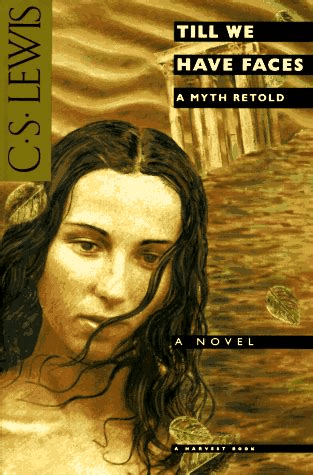
I read Till We Have Faces.
Again.
That’s right, this wasn’t even a first-time read, and it destroyed me. Again. Maybe worse this time.
It’s tempting to do a super detailed book review, including an analysis of all the ancient customs, the Bible Easter eggs, and the symbolism. (My God, the symbolism!) But I’m not going to do that, because I really think you should read it if at all possible. And, even though this book is possibly more powerful on re-reads, I still don’t want to ruin your first read with spoilers.
Any analysis I gave, would be less of an immersive experience than the story itself, because that is the power of fiction.
I will just say a few things about the setting and genre, so you can decide whether to subject yourself to it.
I read TWHF as part of my 2026 “Greco-fiction” project, where I read books set in and/or inspired by the Heroic Age of Greece. When I mentioned this project to someone, they suggested Till We Have Faces. They were right, of course, though I hadn’t put it in the same category in my mind as, say, The Song of Achilles.
The action takes place in a fictional country called Glome. Based upon hints in the text, Glome is located somewhere just south or just north of the Caucasus Mountains, between the Black and Caspian seas. Georgia, Azerbaijan, perhaps southern Russia. Glome is not a mountainous kingdom, but it is near mountains. In the distance, they can see “what we call the sea, though it is nowhere nearly as great as the Great Sea of the Greeks.” This would probably be the Caspian. They are far from Greece, but near enough that they occasionally encounter a Greek captive taken in war. They are near enough to “Phars” (Persia) for that country to present a problem. At one point, the narrative makes a passing mention of “the wagon people, who live beyond the Grey Mountain.” These “wagon people” are probably steppe-dwellers related to the Scythians or Kazaks.
The people of Glome worship a fertility goddess called Ungit, who is embodied in a large irregular black stone that is said to have pushed its way up from the earth. Ungit’s “house” is a group of megaliths joined together with walls. Her worship involves temple prostitution, animal sacrifice, and sometimes human sacrifice, all the usual things that you expect with a fertility religion. Her priest wears a large bird mask on his chest, and dangles with amulets and animal bladders.
The narrator, a little girl named Orual, is frightened of the priest and of Ungit. The story will go on to focus on this fear. Orual very much hopes that the gods are, as her Greek tutor has told her, merely “lies of poets, lies of poets, child.” But are they? Or is there a power in Ungit (and in her son, who dwells on the Grey Mountain) that will leave Orual quite outmatched?
C.S. Lewis is an underrated horror writer. In this story he draws back the curtain on the horror of paganism. We also see, I think, hints of how he himself felt when he was an atheist: desperately hoping there is no spiritual world; uneasily worried that there might be. Relieved, but unsatisfied, by the “clear, shallow” Greek explanations.
So, I’ve said enough. Read it if you dare. I doubt that this year will bring me a better book in the category of Greco-Fiction.
As part of my ongoing, yearlong foray into fiction set in the ancient Mediterranean, I am now re-reading Mary Renault’s The King Must Die. There is so much history and speculation packed into this book, that I make free to do a series of posts on different topics from it, en route to the final book review. So, buckle up! I hope you like ancient historical fiction! (And, since you are visiting Out of Babel Books, I assume you at least don’t hate it!) Today’s topic is Renault’s theme of the two conflicting cultures of Hellenes vs. what they call the “Shore People.”
I have always had the impression that the story of Theseus was one of the older historical myths. It happens when Knossos, on Crete, is still a thriving city. So, in my mind, I put it a few generations before the Iliad. Madeline Miller, author of Circe, seems to agree. In her book, Circe hears of Theseus having killed the Minotaur well before Odysseus comes to land on her island.
If you do the math, Theseus living before the Odyssey would also put him living before Agamemnon returns from the war at Troy and is slaughtered in his bath by his wife, Clytemnestra. In the play Agamemnon (written, of course, much later), Clytemnestra kills her husband in revenge for his having sacrificed their thirteen-year-old daughter before he sailed for Troy, in addition to a couple of other grudges. Like most women, I find it hard not to think Clytemnestra has a case.
Renault, however, takes a different tack. She has a teenaged Theseus hear the following story from a bard:
The song he gave us was the Lay of Mycenae: how Agamemnon the first High King took the land from the Shore Folk, and married their Queen. But while he was at war she brought back the old religion, and chose another king; and when her lord came home she sacrificed him, though he had not consented. Their son, who had been hidden by the Hellenes, came back when he was a man, to restore the Sky Gods’ worship and avenge the dead. But in his blood was the old religion, to which nothing is holier than a mother. So, when he had done justice, horror sent him mad, and the Night’s Daughters chased him half over the world.
ibid, p. 40 in my copy
So here we have Agamemnon, Clytemnestra, their son Orestes, and the Furies. At the same time, this passage raises some questions.
The Shore People make their appearance on the very first page of The King Must Die.
Our house is Hellene, sprung from the seed of Ever-Living Zeus. We worship the Sky Gods before Mother Dia and the gods of the earth. And we have never mixed our blood with the blood of the Shore People, who had the land before us.
-ibid, p. 1
As the story progresses, it rapidly becomes obvious that the Hellenes have, in fact, mixed their blood with the blood of the Shore People. There is the story of Agamemnon, above; Theseus is said to be “blonde and blue-eyed like the Hellenes, but small and wiry like the Shore People,” and Theseus, who is very promiscuous, even has a child who “came out small and dark, but so was [his mother’s] brother.”
So we have two populations, one that is native to the Greek coastlands (or at least has been there a long time), and one that came there from the steppes. Theseus’s grandfather explains to him their ethnic history, which he got from his own grandfather:
“Long ago, he said, our people lived in the northland, beyond Olympos. He said, and he was angry when I doubted it, that they never saw the sea. Instead of water they had a sea of grass, which stretched as far as the swallow flies, from the rising to the setting sun. They lived by the increase of their herds, and built no cities; when the grass was eaten, they moved where there was more. … When they journeyed, the barons in their chariots rode round about, guarding the flocks and the women … [Lord Poseidon] told the King Horse, and the King Horse led them. When they needed new pastures, they let him loose; and he, taking care of the people as the god advised him, would smell the air seeking food and water. The barons followed him, to give battle if his passage was disputed; but only the god told him where to go.”
ibid, pp. 16 – 17
This is a description of the Indo-European lifestyle and homeland. The Indo-Europeans took their reverence for the horse, and their wheeled carts and chariots, with them wherever they went, including to Scandinavia. So the Hellenes are Indo-European, and the Shore People, presumably, Hamitic or Semitic.
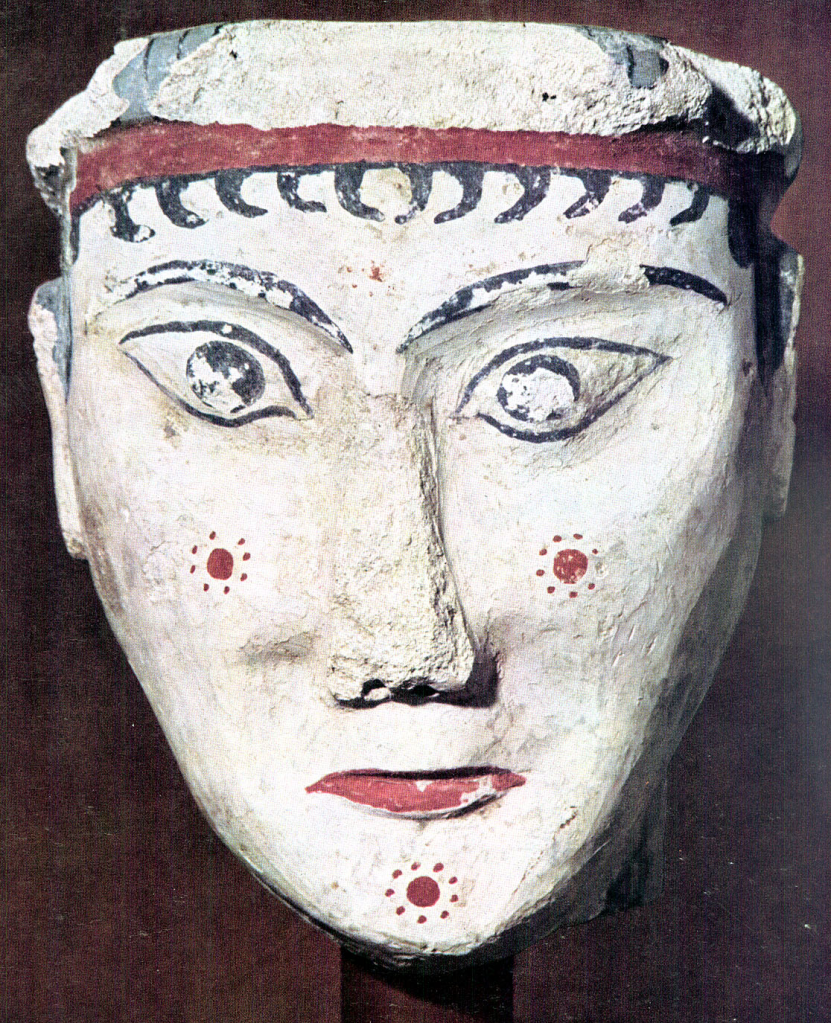
The mask at the top of this post is Mycenaean. Mycenae is located in the Peloponnesian Peninsula, which is also the location of Troizen, Theseus’s home. The ancient Mycenaean culture, older than classical Greece, took its cues from the Cretan urban culture of the time. In later Greece, you get men wearing himations and women wearing finely woven chitons. This is usually how Helen of Troy, for example, is illustrated. However, she probably looked more like the Mycenaean and Cretan women. Here is someone’s attempt to reconstruct the probable hairstyle and costume of the most beautiful woman in the world:
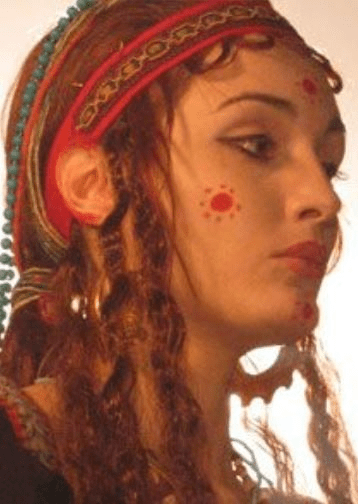
Notice the Egyptian-style, kohl-lined eyes, and the red suns for makeup. Helen might have been blonde, being a Hellene, but her clothing was perhaps more like this.
Here is someone else, reconstructing a traditional Mycenean costume and pose:
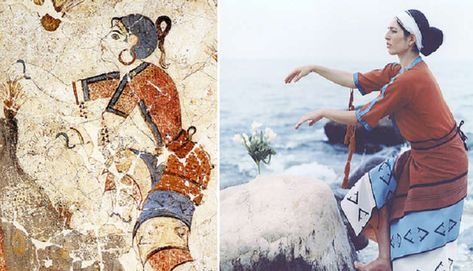
I’m guessing these fashion choices came from the Shore People.
Theseus’s mother is described as wearing this ancient Mycenaean style. She wears a tiered, flounced skirt hung with charms, exposed breasts (what was going on, Crete and Mycenae?) and hair that is curled by the use of “crimping braids” (probably to attain a very curly look for those who do not, like the Shore People, have it naturally). Though a blonde Hellene, she is a priestess of the mother goddess, and so she takes some of her cues from the Shore People, and here is where we find the tension.
Both the Hellenes and the Shore People practice the sacrifice of their kings. However, there is a difference. For the Hellenes, it does not come on a regular schedule. Theseus’s grandfather explains:
“When the work of the King Horse was done, he was given to the god … And in those days, said my great-grandfather, as with the King Horse, so with the King. When the king was dedicated, he knew his moira [i.e. doom]. In three years, or seven, or nine, or whenever the custom was, his term would end and the god would call him. And he went consenting, or else he was no king, and no power would fall on him to lead the people. And the custom changes, Theseus, but the token never. … Later the custom altered. They ceased to offer the King at a set time. They kept him for the extreme sacrifice … And it was no one’s place to say to him, ‘It is time to make the offering.’ He was the nearest to the god, because he had consented to his moira; and he himself received the god’s commandment. And so it is still, Theseus. We know our time. … It is not the sacrifice … it is not the bloodletting that calls down power. It is the consenting, Theseus. The readiness is all.”
ibid. pp. 18 – 19
This might explain why so many kurgan burials are of high-born individuals who seem not to have died of old age.
It also, of course, explains the title of the book.
Meanwhile, it has been established that the Shore People do things a different way: “old laments have come down from the Shore People, of young heroes who love a goddess for a year, and foreknow their deaths” (p. 37). In other words, the Shore People treat their king primarily as the goddess or priestess’s consort, and kill him after just a year.
Marija Gimbutas has tried to make the case that the Shore People practiced a gentle, feminine, goddess-worshipping religion, and that they were cruelly exterminated by the warlike, sky-god worshipping evil Indo-Europeans. Renault is not going to paint with such a broad brush. Realistically, she shows both groups living next to one another and influencing each other. Also, throughout the course of the story, she is going to show by increasingly vivid illustrations that these two cultural systems are absolutely incompatible with each other. And that the mother-worship, in the end, is at least as bloody as the worship of Zeus.
Renault’s take on the story of Agamemnon is a great illustration of this. She interprets the story as a conflict between Clytemnestra’s mother-goddess culture and Agamemnon’s sky-father culture. When Clytemnestra brings back the “old religion,” it means that Agamemnon must die–not in battle, not some day, but now, and actually, yesterday. It means that Orestes is doubly cursed. He has loyalty to both religions, with their incompatible demands, and he is put at the mercy of the furies, the representatives of the goddess-religion. They chase him because he killed his mother, but if we string out the implications, even if he had not, they would probably be chasing him anyway. After all, he is a male heir to the throne, so his days are definitely numbered. Behold, the kindness of the religion of the goddess.
Obviously, there are some universal truths and some redemptive metaphors here, hidden under a thick layer of occultism, war between the sexes, and general pain and suffering for everyone. It is going to take a much greater King than Theseus to cut this difficult knot.
Oh, and Happy Valentine’s Day to everyone! Such a romantic post, I realize.
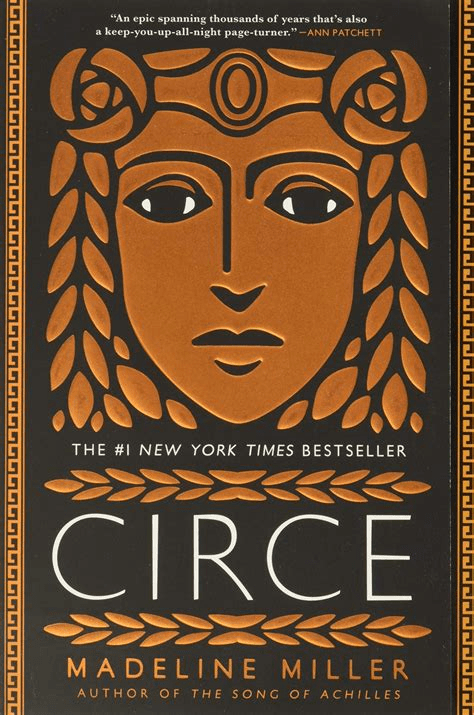
This year, I decided that my fiction focus would be novels inspired by ancient Greek myths. I don’t always pick a fiction focus, but this year, things just coalesced.
In the classical Christian school where I teach, we follow a 4-year “history cycle.” Ancient World, Medieval World, Exploration/Renaissance, Modern World. This year, we are cycling through Ancient, so I have been immersed in the Flood, the Sumerians, Abraham, Egypt, and the Iliad and Odyssey. (Somewhat immersed, of course. We could always immerse ourselves more.)
Revisiting Mycenae and Crete, I remembered that back in university (in the last millennium!) I read what I thought was a fantastic book that was a re-telling of Theseus. Looked it up, and it turns out it was The King Must Die by Mary Renault. And it turns out that Renault has a bunch of other books that I’ve never read. (Back in the last millennium, the way we found books was we stumbled upon them in the library.) So, onto the list went at least a re-read of The King Must Die and its sequel, The Bull from the Sea. I bought myself copies of these for Christmas using my husband’s money, so technically he bought me the copies for Christmas.
Meanwhile, years ago I had won a copy of Circe, and had been waiting to read it until I was ready to stick my head back in the ancient Mediterranean. I’m also aware that Madeline Miller has at least one more book, The Song of Achilles, which is from Patroclos’s point of view. Gay, of course (and that is historically accurate). I decided I might read that, depending upon how I enjoyed or didn’t enjoy Circe. You can write about ancient Greek events from a hard-core feminist/queer perspective, or you can not. I wanted to know first what approach Miller was taking.
Finally, some of my students have been reading Percy Jackson, with the result that they are already quite familiar with the Greek pantheon. I’d known that the Jackson books were out there, so perhaps now is the year when I read at least a few of them. Jackson went onto the list.
Then there are the rereads. Til We Have Faces is C.S. Lewis’s masterpiece, set probably in Scythia or the Caucasus, near the Greeks but not too near. Moving farther from Greece, we have Taliesin, Merlin, and Arthur by Steven R. Lawhead. I read Taliesin in high school. It’s Celtic, not Greek, except that about half the book takes place on Atlantis, with bull dancing and stuff, so I figure that counts. Now, the Daily Wire has made a TV series based on these books. The events of Taliesin take up about an episode and a half. So, if I have time, I’ll reread/read Steven R. Lawhead.
So, here is the list as it stands …
This should fulfill the twelve books that I told Goodreads I’m planning on, this year.
In the course of my teaching year, I have already read The Cat of Bubastes with my students, and am now reading Hittite Warrior, which is also very good. Also on the docket is The Young Carthaginian.
I loved this book. It is exactly the genre I like. Miller did a fantastic job keeping track of all the gods, titans, and nymphs, their little feuds, and their family relations to one another.
Circe, in The Odyssey, is a “witch” whom Odysseus and his men encounter on the island of Aiaia (Corsica or Sardinia … I was imagining Corsica). She turns some of them into pigs, but Odysseus convinces her to change them back. She becomes a sort of ambiguous ally, giving him advice about how to handle the Moving Rocks, the Sirens, and Charybdis and Scylla.
Of course, there is always more detail to the story. Miller has researched this deeply, and I appreciate her portrait of where Circe came from. Circe is the daughter of the sun, Helios, who is a titan, and his one legitimate wife. This makes her the sister of Pasiphaë, wife of King Minos (ahem), and also of Aeetes, father of the witch Madea.
Given that she is divine, Circe gets a front-row seat to nearly all the earliest myths. She meets Prometheus in person. She watches the whole ugly episode with Minotaur go down (this is centuries before Odysseus). Time passes quickly for her. At the same time, she is sort of fascinated by mortals. On the plus side, this means she does not view them as disposable, as most of her relatives do. On the down side, she at first fails to see them as a threat.
Near the end of the book, she has this to say.
I thought once that gods are the opposite of death, but I see now they are more dead than anything, for they are unchanging, and can hold nothing in their hands.
p. 385
Though a page-turner, Circe was a heavy read emotionally. As you might expect, it really stinks to be an ancient Greek god or Titan. You are likely to have horrible parents, for example. The hardest part for me was finding out what we might have suspected by reading between the lines: that Odysseus was actually a real [censored], and that things did not go happily after he made it home to Ithaka. Thankfully, Miller does not leave us there but introduces at least one good man and gives the book’s ending a faint note of redemption.
Based on this read, I think I will try The Song of Achilles if I come across it. Miller’s writing is not ideological. It is extremely tragic, with heartbreaking near misses and so forth, but that is actually how these ancient stories go.
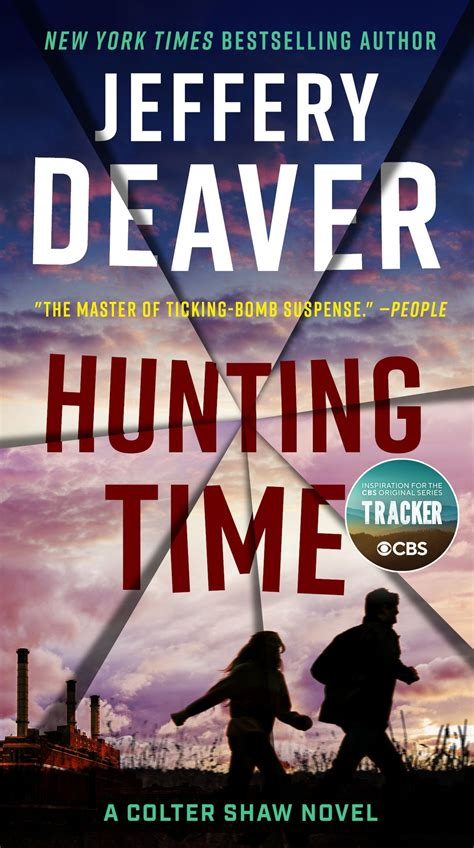
By the way, it’s “hunting TIME,” not “HUNTing time.” The sense is not “time to hunt,” but “we don’t just save time, we hunt it down.”
This is a very professional modern thriller and the author has tons of blurbs on the back from other modern thriller writers. The plot was intricate, the pacing tense, and the characters were distinctive enough to keep them straight and give some emotional momentum to the story. There was also at least one major twist that I did not see coming, and that I really thought was clever.
Possibly the best-drawn “character” is the Midwestern city of Ferrington, the picture of urban blight but without the glamour of a big coastal city. Ferrington used to be an industrial capital, but then many industries left the city, leaving people out of work. Now the place seems to be nothing but drugs, crime, and despair. There are lot of chain-link-fence-surrounded empty lots filled with trash, long streets full of abandoned warehouses, and there is a badly polluted river. The ugliness of the scenes described rises to the level of beauty. The cops are corrupt in some cases and spread too thin in others. I think the name Ferrington is supposed to remind us of Ferguson, Missouri, and this is where we start to get into the book’s flaws.
Though Deaver mostly sticks to the story, when laying his scenes he makes sure to get in occasional digs at the reader. Bigots are everywhere. Trans is good, gay is good. We capitalize Black but not white. Stuff like that. Oh, and of course, capitalists are the one who ruined Ferrington in the first place.
My other issue with this book is the female characters. They’re not terrible, but … but … well. They are just missing a certain je-ne-sais-quois. For example, one of the point of view characters is a woman, Allison Parker. Deaver uses third person limited with her and with Colter Shaw, the sleuth. When we are inside Allison’s point of view, he frequently calls her Parker. That is just a bit confusing. It makes it sound like there is another person in the room. I am pretty sure that most women don’t think of themselves by their last name. Although maybe men do. Which is really the problem: All Deaver’s “female” characters (he has three main ones in this book) think more like men. Allison Parker is an engineering genius, very organized, very no-nonsense. Her daughter Hannah is a math genius, also no-nonsense. Sonja Nilsson is a former military operative (you guessed it, no-nonsense!) who is willing to sleep with Shaw after having known him for a day or two.
This is not a problem with Deaver alone. Many, many female authors write “male” characters who think and talk like women. It’s just awfully difficult to get into the head of the opposite sex.
Finally, there are occasional little things that made me scratch my head. “Seahorses can be sensuous.” (They can?) “Five-high.” (It’s high-five.) Nilsson lost forty pounds, and kept it off, in order to go into witness protection. (Oh, I didn’t realize it was that easy. Especially since she left the military at the same time! But, as we all know, the only thing keeping fat people from losing weight is the want-to. Eye roll)
Due to all these little flaws, and because the reveal of the villain was less satisfying than I had hoped, I give this book three out of five stars.
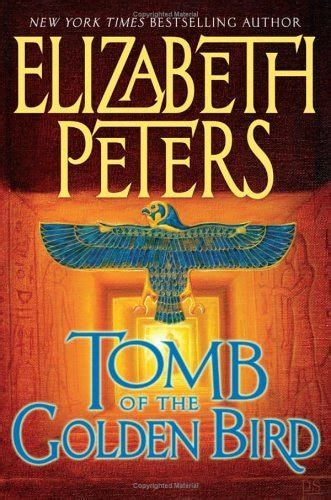
This was pure fun.
The Emersons are a family of British Egyptologists. Emerson, “Father of Curses,” the paterfamilias, is married to Amelia Peabody, whom he calls “Peabody.” This hot couple began their Egyptian adventures back in the Victorian era, but now it is 1922. Their grown son, nicknamed Ramses, is married and has children, and the Emersons have a large, motley household of employees, longtime family friends, relatives, and adoptees, both Egyptian and British. They have returned to Luxor, Egypt, for yet another season of digging. Of course, there are going to be capers, skullduggery, and so forth, and all the Emersons will be involved up to their elbows. Will they be deceived by Emerson’s half-brother Sethos? Will they foil an international plot? Most importantly, will they ever get a peek into the intact tomb that was discovered–technically, by Emerson–and is now being opened by the odious Carter?
This series is exquisitely researched. About 60% of the story is told in the first person by Amelia Peabody, in near-perfect late Victorian/Edwardian language. Scattered everywhere are gems like this one:
… I identified several other [party] guests as journalists. I can always spot them by the bulges in their coat pockets which indicate the presence of notebooks, and by their predatory looks. Messieurs Bradstreet of the New York Times and Bancroft of the Daily Mail were known to me personally (through no fault of mine).
p. 241
The other 40% of the story is told in third person from the point of view of Ramses, who is a quieter character than his colorful parents, but it also includes gems:
He had thought of several innocent explanations for David’s behavior, including the one he had given. It was understandable that [David] might feel the need to be alone; the family en masse or individually could be wearing.
p. 254
I originally came to this series hoping for ancient Egyptian mystical mysteries. It’s not that. It’s more of a romp. Much of this book felt like following the Keystone Cops, but eventually there did turn out to be some twists that gave the whole plot shape and direction. Four out of five stars.
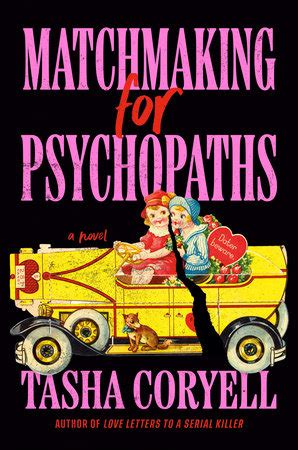
Matchingmaking for Psychopaths, by Tasha Coryell
I picked this up off the New Books shelf at the library. Perhaps I should have left it there, based on the title, but I had read the first few pages and found them engaging. Alas, I returned the book without finishing it. I would have liked there to be at least one main character who I was sure wasn’t a psychopath. A little psychopathology goes a long way.
When I returned the book, the librarian giggled and said, “Oh, that one was silly.” It was indeed silly. But silly and serial murder don’t mix well. At least not for me.
A year or two ago, someone challenged the famous curmudgeon Bookstooge to read Barbara Cartland. This was deliciously absurd, as Barbara Cartland is an incredibly prolific romance author from the last century, whose author picture, lest we forget it, looks like this.

These readalongs are supposed to happen in December.
In December 2024, Bookstooge and his 70,000 followers read Love Saves Day by Barbarba Cartland, which turned out to be essentially an unedited draft that was published after Cartland’s death by her children. Even so, the consensus was that we didn’t hate it as much as we expected to, and that for all its flaws, Cartland is a very professional hand at plotting.
This year, Bookstooge announced that the Cartland of choice was A Rainbow to Heaven. I purchased my copy, and everything was all ready to go. And then, after reading Chapter 3, Bookstooge bailed on us. He had his reasons. You can read them here.
But I am happy to tell you that I finished the book, and boy, did Bookstooge miss out because the plot really heats up after Chapter 3! Below, I will summarize chapter by chapter, and you will see what I saw, that Cartland has the touch when it comes to twists and turns.
And by the way, though this book was published in 1976, it is set in (and, according to the author’s note, written in) 1930.
We meet Diana Headley, beautiful heiress whose father is a self-made man. We see her go to a party with the other “bright young people,” especially eligible society bachelor Hugo Dalk. We see that they are shallow, good-hearted snobs. We learn that Diana is a celebrity, whose picture is always appearing in magazines.
“I feel morbid,” she told Hugo brightly. “Let’s go and have a drink.”
p. 12
Hugo proposes to Diana. She brushes him off. We get a little backstory about how this notorious playboy first got the bug for Diana.
Diana manages to get herself invited to the country home of Jack and Loelia Standish, a married couple whom she admires and who seem to represent some stability and kindness in her world. They have an estate called Huntsman’s House in the Malvern hills in Worcestershire. Jack mentions that he has an old army friend name Barry Dunbar who is “one of the most intellectual young men in Europe today.”
Diana arrives at the beautiful, isolated and peaceful Huntsman’s House.
“So very, very pretty,” Loelia thought. “What a pity she leads such an aimless existence!”
p. 30
We hear more backstory about how Loelia came to marry Jack after a loveless first marriage to a man thirty-five years her senior. We hear how Jack, a sad, cynical soldier in WWI, met Barry Dunbar and was given hope and spiritual elevation by him. We learn that Barry has a project of retrieving obscure Hindu and Buddhist texts and getting them translated into English, and that Jack is helping him with funds.
Then we meet Barry himself. He is not impressed with Diana, and relates an incident in which he caught “three native boys” looking at a copy of Tatler, in which Diana appeared wearing a crazy costume that featured a bikini and top hat. Diana is embarrassed but tries to defend herself. Loelia is disappointed that Barry does not like Diana.
Still at Huntsman’s House, we find that Barry has a way with both children and animals. Sitting in the morning room, intending to write a letter, Diana overhears a conversation between Jack and Barry. They discuss Barry’s travels, how great Buddhism is, and the need for a spiritual awakening in modern England, which apparently Barry’s Buddhist texts are going to catalyze. Jack presses Barry about whether he will ever marry. Barry admits to wanting a son, but doubts whether any woman could put up with his traveling lifestyle. He reiterates that he doesn’t find Diana attractive because her “mind is completely unused.”
The group walks to The Castle, a building on the Standishes’ land. They have fixed up a portion of it so guests can stay there. Eager to impress Barry, Diana asks for a copy of one of his books, and he lends her A Way. Diana finds it “extraordinarily beautiful,” but hard to understand.
Reflecting on the emptiness of her life of luxury, Diana returns to London, where she encounters her friends Cecil and Bebe,
a small vivacious blonde of her own age, who had startled London with her debut, and had continued to keep it considerably surprised ever since.
p. 51
Bebe and Cecil insist on Diana’s throwing a party, which they will organize. Hugo shows up and is disappointed that he can’t spend the evening with Diana alone.
Diana and her large group of friends move from restaurant to theater to bar, drinking oceans of champagne and wasting lots of fine food which they can’t appreciate. Eventually, in the wee hours of the morning, Hugo brings Diana back to her London house. He wants to come in and “talk to her” (get an answer about his proposal), but she puts him off until tomorrow night.
Before going up to bed, Diana sees a light on in her father’s study and finds the body of her father, who has shot himself.
After the police are called and Diana’s brother Jimmy shows up, it is revealed that their father got into serious financial trouble and shot himself rather than declare bankruptcy. He was so active in the financial sphere that his ruin causes a crash, and causes many other people to lose their fortunes as well.
There is a media frenzy making Diana’s father, Robert Headley, the villain. He is portrayed as intentionally looting the public, and luxuriousness of his house is exaggerated.
Quite normally decorated rooms were described as though they were treasure-houses of barbaric splendor.
p. 69
Diana and Jimmy lose everything, but the lawyer encourages Diana to keep her jewels, which she may be able to sell later. She assumes that Hugo will now not want to marry her. She boards a train and goes back to Huntsman’s House for a few days to get away from the publicity and to collect herself.
Staying at the The Castle on Jack and Loelia’s property, Diana gets a letter from her brother Jimmy. He has taken a job at a garage, with the understanding that he will work under an assumed name so as not to damage the garage’s reputation. The other mechanics can tell that he’s upper-class, and they don’t respect him until he gets into a fight. Diana realizes that she does not have any marketable skills. Although she can ride horses, dance, and speaks several languages, she is not equipped to teach any of these things.
Barry catches her sitting outdoors, crying, and tells her that she still has “the only thing that matters … Courage.”
A friend of Diana’s finds a potential job her. She is to be a “companion” to the daughter of a socially climbing family called the Schnibers. This is quite a change for Diana, but she decides to take the job. Once in their home, she sees how Mrs. Schniber raises money and contributes to a lot of charities, but the wealthy patrons she is helping still don’t treat her with courtesy, much to her frustration.
The Schnibers go to Monte Carlo for the summer, and Diana accompanies them. At one point, she gets away from her duties to have supper with a nice young man whose eye she has caught. He reveals that he lost his fortune in the Headley Crash and will be starting work when he gets back to London. Diana excuses herself before he can realize who she is.
Also in Monte Carlo, the Schniber family bump into Hugo. Hugo is shocked to see Diana in reduced circumstances. He still seems to like her and want to get alone with her, but Mrs. Schniber has hopes that Hugo will pursue her own daughter.
The Schnibers and Diana return to London. Diana sells her jewels to help her brother Jimmy pay off a debt that he became liable for while he was still at the university. Diana and Jimmy become closer, and each is impressed with the other’s resilience.
Diana encounters the young man from Monte Carlo, but this time he knows who she is and treats her coldly.
Diana goes to Huntsman’s House for the weekend, where she tells Jack and Loelia about her new job and begins to find it funny. She is happier than when she was wealthy. Jack admits to Loelia that he misjudged Diana.
Loelia and Diana discuss love, marriage, and Barry’s tragic backstory. Barry is unexpectedly also staying with the Standishes, and by the end of her weekend there, Diana has realized that she is in love with Barry. She is surprised by the intensity of this new sensation, and she feels more alive than she ever has.
Diana goes back to working for the Schnibers in London. She remains obsessed with Barry. Hugo has continued to call at the Schnibers, and Mrs. Schniber has finally realized that his interest in is Diana.
While out shopping, Diana bumps into Loelia, who mentions in passing that Barry has joined a Buddhist monastery. Diana is devastated and moves through her days in a daze.
Mrs. Schniber notices the change in Diana and concludes that it is because she is wasting away with love for Hugo. She encourages Hugo to press his suit. He does, and Diana, feeling that nothing matters anymore, agrees to marry him.
In the midst of preparations for her wedding, Diana hears that Barry is no longer at the Buddhist monastery. He spent only three months there as a monk in order to prove his seriousness and gain access to one of their priceless manuscripts. She flees London, leaving letters for Hugo and Mrs. Schniber, and winds up in a village that she picked essentially at random.
Diana spends a few months living with and working for a very poor young couple, Ted and Rose, who run a roadside garage and a small tea room. She is happy living in poverty and obscurity, but she is not eating well.
On a stormy night, Diana stays with Rose, who is in labor, while Ted goes off on his motorcycle to fetch the doctor. Ted crashes in the rain. Rose delivers a baby boy, and both she and Diana are hospitalized.
Diana has caught pneumonia from running around in the rain. In her fever, she continues raving about whether the doctor will come in time. The doctor can’t identify who Diana is from her possessions, but he finds her book A Way, which has “Huntsman’s House” written on the inside. He contacts Jack and Loelia, who bring Diana to recuperate at their home.
Barry comes to visit, where he spends time with the thin and weak Diana. He tells her that he is going to go to his house, on an isolated island off the coast of Cornwall, to write a book. Diana decides to risk everything and pursue him there.
She manages to get Barry’s address out of Loelia, who admits, “Somehow … I’ve always felt that you and Barry would suit each other, even in the days when you were a very frivolous person.” (p. 150)
Diana hops on a train, charters a fishing boat, and manages to beat Barry to his house. It is beautiful, peaceful, and unique, with a vast ocean view and two Chinese servants. There, she announces to the shocked Barry that she is going to stay with him. After ascertaining that she is not planning a large, wild party, and that she is the only guest, Barry finally figures out that Diana is in love with him. He reciprocates. The two of them enter directly into Nirvana.

I am not a person who eagerly awaits the latest release in a series, and pre-orders books as soon as they become available. Usually, I am the one who discovers the series 20 years after it came out. In fact, this series by Klavan is the only exception I can think of. I pre-ordered After That, and it came, as promised, on Halloween.
This is the fifth book in the Cameron Winter series. The other books are:
After That, the Dark takes Winter on the next stage of his journey. It’s designed to be readable as a stand-alone, but you will find it more satisfying if you’ve been with him all along.
Like every Winter book, this one deals with Winter’s psychological journey, and on a parallel track there is an equally devastating crime that he is trying to solve and, inevitably, prevent. Subplots include Winter’s love life and his battles with the leftie professors at the university where he is an English professor.
The title for this book is taken from a poem by English Romantic poet Tennyson:
… Who imagined that his death would be like sailing over the sandbar near the coast and out into the greater ocean.
Twilight and evening bell,
And after that the dark!
And may there be no sadness of farewell,
When I embark;
For tho’ from out our bourne of Time and Place
The flood may bear me far,
I hope to see my Pilot face to face
When I have crost the bar.
ibid, p. 160
Cameron Winter’s academic specialty is English Romantic poetry (about which Klavan recently published a book, himself). Throughout this series, it’s sort of felt as if Klavan wants to have the best of both worlds with his hero. Winter is a former government operative, a dangerous man, and also a soft, spiritual guy who just wants everyone to appreciate poetry. Sort of like a medieval knight. I haven’t felt that this tension was 100% successful in past books, although it does lead to the Superman dynamic where the nerdy guy takes off his glasses and messes up the bad guys good, which is always fun. But in this volume, Winter starts to integrate these two different sides of his personality.
The crimes in this book deal with transhumanism. The victims and potential victims are mothers and babies. One potential victim is an expectant mother who has noticed changes in her husband and can’t articulate them well enough to get anyone to believe her. It’s the kind of thing I wouldn’t have been able to handle a few years ago, when my kids were smaller. I kept reading only because this is Klavan, and I know he doesn’t like stories where women get butchered gratuitously. “Look, when there’s a killer chasing a girl with a knife, I’m on the side of the girl!”
So, if you like poetry, action scenes, demonic possession, or personal growth, you will get all of that here. It’s not exactly like any other action/crime book I’ve read. The hero is usually wrestling with his own demons, but in other books he doesn’t spend so much time talking to his shrink. It’s a bold move on Klavan’s part to allow the hero to actually start beating the personal demons. I don’t know how he’s going to continue a noir-type series once his hero becomes psychologically healthy, but I’m sure he’ll find a way.
As you can see, I’m a little conflicted about Cameron Winter. But I still wholeheartedly give this book five stars, and if you want to find out why, read on for some major spoilers.
I have mentioned before that what I live for in books is when the characters’ concrete experience and myth coalesce, so they are walking the specific path in front of them, but also enacting a mythological scene at the same time. This is a little hard to describe, but you know it when you see it. It’s what makes great art.
This fusion of the everyday and the eternal is most often found in the fantasy or sci-fi genres, because to be honest, it’s easiest to set up there. But to my delight, Klavan has here pulled it off in a modern thriller/true-crime type novel.
Let’s go back to the pregnant woman who starts to suspect her husband. Her name is Tilda, a name probably chosen for how vulnerable it makes her sound. Tilda used to be a “bar girl,” one of the town’s easy marks. Then, her husband Martin picked her up with the line, “Do you have a minute to talk about Jesus Christ?” Tilda thought that was a pretty good joke, but then Martin actually did. He actually did talk to her about Jesus Christ. And he was a perfect gentleman. Tilda married him, and she became a Christian and her life completely changed. But now, the man who led her to this change seems to have become a completely different person and Tilda, understandably, doubts herself. Sometimes, she secretly wonders whether she’s really faking this whole Jesus thing.
Winter, meanwhile, is on the track of a man he knows is out there. He knows this man will have undergone a dramatic personality change recently, and that if not found he will begin to commit gruesome crimes. Winter, though an atheist, is dating a Christian girl and she has given him a cross for his spiritual protection. Winter keeps the cross in the coin pocket of his jeans. When the bad guys, after beating him rather severely, have him handcuffed to a chair, he is able to get the cross out and use it to pick the locks on the cuffs. There follows an action scene wherein Winter, still holding the cross, manages to escape the bad guys and run barefoot into a cornfield. As he runs, a cornstalk punctures his foot. When he finally stops running and wonders why his hand hurts, he looks down and finds that the cross has pierced the inside of his fist. He has to dig it out.
When I read that, I looked up and said to my husband, “The hero just received stigmata.”
But Klavan isn’t done with Winter yet.
Tilda, meanwhile, is tied up in the crawlspace in a house her husband has been working on. She knows her husband is about to come and finish her off. Her mind is a hurricane of incoherent prayers for Jesus to spare her unborn baby.
Then Winter shows up, having already decommissioned the husband outside. Because he has been beaten so badly, his face is a swollen mess, “like a monster.” And the first thing he says to Tilda is exactly what I knew he would say:
“Don’t be afraid.”
This is how Jesus comes to us. “His appearance was so disfigured beyond that of any human being, and his form marred beyond human likeness.” (Isaiah 52:14) He shows up looking like that, and He says to us, “Fear not.”
As Winter strives to calm Tilda down enough to rescue her, he keeps saying the sorts of things that Jesus says:
“Listen to me,” the man said. “I’m going to use a knife. No, no, it’s all right, don’t be afraid. I’m going to use a knife to cut you free. It will look scary, but I will not hurt you. Nothing will hurt you now, but I have to cut you free. Don’t be afraid.”
… The man had climbed out of the space. He was above her again, reaching down for her with both hands.
“[Your husband] is not here. Let me get hold of you. Don’t you hold on to me,” he said. “I’m stronger. Let me hold on to you.”
… Tilda was crying hard now. “I prayed to Jesus and you came,” she explained.
“Oh. Well, good,” said the man. “It’s nice when things happen that way.”
ibid, pp. 305 – 307
That last line, by the way, shows that Klavan is not trying too hard with Winter. Nor is he writing an allegory. This kind of double vision in a book is all the harder to do when you let it grow naturally out of the story and don’t force it. Kudos.


I reached for a Mary Higgins Clark because it’s autumn and I wanted me some New York City. I would never want to live there, mind, but a certain version of NYC gives autumn vibes that can’t be beat. I wanted wet leaves, Burberry plaid, private schools, brownstones, Italian restaurants, snobbery, and houses in the Hamptons. (Don’t even know where the Hamptons are, but I know they come with the package.) This book delivered those vibes adequately. It even had me turning to DuckDuckGo to look up some hole-in-the-wall restaurant in the art district that has been a NYC fixture for years apparently. Or I don’t know if New Yorkers would consider it a hole in the wall. The pictures make it look like one, to my West-of-the-Mississippi eyes, where everything is spread out from everything else.
Anyway. This was very New York-y. The protagonist’s dad is a retired NYC cop. There are Italian restaurants. There are nannies. The fiance has a live-in butler. The couple spend most of the book looking for an apartment that has to be in a certain part of the city. In fact, their realtor was so pushy that I started to wonder whether she would turn out to be in on the crime-spiracy. For NYC vibes, it was second only to a Mary Higgins Clark that I read years ago, where the protag’s mother was in the fashion industry and was killed in Central Park by being strangled with a high-fashion scarf.
As with every Mary Higgins Clark, the plotting is very good, very intricate, and the dialogue not so much. Every person who talks is very smooth, articulate, and sounds like a news anchor or else like the narrator. Oh well. I didn’t come here for Chaucer. This book went down easy.
This is a Michigan gothic, which is like a Southern gothic, but with blizzards and rude people instead of polite people.
It veers very close to being a horror story, but my overwhelming impression is that of heartbreaking sorrow, but sorrow with a lot of human sweetness in it too.
The very first line sets up the whole plot by outlining the problem and introducing the principle characters in one fell swoop:
Nine days after Mama disappeared I heard she was throwing down with Shelton Potter.
Percy James is a sixteen-year-old girl who is an adult before her time. She has quit school and taken a job so that she can support herself and her druggie mother. Shelton Potter is sort of the opposite: he’s twenty-five, but his mental life is more like that of an immature teen.
The chapters alternate between Percy’s point of view, told in the first person, and Shelton’s, told in limited third. Although Percy goes through a lot of horrible stuff, which I won’t share because of spoilers, the parts that really broke my heart were Shelton’s internal monologue. Although Shelton spends the entire book high–making one horrible decision after another–a danger to himself and others–he still has thoughts and feelings. Quite a lot of feelings, actually. Mulhauser does an amazing job making us follow Shelton’s train of thought, feel his sorrow, and see his naive good intentions. Shelton really does have a good heart. It’s just that he doesn’t have any self-control or common sense. Oh, and he’s high all the time. Many books will give us an antagonist who’s a drug dealer/addict, may be violent and touchy, and may not be too bright, and often at or near the end of the book we get a tiny, poignant glimpse into this person’s sad back story. It’s a rare book that has us in that person’s mind from the very beginning, sympathizing with him to a degree but also hoping something stops him before he does major damage.
One more thing I will say in praise of this book: the prose is top shelf. To take just one example, the last paragraph of the book has Percy going through a variety of complex, poignant emotions. It does not have a single sentence telling us what Percy was thinking or feeling. Instead, every sentence in that paragraph describes something she can hear from where she’s standing. It’s all entirely concrete, and it will rip your heart out. That, my friends, is showing-not-telling. I learn at Travis Mulhauser’s feet.

my review of The Penitent by C. David Belt, posted on GoodReads on July 31
I’ve been enjoying these Mormon vampire stories by C. David Belt. This one is the second in the trilogy. In the first book, The Unwilling, a Mormon man named Carl accidentally became a vampire while investigating what he believed was a cult that had seduced his sister. He took the vows you need to take to become a vampire, but didn’t mean them or think they were real. Hence, he is the first “unwilling” vampire in history. Whether or not you think that taking vows while holding mental reservations about them actually lets a person off the hook, for the purposes of this series, it does. The first book is written in the first person, present tense, from Carl’s point of view.
This second book is written in the first person, present tense, from the point of view of Carl’s vampire wife, Moira. (How that came about is a long story, told in the first book.) Moira is a Scottish lass who, more than two hundred years ago, became a vampire intentionally in order to get revenge on the British. But she has since repented and has managed to spend her life without killing any mortals. Hence, she is “The Penitent.” Through a long and convoluted chain of events, Carl and Moira are both somehow vampires and also faithful Mormons who were married in the Temple in Salt Lake City, and who call people to repent and turn to Christ whenever they get a chance.
The worldbuilding in these books is detailed and consistent, in terms of scientific explanations for why vampires are freakishly strong, why they can fly, what can and cannot kill them, and so forth. Oh, and how they can be Christians. The main antagonist is Lilith, “Mother of Night.” The lore around Lilith seems to be a little different in the Mormon world than elsewhere. I had heard that the legend was that Lilith was Adam’s first wife, created before Eve, but in one passage, the characters in this book refer to her as being “three generations down from Adam.”
The theology behind this book is Mormon, which is to say it sounds about 90% Christian, but isn’t quite there. For example, in one scene, Moira is telling a wretched, extremely bitter woman that instead of self-terminating, she should repent and turn to Christ. So far so good. But then Moira tells her that she can be saved if she “turns to Christ and lives a righteous life.” Meanwhile, this poor woman is obviously totally unable to live a righteous life. That’s her whole problem. Mormon theology doesn’t have a really deep grasp of sin nature. I really like the author of this series, C. David Belt, and I sincerely hope that he soon comes to grips with this problem and realizes that people are truly helpless sinners who need something more than what moralism can offer.
The language in this book is pretty good. I don’t personally prefer books written in the present tense, but Belt’s books include a lot of action and also vision/dream sequences that lend themselves to the present tense. Moira tells her story in a slightly Scottish dialect (for example, she consistently uses “nae” instead of “not”), and it’s fun to hear Carl, a former fighter pilot, revert to “pilot speak” when the vampires are flying on a military-like mission.
Based on the plot, worldbuilding, and language, I give this book 5 out of 5 stars for the genre, and in fact it may be the only series of its kind in this genre.
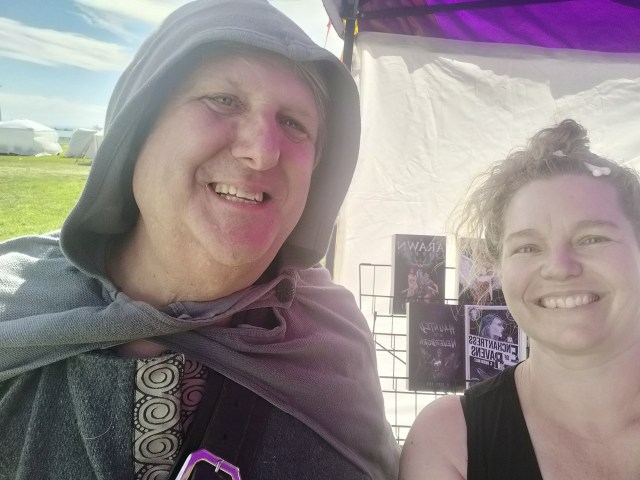
me and C. David Belt at a RenFaire a few years ago. I was dressed as a cartoon cave woman, and he was dressed as a medieval Scot.

This is a view of my neighbor’s house on a smokey afternoon late last summer. It’s also part of the internal landscape of my mind.
Farmlands are one of my favorite biomes. (Yes, they are a biome. I will die on this hill. They are a part of Naure. They are what nature looks like when people live in it.)
Farms and I go way back. I didn’t grow up on one, but I grew up around farms and farmers.
My early years were spent in eastern Pennsylvania, which is a country of rolling green hills and low mountains. My dad was the pastor of a small country church, and most of its members were dairy farmers. Whenever we visited anybody, which was often, we would first be taken into the cow barn. These were black-and-white milk cows. As soon as you stepped into the barn, your senses would be filled with cow sensations: the chorus of moos, the smell. To this day, when I smell a cattle lot, it doesn’t smell bad to me, just like a clean farm smell.
And even cleaner farm smell was the “milk room,” a little brick building with a large stainless-steel tank of milk in the center, and a drain in the middle of the wet floor. It smelled like coolness, milk, and water.
These are memories from when I was very small. That same family that I have in mind, although they had indoor plumbing, also still had a working outhouse in their back yard. There were bees, and the smell wasn’t so nice, but it was raised up on several steps, not just thrown together but definitely constructed. My brother and I would torment this family’s chickens by pulling backwards on their tails so that they flapped. (Not recommended.) We would sit in corrugated buckets filled with water to cool down in the summer, and drink from the garden hose. This family had Dobermans, and I can remember a black bear hanging up in their barn after the father shot it while hunting. Later, it was stuffed in a scary pose and placed in their study.
The dairy farmers in our church also had fields of crops. Our own house had a yard of about an acre and a half. At the back of this yard was a line of poplar trees, and right beyond them, fields rolling away towards the creek. Beyond that, you could see a mountain. They must have rotated the crops in these fields, but I know that at least one year, they were soybeans. We were allowed to pick the pods, open them, and eat the tiny, hard beans out from inside. There was a lot of milkweed, which was fun to pull open and let the tufty parachutes out when it was ripe. There was a lot of ragweed, which my brother turned out to be allergic to, and one year a plague of tent caterpillars turned the mountainside brown.
My dad had a somewhat free schedule, and he would take my brother and me (and later, our sister) on walks in the countryside. These were probably short walks, given that we were little kids, but I remember them lasting hours. We could walk along the borders of the fields and find new fields, or the creek. This habit set “walking between farm fields” permanently in my mind as a normal thing to do. If it was nighttime during this walk, my dad would sing “Walking at Night,” which, in retrospect, is probably a German hiking song.
When I was eight, we moved to western Michigan. Worse, we moved to a city. I complained hard about this. It was the first remotely tragic thing that had ever happened to me, and I was determined to milk it. By this time, my crush on American Indians was well-developed, and I was keenly aware that it was tragic to be driven off your land.
However, despite that we technically lived in a city, our tiny church there was still about half farmers. There were still many opportunities, on prayer meeting and picnic and potluck nights, to run on vast grassy lawns while the adults sat and talked, to climb trees, walk between fields, and hide in the hay lofts and corn cribs.
The countryside in Michigan was flatter and dryer than it had been in Pennsylvania. Furthermore, my small denomination (the “Michiana Mennonites”) straddled the border between Michigan and its neighbor to the south, Indiana, which is really flat. The summer camp we went to served kids from both states, and we often found ourselves crossing the border for pulpit exchanges and things like that. I have attended church in what was literally a tiny, plain white chapel perched at the edge of a sea of fields with no other building nearby. I have tramped over Indiana farms, again with my brother and usually another farm boy, while the adults sat in the house and talked. And these Indiana farms are truly the farmland biome, because there is nothing there but farms, not even a hill to break up the monotony.
The farmland biome combines the best features of wilderness and human habitation. You can walk for as long as you like in solitude. There is wind, there is the changing sky, there are wildflowers, and flora and fauna on the windrows. You can get lost if you want, and if it’s winter, you can get cold and miserable too. But as the sun goes down, you can see in the distance the lights of houses. Coming back from the walk to the warmly glowing farmhouse provides all the romance that a kid with a big imagination and a copy of The Lord of the Rings could desire.
Farms have always been with us, and, though technology has changed somewhat, the logistics of having fields surrounding clusters of buildings mean that farmlands in every place and time look essentially the same. You have the wide horizon, the walls, canals or windrows carving the space up and giving some sense of distance, and the lights low to the ground. Perhaps one reason I like fantasy, as a genre, is that it naturally includes farms surrounding the town and castle.
Some of my favorite fantasy series start with, and often return to, the humble but honest farming community. O.K., actually I can only think of two, but they are good ones. The Belgariad starts off with Garion growing up on Faldor’s farm in Sendaria. Actually, it starts in one of my favorite parts of the farm, the kitchen. And, of course, The Lord of the Rings. Bilbo is not really a farmer, he’s more of a country squire, but the Shire is definitely a farming countryside. The four hobbits’ journey starts out hiking through the fields, as every journey should. Their first encounter with one of the Nine takes place on an otherwise ordinary country road. Farmer Maggot, a wholesome character, takes the four friends in, feeds them, and gets them safely to the river crossing in his wagon. And, when the journey is over, the four hobbits must come back and rescue from collectivization the ordinary, boring farms that they sacrificed to save. What would we do without ordinary, boring farms, after all? We’d starve, that’s what. And we would go insane, because the farming life, though hard, represents a very basic pattern for the way people were designed to live.
I like ’em.
 Out of Babel Books


