
… Of course, there’s a whole lot of this book to go, and so you already know that means that either Royce is wrong [about who the murderer is], or he’ll be killed before he can tell me. I will refrain from stating my preference on this particular matter.
-Benjamin Stevenson, Everyone on this Train is a Suspect, pp. 130 – 131
Tag: genres
Goodbye to the Chubby-Girl Genre

Hi, everyone. I still have a low fever plus the muzzy head and joint aches that go with it, so this post should be … interesting.
Within the last week I finished the book above. If the Shoe Fits is a sort of very loose Cinderella re-telling. The heroine’s name is Cindy. She has a stepmother and stepsisters. They are not hostile to her as in the original story — they are actually quite affectionate — but they are gorgeous, thin Hollywood babes, very much in the T.V. world, and Cindy is plus-sized, so there are some hints that things were a bit rough in high school. The handsome prince is the heir to a fashion empire. Cindy has just graduated from fashion school, with a special interest in shoe design. As you can see on the cover, the author does manage to get her into an outfit that parallel’s Disney’s Cinderella. And yes, there are crystal-covered shoes at one point. (No, she does not lose them, though I was waiting for that.)
O.K., those are the similarities. Now, the differences. This book takes place in the fashion world and in the world of reality T.V. Cindy and Henry must get to know each other while they are both contestants on a show that is obviously The Bachelor (a show whose producer is actually Cindy’s stepmother). So, all of this is pretty different from a fairytale.
A Sensible Story of Chub
If the Shoe Fits was written by Julie Murphy, who is also the author of Dumplin’. I have not read Dumplin’ but I did see the movie. This book, I would say, has the same strengths and weaknesses as the ones I noticed in Dumplin’.
First, the strengths. Both books feature a romantic heroine who is fat. In both cases, the amount of self-pity that gal displays is very low. This is so refreshing. Plus-sized girls need role models who are not whiny and self-obsessed. Dumplin’ is in high school, so she has a few more issues with her weight than Cindy does, and it’s shown how this leads her to be unfair to her naturally thin best friend. Cindy notes that she has gotten catty comments and the like, and it’s hard to find a variety of clothes in her size, especially in the fashion world, but for the most part she’s confident and she displays no envy or hostility to the more Barbie-like women who are also contestants on the T.V. show. Finally, in both books there is an attractive male romantic interest who seems to really like Cindy or Dumplin’, and this is accepted as a matter of course. There’s no insulting discussion along the lines of, “I like you even though you’re fat because …” blah blah blah. Is this unrealistic? Maybe. But remember, this is a romance genre, so it’s a fantasy for women. Also, some guys are attracted to women who would consider themselves fat (correctly or incorrectly). Finally, whenever one person says to another, “I like you even though …,” I would say that’s a red flag. Unless it is Mr. Darcy speaking, it probably means the “even though”-er feels superior to their prospective romantic partner, and expects that they will be able to treat them badly.
The Less Sensible Part
So, those are the strengths of each book. The downside? Both books have a subtext that being fat is just like being gaaay.
In Dumplin’, the heroine has warm memories of “Dolly Parton parties” that she and her beloved aunt used to have. Later, she finds out that her aunt was longtime friends with a whole bunch of drag queens who are also huge fans of Dolly. The drag queens, and their theatre, are a safe space for Dumplin’ and they help her prepare for the beauty pageant. So, a major theme of Dumplin’ seems to be that drag queens are kind, safe people who make great mentors. We have found this not to be true.
In If the Shoe Fits, we have Jay.
“Jay?” Henry calls.
A beautiful person with short, perfectly edged lavender hair, a manicured beard to match, razor-sharp eyeliner, and nude lipstick rounds the corner. Jay wears a flirty skirt with a cropped sweater topped with a trench coat and platform sneakers.
“This is Jay,” says Henry.
“Follow me,” says Jay as Henry helps them down from the stage.
So, Jay is a basically a very lost and confused young man whom the author insists on calling they throughout the entire book.
I realize that what I’m about to point out is well-trodden ground, but I’m going to tread it again.
How do I know Jay is a young man? He has a beard, and he’s “beautiful.” If Jay were a young woman who had been taking testosterone, he would be overweight, balding, with acne, and the beard would be scraggly. So, my instinct is that Jay is a young man. I pictured him that way as soon as the character was introduced, and I continued to think of him as “he” throughout the book.
As a mom, I really feel for Jay. I’d like to just give him a hug and a cup of tea, and introduce him to some genuinely good father figures so he can see there’s nothing wrong with being a man. Jay needs Jesus. And yes, I realize all the real-life Jays out there would howl with indignation if they were to come to this blog and see me say that. They can only interpret “You need Jesus” as a condescending slam, not a genuine expression of love and concern. People have been reacting that way to the name and message of Jesus for 2000 years. I don’t know who needs to hear this, but just because that is your reaction right now, doesn’t mean it has to be that way forever.
Second well-trodden point: go back to the quote above and look at Jay’s outfit. A flirty skirt with a cropped sweater – already sad on a man – but the trench coat and the sneakers take the outfit to a whole new level. That level is chaos. Jay has selected for himself an outfit that screams, “I have no idea what’s going on or what or who I want to be, and I want you to admire this chaos and join me in it.” Yes, this book does take place in the fashion world, which is notoriously in love with the weird … but Cindy describes a number of her own outfits throughout the course of the book, and they all make sense. No matter how creative Cindy gets with her outfits, they are integrated, coordinated, works of art, because Cindy knows what she is: a woman.
Finally (the most well-trodden ground of all) despite the author’s best efforts, it doesn’t really work to use the pronoun they for a character we already know. (They in the singular is fine in English, when it’s referring to an unspecified or unknown individual. When we have already met a character, that person is no longer unspecified.) For example, at one point Jay leads a group of dignitaries into the boutique, and then a little later they hop down from the counter they were sitting on. (Were all the dignitaries sitting on the counter? Or just Jay?)
Just Gotta’ Do It Myself
As someone who wears plus sizes, has a belly, and has in the past been fat, I like the idea of these chubby-heroine books. This is especially true since the majority of women in the U.S. are what the fashion industry considers plus-sized. But sadly, I think I’m done with the genre. The last chubby-heroine book I read tied confidence in a plus sized woman to female empowerment, and female empowerment to abortion, with a side advertisement for “spouse-sharing.” The one before that, a murder mystery, was tame by comparison, but it did include a bunch of little digs at white girls. I’m done.
I guess I will just have to write a chubby heroine into my own books … oh, wait, I already have!
Magya is a short, curvy mother of four who stepped out of the shadows to grab her own romantic subplot in my book The Strange Land. She was pregnant when her husband was tragically killed. Another member of the tribe stepped in to care for Magya and her children, and he found himself falling in love with her as she went through pregnancy and grieving and the hardships of a Siberian winter. He spends the year sitting on his hands so as not to bother her, and by the next year, they are married.
Sari is also a mother of four and a larger lady, but her story, in the same book, is much more tragic.
Don’t go to my novels just for the chubby girls, of course. Go for the survival and the demons and the dinosaurs. But don’t be surprised if you encounter all kinds of women – and men – along the way. That’s what happens when we just write about life.
Nuts to the Grammar Snobs
“You want the difference between pulp and literature? Between a real writer and just a writer? I’ll tell you: adverbs.”
“Adverbs?”
“You use too many of them,” he said, derisively.
-Benjamin Stevenson, Everyone on this Train is a Suspect, p. 68
Look what floated to the top of my TBR List
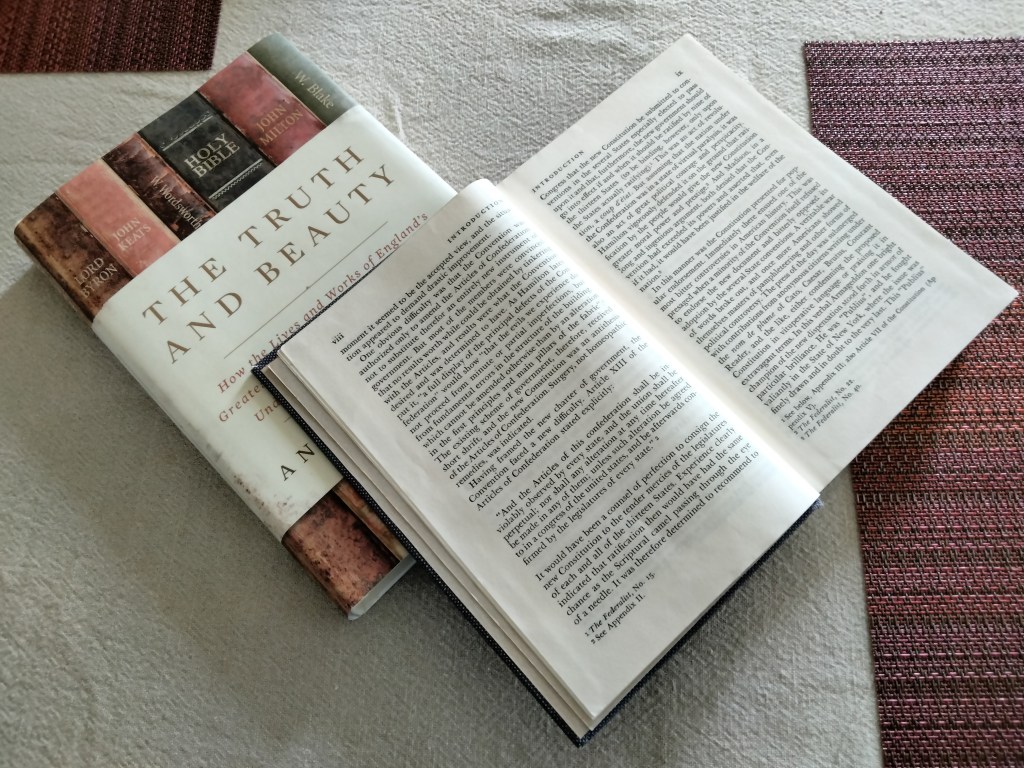
That’s the Federalist papers (remedial), and Andrew Klavan ‘s new book about the English Romantic poets and Jesus.
Quote: Who Needs Verbs? Not Agatha Christie!
Rhoda’s fete had passed off in the manner of fetes. Violent anxiety about the weather which in the early morning appeared capricious in the extreme. Considerable argument as to whether any stalls should be set up in the open, or whether everything should take place in the long barn and the marquee. Various passionate local disputes regarding tea arrangements, produce stalls, et cetera. Tactful settlement of same by Rhoda. Periodical escapes of Rhoda’s delightful but undisciplined dogs who were supposed to be incarcerated in the house, owing to doubts as to their behavior on this great occasion. Doubts fully justified! Arrival of pleasant but vague starlet in a profusion of pale fur, to open the fete, which she did very charmingly, adding a few moving words about the plight of refugees which puzzled everybody, since the object of the fete was the restoration of the church tower. Enormous success of the bottle stall. The usual difficulties about change. Pandemonium at teatime when every patron wanted to invade the marquee and partake of it simultaneously.
Agatha Christie, Pale Horse, pp. 56 – 57
Update: I Don’t Like Giants (A Review of Three Thousand Years of Longing)

I enjoyed this movie more than I expected to. I thought it was going to be some kind of mystical journey with a guru or something. Instead, it’s a pretty good story reminiscent of those found in The Arabian Nights.
I don’t recommend you watch it necessarily, because there are a lot of scenes with naked people. Including multiple scenes with multiple obese naked people in a room covered with fur. (Yes, strange. And disgusting. It was the Ottoman Empire, what can I say?)
So given that you will probably not be watching it, I won’t worry about spoilers.
The Summary
Alithea is a “narratologist” (story expert) who travels to Istanbul for a conference. While in front of an audience, she keeps seeing a frightening, oversized, deadly white guy dressed as, maybe, an ancient Babylonian. This vision opens its mouth and appears to swallow her, and she passes out. Now, maybe I wasn’t paying very good attention, but it seems to me that this scary guy is a plot hole that never gets explained. He shows up in the background in some scenes later in the story, but it is never brought out what, if anything, is his relationship to the main action of the story. Ditto the odd dwarf character with the tall, Nephilim-like head who tries to take Alithea’s suitcase in the Istanbul airport.
Anyway, it’s after this that the main story begins. In a Turkish junk shop, Alithea buys a little blown-glass bottle that has been somewhat deformed at some point by a fire. She takes it back to her hotel room, starts scrubbing it, and out comes a djinn (Idris Elba). At first, Alithea and the djinn can’t communicate, but she finds that she can speak to him in Greek, and after a few moments of watching TV, he picks up on English. He tells her that she gets three wishes, but as a story expert, she knows that every single story involving three wishes is a cautionary tale, so her response is something along the lines of “no way.”
Then the djinn starts to tell his own story, which spans three thousand years. He has had three episodes of being imprisoned in various small vessels. Apparently, he was originally a free djinn, and was in love with the queen of Sheba (incidentally also his cousin – cue nakedness). When Solomon, who in this version of the story was the supplicant, shows up and woos the queen, the djinn’s heart is broken, and Solomon, “a powerful wizard,” imprisons him for the first time.
The first person to release him is a slave girl who’s in love with a prince. She wishes for the prince to fall in love with her, and then to become pregnant by him. Unfortunately, she gets caught up in palace politics, and when the prince falls out of favor, she is killed before she can make her third wish.
The second attempted escape, and imprisonment, is the one featuring the fat people in the sable room. It’s sad and grotesque, but has no love interest for the djinn.
In the third go-round, the djinn is released by a plain but intelligent young woman who is the third wife of a rich man and is essentially a prisoner. (No nudity, but horrifying brief sex scenes with her aged husband.) This young lady uses her first two wishes to learn “all the knowledge in the world” (she and djinn are shown studying together) and to become a formidable scientist. This is where we learn that the djinn is made of electromagnetic particles: “You are made of dust. I am made of subtle fire.” He falls in love with her mind, and tries to prevent her making her third wish so that he can stay with her forever. Feeling controlled, she accidentally traps him in the glass bottle with her third wish.
By the time the narratologist has heard these moving stories, she is ready to make a wish. She wishes to experience that kind of world-without-end love … with the djinn.
C’mon … Really?
At this point the cynic in me wakes up and says, Lady, has it occurred to you that this very large magical dude is telling you these sad stories in order to elicit precisely that wish? He’s lived through millennia having a once-in-a-lifetime love with one human woman after another. The man is an interdimensional slut.
However, the writers for this movie are not as cynical as I am. The djinn appears to make a good-faith effort to fulfill Alithea’s wish, even traveling back with her to London. When it becomes apparent that living in a large, modern city is too hard on him, in a metaphysical sort of way, Alithea wishes “If you cannot stay with me, I wish that you could be where you belong.” (Again: Was that his goal all along?) He does come back and visit her from time to time, which is nice and makes it seem less like she got played.
And here come the giants finally
For those who are interested in my books, this movie has a similar sort of vibe in a few different ways. For one thing, it features an older woman having an affair with a large, impressive foreign man with whom she can’t at first communicate. (I’m always a sucker for scenes where people try to find a common language.) In fact, if Hollywood is paying attention, Idris Elba could do a fine job playing Nimri. (Tilda Swinton could not play Zillah. Sorry.)
But secondly, and on to the main point of this post … giants.
I have put giants in my books because they feature in Scripture and in history. I have made them scary, nonhuman creatures because that is what they are in Scripture and in history, but prior to this, I was never particularly frightened by the idea of giants. I didn’t think of a larger size as anything necessarily to be afraid of, so I didn’t find them scary until I started researching what the historical record says about their behavior.
But watching this movie, I discovered that their size itself makes me physically uncomfortable.
When the djinn first comes out of the bottle, it’s in the form of particles. These particles swirl out of the hotel bathroom and into the main part of the hotel room. The next thing that Alithea sees are enormous golden toes sticking in through the bathroom door.
When she goes out into the bedroom, the djinn is so large that he is literally crouched over like a person trapped in a small box. The camera doesn’t show us this right away. It just shows her face looking at something disturbing and incredible. Then when we do see the djinn, we still don’t get a look at his face, because his back is to us.
Already at this point, I was thinking my first wish would be, “Could you please make yourself smaller?” His size is inconvenient and it makes the room seem weird.
Soon, the djinn makes himself a bit more human-sized (and dons a hotel bathrobe, as you can see above). But even then, he is not … quite … on a human scale. He’s just a little bit too big. The picture above doesn’t capture this very well, but it’s the closest I could find. Tilda Swinton is petite, but she’s not that petite compared to the other humans in the story. She’s not that much shorter than they are.
Somewhat surprisingly, this also made me uncomfortable. Maybe it’s the way that the different scale messes with your perception of reality and your ability to trust your own senses. He’s too big to be human, but he’s not a tank like, say, Shaq. He’s in proportion – just not human proportion.
I was surprised by the fact that this made me — I repeat — physically uncomfortable. So, I guess, it turns out, my stories are even creepier than I realized. Because even when they are well-intentioned (?), like this djinn, I really don’t like giants.
Homeless lady learns a new word
[Ned, the serial killer] went down like a board, as stiff as a 2-by-10. [Pearl, the homeless lady] landed in the middle of his back.
I glanced at Pearl’s face, which was a mask of bruises. One eye was black, one tooth was missing, and a cut at the corner of her mouth oozed blood. She’d positioned herself in the middle of Ned’s back, and the gravity was sufficient to hinder the rise and fall of his chest.
She said, “Sh–. I think I broke my hip again, but right now I’m numb and it doesn’t feel like nothing.”
She bounced a couple of times and I heard an oof of air escape Ned’s lungs. She bounced again, though she winced as she did so. “What’s this here? What I’m doing. You’re a smart girl. I bet you know.”
“As a matter of fact I do. It’s called ‘compressive asphyxia,’ which is mechanically limiting expansion of the lungs by compressing the torso, hence interfering with breathing.”
“Hence. I like that. I’m setting here bouncing on Ned, hence making it impossible for him to draw breath. That’s what he did to them little girls, isn’t it?”
“That was his method of choice.”
Y is for Yesterday, by Sue Grafton, p. 487
And I love those guys
… the man who serves his God with his whole heart is apt to forget his surroundings, and to fling himself so completely into his work that the whole of his nature comes into action, and even his humor, if he be possessed of that faculty, rushes into the battle.
Spurgeon, from Eccentric Preachers, quoted by Douglas Wilson in A Serrated Edge
Book Review: The Sweet Sister, by C. David Belt
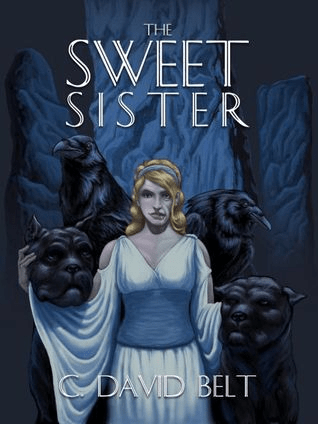
Fun story about how I discovered this book: I was at a Fantasy Faire as a vendor. A fantasy faire is sort of a like a RenFaire, but calling it “fantasy” opens it up to more time periods and more imaginative costumes. This Faire took place in southeast Idaho, so quite a few of the booths were from Utah. As I wandered the booths on the first morning, a banner on one of them caught my eye: “Strangely uplifting LDS horror.” In case you don’t know, LDS stands for Latter-Day Saints, which is the more respectful term for Mormon and what the Mormons usually call themselves. I am not Mormon, but I could not help but be intrigued by this advertising phrase. Horror, written by someone from a community that is mostly known for wanting to keep everything in life PG if not G? That’s going to be some interesting horror. Also, I do like my horror uplifting.
So, long story short, I missed meeting the author, but I bought the book. He has a lot of others, but I went for this one because it was a stand-alone.
The LDS horror did not disappoint. The opening scene takes place at fantasy convention, very similar to the event I was at when I started reading. (Nice.) The main character is LDS, and she is a tall, big-boned, plain-faced 30-year-old woman who has a secret crush on her handsome, also LDS, coworker. In short, a very relatable female lead. Being a lonely, not conventionally attractive 30-year-old woman is tough for everyone, but it’s even worse in the LDS community where there is so much emphasis on marriage.
So, the contemporary main characters are Peggy, whom you met above, and Derek, her crush, who is happy to go to conventions and watch fantasy and sci-fi movies with Peggy, but doesn’t like her “that way” and does not see her worth.
But very soon, we get into the spooky stuff. This is not exactly a time-traveling book, but it has characters who move through time by spending decades in a state of suspended animation brought about by eating an apple-like fruit from a magical tree. So, the mysterious, princess-like young woman on whom Derek gets a hopeless crush really is a woman from millennia ago who doesn’t quite know how to function in the modern world because she has been skipping through time.
I don’t want to give more spoilers than that, but let me just say that the research on this book impressed the heck out of me. The author has taken a deep dive into Celtic mythology, Arthurian legends, British/Roman history, and fairy tales, and he ties it all together. Although the main characters do not travel back in time, the story takes jaunts into the past to reveal to us the sleeping princess’s back story. We see how she gave rise to the “sleeping maiden” fairy tales like Sleeping Beauty and Snow White, but what actually happened was … much creepier. These reveals are tantalizingly done. They are not info dumps, and the whole story is not revealed until the very end.
This author takes a unique approach to paganism, one that I really appreciate. As a Mormon (which he understands to be a version of Christianity), Belt does not endorse the ancient Celtic religion and he doesn’t whitewash it either. He is perfectly willing to portray the darkness and terror and human sacrifice that come with Cernunnos and Morrigan. This is very different from most modern fictional treatments of Celtic paganism, which tend to portray the pagans as harmless, live-and-let-live, nature-loving types whose religion has no down side. However, although Belt mines paganism for horror, he passes the “love test” (the author must love the culture he’s writing about). He writes about the ancient pagans with sympathy and seems to understand their point of view. They are real human beings to him, and their gods are real entities.
And that’s why this horror is “strangely uplifting.” Unlike some horror writers I could name (ahem Stephen King), there are actually good, admirable characters in this book alongside the horror.
If you like fairy tale re-tellings, Arthurian legends, Celtic paganism, or modern-day horror, you might like this book. If you like all four, this book is definitely for you!
Phantasy Phaire Photos
Literally every person who passed by our booth was worthy of a photo essay, so these are just a few highlights.
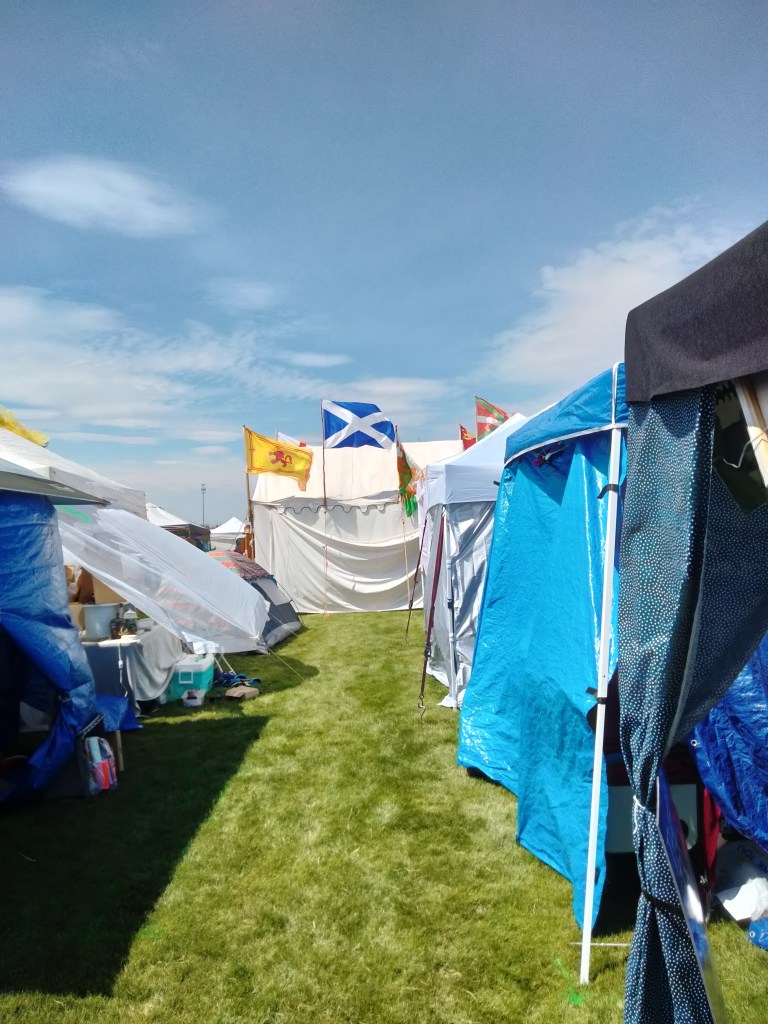
Here’s the alley behind the booths on Saturday. My son said, “It’s beautiful the way everyone shows up and sets up their own booth, and instantly there is a city where there was none before.” He’s eleven.
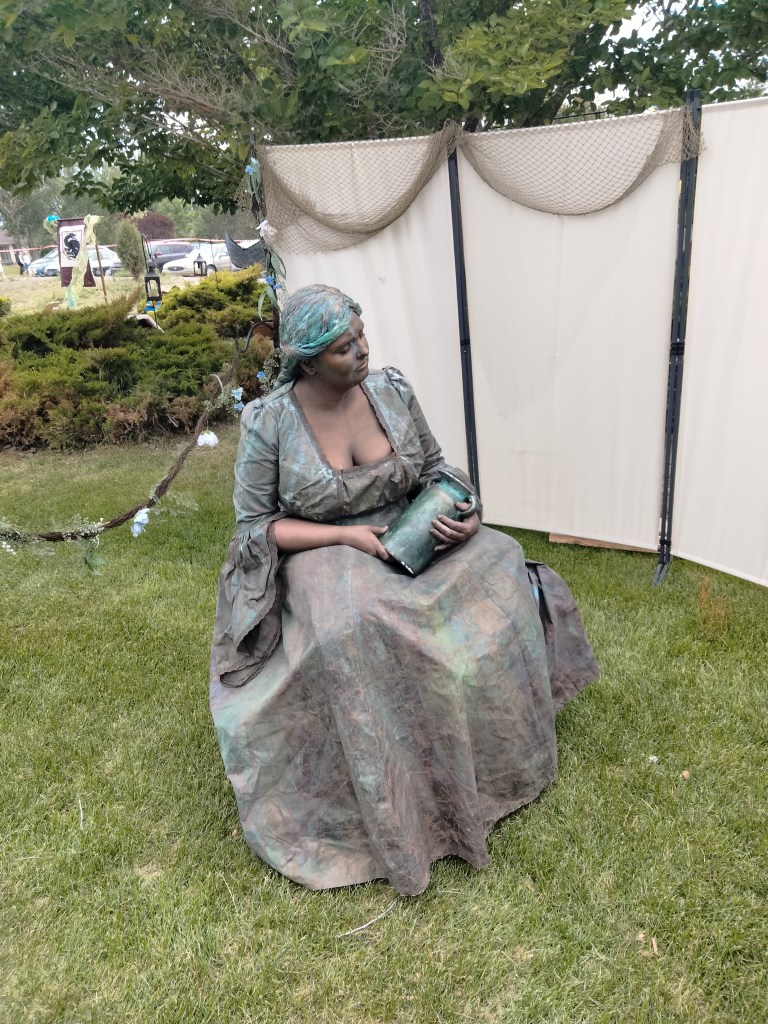
There was this “Enchanted Statue” who, when given a tip, would wink at you.
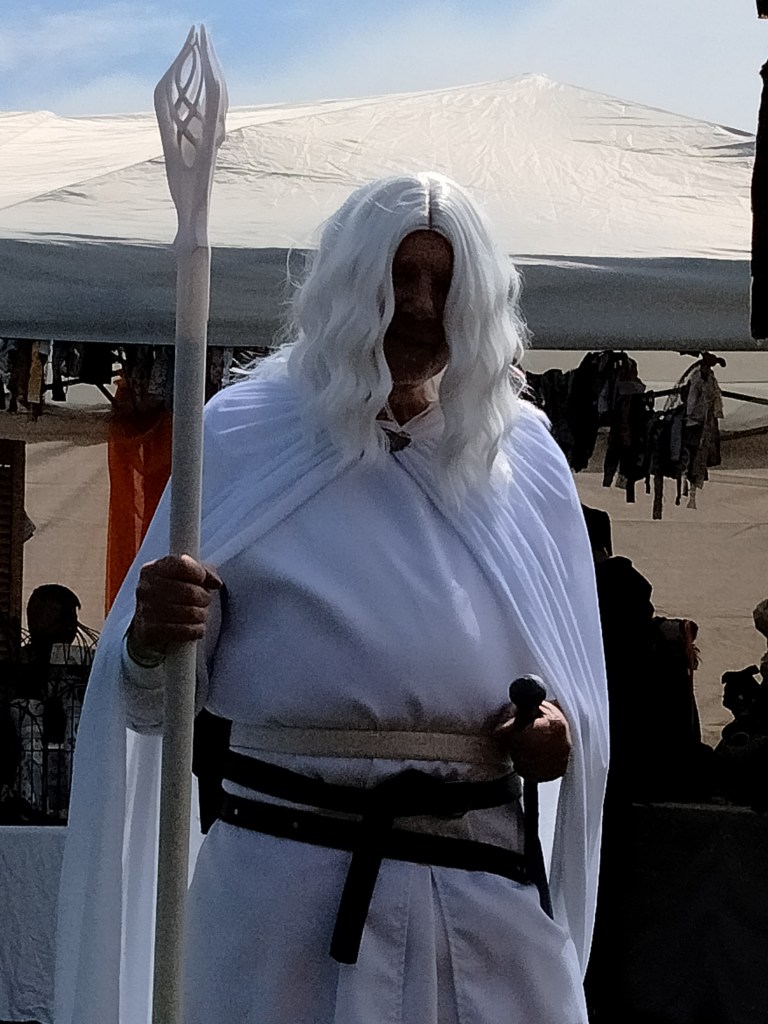
Gandalf the White showed up first thing on Saturday morning.
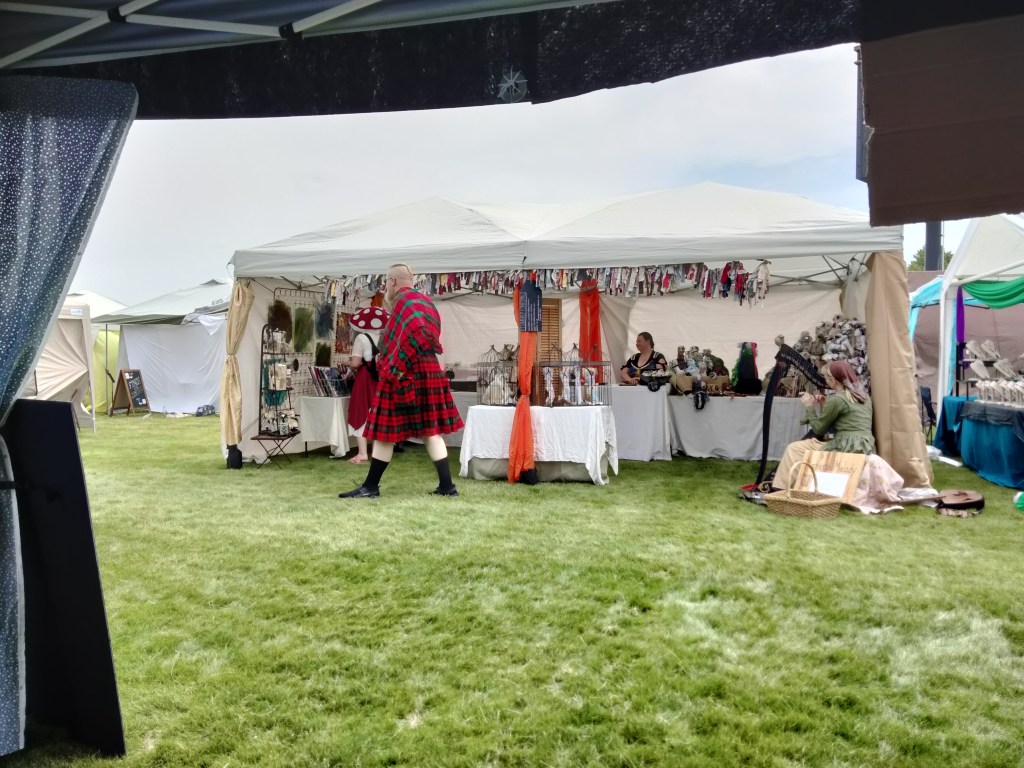
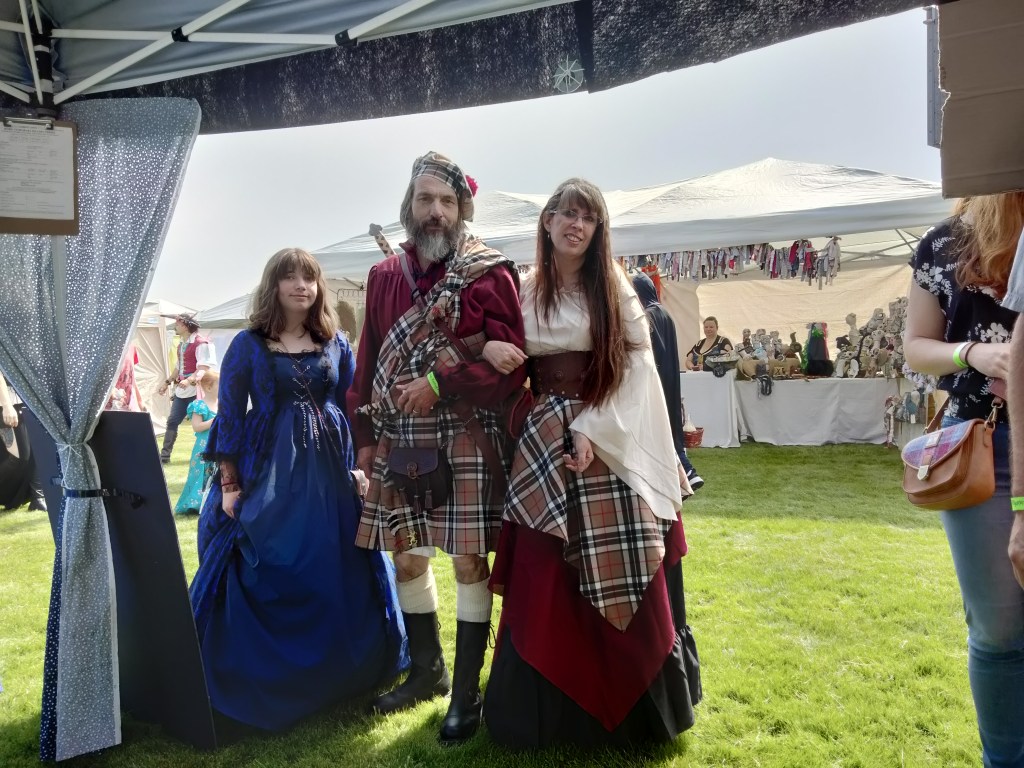

There were many Scotsmen and a few Scots women.

… one ogre …


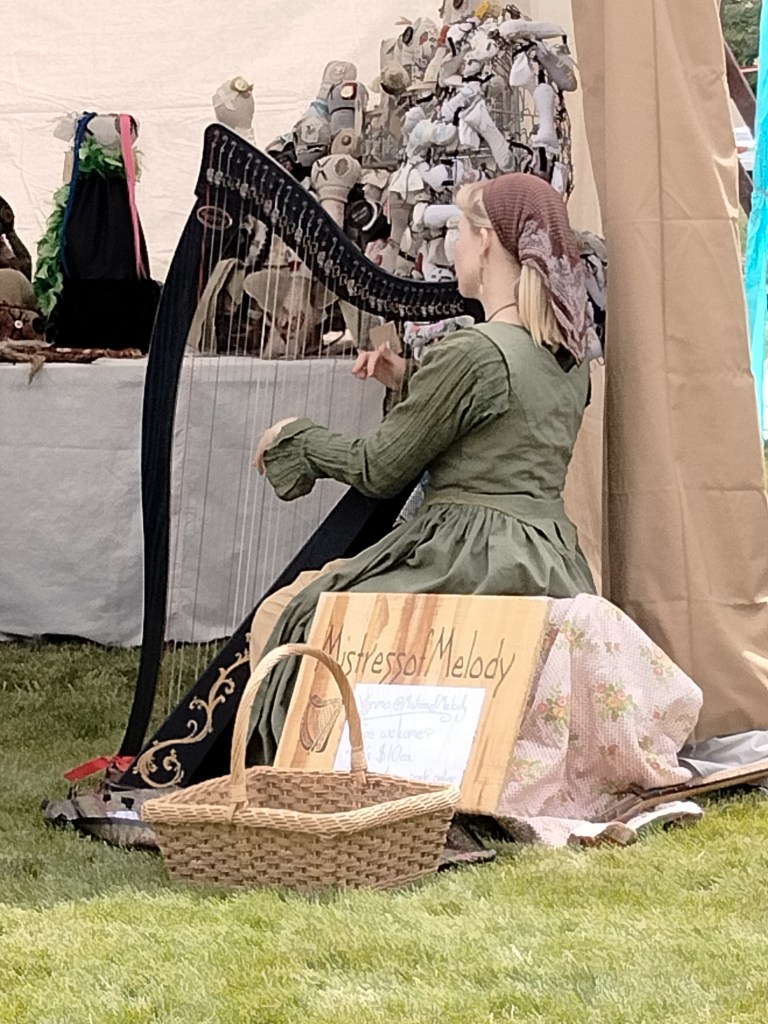
… musicians …
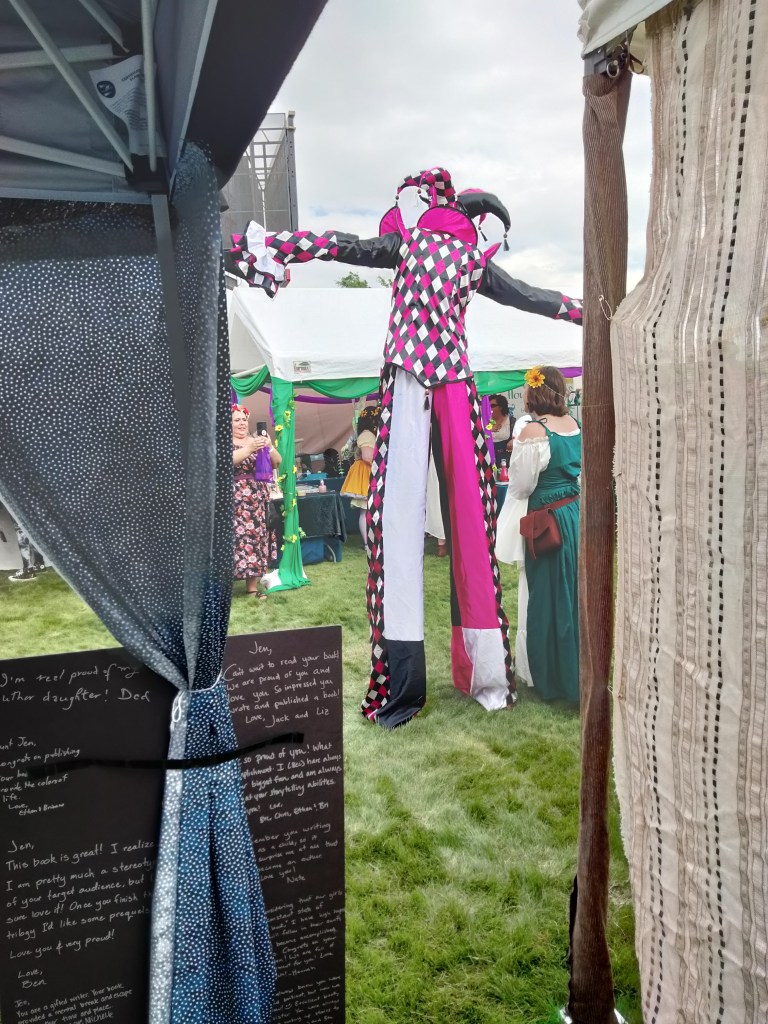
… jesters …

… mushrooms …
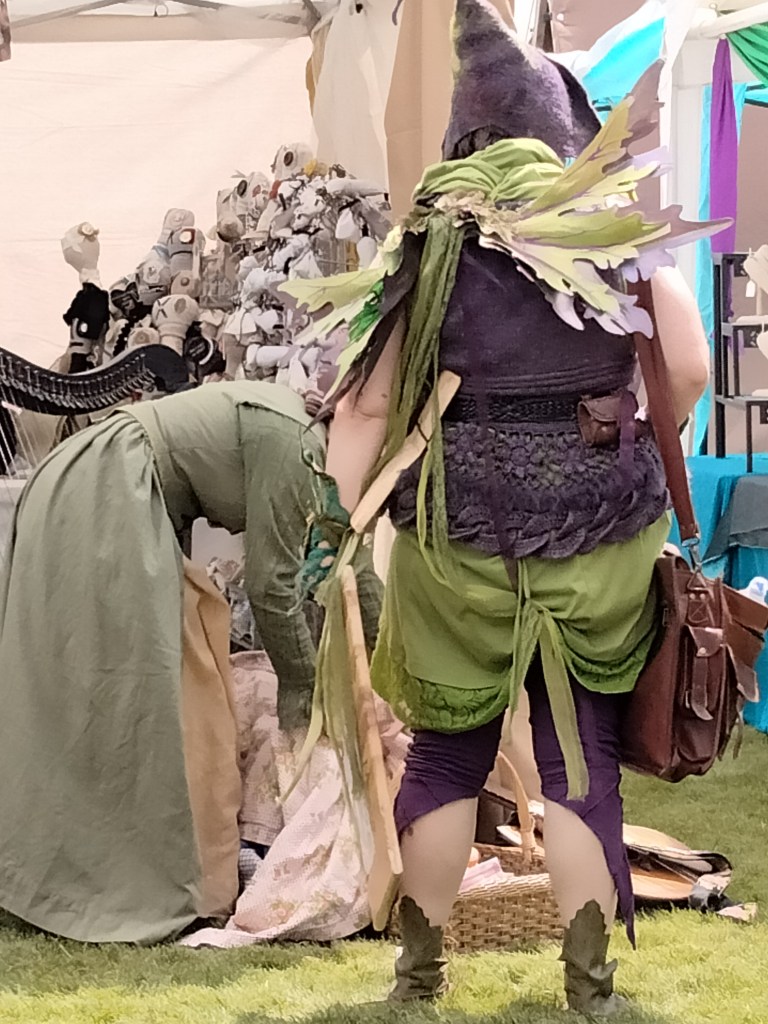
… elves …
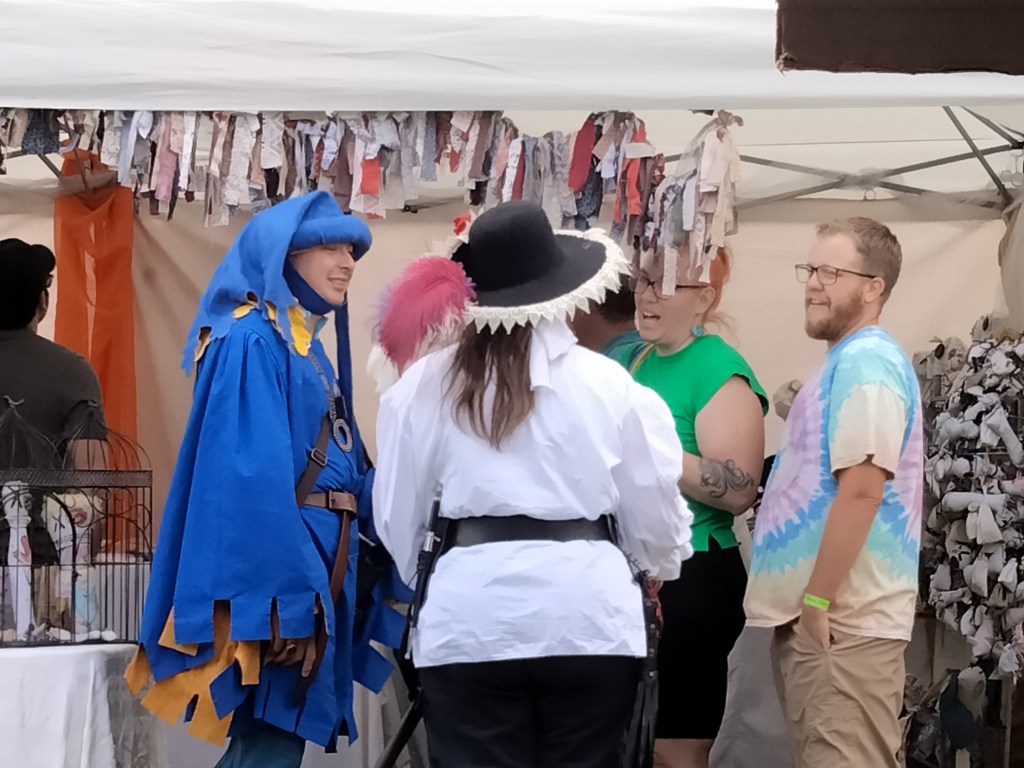
And quite a few pirates. The pirate with her back to the camera would, for $5, “arrest” a victim of your choice and parade them throughout the Faire, calling out “Shame the prisoner!” as they wore a placard stating their crime.

Here she is arresting a lady merchant whose crime was running out of fudge at her booth. The person who put her up to this was my son, who wanted to do everything.
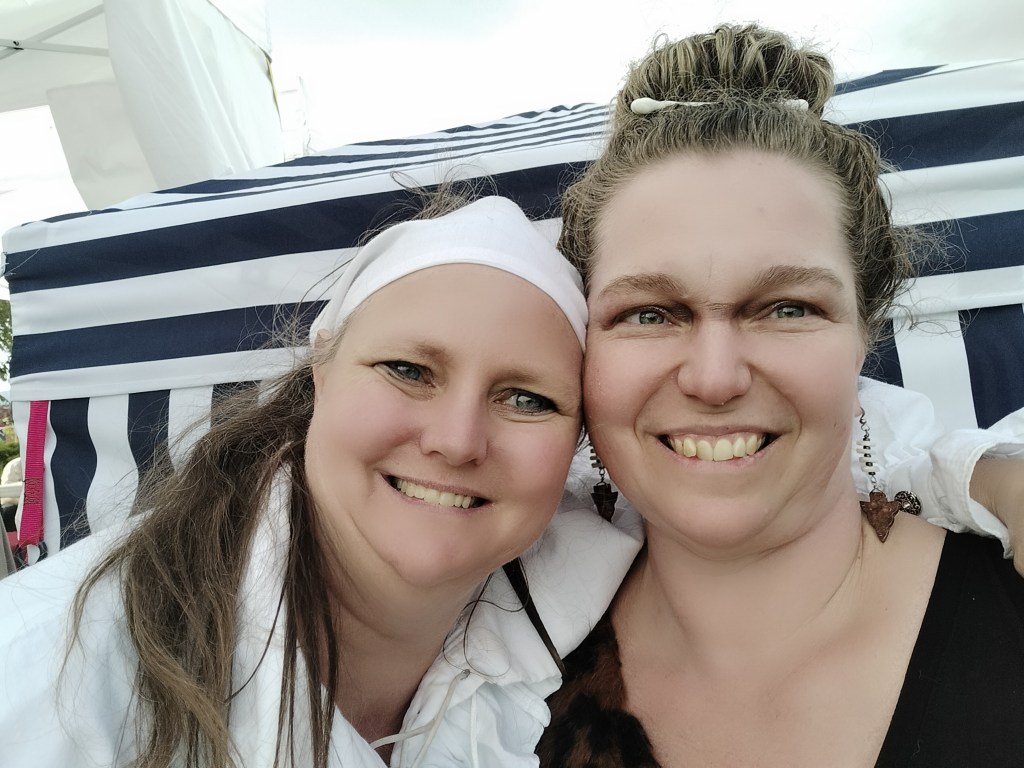
Ensuring that we became friends.

Here’s another friend, from the Pocatello Writers’ Group.
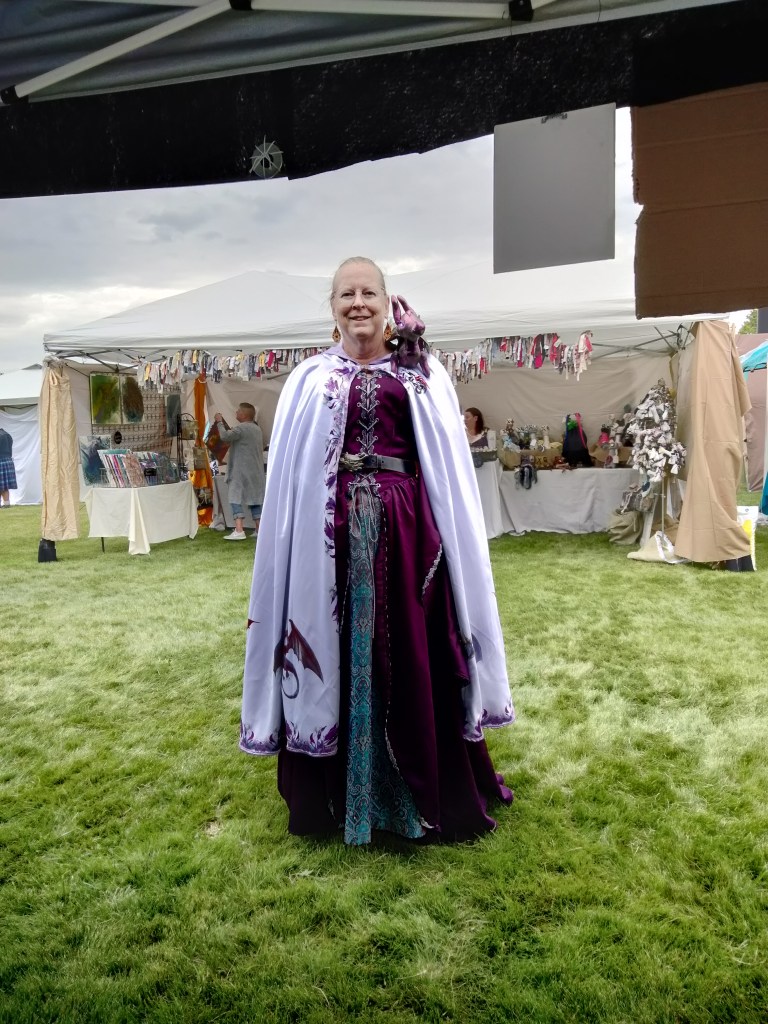
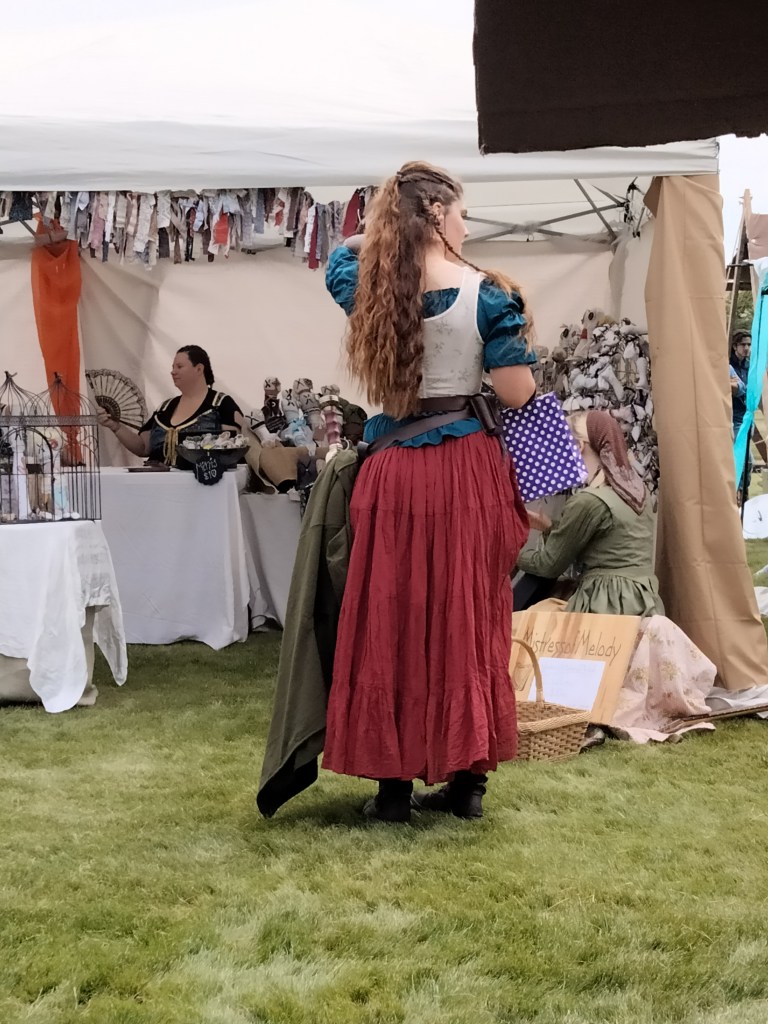
And some more people worth looking at.
One thing I regretfully realized after putting together this post was that I do not have a single picture of a knight or warrior. In fact, there were many of these fellows at the Fantasy Faire. A tall, portly warrior in Viking-style armor bought one of my son’s paintings. Also prominent were the Salt Lake City Crusaders, whose motto is “Real Armor. Real Weapons. Real Athletes.” They had a ring set up in which, twice a day, men in authentic armor battled it out. (I swear that, as I wandered by, I saw one armored guy hitting another armored guy on the helmet with a frying pan.) These warriors would periodically come striding through the Faire, but they always walked so fast that I never got a picture. Plus, I guess, there were so many armored men about that I just took them for granted. But, let the record show that they were there.
 Out of Babel Books