The length of my fiber arts projects is dropping dramatically. First, we had the Indian blanket (1 year) … then, the wool socks (about 6 weeks) … and now, this headband (about half an hour).
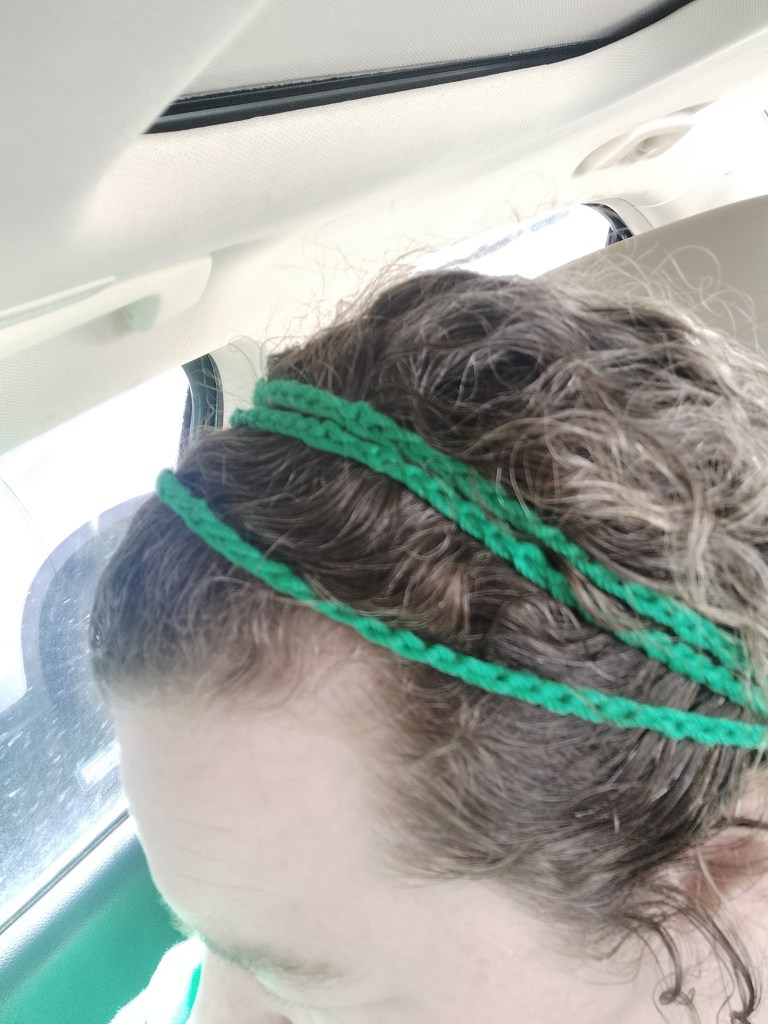
Excuse the poor-quality selfies, taken in my car, but I really think these showcase how this headband is perfect for messy/curly hair. It gives the look of a headband without a wide piece of cloth rubbing and creating frizz on your head (the wind does that instead). It’s supposed to look like it’s barely containing all your curls. To emphasize this look, I did a loose braid and pulled down tendrils.
It’s also on-theme for 2026, what with me reading what I’ve been calling “Greco-fiction” and all.
And the price is right. I bought the pattern on Etsy for about a buck fifty, and when I want a new color of headband, I just womp one up out of my stash of yarn.
The original pattern has a large crocheted flower that you are supposed to attach (and I imagine it holds the strands apart), but I didn’t want the flower so I left it off. The pattern promises three strands, but if you were to follow the directions, you’d have four strands, crocheted together at either end. I only wanted three, so I stopped early. It ties at the back of your head. I’m not always a big fan of things that tie, as that can be a tricky process and can catch your hair in the knot, but the thinness and texture of this headband makes it a simple matter.
This may be more detail than you wanted, but hey! I’m excited!
I read The King Must Die back in university. My education up to that point had some gaping holes, but I had been privileged to attend a school one time where they spent an entire year getting us thoroughly familiar with Greek myths and history. My point is, I knew the story of Theseus. I knew the labyrinth and the Minotaur were the main event. And I was eager to get to them. So I moved through the first part of the book at a pretty good clip, the part that tells of Theseus’ childhood in Troizen, his coming of age, and his journey across the Peloponnesian Peninsula to find his father, the king of Athens.
I thought then, and still think now, that Theseus is not an especially likeable character to modern eyes. He’s a prince of Heroic Age Greek culture, and he is, as they say, a product of his time. He is proud, ambitious, pious towards the gods, stoic, brave, and clever (those are his virtues), and also snobby, entitled, callous, cruel, sexist, and promiscuous. He has all the virtues of ancient paganism, but none of the virtues a Christian man. You can’t endorse all his actions or even his value system. (By the way, that is exactly what makes this such a fantastic historical novel.) But despite all this, there are moments in his story that ring incredibly poignant. And these are moments that I either forgot since my first reading, or missed entirely.
You want to hear about the Minotaur? Let me tell you about a son and his father.
Theseus’s grandfather is king in Troizen, a small Greek kingdom on the east coast of the Peloponnesian Peninsula (or what they call the Isle of Pelops). His mother, a princess, had him when she was a teenager. She lives, still unmarried, in the palace, and serves as a priestess of the Mother, who is goddess left over from before the Greeks arrived, whom they feel they must give her due.
Theseus’s mother has always told him that he is the son of Poseidon. Theseus takes this seriously as a little child. He views the sacred horse, also called a son of Poseidon, as his brother. He whispers “Are you there, Father?” into the sacred well that sometimes grumbles when Poseidon is stirred up. But as he gets a little older, he sees that other people doubt he has a divine father. He becomes defensive.
Truly “god-got” children are known to be really tall, and Theseus has always been small for his age. He waits and waits to grow (he hopes to be six or seven feet tall). He develops “short man syndrome,” taking daring risks in order to prove himself in front of the other boys. He is the best at every sport except for Hellene-style wrestling, because that requires mass and weight.
Once, he even swims way out into the ocean, figuring either Poseidon will prove he is his father, or Theseus will welcome a death by drowning. The current sweeps him back to the island, and he figures he has his answer.
Then Theseus turns seventeen, and his mother shows him the rock that his father said he should try to raise in order to prove whose son he is. So, it wasn’t Poseidon after all.
Theseus tries and can’t raise it by brute strength. He is broken, furious with his mother who won’t tell him anything.
But eventually, he realizes that he can raise it with a lever. That’s when he finds the sword.
His grandfather tells him the story, which is full of the tragedy, ugliness and beauty of ancient paganism is and basically a mini novel within this novel. There was a plague, a drought. Apollo claimed not to be responsible. Poseidon wasn’t answering. Finally, the priestess said it was the Mother. “A virgin must go and wait in the myrtle-house and give herself to the first man who comes along.” The priestess disliked Theseus’s mother, because she was an attractive young girl. His grandfather couldn’t see a way to get her out of this.
But it happened that Aigeus, the thirtysomething king of Athens, was visiting Troizen. He agreed with Theseus’s grandfather that he would be the man. At least the princess would lose her virginity to someone she had met before, and he would be kind and gentle with her. They could not tell her about this arrangement beforehand, because when a member of the royal family is in some way sacrificing themselves for the people, their willingness to make the sacrifice is a critical element. Only then will the god bless it.
The thunderstorm was already arriving. Aigeus stripped and swam across the channel to the sacred island where the Myrtle House was. A flash of lightning revealed to the princess a dark-haired man rising up out of the water, with a ribbon of seaweed on his shoulder. She thought he was Poseidon. She knelt, and crossed her arms over her chest, as one would do for a god.
Why didn’t he wait for the boat? Why did he jump into unknown waters, in a rainstorm, and swim across? Was Poseidon indeed possessing him? say these pagans. Who knows?
Theseus is disappointed, but intrigued, to find out that he has a human father. He travels over the Isthmus (a dangerous and lawless place), gets entangled with the earth-mother-worshipping people of Eleusis, which is very creepy, and eventually makes it to Athens and reveals himself to his father, narrowly escaping being assassinated first.
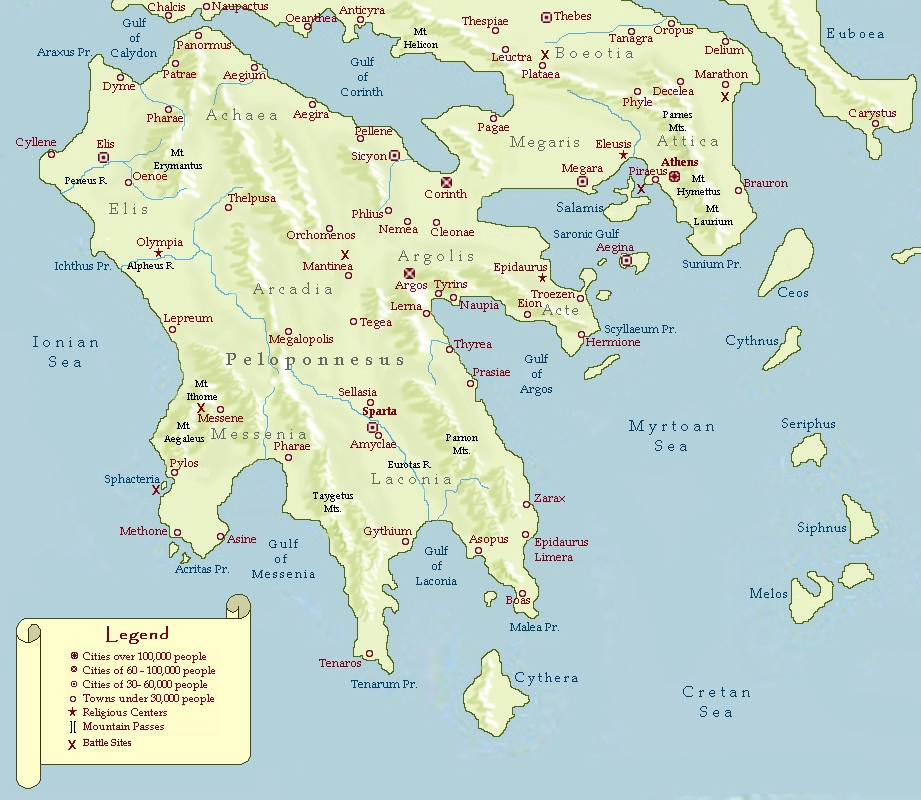
On the map above, if you look around the Saronic Gulf, you can see Troezen on the south side, Athens on the north side, and Eleusis just a bit west of Athens. I wish I’d had this map 25 years ago, when I first read the book.
Aigeus has no other sons. He is thunderstruck and delighted to see Theseus.
There’s not exactly hugging and crying, because both of them are proud, aristocratic, cautious men. On the whole, Aigeus probably wears his feelings closer to the surface than Theseus does. Still, they start getting to know each other.
Theseus’s birthday is approaching. Aigeus wants to have a feast for him. Theseus suggests sending to Troizen to bring his mother for the feast, but Aigeus dismisses this plan. If they wait, the time will get too close to “the tribute” (the sending of young men and women to Crete), and he doesn’t want to be celebrating his long-lost son when some of his subjects have just had to give up theirs.
It’s at this point that the reader who knows the outline of the story realizes that Theseus and his father are not going to have much more time together.
The day of the feast comes. Aigeus gifts Theseus a chariot, “of dark polished cypress-wood, with ivory inlays and silver-bound wheels, a craftsman’s masterpiece.”
It was a gift beyond my dearest wish. I thank him on one knee, putting his hand to my brow; but he said, “Why this haste, before you have seen the horses?”
They were matched blacks, with white-blazed foreheads; strong and glossy, sons of the north wind. My father said, “Aha, we slipped them up here, as neat as Hermes the Trickster lifting Apollo’s steers. The chariot while you were in Eleusis; and the horses this very morning, while you still slept.”
He rubbed his hands together. I was touched at his taking all this care to surprise me, as if I had been a child. “We must take them out,” I said. “Father, finish your business early, and I will be your charioteer.” We agreed that after the rites, we would drive to Paionia below Hymettos.
pp. 154 – 155
In case you missed it, Aigeus just gave his son a sports car.
After the rites, Theseus goes to the stables and waits and waits for his father. When the king does show up, he seems to have forgotten their plan to take a ride. He is stressed out by something. He urges Theseus to ride by himself, but to leave by the back gate.
The reader realizes, with a sinking feeling, that the representatives from Crete have come early to collect the youths and maidens for the tribute.
Aigeus, almost in tears, is trying to get Theseus away from there. But Theseus, too sharp not to realize something is wrong and too proud to be hustled out the back, quickly finds out what is happening and insists on entering the deadly lottery.
And now, the reader realizes that they are never, ever going to take that chariot ride.
The youths and maidens of Athens are chosen by putting their names on scraps of pottery, which are then drawn at random out of a bowl. Aigeus puts in a lot for his son, on which he has surreptitiously written some other youth’s name. But Theseus, standing among the crowd, realizes what has happened when he sees that his father is not worried. What should he do? Should he let the deception stand? Or should he stride forward and insist on being among those who are sacrificed?
I thought, “What was it? What has my father done? What every father would do if he could. And he is King. He has to think for the kingdom. It is true enough that I am needed here. I ought not to think like a warrior only. Has someone else gone to Crete for me? I have led such lads to war, and never thought I wronged them, though some were sure to die. Why then do I hate my father, and myself still more, and feel I cannot bear my life?”
I looked at my father, and remembered how he had invoked Poseidon, praying him to choose the victims. And I thought, “Yes! That is it! He has mocked the god, the guardian of the house, who brought him to beget me. Well may I be angry! This man has mocked my father.”
p. 163
Theseus begins praying his heart to Poseidon. He senses that the god wants him to go to Crete. It is time to make the sacrifice.
Sorrow fell black upon my eyes and the sun grew cold. I thought of what I had planned to do in Athens: small things I had to hoped to force my father’s hand to, great ones when my own time came. I knelt where I was, with my hair hiding my face, and thought of my life; of hunting with the Guard, of feasts and dances, of my room with the lion walls; of a woman I wanted, and had meant to speak to at the festival; of my beautiful horses, who had scarcely felt my hand; of the war paean, the bright rage of battle, and the triumph song. And I thought, “The god cannot mean it. He sent me here to be king.”
“Father Poseidon,” I whispered, “take something else from me. I will not ask to live long, if I can make a name and be remembered in Athens. Now it will be as if I had never been born.” I heard the name called of some Athenian. It was the last of the seven. “Lord Poseidon, I will give you my horses, the best I ever had. Take anything but this.”
The sea-sound grew fainter in my ears. And I thought, “The god is leaving me.”
p. 164
So off he goes. Rather than lose the unction of the god to rule, Theseus insists on going to Crete, where, he has been told, bull-dancers last six months at the most.
“Don’t grieve, Athenians. The god is sending me. He has called me to the bulls, and I must obey his sign. But don’t weep for me, I will come again.” I did not know these words till I had spoken them; they came to me from the god. “I will go with your children, and take them into my hand. They shall be my people.”
They had left off weeping, and their voices sank to a hush. I turned, and faced my father.
I saw the face of a man who has got his death-wound.
This is an unplanned post. But, after all, a blog is a “web-log,” no? As in, a record of how we are doing day to day. And book blogs are records of how our reading affects us.
And whoof. Reading Greco-fiction is proving costlier than I anticipated.
First, there was Circe, with its depressing picture of Odysseus slipping into OCD paranoia after his return to Ithaca.
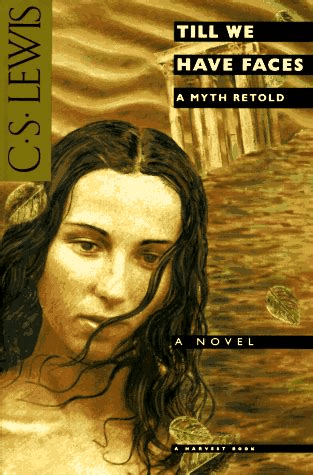
Then, I read Till We Have Faces, which is sort of like having the Holy Spirit do open heart surgery on you, if you really pore over it.
Now, I’m sitting here trying to work, but I’m having to take a break because reading The King Must Die has made my stomach hurt. That is not an exaggeration; I am experiencing psychologically caused stomach pain from reading this book.
I had some time to myself this morning, before leaving for the office. I thought I’d just get caught up on my reading of The King Must Die. Plus, it is hard to put down. I enjoyed reading about the earthquake that brought down the palace of Knossos. I relished when the Greek ship passed the island of Kalliste, the source of the earthquake, and the watery crater where the island used to lie. (This is the eruption of Thera, a well-documented event that took place about 1500 B.C.) Theseus is bringing with him Princess Ariadne of Crete. He is in love with her, and he has promised her father Minos that he will marry her and protect her.
The party lands on the Isle of Dia. I knew what was coming, but I kept reading. I remember this from university.
The people on the Isle of Dia are about to have a festival to Dionysius. Terrible things happen at such times, but everyone is in an altered state. A sacrificial man is torn apart by the wild women, the Maenads. I mean with their bare hands, teeth, etc.
Ariadne participates in this ceremony. When Theseus finds her, sleeping the wine off peacefully, all covered in someone else’s blood and still holding a body part, he vomits. He knew the king must die, but he didn’t anticipate exactly how it would happen. And he’s only eighteen years old.
I knew what would happen, but for some reason, it affected me worse this time. Perhaps because this time, I have children the ages of Theseus, Ariadne (16), and the “King” (also 16) whom she murdered.
At the same time, I can’t just dismiss it as follows: “Well, of course. It’s paganism. It’s all horrible and worthless, not worth caring about these people, not worth my time.” The reason these stories still intrigue us is because there is some very deep stuff going on there. And The King Must Die is filled, almost on every page, with Biblical easter eggs, both as direct quotes and as symbolic allusions. Even the Dionysian ceremony has them. Though I don’t doubt those wild women would indeed have to be possessed, and not in a good way, to do what they did.
Anyway, I’ll get to how I found Christ in The King Must Die in a later post, when I have gathered myself. I just wanted to report that it sort of ruined my day.
Have you ever had a physical reaction to a book? And did you still like the book after?
That’s right, this wasn’t even a first-time read, and it destroyed me. Again. Maybe worse this time.
It’s tempting to do a super detailed book review, including an analysis of all the ancient customs, the Bible Easter eggs, and the symbolism. (My God, the symbolism!) But I’m not going to do that, because I really think you should read it if at all possible. And, even though this book is possibly more powerful on re-reads, I still don’t want to ruin your first read with spoilers.
Any analysis I gave, would be less of an immersive experience than the story itself, because that is the power of fiction.
I will just say a few things about the setting and genre, so you can decide whether to subject yourself to it.
I read TWHF as part of my 2026 “Greco-fiction” project, where I read books set in and/or inspired by the Heroic Age of Greece. When I mentioned this project to someone, they suggested Till We Have Faces. They were right, of course, though I hadn’t put it in the same category in my mind as, say, The Song of Achilles.
The action takes place in a fictional country called Glome. Based upon hints in the text, Glome is located somewhere just south or just north of the Caucasus Mountains, between the Black and Caspian seas. Georgia, Azerbaijan, perhaps southern Russia. Glome is not a mountainous kingdom, but it is near mountains. In the distance, they can see “what we call the sea, though it is nowhere nearly as great as the Great Sea of the Greeks.” This would probably be the Caspian. They are far from Greece, but near enough that they occasionally encounter a Greek captive taken in war. They are near enough to “Phars” (Persia) for that country to present a problem. At one point, the narrative makes a passing mention of “the wagon people, who live beyond the Grey Mountain.” These “wagon people” are probably steppe-dwellers related to the Scythians or Kazaks.
The people of Glome worship a fertility goddess called Ungit, who is embodied in a large irregular black stone that is said to have pushed its way up from the earth. Ungit’s “house” is a group of megaliths joined together with walls. Her worship involves temple prostitution, animal sacrifice, and sometimes human sacrifice, all the usual things that you expect with a fertility religion. Her priest wears a large bird mask on his chest, and dangles with amulets and animal bladders.
The narrator, a little girl named Orual, is frightened of the priest and of Ungit. The story will go on to focus on this fear. Orual very much hopes that the gods are, as her Greek tutor has told her, merely “lies of poets, lies of poets, child.” But are they? Or is there a power in Ungit (and in her son, who dwells on the Grey Mountain) that will leave Orual quite outmatched?
C.S. Lewis is an underrated horror writer. In this story he draws back the curtain on the horror of paganism. We also see, I think, hints of how he himself felt when he was an atheist: desperately hoping there is no spiritual world; uneasily worried that there might be. Relieved, but unsatisfied, by the “clear, shallow” Greek explanations.
So, I’ve said enough. Read it if you dare. I doubt that this year will bring me a better book in the category of Greco-Fiction.
In my Greco-Fiction project, I have briefly set aside The King Must Die in order to re-read Till We Have Faces. I have to read TWHF for a book club, but I can’t complain, really, because I was one who convinced the book club to read it for our February discussion.
If you have never heard of it, Till We Have Faces is one of C.S. Lewis’s lesser-known novels. The point of view character is a young woman, a princess in the ancient, fictional kingdom of Glome, who is cursed with an ugly face, an abusive father, and a horrible fertility goddess for a religion. Her name is Orual. The first bright spot in Orual’s life is a Greek slave her father captured in war, who becomes her tutor. The second, and much brighter, spot is her younger half-sister Psyche.
The back of the book describes it as a “timeless tale of two princesses–one beautiful and one unattractive.” Naturally, when I first picked it up, then in my late teens, I thought, “Well, I know which one of these I will identify with!” Like probably every young woman, I expected to have a grand time wallowing in self-pity on behalf of the ugly princess. However, this is not that kind of story. Orual is not envious of Psyche’s beauty. The jealousy she feels is of a very different kind.
I don’t want to give away the events of the story, because you should definitely read it. However, I do want to post a long passage from the book. This passage is very important thematically, and in terms of Orual’s character development, even though it is not an action scene.
When we topped [the ridge], and stood for a while to let the horse breathe, everything was changed. And my struggle began.
We had come into the sunlight now, too bright to look into, and warm (I threw back my cloak). Heavy dew made the grass jewel-bright. The Mountain, far greater yet also far further off than I expected, seen with the sun hanging a hand-breadth above its topmost crags, did not look like a solid thing. Between us and it was a vast tumble of valley and hill, woods and cliffs, and more little lakes than I could count. To the left and right, and behind us, the whole coloured world with all its hills was heaped up and up to the sky, with, far away, a gleam of what we call the sea. There was a lark singing; but for that, huge and ancient stillness.
And my struggle was this. You may well believe that I had set out sad enough; I came on a sad errand. Now, flung at me like frolic or insolence, there came as if it were a voice–no words–but if you made it into words it would be, “Why should your heart not dance?” It’s the measure of my folly that my heart almost answered, “Why not?” I had to tell myself over and over like a lesson the infinite reasons it had not to dance. My heart to dance? Mine whose love was taken from me, I, the ugly princess who must never look for other love, the drudge of the King, perhaps to be murdered or turned out as a beggar when my father died? And yet, it was a lesson I could hardly keep in my mind. The sight of the huge world put mad ideas into me, as if I could wander away, wander forever, see strange and beautiful things, one after the other to the world’s end. The freshness and wetness all about me made me feel that I had misjudged the world; it seemed kind, and laughing, as if its heart also danced. Even my ugliness I could not quite believe in. Who can feel ugly when the heart meets delight? It is as if, somewhere inside, within the hideous face and bony limbs, one is soft, fresh, lissom and desirable.
Was I not right to struggle against this fool-happy mood? What woman can have patience with the man who can be yet again deceived by his doxy’s fawning after he has thrice proved her false? I should be just like such a man if a mere burst of fair weather, and fresh grass after a long drought, and health after sickness, could make me friends again with this god-haunted, plague-breeding, decaying, tyrannous world.
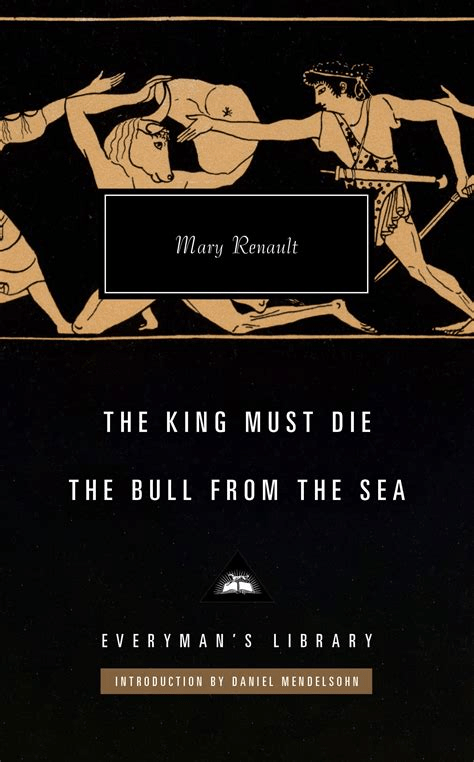
As part of my ongoing, yearlong foray into fiction set in the ancient Mediterranean, I am now re-reading Mary Renault’s The King Must Die. There is so much history and speculation packed into this book, that I make free to do a series of posts on different topics from it, en route to the final book review. So, buckle up! I hope you like ancient historical fiction! (And, since you are visiting Out of Babel Books, I assume you at least don’t hate it!) Today’s topic is Renault’s theme of the two conflicting cultures of Hellenes vs. what they call the “Shore People.”
On the timing of the Theseus story
I have always had the impression that the story of Theseus was one of the older historical myths. It happens when Knossos, on Crete, is still a thriving city. So, in my mind, I put it a few generations before the Iliad. Madeline Miller, author of Circe, seems to agree. In her book, Circe hears of Theseus having killed the Minotaur well before Odysseus comes to land on her island.
If you do the math, Theseus living before the Odyssey would also put him living before Agamemnon returns from the war at Troy and is slaughtered in his bath by his wife, Clytemnestra. In the play Agamemnon (written, of course, much later), Clytemnestra kills her husband in revenge for his having sacrificed their thirteen-year-old daughter before he sailed for Troy, in addition to a couple of other grudges. Like most women, I find it hard not to think Clytemnestra has a case.
Renault, however, takes a different tack. She has a teenaged Theseus hear the following story from a bard:
The song he gave us was the Lay of Mycenae: how Agamemnon the first High King took the land from the Shore Folk, and married their Queen. But while he was at war she brought back the old religion, and chose another king; and when her lord came home she sacrificed him, though he had not consented. Their son, who had been hidden by the Hellenes, came back when he was a man, to restore the Sky Gods’ worship and avenge the dead. But in his blood was the old religion, to which nothing is holier than a mother. So, when he had done justice, horror sent him mad, and the Night’s Daughters chased him half over the world.
ibid, p. 40 in my copy
So here we have Agamemnon, Clytemnestra, their son Orestes, and the Furies. At the same time, this passage raises some questions.
The Shore People and Their Appearance
The Shore People make their appearance on the very first page of The King Must Die.
Our house is Hellene, sprung from the seed of Ever-Living Zeus. We worship the Sky Gods before Mother Dia and the gods of the earth. And we have never mixed our blood with the blood of the Shore People, who had the land before us.
-ibid, p. 1
As the story progresses, it rapidly becomes obvious that the Hellenes have, in fact, mixed their blood with the blood of the Shore People. There is the story of Agamemnon, above; Theseus is said to be “blonde and blue-eyed like the Hellenes, but small and wiry like the Shore People,” and Theseus, who is very promiscuous, even has a child who “came out small and dark, but so was [his mother’s] brother.”
So we have two populations, one that is native to the Greek coastlands (or at least has been there a long time), and one that came there from the steppes. Theseus’s grandfather explains to him their ethnic history, which he got from his own grandfather:
“Long ago, he said, our people lived in the northland, beyond Olympos. He said, and he was angry when I doubted it, that they never saw the sea. Instead of water they had a sea of grass, which stretched as far as the swallow flies, from the rising to the setting sun. They lived by the increase of their herds, and built no cities; when the grass was eaten, they moved where there was more. … When they journeyed, the barons in their chariots rode round about, guarding the flocks and the women … [Lord Poseidon] told the King Horse, and the King Horse led them. When they needed new pastures, they let him loose; and he, taking care of the people as the god advised him, would smell the air seeking food and water. The barons followed him, to give battle if his passage was disputed; but only the god told him where to go.”
ibid, pp. 16 – 17
This is a description of the Indo-European lifestyle and homeland. The Indo-Europeans took their reverence for the horse, and their wheeled carts and chariots, with them wherever they went, including to Scandinavia. So the Hellenes are Indo-European, and the Shore People, presumably, Hamitic or Semitic.
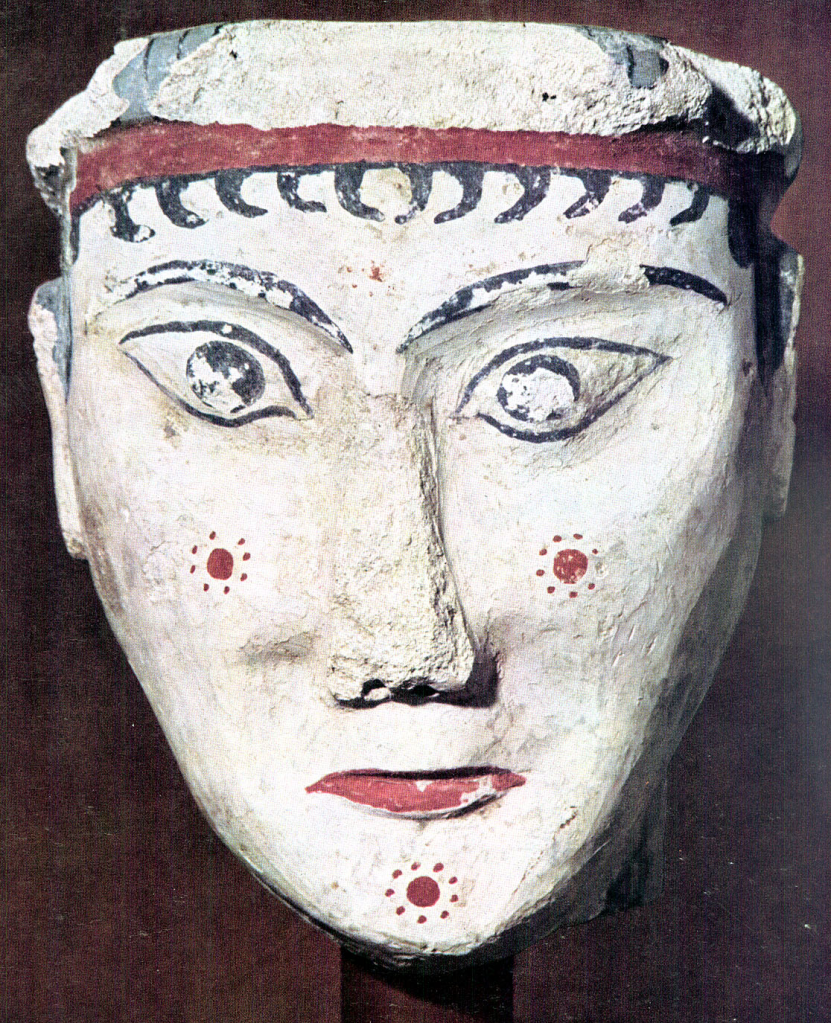
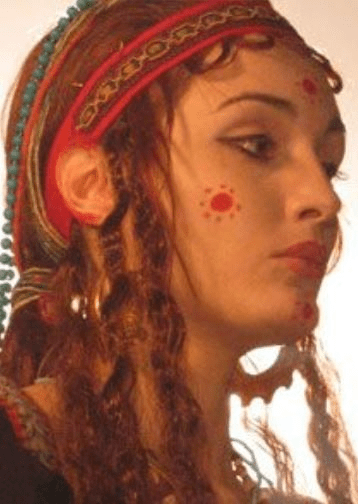
The mask at the top of this post is Mycenaean. Mycenae is located in the Peloponnesian Peninsula, which is also the location of Troizen, Theseus’s home. The ancient Mycenaean culture, older than classical Greece, took its cues from the Cretan urban culture of the time. In later Greece, you get men wearing himations and women wearing finely woven chitons. This is usually how Helen of Troy, for example, is illustrated. However, she probably looked more like the Mycenaean and Cretan women. Here is someone’s attempt to reconstruct the probable hairstyle and costume of the most beautiful woman in the world:
Notice the Egyptian-style, kohl-lined eyes, and the red suns for makeup. Helen might have been blonde, being a Hellene, but her clothing was perhaps more like this.
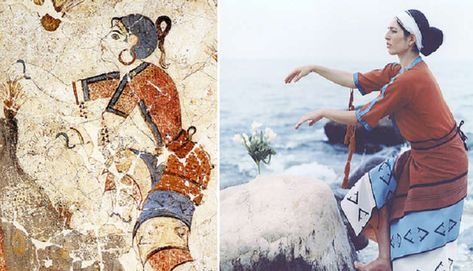
Here is someone else, reconstructing a traditional Mycenean costume and pose:
I’m guessing these fashion choices came from the Shore People.
Theseus’s mother is described as wearing this ancient Mycenaean style. She wears a tiered, flounced skirt hung with charms, exposed breasts (what was going on, Crete and Mycenae?) and hair that is curled by the use of “crimping braids” (probably to attain a very curly look for those who do not, like the Shore People, have it naturally). Though a blonde Hellene, she is a priestess of the mother goddess, and so she takes some of her cues from the Shore People, and here is where we find the tension.
The Shore People and Their Religion
Both the Hellenes and the Shore People practice the sacrifice of their kings. However, there is a difference. For the Hellenes, it does not come on a regular schedule. Theseus’s grandfather explains:
“When the work of the King Horse was done, he was given to the god … And in those days, said my great-grandfather, as with the King Horse, so with the King. When the king was dedicated, he knew his moira [i.e. doom]. In three years, or seven, or nine, or whenever the custom was, his term would end and the god would call him. And he went consenting, or else he was no king, and no power would fall on him to lead the people. And the custom changes, Theseus, but the token never. … Later the custom altered. They ceased to offer the King at a set time. They kept him for the extreme sacrifice … And it was no one’s place to say to him, ‘It is time to make the offering.’ He was the nearest to the god, because he had consented to his moira; and he himself received the god’s commandment. And so it is still, Theseus. We know our time. … It is not the sacrifice … it is not the bloodletting that calls down power. It is the consenting, Theseus. The readiness is all.”
ibid. pp. 18 – 19
This might explain why so many kurgan burials are of high-born individuals who seem not to have died of old age.
It also, of course, explains the title of the book.
Meanwhile, it has been established that the Shore People do things a different way: “old laments have come down from the Shore People, of young heroes who love a goddess for a year, and foreknow their deaths” (p. 37). In other words, the Shore People treat their king primarily as the goddess or priestess’s consort, and kill him after just a year.
Marija Gimbutas has tried to make the case that the Shore People practiced a gentle, feminine, goddess-worshipping religion, and that they were cruelly exterminated by the warlike, sky-god worshipping evil Indo-Europeans. Renault is not going to paint with such a broad brush. Realistically, she shows both groups living next to one another and influencing each other. Also, throughout the course of the story, she is going to show by increasingly vivid illustrations that these two cultural systems are absolutely incompatible with each other. And that the mother-worship, in the end, is at least as bloody as the worship of Zeus.
Renault’s take on the story of Agamemnon is a great illustration of this. She interprets the story as a conflict between Clytemnestra’s mother-goddess culture and Agamemnon’s sky-father culture. When Clytemnestra brings back the “old religion,” it means that Agamemnon must die–not in battle, not some day, but now, and actually, yesterday. It means that Orestes is doubly cursed. He has loyalty to both religions, with their incompatible demands, and he is put at the mercy of the furies, the representatives of the goddess-religion. They chase him because he killed his mother, but if we string out the implications, even if he had not, they would probably be chasing him anyway. After all, he is a male heir to the throne, so his days are definitely numbered. Behold, the kindness of the religion of the goddess.
Obviously, there are some universal truths and some redemptive metaphors here, hidden under a thick layer of occultism, war between the sexes, and general pain and suffering for everyone. It is going to take a much greater King than Theseus to cut this difficult knot.
Seasonal Postscript
Oh, and Happy Valentine’s Day to everyone! Such a romantic post, I realize.
This year, I decided that my fiction focus would be novels inspired by ancient Greek myths. I don’t always pick a fiction focus, but this year, things just coalesced.
In the classical Christian school where I teach, we follow a 4-year “history cycle.” Ancient World, Medieval World, Exploration/Renaissance, Modern World. This year, we are cycling through Ancient, so I have been immersed in the Flood, the Sumerians, Abraham, Egypt, and the Iliad and Odyssey. (Somewhat immersed, of course. We could always immerse ourselves more.)
Revisiting Mycenae and Crete, I remembered that back in university (in the last millennium!) I read what I thought was a fantastic book that was a re-telling of Theseus. Looked it up, and it turns out it was The King Must Die by Mary Renault. And it turns out that Renault has a bunch of other books that I’ve never read. (Back in the last millennium, the way we found books was we stumbled upon them in the library.) So, onto the list went at least a re-read of The King Must Die and its sequel, The Bull from the Sea. I bought myself copies of these for Christmas using my husband’s money, so technically he bought me the copies for Christmas.
Meanwhile, years ago I had won a copy of Circe, and had been waiting to read it until I was ready to stick my head back in the ancient Mediterranean. I’m also aware that Madeline Miller has at least one more book, The Song of Achilles, which is from Patroclos’s point of view. Gay, of course (and that is historically accurate). I decided I might read that, depending upon how I enjoyed or didn’t enjoy Circe. You can write about ancient Greek events from a hard-core feminist/queer perspective, or you can not. I wanted to know first what approach Miller was taking.
Finally, some of my students have been reading Percy Jackson, with the result that they are already quite familiar with the Greek pantheon. I’d known that the Jackson books were out there, so perhaps now is the year when I read at least a few of them. Jackson went onto the list.
Then there are the rereads. Til We Have Faces is C.S. Lewis’s masterpiece, set probably in Scythia or the Caucasus, near the Greeks but not too near. Moving farther from Greece, we have Taliesin, Merlin, and Arthur by Steven R. Lawhead. I read Taliesin in high school. It’s Celtic, not Greek, except that about half the book takes place on Atlantis, with bull dancing and stuff, so I figure that counts. Now, the Daily Wire has made a TV series based on these books. The events of Taliesin take up about an episode and a half. So, if I have time, I’ll reread/read Steven R. Lawhead.
So, here is the list as it stands …
Circe
The Song of Achilles?
The King Must Die
The Bull from the Sea
other books by Renault?
Til We Have Faces
at least a couple of Percy Jackson books
Taliesin
Merlin?
Arthur?
This should fulfill the twelve books that I told Goodreads I’m planning on, this year.
In the course of my teaching year, I have already read The Cat of Bubastes with my students, and am now reading Hittite Warrior, which is also very good. Also on the docket is The Young Carthaginian.
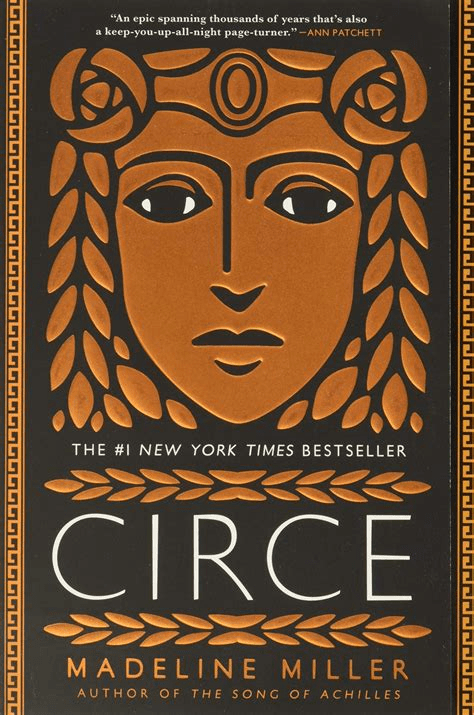
So, how was Circe?
I loved this book. It is exactly the genre I like. Miller did a fantastic job keeping track of all the gods, titans, and nymphs, their little feuds, and their family relations to one another.
Circe, in The Odyssey, is a “witch” whom Odysseus and his men encounter on the island of Aiaia (Corsica or Sardinia … I was imagining Corsica). She turns some of them into pigs, but Odysseus convinces her to change them back. She becomes a sort of ambiguous ally, giving him advice about how to handle the Moving Rocks, the Sirens, and Charybdis and Scylla.
Of course, there is always more detail to the story. Miller has researched this deeply, and I appreciate her portrait of where Circe came from. Circe is the daughter of the sun, Helios, who is a titan, and his one legitimate wife. This makes her the sister of Pasiphaë, wife of King Minos (ahem), and also of Aeetes, father of the witch Madea.
Given that she is divine, Circe gets a front-row seat to nearly all the earliest myths. She meets Prometheus in person. She watches the whole ugly episode with Minotaur go down (this is centuries before Odysseus). Time passes quickly for her. At the same time, she is sort of fascinated by mortals. On the plus side, this means she does not view them as disposable, as most of her relatives do. On the down side, she at first fails to see them as a threat.
Near the end of the book, she has this to say.
I thought once that gods are the opposite of death, but I see now they are more dead than anything, for they are unchanging, and can hold nothing in their hands.
p. 385
Though a page-turner, Circe was a heavy read emotionally. As you might expect, it really stinks to be an ancient Greek god or Titan. You are likely to have horrible parents, for example. The hardest part for me was finding out what we might have suspected by reading between the lines: that Odysseus was actually a real [censored], and that things did not go happily after he made it home to Ithaka. Thankfully, Miller does not leave us there but introduces at least one good man and gives the book’s ending a faint note of redemption.
Based on this read, I think I will try The Song of Achilles if I come across it. Miller’s writing is not ideological. It is extremely tragic, with heartbreaking near misses and so forth, but that is actually how these ancient stories go.



 Out of Babel Books


