A few hours’ drive from my house, in the mountains of southern Idaho, we have a hot springs attraction. The pools are tucked into a niche between the town on one side and the highway on the other.
The photograph above was taken from the east end of the little canyon. Behind me, as I took this photograph, was something called “The Grotto.” It consists of paths and small garden areas winding along the lava-rock hillside. The rocks are basalt, but covered with mineral deposits from the days when the springs gushed out over here.
My husband and I went to the town of Lava, which is very touristy and has a lot of old-timey, cowboy-themed restos and hotels, back in September. I had never walked in The Grotto before. (Usually, I’m just either going in the hot springs or not going in the hot springs.)
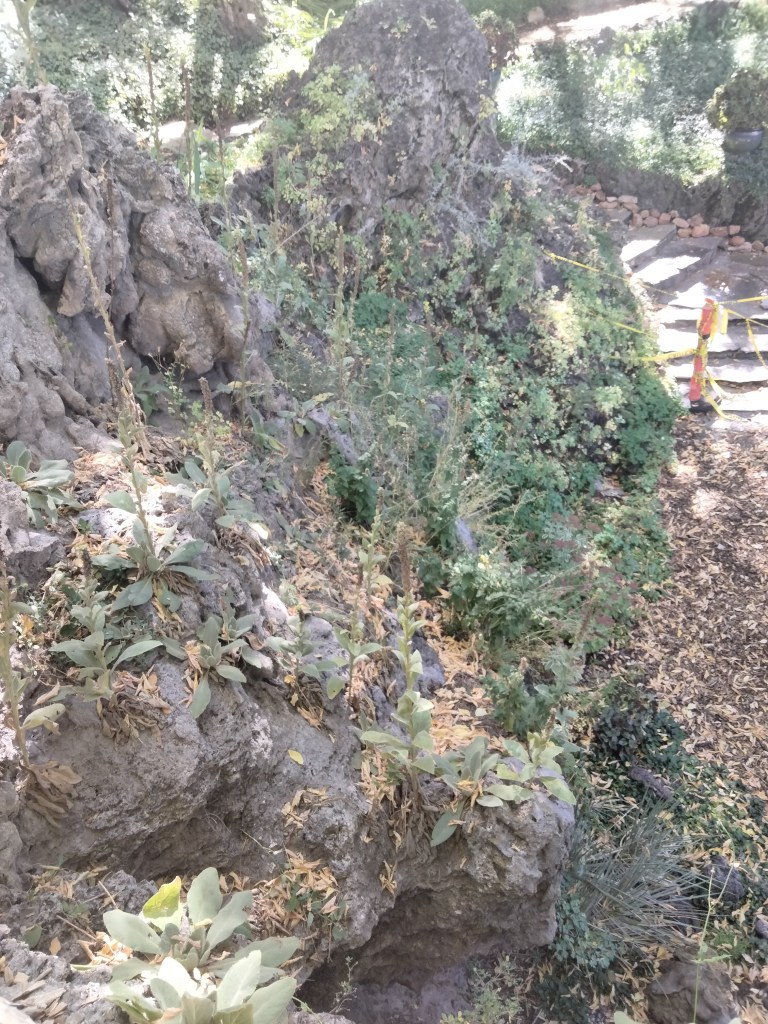
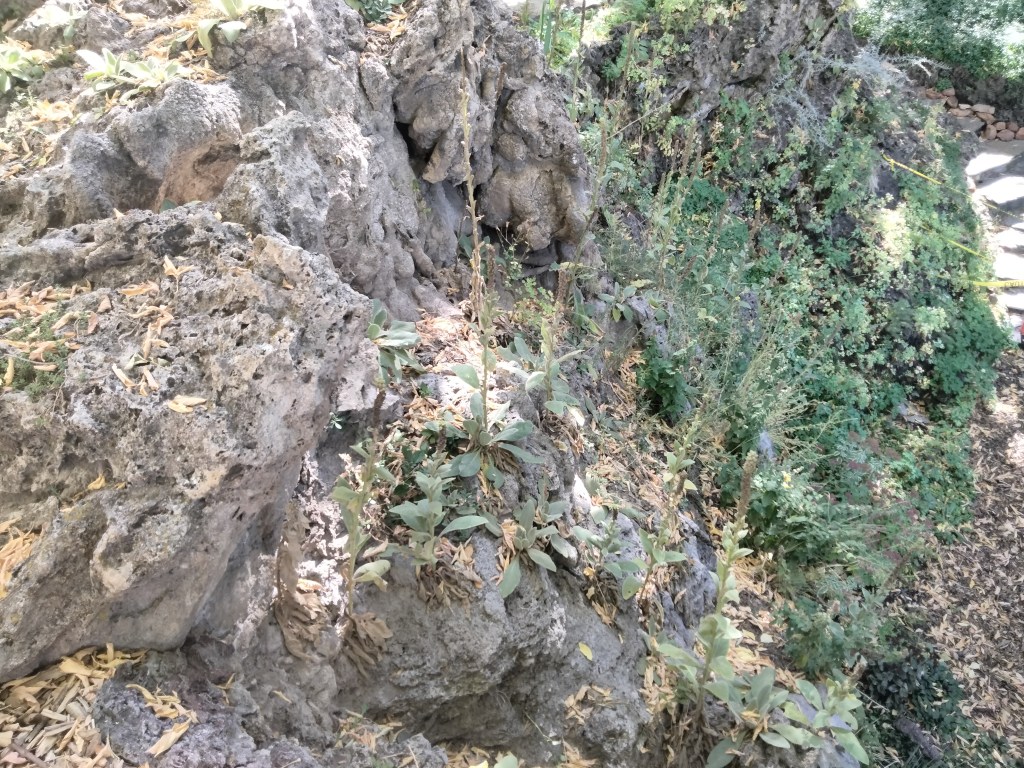
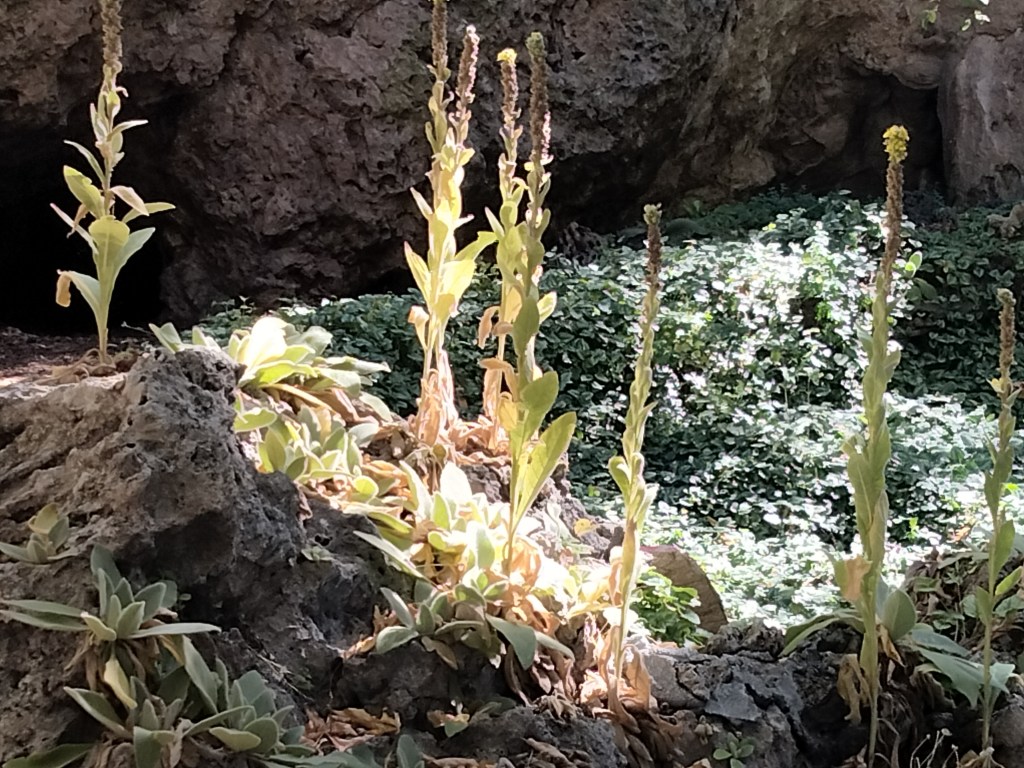
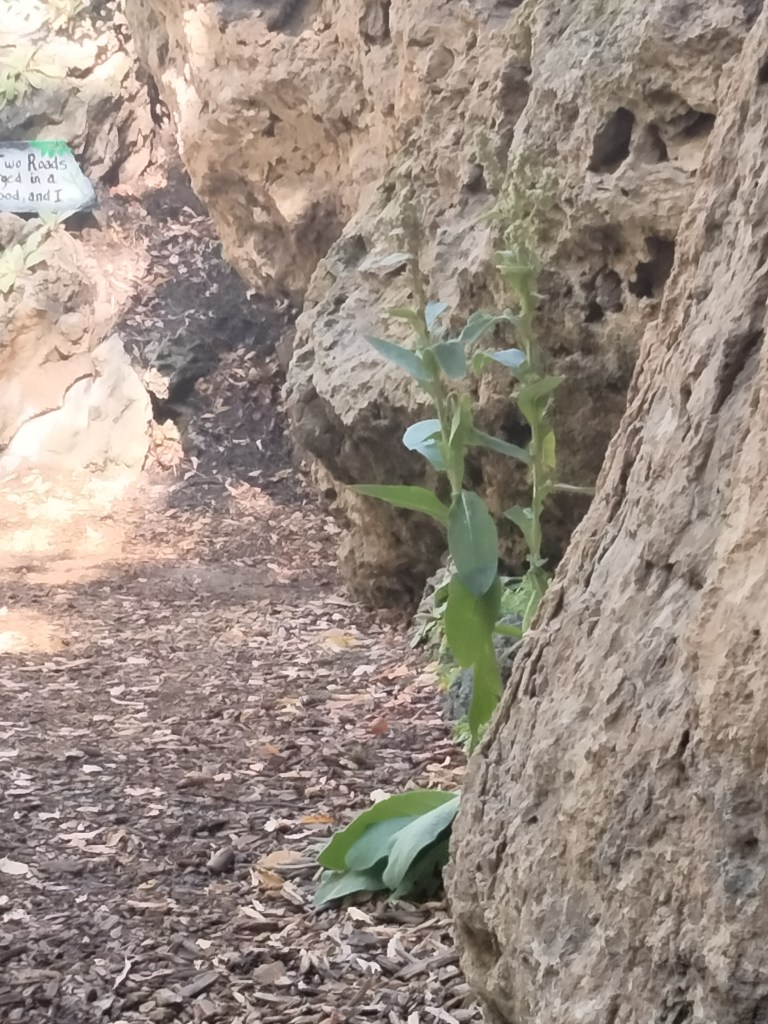
But on this particular September, The Grotto was simply alive with the most Wooly Mullein I had ever seen in one place! Wooly Mullein are those plants you see with broad, pale-green, pillowy-looking basal leaves and (in some cases, not all) a tall spike of a flower.
I blogged about these plants a few years ago, when I had photographed one growing in a farmer’s field near my house. According to Central Rocky Mountain Wildflowers, “They are biennial plants, growing the first year as a round cluster of large radiating basal leaves covered with thick, woolly hair. The second year, they rapidly grow a 1 – 6′ tall stalk, crowded with yellow flowers in a spike arrangement. Then, with all its energy expended, the plant dies.” (p. 157)
“This introduced weed colonizes disturbed places from the valleys and plains to montane forests.” (ibid) Look at how many of them there are! They must love the dry climate.
But Wooly Mullein is not just a weed. “Dioscorides, the Greek physician to the Roman armies in the first century, used mullein to treat coughs, scorpion stings, eye problems, tonsillitis, and toothache. Today, herbalists value it as a medicinal herb for asthma, bronchitis, coughs, throat inflammation, earache, and various other respiratory complaints.” (ibid) My copy of Prepper’s Natural Medicine confirms this.
Hence, Lava is really the place to come if you’re ill in apocalypse situation! The Shoshoni Indians would bathe in and drink the hot-spring water to cure illnesses, plus there is all this mullein here. Still, it might be better to plan ahead.
I walked down this path and sat on a bench set into the rock wall. Lo and behold, up in a niche was Spiderman watching over me! Lava truly does have everything you might need!
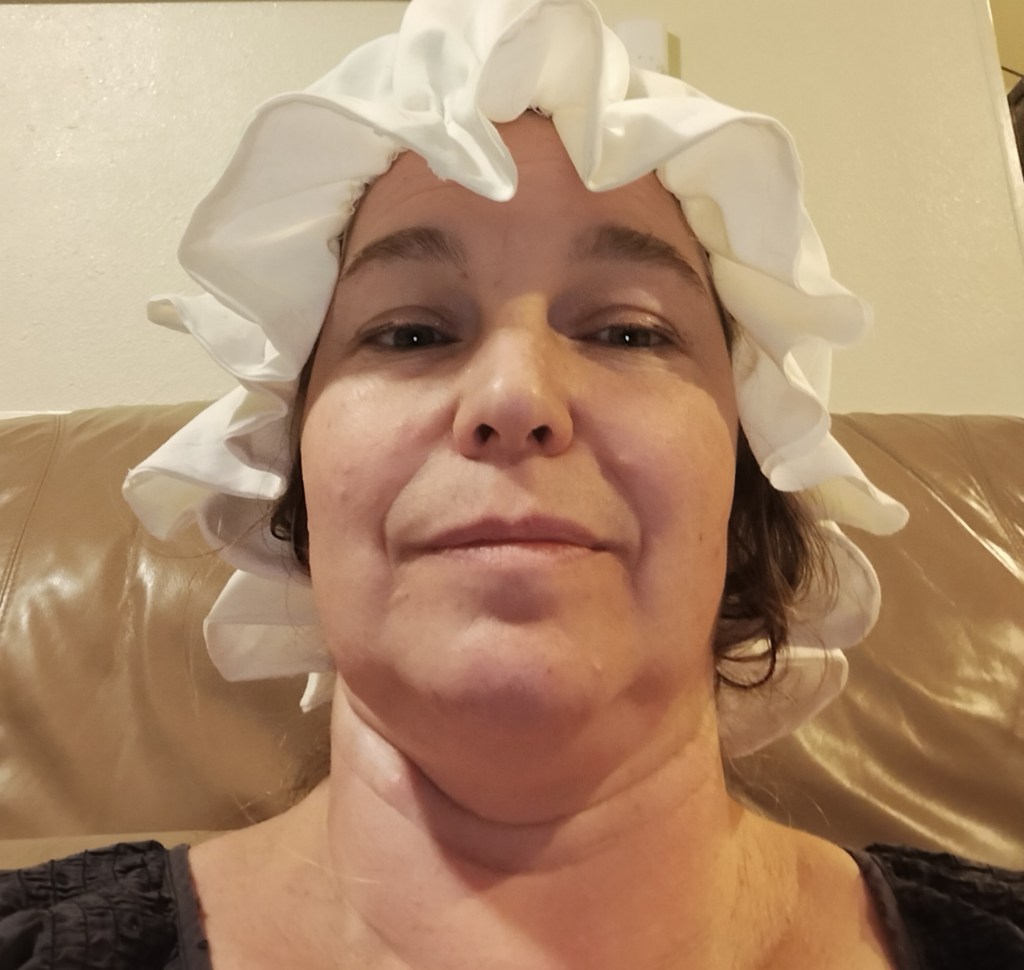
Early this fall (or late this past summer), when I found out my class of schoolchildren was to have a Founding Fathers celebration, I knew I needed to make a mop cap (some people also call them mob caps) so I could dress as a colonial woman.
I already owned a number of full skirts, and I’d purchased a corset at the recent Fantasy Faire that could be adapted to appear 17th- or 18th-century.
I found this easy sewing pattern at Patti’s Place (thanks, Patti!) by searching on Pinterest, my one-stop shop for all things artistic, creative anachronistic, self-sufficient, and conspiratorial. The pattern was so simple I could sew it by hand, which was good because I don’t own a working sewing machine.
I’m delighted with how it turned out. It can be worn with any hairstyle. If you wear the hair up, it looks rather Martha Washington. If you wear the hair in braids, or loose, underneath it, you’re looking more Madame Defarge. I think you all know where my loyalties lie.
I created a mop cap craft for the little girls in my class based upon this pattern, and they looked darling. I’ll post pictures of my costume from the event if I ever get ahold of them. You need a tight-fitting bodice, a full skirt, ruffled cuffs at the elbows, and a shawl tied low on the shoulders to complete the look.
My costume wardrobe now includes 10,000 B.C., 1550 A.D. and 1776 A.D. There’s a rather large gap in there. I’ll update you further as the occasion arises.
You may notice that I have a large tag in my tag cloud called Native Americana. I’ve always been a sucker for American Indians. The second two books in my trilogy are a speculative exploration of what their distant ancestor’s lives might have been like.
This subject comes up every year because of the efforts to change Columbus Day to Indigenous Peoples’ Day. I’m not in favor of this, but I do love all things American Indian. (Traditional things, that is. I’m not a fan of the cultural disintegration brought about by enforced socialism on the rez. For more on this, see the book review below.) Anyway, this is the time of year when I find myself annoyed yet again by Matt Walsh.
Walsh has done yeoman’s work fighting the forces of evil in our culture, but he just doesn’t know very much about American Indians. He’ll portray pre-conquest America as an extremely backwards place, full of “stone-age” people, who “hadn’t even invented the wheel.” This annoys me. There actually had been civilizations in the Americas (howbeit, without wheels), including astronomically aligned earthworks and pyramids, even in North America. The Americas suffered a population collapse about a hundred years before Columbus arrived, as documented by Nathaniel Jeansen of Answers in Genesis and in his book Traced. So, what the Europeans found were the scattered remains of civilizations. (Except Cortez. He found the real thing, and it was terrible to behold.)
Now granted, the American civilizations had not yet been Christianized, so they resembled Ancient Near Eastern pagan theo-states rather than European medieval kingdoms. It was probably this, in fact, that gave the Europeans the intellectual edge and enabled them to conquer the continents. Other things being equal, paganism tends to make people more passive. Fatalism, you know.
So Walsh is right that the Europeans conquered the Americans fair and square, as it were. Just like everywhere else throughout history. Now, the conquerors celebrating and romanticizing those they have conquered is a tradition that goes way back. See Homer writing sympathetically about the Trojans. See the beautiful Roman statue, The Dying Gaul. See the Romans commemorating the abduction of the Sabine women, but also celebrating Romulus and Remus, whose story is enough to curl you hair. So I am all for celebrating indigenous peoples (because I love ’em), but also Columbus (because there is no call to demonize your own culture).
That said, let’s not let sympathy turn into damaging infantilization. That’s what the United States government has done with the American Indians, as documented in the book below.
Book Review: The New Trail of Tears by Naomi Schaefer Riley
Life is very bad on our American Indian reservations.
People on the reservations experience rates of corruption, unemployment, depression, drug addiction, sexual assault and child abuse that are as high or higher than any other place in the nation.
But why?
Those with overly simplistic views of American Indians tend to oversimplify in one of two ways: your average American Indian is seen either as Wise Noble Victim, or Worthless Lazy Drunk. My instincts have always put me in the Wise Noble Victim camp, but I recognize that neither of these oversimplifications explains conditions on the rez. American Indians are people, which means they are sinful but not worthless. As Schaefer Riley puts it, “Indians, just like all people, respond to the economic incentives and political conditions around them” (page 178).
I have occasionally spoken with people who seem to resent all that American Indians receive from the government. Tribal governments are “sovereign.” Tribes have the right to operate casinos on their land (in most states no one else can), and in many cases, tribal governments or even individuals receive direct payments of federal dollars. None of this is false, but what has been the effect of it? It has not led to a cushy life for tribe members; quite the opposite.
The Incentives
Here’s my quick summary of the “economic incentives and political conditions” created by the way the federal government has handled the tribes:
Law enforcement on the rez is a nightmare. Since Indians are not considered as being under the jurisdiction of the state in which they live, if there is a serious crime, it is considered a federal crime, and you could have three or four agencies involved. “He became especially concerned ‘with the lack of coordination between the tribal police and the Bureau of Indian Affairs and the FBI and the Justice Department.'” (page 164) Often, other law enforcement agencies defer to the tribal police, who often, because of nepotism, don’t prosecute. This creates a lawless situation on the rez, with high crime. It gives victims the impression that nothing will be done.
It is difficult for Indians to own land; or, if they happen to own some, to develop or sell it. Most land is not individually owned, but belongs to the tribe. A combination of tribal politics, environmental concerns, and federal red tape tends to block any attempts at development. This means that it is very hard to create or find jobs on the reservation … except jobs in tribal government.
While casinos provide some jobs, the linking of the casinos with tribal membership has introduced all kinds of corruption. Some tribal governments run their casinos essentially as cartels. The effect is that tribal membership is “commodified.” A common political move against a rival would be to get them declared no longer a member of the tribe.
Schools on the rez tend to be as bad as the worst inner-city schools. Schaefer Riley profiles a few schools that have bucked this trend, at least for a few years. One is a Catholic school. There are also Teach for American volunteers who are very motivated to give Indian kids a better education. But these people are usually met with mistrust and actively undermined or driven out because they are outsiders and because of the bad experiences that the older generation had with residential schools trying to forcibly assimilate them.
While it is important for Indian kids to learn about their traditional language and culture, “this is not a good first step.” Schaefer Riley points out that those tribes that have done the most to preserve their language and culture are those that have done the best economically. When no longer just struggling to survive, they use the money and the energy they now have to create museums and cultural centers.
In short, massive amounts of government money and regulations have had the same effects on the Indian reservations that they always have elsewhere. The red tape is at least tripled compared to the red tape faced by other Americans, which pretty much brings any kind of enterprise to a grinding halt. The infusion of government money through the tribal government incentivizes corruption. The lack of private property and actual employment makes people depressed. The white guilt (and the red tape) have made a lost cause of law enforcement.
Possible Solutions
Schaefer Riley ends with a call for American Indians to be treated like all other American citizens. She points out that American Indians have had very high rates of serving in the military.
Indeed, despite centuries of broken promises from the federal government, despite the bitterness that often pervades Indian communities, and despite years of being told by their own leaders and by Washington’s that they must remain a people apart, American Indians largely see themselves as Americans.
pp. 175 – 176
There has to be a way to ensure that Indian crime victims have the same rights under law as other crime victims … that Indians can own land and start businesses as individuals, not just as members of the tribe … that Indian families have access to a choice of schools that will prepare their kids to succeed. It has been suggested that the larger reservations be made into their own states. Then the people who live there would be considered full citizens who happen to reside in that state. This might not be feasible politically (although I think it would be really cool), but there are a few bands in Canada who are trying to get their tribal lands incorporated as cities. This would allow them to do development that they can’t do now, and the tribal leaders would be like city governments. Failing all this, a good step would be to drastically reform (or, ideally, eliminate) the Bureau of Indian Affairs, which is known for being the one of the most corrupt and inefficient government agencies in a field where the competition is stiff.
I sincerely hope that Schaefer Riley’s book catalyzes a move in this direction. It should, of course, be read by anyone with the slightest interest in American Indians’ living conditions in these modern times. But it should also be read by anyone who is concerned about the effect of government micromanaging of citizens’ lives.
A Cautionary Tale
I see at least three ways in which the federal government’s treatment of Indians serves as a sample of what it would like to do with all citizens:
It’s coming from good – or at least utopian – intentions. In the case of the Indians, many people feel that the government owes them lots and lots of money and special rights because of the ways that same government mistreated them in the past. (Turns out, the money and “rights” are a new kind of mistreatment.) There is also an assumption that less development is better, because we don’t want to impact the environment at all. In the same way, there is a strong movement to put all citizens in the same position: “You will own nothing, and you will be happy.” Putting the most charitable interpretation on it, the idealists believe that this would bring about a utopia in which everyone has a high (but more importantly, “equal”) standard of living … there is no family loyalty or private property to cause conflicts … and everyone’s lifestyle is perfectly “green.”
It features forced assimilation. Schaefer Riley points out that Indians are in fact assimilating culturally to the United States, but forced assimilation is a very different story. A few generations ago, Indian children were forcibly removed from their homes and sent to boarding schools where they were not allowed to speak their own language. This idea that, if the parents don’t share the government’s value system, the government has a right to separate children from their parents and re-educate them, has not died away. The idealists have not yet gained enough power to practice forced assimilation on all American children, but they are trying.
It is collectivist. The degree to which Indians have been denied private property and individual initiative is the exact degree to which they have been brought to poverty and despair. In their case, this has been brought about partly from a sort of Rousseauian “noble-savage” myth about the way the Indians lived before Columbus (spoiler: they weren’t collectivists then either). In the case of other Americans, there has been an attempt to demonize private property, small business, and intact families as the problem with humanity. In fact, these things are key to human flourishing. Sin certainly shows up in them, but that is because it is present in human nature and shows up in whatever humans do.
“The bright yellow flowers give way to a grapelike cluster of purple berries with whitish coating. In the fall, some of the leaves often turn bright red, orange, or bronze.
“The tart berries make a refreshing, lemonade-like drink and fine jelly or wine. The yellow inner bark was used by Native Americans as a yellow dye and as a medicine with many applications.”
Here I am, using my color vision to spot the ripest raspberries in the thicket. Darker ones are ready. I can distinguish fine grades of color.
Then, I use my specially designed opposable thumbs to pick the ripest raspberries. My fingers have been given the ability to sense, and calibrate their grip for, the finest gradations of pressure. This allows me to pull each berry off its core without squishing it. Most of the time.
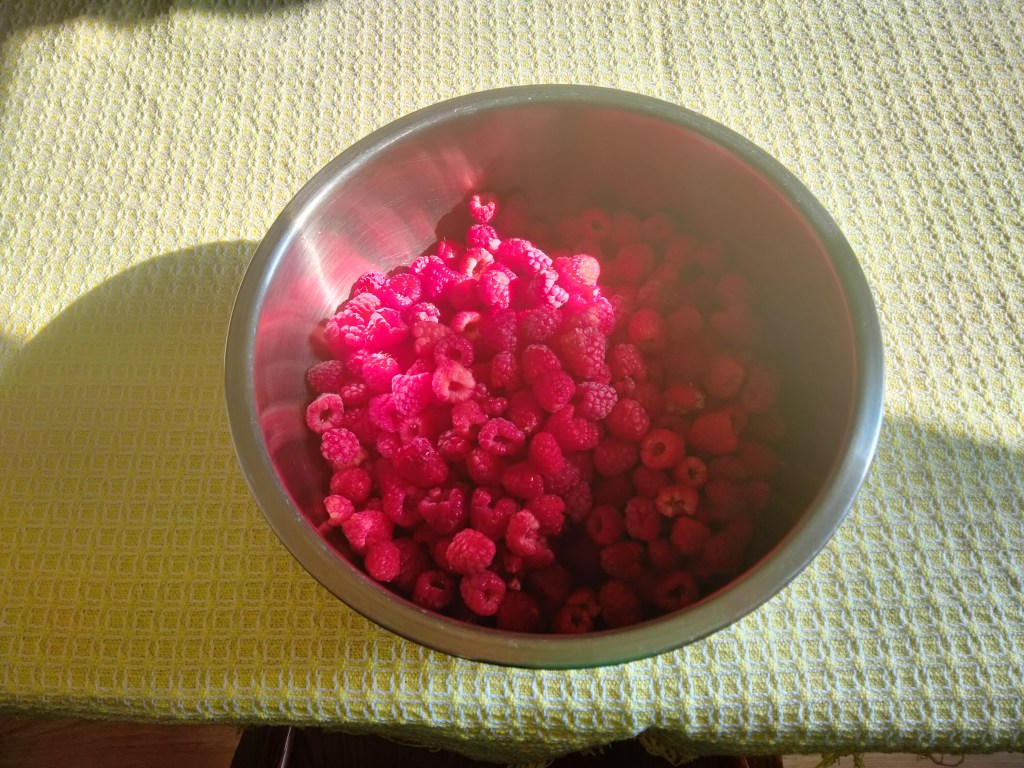
The raspberries, for their part, have been specially designed to be picked and eaten by me. Every year, they produce a ridiculous bumper crop. “Pick us!” they groan. They have been given thorns, of course, but these are at best a halfhearted attempt to fight back. All I need to do is put on a long-sleeved shirt, and the prospect of a nasty scratch is no match for the motivation furnished by the berries’ taste.
The raspberry bushes are very good at surplus. They produce far more berries than I can realistically pick, and they hide them where I will never find them all.
They taste sweet-tart. They provide fiber and Vitamin C and I don’t know what all. They look so pretty paired with yogurt and oatmeal on a summer morning.
This morning while I was deep in the raspberry patch, my son picked up one of our chickens and at that moment she laid, the egg dropping from his arms to the ground. It didn’t break. Food was literally falling from the sky.
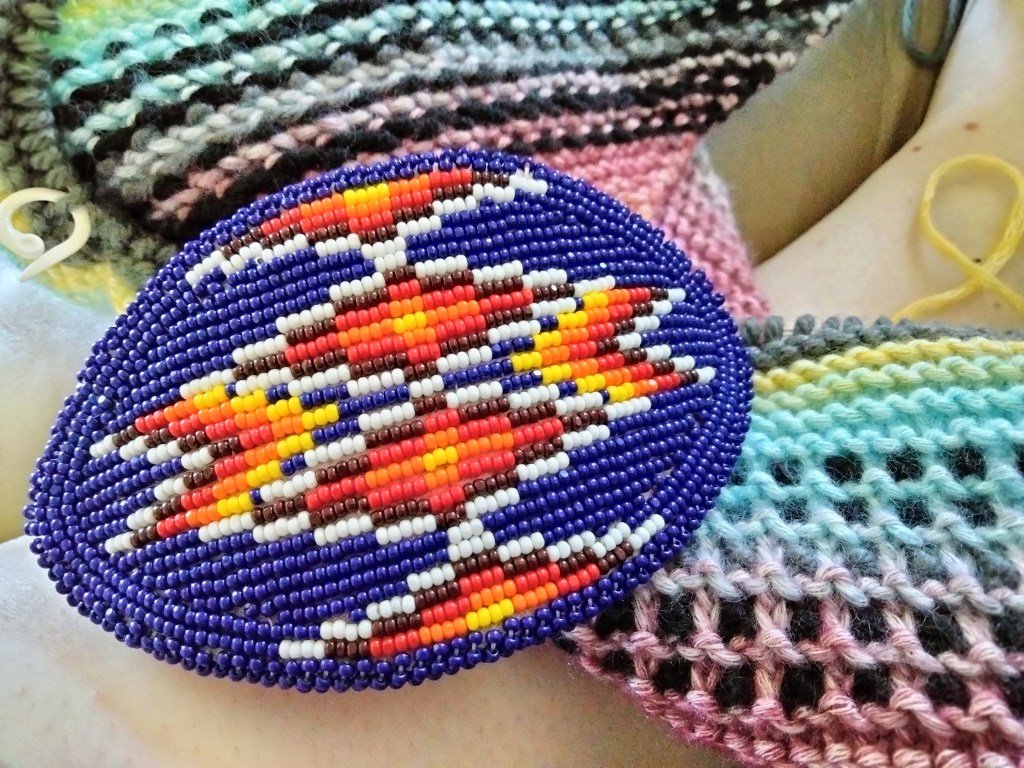
If you have been an Out of Babel (Books) reader for many years, you may remember that I have a hopeless crush on all things American Indian. I happen to live near a reservation, complete with casino (the casino is not so much my crush). This Spring, I went and bought a lovely hand-beaded item from the many on sale there.
Just look at all the man- or woman-hours on that thing!
The beads are sewn into a leather cover that’s attached to a hair barrette. (Fun fact: My grandmother, when she was alive, knew how to make beaded earrings in this style and she taught me how. That’s how I know this item would have taken a looong time!)
Anyway, my little sister, aware of my love for all things American Indian, bought me this lovely yarn, which struck her as being in colors typical of the tribe who live near us. I promptly searched Etsy for a knitting pattern that would showcase this yarn according to its potential. I settled on The Drifter Shawl, by NarrowPathKnitDesign, here.
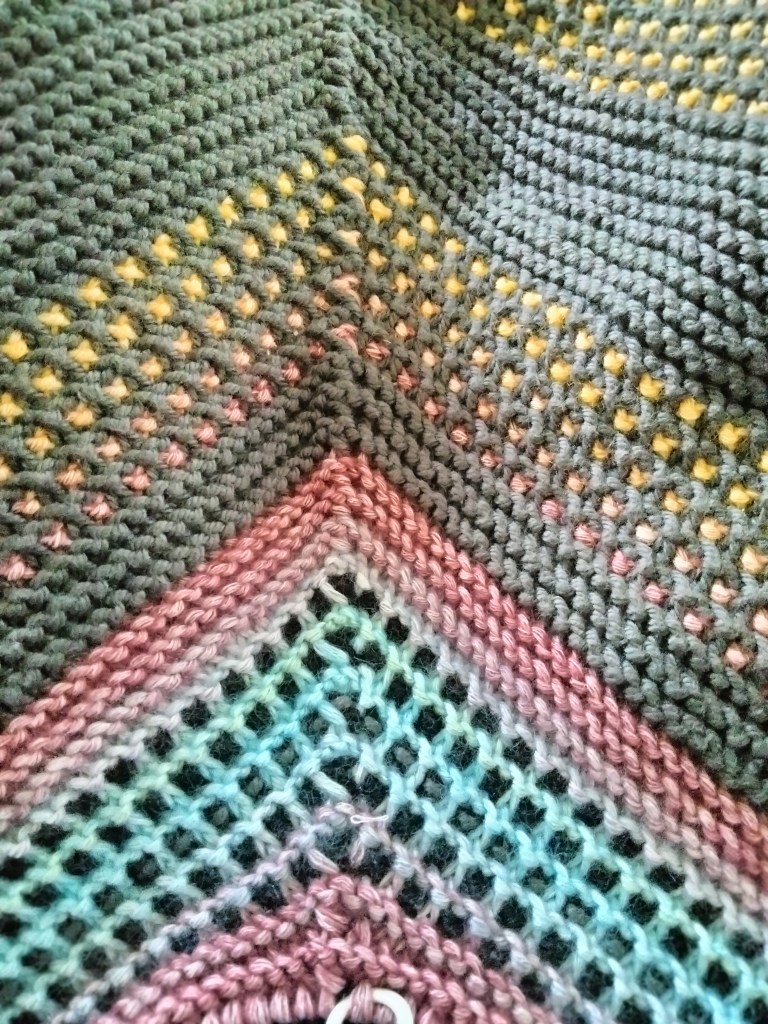
The Drifter uses a Center Double Decrease stitch to create the chevron shape in the middle of the shawl. The center chevron “drifts” towards one side of the shawl (compensatory increases are made on one side but not on the other). The chevron is supposed to go all the way to the edge of the shawl, but I ran out of yarn, so I just bound off early. That’s why there is a slight notch in the finished product. I still love the shawl and get tons of compliments on it.
It can be worn with almost any of the colors found on it: blues, oranges, pinks, duns. In my mind, the Platonic ideal for this shawl is to wear it with black.
Here are some close-ups.
One great thing about the Drifter pattern is that it’s so versatile. The pattern includes a three-color or a two-color option, and obviously, the colors you pick can drastically change the feel of the shawl. I’m already working on another rendition of this shawl for a friend, for which I have bought sufficient yarn this time.
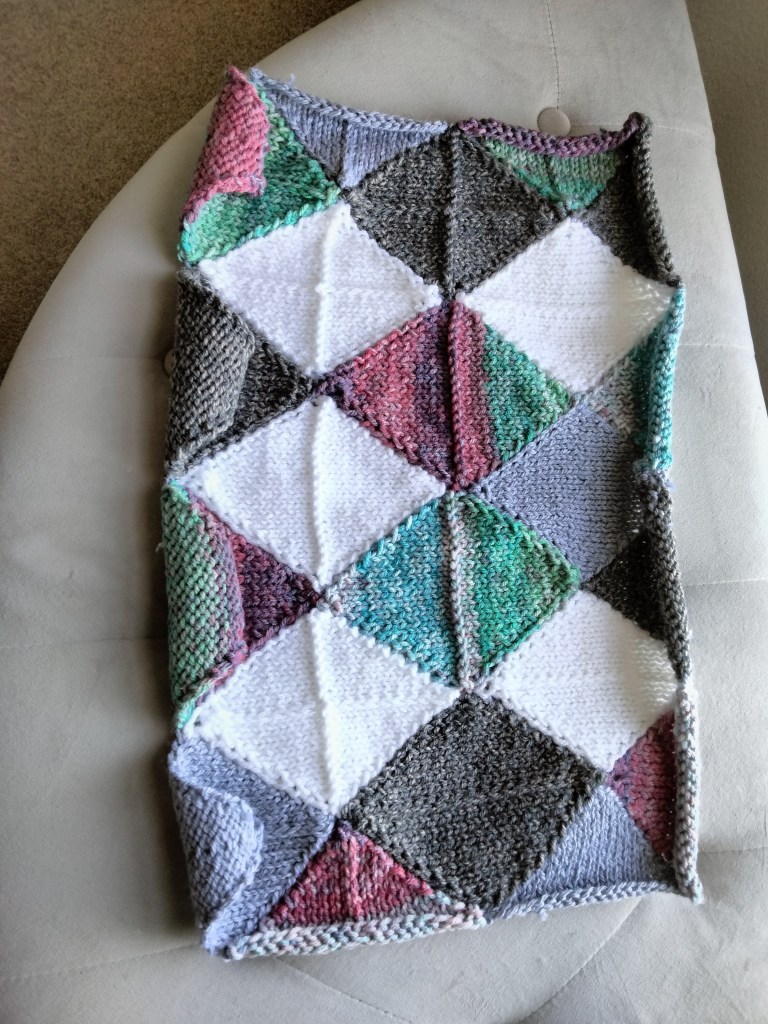
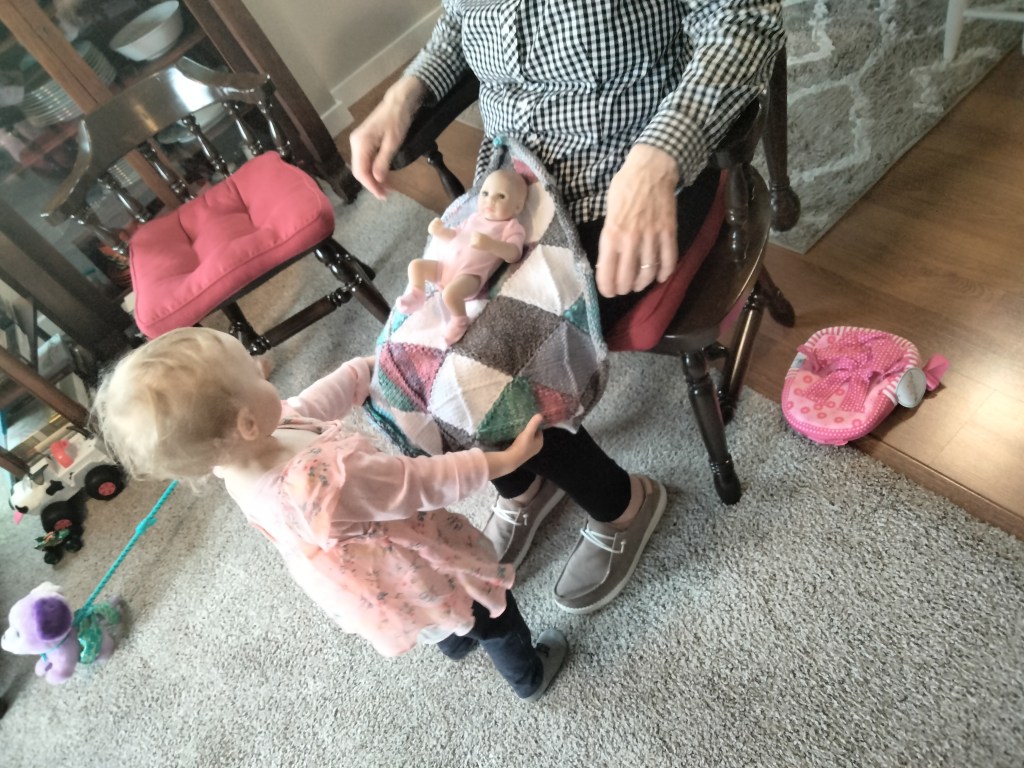
I heard my baby niece was going to receive a baby doll (and really, who loves babies more than babies?) and that I could make a blanket for same. I had some yarns in my stash that would look pretty together, so I started making diamond shapes and grafting them together using the ladder stitch.
I wanted there to be more visual interest, so I added ridges on some of the diamonds, using a row of garter stitches when horizontal and a column of slipped stitches when vertical. The result was a random windowpane type pattern overlaying the harlequin pattern.
The blanket took longer than I expected, but it was a big hit.



















 Out of Babel Books