A term invented by Karl Marx to encapsulate his view that money, and owning private property, is spiritually degrading for people, in his book Das Kapital.
A general term for modern post-industrial society, with special emphasis upon corrupt corporate bureaucracy, commercialism, and the “rat race” as distinctive features of “capitalism” and not just its byproducts.
An all-purpose explanation for anything that goes wrong in the world, such as diseases, poverty, imposter syndrome, environmental degradation, stress, and death.
Private property; the idea that people should be able to own their own houses, land, clothing, vehicles, etc., and keep the fruits of their labor.
You might notice some tension between definitions 3 and 4.
Long story short, Marx coined the term capitalism so he could make private property the world’s whipping boy, and boy howdy, did it work out for him!
Well, it’s that time of year again: the long, long weeks of post-Christmas winter, when we grit our teeth and read the books that are not fun but are good for us. I think it was this time of year, a few years ago, that I read The Gulag Archipelago by Aleksandr Solzehenitsyn. This is similar.
The poison of class war
First, some background. I don’t like Marxism. I don’t like anything that has even the faintest hint of class war in it, in fact.
I was a sensitive, easily guilt-tripped child, and I grew up in a “Christian” denomination that had an intermediate-to-advanced case of marxist infection in its Sunday School materials. They would take verses like “blessed are the poor” and “how hard it is for the rich to enter the kingdom of God!” and use them to make it clear to me that being an American, with a high standard of living relative to the rest of the world, was not only a sin, but a very special sin, in a category all its own, because this was one sin which you could not repent of and to which the blood of Jesus did not apply. I was the “evil rich,” and there was nothing I could do about it. Also, because of this, I was morally guilty for any suffering that happened anywhere in the world, provided that the United States was somehow involved or the people suffering were “poorer” than I was. And I swallowed all this. I felt guilty, not grateful, for every little purchase or luxury. And eventually, I felt defensive about them.
I now know, based upon what I have learned since, that marxian systems by their nature do not include repentance or grace. These are Christian concepts. We cannot expect them from a system that works by designating a villain class, then constantly expanding that class. I had already figured out, simply from applying common sense, that the “logic” of class-war thinking is illogical, years before Lindsay came on the scene, but once I started reading him, it became even clearer.
As a simple piece of first advice for pushing back against Critical Race Theory, stop assuming it has good intentions. Individual people pushing Critical Race Theory might have good intentions, but the Theory they are applying does not. For liberals, this is a tough pill to swallow. Critical Race Theory ideas are not liberal ideas, and they cannot be considered on liberal terms. They are viruses meant to infect the liberal order. Assuming the ideas must mean something more reasonable than it seems or that activists won’t equivocate between meanings in a strategic way to seize power will cause you to lose every single time.
ibid, pp. 254 – 255, emphasis in original
There is no redemption in a marxian system. The only way you, as a dirty resource hog, could possibly redeem yourself would be to fix all the problems and all the suffering in the world. Since you can’t do that, you will probably die in the Revolution. Sorry not sorry. And you’ll deserve it.
It still baffles me when well-meaning people (usually women, TBH) try to “comfort” me by telling me something along the lines of “It’s not your fault. It’s the fault of Capitalism. You are the oppressed. The System needs to change.” (“It” could be anything from the difficulty of navigating the health insurance system, to eating healthy.) I just want to shake their shoulders and say, “Are you kidding? We are the ‘capitalists.’ We are the ones they hate and blame. If you blame ‘capitalism,’ you are blaming me and saying I should not have any private property.”
This sounds kind of self-pitying, so let me hasten to add that I fully realize that being guilt-tripped, blamed, and messed up in the head over your class status is by far the least harmful outcome for anyone exposed to Marxist ideas. For millions of people who were more directly affected, it cost them their very lives. However, my little story does illustrate how the only fruit of class-war rhetoric is to divide people from one another and give them hang-ups. It never makes relationships better.
O.K., so that’s bit of background #1. Me and Marx – not good buddies. No, indeed.
A challenging book to read
Second bit of background: over the past several years, I have listened to many, many hours of lectures by James Lindsay. It was a fellow Daily Wire reader who first pointed me to Lindsay’s website, New Discourses. (Fun fact: one of my kids for several years thought the site was called Nudist Courses.) Anyway, Lindsay’s podcasts quickly became a regular feature of my listening-during-chores lineup. I would do dishes, pick berries, paint, or fold laundry while listening to his dry, mathematician’s voice punctuated by occasional naughty words when the stupidity of the ideas he was describing provoked him really, really bad.
I listened to Lindsay talk about the Grievance Studies Project that he carried off with Peter Boghossian and Helen Pluckrose. I listened to him read and analyze essays by Herbert Marcuse, Kimberle Crenshaw, Derrick Bell, bell hooks, Robin DiAngelo, Jacques Derrida, and Paolo Freire. As I was listening, Lindsay was also learning. He traced modern identity politics back through the postmodernists, back to Marx. Marx’s ideas he traced back to Hegel, as he did long episodes about Hegel’s extremely convoluted philosophy and how Marx tried to remove Hegel’s mysticism. Eventually, he uncovered the occult roots of Hegel and other German philosophers. It was from Lindsay that I first heard the term Hermeticism (although I was listening to a lecture on Gnosticism by Michael Heiser around the same time).
Lindsay started out in the New Atheist movement, with a special interest in the psychology of cults. He then disassociated himself from the New Atheists when he noticed they were behaving, as a group, rather like fundamentalists. His views on religion have matured over the years. He now realizes that not all religions are equally cultlike or equally bad for society. And, after much research, he has correctly identified modern identity politics as a reboot of the ancient Gnostic/Hermetic mystery religions, complete with secret knowledge, sexual initiation rituals, and the promise to transform human nature itself into something greater. “Ye shall be as gods.”
If all of this sounds hard to believe, you can find all these lectures on the New Discourses website and most of them on YouTube as well.
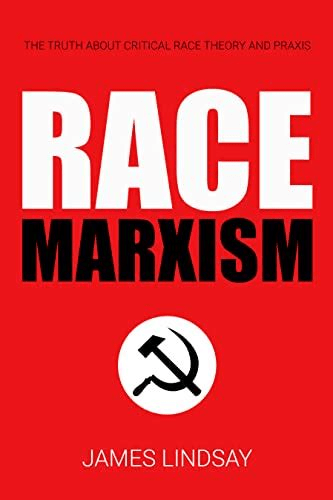
I go on at such length about this in order to convey to you just how well oriented I was when I picked up Race Marxism. I had already heard Lindsay lecture on the thinkers he mentions in the book, many of them multiple times. (And for many of them, it takes multiple times to actually retain their concepts, because they are intentionally complex. Not to speak of the way they love to invent words, flex on their readers, equivocate, and even undermine language itself.)
I was really well oriented, baby.
And even so — even so — I found Race Marxism to be a slog.
I honestly don’t think this is Lindsay’s fault. He’s trying to give us the history of a concept (“Critical Race Theory”) that is intentionally obscure. Many different streams of thought have gone into it, and the Theory’s proponents take advantage of this to toggle back and forth between the different meanings of the concepts in their theory. In fact, they use the Theory’s slipperiness as a sort of shibboleth. That way, if someone says something negative about the Theory, disagrees, or even simply states the theory in terms they don’t like at the moment, they can claim that this person has not really understood it.
Critical Theories exploit this confusion by focusing virtually entirely on “systems,” which are almost impossible to pin down or describe accurately, not least since these “systems” really are stand-in descriptions for “everything that happens in any domain human beings are involved in, and how.” That is, when a Critical Theory calls something “systemic,” what it really means is that it has an all-encompassing Marxian conspiracy theory about that thing. When people don’t think that way, Theorists then accuse them of not understanding systemic thought, or, more simply, of being stupid and intellectually unsophisticated. This little trick is very useful to activists because it allows them to call everyone who disagrees with them too stupid to disagree with them and generally tricks “educated” onlookers into thinking the plain-sense folks must be missing something important, nuanced, and complex.
ibid, p. 233
Any book that tries to engage with, pin down, and define a thought system that uses these tactics is going to be a slog. Lindsay has to trace several different lines of thought, so he’s coming at the same concept from a different angle in chapter after chapter. It’s all one big tapestry, so there’s not a clear, natural place to start. The first few chapters feel as if we are going in circles a bit. Lindsay has to quote CRT authors at some length, and they are not good writers. Additionally, because their entire philosophy is based upon envy and hate, even when they are somewhat clear they are unpleasant to read. But he is not going to make a claim about CRT and then not back it up. So, we get things like, “No, CRT is not simply anti-white-people; instead…” [twenty pages later] “… and that’s how CRT manages to be anti-most -white-people while denying the reality of race.”
The book picks up towards the end, when with much blood, sweat, and tears, the basic claims of CRT have been established beyond a doubt and Lindsay can move on to how it affects organizations and what can be done about it.
What will your experience be like reading this book?
I’m not sure.
It depends upon how familiar you are with these concepts already, and how quick of a study you are. It might also help if you do your reading from this book at a time of day when you are fresh. I think part of my problem is that I was slogging through it, often when tired or otherwise unwell. It’s not really the sort of book that you can take to an event, or dip into in a waiting room.
If these concepts are totally new to you, and you are a very quick study, you might come out of this book with the experience of “mind blown!” However, it’s more likely that you will grasp some things on the first go-round, but will understand more each time you re-read a given chapter. (That’s actually my experience with most non-fiction books.)
It is the nature of Critical Race Theory to have a whole bunch of academic, intimidating-sounding terms to describe just a couple of ideas that, when you get down to it, are fairly simple and also stupid. So the learning curve is steep at first, but quickly flattens out if you know what I mean.
I bought this book primarily to have on hand as a resource. I had to read it cover to cover at least once, so that I know where to find things in it. I probably won’t do that again. But I will certainly dip into it, because it documents painstakingly all the ridiculous, counterintuitive, antihuman, incredibly damaging claims that have been made in this theory, and who made them, when and where in what publication. That is an invaluable resource to have on hand, because there will be new terms and new claims soon, and the Theorists will deny that anyone ever made the old ones.
So, I bought this book more as a reference book than anything. I hope that you will, too. Lindsay has done a fantastic job compiling all this stuff and sorting it all out in some kind of order. Perhaps, if he had spent more years on it, he could have polished the prose and made it more pleasant to read, but that wasn’t the priority. The priority was to get this book out there in time to undeceive as many people as possible about this insidious theory. It doesn’t have to be pretty. It just has to exist.
We can thus understand the synthetic goal of Critical Race Theory. It is to awaken a critically conscious racial awareness … In this sense, Critical Race Theory is, as the warning in artificial intelligence ethics research might describe, a Theoretical paperclip maximizer, except instead of making paperclips, it makes Critical Race Theorists.
[I]t’s much easier to understand Critical Race Theory as the co-opting of black Americans (and feminists) by neo-Marxists (many of whom were Black Feminists) to Marcuse’s revolutionary program than it is to recognize it as a new dimension of approaching civil rights. In fact, it’s like staring at the murder of the Civil Rights Movement for the purposes of promoting a tiny coalition of neo-Marxists … to the role of a revolutionary vanguard …
This book was recommended to me by The Geeky Jock, who has since dropped off my feed.
The author is a wilderness writer, and like many wilderness writers, he can write lyrically about the Canadian forests, giving you a sense of eerie beauty, and then he can turn around and be funny with the hardships that he and his hiking partner have to go through. In this book, he’s on the hunt for “the Traverspine demon,” a mysterious creature that, according to historical records, terrorized a remote outpost in Labrador. It sounds like a Sasquatch (which Shoalts, oversimplifying merrily, says is only attested in the Pacific region), but it leaves cloven footprints.
Shoalts and his friend push on through conditions that would have made this Bigfoot buff turn back, such as days of impassable brush. They don’t find the creature, but they do find a theory. Shoalts, a materialist, decides it was probably a combination of sightings of a wolverine, and moose tracks (both animals were rare in the region at the time). His theory is pretty convincing. He undermines his case a bit by dismissing the Greek centaurs as people’s first sighting of a man on a horse, while ignoring all the other, harder-to-dismiss chimeras that populate Greek legend.
Jack Reacher, drifting through town as is his wont, stops to help out a random guy who’s being bullied, and once again ends up stopping an international plot basically single handedly. He then has a gratuitous affair (not graphically described) with a female character he will never meet again, before leaving town.
Also, Nazis. (Not very creative, guys. Do better.)
One thing I like about the Reacher books is that I’m never worried about him. No matter how outnumbered or apparently outgunned he is, I know Reacher is smarter, quicker, and has more martial arts and military skills than his opponents. But, at the same time, he consistently gets into situations where any sane person would be worried, and I know I should be scared for him. In that way, these books strike a good balance. I’m neither terrified nor bored.
Heartbreaking novel about an American ex-cop who has recently moved to rural Ireland. Super well-written. Very evocative of the landscape, the weather, and the people, including the way they use the English language. For example, they say things like, “He’s after leaving for work” instead of “He just left for work.”
Felix Francis has carried on the beloved institution of “racing thrillers” written by his jockey father, Dick Francis. All novels by Francis (pater and fils) take place in “the racing world.” Sometimes the main character is a jockey, sometimes a trainer or an owner, and sometimes the connection to racing is looser. All are written in the first person.
In this novel, the main character, Chester, very profitably runs a “syndicate.” He buys racehorses and sells shares of them to wealthy people who want to participate in the lifestyle. So each horse has multiple owners, but Chester is the main owner, and the one who liases with the trainers and jockeys to plan out the horses’ careers. Chester is less of a tough-guy character than the typical Francis protagonist. He’s also older and more established than Franics main characters usually are. His children are grown (just), and his wife is aging and losing interest in their marriage.
Syndicate had less action than previous Francis books I’ve read, and considerably less violence (though Francis books do vary a lot in this regard). It is not as tense as the cover makes it appear. I also wasn’t too impressed with some of Chester’s choices. All in all, this wasn’t the strongest Francis novel I’ve read, though it was on-brand. Three stars.
An indispensable reference book. Neither easy nor fun to read. I’ll be reviewing this in greater detail later.
Sorry, folks. Life has continued to be busy. So this weekend, I’m re-posting another one of my most-often-viewed essays for your edification.
Discovering the Extent of the Problem
I learned the word Hermeticism recently.
Here’s an extended simile of what my experience was like in doing a deep dive on this word.
Imagine that your drain keeps backing up. You take a look, and discover a root. You have to find at what point the roots are coming into the pipe, so you do the roto-rooter thing. It turns out that the roots are running through the pipe all the way down to the street and across the street and into the vacant lot, where there is a huge tree.
And oh, look, it’s already pulled down the neighbor’s house!
That’s what it was like. (Oh, no! It’s in my George MacDonald pipe too!)
What Methought I Knew
I’ve listened to a number of James Lindsay podcasts, and he talks a lot about Hegel. In discussing what exactly went wrong with the train wreck that is modern education and politics, James has to dive deep into quite a few unpleasant philosophers, among them Herbert Marcuse, Jaques Derrida, Paolo Friere, and the postmodernists. And Hegel.
I had heard James describe before how Hegel saw the world. Hegel had this idea that progress is reached by opposite things colliding and out of them comes a new synthesis, and then that synthesis has to collide with its opposite and so on until perfection is reached. This process is called the dialectic. Marx took these ideas and applied them to society, where there has to be conflict and revolution, but then the new society that emerges isn’t perfect yet and so there has to be another revolution and so on until everything is perfect and/or everyone is dead.
Obviously I am simplifying a lot. James can talk about this stuff for an hour and he is simplifying too, not because these ideas are themselves complicated but because Hegel produced a huge dump of words, and he came up with terminology that tried to combine his ideas with Christian concepts so that they would be accepted in his era. Anyway, the word dialectic is still used by postmodern writers like Kimberle Crenshaw, and it is a clue that they think constant revolution is the way to bring about utopia.
So, I was familiar with Hegel through the podcasts of Lindsay, and I was also familiar enough with Gnostic thought to at least recognize it when it goes by, as it so often does. For one thing, you kind of have to learn a little bit about Gnosticism if you are a serious Christian, because gnostic (or at least pre-gnostic: Platonic, mystery religion) ideas were very much in the air in New Testament times, and many of the letters of the New Testament were written to refute these ideas. Also, Gnosticism, particularly the mind/body duality, has had such an influence on our culture that it’s hard to miss. It’s present in New Age and neopagan thought, and it’s called out in Nancy Pearcey’s book Love Thy Bodyfor the bad effects it has had on the way we conceive of personhood.
So that’s the background.
Several months ago, I was listening to Lindsay give a talk summarizing his recent research to a church group. He was talking about theologies: systems of thought that make metaphysical and cosmological claims, and come with moral imperatives. And he dashed off this summary, something like the following:
“You could have a theology where at first all that exists is God, but He doesn’t know Himself as God, so in order to know Himself he creates all these other beings, and they are all like pieces of God but they don’t know it, and their task is to become enlightened and realize that they, too, are God, and when they realize this, eventually they will all come back together, but now God is self-conscious because of the process of breaking He’s been through.”
And I’m thinking, Sounds like Pantheism, or maybe Gnosticism.
And James says, “That’s the Hermetic theology.”
And I’ve got a new word to research.
Kind of a Weird Name
So, why is it called Hermeticism? Does it have to do with hermits?
My first foray into Internet Hermeticism immediately showed that the school of thought was named for a guy named Hermes, as in this paragraph from wiki:
Hermeticism, or Hermetism, is a label used to designate a philosophical system that is primarily based on the purported teachings of Hermes Trismegistus (a legendary Hellenistic combination of the Greek god Hermes and the Egyptian god Thoth).[1] These teachings are contained in the various writings attributed to Hermes (the Hermetica), which were produced over a period spanning many centuries (c. 300 BCE – 1200 CE), and may be very different in content and scope.[2]
One of my search hits, I can’t remember which one, said that Hermeticism is “often confused with Gnosticism.” O.K., so if it’s not Gnosticism, that means I know less than I thought and it’s all the more reason to research.
I also found avowedly Hermetic web sites like Hermetic World, whose “summary” is actually more of an attempt to draw you into their movement:
Hermeticism – The secret knowledge
Hermeticism is an ancient secret doctrine that dates back to early Egypt and its innermost knowledge has always been passed on only orally. In each generation there have been some faithful souls in different countries of the world who received the light, carefully cultivated it and did not allow it to be extinguished. Thanks to these strong hearts, these fearless spirits, truth has not been lost. It was always passed on from master to disciple, from adept to neophyte from mouth to ear. The terms “hermetically sealed”, “hermetically locked”, and so on, derive from this tradition and indicate that the general public does not have access to these teachings.
Hermeticism is a key that gives people the possibility to achieve everything they desire deep in their hearts, to develop a profound understanding of life, to become capable of decision making and responsibility; and to answer the question of meaning. Hermeticism offers a hidden key to unfolding.
Nobody can teach this knowledge to himself. Even in competent books like Kybalion, the teaching is only passed on in a veiled way. It always requires a master to pass on the wisdom to the able student. Today, as in the past, authentic mystery schools are a way to acquire this knowledge. The Hermetic Academy is one of these authentic schools.
This is certainly the genuine article, but it is perhaps not the first place to go. I wanted to learn about the basic doctrines from a neutral source, simply and clearly described. I didn’t want to have to wade through a bunch of hand-waving to get there, at least not at first. Still, I suppose we shouldn’t be surprised that Hermetic World tries to cast a mysterious, esoteric, yet somewhat self-help-y atmosphere on their first page. After all, it is a mystery religion.
Well, at least now I know why it’s called Hermeticism. It’s basically an accident of history, due to the name of the guy to whom the founding writings were attributed.
Time to move on to a book.
Moving On to a Book
I am fortunate to be descended from a scholar who has a large personal library, heavy on the theology.
I asked my dad.
Serendipitiously, he had just finished reading Michael J. McClymond’s two-volume history of Christian universalism (the doctrine that everyone is going to heaven), and he remembered that Hermeticism entered into the discussion. He was happy to lend it to me. You can see all the places I’ve marked with tabs. Those are just the ones where Hermeticism is directly mentioned. I hope you now understand my dilemma.
In McClymond’s Appendix A: Gnosis and Western Esotericism: Definitions and Lineages, I found at last the succinct, neutral summary I was looking for:
[“Hermetism”] as used by academics refers to persons, texts, ideas, and practices that are directly linked to the Corpus Hermeticum, a relatively small body of texts that appeared most likely in Egypt during the second or third centuries CE. … “Hermeticism” is often used in a wider way to refer to the general style of thinking that one finds in the Corpus Hermeticum and other works of ancient gnosis, alchemy, Kabbalah, and so forth. “Hermeticism” sometimes functions as a synonym for “esotericism.” The adjective “Hermetic” is ambiguous, since it can refer either to “Hermetism” or “Hermeticism.”
McClymond, p. 1072
O.K.
So it isn’t that different from Gnosticism after all.
“Esoteric,” by the way, means an emphasis on hidden or mystical knowledge that is not available to everyone and/or cannot be reduced to words and propositions. “Exoteric” refers to the style of theology that puts emphasis on knowledge that is public in the sense that it is written down somewhere, asserts something concrete, can be debated, etc.
Even though I have literally just found an actual definition of the word that is clear enough to put into a blog post, in the time it took me to find this definition I feel that I have already gotten a pretty good sense of what this philosophy is like. Perhaps it helps that it has pervaded many, many aspects of our culture, so I have encountered it many times before, as no doubt have you.
I began to peruse the tabs in the volumes above and read the sections there, in all their awful glory.
Yep, James Lindsay in fact did a pretty good job of explaining the core metaphysic of Hermeticism. Of course, this philosophy brings a lot of things with it that he didn’t get into. If we and all beings in the universe are all made of the same spiritual stuff as God Himself, it follows that alchemy should work (getting spiritual results with physical processes and the other way round). It follows that astrology should work (everything is connected, and the stars and men and the gods not only all influence each other, but when you get down to it are actually the same thing). It follows that reincarnation should be a thing (the body is just a shell or an illusion that is occupied by the spirit, the spark of God). It follows that there are many paths to God, since we are all manifestations of God and will all eventually return to Him/It. It follows that the body is not that important (in some versions of this philosophy, matter is actually evil). Therefore we should be able to physically heal ourselves with our minds. Our personhood should be unconnected to (some might say unfettered by) our body, such that we can be born in the wrong body, or we can change our sex or our species if we want to. There might also be bodies that don’t have souls yet (such as unborn babies), and so it would be no wrong to destroy them. Also, since matter is not really a real thing, it follows that Jesus was not really incarnated in a real human body and that He only appeared to do things like sleep, eat, suffer, and die. Also, since we are all parts of God like He is, He is not really one with God in any sense that is unique, but just more of an example of a really enlightened person who realized just how one with God He was.
I imagine that about twenty pop culture bells have gone off in your mind as you read that preceding paragraph. You might also have been reminded of the Church of Jesus Christ of the Latter-Day Saints, which teaches that we were all pre-existent souls literally fathered by God out of some sort of spiritual matter before we came to earth to be born.
So, What the Heck Is It?
Hermeticism is not just one thing. It’s a whole human tradition of thought. It had a lot of streams flowing into it, like Plato, first-century mystery religions, Gnosticism, and early attempts to reconcile Christianity with these things. It has a lot of streams flowing out of it, like many Christian mystics of varying degrees of Christian-ness; Origen; Bohme; Hegel; medieval and Renaissance alchemy; the Romantic literary movement; Mormonism; New Age thinking; identity politics; transhumanism; Shirley McLaine; The Secret, and the movie Phenomenon.
Not all of these thinkers hold to the exact same set of doctrines. In a big philosophical movement like this, almost every serious thinker is going to have his or her own specific formulation that differs from everyone else’s in ways that seem really important to people on the inside of the system. So anyone who is an insider or who has made it their life’s work to research any of the things I mention above (and many others besides) could come along and point out errors or overgeneralizations in this article and make me look like I don’t know anything. That’s partly because it’s a huge historical phenomenon and I actually don’t know much of all there is to know. It’s also partly because these mystery religions delight in making things complicated. They love to add rituals and symbols and secret names and to discover new additional deities that are personifications of abstract ideas like Wisdom. It’s supposed to be esoteric. That’s part of the fun.
Another reason it’s difficult to describe Hermeticism accurately is that when all is one, it is really difficult to talk about anything. In this view of the world, when you get right down to it there is no distinction between spirit and matter, creator and creature, man and woman, conscious and inanimate, and the list goes on. I called it Hermeticism at the beginning of this paragraph, but I was tempted to write Hermeticism/Gnosticism, or perhaps Hermeticism/Gnosticism/alchemy/mystery religions/the New Age/Pantheism/postmodernism. If you’ve ever read any New Age writers, you’ll notice that they tend to write important terms with slashes like that (“Sophia/the divine feminine”). That’s because it’s all one. They don’t want you to forget that. They don’t want to forget it. Even if these ideas do not go very well with the human mind, and they tend to break it if you keep trying to think them.
In a sense, Hermeticism and all these other related movements are very diverse and not the same at all. In another sense, it’s all … the same … crap.
This post might be a little … rambling. A poorly thought-out combination of recent events in my life, vague political implications, and nostalgic revisiting of old favorite fantasy novels. You know, the way blogs used to be back in the day. Because I am just so dedicated to bringing you, my faithful Internet friends, content, even if it is crummy content.
Over the past few weeks, I’ve done a couple of knitting marathons (about which, more in the near future). I like having something to watch while knitting, and the least repellant thing on Netflix was The Lord of the Rings, so I have recently watched through all three movies. I enjoyed the movies mostly because they reminded me of the books, which I haven’t read in a long time. Yeah, I’m a purist. I couldn’t believe they left out Old Man Willow, Tom Bombadil, the Barrow Wights, and they completely messed up the scene in Bree, and they Hollywooded up Gandalf’s confrontation with Saruman and with Theoden, and they destroyed Faramir … but even so, even so, they kept enough of the original plot that watching the movies was edifying.
The theme that jumped out to me this time — well, there were a couple. One was the way that every single member of the party pays a high cost in the service of the quest. Even people with fairly minor roles, such as Merry and Pippin, suffer greatly – Merry from stabbing the Witch King, and Pippin has to deal with Denethor’s madness. Multiple people had to be willing to pour out their lives. Not just Gandalf, and not just Frodo. This rings true to me. Whether we are fighting the good fight by building a family, a school, or a local church, everyone feels like they are giving 110%, and then the job just barely gets done.
The other theme that I noticed this time was that of despair. Denethor succumbs to despair, kills himself, and nearly kills Faramir. Well before that, he essentially abandoned his duty to the people of Minas Tirith because he believed the cause was lost. And it turns out, this was a stratagem of the enemy, who had been showing him misleading things in the Palantir.
Meanwhile, over in Rohan, Wormtongue has gotten Theoden to abandon his duties to his people by convincing him that he’s old and tired and the heroic age has ended. Wormtongue gets inside Eowyn’s head, getting her to see Edoras, the glorious hall of her ancestors, as a stupid redneck hovel, and her own role in it as boring and stultifying. She ends up, essentially, suicidal, but luckily the presence of Aragorn has turned her suicidal impulses in the direction of brave self-sacrifice, rather than foolish action like Denethor’s. But this is another case where despair doesn’t just happen, it is a direct, intentional action of the enemy.
Other characters suffer feelings of, or temptations to, despair, pretty much in direct proportion as they come in contact with the enemy. Physical contact with the Ringwraiths pulls a personal partially into their world, as happens to Frodo at Weathertop, and the Eowyn and to Merry, who says to Pippin, “Are you going to bury me?” Victims don’t just despair of victory, but they doubt their own judgment, their own senses, even their own existence. It’s at times like these that we need the shoulder of a friend.
James Lindsay has posted recently about how modern-day deceivers will try to induce despair by robbing us of epistemic authority (“you don’t know what you are talking about.” “Do you have a degree?”), psychological authority (“you are crazy/phobic”), and moral authority (“you are a bigot/oppressor” “It’s so heartless/insensitive to say that”). The goal is to get their interlocutor to stop trusting their own mind and conscience, and just accept the new system of thought they are being offered. Perhaps this podcast of his was the thing that caused me to notice this dynamic happening in Middle Earth.
Anyway, you can make your own applications. Don’t despair. Your mind is probably working OK. You are probably not a crazy bigot oppressor who doesn’t have a working conscience. You are not the only one who has questions. There are friendly shoulders to lean on.
I was going to call this post “Don’t Despair,” but I thought that would sound too cliched and I wasn’t sure I could follow through on the promise of such a title.
If Monday’s picture of the quonset hut didn’t convince you that we are living in a sci-fi dystopia …
If Wednesday’s quote about a powerful media magnate who thinks he is God is did not unsettle you …
Then the video below should do it.
Yes, it’s three hours long. But like any good horror movie, you will not be able to turn it off.
You may recall that earlier this year, Jason McLean and I had a conversationabout a certain Madame Blavatsky, how she was into the occult, how she had a great influence on a certain German dictator, and aliens entered into the conversation as I recall.
This video traces Madame Blavatsky’s influence through eugenics to Planned Parenthood and through a certain writer named Alice Bailey to social-emotional learning and common core in our public schools, which (James argues) is nothing less than a social-engineering project meant to evolve those children who are capable of it, and which has its roots unapologetically in the occult.
This might seem kind of niche — okay, really niche — but a) what’s a blog for if not to share things the author is currently fired up about?, and b) for the one or two people who actually listen to this podcast, you will see that it actually affects nearly every aspect our lives.
Here’s an extended simile of what my experience was like in doing a deep dive on this word.
Imagine that your drain keeps backing up. You take a look, and discover a root. You have to find at what point the roots are coming into the pipe, so you do the roto-rooter thing. It turns out that the roots are running through the pipe all the way down to the street and across the street and into the vacant lot, where there is a huge tree.
And oh, look, it’s already pulled down the neighbor’s house!
That’s what it was like. (Oh, no! It’s in my George MacDonald pipe too!)
What Methought I Knew
I’ve listened to a number of James Lindsay podcasts, and he talks a lot about Hegel. In discussing what exactly went wrong with the train wreck that is modern education and politics, James has to dive deep into quite a few unpleasant philosophers, among them Herbert Marcuse, Jaques Derrida, Paolo Friere, and the postmodernists. And Hegel.
I had heard James describe before how Hegel saw the world. Hegel had this idea that progress is reached by opposite things colliding and out of them comes a new synthesis, and then that synthesis has to collide with its opposite and so on until perfection is reached. This process is called the dialectic. Marx took these ideas and applied them to society, where there has to be conflict and revolution, but then the new society that emerges isn’t perfect yet and so there has to be another revolution and so on until everything is perfect and/or everyone is dead.
Obviously I am simplifying a lot. James can talk about this stuff for an hour and he is simplifying too, not because these ideas are themselves complicated but because Hegel produced a huge dump of words, and he came up with terminology that tried to combine his ideas with Christian concepts so that they would be accepted in his era. Anyway, the word dialectic is still used by postmodern writers like Kimberle Crenshaw, and it is a clue that they think constant revolution is the way to bring about utopia.
So, I was familiar with Hegel through the podcasts of Lindsay, and I was also familiar enough with Gnostic thought to at least recognize it when it goes by, as it so often does. For one thing, you kind of have to learn a little bit about Gnosticism if you are a serious Christian, because gnostic (or at least pre-gnostic: Platonic, mystery religion) ideas were very much in the air in New Testament times, and many of the letters of the New Testament were written to refute these ideas. Also, Gnosticism, particularly the mind/body duality, has had such an influence on our culture that it’s hard to miss. It’s present in New Age and neopagan thought, and it’s called out in Nancy Pearcey’s book Love Thy Bodyfor the bad effects it has had on the way we conceive of personhood.
So that’s the background.
Several months ago, I was listening to Lindsay give a talk summarizing his recent research to a church group. He was talking about theologies: systems of thought that make metaphysical and cosmological claims, and come with moral imperatives. And he dashed off this summary, something like the following:
“You could have a theology where at first all that exists is God, but He doesn’t know Himself as God, so in order to know Himself he creates all these other beings, and they are all like pieces of God but they don’t know it, and their task is to become enlightened and realize that they, too, are God, and when they realize this, eventually they will all come back together, but now God is self-conscious because of the process of breaking He’s been through.”
And I’m thinking, Sounds like Pantheism, or maybe Gnosticism.
And James says, “That’s the Hermetic theology.”
And I’ve got a new word to research.
Kind of a Weird Name
So, why is it called Hermeticism? Does it have to do with hermits?
My first foray into Internet Hermeticism immediately showed that the school of thought was named for a guy named Hermes, as in this paragraph from wiki:
Hermeticism, or Hermetism, is a label used to designate a philosophical system that is primarily based on the purported teachings of Hermes Trismegistus (a legendary Hellenistic combination of the Greek god Hermes and the Egyptian god Thoth).[1] These teachings are contained in the various writings attributed to Hermes (the Hermetica), which were produced over a period spanning many centuries (c. 300 BCE – 1200 CE), and may be very different in content and scope.[2]
One of my search hits, I can’t remember which one, said that Hermeticism is “often confused with Gnosticism.” O.K., so if it’s not Gnosticism, that means I know less than I thought and it’s all the more reason to research.
I also found avowedly Hermetic web sites like Hermetic World, whose “summary” is actually more of an attempt to draw you into their movement:
Hermeticism – The secret knowledge
Hermeticism is an ancient secret doctrine that dates back to early Egypt and its innermost knowledge has always been passed on only orally. In each generation there have been some faithful souls in different countries of the world who received the light, carefully cultivated it and did not allow it to be extinguished. Thanks to these strong hearts, these fearless spirits, truth has not been lost. It was always passed on from master to disciple, from adept to neophyte from mouth to ear. The terms “hermetically sealed”, “hermetically locked”, and so on, derive from this tradition and indicate that the general public does not have access to these teachings.
Hermeticism is a key that gives people the possibility to achieve everything they desire deep in their hearts, to develop a profound understanding of life, to become capable of decision making and responsibility; and to answer the question of meaning. Hermeticism offers a hidden key to unfolding.
Nobody can teach this knowledge to himself. Even in competent books like Kybalion, the teaching is only passed on in a veiled way. It always requires a master to pass on the wisdom to the able student. Today, as in the past, authentic mystery schools are a way to acquire this knowledge. The Hermetic Academy is one of these authentic schools.
This is certainly the genuine article, but it is perhaps not the first place to go. I wanted to learn about the basic doctrines from a neutral source, simply and clearly described. I didn’t want to have to wade through a bunch of hand-waving to get there, at least not at first. Still, I suppose we shouldn’t be surprised that Hermetic World tries to cast a mysterious, esoteric, yet somewhat self-help-y atmosphere on their first page. After all, it is a mystery religion.
Well, at least now I know why it’s called Hermeticism. It’s basically an accident of history, due to the name of the guy to whom the founding writings were attributed.
Time to move on to a book.
Moving On to a Book
I am fortunate to be descended from a scholar who has a large personal library, heavy on the theology.
I asked my dad.
Serendipitiously, he had just finished reading Michael J. McClymond’s two-volume history of Christian universalism (the doctrine that everyone is going to heaven), and he remembered that Hermeticism entered into the discussion. He was happy to lend it to me. You can see all the places I’ve marked with tabs. Those are just the ones where Hermeticism is directly mentioned. I hope you now understand my dilemma.
In McClymond’s Appendix A: Gnosis and Western Esotericism: Definitions and Lineages, I found at last the succinct, neutral summary I was looking for:
[“Hermetism”] as used by academics refers to persons, texts, ideas, and practices that are directly linked to the Corpus Hermeticum, a relatively small body of texts that appeared most likely in Egypt during the second or third centuries CE. … “Hermeticism” is often used in a wider way to refer to the general style of thinking that one finds in the Corpus Hermeticum and other works of ancient gnosis, alchemy, Kabbalah, and so forth. “Hermeticism” sometimes functions as a synonym for “esotericism.” The adjective “Hermetic” is ambiguous, since it can refer either to “Hermetism” or “Hermeticism.”
McClymond, p. 1072
O.K.
So it isn’t that different from Gnosticism after all.
“Esoteric,” by the way, means an emphasis on hidden or mystical knowledge that is not available to everyone and/or cannot be reduced to words and propositions. “Exoteric” refers to the style of theology that puts emphasis on knowledge that is public in the sense that it is written down somewhere, asserts something concrete, can be debated, etc.
Even though I have literally just found an actual definition of the word that is clear enough to put into a blog post, in the time it took me to find this definition I feel that I have already gotten a pretty good sense of what this philosophy is like. Perhaps it helps that it has pervaded many, many aspects of our culture, so I have encountered it many times before, as no doubt have you.
I began to peruse the tabs in the volumes above and read the sections there, in all their awful glory.
Yep, James Lindsay in fact did a pretty good job of explaining the core metaphysic of Hermeticism. Of course, this philosophy brings a lot of things with it that he didn’t get into. If we and all beings in the universe are all made of the same spiritual stuff as God Himself, it follows that alchemy should work (getting spiritual results with physical processes and the other way round). It follows that astrology should work (everything is connected, and the stars and men and the gods not only all influence each other, but when you get down to it are actually the same thing). It follows that reincarnation should be a thing (the body is just a shell or an illusion that is occupied by the spirit, the spark of God). It follows that there are many paths to God, since we are all manifestations of God and will all eventually return to Him/It. It follows that the body is not that important (in some versions of this philosophy, matter is actually evil). Therefore we should be able to physically heal ourselves with our minds. Our personhood should be unconnected to (some might say unfettered by) our body, such that we can be born in the wrong body, or we can change our sex or our species if we want to. There might also be bodies that don’t have souls yet (such as unborn babies), and so it would be no wrong to destroy them. Also, since matter is not really a real thing, it follows that Jesus was not really incarnated in a real human body and that He only appeared to do things like sleep, eat, suffer, and die. Also, since we are all parts of God like He is, He is not really one with God in any sense that is unique, but just more of an example of a really enlightened person who realized just how one with God He was.
I imagine that about twenty pop culture bells have gone off in your mind as you read that preceding paragraph. You might also have been reminded of the Church of Jesus Christ of the Latter-Day Saints, which teaches that we were all pre-existent souls literally fathered by God out of some sort of spiritual matter before we came to earth to be born.
So, What the Heck Is It?
Hermeticism is not just one thing. It’s a whole human tradition of thought. It had a lot of streams flowing into it, like Plato, first-century mystery religions, Gnosticism, and early attempts to reconcile Christianity with these things. It has a lot of streams flowing out of it, like many Christian mystics of varying degrees of Christian-ness; Origen; Bohme; Hegel; medieval and Renaissance alchemy; the Romantic literary movement; Mormonism; New Age thinking; identity politics; transhumanism; Shirley McLaine; The Secret, and the movie Phenomenon.
Not all of these thinkers hold to the exact same set of doctrines. In a big philosophical movement like this, almost every serious thinker is going to have his or her own specific formulation that differs from everyone else’s in ways that seem really important to people on the inside of the system. So anyone who is an insider or who has made it their life’s work to research any of the things I mention above (and many others besides) could come along and point out errors or overgeneralizations in this article and make me look like I don’t know anything. That’s partly because it’s a huge historical phenomenon and I actually don’t know much of all there is to know. It’s also partly because these mystery religions delight in making things complicated. They love to add rituals and symbols and secret names and to discover new additional deities that are personifications of abstract ideas like Wisdom. It’s supposed to be esoteric. That’s part of the fun.
Another reason it’s difficult to describe Hermeticism accurately is that when all is one, it is really difficult to talk about anything. In this view of the world, when you get right down to it there is no distinction between spirit and matter, creator and creature, man and woman, conscious and inanimate, and the list goes on. I called it Hermeticism at the beginning of this paragraph, but I was tempted to write Hermeticism/Gnosticism, or perhaps Hermeticism/Gnosticism/alchemy/mystery religions/the New Age/Pantheism/postmodernism. If you’ve ever read any New Age writers, you’ll notice that they tend to write important terms with slashes like that (“Sophia/the divine feminine”). That’s because it’s all one. They don’t want you to forget that. They don’t want to forget it. Even if these ideas do not go very well with the human mind, and they tend to break it if you keep trying to think them.
In a sense, Hermeticism and all these other related movements are very diverse and not the same at all. In another sense, it’s all … the same … crap.







 Out of Babel Books