Thank You, St. Boniface

This post is about how we got our Christmas trees. For the record, I would probably still have a Christmas tree in the house even if it they were pagan in origin. (I’ll explain why in a different post, drawing on G.K. Chesterton.) But Christmas trees aren’t pagan. At least, not entirely.

My Barbarian Ancestors

Yes, I had barbarian ancestors, in Ireland, England, Friesland, and probably among the other Germanic tribes as well. Some of them were headhunters, if you go back far enough. (For example, pre-Roman Celts were.) All of us had barbarian ancestors, right? And we love them.

St. Boniface was a missionary during the 700s to pagan Germanic tribes such as the Hessians. At that time, oak trees were an important part of pagan worship all across Europe. You can trace this among the Greeks, for example, and, on the other side of the continent, among the Druids. These trees were felt to be mystical, were sacred to the more important local gods, whichever those were, and were the site of animal and in some cases human sacrifice.

God versus the false gods

St. Boniface famously cut down a huge oak tree on Mt. Gudenberg, which the Hessians held as sacred to Thor.

Now, I would like to note that marching in and destroying a culture’s most sacred symbol is not commonly accepted as good missionary practice. It is not generally the way to win hearts and minds, you might say.

The more preferred method is the one Paul took in the Areopagus, where he noticed that the Athenians had an altar “to an unknown god,” and began to talk to them about this unknown god as someone he could make known, even quoting their own poets to them (Acts 17:16 – 34). In other words, he understood the culture, knew how to speak to people in their own terms, and in these terms was able to explain the Gospel. In fact, a city clerk was able to testify, “These men have neither robbed temples nor blasphemed our goddess” (Acts 19:37). Later (for example, in Ephesus) we see pagan Greeks voluntarily burning their own spellbooks and magic charms when they convert to Christ (Acts 19:17 – 20). This is, in general, a much better way. (Although note that later in the chapter, it causes pushback from those who were losing money in the charm-and-idol trade.)

However, occasionally it is appropriate for a representative of the living God to challenge a local god directly. This is called a power encounter. Elijah, a prophet of ancient Israel, staged a power encounter when he challenged 450 priests of the pagan god Baal to get Baal to bring down fire on an animal sacrifice that had been prepared for him. When no fire came after they had chanted, prayed, and cut themselves all day, Elijah prayed to the God of Israel, who immediately sent fire that burned up not only the sacrifice that had been prepared for Him, but also the stones of the altar (I Kings chapter 18). So, there are times when a power encounter is called for.

A wise missionary who had traveled and talked to Christians all over the world once told me, during a class on the subject, that power encounters tend to be successful in the sense of winning people’s hearts only when they arise naturally. If an outsider comes in and tries to force a power encounter, “It usually just damages relationships.” But people are ready when, say, there had been disagreement in the village or nation about which god to follow, and someone in authority says, “O.K. We are going to settle this once and for all.”

That appears to be the kind of power encounter that Elijah had. Israel was ostensibly supposed to be serving their God, but the king, Ahab, had married a pagan princess and was serving her gods as well. In fact, Ahab had been waffling for years. There had been a drought (which Ahab knew that Elijah — read God — was causing). Everyone was sick of the starvation and the uncertainty. Before calling down the fire, Elijah prays, “Answer me, O LORD, answer me, so these people will know that you, O LORD, are God, and that you are turning their hearts back again.” (I Kings 18:37)

Similar circumstances appear to have been behind Boniface’s decision to cut down the great oak tree. In one of the sources I cite below, Boniface is surrounded by a crowd of bearded, long-haired Hessian chiefs and warriors, who are watching him cut down the oak and waiting for Thor to strike him down. When he is able successfully to cut down the oak, they are shaken. “If our gods are powerless to protect their own holy places, then they are nothing” (Hannula p. 62). Clearly, Boniface had been among them for some time, and the Hessians were already beginning to have doubts and questions, before the oak was felled.

Also note that, just as with Elijah, Boniface was not a colonizer coming in with superior technological power to bulldoze the Hessians’ culture. They could have killed him, just as Ahab could have had Elijah killed. A colonizer coming in with gunboats to destroy a sacred site is not a good look, and it’s not really a power encounter either, because what is being brought to bear in such a case is man’s power and not God’s.

And, Voila! a Christmas Tree

In some versions of this story, Boniface “gives” the Hessians a fir tree to replace the oak he cut down. (In some versions, it miraculously sprouts from the spot.) Instead of celebrating Winter Solstice at the oak tree, they would now celebrate Christ-mass (during Winter Solstice, because everyone needs a holiday around that time) at the fir tree. So, yes, it’s a Christian symbol.

Now, every holiday tradition, laden with symbols and accretions, draws from all kinds of streams. So let me hasten to say that St. Boniface was not the only contributor to the Christmas tree. People have been using trees as objects of decoration, celebration, and well-placed or mis-placed worship, all through history. Some of our Christmas traditions, such as decorating our houses with evergreen and holly boughs, giving gifts, and even pointed red caps, come from the Roman festival of Saturnalia. This is what holidays are like. This is what symbols are like. This is what it is like to be human.

Still, I’d like to say thanks to St. Boniface for getting some of my ancestors started on the tradition of the Christmas tree.

Sources

BBC, “Devon Myths and Legends,” http://www.bbc.co.uk/devon/content/articles/2005/12/05/st_boniface_christmas_tree_feature

Foster, Genevieve, Augustus Caesar’s World: 44 BC to AD 14, Beautiful Feet Books, 1947, 1975, Saturnalia on p. 56 ff.

Hannula, Richard, Trial and Triumph: Stories from church history, Canon Press, 1999. Boniface in chapter 9, pp. 61 – 64.

Puiu, Tibi, “The origin and history of the Christmas tree: from paganism to modern ubiquity,” ZME Science, https://www.zmescience.com/science/history-science/origin-christmas-tree-pagan/


The Guilty Reader Tag

Photo by Kat Jayne on Pexels.com

For the uninitiated, a “tag” is when a fellow blogger asks you to answer a bunch of questions, which usually revolve around a theme. I, for some mysterious reason, tend to get tagged by bloggers who are interested in books, writing, and reading.

This tag was created by  Chami @ Read Like Wildfire and passed on to me by my faithful friend The Orangutan Librarian, a fellow INFP who, like me, is also an expert in guilt. Maybe that’s why I love her sensitive and lighthearted book reviews and parodies.

One. Have You Ever Re-Gifted A Book You’ve Been Given?

Hmm. I don’t think so. But probably. I have been known to buy a book for myself, read it, and then a few years later, give the nearly-new copy to a fellow reader as a gift. And then, after they have enjoyed it, after another few years I have even been known to re-claim it.

Also – fun fact! – I was once given a book that eventually turned out to be a library book. It was pretty good, too.

Two. Have You Ever Said You’ve Read A Book When You Haven’t?

Photo by Marcela Alessandra on Pexels.com

I have definitely implied it.

Back in my college days, when I made an idol of being intellectual and was consequently a poser about it, I would talk as though I was familiar with philosophers like Plato, when I had not read their works but only heard about them.

(Hot tip: if you make an idol of your intellect, you will always feel like a dummy who is about to be exposed.)

Three. Have You Ever Borrowed A Book And Not Returned It?

Yes. I borrowed a book about children in history from a history prof, let it sit around unread, and then eventually returned it. At least, I thought I returned it. She was unable to find it, as was I.

Four. Have You Ever Read A Series Out Of Order?

All. The. Time. Some series seem to stretch on forever into both the past and future, having neither beginning nor end. *Ahem* Dragonlance!

Also, I love Tony Hillerman’s Navajo police procedurals. But they have a big flaw: they are not numbered as a series! Each one can be read as a standalone, but if you read more than a few of them, you realize that they develop over time. You have to read each book to find out where it fits in with the others in terms of Jim Chee’s disastrous love life, for example. I’ll bet that somewhere on the Internet, someone has listed them in order just for people like me.

Five. Have You Ever Spoiled A Book For Someone?

Um, probably, but I can’t remember. What I remember, of course, is when people spoil books for me. The most egregious instance was when a friend spoiled Things Fall Apart.

Six. Have You Ever Dogeared A Book?

Um, so, this is one of those habits that I have had to belatedly realize makes me uncivilized, and have had to train myself out of. (I won’t tell you the others.)

Seven. Have You Ever Told Someone You Don’t Own A Book When You Do?

Maybe, if I forget that I own it. Or, I might think that I own a book, but do so no longer.

Eight. Have You Ever Skipped A Chapter Or A Section Of A Book?

In nonfiction, all the time. Often you can see where a section is going (if you’re wrong it will quickly become apparent), or the author is laying out background that you already have.

In fiction, I occasionally skip atrocities.

Nine. Have You Ever Bad Mouthed A Book You Actually Liked?

Yes. I still feel bad about a review that did for a reviewing site, where I gave a very decent historical fiction volume 2 out of 4 stars just because the characters occasionally spoke like modern people. Once I got more experience, I got more fair with my reviews.

Moral: The Heart is Deceitful

So, it turns out that I have committed every single pecadillo on this list, from the harmless (forgetting I own books) to the prideful (posing as an intellectual). Not super surprised by this. Jesus Christ came into this world to save sinners, of whom I am the worst.

But one question was left off this list: Have you ever been lost in a book at a time when, in the opinion of people around you, you should have been doing something else?

Yes, yes, a thousand times yes!

I’ll post a quote about that tomorrow.

You post your book pecadillos in the comments.

Best to you all.

Surprising Fact of the Week

We should never defend Christianity by saying it is traditional. From the beginning, it has stood against the traditions of its day.

Beginning in the fifth century, Christian leaders finally began to wield enough political influence to pass laws against sexual slavery. The church fathers called it “coerced sin.” One historian notes that the most reliable index of the Christianization of an ancient society was the recognition of the injustice of sexual slavery.

Let that historical fact sink in: The most reliable index of how deeply Christianity had permeated a society was whether [the society] outlawed sexual slavery.

Nancy R. Pearcey, Love Thy Body, pp. 69 – 70, 71 – 72

A Shot of Courage

A student is not above his teacher, nor a servant above his master. It is enough for the student to be like his teacher, and the servant like his master. If the head of the house has been called Beelzebub, how much more the members of his household!

So do not be afraid of them. There is nothing concealed that will not be disclosed, or hidden that will not be made known. What I tell you in the dark, speak in the daylight; what is whispered in your ear, proclaim from the rooftops.

Jesus, in Matthew 10:24 – 27

Writing about the Afterlife

Writing about the afterlife is tricky. It does not always go well.

Bookstooge recently reviewed a book that was set entirely in the afterlife, and it failed (at least, based on his review, it failed) because writing about the afterlife immediately brings out the limitations of the author’s understanding of: God, eternity, human nature, human embodiment, space, time, etc.

Some of these limitations on our understanding can be fixed with better theology. (For example, the TV show The Good Place could have benefitted from an understanding that the human heart is deceitful and desperately wicked, and who can know it?). Others of these limitations can’t be fixed because they are a consequence of our inability to imagine an existence that transcends space and time. New Age accounts of “out of the body” experiences immediately lose me when they describe things like “a cord coming out from between my shoulder blades that connected me to my body.” (Pro tip: if you are out of the body, you do not have shoulder blades.)

But despite these pitfalls, I find it irresistibly attractive to follow my characters just a step or two beyond death. Perhaps it’s because the moment of death is so poignant in a story, or because there is an opportunity to address unfinished business. “Wrong will be right/when Aslan comes in sight.” We are all longing for that wrong will be right moment.

The 11-minute song below is a ballad that successfully (I think) follows a character slightly past death. I find it very moving. I hope you do as well.

For the comments: when an author attempts to write about the afterlife, do you start rolling your eyes or do you go with it? What are some of your favorite post-death scenes in books or movies?

Psalm 91: Encouraging, Yet Confusing

He who dwells in the shelter of the Most High

will rest in the shadow of the Almighty.

I will say of the LORD, “He is my refuge and my fortress,

my God, in whom I trust.”

Surely he will save you from the fowler’s snare

and from the deadly pestilence.

He will cover you with His feathers,

and under His wings you will find refuge;

His faithfulness will be your shield and rampart.

You will not fear the terror of the night,

nor the arrow that flies by day,

nor the pestilence that stalks in the darkness,

nor the plague that destroys at midday.

A thousand may fall at your side,

ten thousand at your right hand,

but it will not come near you.

You will only observe with your eyes

and see the punishment of the wicked.

If you make the Most High your dwelling

— even the LORD, who is my refuge —

then no harm will befall you,

no disaster will come near your tent.

For He will command His angels concerning you

to guard you in all your ways;

they will lift you up in their hands,

so that you will not strike your foot against a stone.

You will tread upon the lion and the cobra;

you will trample the great lion and the serpent.

“Because he loves me,” says the LORD,

“I will rescue him;

I will protect him, for he acknowledges my name.

He will call upon me and I will answer him;

I will be with him in trouble,

I will deliver him and honor him.

With long life will I satisfy him

and show him my salvation.”

Ps. 91:1 – 16

So many things to notice about this psalm. For one thing, it’s one of the better-known psalms. The hymn “Under His Wings” is taken from it. And it’s worth noting that this poem portrays God as … a chicken. This is not the only place in the Bible where God is portrayed as a mother hen protecting her chicks under her wings. (Or, given the mention of the “fowler’s snare,” maybe in this poem a wild game bird is in view.) This is one example of how, though He is called He, the Old Testament God is also shown to be maternal.

Another thing that stands out to me is how the ancient Israelites felt just as helpless as we do in the face of violence, “disaster,” and the “deadly pestilence.”

One of my most vivid memories about this psalm came during an orientation activity when I had just arrived in Asia. A seasoned missionary read the entire thing to us, and then went on to tell a bunch of stories about times when he and people he knew had not been protected from various kinds of disaster.

Jesus knew this as well. Satan actually quotes this psalm to Him, “He will command His angels concerning you …” in Luke 4, to get Him to jump from the pinnacle of the Temple. Jesus does not jump.

This is a poem. It is strangely heartening to read.

Yet it doesn’t always happen this way.

Yet it is the word of God.

I don’t understand it either.

This Harrowing Holocaust Novel Perfectly Prepared Me for Good Friday

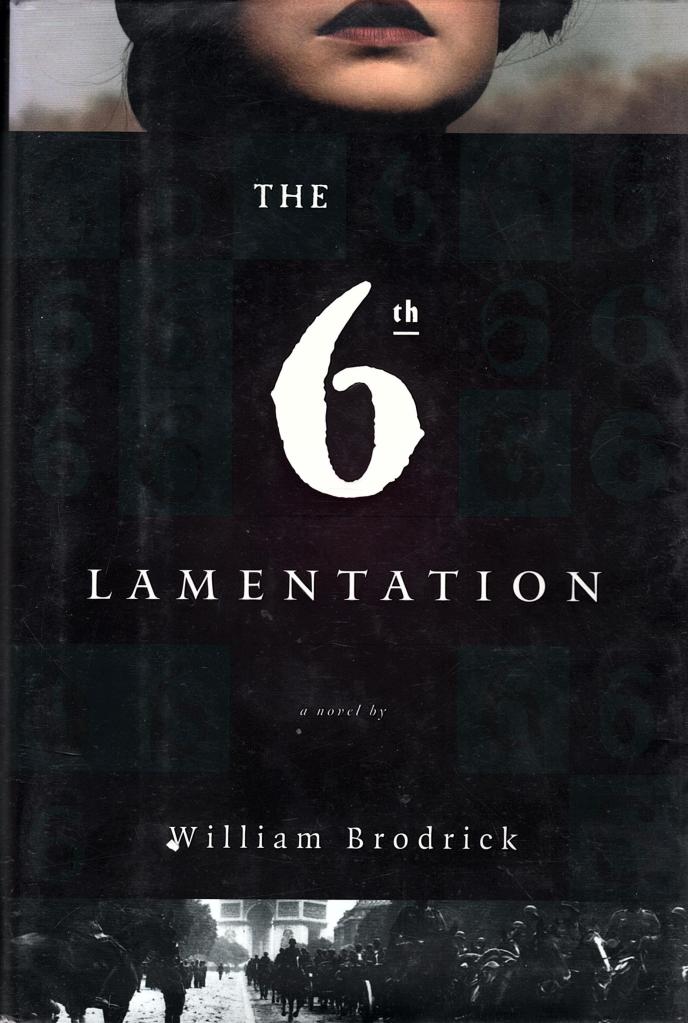
The 6th Lamentation, by William Brodrick, Viking, 2003

Agnes is a bad mother. She seems emotionally distant. She often goes into fugue states where she will stand, staring at nothing. It is hard for her to be fully present with her two children.

What they don’t know is that they aren’t actually her children. They were entrusted to her by their dying mother in a concentration camp.

They also don’t know that Agnes had a child of her own, a baby boy, who was lost in the Holocaust.

Freddie, Agnes’ son, has given up on his mother, her issues and her drama, her apparent inability to be there for him emotionally. It’s not until his own daughter, Lucy, is grown, and Agnes develops a degenerative disease that Freddie will belatedly get to know the history of a warm-hearted woman who was permanently broken by the Nazi occupation of France.

Meanwhile, as Agnes loses her ability to walk, and then to speak, a recently outed Nazi war criminal takes refuge in an English monastary. He is the man who sent Agnes and her baby to the camps.

This beautifully written book was really traumatic to read, and not because there is any graphic violence.  

Brodrick does an amazing job of showing how the Nazi occupation of France put everyone in a position where, almost no matter what they did, they ended up failing or betraying someone. He shows how even a moment of weakness or cowardice could have fatal consequences for a person’s friends. That was the thing that really got me. Reading this, you can’t help asking yourself how you would do in the same situation, and coming up with an unsatisfactory answer. I say it prepared me well for Good Friday because it made me feel guilty as hell.

And these little failures of character, which might not have a huge impact in ordinary times, during the Holocaust would change and cripple people forever. Brodrick shows how a mythology grew up around the young people in the French resistance, such that three generations later, having had a hero in your family could bestow benefits, and being associated with a Nazi or a collaborator became a deep dark family secret.  He shows how even the children who were smuggled out of France grew up with “shame,” because, as avenging angel Salomon Lachaise puts it, “you cannot escape the sensation that you have taken someone else’s place.”

One of the most affecting lines in the book, for me, was after the Frenchman has just been blackmailed by the Nazi guard. He hears the guard throwing up in the adjacent room.

Nevertheless, there is a redemptive thread to this book. It really makes you feel genuinely sorry for every single character (both the war generation and the later generations), and makes you realize how badly these poor people, in the midst of this great evil, needed a supernatural savior.

As do we all.