The 1917 Mine Disaster in Butte, Montana

When I went to see Sage Wall, we stayed in Butte, Montana (pronounced byoot or biut), which is a relatively short drive from my house by the standards of the American West. Butte is a mining town, once known as “The Richest Hill in the World,” although generally, the riches were being spread thin, not going to the people who actually lived there. The riches are copper, silver, and, I believe, opals. If you have more time than we had, Butte has many things like rock shops and a mining museum. You can see little mining towers dotted all over the landscape.

A view of Butte, looking down from the hill above the town.

This plaque talks about women in Butte when it was a boom mining town. Sadly, Old West boom towns are notorious for having a lot of brothels, and Butte was no exception.

Over the town looms the hill itself, and in this hill is a huge, sandy-colored strip mine known as the “Berkeley Pit.” My husband, being the explorer that he is, wanted to visit the Pit. We got there just after the viewing platform closed, so instead, we drove up into the hills above and behind the Pit so as to get a glimpse into its depths.

And lo and behold … on a lookout point that overlooks one section of the Pit, we found this monument to fallen miners.
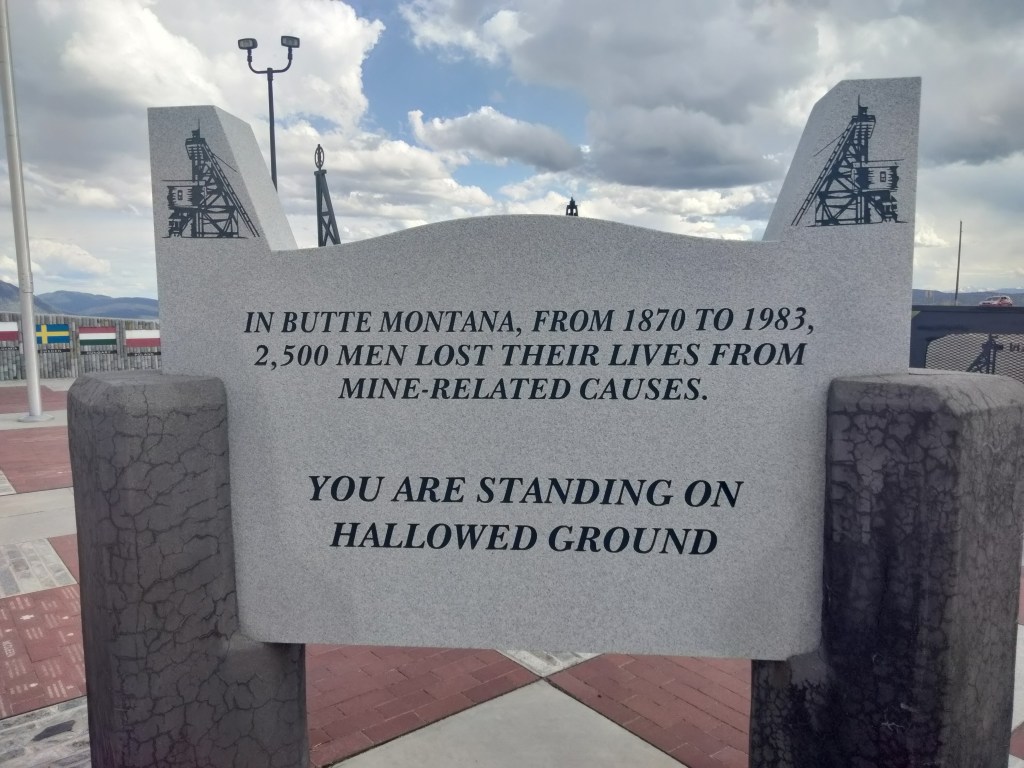
The monument is a large, paved area with the U.S. and Montana flags in the middle, surrounded by a wall on which informational plaques are mounted. I’m going to let my photos of the plaques do most of the work in telling you this story.

The flags you see in the background represent the nationalities of the miners who lost their lives in the disaster.
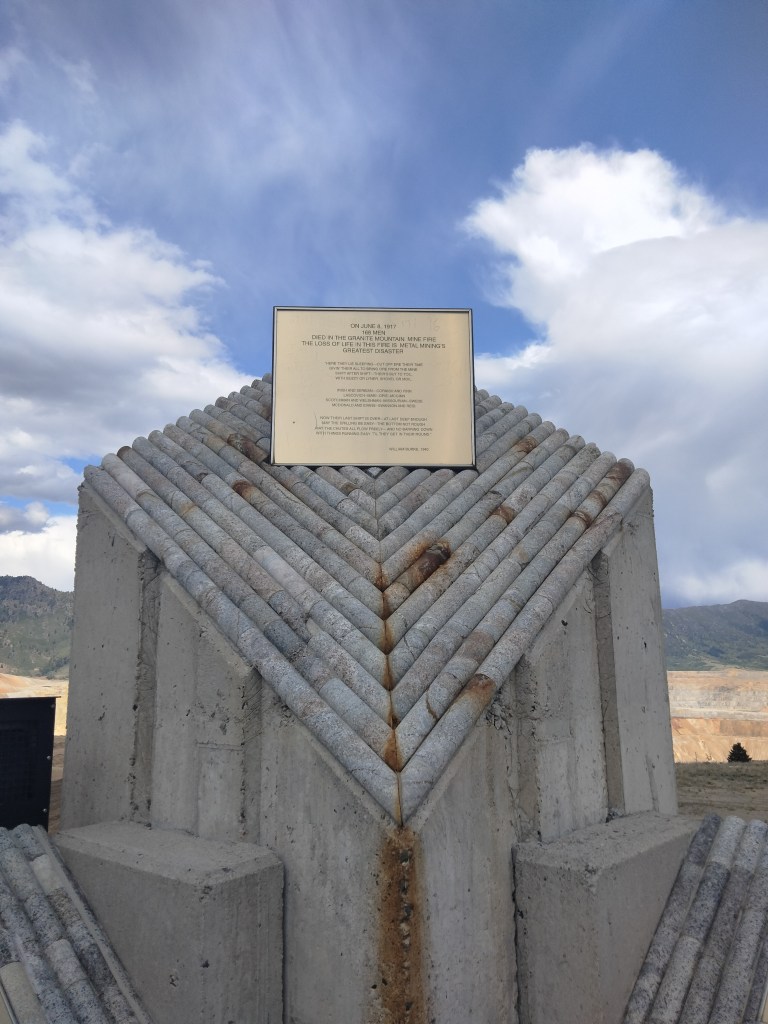
This prominent central plaque gives some basic information about the Granite Mountain Fire in June of 1917. The fire did not take place in the Berkely Pit, but in an underground mine. A cable, which was covered in a paperlike covering, broke and fell down a shaft. A group of miners went down to inspect the damage, and the paper covering on the cable was accidentally caught on fire by one of their headlamps.

This plaque, filled with names of men lost in the fire, is one of several.

The fire quickly filled the mine. Groups of miners, trapped in tunnels, built barricades (“bulkheads”) to protect them from the fire while they awaited rescue. Sealed off like this, their main danger became the limited air supply, plus fear and despair as their food and water ran low and their lamps began to go out.

Some of these men wrote letters to their loved ones. Here is one.

The town of Butte essentially stood vigil for several days. Firemen worked around the clock to put out the fire and rescue miners. Restaurants stayed open and gave meals to the rescue workers. Grocery stores provided for the families of missing miners. People went into churches to pray for their loved ones.

The plaque below describes Butte as “the strongest union town on earth.” My feelings on unions are mixed to say the least, but I can certainly understand the need for them in the early days of mining.

Big Sky Country, with Canal

This little (8×6) landscape acrylic painting is one of my favorites that I’ve done recently.

The water portrayed is actually a stream leading to the Snake River Reservoir, because the canals are not running at this time of year. However, I thought I’d give you some history about our local irrigation canals, because they are really remarkable.

The scheme diverts water from the [Snake] river about ten miles above Blackfoot. The main canal was planned to be 60-85 feet wide, carrying a depth of six feet of water about sixty miles, with many more miles of laterals and smaller ditches. … The canal is 60 feet wide and 8 feet deep, beginning near Firth and ending near the Lamb Weston Potato Plant at American Falls where a small amount of water then empties into the Snake.

Aberdeen, Idaho: Our Small Town Story, by Celia Klassen, p. 14

The canal system was constructed, essentially by hand, using horses, scrapers, and large baskets, and dynamite for rocky areas, between 1894 and approximately 1910. There were a series of investors, some working groups that fell apart, and two different canal companies that were formed to head up the project. The system includes many “fills” … areas where the canal was built up above the surrounding land, as to pass through a low spot.

During the construction, “Tent camps … were set up at various points, and everything the laborers needed had to be brought through the sagebrush by wagon … Families of canal workers lived along the canal while it was being built in what were called ‘ditch camps’.” (ibid, p. 15)

The canal system allows us to farm the Idaho soil, which is volcanic and very fertile, but doesn’t get enough rain for dryland farming. The Aberdeen-Springfield canal company still maintains the 190 miles of main and lateral canals, with sluice gates and the like. A canal runs right past my backyard, built up above the surrounding fields. The canals are drained in the winter months, and last year, an excavator worked its way slowly by our property, deepening the canal and creating large piles of soil on its banks. In the summer, “canal riders” patrol the system, checking for leaks. This is a wonderful system, and it takes a lot of effort to keep it working properly.

Despite being man-made, the canals also beautify the countryside. The presence of water attracts Russian olive trees, cattails, showy milkweed, and birds. Many farm kids grew up inner-tubing in the canals in the summertime, and their raised banks make a natural hiking route for people who want to walk in nature.

The source for this post was the book Aberdeen, Idaho: Our small town story, published by Celia Klassen in 2019. Celia did not grow up in Aberdeen, but married in. As so often happens, it took someone from the outside to appreciate that our local history was worth researching and recording.

Small-Town America, Described by Truman Capote

[T]he newcomer to Garden City, once he has adjusted to the nightly after-eight silence of Main Street, discovers much to support the defensive boastings of the citizenry: a well-run public library, a competent daily newspaper, green-lawned and shady squares here and there, placid residential streets where animals and children are safe to run free, a big, rambling park complete with a small menagerie (“See the Polar Bears!” “See Penny the Elephant!”), and a swimming pool that consumes several acres (“World’s Largest FREE Swim-pool!”). Such accessories, and the dust and the winds and the ever-calling train whistles, add up to a “home town” that is probably remembered with nostalgia by those who have left it, and that, for those who have remained, provides a sense of roots and contentment.

Truman Capote, In Cold Blood, pp. 33 – 34