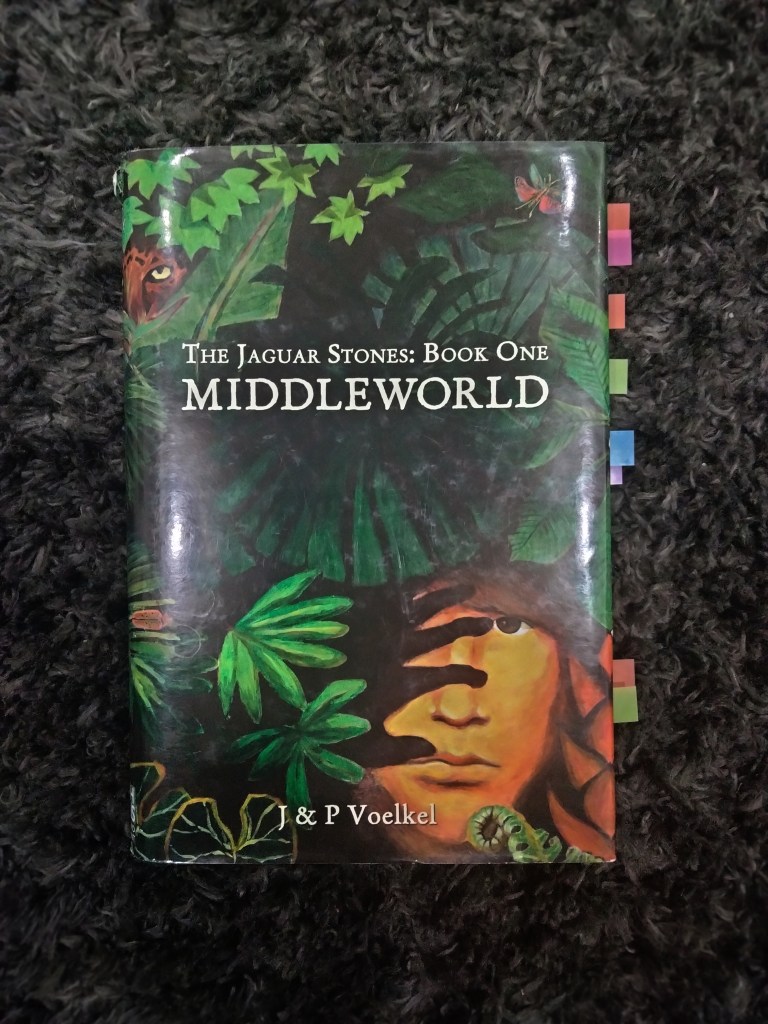
We continue our journey through darkest Jen’s TBR Pile with this book, which I picked up in an Idaho Falls thrift store several years ago and has been waiting patiently, like a pyramid under jungle cover but more durable, to be excavated.
One week ago, Max Murphy’s biggest problem was deciding which pizza to order. Now he’s lost in the perilous rainforest and running for his life with Lola, a modern Maya girl. Their terrifying journey will take them into the heart of an ancient evil and awaken powers that have slept for a thousand years. For fate has delivered an epic challenge to this pampered city boy. From now on, only one thing is for sure: Max Murphy won’t be eating pizza again any time soon.
from the dust cover
This book is the perfect YA Maya adventure. It starts with Max in Boston. His parents are archaeologists. They have to be gone a lot for their work. Max believes they “care more about the Maya than about him,” and he has learned to leverage this guilt into all the video games and snacks, and other luxuries his heart desires. This beginning is presumably there to ease the book’s target audience (American teens) into the Mayan context without a steep learning curve. They aren’t just thrown in; they find out things as Max does.
“Did anyone ever tell you that you’re bossy?” said Max.
“Did anyone ever tell you that you’re lazy?” said Lola.
“Yes,” said Max proudly, “all the time.”
“In the rainforest, lazy boys get eaten by jaguars.”
p. 150
But the book doesn’t stay in boring Boston for long. By Chapter 2, Max is in the fictional country of San Xavier (based on Belize). There is an excellent description of a nightmarish 3rd-world backcountry bus ride, a chapter or two at Max’s estranged uncle’s mansion, and then, he’s off into the jungle.
Behold this perfect author photo. Apparently, Jon grew up in Central America. Note also that the endpapers have a map of San Xavier. The map includes the Monkey River, Villa Isabella (Max’s uncle’s estate), and the five pyramids of Maya cosmology. If a place appears on this map, be sure we will visit it, either in this book or in a sequel.
Middleworld is an excellent introduction to the Maya cosmology, which is incorporated into a very lively adventure. As Max and Lola visit the different pyramids, they discover the purposes of the still-preserved machines within them: controlling the weather, time, etc., and even opening portals to Xibalba, the Maya underworld, into which Max’s parents have disappeared when they jumped into a cenote.
The overall adventure story is a good blend of actual Maya mythology and fictional or fictionalized characters. Lord Six Rabbit, who comes into the story, is a fictional ancient Maya king. The gods and demons we encounter are taken from actual Maya myths. Friar Diego DeLanda, an actual historical person who burned the majority of the Maya codices, makes an appearance. And because the intricate Maya calendar played such a large role in their cosmology, so it does in the events of this book. An Appendix contains an explanation of the interlocking calendar cycles and of how to read Mayan date glyphs, which are quite complex. Other appendices show a diagram of the Mayan cosmos; how to read Mayan numbers; and a glossary of characters and terms which appear in the book. By the time a reader gets to the end of the book, he or she might be interested enough to actually read this material.
It’s clear that the authors love Mayan culture, but they don’t shy away from the fact that many things about it were horrifying. Most of the rituals described call for blood, but the archaeologists have figured out that the blood doesn’t necessarily have to be from a human sacrifice — or even, necessarily, human:
[The archaeologist] Hermanjilio sighed. “Give me a break, will you? I don’t think there’s a precise science to these rituals. As I understand it, they’re more about showing swagger and confidence than following any particular steps. The Maya gods are like children. They like costumes, special effects, and plenty of action. We just have to put on a good show.”
“So you’re going to bluff it?” said Max.
“In a manner of speaking.”
pp. 244 – 245
For example, here is an entry from the glossary:
LORDS OF DEATH: The Maya underworld, Xibalba, is ruled by the twelve Lords of Death. According to the POPOL VUH … their names are One Death, Seven Death, Scab Stripper, Blood Gatherer, Wing, Demon of Pus, Demon of Jaundice, Bone Scepter, Skull Scepter, Demon of Filth, Demon of Woe, and Packstrap [???]. They are usually depicted as skeletons or bloated corpses. It’s their job to inflict sickness, pain, starvation, fear, destitution, and death … Luckily for us, they’re usually far too busy gambling and playing childish pranks on each other to get much work done.
p. 371
Given that everything in the Maya cosmos is simultaneously gross, horrifying, and (at least in this book) funny, it’s not surprising that Max and Lola are able to convince the Lord Six Rabbit and his mother that their chicken is a fearsome beast much more dangerous than its size would predict.
“Now tell them the bad news,” sighed Lady Coco. “Tell them what we heard!”
“What? What was it?” asked the others anxiously.
“The Chee Ken of Death,” said Lord Six-Rabbit. “We did not see it, but we heard its infernal crowing. It seemed to come from behind the cooking hut. I doubt my sleeping draught will work on that scaly devil.”
“Don’t worry, Lord Six-Rabbit,” said Hermanjilio. “I believe I am more than a match for this Chee Ken.”
This book, apparently the first in a series, strikes a good balance between a satisfying end to the adventure, and leaving some significant unfinished business open for later books. Near the end, Max strikes a deal with the Lords of Death in exchange for “a small favor” that they will ask of him in the future. That can’t be good.
My only complaint with this book is that there’s very little publication information on it. I can’t find the year it was published or the titles of the other books in the series. I guess I’ll have to go online to find out more. I will definitely seek to acquire the other Jaguar Stones books if the opportunity arises.
Edit: According to FictionDB, there are four books in the series:
Here is the article introducing yet another large Mayan urban center stumbled upon in the jungle through the use of LIDAR technology.
As the authors say in their Conclusion,
As archaeologists work to document and characterise ancient settlement systems throughout the tropics, local scale ‘dense pasts’ are proliferating. It is increasingly clear that dense palimpsests of human modification are not exceptional in these settings, despite long-standing biases that presumed them to be. The field of archaeology now confronts the twin tasks of understanding how these settlement palimpsests accrued through time, and of charting how they varied across space—the better to appreciate just how crowded tropical antiquity may have been.
Luke Auld-Thomas et. al., published online by Cambridge University Press, Oct. 29 2024
This expectation that, when we see a sparsely populated tropical jungle, it has always been a sparsely populated tropical jungle, is coming from a perfect storm of factors.
For one thing, there is the evolutionary picture of human history, which asserts that people started out, as, essentially, animals, and then became hunter-gatherers before, after a long, agonizing process, we developed agriculture and then all our technology flowed from that. This is over against the picture presented in Genesis, where man develops civilization right away. Christians who take their Bibles seriously might have resisted this false evolutionary picture of human history, but they’ve been few and far between. We were just too intimidated. But archaeological discoveries like this one are continually confirming Genesis.
Secondly, we have the Rousseauian idea of the “noble savage.” Rousseau just comes right out and says that, although history does not show it happening this way, he’s just going to assert that all people started out in a utopian “state of nature,” that only became corrupted when we came up with the horrible, destructive idea of Private Property. (Rousseau is, of course, not the only one who has painted this picture of history.) He also says that people living in a “state of nature,” without clothes, medicine, or a reliable diet due to agriculture, would be stronger and more healthy than people living in civilization. This attractive and totally erroneous picture has led a lot of explorers and anthropologists to expect–nay, hope for–small populations of noble hunter-gatherers, rather than civilizations, in what to them constituted the far-flung corners of the world. (“We don’t have any Noble Savages in Europe, but they must exist somewhere!”)
The third factor is physical. Outsiders (and even locals) didn’t see the Mayan cities because they were literally hard to see. The jungle grows over the ruins and destroys them to boot. Even this LIDAR data wasn’t immediately obvious and had to be looked at by an archaeologist who knew what to look for.
This other article speculates that “climate change” might have been responsible for the downfall of the Mayan civilization. (I guess that’s their interpretation of the original article’s use of the word “drought.”) What we know from history is that the collapse of civilizations is usually owing to a long process and multiple external and internal factors, and that like bankruptcy, it happens gradually, then suddenly. In the case of the Maya, besides the drought and perhaps disease that had filtered its way over from Europe, I might name internal warfare, the neighboring Aztec Empire, and oh yes–the human sacrifice.
Tenochtitlan was the capital of the Aztec Empire. (We call them Aztecs after the legendary land from which they said they had come; they called themselves the Mexica, so as you can see, all of Mexico is named for their empire.)
The city was built out in a shallow, semi-salt and semi-fresh lake, Lake Texcoco. It was reached by large stone causeways which had forts guarding them and had gaps in them where bridges could be lifted to repel invaders. The city itself was honeycombed with canals. It had four residential quarters and a large central plaza where all the main temples were. Buildings tended to have flat roofs.
When I read Cortez and the Aztec Conquesta while back, I found out that, as you might expect, the geography of Tenochtitlan played a huge role in all that went down there. The Spanish were first welcomed (uneasily) into the city. They later got trapped there and had to fight their way out, with catastrophic casualties, when things went wrong. When they returned, fortified with Tlaxcala Indians and additional Spaniards, they spent months building a fleet of boats and then capturing the towns that ringed Lake Texcoco to use as bases. Even then, they had to besiege the city for 50 days. Even then, the construction of the city was so useful for street fighting that the Spaniards and Tlaxcalans eventually had to literally tear down the buildings in order to take the city.
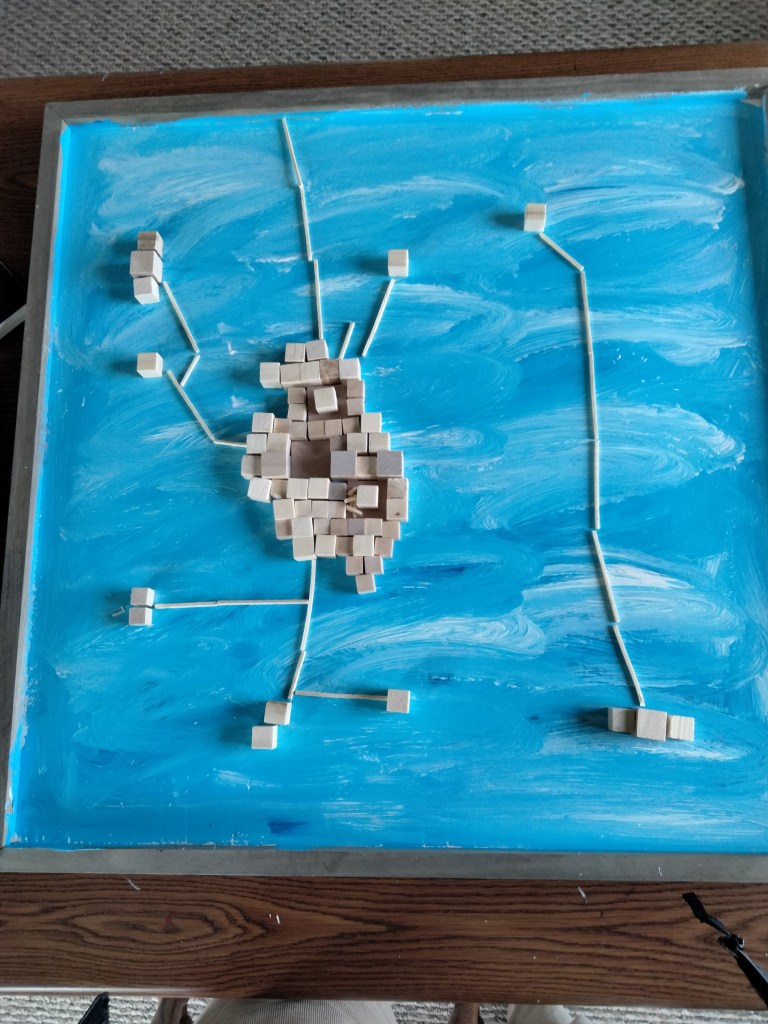
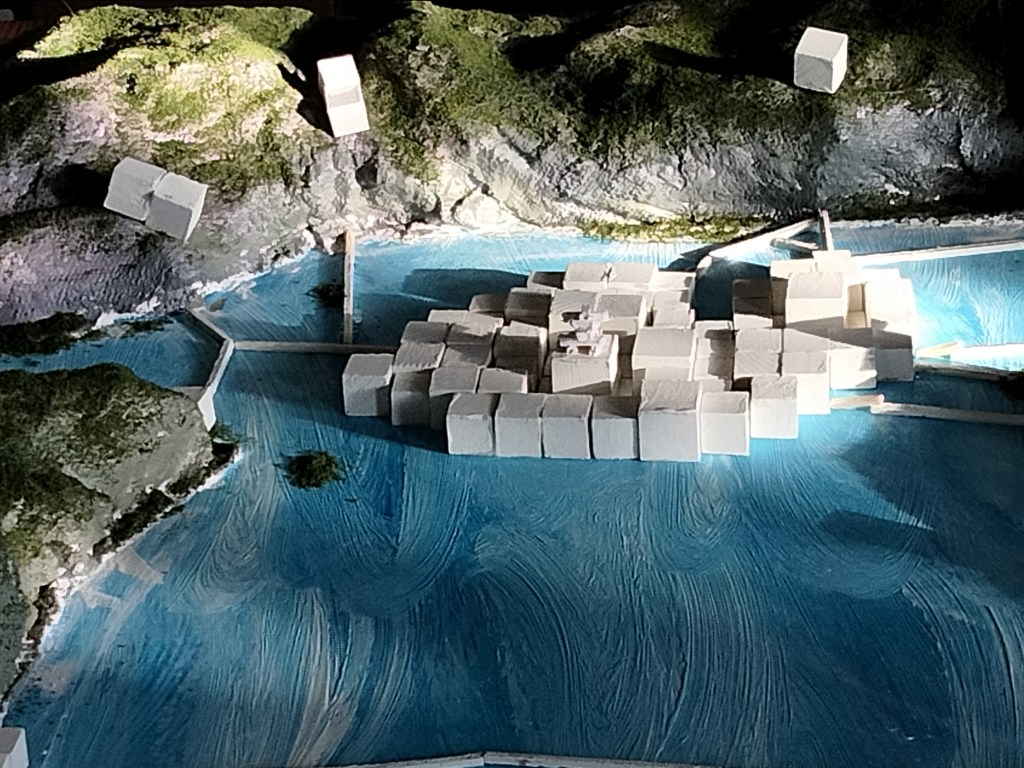
It’s funny how a person’s most eccentric interests sometimes come in useful. This year, I was given the task of teaching the period of about 1400 – 1800 A.D. to young minds. When we came to the part about Cortez, I thought it would be useful to have a model of the city. I thought I could use model-train materials to build it. For sources on how the city layout looked, I drew on Cortez and the Aztec Conquest by Irwin R. Blacker, The Aztecs by Brian M. Fagan, and maps I found on Pinterest. There is not perfect agreement among all sources about the exact location of the different villages and causeways, and there were far more settlements in the hills surrounding the city than I will be able to show. I also had to leave out some causeways for the sake of simplicity.
So, here goes:
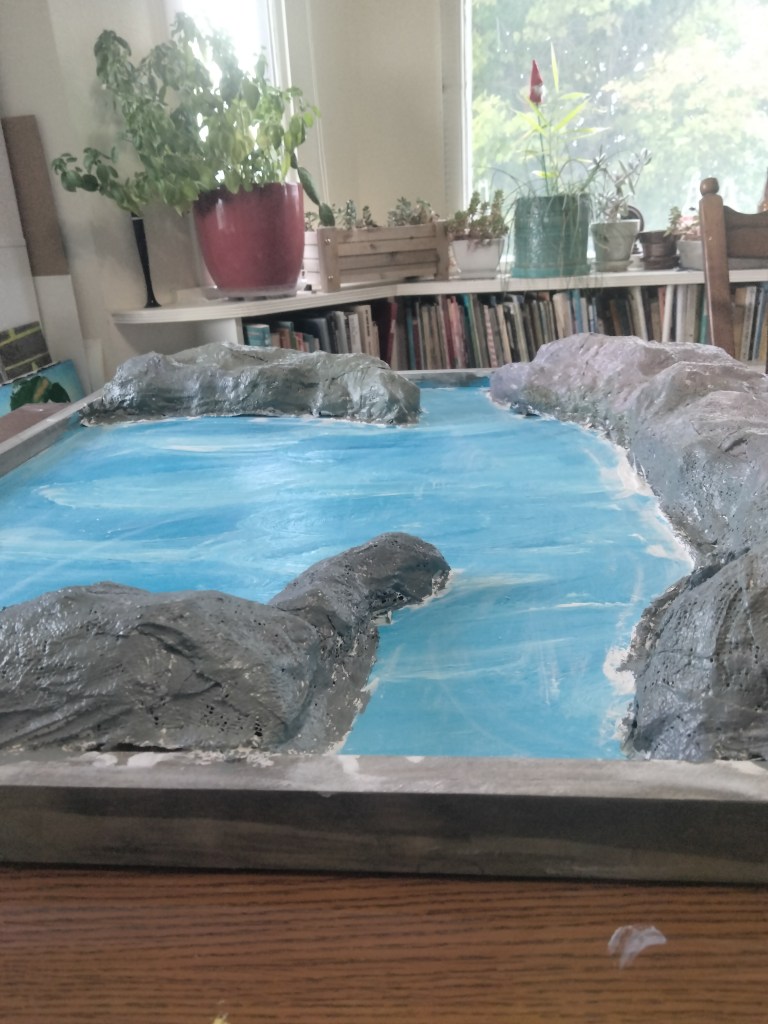
I took a wooden display board (actually meant to bear an inspirational slogan) and painted in Lake Texcoco.
Then I set out the variously-sized wooden blocks, slabs, and matchsticks I had purchased at the hobby store, planning where the city, towns, and causeways would go.
Based on this plan, I was then able to add the “land.” The first step was crumbled packing paper, masking taped down.
Then, paper-mache strips that can be dipped in water and smoothed down to make the hills.
I then painted the hills. I had to mix colors several times, so some of the hills are more greenish and some more greyish. That’s not a huge problem because I have “jungle” greenery to add, and also, the area is somewhat arid.
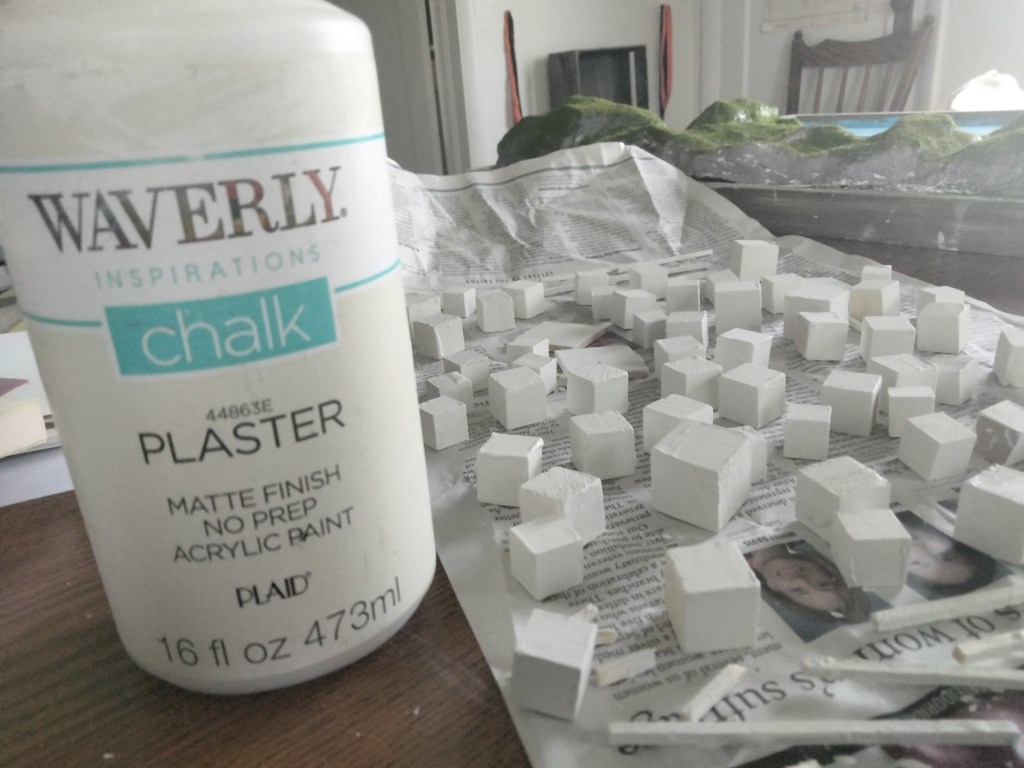
Meanwhile, I painted the blocks white. Actually, the city was probably very colorful, but I am going for a basic look. White represents stone. If desired, I can add color to the temple area over the following years.
Then it was time for the fun part: the hobby store sells “greenery” in a shaker can. I painted glue onto the hills and shook the greenery on. It sticks amazingly well. Let dry, then vacuum up the extra.
Now I placed the city and towns and glued them down, then added additional glue and greenery to make “islands.”
The city is actually two cities: Tenochtitlan, and Tlatelolco slightly to the north and west. I have given each city its own central plaza with a temple in it. The “temples” in my model are actually way too big relative to the size of the city, but this model is not meant to be perfectly to scale.
Final step: photograph in slanting sunlight.
Epic!
In days ahead, I plan to add a compass rose out in the lake and fancy title on the side, but for now, this ain’t bad.
For one thing, I like the guy’s name: High Priest Ahua Ch’Aooah. You have to raise your eyebrows and increase your volume slightly on the Ch‘A-ooah part.
Secondly, I love it that he immediately understands the NARAL employees’ explanation that “baby killing helped them amass lots of gold and that fewer babies on the planet would help stop the weather from getting worse.” I guess the more that child-sacrificing pagan rites change, the more they stay the same.
The dates, as always, are messed up and questionably to be trusted. For example, the idea that the step pyramid at Saqqara is the oldest known pyramid in ancient Egypt.
Still, Caral-Supe seems to be old and I’ll accept that it was the region’s “mother culture.”
“The design of both the architectural and spatial components of the city is masterful, and the monumental platform mounds and recessed circular courts are powerful and influential expressions of a consolidated state.” Also, “Archaeologists think the sites collectively reflect the Americas’ earliest core of civilization, which existed from 3000 to 1800 B.C. and was totally uninfluenced by outside factors.” Both cannot be true. Given that it is a sophisticated city-state centered around pyramidal temples, it seems have been an expression of the ancient,pagan bureaucratic urban human culture. Triangulating with genetic evidence, it was probably carried to Peru across the Pacific when humanity was dispersing after the Flood.
“No trace of warfare has been found at Caral: no battlements, no weapons, no mutilated bodies. Findings suggest it was a gentle society, built on commerce and pleasure.” That’s a nice thought, but I’m withholding judgement. The same thing was said about the Maya until we got better at interpreting their inscriptions, and started finding pictures of gruesome human sacrifice, piles of bones, etc. As Caral-Supe is much older than the Mayan civilization, the traces of warfare might be even harder to find.
We knew about the Olmec and Maya, but their sites were hard to spot and hard to study because of the jungle. Now, we keep learning more and more.
A train project on the Yucatan Peninsula is uncovering hundreds of Mayan settlements, proving that the area was more densely populated than once thought, as archaeologists have been beginning to suspect.
Meanwhile, Lidar technology is able to peer through the jungle and reveal not onlymore and more ceremonial sites stretching over the Olmec and Mayan culture areas, but also common layouts that seem to indicate a broad shared cultural (or at least, architectural) tradition dating back to 3,400 years ago.
It looks to me like what we have here is a Central American version of the Sumerian urban/bureaucratic/temple-based civilization, giving rise to a series of civilizations that followed the same model: Akkadian, then Babylonian, and so on. And, if we believe the 3,400 YA date, the same thing in Central America was happening at almost the same time. It’s almost as if people tend to set up hierarchical city-states with temples wherever they settle, almost as soon as they settle there, whenever circumstances permit. Almost as if they were dispersing, and remembering something.
How do you handle expresssions of time when writing about a preindustrial culture that does not use our time divisons?
Not that Preindusrial People Are Unaware of Time …
I’m not meaning to imply that people in preindustrial cultures take no notice of time. This is a notion, sometimes asserted, that goes with the romantic “noble savage” idea that because hunter-gatherers live closer to the earth, they necessarily live a “simpler” life, comparatively free from worries, cares, and conflict. See The Gods Must Be Crazy, the Wild Yam Question, and many others.
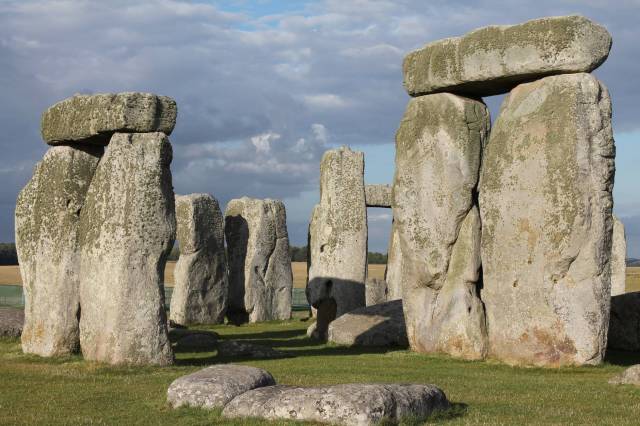
In fact, the earth is trying to kill you, so people who live close to the earth have plenty of survival-related worries (besides the usual human sin problem that did not first arise with industrialization). Farmers have to pay detailed attention to months and seasons, as do hunters, who also have to be concerned with times of day. So, no, there are no “time-free” people. In fact, there have been many ancient cultures that were very, very concerned with calendars. See Stonehenge, above, which was apparently a computer for predicting eclipses, and the Maya, who could be fairly said to be obsessed with dates.
But, Seriously, How Do You Deal with Time?
But, of course, it makes no sense to have a hunter-gatherer culture going around talking about the months by the names we give them. Let alone the days of the week, although if you follow Genesis, people have always known that days come in sevens and one day is for rest. Talk of seconds and minutes is even more of an atmosphere killer when it comes to verisimilitude.
Sci-fi writers can make up their own time divisions or draw on terms from sci-fi convention: clicks, parsecs, light-years, cycles, and no, I don’t know what most of these words mean really. They are fun, though. Perhaps in the comments you can enlighten me.
Anyway, here is how I deal with time. I didn’t spend a lot of … you-know-what … thinking about this when I first started drafting. I became more aware of it as my characters moved more into a hunter-gatherer lifestyle. You will still occasionally see the word, for example, “hours” crop up in my books. But when it would not take too much rewriting to get rid of modern time-words, here is what I use:
I don’t talk about specific months by name. Rather, I talk about seasons. (Early spring, midwinter, etc.) (However, if you are interested, my character Ikash’s birthday is in April and Hyuna’s birthday is right around Christmas.)
I do sometimes mention months in a generic sense, because everyone is aware of lunar months. I don’t say “moons,” because that sounds … well, I just feel like saying “moons” is a minefield.
It has never been necessary for me to mention weeks, either.
For “minute,” I try to use “moment,” which is less specific and technical sounding.
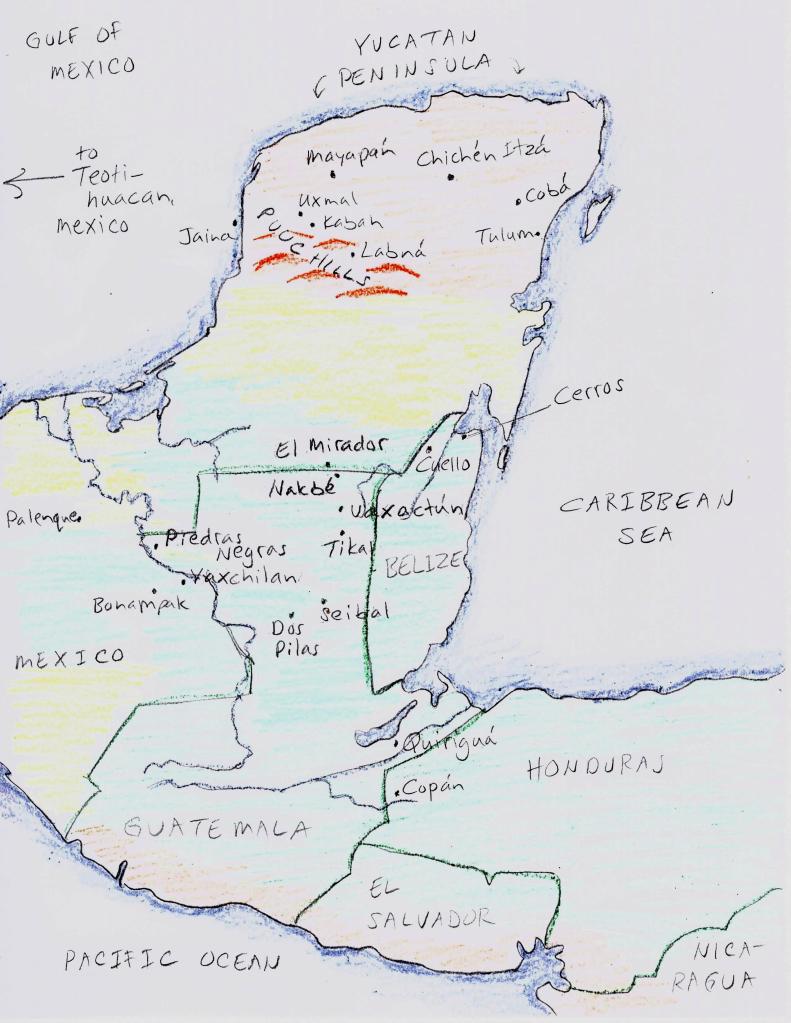
The Maya flourished between approximately 1000 BC and 1500 AD in Central America. Their civilization was centered in the Yucatan Peninsula and the lowland and hilly regions south of it. Their sites are found in what are now the countries of Mexico, Belize, Guatemala, and Honduras.
There is so much to learn about the Maya. I have barely dipped my toe in it. As always when learning about a new culture or civilization, I was met with the thrill of the exotic followed by a creeping feeling of familiarity. Though the Maya are very unique, in their own distinctly Mayan way they also epitomize certain things about human beings. In some sense, the more unique they are, the better they epitomize it.
They Are Surprising to Other People
I don’t know why, but people always get excited when they discover other people. (Animals get excited too: “Oh goody! A person!”) And we are always discovering other people, in the most remote corners of space and time, where for some reason we did not expect to find them, though you would think we’d have learned our lesson by now.
The Maya were particularly hard to find because of the geography of the region they inhabited. Jungle is not kind to the preservation of buildings or artifacts. It destroys things quickly, grows over things and hides them, and can make the region impassable.
Tree destroying a stone arch. From Mysteries of the Ancient Americas, p. 165
A really thick jungle allows no roads through it, and once they arrived, here is what some of the archaeologists found:
“The rain was incessant,” Charnay complained. “The damp seems to penetrate the very marrow of our bones; a vegetable mould settles on our hats which we are obliged to brush off daily; we live in mud, we are covered in mud, we breathe in mud; the ground is so slippery that we are as often on our backs as on our feet.” Once Charnay awakened to find 200 “cold and flat insects the size of a large cockroach” in his hammock, 30 of which clung to his body and bit him painfully.
The Magnificent Maya, p. 22
They Got Romanticized
In the early 1500s, during the Spanish conquest of the region, Spanish priests managed to preserve some Mayan cultural data – vocabulary lists, transcriptions of myths, and a few codices (books) – at the same time they were brutally wiping the culture out. These records remained obscure until, 300 years later, there was a resurgence of interest in the Maya. Explorers, hobbyists, and artists who happened to have the time, money, and fortitude to brave the jungles started unearthing Mayan ruins and making sketches and watercolors of them. In some cases, these sketches are the only record we have, since the jungle has continued its destructive work in the 200 years since.
Once European academics started getting interested in the Maya, they realized there was a very elaborate system of numbers and pictographs that they could not read. Thus began a long, haphazard process of rediscovering old codices and cross-checking them with symbols found on the monuments, as recorded in photographs and drawings. The number system was easier to decipher – dots for ones and bars for fives, for example – and so the first thing that got decoded were dates and astronomical cycles,
… which led many experts to conclude that Maya writing was limited to such matters. As late as the 1950s this was still the most prevalent view, and its chief spokesmen were the American archaeologist Sylvanus G. Morley of the Carnegie Institution in Washington, D.C., and J. Eric S. Thompson, a British archaeologist also affiliated with Carnegie. Thompson drew a picture of the Maya as a peaceful, contemplative people, obsessed with the passage of time, and guided by priests who watched the movements of celestial bodies and discerned in them the will of the gods. Maya cities were ceremonial centers, he believed, not bastions of the worldly power.
The Magnificent Maya. p. 33
Over the next few decades, through the work of several brilliant code breakers, about 80 percent of Mayan glyphs were deciphered. Turns out they are a combination of ideograms (an image representing an idea) and phonetic units (an image representing a sound). As this work went on, researchers have been able to read more and more of the Mayan myths and history, which in turn has helped us better to interpret their art. They started to discover that the 19-century “noble savage” characterization of the Maya was badly mistaken.
They Were Shockingly Cruel
First of all, the Mayan society was indeed hierarchical, with battles for succession and kings of city-states engaging in (perhaps ritual?) warfare. Discoveries during the 1990s confirmed that this hierarchy was present hundreds of years earlier than previously guessed. (Archaeologists’ preconceptions might have had something to do with these inaccurate guesses. See my post about Serpent Mound for a critique of the 19th-century idea that civilizations always develop along certain lines, from hunter-gatherers, to villages, to cities.)
from The Magnificent Maya, p. 108
But warfare was only the beginning. There was also the bloodletting, the torture, and the human sacrifice.
Apparently, Mayan royalty were expected to offer blood to their gods. During these bloodletting rituals, they would have visions. There are pictures and statues of both men and women doing this. Women would draw a stingray spine through their tongue to produce the blood. Men would draw blood from their tongue, earlobes, or genitals. (Yikes.) They would allow the blood to be absorbed by sheets of bark paper, which was then burned, the smoke being a way of getting the blood to the gods.
If a culture is going to have a painful ritual, it’s good that it should be done by the royalty. That’s certainly better than having a royalty that is unwilling to suffer for their duty and their people. If this were the only painful ritual the Maya had, I’d kind of admire it. But it wasn’t.
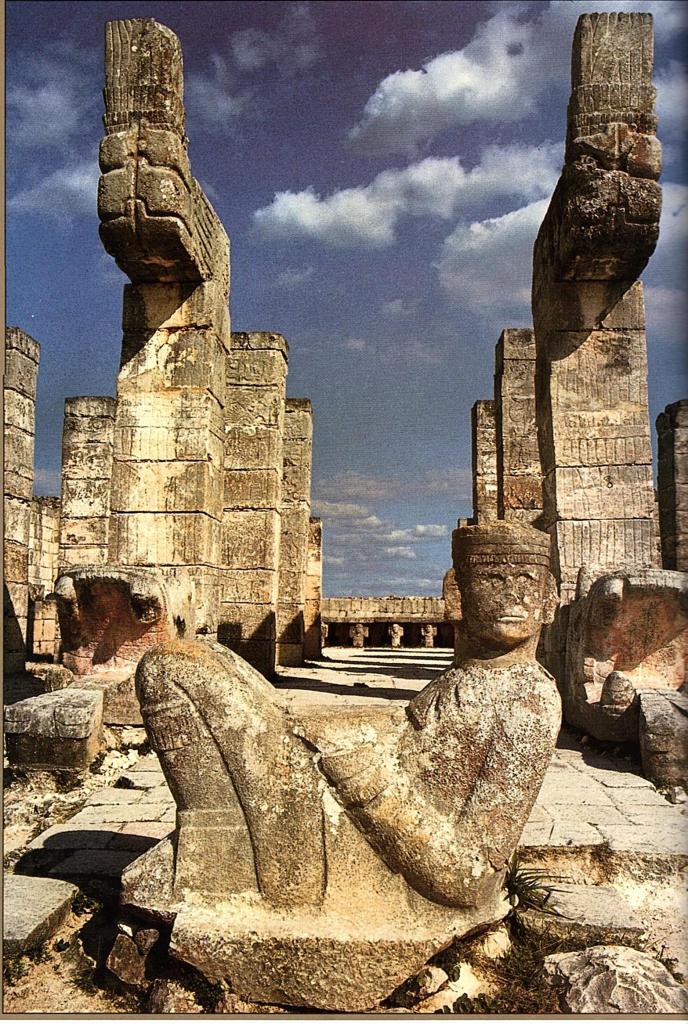
The Maya were big on human sacrifice. Decapitation was popular, or they might throw the victims into a sacred cenote (large natural limestone hole filled with water) if one was available. High-born victims, captured in war, would be mutilated and displayed before the community before being offed. Later, perhaps under the influence of the feathered-serpent cult of the Toltecs, Mayan priests would cut out the victim’s heart, offer it (and its steam – ew!) to the sun, and then kick the body down the steps of the temple. This ritual was still being conducted at Uxmal in the 1500s, which is why we know about details like the kicking of the body (Magnificent Maya, 139 – 140). Chacmools, which were obviously built to hold something, may have been made to hold human hearts.
The Magnificent Maya, p. 136. Temple of the Warriors at Chichen Itza. The reclining statue holding a bowl is the chacmool.
Then there were the ball games. Did I mention that the Maya were big sports fans? Like, really big. You have probably heard of this game, where the players would use their hips and buttocks to bounce a large, heavy rubber ball off the sloping walls of the court. Apparently, the Maya took their sports so seriously that the losers of this game might be sacrificed, either by one of the methods above, or by being trussed up and used as the ball until they died (94 – 95). This very ball game features in the Mayan creation story, the Popol Vuh, where the Hero Twins play the game against the inhabitants of the Underworld. The reason they are obliged to do so? The rulers of the Underworld “covet [the brothers’] sporting gear and want to steal it” (56 – 57). This story, too, features a lot of torture.
Cruelty is always shocking, which is why the heading for this section says “shockingly cruel.” But it should not shock us to discover that a previously unknown civilization featured widespread, institutionalized atrocity. Every single human culture has something like this. Cultures can have good historical moments when the human evil is comparatively restrained, and they can have bad historical moments when it is encouraged. You could argue that in the case of the Maya, it had really gotten out of hand, and I think you’d be right. But I don’t think that makes the Maya different from any other people in their basic humanity. In their uniqueness, they epitomize what human beings are capable of. People are extremely creative, and they have often used their creativity to dream up ways to torture one another. This is why we have the expression, “Man, the glorious ruin.”
They Were Jaw-Droppingly Smart
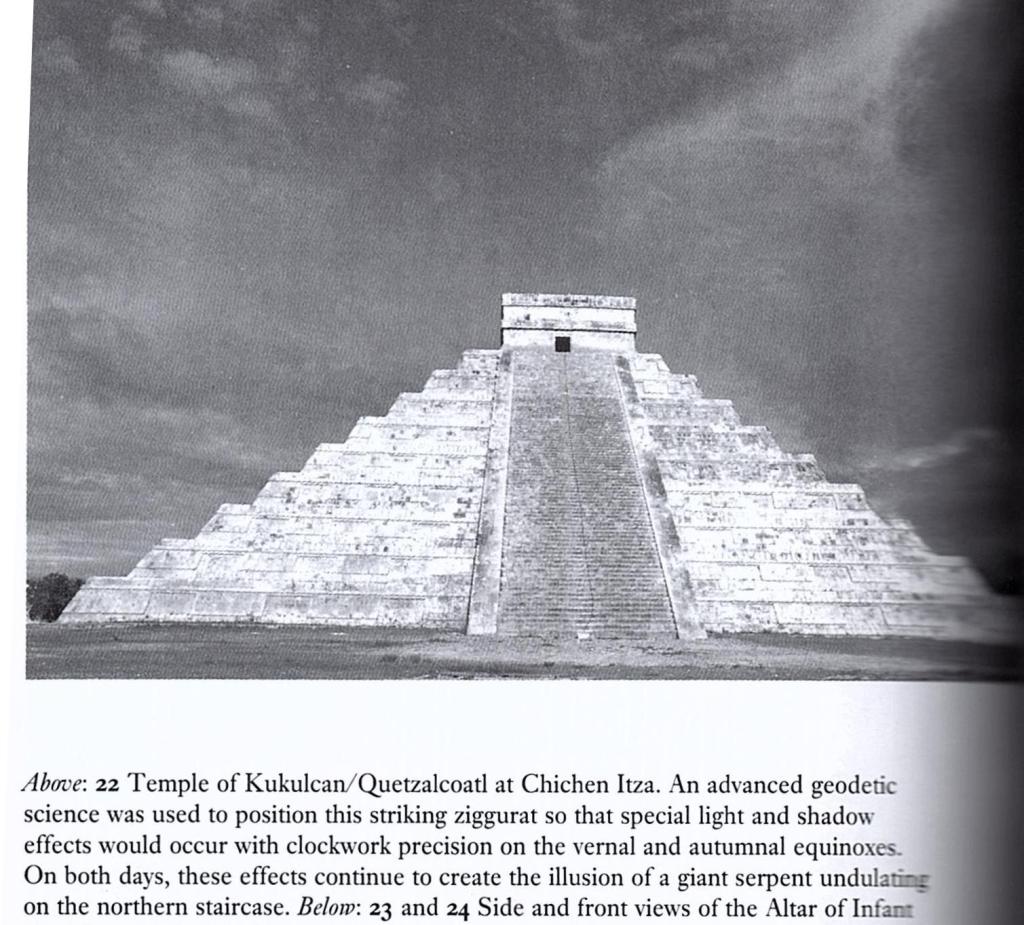
from Fingerprints of the Gods, photo plate between pages 134 – 135. I have no idea how this light and shadow serpent effect was accomplished, but if true, it’s an amazing piece of engineering.
And now we get to the glorious part. No matter how depraved, broken, fallen, or ruined they may be, human beings never stop being made in the image of God, which means they will keep on being creative and clever and productive. It has long been a theme on this blog that ancient people were smarter than modern people expect. This is because they were people, and people are always surprising other people – because the other people are proud – with their cleverness.
The Maya were advanced mathematicians. They had the concept of zero, and the idea of place value, which the Romans did not have. They had calculated the solar year at 365.2420 days (the modern calculation is 365.2422), and the time of the moon’s orbit at 29.528395 days (modern figure is 29.530588). They had figured out the average synodical revolution of the planet Venus (the amount of time it takes for Venus’s orbit and the earth’s orbit to sync up so that Venus is rising in the exact same spot in the sky). This average happens to be 583.92 days, and they had figured out how to reconcile this with their “sacred year” (13 months of 20 days each) and with the solar year, by adding days every certain number of years, similar to our leap year. Bringing all these interlocking calendars into sync then allowed them to calculate mind-blowingly distant dates without losing accuracy.
All the above information is from Graham Hancock in Fingerprints of the Gods. Hancock then quotes Thompson, the romanticizer whom we met a few sections ago. Studying the Mayan calendar, Thompson had reason to be impressed:
As Thompson summed up in his great study on the subject:
“On a stela at Quiriga in Guatemala a date over 90 million years ago is computed; on another a date over 300 million years before that is given. These are actual computations, stating correctly day and month positions, and are comparable to calculations in our calendar giving the month positions on which Easter would have fallen at equivalent distances in the past. The brain reels at such astronomical figures.”
Hancock, Fingerprints of the Gods, p. 162
Hancock, being a bit of a snob, questions why the Maya “needed” to develop these calendrical and mathematical tools. He speculates that the Maya had inherited “a coherent but very specific body of knowledge … from an older and wiser civilization.”
“What kind of level of technological and scientific development,” Hancock asks, “was required for a civilization to devise a calendar as good as this?” (158 – 159)
Of course, he is asking these questions because he’s heading in the direction of civilization having dispersed from a “mother-civilization.” That’s fine with me, but in asking these questions he also betrays a worship of science and technology that is distinctly modern and that, when applied to ancient peoples, makes us shortsighted. Why should mathematical genius exist only in the service of technology? The Maya were smart, and they wanted to make these calculations about the celestial bodies and about dates in the distant past and future. Isn’t that enough? Furthermore, they actually recorded why they were so obsessed with these calculations. Their cosmology held that time proceeded in predictable cycles of disasters, and they were pretty concerned with knowing when the next one was coming. That was the purpose of the Long Count calendar, as Hancock himself points out on page 161. It was a doomsday clock. That may also have been a big part of the reason for the horrifying sacrificial system.
The Long Count calendar is what everyone was talking about when they were saying the Maya had predicted a cataclysm for Dec. 23, 2012. It didn’t happen – phew! – and, frankly, for obvious reasons I don’t completely buy in to their cosmology. Although we do need to consider the possibility that in converting the dates, we made a mistake in interpreting their extremely complex system.
Bottom Line, the Mayans are People
I can’t say that I find the Mayan – or the Toltec, Aztec, or Olmec – myths or aesthetic particularly attractive. I dipped my toe in because as part of the research for my books, I need to at least know my way around the ancient Mesoamerican mindset. As the research proceeds, I find myself becoming increasingly fascinated with these people. But I still wouldn’t want to have lived as one. This has been true of virtually every ancient culture I’ve studied.
So, taking it in reverse order, here is what we have learned about the Maya, and here is what we have learned about humans.
Humans are smart.
Humans are evil.
Humans are wonderful.
Humans are everywhere.
Sources
Hancock, Graham, Fingerprints of the Gods. 1995, Three Rivers Press, Random House, Inc., New York, New York.
Reader’s Digest books, editors, Mysteries of the Ancient Americas. 1986, The Reader’s Digest Association, Inc., Pleasantville, New York.
Who is this handsome fellow? He is Lord Pacal (or Pakal), denizen of the most spectacular tomb ever discovered from the Mayan civilization. This is the tomb at Palenque, the excavation of which reads like an archaeological thriller. The limestone slab covering Lord Pacal’s coffin is the location of the famous Mayan “astronaut” carving, the actual cosmological significance of which is explained here.
This watercolor of him is my own interpretation, done from a photograph of a sculpted head of him, reproduced below.
The Magnificent Maya, p. 85
Though I did my best, in the sculpture his face is even longer, leaner, more angular, more … well … Mayan. I took a guess about skin, hair, and eye color. I also had to interpret his hairstyle and headdress, after staring for some time at the textures in the statue. As near as I can tell, his hair has been arranged to cascade upward and forward over some sort of cone-shaped crown, which I imagined to be jade, a stone the Maya valued. The hair style is apparently meant to accentuate the tall, narrow shape of the head, which was a head shaped valued by the Maya if we go based on their other art. The headband I rendered as a buff-colored woolly material, again based on its texture, though given Pacal’s status it could have been red or gold.
I spent maybe an hour or two on this watercolor, but no doubt the sculptor spent much, much longer on his or her rendering of Lord Pacal, which was probably the most important work of his or her lifetime.
You can see that it’s a dramatic face. You can see why I wanted to paint it.
In my watercolor, Lord Pacal came out looking surprisingly sensitive and gentle. In real life, he probably wasn’t, at least not by the time he reached the age of his death. He was buried with six teenaged human sacrifices, and he came from a culture that produced statues of torture victims.
But my main concern here is with the shape of his face. I am fascinated by the wildly varying types of shape that can and do work as recognizable, and indeed attractive, human faces. Lord Pacal’s face is almost a perfect diamond. It’s widest at the brows and cheekbones, narrowest at the chin and forehead.
As I went to draw this face, I was reminded that I had once drawn another face with a similar shape.
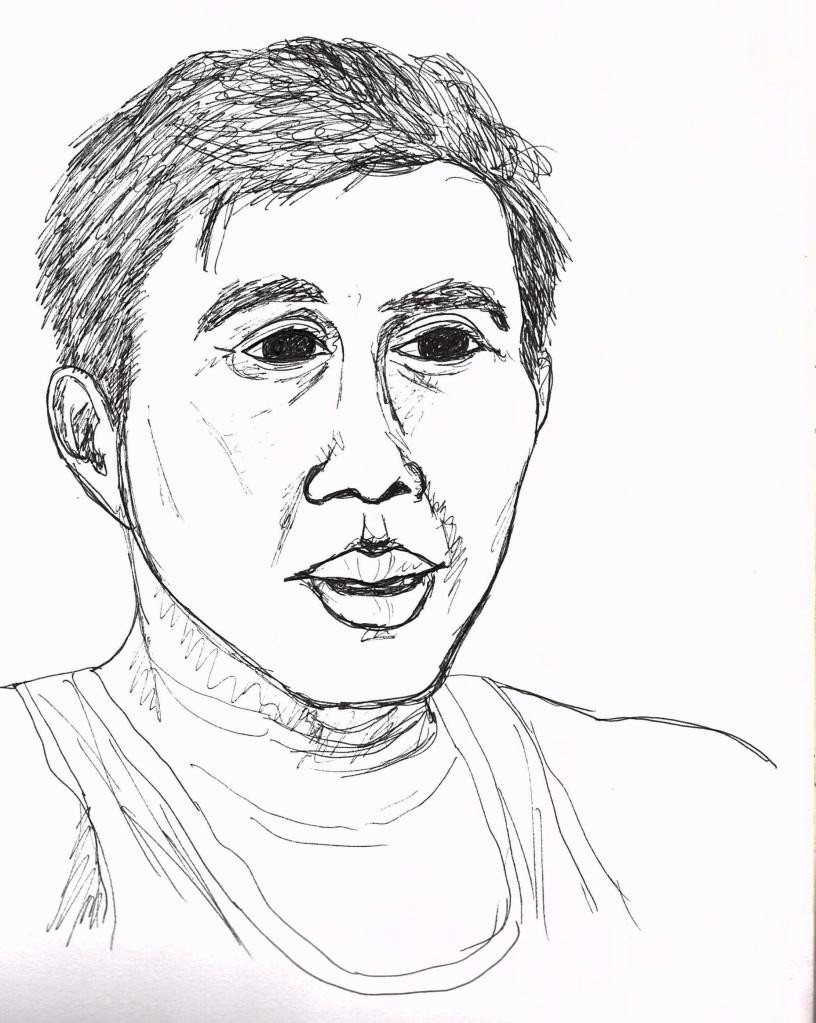
Here is a pen portrait I did from life. This man’s jaw is a touch wider than Lord Pacal’s, but the main difference between the two faces is the nose. This model has a small, rather flat nose with a very low bridge, unlike Lord Pacal’s knifelike nose with its very high bridge, extending all the way up into his forehead, which seems to have been a convention in Mayan portrait art. Whether it this was an ideal of beauty or a real-life physical feature, I don’t know. I do know that low nose bridges are not valued in the culture that the second portrait came from … though I think both kinds can be perfectly beautiful.
And my second model for a diamond-shaped face came from … Borneo. Land Bridge, baby!
Source
The Magnificent Maya, Lost Civilizations series, by the editors of Time-Life Books, Alexandria, Virginia, 1993.
(Much more has been discovered about the Mayan civilization since the publication of this book. In particular, Lidar and UAV aerial imaging have revealed that the Mayan cities were much larger and more numerous than was known in 1993. However, though the context for their interpretation might have changed, the artifacts documented in The Magnificent Maya have not ceased to exist, so I am using the book as an introductory source.)















 Out of Babel Books