I Got Nominated … Sort of

(Is the above really the latest Sunshine Blogger Award logo? Looks kinda messy.)

So, Bookstooge sort-of-nominated me for the Sunshine Blogger Award! Thank you, Bookstooge! I am so flattered. I think his exact words were, “If you’re reading this, consider yourself nominated, because it means you have a pulse.”

Rules For The Sunshine Blogger Award:

  • Display the award’s official logo somewhere on your blog.
  • Thank the person who nominated you.
  • Provide a link to your nominator’s blog.
  • Answer your nominators’ questions.
  • Nominate up to 11 bloggers.
  • Ask your nominees 11 questions.
  • Notify your nominees by commenting on at least one of their blog posts.

Questions from Bookstooge:

  1. Why Would Anyone Consider Cereal to be Soup?

It’s because they are trying to categorize things according to algorithmic rules/decision trees instead of the way the human mind normally works, which is by constructing a schema for the thing in question and then eyeballing it.

With schemas, if the thing mostly resembles the schema, it is considered an instance of that thing, even if it misses checking some important boxes. And if it checks all the boxes but manifestly does NOT resemble the schema at all, then it’s not an instance of that thing.

Cereal is in the latter category. It’s an ungodly modern creation of Mr. Kellogg, who believed that eating meat was morally wrong as well as unhealthy, and sought to banish it from the breakfast table. And I say this as someone who very much likes breakfast cereal, particularly as an evening snack, even though I know it has wreaked havoc with my metabolism (see question #10).

2. Why Do You Blog?

I blog to get you interested in my books. Go buy ’em. BUT, warning, don’t buy the Kindle version of The Strange Land until the end of next week, when it will cost 99 cents because of a special promo.

3. How Do You Justify Your Existence? (I got that one from the Tales of the Black Widowers, good isn’t it?)

Yep, it’s a good one.

Photo by Pixabay on Pexels.com

“So God created man. In the image of God created He him, male and female created He them. And He said to them, ‘Be fruitful and multiply, fill the earth and subdue it. Rule over the fish of the sea and the birds of the air, the cattle and the creatures that move along the ground.'”

Edit: By quoting this passage, I am NOT asserting that the only justification for our life is to reproduce … i.e., that your life somehow has no meaning if you are not a parent. I happen to have been given three children, but that’s God’s gift to me, not mine to Him. No, the point of quoting this passage is this: I justify my existence because God made me. He made us. He wanted there to be people. He wanted us to exist as male and female. And, per the latter part of the passage, He wanted there to be a lot of us. If you exist and you are a human, He is happy about that.

4. How Do You Choose Who to Follow?

Unfortunately, I’m a lot like Trump in this way. If you say nice things to me, I like you and then I follow you.

An alternative route is that you posted something that really interested me. This usually means book reviews, discussion about writing, theology, ancient history, and sometimes art.

5. If John McClane and John Wick were tied on a railroad track and you could only set one of them free, which would you choose and why?

O.K., I had to duckduckgo him, but John McClane is the Bruce Willis character in Die Hard. I would save John McClane instead of John Wick for the following reasons:

  • John Wick could definitely save himself.
  • I only saw the first Die Hard, but in it, John McClane is a family man, whereas John Wick doesn’t even have a dog anymore.
  • Once when we were in Indonesia, somebody swore that my husband looked exactly like Bruce Willis and now I can’t unsee it. That makes me think Bruce Willis is even more handsome.

6. In a game of Parcheesi, who would win, Spongebob Squarepants or the Doom Slayer?

I expect Spongebob to win in the same way that Bugs Bunny would.

7. Do you feel guilty about all of my oxygen that you are breathing?

Yes. My gosh, don’t remind me!

8. What is your favorite movie?

It’s a tie between The Princess Bride and a little hidden gem called Undercover Blues.

9. If you were going to be “accidentally but on purpose” killed tomorrow, how would you spend today?

I would write long letters to each of my children. If I had extra time, I’d move on to my husband, then other close family and friends.

I might try to transfer the rights to my books so they don’t go out of print, but I don’t think that could be done in one day. If you snooze, you lose, and I guess I snost and I lost.

10. Are mirrors Friend, or Foe?

Friend, but only in the sense of “faithful are the wounds of.”

11. If you could change ONE THING about your blog, what would it be?

Every single visit to my blog would result in a book purchase and then a breathless review on Amazon GO BUY MY BOOKS PEOPLE!

Ahem. I Nominate:

I nominate seven friends (the number of perfection!) plus Bookstooge cause I want to hear his answers too. And I nominate you, Reader, if you want to do it! After all, you are breathing! Which might provide the answer to my first question!

To Answer These Questions:

  1. What is the best gift God has given you?
  2. Without sharing details you don’t want to share, how did you come out of your darkest hour/day/year?
  3. What kind of biome would you most prefer to live in (one that can be inhabited by people)?
  4. In real life, how are your social skills (and do you have any tips for me haha)?
  5. What is your favorite genre of fiction?
  6. Do you ever read nonfiction and what makes you pick it up?
  7. Tell me one nice thing about your grandparents.
  8. If you could speak any language, ancient or modern, fluently besides your native one, which one would you choose?
  9. What are your feelings on the Harry Potter series?
  10. Do you have a favorite YouTuber/podcaster? What do they talk about? Now’s your chance to promote them!
  11. When did you first seriously consider the claims of Jesus of Nazareth? If you never have, would you do me a solid and consider doing so?
Fantasy Cast for The Long Guest Movie

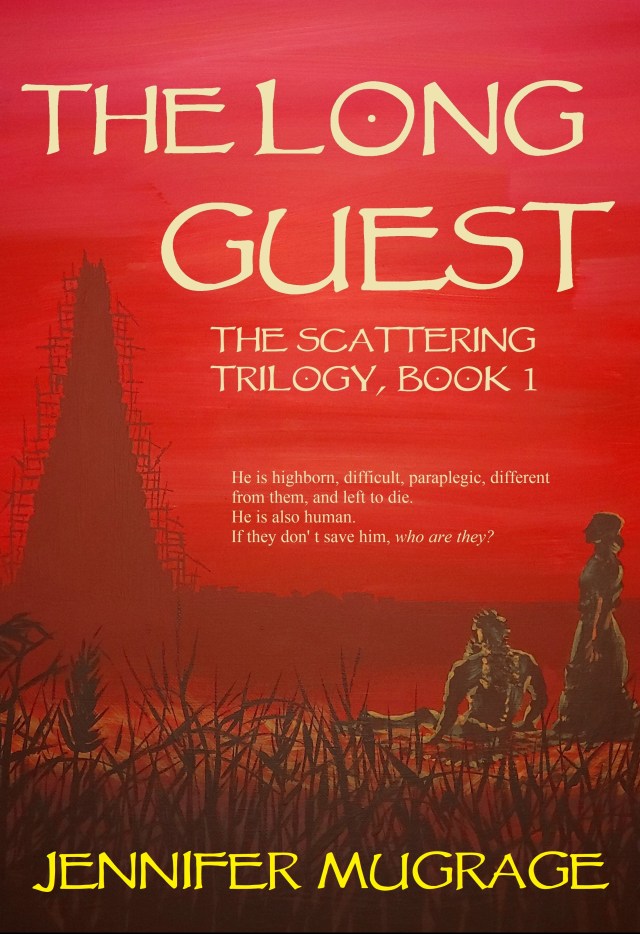
Above is the cover for my epic fantasy/alternate history book The Long Guest. Today, I’m going to tell you which actors I would cast for The Long Movie. I got this idea from Riddhi, who “cast” a favorite book here.

N.b.: This list is really a fantasy for a number of reasons. One reason is that many of these actors would have to be younger than they are now to play these characters, and they would have to conveniently not age until the movie was ready to be made. The character Nimri, for example, is 130 years old, but in the world of TLG that’s only middle-aged. Zillah starts the book in her early 60s, practically a spring chicken. Zillah’s children, of course, are even younger.

Also, sorry I’m only picking mostly big-name stars. One wrinkle with “casting” an imaginary movie is that I’m limited to actors I actually know about.

Nimri: the antihero

Denzel Washington has the look and the gravitas to play Nimri, an arrogant aristocrat related to the Assyrians and Egyptians (he’s “Cushite”) who is taken in by a group of strangers when he suffers paralysis.

Washington usually plays morally upright characters, but he’s a great actor who has been known to play against type, such as in the movie Training Day:

Washington would need a wig, since Nimri has long, curly hair, like the Assyrians.

Update: Ben has suggested Jason Momoa for Nimri. This is a brilliant idea. I didn’t think of Momoa, because I’ve never watched anything he’s been in. But he has the hair, and the roguish vibe.

Imagine this dude screaming at you unintelligibly to take him back to the Tower.

Zillah: the wise matriarch

Widowed at the beginning of the story, Zillah acts as the conscience of her family as they navigate the postapocalyptic chaos. It is she, in fact, who insists they save the life of Nimri, even though he is paraplegic, doesn’t speak their language, and appears to hate them.

Zillah and her family are “Japhethites,” which in my book means they belong to the group that became the ancestors of both Europeans and Asians. They can look like modern-day Europeans, Central or East Asians, or (later) Native Americans. Zillah has medium-fair skin and straight black hair so long that anyone playing her would need a wig.

Any of these ladies could play Zillah:

Sandra Oh

Maura Tierney

Mariska Hargitay. She starred in Law and Order: Special Victims Unit for so many years that I’m sure playing Zillah would actually seem like a nice break by comparison.

Golgal: Zillah’s dead husband

Golgal is killed right before the story opens, but if we needed to portray him in flashbacks, he could be played by Liam Neeson sporting long black hair and a long black beard. And dark contacts.

Enmer: the hyper-responsible son

With his father dead, it’s up to Enmer to get his family out of the riots in the city of Babel. Enmer never really gets over the apocalypse, but he does his best throughout the rest of the book, guided by Zillah.

Kiowa Gordon is an American Indian (Hualapai) actor who played Jim Chee, among other roles. This tense, tragic look on his face is perfect for Enmer.

Ninshi: Enmer’s uptight wife

Lucy Liu has exactly the take-no-nonsense face that Ninshi is usually sporting.

Endu: the cocky young prince

Endu, the second son of Zillah and Golgal, is handsome and cocky. He doesn’t mind letting Enmer lead the group of refugees, but he’d like to have his own kingdom some day.

I only ever saw Johnathan Schaech in That Thing You Do, and never again. But the character he played in that movie was pretty close to Endu’s.

Endu could also be played by a much younger Robert Downey Junior, or by a much younger:

Michael Greyeyes.

Endu is quite a bit darker complected than all these guys, though.

Sari: Endu’s mousy wife

Late in the book, Endu marries a sweet, shy widow who he thinks should be really glad to get him.

I’ve always thought Grace Dove would do a fantastic job as Sari.

Sut: the sunny third child

Sut doesn’t make it very far in the book, but he could be played by either of these handsome young fellers.

Timothee Chalamet

Frank Dillane

Ninna: the little sister

Ninna is only sixteen when the apocalypse happens. She remains a player in the family story throughout the entire trilogy.

Mindy Kaling looks exactly like I picture Ninna (and, in fact, her daughter Magya): dark, pretty, short, sweet, super feminine.

Hur: the slave turned brother

Golgal acquired Hur as a slave when Hur was fourteen. Hur’s father had gotten into debt, and the family was being sold off to pay it. Hur is the same age as Enmer (31) when The Long Guest opens. He is a very capable person, and it doesn’t take him long to insist to Enmer that he be given his freedom and made one of the family, or he will take his skills elsewhere.

Hur is the only member of the initial cast who does not have black hair.

Jeremy Renner looks more or less as I have always pictured Hur. In Wind River, he plays a character who is similar to Hur, as well.

You May Now Complain

Okay, that’s it! If you have actually read The Long Guest, you may have found this post enjoyable (or, perhaps, repulsive). If you haven’t read it yet, I trust that my casting choices have not ruined the mental images you will develop while reading it.

And yes, The Long Guest could be cast almost entirely with American Indian actors, Korean actors, or Bollywood actors. I’m just not knowledgeable enough about the industrie(s) to assemble such a cast in a blog post.

The Belated Hallowe’en / Horror Tropes Tag

I got this tag from Snapdragon Alcove. I hope it’s OK that I’m posting it after Halloween (life is busy!). Because of the relatively narrow range of my horror consumption, I’m freely mixing movies and books.

Pick your favorite example of a …

Zombie apocalypse

The Book of Eli (a movie)

Not exactly zombies, but as I recall, there is an older couple that seems normal, but then you find out they have some sort of neurological disease from having eaten human flesh to survive. Creepy.

Also, I love the characters Denzel Washington usually plays, and this is no exception. I like my apocalyptic movies to be somewhat uplifting, and this fits the bill.

Vampire

The Unwilling, by C. David Belt (a book). Cheating a little, ‘cause I recently reviewed it here. This one made me cry, because there is a child vampire who wants to be “a real boy.”

Haunted house

I guess I don’t read many haunted house books, because Monster House is the only one I can think of. It is just as sad as ghost stories usually are.

Psychological thriller

Fractured and Shutter Island (both movies). I was very angry with both of these movies, but Fractured probably made me angrier.

Creepy doll

The Collision series, by Rich Colburn. So far, it has only two volumes: The Resolve of Immortal Flesh and The Formulacrum. But The Formulacrum ended on a literal cliffhanger, so that means Colburn owes us another one.

Neither of these books is exclusively about creepy dolls, but one very memorable creepy doll is featured … and that’s just about the only book I have ever read with a creepy doll.

Monster

Beowulf, duh.

And, in case you are not up to speed on this, Grendel is a t-rex. But there are plenty of other monsters in this how-to-defeat-monsters book, including the sea monsters Beowulf encounters while swimming in the North Sea, and Grendel’s mother, who appears to be some sort of octopus.

Comedy-horror

The Tremors franchise. It is the best. Extreme gross-outs, but also extreme humor. Survivalist Ed really steals the show.

Teen Horror

Stranger Things.  I will die on this hill.

The series starts out where the kids are about twelve and it more resembles E.T. or The Goonies, but the events cover several years and we see the kids discovering the opposite sex, feeling left out as they grow up at different rates, dealing with problems with their parents and problems involving finding a career and their place in the world. Their lives have all the teen challenges, plus the ghosts and demonic creatures and stuff to deal with. And yes, there are a few make-out scenes that it would be nice if we could skip. I will also say that the series seems to be equally sensitive to the experiences of teen boys and girls.

Some people think the episodes are too long and detailed, but that’s the point. They work in a lot of human drama in addition to the scary stuff, and I am here for it.

Demonic possession

Perelandra and That Hideous Strength by C.S. Lewis both feature possession that gets more terrifying the longer you think about it.

In Perelandra, the possessed man gets to come out and speak instead of the demon once in a while, and this gives a more evocative glimpse into his mind than we might prefer.

In That Hideous Strength, the people that are serving the demons get dehumanized to an even greater extent, and we see the beginning of this dehumanization process happen to one of the main characters. There is also a memorable scene where one of the villains, who up until now has been the most formidable because of his intelligence, wants to put a stop to something, but “he could not think of any words.” This moment of aphasia shows us how close his mind is to total disintegration.

Science fiction

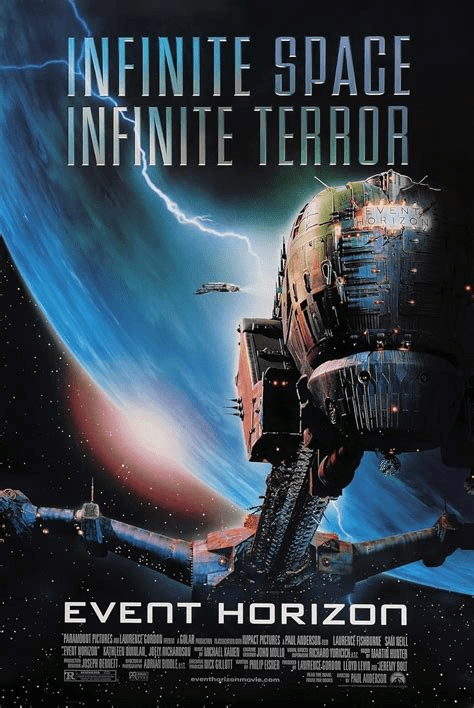
Science fiction reliably pulls towards horror, for obvious reasons. Human nature doesn’t mix well with dimensional portals … or genetic engineering … or time travel.

That second image is from a movie called Paradox. It turns out there are quite a few of those, but this one involves time travel being exploited by a bitter coworker to go postal, and even though the team has an awful lot of information, they can’t figure out what is happening quickly enough.

Movie Review: Gone in the Night

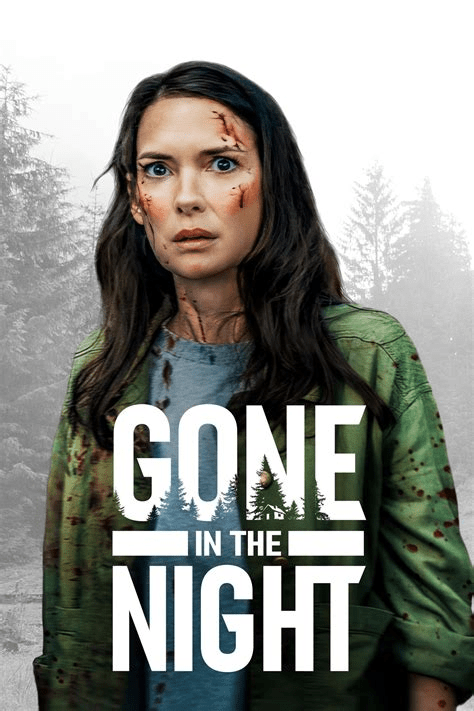
“When Kath and her boyfriend arrive at a remote cabin, they find a mysterious young couple already there. But when her boyfriend disappears with the young woman, Kath becomes obsessed with finding an explanation with the help of an unlikely supporter.”

I checked this 2022 film out of the library so I’d have something to watch while knitting in the evening. I like Winona Ryder, although her character in this film is very different from the beloved Joyce of Stranger Things. As you can see from this cover, she doesn’t look at all like the same person.

This is a mystery/thriller. I won’t give away the plot, except to say that it is disturbing. Instead, I want to talk about the movie’s theme: aging and the way our culture fears it.

Gone does a fabulous job of working the theme into almost every scene. (And, now that I think about it, it’s even arguably present in the title … you wake up and your youth has “gone in the night.”) Some things are very subtle: for example, when the boyfriend (I think his name is Max) gets out of the car to retrieve his hat, the camera lingers on Kath, sitting in the driver’s seat. She opens the mirror on the sun visor and looks at her reflection, then wrinkles her forehead and touches the lines there.

Max is having a beer with a young couple. The woman is flirting with him. She asks how old he is, and he jokingly replies, “Fifty.”

“Fifty? You look good for fifty,” she responds. “You look like you work out.”
“Oh, God, no, I was kidding! I’m not fifty!”

In fact, Kath and Max are both probably closing on 40, or perhaps in their early 40s. They don’t have grey hair or use a walker. They are not old enough to be grandparents. They are middle-aged. Kath seems OK with this. She would be happy to live with “my books, my plants, and have it quiet … forever.” Max, on the other hand, seems to be trying to cling to lost youth. He wants to go to raves and concerts, hike up mountains, and do all the things done by adrenaline junkies in their 20s. He and Kath, since they are not married and don’t have children, are still sort of trying to live in youth culture, but they keep getting messages that they don’t belong.

“How long have you been married?” the twenty-something woman asks Kath.

“What makes you think Max and I are married?”

“Oh! It’s just that people like you are usually either married or alone.”

“What do you mean, ‘people like me’?”

Awkward silence.

In another scene, Kath is following someone. The person leads her to what appears to be a rave happening in an old warehouse. Kath says to bouncer, “I need to get in for a minute. I can pay whatever.”

The bouncer, who is eating a snack, eyes her up and down and then says through a mouthful of food, “Dyahavakidinere or somethin’?”

“What?”

With an eye roll, he clears his mouth, and then articulates very clearly, “Do – you – have – a – kid – in – there?”

Fear of aging – and ultimately, of death – ends up being highly relevant to the plot of Gone. And, really, unless you happen to be a Christian with the certain hope of the resurrection of the body and the life everlasting, how could you not fear it? As Kath says, in a memorable line, “We are all scared.”

Out of Babel, the movie

Some of you may be aware that a while back, I sold my url outofbabel dot com to someone else. Well, what have they done with it?

https://outofbabel.com/

They are making a really cool movie that is due to come in out 2026.

No, it’s not based on my books in any way, but it has all the themes of my series, turned up to 11. I mean to say, if you click on the link above, you will see that their web site features American Indians fighting a dinosaur. Things do not get cooler than that, and as it turns out, they also do not get better historically supported.

Here is a quote from their FAQs section:

The Walam Olum or “Red Record,” which is central to our movie, is very much not alone from multiple Native American historical narratives that provide a clear and consistent telling of giants—especially giants associated with the mound builders and earth works, of which there are tens of thousands in America. The Lenni Lenape’s account of the Nephilim is central to their history (see the “snake people” and the makowini, translated “big men” that existed before and after their Flood account, were part of the reason for the Flood, matching our Bible history). See the Glyphs in Book 2 and Glyphs 1-2 in Book 3. Several other historical documents also mention giants affiliated with tribes around the Lenni-Lenape people.

In other words, these people are kindred spirits, which is why they wanted to buy my url in the first place.

My little url is all grown up, and I couldn’t be prouder.

Still buy my books, I mean. They have their own peculiar charm. But by all means, go and see this movie too.

These cool kids also have a YouTube channel:

https://www.youtube.com/c/GenesisApologetics

And a previous movie about the Flood: https://genesisapologetics.com/ark/

Update: I Don’t Like Giants (A Review of Three Thousand Years of Longing)

I enjoyed this movie more than I expected to. I thought it was going to be some kind of mystical journey with a guru or something. Instead, it’s a pretty good story reminiscent of those found in The Arabian Nights.

I don’t recommend you watch it necessarily, because there are a lot of scenes with naked people. Including multiple scenes with multiple obese naked people in a room covered with fur. (Yes, strange. And disgusting. It was the Ottoman Empire, what can I say?)

So given that you will probably not be watching it, I won’t worry about spoilers.

The Summary

Alithea is a “narratologist” (story expert) who travels to Istanbul for a conference. While in front of an audience, she keeps seeing a frightening, oversized, deadly white guy dressed as, maybe, an ancient Babylonian. This vision opens its mouth and appears to swallow her, and she passes out. Now, maybe I wasn’t paying very good attention, but it seems to me that this scary guy is a plot hole that never gets explained. He shows up in the background in some scenes later in the story, but it is never brought out what, if anything, is his relationship to the main action of the story. Ditto the odd dwarf character with the tall, Nephilim-like head who tries to take Alithea’s suitcase in the Istanbul airport.

Anyway, it’s after this that the main story begins. In a Turkish junk shop, Alithea buys a little blown-glass bottle that has been somewhat deformed at some point by a fire. She takes it back to her hotel room, starts scrubbing it, and out comes a djinn (Idris Elba). At first, Alithea and the djinn can’t communicate, but she finds that she can speak to him in Greek, and after a few moments of watching TV, he picks up on English. He tells her that she gets three wishes, but as a story expert, she knows that every single story involving three wishes is a cautionary tale, so her response is something along the lines of “no way.”

Then the djinn starts to tell his own story, which spans three thousand years. He has had three episodes of being imprisoned in various small vessels. Apparently, he was originally a free djinn, and was in love with the queen of Sheba (incidentally also his cousin – cue nakedness). When Solomon, who in this version of the story was the supplicant, shows up and woos the queen, the djinn’s heart is broken, and Solomon, “a powerful wizard,” imprisons him for the first time.

The first person to release him is a slave girl who’s in love with a prince. She wishes for the prince to fall in love with her, and then to become pregnant by him. Unfortunately, she gets caught up in palace politics, and when the prince falls out of favor, she is killed before she can make her third wish.

The second attempted escape, and imprisonment, is the one featuring the fat people in the sable room. It’s sad and grotesque, but has no love interest for the djinn.

In the third go-round, the djinn is released by a plain but intelligent young woman who is the third wife of a rich man and is essentially a prisoner. (No nudity, but horrifying brief sex scenes with her aged husband.) This young lady uses her first two wishes to learn “all the knowledge in the world” (she and djinn are shown studying together) and to become a formidable scientist. This is where we learn that the djinn is made of electromagnetic particles: “You are made of dust. I am made of subtle fire.” He falls in love with her mind, and tries to prevent her making her third wish so that he can stay with her forever. Feeling controlled, she accidentally traps him in the glass bottle with her third wish.

By the time the narratologist has heard these moving stories, she is ready to make a wish. She wishes to experience that kind of world-without-end love … with the djinn.

C’mon … Really?

At this point the cynic in me wakes up and says, Lady, has it occurred to you that this very large magical dude is telling you these sad stories in order to elicit precisely that wish? He’s lived through millennia having a once-in-a-lifetime love with one human woman after another. The man is an interdimensional slut.

However, the writers for this movie are not as cynical as I am. The djinn appears to make a good-faith effort to fulfill Alithea’s wish, even traveling back with her to London. When it becomes apparent that living in a large, modern city is too hard on him, in a metaphysical sort of way, Alithea wishes “If you cannot stay with me, I wish that you could be where you belong.” (Again: Was that his goal all along?) He does come back and visit her from time to time, which is nice and makes it seem less like she got played.

And here come the giants finally

For those who are interested in my books, this movie has a similar sort of vibe in a few different ways. For one thing, it features an older woman having an affair with a large, impressive foreign man with whom she can’t at first communicate. (I’m always a sucker for scenes where people try to find a common language.) In fact, if Hollywood is paying attention, Idris Elba could do a fine job playing Nimri. (Tilda Swinton could not play Zillah. Sorry.)

But secondly, and on to the main point of this post … giants.

I have put giants in my books because they feature in Scripture and in history. I have made them scary, nonhuman creatures because that is what they are in Scripture and in history, but prior to this, I was never particularly frightened by the idea of giants. I didn’t think of a larger size as anything necessarily to be afraid of, so I didn’t find them scary until I started researching what the historical record says about their behavior.

But watching this movie, I discovered that their size itself makes me physically uncomfortable.

When the djinn first comes out of the bottle, it’s in the form of particles. These particles swirl out of the hotel bathroom and into the main part of the hotel room. The next thing that Alithea sees are enormous golden toes sticking in through the bathroom door.

When she goes out into the bedroom, the djinn is so large that he is literally crouched over like a person trapped in a small box. The camera doesn’t show us this right away. It just shows her face looking at something disturbing and incredible. Then when we do see the djinn, we still don’t get a look at his face, because his back is to us.

Already at this point, I was thinking my first wish would be, “Could you please make yourself smaller?” His size is inconvenient and it makes the room seem weird.

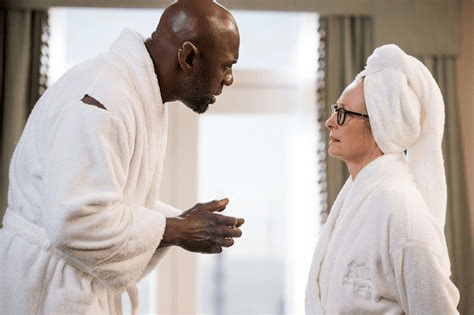
Soon, the djinn makes himself a bit more human-sized (and dons a hotel bathrobe, as you can see above). But even then, he is not … quite … on a human scale. He’s just a little bit too big. The picture above doesn’t capture this very well, but it’s the closest I could find. Tilda Swinton is petite, but she’s not that petite compared to the other humans in the story. She’s not that much shorter than they are.

Somewhat surprisingly, this also made me uncomfortable. Maybe it’s the way that the different scale messes with your perception of reality and your ability to trust your own senses. He’s too big to be human, but he’s not a tank like, say, Shaq. He’s in proportion – just not human proportion.

I was surprised by the fact that this made me — I repeat — physically uncomfortable. So, I guess, it turns out, my stories are even creepier than I realized. Because even when they are well-intentioned (?), like this djinn, I really don’t like giants.

Here’s What I’ve Been Consuming Lately

Three book and two movie reviews:

Battle for the American Mind

by Pete Hegseth with David Goodwin, 2022

I don’t usually go for books with an American flag on the cover. Fairly or unfairly, I expect them to have been written in six weeks with a shallow diagnosis of the problem (and the solution usually being “free-market economics”). But this one is different. The author began to win my trust when he said that a few of his earlier books were, in fact, just like that. Also, the intro is by David Goodwin, who has been in Christian classical education for years.

It’s pretty depressing to read how what Hegseth calls the Western Christian Paideia (WCP) was ripped out of American schools a few years before my parents were born (and how, in fact, the public school system was set up primarily to do this). It was replaced by a shallow new religion, a blend of Hegelianism with some nationalism thrown in to make it palatable to my grandparents’ generation. The goal of this new paideia was to populate a brave new, progressive, technocratic world with obedient and easily manipulated citizens, not with educated, critically-thinking grown adults. So, that kid on the cover looking at the American flag in a pose that looks suspiciously like worship? That’s not what the author is promoting. It’s what he’s criticizing.

First-Time Investor

by Larry Chambers and Dale Rogers, 2004 (3rd ed.)

Investors don’t get much more first-time than yours truly.

The big insight from this book – if I can summarize what I’ve read so far – is that it’s not possible to “pick stocks.” Stocks go up and down in a truly random way. (Which is gratifying to hear, since that’s certainly how it looks from the outside!) So, say the authors, the way to make money long-term on the stock market is to pick the right balance of kinds of stocks. And the kind that do the best, on average, are the companies that appear the least promising.

There. You got that for free.

The Plot

by Jean Hanff Korelitz, 2021

Here’s my Goodreads review:

Hoo boy. Hokay. So.

This book is about a struggling author who “steals” a story that someone once told him, years later, after he finds out the person is deceased. Said story is so sensational that it catapults the author to success: the book becomes a phenomenon. The rise and fall of this author is the outer onion layer of this book.

The inner onion layer is the sensational story itself. It’s about a girl who, at fifteen, becomes pregnant by a random guy, an older married man to whom she intentionally loses her virginity, essentially as a big middle finger to her parents. Her parents force her, not only to carry the baby to term (horror of horrors!), but to raise it in their home. When the baby, which turns out to be a precocious girl, is sixteen and ready to go off to college, the mother kills her. This is the Big Twist that shocks readers and is responsible for the book’s success.

I have three thoughts. One, obviously this book is really well written and makes a compelling read. I finished it in four days, despite my busy life. Hence the four stars.

Two. Every single main character is this book is a sociopath. I include not only the mother, but the daughter (as far as we can tell), the struggling-to-famous author, and a couple of side characters as well. The mother is a smart sociopath with the courage of her convictions, and the author is a dumber, more cowardly sociopath. There isn’t a character we get to know well who is manifestly decent.

Three. Despite being a book about a mother who kills her teenaged daughter, this book somehow manages to be pro-abortion. The fictional pregnant teen is resentful that her parents won’t take her to go get an abortion. They don’t love her or the baby, she opines, they are making her raise it to punish her. Abortion is presented as a solution, as if it would have prevented this very tragedy rather than just anticipating it by sixteen years. The parents also, though “Christian,” forbid their daughter to adopt the baby out, again to punish her. This is the classic straw-man scenario used by abortion promoters, but I don’t think it’s actually very common, let alone widespread. The impression I get is that grandparents often end up raising their daughters’ out-of-wedlock children. Furthermore, Korelitz clearly has no love for pro-life counseling clinics, which are actually places that will give girls in crisis pregnancies assistance in adoption and will give them plenty of other kinds of support when those are lacking at home. These places, when mentioned in the book, are always called abortion “counselors,” with scare quotes, as if the fact they will encourage you not to have your baby killed makes them somehow less professional.

This abortion problem, plus certain things in the tone of the book, gave me the distinct impression that Korelitz is trying to make this kind of sociopathy relatable. For example, one character asserts that it’s sexist of the reading public to find it more shocking when a mother kills her child than when a father does the same. Truly, women’s lib has reached its zenith when women aren’t expected to have any motherly tenderness for their own children, but rather to be just as violent and sociopathic as men are “allowed” to be. And then we can all be good worshippers of Moloch. Yay? It is for this reason that I can’t give the book five stars. No matter how well plotted or rendered, my enjoyment of a story as a story is marred when I find its background assumptions this repellant.

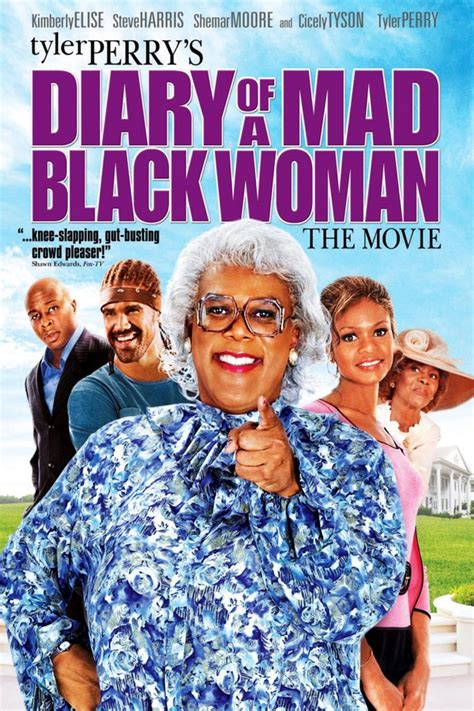
Diary of a Mad Black Woman

I know this is not a new movie, but I’d never seen it before. All I can say is, Tyler Perry really “gets” women. (Far more than Jean Hanff Korelitz does, now that I think of it.)

I did expect Madea to bring more action/solutions and not just comic relief, but interestingly, in this movie the solutions come from … God. I’m fine with that. Now before you go thinking that the frequent references to God mean this movie has an unrealistically rosy outlook on human nature … it’s also a revenge fantasy. Also, it’s got the usual Tyler Perry crude jokes, including Perry playing, not just cousin Brian and Madea, but also Madea’s pervy octogenarian brother.

The Last Stand

This film is very violent, very shooty-shooty-bang-bang. If you can tolerate that, it’s a great movie. It starts out looking like a crime/thriller flick. I didn’t realize until about 3/4 of the way through that it’s actually an updated Western. There is a noontime shootout on Main Street and everything, except instead of just the sheriff on one side and the outlaw on the other, there’s about a dozen people on each side.

There’s also a bonnet-wearing Texas granny who pulls a shotgun out of her knitting basket, which as you can imagine, I loved.

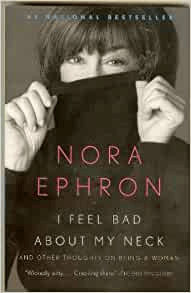
Me & Nora Ephron

So, I finally read Nora Ephron’s iconic (?) I Feel Bad About My Neck. I bought it because it was on sale at the library table for $1 and, when I started browsing through, it did not fail to charm me.

IFBAMN came out, according to the cover flap, in 2006. At that time, I had been married for about five minutes and had no interest in crepey necks. Now, the topic is of mild interest because I am older and wiser. (So old! So wise!) It’s fitting that I picked up this book during the week before my birthday. Perhaps we can call this my I-am-within-sight-of-turning-50 post.

Ephron and I do not have a lot in common. Unlike me, she …

  • is at least ten years older than my parents
  • wrote the screenplays for Silkwood, When Harry Met Sally, Sleepless in Seattle, You’ve Got Mail (basically she wrote the screenplay for Meg Ryan’s career, it appears), Hanging Up, and Bewitched, among others
  • has been married three times
  • lives in New York City, and if this book is to be believed, pays money for things like manicures, pedicures, Botox, a semiweekly wash and blowdry, and hair color every six weeks

All of this puts our worlds pretty far apart.

(However, I would be remiss if I did not point out that Nora Ephron and I also have quite a few things in common:

  • both writers
  • both have been through labor
  • both kind of goofy
  • and somewhat cheap
  • and somewhat disorganized — me somewhat, her very, again if this book is to be believed)

Anyway, all that to say, even with our experiences being so far apart, I find this book of collected essays enjoyable and funny. I can only imagine how hilarious it must be to Ephron’s fellow New Yorkers.

And no, it is not all about necks. That is only the first essay. I am really glad, because there is no way anyone could sustain an entire book about their neck. The second essay, for example, is about how every time Ephron tries to get a new purse, the interior of it instantly becomes a disorganized Bermuda Triangle of Tictacs and Kleenexes and things, and it was this essay that really won my heart and convinced me that this New Yorker and I are kindred spirits.