Son: If our buttcheeks had been shaped differently, farts wouldn’t make any noise.
Me: Are you saying the fart noise is part of God’s eternal plan?
Son: No! Well … yes …

Son: If our buttcheeks had been shaped differently, farts wouldn’t make any noise.
Me: Are you saying the fart noise is part of God’s eternal plan?
Son: No! Well … yes …
To feel sacrifice consciously as self-sacrifice argues a failure in love. When a job is undertaken from necessity, or from a grim sense of disagreeable duty, the worker is self-consciously aware of the toils and pains he undergoes, and will say: “I have made such and such sacrifices for this.”
But when the job is a labor of love, the sacrifices will present themselves to the worker — strange as it may seem — in the guise of enjoyment.
Moralists, looking on at this, will always judge that the former kind of sacrifice is more admirable than the latter, because the moralist, whatever he may pretend, has far more respect for pride than for love.
I do not mean that there is no nobility in doing unpleasant things from a sense of duty, but only that there is more nobility in doing them gladly out of sheer love of the job. The Puritan thinks otherwise; he is inclined to say, “Of course, So-and-So works very hard and has given up a good deal for such-and-such a cause, but there’s no merit in that — he enjoys it.” The merit, of course, lies precisely in the enjoyment, and the nobility of So-and-So consists in the very fact that he is the kind of person to whom the doing of that piece of work is delightful.
Dorothy Sayers, The Mind of the Maker, pp. 134 – 135

This excerpt is from my upcoming book, The Great Snake. If you don’t like spoilers, feel free to skip today’s post.
Background: Many years ago, shortly after Jai had gotten married, Jai’s mother died after giving birth to a baby girl, Klee. Jai took Klee and raised her as his own daughter. His wife, Amal, was jealous of the baby and never liked her. When Klee was a teenager, she ran away from home. The fallout from this blew up Jai’s marriage, and he is now camping out in an abandoned house that used to belong to his father, Endu. While there, he gets a visit from the tribal shaman, Ikash, his little brother.
As soon as he was strong enough to walk around and visit relatives, Ikash went to see his brother.
This required going to his father’s old house, because that was where Jai was staying. Ikash had been inside Endu’s house plenty of times during the four years since the founding of the village, but it had by no means become a second home to him. He had never felt he understood the inner workings of the family his father had built with young Dira, who was only a year older than Ikash himself. All he knew about their family was that it felt different. Different from the one he had grown up in. And so the house had never been exactly homelike.
But now, it was completely alien.
Endu’s house was a cavernous rectangle. The door, set in the middle, gave on to a great central hall. On either end of this were smaller rooms where the family slept. This time, when Ikash entered the central hall, he found it completely filled with the dark, fragrant bulk of drying wood planks. The planks were stacked in hollow boxes with aisles in between. They rose nearly to the ceiling and gave the place a completely different feel. One’s view was blocked, making the place seem even bigger.
His dog, Frost, was at his side. She scrabbled her toenails on the wooden floor and then began to sniff around, cautiously, as if in a new place. Ikash put a calming hand on her back and muttered a command to stay with him.
He called out for his brother.
Instead of echoing, the words seemed to be eaten by the stacked wood.
It was evening and Ikash had it on good authority that Jai was here, bedding down for the night. He must be in one of the side rooms. Ikash picked an aisle at random and began advancing towards the side of the house where Endu had usually slept. He almost felt as if he ought to have a weapon with him, as if he was stepping into an ambush. That, of course, was ridiculous.
He came into sight of the end of the aisle. There he could see the wall, and the door to Endu’s old bedroom. Jai was sitting with his back against the doorframe. He had a stone fire-basin on the floor in front of him, and he was warming his feet at the fire. His big skinny brown dog lay at his side. The fire cast a long shadow from Jai’s sharp nose and lit up a section of the wall around him.
A few steps from the end of the aisle, the firelight fell on Ikash and Frost. Jai squinted, said sharply, “Father? Is that you?” and scrambled to his feet.
“It’s me, brother.”
“Oh, God,” said Jai, visibly relieved. “Of course. It’s Ikash.” He invited his brother to sit down. Then he apologized for his mistake. “I thought for a second you were his ghost. You looked so much like him.”
“I don’t look like Father.”
“You do, though, now that you’ve gotten so skinny. I thought you might be his spirit.”
“I’m not, but thanks for the compliment.”
“I’m sorry I don’t have anything to offer you,” said Jai. “I don’t keep food in this house generally. I had supper at the central fire.”
“I thought that might be the case, and I brought something.”
Ikash had with him a small satchel containing cakes that his wife had made using cornmeal, cattail-root starch, and last year’s dried berries. He brought them out and shared them with his brother, his brother’s dog, and his own dog.
He noted with surprise that this brought tears to Jai’s eyes, but he didn’t say anything. He too had been brought to tears, once upon a time, by the simple fact of someone cooking something special for him.
They sat in silence for a long time. Ikash kept waiting for Jai to speak, but he didn’t. He seemed too preoccupied to wish his younger brother a good recovery, if indeed he was even aware that his brother had been sick.
At last the shaman said, “How do you like this house, brother?”
Jai had a small, narrow face topped with his father’s long almond-shaped eyes. He now turned the face toward his brother and those eyes gave out their trademark flat stare that might have been hostile or incredulous.
“No, of course I don’t like this house. This isn’t a house at all. It’s a goddam warehouse. I am living here because I can’t live in my own house any more. I am homeless. That’s how I like it.”
He snorted.
Ikash drew a breath, but his brother wasn’t finished.
“And I am living here because, as I think you know, I was kicked out of my own house by your wife’s sister and her goddam family. I’ve been replaced by my mother-in-law. That’s how things are going. And you know what the chief is like, you know the way he is about his daughters. I doubt he’d let me back into that house if I wanted to.”
“Do you want to?”
“Yes.” The syllable was bitter, but it nearly broke at the end.
“Tell me more,” said the shaman.
Jai spoke for several minutes about his wife. He was clearly angry with her, mostly for being so angry with him. He was also very lonely. Endu’s house was spooky and unhappy, a far worse place to sleep than sleeping outdoors during a hunt.
Ikash nodded. He had felt the menace as he was walking through the drying wood stacks. He did not wonder that his brother had expected to see a ghost. Jai had the dog with him, that was the saving grace, but even he didn’t want to live here forever.
Ikash said, “What if you were to reconcile with my wife’s older sister?”
Jai stopped dead in his ranting and his long dark eyes looked sideways.
“Is that even possible?”
“Perhaps,” said the shaman. He had not spoken with Amal and knew little about her mental state.
“She insists that I not blame her for our sister leaving. But I have to. She mistreated Klee horribly. I didn’t think it meant so much at the time – she never beat her – but I was wrong. Girls are more sensitive, brother. All it takes to drive them away is words. Now I can’t believe that I let Amal turn her against me. I wish I had put a stop to it at once.”
“How would you have done that, brother?”
“I … don’t know.”
Silence descended as both brothers slowly realized that if Jai had tried to put a stop to it, it would only have brought on this very situation several years earlier.
“I’ve been a terrible father,” said Jai.
“You are not finished being a father.”
“To Klee.”
“You gave her a home, kept her fed and clothed, kept her alive as she grew. Now she is grown and gone. Married. As she would have done in any case.”
“That is true, brother.”
“Do you remember when we were young and we wanted to get out and explore?”
Jai got a fierce, faraway look and said nothing. After a moment he said, “Are you saying that I haven’t failed her?”
“Perhaps not as completely as she thinks.”
“But she hates Amal and me.”
“But she is alive and whole.”
“You are right,” said Jai. “Let her hate us if it makes her happy. I am still her brother.”
“She hates me, too,” said Ikash helpfully.
“And you hate our father.”
“No, brother, I don’t.”
“Well, you think he is dangerous, and a bad man.”
“In many ways, he is.”
“He was a great father,” said Jai. “I still don’t know how his house got so sad and ghosty. I can’t understand it.” He shook his head silently for a few moments, and then said, “Brother … I feel as if …” And then with a very fierce look, “Do not mock me.”
“I won’t.”
“I feel as if,” said Jai, stroking the dog and not meeting his brother’s eye, “As if, were I to … truly let Klee go … I’d be failing our mother. Again.”
And Ikash took a sharp breath as if he had been stabbed, but did not reply.
This was too big a matter for words, so the two of them sat in silence a time.
“But she is grown,” said Jai then. “Not dead, but grown. Do you really think I can reconcile with my wife?”
“Maybe it is possible,” said the shaman carefully. “I think … I think it might be necessary that the two of you stop talking about Klee. I know that … I realize what that … means to you. But you may need to do it if you want to reconcile with your wife. Perhaps you can sort of … start over.”
Jai’s face softened. “Start over,” he murmured. “If she agrees to start over …, would you do some sort of ceremony for us?”
“I’d be honored.”
His intercession did not make all come right immediately. But Jai began to make overtures towards reconciling with Amal. In the early summer, Ikash did a reconciliation ceremony for his brother and sister-in-law that involved smoke and sacrifices. Everyone was as happy as if it were a wedding. At that time, it had been exactly a year since Klee found out the truth about her parentage.
Not long after this, the tribe performed on Endu’s house what might be described as an extreme form of spring cleaning. The seasoned wood was removed and re-stacked in a dry outdoor location, with a temporary cattail roof overhead to protect it from rains. The house itself was then dismantled. Some of the timber was salvaged, but most of it, the “ghosty” part, was burned. Ikash performed a purifying ceremony over the land where the house had been. The newly seasoned timber was then used to make a tribal meeting hall. The remnants of Endu’s house were used in a remodeling project that Jai and Amal were undertaking.

I got this pattern from a book called Wee Garter Stitch. I found it in my then local library, and knew I would want to make this pattern again and again. With the way you can vary the color of the mocs and the kind of fabric you sew on the instep, it is just so versatile. The original pattern called for brown cotton yarn – which I use here – but it had the fringe being all one color. As you can see, in this iteration I decided to change it up.

First, you make the moccasin part. These are made by knitting a simple rectangle, adding a tongue, and sewing the whole thing together. They might be uncomfortable to walk on, but for a baby, they are basically just socks. The pattern suggests you sew the optional fabric onto the instep after the mocs are completed, but I have found that it’s easier to add the fabric before starting on the fringe.
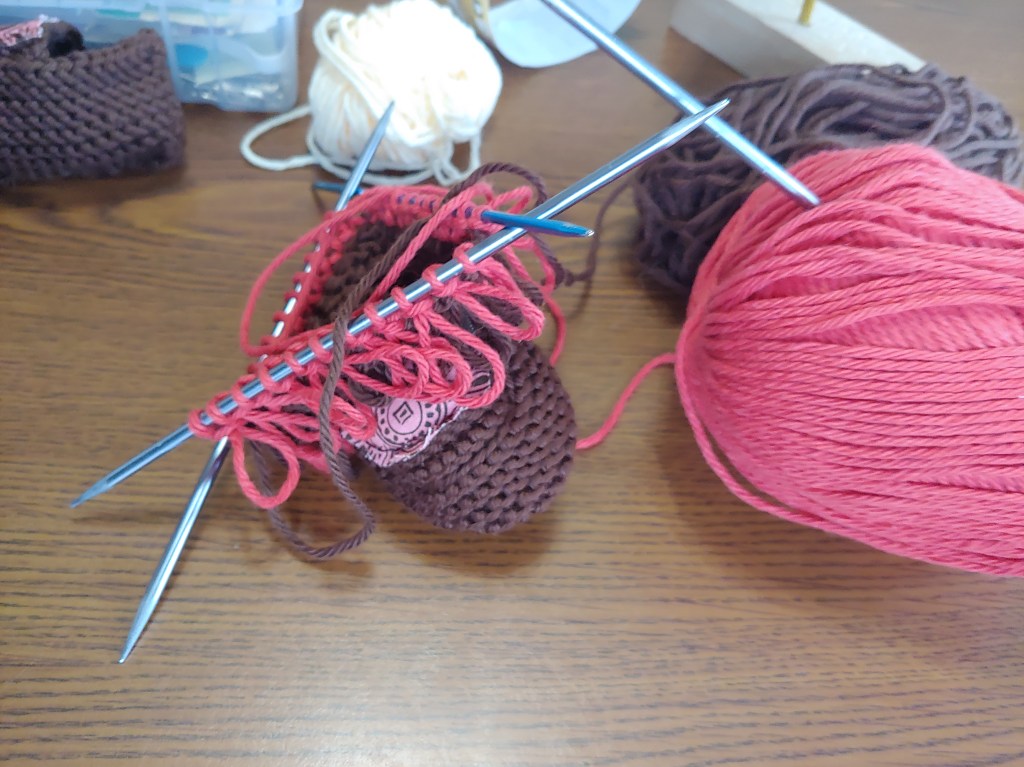
Then, you pick up stitches around the open edge of the moc and start “making a loop” on every stitch every round or two. This pattern taught me the “make a loop” technique, which is pretty cool. It was at this point that I started switching out the colors, partly because I didn’t have enough yarn of just one color. I actually ran out of white cotton yard and had to sub in wool for the last few rounds on one moc.

You do that for a while, and, voila! it’s time to knit four rounds of rib and cast off. Then you cut the loops and even up the fringe.
I don’t actually know how easy or difficult these are to put on a baby, because I’ve never heard back from any of the moms I’ve given such mocs to. But I have a feeling that this time, I’m going to get lucky.
Here is another pair that I made with a different color scheme.


I stuff gift paper into them, to get them to hold their shape and stand up.
Merry Christmas!
Were you bitter, Zechariah? Many fruitless years had you
asked and asked God for a child, just to see your prayers fall through?
Standing slack-jawed at the altar, towering o’er you, Gabriel’s face:
not a chance you could have doubted God’s real power in that place.
But those dark years were your downfall, and your anger was your sin.
Now’s my chance, your sad heart whispered, Just to get one good dig in.
“It’s too late — You should have given us a baby long ago!”
Any man could understand it, but not the angel Gabriel.
Bitter mouths ought to be silenced, so the angel struck you dumb.
And so, dazed and unhappy, out into the light you come.
In a comedy of errors, Luke says you “kept making signs,”
till those gathered came to realize God had come to you inside.
Sometimes silence is a blessing. Yours was not empty but full
as you watched your once-hard neighbors come to wish Elizabeth well,
like an acorn dead below ground till its time comes to unfurl.
Nine months dumb, your mouth was ready to unsay its bitter ways:
Ready to croon to a baby, ready to explode in praise.
What, oh what, will I do to fill the days that are usually taken up with errands and housecleaning and laundry and Max and Ron and their various time-sucking wants and needs? Don’t for one minute think I don’t absolutely adore my life as a wife and mom. But even the best lives need a vacation and, let’s face it, renting a house with your family at a ski resort is NOT a vacation. It’s basically moving your life from one location to another. Unless someone else is making the beds, doing the laundry, and cooking, it’s just the same old life with the added inconvenience of not knowing where anything is in the kitchen.
from Class Mom by Laurie Gelman, page 219
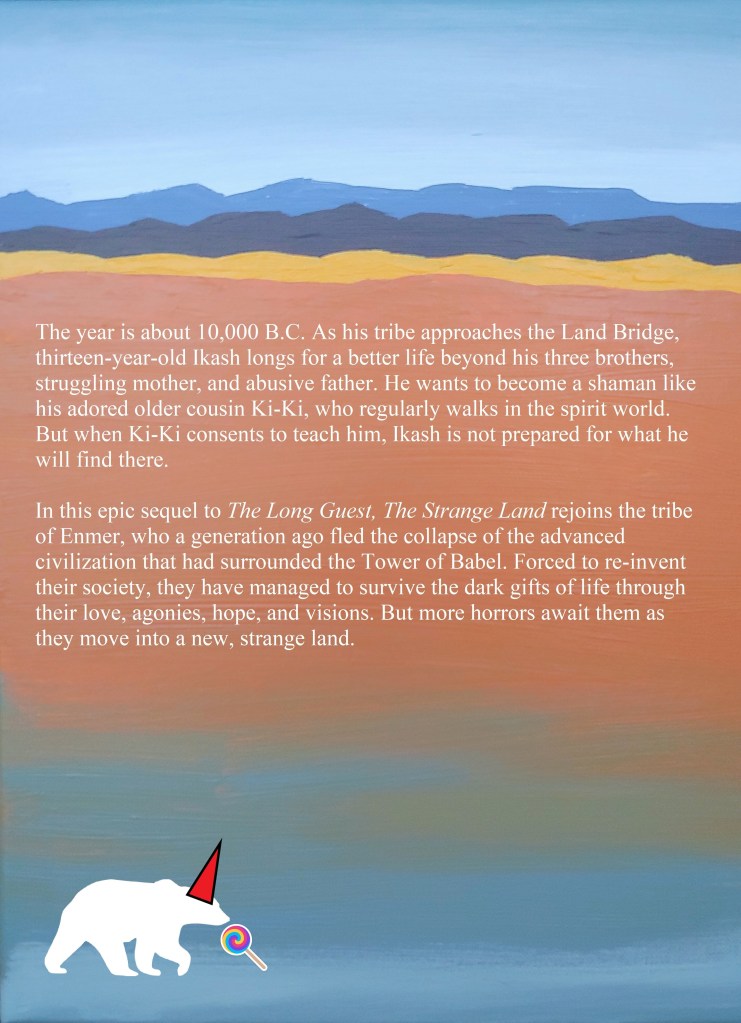
It’s my book’s birthday! Here is The Strange Land‘s back cover. In the spirit of birthday, I have given the bear a lollipop and a party hat. (Hey … it’s better than some other things she could be eating!)
Hope this is not too silly for you. I just figured that faithful blog readers have already seen so many pictures of The Strange Land leading up to today’s release date.
Now you can buy The Strange Land on Amazon or on Bookshop. And, if you have already pre-ordered it (thankyouthankyouthankyou), it should start shipping out to you soon.
If it happens that you have not read the first book in the series, The Long Guest, you can buy it here or here and read it as a prequel. (I decided not to photoshop a birthday hat onto Nimri. You are welcome.)
The release date for The Strange Land was chosen in honor of my father, who turns 70 in conjunction with the book coming out. Happy Birthday, Dad! I am a natural reader and probably would have discovered books without your influence, but luckily, we never had to find out whether that would be the case. Instead, your gift for languages, sense of humor, love for literature and the extremely print-rich environment you provided were perfectly in line with my gifts and interests and gave me a huge leg up on eventually becoming an author, not to mention many hours of culture and enjoyment, and a safe environment in which to develop. It is safe to say that without you, the world would never have been introduced to the universe of the Scattering Trilogy. Now you are 70, which in the world of the Scattering means you are barely middle-aged. May you live to be 130, like Nimri. I love you!
Reality continues to ruin my life.
Calvin & Hobbes

 Out of Babel Books