
I’ve posted before about the “Big Five” personality traits. Though I like personality typologies such as the MBTI, almost all of them come from a pre-existing theory the researchers have and then seek to impose on the data. The Big Five are the closest thing we have to traits that emerged from almost pure data … that is, from casting a very wide net (in this case over adjectives used to describe people), and then seeing if those adjectives “clumped” around certain traits, and then eventually finding biochemical analogues to these traits in the brain. So says Jordan Peterson.
Since the Daily Wire made all of Jordan Peterson’s old materials available on their web site, I’ve been watching my way through a psychology class he taught about the Big Five. His lectures are always so rich and insightful, even if they do get a bit Jung-y, that they never fail to fire my imagination. And the traits never fail to remind us of people we know who are particularly low or high in each of them. Today, I thought it would be fun to name a character from my series who exemplifies each of these traits. All the technical information about these traits in the paragraphs below comes from my recent viewing of Peterson’s lectures.
Extraversion
Extraversion, according to Peterson’s lectures, basically means the person has a very active incentive/reward system in the brain. The basic impulse of extraversion is “There’s a good thing … I’m going to go and get it.”
Nimri (later, Nirri), the main character in The Long Guest, is high in extraversion. Though paraplegic and living basically as a prisoner of people he can’t communicate with, he remains as active as he can, doing arm exercises, keeping a journal, and continually seeking to expand his sphere of activity and influence as much as possible.
Neuroticism
Neuroticism is the technical term for “high sensitivity to negative emotion.” In Peterson’s evolutionary terms, this is the brain system that keeps prey animals alert and hence alive. Statistically, women tend to be higher than men in neuroticism. There are obvious reasons for this: they need to be hair-trigger sensitive to the distress of their babies, and in fact, the world is a more dangerous place for a woman, especially if she is caring for an infant.
However, in my books, Exhibit A for neuroticism is a man. Enmer is 30 years old when an apocalypse hits his society. His father is killed, and Enmer becomes the new head of the family. He feels the burden of keeping them safe very keenly, and when subsequent disasters hit the family, Enmer enters a deep depression with which he will struggle for years.
Enmer is also high in conscientiousness, but we have another character to exemplify that for us.
Conscientiousness
Conscientiousness is made up of two sub-traits: industriousness and orderliness. Industrious people feel bad if they are not working on some task. The evolutionary (or design) usefulness of this trait to the community is obvious. Orderly people like things to be in neat, known categories. This plays on the fear system in the brain, where the unknown or chaotic constitutes a threat.
Though it might seem that being very conscientious would be a miserable experience, under normal circumstances conscientious people have lower levels of anxiety than less conscientious people. Peterson’s theory is that this is because conscientious people tend to order their environment well, which reduces levels of anxiety compared to people who live in a disordered environment (even if they think they like it). Conscientiousness is also a good predictor of overall life success.
Hur is a very conscientious character. He is small, fair-haired, and not very prepossessing, and he starts the series as a slave in Enmer’s household. But he has all kinds of skills, including being a good shot with a bow and knowing how to make bows and arrows. He takes advantage of the apocalypse to demand his freedom and soon becomes the tribe’s go-to guy for both hunting and security. Eventually, he becomes tribal cheif.
Agreeableness
Agreeable people like to please other people and keep relationships good. In any given situation, they will not necessarily ask themselves what they want (or even, in some cases, be aware of it), but will just do what other people want them to do. Statistically, women tend to be higher than men in agreeableness. Being very agreeable is a necessity when you are caring for an infant, as the infant’s needs must always take priority over your own. It does not, Peterson points out, prepare you well to function in an out-of-the-home work environment. You tend to get taken advantage of.
Sari, one of the main characters in The Strange Land, is an agreeable wife and mother. She spends years living with an abusive husband, trying to keep the household running and to mother her children as best she can. When a crisis hits, she does not know how to ask for help and does not want to inconvenience others.
Openness (to new experiences)
Open people are adaptable. If there is a major crisis, you want some people who are high in openness around, as they will handle it better than someone who is very high, for example, in orderliness. Openness plus fluid intelligence is a good predictor of a person’s creative output.
Zillah, who is a main character throughout my entire series, is high in openness. She is the one who encourages the family to take in the injured foreigner Nimri when they stumble upon him as they are fleeing the Tower of Babel apocalypse. She adjusts to the new reality and accepts it far more quickly than Enmer, who never really comes to terms with it.
Though Zillah is not a “creative” person in the sense of producing visual art and music, she shows a great deal of creativity in the way she cares for her extended family, responding to crises, delivering babies, and bearing the brunt of caring for Nimri, including learning to speak with him. She becomes the tribe’s medicine woman and builds up a store of medical knowledge, and she is always on the lookout for someone who needs help.


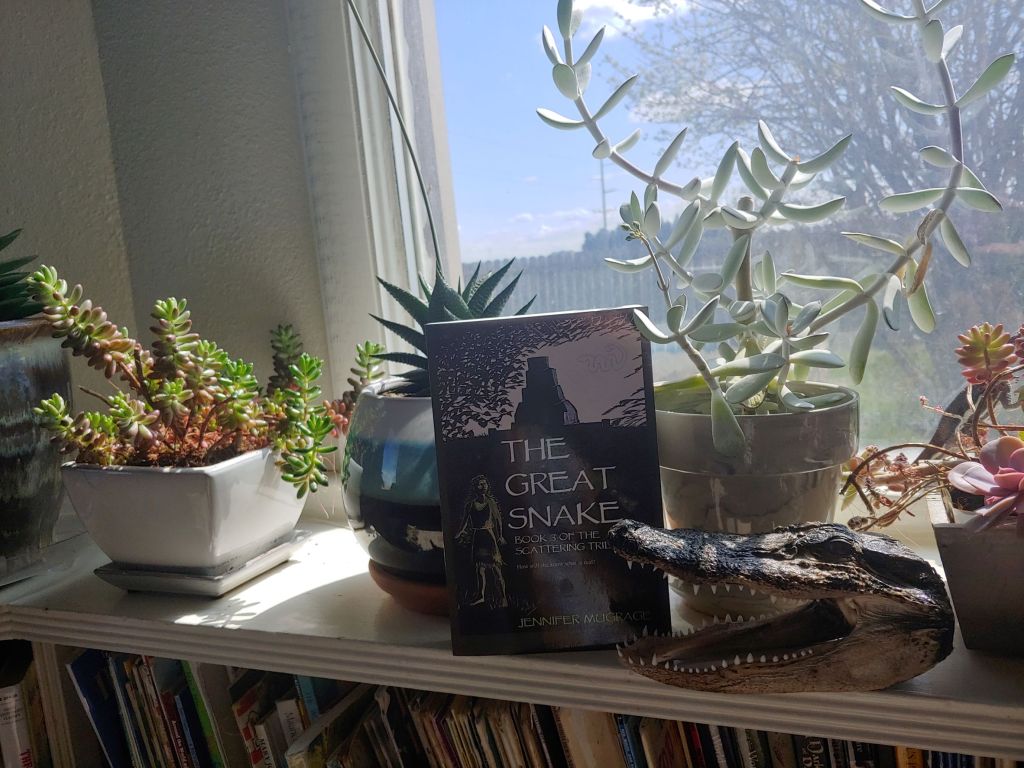





 Out of Babel Books