
Charles Fillmore, the cofounder of Unity, wrote an entire book called Prosperity in 1945 about lessons and laws of abundance. He even changes Psalm 23 to say, “The Lord is my banker. My credit is good … Though I walk in the very shadow of debt, I shall fear no evil … Thou fillest my wallet with plenty.” Can you believe it?
Happy Lies, by Melissa Dougherty, p. 158
Tag: rants
I Got Nominated … Sort of

(Is the above really the latest Sunshine Blogger Award logo? Looks kinda messy.)
So, Bookstooge sort-of-nominated me for the Sunshine Blogger Award! Thank you, Bookstooge! I am so flattered. I think his exact words were, “If you’re reading this, consider yourself nominated, because it means you have a pulse.”
Rules For The Sunshine Blogger Award:
- Display the award’s official logo somewhere on your blog.
- Thank the person who nominated you.
- Provide a link to your nominator’s blog.
- Answer your nominators’ questions.
- Nominate up to 11 bloggers.
- Ask your nominees 11 questions.
- Notify your nominees by commenting on at least one of their blog posts.
Questions from Bookstooge:
- Why Would Anyone Consider Cereal to be Soup?
It’s because they are trying to categorize things according to algorithmic rules/decision trees instead of the way the human mind normally works, which is by constructing a schema for the thing in question and then eyeballing it.
With schemas, if the thing mostly resembles the schema, it is considered an instance of that thing, even if it misses checking some important boxes. And if it checks all the boxes but manifestly does NOT resemble the schema at all, then it’s not an instance of that thing.
Cereal is in the latter category. It’s an ungodly modern creation of Mr. Kellogg, who believed that eating meat was morally wrong as well as unhealthy, and sought to banish it from the breakfast table. And I say this as someone who very much likes breakfast cereal, particularly as an evening snack, even though I know it has wreaked havoc with my metabolism (see question #10).
2. Why Do You Blog?

I blog to get you interested in my books. Go buy ’em. BUT, warning, don’t buy the Kindle version of The Strange Land until the end of next week, when it will cost 99 cents because of a special promo.
3. How Do You Justify Your Existence? (I got that one from the Tales of the Black Widowers, good isn’t it?)
Yep, it’s a good one.

“So God created man. In the image of God created He him, male and female created He them. And He said to them, ‘Be fruitful and multiply, fill the earth and subdue it. Rule over the fish of the sea and the birds of the air, the cattle and the creatures that move along the ground.'”
Edit: By quoting this passage, I am NOT asserting that the only justification for our life is to reproduce … i.e., that your life somehow has no meaning if you are not a parent. I happen to have been given three children, but that’s God’s gift to me, not mine to Him. No, the point of quoting this passage is this: I justify my existence because God made me. He made us. He wanted there to be people. He wanted us to exist as male and female. And, per the latter part of the passage, He wanted there to be a lot of us. If you exist and you are a human, He is happy about that.
4. How Do You Choose Who to Follow?
Unfortunately, I’m a lot like Trump in this way. If you say nice things to me, I like you and then I follow you.
An alternative route is that you posted something that really interested me. This usually means book reviews, discussion about writing, theology, ancient history, and sometimes art.
5. If John McClane and John Wick were tied on a railroad track and you could only set one of them free, which would you choose and why?
O.K., I had to duckduckgo him, but John McClane is the Bruce Willis character in Die Hard. I would save John McClane instead of John Wick for the following reasons:
- John Wick could definitely save himself.
- I only saw the first Die Hard, but in it, John McClane is a family man, whereas John Wick doesn’t even have a dog anymore.
- Once when we were in Indonesia, somebody swore that my husband looked exactly like Bruce Willis and now I can’t unsee it. That makes me think Bruce Willis is even more handsome.
6. In a game of Parcheesi, who would win, Spongebob Squarepants or the Doom Slayer?
I expect Spongebob to win in the same way that Bugs Bunny would.
7. Do you feel guilty about all of my oxygen that you are breathing?
Yes. My gosh, don’t remind me!
8. What is your favorite movie?
It’s a tie between The Princess Bride and a little hidden gem called Undercover Blues.
9. If you were going to be “accidentally but on purpose” killed tomorrow, how would you spend today?
I would write long letters to each of my children. If I had extra time, I’d move on to my husband, then other close family and friends.
I might try to transfer the rights to my books so they don’t go out of print, but I don’t think that could be done in one day. If you snooze, you lose, and I guess I snost and I lost.
10. Are mirrors Friend, or Foe?
Friend, but only in the sense of “faithful are the wounds of.”
11. If you could change ONE THING about your blog, what would it be?
Every single visit to my blog would result in a book purchase and then a breathless review on Amazon GO BUY MY BOOKS PEOPLE!
Ahem. I Nominate:
I nominate seven friends (the number of perfection!) plus Bookstooge cause I want to hear his answers too. And I nominate you, Reader, if you want to do it! After all, you are breathing! Which might provide the answer to my first question!
- Eustacia
- Fran
- Jacqui
- Diana
- Snapdragon
- The Orangutan Librarian
- Chris
- Bookstooge (It’s a boomerang tag!)
To Answer These Questions:
- What is the best gift God has given you?
- Without sharing details you don’t want to share, how did you come out of your darkest hour/day/year?
- What kind of biome would you most prefer to live in (one that can be inhabited by people)?
- In real life, how are your social skills (and do you have any tips for me haha)?
- What is your favorite genre of fiction?
- Do you ever read nonfiction and what makes you pick it up?
- Tell me one nice thing about your grandparents.
- If you could speak any language, ancient or modern, fluently besides your native one, which one would you choose?
- What are your feelings on the Harry Potter series?
- Do you have a favorite YouTuber/podcaster? What do they talk about? Now’s your chance to promote them!
- When did you first seriously consider the claims of Jesus of Nazareth? If you never have, would you do me a solid and consider doing so?
Words That Mean Things, Part I
- kill — This means to cause to die.
- murder — Murder has to have the following components: direct killing, of a human being, intentional, and unlawful. Therefore, the following things are not murder: Executing someone who has committed a capital crime (lawful). Killing an enemy soldier in war (lawful). Accidentally killing civilians in war (unintentional). Shooting in self-defense (unintentional, and in the case of a firefight, indirect). Killing an animal, even a highly sentient animal (not human). Being unable to provide prompt medical care for someone who is OD’ing while in your custody (not direct or intentional, and also not actually killing).
- genocide — direct, intentional, systematic killing of an entire ethnic group, with the express purpose of wiping them out. Not genocide: a war that has a devastating impact upon a particular ethnic group, unless all the abovementioned components of genocide are present. Invasion and conquest. Intermarriage. Taking captives. Poverty. Death of a culture because of any of these causes or because of urbanization. All of these are tragic things that have happened to many, many ethnic groups throughout history, but they are not genocide. Definitely not genocide: natural cultural change that happens because of the spread of an innovation like the written word, or a new religion.
Lunes Latin: The Mystery of the Helping Verbs
Here’s the latest bulletin from my adventures in trying to read Julius Caesar’s Gallic wars.
Caesar’s sentence:
… et regno occupato per tres potentissimos ac firmissimos populos totius Galliae sese potiri posse sperant.
Here’s the English translation given in the book:
“… and hope that, when they have seized the sovereignty, they will, by means of the three most powerful and valiant nations, be enabled to obtain possession of the whole of Gaul.”
Here’s my bumbling translation:
”… and having seized the kingdom, through three most powerful and brave peoples, they hoped to be able to be made able to all of Gaul … um … ones.”
Let’s zoom in on the phrase I am having trouble with:
sese potiri posse sperant
Now, this looks to me like “they hope [sperant] … to be able [posse] … to be MADE able [potiri] … ones [sese].”
Is it really “they hope to be able to be made able”? That’s just a ridiculous amount of helping verbs. It reminds me of the man quoted by Dave Barry, who allegedly said to his wife after she couldn’t get a ride, “If I’d a’ known you’d a’ wanted to went, I’d a seed you’d a’ got to get to go.”
But let’s look up potiri. I think it’s the passive infinitive of posse “to be able,” but maybe it’s something else.
[Duck-Duck-Go]
Ah-ha! It’s a different verb.
potior, potiris, potiri I, potitus sum (Dep.)Verb
user edited
Translations
| to obtain, to acquire, to grasp, to attain, to reach (goal), to come by (experiences) |
Source: https://www.latin-is-simple.com/en/vocabulary/verb/5550/
OK, so now we have:
“They hope [sperant] to be able [posse] to acquire it [sese potiri] the whole of Gaul [totius Galliae].”
Huh. Looks as if Franz Ruedele knows what he’s doing after all.
For those wondering, it looks as if posse does not actually have a passive infinitive.
Follow me for more deep Latin mysteries! Meanwhile, I’ll be sitting here, throwing in helping verbs until it just feels right.
A Return to Modesty at 26

So, I’m reading A Return to Modesty, which I stumbled upon in my dad’s extensive personal library.
This book came out in 1999. I remember hearing about it at the time. I was a Christian girl in my early 20s, just a year away from getting married though I didn’t yet know it. Wendy Shalit, the author of Return, was just a year older than me. I remember being jealous of her (a girl my age who had already published a book!). I also remember that it was rather snippily received. One female reviewer mentioned that it was difficult to take “being lectured to about modesty by a 24-year-old.”
That, of course, is not a coincidence. As Shalit points out in the intro, modern sexual-liberation-niks don’t just disagree with modesty-niks; they actually hate them:
I was fascinated … with the way others would react to them. People around me were saying that these modestyniks were really abuseniks: This one was “obviously very troubled,” and that one seemed to have a “creepy” relationship with her father. Or “Maybe she just had a Bad Experience.” Either way, whatever her problem is, “why doesn’t the poor girl just get some counseling already, and then she won’t take it all so seriously?”
I really became intrigued when I offhandedly mentioned my interest in the modestyniks to a middle-aged man at a cocktail party, and he screamed at me, turning almost blue: “They’re sick, I’m telling you! I’ve heard of them with their not-touching, and they’re sick, sick, sick!” Someone later informed me that this man had been divorced three times.
I began to perceive a direct relationship between how much one was floundering, sex-wise, and how irritated one was by the modestyniks.
ibid, pp. 5 – 6
By writing this book, of course, Shalit put herself among their number. She notes that feminists are often open to what she has to say about women needing privacy, dignity, and romantic dreams of a monogamous relationship … until they find out that she’s an “extreme right-winger,” that is, someone who thinks female modesty (and chastity and reticence and embarrassment and all the other things that come with it) is a good thing.
Shalit first learned of what she calls modestyniks by looking at engagement, wedding, and post-wedding pictures of an elderly couple’s granddaughter, who was following “tzniut, the Jewish laws of sexual modesty.”
In this [picture] the granddaughter was on the beach holding a little baby boy–only now her modestynik smile was twinkling under the brim of a black straw hat. “That’s for the head covering,” her grandma piped up proudly over my shoulder. “A married woman cannot leave her head uncovered.”
That’s how I learned that there are different stages in the life cycle of a modestynik. No Touching, Touching, then Hat.
ibid, p 4
All the reviewers who in 1999 were reacting to the thesis of Shalit’s book were so excited–or offended– by its serious content, that they failed to convey that Shalit is a terrific writer: spunky, funny, able to move from chuckles like this to very serious and heartbreaking content, and back, multiple times in the same chapter or even on the same page.
When I picked up this book from my dad’s library, in preparation for drafting my own book on the logistics of modesty (a project now shelved), I thought I might just thumb through it. I didn’t expect that it would lure me in, as books do, and prove to be a page-turner. But it has.
I won’t go over all the ways Shalit enumerates that the Sexual Revolution and second-wave feminism, by destroying the notion of female modesty, have opened Pandora’s Box for girls and boys both. I’ve ranted about it elsewhere, and so have many others. You could probably write such a rant yourself, and maybe you even have. I will say that it’s really poignant to read a book like this written in 1999.
The 90s are now officially A Long Time Ago. Cars from the 90s are now antiques (!). I am even starting to see memes that portray the 90s in a similar way that we once portrayed the 50s: a naive, wholesome time, when we didn’t have all the problems we have now. For example, one meme said something like, “The 90s were so problem-free that Kurt Cobain had to kill himself because he had nothing to be depressed about.”
As someone who came of age in the 90s, I cry foul. We were a good 30+ years after the Sexual Revolution and 20+ after Roe. We were deep into the divorce and moms-having-serial-boyfriends epidemic. We had anorexia and bulimia and cutting. Ninties kids did not have one foot in pre-1960s social norms; instead, we were completely unmoored from any kind of consistent or coherent framework for how to relate to the opposite sex, or even how to become a man or woman, except that we knew that both of those things were bad. Shalit’s book focuses on the destructive messages that girls and young women got:
Be independent. Don’t count on anyone. Have the low expectations you’re supposed to have. Be independent. Don’t ask any questions. Don’t demand more than what we say you can have. Don’t feel anything you’re not supposed to feel. Do as you’re told. Be independent! Don’t embarrass yourself by loving someone other than yourself. Remember, don’t trust anyone! Show him that you’re an independent person.
ibid, p. 94
… but of course, boys got a very similar litany about how they were not supposed to be polite or gentlemanly or, God forbid, protective of women, and in fact they were not supposed to take any initiative at anything.
They also were sadly unprepared for the fact that women have lots of emotions:
“My ex-girlfriends? Well, let’s see … she was a nut, and then she was a nut, and then her … let’s see … yes, she was a nut, and then … yeah, she was a nut, too, come to think of it! It’s strange that I’ve had such bad luck, to date so many nuts. Anyway, then there was what’s-her-name, who was evil. She left me. God, that really sucked! She was really evil! And then there was another nut …”
What makes a man perceive a woman as a “a nut”? And can all women be nuts? A silly question. Clearly all women can’t be nuts. What does it mean, then, when a society judges that a considerable number of its women are, in fact, nuts? Could it tell us something about how we view womanhood?
ibid, p. 163
If I had read this book in the 90s, I probably would have agreed with it, in a slightly superior, glad-you-finally-came-to-the-modesty-party kind of way, like the smug 20-something Christian know-it-all that I was at the time. I also would have missed a lot of the content that is now resonating with me. Because I’ve spent the 26 years since this book was published wrestling with these very issues and going on these very rants.
I might have been raised in a Christian home. I might have come up in a social environment that was relatively traditional compared to the secular one in which Shalit grew up. I even, somehow, escaped the super-explicit sex-ed elementary school classes in the public schools that Shalit was spared only because her mom found out what was happening, threw a fit, and got Shalit a pass to sit out that class in the library. (I’m not sure how I escaped the explicit sex-ed, to be honest. I went to public schools. Possibly it’s because our family moved a couple of times and school districts were on different schedules.)
But even with being–you would expect–sheltered, I still absorbed all the same messages she did, directly from the teat of society, as it were. As a Christian, I did get the message that you were supposed to be chaste until marriage (opposite of the message she got). But on the other hand I received, loud and clear, the picture of the ideal woman as tough, smart, independent, unconcerned about her clothing or appearance, ready to go join the Navy S.E.A.L.s … basically, a woman with a man’s mind and as close as possible to a man’s body. Girls who had their wedding all planned out at the age of 9 and had already picked out names for their kids, and who wore pink and giggled and blushed and so forth, were “stupid.” I’m a 90s kid, after all.
Anyway … the sad thing about reading this book is, almost thirty years later, nothing has changed. Shalit predicted a return to modesty among my generation. We were figuring out, she said, that modesty is natural to us, it protects us, it’s ultimately more romantic and even sensual. That was why, she said, we liked Jane Austen so much. And while I plead guilty on all charges, it turns out that longing for a return to female modesty has not been enough. You cannot just bring back an entire social system that is lying in smithereens at your feet. There weren’t any rules or norms or consensus about how a girl–or boy–should dress or talk or behave, and we didn’t know what to do. None of us knew what to do. And when I look at my kids’ generation, they still don’t.
Espresso Machine, Drama Queen
She ignored him while the coffee machine went through its noisy, dramatic performance in order to make a thimbleful of espresso.
Kate Atkinson, Death at the Sign of the Rook, p. 137
The Wind Farm
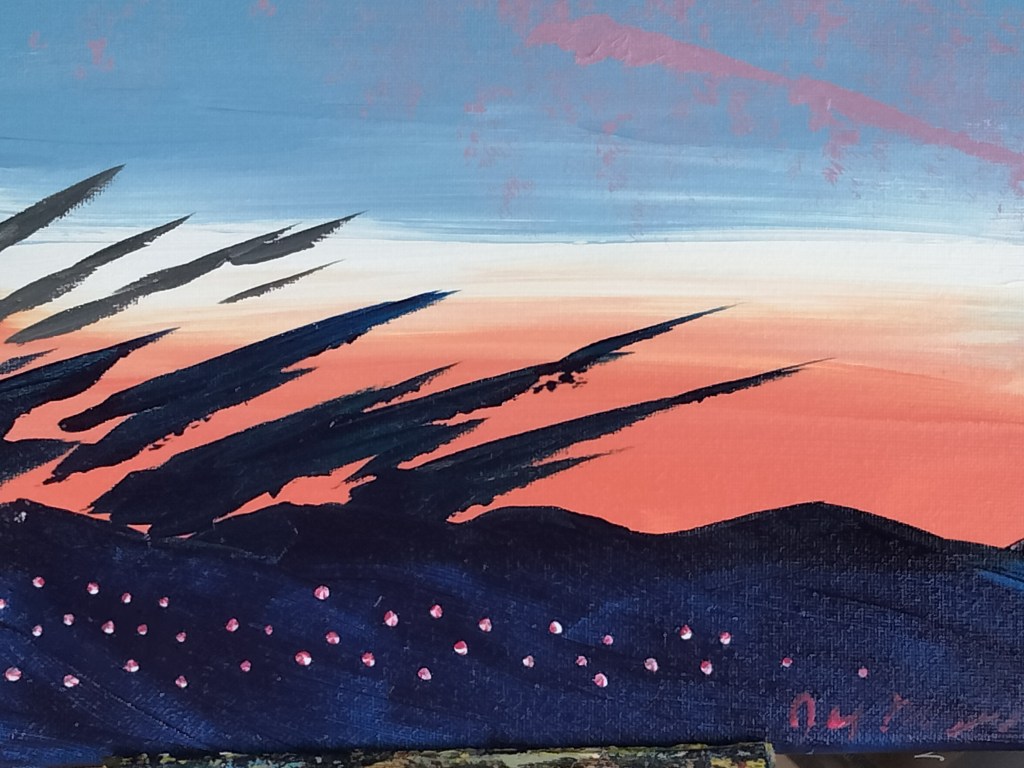
I live in the West, where you can see long distances. About twenty-five miles south of our house is wind farm perched on the foothills. At night, you can clearly see the windmills’ lights twinkling. This painting portrays a more close-up view, glimpsed as I started the drive home on a winter evening.
I never minded seeing wind farms, even in the daytime. I had a positive association with them, almost entirely because of the cover of a Petra album I had as a teenager:
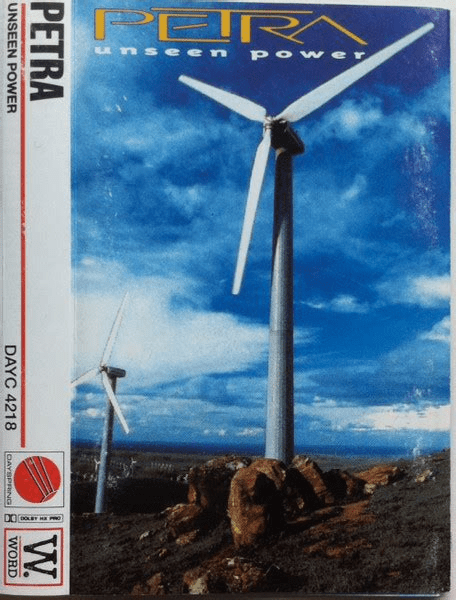
I also believed what I was told, that these windmills would provide cleaner power than oil, coal, and natural gas.
Then, I started hearing about the downsides of wind farms. I heard that people who live near them develop health problems. I heard that, shockingly, it is not unusual for birds to get chopped up by them. The windmills have to be built in naturally windy areas, which are also migration routes for birds, which are apparently hard-wired in to the birds and can’t be changed.
Then, I found out that these turbines are expensive to build, last only about twenty years, and are difficult to dispose of:
https://www.prageru.com/video/whats-wrong-with-wind-and-solar
And that they are extremely inefficient, and the energy they do produce has to be stored in costly batteries:
https://www.prageru.com/video/can-we-rely-on-wind-and-solar-energy
Which can only be made with rare-earth minerals that are obtained using child labor:
https://www.prageru.com/video/green-energy-fueled-by-child-labor
Yikes!
Unfortunately, my aesthetic response to these windmills has already been locked in by Petra. I don’t think it’s going to change. Now, though, I no longer think of them as a good thing, a step in the right direction. I think of them as evidence that we are living in a sci-fi dystopia. Maybe some day, the wind farm in my part of the state will come down. But this little painting will remain as evidence that I lived in the Age of Man when we feared the imminent end of the world and thought we could forestall it by building these things.
I Hope This Post Finds You Well

Well, we have made it through February, when I did a post about something I love every single week. Phew, I’m certainly glad that is over with! What a relief to get into March, and start writing about stuff I hate again.
Just kidding. I didn’t hate this book; in fact, I mostly really enjoyed it. It just wasn’t a perfect bull’s-eye like all the stuff I posted about last month.
This 2024 book is narrated by Jolene, a Canadian woman whose mother is Iranian-Canadian and who works in a regular, that is to say fairly miserable, office. She has social anxiety, a moderate drinking problem, a big cohort of Persian Aunties (her mom’s friends) who really really hope she will get married, and a dark trauma from high school. Oh, and she has a habit of adding passive-aggressive postscripts to her e-mails to her colleagues, hidden in white text.
One day she forgets to turn the text white, and that kicks off her madcap adventures.
If this setup sounds like it’ll be boring and full of self-pity, all I can say is it’s anything but. Jolene, despite her hermitlike ways, is a keen observer of human nature and is mistress of the witty, cunning turn of phrase, which is exactly what makes her e-mail postscripts so devastating, and this narrative so fun to follow.
This little human [baby] doesn’t even realize the greatness of this: the only time in your life when people will simply ignore your public outbursts. The rest of us must cry without actually crying. This child, I learn as Celeste continues to soothe it, is named Thomas. I watch his little eyes dart around the room, taking it all in. Maybe Thomas is just now realizing that eventually he will grow up to spend all his daylight hours under fluorescent lights and water-stained ceiling tiles.
I don’t mean to chuckle at this depressing thought, and I stifle it as soon as I can, but that doesn’t stop a few eyes from drawing my way while I pretend I didn’t just cackle at a technically crying baby.
Then Thomas begins being passed around like a hot burrito. I curl my hands close against my chest and try to back away. When Caitlin takes said bundle, it stops crying in an instant, and her face softens in a way that makes me realize how hard it’s been lately.
“So, how is being a mom?”
Celeste starts describing things that sound dire as sh-t.
Gregory randomly pokes the ——- baby in the belly, and the cries start again in a screeching pitch.
Has anyone ever punched him in the face?
“How was the birth?” Stu for some cursed reason has to ask. I take a step back in order to avoid sticking around for Celeste’s answer.
Rhonda flashes me a disapproving stare. Why is it socially acceptable to discuss a human getting pushed or cut out of a body, yet somehow, it’s unprofessional for me to simply work rather than hold the tiny person I don’t even know?
page 102
That’s a pretty good sample of the writing style — and also a pretty good, lively description of what it’s like to be a woman with social anxiety or maybe autistic tendencies. Very very relatable.
I finished this book very quickly because of the good writing. However, it’s not uplifting or heartwarming. Jolene is engaging in some pretty significant deception throughout almost the entire book, which made it hard to enjoy. She’s under a lot of stress with several different crises bubbling (including one with the Persian Aunties), which keeps the pace fast, but makes the read also stressful. I knock off one star for this dynamic and for the author’s use of the phrase “white-passing.”
Fun thing to Do in February: AI Scavenger Hunt
Remember how, when AI first came out, it couldn’t make human hands? And how now, it can?
This fun activity may quickly become obsolete as AI continues to improve, so enjoy it now, in this golden era.
This is something my son and I figured out is good for a laugh together.
- Start scrolling through pictures of beautiful cottages and tiny houses – say, on Pinterest.
- Find one that’s AI generated.
- How will you know?
- The first impression will just be, “Beautiful house, maybe not very practical though!”
- But as you look closer, you will find things that don’t make sense.
- What is that giant spool of thread doing embedded in that step?
- Why is that one step so tall?
- How did the flower from the flower bush get on the nearby pine tree?
- Is that an arch or a window?
- Hey, the shutters don’t have a window or door near them!
- That’s not a table with flowers on top … it’s a hoop on legs with tall flowers coming up all the way through it!
- What even is this object? It appears to be the sort of thing that AI thinks humans are likely to have lying around.
- Keep doing this until you are in hysterics.
- Wonder why you did not see all this stuff on the first glance.
Have fun!
For Your Viewing Pleasure
Welcome to February! This February, instead of doing a bunch of posts about the gooey stuff (after all, we already read a Barbara Cartland), I’ll be doing posts about stuff I love. I hope you will love it too, and that these posts and the resources they direct you to, will bring joy to your bleak February.
If you have not seen the debate below, you are missing a treat. It may be the most entertaining debate in history, at least for those who have any interest in the Bible, ancient history, or textual criticism.
It’s two hours long, but you could just watch the first hour and be entertained. Or, you could watch it in half-hour snippets for your nightly giggle. Then it would be sort of like watching a reality show, if one of the participants on the reality show was an adult who knew what they were talking about.
Billy Carson, a prominent YouTuber who pushes a Gnostic/neopagan version of the Bible, monologues until fact-checked by an extremely patient Wes Huff, an actual New Testament textual scholar. The moderator interrupts periodically to ramble about how much he loves Jesus because Jesus got rid of all the old sexism.
No matter who has just spoken or how long a turn they have taken, Huff manages to give them a response that is calm, respectful, and adds actual biblical knowledge to what they have just said.
You’re welcome.
 Out of Babel Books