The Curiously Affirming Female Figurines of Ancient Europe

Trigger warning: statue of a naked fat lady

This post is the second in a series of posts based on chapters from this book:
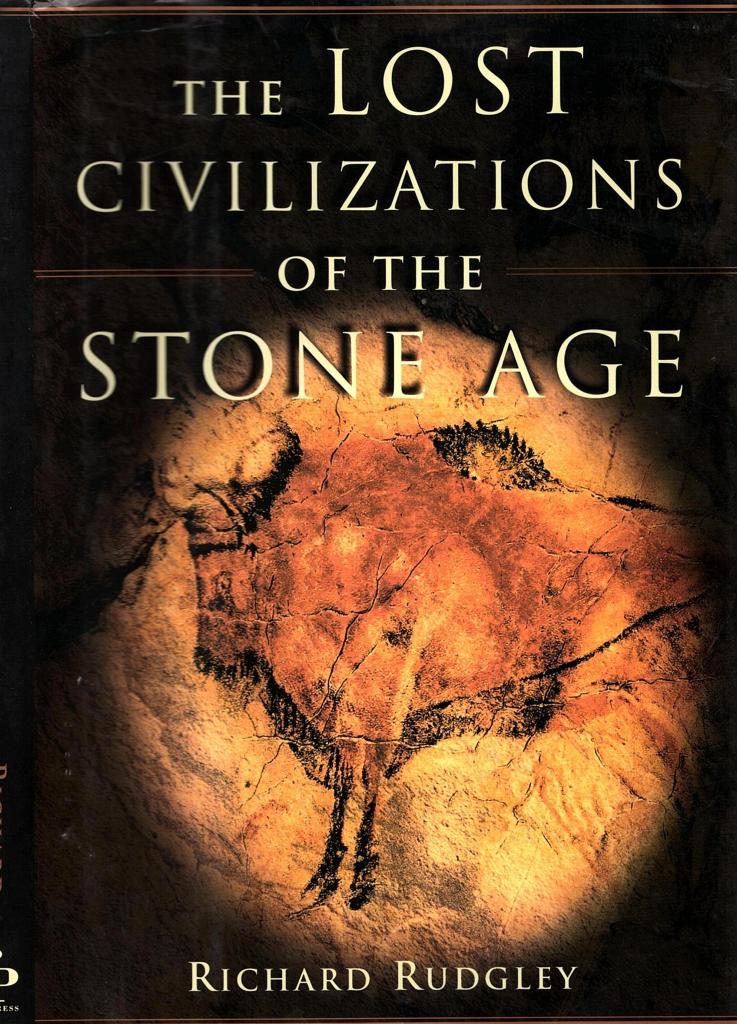
The Lost Civilizations of the Stone Age by Richard Rudgley, Touchstone, 2000.

As Rudgley writes in the Introduction:

In this book I will show … how great is the debt of historical societies to their prehistoric counterparts in all spheres of cultural life; and how civilised in many respects were those human cultures that have been reviled as savage.

Ibid, p. 1

What do you mean, “Stone Age”?

“Stone Age,” of course, sounds very ancient, and that is by design. But when Rudgley talks about the Stone Age, often the dates involved are “only” about 12,000 to 10,000 years ago (approximately the time we think that people were crossing the Land Bridge). This falls before the beginning of recorded history — we think — unless we are willing to accept local origin myths worldwide as inevitably garbled historical records. After the small amount of study I have done about the historicity of myths, of Genesis, and of the many amazing prehistoric engineering feats, I no longer think of Stone Age people as “cave men,” but rather as fully modern humans, certainly our intellectual equals and probably our superiors. For my disclaimer about the dating of archaeological sites and prehistoric events, see my last post about Rudgley, here.

The “Venuses” of Eurasia

Chapter 14 of Rudgley (pp 184 – 200) discusses the large number of small female figurines which have been found all over Europe and as far east as Siberia. These are called “Venuses,” though of course they would not have been called that by the original artists. They were being produced (if we take the dating at face value) over a period of many thousands of years.

The oldest one, according to Rudgley, dates to the Aurignacian age, about 31,000 years ago: “the Venus of Galgenburg [Austria].” It is 7 mm tall, made of a soft green stone, and is artistically sophisticated. The figure is posed as if dancing. She is bearing her weight on her left leg. The right leg is carved free of the left and braces on the base of the figure. The right arm is carved free of the body, with the hand bracing on the knee. Clearly the sculptor knew what he or she was doing when it came to posing the figure, carving free limbs that would not break off, and piercing through the material without breaking it. Since this is (by hypothesis) the oldest such figure that we have, it’s clear that we don’t have a case of an artistic tradition that started out crude and later became more advanced. (pp 192 – 194)

Probably the best-known of these figures is the Venus of Willendorf (also found in Austria).
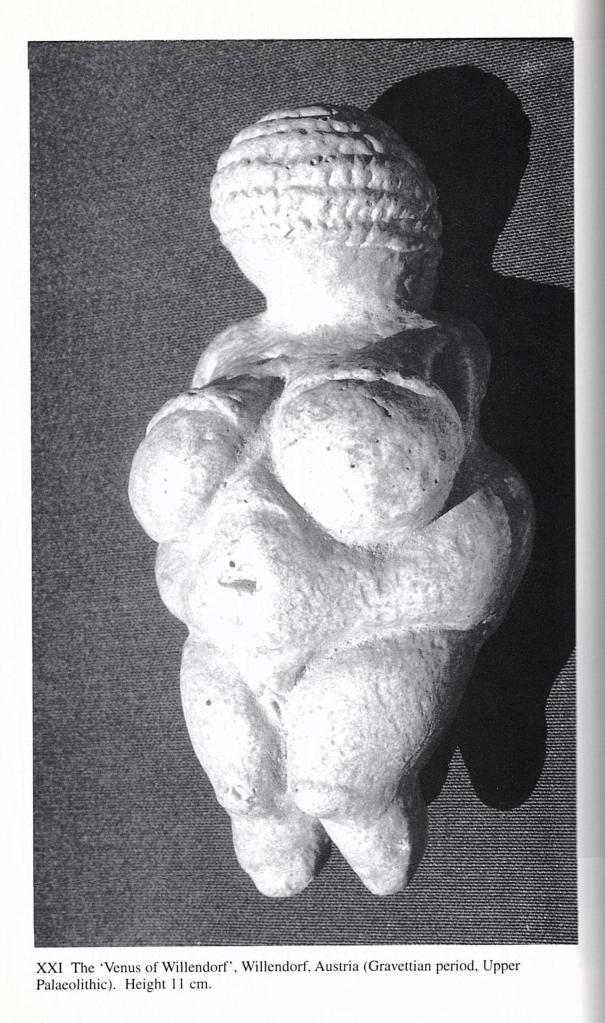
When I was first exposed (pun not intended) to this little figurine, it was introduced to me simply as “the mother goddess.” Although shocking to modern eyes, it is certainly a work of art. As you can see, it has no face, but it has a considerable amount of detail in odd places such as the knees, private parts, and hairdo. The hair looks a bit like corn rows to me, but could also be braids wrapped around the head or even styled curls a la the Babylonian kings. “Alexander Marshack believes the coiffure of the Willendorf figurine may be one of the symbols of a mature and fertile woman” (198).

Not all of the Stone Age Venuses are fat or naked.

Bednarik is very skeptical about the usefulness of lumping all female figurines of the period together, noting that they are extremely diverse in numerous ways. Some are naked; others partly or fully clothed. Some are in pregnant condition; others are not. Some are fat to the point of obesity, whilst others are very slender. Beyond the fact that they all depict females and most come from the same period of the Upper Palaeolithic, they appear to have little in common.

Ibid, p. 197

The Meaning of the Venuses

Figures like the Willendorf Venus are very intriguing to some people, for obvious reasons. The explanation most ready to hand is that they are artifacts of some kind of fertility religion. This explanation is the more intuitive because of what we know about the importance that fertility often plays in pagan religions worldwide.

Marija Gimbutas has taken these figures and other evidence to posit a wide-ranging “civilization of the goddess” in Old Europe. (She published a book with that title in 1991.) She deduces (or speculates) quite a lot about this religion from Venus artifacts and from other sources. Her thesis is that the gentle, goddess-worshipping Old Europeans were overrun by warlike worshippers of a sky god coming from the Eurasian steppes (i.e. the Indo-Europeans). Gimbutas’ work had quite a strong influence on one of my high school literature teachers, who emphasized to us that worshipers of a male sky god “always” come to rape, pillage and plunder, steal, kill, and destroy. (At this point, the neo-pagans in the class would give the Christians the side eye.) We will deal with Gimbutas in another post, probably later this year.

In Jean M. Auel’s Clan of the Cave Bear books, the venuses are definitely symbols of a goddess of fertility and sexuality. Her male lead Jondalar comes from a matriarchal society in western Europe where the figurines are referred to as doni. Jondalar, when distressed, will even exclaim, “Oh, Doni!” The female lead Ayla, meanwhile, was raised by Neanderthals, who in Auel’s books severely oppress their women (because, of course, they fear their procreative power).

Moving even farther along the continuum of being obsessed with sex, Rudgley’s chapter includes a hilarious discussion of how some archaeologists have gotten over-excited and begun to interpret nearly all Palaeolithic art as porn.

It has been suggested that another important aspect of Aurignacian art was their liberal and frequent use of sexual imagery, particularly … female genitalia. This theory was first developed by l’Abbe Breuil … The idea soon caught on among French prehistorians and became something of a dogma, and various shapes engraved in stone … that looked vaguely like a vulva were automatically perceived as such by scholars eager to discover further proof of the prehistoric obsession with sexual matters. … Perhaps the most absurd example of all is a description of a simple straight line as a representation of the vaginal opening.

Ibid, pp. 194 – 195

It just cracks me up that these were French prehistorians. Of course they were. Of course.

Rudgley sums up in a way that I think is quite reasonable and balanced:

[T]he fact that the figurines are found across a huge geographical area and a period of thousands and thousands of years means that it would be ridiculous to think that they all symbolised the same thing to their extremely diverse makers. It is quite apparent that the female body was used to express numerous concerns in Palaeolithic times. [198]

We can now see how any crude explanation of the Willendorf figurine as simply a fertility figure or an object of sexual desire is entirely inadequate. The representation of the female body during the Upper Palaeolithic period … was a symbol of cosmological significance that was able to express all aspects of Palaeolithic human concerns. [199]

If the female body was one of the most widespread and elaborate images of the Old Stone Age, and a symbol for the various forces of nature and the various aspects of culture, would it really be so far from the mark to believe that the figurines actually embody aspects of the Palaeolithic worship of a goddess? [200]

Rudgley, Lost Civilizations, chapter 14

… So, Why Are They Affirming Again?

Well, obviously, on the most superficial level, the Willendorf Venus is an implied affirmation to any modern woman who is pregnant, aging, or concerned about her weight. Somebody worked very hard to portray this lady.

On a slightly deeper level, our modern culture is one that really hates the idea of motherhood. We don’t like the idea that potential motherhood is a defining characteristic of being a woman, or that it might be a worthy or even glorious goal. Unfortunately for our tidy little minds, though, motherhood (besides being a kind of superpower) is in fact a built-in goal in the design of women. Which means that knocking it as a role and calling is pretty hard on women, even those who don’t realize it, because we, as a culture, are constantly asking them, in a thousand ways large and small, if for the sake of decency they could please not exist.

In this kind of environment, it’s a tonic to know that it was not always thus. There could exist – there apparently did exist – a culture that greatly valued, perhaps even worshiped, mothers. You don’t have to be an acolyte of the goddess to appreciate the boost this gives women.

Worshiping a good thing, rather than its creator, is idolatry and idols always turn on their followers. Thus, a religion of motherhood certainly would have come with its own distortions and injustices (such as devaluing infertile women, as we see in the Old Testament). But still … it’s nice to know that at one time a mature, even obese woman was considered a thing so good that she could possibly be worshiped.

I am dealing with this topic not because I feel a particular affinity for it. I don’t enjoy looking at the Venus of Willendorf, and despite the paragraph above I would not want to look like her. I tackled these figurines because my area of interest is prehistory, and durned if they don’t show up in it. Finding out how affirming they are to women was just an unexpected bonus. And if they do feel really weird even as they are affirming, I think the weirdness comes because they are from such a different culture.

Stone Age Surgery

Photo by Renato Danyi on Pexels.com

Trigger warning: Stone Age surgery!

This post is the first in a series I have planned about prehistory. Each post will draw on one or more chapters from the book The Lost Civilizations of the Stone Age, by Richard Rudgley, Touchstone, 2000. From the front flap:

Our long-held myths are exploding. Recent discoveries of astonishing accomplishments from the Neolithic Age – in art, technology, writing, math, science, religion, and medicine, and exploration – demand a fundamental rethinking of human history before the dawn of civilization.

Lost Civilizations, inside flap

So, Rudgley’s thesis is basically that there was, in fact, civilization long before there was civilization. That is, of course, also a theme of this blog. “Ancient people were smarter than we think,” or that art, literature, science and civilization are the natural state of human beings and have been present (ebbing and flowing of course) as long as there has been humanity.

A near-universal theme in the mythologies of the world is that the present state of the world, and more specifically the social world, is in decline — a fall from the Garden of Eden or from a Golden Age. Modern civilization has turned these traditional mythological assumptions on their head and written a new script, one based on the idea of social progress and evolution. In this new mythology the notion of civilization (as it is generally understood) replaces Eden and this novel paradise exists not at the beginning of time but, if not right now, then just around the corner. Civilization is … presented as the final flowering of human achievement born out of a long and interminable struggle against the powers of darkness and ignorance that are represented by the Stone Age.

Lost Civilizations, Introduction, page 1

I have come to believe in the ancientness of civilization because I take ancient documents seriously as historical records: Genesis, primarily, but also the other legends and myths from around the world which Rudgley mentions in his intro. This suspicion that ancient people were much smarter than we give them credit for was further strengthened as I learned about some of their building projects. Now Rudgley is presenting archaeological evidence that they knew far more than we suspect about art, mathematics, the natural sciences, and medicine.

Disclaimer about Dates

By the way, I don’t have a coherent way to sort out which archaeological dates to accept and which ones to doubt. As far as I can tell from my reading, all methods of dating archaeological sites are based on some form of dead reckoning.

Carbon dating depends on certain assumptions about rates of molecular decay, which can’t be proven in the first place and can also be thrown off universally or locally by events such as a comet strike. Carbon dating also seems to be less reliable the farther we go back in time.

Dating by archaeological layers also depends on assumptions about different historical periods and what might be diagnostic of each, except in cases where a site can be reliably linked to a known historical event (which is obviously only the case for relatively recent sites). Other than that, it’s all dead reckoning.

Dating events in human history by the use of genetics depends upon assuming that all genetic differences evolved and assuming certain rates of change. Historical linguistics has the same problem.

Finally, historical records such as the genealogies found in Genesis and in the oral traditions of other peoples worldwide hit only the highlights of a family line and don’t give us any idea how many generations were skipped.

Each of these methods can be pretty convincing in specific cases. It is even more convincing when one or more methods converge, yielding the same date range. But even when that happens, it’s still just one method of dead reckoning appearing to validate another. And most often, different dating methods contradict each other. If a plurality of them converged on one timeline for human history, maybe we could accept that. But they don’t. It’s complete chaos.

I would love to present a clever, coherent, data-grounded rubric for sorting all this stuff out. But I’m not a professional in any of these fields. Even if I were, the pros don’t all agree with one another. It’s starting to look like, in order to have a sorting method that makes sense, I would have to do full-time research for several years. Maybe for a lifetime. So I got nothin’.

My working theory is that humanity, and hence human civilization, is tens of thousands but not hundreds of thousands and certainly not millions of years old. I can’t prove this. No one can.

So, in these posts about Rudgley’s book, I’ll just present the dates as he gives them. I won’t try to integrate them with the picture of ancient human history that I have been piecing together in my books and in other posts on this site, all of which could be invalidated at any time by a new historical or archaeological discovery. Sometimes Rudgley gives dates that are hundreds of thousands or even millions of years old (though not in this chapter). I might be skeptical that they are really that old, but can still accept that these people were living long before mainstream archaeology tells us that there was “civilization.”

On to the Icky Stuff!

So. Stone Age Surgery.

Undoubtedly the widest-known major surgical operation in tribal cultures is trepanation … which, as will become clear, was also known in the Stone Age. This operation involves the removing of one or more parts of the skull without damaging the blood vessels, the three membranes that envelop the brain … or the actual brain.

Lost Civilizations, p 126

That’s right, removing parts of the skull. There are three methods by which this can be done: scraping, “a mixture of boring and sawing,” and “the push-plough method,” which involves creating an oval groove in the skull (basically another method of scraping).

Thomas Wilson Parry, MD (1866 – 1945), became fascinated by trepanation and practiced various methods of it on human skulls (not on live patients), “using implements made of obsidian, flint, slate, glass, shell and shark teeth.” “Parry records that the average time it took him to perform a trepanation by the scraping method on a fresh adult skull was half an hour. He found both flint and obsidian excellent materials to work with surgically, and also expressed the opinion that shells — which were used in Oceania to perform such operations — were highly effective too.” (page 128)

Trepanation appears to be less painful than it sounds. It has been used at various times and places to treat epilepsy, mental illness, head injuries, severe headaches, vertigo and deafness (129). It is “still regularly practised among the Gusii of Kenya, a Bantu people with a population of about one million, and theirs is perhaps the last surviving traditional practice of its kind.” (130) Trepanation was also practiced by the Incas and the pre-Inca peoples; in Neolithic Europe; in 6th-century BC Palestine; and now, trepanned skulls a few thousand years old have also been found in Australia.

Rudgley points out that “as it is usually only the bones of Stone Age people that survive to be discovered … any operation that was performed on the soft parts of the body cannot be detected.” (136) If Neolithic people were willing and able occasionally to practice trepanation, it seems likely that they were able to perform less risky kinds of surgery too. There is some evidence from Neolithic Europe of various kinds of dentistry, including toothpick grooves, birch bark chewing gum, and even a skull with a tooth that has been drilled. (136)

Rudgley’s chapter on trepanation (“Stone Age Surgery”) comes after a chapter called “Under the Knife” (pp 116 – 125), which discusses medical procedures in “tribal” cultures that are known from history and ethnography. This includes everything from circumcision in the Ancient Near East, to amputation among the Australian aborigines, to very detailed anatomical knowledge among the Aleutian islanders. The chapter concludes with two horrifying yet impressive accounts of successful surgeries in a tribal context. There is a c-section performed in Uganda in 1879, and various tumor removals performed in the Ellice [sic] Islands in the 1920s. The message is clear: modern, “civilized” people don’t have a corner on medical knowledge.

Antiseptics and Painkillers

We don’t know whether Stone Age people had germ theory. Nor, if they had it, do we know how they referred to germs. In one of Ursula le Guin’s novels, a wound getting infected is called “the evil of the blade.” That’s hardly less scientific than calling it an “infection,” as long as you know how to prevent or treat it.

Studies of both the trepanned skulls of the Incas and some of those found in Neolithic Europe indicate that healing seems to have been the norm in both cases. It is hard to explain the Stone Age success rate without concluding that some kind of effective antiseptic agent must have been used. Furthermore, the surgeons of the time must have understood the need for it.

Lost Civilizations, p 131

If germ theory was ever explicitly known, it was obviously forgotten at some point in human history, only to be re-discovered much later. But even if people were operating on a different theory, it would be possible for them to know the importance of cleanliness and to know how to treat a patient using any of a large number of natural substances that have antiseptic properties. The words “Stone Age” naturally evoke the image of a cave man, and the idea of a cave man naturally includes an individual who never takes a bath. But it ain’t necessarily so.

It is also possible that people’s immune systems were much stronger many years ago, if we are willing to entertain the idea that the human race has declined over time rather than evolving upwards.

Now, I am sure you want to know about painkillers. Here, gleaned from Rudgley’s Stone Age Surgery chapter, is a short list of substances that have been used as painkillers at different times and places:

  • cocaine (in coca leaves — South America)
  • wine mixed with extract of mandrake (first-century Greece)
  • mandrake beer (ancient Egypt)
  • possibly just beer
  • the opium poppy (starting in the Mediterranean around 6000 BC and spreading west from there)
  • cannabis (native to Central Asia, but quickly spread to Old Europe and China)
  • betel nut (Southeast Asia)
  • tobacco (in the Americas)
  • pituri (a nicotine-bearing plant used by the Australian Aborigines)

Clearly, although we might prefer modern anesthesia, ancient peoples were not completely without recourse when it came to pain. Most of the substances on this list are attested not only in history but also in ancient burials.

And Now, the Lucky Honoree of this Post

This post is dedicated to a certain relative of mine whose birthday today is. Like the surgeons in this post, he is both very smart, and now, as of this birthday … ancient.