
Looking at the situation with twenty-twenty hindsight, one sees that there was something out of the ordinary going on along the New England coast beginning in 1968. The Cape Cod and Long Island area had been hit by unusual spotted fever rickettsia cases that couldn’t be detected by conventional tests … In short, there were multiple, virulent, uncommon diseases in a small area, all transmitted by ticks.
Bitten, by Kris Newby, p. 193
Tag: sci-fi
Dr. Oz’s Good Intentions
Back in August, I got thoroughly shook when I heard a conversation between Dr. Oz and Ben Shapiro, on the Ben Shapiro show. I have saved my reaction for October, a month when I post about scary things, because Dr. Oz does not seem to realize how scary his plans are.
They are discussing the MAHA (Make America Healthy Again-) government initiative. Ben asks about the problem that patients have difficulty getting ahold of their medical records (their “charts”), which makes it difficult to get your information from one specialist to another.
Dr. Oz’s solution, though he doesn’t articulate it in this short, is that each patient chart will exist in a big government database. It will be tied to your social security number, and to “facial recognition, like in airports.” There will also be a big database of MAHA-approved healthcare providers, so these people can have instant access to your patient records. The MAHA bot can recommend to you an approved provider in your area, and, as Dr. Oz forecasts in this short, the MAHA bot can also call your attention to incipient health problems that you may have, and recommend, say, an app to help you lower your blood sugar. And it can tell you not to eat that thing that you’re about to eat. All this, said Dr. Oz on The Ben Shapiro Show, will be “completely optional.”
What could possibly go wrong?
I believe that Dr. Oz has good intentions. He wants to help Americans be healthier, and direct action on this by a massive, centralized government department is the only way he can imagine to get this done.
Whenever we create an awesome new power, we have to game out all the scenarios. We have to imagine not only how it will be used by people with good intentions, but how it could be used by people with bad intentions. Because every awesome new power will fall into the bad-intentioned hands eventually.
So, what could go wrong?
First of all, how long will participation in this system remain optional? And how “optional” will it really be? Will there be any health-care providers who accept patients whose charts haven’t been uploaded into the Leviathan database? Will this system, in fact, make it more difficult to find niche specialists who can help you with your particular problem? Because I gotta say, everyone I know who has become healthier, has done it by using resources outside the official healthcare system.
What happens if an error gets encoded in the official system? We saw this last week, where the diagnostic criteria for Lyme disease were dead wrong. Anyone who wanted to get diagnosed needed to find a rogue doctor. What will we do when Dr. Oz has gotten rid of all the rogue doctors?
Even if you try to opt out, you probably have some former doctors who would willingly turn over their records about you to Leviathan, to be listed next to your face scan and social security number. So you now have a, possibly outdated or incomplete, patient chart that is going to follow you around. Perhaps this chart will include an earlier misdiagnosis, like hysterical hypochondria instead of Lyme disease. Or “drug-seeking behavior” instead of chronic pain.
And how might our bad actors use this chart that is linked to all your other citizen data? Let me count the ways. You could be denied medical care if you don’t comply with a new, untested treatment. (Nevermind. That has never happened before.) Your taxes could go up if you are pre-diabetic; after all, you are costing the taxpayer more money! Never mind that you tried to opt out of Medicaid. You could have your grocery-store purchases restricted (card turned down!) if you try to buy something that the app deems inappropriate for a person of your health status. (These are the same people, recall, who apparently taught us the wrong food pyramid for sixty years.)

And, since this is October, let’s go for the really scary, but still plausible, scenario.
You’re walking down the street in your neighborhood. A drone buzzes up to you, identifies you using face-recognition technology. A friendly little Clippy pops out and chirps,
“Hello! It looks like your blood sugar is high. You have one year to get it down, using this app, or my brother drone will find you and euthanize you in order to save money for the taxpayers.”
Happy Halloween, my friends!
Blackpilled by Bitten

I have a friend who, shortly after he was married, came down with a mysterious illness. It was causing fatigue, pain, digestive problems, and a bunch of other debilitating symptoms. This guy is young (or was when he first became sick), handsome, and looks fit. He is not in a demographic that you would expect to have trouble being believed, but he had trouble. He’s been accused of faking. He’s been yelled at by a doctor. He and his wife used up all their money, and the illness made it difficult for him to work his job as a builder. Finally, after years of seeking solutions on their own, outside the traditional medical establishment, my friend found a doctor who was willing to look at his blood under a microscope.
Turns out, he has Lyme disease.
It took him fifteen years to get this diagnosis.
As I found out when I read this book, this sort of experience is not unusual for a Lyme patient.
Let’s start with another Lyme testimony
The author, Kris Newby, and her husband were both bitten by Lyme-bearing ticks while on vacation in Martha’s Vineyard in 2002. It didn’t take them 15 years to get a diagnosis … but the disease did ruin their professional lives, use up all their money, and cause them to search through more than ten doctors.
We had brain fog: we couldn’t think, multitask, or remember simple things. The crushing fatigue continued. Our necks felt like they were locked in a vice-grip. Paul’s symptoms were more muscle and joint related. He didn’t have the strength to lift his leg over a bike or press the trigger of a portable drill. Mine were more neurological. I was no longer capable of reading books aloud to my sons before bedtime … I’d run into the side of doorways and had trouble recalling the current month and year. … One day I found myself at a stoplight unable to remember what the red, yellow, and green lights meant.
Rather than admit defeat, Dr. B decided that I was an attention-seeking, hysterical female whose husband was suffering from sympathy pains. He diagnosed us with a “psychosomatic couples thing.”
I spent weeks pulling strings to get an appointment with another infectious disease specialist, this one at Stanford University School of Medicine. Our first few appointments were with a young physician/fellow whom I’ll call Dr. C. …During my final appointment, Dr. C told me, “You’d have more chance of winning the lottery than both of you getting Lyme disease.” Then he strongly recommended that we both seek psychological counseling for the depression we were experiencing.
Dr. D came in at the end of the appointment, handed me a box of tissues, and said, “Sorry, we don’t have the tools to fix what is wrong with you.” Then he dismissed us as patients.
ibid, pp. 85 – 88
As it turned out, most Lyme ticks are also infected with rickettsia, another tick-borne illness that is even harder to detect than Lyme in a blood test: “If you’re not looking for it, you won’t see it.” (231) More in a moment about the reasons for this double infection.
Years later, when Newby had been researching Lyme and rickettsia, she found herself again sitting in front of Dr. D., this time as a journalist rather than a patient.
As I sat in his office, I wondered if he remembered me, but I didn’t mention our previous meeting.
At the end of the meeting, I took a chance and asked him, “Are you screening for any rickettsias?”
He said he didn’t know. The genetic sequencing was being done at Columbia University … Dr. D. opened the study protocol on his laptop and realized there were no rickettsias on the screening list. He said he’d see if rickettsias could be added to the search.
As I got up to leave, he added, “When you came by my clinic before, we weren’t allowed to treat chronic Lyme disease. It was department policy. I’m sorry.”
ibid, pp. 236 – 237
The diagnostic standards: made-up
He was not wrong. The diagnostic standards for Lyme specifically deny that chronic Lyme exists.
In the Infectious Disease Society of America guidelines, chronic Lyme isn’t classified as an ongoing, persistent infection; it’s considered either an autoimmune syndrome or a psychological condition caused by “the aches and pains of living” or “prior traumatic psychological events.” These guidelines were often used by medical insurers to deny treatment, and many of its authors are paid consulting fees to testify as expert witnesses in these insurance cases. In some states, the guideline recommendations take on the force of law, so that Lyme physicians who practice outside them are at risk of losing their medical licenses.
ibid, p. 121
It gets worse. In preparation for her documentary Under Our Skin, the author put in a FOIA request to obtain emails between CDC employees and IDSA guidelines authors. She got the runaround for five years, so they completed the documentary without it. Eventually, she received 3,000 pages of emails which revealed that “a majority of the authors of the 2006 IDSA Lyme diagnosis and treatment guidelines held direct or indirect commercial interests related to Lyme disease … tests or vaccines for which they were patent holders. ” (124) Furthermore, “part of the group’s stated mission … was to run a covert ‘disinformation war ‘ to discredit Lyme patients, physicians, and journalists … ‘loonies’ and ‘quacks.'” (123)
This pill is not just red, it’s black
The Jen of ten years ago would have been very skeptical of this kind of expose. It would have struck me as too similar to Marxist conspiracy theories where all the bad stuff in the world is caused by “capitalists,” which means primarily “big corporations,” but then is applied to anybody who doesn’t want socialism. Journalists, and Hollywood movie directors, love their government/big business conspiracies. It’s one of the very few kinds of story that get them going. Ordinarily, when I am presented with a “corrupt capitalists” narrative, I sympathize with the supposed villains of the piece because I know that the authors of the piece, if they knew my views, would probably villainize me just as readily.
However, when it comes to health, the Jen of ten years ago has seen some stuff since that time. I’ve met people with Lyme (my friend above is the most poignant example, but there have been others). I’ve met people, particularly women, who have had an extraordinarily hard time getting autoimmune type physical complaints taken seriously. I’ve even had that happen, on a small scale, to myself.
Then there have been the scandals. The ADD drugs scandal, the depression drugs scandal, the cross-sex hormones scandal, and the one we don’t talk about, which involved financial incentives for drug companies to discredit victims of their product and doctors who tried alternative treatments almost exactly like the incentives in relation to Lyme described in this book.
So yeah, I’m not that Jen anymore. I do think Newby is a little leftie (maybe a lot leftie), but that’s not why she wrote this book. She wrote it because she got Lyme disease and a series of doctors called her crazy.
My friend with Lyme also has a lot of food allergies and substance sensitivities. During You-Know-What, when one of his kids broke an arm, he was worried about bringing her to the hospital, because they might force You-Know-What on her as a condition of treatment. They got the arm treated without a jab; happy ending. But we live in a relatively red state. This is a horrible position to be in: where you’ve basically lost all trust in the people you need for critical care.
And that’s not even the bad part.
The Bad Part
Most of Bitten is neither about IDSA scandal nor about the author’s personal experience with Lyme. Instead, it follows the life of Willy Burgdorfer, a Swiss-American scientist. Chapter 2 opens with Willy’s triumph when, in 1981, he discovered spirochetes, similar to those that cause African relapsing fever, inside the midgut of a blacklegged deer tick. Burgdorfer became a hero in the medical and scientific communities after he and his team proved that these tick-borne spirochetes were what was causing the mysterious Lyme disease. He received awards and honorary degrees. (13 – 15)
Willy called his discovery “serendipity,” a happy accident.
Shortly before his death, Willy was videotaped saying that he believed that the outbreak of tick-borne diseases that started around Lyme, Connecticut, had been caused by a bioweapons release. [This] could explain why the condition we call Lyme disease is so hard to diagnose and treat–and why the epidemic is spreading so far and so fast, [but] Willy’s confession was vague and fragmented because he was suffering from advanced Parkinson’s disease.
ibid, pp. 15 – 17
The book then backs up and starts with Willy’s childhood in Switzerland and his Ph.D. work there on ticks mailed from East Africa which caused relapsing fever and African swine fever. He does a postdoctoral program at the University of Basel (25), then accepts a research position at the Rocky Mountain Laboratory in Hamilton, Montana, studying Rocky Mountain spotted fever. More ticks! In fact, the biggest tick collection in North America. “The U.S. Public Health Service, which would later be renamed the National Institutes of Health, paid for the lab by developing, manufacturing, and distributing vaccines for … diseases transmitted from animal or arthropod vectors to man.” (35) As the chapters roll by, we follow Willy as he falls in love with and marries a fellow scientist who is a U.S. citizen. Already working for the U.S. government during the Cold War, he soon found himself involved in programs testing nerve gasses and biological weapons.
America’s first deployable incapacitating biological weapon was an aerosolized mix of a toxin, a virus, and a bacterium, designed to create a prolonged period of incapacitation across a population. The first component … SEB, was a toxic waste product of the bacterium that causes food poisoning. In three to twelve hours, [victims] would come down with chills, headache, muscle pain, coughing, and a fever as high as 106 F. The second component, Venezuelan equine encephalitis virus, would, in one to five days, cause a high fever and weakness and fatigue lasting for weeks. The third component, Q fever, would cause debilitating flulike symptoms for weeks to months … Q fever could be chronic and sometimes even fatal.
When exposed to this mass-produced germ cocktail, theoretically, few people would die, but it could put a significant percentage of a population out of commission, making an invasion easier. And no city infrastructure would be harmed. Later, Henry Kissinger questioned how nonlethal these weapons could be and wryly noted that they would be nonlethal only for someone with two nurses.
ibid, p. 145
In other words, this was a way to bomb civilians without bombing civilians.
In other words, weapons developers were mixing different germs and toxins deliberately and putting them into a form that could be easily spread.
Meanwhile, Willy was force-feeding pathogens to thousands of ticks.
Near the end of his life, Willy was interviewed on video by Tim Grey, an indie filmmaker, who later shared the tape with Newby.
“If there’s an emergence of a brand-new epidemic that has the tenets of all those things that you put together, do you feel responsible for that?”
“Yeah. It sounds like, throughout the thirty-eight years, I may have …”
Finally, after three hours and fourteen minutes, Grey asked him the one question, the only question, he really cared about: “Was the pathogen that you found in the tick that Allen Steere [the Lyme outbreak investigator] gave you the same pathogen or similar, or a generational mutation, of the one you published in the paper … the paper from 1952?”
In response, Willy crossed his arms defensively, took a deep breath, and stared into the camera for forty-three seconds–an eternity. Then he looked away, down and to the right; he appeared to be working through an internal debate. The left side of his mouth briefly curled up, as if he is thinking, “Oh, well.” Then anger flashes across his face. “Yah,” he said, more in German than English.
ibid, pp. 100 – 101
So now you know why I’m blackpilled when it comes to “science” and “medicine” and the NIH. This is why Lyme is going around ruining people’s lives. Because it was designed to.
Black-pilled, but still not a hippie
The book closes, as all hippie books must, with the obligatory chapter blaming Western colonialism.
Big Hole [Montana] was the site of one of the bloodiest conflicts between the U.S. government and the Nez Perce. … U.S. soldiers ambushed them while they were sleeping. The Nez Perce lost eight-nine people, mostly women and children, and the U.S. soldiers lost twenty-nine, with an additional forty injured.
Two months later, Chief Joseph surrendered.
The Native Americans who used to live here understood that they were part of nature, not the overlords of all living things.
When the white settlers arrived in the Bitterroot Valley, they clear-cut the trees around Hamilton for their houses, railroad ties, and mine shafts. This fostered the overgrowth of brush, which led to a proliferation of small mammals, the blood meal hosts for the wood ticks that carry Rickettsia rickettsi. The spotted fever epidemic at the turn of the last century was fueled by this disruption of a previously balanced ecosystem.
ibid, pp. 245 – 247
Now, you know that I have a special interest in American Indians, and feel as much sympathy for them as anybody. And just for the record, I am against the massacre of civilians. That said, it is ridiculous to imply that the settling of North America by Europeans is responsible for the existence of the Lyme epidemic, or of disease in general.
It is a fact of history that people groups move, expand, colonize, and kill each other. And as a result of these people movements, ecology changes, and new diseases spread or become prominent. All this is true. It does not follow that, before any given people movement, the ecosystem was perfectly “balanced,” or that there was no disease and no death. There would have been different causes of death, different diseases, and different wars. The Anasazi, for example, were severely malnourished. The Aztecs were systematically wiping out all the other peoples in central Mexico. Montana was not Eden. It’s a fallen world.
Rather than blaming the U.S. soldiers who killed the Nez Perce for the Lyme epidemic, let’s blame them for what they actually did; namely, killing the Nez Perce. And call me an old stick-in-the-mud, but I feel that the blame for the Lyme epidemic should fall on the Cold War era government bioweapons bureaucrats and scientists who actually infected ticks with Lyme and rickettsia, and apparently allowed them to escape somewhere on Long Island. I feel that Occam’s Razor would lead us to point towards them as the culprits, rather than to something big and vague like colonialism. Just a thought.
And I do blame them. Despite my semi-defense of colonialism as the way of the world, no, I do not think it’s a good idea to create a cocktail of infectious agents that result in chronic, debilitating, hard-to-diagnose disease, and then to put this into a form that is easy to disseminate. You don’t have to be a naive, anti-war hippie to realize that this is a terrible idea that is sure to bring Murphy’s Law crashing down upon your head. In the same way, I am just a humble non-scientist but I don’t think it’s a good idea to create a genetic “vaccine” packaged in a lipid particle that instructs the body to make a disease, for which you cannot control the dosage or where it goes in the human body. And I’m not sure it’s such a good idea to stop testing this concoction halfway through, turn up your nose at long-term testing, bill it to the public as safe and effective, ignore contrary data, suppress alternative treatment methods, and then demonize and gaslight people who report injuries. It just seems that there are a few things that might could go wrong there. Just a thought.
When Did We Stop Marrying Our Siblings?
… and why do I care?
I might be in the process of drafting a book that takes place before the Flood. So that is forcing me to tackle this issue. Besides needing to get it settled in my own mind, this post is meant to test the waters and see how you, my readers, react to this concept. If I even bring it up, will I be kicked out of polite society?
So, this post is a historical survey of sister-marrying. And it starts in Egypt.
Royals did it
Marrying one’s sister, or half-sister, was not unheard of in the royal families of Ancient Near Eastern cultures. See the following two links for some hair-raising proof that it happened in ancient Egypt:
https://www.historyskills.com/classroom/ancient-history/egypt-brother-sister-marriage/
The practice of royal inbreeding continued so long in Egypt that, by the time we get to Tut-ankh-amen, he has a myriad of health problems and is rather strange-looking.
This was such an established part of married love, at least among royals, in the Ancient Near East that calling someone “my sister” became a conventional endearment. Here, for example, is Solomon:
You have stolen my heart, my sister, my bride,
you have stolen my heart with one glance of your eyes,
with one jewel of your necklace.
Song of Solomon 4:9
And why did they do it? The obvious answer is to keep the royal bloodline pure. Most ANE cultures tended to believe that their royal family was descended from the gods (see my post Genetic Engineering in the Ancient World), and to add another layer to this, their myths about the gods also often featured sibling-marriage. Typically, you’d have gods and goddesses all being descended from the same being (Father Sky and Mother Earth, say), and then reproducing with each other to produce all the typically observed features of the cosmos. (Please, for the love of God, take my word for this and don’t read the Sumerian creation myths. I’m begging you–don’t!)
Speaking of Sumerians, here is an article that argues that Abram married his half-sister Sarai (whose name means princess) for the same reason: because their family was some kind of royalty in Mesopotamia before he left on his journey.
https://biblicalanthropology.blogspot.com/2011/03/sister-wives-and-cousin-wives.html
My question, however, is this. Did this practice of royals marrying their sisters represent breaking an established taboo for a “good” reason, or was it a case of carrying on a common practice a little longer than most people? My contention is that it’s the latter.
Let’s Go to Genesis
Genesis is, as I have often said, my favorite ancient history book. The more I study all of this, the more I realize that it is by far the most accurate written record we have of really ancient history, and of course it’s the only written record we have for some events that are, nevertheless, corroborated indirectly by archaeology, genetics, and historical traditions from around the world.
So, in Genesis, we have humanity starting out with one single couple. If we take this seriously, we have to conclude that the first generation would have had to marry their brothers and sisters, because there was nobody else around.
Nowadays, this would be an impossible genetic problem, besides being taboo. However, clearly it wasn’t taboo at the time. By producing families, people were obeying God’s command to “be fruitful and multiply, fill the earth, and subdue it.” (Gen. 1:28) Based on the extremely long lifespans recorded in Genesis, we can infer that the newly created people were much healthier than we are, with a much more varied and robust genetic code. They would have had few diseases as yet, and almost no harmful mutations to inherit. Adam and Eve, who didn’t die until they were into their 900s, could have had literally a hundred or more children in that first generation. Furthermore, these children need not all have looked alike, except in the sense of being human. We have to remember that Adam and Eve had within them the potential to produce every genetic variation we see today (and actually more, since most of the variety was lost during the Flood).
By the time Cain kills Abel, there are enough people in the earth that Cain can complain, “I will be a restless wanderer on the earth, and whoever finds me will kill me.” These other people that he is worried about would have been his siblings, nephews and nieces, grandnephews and -nieces, and so forth. If we figure that Seth was born not long after the murder of Abel, then the murder of Abel took place just under 130 years after the Fall. (Genesis 4:25 – 5:3) Apparently, that was enough time for the world to be populated.
In this video, starting at about 20:00, geneticist Nathaniel T. Jeansen discusses how our ancestors had to have been more closely related “than we are usually comfortable with.”
A Detour into Evolutionary Theory
“But wait!” you may say. “All this is nonsense. People didn’t all come from one founding couple, we evolved from several different but related species of hominids.”
Actually, if you think that way, you probably stopped reading this article before you got to this section. But let’s dip a toe into natural selection, just in case there is anyone hate-reading or any readers who are intrigued by what I’m saying about history, but are bothered by the science side of things.
Natural selection, in order to work as a mechanism, has to have a population of creatures already in place, with some genetic variation already in their genome. And–this is critical–they have to be already reproducing. That way, natural selection can operate on the subsequent generations of the population, encouraging variety here, stamping it out there, etc.
This creates a big problem if you want to argue that people evolved from (ultimately) one-celled animals. Now, how one-celled animals reproduce is itself a beautiful, complex mystery, but it’s basically by subdividing, producing clones of themselves. In other words, it’s not sexual reproduction.
How did sexual reproduction come about through natural selection? It would call for a wildly improbable series of (already vanishingly rare) beneficial mutations to the genetic code of two different creatures of the same species, such that one ended up male and one ended up female, with their systems perfectly corresponding to each other for reproduction. And it would have to work perfectly the first time.
If you want several different populations of human species, then you need this miracle to happen not once but several times, in different places. If it only happens once, then you’re back to what Genesis describes, which is just one founding couple.
What I’m saying is that introducing evolutionary theory doesn’t make the believability problem smaller, it makes it bigger.
Stephen Meyer explains why beneficial mutations are mathematically impossible.
Back to Genesis Again
We’ve established that in the pre-Flood world, there was no taboo on marrying one’s sibling (or probably, cousin or niece either), and also no health cost to doing so. Also (probably) it would not necessarily mean marrying someone you had grown up in close proximity with, given the size of the families we are talking about.
Then we get the Flood, in Genesis 6 – 9 and also attested in numerous local histories worldwide. At the Flood, the human population of the earth, previously vast in genetic diversity, gets culled down to just four couples, and the men of these couples are all related to each other. It’s from these four couples (perhaps just three of them?) that all of us today are descended. (We are literally just one big family!)
Think about the implications of this. The most distant relationship that any of Noah’s grandchildren would have had to each other would have been cousin during that first generation. Perhaps they married their cousins, and then their second cousins and so forth, but there is nothing to indicate that the possibility of marrying siblings had been closed to them. In Gen. 9:1 -17, God makes a new covenant with Noah and his sons. He reiterates the command to increase in number and fill the earth. He gives them the animals to eat, institutes the death penalty for murder of humans, and promises never to send another worldwide flood. He does not mention any new rules about not marrying your sister.
Next, in Genesis 11 and 10 respectively, we get the Tower of Babel and the Table of Nations. Though the Table of Nations comes before the account of Babel, the fact that we are told which geographical areas these nations settled in hints that the Table of Nations is at least a partial elaboration of where people went when “the LORD scattered them over the face of the earth.”
In the Table of Nations, the peoples are sorted by father. We see the descendants of Shem, Ham, and Japeth listed by a paternal line, and we see them scattering to found cities, kingdoms, and peoples. This implies, though it does not directly say, that they were having a lot of children per family, and that they were practicing in-group marriage.
Now we get to Abram, who was a Sumerian basically, or was living in that region of the world and in that culture area. As has been covered, he married his half-sister Sarai, whether because theirs was an aristocratic family or because it was still common practice in Mesopotamia at the time. Later, on two separate occasions (Gen. 12:10 – 20 and 20:1 – 18), he “lies” by telling a local ruler that Sarai is his sister. On both occasions, the local king understands this to mean that Sarai is not Abram’s wife and is fair game for his harem. This shows that, probably, most wives were not sisters at the time, at least in Egypt (Gen. 12) and southern Palestine (Gen. 20).
This would be about 2,000 B.C.
In Genesis 24, Abraham asks his servant to get a wife for Isaac from among “my own relatives.” The servant, guided by the LORD (!), finds Rebekah, the daughter of Abraham’s niece (Gen. 24:15). One generation later, Rebekah herself encourages Jacob to marry one of his cousins, daughters of her brother Laban. So by this time, we are practicing in-group marriage, but with cousins, not siblings.
Some groups still do this. See my post on The Iroquois Kinship System.
Finally, A Taboo in Leviticus 18!
Finally, in Leviticus 18, we get an explicit prohibition on marrying your sister.
Leviticus comprises the details of the giving of the Law, right after the exodus from Egypt, so about 1400 B.C. If you plop your finger onto Leviticus, it looks really early in the Bible. However, it’s 600 years after Abraham and a couple of thousand years after the Flood, so it is coming rather late from this blog’s perspective on ancient history.
The intended recipients of Leviticus are a large population of tribes who have just spent 400 years becoming culturally Egyptian. Since Moses’ parents were both from the tribe of Levi (Exodus 2:1), we can infer that they are still practicing in-group marriage.
Leviticus chapter 18 begins this way:
The LORD said to Moses: “Speak to the Israelites and say to them: ‘I am the LORD your God. You must not do as they do in Egypt, where you used to live, and you must not do as they do in the land of Canaan, where I am bringing you. Do not follow their practices. You must obey my laws and be careful to follow my decrees. I am the LORD your God. Keep my decrees and laws, for the man who obeys them will live [i.e. find life] by them. I am the LORD.
“No one is to approach any close relative to have sexual relations. I am the LORD.”
Lev. 18:1 – 6
There follows a very comprehensive list of close relatives who are off-limits. This list includes everything you can think of, and some things that you perhaps haven’t. It ranges from very sick perversions, to this:
“‘Do not have sexual relations with your sister, either your father’s daughter or your mother’s daughter, whether she was born in the same home or elsewhere. (v. 9)
“‘Do not take your wife’s sister as a rival wife and have sexual relations with her while your wife is living.'” (v. 17)
Verse 9 gives us a clue of what types of family arrangements were possible among the Israelites of 1400 B.C. You might have a half-sister who was raised in a separate household. Verse 17 describes a behavior that Jacob famously engaged in with Rachael and Leah (additionally, both women were his cousins). In fact, the two women’s rivalry was how we got the twelve tribes of Israel. Marrying two sisters at the same time (not to mention their respective maidservants) was apparently something that was normal in the age of the patriarchs, but now, giving the Law 600 years later, God forbids it.
Leviticus 18:24 – 29 makes it clear that “all these things were done by the people who lived in the land before you,” but God considers them to be things that defile a land. I gather that this means the wide variety of disordered sexual relationships described in Leviticus 18 were not unheard-of, probably not just among the Egyptians and Canaanites, but among many or all of the many tribes in the surrounding areas.
We have God to thank for this taboo
So, now we know approximately when marrying your sister became taboo. 1400 B.C. And people didn’t come up with this on their own; God had to enforce it.
The overall picture is one where we start off with is marriages taking place among close family, in sort of a wholesome way, before and immediately after the Flood. Then, instead of branching out and marrying more and more distantly related people as the earth’s population increases, we see cultures in the Ancient Near East curving back in on themselves and coming up with more and more perverse ways to approach this. I gather from Lev. 18 that, once an ANE man had bagged a wife, he seemed to feel entitled, or at least have an eye out for the opportunity, for sexual rights to everyone related to her.
The time of the Israelite patriarchs, enslavement in Egypt, and Exodus also overlaps with the Minoan civilization on Crete, which gave us the legend (?) of the Minotaur, the offspring (allegedly) of Queen Pasiphae and a white bull. That gives us a clue that such horrifying practices were not confined to the Levant. “Do not defile yourselves in any of these ways, because this is how that nations that I am going to drive out before you became defiled.”
Forgotten in Death: A Book Review

The following review was recently posted by me on GoodReads:
So, it looks as if the “In Death” series by J.D. Robb is yet another very long-running series that I was unaware of. They are police procedurals set in the 2060s. This future world differs from our own about as much as you’d expect. Things are recognizable, and the terms, trends, and technologies that look different seem like reasonable extrapolations from what we have now. Obviously, this isn’t the only way the world could go, but it’s a plausible one. For example, people live slightly longer in this future world, so that one character casually mentions he’s going upstate for his parents’ 75th wedding anniversary.
The world and characters are introduced masterfully in a way that’s very much showing, not telling … so much so that I almost felt lost during the first few chapters. I don’t know whether this is because of an extreme leaning towards showing, or whether because this particular book comes very late in the series. The one thing I wished for more of was a physical description of Eve and of her husband, Roarke. Perhaps these were given in earlier books.
Forgotten also contains easter eggs. Eve’s husband, Roarke, and another family, the Singers, are both in the construction industry in New York City. Sound familiar? When I first started this book, I wondered whether it was going to be a re-telling of The Fountainhead. It wasn’t. There is also an allusion to The Cask of Amontillado. There are probably other literary allusions that I didn’t pick up on. These allusions take this book to a whole new level beyond its genre.
Realistic speech in books is important to me, and Forgotten excels in this area. The characters all speak differently from one another, whether they are a tough cop, a bubbly teenager, or a Russian gangster. I should also note that, although this book is gritty and deals with horrible domestic abuse and crime, it does not portray the world cynically. There are many characters who are genuinely good people, including main and side characters. I didn’t feel I was being sold a vision of the world where everything is class war or patriarchy or whatever.
Though long, this book covers only about three days of investigation. We follow the detective, Eve, through every minute of her day and night. Like many hard-boiled detectives, she and her team are very driven. She works late into the night. She forgets to eat unless someone makes her. She sleeps for … I don’t know. It looks like five or six hours maybe. I don’t enjoy this aspect of detective fiction, because it makes me tired. However, I know it’s part of the genre.
Personal Addenda because this is a blog:
I got this book from my husband’s trucker friend. After reading it, I checked on FictionDB, and oh my goodness! Forgotten is #53 of a 62-book series! And that series includes some books that are, say, number 11.5 as well. This friend of my husband’s is really expanding my horizons.
One other possible reason that I felt disoriented as I began this book was chronic pain. For the entire time reading it, I’ve been suffering nerve pain in my left arm. On and off, but mostly on. Update: it’s now about 7 weeks later, and the arm no longer painful, just pins and needles.
Megalithic Ruins in Montana II: Sage Wall, near Butte

Here I am at Sage Wall, to give you some idea of the scale.
Sage Wall is a possible megalithic site near Butte, Montana. In this post, I am going to thoroughly embarrass my geologist husband by saying that Sage Wall looks manmade to me. But first, how did I come to visit Sage Wall in person?
Getting to Sage Wall
It’s on my bucket list to visit as many archeological sites as a I can, the older the better. Sage Wall was a no-brainer because it’s only a half a day’s drive from my house. It is also a good candidate to visit because looking at photos is kind of ambiguous. To really get a sense of whether it seems manmade or like a natural formation, I felt I had to be there in person.
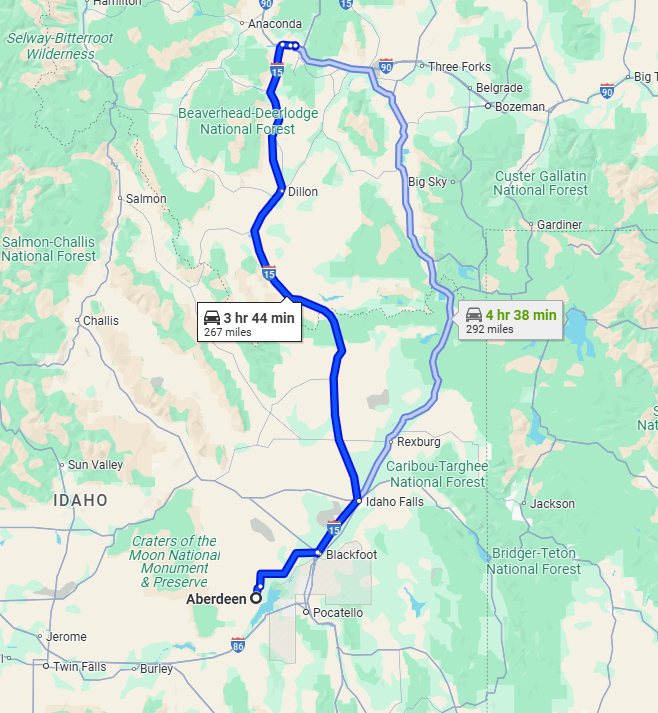
We drove up into the beautiful Montanan Pioneer Mountains (Idaho has some as well), stayed the night in Butte, and the next day, made our way to Sage Mountain Center, where I had a reservation. We could not have asked for a more beautiful day, weather-wise. Early June in the Butte area is still basically Spring.
Chris and Linda are the property owners at Sage Mountain. About three decades ago, they wanted to move out to the middle of nowhere and build a sustainable house and retreat center. They were not looking for megaliths. Linda stumbled upon the wall on a hike one day, and Chris, who has a background in building, looked at it, said, “Yep. That doesn’t look natural. Well, let’s get back to our projects.” It wasn’t until years later, when they had established a sustainability-themed retreat center and had started to create some hiking trails for their guests, that other people started noticing the wall. Chris and Linda cleared the brush around the wall, roped it off, and had it examined by LIDAR and ground-penetrating radar.
Now, many people are coming to see the wall, seemingly to a point where it is almost becoming a problem. Sage Mountain Center is still on a wind-y, washboard-y dirt road, but now many people, seeking to get away from it all, have built new houses and cabins along that same road. Chris asked us, as we drove out, not to “go too fast past our neighbors. We’re trying not to bother them.” I got the impression that his main desire is still to just run a sustainability B&B in peace, but he’s been saddled with this danged wall.
What Would a Skeptic Say?
I want to give the skeptical geologists their due here. I think what they would say is this: “All these people who are saying Sage Wall is amazing megalithic structure are forgetting one thing: It is right in the middle of the Boulder Batholith! There are big granite rocks everywhere!”

source: formontana.net
They are not wrong. The mountains to the east of Butte, where Sage Mountain Center is located, are strewn with large granite boulders and outcroppings. These tend to fracture into shapes resembling worked blocks of stone.
Here are some pictures I took, on the way in, of natural granite outcroppings so you can see how they normally look and how they tend to fracture:
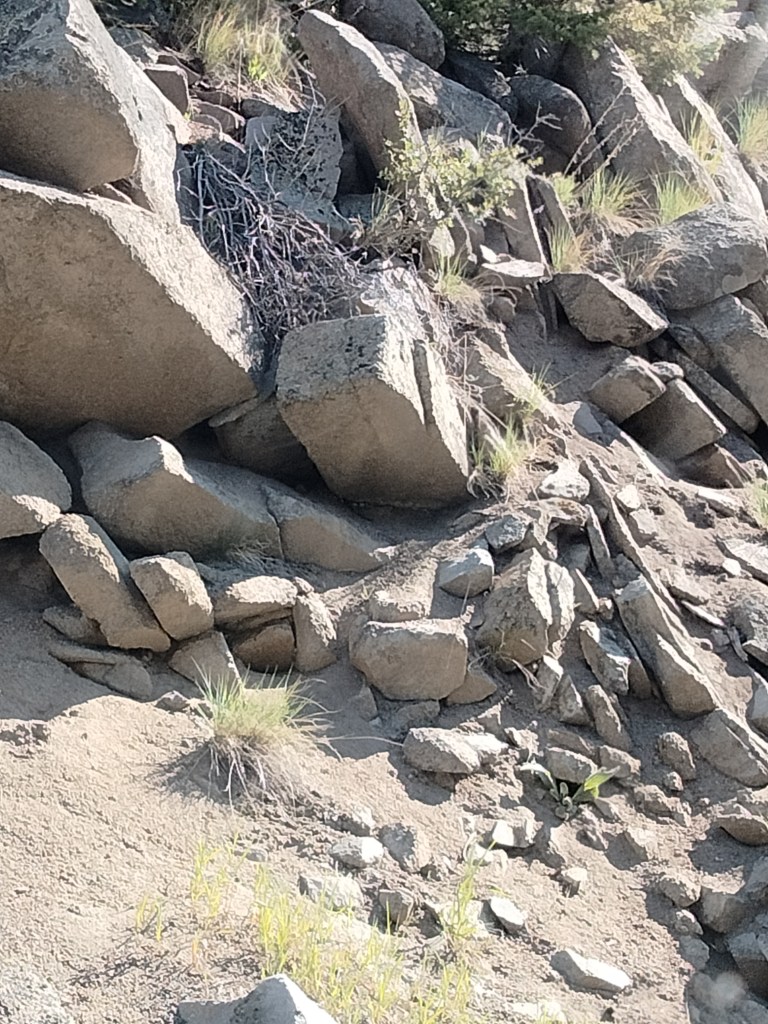

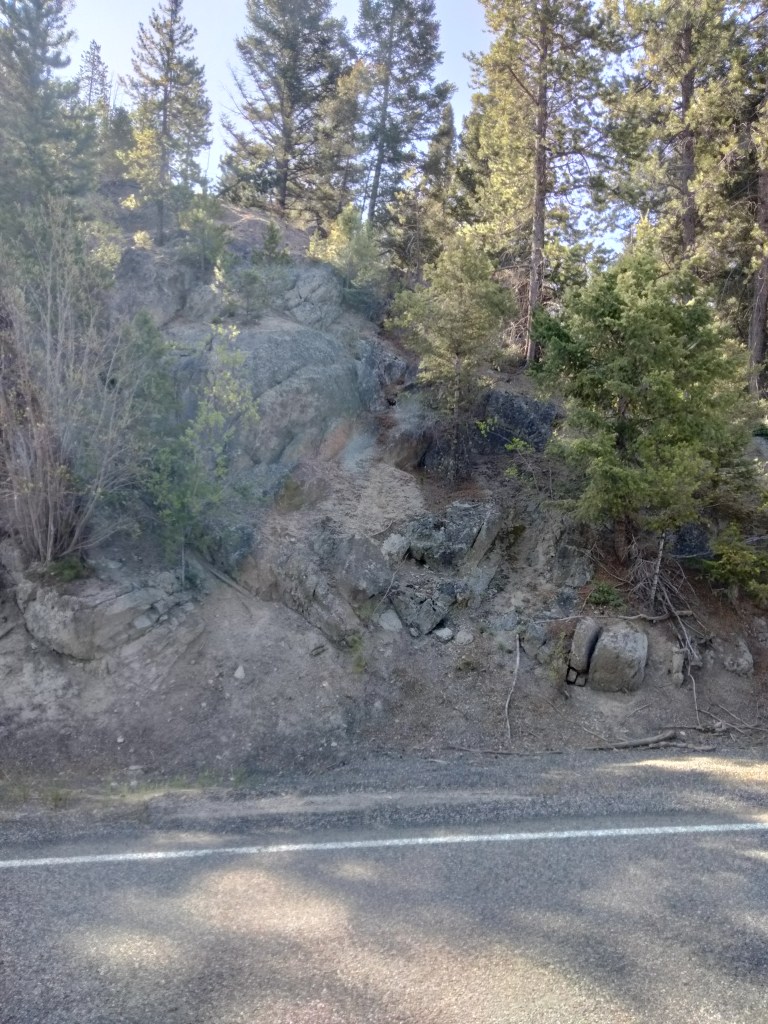
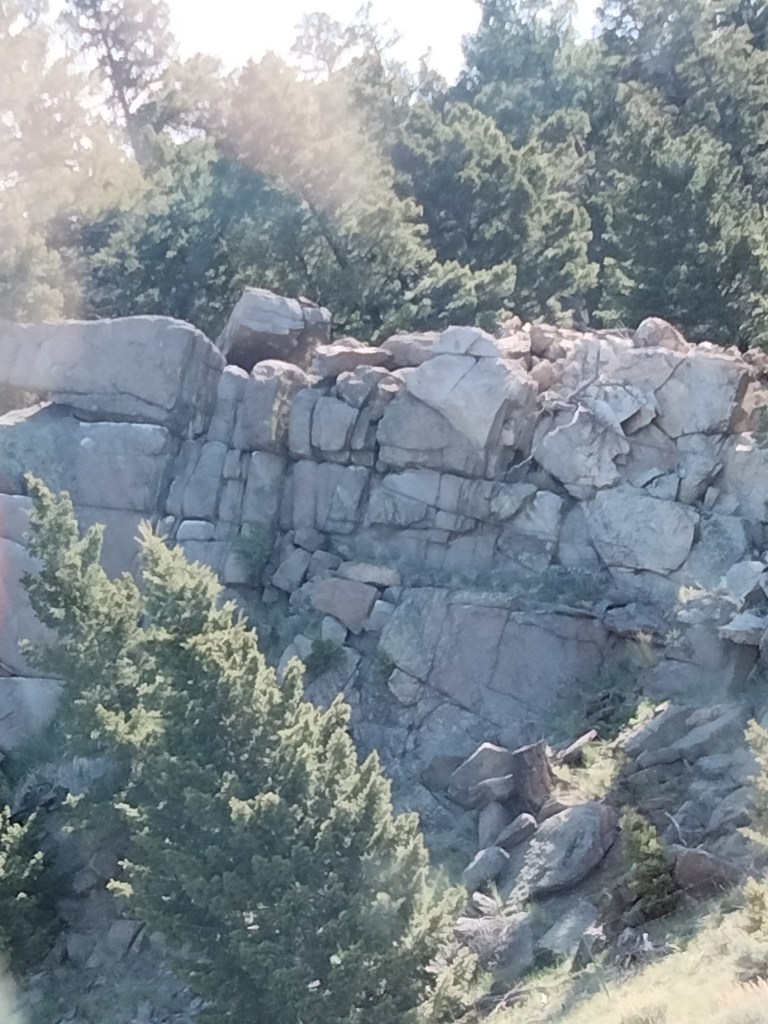
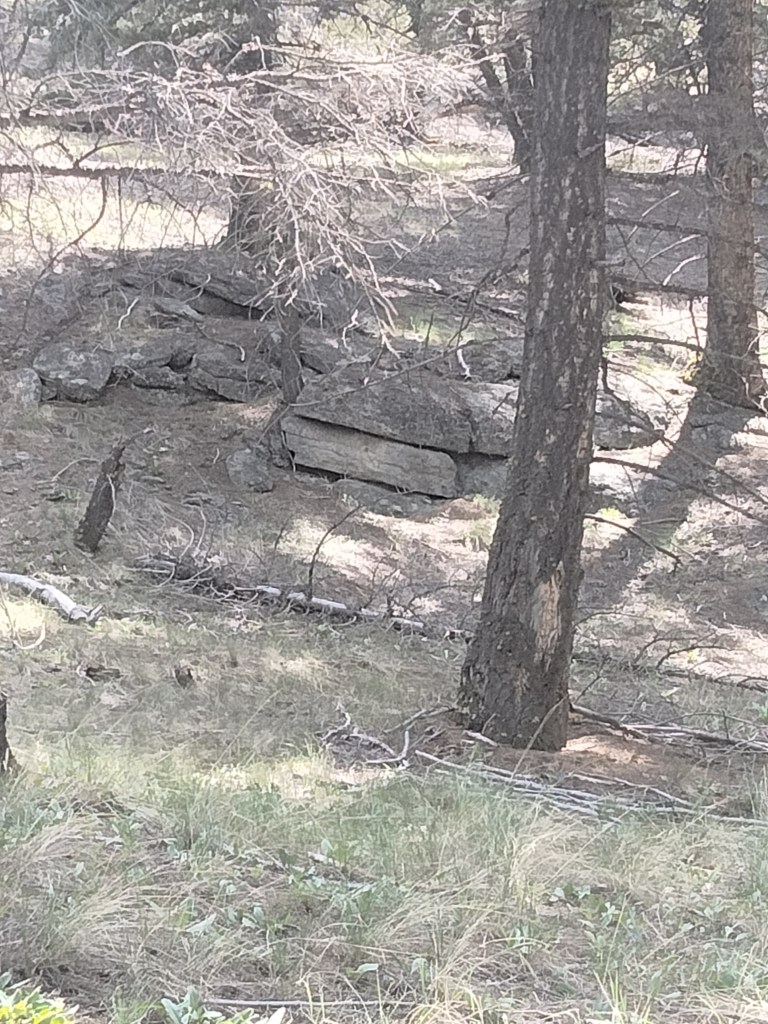
You can see that the fractures are often horizontal and strikingly block-like.
We also saw some pieces of granite that had very large quartz crystals formed in them, which stuck out like chips in a chocolate chip cookie:

And, just for fun, here’s a balanced rock:
I’m not sure whether this balanced rock is natural, but I’m leaning towards no. I’m thinking it was put there to mark the trail.
Anyway, the skeptics are correct that the presence of big, blocky rocks does not an ancient megalithic structure make. This is part of the reason I wanted to see Sage Wall myself. I did not take any videos of it, because I’m not good with video and didn’t have a script ready. But there are now many videos of Sage Wall online, including drone videos. I’ll try to embed some of them at the end of this post.
Why Sage Wall is Likely Man-Made in my Amateur Opinion
So no, the claim is not that this must be a megalithic structure because it is located somewhere that we would not expect rocks. It is definitely surrounded by rocks. However, it looks distinctly different from the more random rock outcroppings around it.
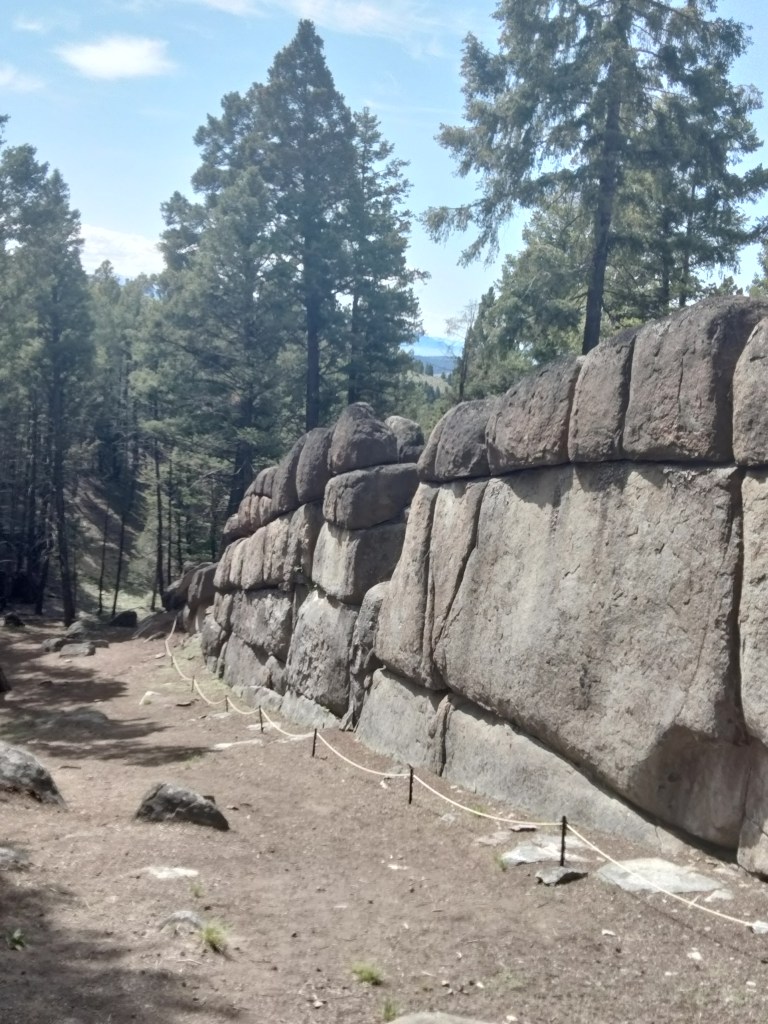
It is very long, and very straight. (The wall extends past the Sage Mountain Center property, but only their section of it has been cleared.)
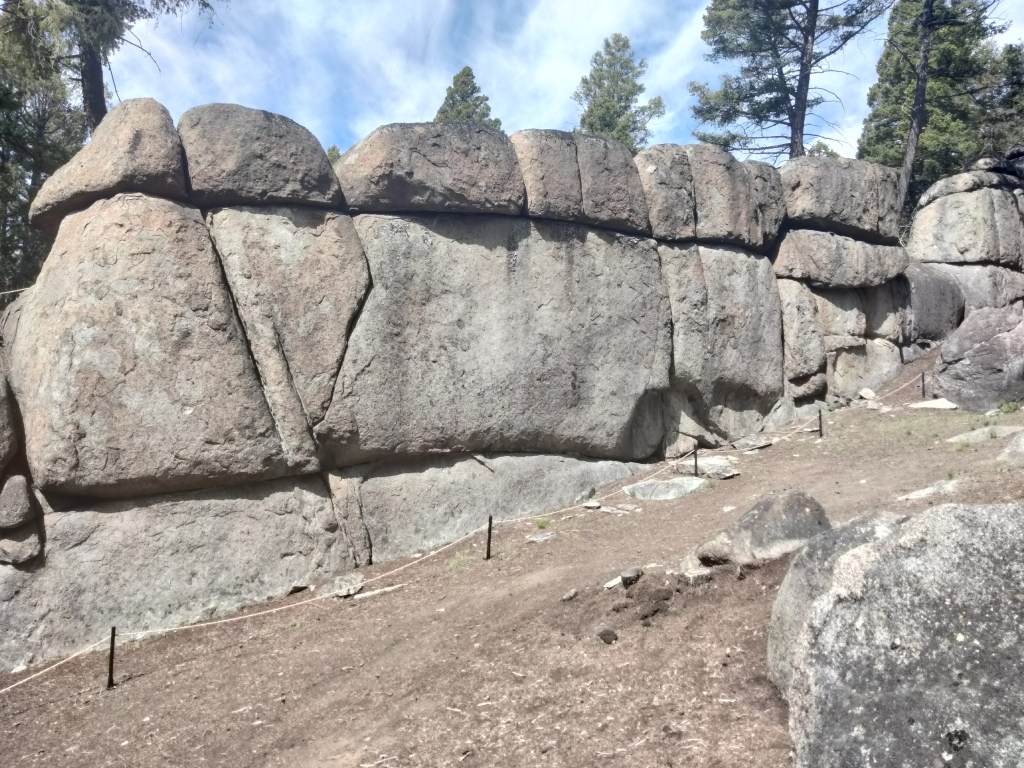
Unlike what we see with other fracturing patterns, the wall consist of very big blocks laid out in what appear to be courses. To my (again, amateur) eye, when we see natural fracturing the blocks tend to fracture into smaller pieces where they are exposed.
In the pictures above (and in the one where I’m posing), you can see a hollow lower down in the wall where a block obviously fell out.

At three different places in the exposed section of the wall, there are gaps in the top similar to doors. Chris told us there had been a lot of speculation about these before researchers realized that they were simply places where boulders had fallen out. In fact, you can see the boulders below them, almost completely buried in dirt and pine duff.
On the picture above, you can also see the remains of a triangular shape. The left side of the triangle is made with shaped blocks, and the right side is incised into the megalith. The triangle happens to frame the gap where a block fell out.
According to Chris, the geophysicist who examined the wall with ground-penetrating radar found that it goes down into the ground about another 20 feet. At the bottom was something that reflected the radar, as it might be a floor or stone foundation.
All of this research is shortly to be posted on the wall’s website, here or possibly here.

Parallel to the wall are the fallen remains of what appears to be another wall. You can see that it is “fractured” in the same way, and these other blocks also have some of the nub and cup features that we’ll talk about below.

Here’s a bit of the second wall, seen end-on.
Behind the Wall
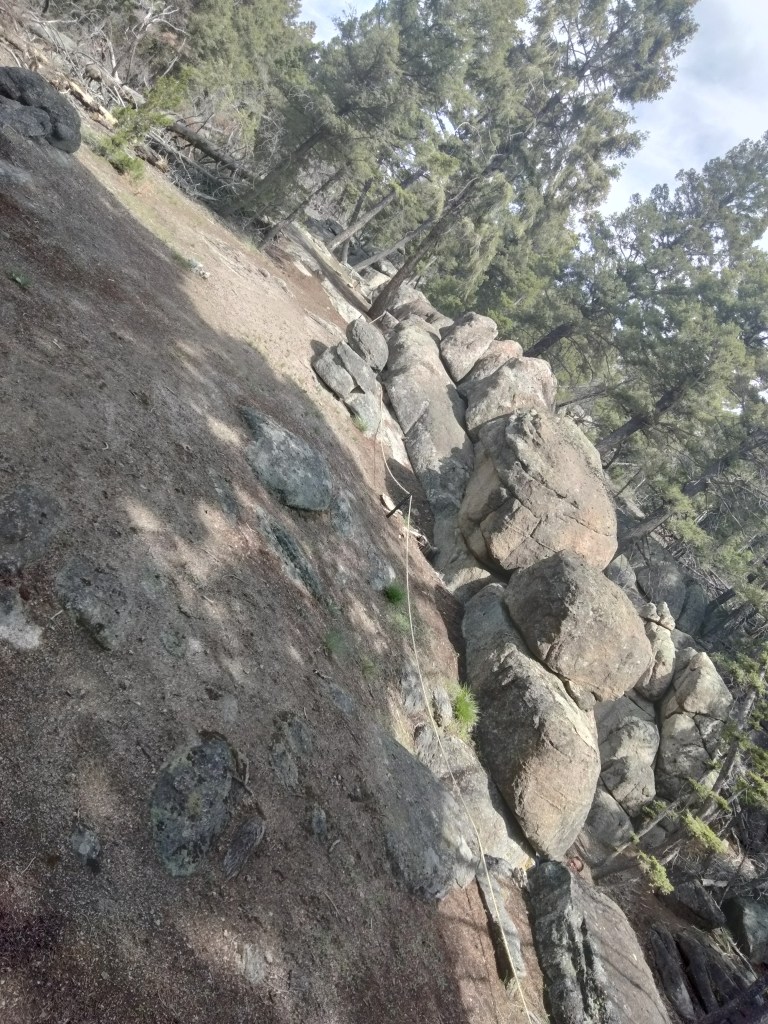
Here’ a view behind the more intact wall. Chris and Linda have installed a rope that allows visitors to climb up behind the wall. As you can see, the wall is not just part of a cliffside, but it does have earth and rocks filled in behind, either as terraces/a retaining wall, or the ravages of time.
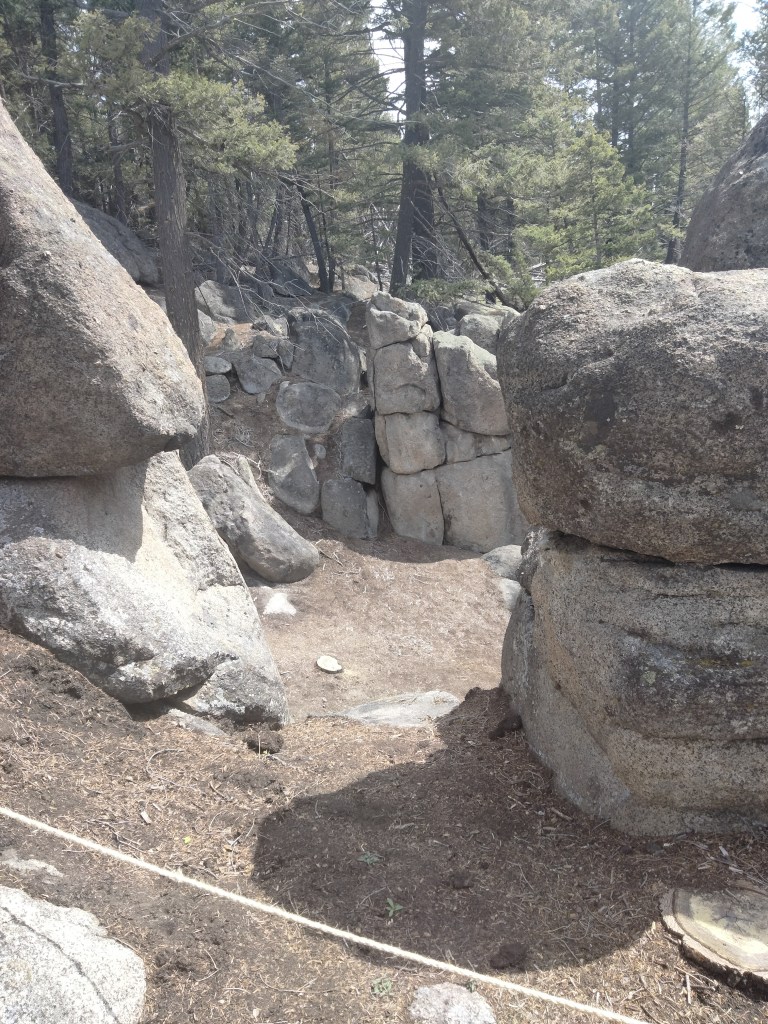
From behind the wall, we look out through a gap left by a fallen stone across the avenue at the remains of the second wall.
Getting close to the top of the wall allows us to see what might be nubs and cups.
Nubs and Cups
Stone nubs and cups (not necessarily corresponding to each other) are sometimes features of megalithic architecture in other parts of the world.
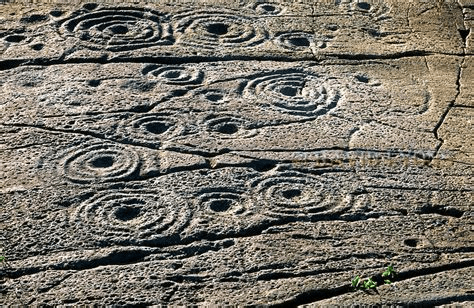
“Cup and ring” markings are apparently found all over the world, but especially in Northern Europe. Here are two articles about them.
Stone nubs or knobs are also found, especially in Incan or pre-Incan megalithic architecture.
Here are some nubs found on top of the intact wall.
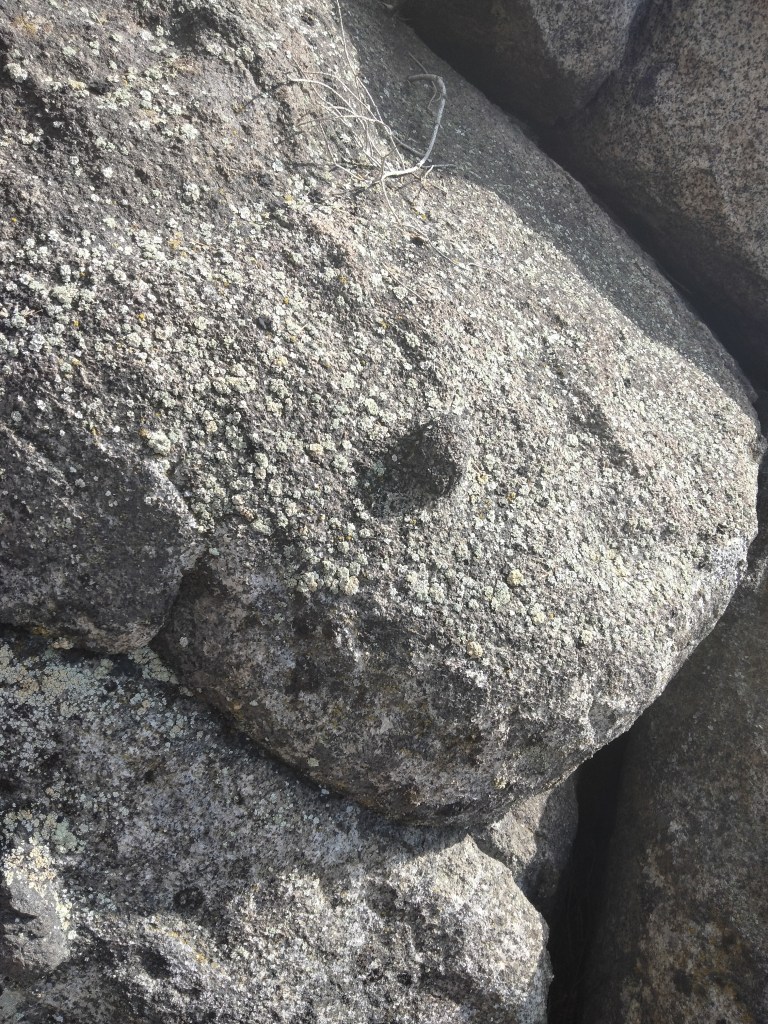
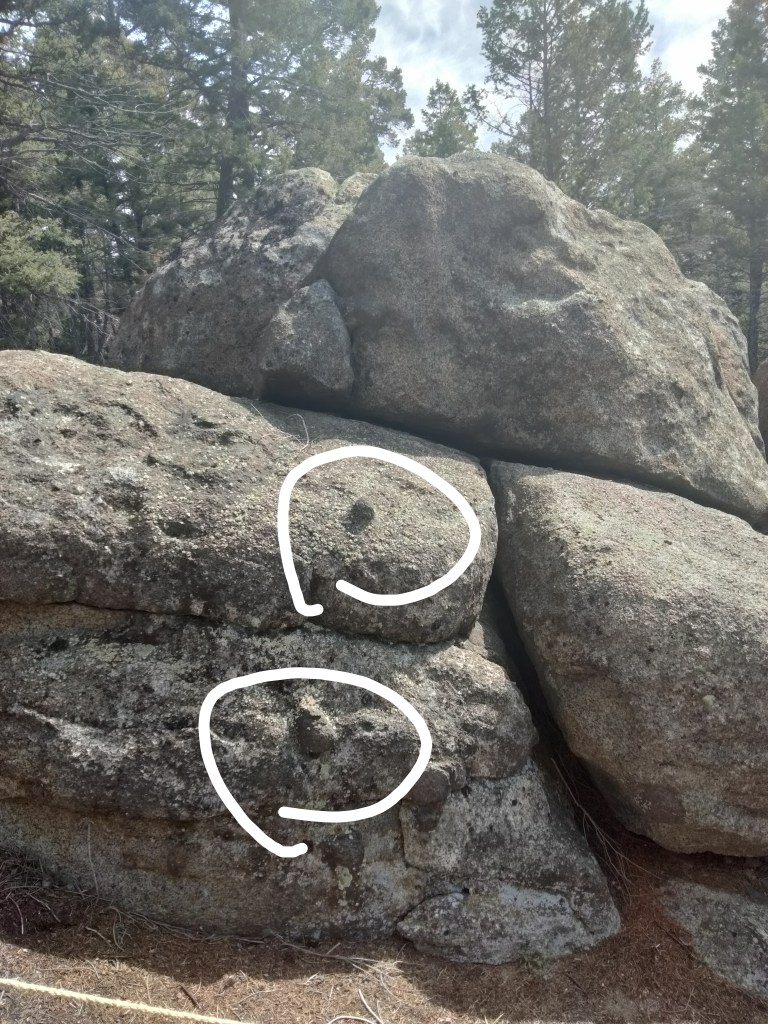

They are not the same as the pieces of quartz sticking out of the natural stone that we photographed earlier.
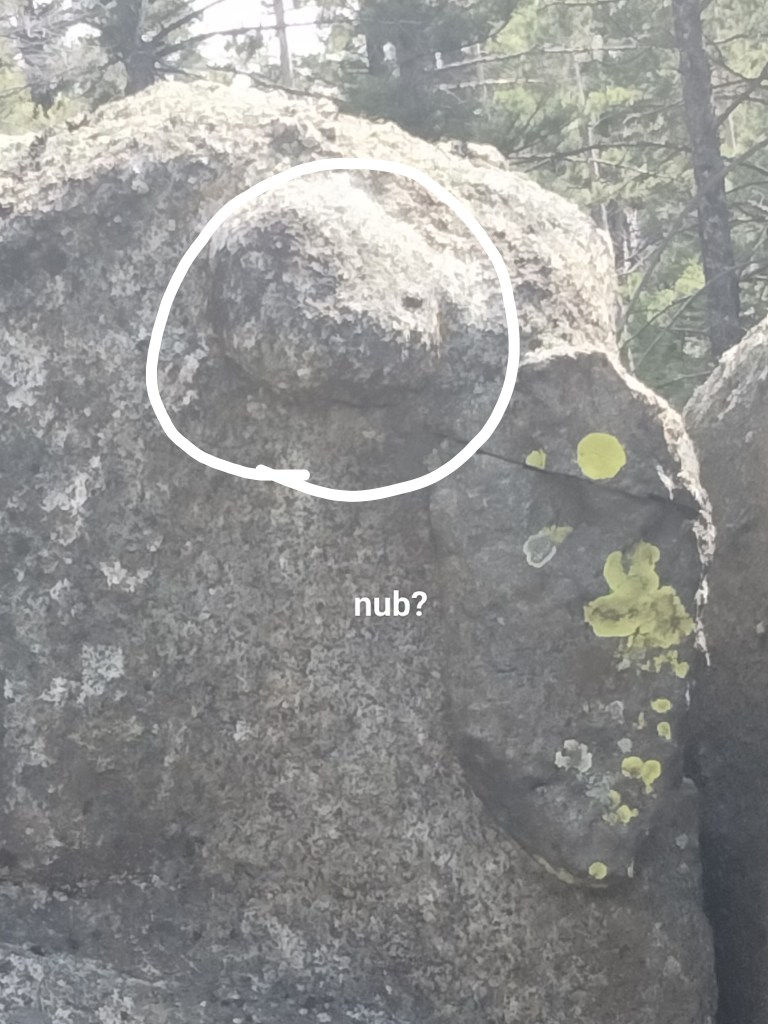
Because the wall is so weathered, some of them are not certain.
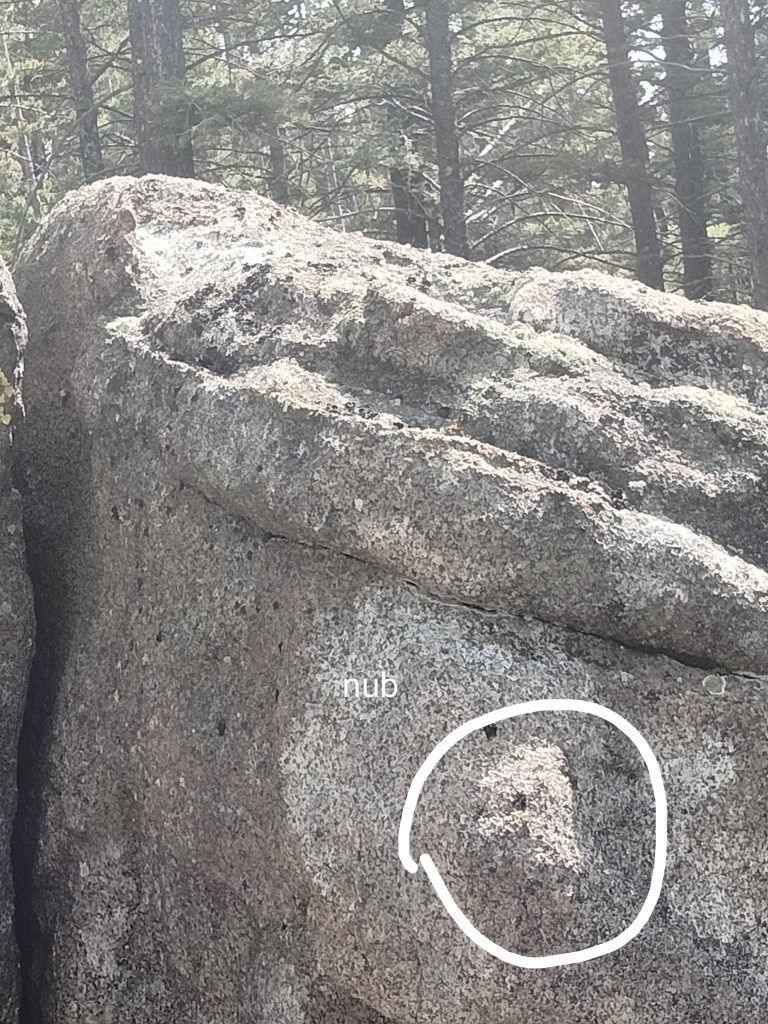
Note the possible incised lines above this last nub.
Here are some other things we saw on the back of the wall:


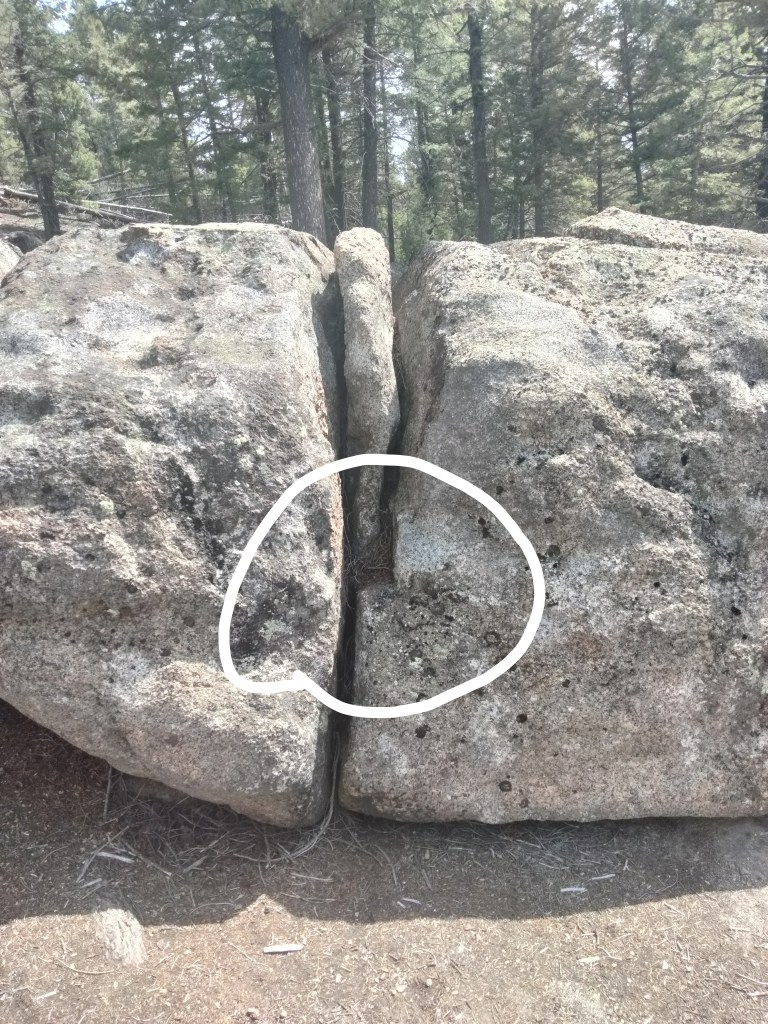
Suspiciously square fracture line
On the fallen wall as well, we found some things that look like nubs, and some possible cups. As a nod to the skeptics, yes, these “cups” do look like they could have been caused by water erosion. This would be especially true if they were found under a waterfall or a persistent drip, which they are not, as far as I can see. Some of them are also suspiciously round.

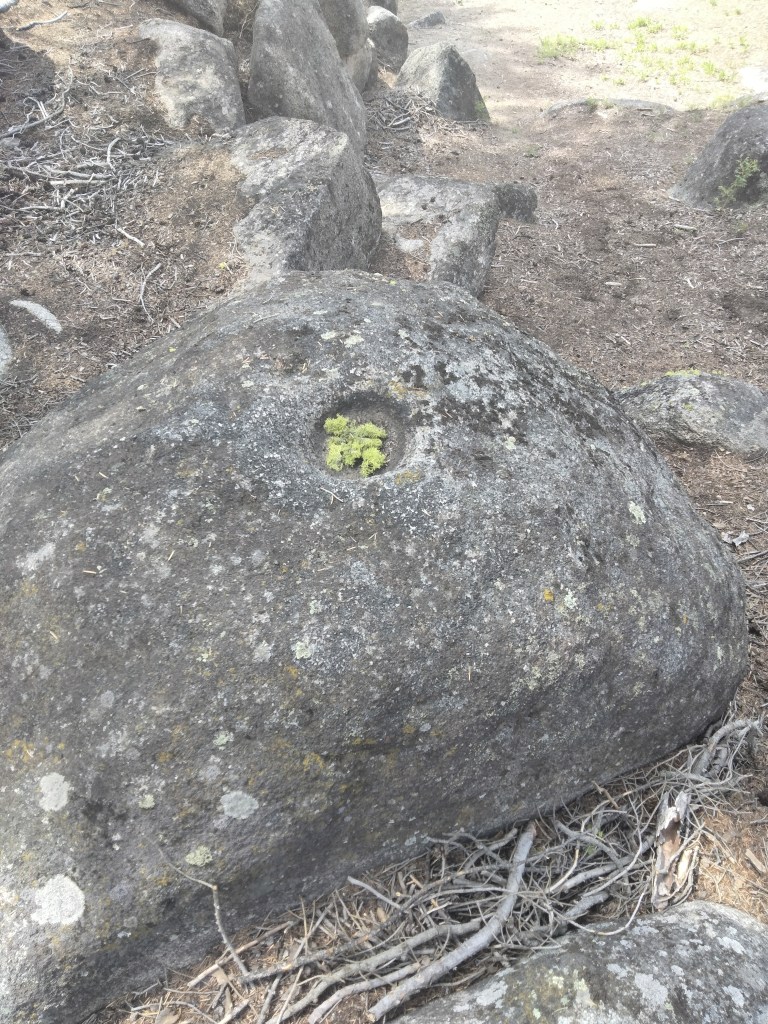
Some also have very straight lines incised near them. My son suggested they could be a water feature.

Looks like a cup with a spout
False Nub Alarm? Or Another Part of the Complex?
As we hiked away from Sage Wall, I took care to photograph natural rock formations for comparison. Not very far from the walls, I saw something that also looked like nubs.
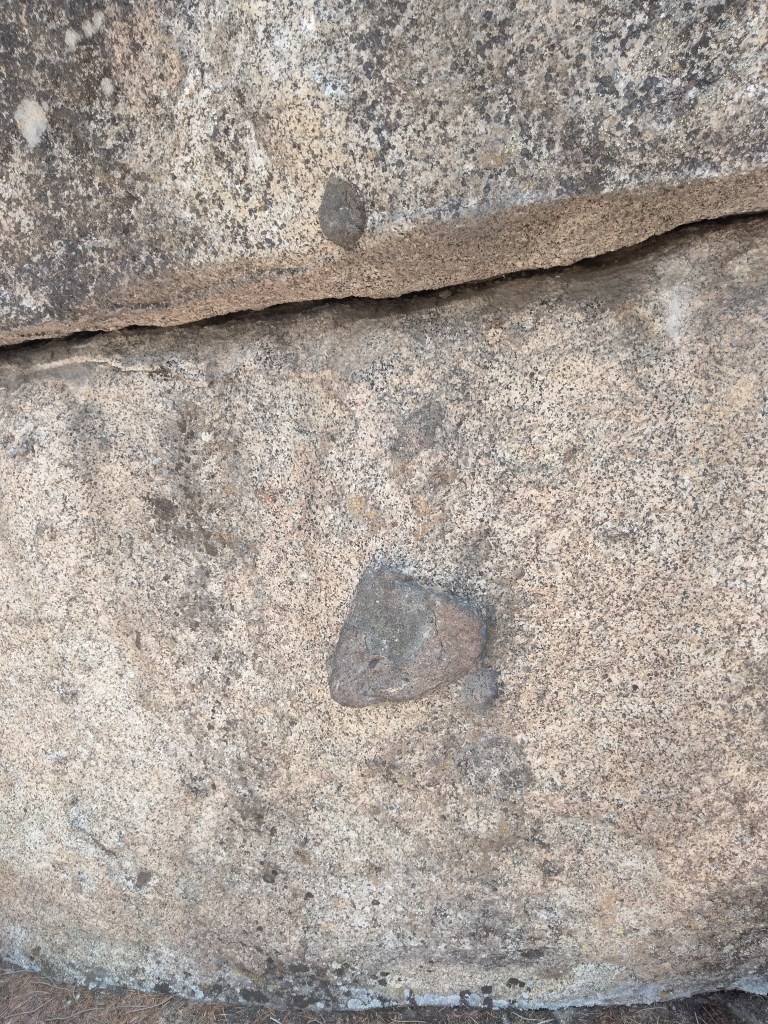
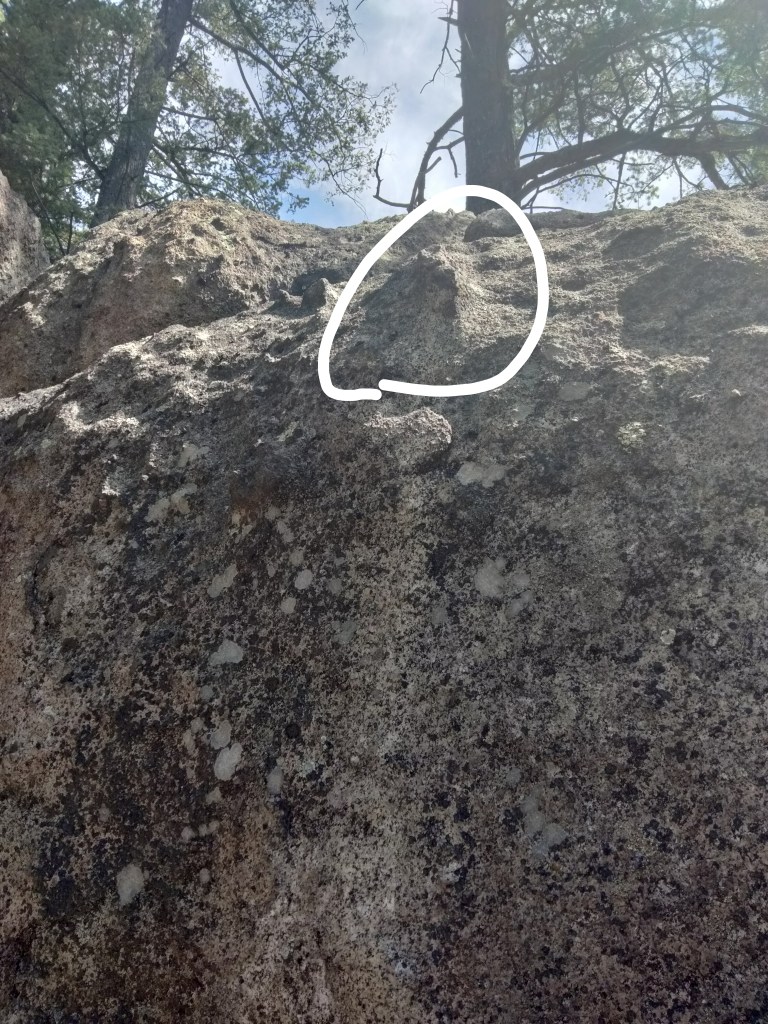
Did this mean that such nubs are a natural feature of the way granite weathers? Or could this be another part of the same complex as the wall? The formation on which I spotted these nubs certainly looks like the remains of a constructed passage.

A Post-Flood Megalithic Culture
After I left Sage Wall, my husband asked, humoring me, what I thought its purpose had been. My answer is that I have no idea. It is way too old, weathered, and partially buried for me to speculate. (This does not bother Julie Ryder over at Montana Megaliths, so if you want to see some people speculate very confidently, you can visit there.)
What I can say is that, granted this is not a natural formation, it most reminds me of Sacsahuayman and other sites in Peru. You have the same dry stone construction with megalithic blocks that are shaped, but are not in uniform sizes or in a regular pattern. And, of course, you have the nubs. As for scale, it appears that if Sage Wall were excavated down to its foundation, it would be thirty or forty feet high.
Another similarity is that both Sage Wall and the Incan or pre-Incan complexes are built at very high elevations (the Continental Divide runs near Butte).
This suggests to me that they partake of the same culture area.
Sage Wall, of course, has been abandoned much longer than any of the impressive Incan complexes, some of which Europeans got to witness still in use. Consequently, it’s much more weathered, run down, and filled in. But it looks like the same sort of thing.
So, it appears that Sage Wall and any other structures we might find in association with it were built by a group of people who knew how to build with megaliths, and who then had to abandon this site for some reason. It was before recorded history in North America, but that doesn’t mean it was before recorded history was happening elsewhere. Then, they or their descendants or people who partook of the same megalithic culture, moved on towards South America and continued their building there.
I believe there is plenty of evidence–not from Sage Wall, but from other sources–that human dispersion happened very quickly after the Flood, and that when people spread out, they took a megalithic culture with them. Dolmens, pyramids, cities, and inexplicable megaliths have been discovered all over the world. In many cases, as with the Bosnian pyramids, they have been abandoned for so long that they are not immediately recognizable as the work of human hands. You have to know what you are looking at before you can see it. The Bosnian pyramids, first thought to be extremely regular hills, were confirmed as artifacts only when a team dug into them and found tunnels. It looks like something similar happened with Sage Wall.
Immediately after the Flood, the earth would have entered an Ice Age. The climate was in a tailspin: temperatures were low, precipitation at an all-time high. Much of that precipitation quickly got locked up in glaciers. Sea levels fell around the newly configured continents. There were land bridges all over: in Beringia, in Doggerland, in Sundaland. People took advantage of all this newly revealed, very humid land and scattered. But the Ice Age was short, and as glaciers melted, there were sudden catastrophic local floods. People had to abandon their sites. Many of their cities, camps, and settlements are now hidden under water along our coasts. In some cases, such as Gobeklitepe and the Vinca cities, they burned, buried, or otherwise destroyed their sites before moving on. Some of these sites might have been built very quickly and inhabited for only a short time before they were abandoned. Other things being equal, archaeologists tend to overestimate how long it took to build something, and how long ago it appeared. But even very recent sites can be quite mysterious. They have had trouble re-constructing Woodstock, for example.
How Did They Build It?
I don’t know. Obviously they were purty smart. Probably an argument is going to be made that Sage Wall must be a natural formation because “we know” that people in the Stone Age didn’t have the ability to make things like this, despite constant evidence being discovered to the contrary. Or they will argue that “we know” that there were no advanced civilizations in North America, despite Sage Wall itself. Such arguments tend to be self-re-enforcing.
I do know that we do not, currently, have the ability to build with megaliths … at least, not so easily that we consider them our first choice in building material. We might make a monument or a gravestone, but we wouldn’t attempt to build an entire house or city out of megaliths. The effort would just not be worth it. This suggests that the ancients may have had ways that were easier than our current methods.
It is worth noting that there is a well-established oral tradition of giants living in North America. There have also been giant skeletons discovered. In Peru, meanwhile, there is the tradition of the Viracochas, bearded, godlike culture-bringers. No, I’m not suggesting aliens. I do think we should take a closer look at the worldwide oral traditions of apocalypses, floods, gods, and giants, and that we should pay attention to myths that suggest that civilizations were “advanced” right from the beginning. If you want to dig into this more than you already have (and if you are reading this, I assume you already have!), please feel free to look at my page The Research Behind the Books for a suggested reading list.
Embedded YouTube Video about Sage Wall
The Wind Farm
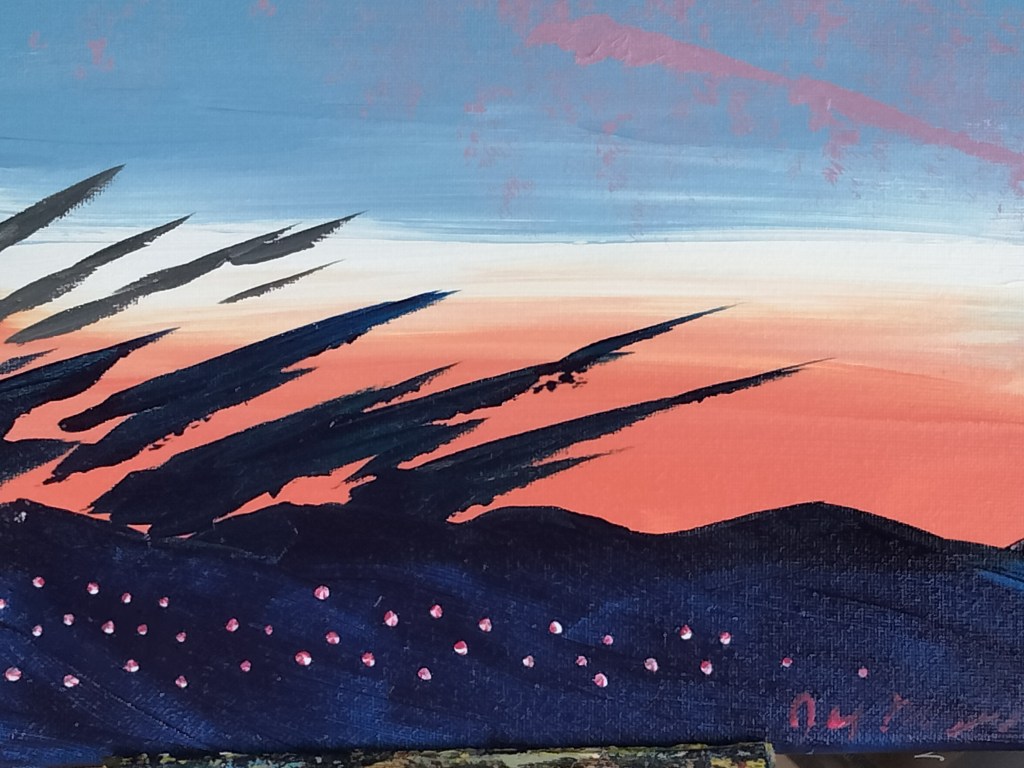
I live in the West, where you can see long distances. About twenty-five miles south of our house is wind farm perched on the foothills. At night, you can clearly see the windmills’ lights twinkling. This painting portrays a more close-up view, glimpsed as I started the drive home on a winter evening.
I never minded seeing wind farms, even in the daytime. I had a positive association with them, almost entirely because of the cover of a Petra album I had as a teenager:

I also believed what I was told, that these windmills would provide cleaner power than oil, coal, and natural gas.
Then, I started hearing about the downsides of wind farms. I heard that people who live near them develop health problems. I heard that, shockingly, it is not unusual for birds to get chopped up by them. The windmills have to be built in naturally windy areas, which are also migration routes for birds, which are apparently hard-wired in to the birds and can’t be changed.
Then, I found out that these turbines are expensive to build, last only about twenty years, and are difficult to dispose of:
https://www.prageru.com/video/whats-wrong-with-wind-and-solar
And that they are extremely inefficient, and the energy they do produce has to be stored in costly batteries:
https://www.prageru.com/video/can-we-rely-on-wind-and-solar-energy
Which can only be made with rare-earth minerals that are obtained using child labor:
https://www.prageru.com/video/green-energy-fueled-by-child-labor
Yikes!
Unfortunately, my aesthetic response to these windmills has already been locked in by Petra. I don’t think it’s going to change. Now, though, I no longer think of them as a good thing, a step in the right direction. I think of them as evidence that we are living in a sci-fi dystopia. Maybe some day, the wind farm in my part of the state will come down. But this little painting will remain as evidence that I lived in the Age of Man when we feared the imminent end of the world and thought we could forestall it by building these things.
More Science Sarcasm
The evaporation of content from the [Darwinian] notion of fitness is nowhere more apparent than in mathematical genetics, a subject with a reputation for pointlessness inferior only to that of modern tax law.
David Berlinski, Science After Babel, p. 21
A Roundup of Atlantis Theories

Too many Atlantises. An embarrassment of Atlantises. One Atlantis, two Atlantis, red Atlantis, blue Atlantis …
Atlantis is Now Off the Coast of Cuba
This article describes an intact granite city, with pyramids, discovered off the West coast of Cuba, about 2,000 feet down, in December of 2001. As our old friend KFM, of Bad Archaeology, points out, the city would be unlikely to survive intact like this if it actually dropped dramatically from what is now sea level, as Plato seems to describe. The article points out that there is another city, the Yonaguni Monument, off the coast of Japan, and Graham Hancock in his book, Underworld, points out that there are submerged megalithic cities in many places around the world, including off the coast of India. (Hancock has cycled through seriously advancing a number of different Atlantis theories, so he will be sort of the workhorse of this post.)
It seems to me that the city off the coast of Cuba is part of a worldwide phenomenon where sea levels were once much lower. We can include in this phenomenon Doggerland (which will make another appearance later in this post), and the land bridges known to have once connected Asia to the Americas and the Indonesian islands to the mainland.
If you are an old-earth believer and have to juggle millions of years, multiple cooling and warming periods, slow but somehow effective continental drift, and some confusing archeological indications that humans were perhaps around well before they should have been … good luck. As someone who believes that the history of the earth is measured in thousands or tens of thousands, but not millions or billions of years, my guess is that this period of low sea levels plus advanced civilization came right after the Great Flood.
You would have a much colder, rainier climate as the earth adjusted to the recent cataclysm (about this more in a minute). You would have had frequent snow and rain storms, with all this precipitation getting frozen in the rapidly forming ice sheets, causing Earth’s water supply to be greatly reduced. Meanwhile, you would have Noah’s children and grandchildren branching out as quickly as possible, building megalithic cities wherever they went, still remembering the techniques and technology (and possibly still assisted by the giants and gods) that they had seen pre-Flood. This period of low sea levels would have had to last long enough for people to disperse and to build, but it need not have been very long. It could have a been a matter of a few hundred to a thousand years. As the climate stabilized, you would have had floods covering settlements and civilizations in different parts of the world. This, I believe, is the reason we have an embarrassment of Atlantises.
There have also been assertions that the reason for the Bermuda Triangle phenomenon is that Atlantis lies underneath it. (Note that the west coast of Cuba is outside of the Bermuda Triangle.) This theory certainly appeals to those who are interested in the potential paranormal effects of the lost city, but I do not know of any actual submerged city found in the Bermuda Triangle area. (If you do, please enlighten me in the comments. I’m always looking for another Atlantis to add to my collection.) This article discusses how ocean-floor mapping technology can create lines that look like city streets.
Atlantis as Antarctica
Graham Hancock makes the case for this in his book Fingerprints of the Gods. He posits that the evidence points to an ancient, advanced civilization which was destroyed by a cataclysm, and asserts that the refugees from it seeded their scientific knowledge, in code form, by creating new religious cults all around the world that featured certain sacred numbers.
If you’ve been reading Out of Babel for a while, you know my assessment of all of this is that it’s right, but not in the way that Hancock thinks it is. Among other things, his scientific materialism and evolutionary beliefs make it impossible for him to imagine that people groups like the Maya, for example, would have come up with advanced mathematics on their own, so he needs to posit a more “advanced” civilization bringing these things from without.
Anyway. For his advanced ancient civilization, Hancock realizes he needs a continent-sized homeland (because, again, his evolutionary beliefs about man require that such a civilization develop gradually, over millennia, from hunter-gatherers to farmers and so on). Antarctica is a good candidate because it’s an entire continent; there is some evidence that it was mapped before it was quite so covered in ice; its general pre-ice outline corresponds roughly to Plato’s description of Atlantis; and there is a theory available for how it could have gone from being in a temperate part of the Atlantic, to being at the South Pole, in a relatively short amount of time. Hancock calls this “earth crust slippage” and posits that it happened about 20,000 B.C.
Now for the version I find more plausible: Creation scientist Dr. Kurt Wise presents his team’s model for “continental sprint” in this video. I find Dr. Wise’s model persuasive as a model of the Great Flood, and as we will discuss, it could explain the Atlantis legend wherever in the world Atlantis proves to have been. However, even if you buy into “continental sprint,” it does not follow that Plato was describing Antarctica when he wrote about Atlantis. If all the land on the earth were breaking up, the ultimate fate of that portion that later became Antarctica would seem like a minor detail.
Atlantis as North America
This one was put forward by Graham Hancock, after he abandoned his Antarctica theory, in his book America Before, a review of which I react to here. Although weak, the theory relies on the fact that there are large structures, either megalithic or earthworks, which align to different astronomical features and/or function as observatories, all around the world, including in North America. For example, the pyramid complex at Teotihuacan appears to be a model of the solar system; the Giza Plateau appears to be a model of Orion, and Serpent Mound in Ohio, which sites towards the sunrise at solstices, may be according to Hancock a model of the constellation Draco.
All that to say, anywhere you can find a large astronomical structure, you can make a case for Atlantis, and Hancock has made that case for North America.
Atlantis as the Cyclades Plateau in the Aegean
This article, which I posted last summer, asserts that Plato’s descriptions of Atlantis are admirably matched by the Cyclades Plateau (now the Cyclades islands), which would have existed when sea levels were 400 feet lower than they are now. The Cyclades Plateau is a rather large formation right in the middle of the Aegean. (If we consider that lower sea levels would have also expanded the coastlines of the rest of Greece, then it would have been even closer to the mainland.) This is an attractive theory in terms of its being what Plato was actually talking about (since he makes Atlantis contemporary with Athens), but it does depend upon this:
Recently, a four year study that included a thorough analysis of Plato’s work established that serious errors by early translators allowed for the mixed messages in the translated document.
Atlantis as Part of Doggerland
Yet another underwater location that used to be inhabited when sea levels were lower, Doggerland was a vast region that stretched between England, France, Holland, and Scandanavia, and is now the relatively shallow southern part of the North Sea. Archaeological discoveries have handily established that this area was once inhabited, here and here among others. As with other now-submerged human habitations, the reader’s preconceptions will determine how long ago you believe it was inhabited, and for how long.
This article describes an entire book which puts forth a detailed theory Plato was describing Doggerland. Apparently, Atlantis had a large, roughly rectangular plain surrounded by “ditches,” which the author thinks could also be translated “dikes.” He imagines the inhabitants of AtlantiDoggerland using these dikes to keep the sea back from a certain region of Doggerland for a period of time. Without some very expensive underwater archeological expeditions (in a notoriously dangerous sea), there is no way to confirm whether the ruins of a large city lie where this theory would predict. The maps are well worth looking at.
Atlantis as the Richat Structure

The Richat Structure, of the “Eye of the Sahara,” is a large (c. 40 km) formation of concentric rings of stone located in present-day Mauritania. Because of its size and remote location, it is hard to spot except from orbit.
Depending upon how you calculate, the structure matches the recorded dimensions of Atlantis quite well. There are also, of course, explanations about how this structure could have formed geologically. I’m not enough of an expert to assess these, but I am more skeptical of geological explanations than I used to be, now that I’ve seen “mountains” that turned out to be pyramids with insides, and geologists’ attempts to explain how a single fossilized tree could cross-cut millions of years’ worth of sedimentary rock layers. In other words, could go either way.
For the Richat structure to be Atlantis, we have to imagine that it was once nearer to coast and was inundated by a tsunami or something of that nature. This theory actually works fairly well with the geological model that Dr. Kurt Wise presents above. “Continental sprint” would have included many earthquakes and resultant tsunamis. Africa, in the model, does not move as much as the other pieces of Pangea, but it would still have undergone earthquakes and, possibly, some uplift.
On this theory, with his tale of Atlantis Plato somehow retained a memory of a pre-Flood incident (and read Athens back into it?). Below is a video of Pastor Joel Webbon discussing the theory with Brian Suave and Ben Garrett of Haunted Cosmos. They get into local lore around the Richat structure, how this dovetails with Greek legends about Atlantis, and how this all could have been plausible in a pre-Flood world haunted by gods and nephilim.
Conclusion
When I first started composing this post, I thought I was going to come out in support of the Richat Structure. Now, I just don’t know. The Haunted Cosmos guys make it sound very plausible, but a few of the other candidates are also plausible (some less so). There does not seem to be any way to “find” Atlantis without sacrificing at least some of what Plato has to say about it. (For example, Athens existed before the Flood? Before there was a Europe?) This makes it really difficult to favor any one theory (although we can probably discard others). What is clear, is that the prehistoric world had many sophisticated cities, lots of things built with megaliths, pyramids on almost every continent, and that there was a period when many human settlements were submerged as sea levels rose. The details are a matter of speculation, of the kind suitable for someone writing a novel.
Yay Neanderthals!
What’s the most entertaining thing about this story? Is it …
- the neat little tidbits about Neanderthal genetics?
- the big reveal that Neanderthals, Denisovans, and so-called “modern humans” are all actually the same species?
- the total blindness to the way this fact contradicts the evolutionary narrative?
- the researchers’ discovering that close kin used to intermarry in the distant past, just like we’re told in Genesis?
- their attempts to minimize this same fact?
 Out of Babel Books