Redemption

It’s been an emotional week.

But that’s partly my own fault. After all, I had to go and listen to this heartrending testimony …

Jonathan Gass’s story is remarkable for how it consisted of essentially unremitting pain until he came to Christ … and then, for how fast he came to Christ and was transformed.

I say remarkable, but I don’t say unique. Many, many other men and women out there are, as we speak, going through the same unremitting pain. This does not make his story easier to listen to. But look at the peace on his face now.

And then, the same week I listened to Jonathan, I was reading my class of elementary-school students The Lion, the Witch, and the Wardrobe, and I came upon this passage:

For a second after Aslan breathed upon him the stone lion looked just the same. Then a tiny streak of gold began to run along his white marble back–then it spread–then the color seemed to lick all over him as the flame licks all over a bit of paper–then, while his hindquarters were still obviously stone, the lion shook his mane and all the heavy, stone folds rippled into living hair. Then he opened his great red mouth, warm and living, and gave a prodigious yawn. And now his hind legs had come to life. He lifted one of them and scratched himself. Then, having caught sight of Aslan, he went bounding after him and frisking round him whimpering with delight and jumping up to lick his face.

The Lion, the Witch, and the Wardrobe, p. 184

Aslan turns him back into a lion, and he immediately starts behaving like … a lion.

But not only the individual creatures, but the Witch’s house itself is a picture of a human soul:

“Now for the inside of this house!” said Aslan. “Look alive, everyone. Up stairs and down stairs and in my lady’s chamber! Leave no corner unsearched. You never know where some poor prisoner may be concealed.”

But at last the ransacking of the Witch’s fortress was ended. The whole castle stood empty with every door and window open and the light and the sweet spring air flooding in to all the dark and evil places which needed them so badly.

[And when the castle gates had been knocked down from the inside], and when the dust had cleared it was odd, standing in that dry, grim, stony yard, to see through the gap all the grass and waving trees and sparkling streams of the forest, and blue hills beyond that and beyond them the sky.

ibid, pp. 187 – 189

Christmas Trees are Christian, but still Very Ancient

This post is about how we got our Christmas trees. For the record, I would probably still have a Christmas tree in the house even if it they were pagan in origin. (I’ll explain why in a different post, drawing on G.K. Chesterton.) But Christmas trees aren’t pagan. At least, not entirely.

My Barbarian Ancestors

Yes, I had barbarian ancestors, in Ireland, England, Friesland, and probably among the other Germanic tribes as well. Some of them were headhunters, if you go back far enough. (For example, pre-Roman Celts were.) All of us had barbarian ancestors, right? And we love them.

St. Boniface was a missionary during the 700s to pagan Germanic tribes such as the Hessians. At that time, oak trees were an important part of pagan worship all across Europe. You can trace this among the Greeks, for example, and, on the other side of the continent, among the Druids. These trees were felt to be mystical, were sacred to the more important local gods, whichever those were, and were the site of animal and in some cases human sacrifice.

God versus the false gods

St. Boniface famously cut down a huge oak tree on Mt. Gudenberg, which the Hessians held as sacred to Thor.

Now, I would like to note that marching in and destroying a culture’s most sacred symbol is not commonly accepted as good missionary practice. It is not generally the way to win hearts and minds, you might say.

The more preferred method is the one Paul took in the Areopagus, where he noticed that the Athenians had an altar “to an unknown god,” and began to talk to them about this unknown god as someone he could make known, even quoting their own poets to them (Acts 17:16 – 34). In other words, he understood the culture, knew how to speak to people in their own terms, and in these terms was able to explain the Gospel. In fact, a city clerk was able to testify, “These men have neither robbed temples nor blasphemed our goddess” (Acts 19:37). Later (for example, in Ephesus) we see pagan Greeks voluntarily burning their own spellbooks and magic charms when they convert to Christ (Acts 19:17 – 20). This is, in general, a much better way. (Although note that later in the chapter, it causes pushback from those who were losing money in the charm-and-idol trade.)

However, occasionally it is appropriate for a representative of the living God to challenge a local god directly. This is called a power encounter. Elijah, a prophet of ancient Israel, staged a power encounter when he challenged 450 priests of the pagan god Baal to get Baal to bring down fire on an animal sacrifice that had been prepared for him. When no fire came after they had chanted, prayed, and cut themselves all day, Elijah prayed to the God of Israel, who immediately sent fire that burned up not only the sacrifice that had been prepared for Him, but also the stones of the altar (I Kings chapter 18). So, there are times when a power encounter is called for.

A wise missionary who had traveled and talked to Christians all over the world once told me, during a class on the subject, that power encounters tend to be successful in the sense of winning people’s hearts only when they arise naturally. If an outsider comes in and tries to force a power encounter, “It usually just damages relationships.” But people are ready when, say, there had been disagreement in the village or nation about which god to follow, and someone in authority says, “O.K. We are going to settle this once and for all.”

That appears to be the kind of power encounter that Elijah had. Israel was ostensibly supposed to be serving their God, but the king, Ahab, had married a pagan princess and was serving her gods as well. In fact, Ahab had been waffling for years. There had been a drought (which Ahab knew that Elijah — read God — was causing). Everyone was sick of the starvation and the uncertainty. Before calling down the fire, Elijah prays, “Answer me, O LORD, answer me, so these people will know that you, O LORD, are God, and that you are turning their hearts back again.” (I Kings 18:37)

Similar circumstances appear to have been behind Boniface’s decision to cut down the great oak tree. In one of the sources I cite below, Boniface is surrounded by a crowd of bearded, long-haired Hessian chiefs and warriors, who are watching him cut down the oak and waiting for Thor to strike him down. When he is able successfully to cut down the oak, they are shaken. “If our gods are powerless to protect their own holy places, then they are nothing” (Hannula p. 62). Clearly, Boniface had been among them for some time, and the Hessians were already beginning to have doubts and questions, before the oak was felled.

Also note that, just as with Elijah, Boniface was not a colonizer coming in with superior technological power to bulldoze the Hessians’ culture. They could have killed him, just as Ahab could have had Elijah killed. A colonizer coming in with gunboats to destroy a sacred site is not a good look, and it’s not really a power encounter either, because what is being brought to bear in such a case is man’s power and not God’s.

And, Voila! a Christmas Tree

In some versions of this story, Boniface “gives” the Hessians a fir tree to replace the oak he cut down. (In some versions, it miraculously sprouts from the spot.) Instead of celebrating Winter Solstice at the oak tree, they would now celebrate Christ-mass (during Winter Solstice, because everyone needs a holiday around that time) at the fir tree. So, yes, it’s a Christian symbol.

Now, every holiday tradition, laden with symbols and accretions, draws from all kinds of streams. So let me hasten to say that St. Boniface was not the only contributor to the Christmas tree. People have been using trees as objects of decoration, celebration, and well-placed or mis-placed worship, all through history. Some of our Christmas traditions, such as decorating our houses with evergreen and holly boughs, giving gifts, and even pointed red caps, come from the Roman festival of Saturnalia. This is what holidays are like. This is what symbols are like. This is what it is like to be human.

Still, I’d like to say thanks to St. Boniface for getting some of my ancestors started on the tradition of the Christmas tree.

Bonus rant, adapted from a discussion I had …

... in a YouTube comments section with a Hebraic-roots Christian who was insisting that Christmas is a “pagan” holiday:

So, as we can see, the evergreen tree is a Christian symbol, not a pagan one, and has been from the very beginning of its usage. St. Boniface cut down the tree that was sacred to Thor, and that was an oak tree, not a Christmas tree. Sacred oaks are pagan. Christmas trees, which incidentally are not actually considered sacred, are Christian.

Yes, I am aware, as are most Christians, that Jesus was probably not actually born on Dec. 25th. Yes, I am aware that Yule was originally a pagan feast time.

But let’s look at the symbolism, shall we?

For those of us who live in northern climes, and especially before the industrial revolution, the winter solstice is the scariest time of the year. The light is getting less and less, and the weather is getting worse and worse, and all in all, this is the time of year when winter officially declares war on humanity. Winter comes around every year. It kills the sick and weak. It makes important activities like travel and agriculture impossible. It makes even basic activities, like getting water, washing things, bathing, and going to the bathroom anywhere from inconvenient to actually dangerous to do without freezing to death. If winter never went away, then we would all surely die. That is a grim but undeniable fact. Read To Build A Fire by Jack London, and tremble.

Thus, people’s vulnerability before winter is both an instance and a symbol of our vulnerable position before all the hardships and dangers in this fallen world, including the biggie, death. And including, because of death, grief and sorrow.

Yule is a time of dealing with these realities and of waiting for them to back off for another year. After the solstice, the days slowly start getting longer again. The light is coming back. Eventually, it will bring warmth with it. Eventually, life.

Thus, it is entirely appropriate that when the Germanic tribes became Christians, they picked the winter solstice as the time to celebrate Jesus’ birth. He is, after all, the light of the world. A little, tiny light – a small beginning – had come into the bitter winter of the sad, dark world, and it was the promise of life to come. The light shines in the darkness, and the darkness has not overcome it. All this biblical, very Hebrew symbolism answers beautifully the question raised by the European pagans’ concern with the sun coming back.

Our ancestors were not “worshipping pagan gods” at Christmas. They were welcoming Christ (who is the God of Abraham, Isaac, and Jacob) into the heart of their culture. They were recognizing that He was the light, using terms they knew, which were Germanic terms, and this is not surprising because they were Germans.

So, if you want to make the case that no holidays are lawful for Christians except those prescribed in the Old Testament for Israel, be my guest. Try to find some Scriptures to back that up. And maybe you can. But you cannot make that case by accusing people who put up a Christmas tree of worshipping pagan gods. All you’ll do then is reveal yourself to be historically ignorant.

Sources

BBC, “Devon Myths and Legends,” http://www.bbc.co.uk/devon/content/articles/2005/12/05/st_boniface_christmas_tree_feature

Foster, Genevieve, Augustus Caesar’s World: 44 BC to AD 14, Beautiful Feet Books, 1947, 1975, Saturnalia on p. 56 ff.

Hannula, Richard, Trial and Triumph: Stories from church history, Canon Press, 1999. Boniface in chapter 9, pp. 61 – 64.

Puiu, Tibi, “The origin and history of the Christmas tree: from paganism to modern ubiquity,” ZME Science, https://www.zmescience.com/science/history-science/origin-christmas-tree-pagan/

The Angel is Not Impressed: A Poem

Were you bitter, Zechariah? Many fruitless years had you

asked and asked God for a child, just to see your prayers fall through?

Standing slack-jawed at the altar, towering o’er you, Gabriel’s face:

not a chance you could have doubted God’s real power in that place.

But those dark years were your downfall, and your anger was your sin.

Now’s my chance, your sad heart whispered, Just to get one good dig in.

“It’s too late — You should have given us a baby long ago!”

Any man could understand it, but not the angel Gabriel.

Bitter mouths ought to be silenced, so the angel struck you dumb.

And so, dazed and unhappy, out into the light you come.

In a comedy of errors, Luke says you “kept making signs,”

till those gathered came to realize God had come to you inside.

Sometimes silence is a blessing. Yours was not empty but full

as you watched your once-hard neighbors come to wish Elizabeth well,

like an acorn dead below ground till its time comes to unfurl.

Nine months dumb, your mouth was ready to unsay its bitter ways:

Ready to croon to a baby, ready to explode in praise.

Another jaded quote about the government

“Well, yeah, but I work for the good guys. Don’t I?”

“Who can say? Not you, certainly. In your lunatic dream of a godless universe, good and evil can only be determined by the opinions of your fellow madmen, and morality is just a matter of democracy in the asylum. Mind you, I can work with that. The government can always find a use for lunatics as long as they’re homicidal. Speaking of which, I have another assignment for you.”

The House of Love and Death, by Andrew Klavan, p. 79

Movie Review: Gone in the Night

“When Kath and her boyfriend arrive at a remote cabin, they find a mysterious young couple already there. But when her boyfriend disappears with the young woman, Kath becomes obsessed with finding an explanation with the help of an unlikely supporter.”

I checked this 2022 film out of the library so I’d have something to watch while knitting in the evening. I like Winona Ryder, although her character in this film is very different from the beloved Joyce of Stranger Things. As you can see from this cover, she doesn’t look at all like the same person.

This is a mystery/thriller. I won’t give away the plot, except to say that it is disturbing. Instead, I want to talk about the movie’s theme: aging and the way our culture fears it.

Gone does a fabulous job of working the theme into almost every scene. (And, now that I think about it, it’s even arguably present in the title … you wake up and your youth has “gone in the night.”) Some things are very subtle: for example, when the boyfriend (I think his name is Max) gets out of the car to retrieve his hat, the camera lingers on Kath, sitting in the driver’s seat. She opens the mirror on the sun visor and looks at her reflection, then wrinkles her forehead and touches the lines there.

Max is having a beer with a young couple. The woman is flirting with him. She asks how old he is, and he jokingly replies, “Fifty.”

“Fifty? You look good for fifty,” she responds. “You look like you work out.”

“Oh, God, no, I was kidding! I’m not fifty!”

In fact, Kath and Max are both probably closing on 40, or perhaps in their early 40s. They don’t have grey hair or use a walker. They are not old enough to be grandparents. They are middle-aged. Kath seems OK with this. She would be happy to live with “my books, my plants, and have it quiet … forever.” Max, on the other hand, seems to be trying to cling to lost youth. He wants to go to raves and concerts, hike up mountains, and do all the things done by adrenaline junkies in their 20s. He and Kath, since they are not married and don’t have children, are still sort of trying to live in youth culture, but they keep getting messages that they don’t belong.

“How long have you been married?” the twenty-something woman asks Kath.

“What makes you think Max and I are married?”

“Oh! It’s just that people like you are usually either married or alone.”

“What do you mean, ‘people like me’?”

Awkward silence.

In another scene, Kath is following someone. The person leads her to what appears to be a rave happening in an old warehouse. Kath says to bouncer, “I need to get in for a minute. I can pay whatever.”

The bouncer, who is eating a snack, eyes her up and down and then says through a mouthful of food, “Dyahavakidinere or somethin’?”

“What?”

With an eye roll, he clears his mouth, and then articulates very clearly, “Do – you – have – a – kid – in – there?”

Fear of aging – and ultimately, of death – ends up being highly relevant to the plot of Gone. And, really, unless you happen to be a Christian with the certain hope of the resurrection of the body and the life everlasting, how could you not fear it? As Kath says, in a memorable line, “We are all scared.”

Quote: When your government handler gots religion

The second I sat down across from him, he said, “So, Poetry Boy, here you are. And you’ll be awestruck to learn that with a single glance through the glassy surface of your idiot gaze, I can see straight into the black heart of nothingness that is your godless and therefore soulless experience of this our only mortal life. And on that evidence of my own senses, I feel safe in saying you have now become morally dead in the service of your country and are therefore ready for your next government assignment.”

“Uh .. thank you?” I asked.

The House of Love and Death, by Andrew Klavan, pp. 4 -5

This is such a cute human thing

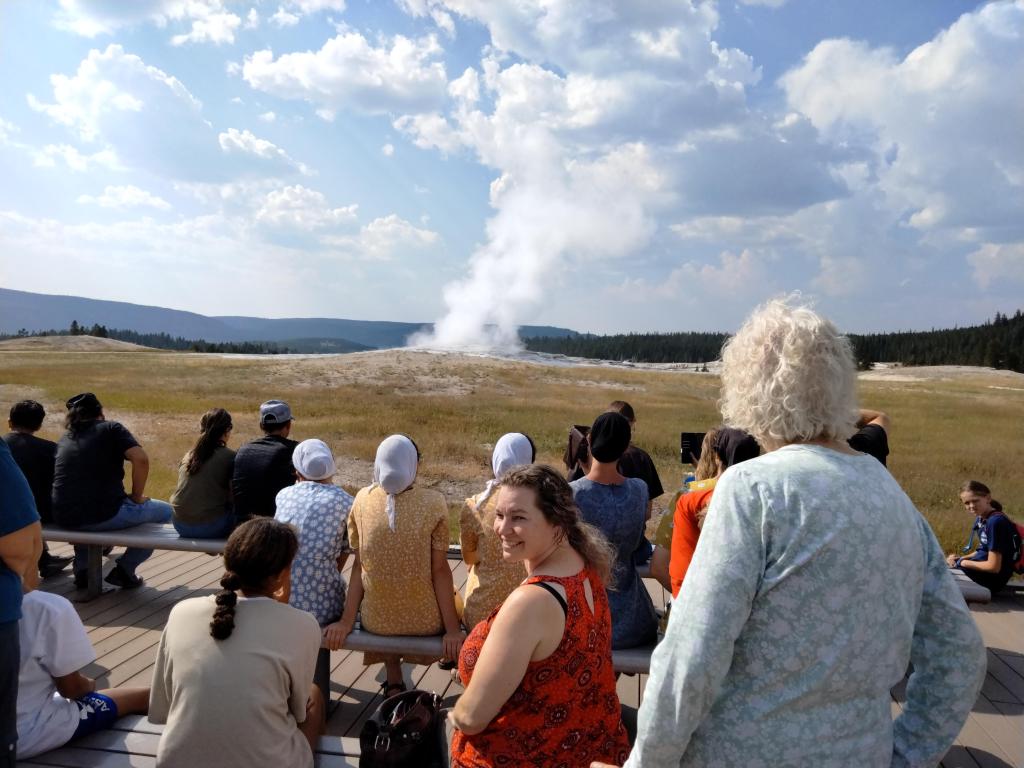
It’s an older Asian couple taking each other’s picture in front of a teepee, in Yellowstone.

I also saw a Pakistani family doing the same thing, which was also super cute.

I can’t remember who it was, but one commentator I listen to pointed out, in response to the move to take American Indians out of team names and products, that American Indians are famous all over the world.

Anyway, I’m here at Yellowstone with the fam and it’s very international here. Languages I heard in the space of a few hours:

  • Hindi (? – pretty sure)
  • German
  • Mandarin
  • Korean
  • Spanish
  • British English

They all came to see Old Faithful, the geyser. Even more faithful than old faithful were the people. We all came at the time it was predicted to blow. We all sat quietly, as if at church, except that occasionally someone would say, “It’s starting! It’s starting!” – and it would be a false alarm.

When Old Faithful did demonstrate its power once again, we all raised our phones in unison, and faithfully recorded it.

The human kindness continued the next day at this lookout point (veiwing Grand Teton peak), reachable by tram from Teton Village. 10,450 feet in the air, we faithfully offered to take each other’s family photos in front of the panorama, exchanging phones and then giving them back.

Human beings can be faithful, and kind, for a couple of days while on vacation.

The One who made the mountains is faithful forever.

Raspberries and Being a Fully Designed Human

Here I am, using my color vision to spot the ripest raspberries in the thicket. Darker ones are ready. I can distinguish fine grades of color.

Then, I use my specially designed opposable thumbs to pick the ripest raspberries. My fingers have been given the ability to sense, and calibrate their grip for, the finest gradations of pressure. This allows me to pull each berry off its core without squishing it. Most of the time.

The raspberries, for their part, have been specially designed to be picked and eaten by me. Every year, they produce a ridiculous bumper crop. “Pick us!” they groan. They have been given thorns, of course, but these are at best a halfhearted attempt to fight back. All I need to do is put on a long-sleeved shirt, and the prospect of a nasty scratch is no match for the motivation furnished by the berries’ taste.

The raspberry bushes are very good at surplus. They produce far more berries than I can realistically pick, and they hide them where I will never find them all.

They taste sweet-tart. They provide fiber and Vitamin C and I don’t know what all. They look so pretty paired with yogurt and oatmeal on a summer morning.

This morning while I was deep in the raspberry patch, my son picked up one of our chickens and at that moment she laid, the egg dropping from his arms to the ground. It didn’t break. Food was literally falling from the sky.

Quote of the Week, Plus a Domain Name Update

When one is trying to get into a house, one seeks openness. One pushes to open its door. So when the gods were seeking to get into the American house and that of Western civilization, the focus was on openness and tolerance. It was never really about either.

The Return of the Gods, by Jonathan Cahn, p. 219

The above book qualifies as my most mind-blowing read of the year so far (as well as I can remember). I’ll work on a review to have up by Friday.

In the meantime, the primary domain of this here Out of Babel blog is now outofbabelbooks.com (note that I have also updated the name on the banner). If you are here, congratulations, you found it!

The old url, outofbabel.com, is still in the process of being transferred to another user. Apparently, this can take a while. When the transfer is complete (perhaps by next week?), the address outofbabel dot com will no longer be associated with me in any way. At that point, some of you may see your shortcuts to my blog stop working. I don’t know. If that happens, keep calm and create a shortcut to outofbabelbooks dot com. Thank you.