Thank You, St. Boniface: A Repost About Christmas

This post is about how we got our Christmas trees. For the record, I would probably still have a Christmas tree in the house even if it they were pagan in origin. (I’ll explain why in a different post, drawing on G.K. Chesterton.) But Christmas trees aren’t pagan. At least, not entirely.

My Barbarian Ancestors

Yes, I had barbarian ancestors, in Ireland, England, Friesland, and probably among the other Germanic tribes as well. Some of them were headhunters, if you go back far enough. (For example, pre-Roman Celts were.) All of us had barbarian ancestors, right? And we love them.

St. Boniface was a missionary during the 700s to pagan Germanic tribes such as the Hessians. At that time, oak trees were an important part of pagan worship all across Europe. You can trace this among the Greeks, for example, and, on the other side of the continent, among the Druids. These trees were felt to be mystical, were sacred to the more important local gods, whichever those were, and were the site of animal and in some cases human sacrifice.

God versus the false gods

St. Boniface famously cut down a huge oak tree on Mt. Gudenberg, which the Hessians held as sacred to Thor.

Now, I would like to note that marching in and destroying a culture’s most sacred symbol is not commonly accepted as good missionary practice. It is not generally the way to win hearts and minds, you might say.

The more preferred method is the one Paul took in the Areopagus, where he noticed that the Athenians had an altar “to an unknown god,” and began to talk to them about this unknown god as someone he could make known, even quoting their own poets to them (Acts 17:16 – 34). In other words, he understood the culture, knew how to speak to people in their own terms, and in these terms was able to explain the Gospel. In fact, a city clerk was able to testify, “These men have neither robbed temples nor blasphemed our goddess” (Acts 19:37). Later (for example, in Ephesus) we see pagan Greeks voluntarily burning their own spellbooks and magic charms when they convert to Christ (Acts 19:17 – 20). This is, in general, a much better way. (Although note that later in the chapter, it causes pushback from those who were losing money in the charm-and-idol trade.)

However, occasionally it is appropriate for a representative of the living God to challenge a local god directly. This is called a power encounter. Elijah, a prophet of ancient Israel, staged a power encounter when he challenged 450 priests of the pagan god Baal to get Baal to bring down fire on an animal sacrifice that had been prepared for him. When no fire came after they had chanted, prayed, and cut themselves all day, Elijah prayed to the God of Israel, who immediately sent fire that burned up not only the sacrifice that had been prepared for Him, but also the stones of the altar (I Kings chapter 18). So, there are times when a power encounter is called for.

A wise missionary who had traveled and talked to Christians all over the world once told me, during a class on the subject, that power encounters tend to be successful in the sense of winning people’s hearts only when they arise naturally. If an outsider comes in and tries to force a power encounter, “It usually just damages relationships.” But people are ready when, say, there had been disagreement in the village or nation about which god to follow, and someone in authority says, “O.K. We are going to settle this once and for all.”

That appears to be the kind of power encounter that Elijah had. Israel was ostensibly supposed to be serving their God, but the king, Ahab, had married a pagan princess and was serving her gods as well. In fact, Ahab had been waffling for years. There had been a drought (which Ahab knew that Elijah — read God — was causing). Everyone was sick of the starvation and the uncertainty. Before calling down the fire, Elijah prays, “Answer me, O LORD, answer me, so these people will know that you, O LORD, are God, and that you are turning their hearts back again.” (I Kings 18:37)

Similar circumstances appear to have been behind Boniface’s decision to cut down the great oak tree. In one of the sources I cite below, Boniface is surrounded by a crowd of bearded, long-haired Hessian chiefs and warriors, who are watching him cut down the oak and waiting for Thor to strike him down. When he is able successfully to cut down the oak, they are shaken. “If our gods are powerless to protect their own holy places, then they are nothing” (Hannula p. 62). Clearly, Boniface had been among them for some time, and the Hessians were already beginning to have doubts and questions, before the oak was felled.

Also note that, just as with Elijah, Boniface was not a colonizer coming in with superior technological power to bulldoze the Hessians’ culture. They could have killed him, just as Ahab could have had Elijah killed. A colonizer coming in with gunboats to destroy a sacred site is not a good look, and it’s not really a power encounter either, because what is being brought to bear in such a case is man’s power and not God’s.

And, Voila! a Christmas Tree

In some versions of this story, Boniface “gives” the Hessians a fir tree to replace the oak he cut down. (In some versions, it miraculously sprouts from the spot.) Instead of celebrating Winter Solstice at the oak tree, they would now celebrate Christ-mass (during Winter Solstice, because everyone needs a holiday around that time) at the fir tree. So, yes, it’s a Christian symbol.

Now, every holiday tradition, laden with symbols and accretions, draws from all kinds of streams. So let me hasten to say that St. Boniface was not the only contributor to the Christmas tree. People have been using trees as objects of decoration, celebration, and well-placed or mis-placed worship, all through history. Some of our Christmas traditions, such as decorating our houses with evergreen and holly boughs, giving gifts, and even pointed red caps, come from the Roman festival of Saturnalia. This is what holidays are like. This is what symbols are like. This is what it is like to be human.

Still, I’d like to say thanks to St. Boniface for getting some of my ancestors started on the tradition of the Christmas tree.

Bonus rant, adapted from a discussion I had …

... in a YouTube comments section with a Hebraic-roots Christian who was insisting that Christmas is a “pagan” holiday:

So, as we can see, the evergreen tree is a Christian symbol, not a pagan one, and has been from the very beginning of its usage. St. Boniface cut down the tree that was sacred to Thor, and that was an oak tree, not a Christmas tree. Sacred oaks are pagan. Christmas trees, which incidentally are not actually considered sacred, are Christian.

Yes, I am aware, as are most Christians, that Jesus was probably not actually born on Dec. 25th. Yes, I am aware that Yule was originally a pagan feast time.

But let’s look at the symbolism, shall we?

For those of us who live in northern climes, and especially before the industrial revolution, the winter solstice is the scariest time of the year. The light is getting less and less, and the weather is getting worse and worse, and all in all, this is the time of year when winter officially declares war on humanity. Winter comes around every year. It kills the sick and weak. It makes important activities like travel and agriculture impossible. It makes even basic activities, like getting water, washing things, bathing, and going to the bathroom anywhere from inconvenient to actually dangerous to do without freezing to death. If winter never went away, then we would all surely die. That is a grim but undeniable fact. Read To Build A Fire by Jack London, and tremble.

Thus, people’s vulnerability before winter is both an instance and a symbol of our vulnerable position before all the hardships and dangers in this fallen world, including the biggie, death. And including, because of death, grief and sorrow.

Yule is a time of dealing with these realities and of waiting for them to back off for another year. After the solstice, the days slowly start getting longer again. The light is coming back. Eventually, it will bring warmth with it. Eventually, life.

Thus, it is entirely appropriate that when the Germanic tribes became Christians, they picked the winter solstice as the time to celebrate Jesus’ birth. He is, after all, the light of the world. A little, tiny light – a small beginning – had come into the bitter winter of the sad, dark world, and it was the promise of life to come. The light shines in the darkness, and the darkness has not overcome it. All this biblical, very Hebrew symbolism answers beautifully the question raised by the European pagans’ concern with the sun coming back.

Our ancestors were not “worshipping pagan gods” at Christmas. They were welcoming Christ (who is the God of Abraham, Isaac, and Jacob) into the heart of their culture. They were recognizing that He was the light, using terms they knew, which were Germanic terms, and this is not surprising because they were Germans.

So, if you want to make the case that no holidays are lawful for Christians except those prescribed in the Old Testament for Israel, be my guest. Try to find some Scriptures to back that up. And maybe you can. But you cannot make that case by accusing people who put up a Christmas tree of worshipping pagan gods. All you’ll do then is reveal yourself to be historically ignorant.

Sources

BBC, “Devon Myths and Legends,” http://www.bbc.co.uk/devon/content/articles/2005/12/05/st_boniface_christmas_tree_feature

Foster, Genevieve, Augustus Caesar’s World: 44 BC to AD 14, Beautiful Feet Books, 1947, 1975, Saturnalia on p. 56 ff.

Hannula, Richard, Trial and Triumph: Stories from church history, Canon Press, 1999. Boniface in chapter 9, pp. 61 – 64.

Puiu, Tibi, “The origin and history of the Christmas tree: from paganism to modern ubiquity,” ZME Science, https://www.zmescience.com/science/history-science/origin-christmas-tree-pagan/
Oh Look, Luther Agrees with Me — Er, the Other Way Round

As yet, most excellent Spalatin, you have only asked me things that were in my power. But to direct you in the study of Holy Scriptures is beyond my ability. If, however, you absolutely wish to know my method, I will not conceal it from you.

It is very certain that we cannot attain to the understanding of Scripture either by study or by intellect. Your first duty is to begin by prayer. Entreat the Lord to grant you, of His great mercy, the true understanding of His Word. There is no other interpreter of the Word of God than the author of this Word, as He Himself has said: “They shall be taught by God.” Hope for nothing from your own labors, from your own understanding: trust solely in God and in the influence of His Spirit. Believe this on the word of a man who has experience.

Martin Luther, quoted in The Triumph of Truth by Jean Henri Merle D’Aubigne , p. 96

Misanthropic Quote: Against Utopianism

Have we not already seen enough of the fallacy and extravagance of those idle theories which have amused us with promises of an exemption from the imperfections, weaknesses, and evils incident to society in every shape? Is it not time to awake from the deceitful dream of a golden age, and to adopt as a practical maxim for the direction of our political conduct that we, as well as the other inhabitants of the globe, are yet remote from the happy empire of perfect wisdom and perfect virtue?

John Jay, Federalist No. 6

Jean Cauvin

How I fell down the Calvinist rabbit hole: a 25-year saga

Do you want to know how I fell down the Calvinist rabbit hole? Of course you do.

I was raised in your basic free-will-Baptist, Arminian environment. I discovered Calvinism in college, but I didn’t know right away that it was called Calvinism. I just knew I was encountering deeper Bible teaching than I had seen before, teaching that seemed to be based on good exegesis, to contain a great deal of psychological insight, and to fit with my own experiences of belief, spiritual growth, and successful and unsuccessful evangelism. Above all, this teaching had the effect of exalting Christ and making the great kindness and mercy of God shine all the more bright. In other words, Gospel teaching.

Not long after, I found out that one of its most copious articulators had been Calvin.

That was OK with me. Anybody who does a great job expounding the grace of God abounding to the chief of sinnners is someone I call friend. If they wrote volumes about it and were insightful and articulate, so much the better. I think this teaching is Biblical; that’s why I’m a Calvinist. But I’m not personally loyal to Calvin or to the idea of Calvin. (“I am of Apollos; I am of Paul.”) I wasn’t growing in the grace and knowledge of Calvin, but of Christ.

Anyway, the upshot was that I started attending Presbyterian churches whenever I was able to find one. That seemed to be where the good stuff was. Oh, and then I married a guy who was also a convert to what we call Reformed Theology or covenant theology. So, you know. I was in pretty deep by this time. All this went down about twenty-five years ago.

Over the years, I’ve interacted with quite a few Christians who are hostile to the name Calvin. These interactions have, in general, served to strengthen my conviction that the doctrine is true. That is because anti-Calvinist arguments, instead of presenting troubling “oh, I never thought of that!” Bible passages that make me call covenant theology into question, usually just seem to be reacting to a straw man of Calvinism, often a really egregious straw man. Here are a few.

No Free Will

The straw man of Calvinism that I most commonly hear presented is as follows: Calvinism is a completely deterministic system in which God controls all people, angels, and demons like He’s Jim Henson and they are the Muppets. It looks like you are making decisions, but it’s actually God steering you with His hand inside your little felt head. You have no free will.

Usually, this straw man came about in one of two ways. First of all, the person has not actually read much (or any?) Calvinist literature but has just heard the doctrine of predestination summarized, often in a hostile way, by someone else. And/or, the person has taken the doctrine of predestination and/or irresistible grace and has tried to work out all its implications in a completely logical system of thought such as we might find in the hard sciences, ignoring human psychology, other Bible passages, and even other Calvinist doctrines.

At its very base, this caricature is based on a naive misunderstanding of the nature of human will.

You see, my friends, our wills are not actually free when we are bound in sin. Sin is like addiction, and we all know that the addict is not free. He is not free to do anything but indulge over and over again in the the thing that has mastered him. Believe me, the working of the Holy Spirit of God on your heart is not nearly so damaging to your free will as is sin. That’s why the Bible says that whoever sins is a slave to sin.

This is basic human psychology, and most people understand it when they are not contemplating Calvinism. None of our decisions are ever completely “free” in the sense of not being influenced by anything at all. That doesn’t make them not decisions. Yes, you did decide to follow Jesus … it’s just that first, He had to set your heart free to do so.

But wait, isn’t the doctrine that God decided back in eternity past who would be saved and who would be damned? How, Madame Calvinist, you ask, can you call that free will? Hmmm?

Well, true. But keep in mind that this doctrine does not only apply to salvation. The sovereignty of God over all things in the universe is a doctrine that is found throughout the Bible. Who of you by worrying can add one hour to his life? God knows about every sparrow that falls, and don’t worry, you are worth at least several sparrows. And even the very hairs of your head are all numbered. He sends rain on the just and on the unjust. He changes times and seasons; he sets up kings and deposes them. The heart of the king is like a watercourse, and the Lord turns it wherever he pleases. The Lord opens and closes the womb. He gives and takes away. Blessed be the name of the Lord.

The sovereignty of God, as I say, is an extremely basic doctrine, and even Christians who hate the name of Calvin will affirm it in a general way when it is presented like this. To try to deny it would land us in much deeper difficulties. (Cue Darwinistic determinism.)

So, God is sovereign over every molecule and every sentient being in the universe (a basic doctrine), AND this universe includes beings other than God (animals; demons; you and me) who make actual decisions with actual consequences. That is another doctrine that is not only blindingly obvious from our experience, but is affirmed, directly and indirectly, in numerous places in Scripture.

Is this a paradox? You bet. Not everything in Scripture is a paradox, but this one is. Not everything in our universe is a paradox, but this one definitely is. Don’t ask me to explain how it works. I’m not God. But to be fair, I should not have to be able to explain how it works in order to assert that God is sovereign over all of creation including the human heart, AND that humans make decisions. Remember, no one else has been able to come up with a philosophical system that accounts for human nature without landing us in determinism, either. This is a paradox that all of us, Calvinist and non-Calvinist, have to live with. If you follow Darwin or Marx instead of Calvin, you will get to determinism a lot faster, and you will like it even less when you get there.

So, this thing about “Calvinisim means we have no free will” is the result of an attempt to woodenly apply human, binary logic to a doctrine about the sovereignty of God, and to draw the conclusions that we think must follow from it (even though they don’t actually follow from it in Calvinist teaching or in Scripture).

So, there’s no point in doing anything, is there?

Another objection I often hear (which is actually a corollary of the first misunderstanding): “If, as Calvin says, God ultimately determines who will be saved and who will be lost, why then there is no point in preaching the Gospel, calling people to repentance, teaching our children about Christ, or combating false teaching. After all, it’s all decided already.”

Again, this is a mischaracterization of actual Calvinist teaching. It’s what people think follows from what they think Calvinism is. But if you crack open any Reformed piece of writing (say, the Canons of Dort), you will very quickly encounter the doctrine that God uses means to accomplish His purposes. Prayer, preaching and the Lord’s Supper are called “the ordinary means of grace.” In other words, sometimes God can use extraordinary means, as He did with Saul on the road to Damascus, in order to call someone to Himself. But ordinarily, the means He uses are someone gave you some good Bible teaching, and so you heard the Gospel. God is sovereign, AND, due to the way He has designed the world, false teaching can do real harm and Gospel teaching can do real good.

Furthermore, God typically (not exclusively, but typically) works in families. So, if you were born into a Christian family, were loved and were taught God’s Word, these were the means He used to bring about your salvation (which He had determined from all eternity past, but that part might not be super relevant to your experience right at first). In my experience, parents in Reformed churches are more serious about giving their children good Gospel teaching than those in other Protestant traditions. So, you may think that Calvinism implies there is no need to teach our children the Gospel, but in actual fact that is not how Calvinists behave, nor is it what they teach.

From childhood, I have sat under both Arminian and Calvinist types of teaching. (Arminian would be the typical Baptist “altar call.”) From personal experience, I can say that certain types of Arminian teaching, especially the kind you get around the campfire in youth group, put a lot of pressure on the individual. “Deciding to follow Jesus” becomes a work that you do, whereby you whip yourself up into an emotional fervor to manufacture a spiritual experience. “Turn over every area of your life to Christ.” That’s right, don’t just repent of the sins you know about and that the Holy Spirit is bringing to mind right now, and then trust Him to reveal more of your sin later. That would be too easy. Instead, you need to do a thorough self-examination and personally peer into and clean out every dark corner of your heart, right now, tonight. After all, it’s your choice. You save yourself, Christ does not save you.

Another bad effect of this shallow understanding of choice, will, and grace is that it tends to keep us trapped in spiritual immaturity. Since people choose God instead of God choosing people, when a child or a teen who has believed on Christ shows that they are still immature, or falls back into sin (which we all do), the tendency of an Arminian is to take this as a sign that the person did not “really” decide to follow Jesus. So instead of being given rebuke, teaching, encouragement, and exhortation, they are terrified with the prospect that they’re not really saved, and invited to manufacture a second (or a fifth or a twentieth) conversion experience. It would be much more helpful to these young people to treat them as Christians who are immature and sinful. This would allow them to grow in spiritual maturity as they gain practice in battling against sin. Such an approach (Calvinist, by the way) is also less insulting to Christ. Christ can save teens and children. He does not just save the good ones. His power is not so frail as to be foiled by the fact that we are lazy, stupid, proud, a bully, or have fallen into sexual sin.

Farther down the rabbit hole

So, over the past 25 years of delightedly growing in grace, I have read a number of books by Calvinist authors. These include books and essays by Martin Luther, R.C. Sproul, John Piper, Ted Tripp, Ed Welch, Matt Whitling, Douglas Jones, and Douglas Wilson. I’ve read a few of the older confessions and creeds, such as the Westminster Confession and the Canons of Dort. I’ve sat under some fantastic Reformed teaching. But one thing I had never done was read a history of Calvin’s life, conversion, and time in Geneva.

That changed this fall, when I was obliged to read up on Calvin (and on his magnum opus, Institutes of the Christian Religion), in order to teach a unit on him. Reading, in fact, is what I am supposed to be doing instead of writing this excellent blog post.

Anyway, what I have found out so far is that his original name was Jean Cauvin. It got Latinized to Calvinus when he entered school, and then later the -us was dropped. He grew up in northeastern France, in and around the stunning cathedral of Noyon, as a Roman Catholic. His dad actually worked as a secretary to the bishop of Noyon, and Calvin was educated with the bishop’s children. Later, Calvin boarded for a while with a godly old man who was a Waldensian (French Protestant). At this same time, the Waldensians who had settled in the Piedmont in Italy were being gruesomely butchered for refusing to convert to Roman Catholicism (read Foxe’s Book of Martyrs, and tremble). The Inquisition was still going on.

Now I have to get back to reading the Institutes and stuff like that. I haven’t come to the bottom of the rabbit hole yet. Have a great weekend, and if you feel a tug, read the Scriptures! It’s probably God calling you, as He determined to do out of His sheer kindness to you from all eternity past!

“What’s Your Life Verse”?

Having a “life verse” used to be a thing in evangelical Christian culture.

I once knew this guy who was interested in dating this girl. He was kind of a new Christian, and she wasn’t 100% sure he was sincere, because guys have been known to fake spirituality in order to get the girl. So she kept grilling him, trying to figure it out. And one question she asked him was, “What is your life verse?”

So if you thought the title of this blog post sounded like a pickup line, you weren’t entirely wrong.

I don’t actually know whether life verses have faded away as a practice, or whether they are still a thing that gets talked about, but I have just moved into denominational circles that are less silly.

Why do I say silly? Not because picking a “life verse” involves meditating intensely on a passage from the Bible. The Word of God is certainly powerful and active and worth returning to as a theme (provided we are actually responding to what the verse actually says, not just to a meaning that we project onto it). Anyone who makes a regular practice of prayerfully reading their Bible has had the experience where a verse, or a passage, seems to pop off the page and hit you between the eyes like a two-by-four. And then you spend several weeks or months revisiting that verse, turning it back and forth in your mind like a huge jewel with many facets, internalizing it, wondering why you didn’t notice it before.

No, the reason I think the idea of a “life verse” is kind of stupid, is that it’s too restrictive. You are going to limit yourself to just one two-by-four verse? Why? The Bible is full of two-by-fours just waiting to whack you. It can happen every few months, or once a year, but definitely there is a going to be a different theme verse for every season in your life.

And if we are talking about a verse that describes your particular experience of life, that might exist, but it’s hard to imagine you how you could pick it as a 20-year-old. Sounds more like the kind of thing that is awarded retroactively, maybe by your biographer.

For example, after several decades of experience, I think my life verse might just be II Corinthians 12:11: “I have made a fool of myself, but you drove me to it.”

I think that would look great on my tombstone. Although, the “you drove me to it” part is debatable.

Anyway. As faithful Out of Babelites are aware, I spent part of last year further educating myself on Gnostic and Hermetic philosophy. Partly as a result of this, I’ve been steeping in the book of Colossians, which is almost entirely about Hermetic and Gnostic beliefs and cults, and how they are not the Gospel once delivered to the saints. Paul was worried about Colossians, who in his absence might be confused by one of the Hermetic “teachers” who were so numerous in the Mediterranean world in the first century. If you want to know whether Gnositc/Hermetic teaching is really the same as what Jesus taught, just in different words, please read Colossians.

So, one of my two-by-four verses this year is this:

Such regulations indeed have an appearance of wisdom, with their self-imposed worship, their false humility and their harsh treatment of the body, but they lack any value in restraining sensual indulgence.

Colossians 2:23

Especially in my youth, I was easily impressed by ascetic and mystical claims and practices. How could these things be bad? They have an appearance of wisdom. “Such regulations” could be found in yoga, Mormonism, Islam, legalistic/Hebrew-roots sects of Christianity, or modern environmental Gnosticism where we save ourselves by education, sensitivity training and clean living.

Now I know: such regulations lack any value in restraining sensual indulgence. They do not give people power to resist sin. That explains why every ascetic cult seems to generate its own sex scandals. It explains why we can expect such scandals from such quarters, even when they have not yet come to light.

So anyway, that’s my life verse for now. Patiently waiting to be clocked by the next two-by-four.

Quote: Originally Written in Hebrew

Hear me when I call, O God of my righteousness!

You have relieved me in my distress;

Have mercy on me, and hear my prayer.

How long, O men, will you turn my glory to shame?

How long will you love worthlessness and seek falsehood? Selah.

But know that the LORD has set apart for Himself him who is godly;

The LORD will hear when I call to Him.

Be angry, and do not sin.

Meditate within your heart on your bed, and be still. Selah.

Offer the sacrifices of righteousness,

And put your trust in the LORD.

There are many who say, “Who will show us any good?”

LORD, lift up the light of your countenance upon us.

You have put gladness in my heart,

More than in the season that their grain and wine increased.

I will both lie down in peace, and sleep;

For You alone, O LORD, make me dwell in safety.

Psalm 4. By David.

So.

My dad used to quote me the last verse of this psalm as a bedtime prayer when I was small.

The classical Christian school where I teach had selected this psalm for memory work for the month of October.

And then …

We hear of atrocities in Israel, committed against Israelites. Every single verse of this psalm, written by David millennia ago, instantly becomes 100 times more relevant and poignant.

When I hear about mothers and babies murdered, reading that last verse out loud is almost more than I can handle.

Let’s all use this psalm to pray for them.

Misanthropic Quote of the Week from P.D. James

He knew even better than she did that you could never predict, any more than you could completely understand, what human beings were capable of. Before an overwhelming temptation everything went down, all the moral and legal sanctions, the privileged education, even religious belief. The act of murder could surprise even the murderer. She had seen, in the faces of men and women, astonishment at what they had done.

The Murder Room, by P.D. James, p. 219

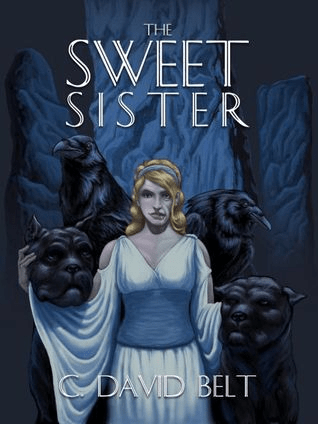
Book Review: The Sweet Sister, by C. David Belt

Fun story about how I discovered this book: I was at a Fantasy Faire as a vendor. A fantasy faire is sort of a like a RenFaire, but calling it “fantasy” opens it up to more time periods and more imaginative costumes. This Faire took place in southeast Idaho, so quite a few of the booths were from Utah. As I wandered the booths on the first morning, a banner on one of them caught my eye: “Strangely uplifting LDS horror.” In case you don’t know, LDS stands for Latter-Day Saints, which is the more respectful term for Mormon and what the Mormons usually call themselves. I am not Mormon, but I could not help but be intrigued by this advertising phrase. Horror, written by someone from a community that is mostly known for wanting to keep everything in life PG if not G? That’s going to be some interesting horror. Also, I do like my horror uplifting.

So, long story short, I missed meeting the author, but I bought the book. He has a lot of others, but I went for this one because it was a stand-alone.

The LDS horror did not disappoint. The opening scene takes place at fantasy convention, very similar to the event I was at when I started reading. (Nice.) The main character is LDS, and she is a tall, big-boned, plain-faced 30-year-old woman who has a secret crush on her handsome, also LDS, coworker. In short, a very relatable female lead. Being a lonely, not conventionally attractive 30-year-old woman is tough for everyone, but it’s even worse in the LDS community where there is so much emphasis on marriage.

So, the contemporary main characters are Peggy, whom you met above, and Derek, her crush, who is happy to go to conventions and watch fantasy and sci-fi movies with Peggy, but doesn’t like her “that way” and does not see her worth.

But very soon, we get into the spooky stuff. This is not exactly a time-traveling book, but it has characters who move through time by spending decades in a state of suspended animation brought about by eating an apple-like fruit from a magical tree. So, the mysterious, princess-like young woman on whom Derek gets a hopeless crush really is a woman from millennia ago who doesn’t quite know how to function in the modern world because she has been skipping through time.

I don’t want to give more spoilers than that, but let me just say that the research on this book impressed the heck out of me. The author has taken a deep dive into Celtic mythology, Arthurian legends, British/Roman history, and fairy tales, and he ties it all together. Although the main characters do not travel back in time, the story takes jaunts into the past to reveal to us the sleeping princess’s back story. We see how she gave rise to the “sleeping maiden” fairy tales like Sleeping Beauty and Snow White, but what actually happened was … much creepier. These reveals are tantalizingly done. They are not info dumps, and the whole story is not revealed until the very end.

This author takes a unique approach to paganism, one that I really appreciate. As a Mormon (which he understands to be a version of Christianity), Belt does not endorse the ancient Celtic religion and he doesn’t whitewash it either. He is perfectly willing to portray the darkness and terror and human sacrifice that come with Cernunnos and Morrigan. This is very different from most modern fictional treatments of Celtic paganism, which tend to portray the pagans as harmless, live-and-let-live, nature-loving types whose religion has no down side. However, although Belt mines paganism for horror, he passes the “love test” (the author must love the culture he’s writing about). He writes about the ancient pagans with sympathy and seems to understand their point of view. They are real human beings to him, and their gods are real entities.

And that’s why this horror is “strangely uplifting.” Unlike some horror writers I could name (ahem Stephen King), there are actually good, admirable characters in this book alongside the horror.

If you like fairy tale re-tellings, Arthurian legends, Celtic paganism, or modern-day horror, you might like this book. If you like all four, this book is definitely for you!