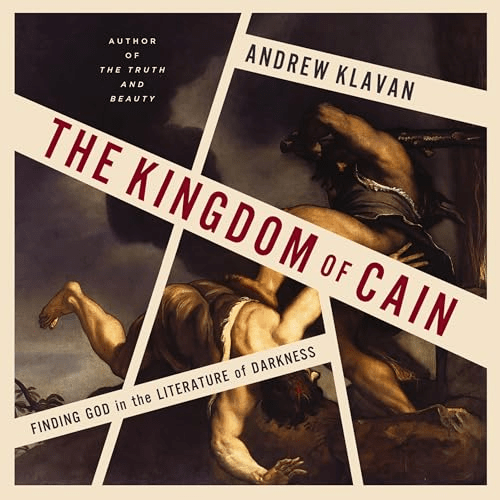
Finding God in the Literature of Darkness

A review of noir writer Andrew Klavan’s The Kingdom of Cain: Finding God in the Literature of Darkness. I have already posted this review on Amazon and Goodreads.

This is a very readable book that fleshes out Andrew Klavan’s thesis:

The opposite of murder is creation–creation, which is the telos of love. And because art, true art, is an act of creation, it always transforms its subject into itself, even if the subject is murder. An act of darkness is not the same thing as a work of art about an act of darkness. The murders in Shakespeare’s Macbeth are horrific, but they are part of a beautiful play.

page 17

In other words, Klavan is wrestling with the problem of evil. Based on his decades of thinking about this, he has concluded that in this life, there is no theological answer that can redeem evil for those who have suffered it. Theological answers there may be, but those are not what redeem it for us. The only answer to suffering is not an answer, exactly; it is beauty. The example he frequently re-visits is the Pieta, “the most beautiful statue in the world,” a statue of Mary cradling her maimed and innocent, dead son.

I think Klavan’s thesis is a very strong one. I think of the book of Job. Job suffers horribly, and apparently undeservedly, and to add to his suffering, he is told that it must be his fault. He asks God why. Now, as it happens, there is an explanation for everything that is happening to Job. But God doesn’t give it. He just starts talking to Job about the wild animals and their habits. This is beauty, it is wonder, and it is far beyond Job’s experience. But ultimately, God answers Job with Himself, with His presence. He answers Job out of the whirlwind. He mentions just a few of His mighty, mysterious works in creation. And this is a good answer. It is enough. It is a much better answer than if God had said, “Well, it all started when I got into this argument with Satan …”

Kingdom of Cain is a hard book to read because of the real-life crimes described in it. Klavan tries not to get too graphic unless he has to, but this is a book about murders after all, including copycat murders. The blurb says it examines the impact of three murders on our culture, but there are a lot more than that, both fictional and–this is the hard to read part–real. The hardest one for me was the kidnap, rape, and murder of a 14-year-old boy by a pair of older teenagers who were later lionized in fiction.

This book is very insightful. Perhaps if I had never heard Klavan make these points before, I’d have given it five stars. But I have been following him for years, and he has been working on this concept for years, so the idea was not new to me. Especially in the later chapters, it felt a little belaboring. Hence, four stars.

I Got Nominated … Sort of

(Is the above really the latest Sunshine Blogger Award logo? Looks kinda messy.)

So, Bookstooge sort-of-nominated me for the Sunshine Blogger Award! Thank you, Bookstooge! I am so flattered. I think his exact words were, “If you’re reading this, consider yourself nominated, because it means you have a pulse.”

Rules For The Sunshine Blogger Award:

  • Display the award’s official logo somewhere on your blog.
  • Thank the person who nominated you.
  • Provide a link to your nominator’s blog.
  • Answer your nominators’ questions.
  • Nominate up to 11 bloggers.
  • Ask your nominees 11 questions.
  • Notify your nominees by commenting on at least one of their blog posts.

Questions from Bookstooge:

  1. Why Would Anyone Consider Cereal to be Soup?

It’s because they are trying to categorize things according to algorithmic rules/decision trees instead of the way the human mind normally works, which is by constructing a schema for the thing in question and then eyeballing it.

With schemas, if the thing mostly resembles the schema, it is considered an instance of that thing, even if it misses checking some important boxes. And if it checks all the boxes but manifestly does NOT resemble the schema at all, then it’s not an instance of that thing.

Cereal is in the latter category. It’s an ungodly modern creation of Mr. Kellogg, who believed that eating meat was morally wrong as well as unhealthy, and sought to banish it from the breakfast table. And I say this as someone who very much likes breakfast cereal, particularly as an evening snack, even though I know it has wreaked havoc with my metabolism (see question #10).

2. Why Do You Blog?

I blog to get you interested in my books. Go buy ’em. BUT, warning, don’t buy the Kindle version of The Strange Land until the end of next week, when it will cost 99 cents because of a special promo.

3. How Do You Justify Your Existence? (I got that one from the Tales of the Black Widowers, good isn’t it?)

Yep, it’s a good one.

Photo by Pixabay on Pexels.com

“So God created man. In the image of God created He him, male and female created He them. And He said to them, ‘Be fruitful and multiply, fill the earth and subdue it. Rule over the fish of the sea and the birds of the air, the cattle and the creatures that move along the ground.'”

Edit: By quoting this passage, I am NOT asserting that the only justification for our life is to reproduce … i.e., that your life somehow has no meaning if you are not a parent. I happen to have been given three children, but that’s God’s gift to me, not mine to Him. No, the point of quoting this passage is this: I justify my existence because God made me. He made us. He wanted there to be people. He wanted us to exist as male and female. And, per the latter part of the passage, He wanted there to be a lot of us. If you exist and you are a human, He is happy about that.

4. How Do You Choose Who to Follow?

Unfortunately, I’m a lot like Trump in this way. If you say nice things to me, I like you and then I follow you.

An alternative route is that you posted something that really interested me. This usually means book reviews, discussion about writing, theology, ancient history, and sometimes art.

5. If John McClane and John Wick were tied on a railroad track and you could only set one of them free, which would you choose and why?

O.K., I had to duckduckgo him, but John McClane is the Bruce Willis character in Die Hard. I would save John McClane instead of John Wick for the following reasons:

  • John Wick could definitely save himself.
  • I only saw the first Die Hard, but in it, John McClane is a family man, whereas John Wick doesn’t even have a dog anymore.
  • Once when we were in Indonesia, somebody swore that my husband looked exactly like Bruce Willis and now I can’t unsee it. That makes me think Bruce Willis is even more handsome.

6. In a game of Parcheesi, who would win, Spongebob Squarepants or the Doom Slayer?

I expect Spongebob to win in the same way that Bugs Bunny would.

7. Do you feel guilty about all of my oxygen that you are breathing?

Yes. My gosh, don’t remind me!

8. What is your favorite movie?

It’s a tie between The Princess Bride and a little hidden gem called Undercover Blues.

9. If you were going to be “accidentally but on purpose” killed tomorrow, how would you spend today?

I would write long letters to each of my children. If I had extra time, I’d move on to my husband, then other close family and friends.

I might try to transfer the rights to my books so they don’t go out of print, but I don’t think that could be done in one day. If you snooze, you lose, and I guess I snost and I lost.

10. Are mirrors Friend, or Foe?

Friend, but only in the sense of “faithful are the wounds of.”

11. If you could change ONE THING about your blog, what would it be?

Every single visit to my blog would result in a book purchase and then a breathless review on Amazon GO BUY MY BOOKS PEOPLE!

Ahem. I Nominate:

I nominate seven friends (the number of perfection!) plus Bookstooge cause I want to hear his answers too. And I nominate you, Reader, if you want to do it! After all, you are breathing! Which might provide the answer to my first question!

To Answer These Questions:

  1. What is the best gift God has given you?
  2. Without sharing details you don’t want to share, how did you come out of your darkest hour/day/year?
  3. What kind of biome would you most prefer to live in (one that can be inhabited by people)?
  4. In real life, how are your social skills (and do you have any tips for me haha)?
  5. What is your favorite genre of fiction?
  6. Do you ever read nonfiction and what makes you pick it up?
  7. Tell me one nice thing about your grandparents.
  8. If you could speak any language, ancient or modern, fluently besides your native one, which one would you choose?
  9. What are your feelings on the Harry Potter series?
  10. Do you have a favorite YouTuber/podcaster? What do they talk about? Now’s your chance to promote them!
  11. When did you first seriously consider the claims of Jesus of Nazareth? If you never have, would you do me a solid and consider doing so?

Becoming, and then Being, Elisabeth Elliot: a review

Quick! Who do we know who’s a linguist, a former missionary, a gifted writer, and wants to capture in novel form the human condition and God’s grace to us in it?

Who is awkward, reserved, and can come off as rude and abrupt, but actually has passionate emotions, a deep love for others, and a rich inner life?

Who loves nature? Crosses cultures happily, but doesn’t fit in so well in the American evangelical context? Who has a secret desire to be admired, but also suffers from poor judgement about the opposite sex?

Why, Elisabeth Elliot, of course!

Me and Elisabeth Elliot

When I was college and just discovering the things I ranted about last Friday, like the fact that we as a culture could use some guidelines about the how the sexes ought to relate to each other, I came across Elisabeth Elliot’s book Passion and Purity. I devoured it.

This book was exactly suited for me at the time. I was just starting to grow in Christ. I really wanted to do God’s will. I also, unbeknownst to me, had a lot in the common with the author of Passion and Purity: socially awkward, ascetic tendencies, perfectionistic, a longing for old-fashioned values. This book is basically about the lessons Betty, as she was called at that time, learned during her five years (!) of waiting for Jim Elliot to make up his mind that God had given him the go-ahead to marry her. Their courtship story strikes many Christian young people as really spiritual upon first hearing, and then on a second look, it starts to look as if he didn’t treat her very well possibly. But I bought into it fully.

Anyway. Full of missionary zeal to win other young people over to the idea of an extremely awkward, chaste, long courtship, I gave this book to a friend. She read it, and her reaction was, “There are the Elisabeth Elliots of this world, but I am not one of them.”

That annoyed me at the time (someone had rejected my idealistic ideal!), but from my perspective now, that friend of mine didn’t know how right she was. In fact, not even Elisabeth Elliot herself was one of the Elisabeth Elliots of the world, at least not in the sense of having perfect wisdom and self-control. At the time she was writing this (early 1980s), Elisabeth was enduring an extremely controlling marriage with a man she married because she didn’t want to be lonely. She stayed with him for the rest of her life, despite an intervention by her family. It’s chilling to realize that the woman who wrote Passion and Purity could make such a foolish decision.

Before Passion and Purity, I remember as kid seeing black-and-white photos of Elisabeth toting her small daughter Valerie into the jungle to serve the Waorani people (then called the Auca), a few years after her husband Jim was killed by them. These were the photos taken by Hungarian photographer Cornell Capa. They, and the books Elisabeth wrote about the Waorani, had made her and her martyred husband Jim famous throughout the evangelical world.

Both greater and lesser than I thought

When you think you know a story, you expect it to be boring. I put off for some time reading this duology by Ellen Vaughn, until it finally floated to the top of my reading list. Once I opened the books, I found that I couldn’t put them down. Vaughn is an excellent researcher and a vivid and sympathetic writer, and though I had read a number of books by and about the Elliots, I certainly didn’t know as much of their story as I thought.

Vaughn, aware that she is telling a story the outlines of which are familiar to readers, moves skillfully back and forth through time, as in a novel (though in rough outline, the first book deals with Betty’s early life and the second book with her post-Ecuador years). Vaughn doesn’t try to tell every story–there are too many, many of which have been told elsewhere, and others of which are apparently too private and will stay hidden forever in Elisabeth’s prolific journals. In fact, as I read these books, I felt I was getting to know two fellow woman writers: Elliot and Vaughn.

When you are a former missionary, it’s difficult to read other missionaries’ stories without comparing them to your own. Usually, this means you are reading about people who were far ahead of you in dedication, selflessness, toughness, and in what they suffered. This is certainly true of the Elliots. At the same time, so much of their personalities and stories seemed shockingly familiar. For example, young Jim Elliot was, besides being a great guy, an insufferable holier-than-thou know-it-all, of the “I’m going to go read my Bible” type. Betty, as Elisabeth was then called, was quiet and reserved and often didn’t realize that she was coming off as standoffish. Jim’s family verbally eviscerated her after her first visit to their home in Portland, and foolish young Jim passed all these criticisms on to Betty in a letter. She was devasted, but thought and prayed over the things they had said, and then concluded that none of them were things she could actually change. Later, Jim couldn’t believe he had shared his family’s words with Betty. As Bugs Bunny would say, “What a maroon. What an imBAYsill.”

They were just people, you see. Not angels. Which means that “just people” can always serve God.

Jim Elliot, you beautiful dunce.

The things they suffered also rang poignantly familiar. They suffered setbacks that lost them a year of their work–for her, language work; for him, building a mission station. Neat and tidy Elisabeth at some points had to live in squalor, and felt guilty for the fact that it bothered her. Fellow missionaries (not all) and Waorani Christians alike (not all) proved manipulative and controlling. In fact, it was relationship difficulties that caused Elisabeth eventually to leave the Waorani, after spending only a few years with them. This was not Elisbeth’s fault: person after person found it impossible to work with Rachel Saint, her fellow translator. But she took on as much of the responsibility for it as she possibly could, agonizing before God in her journals, because that was the kind of person she was.

Elisabeth the Novelist

Now we are getting into events of the second book, Being Elisabeth Elliot. Elisabeth knew that she had a gift of writing. She had made so much money from her books Through Gates of Splendor and The Shadow of the Almighty that she was able to build a house for herself and her daughter near the White Mountains of New Hampshire (talk about living the dream!) and settled down to become a writer. She really wanted to write great literature, the kind that would elevate people’s hearts and give them fresh eyes to see the great work of God all around them in the world.

If I were writing a novel about Elisabeth Elliot, I would end it there, and let her have a period of rest, in the beautiful mountains, with her daughter, writing her books, for the rest of her days. I wish that was how it had gone. I kept hoping, as I read this duology, for there to come a point when Vaughn could write, “And then, she rested.” Alas, that moment never came.

Elliot was indeed a really good writer. Sometime in the twenty-teens, when I was a young mom who had come back from the mission field hanging my head over my many failures, and had unpacked my books and settled into a rented house to minister to my small children, I found on an upstairs shelf a slim volume that looked as if it had been published in the 1960s or 70s, called No Graven Image. This was the novel that Elliot wrote when she first settled down in New Hampshire. She wished, through fiction, to give her readers a more powerful, truer picture of missionary life than her biographies had done.

This is not the cover my copy of the book had, though it also had an image of a condor.

No Graven Image was not well received when it came out. It was the old problem of marketing. To what audience do you market a genre-bending book? The people who liked to read tragic, worldly novels were not interested in a so-called “novel” about a young missionary woman, probably expecting that it would be preachy. The Christians who liked to read missionary stories were shocked and dismayed by a novel in which the protagonist flounders around, makes mistakes, and ultimately, accidently kills her language informant when he has a bad reaction to a shot of penicillin. And then decides that her desire to have a successful language project had been a form of idolatry.

Some readers appreciated the novel (particularly overseas missionaries), but most found it shocking, even blasphemous. They wanted a triumphant novel, not the story of Job. They wondered whether Elisabeth had lost her faith.

When I picked it up, in the twenty-teens, it made me feel extremely understood.

One thing that killed me as I read of Elisabeth’s later years is that this was the only novel she wrote. She very much wanted to write others, and she got as far as making notes for another novel. But life (read: men) intervened, and she was in demand for speaking and for writing nonfiction books such as Passion and Purity. She wasn’t able ever again to get the extended periods of time to concentrate that it would have taken to gestate a novel. She convinced herself that she just didn’t have what it took to write actual good fiction (and perhaps, that it was selfish to try). I am so sad to watch this dream die. I believe that she would have been a good novelist. I don’t know whether her publisher would have kept publishing her books if she had turned to fiction, or whether she would have had trouble finding another publisher. Spiritual non-fiction was what she had already become known for. She probably would have made less money, perhaps found it difficult to support herself. But still … you know … it’s hard to watch. So many things about the second volume of her biography are hard to watch. At the same time, because of Vaugh’s amazing research and writing, it’s hard not to sit back and just stare at this major accomplishment.

A Tale of Two Lost Boys: Perry Smith vs. Ikash son of Endu

Left to right: Dick Hickcock and Perry Smith, killers of the Clutter family; In Cold Blood by Truman Capote; The Strange Land by Jennifer Mugrage; “Don’t Eat My Family” by Jennifer Mugrage.

I hope this image gallery shows up right. I’ve never tried to make one before.

It’s unfortunate that I couldn’t find an image of either Perry or Ikash alone, but in some ways it’s fitting that the image I found for Perry features a mugshot and the image of Ikash shows him protecting his family.

This post will contain spoilers for The Strange Land, which has been out since 2021, and In Cold Blood, which has been out since 1966. This will be a rambling comparison between two character studies. Come along if you like that sort of thing.

It may seem — and O.K., it is — pretentious to compare a book of my own to Truman Capote’s masterpiece. My reasons for comparing the two characters will become clear, but to belabor the obvious, I am not comparing myself to Capote as a writer. It’s my blog, so I can be a little bit pretentious if I want, right? Shall we?

What the two lost boys have in common

The character of Perry Smith has a great deal in common, on a superficial level, with Ikash, the focus of my coming-of-age story The Strange Land. The similarities were strong enough to disturb me when I read Capote’s classic. After all, Perry drifts through the world aimlessly and then commits a senseless murder, whereas Ikash remains kind and courageous and goes on to become the shaman of his people. Perry is real, Ikash is fictional. Does this mean that I had fatally romanticized my character Ikash, a person who would not be nearly so noble in real life?

I do have a tendency to romanticize the sensitive, artistic guys, and ladies, if you share this tendency, it is something you need to watch. Just because a guy is not harsh, does not necessarily mean he is kind. As Jordan Peterson has said, “If you think strong men do a lot of damage, wait ’til you see the damage weak men will do!”

To start at the most superficial level, Smith and Ikash kind of look alike. Both are short and stocky (Smith had underdeveloped legs and feet), with wide faces, fine features, and dark eyes and hair. In fact, both are American Indian, though they are so far removed in time that this fact has no relevance for anything except their appearance. Smith’s father was John “Tex” Smith, an Irishman, and his mother was Florence Buckskin, a Cherokee. Ikash is a fictional character but was supposed to come from a tribe that was ancestral to the American Indians.

Both grew up in rough circumstances and eventually suffered the breakup of their families. Smith’s parents were both drunks. His mother left his father when he was small, and he turned to crime, lived in a series of orphanages, then on the Alaskan frontier with his father as a teenager. He eventually joined the Navy, then proceeded to drift from friend’s house to friend’s house to park bench to jail, not really having a place to go home to. His shrimpy stature was probably from malnutrition as a young child.

Ikash (again, fictional) had it slightly better. He did not suffer from hunger, because the tribe’s Beringian environment provided for them abundantly. However, his father was abusive to mother, leading eventually to her suicide, and periodically to his sons as well. After his mother’s suicide, Ikash’s family essentially broke up, and he and his brother lived together as bachelors. He was a bit of a pariah in the tribe because of his family’s reputation.

Both men are quiet, sensitive types. Both play the guitar (lute, in Ikash’s case) and sing. Both think of themselves as spiritual. In Perry’s case, he has occasional premonitions, visions, and, as he gets more beat up by the world, what appear to be dissociative episodes.

“I could give you a hundred examples. I don’t care if you believe me or not. For instance, right before I had my motorcycle accident I saw the whole thing happen: saw it in my mind–the rain, the skid tracks, me lying there bleeding and my legs broken. That’s what I’ve got now. A premonition.”

… “About that premonition stuff. Tell me this: If you were so damn sure you were gonna crack up, why didn’t you call it quits? It wouldn’t have happened if you’d stayed off your bike–right?”

That was a riddle that Perry had pondered. He felt he’d solved it, but the solution, while simple, was also somewhat hazy: “No. Because once a thing is set to happen, all you can do is hope it won’t. Or will–depending. As long as you live, there’s always something waiting, and even if it’s bad, and you know it’s bad, what can you do? You can’t stop living. Like my dream. Since I was a kid, I’ve had this same dream … What it comes down to is, [in my dream] I want the diamonds more than I’m afraid of the snake. So I go to pick one, I have the diamond in my hand, I’m pulling at it, when the snake lands on top of me… he starts to swallow me. Feet first. Like going down in quicksand.”

Perry hesitated. He could not help noticing that Dick was uninterested in his dream.

Dick said, “So? The snake swallows you? Or what?”

“Never mind. It’s not important.” (But it was! The finale was of great importance, a source of private joy. [It was a] towering bird, the yellow “sort of parrot” … which had first flown into his dreams when he was seven years old, a hated, hating half-breed child living in the California orphanage run by nuns–shrouded disciplinarians who whipped him for wetting his bed. It was after one of these beatings, one he could never forget, that the parrot appeared, arrived while he slept, a bird “taller than Jesus, yellow like a sunflower,” a warrior-angel who blinded the nuns with its beak, fed upon their eyes, slaughtered them as they “pleaded for mercy,” then so gently lifted him, enfolded him, winged him away to “paradise.”

As the years went by, the particular torments from which the bird delivered him altered, but the parrot remained, a hovering avenger.

pp. 90, 92 – 93

Perry has no outlet for his artistic nature and believes that no one appreciates his depth and intelligence.

Ikash, for his part, wants to have visions like his cousin Ki-Ki who is the tribal shaman, and eventually does have visions, but then worries that they are endangering his loved ones.

Ikash can spend a lot of time alone, thinking or praying. Smith travels with a box full of books, papers, maps, and magazines, even when homeless, which is a habit that endeared him to me before I heard more details about the murder he committed.

Ikash, as has been mentioned, moves into a protective role towards members of his tribe. Smith, despite being an unstable character in some other ways, several times protects girls and young women from the predations of his partner in crime, Dick Hickcock.

he had “no respect for people who can’t control themselves sexually,” especially when the lack of control involved what he called “pervertiness”–“bothering kids,” “queer stuff,” rape. And he had thought he had made his views obvious to Dick; indeed, hadn’t they almost had a fist fight when quite recently he had prevented Dick from raping a terrified young girl?

page 202

Finally, another burden these two young men have in common is chronic, or recurring, pain. Smith’s legs were smashed up in his motorcycle crash and appear not to have healed properly. There’s a memorable scene in In Cold Blood where the two criminals, on the way to their heist, stop at a gas station. Perry goes into the bathroom and stays in there for so long that both Dick and the gas station attendant are filled with disgust and impatience. In fact, Perry is first sitting on the toilet, then trying to rise to a standing position, with his legs hurting so badly that he’s holding onto the sink, sweating, and shaking. Ikash has periodic recurring pain from some old broken bones (collarbone, ribs), and also suffers periodic “phantom” pains in other parts of his body, that while short-lived, are severe enough to be temporarily debilitating. Ikash believes that these episodes represent instances of his “bearing” the actual sufferings of other members of his tribe, for them. They can also be understood as the lingering effects of trauma and grief, stored in the body. As can Smith’s health problems.

So what accounts for the different outcomes between these two lost boys?

Easy, you might say. You made Ikash up, so you can make him turn out however you like. Perry Smith lived in the real world, where there are no happy endings.

Well, O.K. I did not write a nihilistic book where characters are trapped by their abusive pasts, character flaws, and poor decisions by themselves and others, because I don’t believe that the world is, ultimately, a nihilistic place. But if you’re going to write hope into a book, it has to come from somewhere. It can’t be deus ex machina hope; it has to be Deus ex caelo, or should I say credo in unum Deum, Patrem Omnipotentem, Factorem caeli et terrae.

Some reviewers of my book said they found the scenes of domestic abuse difficult to read. Actually, I kept them as minimal as I could and still convey the problem, and there is much that I spared Ikash, as can be seen when we compare him to Perry Smith, who had it much worse.

Smith was the youngest in his family, so he was very small when things got chaotic between his mother and father. His mother would bring strange men home and fornicate with them in view of the children, something Ikash’s mother Sari definitely would not do. One of these episodes led to a fight “in which a bullwhip, hot water, and gas lamp were used as weapons.” After the breakup of the family, Perry ended up in orphanages where the nuns would shame and beat him for bedwetting. Ikash was also a bedwetter, as is not uncommon among little boys. Perry Smith had even more reason for it given the instability in his home. This problem continued into adulthood. He believed that his kidneys had been ruined by a childhood diet of bread dipped in sweetened condensed milk, which during the Smith family’s nomadic days was often all they had for supper.

Ikash’s family, though unhappy, remained intact until he was fifteen.

When Smith joined the Merchant Marine, Capote strongly implies that he had another horrible experience which Ikash escaped.

“But I never would have joined [the Merchant Marine] if I’d known what I was going up against,” Perry once said. “I never minded the work, and I liked being a sailor–seaports, and all that. But the queens on the ship wouldn’t leave me alone. A sixteen-year-old kid, and a small kid. I could handle myself, sure. But a lot of queens aren’t effeminate, you know. Hell, I’ve known queens could toss a pool table out a window. And the piano after it. Those kind of girls, they can give you an evil time, especially when there’s a couple of them, they get together and gang up on you, and you’re just a kid. It can make you practically want to kill yourself.”

pp. 133 – 134

Apparently, Smith was the victim of homosexual predators while he was at sea. This kind of violation, arguably the ultimate in horror, is not something I’ve ever felt up to subjecting my characters to. It is, sadly, quite common in the world (especially the ancient world), and I am not saying it’s something that a person cannot come back from. The grace of God is enough to redeem and restore anyone, no matter what they have been through (see The Sparrow.) But I have never had the slightest ability nor desire to put my male characters through this. Real life, on the other hand, is not so merciful.

Ultimately, though, it’s not Perry’s additional bad experiences that left his character to turn sour; instead, it’s relationships that he lacked and Ikash had.

Like Perry, Ikash’s immediate family was not great. His father and his older brothers bullied him. Unlike Perry, Ikash lived in a tribal situation where there were, close at hand, uncles and aunts, cousins, and a grandmother. This kind of situation is not automatically good, of course; tribes can be hotbeds of gossip and social pressure. And indeed, Ikash’s early experiences do cause him to mistrust older relatives who might otherwise be helpful to him. But he is fortunate to have quite a number of kind people in his life who wish to aid him and his mother. Grandmother Zillah does her best to provide breaks for Sari; cousin Ki-Ki mentors Ikash, and a model of a healthy marriage is provided by his father’s sister Ninna and her husband. Even with all these good helpers and models, it is barely enough.

Perry does not seem to have had anything like this kind of potentially beneficial community. His father and mother were itinerant, having met on the rodeo circuit. They don’t seem to live near any extended family. Perry does form connections with friends who he believes understand him, but because of his vagrant lifestyle, the connections are not lasting. At one point, he travels across the entire United States hoping to stay with an old Army buddy, only to find to his dismay that the buddy has moved and left no forwarding address. These kinds of near misses are the story of Perry Smith’s life. What might be called his last friend, Dick Hickock, is a cellmate who wants to use him to pull off a heist, and ultimately puts him in a situation that leads to the moral ruination, and then the death, of both of them. Dick does not understand Perry, nor does he have any concern for the best interests of Perry, the Clutter family–or anyone but himself.

In a counterintuitive dynamic, Perry’s very isolation tends to make him not only lonely, but also increasingly conceited. Having no long-term relationships means there is no check on his delusions. With no one to praise, appreciate and love him properly, there is also no one whose critiques he can take to heart. He’s left to his own assessment of himself, and not able to develop strength of character or clarity of mind. Ultimately, when he cuts Mr. Clutter’s throat, he does it without intending to. “I didn’t want to harm the man. I thought he was a very nice gentleman. Soft-spoken. I thought so right up to the moment I cut his throat.” (p. 244)

Ikash, on the other hand, is surrounded by judgmental relatives who have known him since he was small, who can love on, scold, praise, and criticize him.

Without Hope and Without God in the World

At fourteen, Ikash begs his older cousin Ki-Ki, the tribal shaman, to teach him how to have a vision.

Ki-Ki, the shaman, seemed to be in love with the world and with the many specific things in it. He was in love with his dogs, for example, with the horses, with the wild animals, in love with his wife, in love with God. It was this quality that drew Ikash to him. Ikash would love to approach the world like that. But he had never felt such love for anything, except when it was stirred in him for a few moments by some story or song of Ki-Ki’s. He longed to live in the world of the stories, but he had never been able to manufacture such love inside himself.

p. 93

Ki-Ki is uncertain this will work, or that is even viable (as he says, “visions are dangerous“), but he is willing to give it a try.

They sat, cross-legged, each with his back against a tree. Upstream, there was a view of the grey top of a mountain.

The atmosphere seemed somewhat lacking to Ikash. He looked at his older cousin and muttered, “Aren’t you going to beat a drum or something?”

Ki-Ki grinned whitely. “Then you wouldn’t be sure it was real,” he said. “Besides, God is everywhere. We need no drum to talk to God.”

As soon as he said the word “God” for the second time, a presence was felt in the gully. It was so palpable that Ikash actually gasped.

Ki-Ki apparently felt it too, for he reached out a large, hard hand and grasped Ikash firmly around the wrist as if to keep him from being swept away.

Immediately Ikash knew what his cousin had meant about danger that was not a physical danger. He felt no threat, nor any hostility, such as he had often felt from his father. But the presence was overwhelming, crowding, as of something too huge for the valley to contain.

This was not the sort of vision he had hoped for.

He heard Ki-Ki speak. “It’s too much for him,” he said, and for a second it was as if some great face had turned its terrible eyes towards Ikash … and then, oh thank goodness, the presence was gone suddenly.

pp. 100 – 102

In other words, Ki-Ki, without really trying to, functions as an intermediary to introduce Ikash to God. Later, when quite a few other tragedies have happened and Ki-Ki has been taken from Ikash, the young man has a vision of his own that he can only describe as “a father.”

“A father?” [his brother] Sha blinked, completely thrown.

“A good father.” Ikash was staring earnestly at his brother, as if willing him to grasp this difficult concept. “It gave me a sense of a really good father, the kind we’ve always wanted but never known.”

“What did it look like?” asked [cousin] Mut. He was picturing a bigger, two-eyed version of his own father.

“I told you, it wasn’t visual. I didn’t see anything except the cloud. But I felt the Father. … We have a father.” He made a slight sweeping gesture with his hand that took in himself and, somehow, the entire camp as well. “That’s what makes us able to bear the loss of all the others.”

pp. 512 – 514

A perceptive reader has pointed out that the definition of a horror story is all the bad stuff in the world that happens, minus God. God is what keeps Ikash’s story from remaining one of unremitting horror. This was the horror–the horror of other people’s sins against him, the horror of a complete lack of adequate love, the horror of his own increasingly weak mind, and eventually, his own grievous sins against others–that Perry Smith lived.

Before Smith and Hickock committed their planned robbery, to which Hickock insisted they leave “no witnesses,” they stopped by a Catholic hospital. Perry Smith knew that nuns were guaranteed to have black nylons, and he wanted Hickock to obtain some so the two could cover their faces when they went to rob the Clutter family. Perhaps, if the two had managed to do this, they would not have ended up killing the Clutters. Dick, however, came out of the hospital without having tried to get any nylons (“it was a pukey idea”). Perry was not willing to go in. He believed that nuns were bad luck.

After Smith and Hickock’s arrest, Perry Smith was kept in a cell in the home of the town undersheriff and his wife, a cell that until then had been reserved for female prisoners. (The reason was a desire to keep the two culprits separated.) Sherriff and Mrs. Meier were “deeply Catholic.”

Mrs. Meier had been rebuffed by Perry when she had suggested a consultation with Father Goubeaux, a local priest. (Perry said, “Priests and nuns have had their chance with me. I’m still wearing the scars to prove it.”)

pp. 288 – 289

Now, of course, “nuns and priests” are not necessarily the only way to find out about the redemption offered to us by the God who gives life to the dead, and calls things that are not as though they were. They might not even be the best way. My only point is that unfortunately, for Perry Smith, the only people in his life whom he associated with God, were also people who were abusive to him. He never had a chance to be introduced to the concept of God by anyone he loved and trusted. This is the opposite of the case with Ikash.

Later, in jail, Perry did make friends with a former pastor, now a fellow inmate, who was mystical and simpatico with Perry. This man, however, seemed to be a bit of an apostate, and by that time Smith had already hardened against the whole idea of God. God, certainly, can overcome stories this sad and sadder, but in this case, for whatever reason, He didn’t.

We don’t know whether Perry Smith had a deathbed conversion in the last few seconds before being hung, but tragically, from all appearances, it doesn’t appear so. Neither did Dick Hickcock. That, plus the apparent senselessness of the fate of the Clutters, is what makes In Cold Blood such a tragedy. It underlines how much Smith and Hickock–and indeed all of us–need Jesus, and that is what makes this unedifying event such an appropriate topic for this Easter season.

Jesus, with some well-timed Trollery

Here are some thoughts I had when reading through the book of Mark a while back. Peruse them at your own risk. I hope you find them entertaining, maybe a slightly fresh take on Jesus, but remember this is not authoritative teaching.

Defining “Troll”

Let it be noted that my husband objects to use of the verb “troll” as applied to Jesus.

He was kind of shocked when I brought this up, as a step in my thinking-through-it process. And, I get it. One meaning of “troll” is when someone insults strangers just to be smug, superior and unkind. Obviously, Jesus doesn’t do that. He doesn’t need to cut other people down in order to build Himself up. And He isn’t bitter.

But there’s another definition of trolling, which is: intentionally to violate a social norm, in order to make a point. This is the sense in which trolling can be an art form. And this sense of the word is values-neutral. Trolling in this sense can be mean, or it can be strategic. It depends entirely upon who is the target, and what point you’re making.

I’m in Mark chapters 11 and 12, if you want to join me.

The Triumphal Entry

This in itself is a political powder keg, but we don’t have time to get into all that. I want to focus on the events of the Monday and Tuesday that followed. I just want to note Mark 11:11:

“Jesus entered Jerusalem and went to the Temple. He looked around at everything, but since it was already late, He went out to Bethany with the Twelve.”

The Turning over Tables Incident

The next day (Monday, the second day of their work week), Jesus goes to the outer court of the Temple and starts making a scene. It is obvious that He planned this the night before. I imagine Him sitting on Mary and Martha’s front porch in Bethany, quietly braiding his leather whip and savoring what He’s about to do. He has probably wanted to do it for years.

Also, notice that He didn’t just turn over tables, let the sacrificial animals free, and then leave. He “would not allow anyone to carry merchandise through the Temple courts.” (v. 16) In other words, He essentially barricaded the Temple and sat there all day. I can only imagine the disciples’ mortification. “When evening came, they went out of the city.” (v. 19)

But we still haven’t gotten to the trolling part yet.

The Fallout: The Direct Challenge

Well, Jesus goes right back to the same place the next day (Tuesday), and there are the authorities waiting for Him. “By what authority are you doing these things?” (v. 28) And furthermore, “who gave you the authority to do this?” (also v. 28) You can tell they are mad because they repeat it.

Jesus puts off this direct challenge by posing them a riddle about John’s baptism. This won’t make them any less mad (quite the contrary), and it won’t stop them from killing Him eventually, but it does prevent them from arresting Him right there, because after that great answer He just gave, it would cause a riot. He needs a few more days, partly because He has more teaching to do and partly because His death has to happen on the Passover.

Also, they aren’t mad enough yet.

Jesus Uses the Time He Has Bought to Troll

Mark 12:1 – 12:

Jesus tells what has since been dubbed ‘The Parable of the Tenants,’ in which some ungrateful vineyard tenants refuse to pay their rent, beat or kill bill collector after bill collector, and finally kill (!) the owner’s son.

And then He adds, “What then will the owner of the vineyard do? He will come and kill those tenants and give the vineyard to others.”

Hmm, their top-secret plan to kill Him is not so secret. He just told a thinly-disguised story about it, and wrapped up by saying, “You’ll get what’s coming to you.” This is the ultimate finger in the eye.

The Fallout II: The Obvious Political Trap

Mark 12:13 – 17

Having been stymied in the direct challenge, and still maddeningly unable to arrest Him because of the Jesus mobs, they re-group and send some different people (ooo so tricky!) with some flattery followed by a demand for His position on an impossible political issue.

“Teacher, we know you are a man of integrity. You aren’t swayed by men, because you pay no attention to who they are, but you teach the way of God in accordance with the truth. Is it right to pay taxes to Caesar or not?”

He responds, with an almost audible eye roll, “Why are you trying to trap me?” Which is great, but that’s not enough when a political trap is sprung. You also have to know how to get out of the trap.

“Find me a denarius.” There is then a pause while they hunt one up, because not everybody carries denarii of course, and probably a bigger crowd gathers, wondering what is going on. Finally, they find one.

“Whose portrait is this? And whose inscription?”
“Caesar’s.”

“Give to Caesar what is Caesar’s, and to God what is God’s.”

And that, a devastatingly spicy one-liner, is how we get out of a political trap.

(For what it’s worth, I don’t think Jesus was laying out a whole socio-political philosophy here. I don’t think that with “render unto Caesar” He was saying that all of our money rightfully belongs to the State (since they print it), or that there is no such thing as an unfair tax rate, or that the ideal country could have as high taxes as it pleased and still be perfectly just. Nor do I think He was trying to imply that civic government (Caesar) is a completely different realm from the worship of God, and should never be influenced by it. I’m sure that He had some thoughts about civics and religion, and might even have shared them if someone had asked Him in a more relaxed setting. In this situation, He was just answering a sound-bite-length question with a sound-bite-length answer. Ask a snappy, poorly framed question, get an answer that meets it on its own level.)

The Fallout III: The Elaborate Hypothetical Theological Question Trap

Mark 12:18-27

The political sound-bite thing having failed to work out, the Sadducees decide they are going to ask Him a really hard one. They believe “there is no resurrection” – i.e., no afterlife or future life for those who have died. They have been thinking about this a lot, and the implications are just too absurd. For example, Leverite marriage allows (actually requires) a man to marry his brother’s widow if his brother dies childless. In the unlikely (but possible!) event that one woman married seven brothers in succession, how would that work out? “Whose wife would she be at the Resurrection?”

I could be wrong, but I imagine that by the time the Sadducees got done posing this question, many in the audience had glazed over. All that was left were the theology nerds, and the twelve who were desperately trying to keep up. Scholars love this kind of reductio ad absurdum with an elaborate hypothetical, and to lay people, when it’s not boring it’s intimidating.

The question does sort of confuse Jesus, but not for the reason they meant it to. He’s momentarily thrown by the shallowness of their understanding of the Resurrection type of life. His answer is essentially, “Huh? What do you mean? The Resurrection isn’t like that.”

“Are you not in error because you do not know the Scriptures or the power of God?” He then drops a statement that to Him seemed obvious, but which the rest of us have been puzzling and speculating about ever since: “When the dead rise, they will neither marry nor be given in marriage; they will be like the angels in heaven.”

Wait! we cry. What do you mean, no marriage? If we aren’t allowed to pair off, how can the resurrection life be any fun? Also, will we get to be with our family members from this life? What if we don’t want to, though? Also, what age do people appear to be in heaven? What about those who died as babies… do they grow up, or are they babies for all eternity? Do martyrs get to keep their scars? What about …

Jesus does this a lot. “What are you on about? Of course [insert mind-blowing new doctrine that raises a ton more questions]!” He does know how to talk to regular people and relate to us, but, my gosh, He is sooo much smarter than we are and His perspective is so different! And many of the things that cause us to do a double take, aren’t even His main concern when He’s talking to people.

So He gets back to the main point, which is whether there is another life for the dead, and proves it with one reference to a very basic and well-known verse in Exodus.

And now for something completely different: A Sincere Question

Mark 12:28 – 34

Someone who was impressed with Jesus’ answer to the theological question asks Him a sincere one: “What is the most important commandment in the Law?”

Jesus, recognizing the sincerity, gives him a straight answer. (I won’t spoil it. Go look it up.)

And interestingly, the questioner repeats Jesus’ answer back to Him with enthusiasm. “Well said, teacher!”

I don’t think this guy is sucking up to an authority (since Jesus is not exactly persona grata right this moment), and neither can I fault him for his utterance being not very original. I think he has been turning these things over in his mind, is delighted to get his instincts confirmed by Jesus, and is verbalizing it again as a part of his learning process of really nailing it down. (Some of us can’t learn unless our mouths are moving.)

Jesus agrees: “You are not far from the kingdom of God.”

Trolling II: A Riddle

Mark 12:35 – 37

“How is it that the teachers of the law say that the Messiah is the son of David? David himself, speaking by the Holy Spirit, declared,

‘The Lord said to my Lord,/Sit at my right hand/until I put your enemies/under your feet.’

David himself calls him ‘Lord.’ How then can he be his son?”
The large crowd listened to Him with delight.

I usually don’t like being presented with puzzling things that I can’t understand, but the crowd’s response is, “Teacher, I have no idea, but I love it!” This shows how ready they are to soak up anything He has to say after yesterday’s and today’s performance.

Notice, the Emperor Has No Clothes

Mark 12:38 – 40

Having just given the severely underdressed Emperor a light smack on the behind, Jesus now wants to make sure that the lay people clearly understand the man is naked.

“Watch out for the teachers of the law. They like to walk around in flowing robes and and be greeted in the marketplace, and have the most important seats in the synagogues and the places of honor at banquets. They devour widows’ houses and for a show make lengthy prayers. Such men will be punished most severely.”

Why was this necessary? For the same reason it’s necessary right now to point out, “Big Pharma is a scam. They collude with government agencies and push expensive, harmful drugs on doctors and patients rather than cheap and effective ones.” When someone has been a trusted authority for a long time, many people might not know about their dirty dealings. They might find it hard to believe. They might believe that what the authority says on the surface (the “lengthy prayers”) is sincere. Exposing it through trollery is good but it’s not enough. Jesus needs to use the cachet He has with the crowd, right now, to let them know about WidowsHousesGate and to let know that God is, in fact, just, and is not pleased with all of this. He won’t be around to shepherd these particular people much longer, so He wants to warn them about the wolves that, in a little while, will be the only voices they’ll hear.

Someone Jesus Will Not Troll

Mark 12:41 – 44

“Jesus sat down opposite the place where the offerings were put and watched the crowd putting their money into the temple treasury. Many rich people threw in large amounts. But a poor widow came and put in two very small copper coins, worth only a fraction of a penny.

“Calling His disciples to Him, Jesus said, ‘I tell you the truth, this poor widow has put more into the treasury than all the others. They all gave out of their wealth; but she, out of her poverty, put in everything — all she had to live on.'”

I love it that, during what is one of Jesus’ last three days to live, He chooses to spend some of it people watching.

I also love it that, even though He is relatively young and has never had to support a wife and kids – that is, He’s not in a demographic that is normally very sympathetic to widows — He immediately recognizes her situation and is aware of her struggle to survive, almost as if He were an older person with years of hard life experience.

For Your Viewing Pleasure

Welcome to February! This February, instead of doing a bunch of posts about the gooey stuff (after all, we already read a Barbara Cartland), I’ll be doing posts about stuff I love. I hope you will love it too, and that these posts and the resources they direct you to, will bring joy to your bleak February.

If you have not seen the debate below, you are missing a treat. It may be the most entertaining debate in history, at least for those who have any interest in the Bible, ancient history, or textual criticism.

It’s two hours long, but you could just watch the first hour and be entertained. Or, you could watch it in half-hour snippets for your nightly giggle. Then it would be sort of like watching a reality show, if one of the participants on the reality show was an adult who knew what they were talking about.

Billy Carson, a prominent YouTuber who pushes a Gnostic/neopagan version of the Bible, monologues until fact-checked by an extremely patient Wes Huff, an actual New Testament textual scholar. The moderator interrupts periodically to ramble about how much he loves Jesus because Jesus got rid of all the old sexism.

No matter who has just spoken or how long a turn they have taken, Huff manages to give them a response that is calm, respectful, and adds actual biblical knowledge to what they have just said.

You’re welcome.

O Come, All Ye Faithful Is Much Better in the Original Latin (a repost)

Adeste fideles, laeti triumphantes

“O come, all ye faithful, joyful and triumphant”

Venite, venite in Bethlehem

“Come, come into Bethlehem”

Natum videte, regem angelorum

“Born see, the king of angels”

Venite adoremus [3x]

“O come, let us adore him” [3x]

Dominum

“The Lord”

Deum de Deo, lumen de lumine

“God from God, light from light” *(these are direct objects, so the subject and verb are coming up)

Gestant puellae viscera

“A girls’ innards carry” (the subject and verb, and by far my favorite line)

Deum verum

“True God” (and still the direct object)

genitum non factum

“Begotten, not made”

Refrain: Venite adoremus, Dominum “O come, let us adore/The Lord”

Cantet nunc io, chorus angelorum

“Sing it now, chorus of angels”

Cantet nunc aula caelestium

“Sing now, heavenly court”

Gloria, gloria in excelsis Deo

“Glory, glory to God in the highest”

Refrain: “O come, let us adore/The Lord”

Ergo qui natus die hodierna

“Therefore, who is born on the day of today”

Jesu, tibi sit gloria

“Jesus, to you be glory”

Patris aeterni Verbum caro factum

“Word of the eternal Father made flesh”

Refrain

See how the Latin is actually more direct/efficient than the English? Kind of shockingly so?

I think because the original Latin version had so many syllables, to translate the lines into English, additional words had to be added, and sometimes even new ideas such as “Yea, Lord, we greet thee,” which is how the fourth verse begins in English and is one of my favorite lines in that version.

Christmas Trees are Christian, but still Very Ancient

This post is about how we got our Christmas trees. For the record, I would probably still have a Christmas tree in the house even if it they were pagan in origin. (I’ll explain why in a different post, drawing on G.K. Chesterton.) But Christmas trees aren’t pagan. At least, not entirely.

My Barbarian Ancestors

Yes, I had barbarian ancestors, in Ireland, England, Friesland, and probably among the other Germanic tribes as well. Some of them were headhunters, if you go back far enough. (For example, pre-Roman Celts were.) All of us had barbarian ancestors, right? And we love them.

St. Boniface was a missionary during the 700s to pagan Germanic tribes such as the Hessians. At that time, oak trees were an important part of pagan worship all across Europe. You can trace this among the Greeks, for example, and, on the other side of the continent, among the Druids. These trees were felt to be mystical, were sacred to the more important local gods, whichever those were, and were the site of animal and in some cases human sacrifice.

God versus the false gods

St. Boniface famously cut down a huge oak tree on Mt. Gudenberg, which the Hessians held as sacred to Thor.

Now, I would like to note that marching in and destroying a culture’s most sacred symbol is not commonly accepted as good missionary practice. It is not generally the way to win hearts and minds, you might say.

The more preferred method is the one Paul took in the Areopagus, where he noticed that the Athenians had an altar “to an unknown god,” and began to talk to them about this unknown god as someone he could make known, even quoting their own poets to them (Acts 17:16 – 34). In other words, he understood the culture, knew how to speak to people in their own terms, and in these terms was able to explain the Gospel. In fact, a city clerk was able to testify, “These men have neither robbed temples nor blasphemed our goddess” (Acts 19:37). Later (for example, in Ephesus) we see pagan Greeks voluntarily burning their own spellbooks and magic charms when they convert to Christ (Acts 19:17 – 20). This is, in general, a much better way. (Although note that later in the chapter, it causes pushback from those who were losing money in the charm-and-idol trade.)

However, occasionally it is appropriate for a representative of the living God to challenge a local god directly. This is called a power encounter. Elijah, a prophet of ancient Israel, staged a power encounter when he challenged 450 priests of the pagan god Baal to get Baal to bring down fire on an animal sacrifice that had been prepared for him. When no fire came after they had chanted, prayed, and cut themselves all day, Elijah prayed to the God of Israel, who immediately sent fire that burned up not only the sacrifice that had been prepared for Him, but also the stones of the altar (I Kings chapter 18). So, there are times when a power encounter is called for.

A wise missionary who had traveled and talked to Christians all over the world once told me, during a class on the subject, that power encounters tend to be successful in the sense of winning people’s hearts only when they arise naturally. If an outsider comes in and tries to force a power encounter, “It usually just damages relationships.” But people are ready when, say, there had been disagreement in the village or nation about which god to follow, and someone in authority says, “O.K. We are going to settle this once and for all.”

That appears to be the kind of power encounter that Elijah had. Israel was ostensibly supposed to be serving their God, but the king, Ahab, had married a pagan princess and was serving her gods as well. In fact, Ahab had been waffling for years. There had been a drought (which Ahab knew that Elijah — read God — was causing). Everyone was sick of the starvation and the uncertainty. Before calling down the fire, Elijah prays, “Answer me, O LORD, answer me, so these people will know that you, O LORD, are God, and that you are turning their hearts back again.” (I Kings 18:37)

Similar circumstances appear to have been behind Boniface’s decision to cut down the great oak tree. In one of the sources I cite below, Boniface is surrounded by a crowd of bearded, long-haired Hessian chiefs and warriors, who are watching him cut down the oak and waiting for Thor to strike him down. When he is able successfully to cut down the oak, they are shaken. “If our gods are powerless to protect their own holy places, then they are nothing” (Hannula p. 62). Clearly, Boniface had been among them for some time, and the Hessians were already beginning to have doubts and questions, before the oak was felled.

Also note that, just as with Elijah, Boniface was not a colonizer coming in with superior technological power to bulldoze the Hessians’ culture. They could have killed him, just as Ahab could have had Elijah killed. A colonizer coming in with gunboats to destroy a sacred site is not a good look, and it’s not really a power encounter either, because what is being brought to bear in such a case is man’s power and not God’s.

And, Voila! a Christmas Tree

In some versions of this story, Boniface “gives” the Hessians a fir tree to replace the oak he cut down. (In some versions, it miraculously sprouts from the spot.) Instead of celebrating Winter Solstice at the oak tree, they would now celebrate Christ-mass (during Winter Solstice, because everyone needs a holiday around that time) at the fir tree. So, yes, it’s a Christian symbol.

Now, every holiday tradition, laden with symbols and accretions, draws from all kinds of streams. So let me hasten to say that St. Boniface was not the only contributor to the Christmas tree. People have been using trees as objects of decoration, celebration, and well-placed or mis-placed worship, all through history. Some of our Christmas traditions, such as decorating our houses with evergreen and holly boughs, giving gifts, and even pointed red caps, come from the Roman festival of Saturnalia. This is what holidays are like. This is what symbols are like. This is what it is like to be human.

Still, I’d like to say thanks to St. Boniface for getting some of my ancestors started on the tradition of the Christmas tree.

Bonus rant, adapted from a discussion I had …

... in a YouTube comments section with a Hebraic-roots Christian who was insisting that Christmas is a “pagan” holiday:

So, as we can see, the evergreen tree is a Christian symbol, not a pagan one, and has been from the very beginning of its usage. St. Boniface cut down the tree that was sacred to Thor, and that was an oak tree, not a Christmas tree. Sacred oaks are pagan. Christmas trees, which incidentally are not actually considered sacred, are Christian.

Yes, I am aware, as are most Christians, that Jesus was probably not actually born on Dec. 25th. Yes, I am aware that Yule was originally a pagan feast time.

But let’s look at the symbolism, shall we?

For those of us who live in northern climes, and especially before the industrial revolution, the winter solstice is the scariest time of the year. The light is getting less and less, and the weather is getting worse and worse, and all in all, this is the time of year when winter officially declares war on humanity. Winter comes around every year. It kills the sick and weak. It makes important activities like travel and agriculture impossible. It makes even basic activities, like getting water, washing things, bathing, and going to the bathroom anywhere from inconvenient to actually dangerous to do without freezing to death. If winter never went away, then we would all surely die. That is a grim but undeniable fact. Read To Build A Fire by Jack London, and tremble.

Thus, people’s vulnerability before winter is both an instance and a symbol of our vulnerable position before all the hardships and dangers in this fallen world, including the biggie, death. And including, because of death, grief and sorrow.

Yule is a time of dealing with these realities and of waiting for them to back off for another year. After the solstice, the days slowly start getting longer again. The light is coming back. Eventually, it will bring warmth with it. Eventually, life.

Thus, it is entirely appropriate that when the Germanic tribes became Christians, they picked the winter solstice as the time to celebrate Jesus’ birth. He is, after all, the light of the world. A little, tiny light – a small beginning – had come into the bitter winter of the sad, dark world, and it was the promise of life to come. The light shines in the darkness, and the darkness has not overcome it. All this biblical, very Hebrew symbolism answers beautifully the question raised by the European pagans’ concern with the sun coming back.

Our ancestors were not “worshipping pagan gods” at Christmas. They were welcoming Christ (who is the God of Abraham, Isaac, and Jacob) into the heart of their culture. They were recognizing that He was the light, using terms they knew, which were Germanic terms, and this is not surprising because they were Germans.

So, if you want to make the case that no holidays are lawful for Christians except those prescribed in the Old Testament for Israel, be my guest. Try to find some Scriptures to back that up. And maybe you can. But you cannot make that case by accusing people who put up a Christmas tree of worshipping pagan gods. All you’ll do then is reveal yourself to be historically ignorant.

Sources

BBC, “Devon Myths and Legends,” http://www.bbc.co.uk/devon/content/articles/2005/12/05/st_boniface_christmas_tree_feature

Foster, Genevieve, Augustus Caesar’s World: 44 BC to AD 14, Beautiful Feet Books, 1947, 1975, Saturnalia on p. 56 ff.

Hannula, Richard, Trial and Triumph: Stories from church history, Canon Press, 1999. Boniface in chapter 9, pp. 61 – 64.

Puiu, Tibi, “The origin and history of the Christmas tree: from paganism to modern ubiquity,” ZME Science, https://www.zmescience.com/science/history-science/origin-christmas-tree-pagan/

The Unwilling: A Book Review

Mormon vampires. Need I say more?

Actually, that calls for a lot of explanation, doesn’t it?

The Setup

Carl is a faithful Mormon who is grieving his family. His wife, Sharon, and their three small children were killed by a drunk driver who ploughed over them on the sidewalk. But, Carl knows that if he remains faithful, he will be reunited with his family in the Celestial Kingdom. Per the Mormon promises, they’ll be together forever.

Then, Carl’s sister, who has had a troubled history, is killed by a mysterious woman in an alley. Carl becomes obsessed with finding the killer (the police seem to have given up). He tracks her to what appears to be a sex cult with gothic trappings. Thinking he is just going undercover to collect evidence, Carl takes an oath he doesn’t mean and finds himself becoming a vampire.

He doesn’t finish the ceremony, though. As soon as it becomes clear that he is supposed to drink the blood of an innocent girl, Carl instead breaks free and takes her to the nearest hospital. There, he collapses, and is rescued by Moira. Moira is another well-intentioned vampire (a “Penitent”), who works at the hospital so that she can work nights and have access to blood without having to attack people. Moira shows Carl the ways of surviving as a vampire without doing evil. Incredibly, it later turns out that she too is Mormon. She actually became a Mormon after she was already a vampire, thanks to two very persistent missionaries. For about fifty years, one Mormon bishop after another has handed down to his successor a letter explaining Moira’s special “condition.”

Like I said … Mormon vampires.

Pros and Cons, and Why I Was Crying in Public

(P.S. This section turned out kind of long. Sorry about that.)

C. David Belt (shown here with me at the recent Fantasy Faire) is a fantastic horror writer because he pairs the horror writer’s instincts and penchant for research with a uniquely right-side-up view of the world.

Take, for example, his take on vampires. I don’t usually read vampire books because the vampires are usually presented as like mortals, but better: they don’t age, they’re beautiful, they’re sexy. Mortals who don’t want their blood sucked are prudes and bigots and super intolerant. Not so with Belt. In his books, vampires are actually, you know, evil. Vampirism is actually a horror, like it would be if you encountered it in real life. That’s what I mean by a right-side-up view of the world.

Now, this strong sense of the wholesome can shade into a bit of naivete about the human heart. The whole premise of this series is based upon the idea that Carl took the vampire oath and even allowed his own blood to be drunk … “innocently.” Because he “didn’t mean it” and “didn’t think it was real,” he is blameless. He is, in all of history, the only Unwilling vampire.

This raises two questions. Now, perhaps these will be raised by the author himself later in the series, but I’m taking The Unwilling on its own terms. So here we go.

First, is it really possible to take an oath and not be responsible for it because “you don’t mean it”? That would be an extremely convenient thing, if so. Picture this: you are a follower of the One True God. But you live in a pagan environment, and you’re being pressured to take an oath of loyalty to Kukulkan, or Zeus, or the divine Caesar, or Big Brother is requiring you to “just say” there is no God but Big Brother. I think you see where I’m going with this. Now, granted, in The Unwilling Carl was not clinging to secret reservations just to get out of martyrdom when he took the oath to be loyal to Lilith. We know this because he fled the ceremony room, endangering himself, as soon as he realized what he was really being asked to do. So there are degrees of culpability, and of self-awareness. However, the principle that “I didn’t really mean it” or “I thought it was a game” is a dangerous one to introduce. As G.K. Chesterton has pointed out in The Everlasting Man, there is an element of game to much of pagan worship. It’s not always 100% clear how seriously the pagan followers themselves take all their superstitions. However, God still tells Israel in no uncertain terms not to pour out libations to any foreign god or take up their names in oath. So, “it was a game” or “it was maybe partly a game” is not going to cut it.

This leads directly to the second question. How is it possible that, in all of history, Carl is the first person to take the vampire oath without realizing it is real? Wouldn’t we expect that to be true of almost every person that gets inducted into the vampire cult? Or true of at least 50%? In modern times, most people do not really believe that vampires are an actual thing. Surely, the majority of the people that join this “empowering” gothic sex cult think of it as a sort of cosplay.

After all, this is how people join cults: there are concentric circles. There are the hangers-on or wannabes, then the neophytes, then the journeymen, and so on. Typically only the people in the inner circle know what the cult is really about. By the time someone gets that far in, however, they have so much trauma bonding, Stockholm syndrome, sunk cost fallacy, mental confusion and spiritual deception that they tend not to be repelled by even the most bizarre and obviously evil beliefs.

The only way I can square this circle is to figure that, if there were any other Converted who didn’t take the vampire element seriously, then when it came time to commit the ritual murder, unlike Carl they didn’t balk, but rather went ahead. And this because, we can assume, they were not as strong-minded as Carl, or not as pure of heart and motive.

One downside of having a right-side-up view of the world, where you recognize that good and evil actually exist and that people can choose to do good or evil, is that there’s a tendency to think as though the world consists of some good people and some bad ones. Belt falls prey to this, to a certain degree. I don’t want to overstate this flaw, because on the whole he is quite insightful about human psychology, as any good novelist has to be. But here are some examples of what I mean.

Vampires, it appears, can “smell” when a person is truly depraved, truly far gone in their evil. Such a person’s blood “calls” to the vampire, creating an almost irresistible urge to kill. In this book, occasionally Carl will encounter such a person. One is a crooked cop, who is also molesting his stepdaughter. Another is a random mother we encounter at the Mormon church service. The precise nature of her evil is never revealed, but as Carl puts it when he warns the bishop about this woman, “something is very wrong” in that house.

So far so complex, right? I actually love the scene where Carl and Moira have to restrain themselves from attacking this apparently pious Mormon woman. My beef with this phenomenon is that there are far too few of these people who call to Carl with their rotten/sweet-smelling blood.

Technically, on an orthodox Christain view of the world, the taint is in everybody. “There is none righteous, no, not one. All have turned aside; they have together become corrupt.” But let’s grant that this does not mean (as indeed the doctrine of total depravity doesn’t) that everyone is as bad as they could possibly be. Nevertheless, part of a mature Christain world view is realizing more and more uncomforable truths like the following:

  • Given the intervening steps, anyone is capable of anything.
  • I am far weaker and more sinful than I ever realized, but the grace of God is far deeper and stronger than I ever realized.
  • “I know that in myself lives no good thing.”
  • “Cheer up! You are worse than you think.”
  • “Christ Jesus came into this world to save sinners, of whom I am the chief.”

So, to modify our illustration, if The Unwilling had been written by an orthodox Christian, it would show a world where every single person had this taint in their blood, but some of them were in remission. Nevertheless, the proportion of people who had gone far down the road towards “capable of anything” would be quite large – large enough that Carl would be certain to be distracted by their intoxicating scent every time he went out in public.

But Belt is a Mormon, so although his worldview is basically right-side-up, it doesn’t include total depravity. His picture of the world is basically a bunch of lost, but essentially wholesome and well-meaning people, and a few stinkers. Furthermore, in the Mormon cosmology, salvation is not for the stinkers. It is for the well-meaning people who do their best to save themselves and trust God for the rest.

Take this scene, where Carl and Moira are trying to convince a mortal-turned-vampire to repent of his sins. Things start out well enough:

“You’re Catholic, aren’t you?” I ask him.

He laughs bitterly. “Lapsed.”

“Go to your priest,” I say. “Or go to a Mormon bishop. Only God can help you now.”

So far so good. Carl continues,

“Stop killing. Go to your priest or to a Mormon bishop. Pray. Lean on God. I believe you can find your way back. Atone for your sins as best you can. Put your trust in the Savior to take care of the rest. It’s the only way you can ever find redemption.”

And there we have the difference between Mormonism and orthodox Christianity. Ephesians 2:8 – 9 says, “For by grace you are saved, through faith, and this [faith] is not of yourselves, not of works, lest any man should boast.” The Mormons have a similar verse, but it runs like this: “We are saved by grace, through faith, after we have done all we can.” What this misses is that, if we are “doing all we can,” then one of two things is going on. If we are truly repenting and making restitution, then that itself is a gift and is a sign that the Holy Spirit is already revivifying our heart. Which means that He started this good work in us before we were repentant. The other possibility is that we are “doing all we can” in a cynical way, as a work of our own righteousness, so as to put God in a position where He “has to” forgive us. This is a grievous sin against God, probably far worse than the original bad things we did.

To an orthodox Christian, “Atone for your sins as best you can. Put your trust in the Savior to take care of the rest” is a HUGE insult to the Savior. Did He really suffer torture and the wrath of God to take care of our leftovers? Doesn’t it seem that we could have done a little more and spared Him all that? Or, if there was a portion of our sins that called for torture and death on His part, then doesn’t that suggest that the rest of them were equally bad and probably can’t be dealt with by “doing the best we can”?

These are the things that crossed my mind as I read this book. The psychology is good, and somewhat deep, but it’s not the deepest of the deep. That is reserved for writers like Dostoyevsky and St. Paul.

Finally, I won’t give the background of this because you really should read the book, but there was a certain character whose story had me in tears in the doctor’s office. I had brought this book with me to my son’s doctor appointment, to read in the waiting room, as one does. And – well, it was a really hard to put down part, and so it was that the doctor came in to see us just at the moment when my heart got broke. And I had to knuckle a tear away and say, “Sorry, we are fine. This book made me cry.” Good job, Mr. Belt, good job.