


We must lay it to the credit side of Rome that some of its generals could understand Polycleitus and Pheidias, Scopas and Praxiteles, even if they carried their appreciation to the point of robbery. Of all the spoils that Aemilius Paulus brought back from his victories over Perseus, he kept for himself only the library of the King, as a heritage for his children.
–Caesar and Christ, by Will Durant, p. 96
In other words, he didn’t just pick up on ideas, he literally stole the physical books.
Gardy was essentially convicted the day he was arrested, and his trial is only a formality. The dumb and desperate cops trumped up the charges and fabricated the evidence. The prosecutor knows this but has no spine and is up for reelection next year. The judge is asleep. The jurors are basically nice, simple people, wide-eyed at the process and ever so anxious to believe the lies their proud authorities are producing on the witness stand.
-from Rogue Lawyer, 2016, by a very lazy version of John Grisham
I’m thinking of having a little contest. Who can find a paragraph crammed with the greatest number of offensive, lazy cliches? This is my submission. This is only the second half of the paragraph, but even if I had included the first two sentences, I still think you’d be hard-pressed to find another piece of writing where not a single word is wasted on any original thought.
In 146 the cities of the Achaean League [in Greece] announced a war of liberation [from Rome]. Leaders of the poor seized control of the movement, freed and armed the slaves, declared a moratorium on debts, promised a redistribution of land, and added revolution to war. When the Romans under Mummius entered Greece they found a divided people and easily overcame the undisciplined Greek troops. Mummius burned Corinth, slew its males, sold its women and children into bondage, and carried nearly all its movable wealth and art to Rome. Greece and Macedon were made into a Roman province under a Roman governor; only Athens and Sparta were allowed to remain under their own laws. Greece disappeared from political history for two thousand years.
–Caesar and Christ, by Will Durant, pp. 86 – 87

By the way, it’s “hunting TIME,” not “HUNTing time.” The sense is not “time to hunt,” but “we don’t just save time, we hunt it down.”
This is a very professional modern thriller and the author has tons of blurbs on the back from other modern thriller writers. The plot was intricate, the pacing tense, and the characters were distinctive enough to keep them straight and give some emotional momentum to the story. There was also at least one major twist that I did not see coming, and that I really thought was clever.
Possibly the best-drawn “character” is the Midwestern city of Ferrington, the picture of urban blight but without the glamour of a big coastal city. Ferrington used to be an industrial capital, but then many industries left the city, leaving people out of work. Now the place seems to be nothing but drugs, crime, and despair. There are lot of chain-link-fence-surrounded empty lots filled with trash, long streets full of abandoned warehouses, and there is a badly polluted river. The ugliness of the scenes described rises to the level of beauty. The cops are corrupt in some cases and spread too thin in others. I think the name Ferrington is supposed to remind us of Ferguson, Missouri, and this is where we start to get into the book’s flaws.
Though Deaver mostly sticks to the story, when laying his scenes he makes sure to get in occasional digs at the reader. Bigots are everywhere. Trans is good, gay is good. We capitalize Black but not white. Stuff like that. Oh, and of course, capitalists are the one who ruined Ferrington in the first place.
My other issue with this book is the female characters. They’re not terrible, but … but … well. They are just missing a certain je-ne-sais-quois. For example, one of the point of view characters is a woman, Allison Parker. Deaver uses third person limited with her and with Colter Shaw, the sleuth. When we are inside Allison’s point of view, he frequently calls her Parker. That is just a bit confusing. It makes it sound like there is another person in the room. I am pretty sure that most women don’t think of themselves by their last name. Although maybe men do. Which is really the problem: All Deaver’s “female” characters (he has three main ones in this book) think more like men. Allison Parker is an engineering genius, very organized, very no-nonsense. Her daughter Hannah is a math genius, also no-nonsense. Sonja Nilsson is a former military operative (you guessed it, no-nonsense!) who is willing to sleep with Shaw after having known him for a day or two.
This is not a problem with Deaver alone. Many, many female authors write “male” characters who think and talk like women. It’s just awfully difficult to get into the head of the opposite sex.
Finally, there are occasional little things that made me scratch my head. “Seahorses can be sensuous.” (They can?) “Five-high.” (It’s high-five.) Nilsson lost forty pounds, and kept it off, in order to go into witness protection. (Oh, I didn’t realize it was that easy. Especially since she left the military at the same time! But, as we all know, the only thing keeping fat people from losing weight is the want-to. Eye roll)
Due to all these little flaws, and because the reveal of the villain was less satisfying than I had hoped, I give this book three out of five stars.
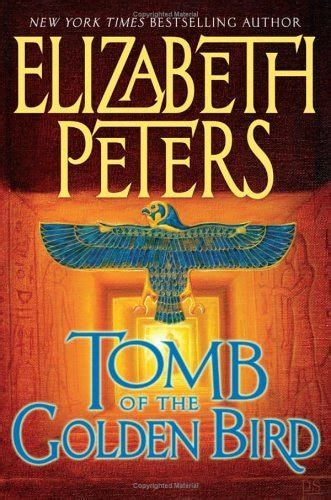
This was pure fun.
The Emersons are a family of British Egyptologists. Emerson, “Father of Curses,” the paterfamilias, is married to Amelia Peabody, whom he calls “Peabody.” This hot couple began their Egyptian adventures back in the Victorian era, but now it is 1922. Their grown son, nicknamed Ramses, is married and has children, and the Emersons have a large, motley household of employees, longtime family friends, relatives, and adoptees, both Egyptian and British. They have returned to Luxor, Egypt, for yet another season of digging. Of course, there are going to be capers, skullduggery, and so forth, and all the Emersons will be involved up to their elbows. Will they be deceived by Emerson’s half-brother Sethos? Will they foil an international plot? Most importantly, will they ever get a peek into the intact tomb that was discovered–technically, by Emerson–and is now being opened by the odious Carter?
This series is exquisitely researched. About 60% of the story is told in the first person by Amelia Peabody, in near-perfect late Victorian/Edwardian language. Scattered everywhere are gems like this one:
… I identified several other [party] guests as journalists. I can always spot them by the bulges in their coat pockets which indicate the presence of notebooks, and by their predatory looks. Messieurs Bradstreet of the New York Times and Bancroft of the Daily Mail were known to me personally (through no fault of mine).
p. 241
The other 40% of the story is told in third person from the point of view of Ramses, who is a quieter character than his colorful parents, but it also includes gems:
He had thought of several innocent explanations for David’s behavior, including the one he had given. It was understandable that [David] might feel the need to be alone; the family en masse or individually could be wearing.
p. 254
I originally came to this series hoping for ancient Egyptian mystical mysteries. It’s not that. It’s more of a romp. Much of this book felt like following the Keystone Cops, but eventually there did turn out to be some twists that gave the whole plot shape and direction. Four out of five stars.

Matchingmaking for Psychopaths, by Tasha Coryell
I picked this up off the New Books shelf at the library. Perhaps I should have left it there, based on the title, but I had read the first few pages and found them engaging. Alas, I returned the book without finishing it. I would have liked there to be at least one main character who I was sure wasn’t a psychopath. A little psychopathology goes a long way.
When I returned the book, the librarian giggled and said, “Oh, that one was silly.” It was indeed silly. But silly and serial murder don’t mix well. At least not for me.

… but there is an infinity sign in the clouds.
I’m not sure what happened, but for some reason, on Tuesday this week Out of Babel Books got more than 400 views. That is about 3000% more than my usual 14. Most of these views were from the United States.
I don’t know whether to thank you all for visiting, or grumble that you’re going to wreck my stats. (No matter how good of a day I have after this, it will look like views are down dramatically.)
I think I’ll go with Thank You. I am so glad you visited Out of Babel. I hope you found what you were looking for. I hope you were all peoples and not botses. I hope you will all buy my books and leave breathless reviews… (O.K., no need to get greedy …)
Cheers! Have a great weekend!
I have eater’s block.
Sometimes, you get into a discussion in a comments section that clearly is beyond the scope of the comments section, both because a) it requires really long comments, b) with footnotes, and c) your interlocutor is not actually going to be convinced. In other words, this discussion ought to be a persuasive essay instead.
When you have a theology blog, this is nothing but good news.
I recently got into such a discussion.
The context: Doug Wilson’s interview with Ross Douthat. Douthat asks Wilson whether, in his ideal Christian Republic 500 years from now, every sin would be against the law. Wilson makes the helpful distinction between sins and crimes. Not every sin should be against the law, he says. Failure to understand this concept got the Puritans into trouble, but we have learned a lot since then. Wilson then goes on to mention the well-known classification of “three types of law” found in the Old Testament: the moral law (universal, binding on all individuals before God), the civil law (what was legal and illegal in the kingdom of Israel, and with what civil penalties), and the ceremonial law (regulations having to do with the Temple, the sacrificial system, and various purity laws such as food laws). If you have been around Christian circles, particularly Reformed circles, you will have heard this distinction. (Edit: I’m now not sure whether Wilson brought up the three categories of law in the video, or whether it came up in the comments as we discussed the distinction he was making between sin and crime.)
Now we come to the commenter who kindly gave me a prompt for this essay. I don’t even know whether this person is man or a woman, but I’m going to call him Rufus.
Rufus says,
The problem is that the distinction [between sin and crime] is always arbitrary, and tends to align with the cultural norms of a particular period of time (e.g. USA in the 1950s).
The inconvenient fact is that moral/civil/ceremonial law distinctions are not in the text, either explicitly or implicitly based on the arrangement (e.g. if you read straight through Leviticus and Deuteronomy, you will find yourself constantly flipping between categories, sometimes verse to verse, without any indication you should be doing so.)
What you are doing is looking at the text vs. normative Christian practice and trying to figure out a system that explains why we follow some of the commandments and not others. Then once you have devised the system, you apply it to the text and say that’s why we follow these and not those. This is a circular argument. The fact you can’t explain satisfactorily how Matthew 5:18 – 20 fits with normative Christian practice is why the Hebrew Roots movement exists. Their position is wrong, but it’s totally reasonable given the premises they’re starting with.
Thanks for the prompt, Rufus. This will give us a lot to chew on.
First, let me clear up just a few simple misunderstandings that Rufus can hardly be blamed for.
Rufus mentions, or implies, that Wilson is just taking a sentimental look back at 1950s America and assuming that, if he can get his Christian republic to look like that, he will have applied the law of God in a culturally appropriate way. Now, it happens that Wilson, in this interview and elsewhere, does mention 50s & 60s America as a place he remembers fondly. He usually brings it up in order to make the point that sodomy was banned back then, and yet America did not resemble the Handmaid’s Tale, which must mean laws against sodomy don’t necessarily produce that kind of society.
However, if Rufus knew Wilson a little better, he would know that Wilson does not look back at the 1950s with a sentimental and uncritical eye. In fact, Wilson has compared the position of the U.S. in the 1950s to that of someone who has just fallen out of an airplane, but is still only a yard below it. Now, we are approaching the ground, but going back to one yard below the plane, if we could do such a thing, would not help in the long run.
If Rufus knew the neoReformed world from within Wilson is writing even better, he would know that, when we do romanticize historical eras, it ain’t the 1950s we usually choose. It’s more likely to be Jane Austen’s England, or Knox’s Scotland, or Jonathan Edwards’s Puritan New England. This shows that Rufus does not really know who he is talking to. He can hardly be blamed for this, on the Internet, but if he wants to attain a “touche” moment, he needs to find out the actual position of his interlocutor, not talk to somebody he has in his mind (maybe a Southern Baptist?).
Then Rufus says to me (or perhaps it’s a general “you”), “What you are doing is looking at the text vs. normative Christian practice and trying to figure out a system that explains why we follow some of the commandments and not others. Then once you have devised the system, you apply it to the text and say that’s why we follow these and not those. This is a circular argument.”
Why yes, it would be a circular argument, if that were something I was doing. And perhaps there are some people who do that, and these are the people Rufus had in mind as the intended audience for his comment. However, I am not those people. I am a person who lived overseas, trying to get a Bible translation movement started in jungle area that boasted a lot of paganism still, a strong Muslim presence as well, and heavy influence from Christian norms that were not American Christian norms. Both before and after living there, I took anthropology and missiology classes where almost all we did was discuss how the Bible can and should be applied in different cultural contexts. I’ve prayed with native people who use their language’s name for the Creator (Mohotara), and it was glorious. I’ve attended a traditional dance ceremony that had been adapted for Christian purposes to give thanks for something. I’ve listened to people discuss whether Christians can keep in their homes heirlooms that were once used for pagan purposes, and what happens when a Muslim man with multiple wives converts to Christianity.
So no, Rufus, if I was the intended audience for your comment, you have me wrong. I was not just taking a received American Christian practice and backfilling it to make it look biblical. But there is no way you could be expected to know this. After all, I don’t even know whether you are a man or a woman.
O.K., so my claim is that people who talk about the three categories of the Law are not just arguing in a circle, or justifying sentimentality or lazy thinking. What is our biblical argument, then? Let’s address Rufus’s exegetical objections.
First, let me say that Rufus is technically right in his comments about Leviticus and Deuteronomy:
The inconvenient fact is that moral/civil/ceremonial law distinctions are not in the text, either explicitly or implicitly based on the arrangement (e.g. if you read straight through Leviticus and Deuteronomy, you will find yourself constantly flipping between categories, sometimes verse to verse, without any indication you should be doing so.)
Rufus 100% is correct that nowhere in the Law are there headings that say “Moral Law,” “Civil Law,” or “Ceremonial Law.” He is also correct that all these three types of commands tend to be mixed together, and sometimes it’s hard to tell which one a given commandment is. In this essay, I will argue that his correctness about the distinctions being “not in the text” only holds if you confine yourself to the texts of the actual commands, ignore the narrative parts, ignore the New Testament, and play dumb.
First, let’s acknowledge that the Books of the Law (Exodus, Leviticus, Numbers, and Deuteronomy) strike the modern person as disorganized. These books toggle back and forth between law and narrative. They give the Ten Commandments, and then a bunch of differing elaborations on them in different places, organized in different ways depending upon the book, the passage, and what is foregrounded after the narrative that just took place. Sometimes, Israel acts up, God says He’s going to reject them, Moses talks Him around, and then all the commands are repeated as they are reiterated. In Numbers, new applications and case law are given as new situations arise (for example, how inheritance should work if a man has only daughters). Some of the annual ceremonies (not to mention the daily ceremonies) work differently when the people of Israel were dwelling in tents with the Tabernacle right there, versus when they were living on their homesteads throughout the land, days, or weeks’ journey from the Tabernacle and later the Temple. So, no, the laws are not organized and laid out conveniently, the way modern people would like a code of laws to be. In some ways, they are more like a tribal history, which is how laws often worked back then.
In fact, I’ll do you one better. The narrative accounts from the times of the patriarchs and Exodus are also mysterious and confusing. All this was so long ago, and so little is known about the context, that it can be difficult to re-construct, for example, Israel’s exact route out of Egypt, despite the many, now obsolete, place-names given. So yes, this is an ancient, ancient document, not a simple user’s manual.
But the distinction between ceremonial, civil, and moral law is far from the only distinction that was not present in the ancient mind, and emerged over time with progressive revelation. Another great example of this would be the doctrine of the Trinity. In the Old Testament, we often see the LORD appearing as a man. Sometimes “the Angel of the LORD” does the same thing, and very occasionally, such as in Genesis 18, we see them together. (See Michael Heiser and his discussion of “two powers in heaven” in his book The Unseen Realm.) We also see “the spirit of the LORD” coming upon people in the Old Testament. The result was usually that they prophesied, or had a kind of battle madness come upon them. Thousands of years later, in the New Testament, we see Jesus say that He is God’s Son, and that “I and the Father are one.” We see the Spirit come down upon Jesus in the form of a dove. In John 15 and 16, Jesus talks openly about both the Father and the Spirit. Finally, in Matthew 28, we get “Baptize them in the name of the Father and of the Son and of the Holy Spirit.” You could not get trinitarian doctrine out of just Leviticus and Deuteronomy, but if you take the whole Bible as inspired, you can’t avoid it.
C.S. Lewis has said somewhere, I think in The Abolition of Man, that the ancient mind did not make a distinction between spiritual and physical. When ancient people saw a king’s throne, for example, they reacted to it as a totality. The physical throne and the concept of majesty and authority were one thing. As time has gone by, and humanity has made a sharper and sharper distinction between physical and spiritual, we can readily infer when the ancients were talking about one, the other, or both.
In the same way, once we have been given the “three categories of law” as a tool to help us in reading Leviticus, it’s usually pretty easy to tell which kind we are looking at. Civil laws usually come with some kind of civil penalty, anything from remuneration to death. Moral laws are usually just commands: “If you see the donkey of one who hates you falling down under its load, do not leave it there; be sure to help him with it.” (Ex. 23:5) Ceremonial laws are often prescriptions of how to handle ceremonial objects and what sacrifices to offer; the subclass of ceremonial laws called purity laws usually come with some kind of purification ritual if someone becomes “unclean.” All this may not be explicit, but neither is it arbitrary.
Now, we acknowledge that these categories are not completely watertight in the context of ancient Israel. Some offenses are both civil and ceremonial, and these often call for death. Examples would be a wide range of sexual offenses that not only wrong the victim, but also defile the nation and dishonor God. Some offenses are just ceremonial but not civil or moral: touching a dead body. Some are both moral and civil (false testimony in court), where others are just moral (envy, gossip). Having said all this, you can usually tell the category(-ies) of the offense by using common sense.
Finally, I’d like to call Rufus’s attention to the fact that the New Testament exists. The question of the difference between a sin and a crime, and of what parts of the Old Testament Law were binding on non-Jewish believers, occupies large swathes of the New Testament. I mean large swathes. This is discussed at length.
The entire book of Hebrews establishes that the ceremonial law was a preparation for Christ, was fulfilled by Christ, and now is no longer necessary. Hebrews was written not too long before the destruction of the Temple in 70 A.D. It warns repeatedly that the whole sacrificial system is “passing away.” Galatians discusses at length whether circumcision, a purity ordinance designed to differentiate Israel from other peoples, is necessary for a Christian to practice (answer: No). Large chunks of Acts are devoted to early believers trying to figure out which parts of the Law are binding on Gentile converts to Christianity. God Himself reveals to Peter that the food laws no longer apply. This gives us a pretty good case that the ceremonial laws associated with temple system, and the purity laws associated with separateness, are their own category.
But there were some prohibitions that were moral, civil, and ceremonial offenses in old Israel, which now are just moral offenses. Fornication, adultery, and sex with temple prostitutes are prime examples. These things were legal in the Roman empire. They are not ceremonial offenses for Gentiles who are no longer under the ceremonial law. But Paul is at some pains to point out in his letters that they are still moral offenses against God. (“Then they should not be illegal in a Christian republic!” Whether they should be civil offenses, they were not in the Roman empire. This shows there is a distinction between moral law and a civil law.)
There is also a fair amount of discussion in the New Testament as to what should be the Christian’s relationship to the civil magistrate — the legal system of the country they live in. In Luke 3:14, when Roman soldiers ask John what they should do to demonstrate repentance, he doesn’t tell them to quit working for Empire, but he tells them not to be corrupt and oppressive. Paul says that Christians should be known as law-abiding (Romans 13:4). He seems to feel that the civil magistrate has actual real authority to enforce civil laws, but that he should not get involved in disputes within the church (I Cor. 6). Similarly, Jesus tells us that paying taxes to pay for law enforcement and national defense should not burden our conscience (Matthew 22:15ff). If someone who has legal authority over others becomes a Christian, Paul (Philemon 1 – 25) and Jesus (Matt. 24:48) say that they should use their authority to do good. Jesus also says that we should use our wealth to do good (Luke 16:9). The general picture is of two different spheres of authority, which overlap in commonsense ways. A Christian may have to engage in civil disobedience if ordered to bow down to the golden statue, but he is not culpable merely by virtue of participating in the system in which he finds himself, and should be law-abiding except in extraordinary circumstances. A Christian who finds himself with some civil power should use that power like a Christian: don’t be corrupt (the prohibition on taking bribes goes all the way back to Exodus), and try to use your influence to do as much good as possible. Long-term, this was going to lead to things like the abolition of sex slavery, then polygamy and wife-beating, and then slavery in general. But the early church could not dream of such influence.
In sum, the New Testament has a lot to tell us about ceremonial, moral, and civil law, but it is not neatly organized. It is in the form of letters and narrative history.
So now we can address Rufus’s claim that “you can’t explain satisfactorily how Matthew 5:18 – 20 fits with normative Christian practice.”
I tell you the truth, until heaven and earth disappear, not the smallest letter, not the least stroke of a pen, will by any means disappear from the Law until everything is accomplished. Anyone who breaks one of these commandments and teaches others to do the same will be called least in the kingdom of heaven, but whoever practices and teaches these commands will be called great in the kingdom of heaven.
You are right, Rufus, but again, you are only right if we squint and play dumb. I can certainly explain it if you back up and include Matthew 5:17:
Do not think that I have come to abolish the Law or the Prophets; I have not come to abolish them but to fulfill them.
Jesus fulfills the Law and the Prophets. How does He do it? By being the last High Priest we’ll ever need (Hebrews 7), the last sacrificial lamb we’ll ever need (John 1:29), the true temple (John 2:19 – 22), the true Ark (I Peter 3:20 – 21), the one for whom the prophets searched intently (I Peter 1:10 – 12), the second Adam (Romans 5:12 – 21), and so on. When His ongoing work is done, then “everything will be accomplished.” At the moment, He has accomplished a lot of it, including making the ceremonial law obsolete. At the time He was speaking in Matthew 5, He had not yet accomplished a lot of this, so the ceremonial Law was still in full force. For a little while.
Jesus did take major issue with how the Law was being applied (all out of emphasis, and contrary to its own spirit). He had been so outspoken about this that some people got the impression He was throwing out the whole thing, and they didn’t know whether to be excited or terrified. In Matthew 5:17 – 22, Jesus hastens to clarify that He is still on the side of the Lawgiver. He wanted us to know that, although large parts of the Law were shortly going to be “accomplished,” they were never going to become wrong. That book is closed, you might say, but it is not burned. It will never be the case that God was wrong to give the Law He gave to the ancient Israelites. It will never be the case that that Law was not good. We cannot accuse God of giving an imperfect Law, which I think is the main point of this passage.
O.K., that’s it. Rufus, if you’re out there, you say that you have looked into these issues deeply, “for decades.” I don’t know what your experience has been. Clearly, it has differed from mine. I hope we can stop talking past each other.
This review was originally posted, in a slightly different form, on Goodreads in June 2025.


This book is a capable history of New Thought in the Christian church, particularly in America. The author first sketches how she grew up around a lot of New Thought and mistook it for Christianity. Then, she sketches how after she realized many of these beliefs were wrong, for some years she was calling them New Age because that’s what everyone else called them. She discusses how she learned of the term New Thought and how it differs from the New Age.
Both belief systems partake of Gnostic/Hermetic cosmology and theory of human nature. However, New Age embraces neopaganism and the occult, whereas New Thought instead tries to cast these Hermetic ideas in “Christianese” and read them back into the New Testament. This is made easier because many New Testament writers were talking directly back to Gnostics, and even re-purposing their terms.
Melissa unpacks the Gnostic/Hermetic assumptions behind such common “Christian” practices as the Prosperity Gospel, visualization, affirmations, “I am” statements, and the like. But instead of just dismissing these practices as “ppf, that’s pagan,” she actually shows where they originated and how they differ from orthodox Christianity.
This book does not dive deeply into the pagan side of Gnosticism and Hermeticism. It doesn’t discuss these philosophies’ relationship to Western mysticism, Eastern mysticism, Kabbalism, or German philosophers like Hegel. It doesn’t discuss the attempts in the early centuries after Christianity to integrate Gnosticism with Christianity. The history of these philosophies is a huge topic that could take up a lifetime of study.
Melissa’s book is not meant to be an intimidating doorstop of a book that covers all of this. She’s zooming in on one little twig on this big, ugly tree: New Thought and its influence on American Christianity. Her book gives well-meaning Christians the tools and vocabulary to recognize this kind of thought and to talk about it. I have bought copies to give to all the women in my family. New Thought can be difficult to talk about because it portrays itself as “what Jesus actually taught.” If you know someone who is into New Thought, you cannot just dismiss it as “No, that’s Gnostic.” Even though you are right, to them it will sound like you’re just brushing them off. This book might be useful in such a situation.
If you want to find out how Hermeticism gave birth to Marxism through Hegel and Marx, there is a fantastic series of lectures about it on YouTube by James Lindsay. I also recommend Melissa’s YouTube channel and the YouTube channel Cultish.
 Out of Babel Books